• Mohsin RS F8
    canva post 7
    Roll no 13
    Opportunities are usually disguised as hard work, so most people don’t recognize them." — Ann Landers

    This powerful quote by Ann Landers teaches us an important lesson about success and personal growth. Many people dream of finding the perfect opportunity that will instantly change their lives. They imagine opportunities as something exciting, easy, or unexpected. However, in reality, opportunities rarely appear in such a form. More often, they come disguised as difficult tasks, long hours, constant learning, and perseverance. Because hard work demands patience and commitment, many people fail to recognize that what they see as a burden may actually be the very opportunity they have been waiting for.

    Throughout history, successful individuals have achieved greatness not because they were lucky, but because they embraced hard work when others avoided it. A student who spends extra hours studying, an athlete who trains every day, an entrepreneur who works tirelessly to build a business, or an artist who keeps practicing despite failures—all of them are investing in opportunities hidden within their efforts. While others may see only challenges and sacrifices, these individuals understand that every small step contributes to something bigger.

    Hard work often tests our patience. There are times when results do not come immediately, and it may feel as though our efforts are going unnoticed. During such moments, many people give up because they expect quick rewards. Yet, true opportunities reveal themselves over time. Skills improve gradually, trust is earned through consistency, and success is built one day at a time. What seems like ordinary effort today may become an extraordinary achievement tomorrow.

    Consider some of the world's greatest inventors, scientists, athletes, and leaders. Their stories are filled with setbacks, failures, and years of dedication. They did not wait for opportunities to knock on their doors; instead, they created opportunities through persistence and determination. Their willingness to work hard allowed them to discover possibilities that others overlooked.

    This quote also reminds us that our

    Mohsin RS F8 🎓✨ canva post 7 Roll no 13 Opportunities are usually disguised as hard work, so most people don’t recognize them." — Ann Landers This powerful quote by Ann Landers teaches us an important lesson about success and personal growth. Many people dream of finding the perfect opportunity that will instantly change their lives. They imagine opportunities as something exciting, easy, or unexpected. However, in reality, opportunities rarely appear in such a form. More often, they come disguised as difficult tasks, long hours, constant learning, and perseverance. Because hard work demands patience and commitment, many people fail to recognize that what they see as a burden may actually be the very opportunity they have been waiting for. Throughout history, successful individuals have achieved greatness not because they were lucky, but because they embraced hard work when others avoided it. A student who spends extra hours studying, an athlete who trains every day, an entrepreneur who works tirelessly to build a business, or an artist who keeps practicing despite failures—all of them are investing in opportunities hidden within their efforts. While others may see only challenges and sacrifices, these individuals understand that every small step contributes to something bigger. Hard work often tests our patience. There are times when results do not come immediately, and it may feel as though our efforts are going unnoticed. During such moments, many people give up because they expect quick rewards. Yet, true opportunities reveal themselves over time. Skills improve gradually, trust is earned through consistency, and success is built one day at a time. What seems like ordinary effort today may become an extraordinary achievement tomorrow. Consider some of the world's greatest inventors, scientists, athletes, and leaders. Their stories are filled with setbacks, failures, and years of dedication. They did not wait for opportunities to knock on their doors; instead, they created opportunities through persistence and determination. Their willingness to work hard allowed them to discover possibilities that others overlooked. This quote also reminds us that our
    0 Commentarii 0 Distribuiri 1136 Views

  • RSIF8
    Roll no:100
    Task no:12
    Task topic:The Clever Plan of Mulla Nasrudin
    The sun began to dip below the mud-brick buildings of Aksehir, casting a warm, golden glow on the cobblestone street. The marketplace buzzed, but a small crowd had gathered around Mulla Nasrudin and his latest presentation.
    On a weathered wooden easel sat a board with a curious message: "Mulla Nasrudin’s Clever Plans & Life Tricks," complete with a drawing of a donkey reading a book. Nearby, his faithful donkey watched patiently, a small bag of grains hanging from its halter.
    Nasrudin, a jolly figure in a colorful turban and multi-patched vest, sat cross-legged on a small rug, his hands animated as he spoke. He pointed with an open, inviting gesture, a knowing smile playing on his lips. Before him were scattered complex wooden interlocking puzzles and a couple of carved wooden boxes.
    Facing him on the ground was a man in a green turban, leaning forward, laughing heartily and nodding in amusement. Other villagers clustered around, their faces a mix of smiles, curiosity, and knowing grins. To the left, a woman in a long blue robe chuckled softly, her hands gently clasped, alongside other onlookers.
    "It’s not just a puzzle, friends!" Nasrudin’s voice rang out, full of mirth. "It’s a metaphor for life's challenges. You think you've found the simplest path," he gestured to a particularly complex puzzle, "and then suddenly, everything shifts! It's about finding the *clever* way, the twist you didn't see coming."
    A ripple of laughter went through the crowd. Nasrudin continued, picking up a wooden cube, "The same applies to making plans. Like the donkey and the book," he chuckled, glancing at the sign, "true learning might require a whole new perspective!" He winked, his eyes sparkling with a familiar trickery and gentle wisdom. The crowd beamed back, captivated by his lighthearted approach to life’s knotty problems. #MullaNasrudin #WiseFool #LifeTricks #GoldenHourMarket
    RSIF8 Roll no:100 Task no:12 Task topic:The Clever Plan of Mulla Nasrudin The sun began to dip below the mud-brick buildings of Aksehir, casting a warm, golden glow on the cobblestone street. The marketplace buzzed, but a small crowd had gathered around Mulla Nasrudin and his latest presentation. On a weathered wooden easel sat a board with a curious message: "Mulla Nasrudin’s Clever Plans & Life Tricks," complete with a drawing of a donkey reading a book. Nearby, his faithful donkey watched patiently, a small bag of grains hanging from its halter. Nasrudin, a jolly figure in a colorful turban and multi-patched vest, sat cross-legged on a small rug, his hands animated as he spoke. He pointed with an open, inviting gesture, a knowing smile playing on his lips. Before him were scattered complex wooden interlocking puzzles and a couple of carved wooden boxes. Facing him on the ground was a man in a green turban, leaning forward, laughing heartily and nodding in amusement. Other villagers clustered around, their faces a mix of smiles, curiosity, and knowing grins. To the left, a woman in a long blue robe chuckled softly, her hands gently clasped, alongside other onlookers. "It’s not just a puzzle, friends!" Nasrudin’s voice rang out, full of mirth. "It’s a metaphor for life's challenges. You think you've found the simplest path," he gestured to a particularly complex puzzle, "and then suddenly, everything shifts! It's about finding the *clever* way, the twist you didn't see coming." A ripple of laughter went through the crowd. Nasrudin continued, picking up a wooden cube, "The same applies to making plans. Like the donkey and the book," he chuckled, glancing at the sign, "true learning might require a whole new perspective!" He winked, his eyes sparkling with a familiar trickery and gentle wisdom. The crowd beamed back, captivated by his lighthearted approach to life’s knotty problems. #MullaNasrudin #WiseFool #LifeTricks #GoldenHourMarket ☀️😂🧩🐴✨
    0 Commentarii 0 Distribuiri 1847 Views
  • RSIF8
    Roll no:100
    Task no:8
    Task topic:How to Download and Use CallAnnie?
    **How to Download & Use CallAnnie**
    Want your own AI assistant on the go? Here's how to get started with **CallAnnie**:
    Download **CallAnnie** from the App Store or Google Play.
    Open the app and sign up or log in.
    Grant the necessary permissions (microphone & notifications).
    Start chatting with Annie using voice or text.
    Ask questions, practice languages, brainstorm ideas, or get everyday assistance anytime!
    **Pro Tip:** Use voice mode for a more natural, real-time conversation experience!
    #CallAnnie #AIAssistant #ArtificialIntelligence #VoiceAI #TechTips #Productivity #AIApps #SmartTechnology #DigitalLife #Innovation
    RSIF8 Roll no:100 Task no:8 Task topic:How to Download and Use CallAnnie? 📲🤖 **How to Download & Use CallAnnie** Want your own AI assistant on the go? 🌟 Here's how to get started with **CallAnnie**: 1️⃣ Download **CallAnnie** from the App Store or Google Play. 📥 2️⃣ Open the app and sign up or log in. 🔐 3️⃣ Grant the necessary permissions (microphone & notifications). 🎤 4️⃣ Start chatting with Annie using voice or text. 💬🎙️ 5️⃣ Ask questions, practice languages, brainstorm ideas, or get everyday assistance anytime! 🚀✨ 💡 **Pro Tip:** Use voice mode for a more natural, real-time conversation experience! #CallAnnie #AIAssistant #ArtificialIntelligence #VoiceAI #TechTips #Productivity #AIApps #SmartTechnology #DigitalLife #Innovation 🚀
    0 Commentarii 0 Distribuiri 2133 Views

  • #rsisb
    Roll no.239
    Maya no.19
    Foundation Level

    **“Conscious – Tracing the Evolution of Awareness”** explores one of the greatest mysteries of science and philosophy: **how awareness and conscious experience developed in living beings**. Consciousness allows us to experience the world, think, remember, feel emotions, make decisions, and recognize ourselves.

    The topic takes us back to the earliest forms of life and asks how simple organisms developed increasingly complex ways of sensing and responding to their surroundings. As nervous systems and brains became more sophisticated, organisms gained greater abilities to process information, learn from experiences, remember events, and respond flexibly to their environments.

    One of the most fascinating questions is whether consciousness appeared suddenly or **evolved gradually over millions of years**. Scientists study the brains and behaviors of humans and other animals to understand possible forms of awareness. However, consciousness remains difficult to explain because subjective experiences—such as seeing colors, feeling pain, or experiencing emotions—are personal and cannot be directly observed by others.

    The discussion also introduces **self-awareness**, which is the ability to recognize oneself and reflect on one's own thoughts and experiences. Human consciousness is closely connected with language, memory, attention, imagination, creativity, and decision-making.

    Another important part of the topic is the relationship between **conscious and unconscious processes**. Many things our brains do happen automatically, without our full awareness. This shows that the human mind is far more complex than conscious thought alone.

    Overall, this 25-minute exploration encourages us to think deeply about **who we are, how awareness developed, and what it means to be conscious**. It connects biology, neuroscience, psychology, evolution, and philosophy while reminding us that many questions about consciousness are still unanswered.

    **Key Message:** Understanding consciousness may help us better understand not only the human brain, but also the evolution of life, intelligence, identity, and our place in the universe.
    ### **Hashtags**

    #Consciousness #Awareness #Evolution #HumanMind #BrainScience #Neuroscience #SelfAwareness #Psychology #Science #Philosophy #HumanEvolution #Learning #Curiosity #Knowledge #MindAndBrain
    #rsisb Roll no.239 Maya no.19 Foundation Level **“Conscious – Tracing the Evolution of Awareness”** explores one of the greatest mysteries of science and philosophy: **how awareness and conscious experience developed in living beings**. Consciousness allows us to experience the world, think, remember, feel emotions, make decisions, and recognize ourselves. The topic takes us back to the earliest forms of life and asks how simple organisms developed increasingly complex ways of sensing and responding to their surroundings. As nervous systems and brains became more sophisticated, organisms gained greater abilities to process information, learn from experiences, remember events, and respond flexibly to their environments. One of the most fascinating questions is whether consciousness appeared suddenly or **evolved gradually over millions of years**. Scientists study the brains and behaviors of humans and other animals to understand possible forms of awareness. However, consciousness remains difficult to explain because subjective experiences—such as seeing colors, feeling pain, or experiencing emotions—are personal and cannot be directly observed by others. The discussion also introduces **self-awareness**, which is the ability to recognize oneself and reflect on one's own thoughts and experiences. Human consciousness is closely connected with language, memory, attention, imagination, creativity, and decision-making. Another important part of the topic is the relationship between **conscious and unconscious processes**. Many things our brains do happen automatically, without our full awareness. This shows that the human mind is far more complex than conscious thought alone. Overall, this 25-minute exploration encourages us to think deeply about **who we are, how awareness developed, and what it means to be conscious**. It connects biology, neuroscience, psychology, evolution, and philosophy while reminding us that many questions about consciousness are still unanswered. 🌟 **Key Message:** Understanding consciousness may help us better understand not only the human brain, but also the evolution of life, intelligence, identity, and our place in the universe. ### **Hashtags** #Consciousness #Awareness #Evolution #HumanMind #BrainScience #Neuroscience #SelfAwareness #Psychology #Science #Philosophy #HumanEvolution #Learning #Curiosity #Knowledge #MindAndBrain 🧠🔬✨
    0 Commentarii 0 Distribuiri 4053 Views 6

  • #rsisb
    Roll no.239
    Maya no.19
    Foundation Level

    **“Conscious – Tracing the Evolution of Awareness”** explores one of the greatest mysteries of science and philosophy: **how awareness and conscious experience developed in living beings**. Consciousness allows us to experience the world, think, remember, feel emotions, make decisions, and recognize ourselves.

    The topic takes us back to the earliest forms of life and asks how simple organisms developed increasingly complex ways of sensing and responding to their surroundings. As nervous systems and brains became more sophisticated, organisms gained greater abilities to process information, learn from experiences, remember events, and respond flexibly to their environments.

    One of the most fascinating questions is whether consciousness appeared suddenly or **evolved gradually over millions of years**. Scientists study the brains and behaviors of humans and other animals to understand possible forms of awareness. However, consciousness remains difficult to explain because subjective experiences—such as seeing colors, feeling pain, or experiencing emotions—are personal and cannot be directly observed by others.

    The discussion also introduces **self-awareness**, which is the ability to recognize oneself and reflect on one's own thoughts and experiences. Human consciousness is closely connected with language, memory, attention, imagination, creativity, and decision-making.

    Another important part of the topic is the relationship between **conscious and unconscious processes**. Many things our brains do happen automatically, without our full awareness. This shows that the human mind is far more complex than conscious thought alone.

    Overall, this 25-minute exploration encourages us to think deeply about **who we are, how awareness developed, and what it means to be conscious**. It connects biology, neuroscience, psychology, evolution, and philosophy while reminding us that many questions about consciousness are still unanswered.

    **Key Message:** Understanding consciousness may help us better understand not only the human brain, but also the evolution of life, intelligence, identity, and our place in the universe.

    ### **Hashtags**

    #Consciousness #Awareness #Evolution #HumanMind #BrainScience #Neuroscience #SelfAwareness #Psychology #Science #Philosophy #HumanEvolution #Learning #Curiosity #Knowledge #MindAndBrain


    **“Conscious – Tracing the Evolution of Awareness”** explores one of the greatest mysteries of science and philosophy: **how awareness and conscious experience developed in living beings**. Consciousness allows us to experience the world, think, remember, feel emotions, make decisions, and recognize ourselves.

    The topic takes us back to the earliest forms of life and asks how simple organisms developed increasingly complex ways of sensing and responding to their surroundings. As nervous systems and brains became more sophisticated, organisms gained greater abilities to process information, learn from experiences, remember events, and respond flexibly to their environments.

    One of the most fascinating questions is whether consciousness appeared suddenly or **evolved gradually over millions of years**. Scientists study the brains and behaviors of humans and other animals to understand possible forms of awareness. However, consciousness remains difficult to explain because subjective experiences—such as seeing colors, feeling pain, or experiencing emotions—are personal and cannot be directly observed by others.

    The discussion also introduces **self-awareness**, which is the ability to recognize oneself and reflect on one's own thoughts and experiences. Human consciousness is closely connected with language, memory, attention, imagination, creativity, and decision-making.

    Another important part of the topic is the relationship between **conscious and unconscious processes**. Many things our brains do happen automatically, without our full awareness. This shows that the human mind is far more complex than conscious thought alone.

    Overall, this 25-minute exploration encourages us to think deeply about **who we are, how awareness developed, and what it means to be conscious**. It connects biology, neuroscience, psychology, evolution, and philosophy while reminding us that many questions about consciousness are still unanswered.

    **Key Message:** Understanding consciousness may help us better understand not only the human brain, but also the evolution of life, intelligence, identity, and our place in the universe.

    ### **Hashtags**

    #Consciousness #Awareness #Evolution #HumanMind #BrainScience #Neuroscience #SelfAwareness #Psychology #Science #Philosophy #HumanEvolution #Learning #Curiosity #Knowledge #MindAndBrain
    #rsisb Roll no.239 Maya no.19 Foundation Level **“Conscious – Tracing the Evolution of Awareness”** explores one of the greatest mysteries of science and philosophy: **how awareness and conscious experience developed in living beings**. Consciousness allows us to experience the world, think, remember, feel emotions, make decisions, and recognize ourselves. The topic takes us back to the earliest forms of life and asks how simple organisms developed increasingly complex ways of sensing and responding to their surroundings. As nervous systems and brains became more sophisticated, organisms gained greater abilities to process information, learn from experiences, remember events, and respond flexibly to their environments. One of the most fascinating questions is whether consciousness appeared suddenly or **evolved gradually over millions of years**. Scientists study the brains and behaviors of humans and other animals to understand possible forms of awareness. However, consciousness remains difficult to explain because subjective experiences—such as seeing colors, feeling pain, or experiencing emotions—are personal and cannot be directly observed by others. The discussion also introduces **self-awareness**, which is the ability to recognize oneself and reflect on one's own thoughts and experiences. Human consciousness is closely connected with language, memory, attention, imagination, creativity, and decision-making. Another important part of the topic is the relationship between **conscious and unconscious processes**. Many things our brains do happen automatically, without our full awareness. This shows that the human mind is far more complex than conscious thought alone. Overall, this 25-minute exploration encourages us to think deeply about **who we are, how awareness developed, and what it means to be conscious**. It connects biology, neuroscience, psychology, evolution, and philosophy while reminding us that many questions about consciousness are still unanswered. 🌟 **Key Message:** Understanding consciousness may help us better understand not only the human brain, but also the evolution of life, intelligence, identity, and our place in the universe. ### **Hashtags** #Consciousness #Awareness #Evolution #HumanMind #BrainScience #Neuroscience #SelfAwareness #Psychology #Science #Philosophy #HumanEvolution #Learning #Curiosity #Knowledge #MindAndBrain 🧠🔬✨ **“Conscious – Tracing the Evolution of Awareness”** explores one of the greatest mysteries of science and philosophy: **how awareness and conscious experience developed in living beings**. Consciousness allows us to experience the world, think, remember, feel emotions, make decisions, and recognize ourselves. The topic takes us back to the earliest forms of life and asks how simple organisms developed increasingly complex ways of sensing and responding to their surroundings. As nervous systems and brains became more sophisticated, organisms gained greater abilities to process information, learn from experiences, remember events, and respond flexibly to their environments. One of the most fascinating questions is whether consciousness appeared suddenly or **evolved gradually over millions of years**. Scientists study the brains and behaviors of humans and other animals to understand possible forms of awareness. However, consciousness remains difficult to explain because subjective experiences—such as seeing colors, feeling pain, or experiencing emotions—are personal and cannot be directly observed by others. The discussion also introduces **self-awareness**, which is the ability to recognize oneself and reflect on one's own thoughts and experiences. Human consciousness is closely connected with language, memory, attention, imagination, creativity, and decision-making. Another important part of the topic is the relationship between **conscious and unconscious processes**. Many things our brains do happen automatically, without our full awareness. This shows that the human mind is far more complex than conscious thought alone. Overall, this 25-minute exploration encourages us to think deeply about **who we are, how awareness developed, and what it means to be conscious**. It connects biology, neuroscience, psychology, evolution, and philosophy while reminding us that many questions about consciousness are still unanswered. 🌟 **Key Message:** Understanding consciousness may help us better understand not only the human brain, but also the evolution of life, intelligence, identity, and our place in the universe. ### **Hashtags** #Consciousness #Awareness #Evolution #HumanMind #BrainScience #Neuroscience #SelfAwareness #Psychology #Science #Philosophy #HumanEvolution #Learning #Curiosity #Knowledge #MindAndBrain 🧠🔬✨
    0 Commentarii 0 Distribuiri 3840 Views 6

  • #rsisb
    Roll no.239
    Maya no.19
    Foundation Level

    **“Conscious – Tracing the Evolution of Awareness”** explores one of the greatest mysteries of science and philosophy: **how awareness and conscious experience developed in living beings**. Consciousness allows us to experience the world, think, remember, feel emotions, make decisions, and recognize ourselves.

    The topic takes us back to the earliest forms of life and asks how simple organisms developed increasingly complex ways of sensing and responding to their surroundings. As nervous systems and brains became more sophisticated, organisms gained greater abilities to process information, learn from experiences, remember events, and respond flexibly to their environments.

    One of the most fascinating questions is whether consciousness appeared suddenly or **evolved gradually over millions of years**. Scientists study the brains and behaviors of humans and other animals to understand possible forms of awareness. However, consciousness remains difficult to explain because subjective experiences—such as seeing colors, feeling pain, or experiencing emotions—are personal and cannot be directly observed by others.

    The discussion also introduces **self-awareness**, which is the ability to recognize oneself and reflect on one's own thoughts and experiences. Human consciousness is closely connected with language, memory, attention, imagination, creativity, and decision-making.

    Another important part of the topic is the relationship between **conscious and unconscious processes**. Many things our brains do happen automatically, without our full awareness. This shows that the human mind is far more complex than conscious thought alone.

    Overall, this 25-minute exploration encourages us to think deeply about **who we are, how awareness developed, and what it means to be conscious**. It connects biology, neuroscience, psychology, evolution, and philosophy while reminding us that many questions about consciousness are still unanswered.

    **Key Message:** Understanding consciousness may help us better understand not only the human brain, but also the evolution of life, intelligence, identity, and our place in the universe.


    #Consciousness #Awareness #Evolution #HumanMind #BrainScience #Neuroscience #SelfAwareness #Psychology #Science #Philosophy #HumanEvolution #Learning #Curiosity #Knowledge #MindAndBrain


    **“Conscious – Tracing the Evolution of Awareness”** explores one of the greatest mysteries of science and philosophy: **how awareness and conscious experience developed in living beings**. Consciousness allows us to experience the world, think, remember, feel emotions, make decisions, and recognize ourselves.

    The topic takes us back to the earliest forms of life and asks how simple organisms developed increasingly complex ways of sensing and responding to their surroundings. As nervous systems and brains became more sophisticated, organisms gained greater abilities to process information, learn from experiences, remember events, and respond flexibly to their environments.
    One of the most fascinating questions is whether consciousness appeared suddenly or **evolved gradually over millions of years**. Scientists study the brains and behaviors of humans and other animals to understand possible forms of awareness. However, consciousness remains difficult to explain because subjective experiences—such as seeing colors, feeling pain, or experiencing emotions—are personal and cannot be directly observed by others.


    #Consciousness #Awareness #Evolution #HumanMind #BrainScience #Neuroscience #SelfAwareness #Psychology #Science #Philosophy #HumanEvolution #Learning #Curiosity #Knowledge #MindAndBrain
    #rsisb Roll no.239 Maya no.19 Foundation Level **“Conscious – Tracing the Evolution of Awareness”** explores one of the greatest mysteries of science and philosophy: **how awareness and conscious experience developed in living beings**. Consciousness allows us to experience the world, think, remember, feel emotions, make decisions, and recognize ourselves. The topic takes us back to the earliest forms of life and asks how simple organisms developed increasingly complex ways of sensing and responding to their surroundings. As nervous systems and brains became more sophisticated, organisms gained greater abilities to process information, learn from experiences, remember events, and respond flexibly to their environments. One of the most fascinating questions is whether consciousness appeared suddenly or **evolved gradually over millions of years**. Scientists study the brains and behaviors of humans and other animals to understand possible forms of awareness. However, consciousness remains difficult to explain because subjective experiences—such as seeing colors, feeling pain, or experiencing emotions—are personal and cannot be directly observed by others. The discussion also introduces **self-awareness**, which is the ability to recognize oneself and reflect on one's own thoughts and experiences. Human consciousness is closely connected with language, memory, attention, imagination, creativity, and decision-making. Another important part of the topic is the relationship between **conscious and unconscious processes**. Many things our brains do happen automatically, without our full awareness. This shows that the human mind is far more complex than conscious thought alone. Overall, this 25-minute exploration encourages us to think deeply about **who we are, how awareness developed, and what it means to be conscious**. It connects biology, neuroscience, psychology, evolution, and philosophy while reminding us that many questions about consciousness are still unanswered. 🌟 **Key Message:** Understanding consciousness may help us better understand not only the human brain, but also the evolution of life, intelligence, identity, and our place in the universe. #Consciousness #Awareness #Evolution #HumanMind #BrainScience #Neuroscience #SelfAwareness #Psychology #Science #Philosophy #HumanEvolution #Learning #Curiosity #Knowledge #MindAndBrain 🧠🔬✨ **“Conscious – Tracing the Evolution of Awareness”** explores one of the greatest mysteries of science and philosophy: **how awareness and conscious experience developed in living beings**. Consciousness allows us to experience the world, think, remember, feel emotions, make decisions, and recognize ourselves. The topic takes us back to the earliest forms of life and asks how simple organisms developed increasingly complex ways of sensing and responding to their surroundings. As nervous systems and brains became more sophisticated, organisms gained greater abilities to process information, learn from experiences, remember events, and respond flexibly to their environments. One of the most fascinating questions is whether consciousness appeared suddenly or **evolved gradually over millions of years**. Scientists study the brains and behaviors of humans and other animals to understand possible forms of awareness. However, consciousness remains difficult to explain because subjective experiences—such as seeing colors, feeling pain, or experiencing emotions—are personal and cannot be directly observed by others. #Consciousness #Awareness #Evolution #HumanMind #BrainScience #Neuroscience #SelfAwareness #Psychology #Science #Philosophy #HumanEvolution #Learning #Curiosity #Knowledge #MindAndBrain 🧠🔬✨
    0 Commentarii 0 Distribuiri 3722 Views 3

  • #rsisb
    Roll no.239
    Maya no.19
    Foundation Level

    **“Conscious – Tracing the Evolution of Awareness”** explores one of the greatest mysteries of science and philosophy: **how awareness and conscious experience developed in living beings**. Consciousness allows us to experience the world, think, remember, feel emotions, make decisions, and recognize ourselves.

    The topic takes us back to the earliest forms of life and asks how simple organisms developed increasingly complex ways of sensing and responding to their surroundings. As nervous systems and brains became more sophisticated, organisms gained greater abilities to process information, learn from experiences, remember events, and respond flexibly to their environments.

    One of the most fascinating questions is whether consciousness appeared suddenly or **evolved gradually over millions of years**. Scientists study the brains and behaviors of humans and other animals to understand possible forms of awareness. However, consciousness remains difficult to explain because subjective experiences—such as seeing colors, feeling pain, or experiencing emotions—are personal and cannot be directly observed by others.

    The discussion also introduces **self-awareness**, which is the ability to recognize oneself and reflect on one's own thoughts and experiences. Human consciousness is closely connected with language, memory, attention, imagination, creativity, and decision-making.

    Another important part of the topic is the relationship between **conscious and unconscious processes**. Many things our brains do happen automatically, without our full awareness. This shows that the human mind is far more complex than conscious thought alone.

    Overall, this 25-minute exploration encourages us to think deeply about **who we are, how awareness developed, and what it means to be conscious**. It connects biology, neuroscience, psychology, evolution, and philosophy while reminding us that many questions about consciousness are still unanswered.

    **Key Message:** Understanding consciousness may help us better understand not only the human brain, but also the evolution of life, intelligence, identity, and our place in the universe.

    ### **Hashtags**

    #Consciousness #Awareness #Evolution #HumanMind #BrainScience #Neuroscience #SelfAwareness #Psychology #Science #Philosophy #HumanEvolution #Learning #Curiosity #Knowledge #MindAndBrain


    **“Conscious – Tracing the Evolution of Awareness”** explores one of the greatest mysteries of science and philosophy: **how awareness and conscious experience developed in living beings**. Consciousness allows us to experience the world, think, remember, feel emotions, make decisions, and recognize ourselves.

    The topic takes us back to the earliest forms of life and asks how simple organisms developed increasingly complex ways of sensing and responding to their surroundings. As nervous systems and brains became more sophisticated, organisms gained greater abilities to process information, learn from experiences, remember events, and respond flexibly to their environments.

    One of the most fascinating questions is whether consciousness appeared suddenly or **evolved gradually over millions of years**. Scientists study the brains and behaviors of humans and other animals to understand possible forms of awareness. However, consciousness remains difficult to explain because subjective experiences—such as seeing colors, feeling pain, or experiencing emotions—are personal and cannot be directly observed by others.
    ### **Hashtags**

    #Consciousness #Awareness #Evolution #HumanMind #BrainScience #Neuroscience #SelfAwareness #Psychology #Science #Philosophy #HumanEvolution #Learning #Curiosity #Knowledge #MindAndBrain
    #rsisb Roll no.239 Maya no.19 Foundation Level **“Conscious – Tracing the Evolution of Awareness”** explores one of the greatest mysteries of science and philosophy: **how awareness and conscious experience developed in living beings**. Consciousness allows us to experience the world, think, remember, feel emotions, make decisions, and recognize ourselves. The topic takes us back to the earliest forms of life and asks how simple organisms developed increasingly complex ways of sensing and responding to their surroundings. As nervous systems and brains became more sophisticated, organisms gained greater abilities to process information, learn from experiences, remember events, and respond flexibly to their environments. One of the most fascinating questions is whether consciousness appeared suddenly or **evolved gradually over millions of years**. Scientists study the brains and behaviors of humans and other animals to understand possible forms of awareness. However, consciousness remains difficult to explain because subjective experiences—such as seeing colors, feeling pain, or experiencing emotions—are personal and cannot be directly observed by others. The discussion also introduces **self-awareness**, which is the ability to recognize oneself and reflect on one's own thoughts and experiences. Human consciousness is closely connected with language, memory, attention, imagination, creativity, and decision-making. Another important part of the topic is the relationship between **conscious and unconscious processes**. Many things our brains do happen automatically, without our full awareness. This shows that the human mind is far more complex than conscious thought alone. Overall, this 25-minute exploration encourages us to think deeply about **who we are, how awareness developed, and what it means to be conscious**. It connects biology, neuroscience, psychology, evolution, and philosophy while reminding us that many questions about consciousness are still unanswered. 🌟 **Key Message:** Understanding consciousness may help us better understand not only the human brain, but also the evolution of life, intelligence, identity, and our place in the universe. ### **Hashtags** #Consciousness #Awareness #Evolution #HumanMind #BrainScience #Neuroscience #SelfAwareness #Psychology #Science #Philosophy #HumanEvolution #Learning #Curiosity #Knowledge #MindAndBrain 🧠🔬✨ **“Conscious – Tracing the Evolution of Awareness”** explores one of the greatest mysteries of science and philosophy: **how awareness and conscious experience developed in living beings**. Consciousness allows us to experience the world, think, remember, feel emotions, make decisions, and recognize ourselves. The topic takes us back to the earliest forms of life and asks how simple organisms developed increasingly complex ways of sensing and responding to their surroundings. As nervous systems and brains became more sophisticated, organisms gained greater abilities to process information, learn from experiences, remember events, and respond flexibly to their environments. One of the most fascinating questions is whether consciousness appeared suddenly or **evolved gradually over millions of years**. Scientists study the brains and behaviors of humans and other animals to understand possible forms of awareness. However, consciousness remains difficult to explain because subjective experiences—such as seeing colors, feeling pain, or experiencing emotions—are personal and cannot be directly observed by others. ### **Hashtags** #Consciousness #Awareness #Evolution #HumanMind #BrainScience #Neuroscience #SelfAwareness #Psychology #Science #Philosophy #HumanEvolution #Learning #Curiosity #Knowledge #MindAndBrain 🧠🔬✨
    0 Commentarii 0 Distribuiri 3656 Views 5

  • #rsisb
    Roll no.239
    Maya no.19
    Foundation Level

    **“Conscious – Tracing the Evolution of Awareness”** explores one of the greatest mysteries of science and philosophy: **how awareness and conscious experience developed in living beings**. Consciousness allows us to experience the world, think, remember, feel emotions, make decisions, and recognize ourselves.

    The topic takes us back to the earliest forms of life and asks how simple organisms developed increasingly complex ways of sensing and responding to their surroundings. As nervous systems and brains became more sophisticated, organisms gained greater abilities to process information, learn from experiences, remember events, and respond flexibly to their environments.

    One of the most fascinating questions is whether consciousness appeared suddenly or **evolved gradually over millions of years**. Scientists study the brains and behaviors of humans and other animals to understand possible forms of awareness. However, consciousness remains difficult to explain because subjective experiences—such as seeing colors, feeling pain, or experiencing emotions—are personal and cannot be directly observed by others.

    The discussion also introduces **self-awareness**, which is the ability to recognize oneself and reflect on one's own thoughts and experiences. Human consciousness is closely connected with language, memory, attention, imagination, creativity, and decision-making.

    Another important part of the topic is the relationship between **conscious and unconscious processes**. Many things our brains do happen automatically, without our full awareness. This shows that the human mind is far more complex than conscious thought alone.

    Overall, this 25-minute exploration encourages us to think deeply about **who we are, how awareness developed, and what it means to be conscious**. It connects biology, neuroscience, psychology, evolution, and philosophy while reminding us that many questions about consciousness are still unanswered.

    **Key Message:** Understanding consciousness may help us better understand not only the human brain, but also the evolution of life, intelligence, identity, and our place in the universe.

    ### **Hashtags**

    #Consciousness #Awareness #Evolution #HumanMind #BrainScience #Neuroscience #SelfAwareness #Psychology #Science #Philosophy #HumanEvolution #Learning #Curiosity #Knowledge #MindAndBrain


    **“Conscious – Tracing the Evolution of Awareness”** explores one of the greatest mysteries of science and philosophy: **how awareness and conscious experience developed in living beings**. Consciousness allows us to experience the world, think, remember, feel emotions, make decisions, and recognize ourselves.

    The topic takes us back to the earliest forms of life and asks how simple organisms developed increasingly complex ways of sensing and responding to their surroundings. As nervous systems and brains became more sophisticated, organisms gained greater abilities to process information, learn from experiences, remember events, and respond flexibly to their environments.

    One of the most fascinating questions is whether consciousness appeared suddenly or **evolved gradually over millions of years**. Scientists study the brains and behaviors of humans and other animals to understand possible forms of awareness. However, consciousness remains difficult to explain because subjective experiences—such as seeing colors, feeling pain, or experiencing emotions—are personal and cannot be directly observed by others.

    The discussion also introduces **self-awareness**, which is the ability to recognize oneself and reflect on one's own thoughts and experiences. Human consciousness is closely connected with language, memory, attention, imagination, creativity, and decision-making.

    Another important part of the topic is the relationship between **conscious and unconscious processes**. Many things our brains do happen automatically, without our full awareness. This shows that the human mind is far more complex than conscious thought alone.

    Overall, this 25-minute exploration encourages us to think deeply about **who we are, how awareness developed, and what it means to be conscious**. It connects biology, neuroscience, psychology, evolution, and philosophy while reminding us that many questions about consciousness are still unanswered.

    **Key Message:** Understanding consciousness may help us better understand not only the human brain, but also the evolution of life, intelligence, identity, and our place in the universe.

    ### **Hashtags**

    #Consciousness #Awareness #Evolution #HumanMind #BrainScience #Neuroscience #SelfAwareness #Psychology #Science #Philosophy #HumanEvolution #Learning #Curiosity #Knowledge #MindAndBrain
    #rsisb Roll no.239 Maya no.19 Foundation Level **“Conscious – Tracing the Evolution of Awareness”** explores one of the greatest mysteries of science and philosophy: **how awareness and conscious experience developed in living beings**. Consciousness allows us to experience the world, think, remember, feel emotions, make decisions, and recognize ourselves. The topic takes us back to the earliest forms of life and asks how simple organisms developed increasingly complex ways of sensing and responding to their surroundings. As nervous systems and brains became more sophisticated, organisms gained greater abilities to process information, learn from experiences, remember events, and respond flexibly to their environments. One of the most fascinating questions is whether consciousness appeared suddenly or **evolved gradually over millions of years**. Scientists study the brains and behaviors of humans and other animals to understand possible forms of awareness. However, consciousness remains difficult to explain because subjective experiences—such as seeing colors, feeling pain, or experiencing emotions—are personal and cannot be directly observed by others. The discussion also introduces **self-awareness**, which is the ability to recognize oneself and reflect on one's own thoughts and experiences. Human consciousness is closely connected with language, memory, attention, imagination, creativity, and decision-making. Another important part of the topic is the relationship between **conscious and unconscious processes**. Many things our brains do happen automatically, without our full awareness. This shows that the human mind is far more complex than conscious thought alone. Overall, this 25-minute exploration encourages us to think deeply about **who we are, how awareness developed, and what it means to be conscious**. It connects biology, neuroscience, psychology, evolution, and philosophy while reminding us that many questions about consciousness are still unanswered. 🌟 **Key Message:** Understanding consciousness may help us better understand not only the human brain, but also the evolution of life, intelligence, identity, and our place in the universe. ### **Hashtags** #Consciousness #Awareness #Evolution #HumanMind #BrainScience #Neuroscience #SelfAwareness #Psychology #Science #Philosophy #HumanEvolution #Learning #Curiosity #Knowledge #MindAndBrain 🧠🔬✨ **“Conscious – Tracing the Evolution of Awareness”** explores one of the greatest mysteries of science and philosophy: **how awareness and conscious experience developed in living beings**. Consciousness allows us to experience the world, think, remember, feel emotions, make decisions, and recognize ourselves. The topic takes us back to the earliest forms of life and asks how simple organisms developed increasingly complex ways of sensing and responding to their surroundings. As nervous systems and brains became more sophisticated, organisms gained greater abilities to process information, learn from experiences, remember events, and respond flexibly to their environments. One of the most fascinating questions is whether consciousness appeared suddenly or **evolved gradually over millions of years**. Scientists study the brains and behaviors of humans and other animals to understand possible forms of awareness. However, consciousness remains difficult to explain because subjective experiences—such as seeing colors, feeling pain, or experiencing emotions—are personal and cannot be directly observed by others. The discussion also introduces **self-awareness**, which is the ability to recognize oneself and reflect on one's own thoughts and experiences. Human consciousness is closely connected with language, memory, attention, imagination, creativity, and decision-making. Another important part of the topic is the relationship between **conscious and unconscious processes**. Many things our brains do happen automatically, without our full awareness. This shows that the human mind is far more complex than conscious thought alone. Overall, this 25-minute exploration encourages us to think deeply about **who we are, how awareness developed, and what it means to be conscious**. It connects biology, neuroscience, psychology, evolution, and philosophy while reminding us that many questions about consciousness are still unanswered. 🌟 **Key Message:** Understanding consciousness may help us better understand not only the human brain, but also the evolution of life, intelligence, identity, and our place in the universe. ### **Hashtags** #Consciousness #Awareness #Evolution #HumanMind #BrainScience #Neuroscience #SelfAwareness #Psychology #Science #Philosophy #HumanEvolution #Learning #Curiosity #Knowledge #MindAndBrain 🧠🔬✨
    0 Commentarii 0 Distribuiri 3510 Views 7

  • #rsisb
    Roll no.239
    Maya no.19
    Foundation Level

    **“Conscious – Tracing the Evolution of Awareness”** explores one of the greatest mysteries of science and philosophy: **how awareness and conscious experience developed in living beings**. Consciousness allows us to experience the world, think, remember, feel emotions, make decisions, and recognize ourselves.

    The topic takes us back to the earliest forms of life and asks how simple organisms developed increasingly complex ways of sensing and responding to their surroundings. As nervous systems and brains became more sophisticated, organisms gained greater abilities to process information, learn from experiences, remember events, and respond flexibly to their environments.

    One of the most fascinating questions is whether consciousness appeared suddenly or **evolved gradually over millions of years**. Scientists study the brains and behaviors of humans and other animals to understand possible forms of awareness. However, consciousness remains difficult to explain because subjective experiences—such as seeing colors, feeling pain, or experiencing emotions—are personal and cannot be directly observed by others.

    The discussion also introduces **self-awareness**, which is the ability to recognize oneself and reflect on one's own thoughts and experiences. Human consciousness is closely connected with language, memory, attention, imagination, creativity, and decision-making.

    Another important part of the topic is the relationship between **conscious and unconscious processes**. Many things our brains do happen automatically, without our full awareness. This shows that the human mind is far more complex than conscious thought alone.

    Overall, this 25-minute exploration encourages us to think deeply about **who we are, how awareness developed, and what it means to be conscious**. It connects biology, neuroscience, psychology, evolution, and philosophy while reminding us that many questions about consciousness are still unanswered.

    **Key Message:** Understanding consciousness may help us better understand not only the human brain, but also the evolution of life, intelligence, identity, and our place in the universe.

    ### **Hashtags**

    #Consciousness #Awareness #Evolution #HumanMind #BrainScience #Neuroscience #SelfAwareness #Psychology #Science #Philosophy #HumanEvolution #Learning #Curiosity #Knowledge #MindAndBrain


    **“Conscious – Tracing the Evolution of Awareness”** explores one of the greatest mysteries of science and philosophy: **how awareness and conscious experience developed in living beings**. Consciousness allows us to experience the world, think, remember, feel emotions, make decisions, and recognize ourselves.

    The topic takes us back to the earliest forms of life and asks how simple organisms developed increasingly complex ways of sensing and responding to their surroundings. As nervous systems and brains became more sophisticated, organisms gained greater abilities to process information, learn from experiences, remember events, and respond flexibly to their environments.

    One of the most fascinating questions is whether consciousness appeared suddenly or **evolved gradually over millions of years**. Scientists study the brains and behaviors of humans and other animals to understand possible forms of awareness. However, consciousness remains difficult to explain because subjective experiences—such as seeing colors, feeling pain, or experiencing emotions—are personal and cannot be directly observed by others.

    The discussion also introduces **self-awareness**, which is the ability to recognize oneself and reflect on one's own thoughts and experiences. Human consciousness is closely connected with language, memory, attention, imagination, creativity, and decision-making.

    Another important part of the topic is the relationship between **conscious and unconscious processes**. Many things our brains do happen automatically, without our full awareness. This shows that the human mind is far more complex than conscious thought alone.

    Overall, this 25-minute exploration encourages us to think deeply about **who we are, how awareness developed, and what it means to be conscious**. It connects biology, neuroscience, psychology, evolution, and philosophy while reminding us that many questions about consciousness are still unanswered.

    **Key Message:** Understanding consciousness may help us better understand not only the human brain, but also the evolution of life, intelligence, identity, and our place in the universe.

    ### **Hashtags**

    #Consciousness #Awareness #Evolution #HumanMind #BrainScience #Neuroscience #SelfAwareness #Psychology #Science #Philosophy #HumanEvolution #Learning #Curiosity #Knowledge #MindAndBrain
    #rsisb Roll no.239 Maya no.19 Foundation Level **“Conscious – Tracing the Evolution of Awareness”** explores one of the greatest mysteries of science and philosophy: **how awareness and conscious experience developed in living beings**. Consciousness allows us to experience the world, think, remember, feel emotions, make decisions, and recognize ourselves. The topic takes us back to the earliest forms of life and asks how simple organisms developed increasingly complex ways of sensing and responding to their surroundings. As nervous systems and brains became more sophisticated, organisms gained greater abilities to process information, learn from experiences, remember events, and respond flexibly to their environments. One of the most fascinating questions is whether consciousness appeared suddenly or **evolved gradually over millions of years**. Scientists study the brains and behaviors of humans and other animals to understand possible forms of awareness. However, consciousness remains difficult to explain because subjective experiences—such as seeing colors, feeling pain, or experiencing emotions—are personal and cannot be directly observed by others. The discussion also introduces **self-awareness**, which is the ability to recognize oneself and reflect on one's own thoughts and experiences. Human consciousness is closely connected with language, memory, attention, imagination, creativity, and decision-making. Another important part of the topic is the relationship between **conscious and unconscious processes**. Many things our brains do happen automatically, without our full awareness. This shows that the human mind is far more complex than conscious thought alone. Overall, this 25-minute exploration encourages us to think deeply about **who we are, how awareness developed, and what it means to be conscious**. It connects biology, neuroscience, psychology, evolution, and philosophy while reminding us that many questions about consciousness are still unanswered. 🌟 **Key Message:** Understanding consciousness may help us better understand not only the human brain, but also the evolution of life, intelligence, identity, and our place in the universe. ### **Hashtags** #Consciousness #Awareness #Evolution #HumanMind #BrainScience #Neuroscience #SelfAwareness #Psychology #Science #Philosophy #HumanEvolution #Learning #Curiosity #Knowledge #MindAndBrain 🧠🔬✨ **“Conscious – Tracing the Evolution of Awareness”** explores one of the greatest mysteries of science and philosophy: **how awareness and conscious experience developed in living beings**. Consciousness allows us to experience the world, think, remember, feel emotions, make decisions, and recognize ourselves. The topic takes us back to the earliest forms of life and asks how simple organisms developed increasingly complex ways of sensing and responding to their surroundings. As nervous systems and brains became more sophisticated, organisms gained greater abilities to process information, learn from experiences, remember events, and respond flexibly to their environments. One of the most fascinating questions is whether consciousness appeared suddenly or **evolved gradually over millions of years**. Scientists study the brains and behaviors of humans and other animals to understand possible forms of awareness. However, consciousness remains difficult to explain because subjective experiences—such as seeing colors, feeling pain, or experiencing emotions—are personal and cannot be directly observed by others. The discussion also introduces **self-awareness**, which is the ability to recognize oneself and reflect on one's own thoughts and experiences. Human consciousness is closely connected with language, memory, attention, imagination, creativity, and decision-making. Another important part of the topic is the relationship between **conscious and unconscious processes**. Many things our brains do happen automatically, without our full awareness. This shows that the human mind is far more complex than conscious thought alone. Overall, this 25-minute exploration encourages us to think deeply about **who we are, how awareness developed, and what it means to be conscious**. It connects biology, neuroscience, psychology, evolution, and philosophy while reminding us that many questions about consciousness are still unanswered. 🌟 **Key Message:** Understanding consciousness may help us better understand not only the human brain, but also the evolution of life, intelligence, identity, and our place in the universe. ### **Hashtags** #Consciousness #Awareness #Evolution #HumanMind #BrainScience #Neuroscience #SelfAwareness #Psychology #Science #Philosophy #HumanEvolution #Learning #Curiosity #Knowledge #MindAndBrain 🧠🔬✨
    0 Commentarii 0 Distribuiri 3384 Views 3
  • #rsisb
    Roll no.247
    Foundation level

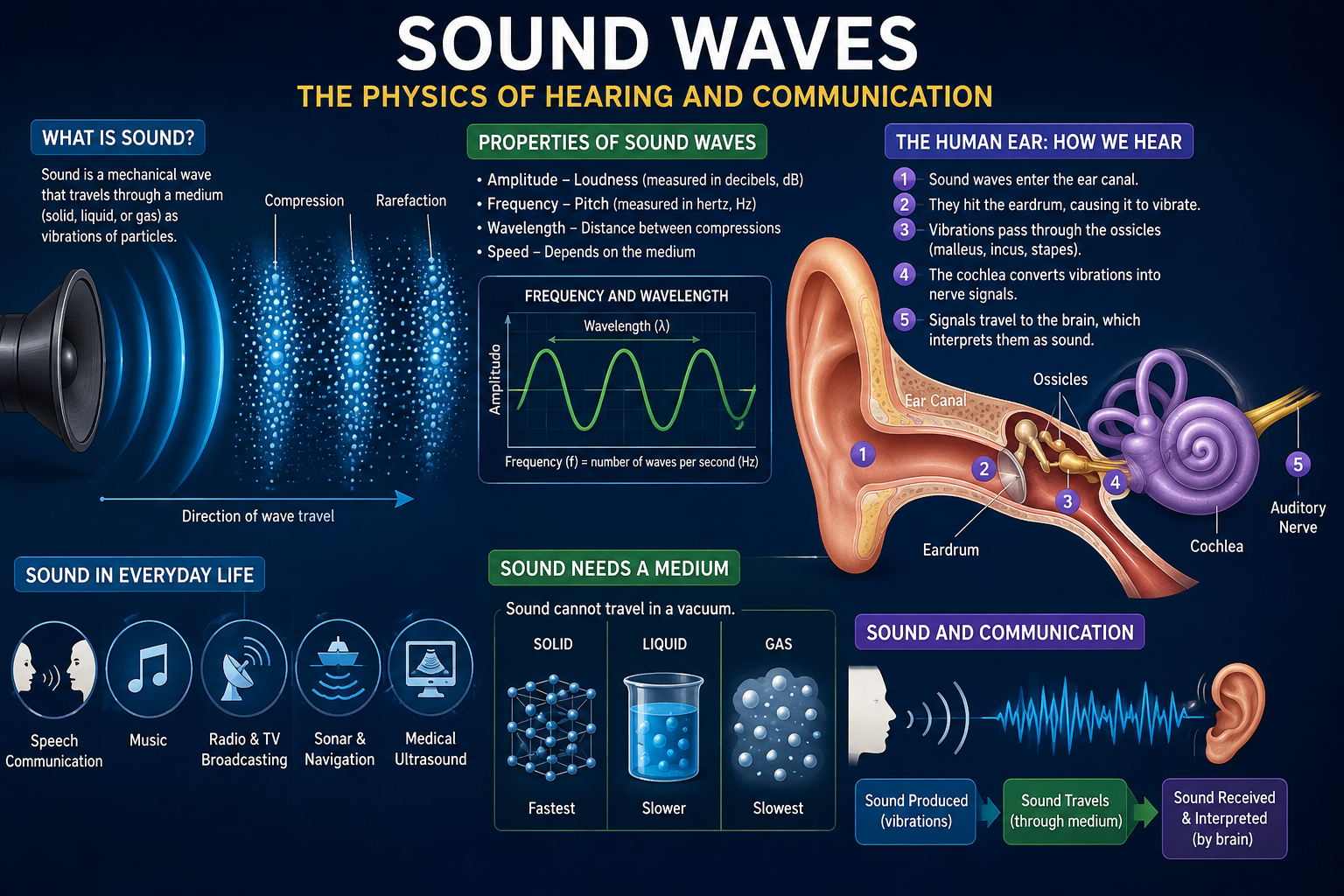
    # Sound Waves: The Physics of Hearing and Communication

    Have you ever wondered how a sound travels from one place to another? How does a musical instrument produce beautiful melodies? How can we hear someone speaking from across a room? The fascinating answer lies in the science of **sound waves!**

    In this exciting exploration of **“Sound Waves: The Physics of Hearing and Communication,”** we dive into the amazing world of sound and discover the physics behind one of the most important ways humans experience and understand the world around them.

    Sound is a form of energy that travels through a medium such as air, water, or solids. When an object vibrates, it causes nearby particles to vibrate, creating a wave that carries energy from one location to another. These vibrations eventually reach our ears, allowing our brains to recognize sounds.

    We’ll explore important concepts such as **frequency, wavelength, amplitude, speed, and pitch**. Understanding these properties helps explain why some sounds are high or low, loud or soft.

    The journey of sound into the human ear is equally fascinating! Sound waves enter the ear and cause tiny structures to vibrate. These vibrations are transformed into electrical signals that travel to the brain, where they are interpreted as meaningful sounds. This incredible process allows us to enjoy music , understand speech , recognize familiar sounds , and communicate with people around us.

    Communication depends heavily on sound. From everyday conversations to public speaking, telephone calls, radio broadcasts, and educational videos, sound allows information to travel between people. Modern technology also uses the principles of sound waves in microphones, speakers, headphones, medical imaging, and many other applications.

    This topic is a wonderful opportunity for students, science lovers, and curious minds to connect **physics with everyday life**. Instead of thinking of sound as something we simply hear, we can understand it as a physical phenomenon involving vibrations, energy, waves, and the remarkable human hearing system.

    **In this learning journey, you can discover:**
    What sound waves are
    How vibrations create sound
    How sound travels through different materials
    The relationship between frequency and pitch
    How amplitude affects loudness
    How the human ear detects sound
    How the brain interprets sound signals
    How sound enables communication
    How microphones and speakers work
    Everyday applications of sound-wave technology

    **Sound is everywhere!** From the gentle sound of rain to birds singing , from the voices of our friends to the music we enjoy , sound surrounds us every day. By understanding its physics, we gain a deeper appreciation for the invisible waves that connect our world.

    So get ready to listen, learn, explore, and discover the fascinating science behind the sounds we hear every day!

    **Learn the science. Understand the waves. Discover the power of sound!**

    #SoundWaves #Physics #Science #PhysicsOfSound #Hearing #Communication #Waves #SoundPhysics #ScienceEducation #PhysicsEducation #LearnScience #STEM #STEMEducation #HumanEar #Frequency #Amplitude #Wavelength #Pitch #Vibrations #ScienceForStudents #EducationalVideo #Learning #ScienceExploration #Technology #Acoustics #SoundAndCommunication #Curiosity #Knowledge #Education #ExploreScience
    #rsisb Roll no.247 Foundation level # 🔊 Sound Waves: The Physics of Hearing and Communication 🎧🌊 Have you ever wondered how a sound travels from one place to another? 🤔🔊 How does a musical instrument produce beautiful melodies? 🎵 How can we hear someone speaking from across a room? 🗣️👂 The fascinating answer lies in the science of **sound waves!** 🌊✨ In this exciting exploration of **“Sound Waves: The Physics of Hearing and Communication,”** we dive into the amazing world of sound and discover the physics behind one of the most important ways humans experience and understand the world around them. 🌍🔬 Sound is a form of energy that travels through a medium such as air, water, or solids. 🌬️💧🪨 When an object vibrates, it causes nearby particles to vibrate, creating a wave that carries energy from one location to another. These vibrations eventually reach our ears, allowing our brains to recognize sounds. 🧠👂💡 We’ll explore important concepts such as **frequency, wavelength, amplitude, speed, and pitch**. 📚📐 Understanding these properties helps explain why some sounds are high or low, loud or soft. 🎶🔉🔊 The journey of sound into the human ear is equally fascinating! 👂✨ Sound waves enter the ear and cause tiny structures to vibrate. These vibrations are transformed into electrical signals that travel to the brain, where they are interpreted as meaningful sounds. 🧠⚡ This incredible process allows us to enjoy music 🎼, understand speech 🗣️, recognize familiar sounds 👋, and communicate with people around us. ❤️🌎 Communication depends heavily on sound. From everyday conversations to public speaking, telephone calls, radio broadcasts, and educational videos, sound allows information to travel between people. 📞📻🎙️ Modern technology also uses the principles of sound waves in microphones, speakers, headphones, medical imaging, and many other applications. 💻🎧🔬 This topic is a wonderful opportunity for students, science lovers, and curious minds to connect **physics with everyday life**. 🌟📖 Instead of thinking of sound as something we simply hear, we can understand it as a physical phenomenon involving vibrations, energy, waves, and the remarkable human hearing system. 🌊⚛️👂 🎯 **In this learning journey, you can discover:** 🔹 What sound waves are 🔹 How vibrations create sound 🔹 How sound travels through different materials 🔹 The relationship between frequency and pitch 🔹 How amplitude affects loudness 🔹 How the human ear detects sound 🔹 How the brain interprets sound signals 🔹 How sound enables communication 🔹 How microphones and speakers work 🔹 Everyday applications of sound-wave technology 🌈 **Sound is everywhere!** From the gentle sound of rain 🌧️ to birds singing 🐦, from the voices of our friends 🗣️ to the music we enjoy 🎵, sound surrounds us every day. By understanding its physics, we gain a deeper appreciation for the invisible waves that connect our world. 🌍🌊✨ So get ready to listen, learn, explore, and discover the fascinating science behind the sounds we hear every day! 🔊🎧🔬📚 💡 **Learn the science. Understand the waves. Discover the power of sound!** 🌊🔊✨ #SoundWaves #Physics #Science #PhysicsOfSound #Hearing #Communication #Waves #SoundPhysics #ScienceEducation #PhysicsEducation #LearnScience #STEM #STEMEducation #HumanEar #Frequency #Amplitude #Wavelength #Pitch #Vibrations #ScienceForStudents #EducationalVideo #Learning #ScienceExploration #Technology #Acoustics #SoundAndCommunication #Curiosity #Knowledge #Education #ExploreScience 🔬📚🌍🎧🔊✨
    0 Commentarii 0 Distribuiri 6392 Views
Sponsorizeaza Paginile