• Level up your game with Test Paki 2 – the upgrade you’ve been waiting for!

    Level up your game with Test Paki 2 – the upgrade you’ve been waiting for!

    #tech #gadgets #innovation #newrelease #musthave #testpaki2 #saturdayvibes #shopping #upgrade #electronics
    Level up your game with Test Paki 2 – the upgrade you’ve been waiting for! Level up your game with Test Paki 2 – the upgrade you’ve been waiting for! 🚀✨ #tech #gadgets #innovation #newrelease #musthave #testpaki2 #saturdayvibes #shopping #upgrade #electronics
    0 Comentários 0 Compartilhamentos 218 Visualizações
  • #rsisb
    Roll no 279
    codig task no 17
    Foundtion level
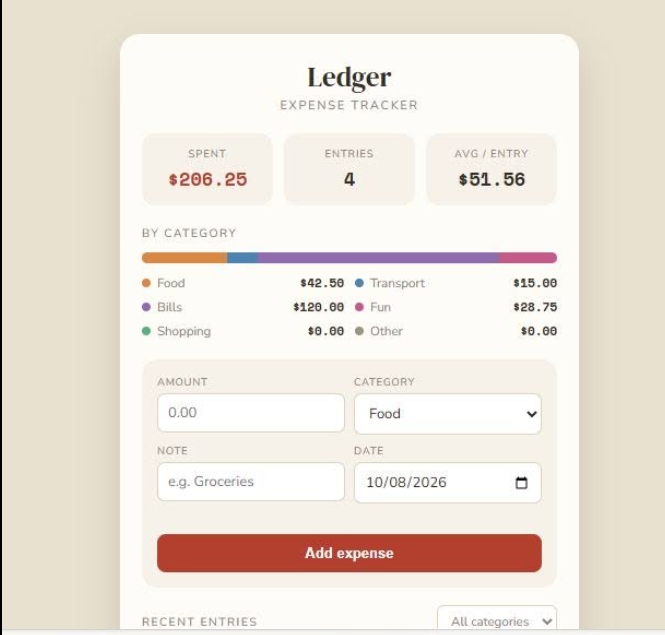
    **Expense Tracker — Track Your Money, Control Your Future!**
    Managing money becomes much easier when you know exactly where it is going. An **Expense Tracker** is a simple and useful tool that helps you record your daily expenses, organize your spending, and understand your financial habits.
    Instead of wondering, **“Where did my money go?”** , you can record every expense and keep a clear picture of your spending. Whether it is food , transportation , shopping , education , entertainment , or other daily needs, an Expense Tracker helps you stay organized.
    One of the biggest benefits is **better budgeting**. When you can see how much you spend in different categories, you can identify unnecessary expenses and make smarter choices. Small savings made regularly can become meaningful over time.
    An Expense Tracker can also help you develop important life skills such as **planning, responsibility, discipline, and financial awareness**. Learning to manage money wisely is an important step toward becoming more independent and prepared for the future.
    ### Key Features:
    Record daily expenses
    Track income and spending
    Organize expenses by category
    View spending over time
    Set simple budgets
    Understand spending habits
    Make smarter financial decisions
    Remember: **You don't need to manage money perfectly—you just need to understand where it goes and make better choices step by step.**
    #ExpenseTracker #MoneyManagement #Budgeting #PersonalFinance #FinancialAwareness #SmartSpending #SaveMoney #MoneyMatters #Productivity #Technology #Learning #DigitalSkills #FutureSkills #StudentProjects
    #rsisb Roll no 279 codig task no 17 Foundtion level 💰 **Expense Tracker — Track Your Money, Control Your Future!** 📊✨ Managing money becomes much easier when you know exactly where it is going. 💵📱 An **Expense Tracker** is a simple and useful tool that helps you record your daily expenses, organize your spending, and understand your financial habits. 📋🧾 Instead of wondering, **“Where did my money go?”** 🤔💸, you can record every expense and keep a clear picture of your spending. Whether it is food 🍔, transportation 🚗, shopping 🛍️, education 📚, entertainment 🎮, or other daily needs, an Expense Tracker helps you stay organized. One of the biggest benefits is **better budgeting**. 🎯💰 When you can see how much you spend in different categories, you can identify unnecessary expenses and make smarter choices. 📊💡 Small savings made regularly can become meaningful over time. 🌱✨ An Expense Tracker can also help you develop important life skills such as **planning, responsibility, discipline, and financial awareness**. 🧠📈 Learning to manage money wisely is an important step toward becoming more independent and prepared for the future. 🚀🌟 ### ⭐ Key Features: 🧾 Record daily expenses 💰 Track income and spending 📊 Organize expenses by category 📅 View spending over time 🎯 Set simple budgets 📈 Understand spending habits 💡 Make smarter financial decisions Remember: **You don't need to manage money perfectly—you just need to understand where it goes and make better choices step by step.** 💪💵🌱 #ExpenseTracker #MoneyManagement #Budgeting #PersonalFinance #FinancialAwareness #SmartSpending #SaveMoney #MoneyMatters #Productivity #Technology #Learning #DigitalSkills #FutureSkills #StudentProjects 📊💰💡🚀✨
    0 Comentários 0 Compartilhamentos 1263 Visualizações
  • RSIF8
    ROLL NO 108
    TASK 82
    CODING TASK 10
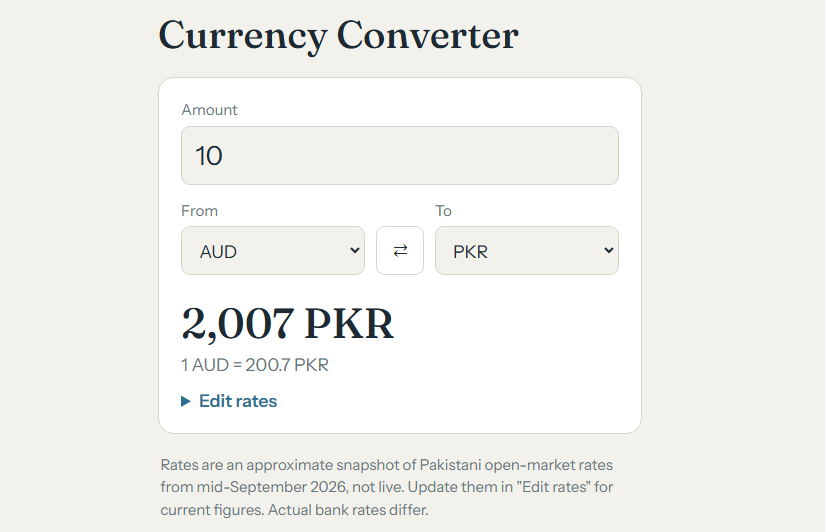
    **Currency Converter – Description**
    A Currency Converter is a useful tool that helps people convert money from one country's currency into another. It allows users to quickly calculate exchange rates between currencies such as US Dollars, Pakistani Rupees, Euros, British Pounds, and Japanese Yen. Simply enter an amount, select the currencies, and get the converted value. This tool makes international shopping, travelling, business, and financial calculations easier and faster. It is simple, accurate, and convenient to use. See less
    RSIF8 ROLL NO 108 TASK 82 CODING TASK 10 **Currency Converter – Description** A Currency Converter is a useful tool that helps people convert money from one country's currency into another. It allows users to quickly calculate exchange rates between currencies such as US Dollars, Pakistani Rupees, Euros, British Pounds, and Japanese Yen. Simply enter an amount, select the currencies, and get the converted value. This tool makes international shopping, travelling, business, and financial calculations easier and faster. It is simple, accurate, and convenient to use. See less
    0 Comentários 0 Compartilhamentos 711 Visualizações
  • Other AIs vs Muse AI

    Know the difference!

    OTHER AIs (ChatGPT, Claude, Gemini, Meta AI, Copilot):
    They are mainly Generative AI — they create content, and YOU still do all the work yourself.

    MUSE AI:
    Generative AI + Agentic AI — it creates AND does your tasks for you: emails, calendar, bookings, shopping, forms and your daily work — always with your approval first.

    Why use an AI that only talks, when Muse AI also works for you?

    Get your Muse AI account:
    1 Billion Tokens FREE | Free Plan, Weekly Limited Usage for forever
    Only Rs 499
    PAY AFTER HANDOVER — Pay after your account is created and given to you.
    WhatsApp now: 0333 0717198
    Other AIs vs Muse AI Know the difference! OTHER AIs (ChatGPT, Claude, Gemini, Meta AI, Copilot): They are mainly Generative AI — they create content, and YOU still do all the work yourself. MUSE AI: Generative AI + Agentic AI — it creates AND does your tasks for you: emails, calendar, bookings, shopping, forms and your daily work — always with your approval first. Why use an AI that only talks, when Muse AI also works for you? Get your Muse AI account: 1 Billion Tokens FREE | Free Plan, Weekly Limited Usage for forever Only Rs 499 ✅ PAY AFTER HANDOVER — Pay after your account is created and given to you. WhatsApp now: 0333 0717198
    1
    0 Comentários 0 Compartilhamentos 1288 Visualizações
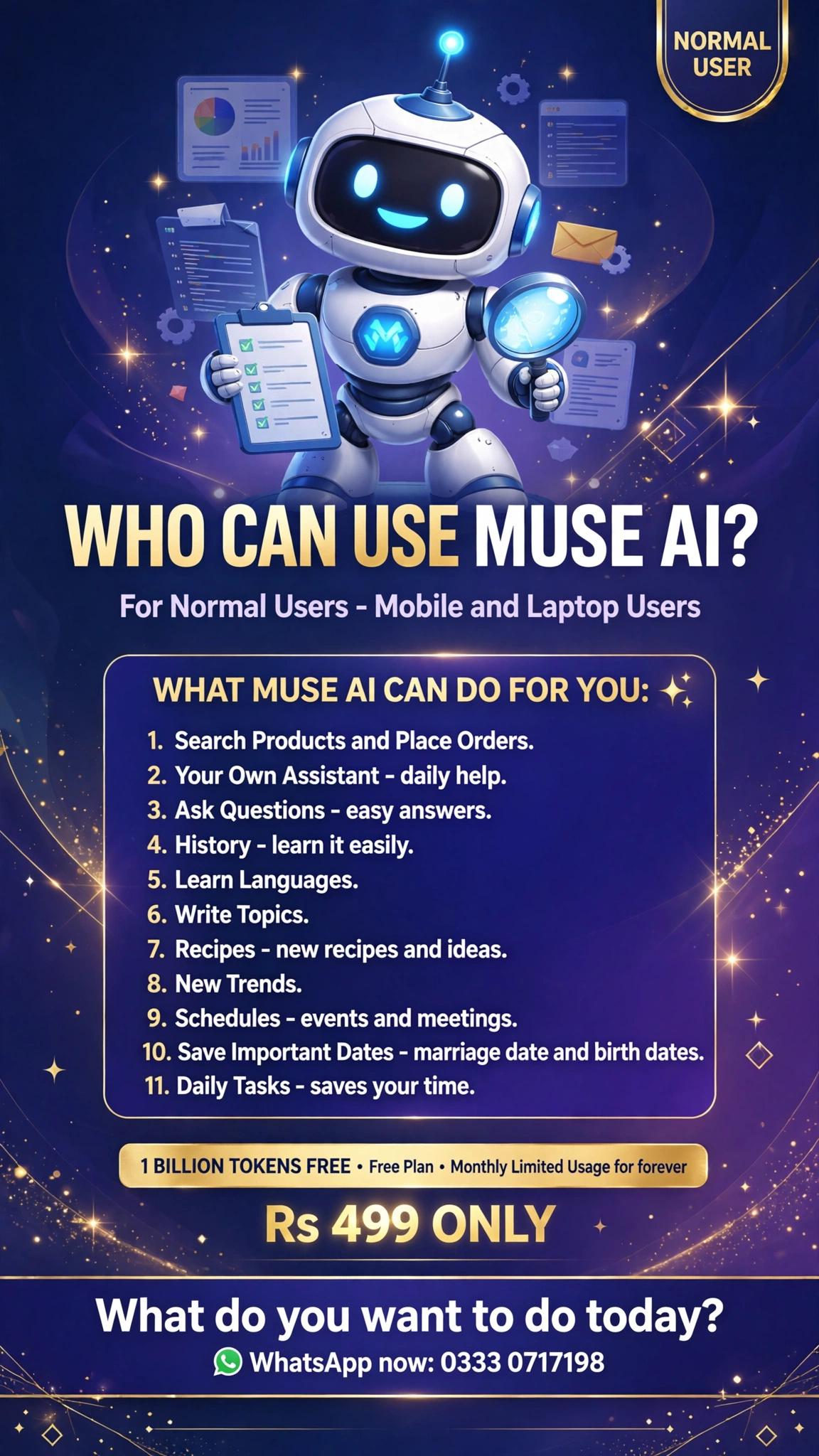
  • Muse AI for Normal Users
    Search products & place orders, ask any question, learn history, learn English & Arabic, write topics, get new recipes,
    follow new trends, schedule events & meetings, and save important dates — marriage date and birth dates.
    1 Billion Tokens FREE | Only Rs 499
    WhatsApp now: 0333 0717198
    #MuseAI #AITools #Pakistan #DailyUse #LearnEnglish #LearnArabic #Recipes #Shopping #Meetings #AIForEveryone
    Muse AI for Normal Users Search products & place orders, ask any question, learn history, learn English & Arabic, write topics, get new recipes, follow new trends, schedule events & meetings, and save important dates — marriage date and birth dates. 1 Billion Tokens FREE | Only Rs 499 WhatsApp now: 0333 0717198 #MuseAI #AITools #Pakistan #DailyUse #LearnEnglish #LearnArabic #Recipes #Shopping #Meetings #AIForEveryone
    0 Comentários 0 Compartilhamentos 3762 Visualizações
  • Daraz Clone — Description

    Is task mein hum Daraz Clone build kar rahe hain, jo ek modern aur fully functional e-commerce marketplace hoga. Is mein product browsing, categories, search, filters, product details, shopping cart, wishlist, checkout, orders, user profiles aur seller features shamil honge. Project ka focus professional UI, responsive design, smooth animations, real functionality aur database integration par hoga.

    STUDENT INFO:
    BOOK 3
    TASK: 12
    ROLL: 71

    #DarazClone #Ecommerce #WebDevelopment #FullStack #OnlineShopping #Database #UIUX #OpenCode #StudentProject #Book3 #Task12 #Roll71
    🛒 Daraz Clone — Description Is task mein hum Daraz Clone build kar rahe hain, jo ek modern aur fully functional e-commerce marketplace hoga. Is mein product browsing, categories, search, filters, product details, shopping cart, wishlist, checkout, orders, user profiles aur seller features shamil honge. Project ka focus professional UI, responsive design, smooth animations, real functionality aur database integration par hoga. STUDENT INFO: BOOK 3 TASK: 12 ROLL: 71 #DarazClone #Ecommerce #WebDevelopment #FullStack #OnlineShopping #Database #UIUX #OpenCode #StudentProject #Book3 #Task12 #Roll71
    0 Comentários 0 Compartilhamentos 3525 Visualizações 0
  • **Roll No: 2**
    **Batch: 14**
    **Book: ACCL**
    **Task No: 153**

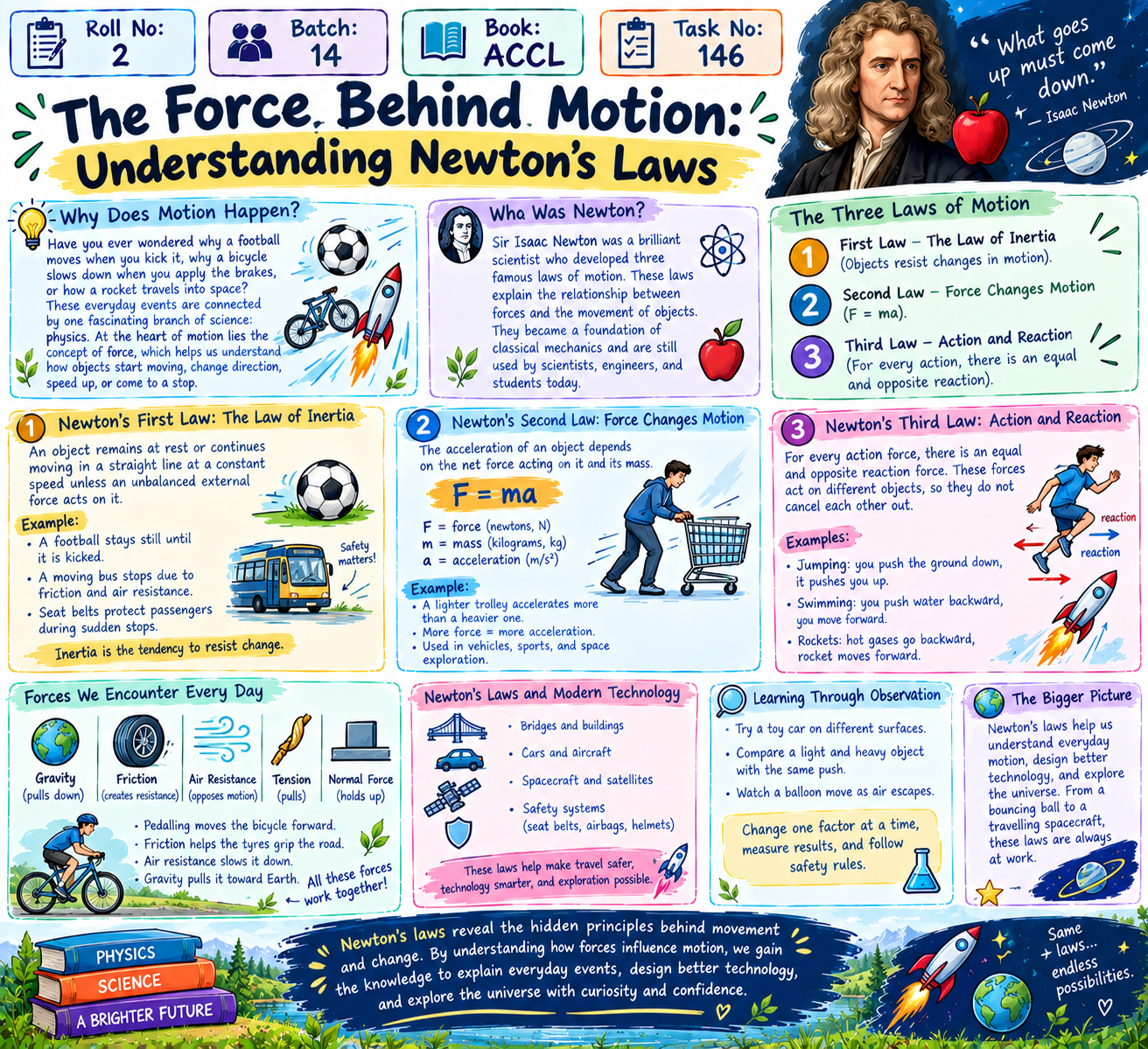
    # The Force Behind Motion: Understanding Newton’s Laws

    Have you ever wondered why a football moves when you kick it, why a bicycle slows down when you apply the brakes, or how a rocket travels into space? These everyday events are connected by one fascinating branch of science: physics. At the heart of motion lies the concept of **force**, which helps us understand how objects start moving, change direction, speed up, or come to a stop.

    One of the most important scientists in the history of physics was **Sir Isaac Newton**. Through his work, Newton developed three famous laws of motion that explain the relationship between forces and the movement of objects. These laws became a foundation of classical mechanics and continue to help scientists, engineers, and students understand the physical world around them.

    ## Newton’s First Law: The Law of Inertia

    Newton’s first law states that an object remains at rest or continues moving in a straight line at a constant speed unless an unbalanced external force acts on it. This tendency to resist changes in motion is called **inertia**.

    Imagine a football resting on the ground. It will remain still until someone kicks it or another force acts upon it. Once the ball begins moving, friction between the ball and the ground, along with air resistance, gradually slows it down. Without these opposing forces, the ball would continue moving at a constant velocity.

    You can also notice inertia when a moving bus suddenly brakes. Passengers may feel their bodies move forward because their bodies tend to maintain their previous motion. Seat belts help protect passengers by providing a force that restrains their movement. This shows how Newton’s first law explains both everyday experiences and important safety features.

    ## Newton’s Second Law: Force Changes Motion

    Newton’s second law explains how an unbalanced force changes an object’s motion. The acceleration of an object depends on the net force acting on it and its mass. For an object with constant mass, the relationship is written as:

    [
    \boxed{F = ma}
    ]

    Here, (F) represents the net force, (m) represents mass, and (a) represents acceleration. Force is measured in newtons (N), mass in kilograms (kg), and acceleration in metres per second squared ((\text{m/s}^2)).

    Consider pushing an empty shopping trolley and then pushing a heavily loaded one. The empty trolley usually accelerates more easily because it has less mass. If the same net force acts on two objects, the object with less mass experiences greater acceleration. Similarly, increasing the net force on an object of constant mass increases its acceleration.

    This law is essential in engineering, transport, sports, and space exploration. Engineers use it to calculate how much force is needed to accelerate vehicles, while athletes use the principles of force and acceleration when running, jumping, and throwing objects. ‍

    ## Newton’s Third Law: Action and Reaction

    Newton’s third law states that **for every action force, there is an equal and opposite reaction force**. These two forces act on different objects, so they do not cancel each other out.

    Think about what happens when you jump. Your feet push down against the ground, and the ground pushes upward on you. This upward force helps you rise into the air. The same principle explains how swimmers move forward by pushing water backward.

    Rockets provide another remarkable example. A rocket expels hot gases backward at high speed, and the gases exert an opposite force on the rocket, pushing it forward. This principle works even in the vacuum of space because the rocket does not need air to push against. Its motion results from the interaction between the rocket and the expelled gases.

    ## Forces We Encounter Every Day

    Forces are all around us, even when we do not notice them. Gravity pulls objects toward Earth, friction acts between surfaces in contact, and air resistance opposes an object moving through the atmosphere. Tension in a rope can pull an object, while a normal force from a supporting surface helps hold an object up.

    These forces often work together. For example, when a cyclist travels along a road, pedalling produces forward motion, friction helps the tyres grip the road, air resistance opposes movement, and gravity pulls the cyclist toward Earth. ‍ Understanding how these forces interact helps explain why the bicycle speeds up, slows down, or turns.

    ## Newton’s Laws and Modern Technology

    Newton’s laws are important far beyond the classroom. Engineers apply them when designing bridges, cars, aircraft, and machines. Scientists use them to predict the motion of many objects, while space agencies apply mechanics to plan spacecraft trajectories and study the movement of satellites.

    These laws also help improve safety. Seat belts, airbags, helmets, and vehicle safety systems are designed with an understanding of motion, forces, and changes in momentum. Although modern physics includes ideas beyond Newton’s laws, his work remains extremely useful for understanding everyday motion and many engineering problems.

    ## Learning Through Observation

    You do not need a complicated laboratory to begin exploring Newton’s laws. You can observe a toy car rolling across different surfaces, compare how a light and a heavier object respond to the same gentle push, or watch a balloon move as air escapes from it. Such simple observations can help connect scientific ideas with real experiences.

    When conducting experiments, it is important to change one factor at a time where possible, measure results carefully, and follow appropriate safety precautions. By observing patterns and asking questions, students can develop critical thinking skills and discover how physics explains the world around them.

    Newton’s laws teach us that motion is not random. The movement of a bouncing ball, a speeding bicycle, a swimming person, and a travelling spacecraft can all be understood by investigating forces and their effects.

    **Newton’s laws reveal the hidden principles behind movement and change. By understanding how forces influence motion, we gain the knowledge to explain everyday events, design better technology, and explore the universe with curiosity and confidence. **

    \#NewtonsLaws #ForceAndMotion #Physics #Science #Inertia #Acceleration #SpaceExploration #ACCL #Batch14 #Task146
    **Roll No: 2** **Batch: 14** **Book: ACCL** **Task No: 153** # 🚀⚙️ The Force Behind Motion: Understanding Newton’s Laws 🍎🌍 Have you ever wondered why a football moves when you kick it, why a bicycle slows down when you apply the brakes, or how a rocket travels into space? 🚲⚽🚀 These everyday events are connected by one fascinating branch of science: physics. At the heart of motion lies the concept of **force**, which helps us understand how objects start moving, change direction, speed up, or come to a stop. One of the most important scientists in the history of physics was **Sir Isaac Newton**. 🍎🔭 Through his work, Newton developed three famous laws of motion that explain the relationship between forces and the movement of objects. These laws became a foundation of classical mechanics and continue to help scientists, engineers, and students understand the physical world around them. ## ⚖️ Newton’s First Law: The Law of Inertia Newton’s first law states that an object remains at rest or continues moving in a straight line at a constant speed unless an unbalanced external force acts on it. This tendency to resist changes in motion is called **inertia**. 🧱✨ Imagine a football resting on the ground. ⚽ It will remain still until someone kicks it or another force acts upon it. Once the ball begins moving, friction between the ball and the ground, along with air resistance, gradually slows it down. Without these opposing forces, the ball would continue moving at a constant velocity. You can also notice inertia when a moving bus suddenly brakes. 🚌 Passengers may feel their bodies move forward because their bodies tend to maintain their previous motion. Seat belts help protect passengers by providing a force that restrains their movement. This shows how Newton’s first law explains both everyday experiences and important safety features. ## 💪 Newton’s Second Law: Force Changes Motion Newton’s second law explains how an unbalanced force changes an object’s motion. The acceleration of an object depends on the net force acting on it and its mass. For an object with constant mass, the relationship is written as: [ \boxed{F = ma} ] Here, (F) represents the net force, (m) represents mass, and (a) represents acceleration. Force is measured in newtons (N), mass in kilograms (kg), and acceleration in metres per second squared ((\text{m/s}^2)). 🔬📐 Consider pushing an empty shopping trolley and then pushing a heavily loaded one. 🛒 The empty trolley usually accelerates more easily because it has less mass. If the same net force acts on two objects, the object with less mass experiences greater acceleration. Similarly, increasing the net force on an object of constant mass increases its acceleration. This law is essential in engineering, transport, sports, and space exploration. Engineers use it to calculate how much force is needed to accelerate vehicles, while athletes use the principles of force and acceleration when running, jumping, and throwing objects. 🏃‍♂️🏀 ## 🔄 Newton’s Third Law: Action and Reaction Newton’s third law states that **for every action force, there is an equal and opposite reaction force**. These two forces act on different objects, so they do not cancel each other out. 🌍⚡ Think about what happens when you jump. Your feet push down against the ground, and the ground pushes upward on you. This upward force helps you rise into the air. 🦘 The same principle explains how swimmers move forward by pushing water backward. Rockets provide another remarkable example. 🚀 A rocket expels hot gases backward at high speed, and the gases exert an opposite force on the rocket, pushing it forward. This principle works even in the vacuum of space because the rocket does not need air to push against. Its motion results from the interaction between the rocket and the expelled gases. ## 🌎 Forces We Encounter Every Day Forces are all around us, even when we do not notice them. Gravity pulls objects toward Earth, friction acts between surfaces in contact, and air resistance opposes an object moving through the atmosphere. 🪂🌬️ Tension in a rope can pull an object, while a normal force from a supporting surface helps hold an object up. These forces often work together. For example, when a cyclist travels along a road, pedalling produces forward motion, friction helps the tyres grip the road, air resistance opposes movement, and gravity pulls the cyclist toward Earth. 🚴‍♂️ Understanding how these forces interact helps explain why the bicycle speeds up, slows down, or turns. ## 🛰️ Newton’s Laws and Modern Technology Newton’s laws are important far beyond the classroom. Engineers apply them when designing bridges, cars, aircraft, and machines. 🏗️🚗 Scientists use them to predict the motion of many objects, while space agencies apply mechanics to plan spacecraft trajectories and study the movement of satellites. These laws also help improve safety. Seat belts, airbags, helmets, and vehicle safety systems are designed with an understanding of motion, forces, and changes in momentum. Although modern physics includes ideas beyond Newton’s laws, his work remains extremely useful for understanding everyday motion and many engineering problems. ## 🧠 Learning Through Observation You do not need a complicated laboratory to begin exploring Newton’s laws. You can observe a toy car rolling across different surfaces, compare how a light and a heavier object respond to the same gentle push, or watch a balloon move as air escapes from it. 🎈🧪 Such simple observations can help connect scientific ideas with real experiences. When conducting experiments, it is important to change one factor at a time where possible, measure results carefully, and follow appropriate safety precautions. By observing patterns and asking questions, students can develop critical thinking skills and discover how physics explains the world around them. Newton’s laws teach us that motion is not random. The movement of a bouncing ball, a speeding bicycle, a swimming person, and a travelling spacecraft can all be understood by investigating forces and their effects. 🌌⚙️ **Newton’s laws reveal the hidden principles behind movement and change. By understanding how forces influence motion, we gain the knowledge to explain everyday events, design better technology, and explore the universe with curiosity and confidence. 🚀🌍💡** \#NewtonsLaws #ForceAndMotion #Physics #Science #Inertia #Acceleration #SpaceExploration #ACCL #Batch14 #Task146 ⚙️🚀📚

    0 Comentários 0 Compartilhamentos 5352 Visualizações
  • RSIF8
    ROLL NO:13
    CLASS: FOUNDATION LEVEL
    CODING TASK NO:11

    Day 11 Coding with ChatGPT – Calculator App Code

    Introduction

    For my Day 11 Coding with ChatGPT task, I worked on creating a simple and user-friendly Calculator App using HTML, CSS, and JavaScript. The main purpose of this project was to learn how to build a useful web application with the help of ChatGPT and understand the basic concepts of web development.

    A calculator is a very useful tool in our daily lives. We use calculators in mathematics, education, shopping, budgeting, and many other activities. Instead of performing every calculation manually, we can use a calculator to get results quickly and easily. Through this project, I learned how a simple calculator can be created using three important web development technologies.

    About My Calculator App

    My Calculator App is designed to perform four basic mathematical operations: addition, subtraction, multiplication, and division. The app provides a simple interface where users can enter numbers, select mathematical operators, and calculate the result.

    The main goal was to make the calculator easy to understand and convenient to use. A clear layout, readable buttons, and a visible display help users enter numbers and view their calculations. This project also helped me understand how different parts of a web application work together.

    Technologies Used

    1. HTML – Structure of the App

    HTML stands for HyperText Markup Language. It is used to create the basic structure of the calculator. I used HTML to organize the calculator display, number buttons, mathematical operators, and other important elements.

    2. CSS – Design and Styling

    CSS stands for Cascading Style Sheets. It is used to make the calculator look attractive and organized. CSS helps control colors, spacing, button sizes, text styles, borders, and the overall layout. It also helps make the app easier to use on different screen

    RSIF8 ROLL NO:13 CLASS: FOUNDATION LEVEL CODING TASK NO:11 Day 11 Coding with ChatGPT – Calculator App Code Introduction For my Day 11 Coding with ChatGPT task, I worked on creating a simple and user-friendly Calculator App using HTML, CSS, and JavaScript. The main purpose of this project was to learn how to build a useful web application with the help of ChatGPT and understand the basic concepts of web development. A calculator is a very useful tool in our daily lives. We use calculators in mathematics, education, shopping, budgeting, and many other activities. Instead of performing every calculation manually, we can use a calculator to get results quickly and easily. Through this project, I learned how a simple calculator can be created using three important web development technologies. About My Calculator App My Calculator App is designed to perform four basic mathematical operations: addition, subtraction, multiplication, and division. The app provides a simple interface where users can enter numbers, select mathematical operators, and calculate the result. The main goal was to make the calculator easy to understand and convenient to use. A clear layout, readable buttons, and a visible display help users enter numbers and view their calculations. This project also helped me understand how different parts of a web application work together. Technologies Used 1. HTML – Structure of the App HTML stands for HyperText Markup Language. It is used to create the basic structure of the calculator. I used HTML to organize the calculator display, number buttons, mathematical operators, and other important elements. 2. CSS – Design and Styling CSS stands for Cascading Style Sheets. It is used to make the calculator look attractive and organized. CSS helps control colors, spacing, button sizes, text styles, borders, and the overall layout. It also helps make the app easier to use on different screen
    0 Comentários 0 Compartilhamentos 1459 Visualizações
  • ACCL TASK
    Day:29
    Roll NO:003
    Coding task

    Student at Rehan School Urdu bazar campus

    # Basic Calculator (Arithmetic Operations)

    A basic calculator is a simple and useful mathematical tool designed to perform essential arithmetic operations quickly and accurately. It helps users solve everyday mathematical problems by performing addition, subtraction, multiplication, and division. Whether you are a student learning mathematics, a teacher explaining calculations, or someone managing daily tasks, a basic calculator makes calculations easier and more convenient.

    The four fundamental arithmetic operations are the foundation of mathematics. **Addition** is used to combine numbers, **subtraction** helps find the difference between numbers, **multiplication** makes repeated addition easier, and **division** allows us to distribute quantities into equal parts. These operations are important in many everyday situations, including shopping, budgeting, measuring, studying, and managing time.

    A basic calculator typically features a simple interface with number buttons, arithmetic operators, a clear button, and an equals button. Users can enter numbers, select an operation, and receive an immediate result. Its straightforward design makes it easy for beginners to understand and use without requiring advanced mathematical knowledge.

    In the digital world, basic calculators are available on computers, smartphones, tablets, and websites. They save time, reduce manual calculation effort, and help users check their answers efficiently. Although a basic calculator may not offer advanced scientific functions, it provides all the essential tools needed for common mathematical tasks.

    **In conclusion, a basic calculator is an essential tool for everyday mathematics.** By making arithmetic operations quick, simple, and accessible, it supports learning, improves convenience, and helps people solve numerical problems with greater confidence.
    https://claude.ai/artifact/GpKfXU3iwFMhSLgfzb96Y3jj
    ACCL TASK Day:29 Roll NO:003 Coding task Student at Rehan School Urdu bazar campus # Basic Calculator (Arithmetic Operations) A basic calculator is a simple and useful mathematical tool designed to perform essential arithmetic operations quickly and accurately. It helps users solve everyday mathematical problems by performing addition, subtraction, multiplication, and division. Whether you are a student learning mathematics, a teacher explaining calculations, or someone managing daily tasks, a basic calculator makes calculations easier and more convenient. The four fundamental arithmetic operations are the foundation of mathematics. **Addition** is used to combine numbers, **subtraction** helps find the difference between numbers, **multiplication** makes repeated addition easier, and **division** allows us to distribute quantities into equal parts. These operations are important in many everyday situations, including shopping, budgeting, measuring, studying, and managing time. A basic calculator typically features a simple interface with number buttons, arithmetic operators, a clear button, and an equals button. Users can enter numbers, select an operation, and receive an immediate result. Its straightforward design makes it easy for beginners to understand and use without requiring advanced mathematical knowledge. In the digital world, basic calculators are available on computers, smartphones, tablets, and websites. They save time, reduce manual calculation effort, and help users check their answers efficiently. Although a basic calculator may not offer advanced scientific functions, it provides all the essential tools needed for common mathematical tasks. **In conclusion, a basic calculator is an essential tool for everyday mathematics.** By making arithmetic operations quick, simple, and accessible, it supports learning, improves convenience, and helps people solve numerical problems with greater confidence. https://claude.ai/artifact/GpKfXU3iwFMhSLgfzb96Y3jj
    0 Comentários 0 Compartilhamentos 1774 Visualizações
  • **Ethical Consumerism and Its Impact | Colin Beavan **

    Have you ever thought about how your everyday shopping choices affect the world? The products we buy, the companies we support, and the resources we consume can have a significant impact on the environment, society, and the lives of people around us.

    In his talk, *“Ethical Consumerism and Its Impact,”* Colin Beavan's topic encourages us to think more deeply about our consumption habits and the consequences of our everyday decisions. Ethical consumerism is about making thoughtful choices by considering how products are made, how workers are treated, and how businesses affect our planet.

    From reducing plastic waste and avoiding unnecessary purchases to supporting responsible businesses and choosing reusable products, small changes in our daily habits can contribute to a more sustainable future. We don't need to be perfect consumers; we simply need to become more aware of our choices and their consequences.

    Ethical consumerism also reminds us that our money can reflect our values. By supporting fair working conditions, environmentally responsible practices, and sustainable production, we can encourage businesses to take greater responsibility for their impact on the world.

    **The key message:** Every purchase is an opportunity to make a more conscious decision. Before buying something, ask yourself whether you truly need it, how it was produced, and what impact it may have on people and the environment.

    Let's choose wisely, consume responsibly, reduce waste, and inspire others to create a healthier and more sustainable planet for future generations. Because a better world begins with the choices we make today!

    #ColinBeavan #EthicalConsumerism #TEDxTalk #Sustainability #ConsciousConsumption #EcoFriendly #SaveOurPlanet #ClimateAwareness #ResponsibleShopping #ReduceReuseRecycle #EnvironmentalAwareness #SustainableLiving #GreenFuture #SocialResponsibility #Minimalism #ProtectNature #MakeADifference #ThinkBeforeYouBuy #PositiveChange #FutureGenerations
    🌍🌱 **Ethical Consumerism and Its Impact | Colin Beavan 🎤✨** Have you ever thought about how your everyday shopping choices affect the world? 🛍️🤔 The products we buy, the companies we support, and the resources we consume can have a significant impact on the environment, society, and the lives of people around us. In his talk, *“Ethical Consumerism and Its Impact,”* Colin Beavan's topic encourages us to think more deeply about our consumption habits and the consequences of our everyday decisions. 💡🌿 Ethical consumerism is about making thoughtful choices by considering how products are made, how workers are treated, and how businesses affect our planet. ♻️ From reducing plastic waste and avoiding unnecessary purchases to supporting responsible businesses and choosing reusable products, small changes in our daily habits can contribute to a more sustainable future. 🌳💚 We don't need to be perfect consumers; we simply need to become more aware of our choices and their consequences. 🤝 Ethical consumerism also reminds us that our money can reflect our values. By supporting fair working conditions, environmentally responsible practices, and sustainable production, we can encourage businesses to take greater responsibility for their impact on the world. 🌎 **The key message:** Every purchase is an opportunity to make a more conscious decision. Before buying something, ask yourself whether you truly need it, how it was produced, and what impact it may have on people and the environment. 💚 Let's choose wisely, consume responsibly, reduce waste, and inspire others to create a healthier and more sustainable planet for future generations. Because a better world begins with the choices we make today! 🌍🌱✨ #ColinBeavan #EthicalConsumerism #TEDxTalk #Sustainability #ConsciousConsumption #EcoFriendly #SaveOurPlanet #ClimateAwareness #ResponsibleShopping #ReduceReuseRecycle #EnvironmentalAwareness #SustainableLiving #GreenFuture #SocialResponsibility #Minimalism #ProtectNature #MakeADifference #ThinkBeforeYouBuy #PositiveChange #FutureGenerations 🌎♻️💚🌱
    0 Comentários 0 Compartilhamentos 7546 Visualizações 4
Páginas Impulsionadas