• **Mulla Nasruddin and the Thief — A Clever and Meaningful Story**

    One quiet night, a thief secretly entered Mulla Nasruddin’s house, hoping to steal something valuable and escape without being noticed. However, Mulla Nasruddin was known for his wisdom, patience, and quick thinking. He noticed the thief but decided not to panic or create unnecessary trouble. Instead, he calmly thought of a clever way to teach the thief an important lesson.

    The thief began looking around the house and collecting things. Mulla Nasruddin then spoke to him calmly and explained that stealing someone else’s hard-earned belongings might give a person temporary benefit, but it can never bring true peace, respect, or happiness.

    The thief was surprised that Mulla Nasruddin did not simply become angry. Instead, Mulla explained that even a small amount earned through honest work is far more valuable than wealth gained through dishonest means. The thief realized his mistake and apologized for what he had done.

    Mulla Nasruddin used the situation to teach him a powerful lesson: **wisdom, patience, honesty, and good character are more valuable than anything that can be stolen.**

    This story reminds us that the wrong path may sometimes look easy, but true success comes from **hard work, honesty, responsibility, and respect for others.**

    **Moral of the Story:**
    Always choose honesty over greed. A clever mind can solve problems, but a good heart knows how to guide others toward the right path.

    If you enjoy **funny, inspiring, and meaningful stories**, share this story with your friends and family and let its lesson reach more people!

    #MullaNasruddin #MullaNasrudin #NasruddinStories #UrduStories #MoralStory #StoryTime #LifeLessons #Wisdom #Honesty #GoodCharacter #InspirationalStory #FunnyStories #KidsStories #ShortStories #TraditionalStories #Motivation #LearnFromStories #PositiveThinking #Storytelling
    🌙 **Mulla Nasruddin and the Thief — A Clever and Meaningful Story** 🏠✨ One quiet night, a thief secretly entered Mulla Nasruddin’s house, hoping to steal something valuable and escape without being noticed. However, Mulla Nasruddin was known for his wisdom, patience, and quick thinking. He noticed the thief but decided not to panic or create unnecessary trouble. Instead, he calmly thought of a clever way to teach the thief an important lesson. 😄💡 The thief began looking around the house and collecting things. Mulla Nasruddin then spoke to him calmly and explained that stealing someone else’s hard-earned belongings might give a person temporary benefit, but it can never bring true peace, respect, or happiness. 🤲❤️ The thief was surprised that Mulla Nasruddin did not simply become angry. Instead, Mulla explained that even a small amount earned through honest work is far more valuable than wealth gained through dishonest means. The thief realized his mistake and apologized for what he had done. 🙏 Mulla Nasruddin used the situation to teach him a powerful lesson: **wisdom, patience, honesty, and good character are more valuable than anything that can be stolen.** 🌟📚 This story reminds us that the wrong path may sometimes look easy, but true success comes from **hard work, honesty, responsibility, and respect for others.** 💫 ✨ **Moral of the Story:** Always choose honesty over greed. A clever mind can solve problems, but a good heart knows how to guide others toward the right path. ❤️🧠 If you enjoy **funny, inspiring, and meaningful stories**, share this story with your friends and family and let its lesson reach more people! 📖🌍✨ #MullaNasruddin #MullaNasrudin #NasruddinStories #UrduStories #MoralStory #StoryTime #LifeLessons #Wisdom #Honesty #GoodCharacter #InspirationalStory #FunnyStories #KidsStories #ShortStories #TraditionalStories #Motivation #LearnFromStories #PositiveThinking #Storytelling 📚✨
    0 Comentários 0 Compartilhamentos 150 Visualizações
  • RSLC ROLL NO 80#
    FONDATION LEVEL Batch 06#
    task: 31
    DAY: 31

    Karachi beach sunset
    Karachi sea waves
    ocean sunset city
    lights night
    ocean breeze
    Pakistan coast
    RSLC ROLL NO 80# FONDATION LEVEL Batch 06# task: 31 DAY: 31 Karachi beach sunset Karachi sea waves ocean sunset city lights night ocean breeze Pakistan coast 😁 😅 😆
    0 Comentários 0 Compartilhamentos 30 Visualizações
  • #rsisb
    Roll no.282
    Story post No 1
    Foundation level
    Mulla Nasruddin’s Clever Plan
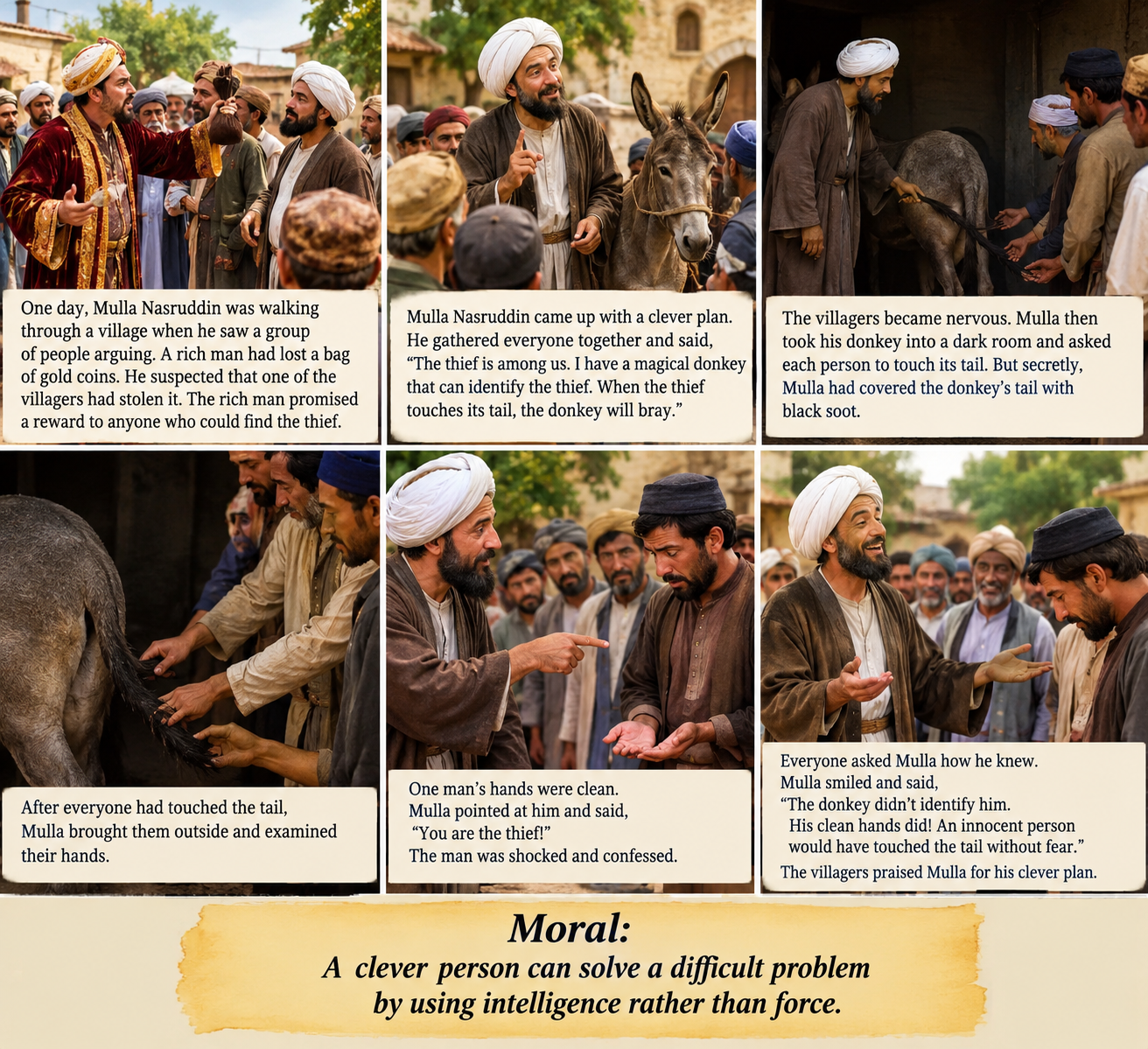
    One day, Mulla Nasruddin was walking through a village when he saw a group of people arguing loudly.
    A rich man had lost a bag of gold coins. He suspected that one of the villagers had stolen it. The rich man promised a reward to anyone who could find the thief.
    The villagers were afraid because there was no evidence against anyone.
    Mulla Nasruddin came up with a clever plan.
    He gathered everyone together and said, “The thief is among us. I have a magical donkey that can identify the thief. When the thief touches its tail, the donkey will bray.”
    The villagers became nervous. Mulla then took his donkey into a dark room and asked each person to touch its tail.
    But secretly, Mulla had covered the donkey's tail with black soot.
    After everyone had touched the tail, Mulla brought them outside and examined their hands.
    One man's hands were clean.
    Mulla pointed at him and said, “You are the thief!”
    The man was shocked and confessed.
    Everyone asked Mulla how he knew.
    Mulla smiled and said, “The donkey didn't identify him. His clean hands did! An innocent person would have touched the tail without fear.”
    The villagers praised Mulla for his clever plan.
    Moral: A clever person can solve a difficult problem by using intelligence rather than force.


    Edit
    #rsisb Roll no.282 Story post No 1 Foundation level Mulla Nasruddin’s Clever Plan One day, Mulla Nasruddin was walking through a village when he saw a group of people arguing loudly. A rich man had lost a bag of gold coins. He suspected that one of the villagers had stolen it. The rich man promised a reward to anyone who could find the thief. The villagers were afraid because there was no evidence against anyone. Mulla Nasruddin came up with a clever plan. He gathered everyone together and said, “The thief is among us. I have a magical donkey that can identify the thief. When the thief touches its tail, the donkey will bray.” The villagers became nervous. Mulla then took his donkey into a dark room and asked each person to touch its tail. But secretly, Mulla had covered the donkey's tail with black soot. After everyone had touched the tail, Mulla brought them outside and examined their hands. One man's hands were clean. Mulla pointed at him and said, “You are the thief!” The man was shocked and confessed. Everyone asked Mulla how he knew. Mulla smiled and said, “The donkey didn't identify him. His clean hands did! An innocent person would have touched the tail without fear.” The villagers praised Mulla for his clever plan. Moral: A clever person can solve a difficult problem by using intelligence rather than force. Edit
    0 Comentários 0 Compartilhamentos 72 Visualizações
  • #rsisb
    Roll no.282
    Story post No 3
    Foundation level
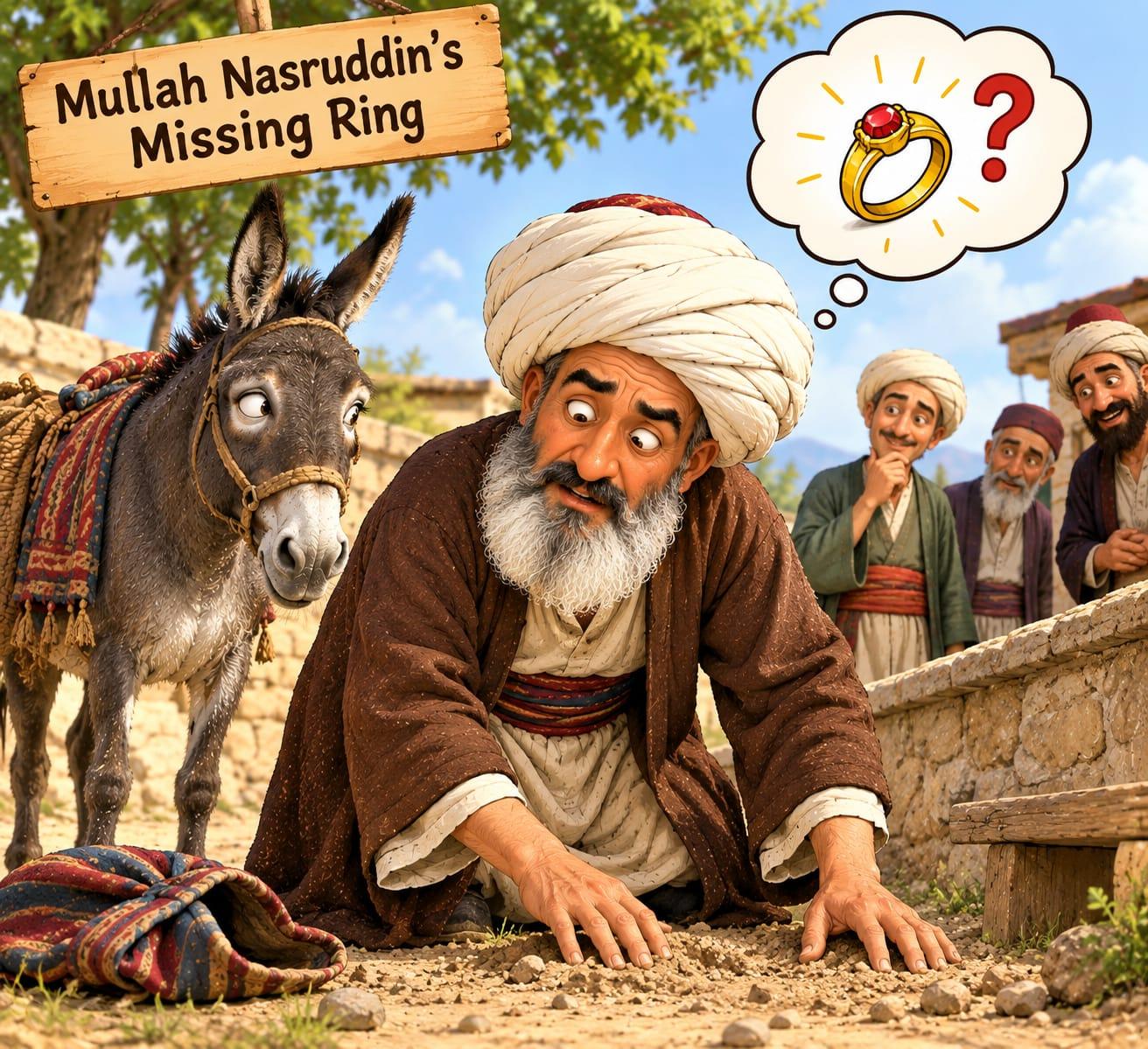
    # Mulla Nasruddin and the Missing Ring

    One evening, Mulla Nasruddin was walking through the village when he saw his neighbor searching under a bright street lamp.

    “What are you looking for?” Mulla asked.

    “My gold ring!” the neighbor replied. “I lost it, and I can't find it anywhere.”

    Mulla began helping him search under the lamp. They looked around for several minutes, but the ring was nowhere to be found.

    Suddenly, Mulla asked, “Are you sure you lost your ring here?”

    The neighbor shook his head and said, “No. I actually lost it in the sand near my house.”

    Mulla looked surprised.

    “Then why are you searching here?” he asked.

    The neighbor replied, “Because there is more light here!”

    Mulla smiled and said, “My friend, the light may be better here, but your ring is still hiding in the sand!”

    They walked over to the sandy area near the neighbor's house. Mulla carefully searched through the sand while the neighbor helped him.

    After a few minutes, Mulla's hand touched something hard.

    “Look!” Mulla shouted. “I found your ring!”

    The neighbor was delighted.

    “Thank you, Mulla! You are very clever.”

    Mulla laughed and replied, “Remember, my friend: **If you want to find something, look where you lost it—not where it is easiest to search.**”

    ### Moral

    **We should look for answers in the right place, even when the right place is difficult to search.**
    #rsisb Roll no.282 Story post No 3 Foundation level # Mulla Nasruddin and the Missing Ring One evening, Mulla Nasruddin was walking through the village when he saw his neighbor searching under a bright street lamp. “What are you looking for?” Mulla asked. “My gold ring!” the neighbor replied. “I lost it, and I can't find it anywhere.” Mulla began helping him search under the lamp. They looked around for several minutes, but the ring was nowhere to be found. Suddenly, Mulla asked, “Are you sure you lost your ring here?” The neighbor shook his head and said, “No. I actually lost it in the sand near my house.” Mulla looked surprised. “Then why are you searching here?” he asked. The neighbor replied, “Because there is more light here!” Mulla smiled and said, “My friend, the light may be better here, but your ring is still hiding in the sand!” They walked over to the sandy area near the neighbor's house. Mulla carefully searched through the sand while the neighbor helped him. After a few minutes, Mulla's hand touched something hard. “Look!” Mulla shouted. “I found your ring!” The neighbor was delighted. “Thank you, Mulla! You are very clever.” Mulla laughed and replied, “Remember, my friend: **If you want to find something, look where you lost it—not where it is easiest to search.**” ### Moral **We should look for answers in the right place, even when the right place is difficult to search.**
    0 Comentários 0 Compartilhamentos 69 Visualizações
  • **Roll No: 2**
    **Batch: 14**
    **Book: ACCL**
    **Task No: 49**

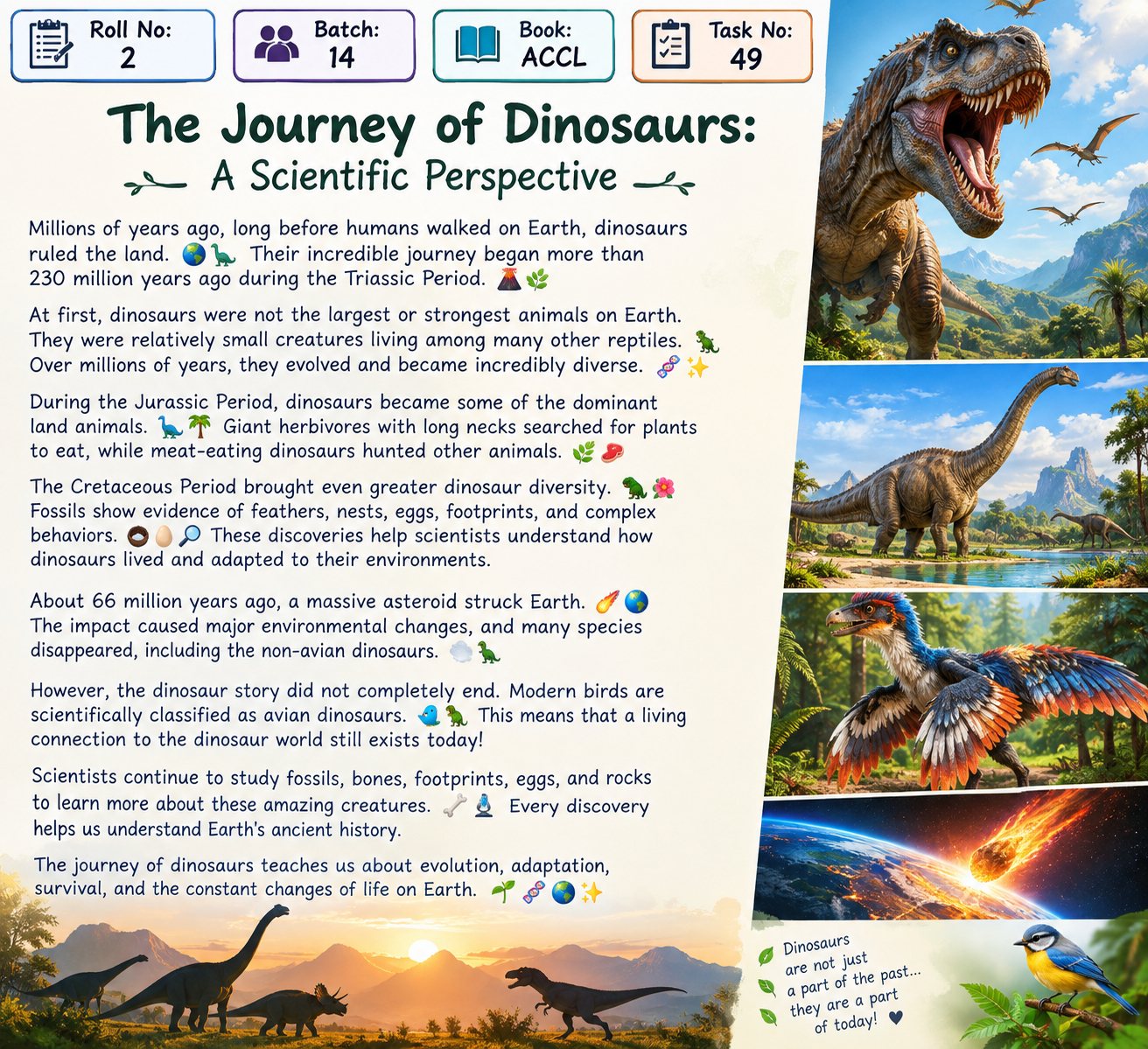
    # The Journey of Dinosaurs: A Scientific Perspective

    Millions of years ago, long before humans walked on Earth, dinosaurs ruled the land. Their incredible journey began more than **230 million years ago** during the Triassic Period.

    At first, dinosaurs were not the largest or strongest animals on Earth. They were relatively small creatures living among many other reptiles. Over millions of years, they evolved and became incredibly diverse.

    During the **Jurassic Period**, dinosaurs became some of the dominant land animals. Giant herbivores with long necks searched for plants to eat, while meat-eating dinosaurs hunted other animals.

    The **Cretaceous Period** brought even greater dinosaur diversity. Fossils show evidence of feathers, nests, eggs, footprints, and complex behaviors. 🪺 These discoveries help scientists understand how dinosaurs lived and adapted to their environments.

    About **66 million years ago**, a massive asteroid struck Earth. The impact caused major environmental changes, and many species disappeared, including the non-avian dinosaurs.

    However, the dinosaur story did not completely end. Modern birds are scientifically classified as **avian dinosaurs**. This means that a living connection to the dinosaur world still exists today!

    Scientists continue to study fossils, bones, footprints, eggs, and rocks to learn more about these amazing creatures. Every discovery helps us understand Earth's ancient history.

    The journey of dinosaurs teaches us about evolution, adaptation, survival, and the constant changes of life on Earth.
    **Roll No: 2** **Batch: 14** **Book: ACCL** **Task No: 49** # 🦖 The Journey of Dinosaurs: A Scientific Perspective 🌍🔬 Millions of years ago, long before humans walked on Earth, dinosaurs ruled the land. 🌎🦕 Their incredible journey began more than **230 million years ago** during the Triassic Period. 🌋🌿 At first, dinosaurs were not the largest or strongest animals on Earth. They were relatively small creatures living among many other reptiles. 🦎 Over millions of years, they evolved and became incredibly diverse. 🧬✨ During the **Jurassic Period**, dinosaurs became some of the dominant land animals. 🦕🌴 Giant herbivores with long necks searched for plants to eat, while meat-eating dinosaurs hunted other animals. 🌿🥩 The **Cretaceous Period** brought even greater dinosaur diversity. 🦖🌺 Fossils show evidence of feathers, nests, eggs, footprints, and complex behaviors. 🪺🥚🔎 These discoveries help scientists understand how dinosaurs lived and adapted to their environments. About **66 million years ago**, a massive asteroid struck Earth. ☄️🌎 The impact caused major environmental changes, and many species disappeared, including the non-avian dinosaurs. 🌫️🦖 However, the dinosaur story did not completely end. Modern birds are scientifically classified as **avian dinosaurs**. 🐦🦖 This means that a living connection to the dinosaur world still exists today! Scientists continue to study fossils, bones, footprints, eggs, and rocks to learn more about these amazing creatures. 🦴🔬 Every discovery helps us understand Earth's ancient history. The journey of dinosaurs teaches us about evolution, adaptation, survival, and the constant changes of life on Earth. 🌱🧬🌍✨
    0 Comentários 0 Compartilhamentos 44 Visualizações
  • ### Roll No: 2

    ### Batch 1

    ### Task 49:

    ### Book: Accl

    ** Success Is Not Overnight **

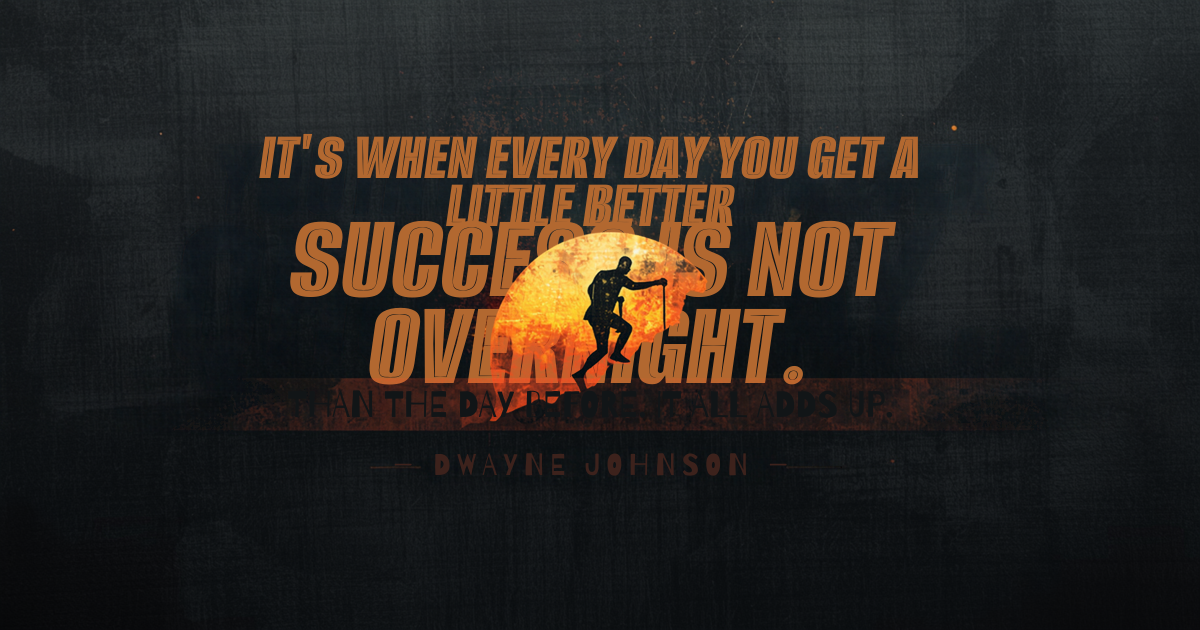
    Today’s task is to create an inspiring and motivational post based on the theme **“Success is not overnight.”** The message focuses on the importance of consistency, patience, daily improvement, and continuous effort. True progress comes from taking small steps every day and learning from each experience. Even when results are not immediate, every effort contributes to long-term growth and achievement. This task encourages a positive mindset and reminds us that dedication, discipline, and persistence can help turn small improvements into meaningful success over time.

    #Batch1 #Task49 #Success #Motivation #DailyImprovement #Consistency #HardWork #GrowthMindset #Persistence #Inspiration #PositiveMindset #DailyTask
    ### 👤 Roll No: 2 ### 📚 Batch 1 ### 🎯 Task 49: ### 📖 Book: Accl **💪✨ Success Is Not Overnight 🌟** Today’s task is to create an inspiring and motivational post based on the theme **“Success is not overnight.”** 🌱🚀 The message focuses on the importance of consistency, patience, daily improvement, and continuous effort. 📈💫 True progress comes from taking small steps every day and learning from each experience. 💪📚 Even when results are not immediate, every effort contributes to long-term growth and achievement. 🌟🏆 This task encourages a positive mindset and reminds us that dedication, discipline, and persistence can help turn small improvements into meaningful success over time. 🔥✨ #Batch1 #Task49 #Success #Motivation #DailyImprovement #Consistency #HardWork #GrowthMindset #Persistence #Inspiration #PositiveMindset #DailyTask
    0 Comentários 0 Compartilhamentos 178 Visualizações
  • #rsisb
    Roll No 253
    Foundation Level
    Story Post 22
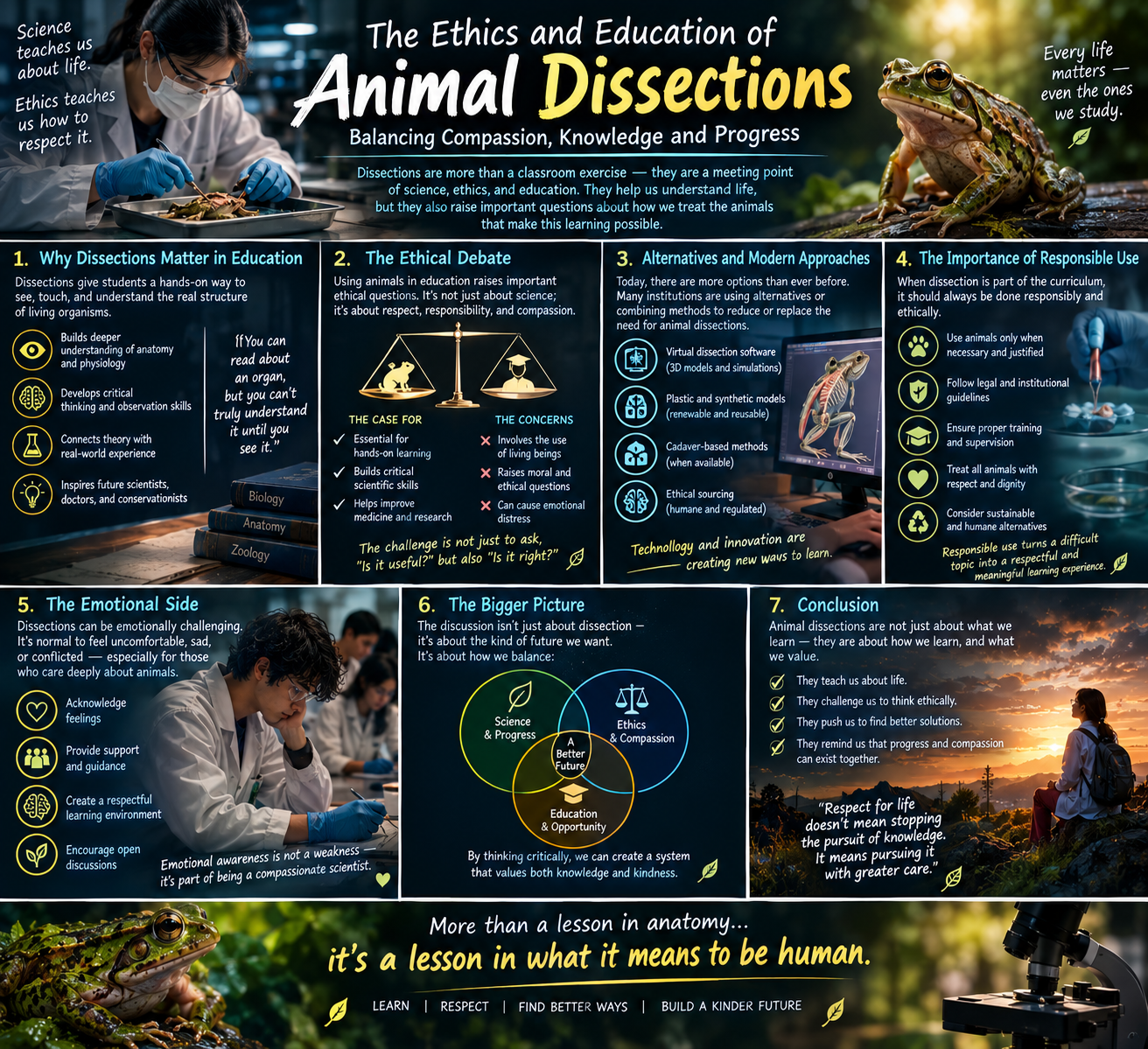
    # The Ethics and Education of Animal Dissections

    ## Balancing Knowledge, Compassion, and Scientific Progress

    Animal dissections have long been used to help students understand anatomy, physiology, and the remarkable complexity of living organisms.

    But dissection is more than a scientific technique.

    It also raises an important question:

    ### **How can we learn about life while treating life with respect?**

    Understanding both the educational value and the ethical considerations surrounding dissections allows us to approach biology with greater knowledge, responsibility, and compassion.

    ---

    ## 1. Why Dissections Matter in Education

    Dissections can provide students with a direct way to explore biological structures that are difficult to fully understand through diagrams or textbooks alone.

    They can help learners:

    Observe real anatomy
    Develop critical thinking
    Understand organ relationships
    Connect theory with physical structures
    Build curiosity about living systems

    Instead of simply memorizing the location of an organ, students can investigate how structures are positioned and connected.

    ### **It turns biological concepts into something tangible.**

    ---

    ## 2. The Ethical Debate

    Using animals for education creates a genuine ethical discussion.

    On one side, supporters may point to the educational benefits of direct anatomical study.

    On the other, concerns include:

    The use of living organisms
    Animal welfare
    Moral responsibility
    Whether alternatives can provide similar educational value

    The central question isn't simply:

    **“Is it useful?”**

    It is also:

    ### **“Is it justified, and can the same learning goals be achieved another way?”**

    Considering both questions encourages students to think scientifically **and ethically**.

    ---

    ## 3. Alternatives and Modern Approaches

    Technology has created new ways to study anatomy without always relying on traditional dissection.

    Modern educational approaches can include:

    Virtual dissection software
    3D anatomical models
    Synthetic or plastic models
    Interactive simulations
    Microscopic analysis
    High-quality anatomical imagery

    These tools can allow students to explore structures repeatedly, change viewpoints, and investigate complex systems in ways that may be difficult with a physical specimen.

    ### **Technology is creating new possibilities for learning.**

    ---

    ## 4. The Importance of Responsible Use

    When animal specimens are used for education or research, responsibility is essential.

    Important principles include:

    Following relevant laws and institutional guidelines
    Providing proper training and supervision
    Using animals only when scientifically or educationally justified
    Treating specimens respectfully
    Considering sustainable and humane alternatives

    Responsible scientific education isn't simply about obtaining knowledge.

    It is about **how that knowledge is obtained.**

    ---

    ## 5. The Emotional Side

    Dissection can affect students differently.

    Some may feel fascinated by anatomy.
    Others may feel uncomfortable.
    Some may experience sadness or conflict because they care deeply about animals.

    These reactions shouldn't automatically be dismissed.

    A respectful educational environment can encourage students to:

    Acknowledge their emotions
    Discuss concerns openly
    Support one another
    Maintain scientific curiosity
    Develop compassion

    ### **Emotional awareness can be part of becoming a responsible scientist.**

    ---

    # 6. The Bigger Picture

    The debate surrounding animal dissection isn't simply about choosing **science or compassion**.

    It is about finding ways for:

    **Scientific progress**
    **Ethical responsibility**
    **Education**
    **Compassion**

    to coexist.

    The goal is to create learning environments where students can develop strong scientific knowledge while also thinking carefully about the consequences of scientific practices.

    ### **Knowledge and compassion don't have to be opposites.**

    ---

    ## 7. What Dissections Can Teach Us

    When conducted appropriately, anatomical study can teach lessons that extend beyond individual organs.

    It can teach us about:

    The complexity of life
    Biological organization
    Interconnected systems
    Evolution and adaptation
    Scientific observation
    Ethical decision-making

    A specimen can become more than an anatomy lesson.

    It can become an opportunity to ask **how we learn, why we learn, and what responsibilities come with knowledge.**

    ---

    # 8. The Real Question

    Perhaps the deepest question isn't simply:

    **“Should animals be dissected?”**

    It is:

    How can we improve biological education?
    How can we reduce unnecessary harm?
    Which alternatives can provide meaningful learning?
    How should scientists balance discovery with responsibility?
    How can future generations learn with greater compassion?

    These questions don't have to end scientific exploration.

    They can make scientific exploration **more thoughtful.**

    ---

    # The Bigger Lesson

    Animal dissections can teach us about anatomy—but the discussion surrounding them can teach us something even larger.

    ### **Science teaches us how life works.**

    ### **Ethics asks us how we should treat it.**

    ### **Education gives us the opportunity to understand both.**

    The future of science isn't only about discovering more.

    It's also about learning to discover **responsibly.**

    So when we look inside an organism to understand its anatomy, we should also look beyond the specimen and consider the larger picture:

    **Respect life.**
    **Pursue knowledge.**
    **Think critically.**
    **Explore better alternatives.**
    **Build a more compassionate future.**

    ## **More than a lesson in anatomy—it's a lesson in what it means to learn responsibly.**


    Asma Shaheen EducationWali
    Saima Empowerment Wali
    Mishaal TrainingWali
    #rsisb Roll No 253 Foundation Level Story Post 22 # 🐸🔬 The Ethics and Education of Animal Dissections ## 🌿⚖️ Balancing Knowledge, Compassion, and Scientific Progress Animal dissections have long been used to help students understand anatomy, physiology, and the remarkable complexity of living organisms. 🧬🫀🔬 But dissection is more than a scientific technique. It also raises an important question: ### **How can we learn about life while treating life with respect?** 🐾❤️ Understanding both the educational value and the ethical considerations surrounding dissections allows us to approach biology with greater knowledge, responsibility, and compassion. --- ## 🎓🔬 1. Why Dissections Matter in Education Dissections can provide students with a direct way to explore biological structures that are difficult to fully understand through diagrams or textbooks alone. 📚➡️🔬 They can help learners: 👁️ Observe real anatomy 🧠 Develop critical thinking 🫀 Understand organ relationships 🔬 Connect theory with physical structures 🌱 Build curiosity about living systems Instead of simply memorizing the location of an organ, students can investigate how structures are positioned and connected. ### **It turns biological concepts into something tangible.** ✨ --- ## ⚖️🐾 2. The Ethical Debate Using animals for education creates a genuine ethical discussion. On one side, supporters may point to the educational benefits of direct anatomical study. 🎓🔬 On the other, concerns include: 🐾 The use of living organisms ❤️ Animal welfare 🧠 Moral responsibility 🌱 Whether alternatives can provide similar educational value The central question isn't simply: **“Is it useful?”** It is also: ### **“Is it justified, and can the same learning goals be achieved another way?”** ⚖️ Considering both questions encourages students to think scientifically **and ethically**. --- ## 💻🧬 3. Alternatives and Modern Approaches Technology has created new ways to study anatomy without always relying on traditional dissection. 🚀🔬 Modern educational approaches can include: 💻 Virtual dissection software 🧊 3D anatomical models 🧫 Synthetic or plastic models 🖥️ Interactive simulations 🔬 Microscopic analysis 📚 High-quality anatomical imagery These tools can allow students to explore structures repeatedly, change viewpoints, and investigate complex systems in ways that may be difficult with a physical specimen. ### **Technology is creating new possibilities for learning.** 💡🌍 --- ## 🧤🐸 4. The Importance of Responsible Use When animal specimens are used for education or research, responsibility is essential. ⚖️🔬 Important principles include: 📜 Following relevant laws and institutional guidelines 🎓 Providing proper training and supervision 🐾 Using animals only when scientifically or educationally justified ❤️ Treating specimens respectfully ♻️ Considering sustainable and humane alternatives Responsible scientific education isn't simply about obtaining knowledge. It is about **how that knowledge is obtained.** --- ## 💭❤️ 5. The Emotional Side Dissection can affect students differently. Some may feel fascinated by anatomy. 🔬 Others may feel uncomfortable. 😟 Some may experience sadness or conflict because they care deeply about animals. 🐾❤️ These reactions shouldn't automatically be dismissed. A respectful educational environment can encourage students to: 🧠 Acknowledge their emotions 💬 Discuss concerns openly 🤝 Support one another 🔬 Maintain scientific curiosity ❤️ Develop compassion ### **Emotional awareness can be part of becoming a responsible scientist.** --- # 🌍⚖️ 6. The Bigger Picture The debate surrounding animal dissection isn't simply about choosing **science or compassion**. It is about finding ways for: 🔬 **Scientific progress** ⚖️ **Ethical responsibility** 🎓 **Education** ❤️ **Compassion** to coexist. The goal is to create learning environments where students can develop strong scientific knowledge while also thinking carefully about the consequences of scientific practices. ### **Knowledge and compassion don't have to be opposites.** 🌱✨ --- ## 🧬📚 7. What Dissections Can Teach Us When conducted appropriately, anatomical study can teach lessons that extend beyond individual organs. It can teach us about: 🫀 The complexity of life 🧬 Biological organization 🔗 Interconnected systems 🌱 Evolution and adaptation 🔬 Scientific observation ⚖️ Ethical decision-making A specimen can become more than an anatomy lesson. It can become an opportunity to ask **how we learn, why we learn, and what responsibilities come with knowledge.** 🧠✨ --- # 🌅🌎 8. The Real Question Perhaps the deepest question isn't simply: **“Should animals be dissected?”** It is: ❓ How can we improve biological education? ❓ How can we reduce unnecessary harm? ❓ Which alternatives can provide meaningful learning? ❓ How should scientists balance discovery with responsibility? ❓ How can future generations learn with greater compassion? These questions don't have to end scientific exploration. They can make scientific exploration **more thoughtful.** 🔬❤️ --- # 🐸💚 The Bigger Lesson Animal dissections can teach us about anatomy—but the discussion surrounding them can teach us something even larger. ### **Science teaches us how life works.** 🔬 ### **Ethics asks us how we should treat it.** ⚖️ ### **Education gives us the opportunity to understand both.** 🎓 The future of science isn't only about discovering more. It's also about learning to discover **responsibly.** 🌍🧬 So when we look inside an organism to understand its anatomy, we should also look beyond the specimen and consider the larger picture: 🐾 **Respect life.** 🔬 **Pursue knowledge.** 🧠 **Think critically.** 💡 **Explore better alternatives.** 🌱 **Build a more compassionate future.** ## ✨ **More than a lesson in anatomy—it's a lesson in what it means to learn responsibly.** 🐸🔬❤️ Asma Shaheen EducationWali Saima Empowerment Wali Mishaal TrainingWali
    0 Comentários 0 Compartilhamentos 73 Visualizações
  • #rsisb
    Roll No 253
    Foundation Level
    Story Post 23

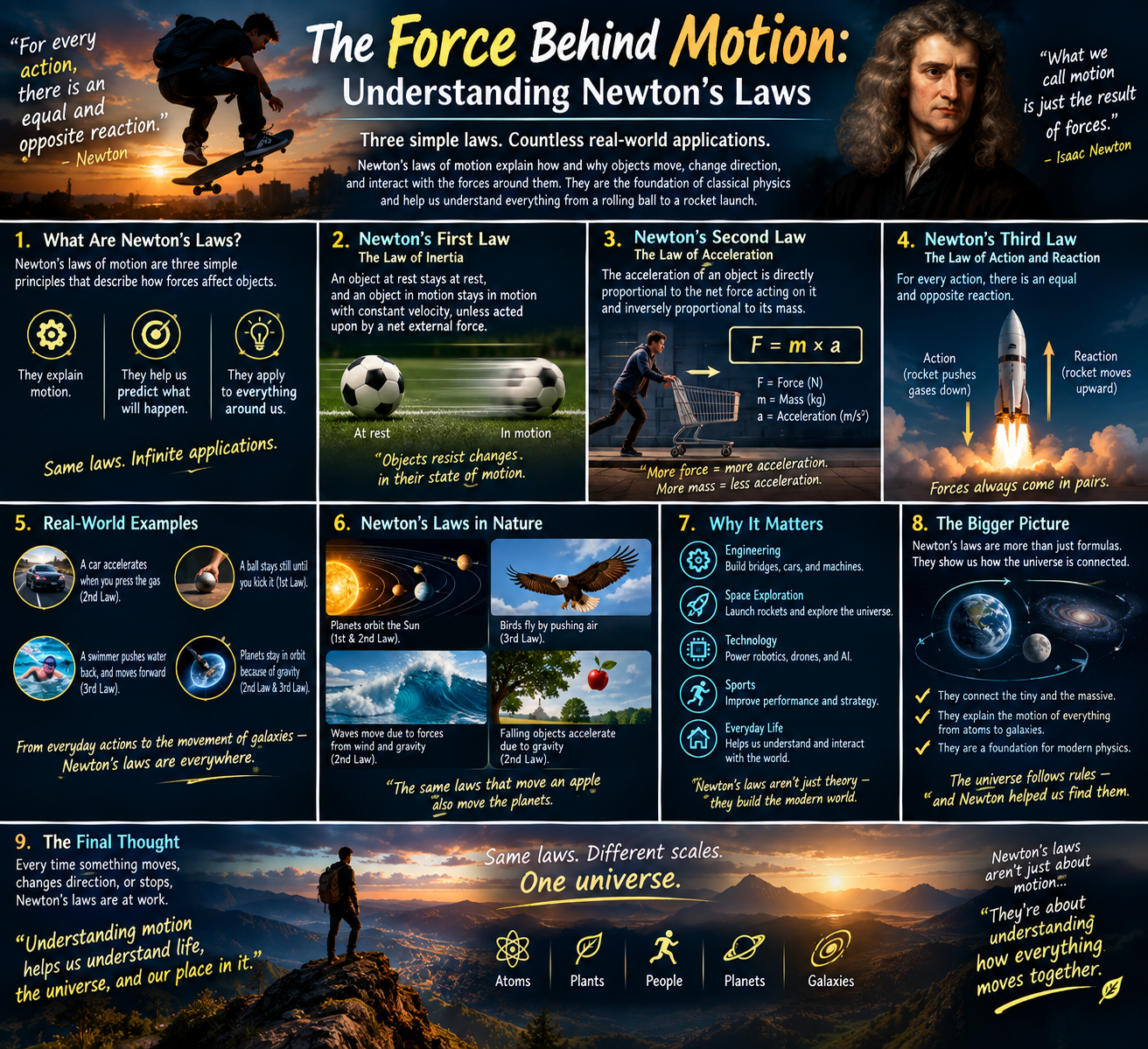
    # The Force Behind Motion: Understanding Newton’s Laws

    Imagine watching a football fly through the air , a car accelerate down a road , a rocket launch into space , or planets orbiting a star .

    These events may appear completely different—but beneath them is the same fundamental idea:

    ## **Forces control motion.**

    More than three centuries ago, **Isaac Newton** developed three laws that transformed our understanding of how objects move and interact. These laws became the foundation of classical mechanics and remain essential to physics, engineering, astronomy, and countless technologies today.

    ---

    # 1. What Are Newton's Laws?

    Newton's three laws describe the relationship between:

    **Force**
    **Mass**
    **Acceleration**
    **Motion**

    Together, they help us explain why objects remain still, why they accelerate, and how forces interact.

    From a rolling ball to a spacecraft , the same fundamental principles apply.

    ### **Three simple laws. Infinite applications.**

    ---

    # 2. Newton's First Law — The Law of Inertia

    Newton's First Law states that an object at rest remains at rest, while an object in motion continues moving at constant velocity unless acted upon by a net external force.

    This property is called **inertia**.

    Imagine a football sitting on the ground.

    It stays there until you kick it.

    Once moving, it won't naturally change its motion unless another force acts on it—such as friction, air resistance, or another object.

    A car requires braking to stop.
    A ball slows because of friction.
    Objects in space can continue moving with very little resistance.

    ### **Objects resist changes in their state of motion.**

    ---

    # 3. Newton's Second Law — The Law of Acceleration

    The second law explains how force changes motion.

    Its famous equation is:

    # **F = m × a**

    Where:

    **F** = Force
    **m** = Mass
    **a** = Acceleration

    This means that increasing the net force on an object generally increases its acceleration, while increasing the object's mass makes the same force produce less acceleration.

    Imagine pushing an empty shopping cart .

    It accelerates easily.

    Now fill it with heavy objects.

    The same push produces less acceleration.

    ### **More net force → more acceleration.**

    ### **More mass → less acceleration for the same force.**

    This simple relationship powers everything from vehicle design to rocket engineering .

    ---

    # 4. Newton's Third Law — Action and Reaction

    Newton's Third Law states:

    ### **For every action, there is an equal and opposite reaction.**

    Forces always occur through interactions between objects.

    Consider a rocket.

    The engine pushes hot gases downward and backward.

    The gases exert an equal and opposite force on the rocket, pushing it upward.

    The same principle appears everywhere:

    A swimmer pushes water backward → the water pushes the swimmer forward.
    A bird pushes air downward → the air helps push the bird upward.
    You push the ground backward → the ground pushes you forward.

    ### **Forces come in pairs.**

    ---

    # 5. Newton's Laws in Everyday Life

    You don't need a laboratory to see Newton's laws.

    They are happening around you constantly.

    **Cars:** Engine force changes speed and direction.
    **Sports:** Kicking a ball changes its motion.
    **Swimming:** Pushing water creates forward motion.
    **Cycling:** Pedaling produces forces that accelerate the bicycle.
    **Falling objects:** Gravity changes their motion.
    **Skateboards:** Pushing against the ground creates movement.

    Everyday motion is essentially a continuous interaction between forces.

    ---

    # 6. Newton's Laws in Nature

    Newton's laws don't stop at Earth.

    They also help describe motion throughout the universe.

    Planets orbit stars.
    Moons orbit planets.
    Comets travel through space.
    Waves respond to forces.
    Birds generate lift through interactions with air.
    Objects accelerate under gravity.

    The same physics that explains a falling apple can help describe the motion of enormous celestial bodies.

    ### **From apples to planets, the same laws operate across nature.**

    ---

    # 7. Why Newton's Laws Matter

    Newton's laws are more than equations in a textbook.

    They are essential tools for understanding and designing the physical world.

    **Engineering** — bridges, buildings, vehicles, and machines
    **Space exploration** — rockets, spacecraft, and orbital motion
    **Technology** — robots, drones, and automated systems
    **Sports science** — movement, speed, and performance
    **Transportation** — cars, aircraft, and trains

    Modern technology depends heavily on our ability to predict how forces produce motion.

    ---

    # 8. The Bigger Picture

    Newton's laws reveal something remarkable:

    The universe is not simply a collection of random movements.

    Objects interact through measurable forces.

    From microscopic particles to massive planets and galaxies , physics provides mathematical relationships that help us understand motion.

    The scale may change.

    The objects may change.

    But the underlying principles remain incredibly powerful.

    ### **Tiny or massive. Fast or slow. Earth or space. Motion follows physical laws.**

    ---

    # 9. The Final Thought

    Every time something moves…

    Every time something accelerates…

    Every time something changes direction…

    **Newton's laws are there.**

    A skateboard rolling down a street
    A bird taking flight
    A rocket leaving Earth
    A planet orbiting the Sun

    Different events.

    Different scales.

    One underlying framework.

    ## **Same laws. Different scales. One universe.**

    Understanding motion isn't just about solving equations.

    It's about understanding **how the physical world moves, interacts, and holds together.**

    ### **Once you understand the forces behind motion, the world around you begins to move in a whole new way.**


    Asma Shaheen EducationWali
    Saima Empowerment Wali
    Mishaal TrainingWali
    #rsisb Roll No 253 Foundation Level Story Post 23 # ⚡🌌 The Force Behind Motion: Understanding Newton’s Laws Imagine watching a football fly through the air ⚽, a car accelerate down a road 🚗💨, a rocket launch into space 🚀, or planets orbiting a star 🪐✨. These events may appear completely different—but beneath them is the same fundamental idea: ## **Forces control motion.** ⚡🧲 More than three centuries ago, **Isaac Newton** developed three laws that transformed our understanding of how objects move and interact. These laws became the foundation of classical mechanics and remain essential to physics, engineering, astronomy, and countless technologies today. 🔬⚙️🌍 --- # 🧠⚡ 1. What Are Newton's Laws? Newton's three laws describe the relationship between: ⚡ **Force** 🧱 **Mass** 💨 **Acceleration** 🏃 **Motion** Together, they help us explain why objects remain still, why they accelerate, and how forces interact. From a rolling ball 🎾 to a spacecraft 🚀, the same fundamental principles apply. ### **Three simple laws. Infinite applications.** 🌌 --- # 🛑➡️ 2. Newton's First Law — The Law of Inertia Newton's First Law states that an object at rest remains at rest, while an object in motion continues moving at constant velocity unless acted upon by a net external force. This property is called **inertia**. 🧱⚡ Imagine a football sitting on the ground. ⚽ It stays there until you kick it. Once moving, it won't naturally change its motion unless another force acts on it—such as friction, air resistance, or another object. 🚗 A car requires braking to stop. ⚽ A ball slows because of friction. 🛰️ Objects in space can continue moving with very little resistance. ### **Objects resist changes in their state of motion.** --- # 💨⚙️ 3. Newton's Second Law — The Law of Acceleration The second law explains how force changes motion. Its famous equation is: # **F = m × a** ⚡ Where: **F** = Force 🧲 **m** = Mass ⚖️ **a** = Acceleration 💨 This means that increasing the net force on an object generally increases its acceleration, while increasing the object's mass makes the same force produce less acceleration. Imagine pushing an empty shopping cart 🛒. It accelerates easily. Now fill it with heavy objects. The same push produces less acceleration. ### **More net force → more acceleration.** ### **More mass → less acceleration for the same force.** This simple relationship powers everything from vehicle design 🚗 to rocket engineering 🚀. --- # 🚀🔥 4. Newton's Third Law — Action and Reaction Newton's Third Law states: ### **For every action, there is an equal and opposite reaction.** ⚡ Forces always occur through interactions between objects. Consider a rocket. 🚀 The engine pushes hot gases downward and backward. The gases exert an equal and opposite force on the rocket, pushing it upward. ⬆️🔥 The same principle appears everywhere: 🏊 A swimmer pushes water backward → the water pushes the swimmer forward. 🦅 A bird pushes air downward → the air helps push the bird upward. 🚶 You push the ground backward → the ground pushes you forward. ### **Forces come in pairs.** 🔗⚡ --- # 🌍⚽ 5. Newton's Laws in Everyday Life You don't need a laboratory to see Newton's laws. They are happening around you constantly. 🚗 **Cars:** Engine force changes speed and direction. ⚽ **Sports:** Kicking a ball changes its motion. 🏊 **Swimming:** Pushing water creates forward motion. 🚲 **Cycling:** Pedaling produces forces that accelerate the bicycle. 🍎 **Falling objects:** Gravity changes their motion. 🛹 **Skateboards:** Pushing against the ground creates movement. Everyday motion is essentially a continuous interaction between forces. --- # 🌌🪐 6. Newton's Laws in Nature Newton's laws don't stop at Earth. They also help describe motion throughout the universe. 🌌 🪐 Planets orbit stars. 🌙 Moons orbit planets. ☄️ Comets travel through space. 🌊 Waves respond to forces. 🦅 Birds generate lift through interactions with air. 🍎 Objects accelerate under gravity. The same physics that explains a falling apple can help describe the motion of enormous celestial bodies. ### **From apples to planets, the same laws operate across nature.** 🍎➡️🪐 --- # ⚙️🚀 7. Why Newton's Laws Matter Newton's laws are more than equations in a textbook. They are essential tools for understanding and designing the physical world. 🏗️ **Engineering** — bridges, buildings, vehicles, and machines 🚀 **Space exploration** — rockets, spacecraft, and orbital motion 🤖 **Technology** — robots, drones, and automated systems 🏃 **Sports science** — movement, speed, and performance 🚗 **Transportation** — cars, aircraft, and trains Modern technology depends heavily on our ability to predict how forces produce motion. --- # 🌌🔭 8. The Bigger Picture Newton's laws reveal something remarkable: The universe is not simply a collection of random movements. Objects interact through measurable forces. ⚛️🧲 From microscopic particles 🔬 to massive planets 🪐 and galaxies 🌌, physics provides mathematical relationships that help us understand motion. The scale may change. The objects may change. But the underlying principles remain incredibly powerful. ### **Tiny or massive. Fast or slow. Earth or space. Motion follows physical laws.** ⚡🌍🌌 --- # 🌅⚡ 9. The Final Thought Every time something moves… Every time something accelerates… Every time something changes direction… **Newton's laws are there.** 🧠⚡ A skateboard rolling down a street 🛹 A bird taking flight 🦅 A rocket leaving Earth 🚀 A planet orbiting the Sun ☀️🪐 Different events. Different scales. One underlying framework. ## 🌌 **Same laws. Different scales. One universe.** Understanding motion isn't just about solving equations. It's about understanding **how the physical world moves, interacts, and holds together.** ⚛️🌍✨ ### **Once you understand the forces behind motion, the world around you begins to move in a whole new way.** ⚡🔬🌌 Asma Shaheen EducationWali Saima Empowerment Wali Mishaal TrainingWali

    0 Comentários 0 Compartilhamentos 78 Visualizações
  • #rsisb
    Roll no.247
    ChatGPT iamge .2
    Foundation level

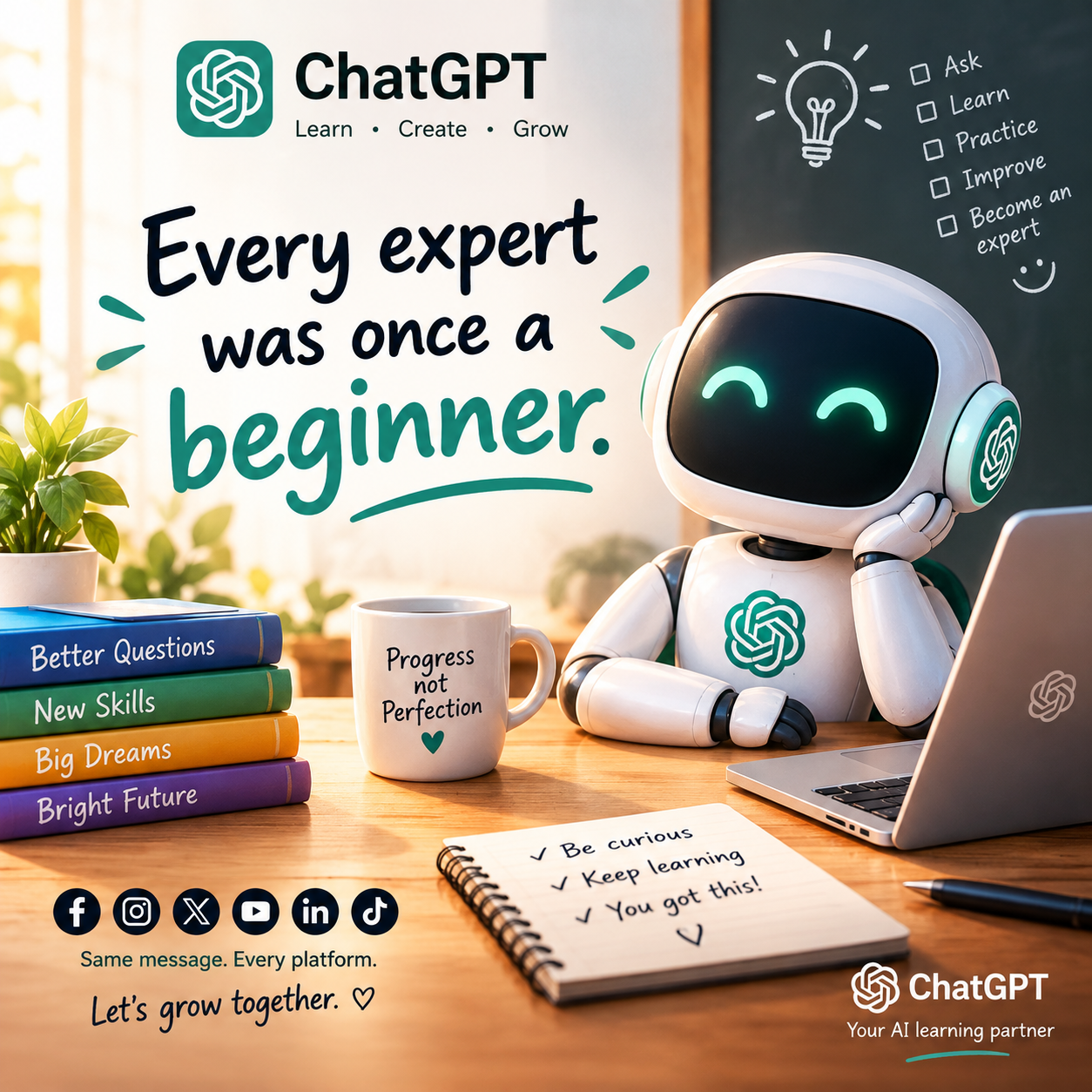
    **Every expert was once a beginner.**

    Behind every great achievement is a first step. No one starts as an expert—people learn, practice, make mistakes, ask questions, and keep going.

    This post is a reminder that learning takes time. Whether you are learning a new language, creating content, studying something new, improving your skills, or chasing a dream, every small effort matters.

    Don’t be afraid to start from zero. Your first attempt may not be perfect, and that’s completely okay. Every mistake can teach you something, every challenge can make you stronger, and every new experience can bring you closer to your goals.

    Believe in the process, stay curious, keep practicing, and never compare your beginning with someone else’s finished journey.

    Today you may be a beginner. Tomorrow, you could inspire someone else with how far you’ve come.

    **Start learning. Keep growing. Never stop believing in yourself!**

    **Share this message across your favorite platforms and inspire someone who is just beginning their journey.**

    #EveryExpertWasOnceABeginner #Beginner #Learning #GrowthMindset #KeepLearning #NeverGiveUp #Motivation #Inspiration #Success #SelfImprovement #Education #PracticeMakesProgress #DreamBig #BelieveInYourself #KeepGrowing #PositiveMindset #NewBeginnings #PersonalGrowth #LearningJourney #ChatGPT
    #rsisb Roll no.247 ChatGPT iamge .2 Foundation level 🌟 **Every expert was once a beginner.** 🌱✨ Behind every great achievement is a first step. No one starts as an expert—people learn, practice, make mistakes, ask questions, and keep going. 💡📚 This post is a reminder that learning takes time. Whether you are learning a new language, creating content, studying something new, improving your skills, or chasing a dream, every small effort matters. 🚀🌍 Don’t be afraid to start from zero. Your first attempt may not be perfect, and that’s completely okay. Every mistake can teach you something, every challenge can make you stronger, and every new experience can bring you closer to your goals. 💪✨ Believe in the process, stay curious, keep practicing, and never compare your beginning with someone else’s finished journey. 🌈📖 Today you may be a beginner. Tomorrow, you could inspire someone else with how far you’ve come. ⭐🏆 **Start learning. Keep growing. Never stop believing in yourself!** 🌱➡️🌟 📱 **Share this message across your favorite platforms and inspire someone who is just beginning their journey.** ❤️ #EveryExpertWasOnceABeginner #Beginner #Learning #GrowthMindset #KeepLearning #NeverGiveUp #Motivation #Inspiration #Success #SelfImprovement #Education #PracticeMakesProgress #DreamBig #BelieveInYourself #KeepGrowing #PositiveMindset #NewBeginnings #PersonalGrowth #LearningJourney #ChatGPT 🤖✨
    0 Comentários 0 Compartilhamentos 40 Visualizações
  • #rsisb
    Roll No 253
    Foundation Level
    Story Post 24

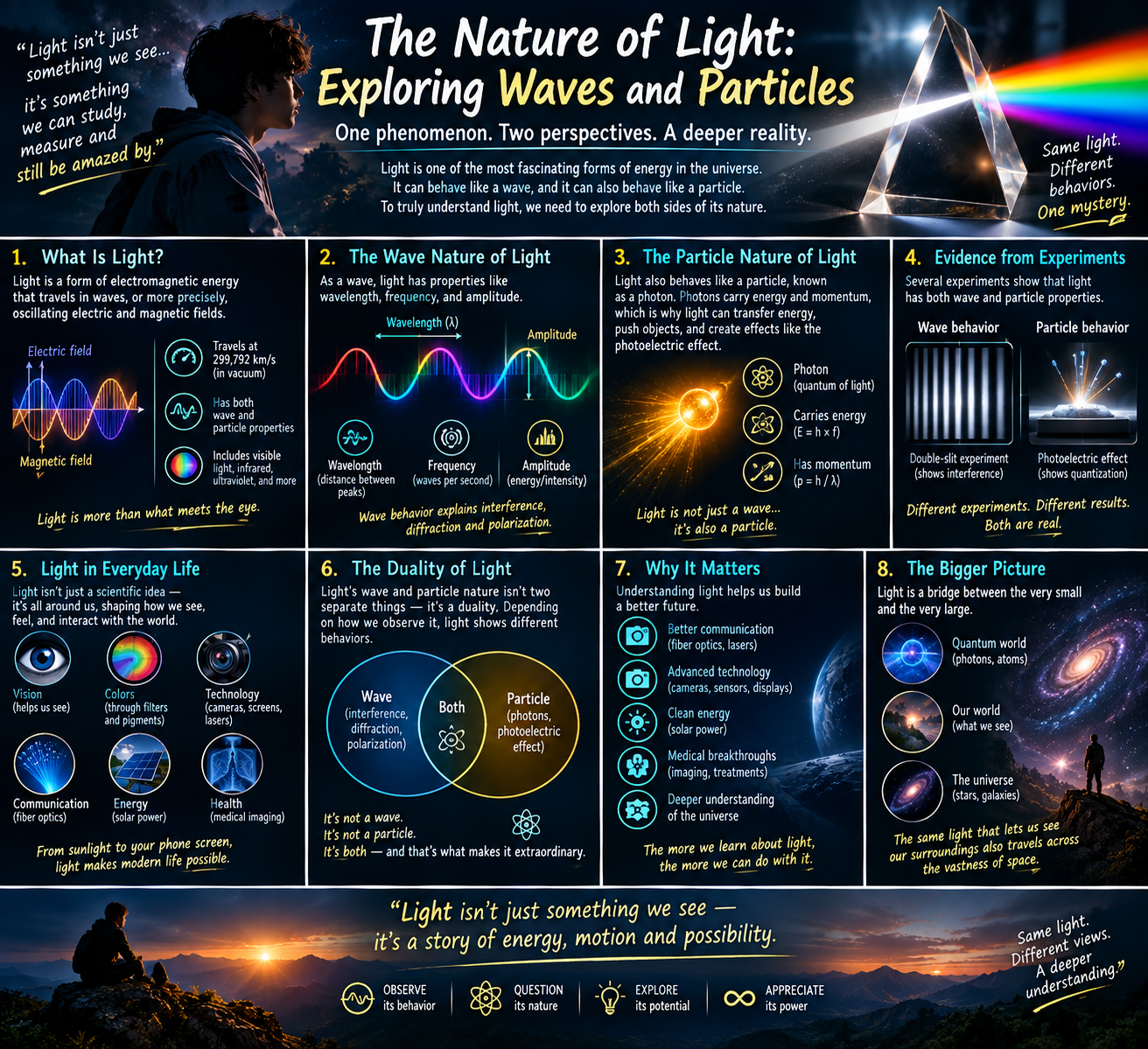
    # The Nature of Light: Exploring Waves and Particles

    Imagine standing beneath a night sky filled with stars.

    Every photon reaching your eyes has traveled across space carrying information from distant worlds. Light allows us to see, measure, communicate, explore, and understand the universe itself.

    But light is far stranger than it first appears.

    Sometimes it behaves like a **wave** .

    Sometimes it behaves like a **particle** .

    And understanding this strange dual nature changed our picture of reality forever.

    ---

    # 1. What Is Light?

    Light is a form of **electromagnetic radiation**—energy carried through oscillating electric and magnetic fields.

    In empty space, electromagnetic waves travel at approximately:

    ### **299,792 kilometers per second**

    That's the speed of light in vacuum.

    Visible light is only a small part of the electromagnetic spectrum.

    Beyond what our eyes can see are:

    Radio waves
    Microwaves
    Infrared
    Visible light
    Ultraviolet
    🩻 X-rays
    Gamma rays

    So light isn't simply what we see.

    ### **It's an enormous family of electromagnetic phenomena.**

    ---

    # 2. The Wave Nature of Light

    When light behaves as a wave, we can describe it using several important properties:

    **Wavelength** — the distance between successive wave peaks
    **Frequency** — how many oscillations occur each second
    **Amplitude** — related to the wave's intensity

    These properties help explain many familiar phenomena.

    **Interference** occurs when waves combine.
    **Diffraction** occurs when waves spread around openings or obstacles.
    **Polarization** describes the orientation of electromagnetic oscillations.

    The wave model explains behaviors that are difficult to understand if we imagine light only as tiny particles.

    ---

    # 3. The Particle Nature of Light

    But the story doesn't end there.

    Light can also behave as if it arrives in discrete packets of energy called **photons**.

    A photon is a quantum of electromagnetic radiation.

    Its energy is related to frequency:

    ### **E = h × f**

    And its momentum is related to its wavelength:

    ### **p = h / λ**

    This particle-like behavior helps explain phenomena such as the **photoelectric effect**, where light can transfer energy to electrons.

    So light isn't simply a smooth continuous wave.

    At the quantum level, energy can be exchanged in discrete amounts.

    ### **Light has another side—and it's quantum.**

    ---

    # 4. Evidence From Experiments

    The strange nature of light isn't merely philosophical.

    Experiments demonstrate it.

    ### Double-Slit Experiment

    When light passes through two narrow openings, an **interference pattern** can appear—strong evidence of wave-like behavior.

    ### Photoelectric Effect

    When light strikes certain materials, it can eject electrons. This behavior is explained using photons and quantized energy.

    Different experiments reveal different aspects of light.

    And that's one of the most fascinating things about physics:

    ### **The same phenomenon can reveal different behaviors depending on how we investigate it.**

    ---

    # 5. Light in Everyday Life

    Light isn't something that exists only inside physics laboratories.

    It's everywhere.

    **Vision** — allows us to see the world
    **Colors** — arise from how different wavelengths interact with matter
    **Cameras** — convert light into images
    **Screens** — produce controlled patterns of light
    **Fiber optics** — carry information using light
    **Solar panels** — convert light energy into electrical energy
    🩻 **Medical imaging** — uses electromagnetic radiation to see inside the body

    From sunrise to smartphone screens…

    ### **Modern civilization depends heavily on our ability to control light.**

    ---

    # 6. The Duality of Light

    Here lies the great mystery.

    Light can display **wave-like behavior**

    and

    **particle-like behavior** .

    This is known as **wave-particle duality**.

    It's important to understand that this doesn't mean light is literally switching between being a classical wave and a classical particle like two separate objects.

    Instead, quantum physics gives us a deeper framework in which classical wave and particle descriptions each capture different aspects of light's behavior.

    ### **Two perspectives. One quantum reality.**

    ---

    # 7. Why Understanding Light Matters

    Learning how light behaves has transformed technology.

    **Communication** — fiber-optic networks
    **Science** — spectroscopy and microscopy
    **Imaging** — cameras and sensors
    **Energy** — solar technology
    **Medicine** — lasers and diagnostic imaging
    **Astronomy** — studying distant stars and galaxies

    When astronomers observe light from a distant star, they aren't simply seeing brightness.

    They can analyze the light's wavelengths and learn about the star's:

    Temperature
    Chemical composition
    Motion
    Environment

    ### **Light carries information across space.**

    ---

    # 8. The Bigger Picture

    Light connects the microscopic and the cosmic.

    At the quantum scale, photons interact with atoms and electrons.

    At human scales, light allows us to see and communicate.

    Across astronomical distances, light travels from stars and galaxies to our telescopes.

    In many ways, light is our messenger from the universe.

    When we look at a distant galaxy, we are receiving photons that may have traveled for millions or billions of years before reaching Earth.

    ### **Looking at the universe means looking at ancient light.**

    ---

    # The Final Thought

    Light is more than something that illuminates a room.

    It is energy.
    It is information.
    It is electromagnetic radiation.
    It has quantum behavior.
    And it is one of the most important tools we have for exploring reality.

    From a photon interacting with an electron…

    to sunlight crossing space…

    to the glow of a distant galaxy…

    ### **Light connects the smallest scales of nature with the largest.**

    So the next time you see sunlight streaming through a window , a rainbow , or stars shining overhead , remember:

    **You aren't simply seeing light.**

    You're witnessing one of the universe's most fascinating mysteries—a phenomenon that behaves in ways far stranger and more beautiful than our everyday experience suggests.

    # **Light isn't just something we see—it's a story of energy, motion, information, and possibility.** ∞


    Asma Shaheen EducationWali
    Saima Empowerment Wali
    Mishaal TrainingWali

    #rsisb Roll No 253 Foundation Level Story Post 24 # 🌈⚡ The Nature of Light: Exploring Waves and Particles Imagine standing beneath a night sky filled with stars. 🌌✨ Every photon reaching your eyes has traveled across space carrying information from distant worlds. Light allows us to see, measure, communicate, explore, and understand the universe itself. 🔭👁️📡 But light is far stranger than it first appears. Sometimes it behaves like a **wave** 🌊. Sometimes it behaves like a **particle** ⚛️. And understanding this strange dual nature changed our picture of reality forever. 🧠🌌 --- # 💡🌌 1. What Is Light? Light is a form of **electromagnetic radiation**—energy carried through oscillating electric and magnetic fields. ⚡🧲 In empty space, electromagnetic waves travel at approximately: ### 🚀 **299,792 kilometers per second** That's the speed of light in vacuum. Visible light 👁️🌈 is only a small part of the electromagnetic spectrum. Beyond what our eyes can see are: 📻 Radio waves 📡 Microwaves 🔥 Infrared 🌈 Visible light ☀️ Ultraviolet 🩻 X-rays ☢️ Gamma rays So light isn't simply what we see. ### **It's an enormous family of electromagnetic phenomena.** 🌌⚡ --- # 🌊🔬 2. The Wave Nature of Light When light behaves as a wave, we can describe it using several important properties: 〰️ **Wavelength** — the distance between successive wave peaks ⚡ **Frequency** — how many oscillations occur each second 📈 **Amplitude** — related to the wave's intensity These properties help explain many familiar phenomena. 🌈 **Interference** occurs when waves combine. 🔍 **Diffraction** occurs when waves spread around openings or obstacles. 🕶️ **Polarization** describes the orientation of electromagnetic oscillations. The wave model explains behaviors that are difficult to understand if we imagine light only as tiny particles. --- # ⚛️✨ 3. The Particle Nature of Light But the story doesn't end there. Light can also behave as if it arrives in discrete packets of energy called **photons**. ⚛️💡 A photon is a quantum of electromagnetic radiation. Its energy is related to frequency: ### **E = h × f** ⚡ And its momentum is related to its wavelength: ### **p = h / λ** 🌊⚛️ This particle-like behavior helps explain phenomena such as the **photoelectric effect**, where light can transfer energy to electrons. So light isn't simply a smooth continuous wave. At the quantum level, energy can be exchanged in discrete amounts. ### **Light has another side—and it's quantum.** 🌌⚛️ --- # 🧪🔍 4. Evidence From Experiments The strange nature of light isn't merely philosophical. Experiments demonstrate it. ### 🌊 Double-Slit Experiment When light passes through two narrow openings, an **interference pattern** can appear—strong evidence of wave-like behavior. 🌊〰️ ### ⚡ Photoelectric Effect When light strikes certain materials, it can eject electrons. This behavior is explained using photons and quantized energy. ⚛️🔋 Different experiments reveal different aspects of light. And that's one of the most fascinating things about physics: ### **The same phenomenon can reveal different behaviors depending on how we investigate it.** 🔬✨ --- # 👁️🌈 5. Light in Everyday Life Light isn't something that exists only inside physics laboratories. It's everywhere. 🌍☀️ 👁️ **Vision** — allows us to see the world 🌈 **Colors** — arise from how different wavelengths interact with matter 📷 **Cameras** — convert light into images 📱 **Screens** — produce controlled patterns of light 🌐 **Fiber optics** — carry information using light ☀️ **Solar panels** — convert light energy into electrical energy 🩻 **Medical imaging** — uses electromagnetic radiation to see inside the body From sunrise to smartphone screens… ### **Modern civilization depends heavily on our ability to control light.** 💡🌍 --- # 🌊⚛️ 6. The Duality of Light Here lies the great mystery. Light can display **wave-like behavior** 🌊 and **particle-like behavior** ⚛️. This is known as **wave-particle duality**. It's important to understand that this doesn't mean light is literally switching between being a classical wave and a classical particle like two separate objects. Instead, quantum physics gives us a deeper framework in which classical wave and particle descriptions each capture different aspects of light's behavior. ### **Two perspectives. One quantum reality.** 🌌✨ --- # 🚀🔬 7. Why Understanding Light Matters Learning how light behaves has transformed technology. 📡 **Communication** — fiber-optic networks 🔬 **Science** — spectroscopy and microscopy 📷 **Imaging** — cameras and sensors ☀️ **Energy** — solar technology 🩺 **Medicine** — lasers and diagnostic imaging 🚀 **Astronomy** — studying distant stars and galaxies When astronomers observe light from a distant star, they aren't simply seeing brightness. They can analyze the light's wavelengths and learn about the star's: 🌡️ Temperature 🧪 Chemical composition 💨 Motion 🌌 Environment ### **Light carries information across space.** --- # 🌌🔭 8. The Bigger Picture Light connects the microscopic and the cosmic. At the quantum scale, photons interact with atoms and electrons. ⚛️🔬 At human scales, light allows us to see and communicate. 👁️📱 Across astronomical distances, light travels from stars and galaxies to our telescopes. 🌟🔭 In many ways, light is our messenger from the universe. When we look at a distant galaxy, we are receiving photons that may have traveled for millions or billions of years before reaching Earth. 🌌⏳ ### **Looking at the universe means looking at ancient light.** ✨ --- # 🌅💡 The Final Thought Light is more than something that illuminates a room. It is energy. ⚡ It is information. 📡 It is electromagnetic radiation. 🌊 It has quantum behavior. ⚛️ And it is one of the most important tools we have for exploring reality. 🔭 From a photon interacting with an electron… to sunlight crossing space… to the glow of a distant galaxy… ### **Light connects the smallest scales of nature with the largest.** 🌌⚛️ So the next time you see sunlight streaming through a window ☀️, a rainbow 🌈, or stars shining overhead ⭐, remember: **You aren't simply seeing light.** You're witnessing one of the universe's most fascinating mysteries—a phenomenon that behaves in ways far stranger and more beautiful than our everyday experience suggests. 🌊⚛️✨ # 🌈🌌 **Light isn't just something we see—it's a story of energy, motion, information, and possibility.** ⚡🔬∞ Asma Shaheen EducationWali Saima Empowerment Wali Mishaal TrainingWali

    0 Comentários 0 Compartilhamentos 55 Visualizações