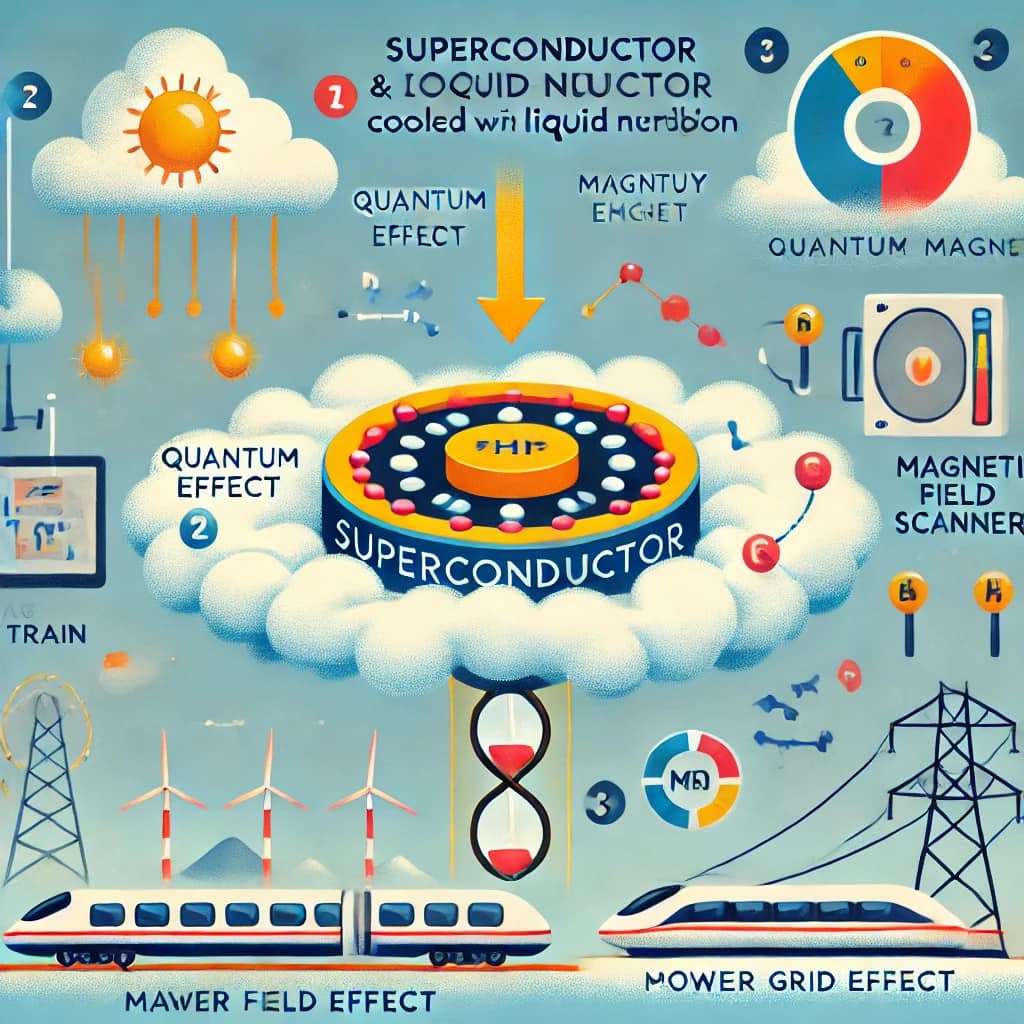
1. What is a Superconductor?
A superconductor is like a super special material. When it gets REALLY cold, it becomes magical—it lets electricity flow through it without wasting any energy. Imagine a perfect slide that never slows you down, no matter how long it is!
But here’s the fun part: superconductors also have a weird relationship with magnets. They don’t like magnets inside them, so they push the magnets away and can even make them float in the air. This floating magic is called quantum levitation.
2. How Cold is SUPER Cold?
To make a superconductor work, you need to make it super cold—much colder than anything we see on Earth. Scientists use special super cold liquids to do this:
• Liquid nitrogen makes things as cold as -196°C (or 77 Kelvin). That’s 100 times colder than your freezer!
• For some superconductors, like niobium, you need liquid helium, which is even colder at -269°C (or 4 Kelvin)—colder than outer space!
When a material gets this cold, something magical happens inside it—it becomes a superconductor.
3. What Happens When It Gets Super Cold?
When a material like Yttrium Barium Copper Oxide (YBCO) is cooled with liquid nitrogen, here’s what happens:
1. Zero Resistance:
Electricity flows perfectly through it, like water rushing through a super smooth pipe. No energy is lost, and nothing slows it down!
2. Pushing Magnets Away:
Superconductors don’t let magnets into their space. If you bring a magnet close, the superconductor creates tiny electric currents on its surface that cancel out the magnetic field inside. This “pushing away” of the magnetic field is called the Meissner Effect.
3. Floating and Locking:
When you place a magnet near the superconductor, the magnetic field gets “stuck” in a very specific way. This makes the magnet float in the air (quantum levitation) and even stay locked in one position, as if it’s frozen in place (quantum locking). It’s like an invisible hand is holding the magnet up!
4. Examples of Superconductors
Here are some materials that can become superconductors when cooled:
• Yttrium Barium Copper Oxide (YBCO): Works at -196°C with liquid nitrogen.
• Niobium: Needs to be even colder, at -269°C, using liquid helium.
• Lead and Mercury: Metals that also become superconductors when super cold.
5. Why is This So Cool?
Because of these magical properties, scientists use superconductors to make things like floating trains (called maglev trains), super powerful magnets, and even futuristic energy systems.
6. Three Real-Life Uses of Superconductors
1. Maglev Trains:
Superconductors are used in magnetic levitation (maglev) trains, which float above the tracks using magnets. These trains are super fast because there’s no friction from wheels. For example, Japan’s maglev train can travel over 600 km/h!
2. MRI Machines:
Superconductors power the strong magnets inside MRI scanners in hospitals. These magnets help doctors see inside your body to check for injuries or illnesses without surgery.
3. Power Grids:
Superconducting wires are being tested for electricity grids. Since they don’t lose energy, they can carry huge amounts of power over long distances without wasting any electricity. This could make energy cheaper and cleaner in the future.
Fun Example:
Imagine pouring liquid nitrogen onto a superconductor like YBCO. It looks like a misty white cloud because the nitrogen turns into gas. When you place a magnet on top, the magnet starts to float, and you can spin it or move it around in the air. It’s like seeing real-life magic, but it’s all science!
So, superconductors are super cool because they need to be super cold, and that’s what makes them work their magic, like floating magnets, perfect electricity, and even saving lives in hospitals. Science can be pretty awesome!