


#rsisb
Roll no.279
story post no.7
Foundation Level
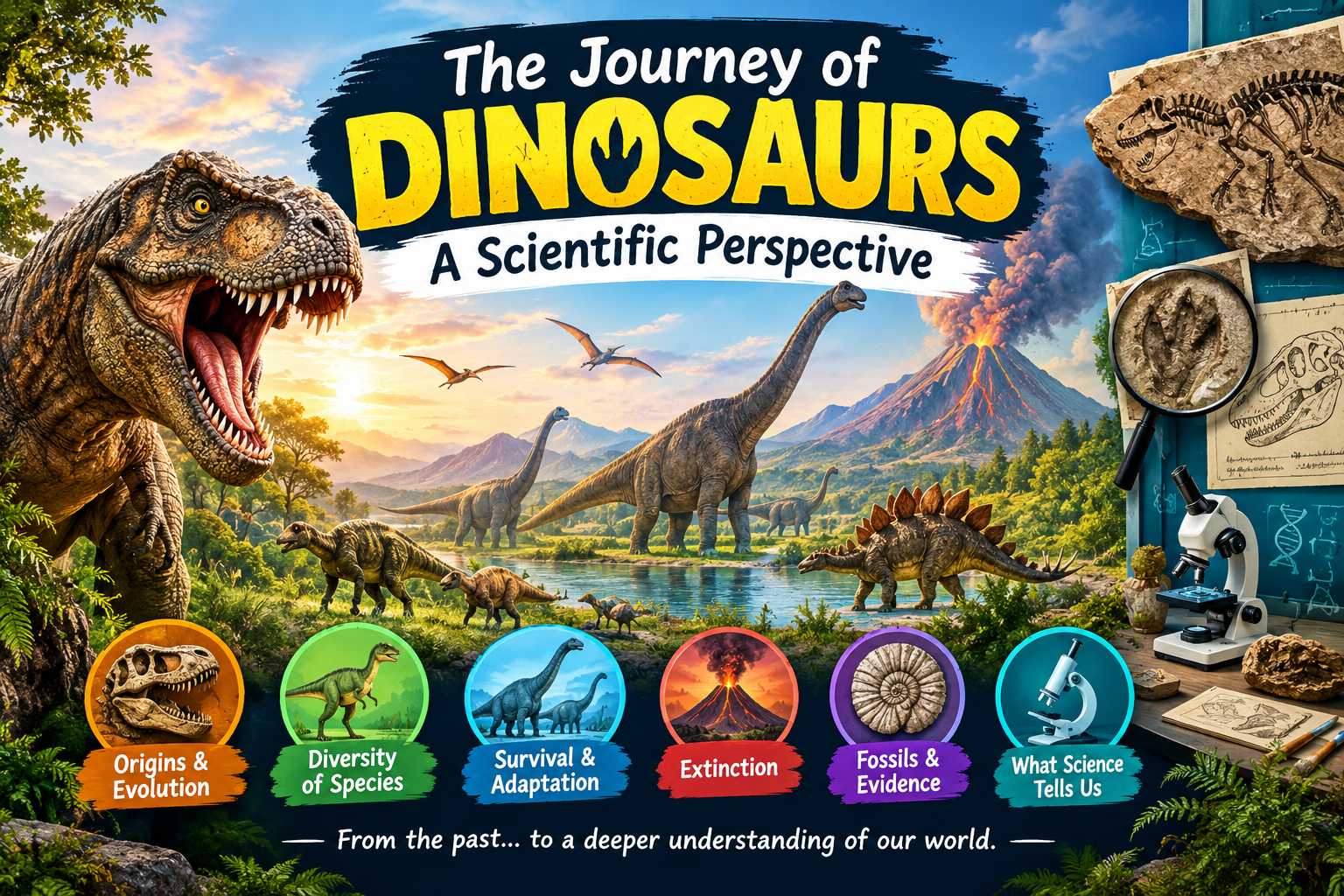
# The Journey of Dinosaurs: A Scientific Perspective
Long before humans walked on Earth, dinosaurs ruled many parts of our planet. Their story began more than 230 million years ago during the **Triassic Period**. At first, dinosaurs were relatively small and not the dominant animals everywhere. But over millions of years, they evolved into an incredible variety of species.
During the **Jurassic Period**, dinosaurs became much more diverse. Huge plant-eaters such as long-necked sauropods lived alongside powerful predators. Some dinosaurs walked on two legs, while others used four. Scientists believe their different body shapes and behaviors helped them survive in changing environments.
Then came the **Cretaceous Period**, when dinosaurs continued to evolve and spread across the world. Dinosaurs developed feathers, horns, armor, and many other fascinating features. Some were tiny, while others were enormous! Scientists learn about these animals by studying fossils, footprints, teeth, bones, and even preserved impressions.
About **66 million years ago**, a massive asteroid struck Earth near what is now Mexico. The impact caused dramatic environmental changes, and many species disappeared. This event marked the end of the non-avian dinosaurs. However, their story did not completely end!
Modern birds are scientifically recognized as living dinosaurs. This means that when we see birds today, we are seeing a surviving branch of the dinosaur family tree.
Today, paleontologists continue searching for fossils and studying ancient rocks to understand how dinosaurs lived, evolved, and disappeared. Every new fossil can reveal another piece of Earth's incredible history.
The journey of dinosaurs teaches us an important lesson: **life on Earth is constantly changing, and evolution can produce extraordinary forms of life.**
**From ancient footprints to modern birds, the story of dinosaurs is still being discovered!**
#Dinosaurs #DinosaurJourney #Science #Paleontology #Evolution #Fossils #AncientEarth #Learning #HistoryOfEarth
Asma Shaheen EducationWali
Saima Happinesswali
Irum Asim
Roll no.279
story post no.7
Foundation Level
# The Journey of Dinosaurs: A Scientific Perspective
Long before humans walked on Earth, dinosaurs ruled many parts of our planet. Their story began more than 230 million years ago during the **Triassic Period**. At first, dinosaurs were relatively small and not the dominant animals everywhere. But over millions of years, they evolved into an incredible variety of species.
During the **Jurassic Period**, dinosaurs became much more diverse. Huge plant-eaters such as long-necked sauropods lived alongside powerful predators. Some dinosaurs walked on two legs, while others used four. Scientists believe their different body shapes and behaviors helped them survive in changing environments.
Then came the **Cretaceous Period**, when dinosaurs continued to evolve and spread across the world. Dinosaurs developed feathers, horns, armor, and many other fascinating features. Some were tiny, while others were enormous! Scientists learn about these animals by studying fossils, footprints, teeth, bones, and even preserved impressions.
About **66 million years ago**, a massive asteroid struck Earth near what is now Mexico. The impact caused dramatic environmental changes, and many species disappeared. This event marked the end of the non-avian dinosaurs. However, their story did not completely end!
Modern birds are scientifically recognized as living dinosaurs. This means that when we see birds today, we are seeing a surviving branch of the dinosaur family tree.
Today, paleontologists continue searching for fossils and studying ancient rocks to understand how dinosaurs lived, evolved, and disappeared. Every new fossil can reveal another piece of Earth's incredible history.
The journey of dinosaurs teaches us an important lesson: **life on Earth is constantly changing, and evolution can produce extraordinary forms of life.**
**From ancient footprints to modern birds, the story of dinosaurs is still being discovered!**
#Dinosaurs #DinosaurJourney #Science #Paleontology #Evolution #Fossils #AncientEarth #Learning #HistoryOfEarth
Asma Shaheen EducationWali
Saima Happinesswali
Irum Asim
#rsisb
Roll no.279
story post no.7
Foundation Level
# 🦖 The Journey of Dinosaurs: A Scientific Perspective 🌍
Long before humans walked on Earth, dinosaurs ruled many parts of our planet. 🌎✨ Their story began more than 230 million years ago during the **Triassic Period**. At first, dinosaurs were relatively small and not the dominant animals everywhere. 🦕🌿 But over millions of years, they evolved into an incredible variety of species.
During the **Jurassic Period**, dinosaurs became much more diverse. 🌳🦕 Huge plant-eaters such as long-necked sauropods lived alongside powerful predators. 🦖🌿 Some dinosaurs walked on two legs, while others used four. Scientists believe their different body shapes and behaviors helped them survive in changing environments.
Then came the **Cretaceous Period**, when dinosaurs continued to evolve and spread across the world. 🌎🦖 Dinosaurs developed feathers, horns, armor, and many other fascinating features. Some were tiny, while others were enormous! 🐾✨ Scientists learn about these animals by studying fossils, footprints, teeth, bones, and even preserved impressions. 🔬🦴
About **66 million years ago**, a massive asteroid struck Earth near what is now Mexico. ☄️🌍 The impact caused dramatic environmental changes, and many species disappeared. This event marked the end of the non-avian dinosaurs. However, their story did not completely end! 🐦🦖
Modern birds are scientifically recognized as living dinosaurs. 🐦✨ This means that when we see birds today, we are seeing a surviving branch of the dinosaur family tree.
Today, paleontologists continue searching for fossils and studying ancient rocks to understand how dinosaurs lived, evolved, and disappeared. 🔎🦴📚 Every new fossil can reveal another piece of Earth's incredible history.
The journey of dinosaurs teaches us an important lesson: **life on Earth is constantly changing, and evolution can produce extraordinary forms of life.** 🌍💫
🦖🔬 **From ancient footprints to modern birds, the story of dinosaurs is still being discovered!** 🐦🌿
#Dinosaurs 🦖 #DinosaurJourney 🦕 #Science 🔬 #Paleontology 🦴 #Evolution 🧬 #Fossils 🌍 #AncientEarth 🌎 #Learning 📚 #HistoryOfEarth ⏳
Asma Shaheen EducationWali
Saima Happinesswali
Irum Asim
0 Commentaires
0 Parts
1207 Vue