


**Roll No: 2**
**Batch: 14**
**Book: ACCL**
**Task No: 130**
# Peering Inside: The Role of Dissections in Understanding Life
Have you ever wondered how scientists discover what lies inside a living organism and how its different organs work together? The human body and the bodies of other animals contain many complex structures that cannot be fully understood by looking only at their outer appearance. Dissection is one scientific method that helps students and researchers explore internal anatomy and understand the remarkable organization of life.
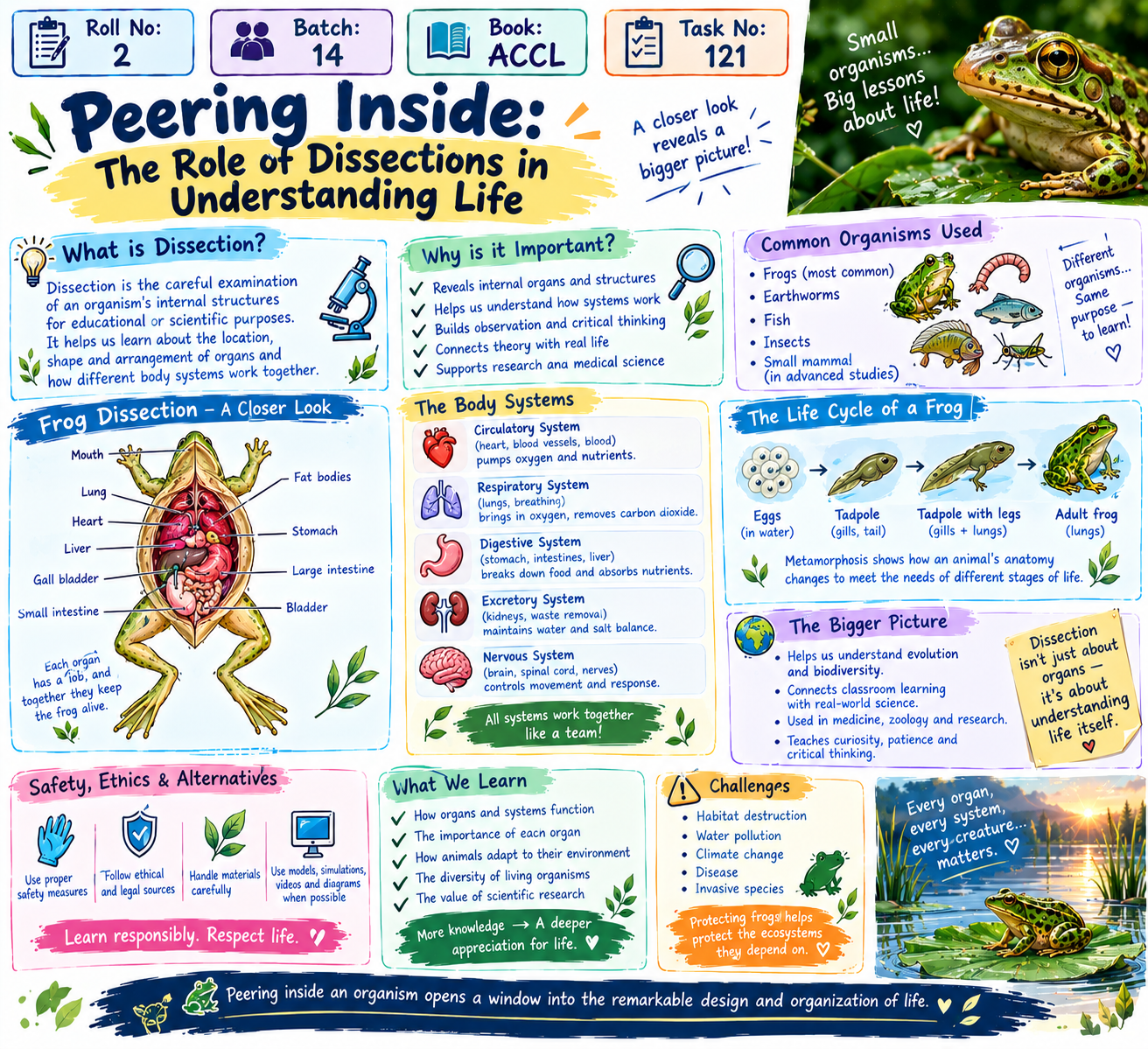
**Dissection is the careful examination of an organism's internal structures for educational or scientific purposes.** It helps us learn about the location, shape, and arrangement of organs and how different body systems work together. By studying anatomy, we can better understand how living organisms obtain energy, breathe, circulate blood, digest food, and respond to their surroundings.
One commonly discussed example in biology education is frog dissection. Frogs are interesting study organisms because they have many organ systems that can be compared with those of other vertebrates. Their bodies are adapted for movement on land and in water, and their anatomy provides useful opportunities to study how organs perform different functions. Observing frog anatomy can help students understand the relationship between body structure and survival.
The circulatory system is an important area of anatomical study. The heart pumps blood through blood vessels, helping transport oxygen, nutrients, and other substances around the body. The respiratory system supports gas exchange, while the digestive system breaks down food so that the body can absorb useful nutrients. These systems work together to supply cells with the materials and energy they need.
The nervous system is equally fascinating. It includes the brain, spinal cord, and nerves, which coordinate movement, process information, and help organisms respond to changes in their environments. The excretory system also plays an essential role by removing waste products and maintaining the balance of water and salts. Studying these systems reveals that every organ has a specific role, yet no organ works entirely alone.
Dissection can also connect classroom learning with real-world science. Medical professionals study anatomy to understand the human body, while zoologists investigate the structures of different animal species. Researchers use many methods, including imaging, microscopy, computer models, and carefully conducted anatomical studies, to investigate how organisms function. These approaches have helped expand our knowledge of health, development, and biodiversity.
Although dissection can be a valuable learning method, science education must also emphasize responsibility and respect for life. Schools and laboratories should follow appropriate safety procedures, use legally and ethically sourced specimens, and handle materials carefully. Whenever possible, students may also learn through digital simulations, anatomical models, videos, and diagrams. These alternatives can explain many internal structures without requiring the use of preserved specimens.
The study of anatomy helps us appreciate the diversity of living organisms. Different species have different body structures because they have adapted to different environments and ways of life. Comparing these structures allows scientists to investigate evolution, understand biological similarities, and discover how organisms meet the challenges of survival.
Dissection teaches more than the names of organs. It encourages observation, patience, careful reasoning, and the ability to connect scientific evidence with biological explanations. It also reminds us that scientific knowledge grows through asking questions, examining evidence, and learning from reliable methods rather than making assumptions.
**Peering inside an organism opens a window into the remarkable design and organization of life. By studying anatomy responsibly, we deepen our understanding of biology, appreciate the connections between body systems, and learn why every discovery should be guided by curiosity, care, and respect for the natural world. **
\#Dissection #Anatomy #Biology #ScienceEducation #AnimalScience #LearningThroughScience #ACCL #Batch14 #Task121
**Batch: 14**
**Book: ACCL**
**Task No: 130**
# Peering Inside: The Role of Dissections in Understanding Life
Have you ever wondered how scientists discover what lies inside a living organism and how its different organs work together? The human body and the bodies of other animals contain many complex structures that cannot be fully understood by looking only at their outer appearance. Dissection is one scientific method that helps students and researchers explore internal anatomy and understand the remarkable organization of life.
**Dissection is the careful examination of an organism's internal structures for educational or scientific purposes.** It helps us learn about the location, shape, and arrangement of organs and how different body systems work together. By studying anatomy, we can better understand how living organisms obtain energy, breathe, circulate blood, digest food, and respond to their surroundings.
One commonly discussed example in biology education is frog dissection. Frogs are interesting study organisms because they have many organ systems that can be compared with those of other vertebrates. Their bodies are adapted for movement on land and in water, and their anatomy provides useful opportunities to study how organs perform different functions. Observing frog anatomy can help students understand the relationship between body structure and survival.
The circulatory system is an important area of anatomical study. The heart pumps blood through blood vessels, helping transport oxygen, nutrients, and other substances around the body. The respiratory system supports gas exchange, while the digestive system breaks down food so that the body can absorb useful nutrients. These systems work together to supply cells with the materials and energy they need.
The nervous system is equally fascinating. It includes the brain, spinal cord, and nerves, which coordinate movement, process information, and help organisms respond to changes in their environments. The excretory system also plays an essential role by removing waste products and maintaining the balance of water and salts. Studying these systems reveals that every organ has a specific role, yet no organ works entirely alone.
Dissection can also connect classroom learning with real-world science. Medical professionals study anatomy to understand the human body, while zoologists investigate the structures of different animal species. Researchers use many methods, including imaging, microscopy, computer models, and carefully conducted anatomical studies, to investigate how organisms function. These approaches have helped expand our knowledge of health, development, and biodiversity.
Although dissection can be a valuable learning method, science education must also emphasize responsibility and respect for life. Schools and laboratories should follow appropriate safety procedures, use legally and ethically sourced specimens, and handle materials carefully. Whenever possible, students may also learn through digital simulations, anatomical models, videos, and diagrams. These alternatives can explain many internal structures without requiring the use of preserved specimens.
The study of anatomy helps us appreciate the diversity of living organisms. Different species have different body structures because they have adapted to different environments and ways of life. Comparing these structures allows scientists to investigate evolution, understand biological similarities, and discover how organisms meet the challenges of survival.
Dissection teaches more than the names of organs. It encourages observation, patience, careful reasoning, and the ability to connect scientific evidence with biological explanations. It also reminds us that scientific knowledge grows through asking questions, examining evidence, and learning from reliable methods rather than making assumptions.
**Peering inside an organism opens a window into the remarkable design and organization of life. By studying anatomy responsibly, we deepen our understanding of biology, appreciate the connections between body systems, and learn why every discovery should be guided by curiosity, care, and respect for the natural world. **
\#Dissection #Anatomy #Biology #ScienceEducation #AnimalScience #LearningThroughScience #ACCL #Batch14 #Task121
**Roll No: 2**
**Batch: 14**
**Book: ACCL**
**Task No: 130**
# 🔬🧬 Peering Inside: The Role of Dissections in Understanding Life 🐸🌿
Have you ever wondered how scientists discover what lies inside a living organism and how its different organs work together? 🔍🫀 The human body and the bodies of other animals contain many complex structures that cannot be fully understood by looking only at their outer appearance. Dissection is one scientific method that helps students and researchers explore internal anatomy and understand the remarkable organization of life. 🌍✨
**Dissection is the careful examination of an organism's internal structures for educational or scientific purposes.** 🔬 It helps us learn about the location, shape, and arrangement of organs and how different body systems work together. By studying anatomy, we can better understand how living organisms obtain energy, breathe, circulate blood, digest food, and respond to their surroundings. 📚🧠
One commonly discussed example in biology education is frog dissection. 🐸 Frogs are interesting study organisms because they have many organ systems that can be compared with those of other vertebrates. Their bodies are adapted for movement on land and in water, and their anatomy provides useful opportunities to study how organs perform different functions. Observing frog anatomy can help students understand the relationship between body structure and survival.
The circulatory system is an important area of anatomical study. ❤️ The heart pumps blood through blood vessels, helping transport oxygen, nutrients, and other substances around the body. The respiratory system supports gas exchange, while the digestive system breaks down food so that the body can absorb useful nutrients. These systems work together to supply cells with the materials and energy they need. ⚡🫁
The nervous system is equally fascinating. 🧠 It includes the brain, spinal cord, and nerves, which coordinate movement, process information, and help organisms respond to changes in their environments. The excretory system also plays an essential role by removing waste products and maintaining the balance of water and salts. Studying these systems reveals that every organ has a specific role, yet no organ works entirely alone.
Dissection can also connect classroom learning with real-world science. 🏥 Medical professionals study anatomy to understand the human body, while zoologists investigate the structures of different animal species. Researchers use many methods, including imaging, microscopy, computer models, and carefully conducted anatomical studies, to investigate how organisms function. These approaches have helped expand our knowledge of health, development, and biodiversity. 🔬📖
Although dissection can be a valuable learning method, science education must also emphasize responsibility and respect for life. 💚 Schools and laboratories should follow appropriate safety procedures, use legally and ethically sourced specimens, and handle materials carefully. Whenever possible, students may also learn through digital simulations, anatomical models, videos, and diagrams. These alternatives can explain many internal structures without requiring the use of preserved specimens.
The study of anatomy helps us appreciate the diversity of living organisms. 🐸🐟🐦 Different species have different body structures because they have adapted to different environments and ways of life. Comparing these structures allows scientists to investigate evolution, understand biological similarities, and discover how organisms meet the challenges of survival.
Dissection teaches more than the names of organs. It encourages observation, patience, careful reasoning, and the ability to connect scientific evidence with biological explanations. 🧪💡 It also reminds us that scientific knowledge grows through asking questions, examining evidence, and learning from reliable methods rather than making assumptions.
**Peering inside an organism opens a window into the remarkable design and organization of life. By studying anatomy responsibly, we deepen our understanding of biology, appreciate the connections between body systems, and learn why every discovery should be guided by curiosity, care, and respect for the natural world. 🔬🌿🌎**
\#Dissection #Anatomy #Biology #ScienceEducation #AnimalScience #LearningThroughScience #ACCL #Batch14 #Task121 🧬🔬💚
0 Comments
0 Shares
60 Views