• **Roll No: 2**
    **Batch: 14**
    **Book: ACCL**
    **Task No: 120**

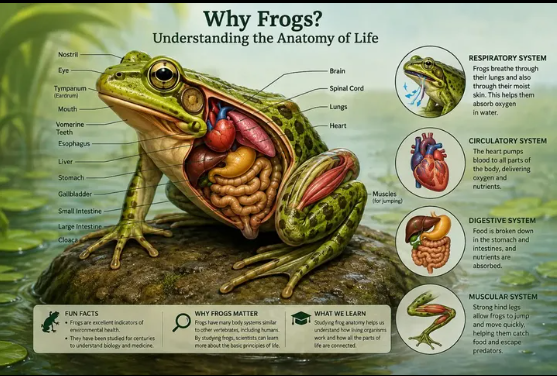
    # Why Frogs? Understanding the Anatomy of Life

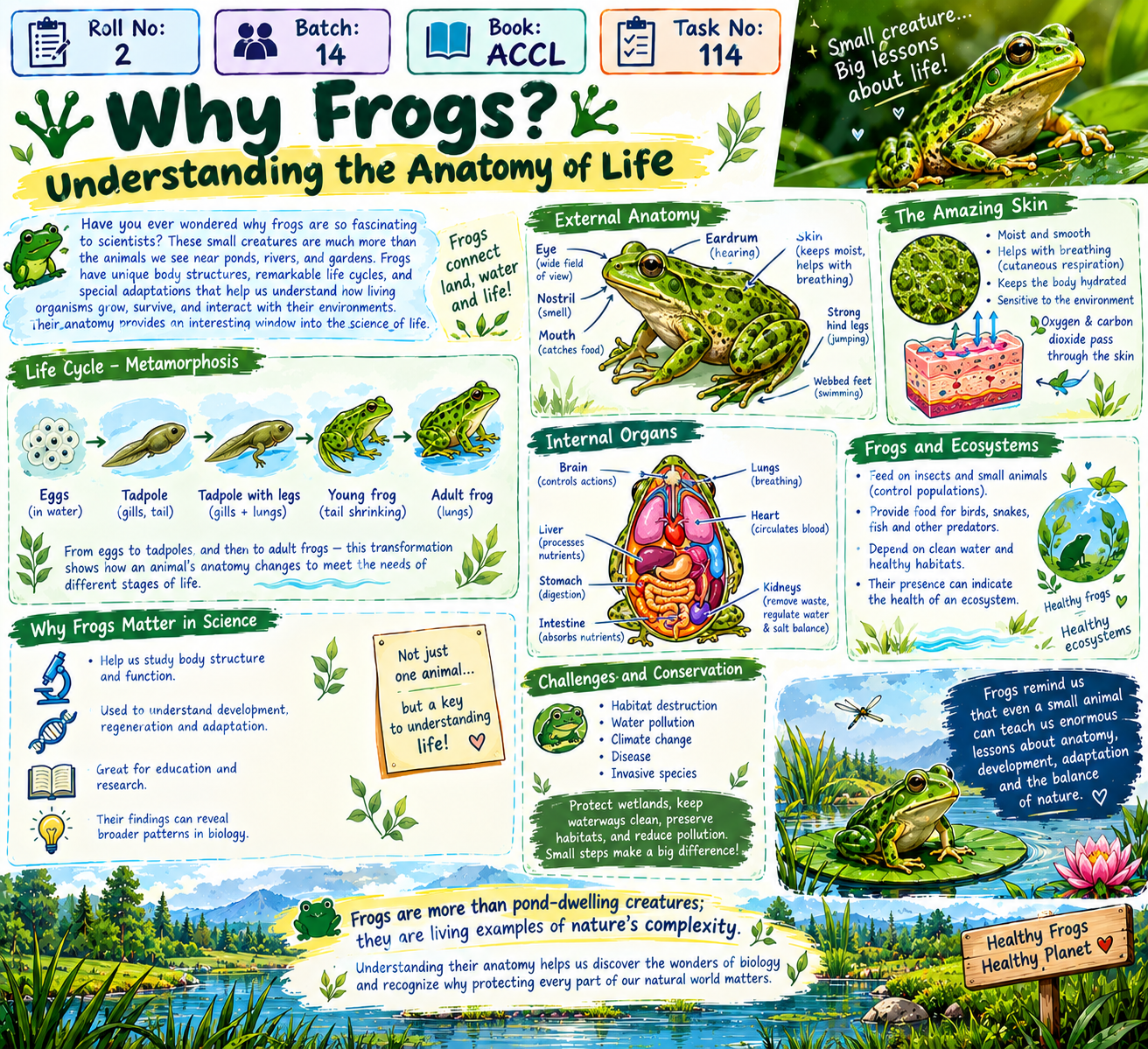
    Have you ever wondered why frogs are so fascinating to scientists? These small creatures are much more than the animals we see near ponds, rivers, and gardens. Frogs have unique body structures, remarkable life cycles, and special adaptations that help us understand how living organisms grow, survive, and interact with their environments. Their anatomy provides an interesting window into the science of life.

    A frog's body is designed for life both in water and on land. Its body generally has a broad head, a short trunk, strong hind legs, and webbed feet in many species. These features help frogs jump, swim, and move through their habitats. Their eyes are positioned to provide a wide field of view, while their sensitive hearing helps them detect sounds, including the calls of other frogs.

    One of the most interesting features of frogs is their skin. Unlike the dry, scaly skin of many reptiles, frog skin is usually moist and plays an important role in their survival. Many frogs can exchange gases through their skin as well as through their lungs. This process, called **cutaneous respiration**, allows oxygen and carbon dioxide to pass across the skin under suitable conditions. Their skin also helps maintain moisture, making a healthy habitat especially important for them.

    Frogs have a fascinating life cycle called **metamorphosis**. Many begin life as eggs in water. The eggs hatch into tadpoles, which usually have tails and breathe mainly through gills. As they develop, they grow legs, their lungs develop, and their bodies gradually change into those of adult frogs. The tail is usually absorbed during development. This transformation demonstrates how an animal's anatomy changes to meet the needs of different stages of life.

    The internal organs of a frog also reveal important biological principles. Its heart circulates blood through the body, carrying oxygen and nutrients to tissues. The digestive system breaks down food, while the kidneys help remove waste and regulate water and salt balance. The brain and nervous system coordinate movement, senses, and responses to the environment. Each organ works with other systems to keep the animal alive.

    Frogs are also valuable to ecosystems. Many feed on insects and other small animals, helping influence populations of these organisms. Frogs themselves provide food for birds, snakes, fish, and other predators. Because many frogs depend on suitable water and land habitats, changes in their populations can provide clues about environmental conditions. Scientists therefore study frogs to learn more about biodiversity, habitat quality, and ecosystem health.

    Another reason frogs are important is their role in scientific research and education. Their anatomy helps students explore the structure and function of organs, compare different vertebrates, and understand biological systems. Researchers also study frog development, regeneration in certain species, communication, and adaptation. Such research can reveal broader patterns in biology, although findings from frogs do not always apply directly to humans.

    Unfortunately, many frog species face challenges such as habitat destruction, water pollution, climate change, disease, and invasive species. Protecting wetlands, keeping waterways clean, preserving natural habitats, and reducing pollution can help support frog populations and the many other organisms that share their ecosystems. Caring for frogs is one way of caring for the wider web of life.

    Frogs remind us that even a small animal can teach us enormous lessons about anatomy, development, adaptation, and the balance of nature. By observing their bodies and studying their life cycles, we gain a deeper appreciation of how living systems work together.

    **Frogs are more than pond-dwelling creatures; they are living examples of nature's complexity. Understanding their anatomy helps us discover the wonders of biology and recognize why protecting every part of our natural world matters. **

    \#Frogs #AnatomyOfLife #Biology #LifeCycle #AnimalScience #Biodiversity #ACCL #Batch14 #Task114
    **Roll No: 2** **Batch: 14** **Book: ACCL** **Task No: 120** # 🐸🔬 Why Frogs? Understanding the Anatomy of Life 🌿💚 Have you ever wondered why frogs are so fascinating to scientists? 🐸🌎 These small creatures are much more than the animals we see near ponds, rivers, and gardens. Frogs have unique body structures, remarkable life cycles, and special adaptations that help us understand how living organisms grow, survive, and interact with their environments. Their anatomy provides an interesting window into the science of life. 🔬✨ A frog's body is designed for life both in water and on land. 💧🌱 Its body generally has a broad head, a short trunk, strong hind legs, and webbed feet in many species. These features help frogs jump, swim, and move through their habitats. Their eyes are positioned to provide a wide field of view, while their sensitive hearing helps them detect sounds, including the calls of other frogs. 🦵👀 One of the most interesting features of frogs is their skin. Unlike the dry, scaly skin of many reptiles, frog skin is usually moist and plays an important role in their survival. 🐸💦 Many frogs can exchange gases through their skin as well as through their lungs. This process, called **cutaneous respiration**, allows oxygen and carbon dioxide to pass across the skin under suitable conditions. Their skin also helps maintain moisture, making a healthy habitat especially important for them. Frogs have a fascinating life cycle called **metamorphosis**. 🥚➡️🐟➡️🐸 Many begin life as eggs in water. The eggs hatch into tadpoles, which usually have tails and breathe mainly through gills. As they develop, they grow legs, their lungs develop, and their bodies gradually change into those of adult frogs. The tail is usually absorbed during development. This transformation demonstrates how an animal's anatomy changes to meet the needs of different stages of life. 🌱🔄 The internal organs of a frog also reveal important biological principles. ❤️ Its heart circulates blood through the body, carrying oxygen and nutrients to tissues. The digestive system breaks down food, while the kidneys help remove waste and regulate water and salt balance. The brain and nervous system coordinate movement, senses, and responses to the environment. Each organ works with other systems to keep the animal alive. 🧠🫀 Frogs are also valuable to ecosystems. 🦟🌿 Many feed on insects and other small animals, helping influence populations of these organisms. Frogs themselves provide food for birds, snakes, fish, and other predators. Because many frogs depend on suitable water and land habitats, changes in their populations can provide clues about environmental conditions. Scientists therefore study frogs to learn more about biodiversity, habitat quality, and ecosystem health. 🌍🔎 Another reason frogs are important is their role in scientific research and education. 📚🔬 Their anatomy helps students explore the structure and function of organs, compare different vertebrates, and understand biological systems. Researchers also study frog development, regeneration in certain species, communication, and adaptation. Such research can reveal broader patterns in biology, although findings from frogs do not always apply directly to humans. Unfortunately, many frog species face challenges such as habitat destruction, water pollution, climate change, disease, and invasive species. 🌧️🏞️ Protecting wetlands, keeping waterways clean, preserving natural habitats, and reducing pollution can help support frog populations and the many other organisms that share their ecosystems. Caring for frogs is one way of caring for the wider web of life. 💚♻️ Frogs remind us that even a small animal can teach us enormous lessons about anatomy, development, adaptation, and the balance of nature. By observing their bodies and studying their life cycles, we gain a deeper appreciation of how living systems work together. 🐸🌎🔬 **Frogs are more than pond-dwelling creatures; they are living examples of nature's complexity. Understanding their anatomy helps us discover the wonders of biology and recognize why protecting every part of our natural world matters. 🐸🧬🌿✨** \#Frogs #AnatomyOfLife #Biology #LifeCycle #AnimalScience #Biodiversity #ACCL #Batch14 #Task114 🐸🔬🌍
    0 Комментарии 0 Поделились 253 Просмотры
  • Why Frogs? Understanding the Anatomy of Life
    #ACCL Day 125
    In classrooms and laboratories, countless students begin their journey into biology with a single question — “Why frogs?”
    Frogs are more than just amphibians; they’re living bridges between water and land, evolution and adaptation, simplicity and complexity.
    Inside a frog’s tiny body lies the blueprint of life itself — beating hearts, flowing blood, expanding lungs — a reflection of how all living creatures share a common thread of design and function.
    By studying frogs, we don’t just explore anatomy — we uncover the rhythm of life, the story of survival, and the miracle of biological balance.
    Every organ, every muscle, every leap reminds us that understanding one small creature helps us understand the entire web of existence.
    #WhyFrogs #AnatomyOfLife #ACCLDay125 #ScienceOfLife #natureandknowledge
    🐸🔬 Why Frogs? Understanding the Anatomy of Life #ACCL Day 125 In classrooms and laboratories, countless students begin their journey into biology with a single question — “Why frogs?” Frogs are more than just amphibians; they’re living bridges between water and land, evolution and adaptation, simplicity and complexity. 🌿💧 Inside a frog’s tiny body lies the blueprint of life itself — beating hearts, flowing blood, expanding lungs — a reflection of how all living creatures share a common thread of design and function. By studying frogs, we don’t just explore anatomy — we uncover the rhythm of life, the story of survival, and the miracle of biological balance. 🌎✨ Every organ, every muscle, every leap reminds us that understanding one small creature helps us understand the entire web of existence. #WhyFrogs #AnatomyOfLife #ACCLDay125 #ScienceOfLife #natureandknowledge
    0 Комментарии 0 Поделились 370 Просмотры
  • #rsisb
    Rol No 253
    Foundation Level
    Song 14
    # The Blueprint of Existence: Unraveling DNA and the Origins of Life

    **Discover the extraordinary story of life through science, DNA, and the mysteries of our existence!**

    What makes every living organism unique? How does a microscopic molecule carry the instructions that shape life? And how did life begin on our remarkable planet? *The Blueprint of Existence: Unraveling DNA and the Origins of Life* takes listeners on a breathtaking scientific journey into the hidden code of life and the fascinating story of our biological origins.

    Blending the wonder of scientific discovery with the power of music, this song explores the incredible world of **DNA (Deoxyribonucleic Acid)** — the molecule that stores the genetic instructions used in the growth, development, functioning, and reproduction of living organisms. From the elegant double-helix structure to the intricate processes of genetic inheritance, every verse celebrates the complexity and beauty of life at its most fundamental level.

    ## What This Song Explores

    **The Language of DNA:** Discover how four chemical bases — adenine, thymine, cytosine, and guanine — help encode genetic information, forming a remarkable molecular system shared by all known cellular life.

    **The Secrets Inside Our Cells:** Journey into the microscopic world of cells, chromosomes, genes, and proteins to understand how genetic instructions contribute to the characteristics of living organisms.

    **The Origins of Life:** Travel back billions of years to the early Earth, where ancient oceans, volcanic landscapes, and changing environmental conditions provide clues to one of science's greatest questions: how did life emerge from nonliving chemistry? Scientists continue to investigate this mystery through research into prebiotic chemistry, early Earth environments, and the earliest evidence of life.

    **Evolution and Genetic Diversity:** Explore how mutations, inheritance, and natural selection contribute to biological variation and the evolution of life across generations. From microscopic organisms to the extraordinary diversity of plants and animals, life's story is one of continuous change and adaptation.

    **The Connection Between Life and the Cosmos:** Reflect on the elements that make living organisms possible and their cosmic history. Many essential elements in our bodies were formed through processes occurring in stars and stellar explosions, connecting the story of life on Earth with the wider universe.

    ## A Journey of Wonder and Discovery

    This song is more than a musical exploration of biology — it is an invitation to question, investigate, and appreciate the extraordinary world around us. It reminds us that the smallest structures can hold enormous significance, that every cell contains fascinating molecular machinery, and that scientific discovery often begins with a simple question.

    Through powerful imagery, engaging scientific themes, and an inspiring atmosphere, the song encourages students, science enthusiasts, and curious minds to explore the connections between genetics, chemistry, evolution, and the history of our planet.

    The origins of life remain an active area of scientific research, and many details are still being investigated. By celebrating curiosity rather than pretending every mystery is solved, this song highlights the importance of evidence, experimentation, critical thinking, and the courage to explore the unknown.

    **Every organism carries a story. Every gene holds instructions. Every discovery reveals another piece of the puzzle.**

    *The Blueprint of Existence* celebrates the remarkable science of life — from the molecular code inside our cells to the ancient history of our living planet.

    **Listen, learn, and explore the magnificent blueprint that connects life on Earth!**

    ---

    ### Hashtags

    #BlueprintOfExistence #DNA #OriginsOfLife #ScienceSong #Biology #Genetics #Evolution #MolecularBiology #ScientificDiscovery #PrebioticChemistry #LifeOnEarth #EducationalMusic #ScienceAndTechnology #ExploreTheUnknown #KnowledgeIsPower


    Asma Shaheen EducationWali
    Saima Empowerment Wali
    Mishaal TrainingWali
    #rsisb Rol No 253 Foundation Level Song 14 # 🧬🌌 The Blueprint of Existence: Unraveling DNA and the Origins of Life 🌍✨ 🎶 **Discover the extraordinary story of life through science, DNA, and the mysteries of our existence!** 🔬🧬 What makes every living organism unique? How does a microscopic molecule carry the instructions that shape life? And how did life begin on our remarkable planet? 🌱🌎 *The Blueprint of Existence: Unraveling DNA and the Origins of Life* takes listeners on a breathtaking scientific journey into the hidden code of life and the fascinating story of our biological origins. 🚀 Blending the wonder of scientific discovery with the power of music, this song explores the incredible world of **DNA (Deoxyribonucleic Acid)** — the molecule that stores the genetic instructions used in the growth, development, functioning, and reproduction of living organisms. From the elegant double-helix structure to the intricate processes of genetic inheritance, every verse celebrates the complexity and beauty of life at its most fundamental level. 🧬🔍 ## 🔬🎵 What This Song Explores 🧬 **The Language of DNA:** Discover how four chemical bases — adenine, thymine, cytosine, and guanine — help encode genetic information, forming a remarkable molecular system shared by all known cellular life. 🔬 **The Secrets Inside Our Cells:** Journey into the microscopic world of cells, chromosomes, genes, and proteins to understand how genetic instructions contribute to the characteristics of living organisms. 🧫✨ 🌋 **The Origins of Life:** Travel back billions of years to the early Earth, where ancient oceans, volcanic landscapes, and changing environmental conditions provide clues to one of science's greatest questions: how did life emerge from nonliving chemistry? 🌊🌍 Scientists continue to investigate this mystery through research into prebiotic chemistry, early Earth environments, and the earliest evidence of life. 🧬 **Evolution and Genetic Diversity:** Explore how mutations, inheritance, and natural selection contribute to biological variation and the evolution of life across generations. From microscopic organisms to the extraordinary diversity of plants and animals, life's story is one of continuous change and adaptation. 🌿🦠 🌌 **The Connection Between Life and the Cosmos:** Reflect on the elements that make living organisms possible and their cosmic history. Many essential elements in our bodies were formed through processes occurring in stars and stellar explosions, connecting the story of life on Earth with the wider universe. ⭐🚀 ## 🌱✨ A Journey of Wonder and Discovery This song is more than a musical exploration of biology — it is an invitation to question, investigate, and appreciate the extraordinary world around us. It reminds us that the smallest structures can hold enormous significance, that every cell contains fascinating molecular machinery, and that scientific discovery often begins with a simple question. Through powerful imagery, engaging scientific themes, and an inspiring atmosphere, the song encourages students, science enthusiasts, and curious minds to explore the connections between genetics, chemistry, evolution, and the history of our planet. 🎓🔭 The origins of life remain an active area of scientific research, and many details are still being investigated. By celebrating curiosity rather than pretending every mystery is solved, this song highlights the importance of evidence, experimentation, critical thinking, and the courage to explore the unknown. 💡🔬 🌍 **Every organism carries a story. Every gene holds instructions. Every discovery reveals another piece of the puzzle.** 🧬✨ *The Blueprint of Existence* celebrates the remarkable science of life — from the molecular code inside our cells to the ancient history of our living planet. 🎧 **Listen, learn, and explore the magnificent blueprint that connects life on Earth!** 🚀🌱 --- ### 🔥 Hashtags #BlueprintOfExistence 🧬 #DNA #OriginsOfLife 🌍 #ScienceSong 🎶 #Biology 🔬 #Genetics 🧫 #Evolution 🌱 #MolecularBiology #ScientificDiscovery 💡 #PrebioticChemistry 🌋 #LifeOnEarth 🌎 #EducationalMusic 🎓 #ScienceAndTechnology 🚀 #ExploreTheUnknown 🌌 #KnowledgeIsPower ✨ Asma Shaheen EducationWali Saima Empowerment Wali Mishaal TrainingWali
    0 Комментарии 0 Поделились 2878 Просмотры 5
  • Mohsin RS F8
    Story post NO:15
    roll NO:13
    Class: Foundation Level
    Made by Me

    Frogs may be small animals, but their bodies contain an amazing combination of organs, systems, and adaptations that make them excellent subjects for understanding the basic principles of life. Studying frog anatomy gives us an opportunity to see how different parts of a living organism work together to support movement, breathing, digestion, communication, growth, and survival. Their anatomy also shares important features with many other vertebrates, making frogs useful for learning fundamental concepts in biology.
    One of the most interesting features of frogs is their respiratory system. Unlike humans, frogs can exchange gases not only through their lungs but also through their moist skin. This special adaptation allows them to survive in aquatic and terrestrial environments. Their circulatory system also plays an important role in maintaining life by transporting oxygen and nutrients throughout the body.
    Frogs have powerful hind legs that are specially adapted for jumping and swimming. Their large eyes provide a wide field of vision and help them detect movement, while their ears allow them to hear sounds and communicate. Inside the body, organs such as the heart, lungs, liver, stomach, and intestines each perform important functions. These organs do not work independently; instead, they form interconnected systems that keep the frog alive and functioning.
    The frog's life cycle is another fascinating example of biological development. It begins with eggs laid in water, followed by the tadpole stage. Tadpoles gradually develop legs and lungs as their bodies change, eventually becoming froglets and then adult frogs. This transformation demonstrates how living organisms can undergo remarkable changes as they grow and mature.
    Frogs are also important indicators of environmental health. Because they are sensitive to changes in their surroundings, changes in frog populations can provide clues about the condition of an ecosystem. They also play an important role in controlling insect populations and maintaining food chains.
    Overall, “Why Frogs? Understanding the Anat
    Mohsin RS F8 🎓✨ Story post NO:15 roll NO:13 Class: Foundation Level 📚 Made by Me 💻🚀 Frogs may be small animals, but their bodies contain an amazing combination of organs, systems, and adaptations that make them excellent subjects for understanding the basic principles of life. Studying frog anatomy gives us an opportunity to see how different parts of a living organism work together to support movement, breathing, digestion, communication, growth, and survival. Their anatomy also shares important features with many other vertebrates, making frogs useful for learning fundamental concepts in biology. One of the most interesting features of frogs is their respiratory system. Unlike humans, frogs can exchange gases not only through their lungs but also through their moist skin. This special adaptation allows them to survive in aquatic and terrestrial environments. Their circulatory system also plays an important role in maintaining life by transporting oxygen and nutrients throughout the body. Frogs have powerful hind legs that are specially adapted for jumping and swimming. Their large eyes provide a wide field of vision and help them detect movement, while their ears allow them to hear sounds and communicate. Inside the body, organs such as the heart, lungs, liver, stomach, and intestines each perform important functions. These organs do not work independently; instead, they form interconnected systems that keep the frog alive and functioning. The frog's life cycle is another fascinating example of biological development. It begins with eggs laid in water, followed by the tadpole stage. Tadpoles gradually develop legs and lungs as their bodies change, eventually becoming froglets and then adult frogs. This transformation demonstrates how living organisms can undergo remarkable changes as they grow and mature. Frogs are also important indicators of environmental health. Because they are sensitive to changes in their surroundings, changes in frog populations can provide clues about the condition of an ecosystem. They also play an important role in controlling insect populations and maintaining food chains. Overall, “Why Frogs? Understanding the Anat
    0 Комментарии 0 Поделились 1126 Просмотры
  • RSIF8
    Roll no:85
    Task no:48
    Task topic: The Journey of Dinosaurs: A Scientific Perspective
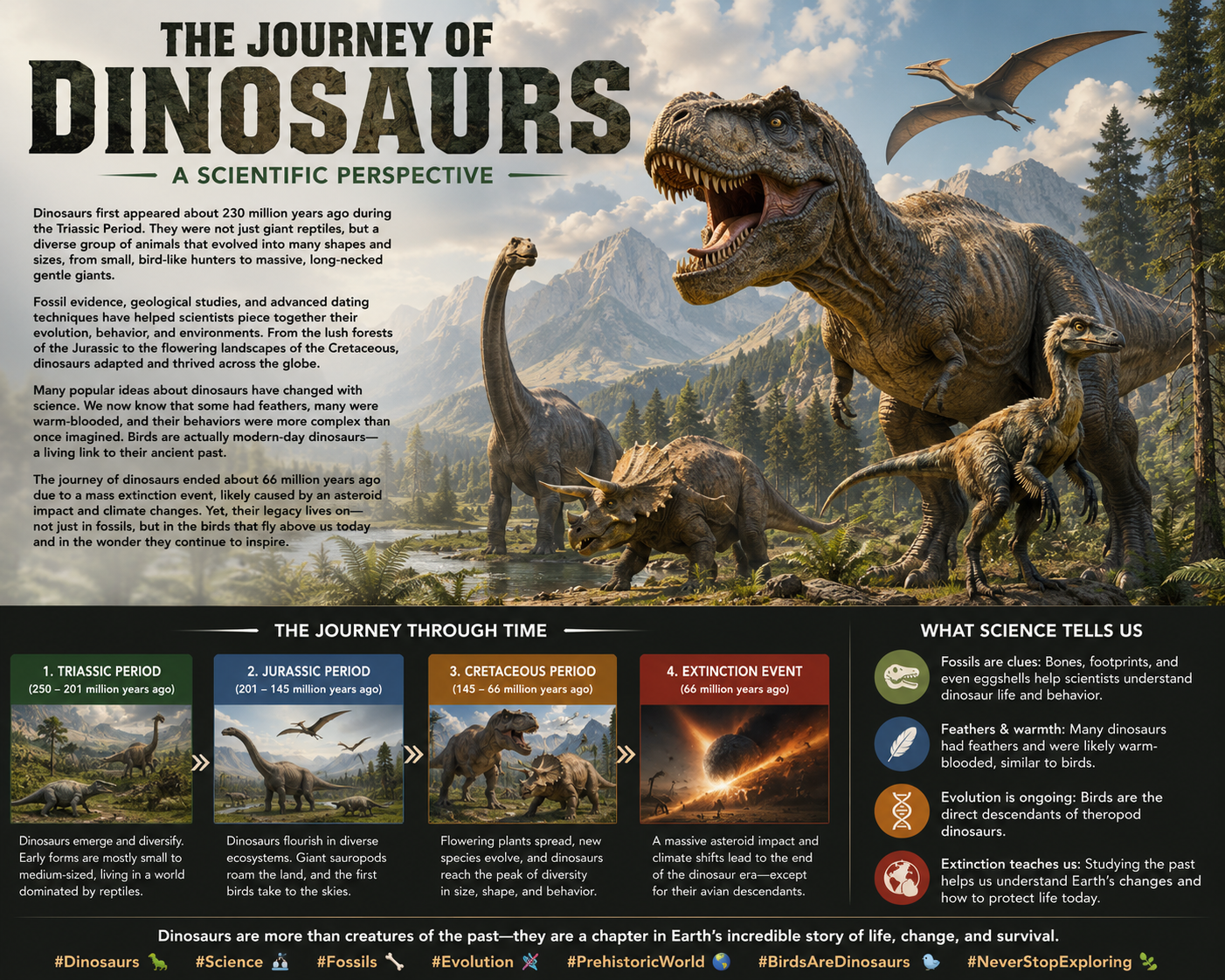
    Dinosaurs ruled our planet for more than 160 million years, evolving into countless species that ranged from tiny feathered hunters to gigantic plant-eating giants. Their incredible journey began during the Triassic Period and continued through the Jurassic and Cretaceous periods, shaping Earth's ecosystems in remarkable ways.

    Scientific discoveries through fossils have revealed fascinating details about dinosaur behavior, diets, and even their connection to modern birds. These ancient creatures adapted to changing environments and became one of the most successful groups of animals in Earth's history.

    Their story came to a dramatic end about 66 million years ago when a massive asteroid impact caused a global extinction event. However, the legacy of dinosaurs still lives on through birds, reminding us that evolution is a continuous and amazing process.

    Studying dinosaurs helps scientists understand Earth's past, climate changes, and the evolution of life itself. The journey of dinosaurs is not just a story of extinction—it's a powerful lesson about adaptation, survival, and the ever-changing nature of our planet.
    RSIF8 Roll no:85 Task no:48 Task topic: The Journey of Dinosaurs: A Scientific Perspective Dinosaurs ruled our planet for more than 160 million years, evolving into countless species that ranged from tiny feathered hunters to gigantic plant-eating giants. Their incredible journey began during the Triassic Period and continued through the Jurassic and Cretaceous periods, shaping Earth's ecosystems in remarkable ways. Scientific discoveries through fossils have revealed fascinating details about dinosaur behavior, diets, and even their connection to modern birds. These ancient creatures adapted to changing environments and became one of the most successful groups of animals in Earth's history. Their story came to a dramatic end about 66 million years ago when a massive asteroid impact caused a global extinction event. However, the legacy of dinosaurs still lives on through birds, reminding us that evolution is a continuous and amazing process. Studying dinosaurs helps scientists understand Earth's past, climate changes, and the evolution of life itself. The journey of dinosaurs is not just a story of extinction—it's a powerful lesson about adaptation, survival, and the ever-changing nature of our planet. 🌍
    0 Комментарии 0 Поделились 1273 Просмотры
  • 📖 **Day 125 | Story Post** 🐸 **Why Frogs? Understanding the Anatomy of Life** Frogs may look like simple animals, but their bodies provide an amazing way to understand how life works. Their anatomy shows how different organs and body systems work together to help them survive. A frog has a **heart, lungs, digestive system, nervous system, muscles, and bones**, just like many other vertebrates. 🫀🫁 One fascinating feature is that frogs can breathe through both their **lungs and their skin**. Their powerful hind legs help them jump, while their eyes and ears help them detect what is happening around them. Studying frogs helps scientists and students understand important concepts in **biology, anatomy, adaptation, and evolution**. 🔬🌿 🐸 **A small frog can teach us a big lesson: every living organism has a remarkable design and a complex system that helps it survive.** 🎓 **Rehan School | Foundation Level** 🔢 **Roll No: 01** ✅ **Day 125 — Task Completed!** http://youtube.com/post/Ugkx8XKleK_2aVCTBhDkbmEeJzY2p9MGPqMb?si=2A-Mzzu9NR4WqiXF
    YOUTUBE.COM
    📖 **Day 125 | Story Post** 🐸 **Why Frogs? Understanding the Anatomy of Life** Frogs may look like simple animals, but their bodies provide an amazing way to ...
    📖 **Day 125 | Story Post** 🐸 **Why Frogs? Understanding the Anatomy of Life** Frogs may look like simple animals, but their bodies provide an amazing way to ...
    0 Комментарии 0 Поделились 1141 Просмотры
  • RSIF8
    Roll no: 99
    Story post no: 17
    Story topic: The Evolution Paradox: Bridging Theories of Life with Divine Design
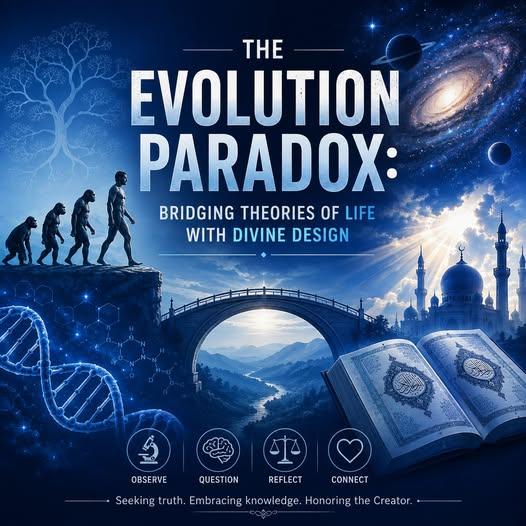
    Evolution is one of science’s most important explanations for how living organisms change and diversify over generations. Through concepts such as natural selection, mutation, and adaptation, scientists study the remarkable variety of life on Earth.
    At the same time, many people view the complexity and order of life through the lens of divine creation. Exploring both scientific theories and ideas about divine design can lead to thoughtful questions about life's origins, purpose, and the relationship between science and faith.
    #Evolution #Science #Biology #DivineDesign #ScienceAndFaith #LifeScience #NaturalSelection #Knowledge #STEM #Education
    RSIF8 Roll no: 99 Story post no: 17 Story topic: The Evolution Paradox: Bridging Theories of Life with Divine Design Evolution is one of science’s most important explanations for how living organisms change and diversify over generations. Through concepts such as natural selection, mutation, and adaptation, scientists study the remarkable variety of life on Earth. At the same time, many people view the complexity and order of life through the lens of divine creation. Exploring both scientific theories and ideas about divine design can lead to thoughtful questions about life's origins, purpose, and the relationship between science and faith. #Evolution #Science #Biology #DivineDesign #ScienceAndFaith #LifeScience #NaturalSelection #Knowledge #STEM #Education
    0 Комментарии 0 Поделились 1089 Просмотры
  • Day: 132
    Roll No: 006
    Foundation Level
    Story Post

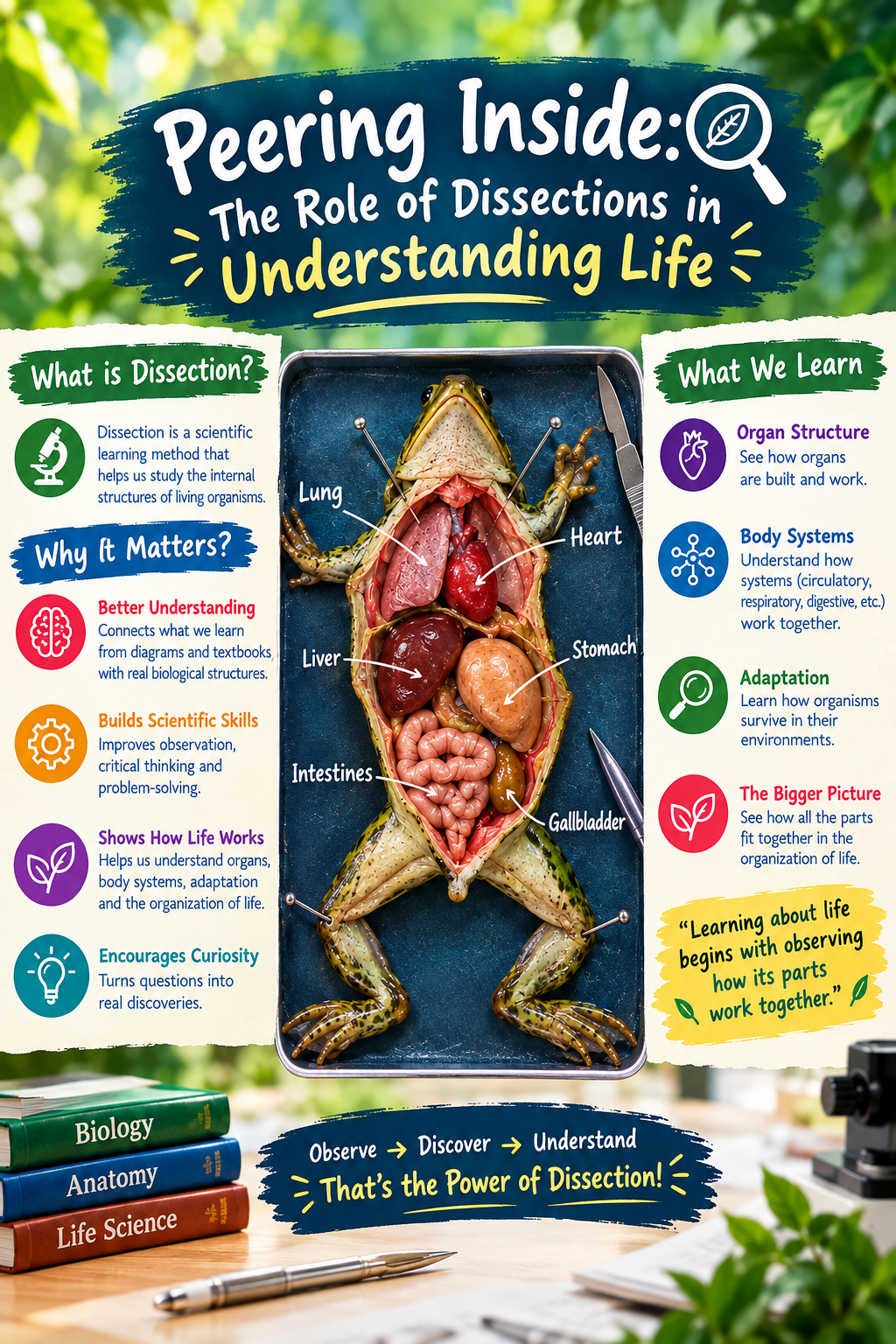
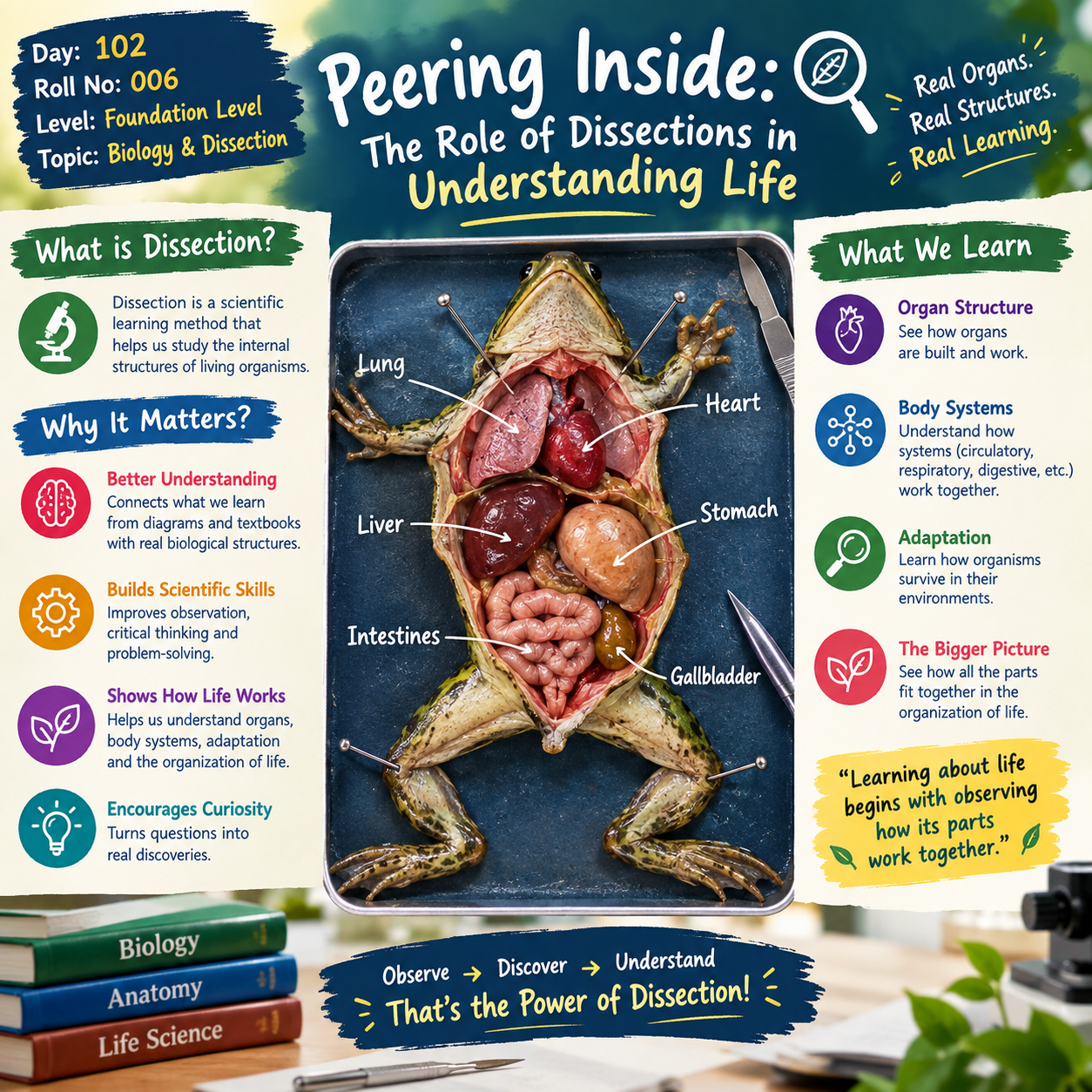
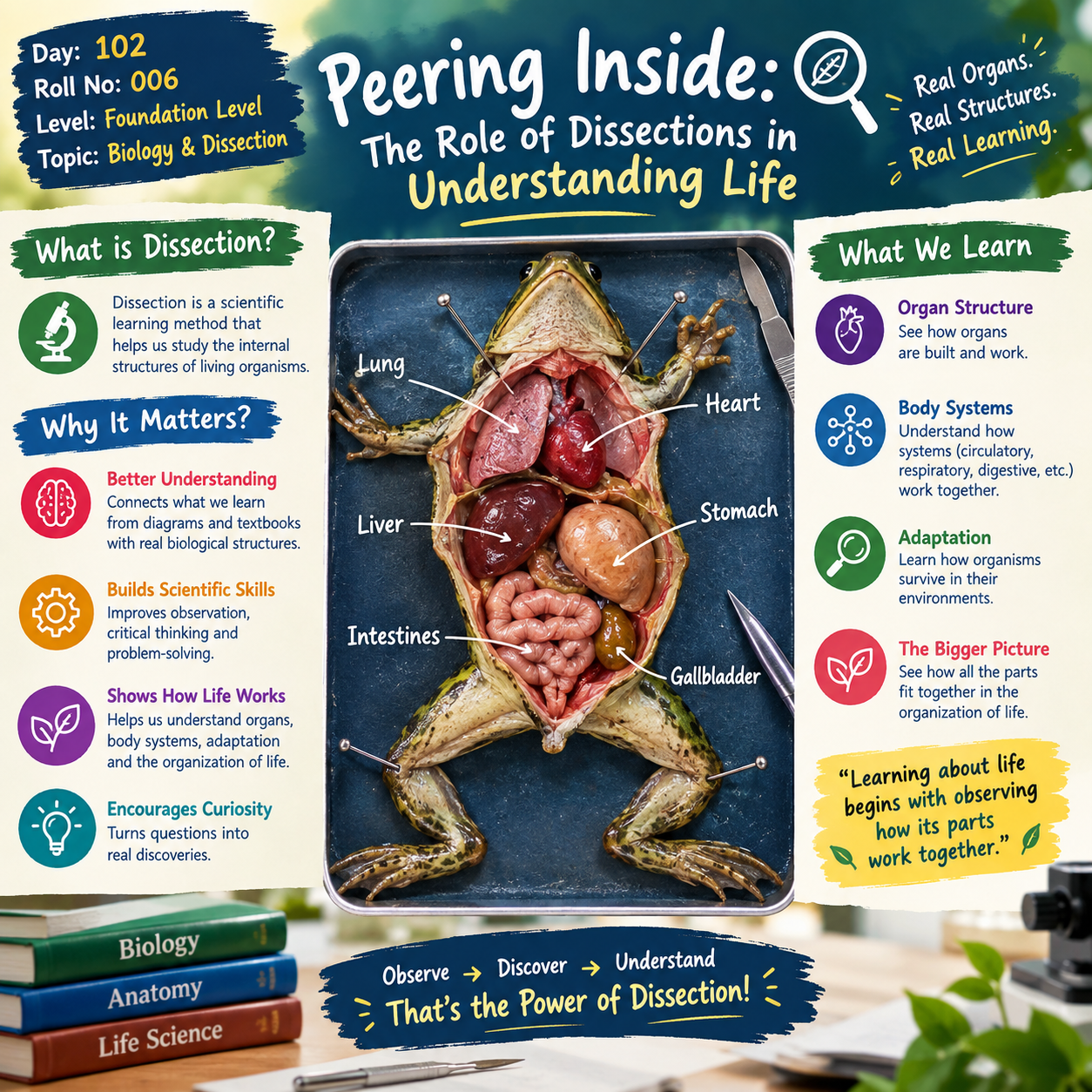
    Dissection is a scientific learning method that helps students understand how organisms are structured and how different organs work together.
    By carefully examining anatomy, students can connect what they learn from diagrams and textbooks with real biological structures. It can deepen understanding of organs, body systems, adaptation, and the organization of life.
    Learning about life begins with observing how its parts work together.
    Hashtags
    #Day102 #Biology #Dissection #Anatomy #Science #LifeScience #BiologyEducation #Learning #ScienceEducation #FoundationLevel #RehanSchool #Education #curiosity
    Day: 132 Roll No: 006 Foundation Level 📖 Story Post Dissection is a scientific learning method that helps students understand how organisms are structured and how different organs work together. 🔬🧬 By carefully examining anatomy, students can connect what they learn from diagrams and textbooks with real biological structures. It can deepen understanding of organs, body systems, adaptation, and the organization of life. 🌱 Learning about life begins with observing how its parts work together. 🔖 Hashtags #Day102 #Biology #Dissection #Anatomy #Science #LifeScience #BiologyEducation #Learning #ScienceEducation #FoundationLevel #RehanSchool #Education #curiosity
    0 Комментарии 0 Поделились 1070 Просмотры
  • Day: 132
    Roll No: 006
    Foundation Level
    Story Post

    Dissection is a scientific learning method that helps students understand how organisms are structured and how different organs work together.
    By carefully examining anatomy, students can connect what they learn from diagrams and textbooks with real biological structures. It can deepen understanding of organs, body systems, adaptation, and the organization of life.
    Learning about life begins with observing how its parts work together.
    Hashtags
    #Day102 #Biology #Dissection #Anatomy #Science #LifeScience #BiologyEducation #Learning #ScienceEducation #FoundationLevel #RehanSchool #Education #Curiosity
    Day: 132 Roll No: 006 Foundation Level 📖 Story Post Dissection is a scientific learning method that helps students understand how organisms are structured and how different organs work together. 🔬🧬 By carefully examining anatomy, students can connect what they learn from diagrams and textbooks with real biological structures. It can deepen understanding of organs, body systems, adaptation, and the organization of life. 🌱 Learning about life begins with observing how its parts work together. 🔖 Hashtags #Day102 #Biology #Dissection #Anatomy #Science #LifeScience #BiologyEducation #Learning #ScienceEducation #FoundationLevel #RehanSchool #Education #Curiosity
    0 Комментарии 0 Поделились 1077 Просмотры
  • Day: 132
    Roll No: 006
    Foundation Level
    Story Post

    Dissection is a scientific learning method that helps students understand how organisms are structured and how different organs work together.
    By carefully examining anatomy, students can connect what they learn from diagrams and textbooks with real biological structures. It can deepen understanding of organs, body systems, adaptation, and the organization of life.
    Learning about life begins with observing how its parts work together.
    Hashtags
    #Day102 #Biology #Dissection #Anatomy #Science #LifeScience #BiologyEducation #Learning #ScienceEducation #FoundationLevel #RehanSchool #Education #Curiosity
    Day: 132 Roll No: 006 Foundation Level 📖 Story Post Dissection is a scientific learning method that helps students understand how organisms are structured and how different organs work together. 🔬🧬 By carefully examining anatomy, students can connect what they learn from diagrams and textbooks with real biological structures. It can deepen understanding of organs, body systems, adaptation, and the organization of life. 🌱 Learning about life begins with observing how its parts work together. 🔖 Hashtags #Day102 #Biology #Dissection #Anatomy #Science #LifeScience #BiologyEducation #Learning #ScienceEducation #FoundationLevel #RehanSchool #Education #Curiosity
    0 Комментарии 0 Поделились 1051 Просмотры
Расширенные страницы