• Day 11
    story post
    Roll no:10
    foundation level
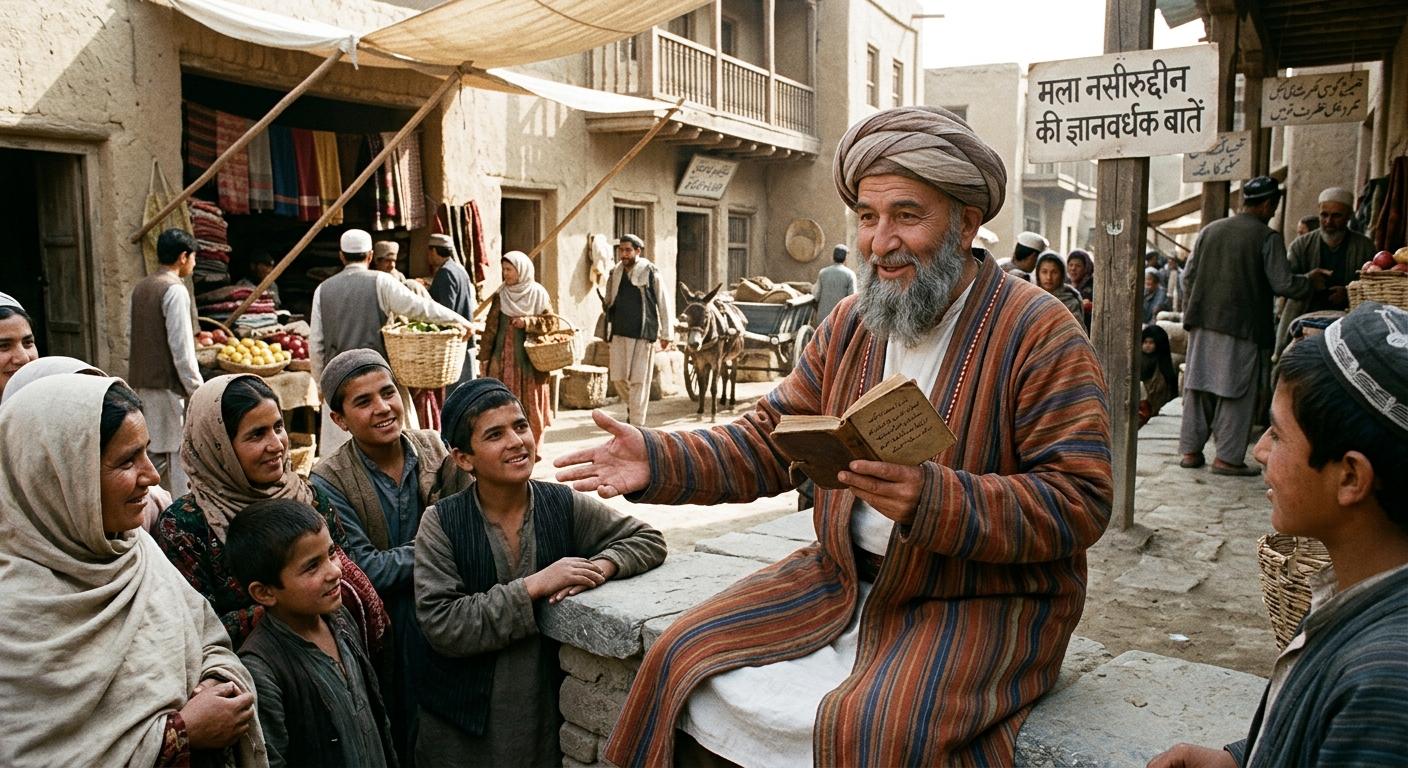
    Mulla Nasrudin was resting under a massive walnut tree in an orchard, looking out at a patch of large watermelons growing nearby on thin, fragile vines.
    He shook his head and murmured, "Oh, Allah, your wisdom is great, but sometimes I wonder about the design of this world! Look at this grand, powerful tree—it produces tiny, insignificant walnuts. And over there, those fragile, trailing vines carry giant, heavy watermelons! Surely it would make much more sense if the big tree grew the big watermelons, and the weak vines held the little nuts."
    Just as he finished his thought, a breeze blew through the orchard. A ripe walnut detached from a high branch, plummeted down, and landed squarely on Nasrudin's bare forehead with a sharp *thwack!*
    Rubbing his sore head, Nasrudin immediately dropped to his knees in prayer. "Forgive me, Allah!" he cried. "I will never question your design again! For if a heavy watermelon had been hanging from that branch instead of a tiny walnut, I would not be alive to tell the story!"
    ---
    ### Key Takeaway
    Nasrudin's tale serves as a classic humorous reminder about **perspective and humility**. It highlights how easy it is to judge a system or design as flawed based on superficial observations, only to realize later that there is a deeper function or balance we hadn't considered. See less
    Day 11 story post Roll no:10 foundation level Mulla Nasrudin was resting under a massive walnut tree in an orchard, looking out at a patch of large watermelons growing nearby on thin, fragile vines. He shook his head and murmured, "Oh, Allah, your wisdom is great, but sometimes I wonder about the design of this world! Look at this grand, powerful tree—it produces tiny, insignificant walnuts. And over there, those fragile, trailing vines carry giant, heavy watermelons! Surely it would make much more sense if the big tree grew the big watermelons, and the weak vines held the little nuts." Just as he finished his thought, a breeze blew through the orchard. A ripe walnut detached from a high branch, plummeted down, and landed squarely on Nasrudin's bare forehead with a sharp *thwack!* Rubbing his sore head, Nasrudin immediately dropped to his knees in prayer. "Forgive me, Allah!" he cried. "I will never question your design again! For if a heavy watermelon had been hanging from that branch instead of a tiny walnut, I would not be alive to tell the story!" --- ### Key Takeaway Nasrudin's tale serves as a classic humorous reminder about **perspective and humility**. It highlights how easy it is to judge a system or design as flawed based on superficial observations, only to realize later that there is a deeper function or balance we hadn't considered. See less
    0 Commentarii 0 Distribuiri 2143 Views
  • Day: -104

    Roll No: 006

    Level: Foundation

    Title: The Blueprint of Existence

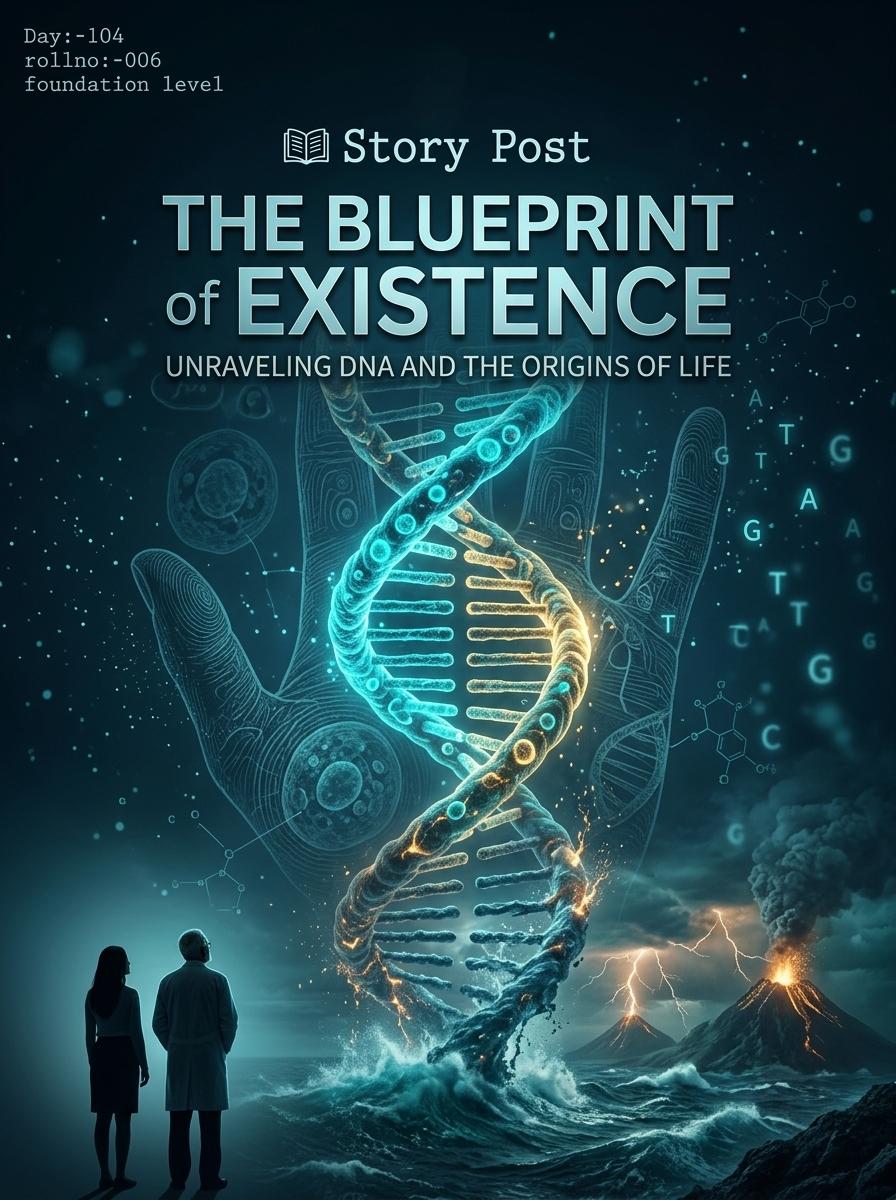
    The laboratory was quiet, save for the low hum of the sequencing machines and the persistent click of Maya’s pen against her notebook. On the monitor, billions of nitrogenous bases flickered in glowing cyan—A, T, C, G—a silent language written four billion years ago.

    For centuries, humanity looked up at the stars to understand where we came from, building telescopes to peer into the void. But as Maya watched the double helix render across her screen, she knew the real ledger of our origins wasn't written in dust and plasma. It was coiled tightly inside every nucleus of every living cell on Earth.

    "Still trying to read the first page?"

    Maya turned. Dr. Aris stood in the doorway, two mugs of cold coffee in hand. He set one on her desk, his gaze lingering on the digital rendering of RNA strands folding over themselves in a simulated primordial tide pool.

    "It’s the transition that gets me," Maya said, tracing the curve of the ribbon on her screen. "RNA was the pioneer—acting as both the blueprint and the engine in the primitive soup. But it was fragile. Volatile. How did life take that impossible leap from chaotic chemistry to the absolute permanence of DNA?"

    Aris smiled, pulling up a chair. "By inventing memory. RNA lived in the moment, reacting and replicating in hydrothermal heat. But DNA was built to endure. It dropped an oxygen atom, twisted into a double helix, and locked the master copy in a vault. It stopped just reacting to the world and started remembering it."

    They sat in silence for a moment, surrounded by data streams containing the genetic blueprints of thousands of species—from ancient deep-sea archaebacteria to modern human genomes. Every single one used the exact same four-letter alphabet, a continuous, unbroken chain of code passed down through unfathomable millennia, surviving mass extinctions, ice ages, and cosmic bombardments.

    "We think of history as monuments, books, and empires," Maya whispered, adjusting her glasses. "But none of those last. Empires crumble to dust. Books burn."

    "And yet," Aris added quietly, "a sequence forged in a primordial tide pool fou
    Day: -104 Roll No: 006 Level: Foundation Title: The Blueprint of Existence The laboratory was quiet, save for the low hum of the sequencing machines and the persistent click of Maya’s pen against her notebook. On the monitor, billions of nitrogenous bases flickered in glowing cyan—A, T, C, G—a silent language written four billion years ago. For centuries, humanity looked up at the stars to understand where we came from, building telescopes to peer into the void. But as Maya watched the double helix render across her screen, she knew the real ledger of our origins wasn't written in dust and plasma. It was coiled tightly inside every nucleus of every living cell on Earth. "Still trying to read the first page?" Maya turned. Dr. Aris stood in the doorway, two mugs of cold coffee in hand. He set one on her desk, his gaze lingering on the digital rendering of RNA strands folding over themselves in a simulated primordial tide pool. "It’s the transition that gets me," Maya said, tracing the curve of the ribbon on her screen. "RNA was the pioneer—acting as both the blueprint and the engine in the primitive soup. But it was fragile. Volatile. How did life take that impossible leap from chaotic chemistry to the absolute permanence of DNA?" Aris smiled, pulling up a chair. "By inventing memory. RNA lived in the moment, reacting and replicating in hydrothermal heat. But DNA was built to endure. It dropped an oxygen atom, twisted into a double helix, and locked the master copy in a vault. It stopped just reacting to the world and started remembering it." They sat in silence for a moment, surrounded by data streams containing the genetic blueprints of thousands of species—from ancient deep-sea archaebacteria to modern human genomes. Every single one used the exact same four-letter alphabet, a continuous, unbroken chain of code passed down through unfathomable millennia, surviving mass extinctions, ice ages, and cosmic bombardments. "We think of history as monuments, books, and empires," Maya whispered, adjusting her glasses. "But none of those last. Empires crumble to dust. Books burn." "And yet," Aris added quietly, "a sequence forged in a primordial tide pool fou
    0 Commentarii 0 Distribuiri 2249 Views
  • Mohsin #RSF8
    #Storypostt6
    Class: Foundation level
    Made by Me
    rool no:13
    The Journey of Dinosaurs: A Scientific Perspective

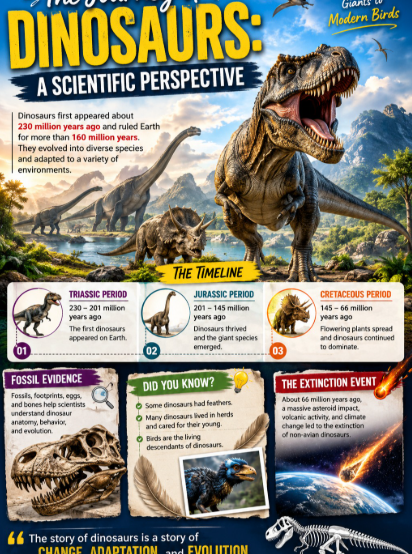
    Travel back hundreds of millions of years and discover the extraordinary story of dinosaurs—some of the most fascinating creatures to ever inhabit our planet. Their journey began during the Triassic Period, approximately 230 million years ago, when the Earth looked vastly different from the world we know today. Continents were joined together in a giant landmass called Pangaea, and early dinosaurs emerged as small, agile reptiles. Over time, these ancient creatures evolved into a diverse range of species, occupying nearly every ecological niche and becoming the dominant animals on Earth for more than 160 million years.

    During the Jurassic Period, dinosaurs flourished and diversified into countless forms. Massive herbivores such as Brachiosaurus and Diplodocus roamed lush forests, while formidable predators like Allosaurus hunted across vast landscapes. Their remarkable adaptations allowed them to thrive in changing environments, demonstrating the power of evolution and natural selection. As ecosystems became increasingly complex, dinosaurs developed specialized characteristics that enabled them to survive and dominate their habitats.

    The Cretaceous Period marked the peak of dinosaur diversity. Iconic species such as Tyrannosaurus rex, Triceratops, and Velociraptor appeared during this era. Scientists believe that many dinosaurs displayed advanced behaviors, including social interaction, parental care, and migration. Fossil evidence has even revealed that some dinosaurs possessed feathers, providing strong support for the evolutionary link between dinosaurs and modern birds. These discoveries have transformed our understanding of dinosaurs, showing that they were dynamic, intelligent, and highly adaptable creatures rather than the slow-moving reptiles once imagined.

    Our knowledge of dinosaurs comes primarily from the study of fossils. Paleontologists carefully examine fossilized bones, footprints, eggs, and even preserved skin impressions to reconstruct the lives of these prehistoric animals. Modern technologies.
    Mohsin #RSF8🎓✨ #Storypostt6 Class: Foundation level 📚 Made by Me 💻🚀 rool no:13 🦖 The Journey of Dinosaurs: A Scientific Perspective Travel back hundreds of millions of years and discover the extraordinary story of dinosaurs—some of the most fascinating creatures to ever inhabit our planet. Their journey began during the Triassic Period, approximately 230 million years ago, when the Earth looked vastly different from the world we know today. Continents were joined together in a giant landmass called Pangaea, and early dinosaurs emerged as small, agile reptiles. Over time, these ancient creatures evolved into a diverse range of species, occupying nearly every ecological niche and becoming the dominant animals on Earth for more than 160 million years. During the Jurassic Period, dinosaurs flourished and diversified into countless forms. Massive herbivores such as Brachiosaurus and Diplodocus roamed lush forests, while formidable predators like Allosaurus hunted across vast landscapes. Their remarkable adaptations allowed them to thrive in changing environments, demonstrating the power of evolution and natural selection. As ecosystems became increasingly complex, dinosaurs developed specialized characteristics that enabled them to survive and dominate their habitats. The Cretaceous Period marked the peak of dinosaur diversity. Iconic species such as Tyrannosaurus rex, Triceratops, and Velociraptor appeared during this era. Scientists believe that many dinosaurs displayed advanced behaviors, including social interaction, parental care, and migration. Fossil evidence has even revealed that some dinosaurs possessed feathers, providing strong support for the evolutionary link between dinosaurs and modern birds. These discoveries have transformed our understanding of dinosaurs, showing that they were dynamic, intelligent, and highly adaptable creatures rather than the slow-moving reptiles once imagined. Our knowledge of dinosaurs comes primarily from the study of fossils. Paleontologists carefully examine fossilized bones, footprints, eggs, and even preserved skin impressions to reconstruct the lives of these prehistoric animals. Modern technologies.
    0 Commentarii 0 Distribuiri 4169 Views
  • #rsisb
    Roll no.239
    maya no.18
    Foundation Level

    The word **“Earth”** is one of the oldest and most meaningful words in the English language. It represents much more than the planet beneath our feet. Earth is our **home, the source of life, the ground we walk on, and a symbol of nature and human existence**. But where did this simple word come from, and how did its meaning develop over time?

    The history of the word **“Earth”** takes us back thousands of years. In ancient forms of English and related Germanic languages, words similar to *earth* were used to describe the **ground, soil, land, and the physical world**. Over time, the word developed into the name we now use for our entire planet. Unlike many planets in our Solar System, whose names are connected to ancient gods and mythology, **Earth's English name is closely connected to the ordinary ground beneath our feet**.

    This connection tells us something important about human history. Long before people understood that they lived on a planet moving through space, they experienced Earth simply as the land around them—the soil that grew their food, the ground that supported their homes, and the world they could see and touch.

    As human knowledge grew, our understanding of Earth changed dramatically. Ancient thinkers observed the sky and began asking important questions about the shape and nature of the world. Over centuries, explorers, scientists, astronomers, and travelers expanded humanity's understanding of the planet. Eventually, space exploration allowed humans to see Earth from beyond its atmosphere. Those images showed something extraordinary: **our vast world is a beautiful, fragile-looking sphere surrounded by the darkness of space**.

    From a scientific perspective, Earth is the **third planet from the Sun** and the only world currently known to support life. It has liquid water on its surface, a protective atmosphere, and a wide variety of environments that support countless living organisms. Its oceans, forests, mountains, deserts, rivers, and grasslands form an incredibly diverse and interconnected system.

    Earth's structure is also fascinating. Beneath the surface are different layers, including the **crust, mantle, and core**. These layers influence many natural processes, including the movement of tectonic plates, earthquakes, volcanic activity, and the formation of mountains. Although we live on the surface, the planet beneath us is constantly changing.

    Life on Earth depends on a delicate balance. **Air, water, sunlight, soil, and biodiversity** all play essential roles in supporting life. Plants produce oxygen and form the foundation of many ecosystems. Oceans help regulate climate and support an enormous variety of life. Forests provide habitats and influence the movement of water and carbon through the environment.

    However, Earth also faces serious environmental challenges. **Pollution, deforestation, habitat destruction, and climate change** affect ecosystems and communities around the world. These challenges remind us that Earth is not an unlimited resource. The choices humans make today can influence the quality of life for future generations.

    Protecting Earth does not always require extraordinary actions. Small changes can make a difference, such as **reducing waste, conserving water and energy, planting and protecting trees, avoiding unnecessary pollution, and learning more about the environment**. Governments, scientists, businesses, communities, and individuals all have important roles to play.

    The word **“Earth”** also has a powerful emotional and cultural meaning. People may come from different countries, speak different languages, and follow different traditions, but we all share the same planet. From this perspective, Earth can be seen as a symbol of our **shared home and shared responsibility**.

    **“Earth” – The History of Our Home in a Word** is therefore a journey through **language, history, science, nature, and human imagination**. The story of this word shows how language grows alongside human knowledge. What once described the soil beneath people's feet eventually became the name of an entire world traveling through space.

    The next time you hear or say the word **“Earth,”** remember that it carries a remarkable story. It connects us to the ancient past, the natural world around us, and the future we are helping to create.

    **Earth is not just where we live—it is the only home we all share. Protecting it is a responsibility that belongs to everyone.**

    ### **Hashtags**

    #Earth #OurPlanet #PlanetEarth #WordHistory #HistoryOfEarth #EnglishLanguage #LanguageHistory #Science #Nature #Environment #ClimateAwareness #ProtectOurPlanet #Sustainability #EarthScience #Space #Astronomy #LifeOnEarth #MotherEarth #SaveEarth #GoGreen #CleanEnvironment #Biodiversity #ClimateChange #Education #Knowledge #LearnAndExplore #OnePlanet #FutureGenerations #EarthLovers #OurHome
    #rsisb Roll no.239 maya no.18 Foundation Level The word **“Earth”** is one of the oldest and most meaningful words in the English language. It represents much more than the planet beneath our feet. Earth is our **home, the source of life, the ground we walk on, and a symbol of nature and human existence**. But where did this simple word come from, and how did its meaning develop over time? The history of the word **“Earth”** takes us back thousands of years. In ancient forms of English and related Germanic languages, words similar to *earth* were used to describe the **ground, soil, land, and the physical world**. Over time, the word developed into the name we now use for our entire planet. Unlike many planets in our Solar System, whose names are connected to ancient gods and mythology, **Earth's English name is closely connected to the ordinary ground beneath our feet**. 📖🌱 This connection tells us something important about human history. Long before people understood that they lived on a planet moving through space, they experienced Earth simply as the land around them—the soil that grew their food, the ground that supported their homes, and the world they could see and touch. As human knowledge grew, our understanding of Earth changed dramatically. Ancient thinkers observed the sky and began asking important questions about the shape and nature of the world. Over centuries, explorers, scientists, astronomers, and travelers expanded humanity's understanding of the planet. Eventually, space exploration allowed humans to see Earth from beyond its atmosphere. Those images showed something extraordinary: **our vast world is a beautiful, fragile-looking sphere surrounded by the darkness of space**. 🚀🌌 From a scientific perspective, Earth is the **third planet from the Sun** and the only world currently known to support life. It has liquid water on its surface, a protective atmosphere, and a wide variety of environments that support countless living organisms. Its oceans, forests, mountains, deserts, rivers, and grasslands form an incredibly diverse and interconnected system. 🌊🏔️🌳 Earth's structure is also fascinating. Beneath the surface are different layers, including the **crust, mantle, and core**. These layers influence many natural processes, including the movement of tectonic plates, earthquakes, volcanic activity, and the formation of mountains. Although we live on the surface, the planet beneath us is constantly changing. Life on Earth depends on a delicate balance. **Air, water, sunlight, soil, and biodiversity** all play essential roles in supporting life. Plants produce oxygen and form the foundation of many ecosystems. Oceans help regulate climate and support an enormous variety of life. Forests provide habitats and influence the movement of water and carbon through the environment. However, Earth also faces serious environmental challenges. **Pollution, deforestation, habitat destruction, and climate change** affect ecosystems and communities around the world. These challenges remind us that Earth is not an unlimited resource. The choices humans make today can influence the quality of life for future generations. 🌿♻️ Protecting Earth does not always require extraordinary actions. Small changes can make a difference, such as **reducing waste, conserving water and energy, planting and protecting trees, avoiding unnecessary pollution, and learning more about the environment**. Governments, scientists, businesses, communities, and individuals all have important roles to play. The word **“Earth”** also has a powerful emotional and cultural meaning. People may come from different countries, speak different languages, and follow different traditions, but we all share the same planet. From this perspective, Earth can be seen as a symbol of our **shared home and shared responsibility**. 🤝🌍 **“Earth” – The History of Our Home in a Word** is therefore a journey through **language, history, science, nature, and human imagination**. The story of this word shows how language grows alongside human knowledge. What once described the soil beneath people's feet eventually became the name of an entire world traveling through space. The next time you hear or say the word **“Earth,”** remember that it carries a remarkable story. It connects us to the ancient past, the natural world around us, and the future we are helping to create. **Earth is not just where we live—it is the only home we all share. Protecting it is a responsibility that belongs to everyone.** 🌍💚✨ ### 🔖 **Hashtags** #Earth #OurPlanet #PlanetEarth #WordHistory #HistoryOfEarth #EnglishLanguage #LanguageHistory #Science #Nature #Environment #ClimateAwareness #ProtectOurPlanet #Sustainability #EarthScience #Space #Astronomy #LifeOnEarth #MotherEarth #SaveEarth #GoGreen #CleanEnvironment #Biodiversity #ClimateChange #Education #Knowledge #LearnAndExplore #OnePlanet #FutureGenerations #EarthLovers #OurHome 🌍🌿💚✨

    0 Commentarii 0 Distribuiri 13789 Views 18
  • Arnon Katz an Israeli who I met over a year a go writes:
    In this disturbing days of war and terror I try to reach my so called "enemies" and speak with them directly without any intermediators, I wish to know them as people, as humans and my aim is to make He or She more comfortable to talk, even if we are in total disagreement.

    I use Facebook to connect and talk but I prefer to do it in private chats and not on public posts, since situation is very sensitive and fragile. I realized that in public posts we tend to express more of our public opinions then our personal opinions, we feel more obligated to the "tribe" we belong to and tend to go against other "tribes"

    I wish to talk about the things we have in common and we do have plenty of things in common as I have learned form conversation with other people from other "tribes". With all the differences we have I still want to believe that different tribes can let other tribes to live. Step by step, one by one we may create trust, we may open a small door of hope and let each other live in dignity.
    Arnon Katz an Israeli who I met over a year a go writes: In this disturbing days of war and terror I try to reach my so called "enemies" and speak with them directly without any intermediators, I wish to know them as people, as humans and my aim is to make He or She more comfortable to talk, even if we are in total disagreement. I use Facebook to connect and talk but I prefer to do it in private chats and not on public posts, since situation is very sensitive and fragile. I realized that in public posts we tend to express more of our public opinions then our personal opinions, we feel more obligated to the "tribe" we belong to and tend to go against other "tribes" I wish to talk about the things we have in common and we do have plenty of things in common as I have learned form conversation with other people from other "tribes". With all the differences we have I still want to believe that different tribes can let other tribes to live. Step by step, one by one we may create trust, we may open a small door of hope and let each other live in dignity.
    0 Commentarii 0 Distribuiri 682 Views
  • 1000 jobs available !

    Job Description
    We are looking for an experienced, highly motivated Full Stack Web Developer.
    If you are passionate about technology, constantly seeking to learn and improve your skillset, then you are the type of person we are looking for.

    Desired development skills:

    1. Experience developing cloud-hosted (AWS), responsive web applications using #JavaScript (React Js), #PHP, #HTML5, #CSS3.

    2. High proficiency with client-side #JavaScript frameworks (preferably React Js), server-side frameworks (preferably #CodeIgniter and Laravel), and #mySql database

    3. Able to integrate with and managing #APIs exposing microservices (RESTFUL APIs)

    4. Experience working with #Agile methodologies (Scrum, Lean Startup, XP) and cross-functional teams (Product Owners, Scrum Masters, Developers, Designers, Business Analysts).

    5. Should have a good command on GitHub

    6. Ideally familiar with Design Thinking, Behavior and Test-Driven Development.

    7. Familiarity with test-and-learn approaches using web and customer analytics data, understanding how these drive hypotheses-based development.

    8. Strong leadership, communication and collaboration skills with track record of taking solution ownership.

    9. A Bachelors or Masters degree in technical or business discipline or equivalent experience.

    10. 5+ years of professional experience.

    Contact Zain Jeewanjee
    1000 jobs available ! Job Description We are looking for an experienced, highly motivated Full Stack Web Developer. If you are passionate about technology, constantly seeking to learn and improve your skillset, then you are the type of person we are looking for. Desired development skills: 1. Experience developing cloud-hosted (AWS), responsive web applications using #JavaScript (React Js), #PHP, #HTML5, #CSS3. 2. High proficiency with client-side #JavaScript frameworks (preferably React Js), server-side frameworks (preferably #CodeIgniter and Laravel), and #mySql database 3. Able to integrate with and managing #APIs exposing microservices (RESTFUL APIs) 4. Experience working with #Agile methodologies (Scrum, Lean Startup, XP) and cross-functional teams (Product Owners, Scrum Masters, Developers, Designers, Business Analysts). 5. Should have a good command on GitHub 6. Ideally familiar with Design Thinking, Behavior and Test-Driven Development. 7. Familiarity with test-and-learn approaches using web and customer analytics data, understanding how these drive hypotheses-based development. 8. Strong leadership, communication and collaboration skills with track record of taking solution ownership. 9. A Bachelors or Master's degree in technical or business discipline or equivalent experience. 10. 5+ years of professional experience. Contact Zain Jeewanjee
    0 Commentarii 0 Distribuiri 5415 Views
  • The Story of SAARC

    In the years after independence, the countries of South Asia shared more than borders. They shared history, culture, languages, and above all, struggles. Poverty was widespread, education levels were low, and economies remained fragile. While Europe was learning to unite under the European Union and Southeast Asia was coming together through ASEAN, South Asia remained divided, mostly because of political mistrust.

    It was in this environment that President Ziaur Rahman of Bangladesh in the late 1970s began to dream of something different. He believed that the nations of South Asia could achieve far more if they stood together than if they worked alone. His proposal for a regional organization was not immediately welcomed—skepticism and suspicion ran high, particularly between India and Pakistan. Yet the idea slowly gained ground.

    Through a series of ministerial meetings in the early 1980s, the concept took shape. Leaders realized that they all faced common challenges: how to lift millions out of poverty, how to improve health and literacy, how to strengthen economies, and how to deal with disasters that so often struck the region. Working together could not erase political disputes, but it might build trust and deliver progress for ordinary people.

    Finally, on 8 December 1985, in Dhaka, Bangladesh, leaders of seven nations—Bangladesh, Bhutan, India, Maldives, Nepal, Pakistan, and Sri Lanka—signed a charter and gave birth to the South Asian Association for Regional Cooperation (SAARC). For the first time, South Asia had its own platform to speak as a region. There was excitement, hope, and a sense of new beginnings.

    The goals were ambitious yet simple: promote economic growth, foster social progress, celebrate cultural ties, and build peace. Later, in 2007, Afghanistan joined as the eighth member, broadening the family. Over the years, SAARC launched projects in education, agriculture, technology, health, and even disaster management. The creation of SAFTA (South Asian Free Trade Area) in 2006 was seen as a bold step toward economic integration.

    But the journey was not smooth. Political rivalries—especially between India and Pakistan—often froze dialogue. Summits were postponed, agreements stayed on paper, and the vision of a united South Asia never fully blossomed. While ASEAN surged ahead in trade and the EU built a common market, SAARC struggled to move beyond speeches and declarations.

    Today, nearly four decades later, #SAARC remains a symbol of both promise and frustration. It showed that South Asian leaders could dream of working together, but it also revealed how deep political divides can stall even the most hopeful visions. Still, the idea of SAARC continues to inspire—because the challenges of poverty, climate change, health, and regional trade are too large for any one country to solve alone.

    The story of SAARC is unfinished. It is the story of a region that knows it can rise higher if united, yet still searches for the courage to overcome mistrust and truly walk forward together.
    The Story of SAARC In the years after independence, the countries of South Asia shared more than borders. They shared history, culture, languages, and above all, struggles. Poverty was widespread, education levels were low, and economies remained fragile. While Europe was learning to unite under the European Union and Southeast Asia was coming together through ASEAN, South Asia remained divided, mostly because of political mistrust. It was in this environment that President Ziaur Rahman of Bangladesh in the late 1970s began to dream of something different. He believed that the nations of South Asia could achieve far more if they stood together than if they worked alone. His proposal for a regional organization was not immediately welcomed—skepticism and suspicion ran high, particularly between India and Pakistan. Yet the idea slowly gained ground. Through a series of ministerial meetings in the early 1980s, the concept took shape. Leaders realized that they all faced common challenges: how to lift millions out of poverty, how to improve health and literacy, how to strengthen economies, and how to deal with disasters that so often struck the region. Working together could not erase political disputes, but it might build trust and deliver progress for ordinary people. Finally, on 8 December 1985, in Dhaka, Bangladesh, leaders of seven nations—Bangladesh, Bhutan, India, Maldives, Nepal, Pakistan, and Sri Lanka—signed a charter and gave birth to the South Asian Association for Regional Cooperation (SAARC). For the first time, South Asia had its own platform to speak as a region. There was excitement, hope, and a sense of new beginnings. The goals were ambitious yet simple: promote economic growth, foster social progress, celebrate cultural ties, and build peace. Later, in 2007, Afghanistan joined as the eighth member, broadening the family. Over the years, SAARC launched projects in education, agriculture, technology, health, and even disaster management. The creation of SAFTA (South Asian Free Trade Area) in 2006 was seen as a bold step toward economic integration. But the journey was not smooth. Political rivalries—especially between India and Pakistan—often froze dialogue. Summits were postponed, agreements stayed on paper, and the vision of a united South Asia never fully blossomed. While ASEAN surged ahead in trade and the EU built a common market, SAARC struggled to move beyond speeches and declarations. Today, nearly four decades later, #SAARC remains a symbol of both promise and frustration. It showed that South Asian leaders could dream of working together, but it also revealed how deep political divides can stall even the most hopeful visions. Still, the idea of SAARC continues to inspire—because the challenges of poverty, climate change, health, and regional trade are too large for any one country to solve alone. The story of SAARC is unfinished. It is the story of a region that knows it can rise higher if united, yet still searches for the courage to overcome mistrust and truly walk forward together.
    0 Commentarii 0 Distribuiri 2185 Views
  • Two Paths, One Dream: The Story of IB and Rehan School

    In Geneva in the 1960s, the world was still healing from the scars of war. A small group of educators dreamed of an education system that would prepare children not just for exams, but for life in a rapidly changing and fragile world. Out of that dream was born the International Baccalaureate (IB) in 1968—a bold experiment in global learning. Its mission was clear: to develop inquiring, knowledgeable, and caring young people who would create a better and more peaceful world.

    At the heart of IB’s origin was the belief that education must unite cultures and nations. Marie-Thérèse Maurette and her colleagues designed a program that challenged students to think critically, serve their communities, and see themselves as citizens of the world. IB began with only a handful of schools, but its vision of “Education for a Better World” carried it across continents. Today, IB operates in more than 150 countries, shaping millions of young minds.

    Half a century later, in Pakistan, another bold dream was born—the Rehan School. Its roots lie not in post-war Europe, but in the digital revolution of the 21st century. Where IB sought to unite cultures through a shared curriculum, Rehan School seeks to empower the underserved through technology and artificial intelligence.

    Rehan School was founded with a different urgency: to create 1,000 leaders who will build $1 million startups, positively impact 1 million people, and raise Pakistan’s per capita income to $100,000. Unlike IB, which started with elite international schools, Rehan School is designed to be accessible to anyone with a mobile phone, internet connection, and the will to learn.

    Both movements share a deep commonality: they believe that education is not just about knowledge, but about transformation. IB emphasized critical thinking, global citizenship, and community service; Rehan School emphasizes entrepreneurship, leadership, and the use of AI to leapfrog traditional barriers. Both want to create not just students, but leaders of change.

    Yet, their contexts differ. IB emerged from a world longing for peace; Rehan School emerges from a world racing through digital disruption. IB spread through brick-and-mortar international schools; Rehan School spreads through smartphones and online platforms. IB focused on preparing children for global universities; Rehan School focuses on preparing adults and youth to build global startups.

    If IB was the education of the 20th century’s challenges, Rehan School is the education for the 21st century’s opportunities. One began in Geneva, the other in Karachi—but both share the same dream: to empower learners to change the world.

    ⸻

    Lesson for Rehan School:
    IB started with a clear, inspiring mission and expanded slowly but steadily into a global force. Rehan School, with its bold vision and AI-first model, can learn from IB’s discipline of mission clarity, global partnerships, and consistent values, while moving even faster thanks to technology.
    Two Paths, One Dream: The Story of IB and Rehan School In Geneva in the 1960s, the world was still healing from the scars of war. A small group of educators dreamed of an education system that would prepare children not just for exams, but for life in a rapidly changing and fragile world. Out of that dream was born the International Baccalaureate (IB) in 1968—a bold experiment in global learning. Its mission was clear: to develop inquiring, knowledgeable, and caring young people who would create a better and more peaceful world. At the heart of IB’s origin was the belief that education must unite cultures and nations. Marie-Thérèse Maurette and her colleagues designed a program that challenged students to think critically, serve their communities, and see themselves as citizens of the world. IB began with only a handful of schools, but its vision of “Education for a Better World” carried it across continents. Today, IB operates in more than 150 countries, shaping millions of young minds. Half a century later, in Pakistan, another bold dream was born—the Rehan School. Its roots lie not in post-war Europe, but in the digital revolution of the 21st century. Where IB sought to unite cultures through a shared curriculum, Rehan School seeks to empower the underserved through technology and artificial intelligence. Rehan School was founded with a different urgency: to create 1,000 leaders who will build $1 million startups, positively impact 1 million people, and raise Pakistan’s per capita income to $100,000. Unlike IB, which started with elite international schools, Rehan School is designed to be accessible to anyone with a mobile phone, internet connection, and the will to learn. Both movements share a deep commonality: they believe that education is not just about knowledge, but about transformation. IB emphasized critical thinking, global citizenship, and community service; Rehan School emphasizes entrepreneurship, leadership, and the use of AI to leapfrog traditional barriers. Both want to create not just students, but leaders of change. Yet, their contexts differ. IB emerged from a world longing for peace; Rehan School emerges from a world racing through digital disruption. IB spread through brick-and-mortar international schools; Rehan School spreads through smartphones and online platforms. IB focused on preparing children for global universities; Rehan School focuses on preparing adults and youth to build global startups. If IB was the education of the 20th century’s challenges, Rehan School is the education for the 21st century’s opportunities. One began in Geneva, the other in Karachi—but both share the same dream: to empower learners to change the world. ⸻ ✨ Lesson for Rehan School: IB started with a clear, inspiring mission and expanded slowly but steadily into a global force. Rehan School, with its bold vision and AI-first model, can learn from IB’s discipline of mission clarity, global partnerships, and consistent values, while moving even faster thanks to technology.
    0 Commentarii 0 Distribuiri 1421 Views
  • A Prayer for the Dawn of a New World

    Nobel Literature Worthy Version

    O Master of Time and Destiny,
    O unseen force by whose whisper galaxies drift,
    and in whose silence the first light of the human heart was kindled—
    I stand before You with my tired hopes,
    carrying in my chest the thousand-year wounds of the world,
    the world that belongs to You,
    but upon whose face humanity has drawn lines of sorrow.

    Lord of All Worlds,
    the earth begs You for a debt of peace.
    Mountains stand in the stillness of Your breath,
    oceans move with the certainty of Your command—
    but we, the children shaped in Your image,
    seek a dawn within ourselves,
    a sun bright enough to outshine the long night inside our minds.

    Light of the Cosmos,
    let Your mercy fall upon Pakistan.
    Melt the shadows of ignorance,
    and let its soil bloom with the green fire of knowledge.
    Fill its streets with laughing children,
    let birds of hope cross its skies,
    and let homes find dignity, livelihood, and love
    descending like rain into their open hands.

    Creator of Hearts,
    grant my nation a place where knowledge is fearless,
    where a human face is not an enemy’s mirror,
    but a reflection of the same fragile soul.
    Let Pakistan rise to a horizon wider than oceans—
    deep, vast, and unafraid.
    Let every child, every woman, every man
    learn not to accept fate as a given,
    but to weave their own destiny from the threads of possibility.

    O Eternal,
    give the world the knowledge of America,
    give America the simplicity of spirit,
    and give all humanity one single heart—
    a heart without borders,
    a heart that weeps only for injustice,
    and one that smiles in the shared joy of the human tribe.

    Maker of the Skies,
    wars are ancient stories carved into the bones of history,
    but the fire inside human beings is still burning.
    Send Your rain upon that inner flame—
    the rain that turns stone into flowers,
    that takes weapons from closed fists
    and replaces them with lamps of kindness.

    Source of the Living Book,
    make the world a single family;
    let nations become mere names,
    and hearts become one tribe.
    Let the earth be a long table
    around which humanity breaks bread together,
    speaks softly, and places flowers
    upon each other’s hidden wounds.

    Lord of Infinite Wisdom,
    if it is within Your decree
    that morning should arrive
    with the world already transformed—
    then turn this earth into a garden,
    where forgiveness is strength,
    mercy is the crown,
    and a smile is faith itself.

    But if Your will is otherwise—
    that paradise must be born through human hands—
    then make me the first seed of that miracle.
    Place light within my grasp,
    consolation upon my tongue,
    healing in my actions,
    and within my heart a fire
    that turns injustice into ash.

    I seek Your grace—
    not for myself alone,
    but for this world in which I exist
    like a single breath,
    yet long to become a prayer
    large enough to shelter all of creation.

    For truly, You have power
    over all things.
    Ameen.
    A Prayer for the Dawn of a New World Nobel Literature Worthy Version O Master of Time and Destiny, O unseen force by whose whisper galaxies drift, and in whose silence the first light of the human heart was kindled— I stand before You with my tired hopes, carrying in my chest the thousand-year wounds of the world, the world that belongs to You, but upon whose face humanity has drawn lines of sorrow. Lord of All Worlds, the earth begs You for a debt of peace. Mountains stand in the stillness of Your breath, oceans move with the certainty of Your command— but we, the children shaped in Your image, seek a dawn within ourselves, a sun bright enough to outshine the long night inside our minds. Light of the Cosmos, let Your mercy fall upon Pakistan. Melt the shadows of ignorance, and let its soil bloom with the green fire of knowledge. Fill its streets with laughing children, let birds of hope cross its skies, and let homes find dignity, livelihood, and love descending like rain into their open hands. Creator of Hearts, grant my nation a place where knowledge is fearless, where a human face is not an enemy’s mirror, but a reflection of the same fragile soul. Let Pakistan rise to a horizon wider than oceans— deep, vast, and unafraid. Let every child, every woman, every man learn not to accept fate as a given, but to weave their own destiny from the threads of possibility. O Eternal, give the world the knowledge of America, give America the simplicity of spirit, and give all humanity one single heart— a heart without borders, a heart that weeps only for injustice, and one that smiles in the shared joy of the human tribe. Maker of the Skies, wars are ancient stories carved into the bones of history, but the fire inside human beings is still burning. Send Your rain upon that inner flame— the rain that turns stone into flowers, that takes weapons from closed fists and replaces them with lamps of kindness. Source of the Living Book, make the world a single family; let nations become mere names, and hearts become one tribe. Let the earth be a long table around which humanity breaks bread together, speaks softly, and places flowers upon each other’s hidden wounds. Lord of Infinite Wisdom, if it is within Your decree that morning should arrive with the world already transformed— then turn this earth into a garden, where forgiveness is strength, mercy is the crown, and a smile is faith itself. But if Your will is otherwise— that paradise must be born through human hands— then make me the first seed of that miracle. Place light within my grasp, consolation upon my tongue, healing in my actions, and within my heart a fire that turns injustice into ash. I seek Your grace— not for myself alone, but for this world in which I exist like a single breath, yet long to become a prayer large enough to shelter all of creation. For truly, You have power over all things. Ameen.
    0 Commentarii 0 Distribuiri 1483 Views
  • The Story of Knowledge: How Humanity Learned to Remember, Share, and Think Together

    Before books, before writing, before cities, knowledge lived in the most fragile place possible: the human mind.

    A hunter taught his son where animals migrate.
    A mother taught her daughter which plants heal and which kill.
    A tribe survived because someone remembered.

    This was the oral age of knowledge.

    Human beings invented memory systems long before writing:
    • Stories wrapped in emotion
    • Songs tied to rhythm
    • Poetry that could not be forgotten

    Knowledge survived not because it was written, but because it was memorable.

    But memory dies with the body.

    And one day, humanity decided that knowledge should live longer than a human life.

    ⸻

    When Knowledge Left the Brain: Clay Tablets

    Around 5,000 years ago, humans pressed symbols into wet clay.

    With clay tablets, knowledge stepped outside the human body for the first time.

    Laws, trade, stories, and calculations were frozen in time.
    A thought could now survive its thinker.

    But this knowledge was:
    • Heavy
    • Slow to copy
    • Controlled by a few scribes

    Knowledge existed — but it did not yet flow.

    ⸻

    The Alphabet: Compressing Human Thought

    Then came a silent revolution.

    Instead of thousands of symbols, humans invented alphabets — a small set of letters that could build infinite meaning.

    This was one of the greatest inventions in human history.

    For the first time:
    • Ordinary people could learn to read
    • Knowledge could spread beyond priests
    • Thought could be compressed efficiently

    The alphabet did to language what ZIP files do to data.

    ⸻

    Numbers, Zero, and Mathematics: Knowledge Becomes Universal

    Words describe.
    Numbers prove.

    When civilizations developed mathematics — especially zero, algebra, and geometry — knowledge became:
    • Precise
    • Universal
    • Predictable

    A law of physics written in numbers could be understood anywhere on Earth.

    Without mathematics:
    • There is no science
    • No engineering
    • No computers

    Math became the language of reality itself.

    ⸻

    Papyrus, Paper, and the Freedom to Travel

    Egypt gave us papyrus.
    China gave us paper.

    This changed everything.

    Knowledge became:
    • Light
    • Cheap
    • Portable

    Now ideas could travel faster than armies.

    Paper quietly enabled:
    • Education systems
    • Exams
    • Bureaucracy
    • Books for the masses

    The printing press would later get the credit — but paper made it possible.

    ⸻

    Libraries & Universities: Knowledge Gets a Home

    As knowledge grew, humanity faced a new problem:

    “Where do we keep it all?”

    Libraries emerged.
    So did universities.

    Places like:
    • Taxila (in today’s Pakistan)
    • Nalanda
    • Al-Qarawiyyin
    • Al-Azhar

    Knowledge stopped being individual and became institutional.

    Universities created:
    • Disciplines
    • Teachers
    • Students
    • Curricula

    Humanity built factories of thinking.

    ⸻

    The Translation Movements: Knowledge Is Saved

    Knowledge nearly died many times.

    When empires fell, books burned.

    But during the Islamic Golden Age, scholars translated Greek, Persian, and Indian knowledge into Arabic — preserving it, expanding it, and improving it.

    Europe later received this knowledge back.

    The Renaissance was not a miracle.
    It was a return shipment.

    ⸻

    The Printing Press: Knowledge Explodes

    In the 1400s, Gutenberg introduced the printing press.

    For the first time:
    • Knowledge multiplied faster than humans
    • Identical copies spread everywhere
    • Education broke elite control

    This single invention reshaped the world:
    • Science accelerated
    • Religion was questioned
    • Literacy exploded

    Knowledge stopped whispering.
    It began to roar.

    ⸻

    The Scientific Method: Truth Changes Its Rules

    Before this moment:

    Truth came from authority.

    After this moment:

    Truth came from evidence.

    The scientific method taught humanity how to test knowledge.

    If it couldn’t be proven, it couldn’t rule.

    This changed everything:
    • Medicine
    • Technology
    • Industry
    • Modern life

    ⸻

    Electricity & Computers: Knowledge Gains Speed

    Electricity gave knowledge:
    • Speed
    • Distance elimination
    • Automation

    Computers turned knowledge into data.
    Storage became cheap.
    Copying became instant.

    But data alone is useless without finding it.

    ⸻

    Search Engines: Knowledge Becomes Findable

    The internet created chaos.
    Search engines created order.

    For the first time:
    • Humanity could ask questions and get answers instantly
    • Knowledge became navigable

    Google did not create knowledge.
    It made it usable.

    ⸻

    Social Media: Knowledge Becomes Emotional

    Then knowledge entered the social age.

    Truth now competed with:
    • Virality
    • Emotion
    • Attention

    Ideas spread not because they were correct —
    but because they were shareable.

    This changed how humans think, argue, and believe.

    ⸻

    Artificial Intelligence: Knowledge Comes Alive

    Now we stand at the greatest turning point since writing itself.

    AI does not just store knowledge.
    It understands, recombines, explains, and teaches it.

    For the first time:
    • Knowledge talks back
    • Adapts to the learner
    • Learns how you learn

    This is not a library.
    This is living knowledge.

    ⸻

    The Real Ending (Which Is Also a Beginning)

    From memory to clay.
    From letters to numbers.
    From books to machines.
    From storage to intelligence.

    The story of humanity is not about tools.
    It is about how we protect, spread, and use knowledge.

    Today, knowledge is no longer scarce.

    Wisdom is.

    And the next civilization will not be ruled by those who have knowledge —
    but by those who understand how to use it responsibly.
    The Story of Knowledge: How Humanity Learned to Remember, Share, and Think Together Before books, before writing, before cities, knowledge lived in the most fragile place possible: the human mind. A hunter taught his son where animals migrate. A mother taught her daughter which plants heal and which kill. A tribe survived because someone remembered. This was the oral age of knowledge. Human beings invented memory systems long before writing: • Stories wrapped in emotion • Songs tied to rhythm • Poetry that could not be forgotten Knowledge survived not because it was written, but because it was memorable. But memory dies with the body. And one day, humanity decided that knowledge should live longer than a human life. ⸻ When Knowledge Left the Brain: Clay Tablets Around 5,000 years ago, humans pressed symbols into wet clay. With clay tablets, knowledge stepped outside the human body for the first time. Laws, trade, stories, and calculations were frozen in time. A thought could now survive its thinker. But this knowledge was: • Heavy • Slow to copy • Controlled by a few scribes Knowledge existed — but it did not yet flow. ⸻ The Alphabet: Compressing Human Thought Then came a silent revolution. Instead of thousands of symbols, humans invented alphabets — a small set of letters that could build infinite meaning. This was one of the greatest inventions in human history. For the first time: • Ordinary people could learn to read • Knowledge could spread beyond priests • Thought could be compressed efficiently The alphabet did to language what ZIP files do to data. ⸻ Numbers, Zero, and Mathematics: Knowledge Becomes Universal Words describe. Numbers prove. When civilizations developed mathematics — especially zero, algebra, and geometry — knowledge became: • Precise • Universal • Predictable A law of physics written in numbers could be understood anywhere on Earth. Without mathematics: • There is no science • No engineering • No computers Math became the language of reality itself. ⸻ Papyrus, Paper, and the Freedom to Travel Egypt gave us papyrus. China gave us paper. This changed everything. Knowledge became: • Light • Cheap • Portable Now ideas could travel faster than armies. Paper quietly enabled: • Education systems • Exams • Bureaucracy • Books for the masses The printing press would later get the credit — but paper made it possible. ⸻ Libraries & Universities: Knowledge Gets a Home As knowledge grew, humanity faced a new problem: “Where do we keep it all?” Libraries emerged. So did universities. Places like: • Taxila (in today’s Pakistan) • Nalanda • Al-Qarawiyyin • Al-Azhar Knowledge stopped being individual and became institutional. Universities created: • Disciplines • Teachers • Students • Curricula Humanity built factories of thinking. ⸻ The Translation Movements: Knowledge Is Saved Knowledge nearly died many times. When empires fell, books burned. But during the Islamic Golden Age, scholars translated Greek, Persian, and Indian knowledge into Arabic — preserving it, expanding it, and improving it. Europe later received this knowledge back. The Renaissance was not a miracle. It was a return shipment. ⸻ The Printing Press: Knowledge Explodes In the 1400s, Gutenberg introduced the printing press. For the first time: • Knowledge multiplied faster than humans • Identical copies spread everywhere • Education broke elite control This single invention reshaped the world: • Science accelerated • Religion was questioned • Literacy exploded Knowledge stopped whispering. It began to roar. ⸻ The Scientific Method: Truth Changes Its Rules Before this moment: Truth came from authority. After this moment: Truth came from evidence. The scientific method taught humanity how to test knowledge. If it couldn’t be proven, it couldn’t rule. This changed everything: • Medicine • Technology • Industry • Modern life ⸻ Electricity & Computers: Knowledge Gains Speed Electricity gave knowledge: • Speed • Distance elimination • Automation Computers turned knowledge into data. Storage became cheap. Copying became instant. But data alone is useless without finding it. ⸻ Search Engines: Knowledge Becomes Findable The internet created chaos. Search engines created order. For the first time: • Humanity could ask questions and get answers instantly • Knowledge became navigable Google did not create knowledge. It made it usable. ⸻ Social Media: Knowledge Becomes Emotional Then knowledge entered the social age. Truth now competed with: • Virality • Emotion • Attention Ideas spread not because they were correct — but because they were shareable. This changed how humans think, argue, and believe. ⸻ Artificial Intelligence: Knowledge Comes Alive Now we stand at the greatest turning point since writing itself. AI does not just store knowledge. It understands, recombines, explains, and teaches it. For the first time: • Knowledge talks back • Adapts to the learner • Learns how you learn This is not a library. This is living knowledge. ⸻ The Real Ending (Which Is Also a Beginning) From memory to clay. From letters to numbers. From books to machines. From storage to intelligence. The story of humanity is not about tools. It is about how we protect, spread, and use knowledge. Today, knowledge is no longer scarce. Wisdom is. And the next civilization will not be ruled by those who have knowledge — but by those who understand how to use it responsibly.
    0 Commentarii 0 Distribuiri 1342 Views
Sponsorizeaza Paginile