• RSIF8
    Roll no:14
    story no:24
    story topic:Climate and Culture: How Geography Shapes Our Way of Life

    # Climate and Culture: How Geography Shapes Our Way of Life

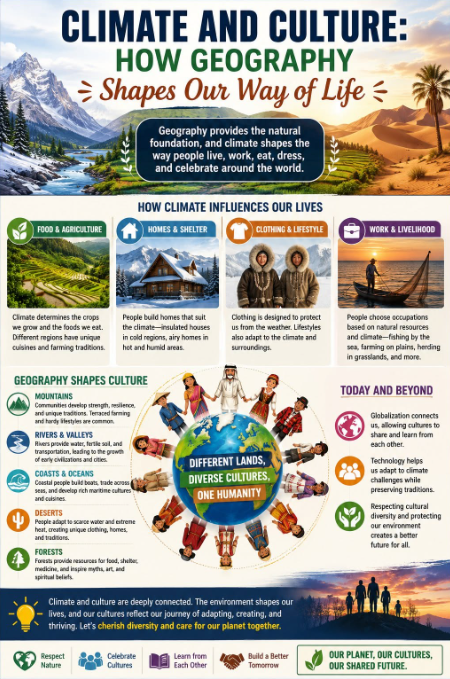
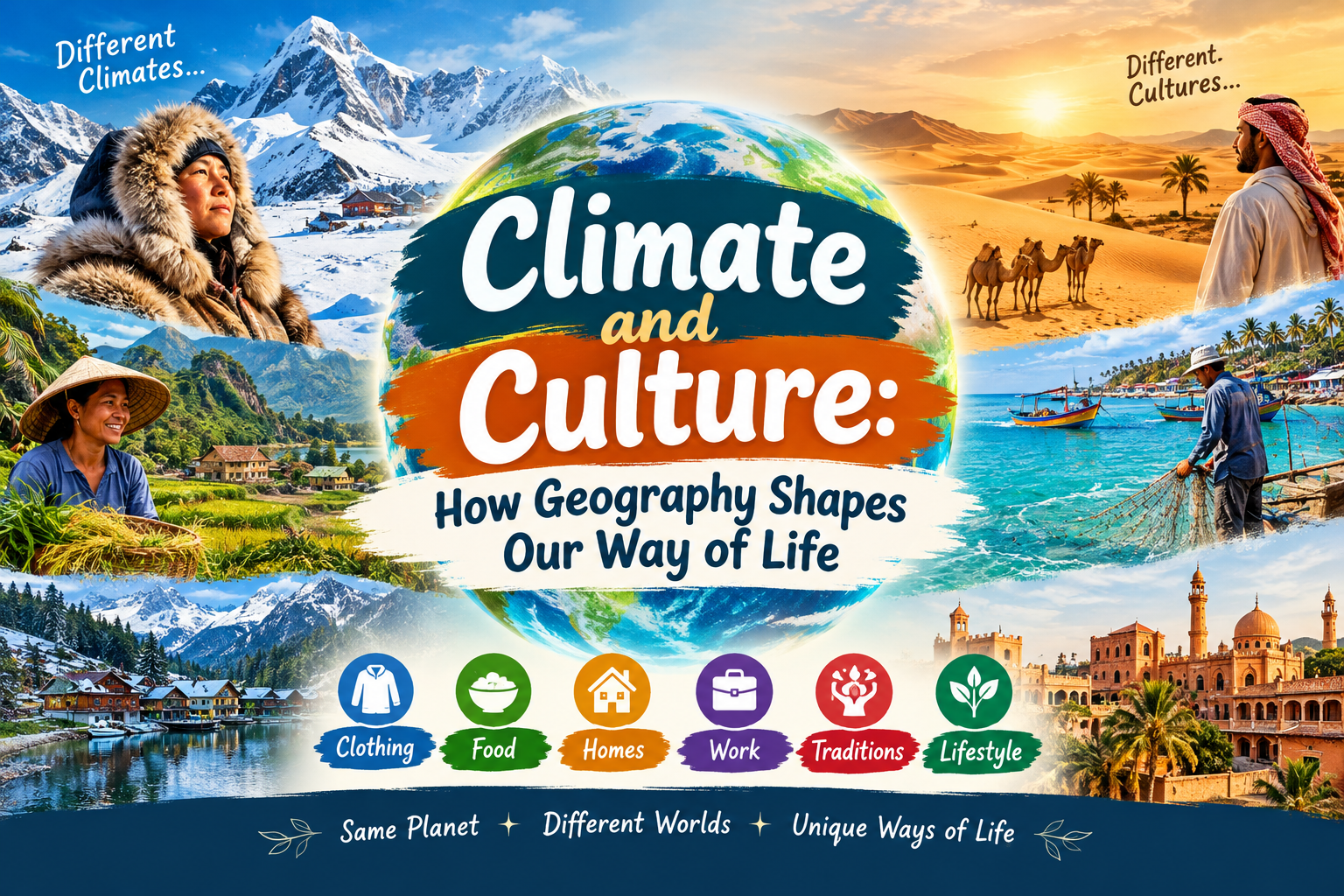
    How does the environment around us influence the way we live, dress, eat, work, and celebrate? **“Climate and Culture: How Geography Shapes Our Way of Life”** explores the fascinating relationship between climate, geography, and human culture. From freezing mountains to hot deserts, every region of the world has unique environmental conditions that shape the lifestyles, traditions, and customs of its people.

    Climate plays an important role in determining the types of clothing people wear, the food they eat, the houses they build, and the activities they enjoy. In colder regions, people often wear warm clothing and construct homes designed to retain heat. In hot areas, lightweight clothing and buildings that provide shade and ventilation help people adapt to high temperatures. Similarly, rainfall, soil fertility, and access to water influence agriculture, occupations, and local economies.

    Geography also contributes to the development of languages, festivals, architecture, and cultural traditions. Communities living near rivers and oceans may depend on fishing and maritime trade, while people in mountainous areas may develop traditions connected to farming, livestock, and mountain life. These differences make every culture unique and demonstrate how closely human societies are connected to the natural world.

    This topic helps students understand the importance of environmental adaptation, cultural diversity, and sustainable living. It encourages us to appreciate different ways of life and recognize how people respond creatively to the opportunities and challenges presented by their surroundings.

    **Discover how our planet shapes our traditions, influences our choices, and connects geography with the beautiful diversity of human life!**

    Watch, learn, and explore the incredible connection between climate, culture, and the world we share.

    #ClimateAndCulture #Geography #HumanGeography #ClimateChange #CulturalDiversity #Environment #WorldCultures #GeographyEducation #SocialStudies #NatureAndCulture #SustainableLiving #EducationalContent #LearningIsFun #OurWorld
    RSIF8 Roll no:14 story no:24 story topic:Climate and Culture: How Geography Shapes Our Way of Life # 🌍 Climate and Culture: How Geography Shapes Our Way of Life 🌦️🏡 How does the environment around us influence the way we live, dress, eat, work, and celebrate? **“Climate and Culture: How Geography Shapes Our Way of Life”** explores the fascinating relationship between climate, geography, and human culture. From freezing mountains to hot deserts, every region of the world has unique environmental conditions that shape the lifestyles, traditions, and customs of its people. 🌎✨ Climate plays an important role in determining the types of clothing people wear, the food they eat, the houses they build, and the activities they enjoy. In colder regions, people often wear warm clothing and construct homes designed to retain heat. In hot areas, lightweight clothing and buildings that provide shade and ventilation help people adapt to high temperatures. Similarly, rainfall, soil fertility, and access to water influence agriculture, occupations, and local economies. 🌧️🏔️☀️ Geography also contributes to the development of languages, festivals, architecture, and cultural traditions. Communities living near rivers and oceans may depend on fishing and maritime trade, while people in mountainous areas may develop traditions connected to farming, livestock, and mountain life. These differences make every culture unique and demonstrate how closely human societies are connected to the natural world. 🌊🌾 This topic helps students understand the importance of environmental adaptation, cultural diversity, and sustainable living. It encourages us to appreciate different ways of life and recognize how people respond creatively to the opportunities and challenges presented by their surroundings. 🌱🤝 💡 **Discover how our planet shapes our traditions, influences our choices, and connects geography with the beautiful diversity of human life!** 🌟 Watch, learn, and explore the incredible connection between climate, culture, and the world we share. #ClimateAndCulture #Geography #HumanGeography #ClimateChange #CulturalDiversity #Environment #WorldCultures #GeographyEducation #SocialStudies #NatureAndCulture #SustainableLiving #EducationalContent #LearningIsFun #OurWorld
    0 Comentários 0 Compartilhamentos 481 Visualizações
  • RSIF8
    Roll no 94
    Story post no 15
    Story post topic
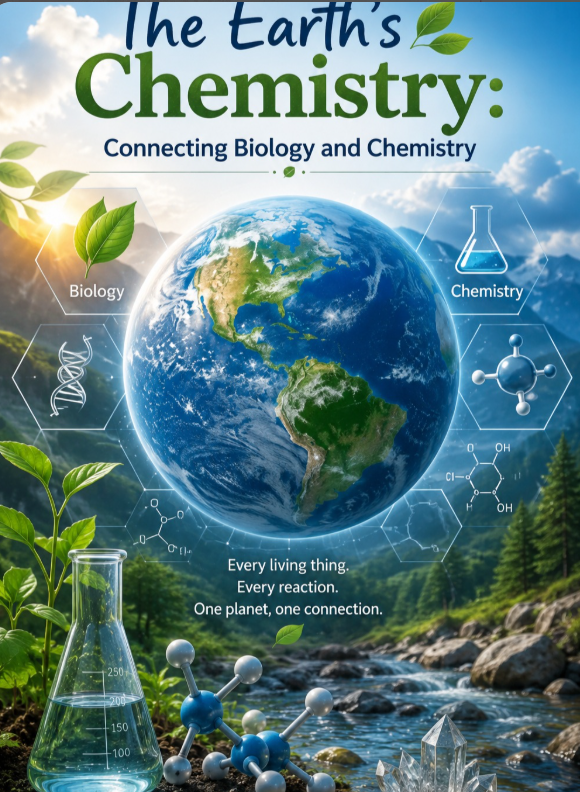
    The Earth's Chemistry: Connecting Biology and Chemistry
    Today I explored the amazing connection between Biology and Chemistry and discovered how these two sciences work together to explain life on Earth. Every living organism, from the smallest cell to the largest tree, depends on chemical reactions to survive and grow.
    Chemistry helps us understand how nutrients are absorbed, how plants perform photosynthesis, and how our bodies produce energy. Biology shows us how these chemical processes create and sustain life. Together, they reveal the incredible systems that keep our planet healthy and balanced.
    Learning about Earth's chemistry reminds us that everything in nature is connected. The air we breathe, the water we drink, the food we eat, and the ecosystems around us all depend on important chemical and biological interactions.
    By studying these connections, scientists can develop new medicines, protect the environment, improve agriculture, and find solutions to global challenges. The more we learn about science, the more we appreciate the beauty and complexity of our world.
    Let's continue exploring, learning, and protecting our planet for future generations!
    #EarthsChemistry #BiologyAndChemistry #ScienceEducation #STEM #EnvironmentalScience #LifeScience #Chemistry #Biology #ScienceLovers #LearningJourney #NatureAndScience #ScientificDiscovery #EarthScience #FutureScientists #Innovation #Education #ExploreScience #KnowledgeIsPower #PlanetEarth #ScienceForEveryone
    RSIF8 Roll no 94 Story post no 15 Story post topic 🌍🧪 The Earth's Chemistry: Connecting Biology and Chemistry 🌱🔬 Today I explored the amazing connection between Biology and Chemistry and discovered how these two sciences work together to explain life on Earth. 🌎✨ Every living organism, from the smallest cell to the largest tree, depends on chemical reactions to survive and grow. 🌿🧬 Chemistry helps us understand how nutrients are absorbed, how plants perform photosynthesis, and how our bodies produce energy. ⚡🌱 Biology shows us how these chemical processes create and sustain life. Together, they reveal the incredible systems that keep our planet healthy and balanced. 🌍💚 Learning about Earth's chemistry reminds us that everything in nature is connected. The air we breathe, the water we drink, the food we eat, and the ecosystems around us all depend on important chemical and biological interactions. 💧🌳☀️ By studying these connections, scientists can develop new medicines, protect the environment, improve agriculture, and find solutions to global challenges. 🔬🌾💊 The more we learn about science, the more we appreciate the beauty and complexity of our world. 🌎✨ Let's continue exploring, learning, and protecting our planet for future generations! 🌍💙🌱 #EarthsChemistry #BiologyAndChemistry #ScienceEducation #STEM #EnvironmentalScience #LifeScience #Chemistry #Biology #ScienceLovers #LearningJourney #NatureAndScience #ScientificDiscovery #EarthScience #FutureScientists #Innovation #Education #ExploreScience #KnowledgeIsPower #PlanetEarth #ScienceForEveryone 🌍🧪🌿🔬💚
    0 Comentários 0 Compartilhamentos 2149 Visualizações
  • #rsisb
    Roll no. 247
    Story post 14
    Foundation level

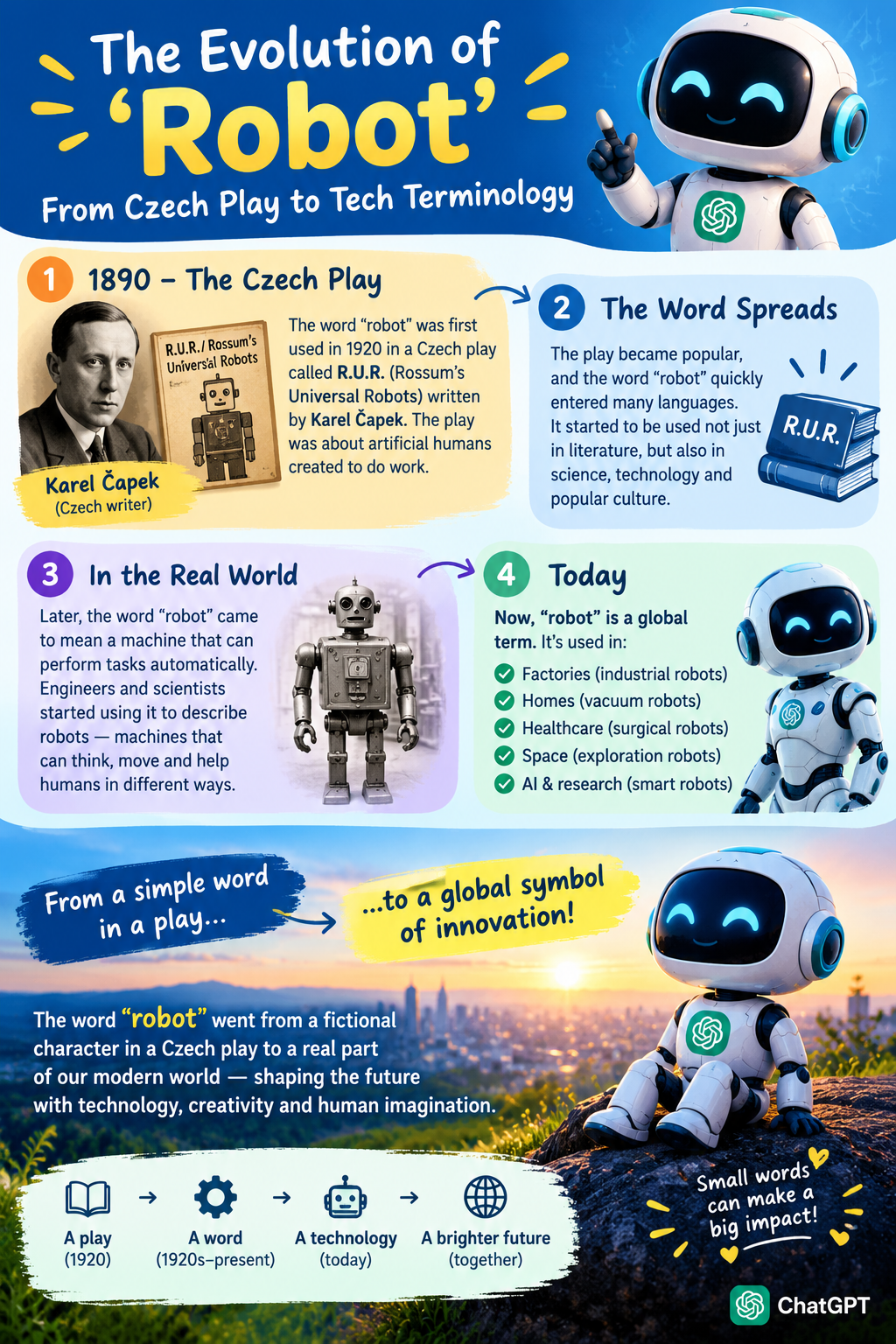
    **The Evolution of “Robot”: From Czech Play to Tech Terminology **

    Have you ever wondered where the word **“robot”** came from? Today, we use this word when talking about smart machines, artificial intelligence, factories, space exploration, and modern technology. But did you know that the word “robot” became popular through a Czech play written more than a century ago? Let's explore the fascinating journey of this little word that became a big part of our technological world!

    **1. The Beginning: A Czech Play **

    The story of the word “robot” begins with Czech writer and playwright **Karel Čapek** and his science-fiction play *R.U.R. (Rossum’s Universal Robots)*, first performed in 1921 and published in 1920. The play imagined artificial workers created to perform tasks for humans. It introduced audiences to ideas about artificial beings, technology, work, and the relationship between humans and machines.

    The word “robot” comes from the Czech word *robota*, associated with forced labor or compulsory work. Interestingly, Karel Čapek credited his brother, **Josef Čapek**, with suggesting the word for the play.

    **2. How the Word Spread Around the World **

    As the play gained attention, the word “robot” spread beyond literature and entered everyday language. People began using it to discuss machines that could perform tasks automatically. Over time, robots became a popular subject in science-fiction stories, films, books, and discussions about the future.

    Writers and scientists explored exciting questions: Could machines help humans? Could robots perform difficult tasks? How might technology change our lives? These questions helped inspire generations of inventors and researchers.

    **3. From Fiction to Real Machines **

    Robots eventually became an important part of real-world engineering and science. Modern robots can perform repetitive tasks, assist with manufacturing, explore places that are difficult for humans to reach, and help researchers carry out complex work.

    Today, we can find robots in many areas:

    **Factories:** Industrial robots help assemble products and perform precise tasks.

    **Homes:** Robotic vacuum cleaners help people with household cleaning.

    **Healthcare:** Specialised robotic systems assist medical professionals with certain procedures.

    **Space Exploration:** Robotic rovers and spacecraft help scientists explore distant worlds.

    **Agriculture:** Some robots help monitor crops and perform farming tasks.

    **Research:** Scientists use robots to test ideas, collect information, and explore new possibilities.

    **4. Robots and Artificial Intelligence **

    Modern technology has introduced new possibilities through artificial intelligence (AI). Some robots use AI to interpret information from sensors, recognise objects, plan actions, or respond to changing conditions. However, not every robot uses AI, and not every AI system is a robot.

    This difference is important! A robot is generally a physical machine that can carry out tasks, while AI refers to computer systems designed to perform tasks that may require abilities such as recognising patterns or understanding language. Together, robotics and AI are helping researchers develop new tools and technologies.

    **5. What Can We Learn from the Evolution of “Robot”?**

    The journey of the word “robot” teaches us that ideas can travel from books and plays into real life. A word introduced through a fictional story became an important term in science, engineering, and technology.

    It also reminds us that technology is created by people using imagination, creativity, teamwork, and scientific knowledge. As we learn more about robots, we should think about how to use technology responsibly and how it can benefit people and communities.

    **Conclusion: From a Czech Play to a Technological Future**

    The evolution of “robot” is a remarkable example of how language, literature, and science connect. What began as a word associated with artificial workers in a Czech play is now used around the world to describe machines that help us in factories, homes, hospitals, laboratories, and space exploration.

    The future of robotics will continue to bring new discoveries, challenges, and opportunities. By learning about the past, understanding the present, and thinking creatively about the future, we can become more informed and responsible users of technology.

    **Let's keep learning, exploring, and innovating!** Every great invention begins with an idea, and every curious mind has the potential to discover something new.

    **Question for everyone:** If you could invent a helpful robot, what would you want it to do? Share your ideas in the comments!

    Like, share, and spread the excitement of science and technology!

    ━━━━━━━━━━━━━━━━━━

    **HASHTAGS**

    #EvolutionOfRobots #RobotHistory #TheWordRobot #KarelCapek #JosefCapek #RUR #CzechLiterature #HistoryOfTechnology #Robotics #ArtificialIntelligence #AI #ScienceAndTechnology #EducationalPost #StoryPost #TechnologyEducation #FutureTechnology #Innovation #Engineering #STEMEducation #ScienceForEveryone #LearningIsFun #DigitalLearning #TechHistory #SmartMachines #SpaceExploration #IndustrialRobots #CreativeThinking #KnowledgeIsPower #ChatGPT #PostOnAllPlatforms
    #rsisb Roll no. 247 Story post 14 Foundation level 🤖🌍 **The Evolution of “Robot”: From Czech Play to Tech Terminology 📚✨** 🚀🤖 Have you ever wondered where the word **“robot”** came from? Today, we use this word when talking about smart machines, artificial intelligence, factories, space exploration, and modern technology. But did you know that the word “robot” became popular through a Czech play written more than a century ago? 📖🌟 Let's explore the fascinating journey of this little word that became a big part of our technological world! 💡🌐 📚 **1. The Beginning: A Czech Play 🇨🇿** The story of the word “robot” begins with Czech writer and playwright **Karel Čapek** and his science-fiction play *R.U.R. (Rossum’s Universal Robots)*, first performed in 1921 and published in 1920. 🎭🤖 The play imagined artificial workers created to perform tasks for humans. It introduced audiences to ideas about artificial beings, technology, work, and the relationship between humans and machines. The word “robot” comes from the Czech word *robota*, associated with forced labor or compulsory work. Interestingly, Karel Čapek credited his brother, **Josef Čapek**, with suggesting the word for the play. ✍️💭 🌎 **2. How the Word Spread Around the World 🌐** As the play gained attention, the word “robot” spread beyond literature and entered everyday language. People began using it to discuss machines that could perform tasks automatically. 📖⚙️ Over time, robots became a popular subject in science-fiction stories, films, books, and discussions about the future. Writers and scientists explored exciting questions: Could machines help humans? Could robots perform difficult tasks? How might technology change our lives? These questions helped inspire generations of inventors and researchers. 🚀🧠 ⚙️ **3. From Fiction to Real Machines 🏭** Robots eventually became an important part of real-world engineering and science. Modern robots can perform repetitive tasks, assist with manufacturing, explore places that are difficult for humans to reach, and help researchers carry out complex work. 🔧🤖 Today, we can find robots in many areas: 🏭 **Factories:** Industrial robots help assemble products and perform precise tasks. 🏠 **Homes:** Robotic vacuum cleaners help people with household cleaning. 🏥 **Healthcare:** Specialised robotic systems assist medical professionals with certain procedures. 🚀 **Space Exploration:** Robotic rovers and spacecraft help scientists explore distant worlds. 🌾 **Agriculture:** Some robots help monitor crops and perform farming tasks. 🧪 **Research:** Scientists use robots to test ideas, collect information, and explore new possibilities. 💻 **4. Robots and Artificial Intelligence 🧠** Modern technology has introduced new possibilities through artificial intelligence (AI). Some robots use AI to interpret information from sensors, recognise objects, plan actions, or respond to changing conditions. 🤖💡 However, not every robot uses AI, and not every AI system is a robot. This difference is important! A robot is generally a physical machine that can carry out tasks, while AI refers to computer systems designed to perform tasks that may require abilities such as recognising patterns or understanding language. Together, robotics and AI are helping researchers develop new tools and technologies. 🌐✨ 🌟 **5. What Can We Learn from the Evolution of “Robot”?** The journey of the word “robot” teaches us that ideas can travel from books and plays into real life. A word introduced through a fictional story became an important term in science, engineering, and technology. 📚➡️⚙️ It also reminds us that technology is created by people using imagination, creativity, teamwork, and scientific knowledge. As we learn more about robots, we should think about how to use technology responsibly and how it can benefit people and communities. ❤️🌍 🎯 **Conclusion: From a Czech Play to a Technological Future** The evolution of “robot” is a remarkable example of how language, literature, and science connect. What began as a word associated with artificial workers in a Czech play is now used around the world to describe machines that help us in factories, homes, hospitals, laboratories, and space exploration. 🤖🚀 The future of robotics will continue to bring new discoveries, challenges, and opportunities. By learning about the past, understanding the present, and thinking creatively about the future, we can become more informed and responsible users of technology. 🌟💚 📢 **Let's keep learning, exploring, and innovating!** Every great invention begins with an idea, and every curious mind has the potential to discover something new. 💡📚 💬 **Question for everyone:** If you could invent a helpful robot, what would you want it to do? Share your ideas in the comments! 👇🤖 ❤️ Like, share, and spread the excitement of science and technology! ━━━━━━━━━━━━━━━━━━ 🏷️ **HASHTAGS** #EvolutionOfRobots #RobotHistory #TheWordRobot #KarelCapek #JosefCapek #RUR #CzechLiterature #HistoryOfTechnology #Robotics #ArtificialIntelligence #AI #ScienceAndTechnology #EducationalPost #StoryPost #TechnologyEducation #FutureTechnology #Innovation #Engineering #STEMEducation #ScienceForEveryone #LearningIsFun #DigitalLearning #TechHistory #SmartMachines #SpaceExploration #IndustrialRobots #CreativeThinking #KnowledgeIsPower #ChatGPT #PostOnAllPlatforms 🤖🌍📚🚀✨
    0 Comentários 0 Compartilhamentos 5720 Visualizações
  • **Roll No: 2**
    **Batch: 14**
    **Book: ACCL**
    **Task No: 104**

    # The Blueprint of Existence: Unraveling DNA and the Origins of Life

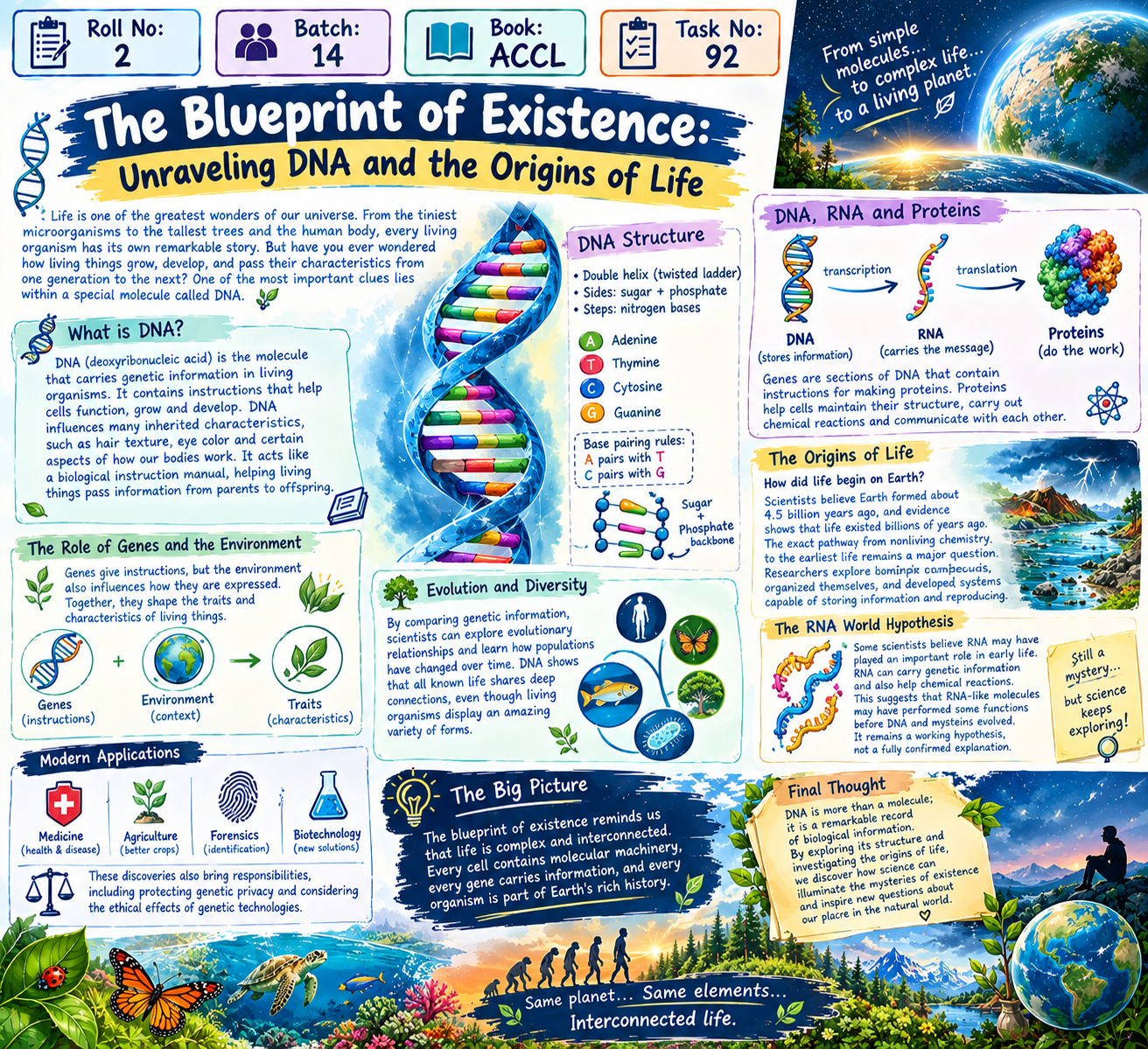
    Life is one of the greatest wonders of our universe. From the tiniest microorganisms to the tallest trees and the human body, every living organism has its own remarkable story. But have you ever wondered how living things grow, develop, and pass their characteristics from one generation to the next? One of the most important clues lies within a special molecule called **DNA**.

    **DNA, or deoxyribonucleic acid, is the molecule that carries genetic information in living organisms.** It contains instructions that help cells function, grow, and develop. DNA influences many inherited characteristics, such as natural hair texture, eye color, and certain aspects of how our bodies work. It acts like a biological instruction manual, helping living things pass information from parents to offspring.

    The structure of DNA is fascinating. It resembles a twisted ladder called a **double helix**. Its sides are made of sugar and phosphate molecules, while its steps contain pairs of chemical bases: adenine, thymine, cytosine, and guanine. These bases follow specific pairing rules: adenine pairs with thymine, while cytosine pairs with guanine. The order of these bases stores genetic information in a form that cells can use.

    DNA works closely with other molecules inside cells. Sections of DNA called **genes** contain instructions for making functional products, often proteins. Proteins perform countless important jobs, including helping cells maintain their structure, carry out chemical reactions, and communicate with one another. This relationship between DNA, RNA, and proteins is a central part of modern biology.

    But how did life begin on Earth? Scientists believe that Earth formed about 4.5 billion years ago, and evidence indicates that life existed billions of years ago. However, the exact pathway through which nonliving chemistry gave rise to the earliest life remains an important scientific question. Researchers investigate how simple molecules might have formed more complex compounds, how these compounds could have organized themselves, and how early systems capable of storing information and reproducing might have developed.

    One area of research explores the possibility that **RNA played an important role in early life**. RNA can carry genetic information, and certain RNA molecules can also help chemical reactions occur. This has led to the RNA-world hypothesis, which suggests that RNA-like molecules may have performed some functions before modern DNA-and-protein systems evolved. It remains an active scientific hypothesis, not a fully confirmed explanation of life's origin.

    The study of DNA also helps scientists understand the diversity of life. By comparing genetic information from different organisms, researchers can investigate evolutionary relationships and learn how populations have changed over generations. DNA evidence supports the scientific understanding that all known life shares deep connections through evolution, even though living organisms display an extraordinary variety of forms.

    Modern DNA research has transformed medicine, agriculture, forensics, and biotechnology. Scientists can study genetic variations, investigate inherited conditions, identify organisms, improve crops, and develop new research methods. These discoveries also bring important responsibilities, including protecting genetic privacy and considering the ethical effects of genetic technologies.

    The blueprint of existence reminds us that life is both complex and interconnected. Every cell contains molecular machinery, every gene carries information, and every organism is part of Earth's rich history. Although many questions about the earliest beginnings of life remain unanswered, careful experiments, observations, and discoveries continue to expand our understanding.

    **DNA is more than a molecule; it is a remarkable record of biological information. By exploring its structure and investigating the origins of life, we discover how science can illuminate the mysteries of existence and inspire new questions about our place in the natural world. **

    \#DNA #OriginsOfLife #Biology #Genetics #Science #Evolution #ACCL #Batch14 #Task92
    **Roll No: 2** **Batch: 14** **Book: ACCL** **Task No: 104** # 🧬🌍 The Blueprint of Existence: Unraveling DNA and the Origins of Life 🔬✨ Life is one of the greatest wonders of our universe. From the tiniest microorganisms to the tallest trees and the human body, every living organism has its own remarkable story. 🌱🦠🌳 But have you ever wondered how living things grow, develop, and pass their characteristics from one generation to the next? One of the most important clues lies within a special molecule called **DNA**. **DNA, or deoxyribonucleic acid, is the molecule that carries genetic information in living organisms.** 🧬 It contains instructions that help cells function, grow, and develop. DNA influences many inherited characteristics, such as natural hair texture, eye color, and certain aspects of how our bodies work. It acts like a biological instruction manual, helping living things pass information from parents to offspring. 📖🔬 The structure of DNA is fascinating. It resembles a twisted ladder called a **double helix**. 🌀 Its sides are made of sugar and phosphate molecules, while its steps contain pairs of chemical bases: adenine, thymine, cytosine, and guanine. These bases follow specific pairing rules: adenine pairs with thymine, while cytosine pairs with guanine. The order of these bases stores genetic information in a form that cells can use. DNA works closely with other molecules inside cells. 🧪 Sections of DNA called **genes** contain instructions for making functional products, often proteins. Proteins perform countless important jobs, including helping cells maintain their structure, carry out chemical reactions, and communicate with one another. This relationship between DNA, RNA, and proteins is a central part of modern biology. ⚙️🧫 But how did life begin on Earth? 🌎 Scientists believe that Earth formed about 4.5 billion years ago, and evidence indicates that life existed billions of years ago. However, the exact pathway through which nonliving chemistry gave rise to the earliest life remains an important scientific question. Researchers investigate how simple molecules might have formed more complex compounds, how these compounds could have organized themselves, and how early systems capable of storing information and reproducing might have developed. 🔭🧪 One area of research explores the possibility that **RNA played an important role in early life**. RNA can carry genetic information, and certain RNA molecules can also help chemical reactions occur. This has led to the RNA-world hypothesis, which suggests that RNA-like molecules may have performed some functions before modern DNA-and-protein systems evolved. It remains an active scientific hypothesis, not a fully confirmed explanation of life's origin. 🧬💡 The study of DNA also helps scientists understand the diversity of life. 🌿🐦🦋 By comparing genetic information from different organisms, researchers can investigate evolutionary relationships and learn how populations have changed over generations. DNA evidence supports the scientific understanding that all known life shares deep connections through evolution, even though living organisms display an extraordinary variety of forms. Modern DNA research has transformed medicine, agriculture, forensics, and biotechnology. 🏥🌾 Scientists can study genetic variations, investigate inherited conditions, identify organisms, improve crops, and develop new research methods. These discoveries also bring important responsibilities, including protecting genetic privacy and considering the ethical effects of genetic technologies. ⚖️🔬 The blueprint of existence reminds us that life is both complex and interconnected. Every cell contains molecular machinery, every gene carries information, and every organism is part of Earth's rich history. Although many questions about the earliest beginnings of life remain unanswered, careful experiments, observations, and discoveries continue to expand our understanding. 🌌📚 **DNA is more than a molecule; it is a remarkable record of biological information. By exploring its structure and investigating the origins of life, we discover how science can illuminate the mysteries of existence and inspire new questions about our place in the natural world. 🧬🌍💚** \#DNA #OriginsOfLife #Biology #Genetics #Science #Evolution #ACCL #Batch14 #Task92 🔬🧬✨
    0 Comentários 0 Compartilhamentos 2486 Visualizações
  • #rsisb
    Roll no.247
    Documentary no.1
    Foundation level

    **The Evolution of “Robot”: From Czech Play to Tech Terminology **

    **Discover the Amazing Journey of Robots!**

    Have you ever wondered where the word **“Robot”** came from? Today, robots are everywhere—from factories and hospitals to schools, homes, and even outer space! But the story of this incredible word began long before modern artificial intelligence and advanced technology became part of our daily lives.

    **The Beginning of the Word “Robot” **

    The word “robot” became famous through a Czech science-fiction play called *R.U.R. (Rossum’s Universal Robots)*, written by Czech writer Karel Čapek. The play premiered in 1921 and introduced audiences to artificial workers created to serve humans. The word is connected to the Czech word *robota*, which refers to forced labor or hard work.

    **From Fiction to Reality!**

    When the word “robot” first appeared, the robots people imagined were very different from the machines we know today. Early robots were mainly ideas from stories, plays, and science fiction. Over time, scientists, engineers, and inventors began building real machines that could perform tasks automatically.

    **The Rise of Modern Robotics**

    As technology developed, robots became more advanced. Industrial robots began helping workers manufacture cars, assemble products, and complete repetitive tasks. Later, robots were developed for medical assistance, scientific research, space exploration, agriculture, and education. ‍

    **Robots and Artificial Intelligence**

    Today, robotics and Artificial Intelligence (AI) are transforming the world! Some robots can recognize objects, follow instructions, navigate their surroundings, and assist people with different tasks. AI can help certain robots process information and make decisions within their designed capabilities.

    However, not every robot uses AI, and robots do not all think or behave like humans. Understanding this difference helps us learn how technology really works!

    **Why Is the Word “Robot” Important?**

    The evolution of the word “robot” shows how imagination can influence science and innovation. A term popularized through a Czech play became an important part of modern science and technology. It reminds us that ideas from books and stories can inspire people to explore new possibilities and create amazing inventions.

    **What Can We Learn From This Story?**

    Words have fascinating histories.
    Stories can inspire scientific discoveries.
    Technology changes and develops over time.
    Robotics can help solve real-world problems.
    Learning about the past helps us understand the future.

    **Think About It!**

    If robots continue to develop, how might they help students, teachers, doctors, scientists, and communities in the future? Could you design a robot that solves a problem in your school or neighborhood?

    Remember, every great invention begins with curiosity, creativity, and the courage to explore new ideas!

    **Watch, Learn, Explore, and Innovate!** Share this documentary with your friends and family, discover the fascinating history of robotics, and keep asking questions about the technology shaping our world.

    **Comment below:** What kind of robot would you like to invent, and what problem would it solve?

    Like | Comment | Share | Follow for more educational documentaries, science stories, technology facts, and exciting learning adventures!

    #Robot #Robotics #EvolutionOfRobots #HistoryOfRobots #KarelCapek #RUR #CzechHistory #ArtificialIntelligence #AI #ScienceAndTechnology #Technology #Innovation #FutureOfTechnology #STEMEducation #ScienceDocumentary #EducationalContent #LearningIsFun #TechHistory #ModernRobotics #RoboticsForKids #DiscoverScience #KnowledgeIsPower #CreativeThinking #FutureInnovators #DigitalLearning #ExploreAndLearn #EducationalJourney #Documentary #ScienceFacts #InspiringInnovation
    #rsisb Roll no.247 Documentary no.1 Foundation level 🤖📚 **The Evolution of “Robot”: From Czech Play to Tech Terminology 🌍🚀** ✨ **Discover the Amazing Journey of Robots!** ✨ Have you ever wondered where the word **“Robot”** came from? 🤔🤖 Today, robots are everywhere—from factories and hospitals to schools, homes, and even outer space! 🚗🏭🏥🚀 But the story of this incredible word began long before modern artificial intelligence and advanced technology became part of our daily lives. 📖 **The Beginning of the Word “Robot” 🇨🇿** The word “robot” became famous through a Czech science-fiction play called *R.U.R. (Rossum’s Universal Robots)*, written by Czech writer Karel Čapek. The play premiered in 1921 and introduced audiences to artificial workers created to serve humans. 🤖🎭 The word is connected to the Czech word *robota*, which refers to forced labor or hard work. 💡 **From Fiction to Reality!** When the word “robot” first appeared, the robots people imagined were very different from the machines we know today. Early robots were mainly ideas from stories, plays, and science fiction. 📚✨ Over time, scientists, engineers, and inventors began building real machines that could perform tasks automatically. ⚙️ **The Rise of Modern Robotics** As technology developed, robots became more advanced. Industrial robots began helping workers manufacture cars, assemble products, and complete repetitive tasks. 🏭🚘 Later, robots were developed for medical assistance, scientific research, space exploration, agriculture, and education. 🌱🧑‍⚕️🔬🪐 🧠 **Robots and Artificial Intelligence** Today, robotics and Artificial Intelligence (AI) are transforming the world! 🌐💻 Some robots can recognize objects, follow instructions, navigate their surroundings, and assist people with different tasks. AI can help certain robots process information and make decisions within their designed capabilities. However, not every robot uses AI, and robots do not all think or behave like humans. Understanding this difference helps us learn how technology really works! 💡📖 🌟 **Why Is the Word “Robot” Important?** The evolution of the word “robot” shows how imagination can influence science and innovation. A term popularized through a Czech play became an important part of modern science and technology. 🚀✨ It reminds us that ideas from books and stories can inspire people to explore new possibilities and create amazing inventions. 🎯 **What Can We Learn From This Story?** ✅ Words have fascinating histories. 📚 ✅ Stories can inspire scientific discoveries. 💭 ✅ Technology changes and develops over time. ⚙️ ✅ Robotics can help solve real-world problems. 🌍 ✅ Learning about the past helps us understand the future. 🚀 🤔 **Think About It!** If robots continue to develop, how might they help students, teachers, doctors, scientists, and communities in the future? Could you design a robot that solves a problem in your school or neighborhood? 🏫🤖💡 Remember, every great invention begins with curiosity, creativity, and the courage to explore new ideas! 🌈🌟 📢 **Watch, Learn, Explore, and Innovate!** Share this documentary with your friends and family, discover the fascinating history of robotics, and keep asking questions about the technology shaping our world. 🤖🌍❤️ 💬 **Comment below:** What kind of robot would you like to invent, and what problem would it solve? 👍 Like | 💬 Comment | 🔄 Share | ⭐ Follow for more educational documentaries, science stories, technology facts, and exciting learning adventures! #Robot #Robotics #EvolutionOfRobots #HistoryOfRobots #KarelCapek #RUR #CzechHistory #ArtificialIntelligence #AI #ScienceAndTechnology #Technology #Innovation #FutureOfTechnology #STEMEducation #ScienceDocumentary #EducationalContent #LearningIsFun #TechHistory #ModernRobotics #RoboticsForKids #DiscoverScience #KnowledgeIsPower #CreativeThinking #FutureInnovators #DigitalLearning #ExploreAndLearn #EducationalJourney #Documentary #ScienceFacts #InspiringInnovation 🤖🚀📚🌍💡✨
    0 Comentários 0 Compartilhamentos 6048 Visualizações 8
  • #rsisb
    Roll no.247
    Story post . 7
    Foundation level

    # Bio Detectives: Unveiling the DNA Code

    **Welcome to the Amazing World of Biology!**

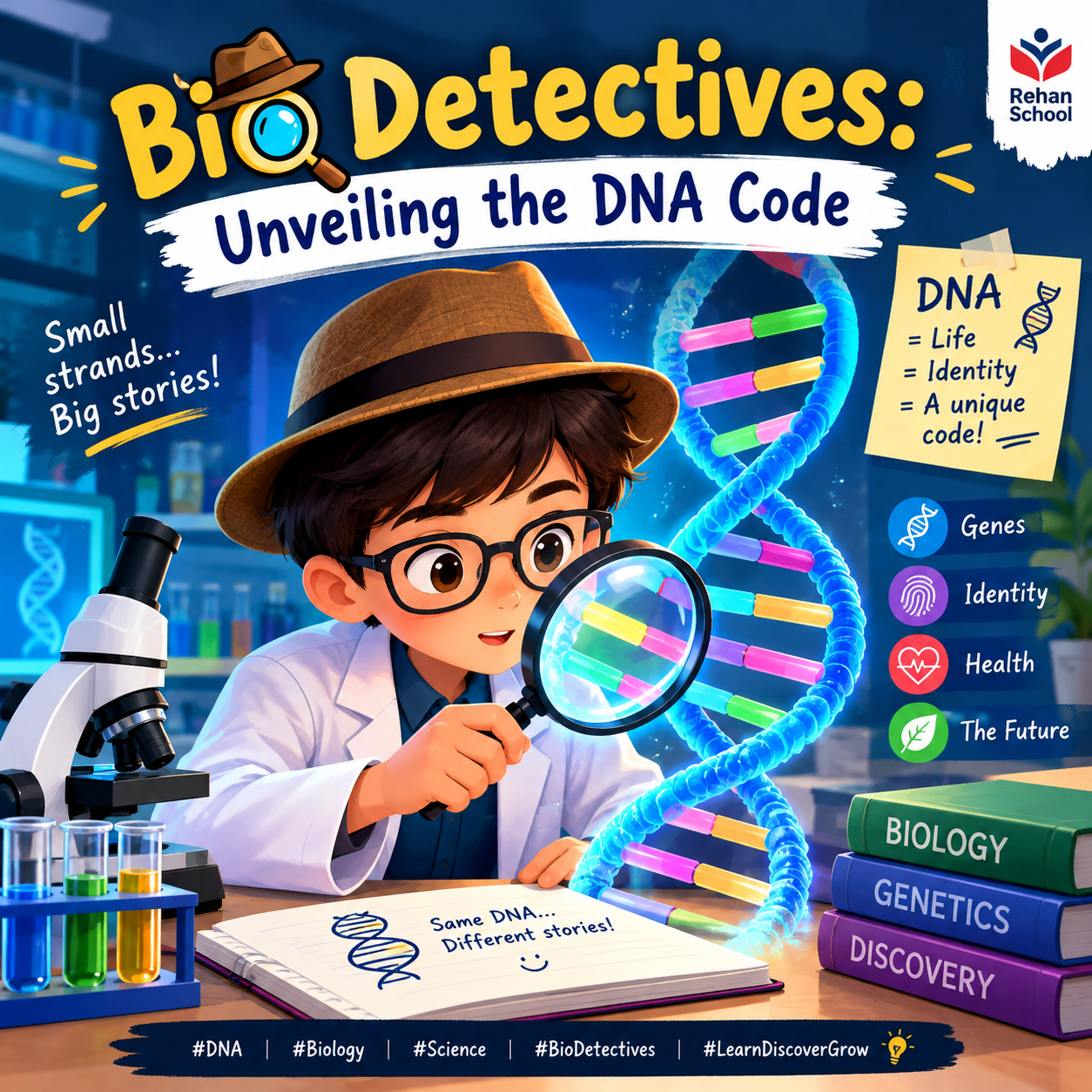
    Have you ever wondered what makes every living thing unique? Why do we have different eye colors, hair types, facial features, and other characteristics? Why do children sometimes look like their parents? ‍‍‍ The answers lie inside one of the most fascinating molecules in the world: **DNA!**

    ‍ Welcome to **“Bio Detectives: Unveiling the DNA Code,”** an exciting scientific adventure where curiosity meets discovery! In this story, we become young biology detectives, exploring the hidden instructions that help living organisms grow, develop, and function.

    **What Is DNA?**

    DNA stands for *Deoxyribonucleic Acid*. It carries genetic information used by living organisms. Think of DNA as a biological instruction manual containing information that helps cells perform their jobs. DNA is found in the cells of almost all living organisms, including humans, animals, and plants.

    **The Secret Code of Life**

    DNA has a famous double-helix structure that looks like a twisted ladder! Its four chemical bases are called adenine (A), thymine (T), cytosine (C), and guanine (G). These bases pair in a special way: A pairs with T, while C pairs with G. Their sequence helps store genetic information. Isn't nature amazing?

    ‍ **Become a Bio Detective!**

    Imagine receiving a mysterious science case! Your mission is to investigate DNA, discover how genes work, and understand how genetic information passes from parents to their children. Along the way, you will explore chromosomes, inherited characteristics, and the incredible science of genetics.

    **Why Is DNA Important?**

    DNA helps scientists understand living things and how characteristics are inherited. Researchers study DNA to learn about evolution, biodiversity, agriculture, and many areas of medicine. By understanding genetics, we can discover more about the natural world and appreciate the incredible complexity of life!

    **Learning Through Curiosity**

    Science is not just about memorizing facts from books. It is about asking questions, observing carefully, testing ideas, and discovering new possibilities! Every great scientist starts with curiosity, and every new discovery begins with a question. Never stop exploring, learning, and thinking like a scientist! ‍

    **Our Mission:**
    Discover what DNA is and why it matters.
    Explore the double-helix structure.
    Learn about genes and chromosomes.
    Understand how characteristics can be inherited. ‍‍‍
    Develop curiosity and a love for biology.
    Become a confident young science explorer!

    **Remember:** The smallest details of life can reveal some of the biggest scientific mysteries. Every cell has a story, every gene carries information, and DNA helps us unlock the fascinating secrets of living organisms!

    **Question for Everyone:** If you could investigate one mystery about DNA, genetics, or the human body, what would you choose? Share your answer in the comments!

    Like, share, and follow for more exciting educational stories, amazing scientific discoveries, and fun learning adventures!

    **Bio Detectives: Unveiling the DNA Code — Discover the science hidden within life!**

    #BioDetectives #UnveilingTheDNACode #DNA #Biology #Genetics #Science #ScienceExploration #DNAResearch #DoubleHelix #Genes #Chromosomes #HumanBiology #LifeScience #BiologyForKids #YoungScientists #ScienceEducation #STEM #STEMEducation #LearnWithFun #EducationalContent #ScienceFacts #DiscoverScience #Curiosity #FutureScientists #KnowledgeIsPower #LearningJourney #ExploreTheWorld #CreativeLearning #SchoolProject #ScienceAdventure
    #rsisb Roll no.247 Story post . 7 Foundation level # 🧬🔍 Bio Detectives: Unveiling the DNA Code 🧪🧬 🌟🔬 **Welcome to the Amazing World of Biology!** 🔬🌟 Have you ever wondered what makes every living thing unique? 🤔🌱 Why do we have different eye colors, hair types, facial features, and other characteristics? Why do children sometimes look like their parents? 👨‍👩‍👧‍👦 The answers lie inside one of the most fascinating molecules in the world: **DNA!** 🧬✨ 🕵️‍♂️🔎 Welcome to **“Bio Detectives: Unveiling the DNA Code,”** an exciting scientific adventure where curiosity meets discovery! In this story, we become young biology detectives, exploring the hidden instructions that help living organisms grow, develop, and function. 🌍🌿 🧬 **What Is DNA?** DNA stands for *Deoxyribonucleic Acid*. It carries genetic information used by living organisms. Think of DNA as a biological instruction manual containing information that helps cells perform their jobs. 📖🔬 DNA is found in the cells of almost all living organisms, including humans, animals, and plants. 🌳🐈👨 🔍 **The Secret Code of Life** DNA has a famous double-helix structure that looks like a twisted ladder! 🪜🧬 Its four chemical bases are called adenine (A), thymine (T), cytosine (C), and guanine (G). These bases pair in a special way: A pairs with T, while C pairs with G. Their sequence helps store genetic information. Isn't nature amazing? 🤩🔬 🕵️‍♀️ **Become a Bio Detective!** Imagine receiving a mysterious science case! 🗂️🔎 Your mission is to investigate DNA, discover how genes work, and understand how genetic information passes from parents to their children. Along the way, you will explore chromosomes, inherited characteristics, and the incredible science of genetics. 🧬🧠 🌱 **Why Is DNA Important?** DNA helps scientists understand living things and how characteristics are inherited. Researchers study DNA to learn about evolution, biodiversity, agriculture, and many areas of medicine. 🌍🌾🔬 By understanding genetics, we can discover more about the natural world and appreciate the incredible complexity of life! 💡 **Learning Through Curiosity** Science is not just about memorizing facts from books. 📚 It is about asking questions, observing carefully, testing ideas, and discovering new possibilities! 🚀 Every great scientist starts with curiosity, and every new discovery begins with a question. Never stop exploring, learning, and thinking like a scientist! 🧑‍🔬✨ 🎯 **Our Mission:** ✅ Discover what DNA is and why it matters. 🧬 ✅ Explore the double-helix structure. 🔬 ✅ Learn about genes and chromosomes. 🧪 ✅ Understand how characteristics can be inherited. 👨‍👩‍👧‍👦 ✅ Develop curiosity and a love for biology. 🌱 ✅ Become a confident young science explorer! 🚀 🌟 **Remember:** The smallest details of life can reveal some of the biggest scientific mysteries. Every cell has a story, every gene carries information, and DNA helps us unlock the fascinating secrets of living organisms! 🧬💚 💬 **Question for Everyone:** If you could investigate one mystery about DNA, genetics, or the human body, what would you choose? Share your answer in the comments! 👇💭 ❤️ Like, share, and follow for more exciting educational stories, amazing scientific discoveries, and fun learning adventures! 📚🔬🌍 🧬🔍 **Bio Detectives: Unveiling the DNA Code — Discover the science hidden within life!** 🔍🧬 #BioDetectives #UnveilingTheDNACode #DNA #Biology #Genetics #Science #ScienceExploration #DNAResearch #DoubleHelix #Genes #Chromosomes #HumanBiology #LifeScience #BiologyForKids #YoungScientists #ScienceEducation #STEM #STEMEducation #LearnWithFun #EducationalContent #ScienceFacts #DiscoverScience #Curiosity #FutureScientists #KnowledgeIsPower #LearningJourney #ExploreTheWorld #CreativeLearning #SchoolProject #ScienceAdventure 🧬🔬🧪🌱🌍📚🚀✨
    0 Comentários 0 Compartilhamentos 5236 Visualizações
  • RSIF8
    Roll no:86
    Task no:38
    Task topic: Living in Denial – Climate Change – Iqra Khilji
    Climate change is one of the greatest challenges facing our world today. Rising temperatures, melting glaciers, extreme weather events, and changing ecosystems are clear signs that our planet is under pressure. Despite the growing evidence, many people continue to deny or ignore the reality of climate change, delaying the actions needed to protect our environment.
    From devastating floods to prolonged droughts and heatwaves, the effects of climate change are becoming more visible every year. Communities around the world are experiencing the consequences, with impacts on agriculture, water resources, wildlife, and public health. These changes remind us that climate change is not a distant problem—it is happening right now.
    Human activities such as deforestation, pollution, and the excessive use of fossil fuels contribute significantly to global warming. However, every individual can play a role in creating positive change. Simple actions like saving energy, reducing waste, recycling, and planting trees can make a meaningful difference in protecting our planet for future generations.
    The first step toward solving any problem is accepting that it exists. By moving beyond denial and embracing responsibility, we can work together to build a cleaner, greener, and more sustainable future. Awareness, education, and action are the keys to combating climate change and ensuring a healthier world for everyone.
    #LivingInDenial #ClimateChange #IqraKhilji #ClimateAction #SaveThePlanet #GlobalWarming #EnvironmentalAwareness #GoGreen #Sustainability #ProtectEarth #EcoFriendly #GreenFuture #ActNow #ClimateCrisis #SaveOurFuture
    RSIF8 Roll no:86 Task no:38 Task topic: Living in Denial – Climate Change – Iqra Khilji Climate change is one of the greatest challenges facing our world today. Rising temperatures, melting glaciers, extreme weather events, and changing ecosystems are clear signs that our planet is under pressure. Despite the growing evidence, many people continue to deny or ignore the reality of climate change, delaying the actions needed to protect our environment. 🌱 🌦️ From devastating floods to prolonged droughts and heatwaves, the effects of climate change are becoming more visible every year. Communities around the world are experiencing the consequences, with impacts on agriculture, water resources, wildlife, and public health. These changes remind us that climate change is not a distant problem—it is happening right now. 🌳 Human activities such as deforestation, pollution, and the excessive use of fossil fuels contribute significantly to global warming. However, every individual can play a role in creating positive change. Simple actions like saving energy, reducing waste, recycling, and planting trees can make a meaningful difference in protecting our planet for future generations. 💚 The first step toward solving any problem is accepting that it exists. By moving beyond denial and embracing responsibility, we can work together to build a cleaner, greener, and more sustainable future. Awareness, education, and action are the keys to combating climate change and ensuring a healthier world for everyone. #LivingInDenial #ClimateChange #IqraKhilji #ClimateAction #SaveThePlanet #GlobalWarming #EnvironmentalAwareness #GoGreen #Sustainability #ProtectEarth #EcoFriendly #GreenFuture #ActNow #ClimateCrisis #SaveOurFuture 🌍🌿
    0 Comentários 0 Compartilhamentos 4014 Visualizações 11
  • **Roll No: 2**
    **Batch: 14**
    **Book: ACCL**
    **Task No: 69**

    # Acids and Bases: The Balance of Nature

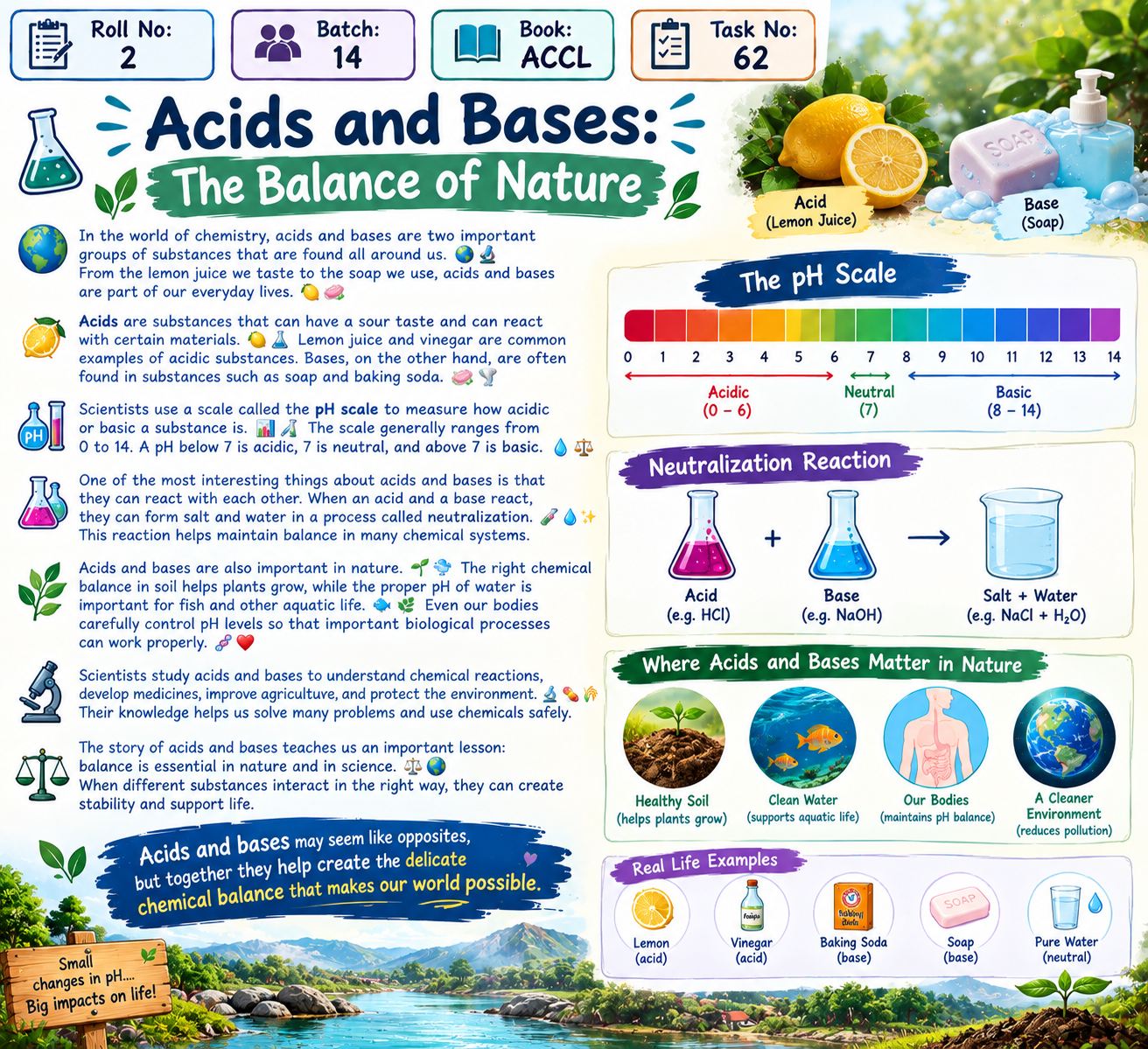
    In the world of chemistry, acids and bases are two important groups of substances that are found all around us. From the lemon juice we taste to the soap we use, acids and bases are part of our everyday lives.

    Acids are substances that can have a sour taste and can react with certain materials. Lemon juice and vinegar are common examples of acidic substances. Bases, on the other hand, are often found in substances such as soap and baking soda.

    Scientists use a scale called the **pH scale** to measure how acidic or basic a substance is. The scale generally ranges from **0 to 14**. A pH below 7 is acidic, 7 is neutral, and above 7 is basic.

    One of the most interesting things about acids and bases is that they can react with each other. When an acid and a base react, they can form **salt and water** in a process called neutralization. This reaction helps maintain balance in many chemical systems.

    Acids and bases are also important in nature. The right chemical balance in soil helps plants grow, while the proper pH of water is important for fish and other aquatic life. Even our bodies carefully control pH levels so that important biological processes can work properly.

    Scientists study acids and bases to understand chemical reactions, develop medicines, improve agriculture, and protect the environment. Their knowledge helps us solve many problems and use chemicals safely.

    The story of acids and bases teaches us an important lesson: **balance is essential in nature and in science.** When different substances interact in the right way, they can create stability and support life.

    **Acids and bases may seem like opposites, but together they help create the delicate chemical balance that makes our world possible. **
    **Roll No: 2** **Batch: 14** **Book: ACCL** **Task No: 69** # 🧪 Acids and Bases: The Balance of Nature 🌿⚖️ In the world of chemistry, acids and bases are two important groups of substances that are found all around us. 🌍🔬 From the lemon juice we taste to the soap we use, acids and bases are part of our everyday lives. 🍋🧼 Acids are substances that can have a sour taste and can react with certain materials. 🍋⚗️ Lemon juice and vinegar are common examples of acidic substances. Bases, on the other hand, are often found in substances such as soap and baking soda. 🧼🥄 Scientists use a scale called the **pH scale** to measure how acidic or basic a substance is. 📊🧪 The scale generally ranges from **0 to 14**. A pH below 7 is acidic, 7 is neutral, and above 7 is basic. 💧⚖️ One of the most interesting things about acids and bases is that they can react with each other. When an acid and a base react, they can form **salt and water** in a process called neutralization. 🧪💧✨ This reaction helps maintain balance in many chemical systems. Acids and bases are also important in nature. 🌱🌧️ The right chemical balance in soil helps plants grow, while the proper pH of water is important for fish and other aquatic life. 🐟🌿 Even our bodies carefully control pH levels so that important biological processes can work properly. 🧬❤️ Scientists study acids and bases to understand chemical reactions, develop medicines, improve agriculture, and protect the environment. 🔬💊🌾 Their knowledge helps us solve many problems and use chemicals safely. The story of acids and bases teaches us an important lesson: **balance is essential in nature and in science.** ⚖️🌍 When different substances interact in the right way, they can create stability and support life. **Acids and bases may seem like opposites, but together they help create the delicate chemical balance that makes our world possible. 🧪🌎✨**
    0 Comentários 0 Compartilhamentos 1351 Visualizações
  • RSIF8
    Roll no:85
    Task no:55
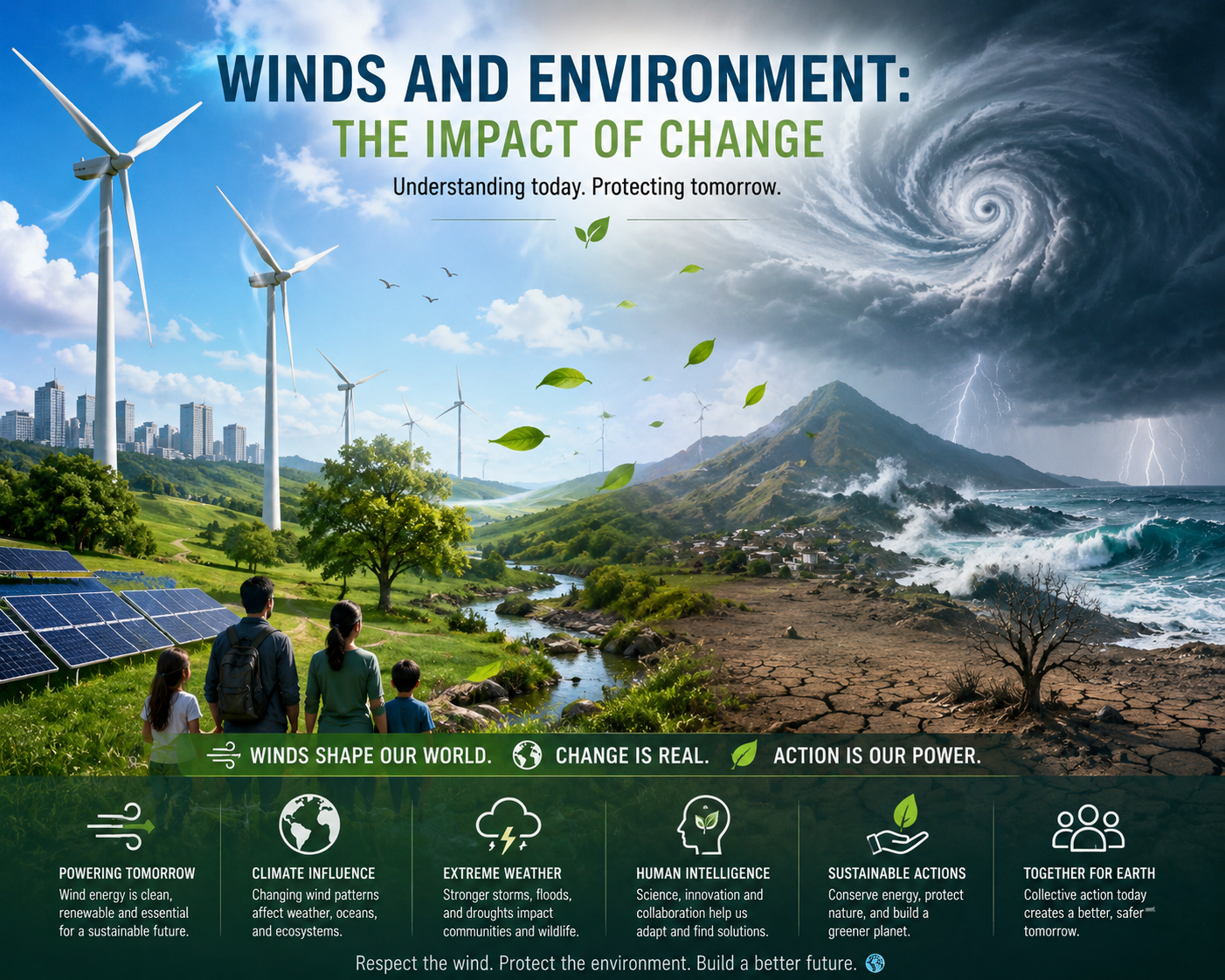
    Task topic: Winds and Environment: The Impact of Change
    The wind is one of nature's most powerful forces, shaping landscapes, influencing weather, and supporting life across the planet. It carries moisture that nourishes forests and farmland, spreads seeds that help plants grow, and drives ocean currents that regulate Earth's climate. For centuries, humans have relied on the wind for travel, agriculture, and renewable energy. Understanding how wind interacts with the environment helps us appreciate its essential role in maintaining the balance of nature.

    As the global climate changes, wind patterns are also shifting in many regions. Rising temperatures, changing air pressure, and altered weather systems can influence the strength, direction, and frequency of winds. These changes may contribute to more intense storms in some areas, prolonged droughts in others, and increased challenges for farming, transportation, and wildlife. Scientists continue to study these complex interactions to better predict future environmental conditions and help communities prepare for changing climates.

    Human intelligence plays a vital role in addressing environmental challenges. Through scientific research, technological innovation, and international cooperation, people are developing cleaner energy sources, improving weather forecasting, and creating sustainable practices that reduce environmental impact. Wind energy, in particular, has become one of the fastest-growing renewable energy sources, offering a cleaner alternative to fossil fuels while helping reduce greenhouse gas emissions.

    Protecting the environment requires both knowledge and action. Every individual can contribute by conserving energy, planting trees, reducing waste, and supporting sustainable solutions. By combining human intelligence with respect for nature, we can better understand the changing relationship between winds and the environment and work toward a healthier, more resilient future for generations to come.
    RSIF8 Roll no:85 Task no:55 Task topic: Winds and Environment: The Impact of Change The wind is one of nature's most powerful forces, shaping landscapes, influencing weather, and supporting life across the planet. It carries moisture that nourishes forests and farmland, spreads seeds that help plants grow, and drives ocean currents that regulate Earth's climate. For centuries, humans have relied on the wind for travel, agriculture, and renewable energy. Understanding how wind interacts with the environment helps us appreciate its essential role in maintaining the balance of nature. As the global climate changes, wind patterns are also shifting in many regions. Rising temperatures, changing air pressure, and altered weather systems can influence the strength, direction, and frequency of winds. These changes may contribute to more intense storms in some areas, prolonged droughts in others, and increased challenges for farming, transportation, and wildlife. Scientists continue to study these complex interactions to better predict future environmental conditions and help communities prepare for changing climates. Human intelligence plays a vital role in addressing environmental challenges. Through scientific research, technological innovation, and international cooperation, people are developing cleaner energy sources, improving weather forecasting, and creating sustainable practices that reduce environmental impact. Wind energy, in particular, has become one of the fastest-growing renewable energy sources, offering a cleaner alternative to fossil fuels while helping reduce greenhouse gas emissions. Protecting the environment requires both knowledge and action. Every individual can contribute by conserving energy, planting trees, reducing waste, and supporting sustainable solutions. By combining human intelligence with respect for nature, we can better understand the changing relationship between winds and the environment and work toward a healthier, more resilient future for generations to come.
    0 Comentários 0 Compartilhamentos 2341 Visualizações
  • RSIF8
    ROll no:82
    Story post: 1
    Story post topic:Climate and Culture: How Geography Shapes Our Way of Life

    The world is a beautiful tapestry of cultures, traditions, and lifestyles, and one of the greatest influences behind this diversity is geography. Mountains, deserts, forests, rivers, oceans, and climate all play a significant role in shaping how people live, work, eat, dress, and celebrate. From the frozen landscapes of the Arctic to the warm tropical islands, every environment has inspired unique ways of life that reflect the challenges and opportunities of nature.

    Climate affects the food we grow, the homes we build, and the clothes we wear. People living in colder regions often construct well-insulated houses and wear warm clothing to protect themselves from harsh winters, while communities in hotter climates design homes with natural ventilation and wear lightweight fabrics to stay cool. Agriculture also depends on climate, influencing the crops that become part of local cuisines and cultural traditions.

    Geography has shaped trade routes, languages, occupations, and even the customs passed down through generations. Coastal communities often develop strong maritime traditions through fishing, shipping, and trade, while mountain communities rely on farming, livestock, and local craftsmanship. Rivers have given rise to some of the world's earliest civilizations, providing fresh water, fertile land, and transportation that supported the growth of cities and cultures.

    Despite these differences, every culture reflects humanity's creativity, resilience, and ability to adapt to its surroundings. Today, technology and globalization connect people across continents, allowing cultures to share ideas while preserving their unique identities. Understanding how geography influences culture helps us appreciate the diversity of our world and encourages respect for the traditions and lifestyles of others.

    Climate and culture are deeply connected, reminding us that the environment not only shapes the landscapes we see but also the stories, values, and traditions that define who we are. By protecting our planet and respecting cultural diversity, we preserve the rich heritage that makes our world vibrant and extraordinary.

    "Geography shapes the land beneath our feet, while culture shapes the lives we lead—together they tell the story of humanity." See less
    RSIF8 ROll no:82 Story post: 1 Story post topic:Climate and Culture: How Geography Shapes Our Way of Life The world is a beautiful tapestry of cultures, traditions, and lifestyles, and one of the greatest influences behind this diversity is geography. Mountains, deserts, forests, rivers, oceans, and climate all play a significant role in shaping how people live, work, eat, dress, and celebrate. From the frozen landscapes of the Arctic to the warm tropical islands, every environment has inspired unique ways of life that reflect the challenges and opportunities of nature. Climate affects the food we grow, the homes we build, and the clothes we wear. People living in colder regions often construct well-insulated houses and wear warm clothing to protect themselves from harsh winters, while communities in hotter climates design homes with natural ventilation and wear lightweight fabrics to stay cool. Agriculture also depends on climate, influencing the crops that become part of local cuisines and cultural traditions. Geography has shaped trade routes, languages, occupations, and even the customs passed down through generations. Coastal communities often develop strong maritime traditions through fishing, shipping, and trade, while mountain communities rely on farming, livestock, and local craftsmanship. Rivers have given rise to some of the world's earliest civilizations, providing fresh water, fertile land, and transportation that supported the growth of cities and cultures. Despite these differences, every culture reflects humanity's creativity, resilience, and ability to adapt to its surroundings. Today, technology and globalization connect people across continents, allowing cultures to share ideas while preserving their unique identities. Understanding how geography influences culture helps us appreciate the diversity of our world and encourages respect for the traditions and lifestyles of others. Climate and culture are deeply connected, reminding us that the environment not only shapes the landscapes we see but also the stories, values, and traditions that define who we are. By protecting our planet and respecting cultural diversity, we preserve the rich heritage that makes our world vibrant and extraordinary. "Geography shapes the land beneath our feet, while culture shapes the lives we lead—together they tell the story of humanity." See less
    0 Comentários 0 Compartilhamentos 2441 Visualizações
Páginas Impulsionadas