#rsisb
Roll no.247
song .26
Foundation level
**Dissecting Frogs: A Gateway to Human Anatomy**
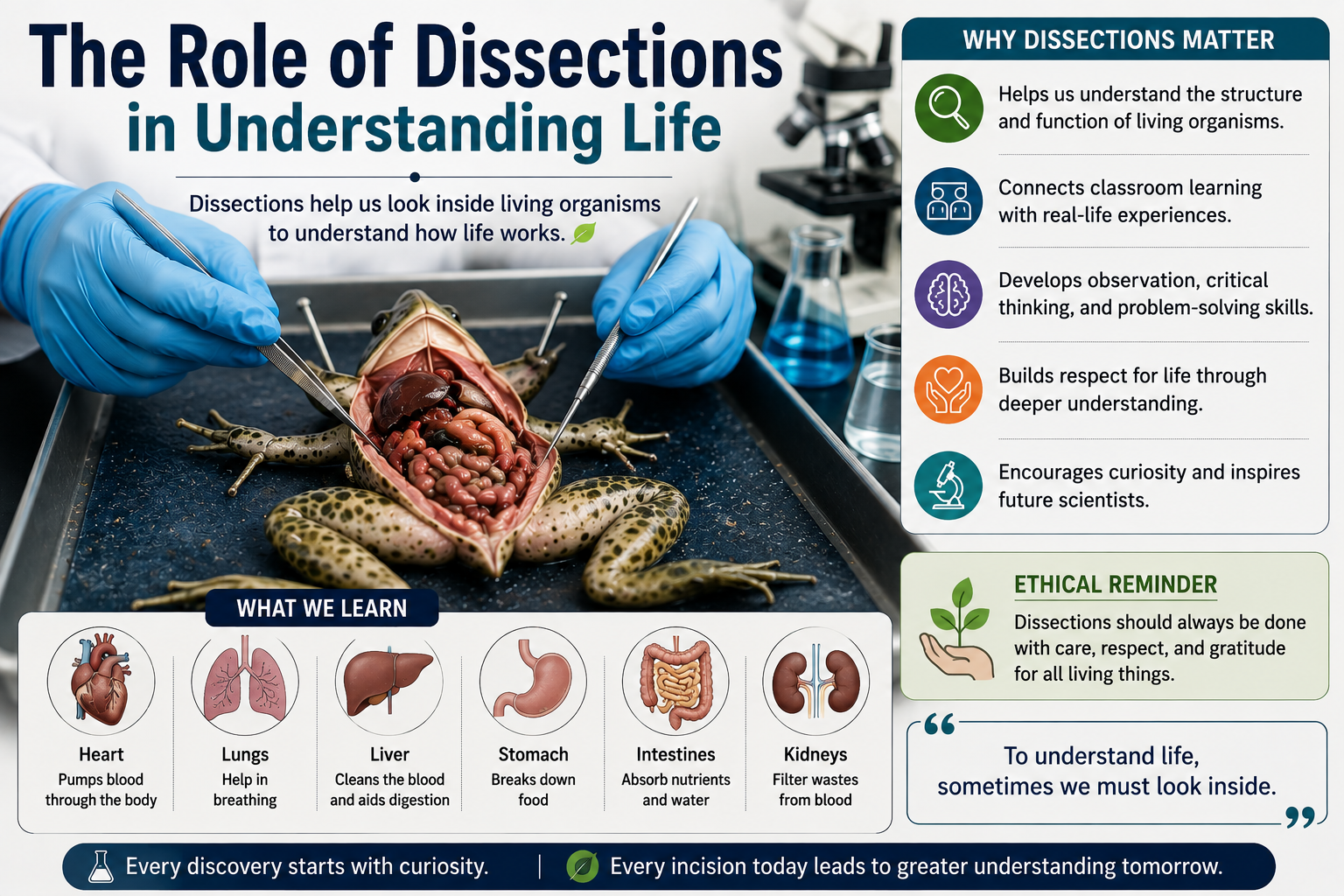
Studying frog anatomy can provide students with a fascinating introduction to the structure and organization of living organisms. Through careful anatomical study, students can learn how different organs are arranged, how body systems work together, and how scientists use observation to understand life.
Frogs are commonly studied in biology because their basic body organization shares important similarities with other vertebrates. Exploring their anatomy can help learners recognize major structures such as the heart, lungs, digestive organs, and reproductive organs, while also developing an understanding of how these systems perform different functions.
**From Frog Anatomy to Human Anatomy**
Learning about a frog's internal organization can help students build foundational knowledge that makes human anatomy easier to understand. By comparing different vertebrate body plans, learners can discover both similarities and differences in organs, tissues, and body systems. This comparison encourages curiosity and strengthens scientific thinking.
**Learning Through Observation**
Anatomical studies teach more than just the names of organs. They encourage students to observe carefully, record information, ask questions, and connect physical structures with biological functions. These skills are valuable in biology, medicine, veterinary science, and many other scientific fields.
**Science, Respect, and Responsibility**
Biology education should always be approached with respect for living organisms and with appropriate safety, ethical, and educational guidelines. Modern classrooms may also use models, diagrams, videos, simulations, and digital anatomy tools to provide meaningful learning experiences.
**Conclusion**
“Dissecting Frogs: A Gateway to Human Anatomy” represents more than an anatomy lesson—it is an opportunity to explore the fascinating organization of life. By studying structures, comparing body systems, and asking scientific questions, students can develop a deeper appreciation for biology and the remarkable complexity of living organisms.
#DissectingFrogs #FrogAnatomy #HumanAnatomy #Biology #ScienceEducation #AnatomyStudy #BiologyLearning #ScienceExperiment #LearningThroughScience #VertebrateAnatomy #LifeScience #ScienceStudents #EducationalJourney #ExploreBiology #ScientificThinking #AnatomyAndPhysiology #STEMEducation #ScienceExploration #BiologyProject #LearningIsFun
Roll no.247
song .26
Foundation level
**Dissecting Frogs: A Gateway to Human Anatomy**
Studying frog anatomy can provide students with a fascinating introduction to the structure and organization of living organisms. Through careful anatomical study, students can learn how different organs are arranged, how body systems work together, and how scientists use observation to understand life.
Frogs are commonly studied in biology because their basic body organization shares important similarities with other vertebrates. Exploring their anatomy can help learners recognize major structures such as the heart, lungs, digestive organs, and reproductive organs, while also developing an understanding of how these systems perform different functions.
**From Frog Anatomy to Human Anatomy**
Learning about a frog's internal organization can help students build foundational knowledge that makes human anatomy easier to understand. By comparing different vertebrate body plans, learners can discover both similarities and differences in organs, tissues, and body systems. This comparison encourages curiosity and strengthens scientific thinking.
**Learning Through Observation**
Anatomical studies teach more than just the names of organs. They encourage students to observe carefully, record information, ask questions, and connect physical structures with biological functions. These skills are valuable in biology, medicine, veterinary science, and many other scientific fields.
**Science, Respect, and Responsibility**
Biology education should always be approached with respect for living organisms and with appropriate safety, ethical, and educational guidelines. Modern classrooms may also use models, diagrams, videos, simulations, and digital anatomy tools to provide meaningful learning experiences.
**Conclusion**
“Dissecting Frogs: A Gateway to Human Anatomy” represents more than an anatomy lesson—it is an opportunity to explore the fascinating organization of life. By studying structures, comparing body systems, and asking scientific questions, students can develop a deeper appreciation for biology and the remarkable complexity of living organisms.
#DissectingFrogs #FrogAnatomy #HumanAnatomy #Biology #ScienceEducation #AnatomyStudy #BiologyLearning #ScienceExperiment #LearningThroughScience #VertebrateAnatomy #LifeScience #ScienceStudents #EducationalJourney #ExploreBiology #ScientificThinking #AnatomyAndPhysiology #STEMEducation #ScienceExploration #BiologyProject #LearningIsFun
#rsisb
Roll no.247
song .26
Foundation level
🐸🔬 **Dissecting Frogs: A Gateway to Human Anatomy** 🧬🫀
Studying frog anatomy can provide students with a fascinating introduction to the structure and organization of living organisms. Through careful anatomical study, students can learn how different organs are arranged, how body systems work together, and how scientists use observation to understand life. 🔍📚
🐸 Frogs are commonly studied in biology because their basic body organization shares important similarities with other vertebrates. Exploring their anatomy can help learners recognize major structures such as the heart, lungs, digestive organs, and reproductive organs, while also developing an understanding of how these systems perform different functions. 🫀🫁
🧠 **From Frog Anatomy to Human Anatomy**
Learning about a frog's internal organization can help students build foundational knowledge that makes human anatomy easier to understand. By comparing different vertebrate body plans, learners can discover both similarities and differences in organs, tissues, and body systems. This comparison encourages curiosity and strengthens scientific thinking. 🔬✨
📖 **Learning Through Observation**
Anatomical studies teach more than just the names of organs. They encourage students to observe carefully, record information, ask questions, and connect physical structures with biological functions. These skills are valuable in biology, medicine, veterinary science, and many other scientific fields. 🧪👩🔬👨🔬
🌱 **Science, Respect, and Responsibility**
Biology education should always be approached with respect for living organisms and with appropriate safety, ethical, and educational guidelines. Modern classrooms may also use models, diagrams, videos, simulations, and digital anatomy tools to provide meaningful learning experiences. 🌍💚
✨ **Conclusion**
“Dissecting Frogs: A Gateway to Human Anatomy” represents more than an anatomy lesson—it is an opportunity to explore the fascinating organization of life. By studying structures, comparing body systems, and asking scientific questions, students can develop a deeper appreciation for biology and the remarkable complexity of living organisms. 🐸🔬🧬🌟
#DissectingFrogs #FrogAnatomy #HumanAnatomy #Biology #ScienceEducation #AnatomyStudy #BiologyLearning #ScienceExperiment #LearningThroughScience #VertebrateAnatomy #LifeScience #ScienceStudents #EducationalJourney #ExploreBiology #ScientificThinking #AnatomyAndPhysiology #STEMEducation #ScienceExploration #BiologyProject #LearningIsFun 🐸🔬📚🧬🫀🫁✨
0 Commenti
0 condivisioni
2697 Views
6