• #rsisb
    Roll No.240
    Story No.12
    Foundation Level

    # Trigonometry: The Story of Angles

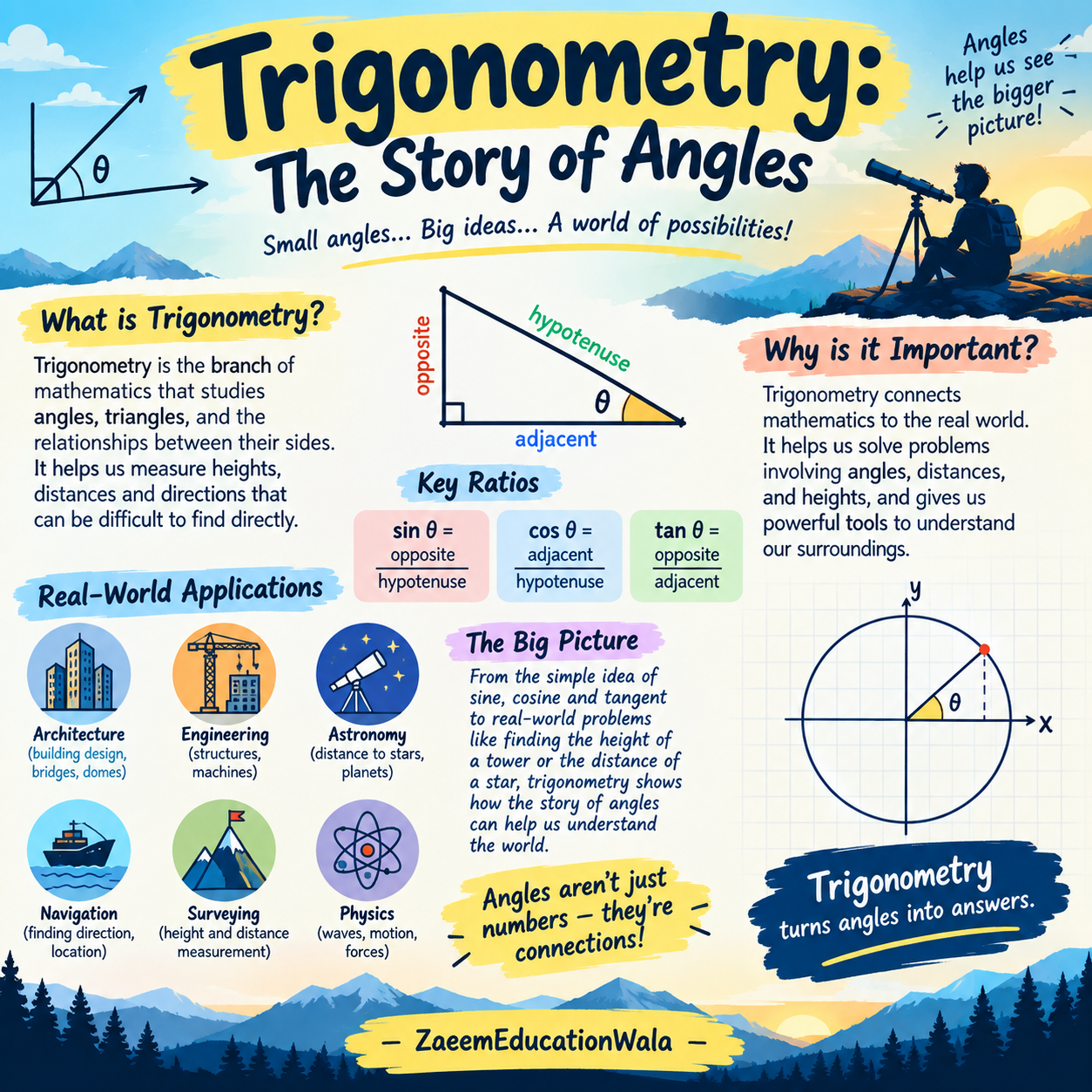
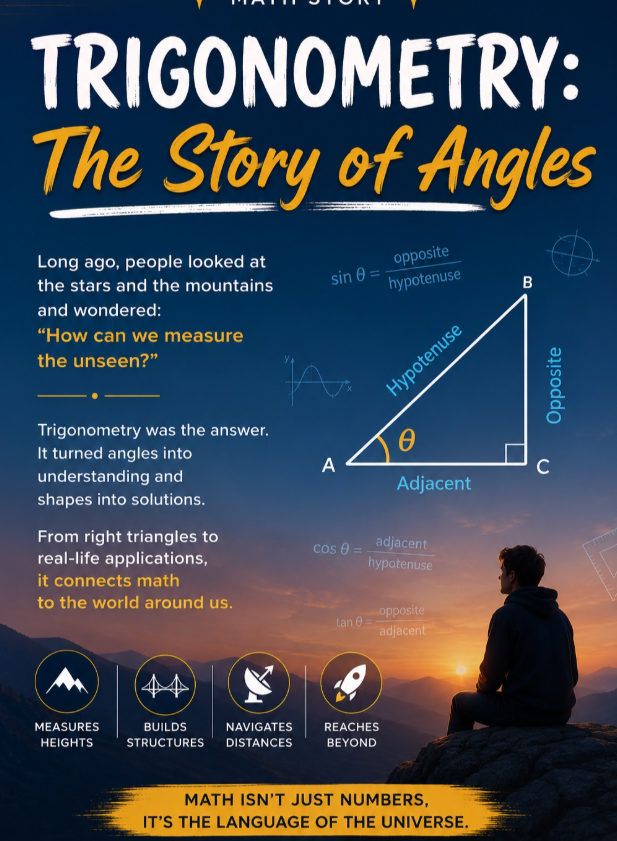
    Trigonometry is the fascinating branch of mathematics that explores the relationships between angles and sides of triangles. From ancient civilizations measuring the heights of pyramids to modern scientists navigating spacecraft, trigonometry has played a vital role in understanding the world around us. By studying angles, sine, cosine, and tangent, we unlock powerful tools that help solve real-world problems in engineering, astronomy, architecture, navigation, computer graphics, and physics.

    More than just formulas, trigonometry tells the story of how mathematics helps us measure the impossible. Every angle reveals a hidden pattern, and every triangle offers a new way to understand distance, direction, and motion. Whether you're learning the basics or advancing into higher mathematics, trigonometry builds logical thinking, problem-solving skills, and a deeper appreciation for the precision and beauty of the universe. Join this exciting journey into the world of angles and discover why trigonometry is one of the most powerful tools in mathematics.

    Rehan School Islamabad Campus
    Asma Shaheen EducationWali
    Irum Asim
    Saima Happinesswali See less


    #rsisb Roll No.240 Story No.12 Foundation Level # Trigonometry: The Story of Angles Trigonometry is the fascinating branch of mathematics that explores the relationships between angles and sides of triangles. From ancient civilizations measuring the heights of pyramids to modern scientists navigating spacecraft, trigonometry has played a vital role in understanding the world around us. By studying angles, sine, cosine, and tangent, we unlock powerful tools that help solve real-world problems in engineering, astronomy, architecture, navigation, computer graphics, and physics. More than just formulas, trigonometry tells the story of how mathematics helps us measure the impossible. Every angle reveals a hidden pattern, and every triangle offers a new way to understand distance, direction, and motion. Whether you're learning the basics or advancing into higher mathematics, trigonometry builds logical thinking, problem-solving skills, and a deeper appreciation for the precision and beauty of the universe. Join this exciting journey into the world of angles and discover why trigonometry is one of the most powerful tools in mathematics. Rehan School Islamabad Campus Asma Shaheen EducationWali Irum Asim Saima Happinesswali See less
    0 Reacties 0 aandelen 113 Views
  • #rsisb
    Roll no.239
    Foundation Level

    **Trigonometry** is the fascinating branch of mathematics that explores the relationships between **angles and the sides of triangles**. The word itself comes from Greek roots meaning “triangle” and “measurement.”

    At the heart of trigonometry are three important ratios: **sine, cosine, and tangent**. These help us understand angles and calculate unknown lengths and measurements.

    genui{"trigonometry_vectors":{"type_id":"UNIT_CIRCLE"}}

    Trigonometry is used far beyond the classroom. It plays an important role in **engineering, architecture, astronomy, physics, navigation, computer graphics, and construction**.

    The story of angles shows us how a simple mathematical idea can become a powerful tool for understanding the world around us.
    #rsisb Roll no.239 Foundation Level **Trigonometry** is the fascinating branch of mathematics that explores the relationships between **angles and the sides of triangles**. The word itself comes from Greek roots meaning “triangle” and “measurement.” At the heart of trigonometry are three important ratios: **sine, cosine, and tangent**. These help us understand angles and calculate unknown lengths and measurements. genui{"trigonometry_vectors":{"type_id":"UNIT_CIRCLE"}} Trigonometry is used far beyond the classroom. It plays an important role in **engineering, architecture, astronomy, physics, navigation, computer graphics, and construction**. The story of angles shows us how a simple mathematical idea can become a powerful tool for understanding the world around us.
    0 Reacties 0 aandelen 188 Views
  • #rsisb
    Roll No.221
    Song No.20
    Foundation Level


    ** Black Holes and Beyond: Exploring the Limits of Physics | Urdu Educational Song **

    Journey into the mysteries of the universe with this inspiring Urdu educational song about **black holes, gravity, space, and the limitless wonders of physics**. From the incredible power of black holes to the secrets hidden deep within the cosmos, this song celebrates humanity's curiosity and our endless quest to understand the universe.

    Whether you're passionate about **science, astronomy, astrophysics, or space exploration**, this song is designed to inspire learning, imagination, and discovery.

    If you enjoyed this educational song, don't forget to **Like, Share, Comment, and Subscribe** for more science-based songs and educational content.

    **#BlackHoles #Physics #Astronomy #Space #Universe #Cosmos #Science #Astrophysics #SpaceExploration #EducationalSong #STEM #Learning #Galaxy #CosmicMystery #UrduSong #YouTube #Facebook**
    Asma Shaheen EducationWali
    Irum Asim
    Saima Happinesswali
    @followers
    #rsisb Roll No.221 Song No.20 Foundation Level **🌌 Black Holes and Beyond: Exploring the Limits of Physics | Urdu Educational Song 🚀** Journey into the mysteries of the universe with this inspiring Urdu educational song about **black holes, gravity, space, and the limitless wonders of physics**. From the incredible power of black holes to the secrets hidden deep within the cosmos, this song celebrates humanity's curiosity and our endless quest to understand the universe. Whether you're passionate about **science, astronomy, astrophysics, or space exploration**, this song is designed to inspire learning, imagination, and discovery. 🎵 If you enjoyed this educational song, don't forget to **Like, Share, Comment, and Subscribe** for more science-based songs and educational content. **#BlackHoles #Physics #Astronomy #Space #Universe #Cosmos #Science #Astrophysics #SpaceExploration #EducationalSong #STEM #Learning #Galaxy #CosmicMystery #UrduSong #YouTube #Facebook** Asma Shaheen EducationWali Irum Asim Saima Happinesswali @followers
    0 Reacties 0 aandelen 3003 Views 27
  • #rsisb
    RollNo.247
    Foundation Level

    **The Quran and Science: A Bond of Knowledge**

    The Holy Quran has inspired millions of people to seek knowledge, reflect on the wonders of creation, and appreciate the beauty of the universe. From the vast galaxies above to the smallest living cells, the Quran repeatedly encourages humanity to observe nature, think deeply, and pursue wisdom.

    Science and faith can both inspire curiosity. While science explores **how** the natural world works through observation and evidence, the Quran encourages believers to reflect on creation as a sign of Allah’s wisdom. Many people find that this combination of faith and learning motivates them to discover, innovate, and contribute positively to society.

    The Quran values education, understanding, and the pursuit of beneficial knowledge. Every new discovery about our world can inspire greater appreciation for the complexity and beauty of creation. Whether studying astronomy, biology, physics, or medicine, learning can strengthen our sense of wonder and responsibility toward the world around us.

    Let us continue to read, learn, ask questions, and use knowledge to build a brighter future filled with compassion, wisdom, and respect for both faith and scientific inquiry. Together, knowledge and reflection can inspire positive change for humanity.

    **"Read, learn, reflect, and grow—knowledge is a light that benefits everyone."**

    #Quran #Science #Knowledge #Learning #Education #FaithAndScience #Islam #Wisdom #SeekKnowledge #Reflection #Nature #Universe #STEM #Innovation #Curiosity #Inspiration #Faith #Research #Discovery #PositiveThinking
    #rsisb RollNo.247 Foundation Level 📖🌍 **The Quran and Science: A Bond of Knowledge** 🌙✨ The Holy Quran has inspired millions of people to seek knowledge, reflect on the wonders of creation, and appreciate the beauty of the universe. 🌌 From the vast galaxies above to the smallest living cells, the Quran repeatedly encourages humanity to observe nature, think deeply, and pursue wisdom. 🧠🔬 Science and faith can both inspire curiosity. While science explores **how** the natural world works through observation and evidence, the Quran encourages believers to reflect on creation as a sign of Allah’s wisdom. 🌱💧🌍 Many people find that this combination of faith and learning motivates them to discover, innovate, and contribute positively to society. The Quran values education, understanding, and the pursuit of beneficial knowledge. 📚✨ Every new discovery about our world can inspire greater appreciation for the complexity and beauty of creation. Whether studying astronomy, biology, physics, or medicine, learning can strengthen our sense of wonder and responsibility toward the world around us. 🌠🔭🧬 Let us continue to read, learn, ask questions, and use knowledge to build a brighter future filled with compassion, wisdom, and respect for both faith and scientific inquiry. Together, knowledge and reflection can inspire positive change for humanity. 🤝💙 🌟 **"Read, learn, reflect, and grow—knowledge is a light that benefits everyone."** 📖✨ #Quran #Science #Knowledge #Learning #Education #FaithAndScience #Islam #Wisdom #SeekKnowledge #Reflection #Nature #Universe #STEM #Innovation #Curiosity #Inspiration #Faith #Research #Discovery #PositiveThinking
    0 Reacties 0 aandelen 2212 Views
  • #rsisb
    RollNo.244
    Story Post
    Foundation Level
    **The Quran and Science: A Bond of Knowledge**

    The Quran encourages people to observe, reflect, and seek knowledge about the world around them. Throughout history, many Muslim scholars have been inspired by its call to explore nature, leading to important contributions in fields such as astronomy, medicine, mathematics, and chemistry.

    While science explains **how** the natural world works through observation and evidence, the Quran inspires many believers to appreciate the wisdom, order, and beauty of creation. Together, they encourage curiosity, learning, and the pursuit of knowledge with humility and purpose.

    *"And say, 'My Lord, increase me in knowledge.'"* — **Quran 20:114**

    #Quran #Science #Knowledge #Learning #Education #STEM #Islam #Curiosity #ScientificDiscovery #RehanSchool
    #rsisb RollNo.244 Story Post Foundation Level 📖✨ **The Quran and Science: A Bond of Knowledge** 🌍🔬 The Quran encourages people to observe, reflect, and seek knowledge about the world around them. Throughout history, many Muslim scholars have been inspired by its call to explore nature, leading to important contributions in fields such as astronomy, medicine, mathematics, and chemistry. 🌙🧬📚 While science explains **how** the natural world works through observation and evidence, the Quran inspires many believers to appreciate the wisdom, order, and beauty of creation. Together, they encourage curiosity, learning, and the pursuit of knowledge with humility and purpose. 🌟 💡 *"And say, 'My Lord, increase me in knowledge.'"* — **Quran 20:114** #Quran #Science #Knowledge #Learning #Education #STEM #Islam #Curiosity #ScientificDiscovery #RehanSchool
    0 Reacties 0 aandelen 1434 Views
  • India has a rich and complex history spanning over 5,000 years, marked by the rise and fall of civilizations, empires, and cultural transformations. Here is a concise historical overview of India’s development:

    1. Ancient India (c. 3000 BCE – 600 BCE)

    Indus Valley Civilization (c. 3000–1500 BCE)

    • One of the world’s earliest urban civilizations, centered in present-day Pakistan and northwestern India.
    • Cities like Harappa and Mohenjo-Daro featured advanced urban planning, drainage systems, and trade networks.
    • The script remains undeciphered, and the civilization’s decline around 1500 BCE is linked to environmental changes and other factors.

    Vedic Period (c. 1500–600 BCE)

    • Arrival of Indo-Aryans who composed the Vedas, the foundational texts of Hinduism.
    • Development of early political structures, social stratification (caste system), and religious practices.
    • Transition from a pastoral to agrarian society.

    2. Classical Period (600 BCE – 1200 CE)

    Rise of Kingdoms and Empires (600 BCE – 300 BCE)

    • Mahajanapadas: 16 powerful kingdoms and republics like Magadha and Koshala.
    • Buddhism and Jainism emerged in the 6th century BCE as reformist movements against Vedic orthodoxy, led by Gautama Buddha and Mahavira.

    Maurya Empire (321–185 BCE)

    • Founded by Chandragupta Maurya, it was one of India’s largest empires.
    • Under Ashoka the Great, Buddhism spread across Asia, and pillars and edicts promoting nonviolence and dharma were erected.

    Gupta Empire (c. 320–550 CE)

    • Known as the “Golden Age” of India, it was a period of immense cultural, scientific, and artistic achievements.
    • Advances in mathematics (concept of zero), astronomy, literature (Kalidasa), and medicine occurred during this time.
    • Hinduism flourished, and major texts like the Puranas and Ramayana were written or codified.

    3. Medieval India (1200–1757)

    Early Medieval Period (600–1200)

    • Emergence of regional kingdoms such as the Chalukyas, Pallavas, Rashtrakutas, and Cholas in southern India.
    • The Chola dynasty expanded maritime trade and cultural influence to Southeast Asia.

    Islamic Invasions and Delhi Sultanate (1206–1526)

    • Islamic rule began with invasions by Mahmud of Ghazni (11th century) and Muhammad Ghori (12th century).
    • Establishment of the Delhi Sultanate, which saw the spread of Islam in India.
    • Significant cultural syncretism, with the fusion of Indian and Islamic traditions in art, architecture (e.g., Qutub Minar), and language.

    Mughal Empire (1526–1757)

    • Founded by Babur in 1526 after defeating the Delhi Sultanate.
    • Reached its zenith under Akbar, who implemented policies of religious tolerance and administrative reforms.
    • Cultural achievements under Shah Jahan (Taj Mahal) and Aurangzeb, though his reign saw the beginning of the empire’s decline.

    4. Colonial Period (1757–1947)

    British East India Company (1757–1857)

    • Following the Battle of Plassey (1757), the British East India Company gained control over Bengal and expanded its influence.
    • Exploitation of India’s resources led to famines, economic decline, and widespread discontent.

    British Raj (1858–1947)

    • After the 1857 Rebellion (India’s First War of Independence), the British Crown took direct control.
    • Infrastructure like railways, telegraphs, and canals developed, but largely served colonial interests.
    • Rise of Indian nationalism, with reform movements led by figures like Raja Ram Mohan Roy and Swami Vivekananda.

    Indian Independence Movement

    • Indian National Congress (1885) and Muslim League (1906) emerged as political platforms.
    • Leaders like Mahatma Gandhi, Jawaharlal Nehru, and Subhas Chandra Bose played key roles in mobilizing the masses.
    • Partition of Bengal (1905), Jallianwala Bagh massacre (1919), and Quit India Movement (1942) were significant events.
    • India gained independence on August 15, 1947, but was partitioned into India and Pakistan.

    5. Modern India (1947–Present)

    Post-Independence (1947–1991)

    • Adoption of the Constitution of India in 1950, establishing a secular, democratic republic.
    • Economic policies focused on self-reliance and industrialization under leaders like Jawaharlal Nehru.
    • Social reforms included the abolition of untouchability and the promotion of women’s rights.
    • Wars with Pakistan (1947, 1965, 1971) and China (1962) shaped foreign policy.
    • Green Revolution in the 1960s improved agricultural productivity but widened inequality.

    Economic Liberalization (1991–Present)

    • In 1991, economic reforms under P. V. Narasimha Rao and Manmohan Singh shifted India from a socialist to a market-oriented economy.
    • Rapid economic growth, fueled by IT, services, and industrial sectors, made India a global player.
    • Challenges include income inequality, environmental degradation, and political polarization.

    21st Century Developments

    • India’s space program (ISRO) achieved milestones like Chandrayaan and Mangalyaan missions.
    • Rise of India as a global economic power, with advancements in technology, healthcare, and infrastructure.
    • Political shifts under leaders like Narendra Modi, emphasizing nationalism, economic reforms, and a strong global presence.

    Summary of Contributions:

    1. Religion and Philosophy: Birthplace of Hinduism, Buddhism, Jainism, and Sikhism.
    2. Science and Mathematics: Innovations in astronomy, mathematics (concept of zero, decimals), and medicine.
    3. Art and Culture: Flourished under various dynasties; notable for architecture, literature, and music.
    4. Modern Global Influence: A rising power in technology, economy, and geopolitics.

    India’s history is a testament to its resilience, diversity, and enduring cultural richness.
    India has a rich and complex history spanning over 5,000 years, marked by the rise and fall of civilizations, empires, and cultural transformations. Here is a concise historical overview of India’s development: 1. Ancient India (c. 3000 BCE – 600 BCE) Indus Valley Civilization (c. 3000–1500 BCE) • One of the world’s earliest urban civilizations, centered in present-day Pakistan and northwestern India. • Cities like Harappa and Mohenjo-Daro featured advanced urban planning, drainage systems, and trade networks. • The script remains undeciphered, and the civilization’s decline around 1500 BCE is linked to environmental changes and other factors. Vedic Period (c. 1500–600 BCE) • Arrival of Indo-Aryans who composed the Vedas, the foundational texts of Hinduism. • Development of early political structures, social stratification (caste system), and religious practices. • Transition from a pastoral to agrarian society. 2. Classical Period (600 BCE – 1200 CE) Rise of Kingdoms and Empires (600 BCE – 300 BCE) • Mahajanapadas: 16 powerful kingdoms and republics like Magadha and Koshala. • Buddhism and Jainism emerged in the 6th century BCE as reformist movements against Vedic orthodoxy, led by Gautama Buddha and Mahavira. Maurya Empire (321–185 BCE) • Founded by Chandragupta Maurya, it was one of India’s largest empires. • Under Ashoka the Great, Buddhism spread across Asia, and pillars and edicts promoting nonviolence and dharma were erected. Gupta Empire (c. 320–550 CE) • Known as the “Golden Age” of India, it was a period of immense cultural, scientific, and artistic achievements. • Advances in mathematics (concept of zero), astronomy, literature (Kalidasa), and medicine occurred during this time. • Hinduism flourished, and major texts like the Puranas and Ramayana were written or codified. 3. Medieval India (1200–1757) Early Medieval Period (600–1200) • Emergence of regional kingdoms such as the Chalukyas, Pallavas, Rashtrakutas, and Cholas in southern India. • The Chola dynasty expanded maritime trade and cultural influence to Southeast Asia. Islamic Invasions and Delhi Sultanate (1206–1526) • Islamic rule began with invasions by Mahmud of Ghazni (11th century) and Muhammad Ghori (12th century). • Establishment of the Delhi Sultanate, which saw the spread of Islam in India. • Significant cultural syncretism, with the fusion of Indian and Islamic traditions in art, architecture (e.g., Qutub Minar), and language. Mughal Empire (1526–1757) • Founded by Babur in 1526 after defeating the Delhi Sultanate. • Reached its zenith under Akbar, who implemented policies of religious tolerance and administrative reforms. • Cultural achievements under Shah Jahan (Taj Mahal) and Aurangzeb, though his reign saw the beginning of the empire’s decline. 4. Colonial Period (1757–1947) British East India Company (1757–1857) • Following the Battle of Plassey (1757), the British East India Company gained control over Bengal and expanded its influence. • Exploitation of India’s resources led to famines, economic decline, and widespread discontent. British Raj (1858–1947) • After the 1857 Rebellion (India’s First War of Independence), the British Crown took direct control. • Infrastructure like railways, telegraphs, and canals developed, but largely served colonial interests. • Rise of Indian nationalism, with reform movements led by figures like Raja Ram Mohan Roy and Swami Vivekananda. Indian Independence Movement • Indian National Congress (1885) and Muslim League (1906) emerged as political platforms. • Leaders like Mahatma Gandhi, Jawaharlal Nehru, and Subhas Chandra Bose played key roles in mobilizing the masses. • Partition of Bengal (1905), Jallianwala Bagh massacre (1919), and Quit India Movement (1942) were significant events. • India gained independence on August 15, 1947, but was partitioned into India and Pakistan. 5. Modern India (1947–Present) Post-Independence (1947–1991) • Adoption of the Constitution of India in 1950, establishing a secular, democratic republic. • Economic policies focused on self-reliance and industrialization under leaders like Jawaharlal Nehru. • Social reforms included the abolition of untouchability and the promotion of women’s rights. • Wars with Pakistan (1947, 1965, 1971) and China (1962) shaped foreign policy. • Green Revolution in the 1960s improved agricultural productivity but widened inequality. Economic Liberalization (1991–Present) • In 1991, economic reforms under P. V. Narasimha Rao and Manmohan Singh shifted India from a socialist to a market-oriented economy. • Rapid economic growth, fueled by IT, services, and industrial sectors, made India a global player. • Challenges include income inequality, environmental degradation, and political polarization. 21st Century Developments • India’s space program (ISRO) achieved milestones like Chandrayaan and Mangalyaan missions. • Rise of India as a global economic power, with advancements in technology, healthcare, and infrastructure. • Political shifts under leaders like Narendra Modi, emphasizing nationalism, economic reforms, and a strong global presence. Summary of Contributions: 1. Religion and Philosophy: Birthplace of Hinduism, Buddhism, Jainism, and Sikhism. 2. Science and Mathematics: Innovations in astronomy, mathematics (concept of zero, decimals), and medicine. 3. Art and Culture: Flourished under various dynasties; notable for architecture, literature, and music. 4. Modern Global Influence: A rising power in technology, economy, and geopolitics. India’s history is a testament to its resilience, diversity, and enduring cultural richness.
    0 Reacties 0 aandelen 1605 Views
  • Sages of India Who Came from Today’s Pakistan

    When we talk about the history of sages and saints of India, we must remember that in ancient times, there was no India or Pakistan as we know today. The whole region was one cultural land. Many of the great sages, teachers, and thinkers lived in the areas that are now part of Pakistan.

    The Land of Ancient Wisdom

    The land of present-day Pakistan was home to the Indus Valley Civilization (Harappa, Mohenjo-daro) and later became a center of Hindu, Buddhist, and Jain philosophy. The rivers Indus, Ravi, Chenab, and others made this land fertile, while its mountains and forests gave peace for meditation. That is why so many sages chose this land.

    Famous Sages Connected to This Land
    1. Rishi Valmiki (Taxila Region):
    Known as the author of the Ramayana, he is believed to have lived and taught near the region of today’s Taxila.
    2. Takshashila Sages:
    Takshashila (near Islamabad) was one of the world’s oldest universities. Here taught great sages like Chanakya (Kautilya), the author of the Arthashastra, and teachers of medicine, astronomy, and philosophy.
    3. Guru Nanak (Nankana Sahib, Punjab):
    The founder of Sikhism, born in today’s Pakistan, spread the message of peace, equality, and service to humanity.
    4. Lord Buddha (Kapilavastu nearby & Gandhara Region):
    While the Buddha was born in Nepal, the Gandhara region (Peshawar, Swat, Taxila) became one of the greatest centers of Buddhist sages, monks, and teachers. This is where Buddhist philosophy spread to the world.
    5. Sufi Saints (Medieval Times):
    Later, many Islamic sages also made Pakistan their home, such as Data Ganj Bakhsh (Lahore), Baba Farid (Pakpattan), and Lal Shahbaz Qalandar (Sehwan). They continued the tradition of wisdom, love, and spirituality on this soil.

    Why It Matters

    This history shows that the land of today’s Pakistan has always been a cradle of knowledge and spirituality. From Hindu rishis and Buddhist monks to Sikh Gurus and Muslim Sufis, sages from this region have guided millions of people.


    Conclusion

    Many sages of India actually came from the land we call Pakistan today. This reminds us that wisdom and spirituality know no borders. The soil of Pakistan has always been rich with saints, thinkers, and teachers who taught love, peace, and truth to the whole world.
    Sages of India Who Came from Today’s Pakistan When we talk about the history of sages and saints of India, we must remember that in ancient times, there was no India or Pakistan as we know today. The whole region was one cultural land. Many of the great sages, teachers, and thinkers lived in the areas that are now part of Pakistan. The Land of Ancient Wisdom The land of present-day Pakistan was home to the Indus Valley Civilization (Harappa, Mohenjo-daro) and later became a center of Hindu, Buddhist, and Jain philosophy. The rivers Indus, Ravi, Chenab, and others made this land fertile, while its mountains and forests gave peace for meditation. That is why so many sages chose this land. Famous Sages Connected to This Land 1. Rishi Valmiki (Taxila Region): Known as the author of the Ramayana, he is believed to have lived and taught near the region of today’s Taxila. 2. Takshashila Sages: Takshashila (near Islamabad) was one of the world’s oldest universities. Here taught great sages like Chanakya (Kautilya), the author of the Arthashastra, and teachers of medicine, astronomy, and philosophy. 3. Guru Nanak (Nankana Sahib, Punjab): The founder of Sikhism, born in today’s Pakistan, spread the message of peace, equality, and service to humanity. 4. Lord Buddha (Kapilavastu nearby & Gandhara Region): While the Buddha was born in Nepal, the Gandhara region (Peshawar, Swat, Taxila) became one of the greatest centers of Buddhist sages, monks, and teachers. This is where Buddhist philosophy spread to the world. 5. Sufi Saints (Medieval Times): Later, many Islamic sages also made Pakistan their home, such as Data Ganj Bakhsh (Lahore), Baba Farid (Pakpattan), and Lal Shahbaz Qalandar (Sehwan). They continued the tradition of wisdom, love, and spirituality on this soil. Why It Matters This history shows that the land of today’s Pakistan has always been a cradle of knowledge and spirituality. From Hindu rishis and Buddhist monks to Sikh Gurus and Muslim Sufis, sages from this region have guided millions of people. ⸻ Conclusion Many sages of India actually came from the land we call Pakistan today. This reminds us that wisdom and spirituality know no borders. The soil of Pakistan has always been rich with saints, thinkers, and teachers who taught love, peace, and truth to the whole world.
    0 Reacties 0 aandelen 637 Views
  • Essay: The World’s First University Was in Pakistan – Taxila (Takshashila)

    Long before modern universities like Oxford, Harvard, or Cambridge, there was an ancient center of learning in South Asia called Taxila University. In old times, it was known as Takshashila, a Sanskrit word meaning “the City of Cut Stone.” It was located in the region of today’s Pakistan, near Islamabad and Rawalpindi. Many historians believe it was the world’s first organized university, where students came from faraway lands to study.

    A Center of Knowledge

    Takshashila was not just a city; it was a hub of wisdom. From around 600 BCE to 500 CE, it became a famous place where thousands of students gathered. There were no classrooms like today, but students learned directly from teachers (gurus) in small groups, under trees, in temples, or in houses.

    Subjects Taught

    At Takshashila University, students studied a wide range of subjects:
    • Philosophy and Logic
    • Medicine and Surgery (Ayurveda)
    • Mathematics and Astronomy
    • Grammar and Languages (Sanskrit, Pali, Greek, etc.)
    • Politics, Economics, and Law
    • Military Science and Archery
    • Religion (Hinduism, Buddhism, Jainism)

    This variety made it a true world university.

    Famous Teachers and Students
    • Chanakya (Kautilya): A great teacher of politics and economics at Takshashila. He wrote the famous Arthashastra, a book on governance and strategy.
    • Panini: The world’s greatest grammarian, also connected to Takshashila. His book on Sanskrit grammar is still admired today.
    • Jivaka: A famous doctor who studied medicine here and later became the personal physician of the Buddha.
    • Princes and Kings: Many royal families sent their sons to study at Takshashila to learn leadership, warfare, and statecraft.

    Importance in History

    Takshashila University was not limited to one religion or culture. People from Greece, China, Central Asia, and India came here. This made it an international center of education. Its teachings influenced not only South Asia but also the wider world.

    The Decline

    With invasions and political changes, Takshashila lost its glory around the 5th century CE, especially after the Huns attacked. But its legacy as one of the world’s first great universities still lives on.


    Conclusion

    Taxila, or Takshashila, proves that the world’s first university was in Pakistan. The sages, scientists, and leaders who studied there shaped history for centuries. It reminds us that education has always been the true power of a nation.
    Essay: The World’s First University Was in Pakistan – Taxila (Takshashila) Long before modern universities like Oxford, Harvard, or Cambridge, there was an ancient center of learning in South Asia called Taxila University. In old times, it was known as Takshashila, a Sanskrit word meaning “the City of Cut Stone.” It was located in the region of today’s Pakistan, near Islamabad and Rawalpindi. Many historians believe it was the world’s first organized university, where students came from faraway lands to study. A Center of Knowledge Takshashila was not just a city; it was a hub of wisdom. From around 600 BCE to 500 CE, it became a famous place where thousands of students gathered. There were no classrooms like today, but students learned directly from teachers (gurus) in small groups, under trees, in temples, or in houses. Subjects Taught At Takshashila University, students studied a wide range of subjects: • Philosophy and Logic • Medicine and Surgery (Ayurveda) • Mathematics and Astronomy • Grammar and Languages (Sanskrit, Pali, Greek, etc.) • Politics, Economics, and Law • Military Science and Archery • Religion (Hinduism, Buddhism, Jainism) This variety made it a true world university. Famous Teachers and Students • Chanakya (Kautilya): A great teacher of politics and economics at Takshashila. He wrote the famous Arthashastra, a book on governance and strategy. • Panini: The world’s greatest grammarian, also connected to Takshashila. His book on Sanskrit grammar is still admired today. • Jivaka: A famous doctor who studied medicine here and later became the personal physician of the Buddha. • Princes and Kings: Many royal families sent their sons to study at Takshashila to learn leadership, warfare, and statecraft. Importance in History Takshashila University was not limited to one religion or culture. People from Greece, China, Central Asia, and India came here. This made it an international center of education. Its teachings influenced not only South Asia but also the wider world. The Decline With invasions and political changes, Takshashila lost its glory around the 5th century CE, especially after the Huns attacked. But its legacy as one of the world’s first great universities still lives on. ⸻ Conclusion Taxila, or Takshashila, proves that the world’s first university was in Pakistan. The sages, scientists, and leaders who studied there shaped history for centuries. It reminds us that education has always been the true power of a nation.
    0 Reacties 0 aandelen 1096 Views
  • The Story of the Word “University”

    Long before a university became a building of classrooms, libraries, and degrees, it was an idea—a powerful one.

    The word university comes from the Latin word universitas.

    But here is the surprise:
    Universitas did not originally mean a place of study.

    It meant “the whole,” “the entire body,” or “a community bound together.”


    The Birth of the Word

    In ancient Rome, universitas was used to describe any complete group:
    • A group of merchants
    • A guild of craftsmen
    • A body of people acting as one

    Its root, universus, means:
    • turned into one
    • everything taken together
    • the whole world

    From the very beginning, the word carried a deep message:

    True knowledge is not fragments. True knowledge is unity.


    Before the Word, the Idea Already Existed: Takshashila (Taxila)

    Long before Europe used the word universitas, the idea of a university already existed in South Asia.

    Around 700 BCE, in what is today Taxila (near modern-day Islamabad, Pakistan), stood one of the world’s earliest centers of higher learning:
    Takshashila University.

    It had:
    • No fixed classrooms
    • No degrees
    • No central administration

    Yet students came from across Asia—China, Central Asia, Persia, and India.

    What Was Taught at Takshashila?
    • Philosophy
    • Medicine (Ayurveda & surgery)
    • Mathematics
    • Astronomy
    • Politics and governance
    • Warfare and strategy
    • Ethics and law

    Students lived with teachers, debated openly, and studied multiple disciplines together.

    This perfectly matched what universitas would later mean:

    Knowledge as a complete system, not isolated subjects.

    Takshashila proves an important truth:

    Universities did not begin in buildings.
    They began wherever minds gathered to understand the whole of life.


    When Learning Met Universitas in Europe

    In the Middle Ages (11th–12th century), groups of teachers and students in Europe began forming learning communities.

    They called themselves:

    Universitas magistrorum et scholarium
    A community of teachers and learners

    The first European universities—Bologna, Paris, Oxford—were not campuses at first.

    They were:
    • Communities
    • Conversations
    • Shared pursuit of understanding

    Once again, university meant unity.


    A Forgotten Chapter: The University Founded by a Woman in North Africa

    One of the most powerful and least-told stories in the history of universities comes from North Africa.

    In 859 CE, in the city of Fez, Morocco, a woman named Fatima al-Fihri used her inheritance to establish a place of learning.

    This institution became:

    The University of al-Qarawiyyin
    — recognized by UNESCO as the oldest continuously operating university in the world

    What Makes This Extraordinary?
    • It was founded by a woman
    • Over 1,100 years ago
    • Long before many European universities
    • At a time when women are often wrongly assumed to be excluded from knowledge

    What Was Taught There?
    • Mathematics
    • Astronomy
    • Medicine
    • Philosophy
    • Grammar and languages
    • Theology and law

    Scholars from Europe, Africa, and the Middle East studied there.
    Even thinkers who later shaped Europe’s Renaissance were influenced by knowledge preserved and taught in places like al-Qarawiyyin.

    This university embodied the true meaning of universitas:
    • Knowledge without borders
    • Learning as a shared human inheritance


    What a University Was Meant to Be

    From Takshashila to al-Qarawiyyin, from Bologna to Oxford, the idea remained the same:

    A university was meant to:
    • Connect disciplines
    • Train the mind to see patterns
    • Teach wisdom, not just information

    It was not about specialization alone.

    It was about understanding how everything fits together.


    How the Meaning Drifted

    Over time, the word university slowly changed.

    It became:
    • A degree factory
    • A job pipeline
    • A system of exams

    The original meaning—unity of knowledge—was pushed aside.

    Today, many universities teach parts without the whole.

    But the word itself still remembers its origin.


    The Hidden Message Inside the Word

    Every time we say university, we are unknowingly saying:
    • Universe
    • Unity
    • Universal understanding

    A true university helps a human being understand:
    • Society and self
    • Science and ethics
    • Technology and responsibility


    The University of the Future

    If we return to the original meaning of the word, the university of the future would:
    • Teach connection, not confusion
    • Train thinkers, not just workers
    • Prepare humans to live consciously on Planet Earth, not just inside economies

    It would look less like a factory
    and more like Takshashila
    more like al-Qarawiyyin
    more like a living community of learning.


    Final Thought

    The story of the word university teaches us one simple lesson:

    When knowledge is divided, humanity weakens.
    When knowledge is united, civilizations rise.

    That was the original promise of the university.
    The Story of the Word “University” Long before a university became a building of classrooms, libraries, and degrees, it was an idea—a powerful one. The word university comes from the Latin word universitas. But here is the surprise: Universitas did not originally mean a place of study. It meant “the whole,” “the entire body,” or “a community bound together.” ⸻ The Birth of the Word In ancient Rome, universitas was used to describe any complete group: • A group of merchants • A guild of craftsmen • A body of people acting as one Its root, universus, means: • turned into one • everything taken together • the whole world From the very beginning, the word carried a deep message: True knowledge is not fragments. True knowledge is unity. ⸻ Before the Word, the Idea Already Existed: Takshashila (Taxila) Long before Europe used the word universitas, the idea of a university already existed in South Asia. Around 700 BCE, in what is today Taxila (near modern-day Islamabad, Pakistan), stood one of the world’s earliest centers of higher learning: Takshashila University. It had: • No fixed classrooms • No degrees • No central administration Yet students came from across Asia—China, Central Asia, Persia, and India. What Was Taught at Takshashila? • Philosophy • Medicine (Ayurveda & surgery) • Mathematics • Astronomy • Politics and governance • Warfare and strategy • Ethics and law Students lived with teachers, debated openly, and studied multiple disciplines together. This perfectly matched what universitas would later mean: Knowledge as a complete system, not isolated subjects. Takshashila proves an important truth: Universities did not begin in buildings. They began wherever minds gathered to understand the whole of life. ⸻ When Learning Met Universitas in Europe In the Middle Ages (11th–12th century), groups of teachers and students in Europe began forming learning communities. They called themselves: Universitas magistrorum et scholarium A community of teachers and learners The first European universities—Bologna, Paris, Oxford—were not campuses at first. They were: • Communities • Conversations • Shared pursuit of understanding Once again, university meant unity. ⸻ A Forgotten Chapter: The University Founded by a Woman in North Africa One of the most powerful and least-told stories in the history of universities comes from North Africa. In 859 CE, in the city of Fez, Morocco, a woman named Fatima al-Fihri used her inheritance to establish a place of learning. This institution became: The University of al-Qarawiyyin — recognized by UNESCO as the oldest continuously operating university in the world What Makes This Extraordinary? • It was founded by a woman • Over 1,100 years ago • Long before many European universities • At a time when women are often wrongly assumed to be excluded from knowledge What Was Taught There? • Mathematics • Astronomy • Medicine • Philosophy • Grammar and languages • Theology and law Scholars from Europe, Africa, and the Middle East studied there. Even thinkers who later shaped Europe’s Renaissance were influenced by knowledge preserved and taught in places like al-Qarawiyyin. This university embodied the true meaning of universitas: • Knowledge without borders • Learning as a shared human inheritance ⸻ What a University Was Meant to Be From Takshashila to al-Qarawiyyin, from Bologna to Oxford, the idea remained the same: A university was meant to: • Connect disciplines • Train the mind to see patterns • Teach wisdom, not just information It was not about specialization alone. It was about understanding how everything fits together. ⸻ How the Meaning Drifted Over time, the word university slowly changed. It became: • A degree factory • A job pipeline • A system of exams The original meaning—unity of knowledge—was pushed aside. Today, many universities teach parts without the whole. But the word itself still remembers its origin. ⸻ The Hidden Message Inside the Word Every time we say university, we are unknowingly saying: • Universe • Unity • Universal understanding A true university helps a human being understand: • Society and self • Science and ethics • Technology and responsibility ⸻ The University of the Future If we return to the original meaning of the word, the university of the future would: • Teach connection, not confusion • Train thinkers, not just workers • Prepare humans to live consciously on Planet Earth, not just inside economies It would look less like a factory and more like Takshashila more like al-Qarawiyyin more like a living community of learning. ⸻ Final Thought The story of the word university teaches us one simple lesson: When knowledge is divided, humanity weakens. When knowledge is united, civilizations rise. That was the original promise of the university.
    0 Reacties 0 aandelen 556 Views
  • Below is a clear, historically ordered list of ancient universities / learning centers that existed before Taxila (Takshashila).
    These institutions did not use the word university, but they fully matched the idea of a university: organized teaching, multiple disciplines, teachers, students, and knowledge preserved across generations.


    Ancient Universities and Learning Centers Before Taxila

    1. Edubba (Tablet Houses) — Sumer, Mesopotamia

    Period: c. 3000 BCE
    Location: Present-day Iraq
    • Considered the earliest formal education system in the world
    • “Edubba” literally meant House of Tablets
    • Subjects taught:
    • Writing (cuneiform)
    • Mathematics
    • Law
    • Accounting
    • Astronomy
    • Trained scribes, administrators, and scholars

    This was humanity’s first organized school system


    2. House of Life (Per Ankh) — Ancient Egypt

    Period: c. 2600 BCE
    Location: Memphis, Thebes, and other Egyptian cities
    • Attached to major temples
    • Centers of medicine, science, and philosophy
    • Subjects included:
    • Medicine and surgery
    • Mathematics
    • Astronomy
    • Philosophy
    • Ethics
    • Greek scholars later studied Egyptian knowledge here

    A fusion of science, spirituality, and governance


    3. Library and Scholarly Centers of Nineveh — Assyria

    Period: c. 2500–700 BCE
    Location: Ancient Assyria (modern Iraq)
    • One of the earliest research institutions
    • Thousands of clay tablets preserved
    • Fields included:
    • Law
    • Medicine
    • Literature
    • Mathematics
    • Astronomy
    • Scholars worked as archivists, translators, and researchers

    An early research university and knowledge archive


    4. Gurukul System — Ancient Indian Subcontinent

    Period: c. 3000–2000 BCE
    Location: South Asia
    • Residential education system
    • Students lived with their teacher (guru)
    • Education was holistic:
    • Philosophy
    • Mathematics
    • Astronomy
    • Linguistics
    • Ethics
    • Music
    • Learning was connected to daily life and discipline

    A life-integrated university model


    5. Early Imperial Academies — Ancient China

    Period: c. 2000–1500 BCE (formalized later)
    Location: Ancient China
    • State-supported learning centers
    • Focused on:
    • Ethics
    • Philosophy
    • Governance
    • Social harmony
    • Teacher–student lineage was central
    • Later evolved into Confucian academies

    A moral and administrative university system


    6. Early Greek Philosophical Schools

    Period: c. 700–500 BCE
    Location: Ancient Greece
    • Pre-Plato schools such as:
    • Pythagorean School
    • Eleatic School
    • Subjects taught:
    • Logic
    • Mathematics
    • Philosophy
    • Nature and cosmology
    • Learning centered on dialogue and inquiry

    Foundations of Western theoretical education


    Then Came: Taxila (Takshashila) — c. 600 BCE

    Taxila did something unique:
    • Combined Eastern and Western knowledge
    • Hosted international students
    • Taught medicine, politics, military science, philosophy, and ethics
    • Functioned as a truly global university

    Because of this, Taxila is often called:

    The world’s first international university


    Timeline Summary
    • 3000 BCE — Edubba (Sumer)
    • 2600 BCE — House of Life (Egypt)
    • 2500 BCE — Nineveh scholarly centers
    • 3000–2000 BCE — Gurukul system (South Asia)
    • 2000 BCE — Chinese academies
    • 700–500 BCE — Greek philosophical schools
    • 600 BCE — Taxila


    Final Thought

    The word university is new.
    The idea of a university is as old as civilization itself.
    Below is a clear, historically ordered list of ancient universities / learning centers that existed before Taxila (Takshashila). These institutions did not use the word university, but they fully matched the idea of a university: organized teaching, multiple disciplines, teachers, students, and knowledge preserved across generations. ⸻ Ancient Universities and Learning Centers Before Taxila 1. Edubba (Tablet Houses) — Sumer, Mesopotamia Period: c. 3000 BCE Location: Present-day Iraq • Considered the earliest formal education system in the world • “Edubba” literally meant House of Tablets • Subjects taught: • Writing (cuneiform) • Mathematics • Law • Accounting • Astronomy • Trained scribes, administrators, and scholars ➡️ This was humanity’s first organized school system ⸻ 2. House of Life (Per Ankh) — Ancient Egypt Period: c. 2600 BCE Location: Memphis, Thebes, and other Egyptian cities • Attached to major temples • Centers of medicine, science, and philosophy • Subjects included: • Medicine and surgery • Mathematics • Astronomy • Philosophy • Ethics • Greek scholars later studied Egyptian knowledge here ➡️ A fusion of science, spirituality, and governance ⸻ 3. Library and Scholarly Centers of Nineveh — Assyria Period: c. 2500–700 BCE Location: Ancient Assyria (modern Iraq) • One of the earliest research institutions • Thousands of clay tablets preserved • Fields included: • Law • Medicine • Literature • Mathematics • Astronomy • Scholars worked as archivists, translators, and researchers ➡️ An early research university and knowledge archive ⸻ 4. Gurukul System — Ancient Indian Subcontinent Period: c. 3000–2000 BCE Location: South Asia • Residential education system • Students lived with their teacher (guru) • Education was holistic: • Philosophy • Mathematics • Astronomy • Linguistics • Ethics • Music • Learning was connected to daily life and discipline ➡️ A life-integrated university model ⸻ 5. Early Imperial Academies — Ancient China Period: c. 2000–1500 BCE (formalized later) Location: Ancient China • State-supported learning centers • Focused on: • Ethics • Philosophy • Governance • Social harmony • Teacher–student lineage was central • Later evolved into Confucian academies ➡️ A moral and administrative university system ⸻ 6. Early Greek Philosophical Schools Period: c. 700–500 BCE Location: Ancient Greece • Pre-Plato schools such as: • Pythagorean School • Eleatic School • Subjects taught: • Logic • Mathematics • Philosophy • Nature and cosmology • Learning centered on dialogue and inquiry ➡️ Foundations of Western theoretical education ⸻ Then Came: Taxila (Takshashila) — c. 600 BCE Taxila did something unique: • Combined Eastern and Western knowledge • Hosted international students • Taught medicine, politics, military science, philosophy, and ethics • Functioned as a truly global university Because of this, Taxila is often called: The world’s first international university ⸻ Timeline Summary • 3000 BCE — Edubba (Sumer) • 2600 BCE — House of Life (Egypt) • 2500 BCE — Nineveh scholarly centers • 3000–2000 BCE — Gurukul system (South Asia) • 2000 BCE — Chinese academies • 700–500 BCE — Greek philosophical schools • 600 BCE — Taxila ⸻ Final Thought The word university is new. The idea of a university is as old as civilization itself.
    0 Reacties 0 aandelen 684 Views
Zoekresultaten