• RSIF8
    ROLL NO 66
    STORY POST NO 28
    STORY POST TOPIC: Ecosystem Explorers: Discovering Earth’s Habitats

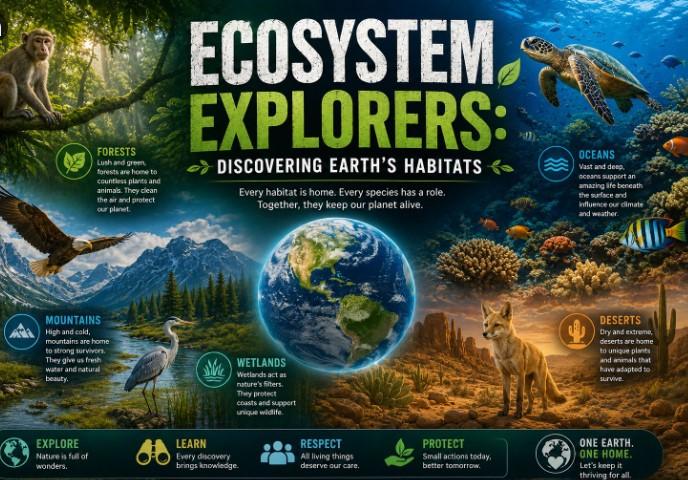
    Step into the incredible world of Earth’s ecosystems and discover the amazing habitats that support life on our planet.

    From the lush forests and powerful mountains to the diverse wetlands, vast oceans, and fascinating deserts, every habitat has its own unique environment, plants, animals, and natural processes. Each species has an important role to play in maintaining the balance of nature.

    This educational visual explores how different ecosystems work together to keep our planet healthy and full of life. It also reminds us that protecting habitats means protecting the countless species and natural resources that depend on them.

    Explore. Learn. Respect. Protect.
    Because every habitat is a home, every species has a role, and we all share one Earth.

    hashtag#EcosystemExplorers hashtag#Ecosystems hashtag#EarthHabitats hashtag#Nature hashtag#Environment hashtag#Biodiversity hashtag#Wildlife hashtag#ScienceEducation hashtag#EarthScience hashtag#Forests hashtag#Oceans hashtag#Mountains hashtag#Wetlands hashtag#Deserts hashtag#NatureLovers hashtag#EnvironmentalAwareness hashtag#ProtectNature hashtag#SaveOurPlanet hashtag#Education hashtag#Learning
    RSIF8 ROLL NO 66 STORY POST NO 28 STORY POST TOPIC: 🌍 Ecosystem Explorers: Discovering Earth’s Habitats Step into the incredible world of Earth’s ecosystems and discover the amazing habitats that support life on our planet. πŸŒΏπŸ’πŸŒŠπŸ”οΈπŸœοΈ From the lush forests and powerful mountains to the diverse wetlands, vast oceans, and fascinating deserts, every habitat has its own unique environment, plants, animals, and natural processes. Each species has an important role to play in maintaining the balance of nature. This educational visual explores how different ecosystems work together to keep our planet healthy and full of life. 🌎✨ It also reminds us that protecting habitats means protecting the countless species and natural resources that depend on them. πŸ” Explore. Learn. Respect. Protect. Because every habitat is a home, every species has a role, and we all share one Earth. πŸ’š hashtag#EcosystemExplorers hashtag#Ecosystems hashtag#EarthHabitats hashtag#Nature hashtag#Environment hashtag#Biodiversity hashtag#Wildlife hashtag#ScienceEducation hashtag#EarthScience hashtag#Forests hashtag#Oceans hashtag#Mountains hashtag#Wetlands hashtag#Deserts hashtag#NatureLovers hashtag#EnvironmentalAwareness hashtag#ProtectNature hashtag#SaveOurPlanet hashtag#Education hashtag#Learning
    0 Commenti 0 condivisioni 783 Views
  • RSIF8
    ROLL NO 66
    SONG NO 22
    SONG TOPIC: **The Journey of the Water Cycle**

    Take a musical journey through one of nature’s most amazing processes—the **water cycle**! From evaporation under the warmth of the Sun to condensation in the clouds, precipitation as rain, and collection in rivers, lakes, and oceans, water is constantly moving through our planet in a beautiful and continuous cycle.

    This song turns an important science concept into an easy and engaging learning experience. It helps explain how water travels between the Earth’s surface and the atmosphere while highlighting the key stages of **evaporation, condensation, precipitation, and collection**.

    The water cycle is essential for life, supporting plants, animals, people, agriculture, and ecosystems around the world.

    **Learn the science. Enjoy the music. Discover the journey of water!**

    #WaterCycle #Science #Biology #EarthScience #ScienceEducation #Learning #Water #Nature #Environment #STEM #Education #Evaporation #Condensation #Precipitation #Earth #ScienceSong #EducationalMusic
    RSIF8 ROLL NO 66 SONG NO 22 SONG TOPIC: πŸ’§πŸŒ **The Journey of the Water Cycle** Take a musical journey through one of nature’s most amazing processes—the **water cycle**! πŸŒ§οΈβ˜€οΈβ˜οΈ From evaporation under the warmth of the Sun to condensation in the clouds, precipitation as rain, and collection in rivers, lakes, and oceans, water is constantly moving through our planet in a beautiful and continuous cycle. This song turns an important science concept into an easy and engaging learning experience. It helps explain how water travels between the Earth’s surface and the atmosphere while highlighting the key stages of **evaporation, condensation, precipitation, and collection**. The water cycle is essential for life, supporting plants, animals, people, agriculture, and ecosystems around the world. πŸŒ±πŸ’¦ 🎢 **Learn the science. Enjoy the music. Discover the journey of water!** #WaterCycle #Science #Biology #EarthScience #ScienceEducation #Learning #Water #Nature #Environment #STEM #Education #Evaporation #Condensation #Precipitation #Earth #ScienceSong #EducationalMusic
    0 Commenti 0 condivisioni 888 Views 3
  • RSIF 8

    Roll no 93

    Story post no 26

    Task topic:"Ecosystem Explorers: Discovering Earth's Habitats".Here is a ready-to-use **story post** for **“Ecosystem Explorers: Discovering Earth’s Habitats”**


    **Ecosystem Explorers: Discovering Earth’s Habitats**


    Have you ever wondered how animals, plants, and people live together in different parts of our amazing planet?


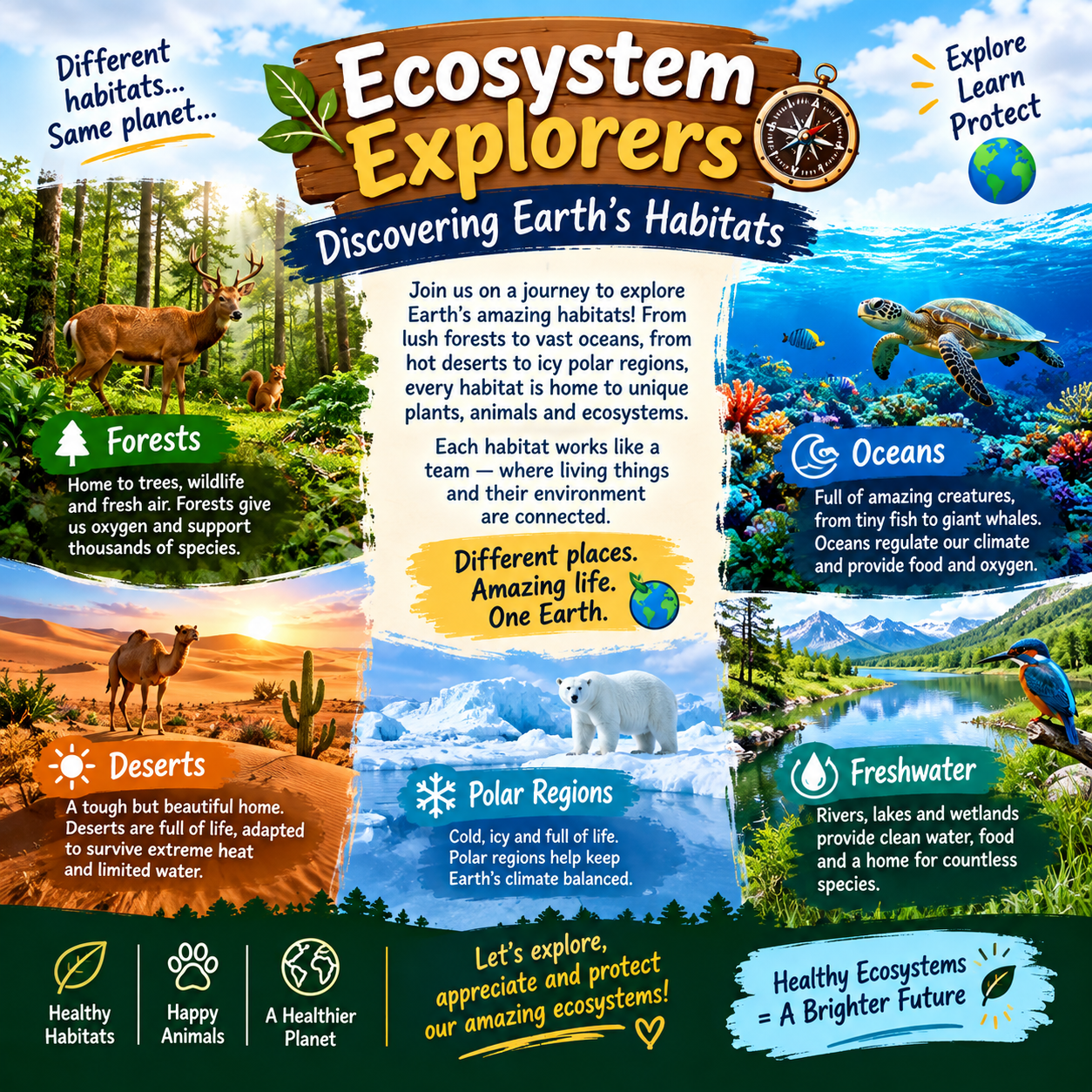
    Join our **Ecosystem Explorers** as we travel through Earth’s incredible habitats—from lush forests and dry deserts to deep oceans and icy polar regions .


    In every habitat, living things have special ways to survive. A camel can survive for long periods in the desert, polar bears are adapted to freezing temperatures, and rainforest plants compete for sunlight beneath a thick green canopy.


    But every ecosystem is connected. Plants provide oxygen and food, animals help maintain natural balance, water supports life, and tiny organisms help recycle nutrients back into the environment.


    As explorers, our mission is not only to discover these habitats but also to understand why they matter. Pollution, deforestation, climate change, and habitat destruction can affect ecosystems and the creatures that depend on them.


    **The Earth is our shared home. Let’s explore it, learn about it, and protect it for future generations.**


    **Explore. Learn. Protect. Repeat.**


    #EcosystemExplorers #EarthHabitats #Ecosystems #Nature #Environment #Wildlife #Biodiversity #SaveOurPlanet #ClimateAction #Earth #Science #Learning #NatureLovers #ProtectNature


    You can use this as your **Facebook, Instagram, LinkedIn, YouTube, or TikTok post description**.
    RSIF 8 Roll no 93 Story post no 26 Task topic:"Ecosystem Explorers: Discovering Earth's Habitats".Here is a ready-to-use **story post** for **“Ecosystem Explorers: Discovering Earth’s Habitats”** 🌍🌿 🌍🌿 **Ecosystem Explorers: Discovering Earth’s Habitats** 🐾🌊 Have you ever wondered how animals, plants, and people live together in different parts of our amazing planet? 🌎 Join our **Ecosystem Explorers** as we travel through Earth’s incredible habitats—from lush forests 🌳 and dry deserts 🏜️ to deep oceans 🌊 and icy polar regions ❄️. In every habitat, living things have special ways to survive. A camel can survive for long periods in the desert, polar bears are adapted to freezing temperatures, and rainforest plants compete for sunlight beneath a thick green canopy. πŸͺ🐻‍β„οΈπŸŒ± But every ecosystem is connected. Plants provide oxygen and food, animals help maintain natural balance, water supports life, and tiny organisms help recycle nutrients back into the environment. πŸŒ±πŸ’§πŸ¦‹ As explorers, our mission is not only to discover these habitats but also to understand why they matter. Pollution, deforestation, climate change, and habitat destruction can affect ecosystems and the creatures that depend on them. πŸŒπŸ’š **The Earth is our shared home. Let’s explore it, learn about it, and protect it for future generations.** 🌎✨ πŸ”Ž **Explore. Learn. Protect. Repeat.** #EcosystemExplorers #EarthHabitats #Ecosystems #Nature #Environment #Wildlife #Biodiversity #SaveOurPlanet #ClimateAction #Earth #Science #Learning #NatureLovers #ProtectNature You can use this as your **Facebook, Instagram, LinkedIn, YouTube, or TikTok post description**.
    0 Commenti 0 condivisioni 1382 Views
  • Mohsin #RSF8
    #Storypostt6
    Class: Foundation level
    Made by Me
    rool no:13
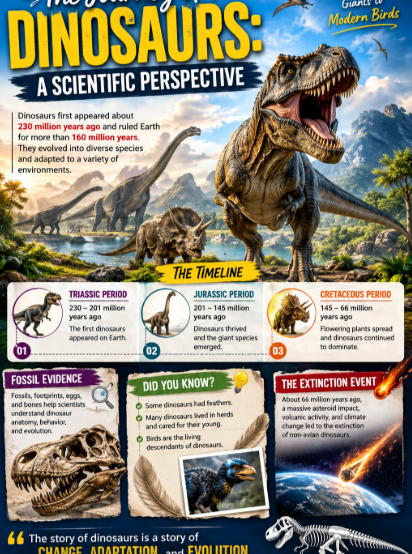
    The Journey of Dinosaurs: A Scientific Perspective

    Travel back hundreds of millions of years and discover the extraordinary story of dinosaurs—some of the most fascinating creatures to ever inhabit our planet. Their journey began during the Triassic Period, approximately 230 million years ago, when the Earth looked vastly different from the world we know today. Continents were joined together in a giant landmass called Pangaea, and early dinosaurs emerged as small, agile reptiles. Over time, these ancient creatures evolved into a diverse range of species, occupying nearly every ecological niche and becoming the dominant animals on Earth for more than 160 million years.

    During the Jurassic Period, dinosaurs flourished and diversified into countless forms. Massive herbivores such as Brachiosaurus and Diplodocus roamed lush forests, while formidable predators like Allosaurus hunted across vast landscapes. Their remarkable adaptations allowed them to thrive in changing environments, demonstrating the power of evolution and natural selection. As ecosystems became increasingly complex, dinosaurs developed specialized characteristics that enabled them to survive and dominate their habitats.

    The Cretaceous Period marked the peak of dinosaur diversity. Iconic species such as Tyrannosaurus rex, Triceratops, and Velociraptor appeared during this era. Scientists believe that many dinosaurs displayed advanced behaviors, including social interaction, parental care, and migration. Fossil evidence has even revealed that some dinosaurs possessed feathers, providing strong support for the evolutionary link between dinosaurs and modern birds. These discoveries have transformed our understanding of dinosaurs, showing that they were dynamic, intelligent, and highly adaptable creatures rather than the slow-moving reptiles once imagined.

    Our knowledge of dinosaurs comes primarily from the study of fossils. Paleontologists carefully examine fossilized bones, footprints, eggs, and even preserved skin impressions to reconstruct the lives of these prehistoric animals. Modern technologies.
    Mohsin #RSF8πŸŽ“βœ¨ #Storypostt6 Class: Foundation level πŸ“š Made by Me πŸ’»πŸš€ rool no:13 πŸ¦– The Journey of Dinosaurs: A Scientific Perspective Travel back hundreds of millions of years and discover the extraordinary story of dinosaurs—some of the most fascinating creatures to ever inhabit our planet. Their journey began during the Triassic Period, approximately 230 million years ago, when the Earth looked vastly different from the world we know today. Continents were joined together in a giant landmass called Pangaea, and early dinosaurs emerged as small, agile reptiles. Over time, these ancient creatures evolved into a diverse range of species, occupying nearly every ecological niche and becoming the dominant animals on Earth for more than 160 million years. During the Jurassic Period, dinosaurs flourished and diversified into countless forms. Massive herbivores such as Brachiosaurus and Diplodocus roamed lush forests, while formidable predators like Allosaurus hunted across vast landscapes. Their remarkable adaptations allowed them to thrive in changing environments, demonstrating the power of evolution and natural selection. As ecosystems became increasingly complex, dinosaurs developed specialized characteristics that enabled them to survive and dominate their habitats. The Cretaceous Period marked the peak of dinosaur diversity. Iconic species such as Tyrannosaurus rex, Triceratops, and Velociraptor appeared during this era. Scientists believe that many dinosaurs displayed advanced behaviors, including social interaction, parental care, and migration. Fossil evidence has even revealed that some dinosaurs possessed feathers, providing strong support for the evolutionary link between dinosaurs and modern birds. These discoveries have transformed our understanding of dinosaurs, showing that they were dynamic, intelligent, and highly adaptable creatures rather than the slow-moving reptiles once imagined. Our knowledge of dinosaurs comes primarily from the study of fossils. Paleontologists carefully examine fossilized bones, footprints, eggs, and even preserved skin impressions to reconstruct the lives of these prehistoric animals. Modern technologies.
    0 Commenti 0 condivisioni 818 Views
  • Foundation level

    Day:- 97
    Rollno:-005
    Story Post

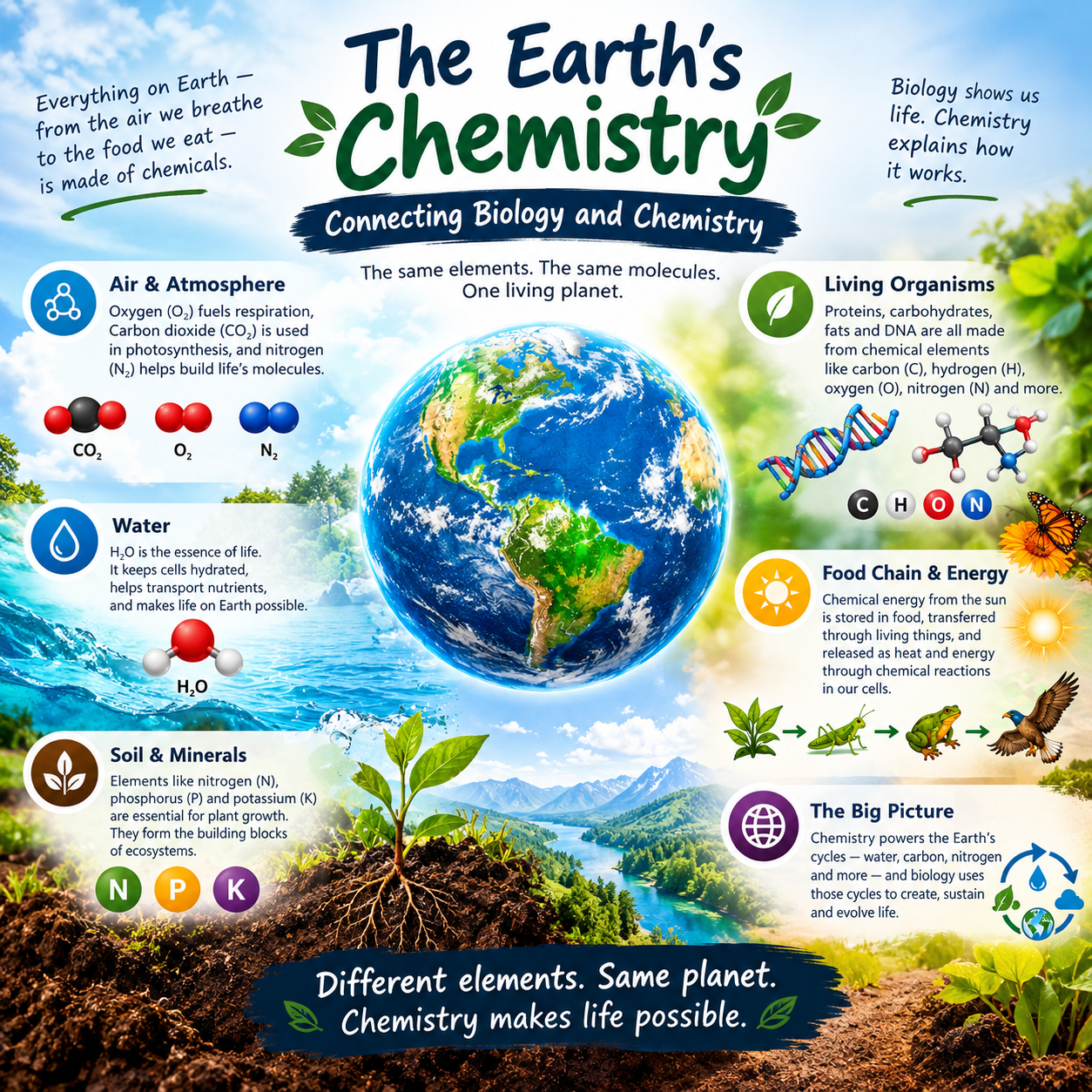
    The Earth’s Chemistry – Connecting Biology and Chemistry

    Everything around us—from the air we breathe and the water we drink to plants, animals, soil, and even our own bodies—is connected through chemistry. Chemistry explains the elements and molecules that make life possible, while biology shows how living organisms use them.

    From oxygen and carbon dioxide in the atmosphere to water, minerals, proteins, DNA, and carbohydrates, chemical reactions are constantly taking place on Earth.

    This educational post explores how chemistry and biology work together to support life, ecosystems, energy flow, and Earth’s natural cycles.

    Different elements. Same planet. Chemistry makes life possible!

    #EarthsChemistry #Chemistry #Biology #Science #EarthScience #Molecules #Elements #Nature #Education #SciencePost #Learning #STEM #EnvironmentalScience #ChemistryAndBiology
    Foundation level Day:- 97 Rollno:-005 πŸ“– Story Post 🌍 The Earth’s Chemistry – Connecting Biology and Chemistry πŸ§ͺ🌱 Everything around us—from the air we breathe and the water we drink to plants, animals, soil, and even our own bodies—is connected through chemistry. Chemistry explains the elements and molecules that make life possible, while biology shows how living organisms use them. From oxygen and carbon dioxide in the atmosphere to water, minerals, proteins, DNA, and carbohydrates, chemical reactions are constantly taking place on Earth. πŸŒΏπŸ”¬ This educational post explores how chemistry and biology work together to support life, ecosystems, energy flow, and Earth’s natural cycles. ✨ Different elements. Same planet. Chemistry makes life possible! #EarthsChemistry #Chemistry #Biology #Science #EarthScience #Molecules #Elements #Nature #Education #SciencePost #Learning #STEM #EnvironmentalScience #ChemistryAndBiology
    0 Commenti 0 condivisioni 965 Views
  • **Foundation Level** **Day 125** **story post** **Roll Number: 005**

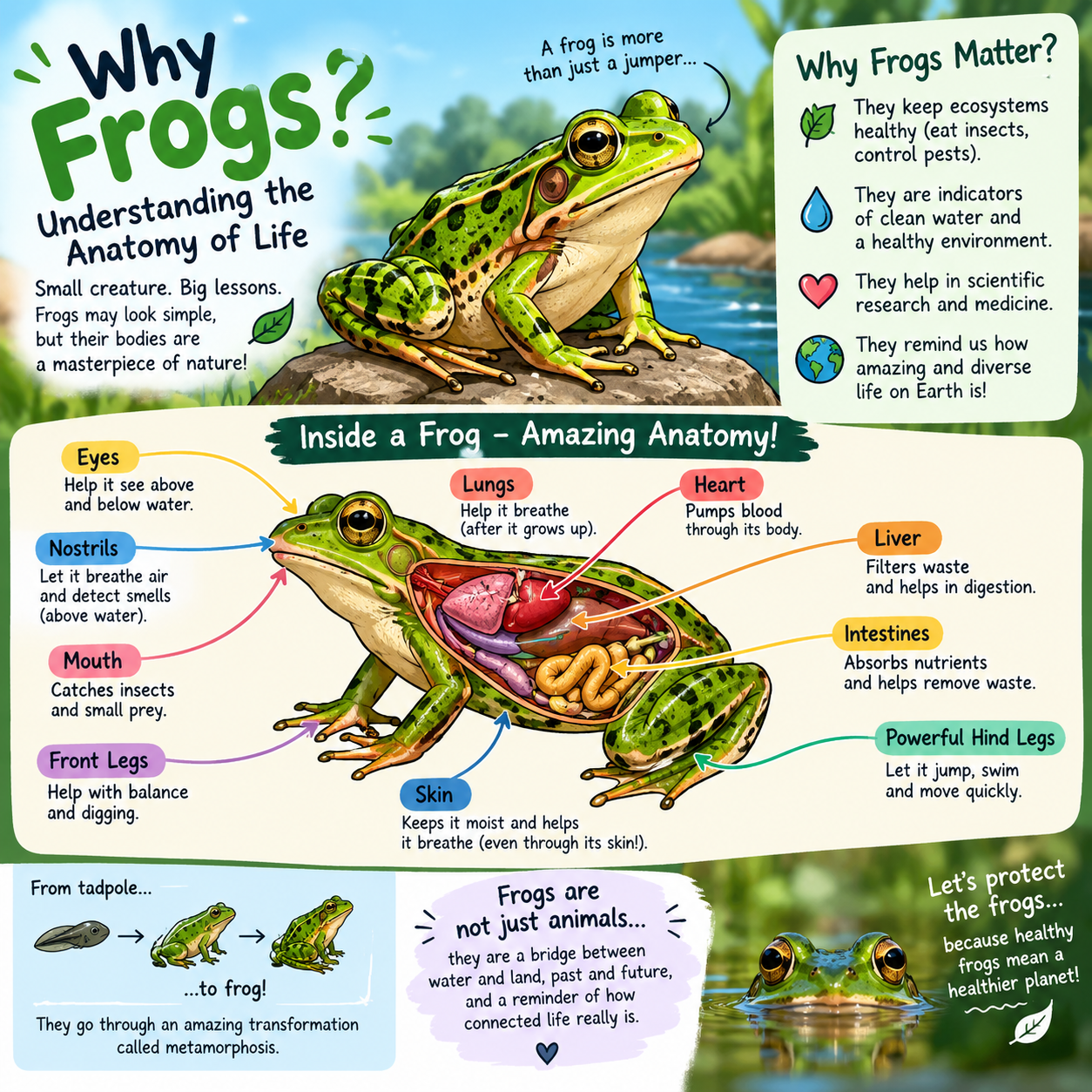
    Why Frogs? Understanding the Anatomy of Life

    Frogs may look like simple little creatures, but their bodies reveal amazing lessons about life and nature! This educational comic explores frog anatomy, including the eyes, lungs, heart, liver, intestines, skin, and powerful hind legs, while showing how each part helps the frog survive.

    From tadpole to frog, their incredible metamorphosis shows the beauty of nature’s transformations. Frogs also help keep ecosystems healthy and can indicate the condition of our environment.

    Learn about frogs. Understand life. Protect nature.

    #Frogs #Anatomy #Biology #ScienceEducation #Nature #AnimalScience #LifeScience #Metamorphosis #Environment #EducationalPost #ScienceComic #InstagramEducation
    **Foundation Level** **Day 125** **story post** **Roll Number: 005** 🐸 Why Frogs? Understanding the Anatomy of Life 🌿 Frogs may look like simple little creatures, but their bodies reveal amazing lessons about life and nature! πŸ”¬βœ¨ This educational comic explores frog anatomy, including the eyes, lungs, heart, liver, intestines, skin, and powerful hind legs, while showing how each part helps the frog survive. From tadpole to frog, their incredible metamorphosis shows the beauty of nature’s transformations. πŸŒ±πŸ’§ Frogs also help keep ecosystems healthy and can indicate the condition of our environment. πŸ’š Learn about frogs. Understand life. Protect nature. #Frogs #Anatomy #Biology #ScienceEducation #Nature #AnimalScience #LifeScience #Metamorphosis #Environment #EducationalPost #ScienceComic #InstagramEducation
    0 Commenti 0 condivisioni 1243 Views
  • #rsisb
    Roll no.239
    Song no .29
    Foundation Level

    **Why Do We Experiment? The Search for Truth in Biology** explores how experiments help scientists investigate living organisms, test ideas, and understand biological processes. By making observations, forming hypotheses, collecting evidence, and analyzing results, researchers can build and refine scientific knowledge.

    Experiments are important because they allow scientists to **test explanations, discover patterns, identify cause-and-effect relationships, and improve our understanding of life**. From studying cells and genetics to ecosystems and human biology, experimentation is a key part of the scientific method.

    #Biology #ScientificMethod #Experiments #Science #Research #BiologyExperiments #ScientificDiscovery #Education #Learning
    #rsisb Roll no.239 Song no .29 Foundation Level **Why Do We Experiment? The Search for Truth in Biology** explores how experiments help scientists investigate living organisms, test ideas, and understand biological processes. πŸ§ͺ✨ By making observations, forming hypotheses, collecting evidence, and analyzing results, researchers can build and refine scientific knowledge. Experiments are important because they allow scientists to **test explanations, discover patterns, identify cause-and-effect relationships, and improve our understanding of life**. From studying cells and genetics to ecosystems and human biology, experimentation is a key part of the scientific method. πŸŒ±πŸ”¬ #Biology #ScientificMethod #Experiments #Science #Research #BiologyExperiments #ScientificDiscovery #Education #Learning 🧬πŸ§ͺ✨
    0 Commenti 0 condivisioni 787 Views 4
  • #rsisb
    Roll no.239
    Song no .25
    Foundation Level

    **Microbial Universe: The Power of the Invisible World** explores the fascinating world of microorganisms—tiny forms of life that are often invisible to the naked eye. From bacteria and fungi to microscopic algae and other microbes, these organisms play important roles in nature and in our daily lives.

    Microorganisms help **decompose organic matter, recycle nutrients, support ecosystems, produce useful foods and medicines, and influence human health**. This topic reveals how an invisible world can have a remarkable impact on life on Earth.

    #MicrobialUniverse #Microbiology #Microorganisms #Bacteria #Science #Biology #InvisibleWorld #Education #Learning
    #rsisb Roll no.239 Song no .25 Foundation Level **Microbial Universe: The Power of the Invisible World** explores the fascinating world of microorganisms—tiny forms of life that are often invisible to the naked eye. πŸ”¬βœ¨ From bacteria and fungi to microscopic algae and other microbes, these organisms play important roles in nature and in our daily lives. Microorganisms help **decompose organic matter, recycle nutrients, support ecosystems, produce useful foods and medicines, and influence human health**. This topic reveals how an invisible world can have a remarkable impact on life on Earth. πŸŒ±πŸ§¬πŸ”¬ #MicrobialUniverse #Microbiology #Microorganisms #Bacteria #Science #Biology #InvisibleWorld #Education #Learning πŸ¦ πŸ”¬πŸŒβœ¨
    0 Commenti 0 condivisioni 915 Views 9
  • #RSTA
    #Task : Song Post
    #Class: Foundation Level
    #Day No: 112
    #Made By Me

    Total Post:15


    Today, I explored the amazing world of microorganisms. These tiny living organisms may be invisible to our eyes, but they play an important role in nature, our environment, and everyday life.

    This task helped me understand how microbes support life, recycle nutrients, and contribute to healthy ecosystems. Science shows us that even the smallest things can have a big impact!

    **Tiny World • Big Impact • Amazing Science**

    RSTA FoundationLevel MicrobialUniverse Microorganisms Science Biology Learning Discovery MadeByMe
    #RSTA #Task : Song Post #Class: Foundation Level #Day No: 112 #Made By Me Total Post:15 Today, I explored the amazing world of microorganisms. These tiny living organisms may be invisible to our eyes, but they play an important role in nature, our environment, and everyday life. πŸŒ±πŸ’§ This task helped me understand how microbes support life, recycle nutrients, and contribute to healthy ecosystems. Science shows us that even the smallest things can have a big impact! βœ¨πŸ“š **Tiny World • Big Impact • Amazing Science** πŸ’‘ RSTA FoundationLevel MicrobialUniverse Microorganisms Science Biology Learning Discovery MadeByMe
    0 Commenti 0 condivisioni 592 Views 3
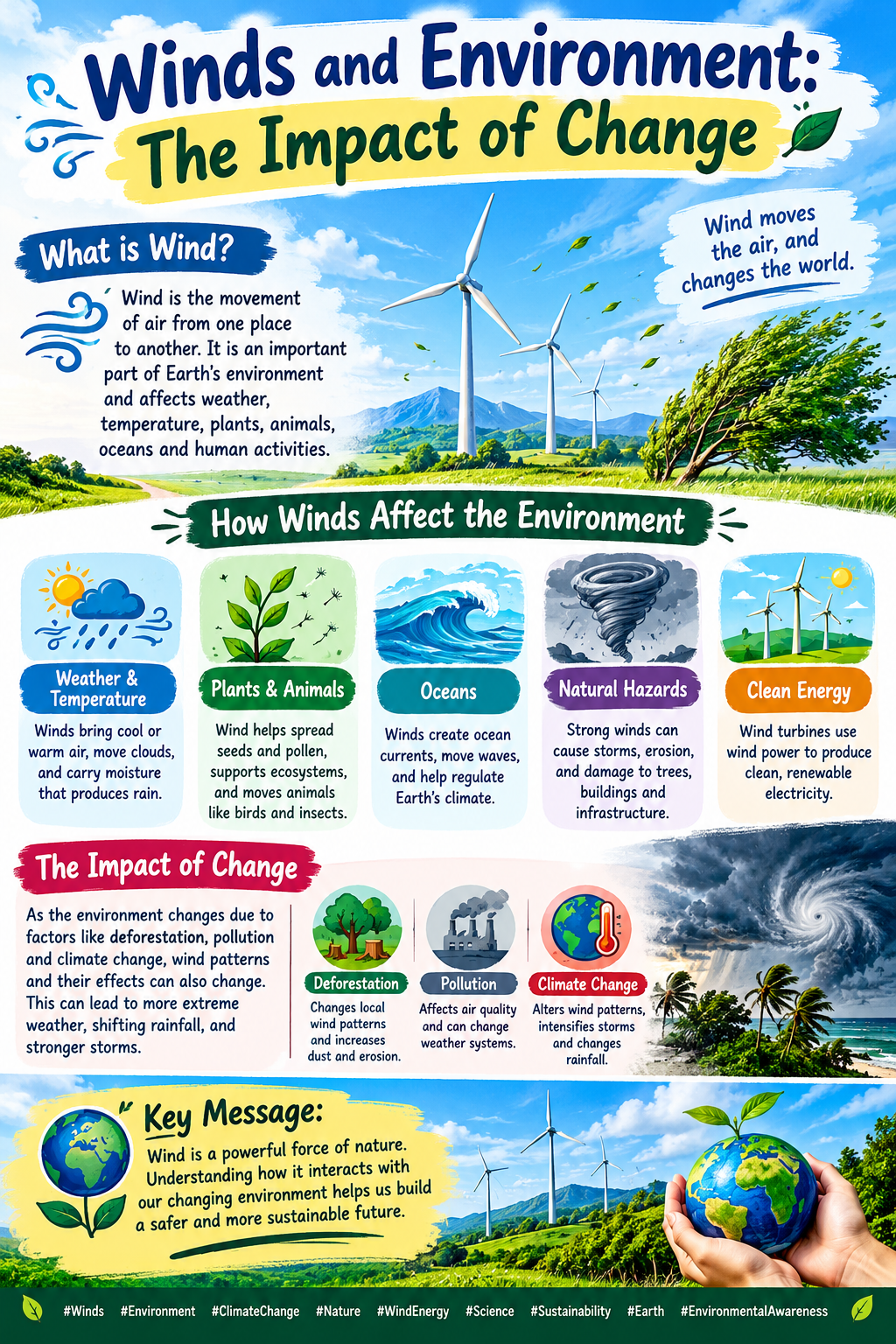
  • Winds and Environment: The Impact of Change

    Wind is the movement of air from one place to another. It is an important part of Earth’s environment and affects weather, temperature, plants, animals, oceans, and human activities.

    Winds can bring cool or warm air, move clouds, and carry moisture that produces rain. Strong winds can also cause storms, erosion, and damage to trees and buildings. In dry areas, wind can carry dust and sand over long distances.

    Wind also has positive effects. It helps spread seeds and pollen, supports natural ecosystems, and can be used to produce clean electricity through wind turbines.

    As the environment changes because of factors such as deforestation, pollution, and climate change, wind patterns and their effects can also change. Understanding these changes helps us prepare for extreme weather and protect our environment.

    Key Message:
    Wind is a powerful force of nature. Understanding how it interacts with our changing environment helps us build a safer and more sustainable future.

    #Winds #Environment #ClimateChange #Nature #Weather #WindEnergy #Science #Sustainability #Earth #EnvironmentalAwareness

    Day:- 55
    rollno:- 006
    foundation level
    Story Post
    🌬️ Winds and Environment: The Impact of Change Wind is the movement of air from one place to another. It is an important part of Earth’s environment and affects weather, temperature, plants, animals, oceans, and human activities. Winds can bring cool or warm air, move clouds, and carry moisture that produces rain. Strong winds can also cause storms, erosion, and damage to trees and buildings. In dry areas, wind can carry dust and sand over long distances. Wind also has positive effects. It helps spread seeds and pollen, supports natural ecosystems, and can be used to produce clean electricity through wind turbines. As the environment changes because of factors such as deforestation, pollution, and climate change, wind patterns and their effects can also change. Understanding these changes helps us prepare for extreme weather and protect our environment. 🌍 Key Message: Wind is a powerful force of nature. Understanding how it interacts with our changing environment helps us build a safer and more sustainable future. #Winds #Environment #ClimateChange #Nature #Weather #WindEnergy #Science #Sustainability #Earth #EnvironmentalAwareness Day:- 55 rollno:- 006 foundation level πŸ“– Story Post
    0 Commenti 0 condivisioni 1259 Views
Pagine in Evidenza