• Meet the girl who has lived 200 years of life in 35 year of age !

    Travelled to 120 countries ! Nomad since 6 years traveling the world ! Started the startup ecosystem in Sweden under Startup Sweden !

    Wanna connect with her ? Inbox her and add her ! #liftpakistan
    Meet the girl who has lived 200 years of life in 35 year of age ! Travelled to 120 countries ! Nomad since 6 years traveling the world ! Started the startup ecosystem in Sweden under Startup Sweden ! Wanna connect with her ? Inbox her and add her ! #liftpakistan
    0 Commentarii 0 Distribuiri 1251 Views 0
  • #rsisb
    Roll No.190
    Story Post No.39
    Foundation Level

    What Animal Dissection Involves
    Educational purpose: Students dissect frogs, fetal pigs, or rats to learn anatomy and physiology.

    Skill development: Builds fine motor skills, hand-eye coordination, and scientific observation.

    Historical roots: Practice dates back to ancient Greece and became common in schools by the 1920s.

    Ethical Concerns
    Animal welfare: Millions of animals are used annually, raising questions about humane treatment.

    Alternatives: Virtual dissections and 3D models offer cruelty-free learning options.

    Student choice: In many regions, students can opt out and request alternative assignments.

    Pros vs Cons
    Pros Cons
    Real specimens provide deeper learning Animal sourcing often considered inhumane
    Encourages careers in science & medicine Not required by most curricula
    Develops motor skills & lab confidence Effective digital alternatives exist
    Tangible connection to biology concepts Environmental impact of specimen use


    Modern Alternatives
    Virtual dissection software: Interactive 3D models of frogs, pigs, and human anatomy.

    Synthetic models: Plastic or silicone replicas allow repeated practice.

    Augmented reality: AR apps overlay anatomical structures on real-world objects.


    Would you like me to dive deeper into the ethical arguments or explore the latest alternatives being adopted in schools worldwide?

    The Ethics and Education of Animal Dissections give me deas\
    Here are some thoughtful ideas for exploring The Ethics and Education of Animal Dissections — perfect for essays, presentations, or classroom debates.

    Core Discussion Themes
    Moral responsibility: Should schools prioritize compassion over tradition when teaching biology?

    Educational value: Does hands-on dissection truly deepen understanding compared to digital alternatives?

    Student consent: Should participation be voluntary, respecting personal beliefs?

    Alternatives in education: Explore virtual labs, 3D models, and augmented reality dissections.

    Project or Essay Ideas
    Idea Focus Area Goal
    Ethical Debate Compare utilitarian vs. animal rights perspectives Encourage critical thinking
    Curriculum Reform Assess how schools can modernize biology teaching Promote humane education
    Student Survey Gather opinions on dissection experiences Measure ethical awareness
    Tech Integration Evaluate virtual dissection tools Highlight innovation in learning


    Broader Reflections
    Environmental impact: Consider how specimen sourcing affects ecosystems.

    Cultural perspectives: Different societies view animal use in education differently.

    Future of biology education: Imagine classrooms where empathy and technology coexist.

    Would you like me to help you outline a short essay or design a classroom debate plan around this topic?
    #rsisb Roll No.190 Story Post No.39 Foundation Level 🧪 What Animal Dissection Involves Educational purpose: Students dissect frogs, fetal pigs, or rats to learn anatomy and physiology. Skill development: Builds fine motor skills, hand-eye coordination, and scientific observation. Historical roots: Practice dates back to ancient Greece and became common in schools by the 1920s. ⚖️ Ethical Concerns Animal welfare: Millions of animals are used annually, raising questions about humane treatment. Alternatives: Virtual dissections and 3D models offer cruelty-free learning options. Student choice: In many regions, students can opt out and request alternative assignments. ✅ Pros vs ❌ Cons Pros Cons Real specimens provide deeper learning Animal sourcing often considered inhumane Encourages careers in science & medicine Not required by most curricula Develops motor skills & lab confidence Effective digital alternatives exist Tangible connection to biology concepts Environmental impact of specimen use 🌍 Modern Alternatives Virtual dissection software: Interactive 3D models of frogs, pigs, and human anatomy. Synthetic models: Plastic or silicone replicas allow repeated practice. Augmented reality: AR apps overlay anatomical structures on real-world objects. Would you like me to dive deeper into the ethical arguments or explore the latest alternatives being adopted in schools worldwide? The Ethics and Education of Animal Dissections give me deas\ Here are some thoughtful ideas for exploring The Ethics and Education of Animal Dissections — perfect for essays, presentations, or classroom debates. 🧠 Core Discussion Themes Moral responsibility: Should schools prioritize compassion over tradition when teaching biology? Educational value: Does hands-on dissection truly deepen understanding compared to digital alternatives? Student consent: Should participation be voluntary, respecting personal beliefs? Alternatives in education: Explore virtual labs, 3D models, and augmented reality dissections. 🧪 Project or Essay Ideas Idea Focus Area Goal Ethical Debate Compare utilitarian vs. animal rights perspectives Encourage critical thinking Curriculum Reform Assess how schools can modernize biology teaching Promote humane education Student Survey Gather opinions on dissection experiences Measure ethical awareness Tech Integration Evaluate virtual dissection tools Highlight innovation in learning 🌍 Broader Reflections Environmental impact: Consider how specimen sourcing affects ecosystems. Cultural perspectives: Different societies view animal use in education differently. Future of biology education: Imagine classrooms where empathy and technology coexist. Would you like me to help you outline a short essay or design a classroom debate plan around this topic?
    0 Commentarii 0 Distribuiri 5570 Views
  • #rsisb
    Roll No.190
    Canva Post No.49
    Foundation Level

    Exploring Life’s Mechanisms Through Experimentation

    Life is one of the greatest mysteries in the universe. From the smallest microscopic cell to the most complex living organisms, every form of life operates through intricate biological mechanisms that enable growth, reproduction, adaptation, and survival. Understanding these mechanisms is at the heart of biological science, and experimentation serves as one of the most powerful tools for uncovering the secrets of life.

    Experimentation allows scientists, researchers, and students to move beyond observation and actively investigate how living systems function. Through carefully designed experiments, we can test hypotheses, collect evidence, and draw conclusions about the natural processes that govern life. Whether studying the structure of cells, the role of DNA, the functions of organs, or the interactions between organisms and their environments, experimentation transforms curiosity into meaningful scientific knowledge.

    Every scientific breakthrough begins with a question. How do cells communicate with one another? What causes certain traits to be inherited? How do organisms adapt to changing environments? Experiments provide a systematic way to explore these questions and discover reliable answers. By manipulating variables, recording observations, and analyzing results, scientists can identify patterns and mechanisms that would otherwise remain hidden.

    Laboratory investigations have played a crucial role in advancing our understanding of biology. Through experiments, researchers have uncovered the structure of DNA, developed life-saving medicines, improved agricultural practices, and gained insights into diseases that affect millions of people worldwide. These discoveries have transformed healthcare, enhanced food production, and contributed to a better understanding of the natural world.

    Experimentation also helps us understand the interconnectedness of life. Ecosystems consist of countless interactions among plants, animals, microorganisms, and their environments. By studying these relationships through experiments, scientists can develop strategies to protect biodiversity, conserve natural resources, and address environmental challenges such as climate change and habitat loss.

    For students, experimentation is more than a learning activity—it is an opportunity to think critically, solve problems, and develop scientific skills. Conducting experiments encourages observation, analysis, creativity, and logical reasoning. It helps learners understand that science is not just a collection of facts but a dynamic process of discovery and exploration.

    Through experimentation, we gain a deeper appreciation for the complexity and beauty of life. Every cell, tissue, organ, and organism contributes to a vast network of biological processes that sustain living systems. Exploring these mechanisms allows us to answer important questions, improve human well-being, and inspire future generations of scientists and innovators.

    The journey of scientific discovery never ends. As technology advances and new questions arise, experimentation will continue to reveal the remarkable mechanisms that drive life itself. By embracing curiosity and investigation, we unlock new possibilities for understanding our world and shaping a better future.

    Science begins with a question, grows through experimentation, and flourishes through discovery. Every experiment is a step closer to understanding the incredible mechanisms that make life possible.

    #ExploringLife #LifeMechanisms #Experimentation #Biology #ScienceEducation #STEM #ScientificDiscovery #Research #LaboratoryLife #FutureScientists #Innovation #Learning #Curiosity #LifeSciences #Knowledge #ScienceMatters #DiscoveryJourney #BiologicalResearch #ExploreAndLearn #EducationForAll #ScienceInAction #FutureOfScience #ThinkLikeAScientist #AcademicExcellence #ResearchAndDiscovery #InspiringMinds #ScienceCommunity #UnlockingLif
    #rsisb Roll No.190 Canva Post No.49 Foundation Level 🧬🔬 Exploring Life’s Mechanisms Through Experimentation 🔬🧬 Life is one of the greatest mysteries in the universe. From the smallest microscopic cell to the most complex living organisms, every form of life operates through intricate biological mechanisms that enable growth, reproduction, adaptation, and survival. Understanding these mechanisms is at the heart of biological science, and experimentation serves as one of the most powerful tools for uncovering the secrets of life. 🌱 Experimentation allows scientists, researchers, and students to move beyond observation and actively investigate how living systems function. Through carefully designed experiments, we can test hypotheses, collect evidence, and draw conclusions about the natural processes that govern life. Whether studying the structure of cells, the role of DNA, the functions of organs, or the interactions between organisms and their environments, experimentation transforms curiosity into meaningful scientific knowledge. 🔬 Every scientific breakthrough begins with a question. How do cells communicate with one another? What causes certain traits to be inherited? How do organisms adapt to changing environments? Experiments provide a systematic way to explore these questions and discover reliable answers. By manipulating variables, recording observations, and analyzing results, scientists can identify patterns and mechanisms that would otherwise remain hidden. 🧪 Laboratory investigations have played a crucial role in advancing our understanding of biology. Through experiments, researchers have uncovered the structure of DNA, developed life-saving medicines, improved agricultural practices, and gained insights into diseases that affect millions of people worldwide. These discoveries have transformed healthcare, enhanced food production, and contributed to a better understanding of the natural world. 🌍 Experimentation also helps us understand the interconnectedness of life. Ecosystems consist of countless interactions among plants, animals, microorganisms, and their environments. By studying these relationships through experiments, scientists can develop strategies to protect biodiversity, conserve natural resources, and address environmental challenges such as climate change and habitat loss. 💡 For students, experimentation is more than a learning activity—it is an opportunity to think critically, solve problems, and develop scientific skills. Conducting experiments encourages observation, analysis, creativity, and logical reasoning. It helps learners understand that science is not just a collection of facts but a dynamic process of discovery and exploration. 🧬 Through experimentation, we gain a deeper appreciation for the complexity and beauty of life. Every cell, tissue, organ, and organism contributes to a vast network of biological processes that sustain living systems. Exploring these mechanisms allows us to answer important questions, improve human well-being, and inspire future generations of scientists and innovators. 🚀 The journey of scientific discovery never ends. As technology advances and new questions arise, experimentation will continue to reveal the remarkable mechanisms that drive life itself. By embracing curiosity and investigation, we unlock new possibilities for understanding our world and shaping a better future. ✨ Science begins with a question, grows through experimentation, and flourishes through discovery. Every experiment is a step closer to understanding the incredible mechanisms that make life possible. #ExploringLife 🔬 #LifeMechanisms 🧬 #Experimentation 🧪 #Biology 🌱 #ScienceEducation 📚 #STEM 🚀 #ScientificDiscovery 🔍 #Research 🧫 #LaboratoryLife 👩‍🔬 #FutureScientists 🌟 #Innovation 💡 #Learning 🎓 #Curiosity ✨ #LifeSciences 🧬 #Knowledge 📖 #ScienceMatters 🌍 #DiscoveryJourney 🚀 #BiologicalResearch 🔬 #ExploreAndLearn 🌱 #EducationForAll 📚 #ScienceInAction 🧪 #FutureOfScience 🌟 #ThinkLikeAScientist 💡 #AcademicExcellence 🎓 #ResearchAndDiscovery 🔍 #InspiringMinds ✨ #ScienceCommunity 🧬 #UnlockingLif
    0 Commentarii 0 Distribuiri 8976 Views
  • #rsisb
    Roll No.190
    Story Post No.38
    Foundation Level

    Exploring Life’s Mechanisms Through Experimentation

    Life is a fascinating puzzle made up of countless biological processes that work together to sustain living organisms. Through experimentation, scientists uncover the secrets behind these processes, from the behavior of cells and genes to the complex interactions within ecosystems. Experiments allow us to test hypotheses, observe changes, and gain a deeper understanding of how life functions at every level.

    By exploring biological mechanisms through hands-on investigation, students and researchers develop critical thinking skills and discover the scientific principles that shape the natural world. Whether examining microscopic organisms, studying plant growth, or analyzing anatomy, experimentation transforms curiosity into knowledge and knowledge into innovation.

    Every experiment is an opportunity to ask questions, seek answers, and contribute to our understanding of life. Through careful observation and analysis, we learn not only how living systems operate but also how scientific discoveries can improve health, agriculture, and environmental conservation.

    Science begins with curiosity, grows through experimentation, and leads to discovery.

    #Science #Biology #Experimentation #ScientificDiscovery #STEM #Education #Research #Learning #Innovation #LifeSciences #Curiosity #FutureScientists #Knowledge #ScienceEducation #Discovery #Laboratory #BiologicalResearch #ExploreAndLearn
    #rsisb Roll No.190 Story Post No.38 Foundation Level 🧬🔬 Exploring Life’s Mechanisms Through Experimentation 🔬🧬 Life is a fascinating puzzle made up of countless biological processes that work together to sustain living organisms. Through experimentation, scientists uncover the secrets behind these processes, from the behavior of cells and genes to the complex interactions within ecosystems. Experiments allow us to test hypotheses, observe changes, and gain a deeper understanding of how life functions at every level. 🌱 By exploring biological mechanisms through hands-on investigation, students and researchers develop critical thinking skills and discover the scientific principles that shape the natural world. Whether examining microscopic organisms, studying plant growth, or analyzing anatomy, experimentation transforms curiosity into knowledge and knowledge into innovation. 🔍 Every experiment is an opportunity to ask questions, seek answers, and contribute to our understanding of life. Through careful observation and analysis, we learn not only how living systems operate but also how scientific discoveries can improve health, agriculture, and environmental conservation. ✨ Science begins with curiosity, grows through experimentation, and leads to discovery. #Science 🔬 #Biology 🧬 #Experimentation 🧪 #ScientificDiscovery 🌟 #STEM 📚 #Education 🎓 #Research 🔍 #Learning 🌱 #Innovation 🚀 #LifeSciences 🧫 #Curiosity 💡 #FutureScientists 👩‍🔬 #Knowledge 📖 #ScienceEducation 🌍 #Discovery ✨ #Laboratory 🧪 #BiologicalResearch 🧬 #ExploreAndLearn 🌟
    0 Commentarii 0 Distribuiri 5543 Views
  • #rsib
    Roll No.190
    Story Post No.37
    Foundation Level

    :

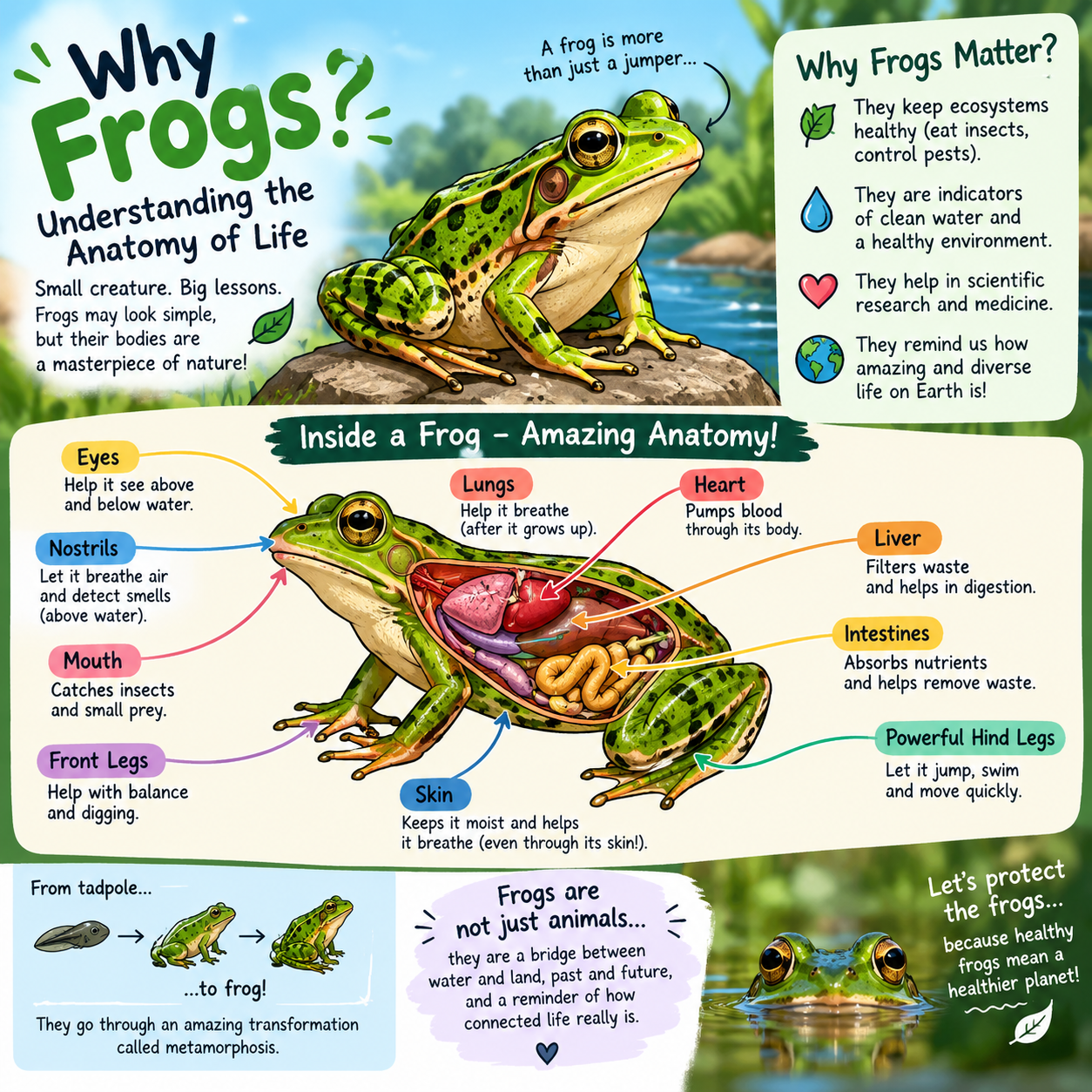
    Why Frogs? Understanding the Anatomy of Life

    Frogs are some of the most fascinating creatures on Earth. They are much more than simple amphibians hopping around ponds and forests. Frogs help scientists understand how living organisms grow, adapt, and survive. Their unique anatomy, incredible life cycle, and important role in ecosystems make them valuable subjects for biological research.

    From tiny eggs to swimming tadpoles and finally adult frogs, their transformation showcases one of nature's most amazing processes. Their sensitive skin, powerful legs, and specialized organs help them thrive both in water and on land. Because frogs react quickly to environmental changes, they are also important indicators of ecosystem health.

    Studying frogs helps researchers learn about genetics, development, medicine, evolution, and environmental conservation. By understanding frogs, we gain deeper insights into life itself and the delicate balance of nature that supports all living things.

    Let's appreciate these incredible amphibians and work together to protect their habitats for future generations.

    #WhyFrogs #FrogAnatomy #Biology #ScienceEducation #LifeScience #Amphibians #Nature #Wildlife #EnvironmentalScience #Ecosystem #FrogLifeCycle #ScientificResearch #STEM #Learning #Education #NatureLovers #AnimalScience #Conservation #Biodiversity #DiscoverScience #EarthScience #AmazingNature #StudyOfLife #Knowledge #ExploreNature
    #rsib Roll No.190 Story Post No.37 Foundation Level : 🐸🔬🌿 Why Frogs? Understanding the Anatomy of Life 🌿🔬🐸 Frogs are some of the most fascinating creatures on Earth. They are much more than simple amphibians hopping around ponds and forests. Frogs help scientists understand how living organisms grow, adapt, and survive. Their unique anatomy, incredible life cycle, and important role in ecosystems make them valuable subjects for biological research. From tiny eggs to swimming tadpoles and finally adult frogs, their transformation showcases one of nature's most amazing processes. Their sensitive skin, powerful legs, and specialized organs help them thrive both in water and on land. Because frogs react quickly to environmental changes, they are also important indicators of ecosystem health. 🌎💧 Studying frogs helps researchers learn about genetics, development, medicine, evolution, and environmental conservation. By understanding frogs, we gain deeper insights into life itself and the delicate balance of nature that supports all living things. 🌱✨ Let's appreciate these incredible amphibians and work together to protect their habitats for future generations. 🐸💚🌍 #WhyFrogs #FrogAnatomy #Biology #ScienceEducation #LifeScience #Amphibians #Nature #Wildlife #EnvironmentalScience #Ecosystem #FrogLifeCycle #ScientificResearch #STEM #Learning #Education #NatureLovers #AnimalScience #Conservation #Biodiversity #DiscoverScience #EarthScience #AmazingNature #StudyOfLife #Knowledge #ExploreNature 🐸🔬🌿💚🌎✨📚🧬🌱
    0 Commentarii 0 Distribuiri 6377 Views
  • Hello AI user! We are excited to present the evolution of our technology with two distinct versions of Super AI, each designed to push the boundaries of artificial intelligence.

    Super AI 1: The Creative Engine
    This version focuses on high-level inventive capabilities. It is designed for users who need a powerful partner for complex problem-solving, creative asset generation, and architectural logic. It serves as the foundation for our most advanced AI experiments.

    Super AI 2: The Interactive Experience
    Building on the original framework, Super AI 2 offers a more refined, user-friendly interface. This version is optimized for seamless interaction, high-speed responses, and specialized app-like integration. It is the perfect tool for developers and everyday users looking for a professional, high-tech AI companion.

    Whether you are looking for raw processing power or a sleek, modern interface, our Super AI ecosystem has the right tool for your next project.

    Link in my Profile
    Hello AI user! We are excited to present the evolution of our technology with two distinct versions of Super AI, each designed to push the boundaries of artificial intelligence. Super AI 1: The Creative Engine This version focuses on high-level inventive capabilities. It is designed for users who need a powerful partner for complex problem-solving, creative asset generation, and architectural logic. It serves as the foundation for our most advanced AI experiments. Super AI 2: The Interactive Experience Building on the original framework, Super AI 2 offers a more refined, user-friendly interface. This version is optimized for seamless interaction, high-speed responses, and specialized app-like integration. It is the perfect tool for developers and everyday users looking for a professional, high-tech AI companion. Whether you are looking for raw processing power or a sleek, modern interface, our Super AI ecosystem has the right tool for your next project. Link in my Profile 😇
    0 Commentarii 0 Distribuiri 1717 Views