• Mohsin RS F8
    Story post NO:16
    roll NO:13
    Class: Foundation Level
    Made by Me

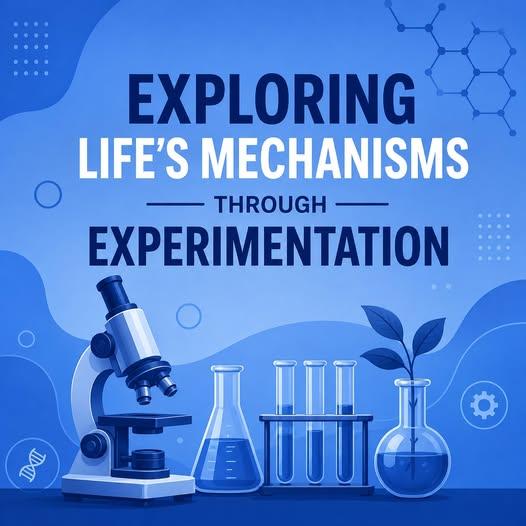
    Exploring Life’s Mechanisms Through Experimentation

    Life is a remarkable system filled with countless processes that work together every moment. From the activity of tiny cells to the growth of plants and the functioning of complex organisms, nature is constantly performing fascinating biological processes. But how can we understand these hidden mechanisms? The answer lies in scientific investigation and experimentation.

    Experimentation gives us a way to explore the living world through observation, questions, testing, and evidence. Instead of simply believing an explanation, scientists investigate it carefully. They ask questions such as: How do plants grow? How do cells obtain energy? How do organisms respond to their environment? What factors affect biological processes? These questions can lead to experiments that help us discover how life works.

    A scientific experiment usually begins with curiosity. A researcher observes something interesting and develops a question about it. The researcher may then create a hypothesis, which is a possible explanation that can be tested. After designing an appropriate investigation, observations and measurements are collected. The results are then analyzed to determine whether they support the original idea.

    For example, scientists can investigate how different environmental conditions affect plant growth. By carefully controlling relevant factors and observing changes over time, researchers can learn more about the relationship between living organisms and their surroundings. Experiments like these help turn simple observations into scientific knowledge.

    Laboratory tools also play an important role in exploring life's mechanisms. Microscopes allow researchers to observe structures that are too small to see with the naked eye. Test tubes, petri dishes, measuring equipment, and other laboratory tools allow scientists to conduct controlled investigations. Modern technologies have expanded these possibilities even further, allowing researchers to study DNA, proteins, cells, and many other biological systems.

    Mohsin RS F8 🎓✨ Story post NO:16 roll NO:13 Class: Foundation Level 📚 Made by Me 💻🚀 🔬 Exploring Life’s Mechanisms Through Experimentation Life is a remarkable system filled with countless processes that work together every moment. From the activity of tiny cells to the growth of plants and the functioning of complex organisms, nature is constantly performing fascinating biological processes. But how can we understand these hidden mechanisms? The answer lies in scientific investigation and experimentation. Experimentation gives us a way to explore the living world through observation, questions, testing, and evidence. Instead of simply believing an explanation, scientists investigate it carefully. They ask questions such as: How do plants grow? How do cells obtain energy? How do organisms respond to their environment? What factors affect biological processes? These questions can lead to experiments that help us discover how life works. A scientific experiment usually begins with curiosity. A researcher observes something interesting and develops a question about it. The researcher may then create a hypothesis, which is a possible explanation that can be tested. After designing an appropriate investigation, observations and measurements are collected. The results are then analyzed to determine whether they support the original idea. For example, scientists can investigate how different environmental conditions affect plant growth. By carefully controlling relevant factors and observing changes over time, researchers can learn more about the relationship between living organisms and their surroundings. Experiments like these help turn simple observations into scientific knowledge. Laboratory tools also play an important role in exploring life's mechanisms. Microscopes allow researchers to observe structures that are too small to see with the naked eye. Test tubes, petri dishes, measuring equipment, and other laboratory tools allow scientists to conduct controlled investigations. Modern technologies have expanded these possibilities even further, allowing researchers to study DNA, proteins, cells, and many other biological systems.
    0 التعليقات 0 المشاركات 241 مشاهدة
  • RSIF8
    Roll no:17
    Short Documentary no:03
    Topic:The Birth of Scientist: From Philosophy to Modern Terminology.

    **The Birth of “Scientist” — From Philosophy to Modern Terminology** Have you ever wondered where the word **“scientist”** came from? In this documentary, I explored how people who studied nature were once called **natural philosophers** and how the term **“scientist”** was introduced in the 19th century. From philosophy to experiments, observations, and modern scientific research, this journey shows how science and language developed together. Science begins with **curiosity, questions, and the courage to discover!**

    #Scientist #HistoryOfScience #Science #ScientificRevolution #NaturalPhilosophy #ScienceHistory #Learning #Education #Curiosity #Discovery #Innovation #StudentLearning #RehanSchool #RehanAI #LearningJourney
    RSIF8 Roll no:17 Short Documentary no:03 Topic:The Birth of Scientist: From Philosophy to Modern Terminology. 🔬✨ **The Birth of “Scientist” — From Philosophy to Modern Terminology** 📚🌍Have you ever wondered where the word **“scientist”** came from? 🤔🔬 In this documentary, I explored how people who studied nature were once called **natural philosophers** and how the term **“scientist”** was introduced in the 19th century.📖 From philosophy to experiments, observations, and modern scientific research, this journey shows how science and language developed together. 🌱🧪🚀Science begins with **curiosity, questions, and the courage to discover!** 💡🌟#Scientist #HistoryOfScience #Science #ScientificRevolution #NaturalPhilosophy #ScienceHistory #Learning #Education #Curiosity #Discovery #Innovation #StudentLearning #RehanSchool #RehanAI #LearningJourney 🔬📚✨🌍
    0 التعليقات 0 المشاركات 934 مشاهدة 1
  • #RSTA
    #Task : Story Post
    #Class: Foundation Level Book 2
    #Day No: 4
    #Made By Me

    Total Post:2


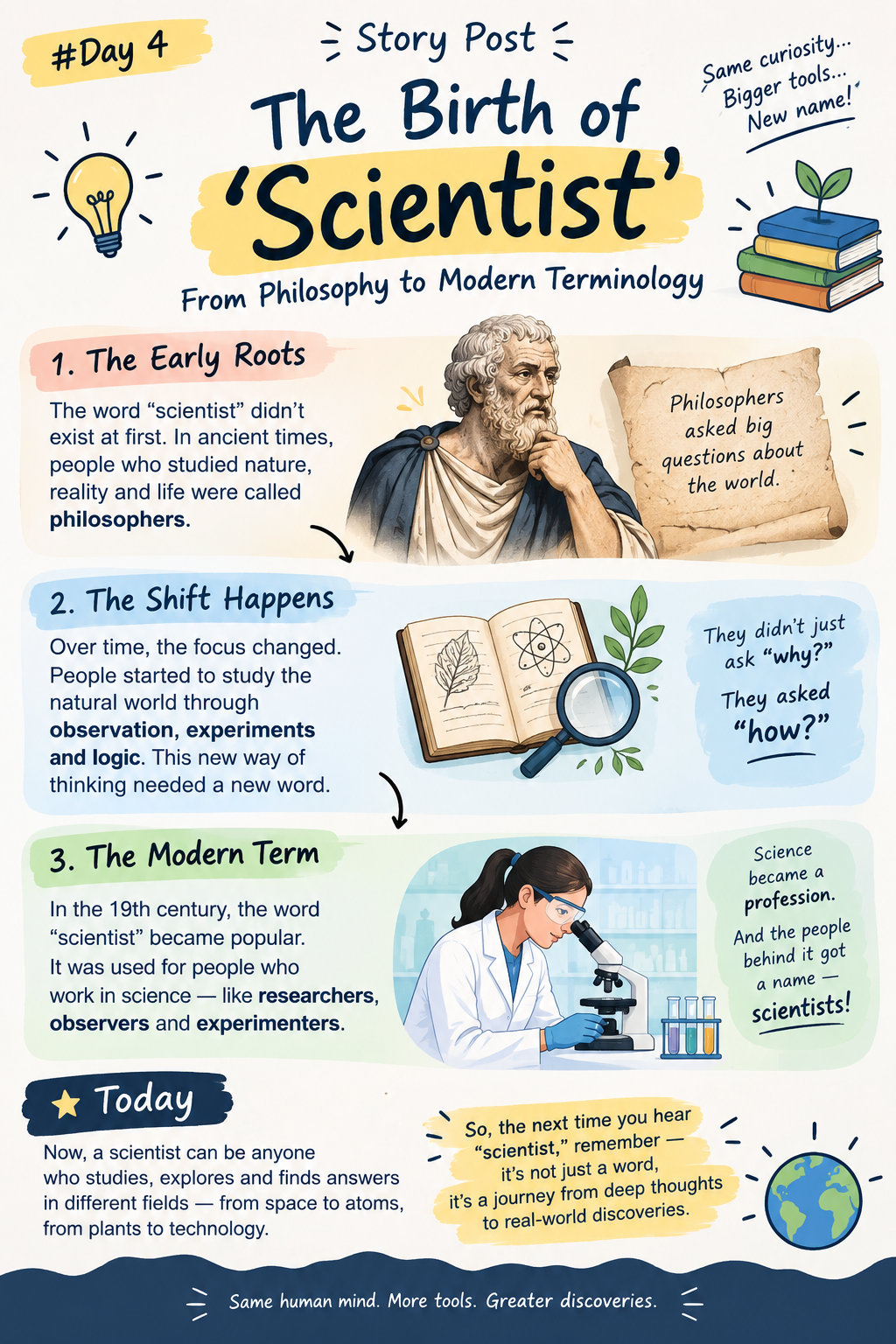
    This story explores how the word **“Scientist”** came into use and how the study of nature changed from ancient philosophy to modern science. It takes us through the journey from philosophers asking “why?” to scientists using observation, experiments, and logic to discover “how.”

    I also created a creative image based on this story and shared the post on **Facebook, YouTube, LinkedIn, Instagram, and TikTok.**

    RSTA StoryPost Scientist ScienceHistory Learning Education ModernScience MadeByMe
    #RSTA #Task : Story Post #Class: Foundation Level Book 2 #Day No: 4 #Made By Me Total Post:2 This story explores how the word **“Scientist”** came into use and how the study of nature changed from ancient philosophy to modern science. 🔬✨ It takes us through the journey from philosophers asking “why?” to scientists using observation, experiments, and logic to discover “how.” 🎨 I also created a creative image based on this story and shared the post on **Facebook, YouTube, LinkedIn, Instagram, and TikTok.** RSTA StoryPost Scientist ScienceHistory Learning Education ModernScience MadeByMe
    0 التعليقات 0 المشاركات 726 مشاهدة
  • Mohsin RS F8
    Story post NO:13
    Class: Foundation Level
    Made by Me

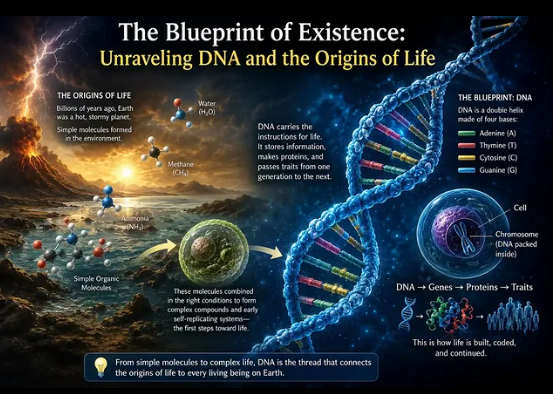
    The Blueprint of Existence: Unraveling DNA and the Origins of Life explores one of the greatest scientific mysteries: what makes life possible, and how did life begin? At the center of this story is DNA, the remarkable molecule that stores and carries genetic information in almost every living organism. Often described as the “blueprint of life,” DNA contains the instructions that help cells grow, function, reproduce, and pass characteristics from one generation to the next.
    DNA is built from four chemical bases—adenine, thymine, cytosine, and guanine—which are arranged in different sequences to encode biological information. Its famous double-helix structure allows genetic information to be stored efficiently and copied with remarkable accuracy. Small sections of DNA called genes provide instructions for producing proteins and regulating many of the processes that keep living organisms functioning. Although all humans share most of their DNA, small differences in our genetic sequences contribute to biological variation.
    But the story of life reaches much further back than modern DNA. Scientists continue to investigate how the first self-replicating molecules and primitive cells could have emerged on the early Earth billions of years ago. The young Earth was very different from today, with active volcanoes, oceans, atmospheric changes, and numerous sources of chemical energy. These conditions may have allowed simple molecules to interact, combine, and gradually form increasingly complex chemical systems.
    One important area of research focuses on the possibility that RNA-like molecules played an early role because RNA can both store information and participate in chemical reactions. Scientists also study ancient rocks, meteorites, laboratory experiments, and the chemistry of early Earth to understand which pathways could have led from non-living chemistry to the earliest forms of life. There is still no single confirmed explanation for exactly how life began, making the subject an active area of scientific research.
    DNA also provides a powerful record of l
    Mohsin RS F8 🎓✨ Story post NO:13 Class: Foundation Level 📚 Made by Me 💻🚀 The Blueprint of Existence: Unraveling DNA and the Origins of Life explores one of the greatest scientific mysteries: what makes life possible, and how did life begin? At the center of this story is DNA, the remarkable molecule that stores and carries genetic information in almost every living organism. Often described as the “blueprint of life,” DNA contains the instructions that help cells grow, function, reproduce, and pass characteristics from one generation to the next. DNA is built from four chemical bases—adenine, thymine, cytosine, and guanine—which are arranged in different sequences to encode biological information. Its famous double-helix structure allows genetic information to be stored efficiently and copied with remarkable accuracy. Small sections of DNA called genes provide instructions for producing proteins and regulating many of the processes that keep living organisms functioning. Although all humans share most of their DNA, small differences in our genetic sequences contribute to biological variation. But the story of life reaches much further back than modern DNA. Scientists continue to investigate how the first self-replicating molecules and primitive cells could have emerged on the early Earth billions of years ago. The young Earth was very different from today, with active volcanoes, oceans, atmospheric changes, and numerous sources of chemical energy. These conditions may have allowed simple molecules to interact, combine, and gradually form increasingly complex chemical systems. One important area of research focuses on the possibility that RNA-like molecules played an early role because RNA can both store information and participate in chemical reactions. Scientists also study ancient rocks, meteorites, laboratory experiments, and the chemistry of early Earth to understand which pathways could have led from non-living chemistry to the earliest forms of life. There is still no single confirmed explanation for exactly how life began, making the subject an active area of scientific research. DNA also provides a powerful record of l
    0 التعليقات 0 المشاركات 1087 مشاهدة
  • RSIF8
    Roll no: 99
    Song no: 20
    Song topic: From Specimens to Knowledge: The Purpose of Science Experiments
    Science experiments turn observation into understanding. From studying specimens to examining biological structures and testing scientific ideas, experiments help us explore how life works and discover knowledge through evidence. Every experiment is a step toward curiosity, discovery, and a deeper understanding of the world around us.
    #Science #Experiments #Biology #ScientificDiscovery #Learning #Research #Education #Knowledge #RSIF8
    RSIF8 Roll no: 99 Song no: 20 Song topic: From Specimens to Knowledge: The Purpose of Science Experiments Science experiments turn observation into understanding. From studying specimens to examining biological structures and testing scientific ideas, experiments help us explore how life works and discover knowledge through evidence. Every experiment is a step toward curiosity, discovery, and a deeper understanding of the world around us. 🔬🧪 #Science #Experiments #Biology #ScientificDiscovery #Learning #Research #Education #Knowledge #RSIF8
    0 التعليقات 0 المشاركات 772 مشاهدة 0
  • RSIF8
    Roll no: 99
    Song no: 19
    Song topic: Why Do We Experiment? The Search for Truth in Biology
    Experiments are at the heart of biological discovery. By asking questions, making observations, testing ideas, and analyzing results, scientists uncover how living systems work. This song explores why experimentation is essential in biology and how the search for evidence helps us move from curiosity to knowledge and from questions to scientific understanding.
    #WhyWeExperiment #Biology #ScientificMethod #SearchForTruth #Science #BiologicalScience #Experimentation #ScienceSong #Learning #Education
    RSIF8 Roll no: 99 Song no: 19 Song topic: Why Do We Experiment? The Search for Truth in Biology Experiments are at the heart of biological discovery. By asking questions, making observations, testing ideas, and analyzing results, scientists uncover how living systems work. This song explores why experimentation is essential in biology and how the search for evidence helps us move from curiosity to knowledge and from questions to scientific understanding. #WhyWeExperiment #Biology #ScientificMethod #SearchForTruth #Science #BiologicalScience #Experimentation #ScienceSong #Learning #Education
    0 التعليقات 0 المشاركات 855 مشاهدة 0
  • RSIF8
    Roll no: 99
    Story post no: 21
    Story topic: Exploring Life's Mechanisms Through Experimentation
    Experimentation is an essential part of biology that helps us understand how living organisms function. By conducting experiments, scientists can observe biological processes, test ideas, and discover how different systems interact with one another.
    From studying cells and enzymes to observing plant growth and biological reactions, experiments allow us to explore the mechanisms that make life possible. Through careful observation and investigation, we can turn questions into knowledge and gain a deeper appreciation for the complexity of living systems.
    #BiologyExperiments #Biology #LifeScience #Science #Experimentation #BiologyEducation #STEM #LearnBiology #ScienceEducation #Education
    RSIF8 Roll no: 99 Story post no: 21 Story topic: Exploring Life's Mechanisms Through Experimentation Experimentation is an essential part of biology that helps us understand how living organisms function. By conducting experiments, scientists can observe biological processes, test ideas, and discover how different systems interact with one another. From studying cells and enzymes to observing plant growth and biological reactions, experiments allow us to explore the mechanisms that make life possible. Through careful observation and investigation, we can turn questions into knowledge and gain a deeper appreciation for the complexity of living systems. #BiologyExperiments #Biology #LifeScience #Science #Experimentation #BiologyEducation #STEM #LearnBiology #ScienceEducation #Education
    0 التعليقات 0 المشاركات 1188 مشاهدة
  • MohsinRSF8
    song title no:7
    Rool no:13

    Here's a much **longer social media description**:

    **Chemical Reactions: The Engine of Life**

    Life is full of amazing mysteries, and one of the greatest is the incredible world of chemical reactions. Although we cannot see them with our eyes, millions of chemical reactions take place every single second inside our bodies and throughout the natural world. These tiny but powerful processes are responsible for every heartbeat, every breath we take, every movement we make, and every thought we think. They are the invisible force that keeps life moving forward, making them the true **Engine of Life**.

    This song, **"Chemical Reactions: The Engine of Life,"** is a tribute to the beauty of science and the extraordinary role chemistry plays in our everyday lives. It is inspired by the idea that every living organism—from the smallest cell to the largest tree, from tiny insects to human beings—depends on chemical reactions to survive, grow, and thrive. Chemistry is not confined to laboratories or classrooms; it exists in every drop of water, every ray of sunlight, every green leaf, every heartbeat, and every breath.

    When plants absorb sunlight, they perform photosynthesis, one of the most important chemical reactions on Earth. This process creates oxygen for us to breathe and produces the food that supports nearly all life. Inside our own bodies, food is broken down into nutrients through digestion, and those nutrients are converted into energy through cellular respiration. Every muscle movement, every nerve signal, every healing wound, and every new cell depends on carefully coordinated chemical reactions working together in perfect harmony.

    The purpose of this song is to remind us that science is not just a collection of formulas and experiments—it is the story of life itself. Every chemical reaction tells a fascinating story of transformation, balance, and creation. They teach us that even the smallest particles can produce remarkable changes, proving that great things often begin with tiny actions. Just as atoms join together to create molecules, people can come together through knowledge, creativity, and curiosity
    MohsinRSF8 song title no:7 Rool no:13 Here's a much **longer social media description**: 🧪🎶 **Chemical Reactions: The Engine of Life** 🎶🧪 Life is full of amazing mysteries, and one of the greatest is the incredible world of chemical reactions. Although we cannot see them with our eyes, millions of chemical reactions take place every single second inside our bodies and throughout the natural world. These tiny but powerful processes are responsible for every heartbeat, every breath we take, every movement we make, and every thought we think. They are the invisible force that keeps life moving forward, making them the true **Engine of Life**. This song, **"Chemical Reactions: The Engine of Life,"** is a tribute to the beauty of science and the extraordinary role chemistry plays in our everyday lives. It is inspired by the idea that every living organism—from the smallest cell to the largest tree, from tiny insects to human beings—depends on chemical reactions to survive, grow, and thrive. Chemistry is not confined to laboratories or classrooms; it exists in every drop of water, every ray of sunlight, every green leaf, every heartbeat, and every breath. When plants absorb sunlight, they perform photosynthesis, one of the most important chemical reactions on Earth. This process creates oxygen for us to breathe and produces the food that supports nearly all life. Inside our own bodies, food is broken down into nutrients through digestion, and those nutrients are converted into energy through cellular respiration. Every muscle movement, every nerve signal, every healing wound, and every new cell depends on carefully coordinated chemical reactions working together in perfect harmony. The purpose of this song is to remind us that science is not just a collection of formulas and experiments—it is the story of life itself. Every chemical reaction tells a fascinating story of transformation, balance, and creation. They teach us that even the smallest particles can produce remarkable changes, proving that great things often begin with tiny actions. Just as atoms join together to create molecules, people can come together through knowledge, creativity, and curiosity
    0 التعليقات 0 المشاركات 1377 مشاهدة 48
  • #rsisb
    Roll NO:232
    Foundation level student.
    Story post:52

    ### Description

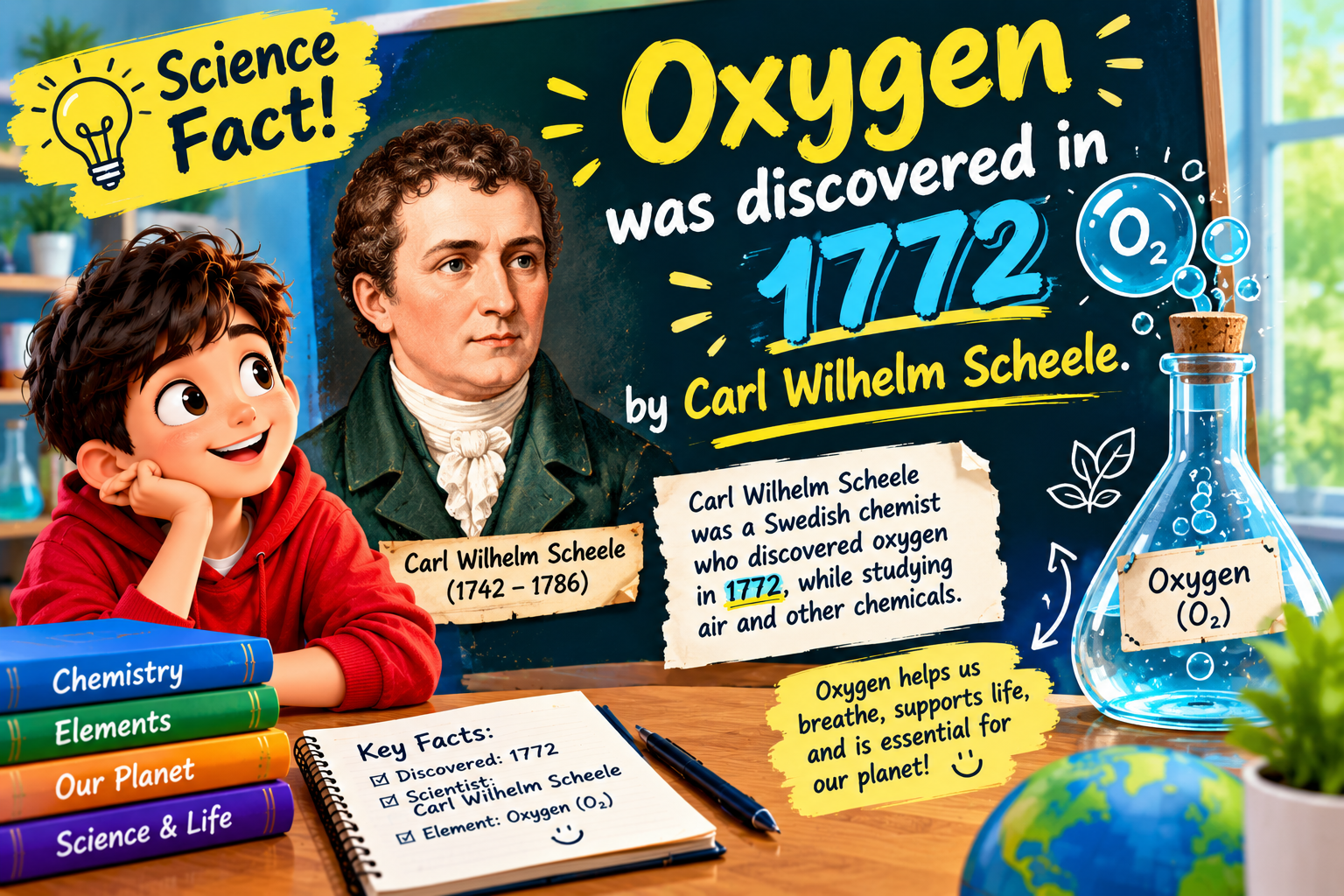
    **“Oxygen Was Discovered in 1772 by Carl Wilhelm Scheele.”**

    Did you know that oxygen has a fascinating history? Swedish chemist **Carl Wilhelm Scheele** produced oxygen in experiments around **1772** and called it “fire air” because it supported combustion.

    Although Scheele’s work was important, the history of oxygen’s discovery is shared with other scientists. **Joseph Priestley independently produced and studied oxygen in 1774**, and **Antoine Lavoisier later helped establish oxygen’s role in combustion and respiration and gave the element its modern name.**

    This story shows how scientific discoveries often develop through the work of several scientists over time.

    **Keep exploring science—every discovery begins with curiosity and a question!**

    ### Hashtags

    #Oxygen #CarlWilhelmScheele #ScienceFacts #Chemistry #HistoryOfScience #DidYouKnow #AmazingFacts #ScienceHistory #ChemistryFacts #LearnSomethingNew #ScienceIsFun #Education #Knowledge #Curiosity #STEM #KeepLearning

    ### Emojis


    #rsisb Roll NO:232 Foundation level student. Story post:52 ### 🔬 Description **“Oxygen Was Discovered in 1772 by Carl Wilhelm Scheele.”** 🧪🌍✨ Did you know that oxygen has a fascinating history? 🤯🔬 Swedish chemist **Carl Wilhelm Scheele** produced oxygen in experiments around **1772** and called it “fire air” because it supported combustion. 🔥🧪 Although Scheele’s work was important, the history of oxygen’s discovery is shared with other scientists. **Joseph Priestley independently produced and studied oxygen in 1774**, and **Antoine Lavoisier later helped establish oxygen’s role in combustion and respiration and gave the element its modern name.** 🧠📚 This story shows how scientific discoveries often develop through the work of several scientists over time. 🌟🔬 **Keep exploring science—every discovery begins with curiosity and a question!** 🚀💡🌱 ### 🔖 Hashtags #Oxygen #CarlWilhelmScheele #ScienceFacts #Chemistry #HistoryOfScience #DidYouKnow #AmazingFacts #ScienceHistory #ChemistryFacts #LearnSomethingNew #ScienceIsFun #Education #Knowledge #Curiosity #STEM #KeepLearning ### 😊 Emojis 🧪🔬💨🔥🌍📚🧠💡✨🌟🚀⚗️😊🔎🌱📖
    0 التعليقات 0 المشاركات 1352 مشاهدة
  • #rsisb
    Roll No 253
    Foundation Level
    Story Post 24

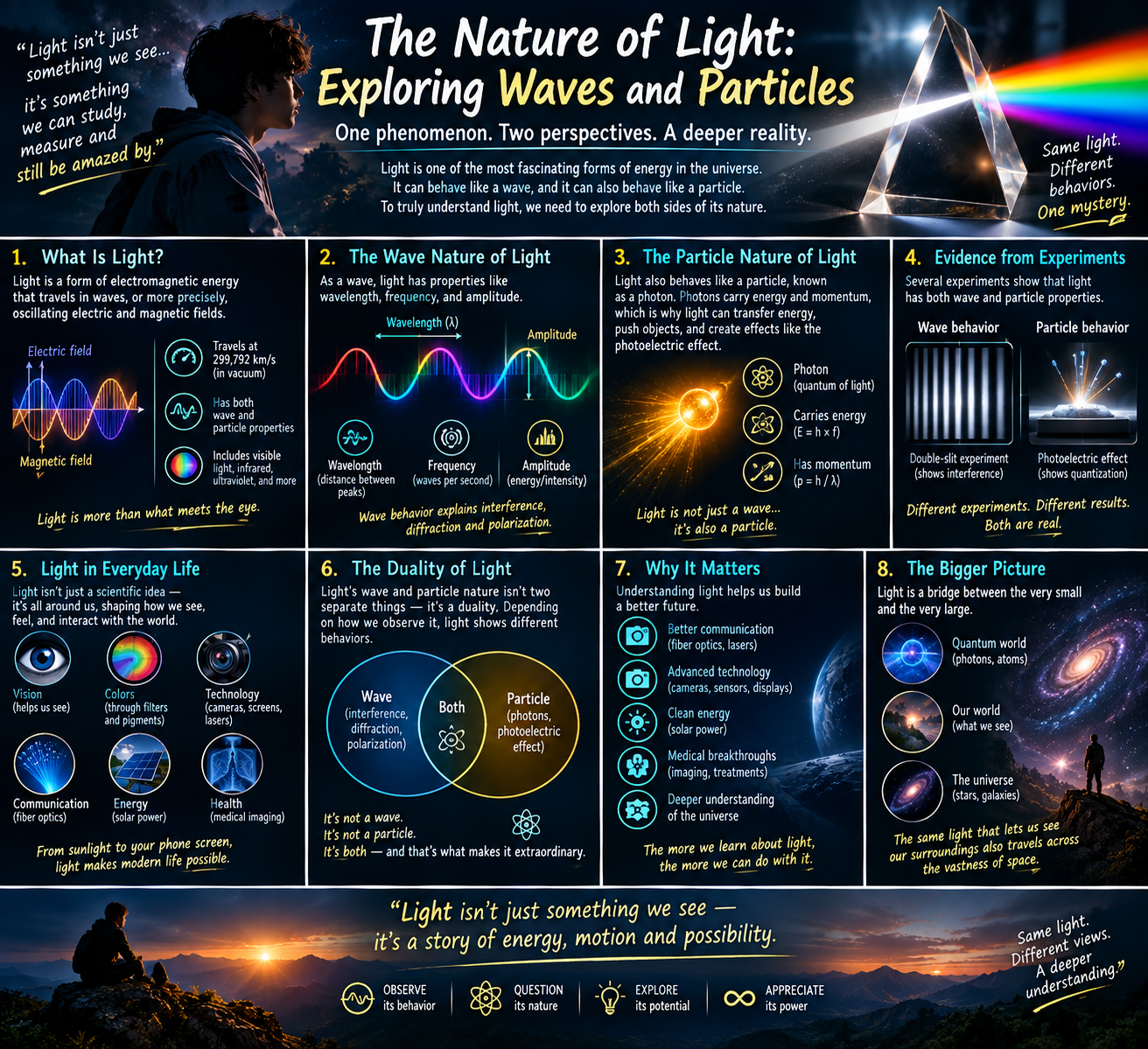
    # The Nature of Light: Exploring Waves and Particles

    Imagine standing beneath a night sky filled with stars.

    Every photon reaching your eyes has traveled across space carrying information from distant worlds. Light allows us to see, measure, communicate, explore, and understand the universe itself.

    But light is far stranger than it first appears.

    Sometimes it behaves like a **wave** .

    Sometimes it behaves like a **particle** .

    And understanding this strange dual nature changed our picture of reality forever.

    ---

    # 1. What Is Light?

    Light is a form of **electromagnetic radiation**—energy carried through oscillating electric and magnetic fields.

    In empty space, electromagnetic waves travel at approximately:

    ### **299,792 kilometers per second**

    That's the speed of light in vacuum.

    Visible light is only a small part of the electromagnetic spectrum.

    Beyond what our eyes can see are:

    Radio waves
    Microwaves
    Infrared
    Visible light
    Ultraviolet
    🩻 X-rays
    Gamma rays

    So light isn't simply what we see.

    ### **It's an enormous family of electromagnetic phenomena.**

    ---

    # 2. The Wave Nature of Light

    When light behaves as a wave, we can describe it using several important properties:

    **Wavelength** — the distance between successive wave peaks
    **Frequency** — how many oscillations occur each second
    **Amplitude** — related to the wave's intensity

    These properties help explain many familiar phenomena.

    **Interference** occurs when waves combine.
    **Diffraction** occurs when waves spread around openings or obstacles.
    **Polarization** describes the orientation of electromagnetic oscillations.

    The wave model explains behaviors that are difficult to understand if we imagine light only as tiny particles.

    ---

    # 3. The Particle Nature of Light

    But the story doesn't end there.

    Light can also behave as if it arrives in discrete packets of energy called **photons**.

    A photon is a quantum of electromagnetic radiation.

    Its energy is related to frequency:

    ### **E = h × f**

    And its momentum is related to its wavelength:

    ### **p = h / λ**

    This particle-like behavior helps explain phenomena such as the **photoelectric effect**, where light can transfer energy to electrons.

    So light isn't simply a smooth continuous wave.

    At the quantum level, energy can be exchanged in discrete amounts.

    ### **Light has another side—and it's quantum.**

    ---

    # 4. Evidence From Experiments

    The strange nature of light isn't merely philosophical.

    Experiments demonstrate it.

    ### Double-Slit Experiment

    When light passes through two narrow openings, an **interference pattern** can appear—strong evidence of wave-like behavior.

    ### Photoelectric Effect

    When light strikes certain materials, it can eject electrons. This behavior is explained using photons and quantized energy.

    Different experiments reveal different aspects of light.

    And that's one of the most fascinating things about physics:

    ### **The same phenomenon can reveal different behaviors depending on how we investigate it.**

    ---

    # 5. Light in Everyday Life

    Light isn't something that exists only inside physics laboratories.

    It's everywhere.

    **Vision** — allows us to see the world
    **Colors** — arise from how different wavelengths interact with matter
    **Cameras** — convert light into images
    **Screens** — produce controlled patterns of light
    **Fiber optics** — carry information using light
    **Solar panels** — convert light energy into electrical energy
    🩻 **Medical imaging** — uses electromagnetic radiation to see inside the body

    From sunrise to smartphone screens…

    ### **Modern civilization depends heavily on our ability to control light.**

    ---

    # 6. The Duality of Light

    Here lies the great mystery.

    Light can display **wave-like behavior**

    and

    **particle-like behavior** .

    This is known as **wave-particle duality**.

    It's important to understand that this doesn't mean light is literally switching between being a classical wave and a classical particle like two separate objects.

    Instead, quantum physics gives us a deeper framework in which classical wave and particle descriptions each capture different aspects of light's behavior.

    ### **Two perspectives. One quantum reality.**

    ---

    # 7. Why Understanding Light Matters

    Learning how light behaves has transformed technology.

    **Communication** — fiber-optic networks
    **Science** — spectroscopy and microscopy
    **Imaging** — cameras and sensors
    **Energy** — solar technology
    **Medicine** — lasers and diagnostic imaging
    **Astronomy** — studying distant stars and galaxies

    When astronomers observe light from a distant star, they aren't simply seeing brightness.

    They can analyze the light's wavelengths and learn about the star's:

    Temperature
    Chemical composition
    Motion
    Environment

    ### **Light carries information across space.**

    ---

    # 8. The Bigger Picture

    Light connects the microscopic and the cosmic.

    At the quantum scale, photons interact with atoms and electrons.

    At human scales, light allows us to see and communicate.

    Across astronomical distances, light travels from stars and galaxies to our telescopes.

    In many ways, light is our messenger from the universe.

    When we look at a distant galaxy, we are receiving photons that may have traveled for millions or billions of years before reaching Earth.

    ### **Looking at the universe means looking at ancient light.**

    ---

    # The Final Thought

    Light is more than something that illuminates a room.

    It is energy.
    It is information.
    It is electromagnetic radiation.
    It has quantum behavior.
    And it is one of the most important tools we have for exploring reality.

    From a photon interacting with an electron…

    to sunlight crossing space…

    to the glow of a distant galaxy…

    ### **Light connects the smallest scales of nature with the largest.**

    So the next time you see sunlight streaming through a window , a rainbow , or stars shining overhead , remember:

    **You aren't simply seeing light.**

    You're witnessing one of the universe's most fascinating mysteries—a phenomenon that behaves in ways far stranger and more beautiful than our everyday experience suggests.

    # **Light isn't just something we see—it's a story of energy, motion, information, and possibility.** ∞


    Asma Shaheen EducationWali
    Saima Empowerment Wali
    Mishaal TrainingWali
    #rsisb Roll No 253 Foundation Level Story Post 24 # 🌈⚡ The Nature of Light: Exploring Waves and Particles Imagine standing beneath a night sky filled with stars. 🌌✨ Every photon reaching your eyes has traveled across space carrying information from distant worlds. Light allows us to see, measure, communicate, explore, and understand the universe itself. 🔭👁️📡 But light is far stranger than it first appears. Sometimes it behaves like a **wave** 🌊. Sometimes it behaves like a **particle** ⚛️. And understanding this strange dual nature changed our picture of reality forever. 🧠🌌 --- # 💡🌌 1. What Is Light? Light is a form of **electromagnetic radiation**—energy carried through oscillating electric and magnetic fields. ⚡🧲 In empty space, electromagnetic waves travel at approximately: ### 🚀 **299,792 kilometers per second** That's the speed of light in vacuum. Visible light 👁️🌈 is only a small part of the electromagnetic spectrum. Beyond what our eyes can see are: 📻 Radio waves 📡 Microwaves 🔥 Infrared 🌈 Visible light ☀️ Ultraviolet 🩻 X-rays ☢️ Gamma rays So light isn't simply what we see. ### **It's an enormous family of electromagnetic phenomena.** 🌌⚡ --- # 🌊🔬 2. The Wave Nature of Light When light behaves as a wave, we can describe it using several important properties: 〰️ **Wavelength** — the distance between successive wave peaks ⚡ **Frequency** — how many oscillations occur each second 📈 **Amplitude** — related to the wave's intensity These properties help explain many familiar phenomena. 🌈 **Interference** occurs when waves combine. 🔍 **Diffraction** occurs when waves spread around openings or obstacles. 🕶️ **Polarization** describes the orientation of electromagnetic oscillations. The wave model explains behaviors that are difficult to understand if we imagine light only as tiny particles. --- # ⚛️✨ 3. The Particle Nature of Light But the story doesn't end there. Light can also behave as if it arrives in discrete packets of energy called **photons**. ⚛️💡 A photon is a quantum of electromagnetic radiation. Its energy is related to frequency: ### **E = h × f** ⚡ And its momentum is related to its wavelength: ### **p = h / λ** 🌊⚛️ This particle-like behavior helps explain phenomena such as the **photoelectric effect**, where light can transfer energy to electrons. So light isn't simply a smooth continuous wave. At the quantum level, energy can be exchanged in discrete amounts. ### **Light has another side—and it's quantum.** 🌌⚛️ --- # 🧪🔍 4. Evidence From Experiments The strange nature of light isn't merely philosophical. Experiments demonstrate it. ### 🌊 Double-Slit Experiment When light passes through two narrow openings, an **interference pattern** can appear—strong evidence of wave-like behavior. 🌊〰️ ### ⚡ Photoelectric Effect When light strikes certain materials, it can eject electrons. This behavior is explained using photons and quantized energy. ⚛️🔋 Different experiments reveal different aspects of light. And that's one of the most fascinating things about physics: ### **The same phenomenon can reveal different behaviors depending on how we investigate it.** 🔬✨ --- # 👁️🌈 5. Light in Everyday Life Light isn't something that exists only inside physics laboratories. It's everywhere. 🌍☀️ 👁️ **Vision** — allows us to see the world 🌈 **Colors** — arise from how different wavelengths interact with matter 📷 **Cameras** — convert light into images 📱 **Screens** — produce controlled patterns of light 🌐 **Fiber optics** — carry information using light ☀️ **Solar panels** — convert light energy into electrical energy 🩻 **Medical imaging** — uses electromagnetic radiation to see inside the body From sunrise to smartphone screens… ### **Modern civilization depends heavily on our ability to control light.** 💡🌍 --- # 🌊⚛️ 6. The Duality of Light Here lies the great mystery. Light can display **wave-like behavior** 🌊 and **particle-like behavior** ⚛️. This is known as **wave-particle duality**. It's important to understand that this doesn't mean light is literally switching between being a classical wave and a classical particle like two separate objects. Instead, quantum physics gives us a deeper framework in which classical wave and particle descriptions each capture different aspects of light's behavior. ### **Two perspectives. One quantum reality.** 🌌✨ --- # 🚀🔬 7. Why Understanding Light Matters Learning how light behaves has transformed technology. 📡 **Communication** — fiber-optic networks 🔬 **Science** — spectroscopy and microscopy 📷 **Imaging** — cameras and sensors ☀️ **Energy** — solar technology 🩺 **Medicine** — lasers and diagnostic imaging 🚀 **Astronomy** — studying distant stars and galaxies When astronomers observe light from a distant star, they aren't simply seeing brightness. They can analyze the light's wavelengths and learn about the star's: 🌡️ Temperature 🧪 Chemical composition 💨 Motion 🌌 Environment ### **Light carries information across space.** --- # 🌌🔭 8. The Bigger Picture Light connects the microscopic and the cosmic. At the quantum scale, photons interact with atoms and electrons. ⚛️🔬 At human scales, light allows us to see and communicate. 👁️📱 Across astronomical distances, light travels from stars and galaxies to our telescopes. 🌟🔭 In many ways, light is our messenger from the universe. When we look at a distant galaxy, we are receiving photons that may have traveled for millions or billions of years before reaching Earth. 🌌⏳ ### **Looking at the universe means looking at ancient light.** ✨ --- # 🌅💡 The Final Thought Light is more than something that illuminates a room. It is energy. ⚡ It is information. 📡 It is electromagnetic radiation. 🌊 It has quantum behavior. ⚛️ And it is one of the most important tools we have for exploring reality. 🔭 From a photon interacting with an electron… to sunlight crossing space… to the glow of a distant galaxy… ### **Light connects the smallest scales of nature with the largest.** 🌌⚛️ So the next time you see sunlight streaming through a window ☀️, a rainbow 🌈, or stars shining overhead ⭐, remember: **You aren't simply seeing light.** You're witnessing one of the universe's most fascinating mysteries—a phenomenon that behaves in ways far stranger and more beautiful than our everyday experience suggests. 🌊⚛️✨ # 🌈🌌 **Light isn't just something we see—it's a story of energy, motion, information, and possibility.** ⚡🔬∞ Asma Shaheen EducationWali Saima Empowerment Wali Mishaal TrainingWali
    0 التعليقات 0 المشاركات 3599 مشاهدة
الصفحات المعززة