• Fondation Level Batch No 4
    Roll RSLC #42
    Task No #160
    Day #160

    One evening, Ayan sat by his window watching the golden sunlight fill his room.
    He wondered how light traveled from the Sun across the vastness of space.
    The next day, he asked his science teacher about the true nature of light.
    His teacher explained that light is much more mysterious than it appears.
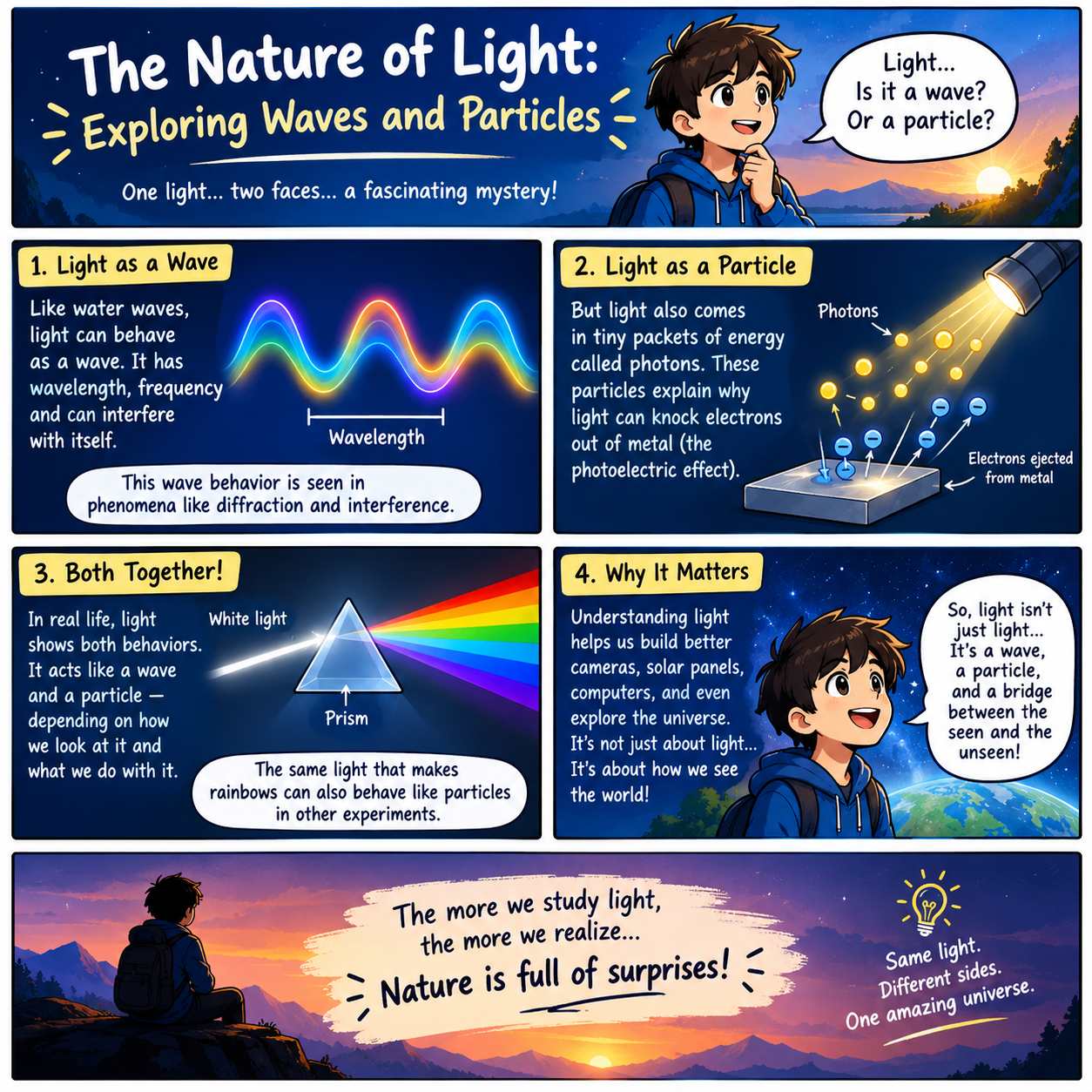
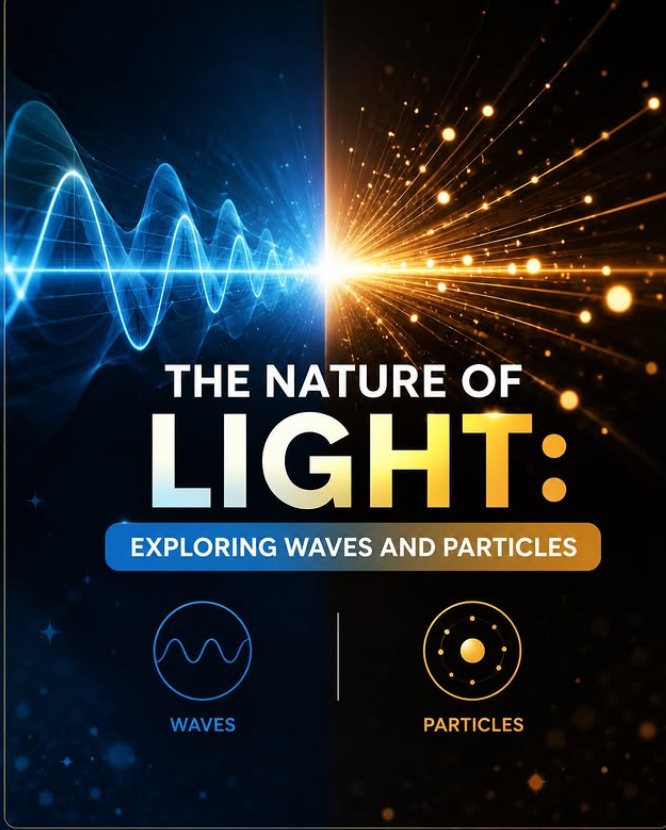
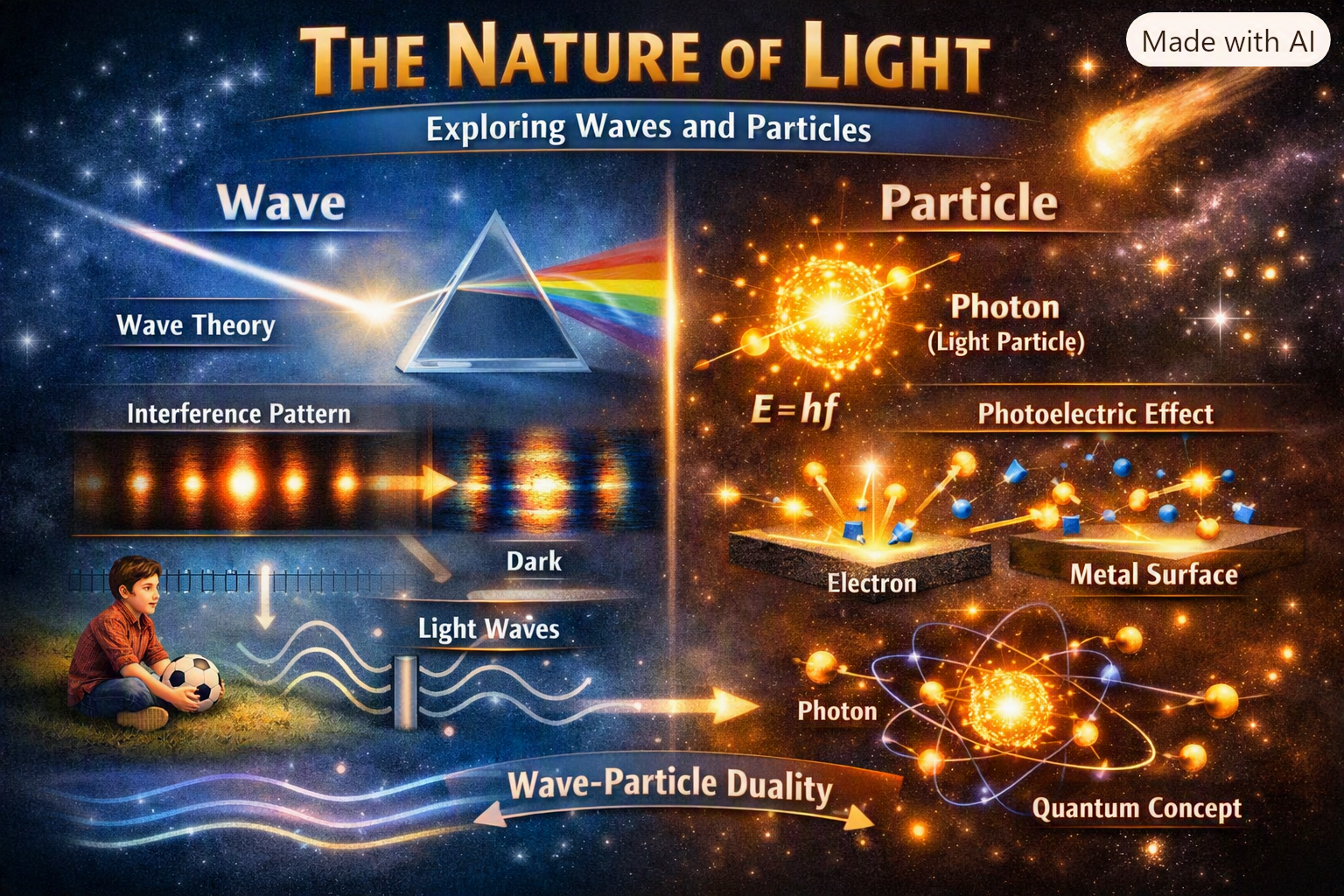
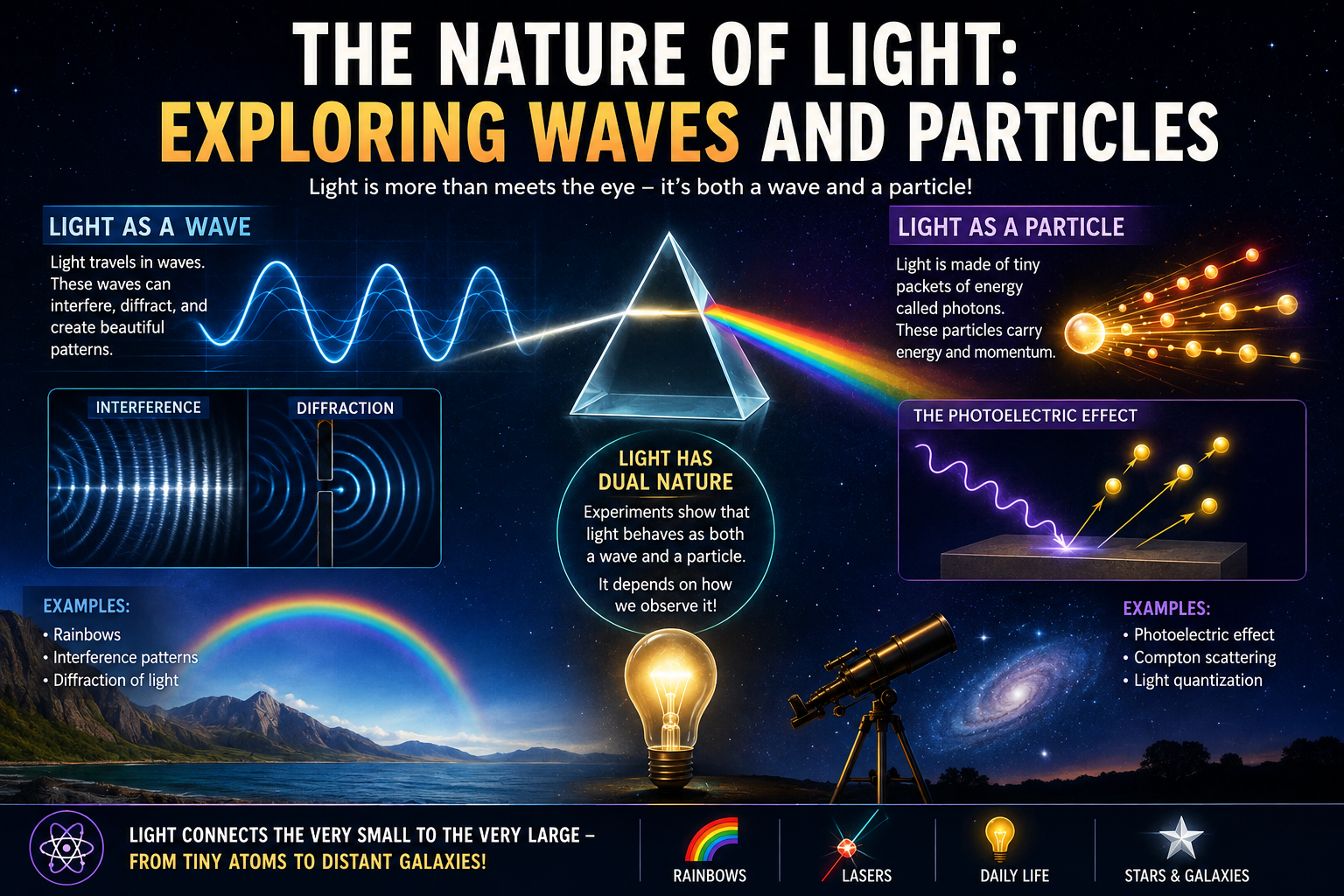
    Scientists discovered that light can behave both like waves and tiny particles.
    This fascinating property is called the wave-particle duality of light.
    Ayan became curious and wanted to discover how this was possible.
    He began an exciting journey into the hidden world of light.
    His teacher explained that light can behave like waves moving through space.
    Light shows reflection, refraction, diffraction, and interference in different situations.
    Reflection allows light to bounce from surfaces such as mirrors and shiny objects.
    Refraction causes light to change direction when it passes through different materials.
    Interference happens when light waves meet and interact with one another.
    These properties help explain rainbows, colors, reflections, and many other phenomena.
    Ayan realized that everyday sights could reveal important scientific secrets.
    He became even more fascinated by the mysterious behavior of light.
    Then Ayan learned that light can also behave like tiny particles called photons.
    Each photon carries energy and can interact with matter in different ways.
    This particle-like behavior helps scientists understand the photoelectric effect.
    Ayan found it amazing that light could appear as both a wave and a particle.
    His teacher explained that this strange behavior is a key idea in quantum physics.
    The quantum world does not always follow the rules we experience every day.
    Light became a perfect example of nature?s surprising complexity.
    Ayan realized that science often reveals things we cannot understand at first.
    That evening, Ayan looked at the sunlight outside with completely new eyes.
    He imagined photons traveling through space and waves carrying energy across the universe.
    He understood that something as ordinary as sunlight could hold incredible mysteries.
    The experience taught him that science is not only about learning known facts.
    It is also about asking questions and searching for answers beyond what we can see.
    Ayan felt inspired to explore more mysteries hidden throughout the universe.
    From that day forward, every beam of light reminded him of his discovery.
    He learned that even the simplest things can contain the greatest scientific wonders.


    #NatureOfLight #LightWaves #LightParticles #Photon #QuantumPhysics #ScienceExploration #PhysicsFacts
    Fondation Level Batch No 4 Roll RSLC #42 Task No #160 Day #160 One evening, Ayan sat by his window watching the golden sunlight fill his room. He wondered how light traveled from the Sun across the vastness of space. The next day, he asked his science teacher about the true nature of light. His teacher explained that light is much more mysterious than it appears. Scientists discovered that light can behave both like waves and tiny particles. This fascinating property is called the wave-particle duality of light. Ayan became curious and wanted to discover how this was possible. He began an exciting journey into the hidden world of light. His teacher explained that light can behave like waves moving through space. Light shows reflection, refraction, diffraction, and interference in different situations. Reflection allows light to bounce from surfaces such as mirrors and shiny objects. Refraction causes light to change direction when it passes through different materials. Interference happens when light waves meet and interact with one another. These properties help explain rainbows, colors, reflections, and many other phenomena. Ayan realized that everyday sights could reveal important scientific secrets. He became even more fascinated by the mysterious behavior of light. Then Ayan learned that light can also behave like tiny particles called photons. Each photon carries energy and can interact with matter in different ways. This particle-like behavior helps scientists understand the photoelectric effect. Ayan found it amazing that light could appear as both a wave and a particle. His teacher explained that this strange behavior is a key idea in quantum physics. The quantum world does not always follow the rules we experience every day. Light became a perfect example of nature?s surprising complexity. Ayan realized that science often reveals things we cannot understand at first. That evening, Ayan looked at the sunlight outside with completely new eyes. He imagined photons traveling through space and waves carrying energy across the universe. He understood that something as ordinary as sunlight could hold incredible mysteries. The experience taught him that science is not only about learning known facts. It is also about asking questions and searching for answers beyond what we can see. Ayan felt inspired to explore more mysteries hidden throughout the universe. From that day forward, every beam of light reminded him of his discovery. He learned that even the simplest things can contain the greatest scientific wonders. #NatureOfLight #LightWaves #LightParticles #Photon #QuantumPhysics #ScienceExploration #PhysicsFacts
    0 Commenti 0 condivisioni 279 Views
  • #rsisb
    Roll No.269
    Foundation Level
    Story Post No.25

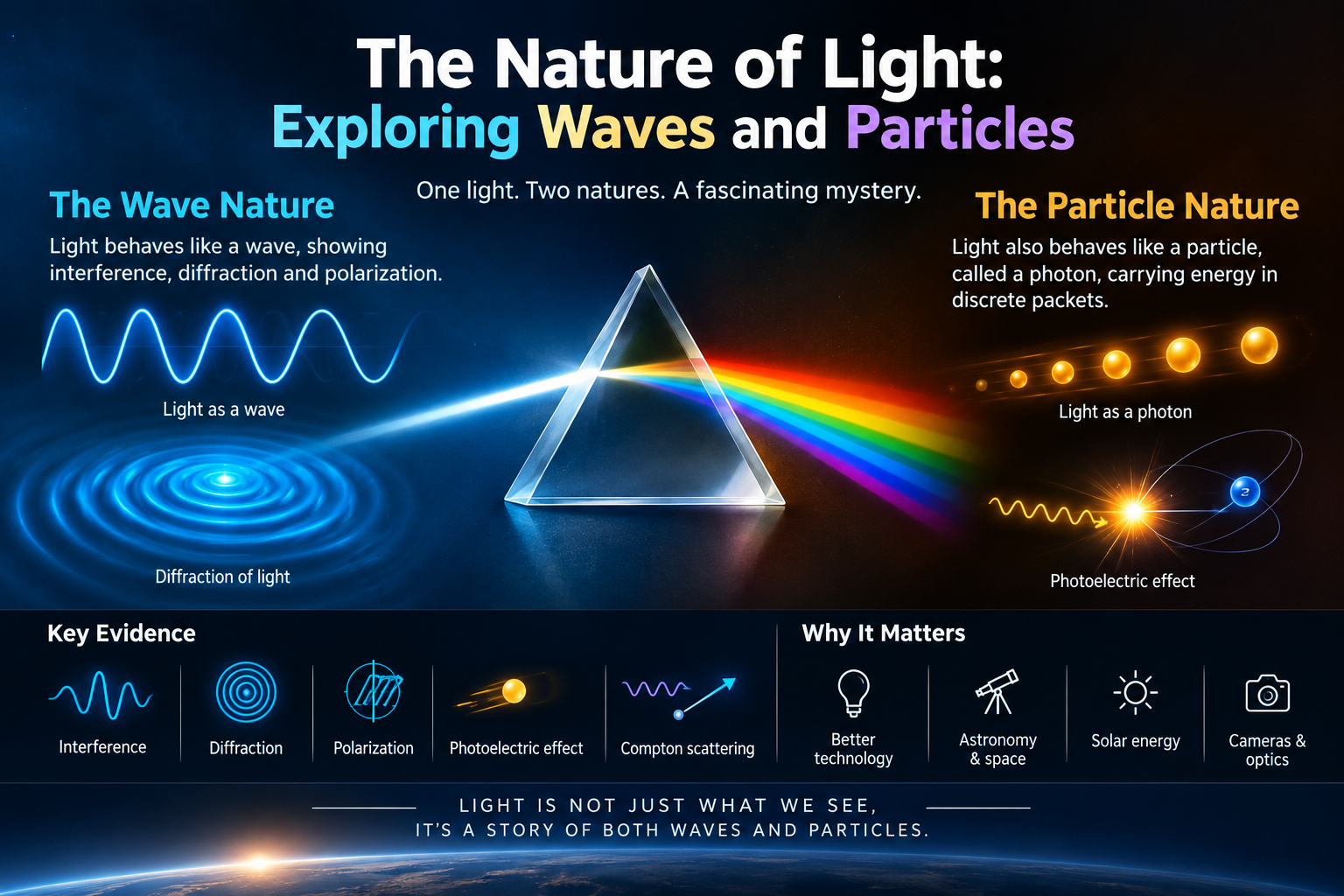
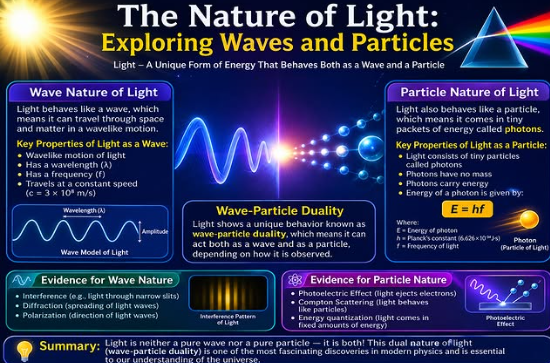
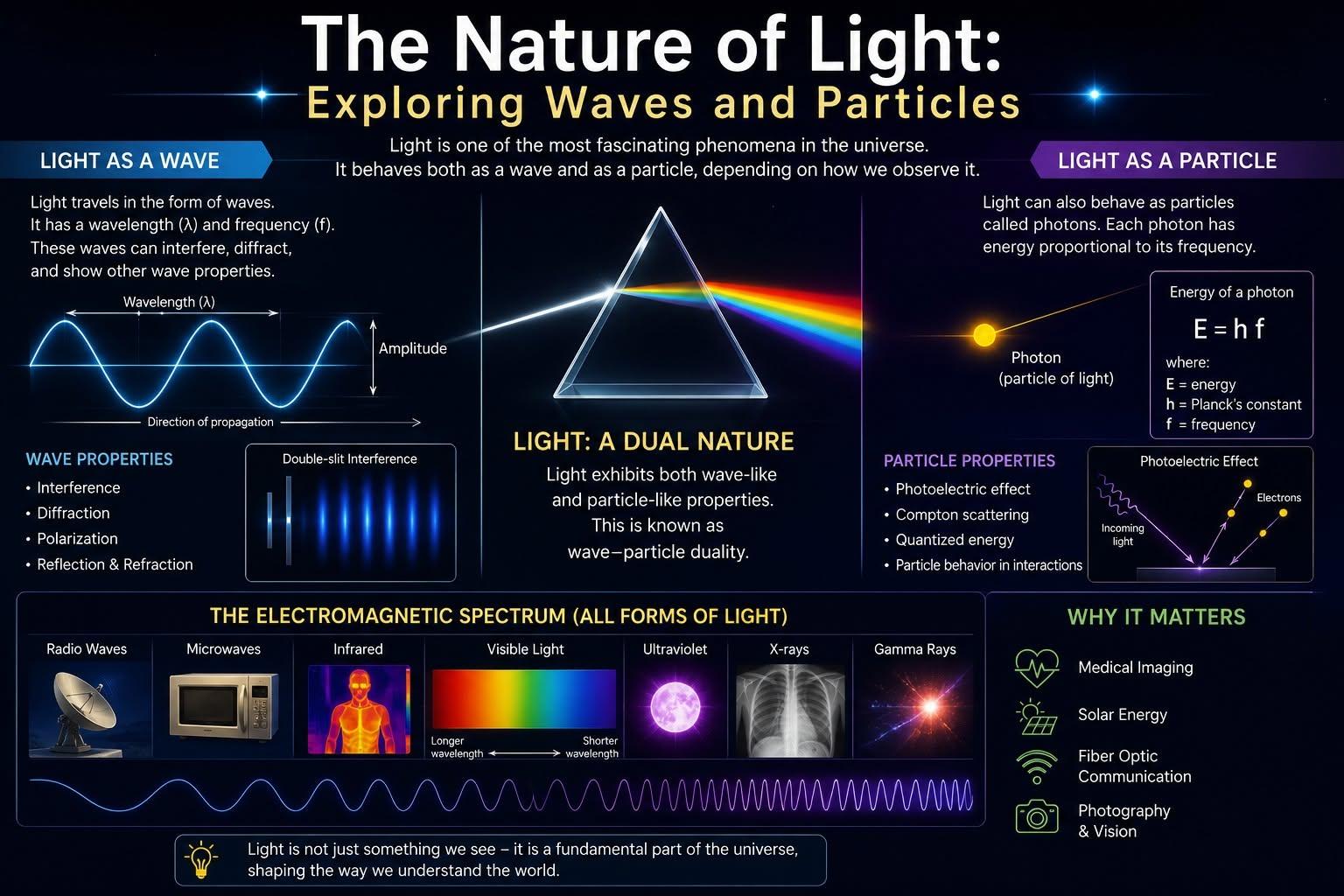
    **The Nature of Light: Exploring Waves and Particles**

    Light is one of the most fascinating phenomena in the universe. We see it every day, but have you ever wondered what light really is and how it travels? In this video, we explore the amazing nature of light and discover how it can behave both as a **wave and as a particle**.

    We will learn about the wave properties of light, including reflection, refraction, interference, and diffraction. We will also explore the particle nature of light and understand how photons help explain the behavior of light at a microscopic level.

    The wave-particle duality of light is one of the most interesting ideas in modern physics. It shows us that nature can behave in ways that are very different from our everyday experiences.

    From sunlight and rainbows to lasers, cameras, and modern technology , light plays an important role in our daily lives and in scientific discoveries.

    Join us as we explore the fascinating world of **light, waves, particles, and quantum physics**. Keep learning, stay curious, and discover the science behind the light around us!

    #Light #Physics #LightWaves #WaveParticleDuality #Particles #Photons #QuantumPhysics #Optics #Science #PhysicsFacts #ScienceEducation #Learning #Reflection #Refraction #Interference #Diffraction #ElectromagneticWaves #ScientificDiscovery #Technology #SpaceScience #Knowledge #Curiosity #StudentLife #RehanSchool #LearnAndGrow
    #rsisb Roll No.269 Foundation Level Story Post No.25 💡 **The Nature of Light: Exploring Waves and Particles** 🌈🔬 Light is one of the most fascinating phenomena in the universe. 🌟 We see it every day, but have you ever wondered what light really is and how it travels? 🤔 In this video, we explore the amazing nature of light and discover how it can behave both as a **wave and as a particle**. We will learn about the wave properties of light, including reflection, refraction, interference, and diffraction. 🌊✨ We will also explore the particle nature of light and understand how photons help explain the behavior of light at a microscopic level. 🔬⚡ The wave-particle duality of light is one of the most interesting ideas in modern physics. It shows us that nature can behave in ways that are very different from our everyday experiences. 🌌🧠 From sunlight and rainbows 🌈 to lasers, cameras, and modern technology 📷💻, light plays an important role in our daily lives and in scientific discoveries. Join us as we explore the fascinating world of **light, waves, particles, and quantum physics**. Keep learning, stay curious, and discover the science behind the light around us! 🚀📚✨ #Light 💡 #Physics 🔬 #LightWaves 🌊 #WaveParticleDuality ⚛️ #Particles #Photons ⚡ #QuantumPhysics 🌌 #Optics 👓 #Science 📚 #PhysicsFacts 🧠 #ScienceEducation 🎓 #Learning 📖 #Reflection ✨ #Refraction 🌈 #Interference 🔬 #Diffraction 🌊 #ElectromagneticWaves ⚡ #ScientificDiscovery 🔍 #Technology 💻 #SpaceScience 🚀 #Knowledge 💡 #Curiosity 🤔 #StudentLife 🎓 #RehanSchool 🏫 #LearnAndGrow 🌱
    0 Commenti 0 condivisioni 1719 Views
  • #rsisb
    Roll no.239
    Story post no.22
    Foundation Level

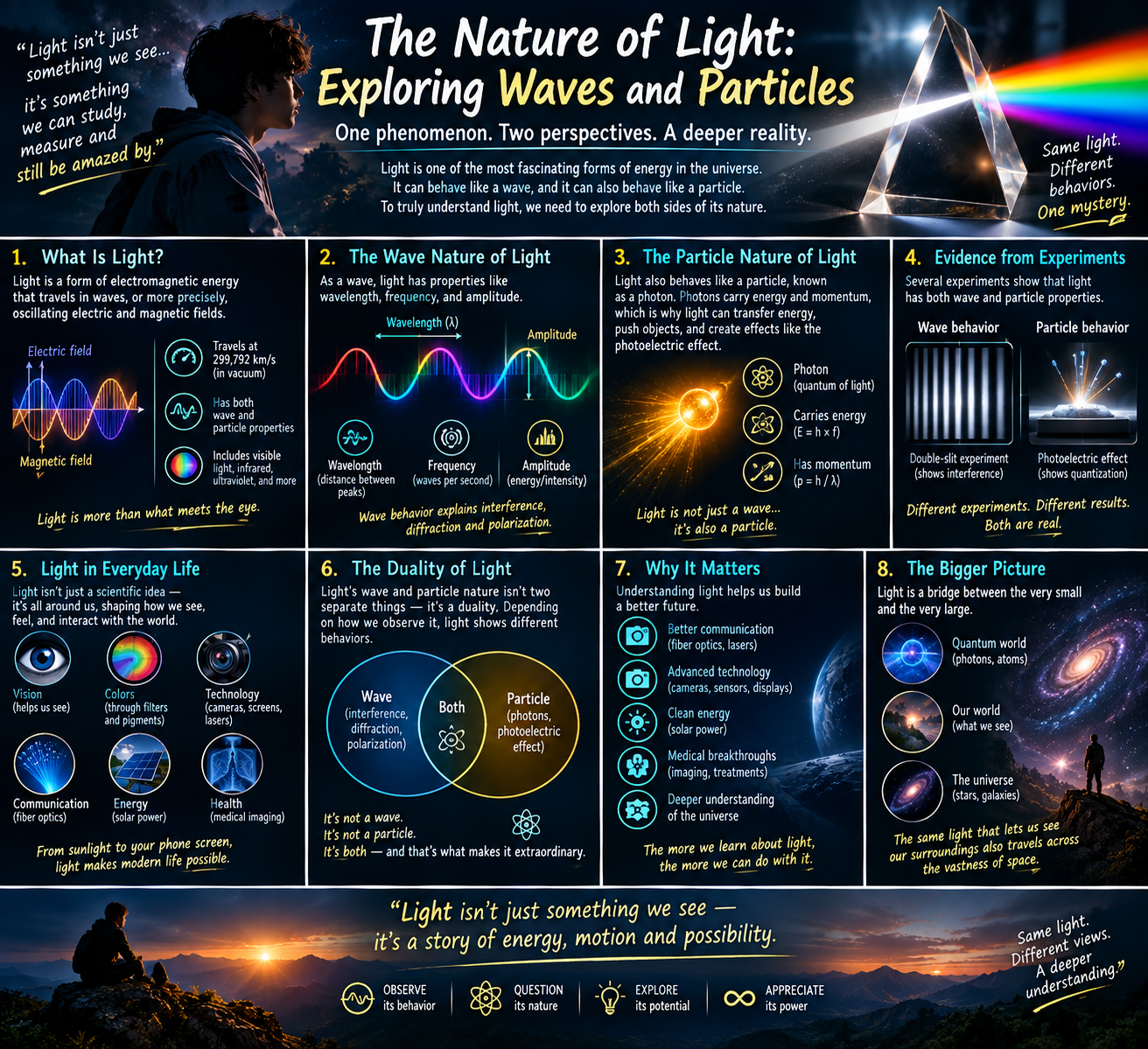
    Light is one of the most fascinating phenomena in the universe. It helps us see the world, carries energy from the Sun, and plays a vital role in modern technology.
    Scientists discovered that light has a **dual nature** — it behaves both like a **wave** and like a **particle**.
    As a **wave**, light can show phenomena such as **interference, diffraction, and polarization**. As a **particle**, light is made of tiny packets of energy called **photons**. The particle nature of light helps explain the **photoelectric effect**, where light can cause electrons to be released from certain materials.
    This wave-particle duality shows us that nature can be more complex than it first appears. Understanding light has helped humanity develop technologies such as **lasers, fiber-optic communication, cameras, solar panels, and medical imaging**.
    ### Key Takeaway
    **Light is neither simply a wave nor simply a particle—it exhibits properties of both, depending on how it is observed and measured.**
    #NatureOfLight #Physics #Science #Light #WaveParticleDuality #Photons #QuantumPhysics #STEM #ScienceExplained #Learning #Education
    #rsisb Roll no.239 Story post no.22 Foundation Level Light is one of the most fascinating phenomena in the universe. 🌟 It helps us see the world, carries energy from the Sun, and plays a vital role in modern technology. Scientists discovered that light has a **dual nature** — it behaves both like a **wave** and like a **particle**. 🌊⚛️ As a **wave**, light can show phenomena such as **interference, diffraction, and polarization**. As a **particle**, light is made of tiny packets of energy called **photons**. The particle nature of light helps explain the **photoelectric effect**, where light can cause electrons to be released from certain materials. This wave-particle duality shows us that nature can be more complex than it first appears. 🔬✨ Understanding light has helped humanity develop technologies such as **lasers, fiber-optic communication, cameras, solar panels, and medical imaging**. ### 🔑 Key Takeaway **Light is neither simply a wave nor simply a particle—it exhibits properties of both, depending on how it is observed and measured.** #NatureOfLight #Physics #Science #Light #WaveParticleDuality #Photons #QuantumPhysics #STEM #ScienceExplained #Learning #Education 🔬🌊⚛️
    0 Commenti 0 condivisioni 1273 Views
  • #rsisb
    Roll No.240
    Story No.15
    Foundation Level

    ### **The Nature of Light: Exploring Waves and Particles**

    Light is one of the most fascinating phenomena in the universe, playing a vital role in everything from vision and communication to modern technology and scientific discovery. Unlike ordinary objects, light exhibits a remarkable property known as **wave-particle duality**, meaning it behaves both as a wave and as a stream of tiny particles called **photons**. This unique characteristic has transformed our understanding of physics and the fundamental laws that govern the universe.

    As a wave, light travels through space in the form of electromagnetic waves, displaying properties such as reflection, refraction, interference, diffraction, and polarization. These wave behaviors explain everyday phenomena like rainbows, mirrors, lenses, and the colors we observe in nature. As particles, photons carry discrete amounts of energy, allowing light to interact with matter in ways that explain the photoelectric effect, lasers, and many modern technologies. Together, these two perspectives provide a complete understanding of how light behaves under different conditions.

    Exploring the nature of light helps us appreciate the incredible discoveries made by scientists such as Isaac Newton, Thomas Young, James Clerk Maxwell, Albert Einstein, and Max Planck. Their groundbreaking work laid the foundation for quantum mechanics, optics, telecommunications, medical imaging, fiber-optic communication, astronomy, and renewable energy technologies. From illuminating our homes to enabling space exploration, light continues to shape the modern world in extraordinary ways.

    **#NatureOfLight #Physics #Science #WaveParticleDuality #Light #Photons #ElectromagneticWaves #QuantumPhysics #Optics #STEM #Education #ScientificDiscovery #Technology #Learning #ExploreScience **

    Rehan School Islamabad Campus
    Asma Shaheen EducationWali
    Irum Asim
    Saima Happinesswali
    #rsisb Roll No.240 Story No.15 Foundation Level ### **The Nature of Light: Exploring Waves and Particles** Light is one of the most fascinating phenomena in the universe, playing a vital role in everything from vision and communication to modern technology and scientific discovery. Unlike ordinary objects, light exhibits a remarkable property known as **wave-particle duality**, meaning it behaves both as a wave and as a stream of tiny particles called **photons**. This unique characteristic has transformed our understanding of physics and the fundamental laws that govern the universe. As a wave, light travels through space in the form of electromagnetic waves, displaying properties such as reflection, refraction, interference, diffraction, and polarization. These wave behaviors explain everyday phenomena like rainbows, mirrors, lenses, and the colors we observe in nature. As particles, photons carry discrete amounts of energy, allowing light to interact with matter in ways that explain the photoelectric effect, lasers, and many modern technologies. Together, these two perspectives provide a complete understanding of how light behaves under different conditions. Exploring the nature of light helps us appreciate the incredible discoveries made by scientists such as Isaac Newton, Thomas Young, James Clerk Maxwell, Albert Einstein, and Max Planck. Their groundbreaking work laid the foundation for quantum mechanics, optics, telecommunications, medical imaging, fiber-optic communication, astronomy, and renewable energy technologies. From illuminating our homes to enabling space exploration, light continues to shape the modern world in extraordinary ways. **#NatureOfLight #Physics #Science #WaveParticleDuality #Light #Photons #ElectromagneticWaves #QuantumPhysics #Optics #STEM #Education #ScientificDiscovery #Technology #Learning #ExploreScience 🌈💡🔬⚛️📚** Rehan School Islamabad Campus Asma Shaheen EducationWali Irum Asim Saima Happinesswali
    0 Commenti 0 condivisioni 6497 Views
  • The millatry industrial complex :(

    WORLD NEWS
    Pakistani Leader Sharif Nears Pact With Military
    Army Presses Sharif to Relinquish Control of Security Affairs, Foreign Policy
    ISLAMABAD—The Pakistani military is close to an agreement with the government in which the prime minister would relinquish control of security affairs and strategic foreign policy, government officials said, amid antigovernment protests that have paralyzed the capital.
    A nearly two-week confrontation between the administration and demonstrators, which the government believes are backed by the military, has put Prime Minister Nawaz Sharif under pressure.
    Government aides said the military has seized on Mr. Sharifs weakened status during the political crisis to strike a deal in which he would leave strategic policy areas—including relations with the U.S., Afghanistan and India—to be controlled by the armed forces.
    The military is now seeking guarantees from the prime minister that he will follow through on the agreement, the aides said. Spokesmen for Mr. Sharif and several government ministries didnt return calls seeking comment. A Pakistani military spokesman didnt respond to requests to comment.
    Since winning an outright majority in Parliament 16 months ago, Mr. Sharif has angered the military establishment with efforts to assert civilian control of the armed forces and decide on policies that were traditionally the domain of the military. The deal with the military would sharply curtail Mr. Sharifs powers, and cast doubt on his ability to make peace with Pakistans rival, India, a top priority for the prime minister.
    "If Nawaz Sharif survives, for the rest of his term, he will be a ceremonial prime minister—the world will not take him seriously," said Ayesha Siddiqa, an analyst based in Islamabad. "A soft coup has already taken place. The question is whether it will harden."
    Thousands of protesters arrived on Aug. 15 in Islamabad, led by Imran Khan, a politician and former cricket star, and Muslim cleric Tahir ul Qadri, demanding the prime ministers resignation. The activists have slept on the streets of the capital since, protesters moving last week in front of the Parliament.

    The armed forces have run Pakistan for half its 67-year history, including a 1999 coup led by then-army chief Pervez Musharraf, which ended Mr. Sharifs last stint as prime minister. Even when not formally in power, the military has traditionally run foreign and internal security policies.
    Government aides said the military has extracted a promise of freedom for Mr. Musharraf, who is being prosecuted by Mr. Sharifs government for treason. That charge, related to Mr. Musharrafs military rule following the 1999 coup, is another major source of tension between the administration and the armed forces. Mr. Musharraf denies the treason charge.
    According to political and security officials, Mr. Sharifs government had secretly agreed to let Mr. Musharraf go abroad after a symbolic indictment over treason, which took place in March, but the government went back on the deal. That eroded trust between the military and Mr. Sharif.
    Government aides said the administration was also willing to let the prime ministers brother, Shahbaz Sharif, step down as chief minister of Punjab province, the countrys most heavily populated region.
    Democracy was restored in Pakistan in 2008, when a government led by Asif Zardari of the Pakistan Peoples Party was elected and ruled until last years elections. Mr. Zardaris government, a weak coalition, had also in its early days tried to push its own foreign and security policies, but it was soon beaten back.
    "Nawaz Sharif thought that he was no Asif Zardari," said Murtaza Solangi, an analyst who had served as head of Radio Pakistan, the state broadcaster, under the Zardari government. "But the military decided that theyll make him an Asif Zardari."
    Mr. Sharifs election victory had also raised hopes of a shift in policy toward Afghanistan and India. Mr. Sharif offered India a trade liberalization deal, and pledged to Kabul that he would end Pakistans interference in Afghanistan.
    But Mr. Sharifs stated aim of making peace with India and the pace at which he started to pursue this goal—seen in Washington as a historic opportunity— riled the military establishment. Mr. Sharifs policy of holding extended peace talks with Pakistani Taliban militants held up the armys plans for an operation against them, sowing further misgivings about the government.
    A government aide said that the personal political ambitions of the protest leaders had been encouraged by a military that wanted to "cut Nawaz Sharif down to size."
    "The script was never to topple the government but weaken it to the point where it was just left hanging, unable to move," said the aide.
    Mr. Khan has called for a government of "technocrats" to be brought in now, but denied that he is acting on behalf of the military.
    "Im doing this for Pakistan, not for myself," Mr. Khan told supporters in a speech Wednesday. "To save our democracy, Im not going from here without Nawaz Sharifs resignation."
    Washington last week put out a statement of support for the administration, saying: "We support the constitutional and electoral process in Pakistan, which produced the Prime Minister of Nawaz Sharif."
    The millatry industrial complex :( WORLD NEWS Pakistani Leader Sharif Nears Pact With Military Army Presses Sharif to Relinquish Control of Security Affairs, Foreign Policy ISLAMABAD—The Pakistani military is close to an agreement with the government in which the prime minister would relinquish control of security affairs and strategic foreign policy, government officials said, amid antigovernment protests that have paralyzed the capital. A nearly two-week confrontation between the administration and demonstrators, which the government believes are backed by the military, has put Prime Minister Nawaz Sharif under pressure. Government aides said the military has seized on Mr. Sharif's weakened status during the political crisis to strike a deal in which he would leave strategic policy areas—including relations with the U.S., Afghanistan and India—to be controlled by the armed forces. The military is now seeking guarantees from the prime minister that he will follow through on the agreement, the aides said. Spokesmen for Mr. Sharif and several government ministries didn't return calls seeking comment. A Pakistani military spokesman didn't respond to requests to comment. Since winning an outright majority in Parliament 16 months ago, Mr. Sharif has angered the military establishment with efforts to assert civilian control of the armed forces and decide on policies that were traditionally the domain of the military. The deal with the military would sharply curtail Mr. Sharif's powers, and cast doubt on his ability to make peace with Pakistan's rival, India, a top priority for the prime minister. "If Nawaz Sharif survives, for the rest of his term, he will be a ceremonial prime minister—the world will not take him seriously," said Ayesha Siddiqa, an analyst based in Islamabad. "A soft coup has already taken place. The question is whether it will harden." Thousands of protesters arrived on Aug. 15 in Islamabad, led by Imran Khan, a politician and former cricket star, and Muslim cleric Tahir ul Qadri, demanding the prime minister's resignation. The activists have slept on the streets of the capital since, protesters moving last week in front of the Parliament. The armed forces have run Pakistan for half its 67-year history, including a 1999 coup led by then-army chief Pervez Musharraf, which ended Mr. Sharif's last stint as prime minister. Even when not formally in power, the military has traditionally run foreign and internal security policies. Government aides said the military has extracted a promise of freedom for Mr. Musharraf, who is being prosecuted by Mr. Sharif's government for treason. That charge, related to Mr. Musharraf's military rule following the 1999 coup, is another major source of tension between the administration and the armed forces. Mr. Musharraf denies the treason charge. According to political and security officials, Mr. Sharif's government had secretly agreed to let Mr. Musharraf go abroad after a symbolic indictment over treason, which took place in March, but the government went back on the deal. That eroded trust between the military and Mr. Sharif. Government aides said the administration was also willing to let the prime minister's brother, Shahbaz Sharif, step down as chief minister of Punjab province, the country's most heavily populated region. Democracy was restored in Pakistan in 2008, when a government led by Asif Zardari of the Pakistan Peoples Party was elected and ruled until last year's elections. Mr. Zardari's government, a weak coalition, had also in its early days tried to push its own foreign and security policies, but it was soon beaten back. "Nawaz Sharif thought that he was no Asif Zardari," said Murtaza Solangi, an analyst who had served as head of Radio Pakistan, the state broadcaster, under the Zardari government. "But the military decided that they'll make him an Asif Zardari." Mr. Sharif's election victory had also raised hopes of a shift in policy toward Afghanistan and India. Mr. Sharif offered India a trade liberalization deal, and pledged to Kabul that he would end Pakistan's interference in Afghanistan. But Mr. Sharif's stated aim of making peace with India and the pace at which he started to pursue this goal—seen in Washington as a historic opportunity— riled the military establishment. Mr. Sharif's policy of holding extended peace talks with Pakistani Taliban militants held up the army's plans for an operation against them, sowing further misgivings about the government. A government aide said that the personal political ambitions of the protest leaders had been encouraged by a military that wanted to "cut Nawaz Sharif down to size." "The script was never to topple the government but weaken it to the point where it was just left hanging, unable to move," said the aide. Mr. Khan has called for a government of "technocrats" to be brought in now, but denied that he is acting on behalf of the military. "I'm doing this for Pakistan, not for myself," Mr. Khan told supporters in a speech Wednesday. "To save our democracy, I'm not going from here without Nawaz Sharif's resignation." Washington last week put out a statement of support for the administration, saying: "We support the constitutional and electoral process in Pakistan, which produced the Prime Minister of Nawaz Sharif."
    0 Commenti 0 condivisioni 4534 Views
  • Paul Graham, who helps people start new companies, shared some thoughts about how the people who create companies (called founders) should run them. He noticed that as companies get bigger, people often tell the founders to step back and let other people, called managers, take over and run things. The advice is usually to hire good people and let them do their jobs without too much interference.

    But Brian Chesky, who started Airbnb, tried this advice and found that it didn’t work well for his company. Instead, he looked at how Steve Jobs, who started Apple, ran his company. He realized that founders might need to stay more involved in their companies to make sure things are done right.

    Paul Graham says that there are two ways to run a company: one way is "manager mode," where you let others do most of the work, and the other way is "founder mode," where the founder stays very involved in everything. He thinks founders should stay in "founder mode" because they understand their company better than anyone else.

    The problem is that many people, like teachers and business advisers, usually teach "manager mode" because it sounds like the right way to run a big company. But Paul Graham thinks this advice doesn’t always work for founders, and if they follow it, it can sometimes cause problems, like having people who seem like they’re doing a good job but actually aren’t.

    In simpler terms, Paul Graham is saying that the people who start companies should stay really involved in running them, even as they get bigger, because they know their company best.
    Paul Graham, who helps people start new companies, shared some thoughts about how the people who create companies (called founders) should run them. He noticed that as companies get bigger, people often tell the founders to step back and let other people, called managers, take over and run things. The advice is usually to hire good people and let them do their jobs without too much interference. But Brian Chesky, who started Airbnb, tried this advice and found that it didn’t work well for his company. Instead, he looked at how Steve Jobs, who started Apple, ran his company. He realized that founders might need to stay more involved in their companies to make sure things are done right. Paul Graham says that there are two ways to run a company: one way is "manager mode," where you let others do most of the work, and the other way is "founder mode," where the founder stays very involved in everything. He thinks founders should stay in "founder mode" because they understand their company better than anyone else. The problem is that many people, like teachers and business advisers, usually teach "manager mode" because it sounds like the right way to run a big company. But Paul Graham thinks this advice doesn’t always work for founders, and if they follow it, it can sometimes cause problems, like having people who seem like they’re doing a good job but actually aren’t. In simpler terms, Paul Graham is saying that the people who start companies should stay really involved in running them, even as they get bigger, because they know their company best.
    0 Commenti 0 condivisioni 379 Views
  • The Science of Silence – How Quiet Time Gives You Answers

    Most people think silence means nothing is happening. But in reality, silence is one of the most powerful times for your brain. When you stay quiet for 40 to 60 minutes, your brain starts doing something very special — it begins to solve problems, organize memories, and bring new ideas to the surface.

    What Happens Inside the Brain

    Our brain has two main modes:
    1. Active Mode: When you are talking, watching videos, studying, or scrolling on your phone — your brain is busy reacting to outside information.
    2. Silent Mode: When you stop talking and sit quietly, your brain switches to a system called the Default Mode Network (DMN).

    This network turns on when you are not focused on the outside world. It connects your memories, imagination, and emotions together. It’s like your brain’s “background workshop” — silently fixing problems, testing new ideas, and linking pieces of information you already know.

    How Silence Creates Ideas

    When you are quiet:
    • Your stress hormones like cortisol go down.
    • Your alpha brain waves increase — these help you relax and think clearly.
    • Your memory system (hippocampus) starts replaying and rearranging thoughts, like shuffling puzzle pieces until a picture appears.

    This is why, after sitting quietly for some time, new ideas suddenly “pop up.” It feels like inspiration — but it’s actually your brain connecting the dots without interference.

    Why 40–60 Minutes?

    It takes about 10–20 minutes for your mind to stop jumping from one thought to another. After that, your brain enters a calm, deep-thinking zone. Staying in that state for 40–60 minutes gives enough time for deep reflection and insight.

    How Silence Helps You in Daily Life
    1. Problem Solving: When you stop trying to “force” answers, your brain finds them naturally.
    2. Emotional Control: Silence reduces anxiety and helps you see your emotions clearly instead of reacting.
    3. Better Focus: After quiet time, your concentration and memory improve.
    4. Creativity: Many inventions, poems, and business ideas come during silent walks, showers, or meditation.

    Even great minds like Newton, Einstein, and Rumi used silence to think deeply and receive inspiration.

    How to Practice

    You can do this anywhere:
    • Sit in a quiet room or garden.
    • Keep your phone away.
    • Close your eyes or look softly at one point.
    • Take slow breaths and let thoughts come and go.
    • Keep a notebook nearby. When silence ends, write what came to mind — often you’ll find new solutions or creative ideas there.

    In Simple Words

    Silence is not empty — it is full of answers.
    When we stop talking, the noise of the world fades, and the voice of our inner wisdom becomes clear.

    It’s like cleaning a dirty mirror — once the dust settles, you can finally see your reflection and your direction.

    The Science of Silence – How Quiet Time Gives You Answers Most people think silence means nothing is happening. But in reality, silence is one of the most powerful times for your brain. When you stay quiet for 40 to 60 minutes, your brain starts doing something very special — it begins to solve problems, organize memories, and bring new ideas to the surface. What Happens Inside the Brain Our brain has two main modes: 1. Active Mode: When you are talking, watching videos, studying, or scrolling on your phone — your brain is busy reacting to outside information. 2. Silent Mode: When you stop talking and sit quietly, your brain switches to a system called the Default Mode Network (DMN). This network turns on when you are not focused on the outside world. It connects your memories, imagination, and emotions together. It’s like your brain’s “background workshop” — silently fixing problems, testing new ideas, and linking pieces of information you already know. How Silence Creates Ideas When you are quiet: • Your stress hormones like cortisol go down. • Your alpha brain waves increase — these help you relax and think clearly. • Your memory system (hippocampus) starts replaying and rearranging thoughts, like shuffling puzzle pieces until a picture appears. This is why, after sitting quietly for some time, new ideas suddenly “pop up.” It feels like inspiration — but it’s actually your brain connecting the dots without interference. Why 40–60 Minutes? It takes about 10–20 minutes for your mind to stop jumping from one thought to another. After that, your brain enters a calm, deep-thinking zone. Staying in that state for 40–60 minutes gives enough time for deep reflection and insight. How Silence Helps You in Daily Life 1. Problem Solving: When you stop trying to “force” answers, your brain finds them naturally. 2. Emotional Control: Silence reduces anxiety and helps you see your emotions clearly instead of reacting. 3. Better Focus: After quiet time, your concentration and memory improve. 4. Creativity: Many inventions, poems, and business ideas come during silent walks, showers, or meditation. Even great minds like Newton, Einstein, and Rumi used silence to think deeply and receive inspiration. How to Practice You can do this anywhere: • Sit in a quiet room or garden. • Keep your phone away. • Close your eyes or look softly at one point. • Take slow breaths and let thoughts come and go. • Keep a notebook nearby. When silence ends, write what came to mind — often you’ll find new solutions or creative ideas there. In Simple Words Silence is not empty — it is full of answers. When we stop talking, the noise of the world fades, and the voice of our inner wisdom becomes clear. It’s like cleaning a dirty mirror — once the dust settles, you can finally see your reflection and your direction. ⸻
    0 Commenti 0 condivisioni 970 Views
  • The Story of Nation-States

    How the World Moved from Tribes and Empires to Countries

    For most of human history, the world did not have countries the way we know them today.
    There were tribes, kingdoms, empires, and city-states — but the idea that a land belongs to a nation of people with a shared identity is surprisingly very new.

    The concept of the nation-state is only about 300–400 years old, yet today almost the entire planet is divided into them.

    Let’s understand how this powerful idea was born.


    1. The World Before Nation-States

    Tribes, Kingdoms, and Empires

    Before the 1600s, people did not identify themselves as citizens of a country.

    Instead they belonged to:

    • Tribes (based on family and blood relations)
    • City-states like Athens or Sparta
    • Kingdoms ruled by monarchs
    • Large empires controlling many cultures

    Examples:
    • Roman Empire
    • Ottoman Empire
    • Mughal Empire
    • Chinese Empire

    These empires ruled many languages, religions, and ethnic groups.

    People identified themselves mainly as:
    • Muslims or Christians
    • Members of a tribe
    • Subjects of a king

    Not as “citizens of a nation.”

    For example:

    A person living in Lahore in 1700 would say
    “I am a subject of the Mughal Emperor” — not “I am Pakistani.”


    2. The Turning Point: Peace of Westphalia (1648)

    The modern nation-state system began after the Thirty Years’ War in Europe.

    This war destroyed large parts of Europe and involved many kingdoms fighting over religion and power.

    The war ended with a historic agreement:

    Peace of Westphalia (1648)

    This treaty introduced a revolutionary idea:

    Each territory should control its own affairs.

    Three important principles emerged:

    Sovereignty – Every state controls its own territory.
    Borders matter – Clear geographical boundaries.
    Non-interference – Other states should not interfere.

    This became the foundation of the modern international system.


    3. The Rise of Nationalism (1700s–1800s)

    During the 18th and 19th centuries, a powerful new idea spread:

    A nation should govern itself.

    This idea is called nationalism.

    Three major revolutions helped spread it.


    American Revolution (1776)

    American Revolution

    People in the American colonies rejected the rule of the British king.

    They declared:

    Governments should represent the people.

    This created the United States, one of the earliest modern nation-states.


    French Revolution (1789)

    French Revolution

    This revolution changed the political language of the world.

    Before the revolution:

    People served the king.

    After the revolution:

    People belonged to the nation.

    New ideas emerged:
    • Citizenship
    • Equality before law
    • National identity


    🗺 4. Europe Becomes Nation-States

    During the 1800s many regions reorganized into modern nations.

    Examples include:
    • Germany unified in 1871
    • Italy unified in 1861

    Before this, Germany and Italy were dozens of small kingdoms and duchies.

    Nationalism united them into single states.


    5. Nation-States Spread Across the World

    The idea spread globally during the 20th century.

    Two major events accelerated it.


    World War I (1914–1918)

    World War I

    After this war, large empires collapsed:
    • Ottoman Empire
    • Austro‑Hungarian Empire
    • Russian Empire

    Many new countries appeared in Europe and the Middle East.


    World War II and Decolonization

    World War II

    After 1945, European colonial empires weakened.

    Countries in Asia and Africa demanded independence.

    Examples:
    • India (1947)
    • Pakistan (1947)
    • Indonesia (1945)
    • Nigeria (1960)

    Within a few decades, dozens of new nation-states emerged.


    6. The World Today

    Today the international system is based on nation-states.

    There are about 195 countries in the world.

    They interact through global institutions like:
    • United Nations
    • World Bank
    • International Monetary Fund

    Each state has:
    • Defined borders
    • Government
    • Citizens
    • Sovereignty


    The Challenge of Nation-States

    Although nation-states dominate today, they also face major challenges:

    • Many states contain multiple ethnic groups
    • Borders drawn during colonial times created conflicts
    • Globalization weakens traditional borders
    • Migration mixes cultures

    Examples include tensions in regions like:
    • the Middle East
    • parts of Africa
    • Eastern Europe


    A Powerful Idea That Changed the World

    The nation-state transformed human civilization.

    It created:
    • modern governments
    • citizenship
    • passports
    • national economies
    • international diplomacy

    But historically speaking, it is still a very young invention.

    For thousands of years humans lived under tribes and empires.

    Only recently have we organized the world into countries.

    And the future may bring yet another transformation.

    Because history shows something very important:

    Human political systems are always evolving.
    🌍 The Story of Nation-States How the World Moved from Tribes and Empires to Countries For most of human history, the world did not have countries the way we know them today. There were tribes, kingdoms, empires, and city-states — but the idea that a land belongs to a nation of people with a shared identity is surprisingly very new. The concept of the nation-state is only about 300–400 years old, yet today almost the entire planet is divided into them. Let’s understand how this powerful idea was born. ⸻ 🏹 1. The World Before Nation-States Tribes, Kingdoms, and Empires Before the 1600s, people did not identify themselves as citizens of a country. Instead they belonged to: • Tribes (based on family and blood relations) • City-states like Athens or Sparta • Kingdoms ruled by monarchs • Large empires controlling many cultures Examples: • Roman Empire • Ottoman Empire • Mughal Empire • Chinese Empire These empires ruled many languages, religions, and ethnic groups. People identified themselves mainly as: • Muslims or Christians • Members of a tribe • Subjects of a king Not as “citizens of a nation.” For example: A person living in Lahore in 1700 would say “I am a subject of the Mughal Emperor” — not “I am Pakistani.” ⸻ ⚔️ 2. The Turning Point: Peace of Westphalia (1648) The modern nation-state system began after the Thirty Years’ War in Europe. This war destroyed large parts of Europe and involved many kingdoms fighting over religion and power. The war ended with a historic agreement: Peace of Westphalia (1648) This treaty introduced a revolutionary idea: Each territory should control its own affairs. Three important principles emerged: 1️⃣ Sovereignty – Every state controls its own territory. 2️⃣ Borders matter – Clear geographical boundaries. 3️⃣ Non-interference – Other states should not interfere. This became the foundation of the modern international system. ⸻ 📚 3. The Rise of Nationalism (1700s–1800s) During the 18th and 19th centuries, a powerful new idea spread: A nation should govern itself. This idea is called nationalism. Three major revolutions helped spread it. ⸻ 🇺🇸 American Revolution (1776) American Revolution People in the American colonies rejected the rule of the British king. They declared: Governments should represent the people. This created the United States, one of the earliest modern nation-states. ⸻ 🇫🇷 French Revolution (1789) French Revolution This revolution changed the political language of the world. Before the revolution: People served the king. After the revolution: People belonged to the nation. New ideas emerged: • Citizenship • Equality before law • National identity ⸻ 🗺 4. Europe Becomes Nation-States During the 1800s many regions reorganized into modern nations. Examples include: • Germany unified in 1871 • Italy unified in 1861 Before this, Germany and Italy were dozens of small kingdoms and duchies. Nationalism united them into single states. ⸻ 🌏 5. Nation-States Spread Across the World The idea spread globally during the 20th century. Two major events accelerated it. ⸻ 🌍 World War I (1914–1918) World War I After this war, large empires collapsed: • Ottoman Empire • Austro‑Hungarian Empire • Russian Empire Many new countries appeared in Europe and the Middle East. ⸻ 🌍 World War II and Decolonization World War II After 1945, European colonial empires weakened. Countries in Asia and Africa demanded independence. Examples: • India (1947) • Pakistan (1947) • Indonesia (1945) • Nigeria (1960) Within a few decades, dozens of new nation-states emerged. ⸻ 🌐 6. The World Today Today the international system is based on nation-states. There are about 195 countries in the world. They interact through global institutions like: • United Nations • World Bank • International Monetary Fund Each state has: • Defined borders • Government • Citizens • Sovereignty ⸻ ⚠️ The Challenge of Nation-States Although nation-states dominate today, they also face major challenges: • Many states contain multiple ethnic groups • Borders drawn during colonial times created conflicts • Globalization weakens traditional borders • Migration mixes cultures Examples include tensions in regions like: • the Middle East • parts of Africa • Eastern Europe ⸻ 🚀 A Powerful Idea That Changed the World The nation-state transformed human civilization. It created: • modern governments • citizenship • passports • national economies • international diplomacy But historically speaking, it is still a very young invention. For thousands of years humans lived under tribes and empires. Only recently have we organized the world into countries. And the future may bring yet another transformation. Because history shows something very important: Human political systems are always evolving.
    0 Commenti 0 condivisioni 1047 Views
  • Colors in nature come mainly from three sources: pigments, structural colors, and bioluminescence. Such is the case of blue and green colors, compared to reds and the rest because they can be structural colors.

    Colors in nature come mainly from three sources: pigments, structural colors, and bioluminescence. Such is the case of blue and green colors, compared to reds and the rest because they can be structural colors.

    Structural coloring is the result of microscopically fine structured surfaces that interfere with visible light, sometimes in combination with pigments. For example, peacock tail feathers are brown pigmented, but because of their microscopic structure, they also reflect blue, turquoise and green light. And they are often iridescent. Thus, structural coloring is a classic optical effect of interference and diffraction, rather than a quantum property of photon absorption and emission, which is responsible for color in pigments (as plants, which efficiently absorb red light and the green is reflected) and bioluminescence.

    Learn more about the biophysics of the natural world in the free Unified Science Course in the Resonance Academy at ResonanceScience.org

    Photo by Kelvin Hudson
    Colors in nature come mainly from three sources: pigments, structural colors, and bioluminescence. Such is the case of blue and green colors, compared to reds and the rest because they can be structural colors. Colors in nature come mainly from three sources: pigments, structural colors, and bioluminescence. Such is the case of blue and green colors, compared to reds and the rest because they can be structural colors. Structural coloring is the result of microscopically fine structured surfaces that interfere with visible light, sometimes in combination with pigments. For example, peacock tail feathers are brown pigmented, but because of their microscopic structure, they also reflect blue, turquoise and green light. And they are often iridescent. Thus, structural coloring is a classic optical effect of interference and diffraction, rather than a quantum property of photon absorption and emission, which is responsible for color in pigments (as plants, which efficiently absorb red light and the green is reflected) and bioluminescence. Learn more about the biophysics of the natural world in the free Unified Science Course in the Resonance Academy at ResonanceScience.org Photo by Kelvin Hudson
    0 Commenti 0 condivisioni 1244 Views
  • In a moment that should’ve stopped time, Jimmy Carter—quiet as a monk, sharp as a scalpel—offered a truth so unassuming, most missed the incision. He was speaking to Trump, but really, he was speaking to all of us.

    Carter’s point was this: While China has spent decades laying tracks for the future, we’ve been digging graves in the past. They’ve built cities, schools, trains that move faster than thought. We’ve built military bases, debt, and an empire of rust.

    It wasn’t a boast. It was an autopsy.

    China chose infrastructure. We chose interference. They built railways across continents. We bombed bridges across borders. They invested in AI, medicine, and education. We invested in overthrowing oil-rich governments, branding it freedom.

    We spent $300 billion trying to bend the world to our will. They spent it making their own nation unshakable.

    We don’t have high-speed trains. We don’t have roads that last. We don’t have universal healthcare, or education systems that top the charts. But we do have the most advanced weapons on Earth, pointed at every direction but inward.

    If we’d used even a fraction of that money on ourselves, our cities would hum like circuits. Our schools would shine. Our hospitals would heal. Our people might feel something we haven’t felt in a long time—progress.

    That was Carter’s quiet bombshell: the war we’re losing isn’t to China. It’s to our own addiction to dominance. And our refusal to invest in anything we can’t control.

    Forwarded as shared
    In a moment that should’ve stopped time, Jimmy Carter—quiet as a monk, sharp as a scalpel—offered a truth so unassuming, most missed the incision. He was speaking to Trump, but really, he was speaking to all of us. Carter’s point was this: While China has spent decades laying tracks for the future, we’ve been digging graves in the past. They’ve built cities, schools, trains that move faster than thought. We’ve built military bases, debt, and an empire of rust. It wasn’t a boast. It was an autopsy. China chose infrastructure. We chose interference. They built railways across continents. We bombed bridges across borders. They invested in AI, medicine, and education. We invested in overthrowing oil-rich governments, branding it freedom. We spent $300 billion trying to bend the world to our will. They spent it making their own nation unshakable. We don’t have high-speed trains. We don’t have roads that last. We don’t have universal healthcare, or education systems that top the charts. But we do have the most advanced weapons on Earth, pointed at every direction but inward. If we’d used even a fraction of that money on ourselves, our cities would hum like circuits. Our schools would shine. Our hospitals would heal. Our people might feel something we haven’t felt in a long time—progress. That was Carter’s quiet bombshell: the war we’re losing isn’t to China. It’s to our own addiction to dominance. And our refusal to invest in anything we can’t control. Forwarded as shared
    0 Commenti 0 condivisioni 284 Views
Pagine in Evidenza