• **Foundation Level** **Day 166** **story post** **Roll Number: 005**

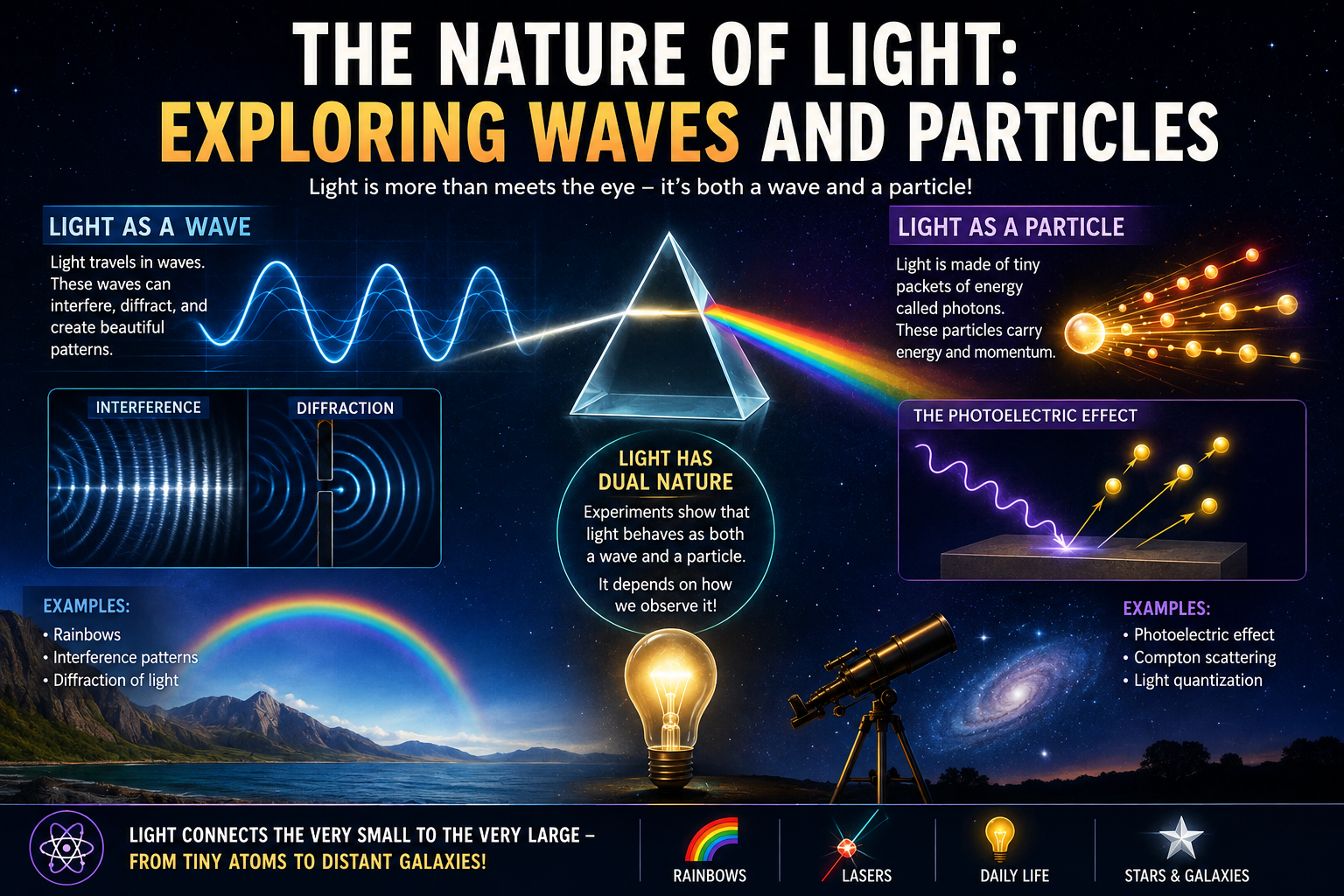
    The Nature of Light: Exploring Waves and Particles

    What exactly is light? Is it a wave, a particle, or somehow both?

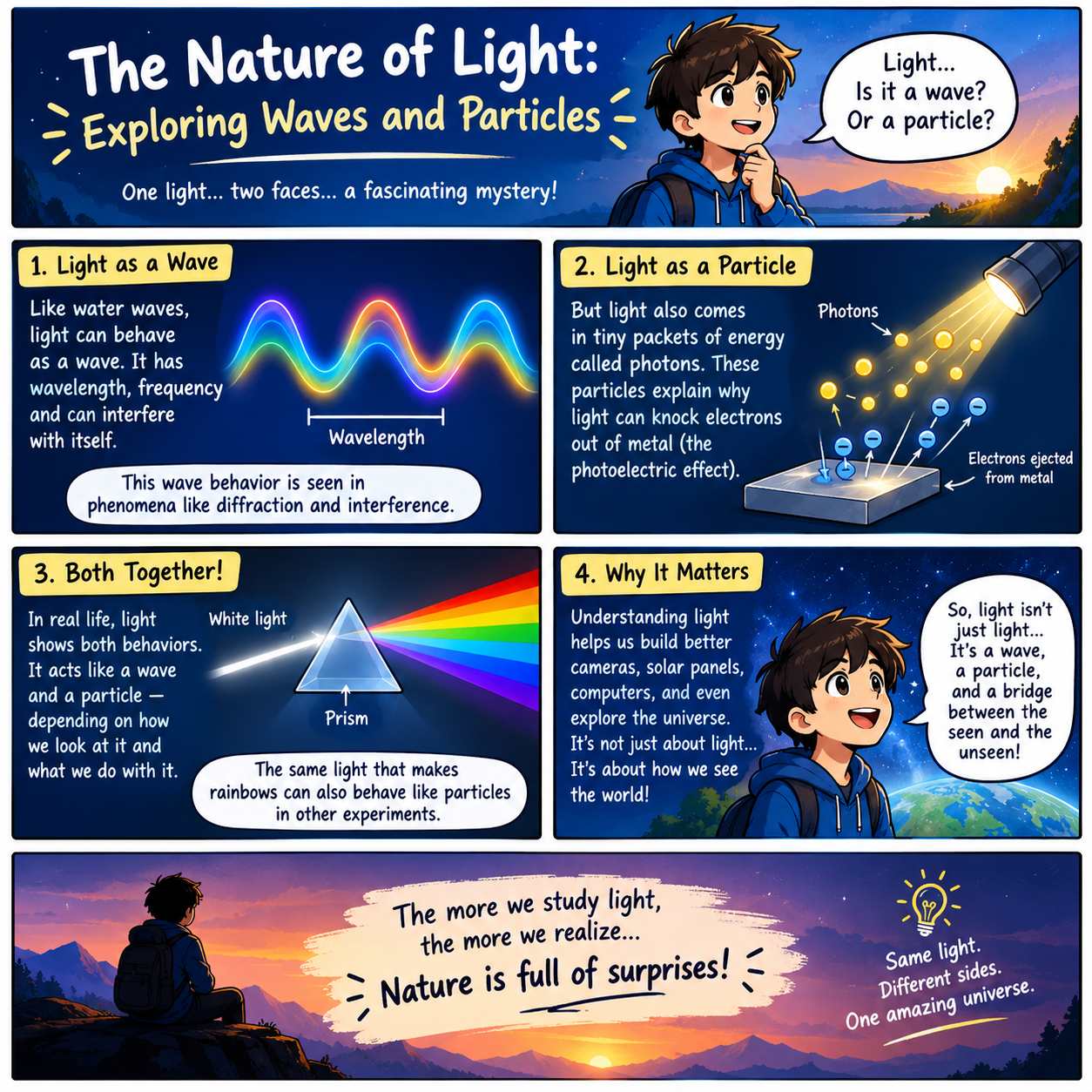
    In this colorful science comic, we explore the fascinating dual nature of light. Discover how light behaves like a wave through interference and diffraction, while also acting as tiny packets of energy called photons.

    From colorful rainbows to the photoelectric effect, this comic shows how understanding light helps us explore technology, science, and the universe around us.

    One light. Two behaviors. One amazing mystery!

    #NatureOfLight #Physics #ScienceComic #Light #WavesAndParticles #Photon #Science #PhysicsForStudents #EducationalComic #InstagramScience
    **Foundation Level** **Day 166** **story post** **Roll Number: 005** 🌟 The Nature of Light: Exploring Waves and Particles 🌈 What exactly is light? Is it a wave, a particle, or somehow both? 🔬✨ In this colorful science comic, we explore the fascinating dual nature of light. Discover how light behaves like a wave through interference and diffraction, while also acting as tiny packets of energy called photons. From colorful rainbows to the photoelectric effect, this comic shows how understanding light helps us explore technology, science, and the universe around us. 🌌💡 One light. Two behaviors. One amazing mystery! 🚀 #NatureOfLight #Physics #ScienceComic #Light #WavesAndParticles #Photon #Science #PhysicsForStudents #EducationalComic #InstagramScience
    0 Comments 0 Shares 1412 Views
  • #RSTA
    #Task : Story Post
    #Class: Foundation Level
    #Day No: 160
    #Made By Me

    Total Post:22


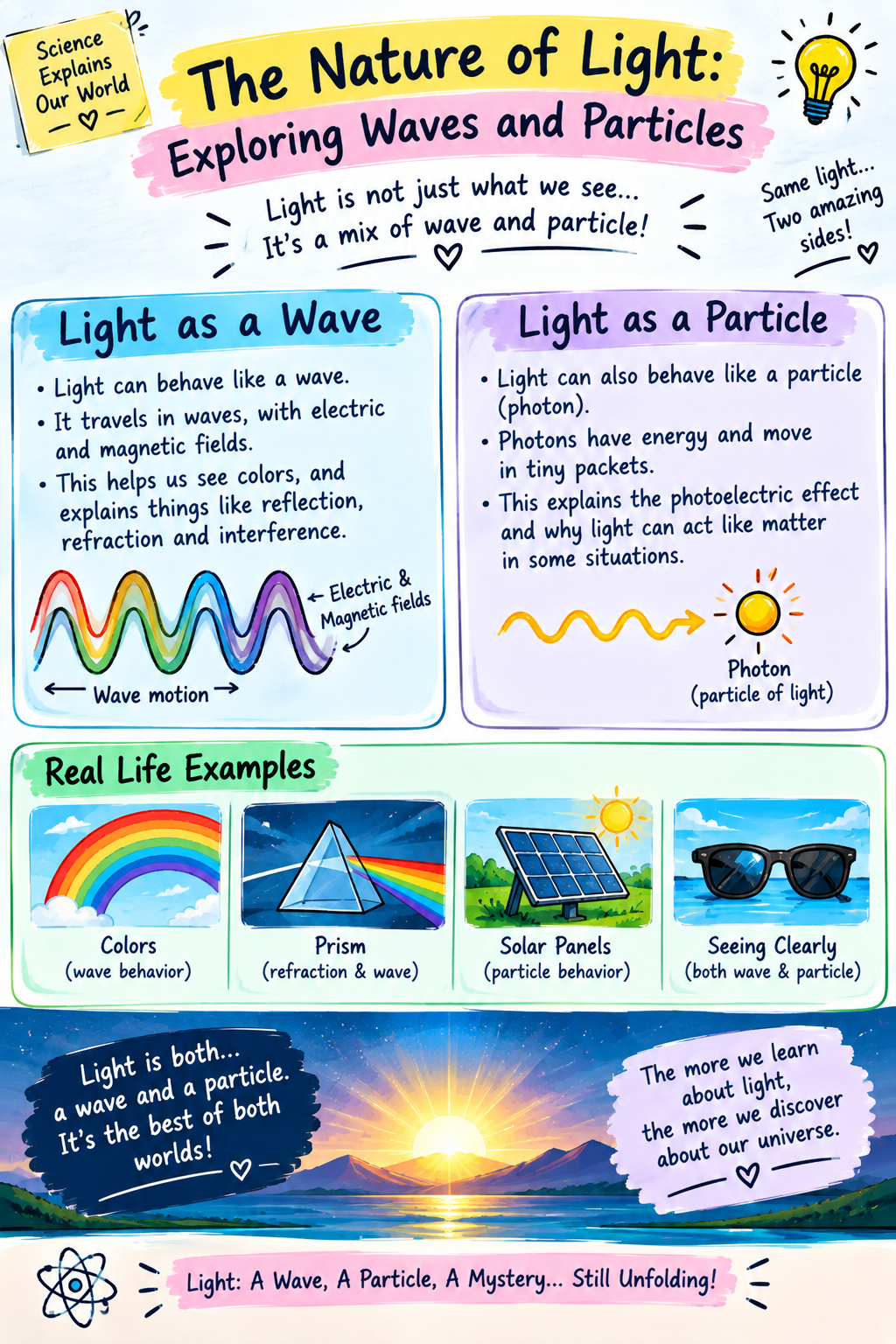
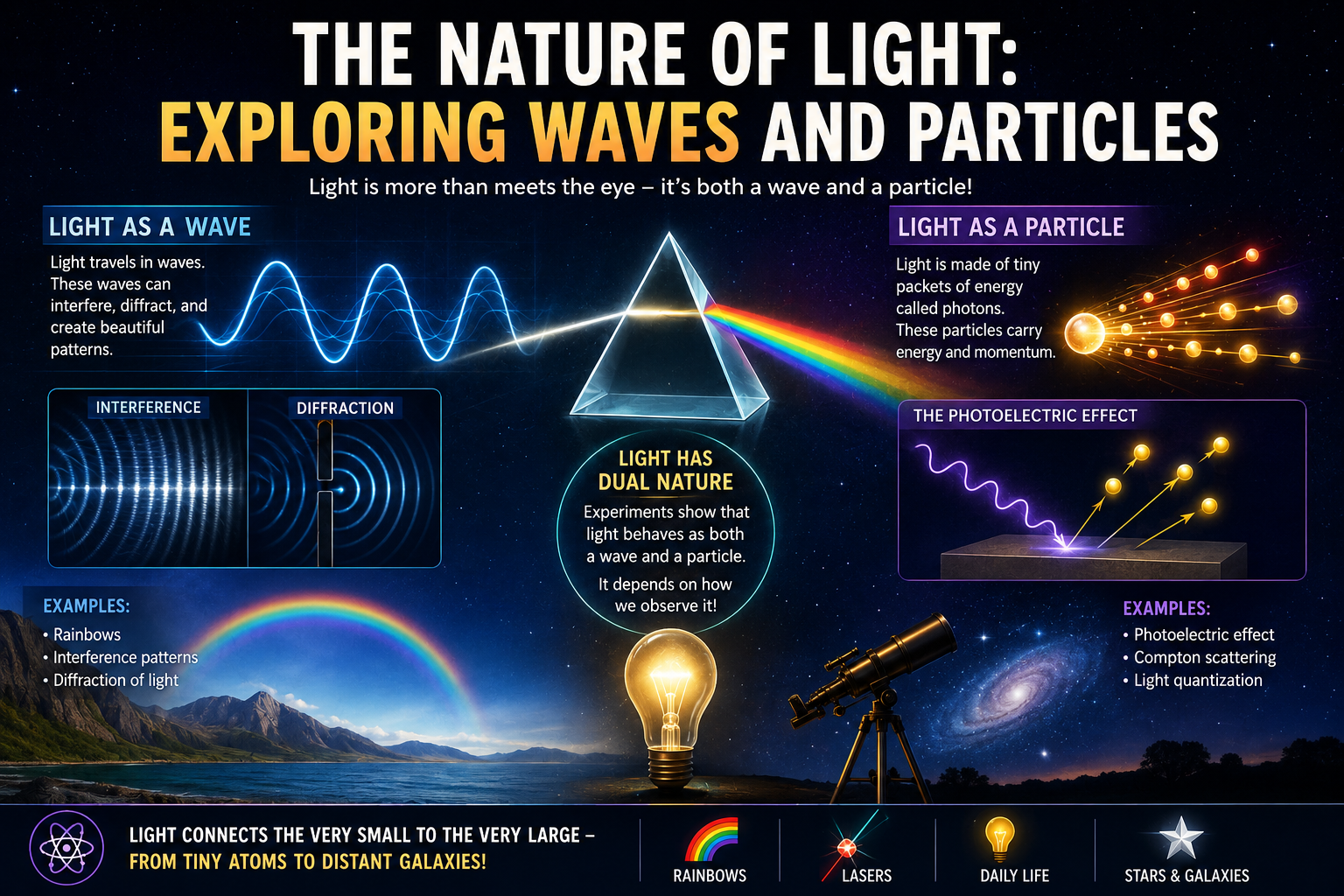
    Today, I completed my task on **the nature of light**. I learned that light can behave both like a **wave and a particle**. Its wave nature helps explain reflection, refraction, and colors, while its particle nature helps us understand photons and how light carries energy.

    This topic showed me how amazing and mysterious light is, and how science helps us understand the world around us.

    RSTA FoundationLevel NatureOfLight Light WavesAndParticles Physics Science Learning MadeByMe
    #RSTA #Task : Story Post #Class: Foundation Level #Day No: 160 #Made By Me Total Post:22 Today, I completed my task on **the nature of light**. I learned that light can behave both like a **wave and a particle**. Its wave nature helps explain reflection, refraction, and colors, while its particle nature helps us understand photons and how light carries energy. 🔬✨ This topic showed me how amazing and mysterious light is, and how science helps us understand the world around us. 🌍📚 RSTA FoundationLevel NatureOfLight Light WavesAndParticles Physics Science Learning MadeByMe
    0 Comments 0 Shares 545 Views
  • RSIF8
    Roll no 68
    Task no 158
    Task topic; The Nature of Light: Waves and Particles

    Light is one of the most fascinating parts of physics. It can behave like a **wave**, showing properties such as interference and diffraction, while also behaving like **particles called photons**. This amazing dual nature of light helps us understand everything from colors and lasers to modern technologies like solar panels and cameras.
    RSIF8 Roll no 68 Task no 158 Task topic; The Nature of Light: Waves and Particles 🌟🔬 Light is one of the most fascinating parts of physics. It can behave like a **wave**, showing properties such as interference and diffraction, while also behaving like **particles called photons**. This amazing dual nature of light helps us understand everything from colors and lasers to modern technologies like solar panels and cameras. 💡🌈
    0 Comments 0 Shares 656 Views
  • Fondation Level Batch No 4
    Roll RSLC #42
    Task No #160
    Day #160

    One evening, Ayan sat by his window watching the golden sunlight fill his room.
    He wondered how light traveled from the Sun across the vastness of space.
    The next day, he asked his science teacher about the true nature of light.
    His teacher explained that light is much more mysterious than it appears.
    Scientists discovered that light can behave both like waves and tiny particles.
    This fascinating property is called the wave-particle duality of light.
    Ayan became curious and wanted to discover how this was possible.
    He began an exciting journey into the hidden world of light.
    His teacher explained that light can behave like waves moving through space.
    Light shows reflection, refraction, diffraction, and interference in different situations.
    Reflection allows light to bounce from surfaces such as mirrors and shiny objects.
    Refraction causes light to change direction when it passes through different materials.
    Interference happens when light waves meet and interact with one another.
    These properties help explain rainbows, colors, reflections, and many other phenomena.
    Ayan realized that everyday sights could reveal important scientific secrets.
    He became even more fascinated by the mysterious behavior of light.
    Then Ayan learned that light can also behave like tiny particles called photons.
    Each photon carries energy and can interact with matter in different ways.
    This particle-like behavior helps scientists understand the photoelectric effect.
    Ayan found it amazing that light could appear as both a wave and a particle.
    His teacher explained that this strange behavior is a key idea in quantum physics.
    The quantum world does not always follow the rules we experience every day.
    Light became a perfect example of nature?s surprising complexity.
    Ayan realized that science often reveals things we cannot understand at first.
    That evening, Ayan looked at the sunlight outside with completely new eyes.
    He imagined photons traveling through space and waves carrying energy across the universe.
    He understood that something as ordinary as sunlight could hold incredible mysteries.
    The experience taught him that science is not only about learning known facts.
    It is also about asking questions and searching for answers beyond what we can see.
    Ayan felt inspired to explore more mysteries hidden throughout the universe.
    From that day forward, every beam of light reminded him of his discovery.
    He learned that even the simplest things can contain the greatest scientific wonders.


    #NatureOfLight #LightWaves #LightParticles #Photon #QuantumPhysics #ScienceExploration #PhysicsFacts
    Fondation Level Batch No 4 Roll RSLC #42 Task No #160 Day #160 One evening, Ayan sat by his window watching the golden sunlight fill his room. He wondered how light traveled from the Sun across the vastness of space. The next day, he asked his science teacher about the true nature of light. His teacher explained that light is much more mysterious than it appears. Scientists discovered that light can behave both like waves and tiny particles. This fascinating property is called the wave-particle duality of light. Ayan became curious and wanted to discover how this was possible. He began an exciting journey into the hidden world of light. His teacher explained that light can behave like waves moving through space. Light shows reflection, refraction, diffraction, and interference in different situations. Reflection allows light to bounce from surfaces such as mirrors and shiny objects. Refraction causes light to change direction when it passes through different materials. Interference happens when light waves meet and interact with one another. These properties help explain rainbows, colors, reflections, and many other phenomena. Ayan realized that everyday sights could reveal important scientific secrets. He became even more fascinated by the mysterious behavior of light. Then Ayan learned that light can also behave like tiny particles called photons. Each photon carries energy and can interact with matter in different ways. This particle-like behavior helps scientists understand the photoelectric effect. Ayan found it amazing that light could appear as both a wave and a particle. His teacher explained that this strange behavior is a key idea in quantum physics. The quantum world does not always follow the rules we experience every day. Light became a perfect example of nature?s surprising complexity. Ayan realized that science often reveals things we cannot understand at first. That evening, Ayan looked at the sunlight outside with completely new eyes. He imagined photons traveling through space and waves carrying energy across the universe. He understood that something as ordinary as sunlight could hold incredible mysteries. The experience taught him that science is not only about learning known facts. It is also about asking questions and searching for answers beyond what we can see. Ayan felt inspired to explore more mysteries hidden throughout the universe. From that day forward, every beam of light reminded him of his discovery. He learned that even the simplest things can contain the greatest scientific wonders. #NatureOfLight #LightWaves #LightParticles #Photon #QuantumPhysics #ScienceExploration #PhysicsFacts
    0 Comments 0 Shares 2695 Views
  • #rsisb
    Roll No.269
    Foundation Level
    Story Post No.25

    **The Nature of Light: Exploring Waves and Particles**

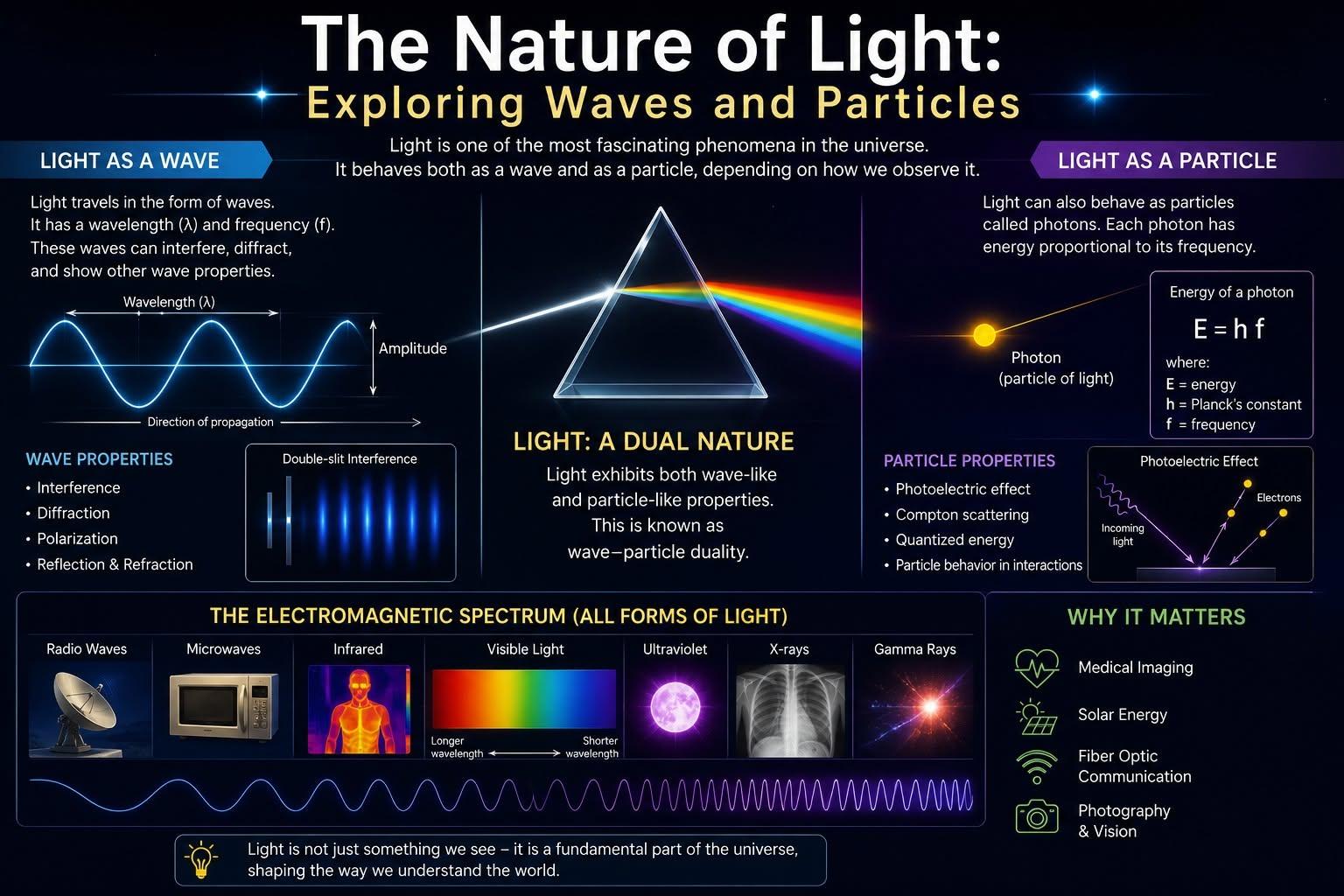
    Light is one of the most fascinating phenomena in the universe. We see it every day, but have you ever wondered what light really is and how it travels? In this video, we explore the amazing nature of light and discover how it can behave both as a **wave and as a particle**.

    We will learn about the wave properties of light, including reflection, refraction, interference, and diffraction. We will also explore the particle nature of light and understand how photons help explain the behavior of light at a microscopic level.

    The wave-particle duality of light is one of the most interesting ideas in modern physics. It shows us that nature can behave in ways that are very different from our everyday experiences.

    From sunlight and rainbows to lasers, cameras, and modern technology , light plays an important role in our daily lives and in scientific discoveries.

    Join us as we explore the fascinating world of **light, waves, particles, and quantum physics**. Keep learning, stay curious, and discover the science behind the light around us!

    #Light #Physics #LightWaves #WaveParticleDuality #Particles #Photons #QuantumPhysics #Optics #Science #PhysicsFacts #ScienceEducation #Learning #Reflection #Refraction #Interference #Diffraction #ElectromagneticWaves #ScientificDiscovery #Technology #SpaceScience #Knowledge #Curiosity #StudentLife #RehanSchool #LearnAndGrow
    #rsisb Roll No.269 Foundation Level Story Post No.25 💡 **The Nature of Light: Exploring Waves and Particles** 🌈🔬 Light is one of the most fascinating phenomena in the universe. 🌟 We see it every day, but have you ever wondered what light really is and how it travels? 🤔 In this video, we explore the amazing nature of light and discover how it can behave both as a **wave and as a particle**. We will learn about the wave properties of light, including reflection, refraction, interference, and diffraction. 🌊✨ We will also explore the particle nature of light and understand how photons help explain the behavior of light at a microscopic level. 🔬⚡ The wave-particle duality of light is one of the most interesting ideas in modern physics. It shows us that nature can behave in ways that are very different from our everyday experiences. 🌌🧠 From sunlight and rainbows 🌈 to lasers, cameras, and modern technology 📷💻, light plays an important role in our daily lives and in scientific discoveries. Join us as we explore the fascinating world of **light, waves, particles, and quantum physics**. Keep learning, stay curious, and discover the science behind the light around us! 🚀📚✨ #Light 💡 #Physics 🔬 #LightWaves 🌊 #WaveParticleDuality ⚛️ #Particles #Photons ⚡ #QuantumPhysics 🌌 #Optics 👓 #Science 📚 #PhysicsFacts 🧠 #ScienceEducation 🎓 #Learning 📖 #Reflection ✨ #Refraction 🌈 #Interference 🔬 #Diffraction 🌊 #ElectromagneticWaves ⚡ #ScientificDiscovery 🔍 #Technology 💻 #SpaceScience 🚀 #Knowledge 💡 #Curiosity 🤔 #StudentLife 🎓 #RehanSchool 🏫 #LearnAndGrow 🌱
    0 Comments 0 Shares 3319 Views
  • #rsisb
    Roll no.239
    Story post no.22
    Foundation Level

    Light is one of the most fascinating phenomena in the universe. It helps us see the world, carries energy from the Sun, and plays a vital role in modern technology.
    Scientists discovered that light has a **dual nature** — it behaves both like a **wave** and like a **particle**.
    As a **wave**, light can show phenomena such as **interference, diffraction, and polarization**. As a **particle**, light is made of tiny packets of energy called **photons**. The particle nature of light helps explain the **photoelectric effect**, where light can cause electrons to be released from certain materials.
    This wave-particle duality shows us that nature can be more complex than it first appears. Understanding light has helped humanity develop technologies such as **lasers, fiber-optic communication, cameras, solar panels, and medical imaging**.
    ### Key Takeaway
    **Light is neither simply a wave nor simply a particle—it exhibits properties of both, depending on how it is observed and measured.**
    #NatureOfLight #Physics #Science #Light #WaveParticleDuality #Photons #QuantumPhysics #STEM #ScienceExplained #Learning #Education
    #rsisb Roll no.239 Story post no.22 Foundation Level Light is one of the most fascinating phenomena in the universe. 🌟 It helps us see the world, carries energy from the Sun, and plays a vital role in modern technology. Scientists discovered that light has a **dual nature** — it behaves both like a **wave** and like a **particle**. 🌊⚛️ As a **wave**, light can show phenomena such as **interference, diffraction, and polarization**. As a **particle**, light is made of tiny packets of energy called **photons**. The particle nature of light helps explain the **photoelectric effect**, where light can cause electrons to be released from certain materials. This wave-particle duality shows us that nature can be more complex than it first appears. 🔬✨ Understanding light has helped humanity develop technologies such as **lasers, fiber-optic communication, cameras, solar panels, and medical imaging**. ### 🔑 Key Takeaway **Light is neither simply a wave nor simply a particle—it exhibits properties of both, depending on how it is observed and measured.** #NatureOfLight #Physics #Science #Light #WaveParticleDuality #Photons #QuantumPhysics #STEM #ScienceExplained #Learning #Education 🔬🌊⚛️
    0 Comments 0 Shares 2142 Views
  • #rsisb
    Roll no 248
    Foundation level
    story post no 17
    **The Nature of Light: Exploring Waves and Particles**

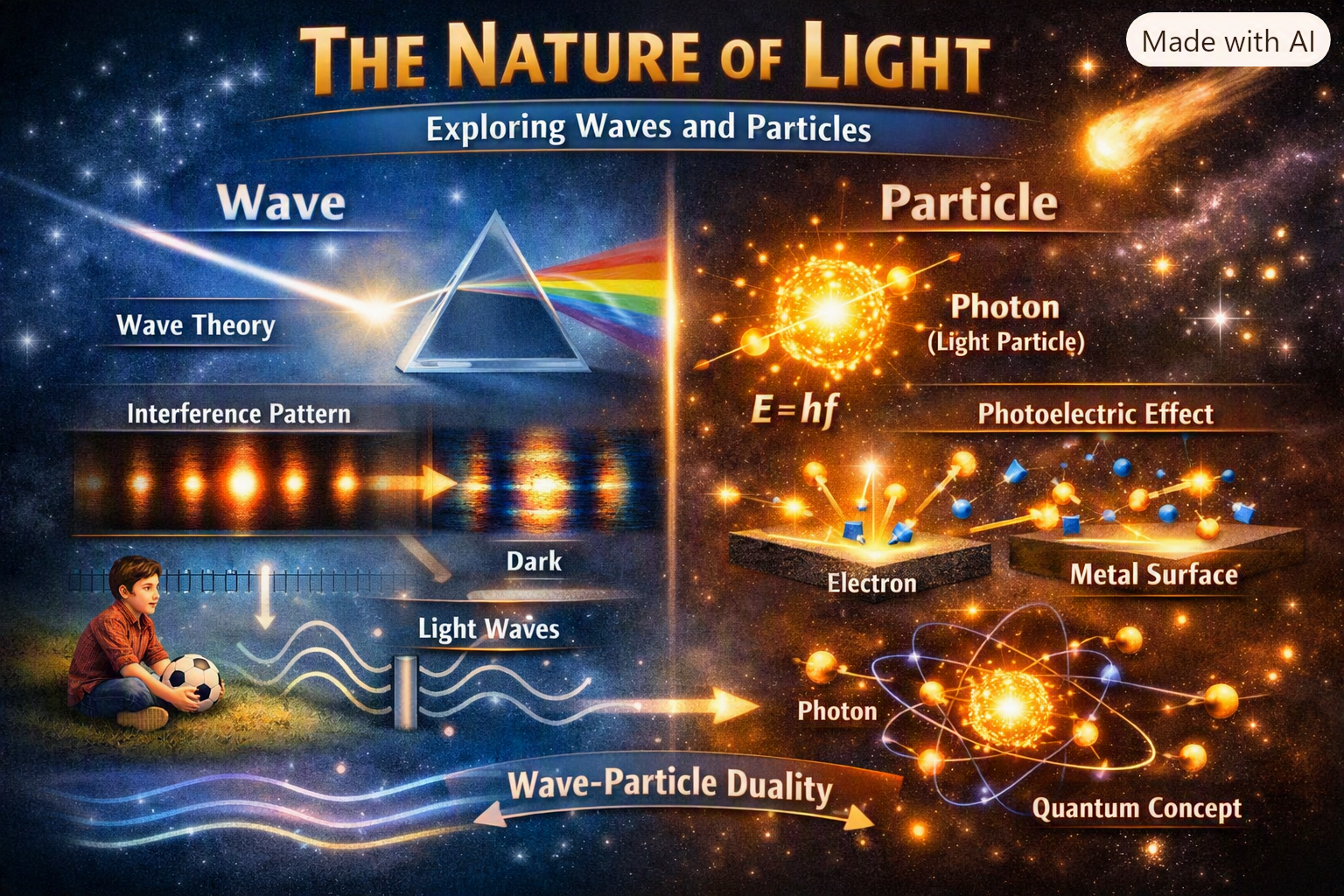
    What is light? Is it a wave, a particle, or both? Explore the fascinating world of light and discover how it can behave like a **wave** and like tiny packets of energy called **photons** . From colorful rainbows to lasers and the light from distant stars , light is everywhere around us!

    Join us on an exciting journey through physics and uncover the amazing science behind one of nature’s most mysterious phenomena.

    #NatureOfLight #Light #Physics #WavesAndParticles #Photon #Science #PhysicsFacts #STEM #ScienceLearning #Waves #Energy #Education #ExploreScience #AmazingScience
    #rsisb Roll no 248 Foundation level story post no 17 💡🌈 **The Nature of Light: Exploring Waves and Particles** 🔬✨ What is light? Is it a wave, a particle, or both? 🤔💫 Explore the fascinating world of light and discover how it can behave like a **wave** 🌊 and like tiny packets of energy called **photons** ⚛️. From colorful rainbows 🌈 to lasers 🔦 and the light from distant stars ⭐, light is everywhere around us! Join us on an exciting journey through physics and uncover the amazing science behind one of nature’s most mysterious phenomena. 🚀🔬📚 #NatureOfLight #Light #Physics #WavesAndParticles #Photon #Science #PhysicsFacts #STEM #ScienceLearning #Waves #Energy #Education #ExploreScience #AmazingScience 🌈💡🔬✨
    0 Comments 0 Shares 3543 Views
  • #rsisb
    Roll No.240
    Story No.15
    Foundation Level

    ### **The Nature of Light: Exploring Waves and Particles**

    Light is one of the most fascinating phenomena in the universe, playing a vital role in everything from vision and communication to modern technology and scientific discovery. Unlike ordinary objects, light exhibits a remarkable property known as **wave-particle duality**, meaning it behaves both as a wave and as a stream of tiny particles called **photons**. This unique characteristic has transformed our understanding of physics and the fundamental laws that govern the universe.

    As a wave, light travels through space in the form of electromagnetic waves, displaying properties such as reflection, refraction, interference, diffraction, and polarization. These wave behaviors explain everyday phenomena like rainbows, mirrors, lenses, and the colors we observe in nature. As particles, photons carry discrete amounts of energy, allowing light to interact with matter in ways that explain the photoelectric effect, lasers, and many modern technologies. Together, these two perspectives provide a complete understanding of how light behaves under different conditions.

    Exploring the nature of light helps us appreciate the incredible discoveries made by scientists such as Isaac Newton, Thomas Young, James Clerk Maxwell, Albert Einstein, and Max Planck. Their groundbreaking work laid the foundation for quantum mechanics, optics, telecommunications, medical imaging, fiber-optic communication, astronomy, and renewable energy technologies. From illuminating our homes to enabling space exploration, light continues to shape the modern world in extraordinary ways.

    **#NatureOfLight #Physics #Science #WaveParticleDuality #Light #Photons #ElectromagneticWaves #QuantumPhysics #Optics #STEM #Education #ScientificDiscovery #Technology #Learning #ExploreScience **

    Rehan School Islamabad Campus
    Asma Shaheen EducationWali
    Irum Asim
    Saima Happinesswali
    #rsisb Roll No.240 Story No.15 Foundation Level ### **The Nature of Light: Exploring Waves and Particles** Light is one of the most fascinating phenomena in the universe, playing a vital role in everything from vision and communication to modern technology and scientific discovery. Unlike ordinary objects, light exhibits a remarkable property known as **wave-particle duality**, meaning it behaves both as a wave and as a stream of tiny particles called **photons**. This unique characteristic has transformed our understanding of physics and the fundamental laws that govern the universe. As a wave, light travels through space in the form of electromagnetic waves, displaying properties such as reflection, refraction, interference, diffraction, and polarization. These wave behaviors explain everyday phenomena like rainbows, mirrors, lenses, and the colors we observe in nature. As particles, photons carry discrete amounts of energy, allowing light to interact with matter in ways that explain the photoelectric effect, lasers, and many modern technologies. Together, these two perspectives provide a complete understanding of how light behaves under different conditions. Exploring the nature of light helps us appreciate the incredible discoveries made by scientists such as Isaac Newton, Thomas Young, James Clerk Maxwell, Albert Einstein, and Max Planck. Their groundbreaking work laid the foundation for quantum mechanics, optics, telecommunications, medical imaging, fiber-optic communication, astronomy, and renewable energy technologies. From illuminating our homes to enabling space exploration, light continues to shape the modern world in extraordinary ways. **#NatureOfLight #Physics #Science #WaveParticleDuality #Light #Photons #ElectromagneticWaves #QuantumPhysics #Optics #STEM #Education #ScientificDiscovery #Technology #Learning #ExploreScience 🌈💡🔬⚛️📚** Rehan School Islamabad Campus Asma Shaheen EducationWali Irum Asim Saima Happinesswali
    0 Comments 0 Shares 7632 Views
  • Teleportation, as seen in science fiction, where a person or object instantly moves from one place to another, is not real in the physical sense. However, in the field of quantum mechanics, a form of teleportation called quantum teleportation has been successfully demonstrated in experiments.

    Quantum Teleportation:

    Quantum teleportation does not transfer matter itself but instead transfers quantum information from one particle to another, even if they are far apart. This process relies on a phenomenon called quantum entanglement, where two particles remain connected in such a way that changing the state of one instantly affects the other, regardless of distance.

    Successful Experiments:

    Scientists have successfully teleported quantum states of particles such as photons (light particles), atoms, and electrons over distances ranging from a few meters to hundreds of kilometers. For example:
    • In 1997, scientists at the University of Innsbruck, Austria, successfully teleported a quantum state of a photon.
    • In 2015, researchers teleported quantum information between atoms over a meter in a laboratory.
    • In 2017, China’s Micius satellite teleported photons from Earth to space over 1,200 km, the longest distance recorded.

    Can We Teleport Humans?

    Currently, teleporting humans or large objects is impossible because:
    1. Human Complexity: A human body consists of trillions of atoms, and transferring all quantum states accurately would require enormous computing power.
    2. Destruction and Reconstruction: Theoretically, teleportation would require breaking down a person’s atomic structure at one location and reassembling it at another, which raises ethical and technical challenges.
    3. Heisenberg’s Uncertainty Principle: This principle states that measuring the exact state of a particle disturbs it, making perfect reconstruction difficult.

    Conclusion:

    While quantum teleportation is real and has been successfully tested, physical teleportation of people or objects, like in movies, is still science fiction. However, future advancements in quantum mechanics and computing might open new possibilities.
    Teleportation, as seen in science fiction, where a person or object instantly moves from one place to another, is not real in the physical sense. However, in the field of quantum mechanics, a form of teleportation called quantum teleportation has been successfully demonstrated in experiments. Quantum Teleportation: Quantum teleportation does not transfer matter itself but instead transfers quantum information from one particle to another, even if they are far apart. This process relies on a phenomenon called quantum entanglement, where two particles remain connected in such a way that changing the state of one instantly affects the other, regardless of distance. Successful Experiments: Scientists have successfully teleported quantum states of particles such as photons (light particles), atoms, and electrons over distances ranging from a few meters to hundreds of kilometers. For example: • In 1997, scientists at the University of Innsbruck, Austria, successfully teleported a quantum state of a photon. • In 2015, researchers teleported quantum information between atoms over a meter in a laboratory. • In 2017, China’s Micius satellite teleported photons from Earth to space over 1,200 km, the longest distance recorded. Can We Teleport Humans? Currently, teleporting humans or large objects is impossible because: 1. Human Complexity: A human body consists of trillions of atoms, and transferring all quantum states accurately would require enormous computing power. 2. Destruction and Reconstruction: Theoretically, teleportation would require breaking down a person’s atomic structure at one location and reassembling it at another, which raises ethical and technical challenges. 3. Heisenberg’s Uncertainty Principle: This principle states that measuring the exact state of a particle disturbs it, making perfect reconstruction difficult. Conclusion: While quantum teleportation is real and has been successfully tested, physical teleportation of people or objects, like in movies, is still science fiction. However, future advancements in quantum mechanics and computing might open new possibilities.
    0 Comments 0 Shares 1876 Views
  • What is Physics? A Journey from Curiosity to Science

    Physics is the science of nature. It studies the laws that govern matter, energy, space, and time. From the falling of an apple to the motion of galaxies, from the spark of electricity to the mysteries of black holes, physics explains how the universe works.

    But physics did not appear fully formed. It has a long history, beginning with human curiosity thousands of years ago.

    ⸻

    1. The Birth of Wonder (Ancient Civilizations)

    The story of physics begins with the first humans who looked at the sky and asked:
    • Why do the stars move?
    • Why does the sun rise and set?
    • Why do objects fall down instead of up?

    Ancient Egyptians studied the stars to predict the Nile floods. Babylonians recorded planetary motion. The Chinese studied magnetism. In India, thinkers like Kanada spoke of atoms (anu). These were not yet “physics,” but they planted the seeds of scientific thinking.

    ⸻

    2. Greek Beginnings (6th century BCE – 4th century BCE)

    The Greeks were the first to ask systematic questions about nature.
    • Thales believed everything came from water.
    • Democritus imagined the universe was made of tiny, indivisible particles called “atoms.”
    • Aristotle (4th century BCE) wrote about motion, elements, and the heavens. Although many of his ideas were wrong, they shaped science for centuries.

    Greek physics was more philosophy than experiment, but it gave us the habit of searching for universal laws.

    ⸻

    3. The Age of Islamic Science (8th – 14th century CE)

    When Europe entered the Dark Ages, the Islamic world became the center of science.
    • Alhazen (Ibn al-Haytham) pioneered the scientific method and explained how vision works using light.
    • Al-Biruni measured Earth’s radius with surprising accuracy.
    • Avicenna (Ibn Sina) studied motion and inertia, anticipating Newton.

    These scholars translated Greek works, criticized them, and laid the foundations for modern physics.

    ⸻

    4. The Scientific Revolution (16th – 17th century)

    This was the true birth of modern physics.
    • Copernicus placed the sun, not Earth, at the center of the universe.
    • Galileo Galilei used experiments to study falling bodies and the motion of planets, overthrowing Aristotle’s ideas.
    • Isaac Newton (1687) united heaven and earth under the same laws of motion and gravity, creating classical mechanics.

    For the first time, the universe was seen as a giant machine governed by mathematical laws.

    ⸻

    5. The Age of Energy and Light (18th – 19th century)

    The Industrial Revolution brought new questions.
    • Thermodynamics (heat and engines) explained steam power.
    • Electromagnetism (Faraday, Maxwell) united electricity, magnetism, and light into one theory.
    • Scientists discovered atoms were made of smaller particles.

    Physics was no longer about stars alone—it powered machines, factories, and cities.

    ⸻

    6. The 20th Century: Revolution Upon Revolution

    The 1900s brought the most radical changes:
    • Einstein’s Relativity (1905–1915) showed that time and space are not fixed but bend with motion and gravity.
    • Quantum Mechanics (Planck, Bohr, Heisenberg, Schrödinger) revealed the strange rules of the atomic world—where particles can exist in two places at once.
    • Nuclear Physics led to both energy (nuclear power) and destruction (atomic bombs).
    • Cosmology revealed that the universe is expanding from a Big Bang.

    Physics became the science not only of the very large (cosmos) but also of the very small (quarks, photons, neutrinos).

    ⸻

    7. The Present and the Future

    Today, physics continues to ask questions:
    • What is dark matter and dark energy (95% of the universe)?
    • How do we unify relativity and quantum mechanics into a “theory of everything”?
    • Can we control fusion energy like the sun?
    • Is the universe infinite or part of a multiverse?

    With AI tools like ChatGPT, physicists can now analyze mountains of data, generate new hypotheses, and even simulate universes, accelerating discovery beyond what was ever possible before.

    ⸻

    Conclusion

    Physics began as simple curiosity—watching the stars, asking why things fall, wondering about light. Over thousands of years, it has grown into a science that explains the structure of the universe and powers modern life.

    From Aristotle to Newton, from Einstein to today’s AI-powered research, the journey of physics shows one truth: every mystery of nature is an invitation to discover a new law.

    And perhaps the next great leap in physics—the Physics of Consciousness, the Physics of Abundance, or the Physics of AI-Human Symbiosis—will begin with us.

    What is Physics? A Journey from Curiosity to Science Physics is the science of nature. It studies the laws that govern matter, energy, space, and time. From the falling of an apple to the motion of galaxies, from the spark of electricity to the mysteries of black holes, physics explains how the universe works. But physics did not appear fully formed. It has a long history, beginning with human curiosity thousands of years ago. ⸻ 1. The Birth of Wonder (Ancient Civilizations) The story of physics begins with the first humans who looked at the sky and asked: • Why do the stars move? • Why does the sun rise and set? • Why do objects fall down instead of up? Ancient Egyptians studied the stars to predict the Nile floods. Babylonians recorded planetary motion. The Chinese studied magnetism. In India, thinkers like Kanada spoke of atoms (anu). These were not yet “physics,” but they planted the seeds of scientific thinking. ⸻ 2. Greek Beginnings (6th century BCE – 4th century BCE) The Greeks were the first to ask systematic questions about nature. • Thales believed everything came from water. • Democritus imagined the universe was made of tiny, indivisible particles called “atoms.” • Aristotle (4th century BCE) wrote about motion, elements, and the heavens. Although many of his ideas were wrong, they shaped science for centuries. Greek physics was more philosophy than experiment, but it gave us the habit of searching for universal laws. ⸻ 3. The Age of Islamic Science (8th – 14th century CE) When Europe entered the Dark Ages, the Islamic world became the center of science. • Alhazen (Ibn al-Haytham) pioneered the scientific method and explained how vision works using light. • Al-Biruni measured Earth’s radius with surprising accuracy. • Avicenna (Ibn Sina) studied motion and inertia, anticipating Newton. These scholars translated Greek works, criticized them, and laid the foundations for modern physics. ⸻ 4. The Scientific Revolution (16th – 17th century) This was the true birth of modern physics. • Copernicus placed the sun, not Earth, at the center of the universe. • Galileo Galilei used experiments to study falling bodies and the motion of planets, overthrowing Aristotle’s ideas. • Isaac Newton (1687) united heaven and earth under the same laws of motion and gravity, creating classical mechanics. For the first time, the universe was seen as a giant machine governed by mathematical laws. ⸻ 5. The Age of Energy and Light (18th – 19th century) The Industrial Revolution brought new questions. • Thermodynamics (heat and engines) explained steam power. • Electromagnetism (Faraday, Maxwell) united electricity, magnetism, and light into one theory. • Scientists discovered atoms were made of smaller particles. Physics was no longer about stars alone—it powered machines, factories, and cities. ⸻ 6. The 20th Century: Revolution Upon Revolution The 1900s brought the most radical changes: • Einstein’s Relativity (1905–1915) showed that time and space are not fixed but bend with motion and gravity. • Quantum Mechanics (Planck, Bohr, Heisenberg, Schrödinger) revealed the strange rules of the atomic world—where particles can exist in two places at once. • Nuclear Physics led to both energy (nuclear power) and destruction (atomic bombs). • Cosmology revealed that the universe is expanding from a Big Bang. Physics became the science not only of the very large (cosmos) but also of the very small (quarks, photons, neutrinos). ⸻ 7. The Present and the Future Today, physics continues to ask questions: • What is dark matter and dark energy (95% of the universe)? • How do we unify relativity and quantum mechanics into a “theory of everything”? • Can we control fusion energy like the sun? • Is the universe infinite or part of a multiverse? With AI tools like ChatGPT, physicists can now analyze mountains of data, generate new hypotheses, and even simulate universes, accelerating discovery beyond what was ever possible before. ⸻ Conclusion Physics began as simple curiosity—watching the stars, asking why things fall, wondering about light. Over thousands of years, it has grown into a science that explains the structure of the universe and powers modern life. From Aristotle to Newton, from Einstein to today’s AI-powered research, the journey of physics shows one truth: every mystery of nature is an invitation to discover a new law. And perhaps the next great leap in physics—the Physics of Consciousness, the Physics of Abundance, or the Physics of AI-Human Symbiosis—will begin with us.

    0 Comments 0 Shares 2636 Views
More Results