• ACCL TASK:160
    Day:160
    foundation level
    **The Nature of Light: Exploring Waves and Particles**
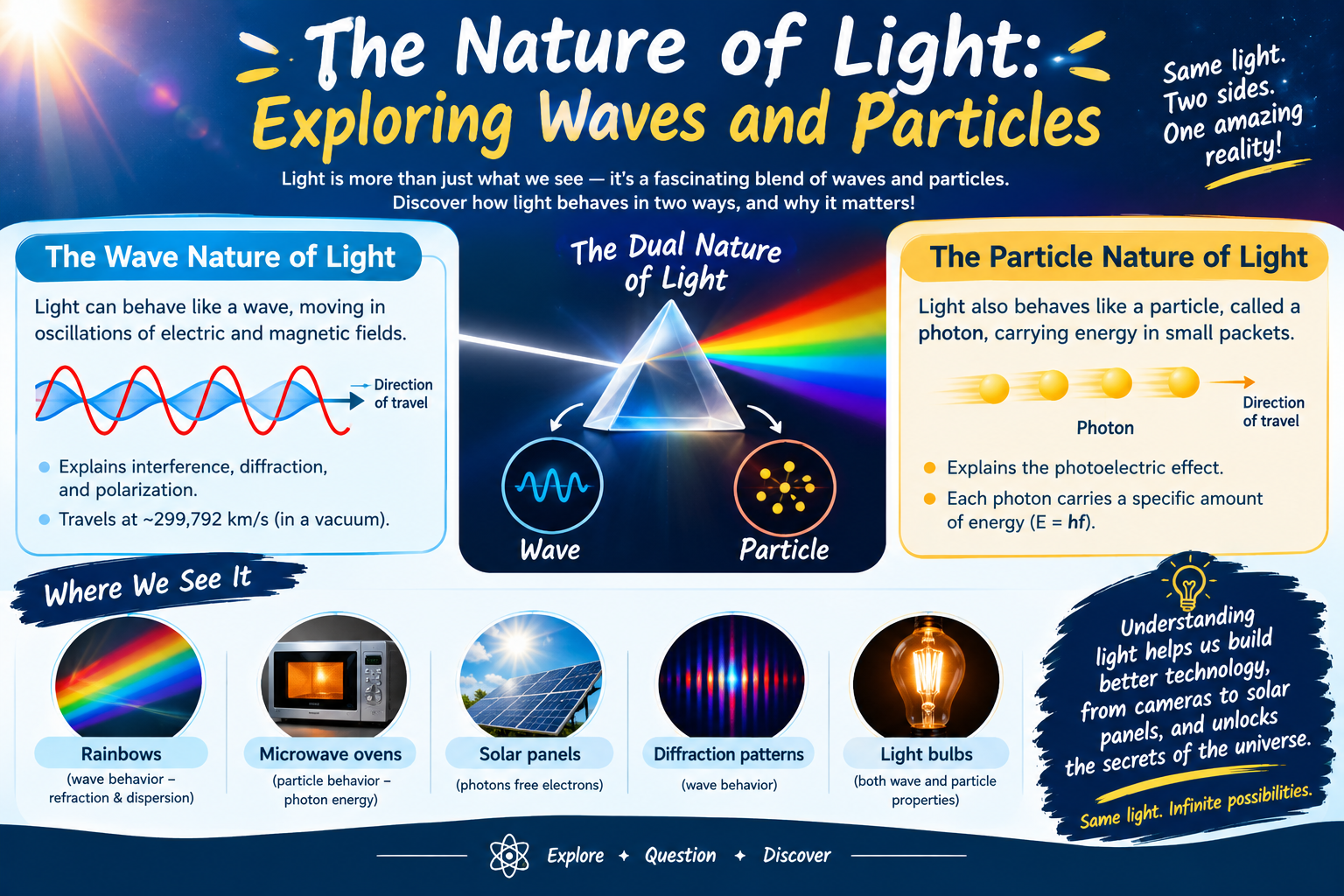
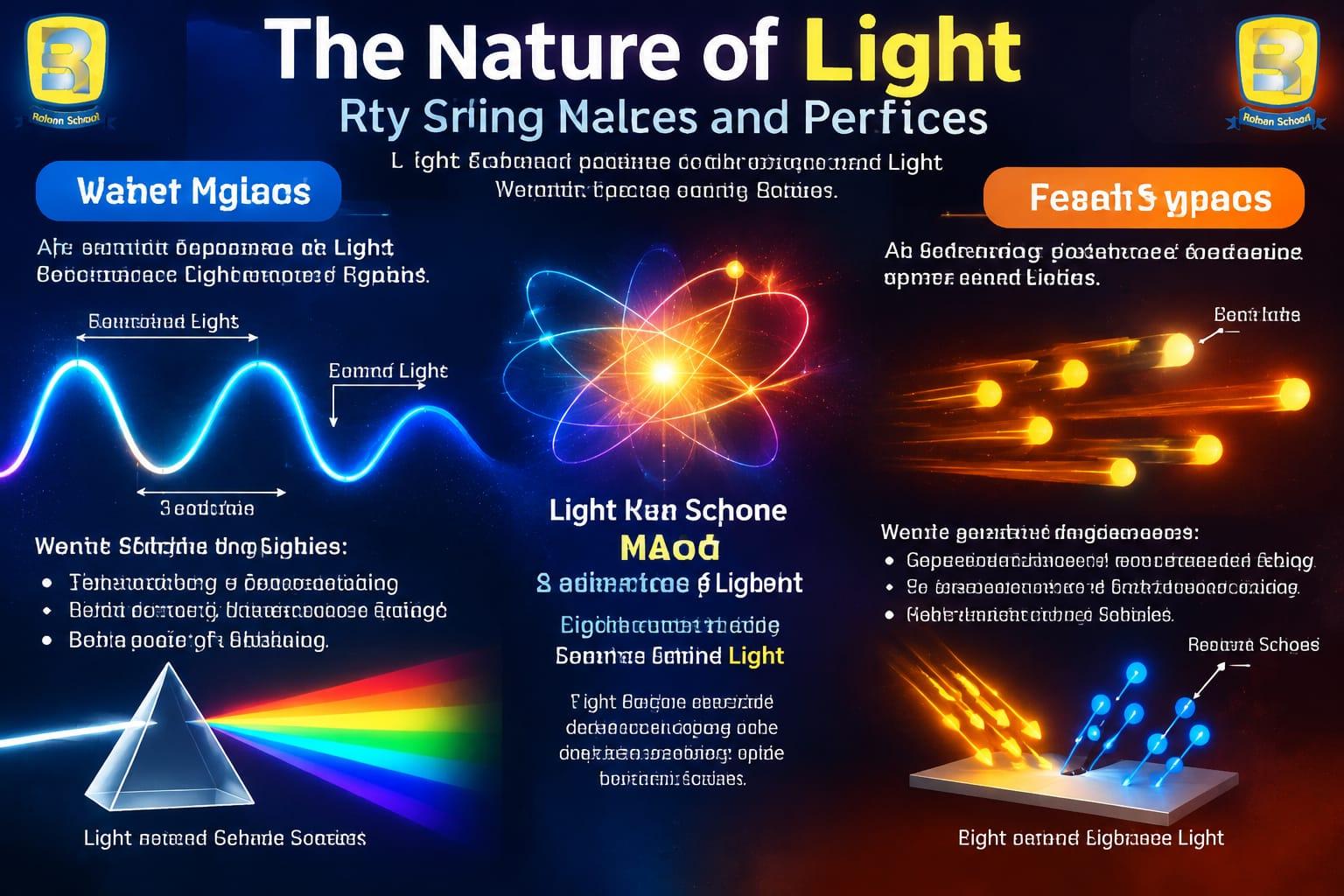
    Light is one of the most fascinating phenomena in physics. It can behave like a **wave**, showing interference, diffraction, and polarization, while also behaving like **particles called photons** that carry energy.
    From rainbows and solar panels to cameras and modern technology, understanding light helps us explore the world and the universe around us.
    #NatureOfLight #Physics #ScienceEducation #WaveParticleDuality #Photon #Learning #RehanSchool
    ACCL TASK:160 Day:160 foundation level **The Nature of Light: Exploring Waves and Particles** πŸŒˆπŸ”¬πŸ’‘ Light is one of the most fascinating phenomena in physics. It can behave like a **wave**, showing interference, diffraction, and polarization, while also behaving like **particles called photons** that carry energy. From rainbows and solar panels to cameras and modern technology, understanding light helps us explore the world and the universe around us. 🌌✨ #NatureOfLight #Physics #ScienceEducation #WaveParticleDuality #Photon #Learning #RehanSchool
    0 Commenti 0 condivisioni 683 Views
  • **Roll No: 2**
    **Batch: 14**
    **Book: ACCL**
    **Task No: 160**

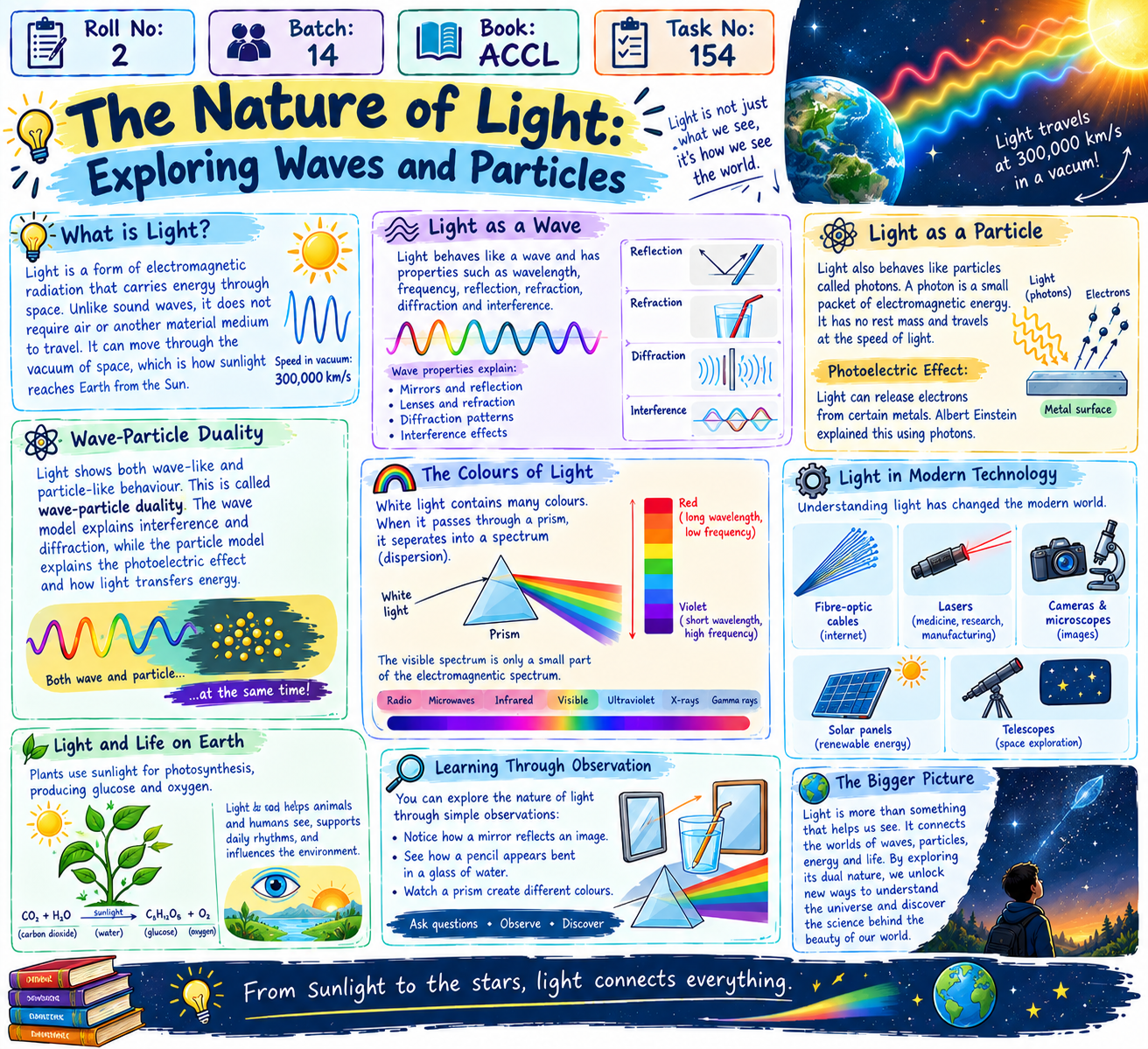
    # The Nature of Light: Exploring Waves and Particles

    Have you ever wondered how we see the colorful world around us? From the bright sunshine in the morning to the glowing stars at night, light plays an essential role in our lives. It allows us to see objects, helps plants grow, and makes many modern technologies possible. But what exactly is light? Is it a wave, a particle, or something even more fascinating?

    **Light is a form of electromagnetic radiation that carries energy through space.** Unlike sound waves, light does not require air or another material medium to travel. It can move through the vacuum of space, which is how sunlight reaches Earth from the Sun. In a vacuum, light travels at approximately 300,000 kilometres per second, making it one of the fastest phenomena in nature.

    ## Light as a Wave

    For many years, scientists studied light and discovered that it behaves like a wave. Light waves have properties such as wavelength, frequency, reflection, refraction, diffraction, and interference. These properties help explain many everyday optical phenomena.

    **Reflection** occurs when light bounces off a surface. A mirror is a familiar example because it reflects light and allows us to see our image. **Refraction** happens when light changes direction as it passes from one transparent material into another, such as from air into water. This is why a straw placed in a glass of water may appear bent.

    Light can also spread out through a process called diffraction and produce patterns through interference. These wave properties provide important evidence of the wave nature of light. Scientists use them to understand lenses, microscopes, telescopes, and many other optical instruments.

    ## Light as a Particle

    Light also behaves in ways that can be explained by particles called **photons**. A photon is a small packet, or quantum, of electromagnetic energy. Photons have no rest mass and travel at the speed of light in a vacuum.

    One important discovery was the photoelectric effect. Scientists observed that when light of a suitable frequency shines on certain metals, it can cause electrons to be released. Albert Einstein explained this phenomenon by showing that light transfers energy in individual packets called photons. This discovery helped establish the foundation of quantum physics.

    The particle model explains how light interacts with matter in processes such as the photoelectric effect and the absorption and emission of energy by atoms.

    ## Wave-Particle Duality

    One of the most fascinating discoveries in physics is that light shows both wave-like and particle-like behaviour. This idea is known as **wave-particle duality**.

    Light does not behave like an ordinary water wave or a tiny solid ball. Instead, its behaviour depends on the type of experiment and how it interacts with matter. The wave description helps explain interference and diffraction, while the photon description explains how light transfers energy in individual amounts.

    This discovery changed the way scientists understand the universe and became an important part of quantum mechanics.

    ## The Colours of Light

    White light may look simple, but it contains many different colours. When white light passes through a glass prism, it separates into a spectrum of colours: red, orange, yellow, green, blue, indigo, and violet. This process is called **dispersion**.

    Each colour has a different wavelength and frequency. Red light has a longer wavelength than violet light, while violet light has a higher frequency. The visible spectrum is only a small part of the electromagnetic spectrum, which also includes radio waves, microwaves, infrared radiation, ultraviolet radiation, X-rays, and gamma rays.

    ## Light in Modern Technology

    The study of light has transformed the modern world. Fibre-optic cables use light to transmit information over long distances, supporting internet communication and global connectivity. Lasers are used in medical equipment, scientific research, manufacturing, and barcode scanners.

    Cameras and microscopes use lenses to control light and produce images. Solar panels convert energy from sunlight into electrical energy, while telescopes help scientists observe distant stars and galaxies. These technologies demonstrate how understanding light can improve everyday life and expand human knowledge.

    ## Light and Life on Earth

    Light is essential for many living organisms. Green plants use sunlight during photosynthesis to produce glucose from water and carbon dioxide, releasing oxygen as a by-product. This process supports food chains and helps maintain the balance of gases in Earth's atmosphere.

    Light also helps animals and humans understand their surroundings through vision. Many organisms use natural light patterns to regulate daily activities, while sunlight influences environmental conditions and the rhythms of life.

    ## Learning Through Observation

    You can explore the nature of light through simple observations. Notice how a mirror reflects an image, how a pencil appears bent in a glass of water, or how sunlight passing through a prism produces different colours. These examples connect scientific ideas with experiences from everyday life.

    By asking questions, making observations, and studying experiments, we can understand how light behaves and why it is so important in science.

    **Light is more than something that helps us see; it is a fascinating phenomenon that connects the worlds of waves, particles, energy, and life. By exploring its dual nature, we unlock new ways to understand the universe and discover the science behind the beauty of our world. **

    \#NatureOfLight #WavesAndParticles #Physics #QuantumPhysics #ElectromagneticWaves #Science #ACCL #Batch14 #Task154
    **Roll No: 2** **Batch: 14** **Book: ACCL** **Task No: 160** # πŸŒˆπŸ’‘ The Nature of Light: Exploring Waves and Particles πŸ”¬πŸŒŠ Have you ever wondered how we see the colorful world around us? 🌍 From the bright sunshine in the morning to the glowing stars at night, light plays an essential role in our lives. It allows us to see objects, helps plants grow, and makes many modern technologies possible. But what exactly is light? Is it a wave, a particle, or something even more fascinating? ✨ **Light is a form of electromagnetic radiation that carries energy through space.** Unlike sound waves, light does not require air or another material medium to travel. It can move through the vacuum of space, which is how sunlight reaches Earth from the Sun. In a vacuum, light travels at approximately 300,000 kilometres per second, making it one of the fastest phenomena in nature. β˜€οΈπŸš€ ## 🌊 Light as a Wave For many years, scientists studied light and discovered that it behaves like a wave. Light waves have properties such as wavelength, frequency, reflection, refraction, diffraction, and interference. These properties help explain many everyday optical phenomena. 🌈 **Reflection** occurs when light bounces off a surface. A mirror is a familiar example because it reflects light and allows us to see our image. **Refraction** happens when light changes direction as it passes from one transparent material into another, such as from air into water. This is why a straw placed in a glass of water may appear bent. πŸͺžπŸ’§ Light can also spread out through a process called diffraction and produce patterns through interference. These wave properties provide important evidence of the wave nature of light. Scientists use them to understand lenses, microscopes, telescopes, and many other optical instruments. πŸ”­πŸ”¬ ## βš›οΈ Light as a Particle Light also behaves in ways that can be explained by particles called **photons**. A photon is a small packet, or quantum, of electromagnetic energy. Photons have no rest mass and travel at the speed of light in a vacuum. ⚑ One important discovery was the photoelectric effect. Scientists observed that when light of a suitable frequency shines on certain metals, it can cause electrons to be released. Albert Einstein explained this phenomenon by showing that light transfers energy in individual packets called photons. This discovery helped establish the foundation of quantum physics. πŸ§ͺ The particle model explains how light interacts with matter in processes such as the photoelectric effect and the absorption and emission of energy by atoms. ## πŸ”¬ Wave-Particle Duality One of the most fascinating discoveries in physics is that light shows both wave-like and particle-like behaviour. This idea is known as **wave-particle duality**. 🌌 Light does not behave like an ordinary water wave or a tiny solid ball. Instead, its behaviour depends on the type of experiment and how it interacts with matter. The wave description helps explain interference and diffraction, while the photon description explains how light transfers energy in individual amounts. This discovery changed the way scientists understand the universe and became an important part of quantum mechanics. ## 🌈 The Colours of Light White light may look simple, but it contains many different colours. When white light passes through a glass prism, it separates into a spectrum of colours: red, orange, yellow, green, blue, indigo, and violet. This process is called **dispersion**. 🌈 Each colour has a different wavelength and frequency. Red light has a longer wavelength than violet light, while violet light has a higher frequency. The visible spectrum is only a small part of the electromagnetic spectrum, which also includes radio waves, microwaves, infrared radiation, ultraviolet radiation, X-rays, and gamma rays. ## πŸ“‘ Light in Modern Technology The study of light has transformed the modern world. Fibre-optic cables use light to transmit information over long distances, supporting internet communication and global connectivity. πŸ’»πŸŒ Lasers are used in medical equipment, scientific research, manufacturing, and barcode scanners. Cameras and microscopes use lenses to control light and produce images. Solar panels convert energy from sunlight into electrical energy, while telescopes help scientists observe distant stars and galaxies. These technologies demonstrate how understanding light can improve everyday life and expand human knowledge. πŸ”­πŸ”‹ ## 🌱 Light and Life on Earth Light is essential for many living organisms. Green plants use sunlight during photosynthesis to produce glucose from water and carbon dioxide, releasing oxygen as a by-product. This process supports food chains and helps maintain the balance of gases in Earth's atmosphere. πŸŒΏβ˜€οΈ Light also helps animals and humans understand their surroundings through vision. Many organisms use natural light patterns to regulate daily activities, while sunlight influences environmental conditions and the rhythms of life. ## 🧠 Learning Through Observation You can explore the nature of light through simple observations. Notice how a mirror reflects an image, how a pencil appears bent in a glass of water, or how sunlight passing through a prism produces different colours. These examples connect scientific ideas with experiences from everyday life. πŸ”πŸ“š By asking questions, making observations, and studying experiments, we can understand how light behaves and why it is so important in science. **Light is more than something that helps us see; it is a fascinating phenomenon that connects the worlds of waves, particles, energy, and life. By exploring its dual nature, we unlock new ways to understand the universe and discover the science behind the beauty of our world. πŸŒˆπŸ’‘πŸŒ** \#NatureOfLight #WavesAndParticles #Physics #QuantumPhysics #ElectromagneticWaves #Science #ACCL #Batch14 #Task154 πŸŒˆπŸ”¬βœ¨
    0 Commenti 0 condivisioni 3585 Views
  • **Story Post | Day 160**
    **Foundation Level**
    **Roll No: 01**
    **Rehan School | Urdu Bazar Campus**

    **The Nature of Light: Exploring Waves and Particles**

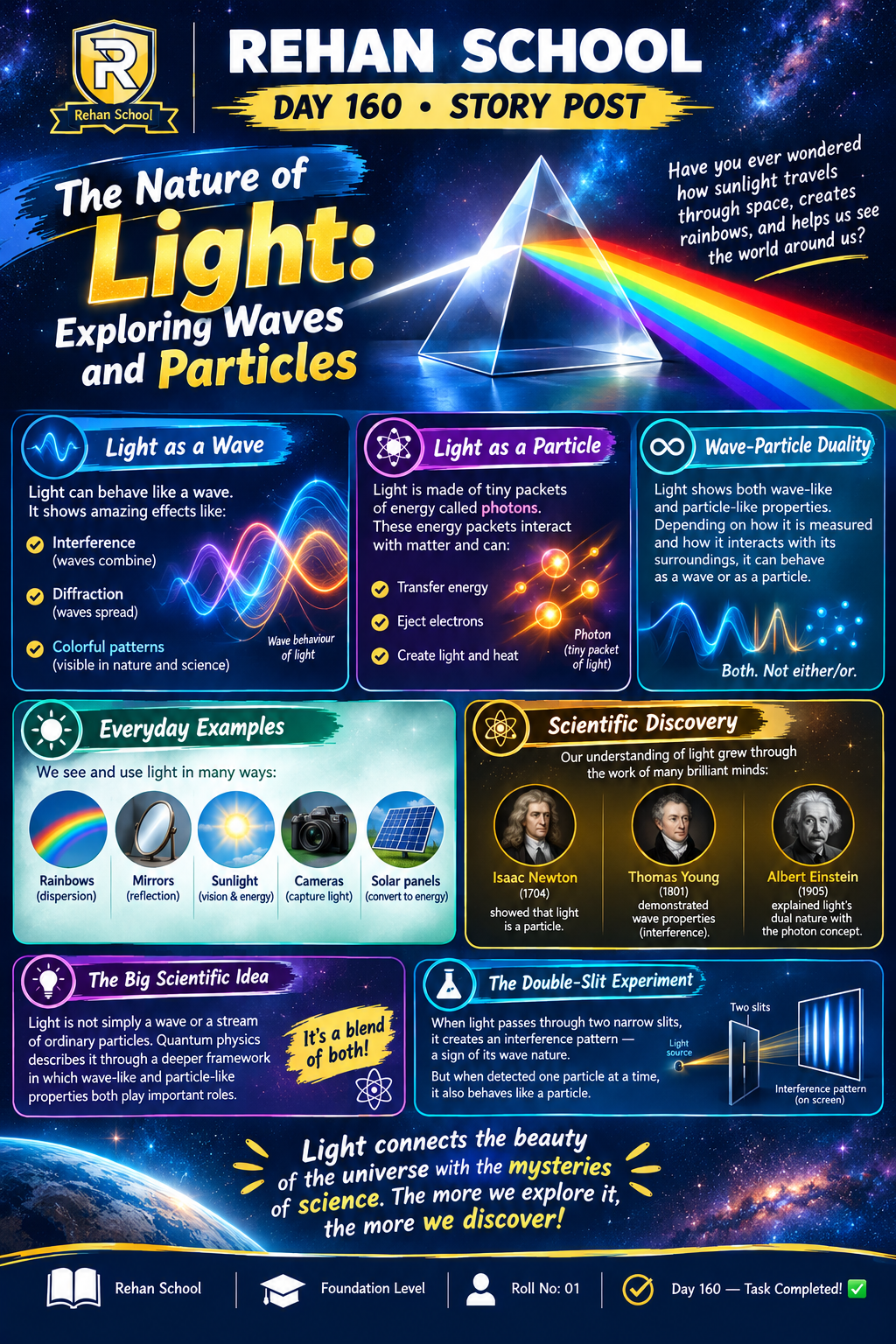
    Light is one of the most fascinating wonders of science! Through this task, I learned how light behaves like both a wave and a particle, and how photons help us understand its amazing properties.

    From colorful rainbows and reflections to cameras and solar panels, light plays an important role in our everyday lives. The discoveries of Isaac Newton, Thomas Young, and Albert Einstein helped us understand light in new and exciting ways.

    **Learning about light reminds us that curiosity and scientific exploration can reveal the hidden wonders of our universe!**

    **Rehan School | Day 160 — Task Completed! **

    #RehanSchool #UrduBazarCampus #Day160 #StoryPost #FoundationLevel #RollNo01 #Physics #NatureOfLight #ScienceEducation #KeepLearning
    πŸ“– **Story Post | Day 160** πŸ“š **Foundation Level** πŸ”’ **Roll No: 01** 🏫 **Rehan School | Urdu Bazar Campus** 🌈 **The Nature of Light: Exploring Waves and Particles** Light is one of the most fascinating wonders of science! ✨ Through this task, I learned how light behaves like both a wave and a particle, and how photons help us understand its amazing properties. πŸ”¬ From colorful rainbows and reflections to cameras and solar panels, light plays an important role in our everyday lives. The discoveries of Isaac Newton, Thomas Young, and Albert Einstein helped us understand light in new and exciting ways. 🌌 πŸ’‘ **Learning about light reminds us that curiosity and scientific exploration can reveal the hidden wonders of our universe!** πŸŽ“ **Rehan School | Day 160 — Task Completed! βœ…** #RehanSchool #UrduBazarCampus #Day160 #StoryPost #FoundationLevel #RollNo01 #Physics #NatureOfLight #ScienceEducation #KeepLearning
    0 Commenti 0 condivisioni 2443 Views
  • RSIF8
    Roll no:14
    story no:24
    story topic:The Nature of Light: Exploring Waves and Particles

    **The Nature of Light: Exploring Waves and Particles**

    Have you ever wondered what light really is? How does sunlight travel across millions of kilometers through space, how do rainbows form, and how can light behave like both a wave and a particle? The nature of light is one of the most fascinating topics in physics, revealing the extraordinary connection between the visible world and the mysterious laws of quantum mechanics. From the light that illuminates our homes to the distant stars shining in the universe, light plays an essential role in understanding the world around us.

    **1. The Wave Nature of Light **

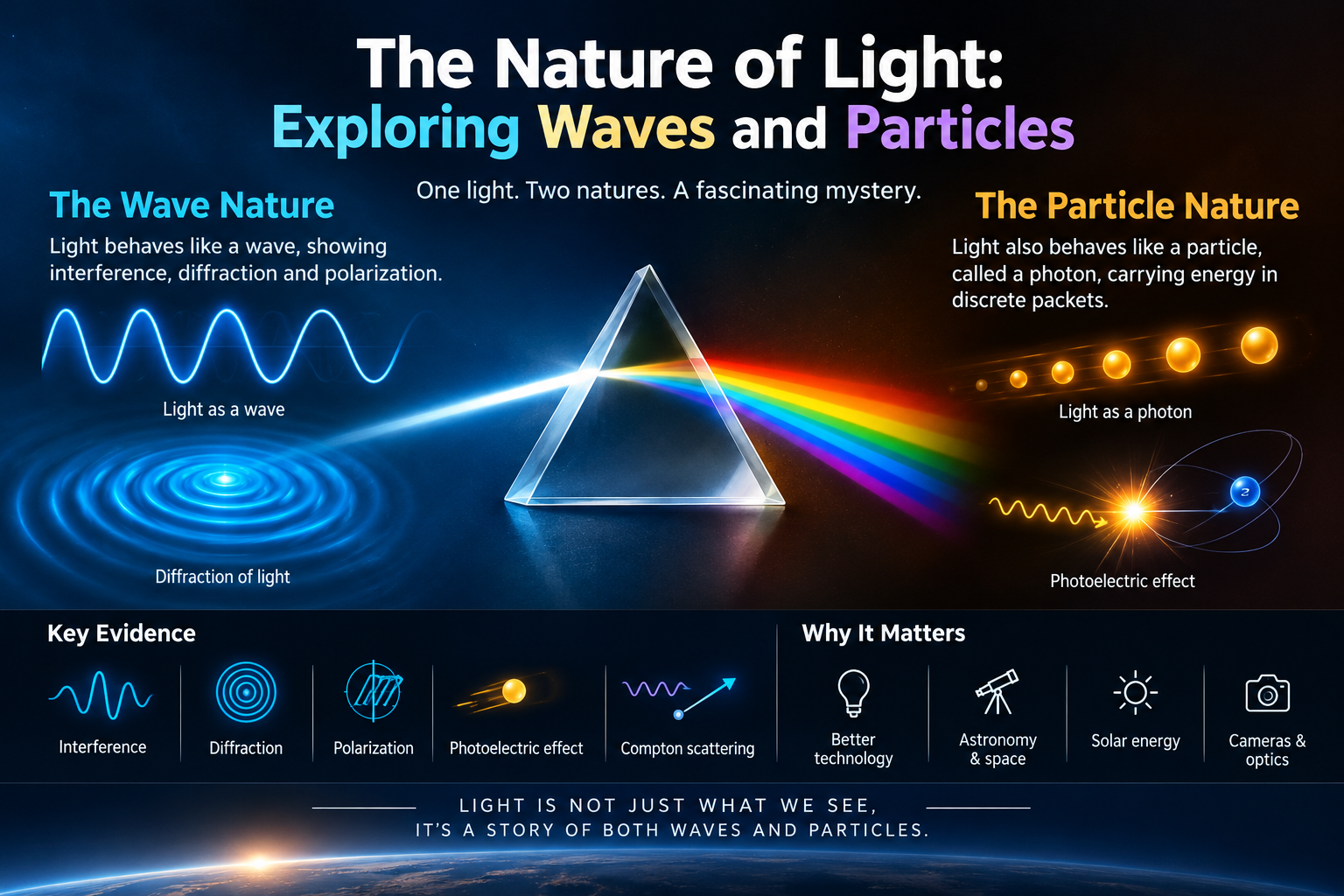
    For many years, scientists have studied light as a wave because it demonstrates important wave-like properties. Light can undergo interference, diffraction, and polarization. Interference occurs when light waves overlap and combine, producing patterns of brightness and darkness. Diffraction happens when light spreads around an obstacle or passes through a narrow opening. Polarization describes the orientation of light's oscillations and helps us understand how light interacts with different materials.

    These properties demonstrate that the wave model is essential for explaining many optical phenomena. From colorful patterns created by thin films to the operation of polarized sunglasses, the wave nature of light has many applications in everyday life and modern technology.

    **2. The Particle Nature of Light **

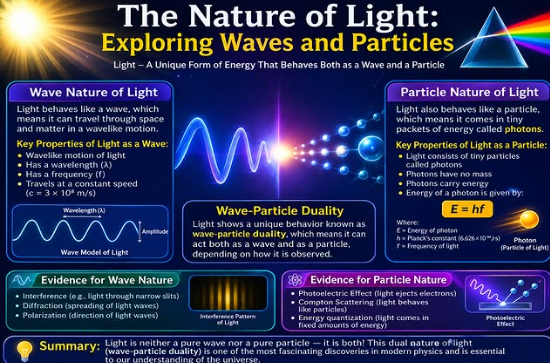
    Light also behaves in ways that reveal its particle nature. In quantum physics, light energy is exchanged in discrete packets called **photons**. Each photon carries energy determined by its frequency, described by the equation **E = hf**, where E represents energy, h is Planck's constant, and f is frequency.

    The photoelectric effect provides important evidence for this particle nature. When light of a suitable frequency strikes certain materials, it can release electrons from their surfaces. This phenomenon helped scientists understand that light energy is transferred in individual quanta rather than always behaving like a continuous wave.

    Another important example is Compton scattering, in which photons exchange energy and momentum with electrons. These discoveries transformed our understanding of light and helped establish the foundations of quantum physics.

    **3. Wave-Particle Duality: Two Sides of Light**

    One of the most remarkable discoveries in science is that light cannot be fully explained by treating it only as a classical wave or only as a classical particle. Its behavior depends on the physical process being investigated and how it is measured. This concept is known as **wave-particle duality**.

    Experiments involving interference reveal wave-like patterns, while experiments involving photon detection show that light energy is detected in discrete units. Quantum mechanics brings these observations together into a more complete description of nature. Rather than being an ordinary wave or a tiny classical object, light is a quantum phenomenon with properties that challenge our everyday intuition.

    **4. How Do We Discover the Secrets of Light?**

    Scientists use carefully designed experiments to explore the behavior of light. Prisms separate white light into different colors, optical instruments measure its properties, and advanced detectors record individual photons. Interference experiments reveal patterns that cannot be explained by simple particle models, while photoelectric experiments demonstrate the importance of quantized energy.

    The work of scientists such as Isaac Newton, Thomas Young, Max Planck, Albert Einstein, and Arthur Compton helped build our modern understanding of light. Their discoveries show how scientific knowledge develops through observation, experimentation, mathematical reasoning, and new ideas.

    **5. Why Is the Nature of Light Important?**

    Understanding light is essential to many technologies that shape modern life. Lasers are used in medicine, manufacturing, and scientific research. Fiber-optic cables transmit information across the world using pulses of light. Solar panels convert light energy into electrical energy, while cameras and telescopes help us capture images and explore distant objects in space.

    The principles of light are also important in astronomy, microscopy, optical communication, quantum technologies, and the study of the universe. By investigating how light behaves, scientists can examine distant galaxies, study the structure of matter, and develop new tools that improve our understanding of nature.

    **6. Light: Connecting Science and the Universe**

    Light is much more than what allows us to see. It carries information about distant stars, reveals the composition of celestial objects, and provides clues about the physical processes occurring throughout the cosmos. By analyzing the light received from distant galaxies, astronomers can learn about their temperatures, chemical compositions, and motion.

    At the smallest scales, the study of photons helps scientists investigate the quantum world and understand how energy interacts with matter. From the smallest laboratory experiments to the largest astronomical observations, light connects different areas of science in extraordinary ways.

    **Conclusion: The Extraordinary Mystery of Light**

    The study of light demonstrates how nature can be far more complex than it first appears. Its wave-like properties explain interference, diffraction, and polarization, while its particle-like properties help explain the photoelectric effect and Compton scattering. Together, these discoveries form an important part of our modern understanding of physics.

    Learning about wave-particle duality encourages us to question assumptions, explore scientific evidence, and appreciate the discoveries that continue to expand human knowledge. Every beam of sunlight, every shining star, and every photon detected by a scientific instrument reminds us that there is still much to discover about the universe.

    **Light Is More Than What We See—It Is a Window into the Fundamental Nature of Reality!**

    If you enjoyed this science topic, share it with others and continue exploring the fascinating world of physics. Stay curious, keep asking questions, and never stop learning!

    #NatureOfLight #WaveParticleDuality #Physics #QuantumPhysics #ScienceEducation #Photons #LightWaves #PhotoelectricEffect #ComptonScattering #Optics #Astronomy #ScientificDiscoveries #STEMEducation #LearnPhysics #ScienceExplained #EducationalContent #WavesAndParticles
    RSIF8 Roll no:14 story no:24 story topic:The Nature of Light: Exploring Waves and Particles 🌟 **The Nature of Light: Exploring Waves and Particles** πŸŒˆπŸ”¬ Have you ever wondered what light really is? How does sunlight travel across millions of kilometers through space, how do rainbows form, and how can light behave like both a wave and a particle? The nature of light is one of the most fascinating topics in physics, revealing the extraordinary connection between the visible world and the mysterious laws of quantum mechanics. From the light that illuminates our homes to the distant stars shining in the universe, light plays an essential role in understanding the world around us. 🌍✨ πŸ’‘ **1. The Wave Nature of Light 🌊** For many years, scientists have studied light as a wave because it demonstrates important wave-like properties. Light can undergo interference, diffraction, and polarization. Interference occurs when light waves overlap and combine, producing patterns of brightness and darkness. Diffraction happens when light spreads around an obstacle or passes through a narrow opening. Polarization describes the orientation of light's oscillations and helps us understand how light interacts with different materials. These properties demonstrate that the wave model is essential for explaining many optical phenomena. From colorful patterns created by thin films to the operation of polarized sunglasses, the wave nature of light has many applications in everyday life and modern technology. βš›οΈ **2. The Particle Nature of Light ✨** Light also behaves in ways that reveal its particle nature. In quantum physics, light energy is exchanged in discrete packets called **photons**. Each photon carries energy determined by its frequency, described by the equation **E = hf**, where E represents energy, h is Planck's constant, and f is frequency. The photoelectric effect provides important evidence for this particle nature. When light of a suitable frequency strikes certain materials, it can release electrons from their surfaces. This phenomenon helped scientists understand that light energy is transferred in individual quanta rather than always behaving like a continuous wave. Another important example is Compton scattering, in which photons exchange energy and momentum with electrons. These discoveries transformed our understanding of light and helped establish the foundations of quantum physics. πŸ”¬ **3. Wave-Particle Duality: Two Sides of Light** One of the most remarkable discoveries in science is that light cannot be fully explained by treating it only as a classical wave or only as a classical particle. Its behavior depends on the physical process being investigated and how it is measured. This concept is known as **wave-particle duality**. Experiments involving interference reveal wave-like patterns, while experiments involving photon detection show that light energy is detected in discrete units. Quantum mechanics brings these observations together into a more complete description of nature. Rather than being an ordinary wave or a tiny classical object, light is a quantum phenomenon with properties that challenge our everyday intuition. 🌈 **4. How Do We Discover the Secrets of Light?** Scientists use carefully designed experiments to explore the behavior of light. Prisms separate white light into different colors, optical instruments measure its properties, and advanced detectors record individual photons. Interference experiments reveal patterns that cannot be explained by simple particle models, while photoelectric experiments demonstrate the importance of quantized energy. The work of scientists such as Isaac Newton, Thomas Young, Max Planck, Albert Einstein, and Arthur Compton helped build our modern understanding of light. Their discoveries show how scientific knowledge develops through observation, experimentation, mathematical reasoning, and new ideas. πŸš€ **5. Why Is the Nature of Light Important?** Understanding light is essential to many technologies that shape modern life. Lasers are used in medicine, manufacturing, and scientific research. Fiber-optic cables transmit information across the world using pulses of light. Solar panels convert light energy into electrical energy, while cameras and telescopes help us capture images and explore distant objects in space. The principles of light are also important in astronomy, microscopy, optical communication, quantum technologies, and the study of the universe. By investigating how light behaves, scientists can examine distant galaxies, study the structure of matter, and develop new tools that improve our understanding of nature. 🌍 **6. Light: Connecting Science and the Universe** Light is much more than what allows us to see. It carries information about distant stars, reveals the composition of celestial objects, and provides clues about the physical processes occurring throughout the cosmos. By analyzing the light received from distant galaxies, astronomers can learn about their temperatures, chemical compositions, and motion. At the smallest scales, the study of photons helps scientists investigate the quantum world and understand how energy interacts with matter. From the smallest laboratory experiments to the largest astronomical observations, light connects different areas of science in extraordinary ways. πŸ’« **Conclusion: The Extraordinary Mystery of Light** The study of light demonstrates how nature can be far more complex than it first appears. Its wave-like properties explain interference, diffraction, and polarization, while its particle-like properties help explain the photoelectric effect and Compton scattering. Together, these discoveries form an important part of our modern understanding of physics. Learning about wave-particle duality encourages us to question assumptions, explore scientific evidence, and appreciate the discoveries that continue to expand human knowledge. Every beam of sunlight, every shining star, and every photon detected by a scientific instrument reminds us that there is still much to discover about the universe. ✨ **Light Is More Than What We See—It Is a Window into the Fundamental Nature of Reality!** πŸ”­πŸŒŒ πŸ‘ If you enjoyed this science topic, share it with others and continue exploring the fascinating world of physics. Stay curious, keep asking questions, and never stop learning! #NatureOfLight #WaveParticleDuality #Physics #QuantumPhysics #ScienceEducation #Photons #LightWaves #PhotoelectricEffect #ComptonScattering #Optics #Astronomy #ScientificDiscoveries #STEMEducation #LearnPhysics #ScienceExplained #EducationalContent #WavesAndParticles πŸŒˆπŸ”¬πŸš€
    0 Commenti 0 condivisioni 8871 Views
  • #rsisb
    Roll no.279
    story post no.23
    Foundation Level
    The Mystery of Light: A Journey Through the Universe
    Once upon a time, a curious student wanted to discover the secrets of light. Every morning, sunlight entered his room and filled it with brightness. He wondered, “How does light travel, and why does it sometimes behave like a wave and sometimes like a particle?”
    He began exploring science and learned that light travels incredibly fast and helps us see the world around us. He discovered that rainbows form when sunlight interacts with water droplets. He also learned that light is made of tiny packets of energy called photons.
    With every discovery, his curiosity grew stronger. He realized that science is full of mysteries waiting to be explored. His journey taught him one important lesson: Never stop asking questions, because every question can lead to a new discovery!
    \#ScienceStory #NatureOfLight #WavesAndParticles #Curiosity #Physics #KeepLearning
    Asma Shaheen EducationWali
    Saima Empowerment Wali
    Irum Asim Leadershipwali
    #rsisb Roll no.279 story post no.23 Foundation Level 🌟 The Mystery of Light: A Journey Through the Universe πŸŒŒπŸ’‘ Once upon a time, a curious student wanted to discover the secrets of light. πŸ”βœ¨ Every morning, sunlight entered his room and filled it with brightness. β˜€οΈ He wondered, “How does light travel, and why does it sometimes behave like a wave and sometimes like a particle?” πŸŒŠβš›οΈ He began exploring science and learned that light travels incredibly fast and helps us see the world around us. πŸŒˆπŸ”¬ He discovered that rainbows form when sunlight interacts with water droplets. 🌦️🌈 He also learned that light is made of tiny packets of energy called photons. ⚑ With every discovery, his curiosity grew stronger. πŸš€ He realized that science is full of mysteries waiting to be explored. His journey taught him one important lesson: Never stop asking questions, because every question can lead to a new discovery! πŸ’‘πŸ“šπŸŒ \#ScienceStory #NatureOfLight #WavesAndParticles #Curiosity #Physics #KeepLearning πŸ”¬πŸŒˆβœ¨ Asma Shaheen EducationWali Saima Empowerment Wali Irum Asim Leadershipwali
    0 Commenti 0 condivisioni 1514 Views
  • Mohsin RS F8
    Story post NO:19
    roll NO:13
    Class: Foundation Level
    Made by Me

    The Nature of Light: Exploring Waves and Particles

    Light is one of the most fascinating phenomena in the universe. We see it every day, from the warm glow of the Sun to the colors of a rainbow, but understanding what light actually is has been one of the most interesting challenges in the history of science. The topic “The Nature of Light: Exploring Waves and Particles” takes us on an exciting journey into the world of physics and helps us understand why light can behave in two seemingly different ways.

    For a long time, scientists debated whether light should be understood as a wave or as a collection of tiny particles. Experiments eventually showed that light has characteristics of both waves and particles. This remarkable property is known as wave-particle duality and is one of the foundations of modern physics.

    Light as a Wave

    When we study light as a wave, we can describe it using properties such as wavelength, frequency, and amplitude. Light can demonstrate wave behaviors such as interference, diffraction, and polarization. The famous double-slit experiment provides a powerful example of how light can create an interference pattern, showing behavior associated with waves.

    Different wavelengths of visible light correspond to different colors. When white light passes through a prism, it can separate into a beautiful spectrum of colors, reminding us that the light around us contains a fascinating range of electromagnetic radiation.

    Light as a Particle

    Light also displays particle-like behavior. In modern physics, these particles are called photons. A photon is a quantum of electromagnetic energy, and its energy is related to the frequency of light through the equation:

    E = hf

    Here, E represents the energy of a photon, h is Planck’s constant, and f is the frequency of the light.

    The photoelectric effect provided important evidence for the particle nature of light. In this phenomenon, light can transfer energy to electrons in certain materials. This discovery played an important role in the development of quantum physics.
    Mohsin RS F8 πŸŽ“βœ¨ Story post NO:19 roll NO:13 Class: Foundation Level πŸ“š Made by Me πŸ’»πŸš€ 🌟 The Nature of Light: Exploring Waves and Particles πŸ’‘πŸŒˆ Light is one of the most fascinating phenomena in the universe. We see it every day, from the warm glow of the Sun to the colors of a rainbow, but understanding what light actually is has been one of the most interesting challenges in the history of science. The topic “The Nature of Light: Exploring Waves and Particles” takes us on an exciting journey into the world of physics and helps us understand why light can behave in two seemingly different ways. For a long time, scientists debated whether light should be understood as a wave or as a collection of tiny particles. Experiments eventually showed that light has characteristics of both waves and particles. This remarkable property is known as wave-particle duality and is one of the foundations of modern physics. 🌊 Light as a Wave When we study light as a wave, we can describe it using properties such as wavelength, frequency, and amplitude. Light can demonstrate wave behaviors such as interference, diffraction, and polarization. The famous double-slit experiment provides a powerful example of how light can create an interference pattern, showing behavior associated with waves. Different wavelengths of visible light correspond to different colors. When white light passes through a prism, it can separate into a beautiful spectrum of colors, reminding us that the light around us contains a fascinating range of electromagnetic radiation. ✨ Light as a Particle Light also displays particle-like behavior. In modern physics, these particles are called photons. A photon is a quantum of electromagnetic energy, and its energy is related to the frequency of light through the equation: E = hf Here, E represents the energy of a photon, h is Planck’s constant, and f is the frequency of the light. The photoelectric effect provided important evidence for the particle nature of light. In this phenomenon, light can transfer energy to electrons in certain materials. This discovery played an important role in the development of quantum physics.
    0 Commenti 0 condivisioni 2659 Views
  • RSIF8
    Roll NO:92
    Story Post No:30
    Topic:Vision Ventures: The Secrets of the Human Eye
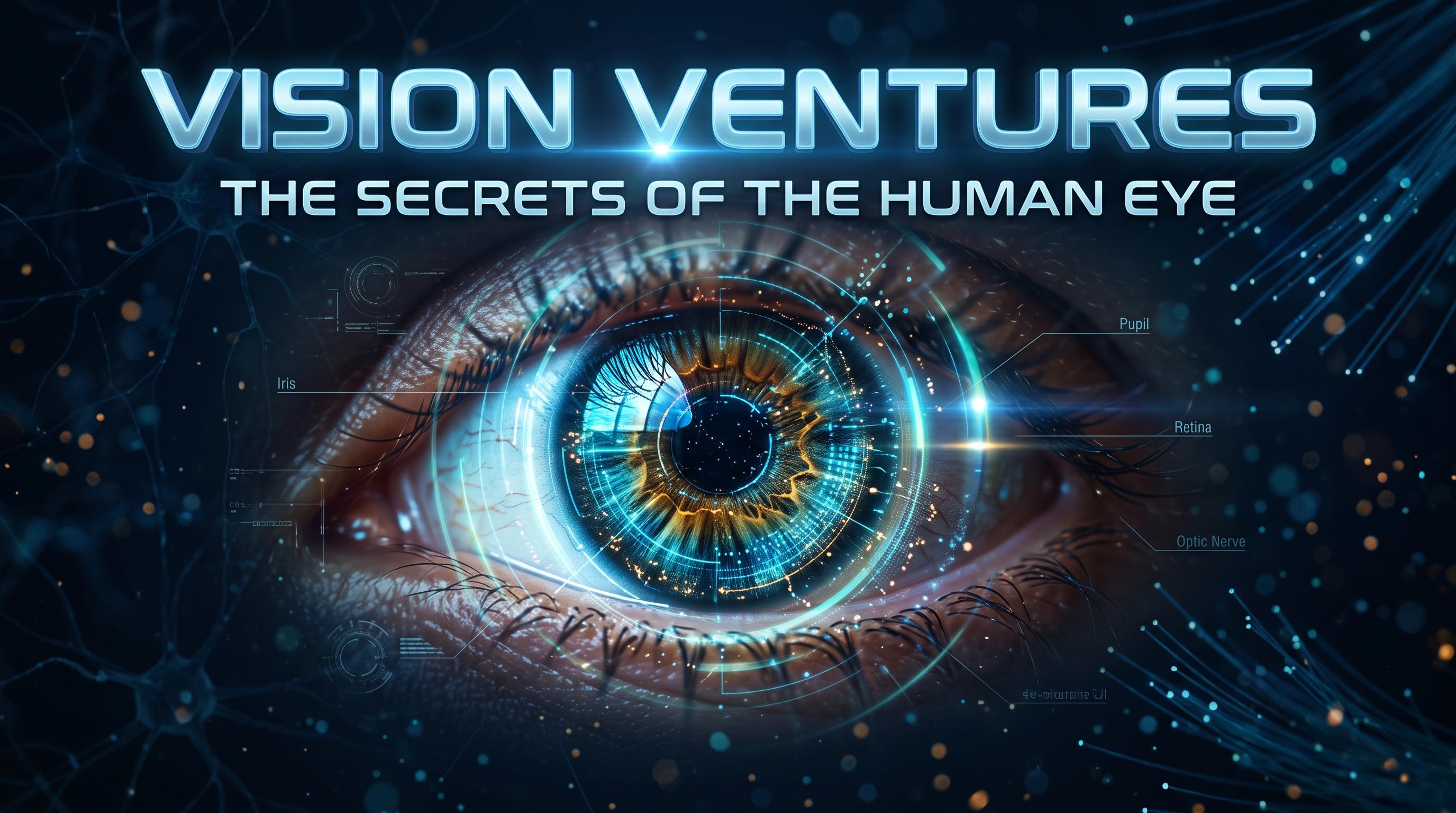
    The human eye functions as both a biological marvel and a high-precision optical instrument, translating ambient light into the complex visual reality processed by the brain.

    The Optical Aperture: Light enters through the cornea and passes through the pupil, where the iris dynamically contracts and expands to regulate illumination levels, much like an advanced camera aperture.

    The Focusing Engine: The crystalline lens fine-tunes incoming light rays, utilizing ciliary muscles to alter its shape—a process called accommodation—to snap objects into sharp focus across varying distances.

    The Photoreceptive Sensor: The retina lines the back of the eye with over 120 million rods and cones, converting incoming photons into biochemical and electrical impulses. Rods handle peripheral vision and low-light detection, while cones provide sharp central detail and full-spectrum color discernment.

    The Neural Bridge: Millions of retinal nerve fibers converge at the optic disc to form the optic nerve, an information superhighway transmitting raw electrical signals at rapid speeds to the visual cortex for interpretation.
    RSIF8 Roll NO:92 Story Post No:30 Topic:Vision Ventures: The Secrets of the Human Eye The human eye functions as both a biological marvel and a high-precision optical instrument, translating ambient light into the complex visual reality processed by the brain. The Optical Aperture: Light enters through the cornea and passes through the pupil, where the iris dynamically contracts and expands to regulate illumination levels, much like an advanced camera aperture. The Focusing Engine: The crystalline lens fine-tunes incoming light rays, utilizing ciliary muscles to alter its shape—a process called accommodation—to snap objects into sharp focus across varying distances. The Photoreceptive Sensor: The retina lines the back of the eye with over 120 million rods and cones, converting incoming photons into biochemical and electrical impulses. Rods handle peripheral vision and low-light detection, while cones provide sharp central detail and full-spectrum color discernment. The Neural Bridge: Millions of retinal nerve fibers converge at the optic disc to form the optic nerve, an information superhighway transmitting raw electrical signals at rapid speeds to the visual cortex for interpretation.
    0 Commenti 0 condivisioni 1273 Views
  • RSIF8
    Roll no: 99
    Story post no: 24
    Story topic: The Nature of Light: Exploring Waves and Particles
    Light is one of the most fascinating phenomena in physics. It allows us to see the world around us, carries energy across vast distances, and plays a fundamental role in technologies ranging from cameras to fiber-optic communication.
    One of the most remarkable discoveries in modern physics is that light can behave both as a wave and as a particle. Its wave nature explains phenomena such as interference, diffraction, and polarization, while its particle nature is described through photons, which carry discrete amounts of energy.
    Understanding the dual nature of light helps us explore the deeper principles of quantum physics and reveals how the same phenomenon can behave in different ways depending on how it is observed.
    #NatureOfLight #Physics #Light #WaveParticleDuality #QuantumPhysics #Photon #ScienceEducation #PhysicsEducation #STEM #LearnPhysics #Education
    RSIF8 Roll no: 99 Story post no: 24 Story topic: The Nature of Light: Exploring Waves and Particles Light is one of the most fascinating phenomena in physics. It allows us to see the world around us, carries energy across vast distances, and plays a fundamental role in technologies ranging from cameras to fiber-optic communication. One of the most remarkable discoveries in modern physics is that light can behave both as a wave and as a particle. Its wave nature explains phenomena such as interference, diffraction, and polarization, while its particle nature is described through photons, which carry discrete amounts of energy. Understanding the dual nature of light helps us explore the deeper principles of quantum physics and reveals how the same phenomenon can behave in different ways depending on how it is observed. #NatureOfLight #Physics #Light #WaveParticleDuality #QuantumPhysics #Photon #ScienceEducation #PhysicsEducation #STEM #LearnPhysics #Education
    0 Commenti 0 condivisioni 3158 Views
  • #rsisb
    Roll No 253
    Foundation Level
    Story Post 24

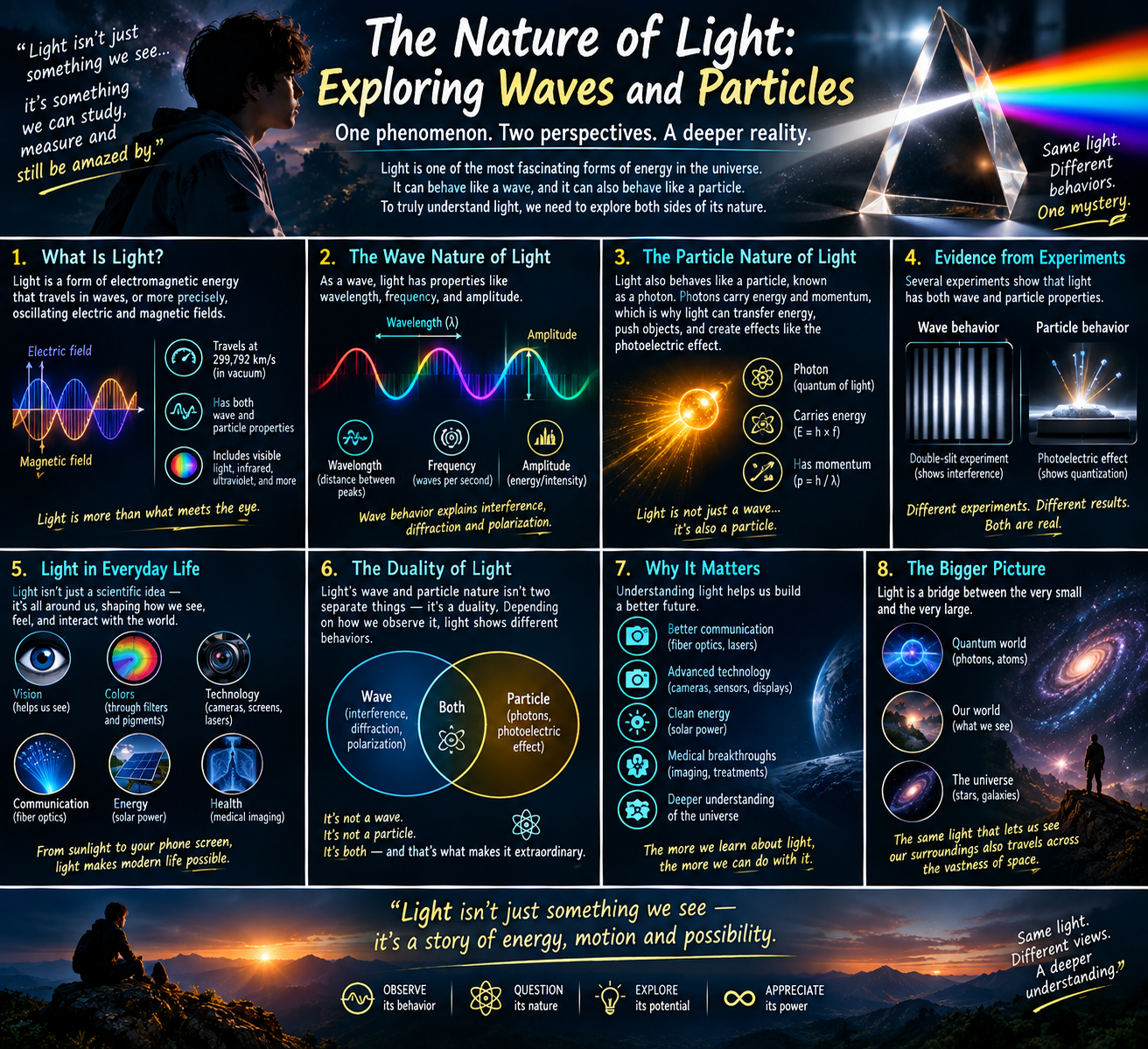
    # The Nature of Light: Exploring Waves and Particles

    Imagine standing beneath a night sky filled with stars.

    Every photon reaching your eyes has traveled across space carrying information from distant worlds. Light allows us to see, measure, communicate, explore, and understand the universe itself.

    But light is far stranger than it first appears.

    Sometimes it behaves like a **wave** .

    Sometimes it behaves like a **particle** .

    And understanding this strange dual nature changed our picture of reality forever.

    ---

    # 1. What Is Light?

    Light is a form of **electromagnetic radiation**—energy carried through oscillating electric and magnetic fields.

    In empty space, electromagnetic waves travel at approximately:

    ### **299,792 kilometers per second**

    That's the speed of light in vacuum.

    Visible light is only a small part of the electromagnetic spectrum.

    Beyond what our eyes can see are:

    Radio waves
    Microwaves
    Infrared
    Visible light
    Ultraviolet
    🩻 X-rays
    Gamma rays

    So light isn't simply what we see.

    ### **It's an enormous family of electromagnetic phenomena.**

    ---

    # 2. The Wave Nature of Light

    When light behaves as a wave, we can describe it using several important properties:

    **Wavelength** — the distance between successive wave peaks
    **Frequency** — how many oscillations occur each second
    **Amplitude** — related to the wave's intensity

    These properties help explain many familiar phenomena.

    **Interference** occurs when waves combine.
    **Diffraction** occurs when waves spread around openings or obstacles.
    **Polarization** describes the orientation of electromagnetic oscillations.

    The wave model explains behaviors that are difficult to understand if we imagine light only as tiny particles.

    ---

    # 3. The Particle Nature of Light

    But the story doesn't end there.

    Light can also behave as if it arrives in discrete packets of energy called **photons**.

    A photon is a quantum of electromagnetic radiation.

    Its energy is related to frequency:

    ### **E = h × f**

    And its momentum is related to its wavelength:

    ### **p = h / λ**

    This particle-like behavior helps explain phenomena such as the **photoelectric effect**, where light can transfer energy to electrons.

    So light isn't simply a smooth continuous wave.

    At the quantum level, energy can be exchanged in discrete amounts.

    ### **Light has another side—and it's quantum.**

    ---

    # 4. Evidence From Experiments

    The strange nature of light isn't merely philosophical.

    Experiments demonstrate it.

    ### Double-Slit Experiment

    When light passes through two narrow openings, an **interference pattern** can appear—strong evidence of wave-like behavior.

    ### Photoelectric Effect

    When light strikes certain materials, it can eject electrons. This behavior is explained using photons and quantized energy.

    Different experiments reveal different aspects of light.

    And that's one of the most fascinating things about physics:

    ### **The same phenomenon can reveal different behaviors depending on how we investigate it.**

    ---

    # 5. Light in Everyday Life

    Light isn't something that exists only inside physics laboratories.

    It's everywhere.

    **Vision** — allows us to see the world
    **Colors** — arise from how different wavelengths interact with matter
    **Cameras** — convert light into images
    **Screens** — produce controlled patterns of light
    **Fiber optics** — carry information using light
    **Solar panels** — convert light energy into electrical energy
    🩻 **Medical imaging** — uses electromagnetic radiation to see inside the body

    From sunrise to smartphone screens…

    ### **Modern civilization depends heavily on our ability to control light.**

    ---

    # 6. The Duality of Light

    Here lies the great mystery.

    Light can display **wave-like behavior**

    and

    **particle-like behavior** .

    This is known as **wave-particle duality**.

    It's important to understand that this doesn't mean light is literally switching between being a classical wave and a classical particle like two separate objects.

    Instead, quantum physics gives us a deeper framework in which classical wave and particle descriptions each capture different aspects of light's behavior.

    ### **Two perspectives. One quantum reality.**

    ---

    # 7. Why Understanding Light Matters

    Learning how light behaves has transformed technology.

    **Communication** — fiber-optic networks
    **Science** — spectroscopy and microscopy
    **Imaging** — cameras and sensors
    **Energy** — solar technology
    **Medicine** — lasers and diagnostic imaging
    **Astronomy** — studying distant stars and galaxies

    When astronomers observe light from a distant star, they aren't simply seeing brightness.

    They can analyze the light's wavelengths and learn about the star's:

    Temperature
    Chemical composition
    Motion
    Environment

    ### **Light carries information across space.**

    ---

    # 8. The Bigger Picture

    Light connects the microscopic and the cosmic.

    At the quantum scale, photons interact with atoms and electrons.

    At human scales, light allows us to see and communicate.

    Across astronomical distances, light travels from stars and galaxies to our telescopes.

    In many ways, light is our messenger from the universe.

    When we look at a distant galaxy, we are receiving photons that may have traveled for millions or billions of years before reaching Earth.

    ### **Looking at the universe means looking at ancient light.**

    ---

    # The Final Thought

    Light is more than something that illuminates a room.

    It is energy.
    It is information.
    It is electromagnetic radiation.
    It has quantum behavior.
    And it is one of the most important tools we have for exploring reality.

    From a photon interacting with an electron…

    to sunlight crossing space…

    to the glow of a distant galaxy…

    ### **Light connects the smallest scales of nature with the largest.**

    So the next time you see sunlight streaming through a window , a rainbow , or stars shining overhead , remember:

    **You aren't simply seeing light.**

    You're witnessing one of the universe's most fascinating mysteries—a phenomenon that behaves in ways far stranger and more beautiful than our everyday experience suggests.

    # **Light isn't just something we see—it's a story of energy, motion, information, and possibility.** ∞


    Asma Shaheen EducationWali
    Saima Empowerment Wali
    Mishaal TrainingWali

    #rsisb Roll No 253 Foundation Level Story Post 24 # 🌈⚑ The Nature of Light: Exploring Waves and Particles Imagine standing beneath a night sky filled with stars. 🌌✨ Every photon reaching your eyes has traveled across space carrying information from distant worlds. Light allows us to see, measure, communicate, explore, and understand the universe itself. πŸ”­πŸ‘οΈπŸ“‘ But light is far stranger than it first appears. Sometimes it behaves like a **wave** 🌊. Sometimes it behaves like a **particle** βš›οΈ. And understanding this strange dual nature changed our picture of reality forever. 🧠🌌 --- # πŸ’‘πŸŒŒ 1. What Is Light? Light is a form of **electromagnetic radiation**—energy carried through oscillating electric and magnetic fields. ⚑🧲 In empty space, electromagnetic waves travel at approximately: ### πŸš€ **299,792 kilometers per second** That's the speed of light in vacuum. Visible light πŸ‘οΈπŸŒˆ is only a small part of the electromagnetic spectrum. Beyond what our eyes can see are: πŸ“» Radio waves πŸ“‘ Microwaves πŸ”₯ Infrared 🌈 Visible light β˜€οΈ Ultraviolet 🩻 X-rays ☒️ Gamma rays So light isn't simply what we see. ### **It's an enormous family of electromagnetic phenomena.** 🌌⚑ --- # πŸŒŠπŸ”¬ 2. The Wave Nature of Light When light behaves as a wave, we can describe it using several important properties: 〰️ **Wavelength** — the distance between successive wave peaks ⚑ **Frequency** — how many oscillations occur each second πŸ“ˆ **Amplitude** — related to the wave's intensity These properties help explain many familiar phenomena. 🌈 **Interference** occurs when waves combine. πŸ” **Diffraction** occurs when waves spread around openings or obstacles. πŸ•ΆοΈ **Polarization** describes the orientation of electromagnetic oscillations. The wave model explains behaviors that are difficult to understand if we imagine light only as tiny particles. --- # βš›οΈβœ¨ 3. The Particle Nature of Light But the story doesn't end there. Light can also behave as if it arrives in discrete packets of energy called **photons**. βš›οΈπŸ’‘ A photon is a quantum of electromagnetic radiation. Its energy is related to frequency: ### **E = h × f** ⚑ And its momentum is related to its wavelength: ### **p = h / λ** πŸŒŠβš›οΈ This particle-like behavior helps explain phenomena such as the **photoelectric effect**, where light can transfer energy to electrons. So light isn't simply a smooth continuous wave. At the quantum level, energy can be exchanged in discrete amounts. ### **Light has another side—and it's quantum.** πŸŒŒβš›οΈ --- # πŸ§ͺπŸ” 4. Evidence From Experiments The strange nature of light isn't merely philosophical. Experiments demonstrate it. ### 🌊 Double-Slit Experiment When light passes through two narrow openings, an **interference pattern** can appear—strong evidence of wave-like behavior. πŸŒŠγ€°οΈ ### ⚑ Photoelectric Effect When light strikes certain materials, it can eject electrons. This behavior is explained using photons and quantized energy. βš›οΈπŸ”‹ Different experiments reveal different aspects of light. And that's one of the most fascinating things about physics: ### **The same phenomenon can reveal different behaviors depending on how we investigate it.** πŸ”¬βœ¨ --- # πŸ‘οΈπŸŒˆ 5. Light in Everyday Life Light isn't something that exists only inside physics laboratories. It's everywhere. πŸŒβ˜€οΈ πŸ‘οΈ **Vision** — allows us to see the world 🌈 **Colors** — arise from how different wavelengths interact with matter πŸ“· **Cameras** — convert light into images πŸ“± **Screens** — produce controlled patterns of light 🌐 **Fiber optics** — carry information using light β˜€οΈ **Solar panels** — convert light energy into electrical energy 🩻 **Medical imaging** — uses electromagnetic radiation to see inside the body From sunrise to smartphone screens… ### **Modern civilization depends heavily on our ability to control light.** πŸ’‘πŸŒ --- # πŸŒŠβš›οΈ 6. The Duality of Light Here lies the great mystery. Light can display **wave-like behavior** 🌊 and **particle-like behavior** βš›οΈ. This is known as **wave-particle duality**. It's important to understand that this doesn't mean light is literally switching between being a classical wave and a classical particle like two separate objects. Instead, quantum physics gives us a deeper framework in which classical wave and particle descriptions each capture different aspects of light's behavior. ### **Two perspectives. One quantum reality.** 🌌✨ --- # πŸš€πŸ”¬ 7. Why Understanding Light Matters Learning how light behaves has transformed technology. πŸ“‘ **Communication** — fiber-optic networks πŸ”¬ **Science** — spectroscopy and microscopy πŸ“· **Imaging** — cameras and sensors β˜€οΈ **Energy** — solar technology 🩺 **Medicine** — lasers and diagnostic imaging πŸš€ **Astronomy** — studying distant stars and galaxies When astronomers observe light from a distant star, they aren't simply seeing brightness. They can analyze the light's wavelengths and learn about the star's: 🌑️ Temperature πŸ§ͺ Chemical composition πŸ’¨ Motion 🌌 Environment ### **Light carries information across space.** --- # πŸŒŒπŸ”­ 8. The Bigger Picture Light connects the microscopic and the cosmic. At the quantum scale, photons interact with atoms and electrons. βš›οΈπŸ”¬ At human scales, light allows us to see and communicate. πŸ‘οΈπŸ“± Across astronomical distances, light travels from stars and galaxies to our telescopes. πŸŒŸπŸ”­ In many ways, light is our messenger from the universe. When we look at a distant galaxy, we are receiving photons that may have traveled for millions or billions of years before reaching Earth. 🌌⏳ ### **Looking at the universe means looking at ancient light.** ✨ --- # πŸŒ…πŸ’‘ The Final Thought Light is more than something that illuminates a room. It is energy. ⚑ It is information. πŸ“‘ It is electromagnetic radiation. 🌊 It has quantum behavior. βš›οΈ And it is one of the most important tools we have for exploring reality. πŸ”­ From a photon interacting with an electron… to sunlight crossing space… to the glow of a distant galaxy… ### **Light connects the smallest scales of nature with the largest.** πŸŒŒβš›οΈ So the next time you see sunlight streaming through a window β˜€οΈ, a rainbow 🌈, or stars shining overhead ⭐, remember: **You aren't simply seeing light.** You're witnessing one of the universe's most fascinating mysteries—a phenomenon that behaves in ways far stranger and more beautiful than our everyday experience suggests. πŸŒŠβš›οΈβœ¨ # 🌈🌌 **Light isn't just something we see—it's a story of energy, motion, information, and possibility.** βš‘πŸ”¬∞ Asma Shaheen EducationWali Saima Empowerment Wali Mishaal TrainingWali

    0 Commenti 0 condivisioni 6846 Views
  • **Foundation Level** **Day 166** **story post** **Roll Number: 005**

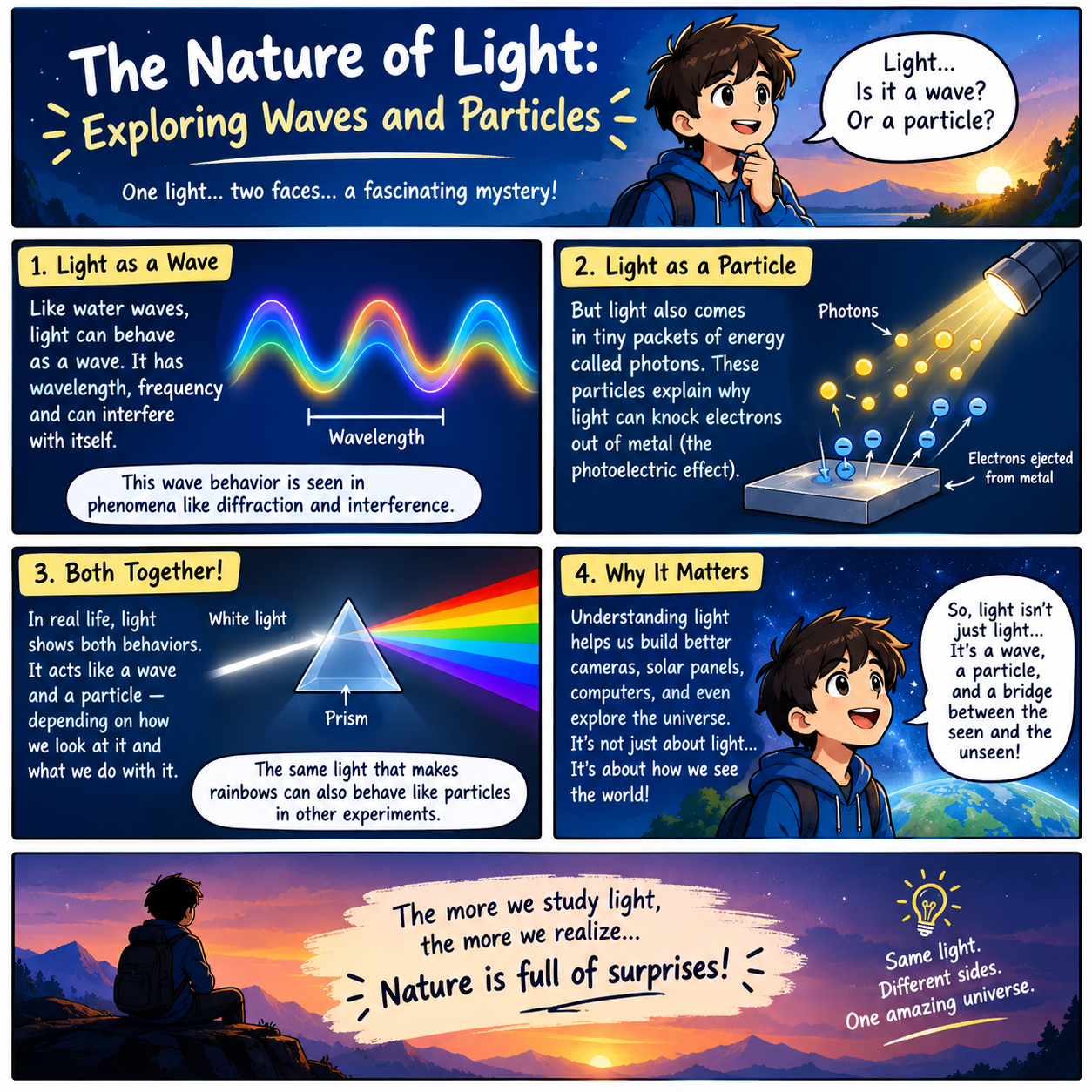
    The Nature of Light: Exploring Waves and Particles

    What exactly is light? Is it a wave, a particle, or somehow both?

    In this colorful science comic, we explore the fascinating dual nature of light. Discover how light behaves like a wave through interference and diffraction, while also acting as tiny packets of energy called photons.

    From colorful rainbows to the photoelectric effect, this comic shows how understanding light helps us explore technology, science, and the universe around us.

    One light. Two behaviors. One amazing mystery!

    #NatureOfLight #Physics #ScienceComic #Light #WavesAndParticles #Photon #Science #PhysicsForStudents #EducationalComic #InstagramScience
    **Foundation Level** **Day 166** **story post** **Roll Number: 005** 🌟 The Nature of Light: Exploring Waves and Particles 🌈 What exactly is light? Is it a wave, a particle, or somehow both? πŸ”¬βœ¨ In this colorful science comic, we explore the fascinating dual nature of light. Discover how light behaves like a wave through interference and diffraction, while also acting as tiny packets of energy called photons. From colorful rainbows to the photoelectric effect, this comic shows how understanding light helps us explore technology, science, and the universe around us. πŸŒŒπŸ’‘ One light. Two behaviors. One amazing mystery! πŸš€ #NatureOfLight #Physics #ScienceComic #Light #WavesAndParticles #Photon #Science #PhysicsForStudents #EducationalComic #InstagramScience
    0 Commenti 0 condivisioni 4770 Views
Pagine in Evidenza