• RSIF8
    Roll no:14
    story no:22
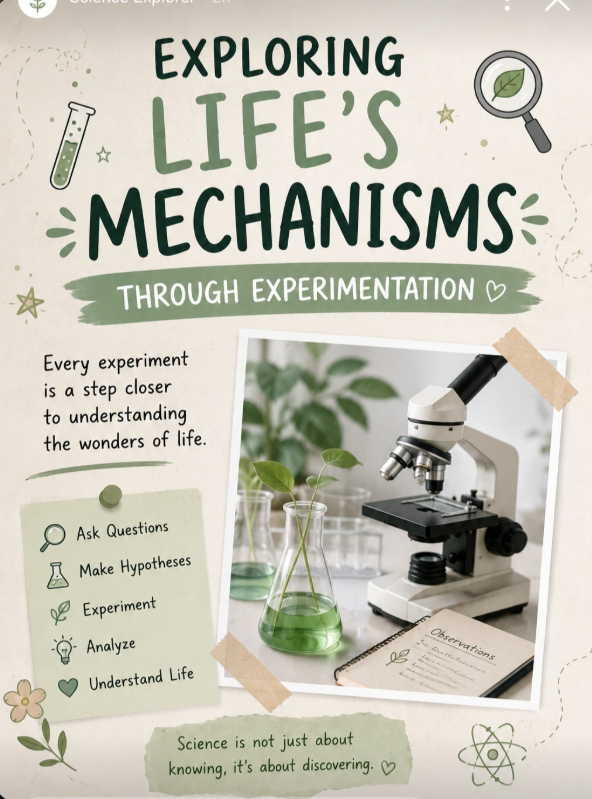
    story post topic:Exploring Life’s Mechanisms Through Experimentation
    # Exploring Life’s Mechanisms Through Experimentation

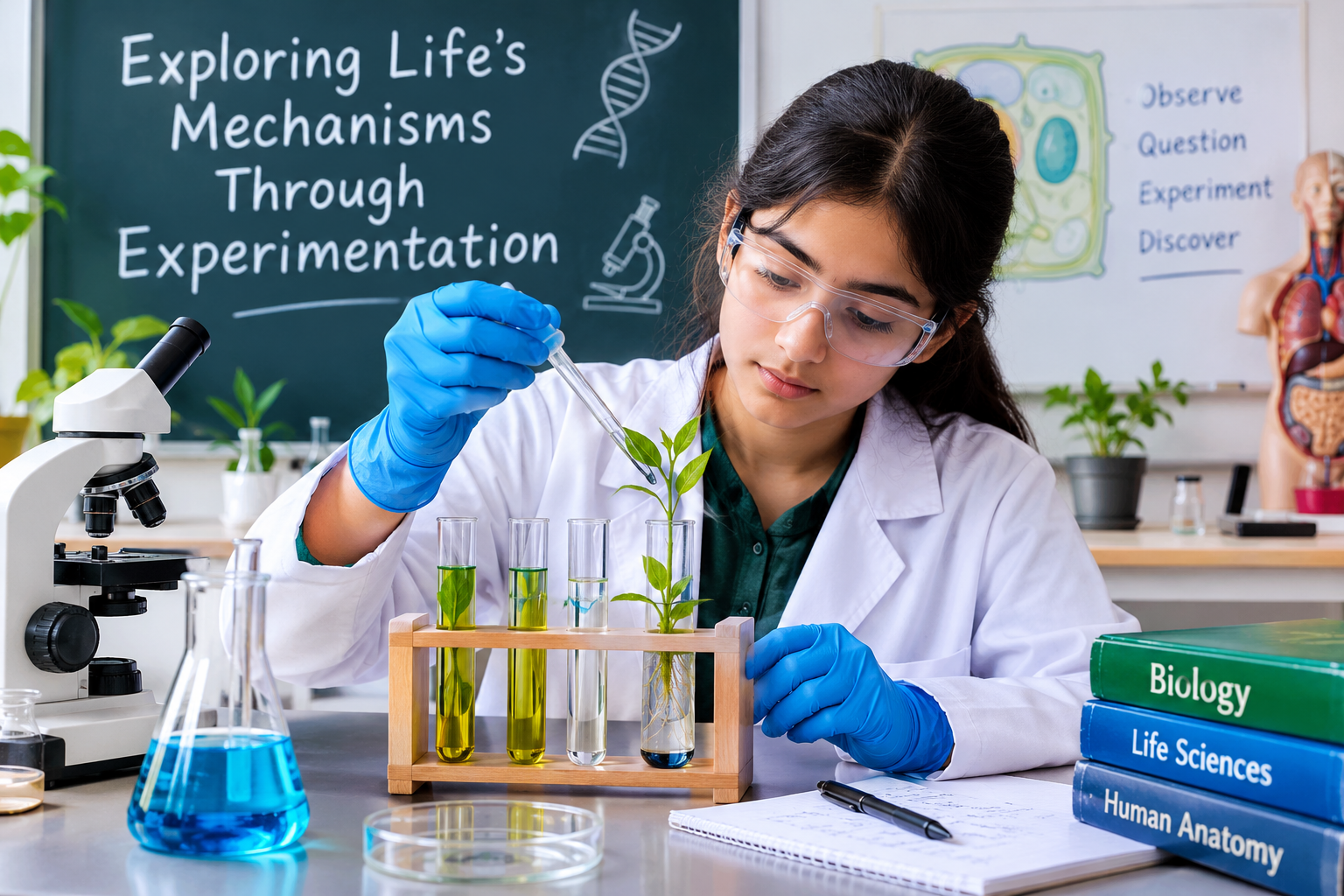
    Welcome to the fascinating world of scientific discovery, where curiosity meets experimentation and every observation brings us closer to understanding the mysteries of life! **“Exploring Life’s Mechanisms Through Experimentation”** highlights the importance of practical experiments in understanding how living organisms function, grow, and interact with their environments.

    Through hands-on activities, laboratory experiments, microscopes, and scientific observations, students can explore the amazing processes that take place inside living things. From examining plant growth and studying cells to understanding biological systems, experimentation helps transform scientific theories into meaningful discoveries.

    **Key Topics Covered:**
    - Understanding the structure and functions of living organisms
    - Exploring cells, DNA, and biological processes
    - Investigating plant growth and environmental factors
    - Learning through experiments and scientific observations
    - Developing critical thinking and problem-solving skills
    - Discovering how living organisms interact with their surroundings

    **Why Is Experimentation Important?**

    Scientific experimentation allows learners to ask questions, test ideas, analyze results, and develop evidence-based conclusions. It encourages creativity, patience, and curiosity while helping students understand the principles of biology and life sciences.

    Whether you are a student, science enthusiast, or aspiring researcher, exploring life's mechanisms through experimentation opens the door to new knowledge and exciting discoveries. Every experiment is an opportunity to learn something new about the incredible world around us!

    **Observe, experiment, discover, and explore the science of life—because every great discovery begins with a question!**

    #Biology #ScienceExperiments #LifeSciences #ScientificDiscovery #BiologyLab #LearningThroughExperimentation #STEMEducation #ScienceLearning #CellBiology #NatureAndScience #EducationalContent #ExploreScience
    RSIF8 Roll no:14 story no:22 story post topic:Exploring Life’s Mechanisms Through Experimentation # 🔬 Exploring Life’s Mechanisms Through Experimentation 🧬 Welcome to the fascinating world of scientific discovery, where curiosity meets experimentation and every observation brings us closer to understanding the mysteries of life! 🌱🔍 **“Exploring Life’s Mechanisms Through Experimentation”** highlights the importance of practical experiments in understanding how living organisms function, grow, and interact with their environments. Through hands-on activities, laboratory experiments, microscopes, and scientific observations, students can explore the amazing processes that take place inside living things. From examining plant growth and studying cells to understanding biological systems, experimentation helps transform scientific theories into meaningful discoveries. 🧪🌿 💡 **Key Topics Covered:** - 🔬 Understanding the structure and functions of living organisms - 🧬 Exploring cells, DNA, and biological processes - 🌱 Investigating plant growth and environmental factors - 🧪 Learning through experiments and scientific observations - 📚 Developing critical thinking and problem-solving skills - 🌍 Discovering how living organisms interact with their surroundings 🎯 **Why Is Experimentation Important?** Scientific experimentation allows learners to ask questions, test ideas, analyze results, and develop evidence-based conclusions. It encourages creativity, patience, and curiosity while helping students understand the principles of biology and life sciences. 🌟 Whether you are a student, science enthusiast, or aspiring researcher, exploring life's mechanisms through experimentation opens the door to new knowledge and exciting discoveries. Every experiment is an opportunity to learn something new about the incredible world around us! ✨ **Observe, experiment, discover, and explore the science of life—because every great discovery begins with a question!** #Biology #ScienceExperiments #LifeSciences #ScientificDiscovery #BiologyLab #LearningThroughExperimentation #STEMEducation #ScienceLearning #CellBiology #NatureAndScience #EducationalContent #ExploreScience
    0 Комментарии 0 Поделились 4085 Просмотры
  • RSIF8
    Roll no:14
    story no:21
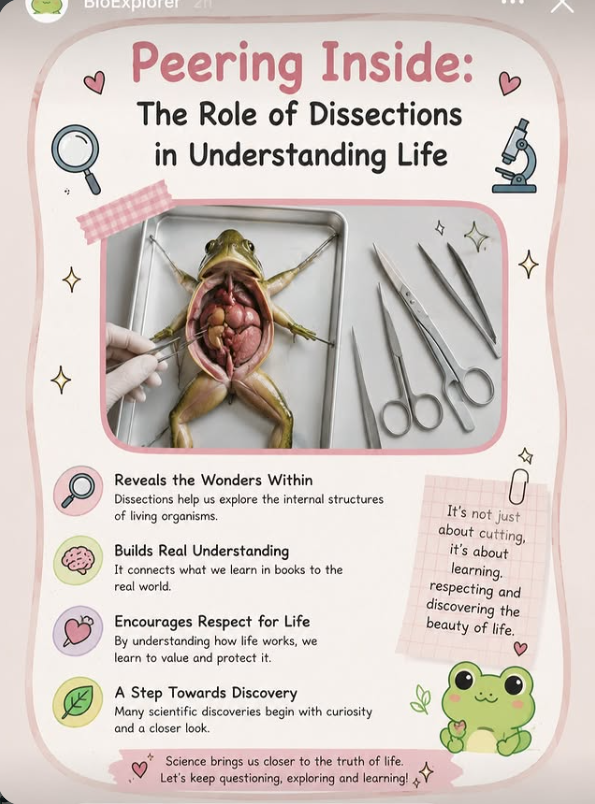
    story topic:Peering Inside: The Role of Dissections in Understanding Life
    # Peering Inside: The Role of Dissections in Understanding Life

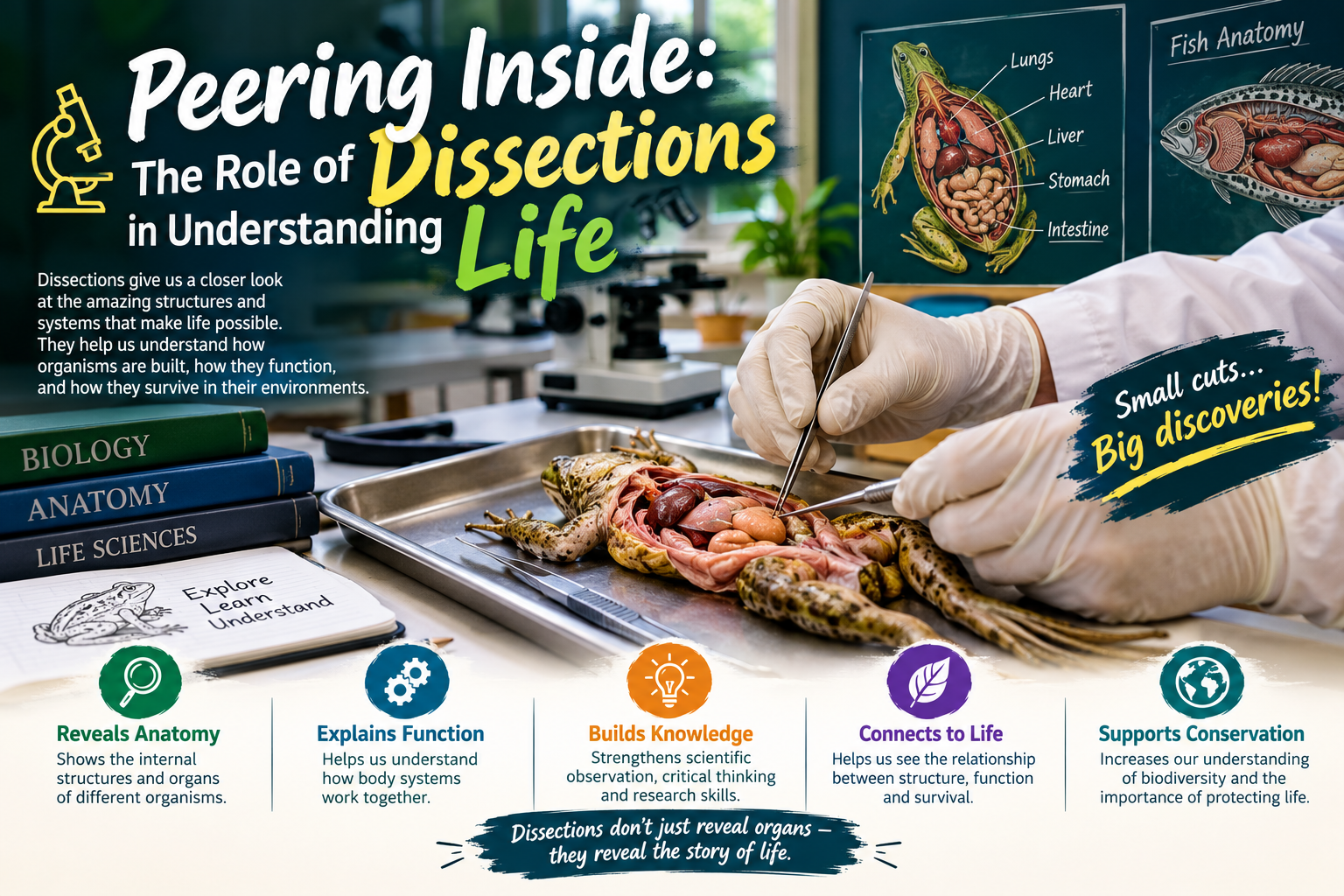
    Discover the fascinating world of biology through **“Peering Inside: The Role of Dissections in Understanding Life.”** This educational topic explores how dissection helps scientists and students understand the internal structures of living organisms and uncover the amazing systems that make life possible.

    Dissection is an important scientific method that allows researchers to examine organs, tissues, and body structures to learn how different parts of an organism work together. By studying anatomy, we can better understand the relationship between structure and function, how body systems support survival, and how different species are adapted to their environments.

    **What Will You Learn?**

    - **Understanding Anatomy:** Discover the internal structures and organs of living organisms.
    - **Structure and Function:** Learn how different organs work together to support life.
    - **Exploring Organisms:** Understand the similarities and differences between various species.
    - **Scientific Investigation:** Develop observation, analytical thinking, and research skills.
    - **Biodiversity and Conservation:** Explore how anatomical knowledge contributes to understanding and protecting living things.
    - **Educational Importance:** Discover how dissection supports biology, medicine, and scientific learning.

    Dissection has contributed greatly to our understanding of the human body and other organisms. Today, scientists and educators can also use anatomical models, digital simulations, and virtual dissection tools to explore biological structures. Responsible scientific study emphasizes ethical practices, safety, and respect for living things.

    **Conclusion:** Dissection is more than the study of internal organs; it is a window into the complexity, organization, and wonder of life. By exploring anatomy, we gain valuable knowledge about how organisms function, survive, and interact with the world around them.

    **“Dissections don't just reveal organs — they reveal the story of life!”**

    #PeeringInside #Dissection #Anatomy #Biology #LifeSciences #ScienceEducation #ScientificDiscovery #HumanAnatomy #AnimalBiology #Biodiversity #LearningThroughScience #EducationalContent #ExploreLife
    RSIF8 Roll no:14 story no:21 story topic:Peering Inside: The Role of Dissections in Understanding Life # 🔬 Peering Inside: The Role of Dissections in Understanding Life 🧬 Discover the fascinating world of biology through **“Peering Inside: The Role of Dissections in Understanding Life.”** This educational topic explores how dissection helps scientists and students understand the internal structures of living organisms and uncover the amazing systems that make life possible. 🌿✨ Dissection is an important scientific method that allows researchers to examine organs, tissues, and body structures to learn how different parts of an organism work together. By studying anatomy, we can better understand the relationship between structure and function, how body systems support survival, and how different species are adapted to their environments. 🔍 **What Will You Learn?** - 🫀 **Understanding Anatomy:** Discover the internal structures and organs of living organisms. - 🧠 **Structure and Function:** Learn how different organs work together to support life. - 🐸 **Exploring Organisms:** Understand the similarities and differences between various species. - 🔬 **Scientific Investigation:** Develop observation, analytical thinking, and research skills. - 🌍 **Biodiversity and Conservation:** Explore how anatomical knowledge contributes to understanding and protecting living things. - 📚 **Educational Importance:** Discover how dissection supports biology, medicine, and scientific learning. Dissection has contributed greatly to our understanding of the human body and other organisms. Today, scientists and educators can also use anatomical models, digital simulations, and virtual dissection tools to explore biological structures. Responsible scientific study emphasizes ethical practices, safety, and respect for living things. 💚 ✨ **Conclusion:** Dissection is more than the study of internal organs; it is a window into the complexity, organization, and wonder of life. By exploring anatomy, we gain valuable knowledge about how organisms function, survive, and interact with the world around them. **“Dissections don't just reveal organs — they reveal the story of life!”** 🌱🔬 #PeeringInside #Dissection #Anatomy #Biology #LifeSciences #ScienceEducation #ScientificDiscovery #HumanAnatomy #AnimalBiology #Biodiversity #LearningThroughScience #EducationalContent #ExploreLife
    0 Комментарии 0 Поделились 4296 Просмотры
  • RSIF8
    Roll no 94
    Song no 19
    Song topic
    Why Do We Experiment? The Search for Truth in Biology

    Every discovery in biology begins with a question and grows through experimentation. From understanding cells to unlocking the secrets of life, experiments help us uncover the truth hidden within nature.

    Join me on this journey of curiosity, learning, and scientific exploration!

    #Biology #Science #Experimentation #SearchForTruth #LearningJourney #STEMEducation #ScientificDiscovery #BiologyLovers #Education #Curiosity #Innovation #LifeSciences
    RSIF8 Roll no 94 Song no 19 Song topic 🌿🔬 Why Do We Experiment? The Search for Truth in Biology 🎶 Every discovery in biology begins with a question and grows through experimentation. 🧬✨ From understanding cells to unlocking the secrets of life, experiments help us uncover the truth hidden within nature. 🌱🔍 Join me on this journey of curiosity, learning, and scientific exploration! 🚀📚 #Biology #Science #Experimentation #SearchForTruth #LearningJourney #STEMEducation #ScientificDiscovery #BiologyLovers #Education #Curiosity #Innovation #LifeSciences 🧬🔬🌿✨🚀
    0 Комментарии 0 Поделились 1893 Просмотры 7
  • RSIF8
    Roll no 94
    Storypost no 20
    Storypost topic
    Exploring Life's Mechanisms Through Experimentation
    Science begins with curiosity and grows through discovery. Every experiment helps us understand how living organisms function, adapt, and interact with the world around them.
    From observing tiny cells under a microscope to testing hypotheses in the lab, experimentation allows us to uncover the fascinating mechanisms that make life possible.
    Keep asking questions, exploring new ideas, and embracing the journey of learning. Every discovery starts with a single experiment!
    #Science #Biology #Experimentation #STEM #LifeSciences #ScientificDiscovery #Learning #Innovation #Curiosity #FutureScientists #Education #Research
    RSIF8 Roll no 94 Storypost no 20 Storypost topic 🔬🌱 Exploring Life's Mechanisms Through Experimentation 🧪✨ Science begins with curiosity and grows through discovery. Every experiment helps us understand how living organisms function, adapt, and interact with the world around them. 🌍💡 From observing tiny cells under a microscope to testing hypotheses in the lab, experimentation allows us to uncover the fascinating mechanisms that make life possible. 🔍🧬 Keep asking questions, exploring new ideas, and embracing the journey of learning. Every discovery starts with a single experiment! 🚀📚💚 #Science #Biology #Experimentation #STEM #LifeSciences #ScientificDiscovery #Learning #Innovation #Curiosity #FutureScientists #Education #Research 🔬🧪🌱📖✨
    0 Комментарии 0 Поделились 2034 Просмотры
  • RSIF8
    Roll no 94
    Storypost no 19
    Storypost topic
    Peering Inside: The Role of Dissections in Understanding Life
    Every living organism has an incredible story hidden inside. Through dissections, we gain a deeper understanding of anatomy, organ functions, and the complex systems that keep life moving.
    This hands-on learning experience helps connect classroom knowledge with real-world science, inspiring curiosity, discovery, and respect for living things.
    Let's explore, learn, and uncover the wonders of life together!
    #ScienceEducation #Biology #Dissection #LearningByDoing #STEMEducation #Anatomy #LifeSciences #ScientificDiscovery #Curiosity #StudentLife #EducationMatters #FutureScientists
    RSIF8 Roll no 94 Storypost no 19 Storypost topic 🔬🐸 Peering Inside: The Role of Dissections in Understanding Life 🧬✨ Every living organism has an incredible story hidden inside. Through dissections, we gain a deeper understanding of anatomy, organ functions, and the complex systems that keep life moving. 🌱💡 This hands-on learning experience helps connect classroom knowledge with real-world science, inspiring curiosity, discovery, and respect for living things. 🔍❤️ Let's explore, learn, and uncover the wonders of life together! 🌍📚✨ #ScienceEducation #Biology #Dissection #LearningByDoing #STEMEducation #Anatomy #LifeSciences #ScientificDiscovery #Curiosity #StudentLife #EducationMatters #FutureScientists 🐸🔬🧬📖✨
    0 Комментарии 0 Поделились 2357 Просмотры
  • RSIF8
    Roll no 94
    Song no 17
    Song topic
    Dissecting Frogs: A Gateway to Human Anatomy
    Exploring frog anatomy helps us understand the amazing structure and functions of the human body! From organs to body systems, every discovery brings us closer to understanding life and science.
    Join me on this fascinating journey into biology and uncover the connections between frogs and humans! ‍
    #DissectingFrogs #HumanAnatomy #BiologyEducation #ScienceLearning #STEM #MedicalScience #AnatomyStudy #LifeSciences #LearningJourney #ScienceExplorer
    RSIF8 Roll no 94 Song no 17 Song topic 🐸🔬 Dissecting Frogs: A Gateway to Human Anatomy 🫀🧠 Exploring frog anatomy helps us understand the amazing structure and functions of the human body! 🌟 From organs to body systems, every discovery brings us closer to understanding life and science. 📚🔍 Join me on this fascinating journey into biology and uncover the connections between frogs and humans! 🐸➡️👨‍⚕️ #DissectingFrogs #HumanAnatomy #BiologyEducation #ScienceLearning #STEM #MedicalScience #AnatomyStudy #LifeSciences #LearningJourney #ScienceExplorer 🧪🔬📖
    0 Комментарии 0 Поделились 1920 Просмотры 15
  • **Roll No: 2**
    **Batch: 14**
    **Book: ACCL**
    **Task No: 138**

    # Exploring Life’s Mechanisms Through Experimentation

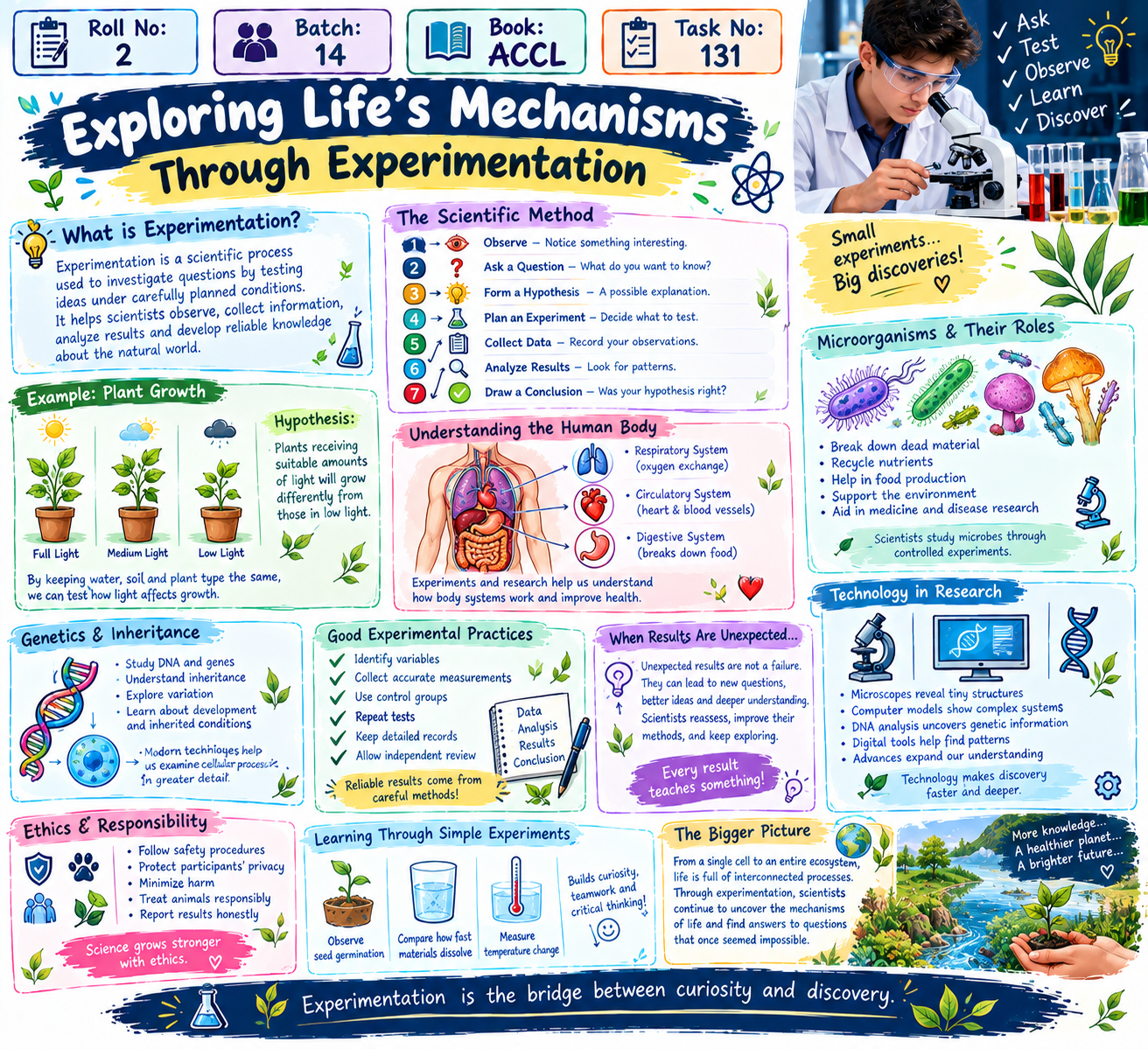
    Have you ever wondered how scientists discover the secrets of life? From understanding how plants grow to investigating how the human heart works, science helps us explore the processes that make living organisms function. Behind many important discoveries lies a powerful method called **experimentation**, which allows scientists to test ideas, observe results, and develop a deeper understanding of the natural world.

    **Experimentation is a scientific process used to investigate questions by testing ideas under carefully planned conditions.** Scientists begin by observing something interesting, asking a question, and developing a hypothesis—a possible explanation that can be tested. They then design an experiment, collect information, and analyze the results to determine whether the evidence supports their original idea. This process helps turn curiosity into reliable scientific knowledge.

    One fascinating example is the study of plant growth. Imagine a student who wants to discover whether the amount of light affects how quickly a plant grows. The student forms a hypothesis that plants receiving suitable amounts of light will grow differently from plants kept in low-light conditions. By keeping factors such as water, soil, and plant type consistent, the student can compare the results and investigate the role of light in plant development.

    Experimentation is also essential for understanding the human body. Scientists investigate how the heart circulates blood, how the lungs exchange gases, and how the digestive system processes food. Through carefully designed studies, medical imaging, laboratory tests, and other research methods, scientists learn how body systems work together to maintain health. Their findings can contribute to improved medical treatments and a better understanding of human biology.

    Another important field is microbiology, the study of microscopic organisms. Many bacteria and fungi play beneficial roles in nature, including breaking down dead material and recycling nutrients. Scientists use controlled experiments to investigate how these organisms respond to different environmental conditions. Such research can help improve food production, develop medicines, understand infectious diseases, and protect ecosystems.

    Experiments also help researchers understand genetics and the mechanisms of inheritance. By studying DNA, genes, and the characteristics of organisms across generations, scientists investigate how biological information is passed on and how variations arise. Modern techniques allow researchers to explore cellular processes in greater detail, helping them understand development, inherited conditions, and the relationships among different forms of life.

    A successful experiment requires more than simply observing what happens. Scientists must identify the variables they are studying, collect accurate measurements, and repeat tests when appropriate. They often use control groups for comparison and record their observations carefully. Repeating experiments helps determine whether a result is consistent, while independent review allows other researchers to examine the methods and evaluate the conclusions. These practices make scientific findings more trustworthy.

    Sometimes experiments produce unexpected results. Instead of treating an unexpected outcome as a failure, scientists use it as an opportunity to ask new questions. They may reconsider their hypothesis, improve their experimental design, or investigate another possible explanation. Scientific progress often happens through this cycle of questioning, testing, learning, and refining ideas. Every result can contribute something valuable when it is interpreted carefully.

    Technology has made biological experimentation more advanced than ever before. Microscopes reveal structures too small to see with the naked eye, computer models help researchers understand complicated systems, and DNA analysis allows scientists to investigate genetic information. Digital tools can also help organize large amounts of data and identify patterns that might otherwise be difficult to notice. These innovations continue to expand our understanding of living organisms.

    However, scientific experimentation must always be guided by responsibility and ethics. Researchers should follow safety procedures, protect participants' privacy, minimize harm, and treat animals responsibly. Experiments involving people or animals require appropriate ethical review and safeguards. Scientists must also report results honestly, even when the findings do not match their expectations. Reliable science depends on both accurate evidence and responsible behavior.

    Experimentation connects classroom learning with real-world discoveries. Students can explore scientific ideas through safe activities, such as observing seed germination, comparing how quickly different materials dissolve in water, or measuring changes in temperature. These activities encourage curiosity, careful observation, teamwork, and critical thinking. They also show that science is not just a collection of facts to memorize; it is an ongoing process of discovery.

    As we explore life's mechanisms, we begin to understand how countless processes work together to support living organisms. From the activity inside a single cell to the interactions among species in an ecosystem, each discovery reveals another part of nature's complexity. Through experimentation, scientists continue to investigate these connections and search for answers to questions that once seemed impossible to solve.

    **Experimentation is the bridge between curiosity and discovery. By asking thoughtful questions, testing ideas fairly, and learning from evidence, we can uncover the mechanisms of life and use scientific knowledge to improve human health, protect the environment, and build a brighter future. **

    \#Experimentation #Biology #ScientificMethod #LifeSciences #ScientificDiscovery #Research #ACCL #Batch14 #Task131
    **Roll No: 2** **Batch: 14** **Book: ACCL** **Task No: 138** # 🔬🧪 Exploring Life’s Mechanisms Through Experimentation 🌱🧬 Have you ever wondered how scientists discover the secrets of life? 🌍 From understanding how plants grow to investigating how the human heart works, science helps us explore the processes that make living organisms function. Behind many important discoveries lies a powerful method called **experimentation**, which allows scientists to test ideas, observe results, and develop a deeper understanding of the natural world. 🔍✨ **Experimentation is a scientific process used to investigate questions by testing ideas under carefully planned conditions.** 🧪 Scientists begin by observing something interesting, asking a question, and developing a hypothesis—a possible explanation that can be tested. They then design an experiment, collect information, and analyze the results to determine whether the evidence supports their original idea. This process helps turn curiosity into reliable scientific knowledge. 📚💡 One fascinating example is the study of plant growth. 🌱 Imagine a student who wants to discover whether the amount of light affects how quickly a plant grows. The student forms a hypothesis that plants receiving suitable amounts of light will grow differently from plants kept in low-light conditions. By keeping factors such as water, soil, and plant type consistent, the student can compare the results and investigate the role of light in plant development. ☀️🌿 Experimentation is also essential for understanding the human body. ❤️ Scientists investigate how the heart circulates blood, how the lungs exchange gases, and how the digestive system processes food. Through carefully designed studies, medical imaging, laboratory tests, and other research methods, scientists learn how body systems work together to maintain health. Their findings can contribute to improved medical treatments and a better understanding of human biology. 🫁🧠 Another important field is microbiology, the study of microscopic organisms. 🦠 Many bacteria and fungi play beneficial roles in nature, including breaking down dead material and recycling nutrients. Scientists use controlled experiments to investigate how these organisms respond to different environmental conditions. Such research can help improve food production, develop medicines, understand infectious diseases, and protect ecosystems. 🔬🌍 Experiments also help researchers understand genetics and the mechanisms of inheritance. 🧬 By studying DNA, genes, and the characteristics of organisms across generations, scientists investigate how biological information is passed on and how variations arise. Modern techniques allow researchers to explore cellular processes in greater detail, helping them understand development, inherited conditions, and the relationships among different forms of life. 🌱🔍 A successful experiment requires more than simply observing what happens. Scientists must identify the variables they are studying, collect accurate measurements, and repeat tests when appropriate. 📏 They often use control groups for comparison and record their observations carefully. Repeating experiments helps determine whether a result is consistent, while independent review allows other researchers to examine the methods and evaluate the conclusions. These practices make scientific findings more trustworthy. 📊📝 Sometimes experiments produce unexpected results. 🤔 Instead of treating an unexpected outcome as a failure, scientists use it as an opportunity to ask new questions. They may reconsider their hypothesis, improve their experimental design, or investigate another possible explanation. Scientific progress often happens through this cycle of questioning, testing, learning, and refining ideas. Every result can contribute something valuable when it is interpreted carefully. 💡🔄 Technology has made biological experimentation more advanced than ever before. 🤖🔬 Microscopes reveal structures too small to see with the naked eye, computer models help researchers understand complicated systems, and DNA analysis allows scientists to investigate genetic information. Digital tools can also help organize large amounts of data and identify patterns that might otherwise be difficult to notice. These innovations continue to expand our understanding of living organisms. 💻🧬 However, scientific experimentation must always be guided by responsibility and ethics. 💚 Researchers should follow safety procedures, protect participants' privacy, minimize harm, and treat animals responsibly. Experiments involving people or animals require appropriate ethical review and safeguards. Scientists must also report results honestly, even when the findings do not match their expectations. Reliable science depends on both accurate evidence and responsible behavior. ⚖️🌿 Experimentation connects classroom learning with real-world discoveries. 🏫 Students can explore scientific ideas through safe activities, such as observing seed germination, comparing how quickly different materials dissolve in water, or measuring changes in temperature. These activities encourage curiosity, careful observation, teamwork, and critical thinking. They also show that science is not just a collection of facts to memorize; it is an ongoing process of discovery. 🌈🧪 As we explore life's mechanisms, we begin to understand how countless processes work together to support living organisms. From the activity inside a single cell to the interactions among species in an ecosystem, each discovery reveals another part of nature's complexity. Through experimentation, scientists continue to investigate these connections and search for answers to questions that once seemed impossible to solve. 🌎🦋🔬 **Experimentation is the bridge between curiosity and discovery. By asking thoughtful questions, testing ideas fairly, and learning from evidence, we can uncover the mechanisms of life and use scientific knowledge to improve human health, protect the environment, and build a brighter future. 🔬🧬🌍💚** \#Experimentation #Biology #ScientificMethod #LifeSciences #ScientificDiscovery #Research #ACCL #Batch14 #Task131 🧪🔬🌱
    0 Комментарии 0 Поделились 6497 Просмотры
  • RSIF8
    Roll no 94
    Story post no 7
    Story post topic
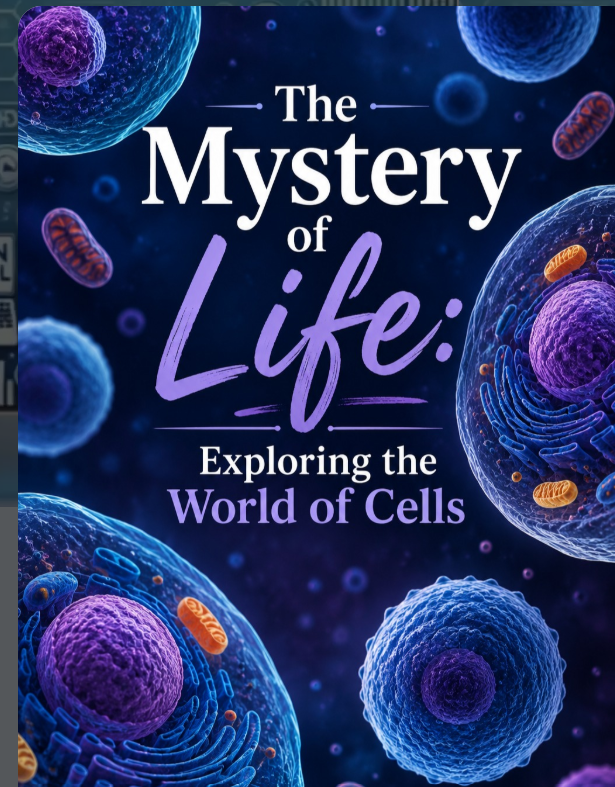
    The Mystery of Life: Exploring the World of Cells
    Have you ever wondered what makes life possible? Dive into the fascinating world of cells—the tiny building blocks that create every living thing around us! From their incredible structures to their amazing functions, cells hold the secrets of life itself.
    Join this exciting journey into the microscopic universe and discover how these tiny wonders shape our world.
    What is the most interesting fact you know about cells? Share it in the comments!
    #TheMysteryOfLife #WorldOfCells #CellBiology #ScienceEducation #STEM #Biology #MicroscopicWorld #ScienceFacts #LearningJourney #ExploreScience #EducationalContent #LifeSciences #ScienceLovers #KnowledgeIsPower #DiscoverMore
    RSIF8 Roll no 94 Story post no 7 Story post topic 🔬✨ The Mystery of Life: Exploring the World of Cells ✨🔬 Have you ever wondered what makes life possible? 🌍🧬 Dive into the fascinating world of cells—the tiny building blocks that create every living thing around us! From their incredible structures to their amazing functions, cells hold the secrets of life itself. 🔍💡 Join this exciting journey into the microscopic universe and discover how these tiny wonders shape our world. 🌱🔬✨ 💭 What is the most interesting fact you know about cells? Share it in the comments! #TheMysteryOfLife #WorldOfCells #CellBiology #ScienceEducation #STEM #Biology #MicroscopicWorld #ScienceFacts #LearningJourney #ExploreScience #EducationalContent #LifeSciences #ScienceLovers #KnowledgeIsPower #DiscoverMore 🔬🧫🧬✨🌍
    0 Комментарии 0 Поделились 1879 Просмотры
  • #rsisb
    Roll No.240
    Story No.17
    Foundation level

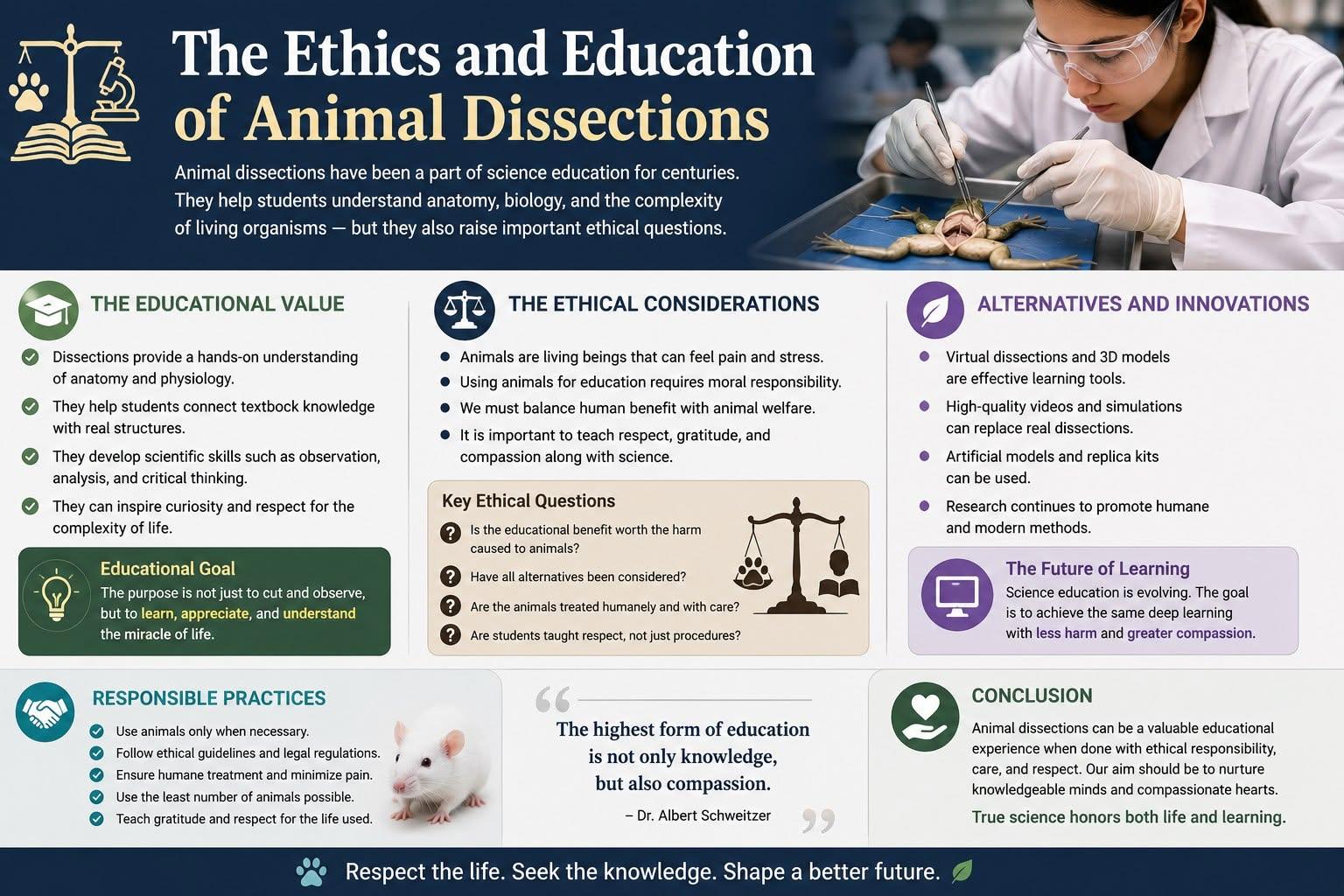
    ### **The Ethics and Education of Animal Dissections**

    Animal dissection has long been an important part of biology and medical education, helping students understand anatomy, physiology, and the complex structures of living organisms. By examining real biological specimens, learners gain hands-on experience that strengthens their observation, critical thinking, and scientific investigation skills. For many years, dissections have played a significant role in preparing future doctors, veterinarians, scientists, and researchers by providing practical knowledge that complements classroom learning.

    At the same time, animal dissections raise important ethical questions about animal welfare, responsible scientific practice, and the balance between educational benefits and respect for living creatures. Modern education encourages students to consider these ethical perspectives while learning about science. Many schools and universities now offer alternatives such as virtual dissections, 3D anatomical models, computer simulations, and interactive digital laboratories. These innovative tools provide effective learning experiences while reducing the need for animal specimens in many educational settings.

    Understanding the ethics of animal dissection helps students develop not only scientific knowledge but also compassion, responsibility, and respect for life. By combining ethical awareness with scientific inquiry, educators can inspire future generations to pursue discovery in ways that are both innovative and humane. This balanced approach promotes critical thinking, responsible decision-making, and a deeper appreciation for the relationship between science, education, and the living world.

    **#AnimalDissection #Biology #ScienceEducation #Ethics #STEM #BiologyLab #Anatomy #LifeSciences #ScientificLearning #AnimalWelfare #Education #MedicalScience #CriticalThinking #Research #Science **

    Rehan School Islamabad Campus
    Asma Shaheen EducationWali
    Irum Asim
    Saima Happinesswali
    #rsisb Roll No.240 Story No.17 Foundation level ### **The Ethics and Education of Animal Dissections** Animal dissection has long been an important part of biology and medical education, helping students understand anatomy, physiology, and the complex structures of living organisms. By examining real biological specimens, learners gain hands-on experience that strengthens their observation, critical thinking, and scientific investigation skills. For many years, dissections have played a significant role in preparing future doctors, veterinarians, scientists, and researchers by providing practical knowledge that complements classroom learning. At the same time, animal dissections raise important ethical questions about animal welfare, responsible scientific practice, and the balance between educational benefits and respect for living creatures. Modern education encourages students to consider these ethical perspectives while learning about science. Many schools and universities now offer alternatives such as virtual dissections, 3D anatomical models, computer simulations, and interactive digital laboratories. These innovative tools provide effective learning experiences while reducing the need for animal specimens in many educational settings. Understanding the ethics of animal dissection helps students develop not only scientific knowledge but also compassion, responsibility, and respect for life. By combining ethical awareness with scientific inquiry, educators can inspire future generations to pursue discovery in ways that are both innovative and humane. This balanced approach promotes critical thinking, responsible decision-making, and a deeper appreciation for the relationship between science, education, and the living world. **#AnimalDissection #Biology #ScienceEducation #Ethics #STEM #BiologyLab #Anatomy #LifeSciences #ScientificLearning #AnimalWelfare #Education #MedicalScience #CriticalThinking #Research #Science 🌿🔬🧬🐸📚** Rehan School Islamabad Campus Asma Shaheen EducationWali Irum Asim Saima Happinesswali
    0 Комментарии 0 Поделились 9128 Просмотры
  • #rsisb
    Roll No.240
    Story No.19
    Foundation Level

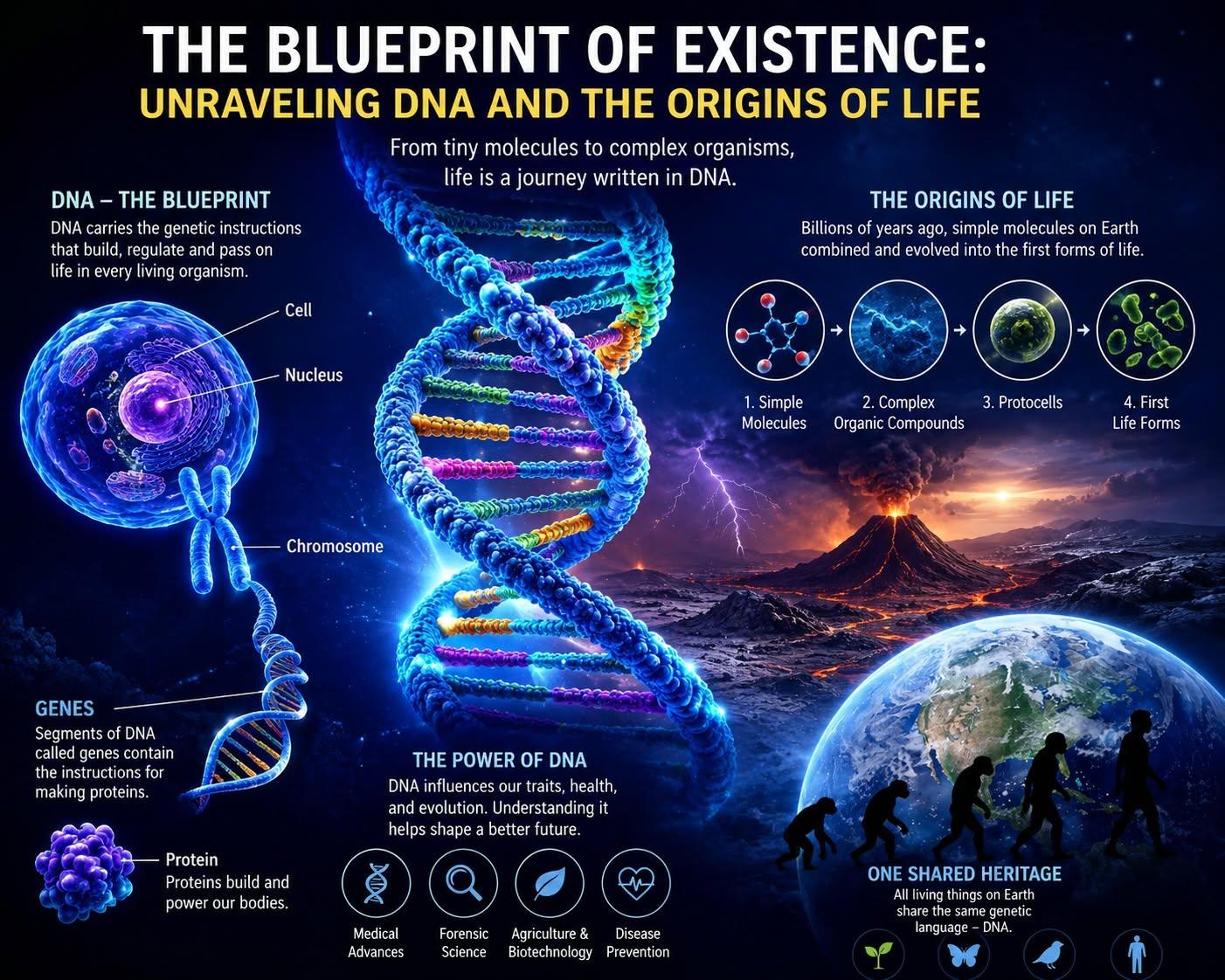
    # The Blueprint of Existence: Unraveling DNA and the Origins of Life

    DNA, or **Deoxyribonucleic Acid**, is often called the **blueprint of life** because it contains the genetic instructions that guide the growth, development, and functioning of every living organism. From the tiniest bacteria to the largest mammals, DNA carries the information that determines how living things are built, how they reproduce, and how traits are passed from one generation to the next. Understanding DNA has revolutionized biology, medicine, agriculture, and forensic science, helping scientists unlock the mysteries of life itself.

    The origins of life remain one of science's greatest questions. Researchers believe that billions of years ago, simple molecules on the early Earth gradually combined through natural chemical processes to form more complex compounds. Over immense periods of time, these molecules eventually developed the ability to replicate and evolve, leading to the first primitive forms of life. While many details are still being explored, scientific evidence suggests that DNA became the primary storage system for genetic information as life evolved.

    Every cell in the human body contains DNA organized into chromosomes, with thousands of genes carrying instructions for producing proteins. These proteins perform countless essential functions, from building tissues and organs to regulating metabolism and supporting the immune system. Even small changes in DNA can influence physical characteristics, health, and susceptibility to certain diseases, making genetics one of the most important fields in modern science.

    The study of DNA has transformed healthcare through genetic testing, personalized medicine, gene therapy, and disease prevention. It has also helped solve criminal investigations through DNA fingerprinting, improved crop production through genetic engineering, and deepened our understanding of evolution by revealing the shared ancestry of all living organisms.

    As scientists continue exploring genetics and the origins of life, new discoveries are reshaping our understanding of biology and opening exciting possibilities for the future. By unraveling the secrets hidden within DNA, humanity moves closer to understanding not only where life came from but also how we can improve health, protect biodiversity, and advance scientific knowledge for generations to come.

    **#DNA #Genetics #Biology #Science #OriginOfLife #MolecularBiology #Evolution #GeneticResearch #LifeSciences #STEM #Education #ScientificDiscovery #Innovation #Learning #FutureOfScience**

    Rehan School Islamabad Campus
    Asma Shaheen EducationWali
    Irum Asim
    Saima Happinesswali
    #rsisb Roll No.240 Story No.19 Foundation Level # 🧬 The Blueprint of Existence: Unraveling DNA and the Origins of Life DNA, or **Deoxyribonucleic Acid**, is often called the **blueprint of life** because it contains the genetic instructions that guide the growth, development, and functioning of every living organism. From the tiniest bacteria to the largest mammals, DNA carries the information that determines how living things are built, how they reproduce, and how traits are passed from one generation to the next. Understanding DNA has revolutionized biology, medicine, agriculture, and forensic science, helping scientists unlock the mysteries of life itself. The origins of life remain one of science's greatest questions. Researchers believe that billions of years ago, simple molecules on the early Earth gradually combined through natural chemical processes to form more complex compounds. Over immense periods of time, these molecules eventually developed the ability to replicate and evolve, leading to the first primitive forms of life. While many details are still being explored, scientific evidence suggests that DNA became the primary storage system for genetic information as life evolved. Every cell in the human body contains DNA organized into chromosomes, with thousands of genes carrying instructions for producing proteins. These proteins perform countless essential functions, from building tissues and organs to regulating metabolism and supporting the immune system. Even small changes in DNA can influence physical characteristics, health, and susceptibility to certain diseases, making genetics one of the most important fields in modern science. The study of DNA has transformed healthcare through genetic testing, personalized medicine, gene therapy, and disease prevention. It has also helped solve criminal investigations through DNA fingerprinting, improved crop production through genetic engineering, and deepened our understanding of evolution by revealing the shared ancestry of all living organisms. As scientists continue exploring genetics and the origins of life, new discoveries are reshaping our understanding of biology and opening exciting possibilities for the future. By unraveling the secrets hidden within DNA, humanity moves closer to understanding not only where life came from but also how we can improve health, protect biodiversity, and advance scientific knowledge for generations to come. **#DNA #Genetics #Biology #Science #OriginOfLife #MolecularBiology #Evolution #GeneticResearch #LifeSciences #STEM #Education #ScientificDiscovery #Innovation #Learning #FutureOfScience** 🧬🔬🌍📚✨ Rehan School Islamabad Campus Asma Shaheen EducationWali Irum Asim Saima Happinesswali
    0 Комментарии 0 Поделились 8017 Просмотры
Расширенные страницы