• RSIF8
    Roll no:14
    story no:24
    story topic:The Nature of Light: Exploring Waves and Particles

    **The Nature of Light: Exploring Waves and Particles**

    Have you ever wondered what light really is? How does sunlight travel across millions of kilometers through space, how do rainbows form, and how can light behave like both a wave and a particle? The nature of light is one of the most fascinating topics in physics, revealing the extraordinary connection between the visible world and the mysterious laws of quantum mechanics. From the light that illuminates our homes to the distant stars shining in the universe, light plays an essential role in understanding the world around us.

    **1. The Wave Nature of Light **

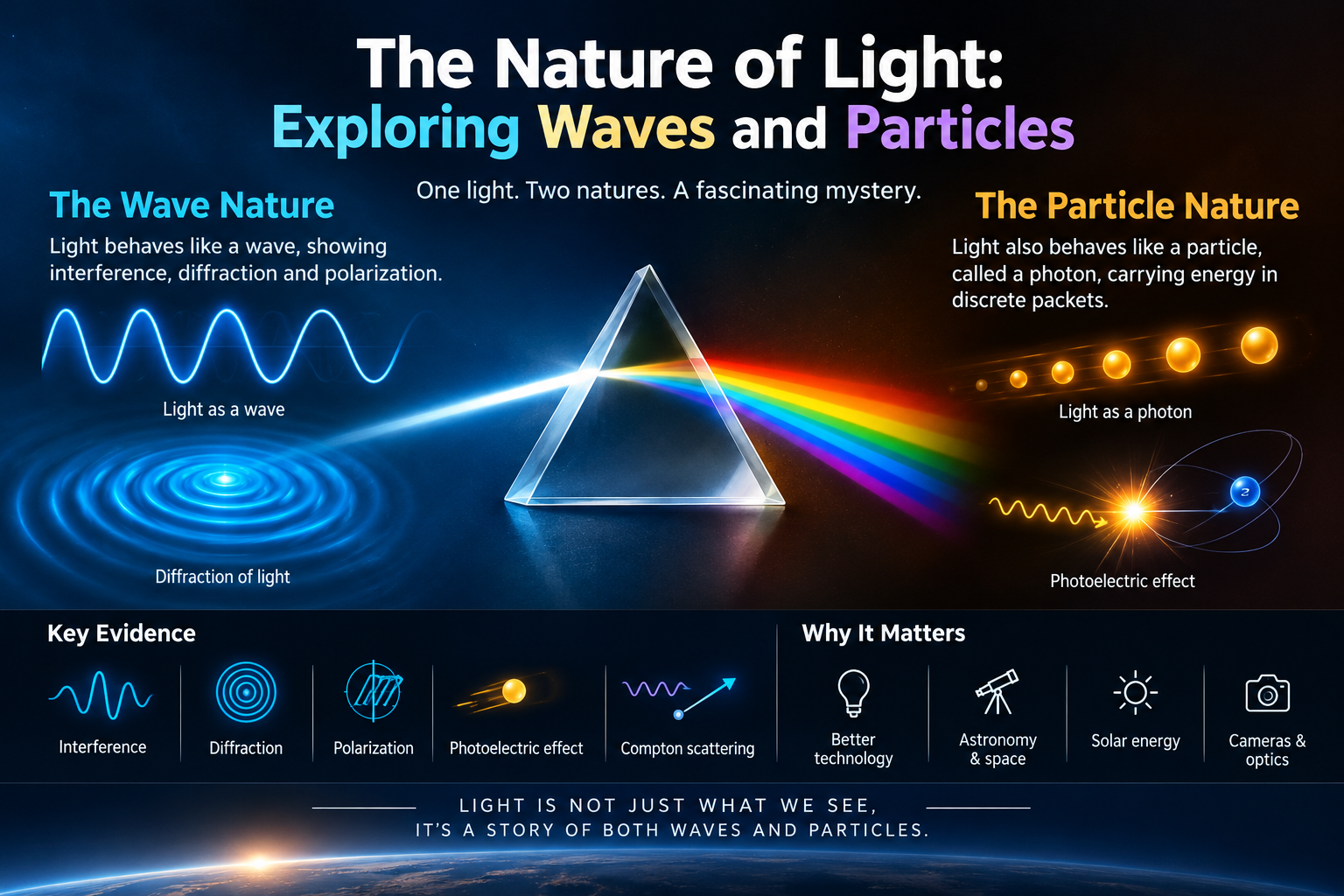
    For many years, scientists have studied light as a wave because it demonstrates important wave-like properties. Light can undergo interference, diffraction, and polarization. Interference occurs when light waves overlap and combine, producing patterns of brightness and darkness. Diffraction happens when light spreads around an obstacle or passes through a narrow opening. Polarization describes the orientation of light's oscillations and helps us understand how light interacts with different materials.

    These properties demonstrate that the wave model is essential for explaining many optical phenomena. From colorful patterns created by thin films to the operation of polarized sunglasses, the wave nature of light has many applications in everyday life and modern technology.

    **2. The Particle Nature of Light **

    Light also behaves in ways that reveal its particle nature. In quantum physics, light energy is exchanged in discrete packets called **photons**. Each photon carries energy determined by its frequency, described by the equation **E = hf**, where E represents energy, h is Planck's constant, and f is frequency.

    The photoelectric effect provides important evidence for this particle nature. When light of a suitable frequency strikes certain materials, it can release electrons from their surfaces. This phenomenon helped scientists understand that light energy is transferred in individual quanta rather than always behaving like a continuous wave.

    Another important example is Compton scattering, in which photons exchange energy and momentum with electrons. These discoveries transformed our understanding of light and helped establish the foundations of quantum physics.

    **3. Wave-Particle Duality: Two Sides of Light**

    One of the most remarkable discoveries in science is that light cannot be fully explained by treating it only as a classical wave or only as a classical particle. Its behavior depends on the physical process being investigated and how it is measured. This concept is known as **wave-particle duality**.

    Experiments involving interference reveal wave-like patterns, while experiments involving photon detection show that light energy is detected in discrete units. Quantum mechanics brings these observations together into a more complete description of nature. Rather than being an ordinary wave or a tiny classical object, light is a quantum phenomenon with properties that challenge our everyday intuition.

    **4. How Do We Discover the Secrets of Light?**

    Scientists use carefully designed experiments to explore the behavior of light. Prisms separate white light into different colors, optical instruments measure its properties, and advanced detectors record individual photons. Interference experiments reveal patterns that cannot be explained by simple particle models, while photoelectric experiments demonstrate the importance of quantized energy.

    The work of scientists such as Isaac Newton, Thomas Young, Max Planck, Albert Einstein, and Arthur Compton helped build our modern understanding of light. Their discoveries show how scientific knowledge develops through observation, experimentation, mathematical reasoning, and new ideas.

    **5. Why Is the Nature of Light Important?**

    Understanding light is essential to many technologies that shape modern life. Lasers are used in medicine, manufacturing, and scientific research. Fiber-optic cables transmit information across the world using pulses of light. Solar panels convert light energy into electrical energy, while cameras and telescopes help us capture images and explore distant objects in space.

    The principles of light are also important in astronomy, microscopy, optical communication, quantum technologies, and the study of the universe. By investigating how light behaves, scientists can examine distant galaxies, study the structure of matter, and develop new tools that improve our understanding of nature.

    **6. Light: Connecting Science and the Universe**

    Light is much more than what allows us to see. It carries information about distant stars, reveals the composition of celestial objects, and provides clues about the physical processes occurring throughout the cosmos. By analyzing the light received from distant galaxies, astronomers can learn about their temperatures, chemical compositions, and motion.

    At the smallest scales, the study of photons helps scientists investigate the quantum world and understand how energy interacts with matter. From the smallest laboratory experiments to the largest astronomical observations, light connects different areas of science in extraordinary ways.

    **Conclusion: The Extraordinary Mystery of Light**

    The study of light demonstrates how nature can be far more complex than it first appears. Its wave-like properties explain interference, diffraction, and polarization, while its particle-like properties help explain the photoelectric effect and Compton scattering. Together, these discoveries form an important part of our modern understanding of physics.

    Learning about wave-particle duality encourages us to question assumptions, explore scientific evidence, and appreciate the discoveries that continue to expand human knowledge. Every beam of sunlight, every shining star, and every photon detected by a scientific instrument reminds us that there is still much to discover about the universe.

    **Light Is More Than What We See—It Is a Window into the Fundamental Nature of Reality!**

    If you enjoyed this science topic, share it with others and continue exploring the fascinating world of physics. Stay curious, keep asking questions, and never stop learning!

    #NatureOfLight #WaveParticleDuality #Physics #QuantumPhysics #ScienceEducation #Photons #LightWaves #PhotoelectricEffect #ComptonScattering #Optics #Astronomy #ScientificDiscoveries #STEMEducation #LearnPhysics #ScienceExplained #EducationalContent #WavesAndParticles
    RSIF8 Roll no:14 story no:24 story topic:The Nature of Light: Exploring Waves and Particles 🌟 **The Nature of Light: Exploring Waves and Particles** 🌈🔬 Have you ever wondered what light really is? How does sunlight travel across millions of kilometers through space, how do rainbows form, and how can light behave like both a wave and a particle? The nature of light is one of the most fascinating topics in physics, revealing the extraordinary connection between the visible world and the mysterious laws of quantum mechanics. From the light that illuminates our homes to the distant stars shining in the universe, light plays an essential role in understanding the world around us. 🌍✨ 💡 **1. The Wave Nature of Light 🌊** For many years, scientists have studied light as a wave because it demonstrates important wave-like properties. Light can undergo interference, diffraction, and polarization. Interference occurs when light waves overlap and combine, producing patterns of brightness and darkness. Diffraction happens when light spreads around an obstacle or passes through a narrow opening. Polarization describes the orientation of light's oscillations and helps us understand how light interacts with different materials. These properties demonstrate that the wave model is essential for explaining many optical phenomena. From colorful patterns created by thin films to the operation of polarized sunglasses, the wave nature of light has many applications in everyday life and modern technology. ⚛️ **2. The Particle Nature of Light ✨** Light also behaves in ways that reveal its particle nature. In quantum physics, light energy is exchanged in discrete packets called **photons**. Each photon carries energy determined by its frequency, described by the equation **E = hf**, where E represents energy, h is Planck's constant, and f is frequency. The photoelectric effect provides important evidence for this particle nature. When light of a suitable frequency strikes certain materials, it can release electrons from their surfaces. This phenomenon helped scientists understand that light energy is transferred in individual quanta rather than always behaving like a continuous wave. Another important example is Compton scattering, in which photons exchange energy and momentum with electrons. These discoveries transformed our understanding of light and helped establish the foundations of quantum physics. 🔬 **3. Wave-Particle Duality: Two Sides of Light** One of the most remarkable discoveries in science is that light cannot be fully explained by treating it only as a classical wave or only as a classical particle. Its behavior depends on the physical process being investigated and how it is measured. This concept is known as **wave-particle duality**. Experiments involving interference reveal wave-like patterns, while experiments involving photon detection show that light energy is detected in discrete units. Quantum mechanics brings these observations together into a more complete description of nature. Rather than being an ordinary wave or a tiny classical object, light is a quantum phenomenon with properties that challenge our everyday intuition. 🌈 **4. How Do We Discover the Secrets of Light?** Scientists use carefully designed experiments to explore the behavior of light. Prisms separate white light into different colors, optical instruments measure its properties, and advanced detectors record individual photons. Interference experiments reveal patterns that cannot be explained by simple particle models, while photoelectric experiments demonstrate the importance of quantized energy. The work of scientists such as Isaac Newton, Thomas Young, Max Planck, Albert Einstein, and Arthur Compton helped build our modern understanding of light. Their discoveries show how scientific knowledge develops through observation, experimentation, mathematical reasoning, and new ideas. 🚀 **5. Why Is the Nature of Light Important?** Understanding light is essential to many technologies that shape modern life. Lasers are used in medicine, manufacturing, and scientific research. Fiber-optic cables transmit information across the world using pulses of light. Solar panels convert light energy into electrical energy, while cameras and telescopes help us capture images and explore distant objects in space. The principles of light are also important in astronomy, microscopy, optical communication, quantum technologies, and the study of the universe. By investigating how light behaves, scientists can examine distant galaxies, study the structure of matter, and develop new tools that improve our understanding of nature. 🌍 **6. Light: Connecting Science and the Universe** Light is much more than what allows us to see. It carries information about distant stars, reveals the composition of celestial objects, and provides clues about the physical processes occurring throughout the cosmos. By analyzing the light received from distant galaxies, astronomers can learn about their temperatures, chemical compositions, and motion. At the smallest scales, the study of photons helps scientists investigate the quantum world and understand how energy interacts with matter. From the smallest laboratory experiments to the largest astronomical observations, light connects different areas of science in extraordinary ways. 💫 **Conclusion: The Extraordinary Mystery of Light** The study of light demonstrates how nature can be far more complex than it first appears. Its wave-like properties explain interference, diffraction, and polarization, while its particle-like properties help explain the photoelectric effect and Compton scattering. Together, these discoveries form an important part of our modern understanding of physics. Learning about wave-particle duality encourages us to question assumptions, explore scientific evidence, and appreciate the discoveries that continue to expand human knowledge. Every beam of sunlight, every shining star, and every photon detected by a scientific instrument reminds us that there is still much to discover about the universe. ✨ **Light Is More Than What We See—It Is a Window into the Fundamental Nature of Reality!** 🔭🌌 👍 If you enjoyed this science topic, share it with others and continue exploring the fascinating world of physics. Stay curious, keep asking questions, and never stop learning! #NatureOfLight #WaveParticleDuality #Physics #QuantumPhysics #ScienceEducation #Photons #LightWaves #PhotoelectricEffect #ComptonScattering #Optics #Astronomy #ScientificDiscoveries #STEMEducation #LearnPhysics #ScienceExplained #EducationalContent #WavesAndParticles 🌈🔬🚀
    0 Σχόλια 0 Μοιράστηκε 1041 Views
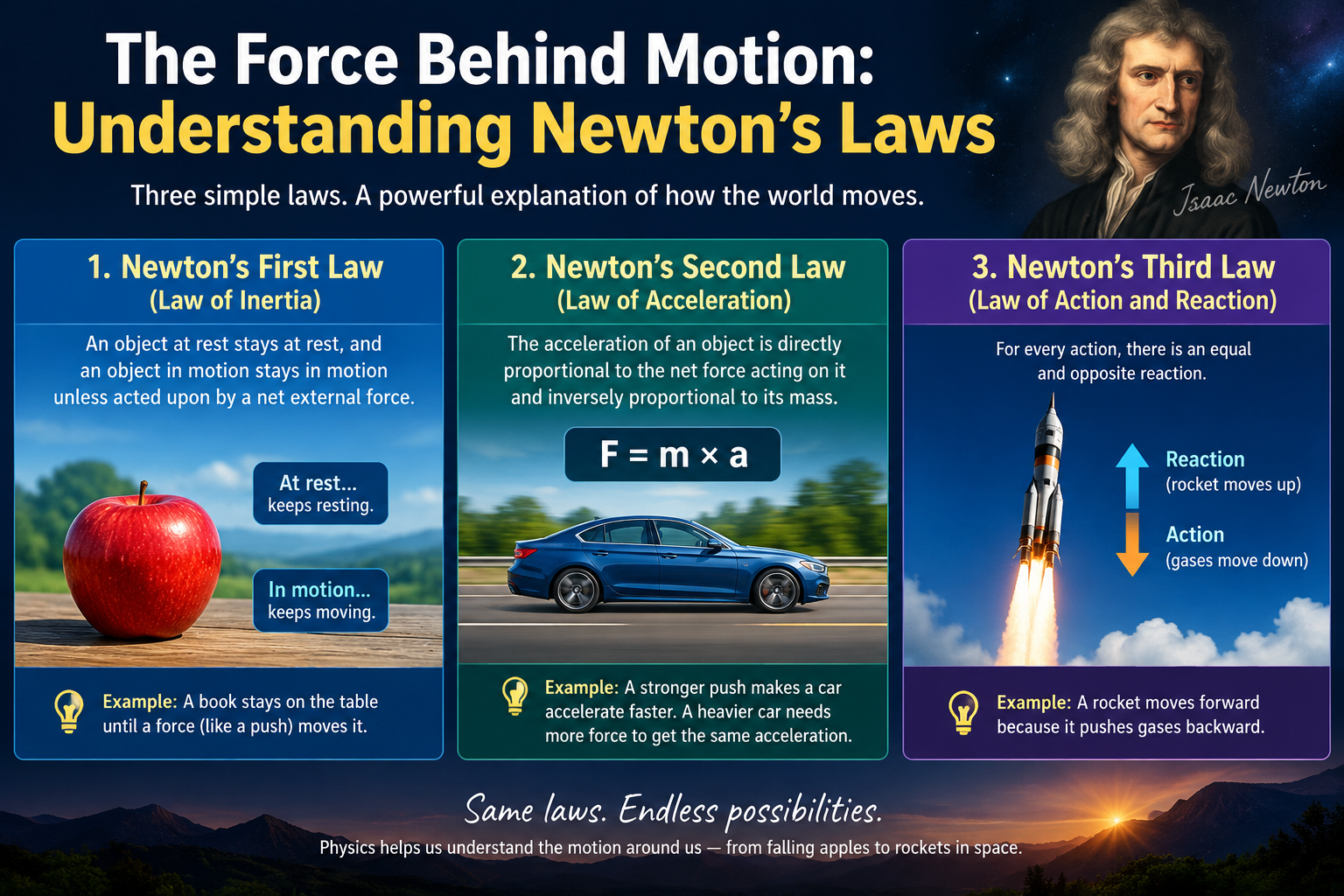
  • RSIF8
    Roll no:14
    story no:24
    story topic:The Force Behind Motion: Understanding Newton’s Laws

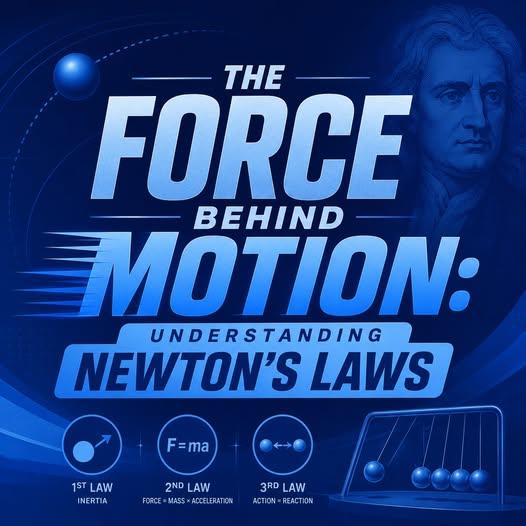
    **The Force Behind Motion: Understanding Newton’s Laws**

    Welcome to the fascinating world of physics, where forces, motion, and energy work together to explain how our universe operates! In this educational journey, we explore **Newton’s Three Laws of Motion**, some of the most important principles in science that help us understand why objects move, how they change speed, and how forces affect everything around us. From a simple falling apple to a speeding car and a powerful rocket launching into space, Newton’s laws are everywhere in our daily lives!

    **1. Newton’s First Law — The Law of Inertia**

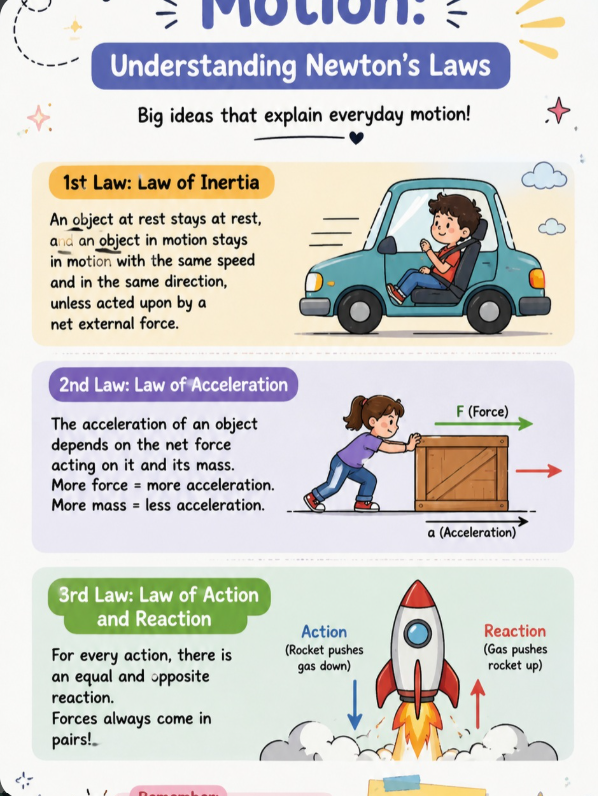
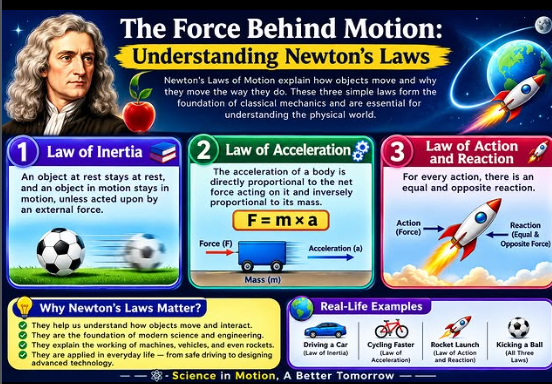
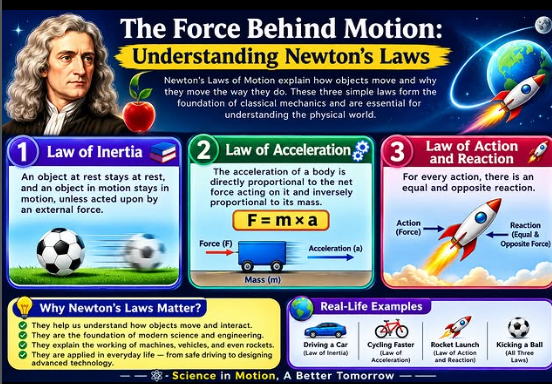
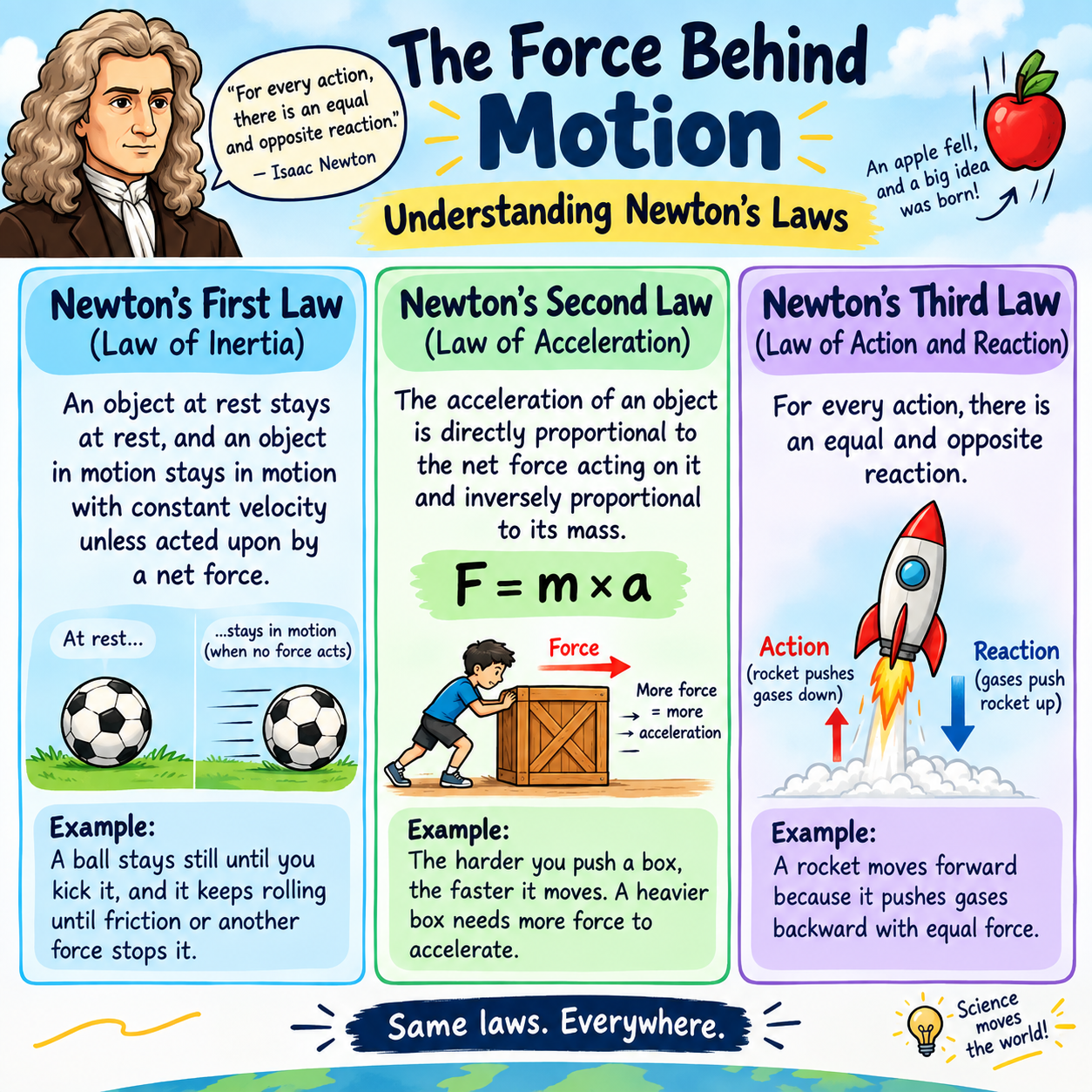
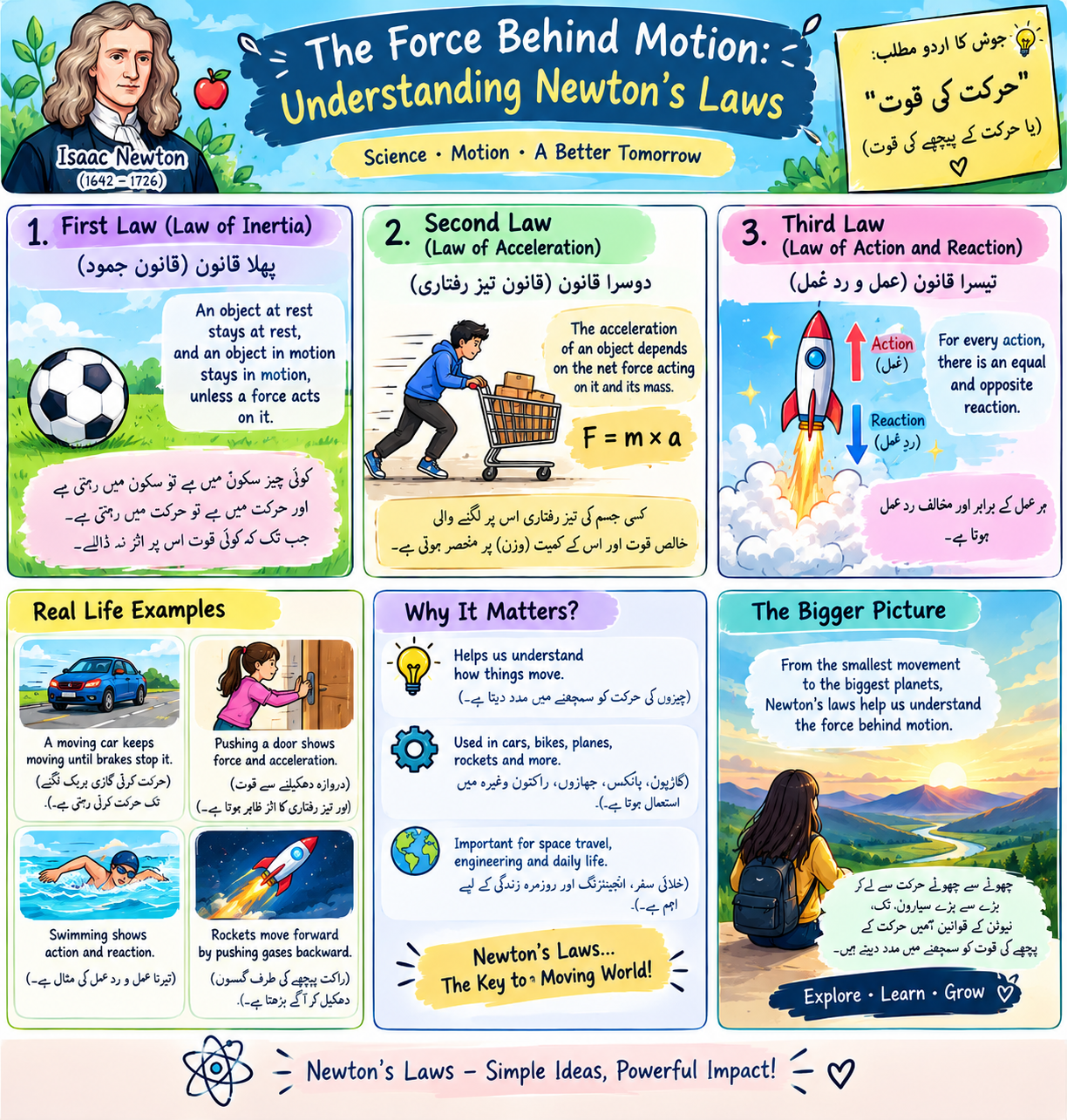
    Newton’s First Law states that an object at rest remains at rest, and an object in motion continues moving at a constant speed in a straight line unless acted upon by an unbalanced external force. This principle explains why a book stays on a table until someone moves it and why passengers tend to move forward when a moving car suddenly stops. Inertia is the natural tendency of objects to resist changes in their state of motion.

    **2. Newton’s Second Law — The Law of Acceleration**

    Newton’s Second Law explains how force, mass, and acceleration are connected. The greater the net force applied to an object, the greater its acceleration. However, a heavier object requires more force than a lighter object to achieve the same acceleration. This relationship is expressed through the famous formula **F = m × a**, where F represents force, m represents mass, and a represents acceleration. This law helps engineers design vehicles, machines, and countless other technologies.

    **3. Newton’s Third Law — The Law of Action and Reaction**

    Newton’s Third Law states that for every action, there is an equal and opposite reaction. Whenever one object exerts a force on another, the second object exerts an equal force in the opposite direction. This principle explains how rockets move forward by pushing exhaust gases backward, how swimmers move through water, and how we walk by pushing against the ground. It reveals the incredible relationship between forces acting on interacting objects.

    **Why Are Newton’s Laws Important?**

    Newton’s laws are essential for understanding the physical world. They help scientists explain motion, engineers develop safer vehicles, athletes improve their performance, and space agencies calculate the movements of spacecraft. These principles are used in transportation, construction, robotics, aviation, sports science, and space exploration. By understanding these laws, students can develop stronger scientific thinking and see how classroom physics connects to real-life experiences.

    **Explore the Science Behind Everyday Motion!**

    Physics is more than formulas and equations; it is a way to understand the world around us. Every moving bicycle, bouncing ball, accelerating car, and launching rocket demonstrates the fascinating principles of force and motion. Learning Newton’s laws opens the door to deeper discoveries in science, technology, engineering, and mathematics.

    Join us on this exciting journey to discover how simple scientific principles explain some of the most extraordinary movements in our universe. Keep asking questions, stay curious, and never stop exploring the wonders of science!

    **Learn the Laws. Understand the Forces. Discover the Science of Motion!**

    Like, share, and follow for more educational content, fascinating science topics, and easy-to-understand explanations that make learning enjoyable!

    #NewtonsLaws #ForceAndMotion #Physics #ScienceEducation #IsaacNewton #LawOfInertia #Acceleration #ActionAndReaction #PhysicsExplained #ScienceFacts #STEMEducation #EducationalVideos #LearnScience #ScientificDiscoveries #SpaceExploration #KnowledgeIsPower
    RSIF8 Roll no:14 story no:24 story topic:The Force Behind Motion: Understanding Newton’s Laws 🚀 **The Force Behind Motion: Understanding Newton’s Laws** 🌍🔬 Welcome to the fascinating world of physics, where forces, motion, and energy work together to explain how our universe operates! 🌌 In this educational journey, we explore **Newton’s Three Laws of Motion**, some of the most important principles in science that help us understand why objects move, how they change speed, and how forces affect everything around us. From a simple falling apple to a speeding car and a powerful rocket launching into space, Newton’s laws are everywhere in our daily lives! 🍎🚗🚀 📘 **1. Newton’s First Law — The Law of Inertia** Newton’s First Law states that an object at rest remains at rest, and an object in motion continues moving at a constant speed in a straight line unless acted upon by an unbalanced external force. This principle explains why a book stays on a table until someone moves it and why passengers tend to move forward when a moving car suddenly stops. Inertia is the natural tendency of objects to resist changes in their state of motion. ⚡ **2. Newton’s Second Law — The Law of Acceleration** Newton’s Second Law explains how force, mass, and acceleration are connected. The greater the net force applied to an object, the greater its acceleration. However, a heavier object requires more force than a lighter object to achieve the same acceleration. This relationship is expressed through the famous formula **F = m × a**, where F represents force, m represents mass, and a represents acceleration. This law helps engineers design vehicles, machines, and countless other technologies. 🌟 **3. Newton’s Third Law — The Law of Action and Reaction** Newton’s Third Law states that for every action, there is an equal and opposite reaction. Whenever one object exerts a force on another, the second object exerts an equal force in the opposite direction. This principle explains how rockets move forward by pushing exhaust gases backward, how swimmers move through water, and how we walk by pushing against the ground. It reveals the incredible relationship between forces acting on interacting objects. 🔍 **Why Are Newton’s Laws Important?** Newton’s laws are essential for understanding the physical world. They help scientists explain motion, engineers develop safer vehicles, athletes improve their performance, and space agencies calculate the movements of spacecraft. These principles are used in transportation, construction, robotics, aviation, sports science, and space exploration. By understanding these laws, students can develop stronger scientific thinking and see how classroom physics connects to real-life experiences. 💡 **Explore the Science Behind Everyday Motion!** Physics is more than formulas and equations; it is a way to understand the world around us. Every moving bicycle, bouncing ball, accelerating car, and launching rocket demonstrates the fascinating principles of force and motion. Learning Newton’s laws opens the door to deeper discoveries in science, technology, engineering, and mathematics. Join us on this exciting journey to discover how simple scientific principles explain some of the most extraordinary movements in our universe. Keep asking questions, stay curious, and never stop exploring the wonders of science! 🌍✨ 🎯 **Learn the Laws. Understand the Forces. Discover the Science of Motion!** 👍 Like, share, and follow for more educational content, fascinating science topics, and easy-to-understand explanations that make learning enjoyable! #NewtonsLaws #ForceAndMotion #Physics #ScienceEducation #IsaacNewton #LawOfInertia #Acceleration #ActionAndReaction #PhysicsExplained #ScienceFacts #STEMEducation #EducationalVideos #LearnScience #ScientificDiscoveries #SpaceExploration #KnowledgeIsPower 🚀📚
    0 Σχόλια 0 Μοιράστηκε 823 Views
  • RSIF8
    Roll no 94
    Story post no 22
    Story post topic
    The Force Behind Motion: Understanding Newton’s Laws
    Motion is all around us—from a moving car to a soaring rocket ! Newton’s Laws of Motion help us understand how forces affect the way objects move. Learning these laws makes physics fun, practical, and easier to understand.
    Discover:
    Law of Inertia
    Law of Acceleration
    Law of Action & Reaction
    Keep exploring, keep learning, and let science inspire your curiosity!
    #NewtonsLaws #Physics #ScienceEducation #STEM #LearningIsFun #ForceAndMotion #ScienceFacts #EducationalPost #PhysicsStudents #Knowledge #StudentLife #ExploreScience
    RSIF8 Roll no 94 Story post no 22 Story post topic 🚀📚 The Force Behind Motion: Understanding Newton’s Laws ⚖️✨ Motion is all around us—from a moving car 🚗 to a soaring rocket 🚀! Newton’s Laws of Motion help us understand how forces affect the way objects move. Learning these laws makes physics fun, practical, and easier to understand. 🌟🔬 💡 Discover: 🔹 Law of Inertia 🔹 Law of Acceleration 🔹 Law of Action & Reaction Keep exploring, keep learning, and let science inspire your curiosity! 🌍📖✨ #NewtonsLaws #Physics #ScienceEducation #STEM #LearningIsFun #ForceAndMotion #ScienceFacts #EducationalPost #PhysicsStudents #Knowledge #StudentLife #ExploreScience 🚀📚🔬✨🌟
    0 Σχόλια 0 Μοιράστηκε 1449 Views
  • Mohsin RS F8
    Story post NO:18
    roll NO:13
    Class: Foundation Level
    Made by Me

    The Force Behind Motion: Understanding Newton’s Laws

    Motion is one of the most important ideas in physics. Everything around us is constantly affected by forces, whether we notice them or not. A ball rolling across the ground, a car accelerating on a road, a bicycle slowing down, a person jumping, and a rocket launching into space are all examples of motion caused or changed by forces. To understand these everyday movements, scientists use fundamental principles known as Newton’s Laws of Motion.

    Sir Isaac Newton developed his three laws of motion in the 17th century, and they became a foundation of classical physics. These laws help explain the relationship between force, mass, and motion. They allow us to understand not only simple movements around us but also complicated systems involving machines, vehicles, sports, engineering, and space exploration.

    The First Law of Motion, often called the Law of Inertia, explains that an object at rest tends to remain at rest, while an object in motion tends to continue moving in the same direction and at the same speed unless an external force acts upon it. In everyday life, we can see this when a football remains still until someone kicks it. Similarly, when a moving car suddenly stops, passengers tend to move forward because their bodies were already in motion. This law teaches us that objects do not naturally change their motion without a force acting on them.

    The Second Law of Motion explains how force affects the acceleration of an object. It is commonly represented by the equation F = m × a, meaning that force is equal to mass multiplied by acceleration. This law shows that applying a greater force can produce greater acceleration, while an object with greater mass requires more force to achieve the same acceleration. For example, pushing an empty shopping cart is usually easier than pushing a heavily loaded one. This principle is extremely important in the design of vehicles, machines, sports equipment, and many engineering systems.

    The Third Law of Motion states that for every action, there is an equal and opposite
    Mohsin RS F8 🎓✨ Story post NO:18 roll NO:13 Class: Foundation Level 📚 Made by Me 💻🚀 The Force Behind Motion: Understanding Newton’s Laws ⚡🔬🚀 Motion is one of the most important ideas in physics. Everything around us is constantly affected by forces, whether we notice them or not. A ball rolling across the ground, a car accelerating on a road, a bicycle slowing down, a person jumping, and a rocket launching into space are all examples of motion caused or changed by forces. To understand these everyday movements, scientists use fundamental principles known as Newton’s Laws of Motion. Sir Isaac Newton developed his three laws of motion in the 17th century, and they became a foundation of classical physics. These laws help explain the relationship between force, mass, and motion. They allow us to understand not only simple movements around us but also complicated systems involving machines, vehicles, sports, engineering, and space exploration. The First Law of Motion, often called the Law of Inertia, explains that an object at rest tends to remain at rest, while an object in motion tends to continue moving in the same direction and at the same speed unless an external force acts upon it. In everyday life, we can see this when a football remains still until someone kicks it. Similarly, when a moving car suddenly stops, passengers tend to move forward because their bodies were already in motion. This law teaches us that objects do not naturally change their motion without a force acting on them. The Second Law of Motion explains how force affects the acceleration of an object. It is commonly represented by the equation F = m × a, meaning that force is equal to mass multiplied by acceleration. This law shows that applying a greater force can produce greater acceleration, while an object with greater mass requires more force to achieve the same acceleration. For example, pushing an empty shopping cart is usually easier than pushing a heavily loaded one. This principle is extremely important in the design of vehicles, machines, sports equipment, and many engineering systems. The Third Law of Motion states that for every action, there is an equal and opposite
    0 Σχόλια 0 Μοιράστηκε 940 Views
  • ACCL Day 153 — Story: The Force Behind Motion: Understanding Newton’s Laws

    The sun was barely up when the science lab doors slid open, and young Ayan stepped inside. Today wasn’t just any day — it was the day he finally understood why things move the way they do.

    As he placed a small toy car on the table, Sir Imran walked in with his usual smile.
    “Ready to learn how the universe pushes you around?” he joked.

    Ayan nodded.

    “Good,” Sir Imran said. “Let’s talk Newton.”

    First Law — The Law of Inertia

    Ayan flicked the toy car lightly. It moved… then stopped.
    “Why did it stop?” Sir Imran asked.
    “Because I stopped pushing it,” Ayan replied.
    “No,” Sir Imran grinned. “It stopped because friction pushed back. Without any forces, things keep going forever.”

    Ayan imagined a car flying endlessly through space — no brakes, no slowing down.
    So that’s inertia, he thought.
    Objects don’t stop unless something forces them to.

    Second Law — F = ma

    Sir Imran handed him two identical cars: one empty, one full of metal weights.
    “Push them both,” he ordered.

    Ayan pushed.
    The light car zoomed. The heavy one crawled.

    “The heavier something is, the more force you need,” Sir Imran explained. “Force equals mass times acceleration. Simple math — powerful truth.”

    Ayan felt like he had just unlocked a secret code of the universe.

    Third Law — Action & Reaction

    Finally, Sir Imran placed a balloon car on the table.
    “Let go.”

    WOOSH! The balloon shot air backwards — the car zoomed forward.

    “For every action,” Sir Imran said, “there’s an equal and opposite reaction. The universe always responds.”

    Ayan watched the car bounce off the wall and laughed.
    It wasn’t just science… it felt like magic.

    The Lesson of the Day

    As Ayan packed up, he whispered to himself:
    “Everything moves for a reason. Forces shape every step we take.”

    Walking out of the lab, he felt the world differently — every motion, every push, every reaction suddenly made sense.

    Newton wasn’t just writing laws.
    He was explaining the story written into every moment of our lives.
    ACCL Day 153 — Story: The Force Behind Motion: Understanding Newton’s Laws The sun was barely up when the science lab doors slid open, and young Ayan stepped inside. Today wasn’t just any day — it was the day he finally understood why things move the way they do. As he placed a small toy car on the table, Sir Imran walked in with his usual smile. “Ready to learn how the universe pushes you around?” he joked. Ayan nodded. “Good,” Sir Imran said. “Let’s talk Newton.” First Law — The Law of Inertia Ayan flicked the toy car lightly. It moved… then stopped. “Why did it stop?” Sir Imran asked. “Because I stopped pushing it,” Ayan replied. “No,” Sir Imran grinned. “It stopped because friction pushed back. Without any forces, things keep going forever.” Ayan imagined a car flying endlessly through space — no brakes, no slowing down. So that’s inertia, he thought. Objects don’t stop unless something forces them to. Second Law — F = ma Sir Imran handed him two identical cars: one empty, one full of metal weights. “Push them both,” he ordered. Ayan pushed. The light car zoomed. The heavy one crawled. “The heavier something is, the more force you need,” Sir Imran explained. “Force equals mass times acceleration. Simple math — powerful truth.” Ayan felt like he had just unlocked a secret code of the universe. Third Law — Action & Reaction Finally, Sir Imran placed a balloon car on the table. “Let go.” WOOSH! The balloon shot air backwards — the car zoomed forward. “For every action,” Sir Imran said, “there’s an equal and opposite reaction. The universe always responds.” Ayan watched the car bounce off the wall and laughed. It wasn’t just science… it felt like magic. The Lesson of the Day As Ayan packed up, he whispered to himself: “Everything moves for a reason. Forces shape every step we take.” Walking out of the lab, he felt the world differently — every motion, every push, every reaction suddenly made sense. Newton wasn’t just writing laws. He was explaining the story written into every moment of our lives.
    0 Σχόλια 0 Μοιράστηκε 827 Views
  • Mohsin RS F8
    Story post NO:18
    roll NO:13
    Class: Foundation Level
    Made by Me

    The Force Behind Motion: Understanding Newton’s Laws

    Motion is one of the most important ideas in physics. Everything around us is constantly affected by forces, whether we notice them or not. A ball rolling across the ground, a car accelerating on a road, a bicycle slowing down, a person jumping, and a rocket launching into space are all examples of motion caused or changed by forces. To understand these everyday movements, scientists use fundamental principles known as Newton’s Laws of Motion.

    Sir Isaac Newton developed his three laws of motion in the 17th century, and they became a foundation of classical physics. These laws help explain the relationship between force, mass, and motion. They allow us to understand not only simple movements around us but also complicated systems involving machines, vehicles, sports, engineering, and space exploration.

    The First Law of Motion, often called the Law of Inertia, explains that an object at rest tends to remain at rest, while an object in motion tends to continue moving in the same direction and at the same speed unless an external force acts upon it. In everyday life, we can see this when a football remains still until someone kicks it. Similarly, when a moving car suddenly stops, passengers tend to move forward because their bodies were already in motion. This law teaches us that objects do not naturally change their motion without a force acting on them.

    The Second Law of Motion explains how force affects the acceleration of an object. It is commonly represented by the equation F = m × a, meaning that force is equal to mass multiplied by acceleration. This law shows that applying a greater force can produce greater acceleration, while an object with greater mass requires more force to achieve the same acceleration. For example, pushing an empty shopping cart is usually easier than pushing a heavily loaded one. This principle is extremely important in the design of vehicles, machines, sports equipment, and many engineering systems.

    The Third Law of Motion states that for every action, there is an equal and opposite
    Mohsin RS F8 🎓✨ Story post NO:18 roll NO:13 Class: Foundation Level 📚 Made by Me 💻🚀 The Force Behind Motion: Understanding Newton’s Laws ⚡🔬🚀 Motion is one of the most important ideas in physics. Everything around us is constantly affected by forces, whether we notice them or not. A ball rolling across the ground, a car accelerating on a road, a bicycle slowing down, a person jumping, and a rocket launching into space are all examples of motion caused or changed by forces. To understand these everyday movements, scientists use fundamental principles known as Newton’s Laws of Motion. Sir Isaac Newton developed his three laws of motion in the 17th century, and they became a foundation of classical physics. These laws help explain the relationship between force, mass, and motion. They allow us to understand not only simple movements around us but also complicated systems involving machines, vehicles, sports, engineering, and space exploration. The First Law of Motion, often called the Law of Inertia, explains that an object at rest tends to remain at rest, while an object in motion tends to continue moving in the same direction and at the same speed unless an external force acts upon it. In everyday life, we can see this when a football remains still until someone kicks it. Similarly, when a moving car suddenly stops, passengers tend to move forward because their bodies were already in motion. This law teaches us that objects do not naturally change their motion without a force acting on them. The Second Law of Motion explains how force affects the acceleration of an object. It is commonly represented by the equation F = m × a, meaning that force is equal to mass multiplied by acceleration. This law shows that applying a greater force can produce greater acceleration, while an object with greater mass requires more force to achieve the same acceleration. For example, pushing an empty shopping cart is usually easier than pushing a heavily loaded one. This principle is extremely important in the design of vehicles, machines, sports equipment, and many engineering systems. The Third Law of Motion states that for every action, there is an equal and opposite
    0 Σχόλια 0 Μοιράστηκε 1256 Views
  • RSIF8
    Roll no: 99
    Story post no: 23
    Story topic: The Force Behind Motion: Understanding Newton's Laws
    Newton’s laws of motion form the foundation of classical mechanics and help us understand how forces affect the movement of objects. From a moving car to a falling object, these laws explain motion in everyday life and across the universe.
    The First Law introduces inertia, explaining that an object remains at rest or in motion unless acted upon by an external force. The Second Law connects force, mass, and acceleration through the equation F = ma. The Third Law states that every action has an equal and opposite reaction.
    Together, Newton’s laws provide a powerful framework for understanding motion and show how simple principles can explain complex physical phenomena.
    #NewtonLaws #Physics #Newton #Motion #Force #ClassicalMechanics #ScienceEducation #PhysicsEducation #STEM #LearnPhysics #Education
    RSIF8 Roll no: 99 Story post no: 23 Story topic: The Force Behind Motion: Understanding Newton's Laws Newton’s laws of motion form the foundation of classical mechanics and help us understand how forces affect the movement of objects. From a moving car to a falling object, these laws explain motion in everyday life and across the universe. The First Law introduces inertia, explaining that an object remains at rest or in motion unless acted upon by an external force. The Second Law connects force, mass, and acceleration through the equation F = ma. The Third Law states that every action has an equal and opposite reaction. Together, Newton’s laws provide a powerful framework for understanding motion and show how simple principles can explain complex physical phenomena. #NewtonLaws #Physics #Newton #Motion #Force #ClassicalMechanics #ScienceEducation #PhysicsEducation #STEM #LearnPhysics #Education
    0 Σχόλια 0 Μοιράστηκε 2106 Views
  • #rsisb
    Roll No 253
    Foundation Level
    Story Post 23

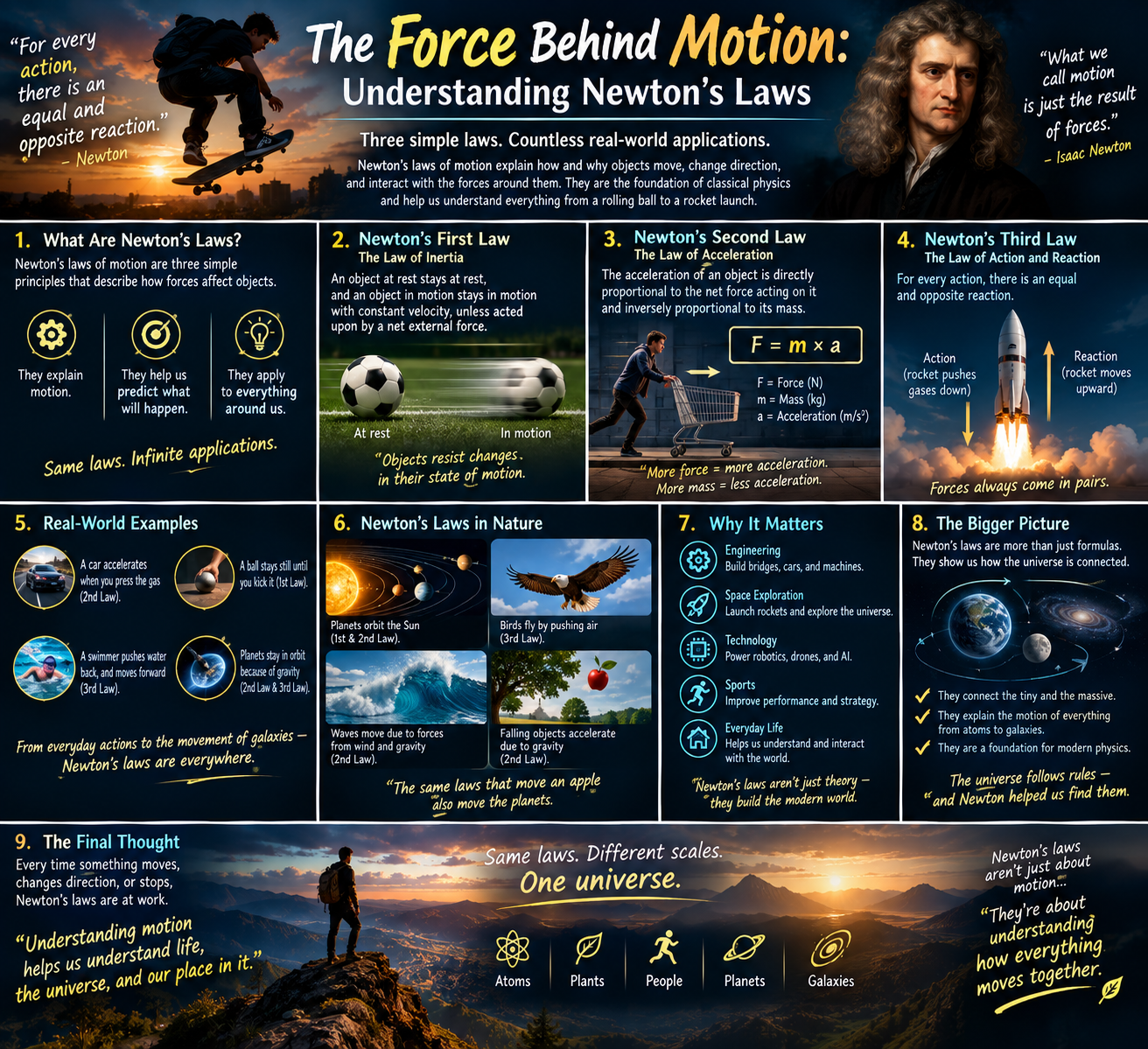
    # The Force Behind Motion: Understanding Newton’s Laws

    Imagine watching a football fly through the air , a car accelerate down a road , a rocket launch into space , or planets orbiting a star .

    These events may appear completely different—but beneath them is the same fundamental idea:

    ## **Forces control motion.**

    More than three centuries ago, **Isaac Newton** developed three laws that transformed our understanding of how objects move and interact. These laws became the foundation of classical mechanics and remain essential to physics, engineering, astronomy, and countless technologies today.

    ---

    # 1. What Are Newton's Laws?

    Newton's three laws describe the relationship between:

    **Force**
    **Mass**
    **Acceleration**
    **Motion**

    Together, they help us explain why objects remain still, why they accelerate, and how forces interact.

    From a rolling ball to a spacecraft , the same fundamental principles apply.

    ### **Three simple laws. Infinite applications.**

    ---

    # 2. Newton's First Law — The Law of Inertia

    Newton's First Law states that an object at rest remains at rest, while an object in motion continues moving at constant velocity unless acted upon by a net external force.

    This property is called **inertia**.

    Imagine a football sitting on the ground.

    It stays there until you kick it.

    Once moving, it won't naturally change its motion unless another force acts on it—such as friction, air resistance, or another object.

    A car requires braking to stop.
    A ball slows because of friction.
    Objects in space can continue moving with very little resistance.

    ### **Objects resist changes in their state of motion.**

    ---

    # 3. Newton's Second Law — The Law of Acceleration

    The second law explains how force changes motion.

    Its famous equation is:

    # **F = m × a**

    Where:

    **F** = Force
    **m** = Mass
    **a** = Acceleration

    This means that increasing the net force on an object generally increases its acceleration, while increasing the object's mass makes the same force produce less acceleration.

    Imagine pushing an empty shopping cart .

    It accelerates easily.

    Now fill it with heavy objects.

    The same push produces less acceleration.

    ### **More net force → more acceleration.**

    ### **More mass → less acceleration for the same force.**

    This simple relationship powers everything from vehicle design to rocket engineering .

    ---

    # 4. Newton's Third Law — Action and Reaction

    Newton's Third Law states:

    ### **For every action, there is an equal and opposite reaction.**

    Forces always occur through interactions between objects.

    Consider a rocket.

    The engine pushes hot gases downward and backward.

    The gases exert an equal and opposite force on the rocket, pushing it upward.

    The same principle appears everywhere:

    A swimmer pushes water backward → the water pushes the swimmer forward.
    A bird pushes air downward → the air helps push the bird upward.
    You push the ground backward → the ground pushes you forward.

    ### **Forces come in pairs.**

    ---

    # 5. Newton's Laws in Everyday Life

    You don't need a laboratory to see Newton's laws.

    They are happening around you constantly.

    **Cars:** Engine force changes speed and direction.
    **Sports:** Kicking a ball changes its motion.
    **Swimming:** Pushing water creates forward motion.
    **Cycling:** Pedaling produces forces that accelerate the bicycle.
    **Falling objects:** Gravity changes their motion.
    **Skateboards:** Pushing against the ground creates movement.

    Everyday motion is essentially a continuous interaction between forces.

    ---

    # 6. Newton's Laws in Nature

    Newton's laws don't stop at Earth.

    They also help describe motion throughout the universe.

    Planets orbit stars.
    Moons orbit planets.
    Comets travel through space.
    Waves respond to forces.
    Birds generate lift through interactions with air.
    Objects accelerate under gravity.

    The same physics that explains a falling apple can help describe the motion of enormous celestial bodies.

    ### **From apples to planets, the same laws operate across nature.**

    ---

    # 7. Why Newton's Laws Matter

    Newton's laws are more than equations in a textbook.

    They are essential tools for understanding and designing the physical world.

    **Engineering** — bridges, buildings, vehicles, and machines
    **Space exploration** — rockets, spacecraft, and orbital motion
    **Technology** — robots, drones, and automated systems
    **Sports science** — movement, speed, and performance
    **Transportation** — cars, aircraft, and trains

    Modern technology depends heavily on our ability to predict how forces produce motion.

    ---

    # 8. The Bigger Picture

    Newton's laws reveal something remarkable:

    The universe is not simply a collection of random movements.

    Objects interact through measurable forces.

    From microscopic particles to massive planets and galaxies , physics provides mathematical relationships that help us understand motion.

    The scale may change.

    The objects may change.

    But the underlying principles remain incredibly powerful.

    ### **Tiny or massive. Fast or slow. Earth or space. Motion follows physical laws.**

    ---

    # 9. The Final Thought

    Every time something moves…

    Every time something accelerates…

    Every time something changes direction…

    **Newton's laws are there.**

    A skateboard rolling down a street
    A bird taking flight
    A rocket leaving Earth
    A planet orbiting the Sun

    Different events.

    Different scales.

    One underlying framework.

    ## **Same laws. Different scales. One universe.**

    Understanding motion isn't just about solving equations.

    It's about understanding **how the physical world moves, interacts, and holds together.**

    ### **Once you understand the forces behind motion, the world around you begins to move in a whole new way.**


    Asma Shaheen EducationWali
    Saima Empowerment Wali
    Mishaal TrainingWali
    #rsisb Roll No 253 Foundation Level Story Post 23 # ⚡🌌 The Force Behind Motion: Understanding Newton’s Laws Imagine watching a football fly through the air ⚽, a car accelerate down a road 🚗💨, a rocket launch into space 🚀, or planets orbiting a star 🪐✨. These events may appear completely different—but beneath them is the same fundamental idea: ## **Forces control motion.** ⚡🧲 More than three centuries ago, **Isaac Newton** developed three laws that transformed our understanding of how objects move and interact. These laws became the foundation of classical mechanics and remain essential to physics, engineering, astronomy, and countless technologies today. 🔬⚙️🌍 --- # 🧠⚡ 1. What Are Newton's Laws? Newton's three laws describe the relationship between: ⚡ **Force** 🧱 **Mass** 💨 **Acceleration** 🏃 **Motion** Together, they help us explain why objects remain still, why they accelerate, and how forces interact. From a rolling ball 🎾 to a spacecraft 🚀, the same fundamental principles apply. ### **Three simple laws. Infinite applications.** 🌌 --- # 🛑➡️ 2. Newton's First Law — The Law of Inertia Newton's First Law states that an object at rest remains at rest, while an object in motion continues moving at constant velocity unless acted upon by a net external force. This property is called **inertia**. 🧱⚡ Imagine a football sitting on the ground. ⚽ It stays there until you kick it. Once moving, it won't naturally change its motion unless another force acts on it—such as friction, air resistance, or another object. 🚗 A car requires braking to stop. ⚽ A ball slows because of friction. 🛰️ Objects in space can continue moving with very little resistance. ### **Objects resist changes in their state of motion.** --- # 💨⚙️ 3. Newton's Second Law — The Law of Acceleration The second law explains how force changes motion. Its famous equation is: # **F = m × a** ⚡ Where: **F** = Force 🧲 **m** = Mass ⚖️ **a** = Acceleration 💨 This means that increasing the net force on an object generally increases its acceleration, while increasing the object's mass makes the same force produce less acceleration. Imagine pushing an empty shopping cart 🛒. It accelerates easily. Now fill it with heavy objects. The same push produces less acceleration. ### **More net force → more acceleration.** ### **More mass → less acceleration for the same force.** This simple relationship powers everything from vehicle design 🚗 to rocket engineering 🚀. --- # 🚀🔥 4. Newton's Third Law — Action and Reaction Newton's Third Law states: ### **For every action, there is an equal and opposite reaction.** ⚡ Forces always occur through interactions between objects. Consider a rocket. 🚀 The engine pushes hot gases downward and backward. The gases exert an equal and opposite force on the rocket, pushing it upward. ⬆️🔥 The same principle appears everywhere: 🏊 A swimmer pushes water backward → the water pushes the swimmer forward. 🦅 A bird pushes air downward → the air helps push the bird upward. 🚶 You push the ground backward → the ground pushes you forward. ### **Forces come in pairs.** 🔗⚡ --- # 🌍⚽ 5. Newton's Laws in Everyday Life You don't need a laboratory to see Newton's laws. They are happening around you constantly. 🚗 **Cars:** Engine force changes speed and direction. ⚽ **Sports:** Kicking a ball changes its motion. 🏊 **Swimming:** Pushing water creates forward motion. 🚲 **Cycling:** Pedaling produces forces that accelerate the bicycle. 🍎 **Falling objects:** Gravity changes their motion. 🛹 **Skateboards:** Pushing against the ground creates movement. Everyday motion is essentially a continuous interaction between forces. --- # 🌌🪐 6. Newton's Laws in Nature Newton's laws don't stop at Earth. They also help describe motion throughout the universe. 🌌 🪐 Planets orbit stars. 🌙 Moons orbit planets. ☄️ Comets travel through space. 🌊 Waves respond to forces. 🦅 Birds generate lift through interactions with air. 🍎 Objects accelerate under gravity. The same physics that explains a falling apple can help describe the motion of enormous celestial bodies. ### **From apples to planets, the same laws operate across nature.** 🍎➡️🪐 --- # ⚙️🚀 7. Why Newton's Laws Matter Newton's laws are more than equations in a textbook. They are essential tools for understanding and designing the physical world. 🏗️ **Engineering** — bridges, buildings, vehicles, and machines 🚀 **Space exploration** — rockets, spacecraft, and orbital motion 🤖 **Technology** — robots, drones, and automated systems 🏃 **Sports science** — movement, speed, and performance 🚗 **Transportation** — cars, aircraft, and trains Modern technology depends heavily on our ability to predict how forces produce motion. --- # 🌌🔭 8. The Bigger Picture Newton's laws reveal something remarkable: The universe is not simply a collection of random movements. Objects interact through measurable forces. ⚛️🧲 From microscopic particles 🔬 to massive planets 🪐 and galaxies 🌌, physics provides mathematical relationships that help us understand motion. The scale may change. The objects may change. But the underlying principles remain incredibly powerful. ### **Tiny or massive. Fast or slow. Earth or space. Motion follows physical laws.** ⚡🌍🌌 --- # 🌅⚡ 9. The Final Thought Every time something moves… Every time something accelerates… Every time something changes direction… **Newton's laws are there.** 🧠⚡ A skateboard rolling down a street 🛹 A bird taking flight 🦅 A rocket leaving Earth 🚀 A planet orbiting the Sun ☀️🪐 Different events. Different scales. One underlying framework. ## 🌌 **Same laws. Different scales. One universe.** Understanding motion isn't just about solving equations. It's about understanding **how the physical world moves, interacts, and holds together.** ⚛️🌍✨ ### **Once you understand the forces behind motion, the world around you begins to move in a whole new way.** ⚡🔬🌌 Asma Shaheen EducationWali Saima Empowerment Wali Mishaal TrainingWali
    0 Σχόλια 0 Μοιράστηκε 4052 Views
  • **Foundation Level** **Day 153** **story post** **Roll Number: 005**

    The Force Behind Motion: Understanding Newton’s Laws

    Ever wondered why objects move, stop, or change direction? Isaac Newton’s three laws of motion help us understand the forces behind movement.

    First Law – Inertia: Objects keep their state of motion unless a force changes it.
    Second Law – Acceleration: Force, mass, and acceleration are connected by F = m × a.
    Third Law – Action & Reaction: Every action has an equal and opposite reaction.

    From a rolling ball to a launching rocket , Newton’s laws are working all around us!

    #NewtonLaws #Physics #Science #Motion #Force #Education #ScienceExplained #PhysicsForStudents #LearningScience #InstagramEducation
    **Foundation Level** **Day 153** **story post** **Roll Number: 005** 🚀 The Force Behind Motion: Understanding Newton’s Laws ⚡ Ever wondered why objects move, stop, or change direction? 🌍 Isaac Newton’s three laws of motion help us understand the forces behind movement. 🔹 First Law – Inertia: Objects keep their state of motion unless a force changes it. 🔹 Second Law – Acceleration: Force, mass, and acceleration are connected by F = m × a. 🔹 Third Law – Action & Reaction: Every action has an equal and opposite reaction. From a rolling ball ⚽ to a launching rocket 🚀, Newton’s laws are working all around us! #NewtonLaws #Physics #Science #Motion #Force #Education #ScienceExplained #PhysicsForStudents #LearningScience #InstagramEducation
    0 Σχόλια 0 Μοιράστηκε 2195 Views
  • #RSTA
    #Task : Story Post
    #Class: Foundation Level
    #Day No: 153
    #Made By Me

    Total Post:21


    Today, I completed my task on **Newton’s Laws of Motion**. I learned how force affects the movement of objects and how Newton’s three laws explain motion in our daily lives. From cars and bicycles to rockets and sports, these laws help us understand how things move.

    This task helped me learn an important part of physics in a simple and interesting way.

    RSTA FoundationLevel Newtonslaws Motion Force Physics Science Learning MadeByMe
    #RSTA #Task : Story Post #Class: Foundation Level #Day No: 153 #Made By Me Total Post:21 Today, I completed my task on **Newton’s Laws of Motion**. I learned how force affects the movement of objects and how Newton’s three laws explain motion in our daily lives. From cars and bicycles to rockets and sports, these laws help us understand how things move. 🌍🔬 This task helped me learn an important part of physics in a simple and interesting way. 📚✨ RSTA FoundationLevel Newtonslaws Motion Force Physics Science Learning MadeByMe
    0 Σχόλια 0 Μοιράστηκε 987 Views
Αναζήτηση αποτελεσμάτων