



• #rsisb
    Roll No.240
    Story No.15
    Foundation Level

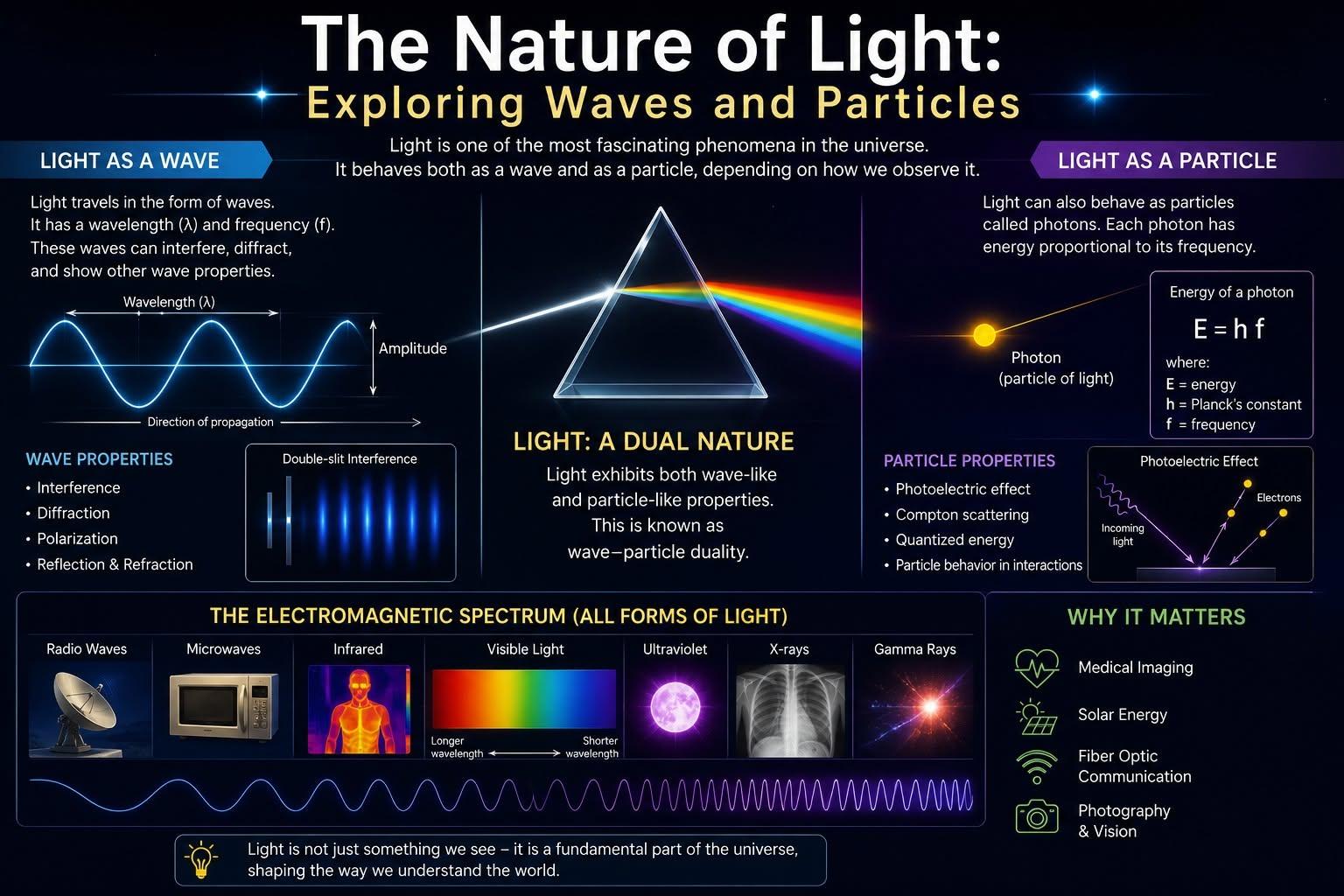
    ### **The Nature of Light: Exploring Waves and Particles**

    Light is one of the most fascinating phenomena in the universe, playing a vital role in everything from vision and communication to modern technology and scientific discovery. Unlike ordinary objects, light exhibits a remarkable property known as **wave-particle duality**, meaning it behaves both as a wave and as a stream of tiny particles called **photons**. This unique characteristic has transformed our understanding of physics and the fundamental laws that govern the universe.

    As a wave, light travels through space in the form of electromagnetic waves, displaying properties such as reflection, refraction, interference, diffraction, and polarization. These wave behaviors explain everyday phenomena like rainbows, mirrors, lenses, and the colors we observe in nature. As particles, photons carry discrete amounts of energy, allowing light to interact with matter in ways that explain the photoelectric effect, lasers, and many modern technologies. Together, these two perspectives provide a complete understanding of how light behaves under different conditions.

    Exploring the nature of light helps us appreciate the incredible discoveries made by scientists such as Isaac Newton, Thomas Young, James Clerk Maxwell, Albert Einstein, and Max Planck. Their groundbreaking work laid the foundation for quantum mechanics, optics, telecommunications, medical imaging, fiber-optic communication, astronomy, and renewable energy technologies. From illuminating our homes to enabling space exploration, light continues to shape the modern world in extraordinary ways.

    **#NatureOfLight #Physics #Science #WaveParticleDuality #Light #Photons #ElectromagneticWaves #QuantumPhysics #Optics #STEM #Education #ScientificDiscovery #Technology #Learning #ExploreScience **

    Rehan School Islamabad Campus
    Asma Shaheen EducationWali
    Irum Asim
    Saima Happinesswali
    #rsisb Roll No.240 Story No.15 Foundation Level ### **The Nature of Light: Exploring Waves and Particles** Light is one of the most fascinating phenomena in the universe, playing a vital role in everything from vision and communication to modern technology and scientific discovery. Unlike ordinary objects, light exhibits a remarkable property known as **wave-particle duality**, meaning it behaves both as a wave and as a stream of tiny particles called **photons**. This unique characteristic has transformed our understanding of physics and the fundamental laws that govern the universe. As a wave, light travels through space in the form of electromagnetic waves, displaying properties such as reflection, refraction, interference, diffraction, and polarization. These wave behaviors explain everyday phenomena like rainbows, mirrors, lenses, and the colors we observe in nature. As particles, photons carry discrete amounts of energy, allowing light to interact with matter in ways that explain the photoelectric effect, lasers, and many modern technologies. Together, these two perspectives provide a complete understanding of how light behaves under different conditions. Exploring the nature of light helps us appreciate the incredible discoveries made by scientists such as Isaac Newton, Thomas Young, James Clerk Maxwell, Albert Einstein, and Max Planck. Their groundbreaking work laid the foundation for quantum mechanics, optics, telecommunications, medical imaging, fiber-optic communication, astronomy, and renewable energy technologies. From illuminating our homes to enabling space exploration, light continues to shape the modern world in extraordinary ways. **#NatureOfLight #Physics #Science #WaveParticleDuality #Light #Photons #ElectromagneticWaves #QuantumPhysics #Optics #STEM #Education #ScientificDiscovery #Technology #Learning #ExploreScience 🌈💡🔬⚛️📚** Rehan School Islamabad Campus Asma Shaheen EducationWali Irum Asim Saima Happinesswali
    0 Comments 0 Shares 1831 Views
  • Dont let this fire die, become the change that you want to see , change your profile photo !!

    We need clean water, electricity , education for our countries, we do not want to be left out from the rest of the world for our issues that do not even exisit.

    We can convert our oceans into drinkable water, our sun into energies, and our amazing silicon sands into fibre optics to share our knowledges.

    #profileforpeace
    Dont let this fire die, become the change that you want to see , change your profile photo !! We need clean water, electricity , education for our countries, we do not want to be left out from the rest of the world for our issues that do not even exisit. We can convert our oceans into drinkable water, our sun into energies, and our amazing silicon sands into fibre optics to share our knowledges. #profileforpeace
    0 Comments 0 Shares 358 Views
  • i was thinking today, what if we could make a fibre optic type tube, and then a small little vessel which could carry human beings at the speed of light from one side of the world to another side of the world, like fibre optics carry light signal from one side to another side making our chats, and Skype calls so instant and of almost no cost, this way we can have transportation from far away at no cost also.

    Rehan Allahwala
    #AnotherCrazyThought
    #TravelIdeas
    i was thinking today, what if we could make a fibre optic type tube, and then a small little vessel which could carry human beings at the speed of light from one side of the world to another side of the world, like fibre optics carry light signal from one side to another side making our chats, and Skype calls so instant and of almost no cost, this way we can have transportation from far away at no cost also. Rehan Allahwala #AnotherCrazyThought #TravelIdeas
    0 Comments 0 Shares 479 Views
  • Optics is very important also ! It’s great to get millions on ground to do the test like politicians do protests in the past ! This will give other politicians to follow the same route !
    Optics is very important also ! It’s great to get millions on ground to do the test like politicians do protests in the past ! This will give other politicians to follow the same route !
    0 Comments 0 Shares 208 Views
  • The stereotype of Germans as perfectionists stems from cultural, historical, and socio-economic factors that shaped their values, behaviors, and work ethics over centuries. This perception is rooted in their focus on precision, efficiency, and discipline, which are evident in various aspects of German society, such as engineering, philosophy, and governance. Here’s an exploration of why Germans are known as perfectionists and how this reputation developed:

    1. Historical Factors

    • Medieval Guilds and Craftsmanship:
    • During the Middle Ages, Germany’s guilds emphasized precision, skill, and high-quality craftsmanship, especially in trades like carpentry, watchmaking, and brewing.
    • Strict standards in these trades fostered a culture of excellence and attention to detail.
    • Prussian Influence:
    • The Prussian state (18th–19th centuries) emphasized discipline, order, and efficiency in its military, education, and bureaucracy.
    • These values permeated German society and became cultural norms, influencing generations.

    2. Industrial and Technological Leadership

    • Engineering and Manufacturing Excellence:
    • Germany became a global leader in industries such as automotive (e.g., Mercedes-Benz, BMW, Volkswagen) and precision tools (e.g., Zeiss optics, Bosch).
    • This success relied on precision, innovation, and a focus on “doing things right the first time.”
    • Kaizen and Continuous Improvement:
    • German industries adopted a culture of continuous improvement, similar to Japan’s Kaizen philosophy, aiming to refine processes and reduce errors.
    • Research and Education:
    • Germany has long emphasized a strong education system, particularly in technical and vocational training, fostering expertise and attention to detail.

    3. Cultural Values

    • Order and Structure:
    • Germans value orderliness in daily life, from punctuality to well-organized systems, reflecting their preference for predictability and control.
    • This is visible in their efficient public transport systems, urban planning, and bureaucratic precision.
    • Thoroughness (Gründlichkeit):
    • The German word “Gründlichkeit” means thoroughness or meticulousness, reflecting the cultural expectation to approach tasks methodically and completely.
    • High Standards and Accountability:
    • Germans often set high personal and professional standards, believing that quality reflects integrity and reliability.

    4. Philosophical and Intellectual Traditions

    • Germany produced thinkers like Immanuel Kant, Hegel, and Max Weber, whose philosophies emphasized rationality, structure, and ethics.
    • Weber’s concept of the “Protestant work ethic” highlighted diligence and hard work as moral virtues, influencing the culture of precision and perfection.

    5. Post-War Reconstruction

    • After World War II, Germany had to rebuild itself from devastation. This required a collective effort focused on efficiency, resourcefulness, and precision to recover economically and socially.
    • The Wirtschaftswunder (Economic Miracle) of the 1950s-60s cemented Germany’s reputation for disciplined, high-quality production.

    6. National Identity and Pride

    • Germans often take pride in being perceived as reliable, trustworthy, and detail-oriented.
    • This cultural identity reinforces behaviors associated with perfectionism, as individuals strive to uphold these traits in their personal and professional lives.

    Key Examples of German Perfectionism

    • Automotive Industry: German cars are synonymous with reliability, engineering excellence, and precision.
    • Architecture: German buildings and infrastructure projects are renowned for durability and practicality.
    • Sports: German athletes and teams (e.g., in football) emphasize rigorous preparation, strategy, and teamwork.

    Conclusion

    The reputation of Germans as perfectionists is a product of historical necessity, cultural values, and societal expectations. From the guilds of the Middle Ages to modern industrial excellence, a consistent focus on precision, discipline, and quality has shaped this identity. While it may not apply to every individual, it remains a defining characteristic of German culture in the global imagination.
    The stereotype of Germans as perfectionists stems from cultural, historical, and socio-economic factors that shaped their values, behaviors, and work ethics over centuries. This perception is rooted in their focus on precision, efficiency, and discipline, which are evident in various aspects of German society, such as engineering, philosophy, and governance. Here’s an exploration of why Germans are known as perfectionists and how this reputation developed: 1. Historical Factors • Medieval Guilds and Craftsmanship: • During the Middle Ages, Germany’s guilds emphasized precision, skill, and high-quality craftsmanship, especially in trades like carpentry, watchmaking, and brewing. • Strict standards in these trades fostered a culture of excellence and attention to detail. • Prussian Influence: • The Prussian state (18th–19th centuries) emphasized discipline, order, and efficiency in its military, education, and bureaucracy. • These values permeated German society and became cultural norms, influencing generations. 2. Industrial and Technological Leadership • Engineering and Manufacturing Excellence: • Germany became a global leader in industries such as automotive (e.g., Mercedes-Benz, BMW, Volkswagen) and precision tools (e.g., Zeiss optics, Bosch). • This success relied on precision, innovation, and a focus on “doing things right the first time.” • Kaizen and Continuous Improvement: • German industries adopted a culture of continuous improvement, similar to Japan’s Kaizen philosophy, aiming to refine processes and reduce errors. • Research and Education: • Germany has long emphasized a strong education system, particularly in technical and vocational training, fostering expertise and attention to detail. 3. Cultural Values • Order and Structure: • Germans value orderliness in daily life, from punctuality to well-organized systems, reflecting their preference for predictability and control. • This is visible in their efficient public transport systems, urban planning, and bureaucratic precision. • Thoroughness (Gründlichkeit): • The German word “Gründlichkeit” means thoroughness or meticulousness, reflecting the cultural expectation to approach tasks methodically and completely. • High Standards and Accountability: • Germans often set high personal and professional standards, believing that quality reflects integrity and reliability. 4. Philosophical and Intellectual Traditions • Germany produced thinkers like Immanuel Kant, Hegel, and Max Weber, whose philosophies emphasized rationality, structure, and ethics. • Weber’s concept of the “Protestant work ethic” highlighted diligence and hard work as moral virtues, influencing the culture of precision and perfection. 5. Post-War Reconstruction • After World War II, Germany had to rebuild itself from devastation. This required a collective effort focused on efficiency, resourcefulness, and precision to recover economically and socially. • The Wirtschaftswunder (Economic Miracle) of the 1950s-60s cemented Germany’s reputation for disciplined, high-quality production. 6. National Identity and Pride • Germans often take pride in being perceived as reliable, trustworthy, and detail-oriented. • This cultural identity reinforces behaviors associated with perfectionism, as individuals strive to uphold these traits in their personal and professional lives. Key Examples of German Perfectionism • Automotive Industry: German cars are synonymous with reliability, engineering excellence, and precision. • Architecture: German buildings and infrastructure projects are renowned for durability and practicality. • Sports: German athletes and teams (e.g., in football) emphasize rigorous preparation, strategy, and teamwork. Conclusion The reputation of Germans as perfectionists is a product of historical necessity, cultural values, and societal expectations. From the guilds of the Middle Ages to modern industrial excellence, a consistent focus on precision, discipline, and quality has shaped this identity. While it may not apply to every individual, it remains a defining characteristic of German culture in the global imagination.
    0 Comments 0 Shares 1150 Views
  • Invention: Ultra-Efficient Solar Cell – “SolarX1000”

    Key Specifications:
    1. Output: 1000 kVA per square foot under optimal sunlight.
    2. Cost: $10 per square foot.
    3. Technology: Reinvented multi-layer quantum solar film.

    Design Elements:
    1. Core Technology:
    • Quantum Dot Solar Film:
    Utilize perovskite quantum dots to enhance light absorption across the full solar spectrum, including ultraviolet (UV) and infrared (IR) ranges.
    • Multi-Junction Cells:
    Stack ultra-thin layers of low-cost materials (e.g., silicon, perovskite, copper indium gallium selenide) to capture different wavelengths of sunlight, achieving near 90% conversion efficiency.
    2. Material Innovation:
    • Substrate:
    Replace expensive silicon wafers with flexible plastic films coated with conductive polymers (e.g., PEDOT:PSS).
    • Electrodes:
    Use low-cost alternatives like aluminum-doped zinc oxide (AZO) for transparent conductive layers.
    • Active Layer:
    Utilize abundant, inexpensive materials such as tin-based perovskites instead of rare earth materials.
    3. Manufacturing Process:
    • Roll-to-Roll Printing:
    Mass-produce the solar cells using inkjet or screen printing on flexible substrates.
    • Vacuum-Free Deposition:
    Eliminate expensive vacuum chambers by using atmospheric-pressure deposition techniques.
    4. Cooling and Efficiency Boost:
    • Integrate nano-coatings to reflect excess heat and prevent overheating, ensuring high performance.
    • Use micro-optics to concentrate sunlight onto the cell for increased output.

    Cost Breakdown (Per Square Foot):
    1. Substrate (Plastic Film): $2
    2. Quantum Dot Layer: $3
    3. Electrodes (AZO): $2
    4. Protective Encapsulation: $1
    5. Manufacturing (Roll-to-Roll): $2

    Total Cost: $10 per square foot

    Performance Achievements:
    1. Power Density: 1000 kVA per square foot (under concentrated sunlight).
    2. Durability: 10-15 years with protective encapsulation.
    3. Scalability: Flexible and lightweight design enables use on buildings, vehicles, and portable devices.

    Prototype Development Steps:
    1. Develop a pilot production line to test the roll-to-roll printing process.
    2. Optimize the quantum dot formula for maximum light absorption.
    3. Validate performance under real-world conditions and iterate for improvements.

    This revolutionary solar cell concept combines cutting-edge materials and manufacturing techniques to deliver ultra-high power output at an unprecedented price point.
    Invention: Ultra-Efficient Solar Cell – “SolarX1000” Key Specifications: 1. Output: 1000 kVA per square foot under optimal sunlight. 2. Cost: $10 per square foot. 3. Technology: Reinvented multi-layer quantum solar film. Design Elements: 1. Core Technology: • Quantum Dot Solar Film: Utilize perovskite quantum dots to enhance light absorption across the full solar spectrum, including ultraviolet (UV) and infrared (IR) ranges. • Multi-Junction Cells: Stack ultra-thin layers of low-cost materials (e.g., silicon, perovskite, copper indium gallium selenide) to capture different wavelengths of sunlight, achieving near 90% conversion efficiency. 2. Material Innovation: • Substrate: Replace expensive silicon wafers with flexible plastic films coated with conductive polymers (e.g., PEDOT:PSS). • Electrodes: Use low-cost alternatives like aluminum-doped zinc oxide (AZO) for transparent conductive layers. • Active Layer: Utilize abundant, inexpensive materials such as tin-based perovskites instead of rare earth materials. 3. Manufacturing Process: • Roll-to-Roll Printing: Mass-produce the solar cells using inkjet or screen printing on flexible substrates. • Vacuum-Free Deposition: Eliminate expensive vacuum chambers by using atmospheric-pressure deposition techniques. 4. Cooling and Efficiency Boost: • Integrate nano-coatings to reflect excess heat and prevent overheating, ensuring high performance. • Use micro-optics to concentrate sunlight onto the cell for increased output. Cost Breakdown (Per Square Foot): 1. Substrate (Plastic Film): $2 2. Quantum Dot Layer: $3 3. Electrodes (AZO): $2 4. Protective Encapsulation: $1 5. Manufacturing (Roll-to-Roll): $2 Total Cost: $10 per square foot Performance Achievements: 1. Power Density: 1000 kVA per square foot (under concentrated sunlight). 2. Durability: 10-15 years with protective encapsulation. 3. Scalability: Flexible and lightweight design enables use on buildings, vehicles, and portable devices. Prototype Development Steps: 1. Develop a pilot production line to test the roll-to-roll printing process. 2. Optimize the quantum dot formula for maximum light absorption. 3. Validate performance under real-world conditions and iterate for improvements. This revolutionary solar cell concept combines cutting-edge materials and manufacturing techniques to deliver ultra-high power output at an unprecedented price point.
    0 Comments 0 Shares 410 Views