• RSIf8
    Roll Number: 49
    Story post no.34
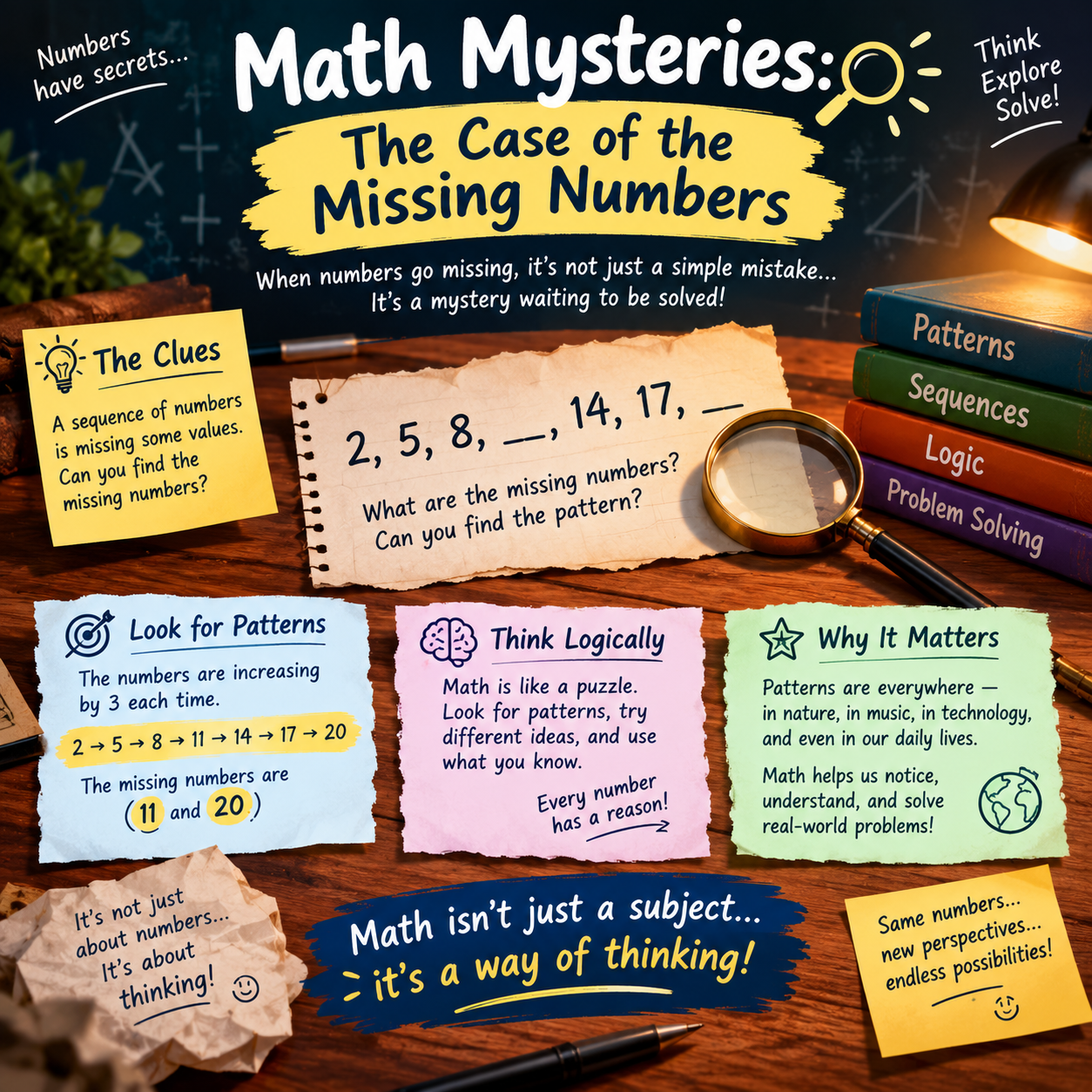
    Story post topic:Math Mysteries — The Case of the Missing Numbers

    Have you ever wondered how numbers can hide exciting mysteries waiting to be solved? ‍ In this creative story post, I explore the fascinating world of mathematics through a mystery filled with number patterns, logical thinking, and problem-solving challenges.

    The adventure begins with a sequence of numbers: 2, 5, 8, __, 14, 17, __. By carefully observing the pattern and adding 3 each time, we can discover the missing numbers: 11 and 20!

    Through this activity, I learned that mathematics is not just about calculations; it is also about observing patterns, thinking logically, and finding solutions. Numbers and patterns are everywhere—in nature, music, technology, and our everyday lives.

    This story makes learning mathematics fun, interactive, and exciting while encouraging curiosity and creative thinking. Every mystery has clues, and every problem has a solution waiting to be discovered!

    #MathMysteries #MissingNumbers #Mathematics #NumberPatterns #LogicalThinking #ProblemSolving #CreativeLearning #MathIsFun #Education #ClassFoundation #RSf8
    RSIf8 Roll Number: 49 Story post no.34 Story post topic:Math Mysteries — The Case of the Missing Numbers 🧩✨ Have you ever wondered how numbers can hide exciting mysteries waiting to be solved? 🕵️‍♂️📚 In this creative story post, I explore the fascinating world of mathematics through a mystery filled with number patterns, logical thinking, and problem-solving challenges. The adventure begins with a sequence of numbers: 2, 5, 8, __, 14, 17, __. By carefully observing the pattern and adding 3 each time, we can discover the missing numbers: 11 and 20! 🎯💡 Through this activity, I learned that mathematics is not just about calculations; it is also about observing patterns, thinking logically, and finding solutions. Numbers and patterns are everywhere—in nature, music, technology, and our everyday lives. 🌍🧠 This story makes learning mathematics fun, interactive, and exciting while encouraging curiosity and creative thinking. Every mystery has clues, and every problem has a solution waiting to be discovered! 🚀📖 #MathMysteries #MissingNumbers #Mathematics #NumberPatterns #LogicalThinking #ProblemSolving #CreativeLearning #MathIsFun #Education #ClassFoundation #RSf8
    0 Σχόλια 0 Μοιράστηκε 927 Views
  • RSIF8
    Roll no:14
    story no:24
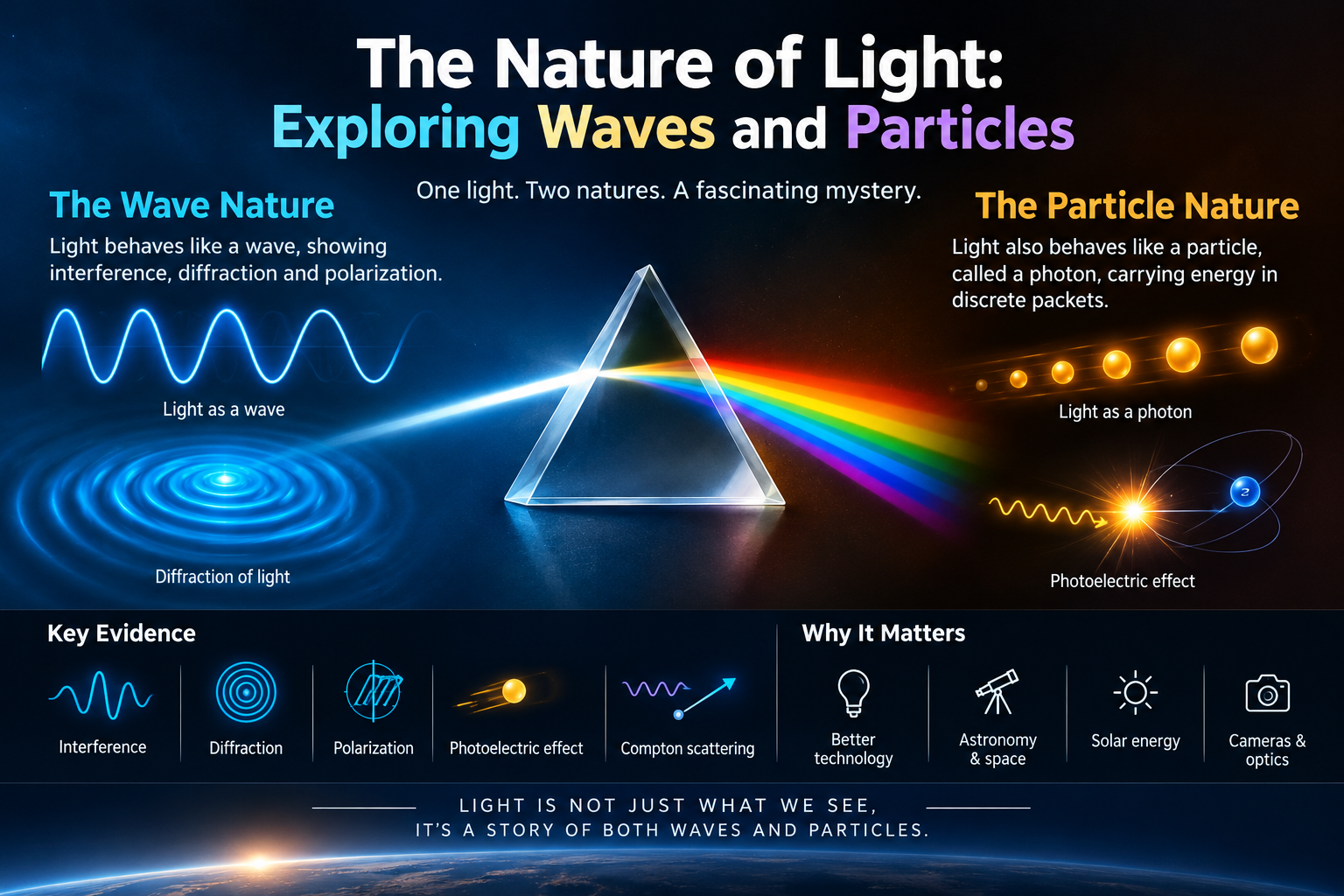
    story topic:The Nature of Light: Exploring Waves and Particles

    **The Nature of Light: Exploring Waves and Particles**

    Have you ever wondered what light really is? How does sunlight travel across millions of kilometers through space, how do rainbows form, and how can light behave like both a wave and a particle? The nature of light is one of the most fascinating topics in physics, revealing the extraordinary connection between the visible world and the mysterious laws of quantum mechanics. From the light that illuminates our homes to the distant stars shining in the universe, light plays an essential role in understanding the world around us.

    **1. The Wave Nature of Light **

    For many years, scientists have studied light as a wave because it demonstrates important wave-like properties. Light can undergo interference, diffraction, and polarization. Interference occurs when light waves overlap and combine, producing patterns of brightness and darkness. Diffraction happens when light spreads around an obstacle or passes through a narrow opening. Polarization describes the orientation of light's oscillations and helps us understand how light interacts with different materials.

    These properties demonstrate that the wave model is essential for explaining many optical phenomena. From colorful patterns created by thin films to the operation of polarized sunglasses, the wave nature of light has many applications in everyday life and modern technology.

    **2. The Particle Nature of Light **

    Light also behaves in ways that reveal its particle nature. In quantum physics, light energy is exchanged in discrete packets called **photons**. Each photon carries energy determined by its frequency, described by the equation **E = hf**, where E represents energy, h is Planck's constant, and f is frequency.

    The photoelectric effect provides important evidence for this particle nature. When light of a suitable frequency strikes certain materials, it can release electrons from their surfaces. This phenomenon helped scientists understand that light energy is transferred in individual quanta rather than always behaving like a continuous wave.

    Another important example is Compton scattering, in which photons exchange energy and momentum with electrons. These discoveries transformed our understanding of light and helped establish the foundations of quantum physics.

    **3. Wave-Particle Duality: Two Sides of Light**

    One of the most remarkable discoveries in science is that light cannot be fully explained by treating it only as a classical wave or only as a classical particle. Its behavior depends on the physical process being investigated and how it is measured. This concept is known as **wave-particle duality**.

    Experiments involving interference reveal wave-like patterns, while experiments involving photon detection show that light energy is detected in discrete units. Quantum mechanics brings these observations together into a more complete description of nature. Rather than being an ordinary wave or a tiny classical object, light is a quantum phenomenon with properties that challenge our everyday intuition.

    **4. How Do We Discover the Secrets of Light?**

    Scientists use carefully designed experiments to explore the behavior of light. Prisms separate white light into different colors, optical instruments measure its properties, and advanced detectors record individual photons. Interference experiments reveal patterns that cannot be explained by simple particle models, while photoelectric experiments demonstrate the importance of quantized energy.

    The work of scientists such as Isaac Newton, Thomas Young, Max Planck, Albert Einstein, and Arthur Compton helped build our modern understanding of light. Their discoveries show how scientific knowledge develops through observation, experimentation, mathematical reasoning, and new ideas.

    **5. Why Is the Nature of Light Important?**

    Understanding light is essential to many technologies that shape modern life. Lasers are used in medicine, manufacturing, and scientific research. Fiber-optic cables transmit information across the world using pulses of light. Solar panels convert light energy into electrical energy, while cameras and telescopes help us capture images and explore distant objects in space.

    The principles of light are also important in astronomy, microscopy, optical communication, quantum technologies, and the study of the universe. By investigating how light behaves, scientists can examine distant galaxies, study the structure of matter, and develop new tools that improve our understanding of nature.

    **6. Light: Connecting Science and the Universe**

    Light is much more than what allows us to see. It carries information about distant stars, reveals the composition of celestial objects, and provides clues about the physical processes occurring throughout the cosmos. By analyzing the light received from distant galaxies, astronomers can learn about their temperatures, chemical compositions, and motion.

    At the smallest scales, the study of photons helps scientists investigate the quantum world and understand how energy interacts with matter. From the smallest laboratory experiments to the largest astronomical observations, light connects different areas of science in extraordinary ways.

    **Conclusion: The Extraordinary Mystery of Light**

    The study of light demonstrates how nature can be far more complex than it first appears. Its wave-like properties explain interference, diffraction, and polarization, while its particle-like properties help explain the photoelectric effect and Compton scattering. Together, these discoveries form an important part of our modern understanding of physics.

    Learning about wave-particle duality encourages us to question assumptions, explore scientific evidence, and appreciate the discoveries that continue to expand human knowledge. Every beam of sunlight, every shining star, and every photon detected by a scientific instrument reminds us that there is still much to discover about the universe.

    **Light Is More Than What We See—It Is a Window into the Fundamental Nature of Reality!**

    If you enjoyed this science topic, share it with others and continue exploring the fascinating world of physics. Stay curious, keep asking questions, and never stop learning!

    #NatureOfLight #WaveParticleDuality #Physics #QuantumPhysics #ScienceEducation #Photons #LightWaves #PhotoelectricEffect #ComptonScattering #Optics #Astronomy #ScientificDiscoveries #STEMEducation #LearnPhysics #ScienceExplained #EducationalContent #WavesAndParticles
    RSIF8 Roll no:14 story no:24 story topic:The Nature of Light: Exploring Waves and Particles 🌟 **The Nature of Light: Exploring Waves and Particles** 🌈🔬 Have you ever wondered what light really is? How does sunlight travel across millions of kilometers through space, how do rainbows form, and how can light behave like both a wave and a particle? The nature of light is one of the most fascinating topics in physics, revealing the extraordinary connection between the visible world and the mysterious laws of quantum mechanics. From the light that illuminates our homes to the distant stars shining in the universe, light plays an essential role in understanding the world around us. 🌍✨ 💡 **1. The Wave Nature of Light 🌊** For many years, scientists have studied light as a wave because it demonstrates important wave-like properties. Light can undergo interference, diffraction, and polarization. Interference occurs when light waves overlap and combine, producing patterns of brightness and darkness. Diffraction happens when light spreads around an obstacle or passes through a narrow opening. Polarization describes the orientation of light's oscillations and helps us understand how light interacts with different materials. These properties demonstrate that the wave model is essential for explaining many optical phenomena. From colorful patterns created by thin films to the operation of polarized sunglasses, the wave nature of light has many applications in everyday life and modern technology. ⚛️ **2. The Particle Nature of Light ✨** Light also behaves in ways that reveal its particle nature. In quantum physics, light energy is exchanged in discrete packets called **photons**. Each photon carries energy determined by its frequency, described by the equation **E = hf**, where E represents energy, h is Planck's constant, and f is frequency. The photoelectric effect provides important evidence for this particle nature. When light of a suitable frequency strikes certain materials, it can release electrons from their surfaces. This phenomenon helped scientists understand that light energy is transferred in individual quanta rather than always behaving like a continuous wave. Another important example is Compton scattering, in which photons exchange energy and momentum with electrons. These discoveries transformed our understanding of light and helped establish the foundations of quantum physics. 🔬 **3. Wave-Particle Duality: Two Sides of Light** One of the most remarkable discoveries in science is that light cannot be fully explained by treating it only as a classical wave or only as a classical particle. Its behavior depends on the physical process being investigated and how it is measured. This concept is known as **wave-particle duality**. Experiments involving interference reveal wave-like patterns, while experiments involving photon detection show that light energy is detected in discrete units. Quantum mechanics brings these observations together into a more complete description of nature. Rather than being an ordinary wave or a tiny classical object, light is a quantum phenomenon with properties that challenge our everyday intuition. 🌈 **4. How Do We Discover the Secrets of Light?** Scientists use carefully designed experiments to explore the behavior of light. Prisms separate white light into different colors, optical instruments measure its properties, and advanced detectors record individual photons. Interference experiments reveal patterns that cannot be explained by simple particle models, while photoelectric experiments demonstrate the importance of quantized energy. The work of scientists such as Isaac Newton, Thomas Young, Max Planck, Albert Einstein, and Arthur Compton helped build our modern understanding of light. Their discoveries show how scientific knowledge develops through observation, experimentation, mathematical reasoning, and new ideas. 🚀 **5. Why Is the Nature of Light Important?** Understanding light is essential to many technologies that shape modern life. Lasers are used in medicine, manufacturing, and scientific research. Fiber-optic cables transmit information across the world using pulses of light. Solar panels convert light energy into electrical energy, while cameras and telescopes help us capture images and explore distant objects in space. The principles of light are also important in astronomy, microscopy, optical communication, quantum technologies, and the study of the universe. By investigating how light behaves, scientists can examine distant galaxies, study the structure of matter, and develop new tools that improve our understanding of nature. 🌍 **6. Light: Connecting Science and the Universe** Light is much more than what allows us to see. It carries information about distant stars, reveals the composition of celestial objects, and provides clues about the physical processes occurring throughout the cosmos. By analyzing the light received from distant galaxies, astronomers can learn about their temperatures, chemical compositions, and motion. At the smallest scales, the study of photons helps scientists investigate the quantum world and understand how energy interacts with matter. From the smallest laboratory experiments to the largest astronomical observations, light connects different areas of science in extraordinary ways. 💫 **Conclusion: The Extraordinary Mystery of Light** The study of light demonstrates how nature can be far more complex than it first appears. Its wave-like properties explain interference, diffraction, and polarization, while its particle-like properties help explain the photoelectric effect and Compton scattering. Together, these discoveries form an important part of our modern understanding of physics. Learning about wave-particle duality encourages us to question assumptions, explore scientific evidence, and appreciate the discoveries that continue to expand human knowledge. Every beam of sunlight, every shining star, and every photon detected by a scientific instrument reminds us that there is still much to discover about the universe. ✨ **Light Is More Than What We See—It Is a Window into the Fundamental Nature of Reality!** 🔭🌌 👍 If you enjoyed this science topic, share it with others and continue exploring the fascinating world of physics. Stay curious, keep asking questions, and never stop learning! #NatureOfLight #WaveParticleDuality #Physics #QuantumPhysics #ScienceEducation #Photons #LightWaves #PhotoelectricEffect #ComptonScattering #Optics #Astronomy #ScientificDiscoveries #STEMEducation #LearnPhysics #ScienceExplained #EducationalContent #WavesAndParticles 🌈🔬🚀

    0 Σχόλια 0 Μοιράστηκε 3096 Views
  • RSIF8
    ROLL NO 77
    SONG
    SONG TOPIC "Mathematical Marvels: Patterns in Nature"

    **Mathematical Marvels: Patterns in Nature**

    Have you ever wondered how mathematics shapes the natural world? From the beautiful spirals of seashells and sunflowers to the amazing patterns of snowflakes and honeycombs , mathematics is everywhere around us!

    Nature is full of fascinating shapes, patterns, numbers, and sequences that reveal the hidden beauty of our universe.

    **Explore the magic of mathematics in nature and discover how science and beauty come together!**

    *Look closely at nature, and you will find mathematics in every corner!*

    Like, share, and follow for more amazing educational content!

    \#MathematicalMarvels #PatternsInNature #Mathematics #NatureLovers #MathIsEverywhere #ScienceAndNature #EducationalContent #LearnWithFun #DiscoverNature #STEMEducation #KnowledgeIsPower #RehanCodingWithAI
    RSIF8 ROLL NO 77 SONG SONG TOPIC "Mathematical Marvels: Patterns in Nature" 🌿🔢 **Mathematical Marvels: Patterns in Nature** 🌸✨ Have you ever wondered how mathematics shapes the natural world? 🌍 From the beautiful spirals of seashells 🐚 and sunflowers 🌻 to the amazing patterns of snowflakes ❄️ and honeycombs 🐝, mathematics is everywhere around us! Nature is full of fascinating shapes, patterns, numbers, and sequences that reveal the hidden beauty of our universe. 🌌💚 🔍 **Explore the magic of mathematics in nature and discover how science and beauty come together!** 💡 *Look closely at nature, and you will find mathematics in every corner!* ❤️ Like, share, and follow for more amazing educational content! 🚀📚 \#MathematicalMarvels #PatternsInNature #Mathematics #NatureLovers #MathIsEverywhere #ScienceAndNature #EducationalContent #LearnWithFun #DiscoverNature #STEMEducation #KnowledgeIsPower #RehanCodingWithAI 🌿🔢✨
    0 Σχόλια 0 Μοιράστηκε 1595 Views 14
  • RSIF8
    Roll no: 99
    Song no: 11
    Song topic: Calculus: The Journey of Numbers and Sacred Spaces

    A fascinating melody exploring the beauty of calculus, where numbers, infinity, and sacred patterns reveal the hidden harmony of the universe. ∞

    #Calculus #SacredGeometry #Mathematics #BeautyOfNumbers #RSIF8
    RSIF8 Roll no: 99 Song no: 11 Song topic: Calculus: The Journey of Numbers and Sacred Spaces A fascinating melody exploring the beauty of calculus, where numbers, infinity, and sacred patterns reveal the hidden harmony of the universe. ∞📐🎶 #Calculus #SacredGeometry #Mathematics #BeautyOfNumbers #RSIF8
    0 Σχόλια 0 Μοιράστηκε 816 Views 10

  • **Roll No: 2**

    **Batch: 14**

    **Book: ACCL**

    **Task No: 149**

    # Expense Tracker — Record and Categorize Personal Expenses

    Today’s task is to develop an **Expense Tracker application** that helps users record, organize, and monitor their personal expenses in a simple and efficient way. The application will allow users to enter expense details, including the amount, date, description, and category, such as food, transportation, education, shopping, or entertainment. Users will be able to view their recorded transactions, categorize spending, and calculate their total expenses over a selected period. The project can also include features such as editing or deleting entries, filtering expenses by category, and displaying summaries to make spending patterns easier to understand. Through this coding task, I will practice programming concepts such as user input, data storage, functions, calculations, and data organization. This project will demonstrate how technology can support financial awareness, responsible spending, and better everyday money management while strengthening my coding and problem-solving skills.

    #Batch14 #Task149 #ACCL #ExpenseTracker #CodingTask #Programming #AppDevelopment #PersonalFinance #Budgeting #MoneyManagement #DataOrganization #ProblemSolving #DigitalSkills #DailyTask
    👤 **Roll No: 2** 📚 **Batch: 14** 📖 **Book: ACCL** 🎯 **Task No: 149** # 💰 Expense Tracker — Record and Categorize Personal Expenses 📊💻 Today’s task is to develop an **Expense Tracker application** that helps users record, organize, and monitor their personal expenses in a simple and efficient way. 💡 The application will allow users to enter expense details, including the amount, date, description, and category, such as food, transportation, education, shopping, or entertainment. 🛍️ Users will be able to view their recorded transactions, categorize spending, and calculate their total expenses over a selected period. 📈 The project can also include features such as editing or deleting entries, filtering expenses by category, and displaying summaries to make spending patterns easier to understand. Through this coding task, I will practice programming concepts such as user input, data storage, functions, calculations, and data organization. 🚀 This project will demonstrate how technology can support financial awareness, responsible spending, and better everyday money management while strengthening my coding and problem-solving skills. #Batch14 #Task149 #ACCL #ExpenseTracker #CodingTask #Programming #AppDevelopment #PersonalFinance #Budgeting #MoneyManagement #DataOrganization #ProblemSolving #DigitalSkills #DailyTask
    0 Σχόλια 0 Μοιράστηκε 2004 Views
  • **Roll No: 2**
    **Batch: 14**
    **Book: ACCL**
    **Task No: 138**

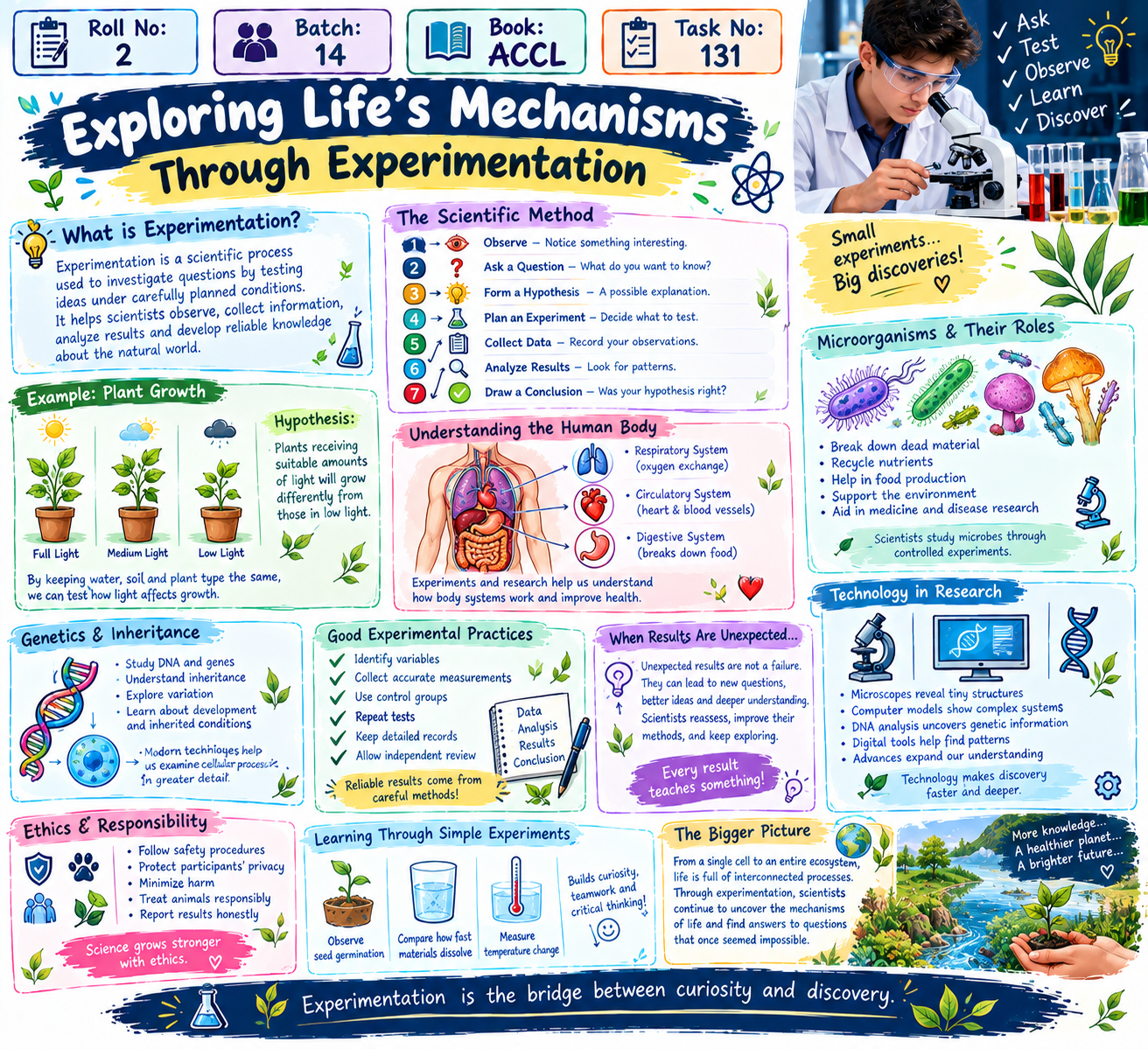
    # Exploring Life’s Mechanisms Through Experimentation

    Have you ever wondered how scientists discover the secrets of life? From understanding how plants grow to investigating how the human heart works, science helps us explore the processes that make living organisms function. Behind many important discoveries lies a powerful method called **experimentation**, which allows scientists to test ideas, observe results, and develop a deeper understanding of the natural world.

    **Experimentation is a scientific process used to investigate questions by testing ideas under carefully planned conditions.** Scientists begin by observing something interesting, asking a question, and developing a hypothesis—a possible explanation that can be tested. They then design an experiment, collect information, and analyze the results to determine whether the evidence supports their original idea. This process helps turn curiosity into reliable scientific knowledge.

    One fascinating example is the study of plant growth. Imagine a student who wants to discover whether the amount of light affects how quickly a plant grows. The student forms a hypothesis that plants receiving suitable amounts of light will grow differently from plants kept in low-light conditions. By keeping factors such as water, soil, and plant type consistent, the student can compare the results and investigate the role of light in plant development.

    Experimentation is also essential for understanding the human body. Scientists investigate how the heart circulates blood, how the lungs exchange gases, and how the digestive system processes food. Through carefully designed studies, medical imaging, laboratory tests, and other research methods, scientists learn how body systems work together to maintain health. Their findings can contribute to improved medical treatments and a better understanding of human biology.

    Another important field is microbiology, the study of microscopic organisms. Many bacteria and fungi play beneficial roles in nature, including breaking down dead material and recycling nutrients. Scientists use controlled experiments to investigate how these organisms respond to different environmental conditions. Such research can help improve food production, develop medicines, understand infectious diseases, and protect ecosystems.

    Experiments also help researchers understand genetics and the mechanisms of inheritance. By studying DNA, genes, and the characteristics of organisms across generations, scientists investigate how biological information is passed on and how variations arise. Modern techniques allow researchers to explore cellular processes in greater detail, helping them understand development, inherited conditions, and the relationships among different forms of life.

    A successful experiment requires more than simply observing what happens. Scientists must identify the variables they are studying, collect accurate measurements, and repeat tests when appropriate. They often use control groups for comparison and record their observations carefully. Repeating experiments helps determine whether a result is consistent, while independent review allows other researchers to examine the methods and evaluate the conclusions. These practices make scientific findings more trustworthy.

    Sometimes experiments produce unexpected results. Instead of treating an unexpected outcome as a failure, scientists use it as an opportunity to ask new questions. They may reconsider their hypothesis, improve their experimental design, or investigate another possible explanation. Scientific progress often happens through this cycle of questioning, testing, learning, and refining ideas. Every result can contribute something valuable when it is interpreted carefully.

    Technology has made biological experimentation more advanced than ever before. Microscopes reveal structures too small to see with the naked eye, computer models help researchers understand complicated systems, and DNA analysis allows scientists to investigate genetic information. Digital tools can also help organize large amounts of data and identify patterns that might otherwise be difficult to notice. These innovations continue to expand our understanding of living organisms.

    However, scientific experimentation must always be guided by responsibility and ethics. Researchers should follow safety procedures, protect participants' privacy, minimize harm, and treat animals responsibly. Experiments involving people or animals require appropriate ethical review and safeguards. Scientists must also report results honestly, even when the findings do not match their expectations. Reliable science depends on both accurate evidence and responsible behavior.

    Experimentation connects classroom learning with real-world discoveries. Students can explore scientific ideas through safe activities, such as observing seed germination, comparing how quickly different materials dissolve in water, or measuring changes in temperature. These activities encourage curiosity, careful observation, teamwork, and critical thinking. They also show that science is not just a collection of facts to memorize; it is an ongoing process of discovery.

    As we explore life's mechanisms, we begin to understand how countless processes work together to support living organisms. From the activity inside a single cell to the interactions among species in an ecosystem, each discovery reveals another part of nature's complexity. Through experimentation, scientists continue to investigate these connections and search for answers to questions that once seemed impossible to solve.

    **Experimentation is the bridge between curiosity and discovery. By asking thoughtful questions, testing ideas fairly, and learning from evidence, we can uncover the mechanisms of life and use scientific knowledge to improve human health, protect the environment, and build a brighter future. **

    \#Experimentation #Biology #ScientificMethod #LifeSciences #ScientificDiscovery #Research #ACCL #Batch14 #Task131
    **Roll No: 2** **Batch: 14** **Book: ACCL** **Task No: 138** # 🔬🧪 Exploring Life’s Mechanisms Through Experimentation 🌱🧬 Have you ever wondered how scientists discover the secrets of life? 🌍 From understanding how plants grow to investigating how the human heart works, science helps us explore the processes that make living organisms function. Behind many important discoveries lies a powerful method called **experimentation**, which allows scientists to test ideas, observe results, and develop a deeper understanding of the natural world. 🔍✨ **Experimentation is a scientific process used to investigate questions by testing ideas under carefully planned conditions.** 🧪 Scientists begin by observing something interesting, asking a question, and developing a hypothesis—a possible explanation that can be tested. They then design an experiment, collect information, and analyze the results to determine whether the evidence supports their original idea. This process helps turn curiosity into reliable scientific knowledge. 📚💡 One fascinating example is the study of plant growth. 🌱 Imagine a student who wants to discover whether the amount of light affects how quickly a plant grows. The student forms a hypothesis that plants receiving suitable amounts of light will grow differently from plants kept in low-light conditions. By keeping factors such as water, soil, and plant type consistent, the student can compare the results and investigate the role of light in plant development. ☀️🌿 Experimentation is also essential for understanding the human body. ❤️ Scientists investigate how the heart circulates blood, how the lungs exchange gases, and how the digestive system processes food. Through carefully designed studies, medical imaging, laboratory tests, and other research methods, scientists learn how body systems work together to maintain health. Their findings can contribute to improved medical treatments and a better understanding of human biology. 🫁🧠 Another important field is microbiology, the study of microscopic organisms. 🦠 Many bacteria and fungi play beneficial roles in nature, including breaking down dead material and recycling nutrients. Scientists use controlled experiments to investigate how these organisms respond to different environmental conditions. Such research can help improve food production, develop medicines, understand infectious diseases, and protect ecosystems. 🔬🌍 Experiments also help researchers understand genetics and the mechanisms of inheritance. 🧬 By studying DNA, genes, and the characteristics of organisms across generations, scientists investigate how biological information is passed on and how variations arise. Modern techniques allow researchers to explore cellular processes in greater detail, helping them understand development, inherited conditions, and the relationships among different forms of life. 🌱🔍 A successful experiment requires more than simply observing what happens. Scientists must identify the variables they are studying, collect accurate measurements, and repeat tests when appropriate. 📏 They often use control groups for comparison and record their observations carefully. Repeating experiments helps determine whether a result is consistent, while independent review allows other researchers to examine the methods and evaluate the conclusions. These practices make scientific findings more trustworthy. 📊📝 Sometimes experiments produce unexpected results. 🤔 Instead of treating an unexpected outcome as a failure, scientists use it as an opportunity to ask new questions. They may reconsider their hypothesis, improve their experimental design, or investigate another possible explanation. Scientific progress often happens through this cycle of questioning, testing, learning, and refining ideas. Every result can contribute something valuable when it is interpreted carefully. 💡🔄 Technology has made biological experimentation more advanced than ever before. 🤖🔬 Microscopes reveal structures too small to see with the naked eye, computer models help researchers understand complicated systems, and DNA analysis allows scientists to investigate genetic information. Digital tools can also help organize large amounts of data and identify patterns that might otherwise be difficult to notice. These innovations continue to expand our understanding of living organisms. 💻🧬 However, scientific experimentation must always be guided by responsibility and ethics. 💚 Researchers should follow safety procedures, protect participants' privacy, minimize harm, and treat animals responsibly. Experiments involving people or animals require appropriate ethical review and safeguards. Scientists must also report results honestly, even when the findings do not match their expectations. Reliable science depends on both accurate evidence and responsible behavior. ⚖️🌿 Experimentation connects classroom learning with real-world discoveries. 🏫 Students can explore scientific ideas through safe activities, such as observing seed germination, comparing how quickly different materials dissolve in water, or measuring changes in temperature. These activities encourage curiosity, careful observation, teamwork, and critical thinking. They also show that science is not just a collection of facts to memorize; it is an ongoing process of discovery. 🌈🧪 As we explore life's mechanisms, we begin to understand how countless processes work together to support living organisms. From the activity inside a single cell to the interactions among species in an ecosystem, each discovery reveals another part of nature's complexity. Through experimentation, scientists continue to investigate these connections and search for answers to questions that once seemed impossible to solve. 🌎🦋🔬 **Experimentation is the bridge between curiosity and discovery. By asking thoughtful questions, testing ideas fairly, and learning from evidence, we can uncover the mechanisms of life and use scientific knowledge to improve human health, protect the environment, and build a brighter future. 🔬🧬🌍💚** \#Experimentation #Biology #ScientificMethod #LifeSciences #ScientificDiscovery #Research #ACCL #Batch14 #Task131 🧪🔬🌱
    0 Σχόλια 0 Μοιράστηκε 4065 Views
  • RSIF8
    Roll NO:92
    CHAT GPT TASK NO:12
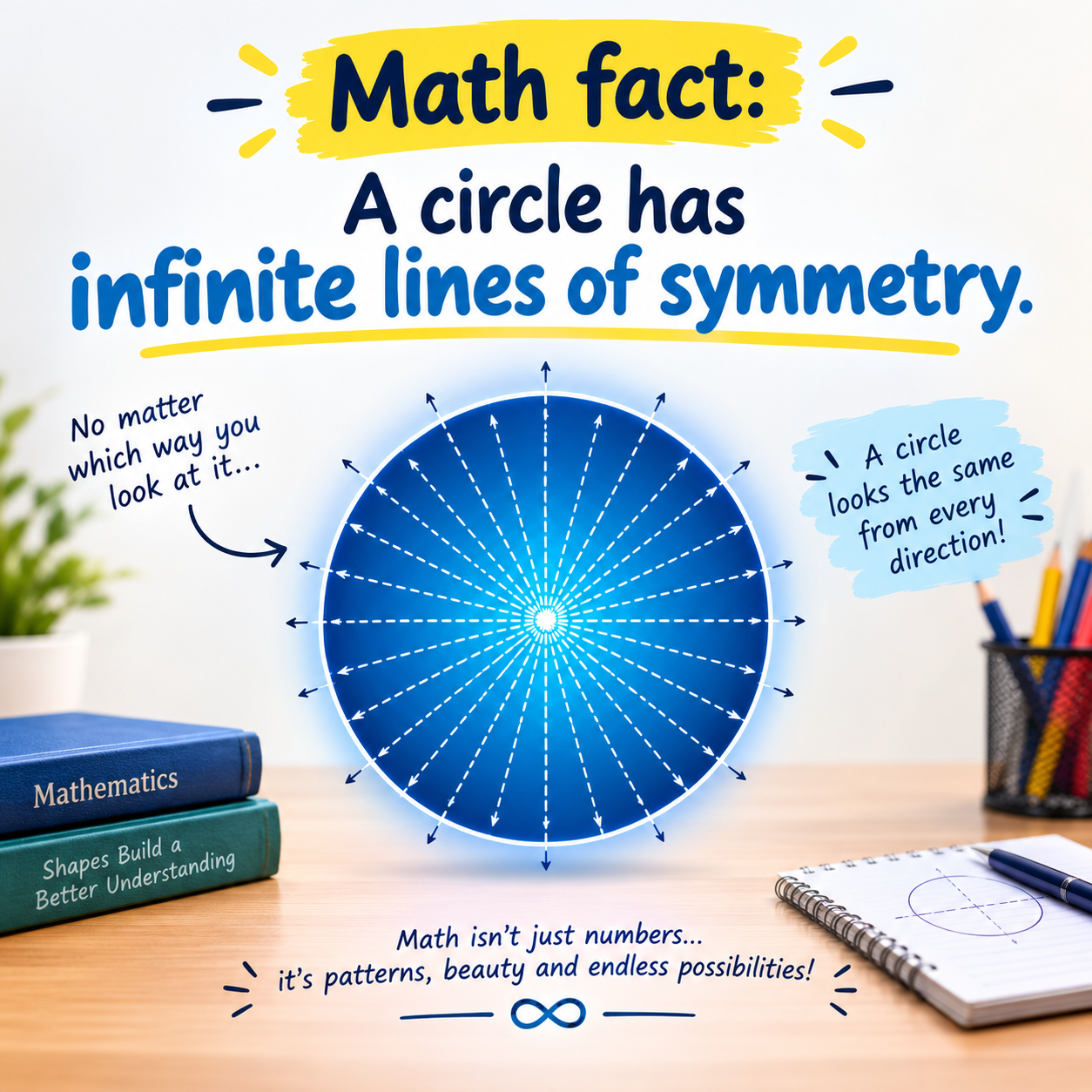
    Topic: **Math Fact: A Circle Has Infinite Lines of Symmetry! **

    Did you know? A circle has **infinite lines of symmetry** because any straight line passing through its center divides it into two equal halves. No matter which direction you choose, the circle remains symmetrical!

    Mathematics is full of amazing patterns, shapes, and discoveries. Keep learning, keep exploring, and make math fun!

    **Fun Fact:** A circle looks the same when reflected across any line passing through its center.

    #MathFacts #Mathematics #DidYouKnow #CircleOfKnowledge #LinesOfSymmetry #LearnWithFun #EducationalPost #ScienceAndMath #KnowledgeIsPower #StudySmart
    RSIF8 Roll NO:92 CHAT GPT TASK NO:12 Topic:📐 **Math Fact: A Circle Has Infinite Lines of Symmetry! 🔵** Did you know? A circle has **infinite lines of symmetry** because any straight line passing through its center divides it into two equal halves. No matter which direction you choose, the circle remains symmetrical! ✨ Mathematics is full of amazing patterns, shapes, and discoveries. Keep learning, keep exploring, and make math fun! 🧠📚 💡 **Fun Fact:** A circle looks the same when reflected across any line passing through its center. #MathFacts #Mathematics #DidYouKnow #CircleOfKnowledge #LinesOfSymmetry #LearnWithFun #EducationalPost #ScienceAndMath #KnowledgeIsPower #StudySmart
    0 Σχόλια 0 Μοιράστηκε 1236 Views
  • RSIF8
    Roll no 94
    Song no 11
    Song topic
    Calculus: The Journey of Numbers and Sacred Spaces
    Exploring the beauty of calculus, where numbers, patterns, and change help us understand the world around us. From elegant curves to infinite possibilities, mathematics connects logic, creativity, and discovery.
    Join me on this fascinating journey through numbers and sacred spaces, where learning becomes an adventure and every equation tells a story!
    #Calculus #Mathematics #LearningJourney #STEM #Education #Numbers #Science #MathLovers #Knowledge #Students #Inspiration #SacredSpaces #ExploreToLearn #FutureThinkers #RehanSchool
    RSIF8 Roll no 94 Song no 11 Song topic 📐✨ Calculus: The Journey of Numbers and Sacred Spaces ✨🕌 Exploring the beauty of calculus, where numbers, patterns, and change help us understand the world around us. From elegant curves to infinite possibilities, mathematics connects logic, creativity, and discovery. 🌍📚➗ Join me on this fascinating journey through numbers and sacred spaces, where learning becomes an adventure and every equation tells a story! 🚀💡 #Calculus #Mathematics #LearningJourney #STEM #Education #Numbers #Science #MathLovers #Knowledge #Students #Inspiration #SacredSpaces #ExploreToLearn #FutureThinkers #RehanSchool 📐✨📚🚀🕌🌟
    0 Σχόλια 0 Μοιράστηκε 1042 Views 2
  • RSIF8
    Roll no 94
    Story post no 13
    Story post topic
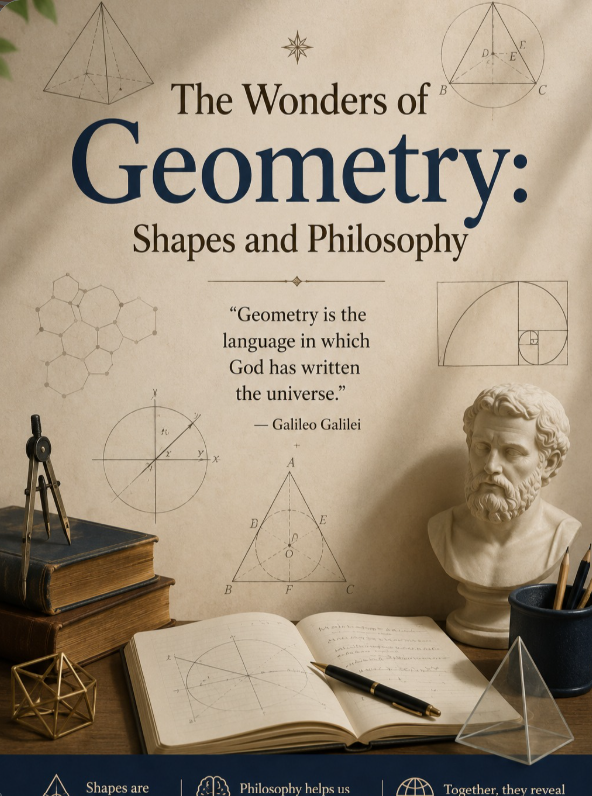
    The Wonders of Geometry: Shapes and Philosophy

    Geometry is more than just lines, angles, and shapes—it helps us understand the beauty, balance, and patterns of the world around us. From the symmetry of nature to the design of buildings, geometry connects mathematics with creativity and philosophy.

    Every shape tells a story, and every angle reveals a new perspective. Today, let's explore how geometry shapes our thinking and inspires us to see the world in a whole new way!

    #Geometry #Mathematics #Shapes #Learning #Education #STEM #MathIsFun #Philosophy #CreativeThinking #Knowledge #Students #RehanSchool #ExploreAndLearn #Inspiration #ShapeOfTheWorld
    RSIF8 Roll no 94 Story post no 13 Story post topic 📐✨ The Wonders of Geometry: Shapes and Philosophy ✨📐 Geometry is more than just lines, angles, and shapes—it helps us understand the beauty, balance, and patterns of the world around us. 🌍🔺 From the symmetry of nature to the design of buildings, geometry connects mathematics with creativity and philosophy. 🏛️💡 Every shape tells a story, and every angle reveals a new perspective. Today, let's explore how geometry shapes our thinking and inspires us to see the world in a whole new way! 📏🌟 #Geometry #Mathematics #Shapes #Learning #Education #STEM #MathIsFun #Philosophy #CreativeThinking #Knowledge #Students #RehanSchool #ExploreAndLearn #Inspiration #ShapeOfTheWorld 📐✨🌍
    0 Σχόλια 0 Μοιράστηκε 879 Views
  • **Roll No: 2**
    **Batch: 14**
    **Book: ACCL**
    **Task No: 120**

    # Why Frogs? Understanding the Anatomy of Life

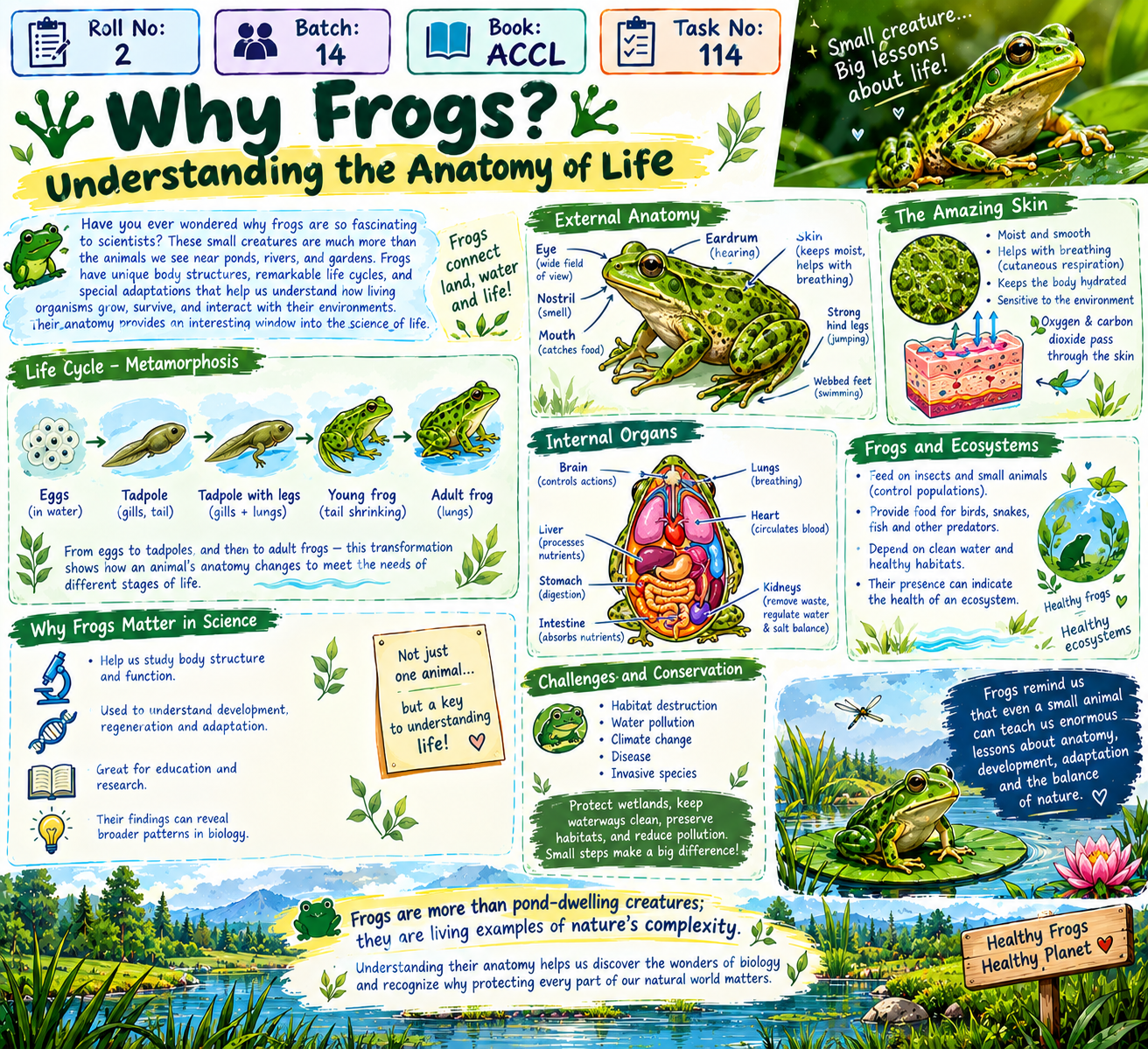
    Have you ever wondered why frogs are so fascinating to scientists? These small creatures are much more than the animals we see near ponds, rivers, and gardens. Frogs have unique body structures, remarkable life cycles, and special adaptations that help us understand how living organisms grow, survive, and interact with their environments. Their anatomy provides an interesting window into the science of life.

    A frog's body is designed for life both in water and on land. Its body generally has a broad head, a short trunk, strong hind legs, and webbed feet in many species. These features help frogs jump, swim, and move through their habitats. Their eyes are positioned to provide a wide field of view, while their sensitive hearing helps them detect sounds, including the calls of other frogs.

    One of the most interesting features of frogs is their skin. Unlike the dry, scaly skin of many reptiles, frog skin is usually moist and plays an important role in their survival. Many frogs can exchange gases through their skin as well as through their lungs. This process, called **cutaneous respiration**, allows oxygen and carbon dioxide to pass across the skin under suitable conditions. Their skin also helps maintain moisture, making a healthy habitat especially important for them.

    Frogs have a fascinating life cycle called **metamorphosis**. Many begin life as eggs in water. The eggs hatch into tadpoles, which usually have tails and breathe mainly through gills. As they develop, they grow legs, their lungs develop, and their bodies gradually change into those of adult frogs. The tail is usually absorbed during development. This transformation demonstrates how an animal's anatomy changes to meet the needs of different stages of life.

    The internal organs of a frog also reveal important biological principles. Its heart circulates blood through the body, carrying oxygen and nutrients to tissues. The digestive system breaks down food, while the kidneys help remove waste and regulate water and salt balance. The brain and nervous system coordinate movement, senses, and responses to the environment. Each organ works with other systems to keep the animal alive.

    Frogs are also valuable to ecosystems. Many feed on insects and other small animals, helping influence populations of these organisms. Frogs themselves provide food for birds, snakes, fish, and other predators. Because many frogs depend on suitable water and land habitats, changes in their populations can provide clues about environmental conditions. Scientists therefore study frogs to learn more about biodiversity, habitat quality, and ecosystem health.

    Another reason frogs are important is their role in scientific research and education. Their anatomy helps students explore the structure and function of organs, compare different vertebrates, and understand biological systems. Researchers also study frog development, regeneration in certain species, communication, and adaptation. Such research can reveal broader patterns in biology, although findings from frogs do not always apply directly to humans.

    Unfortunately, many frog species face challenges such as habitat destruction, water pollution, climate change, disease, and invasive species. Protecting wetlands, keeping waterways clean, preserving natural habitats, and reducing pollution can help support frog populations and the many other organisms that share their ecosystems. Caring for frogs is one way of caring for the wider web of life.

    Frogs remind us that even a small animal can teach us enormous lessons about anatomy, development, adaptation, and the balance of nature. By observing their bodies and studying their life cycles, we gain a deeper appreciation of how living systems work together.

    **Frogs are more than pond-dwelling creatures; they are living examples of nature's complexity. Understanding their anatomy helps us discover the wonders of biology and recognize why protecting every part of our natural world matters. **

    \#Frogs #AnatomyOfLife #Biology #LifeCycle #AnimalScience #Biodiversity #ACCL #Batch14 #Task114
    **Roll No: 2** **Batch: 14** **Book: ACCL** **Task No: 120** # 🐸🔬 Why Frogs? Understanding the Anatomy of Life 🌿💚 Have you ever wondered why frogs are so fascinating to scientists? 🐸🌎 These small creatures are much more than the animals we see near ponds, rivers, and gardens. Frogs have unique body structures, remarkable life cycles, and special adaptations that help us understand how living organisms grow, survive, and interact with their environments. Their anatomy provides an interesting window into the science of life. 🔬✨ A frog's body is designed for life both in water and on land. 💧🌱 Its body generally has a broad head, a short trunk, strong hind legs, and webbed feet in many species. These features help frogs jump, swim, and move through their habitats. Their eyes are positioned to provide a wide field of view, while their sensitive hearing helps them detect sounds, including the calls of other frogs. 🦵👀 One of the most interesting features of frogs is their skin. Unlike the dry, scaly skin of many reptiles, frog skin is usually moist and plays an important role in their survival. 🐸💦 Many frogs can exchange gases through their skin as well as through their lungs. This process, called **cutaneous respiration**, allows oxygen and carbon dioxide to pass across the skin under suitable conditions. Their skin also helps maintain moisture, making a healthy habitat especially important for them. Frogs have a fascinating life cycle called **metamorphosis**. 🥚➡️🐟➡️🐸 Many begin life as eggs in water. The eggs hatch into tadpoles, which usually have tails and breathe mainly through gills. As they develop, they grow legs, their lungs develop, and their bodies gradually change into those of adult frogs. The tail is usually absorbed during development. This transformation demonstrates how an animal's anatomy changes to meet the needs of different stages of life. 🌱🔄 The internal organs of a frog also reveal important biological principles. ❤️ Its heart circulates blood through the body, carrying oxygen and nutrients to tissues. The digestive system breaks down food, while the kidneys help remove waste and regulate water and salt balance. The brain and nervous system coordinate movement, senses, and responses to the environment. Each organ works with other systems to keep the animal alive. 🧠🫀 Frogs are also valuable to ecosystems. 🦟🌿 Many feed on insects and other small animals, helping influence populations of these organisms. Frogs themselves provide food for birds, snakes, fish, and other predators. Because many frogs depend on suitable water and land habitats, changes in their populations can provide clues about environmental conditions. Scientists therefore study frogs to learn more about biodiversity, habitat quality, and ecosystem health. 🌍🔎 Another reason frogs are important is their role in scientific research and education. 📚🔬 Their anatomy helps students explore the structure and function of organs, compare different vertebrates, and understand biological systems. Researchers also study frog development, regeneration in certain species, communication, and adaptation. Such research can reveal broader patterns in biology, although findings from frogs do not always apply directly to humans. Unfortunately, many frog species face challenges such as habitat destruction, water pollution, climate change, disease, and invasive species. 🌧️🏞️ Protecting wetlands, keeping waterways clean, preserving natural habitats, and reducing pollution can help support frog populations and the many other organisms that share their ecosystems. Caring for frogs is one way of caring for the wider web of life. 💚♻️ Frogs remind us that even a small animal can teach us enormous lessons about anatomy, development, adaptation, and the balance of nature. By observing their bodies and studying their life cycles, we gain a deeper appreciation of how living systems work together. 🐸🌎🔬 **Frogs are more than pond-dwelling creatures; they are living examples of nature's complexity. Understanding their anatomy helps us discover the wonders of biology and recognize why protecting every part of our natural world matters. 🐸🧬🌿✨** \#Frogs #AnatomyOfLife #Biology #LifeCycle #AnimalScience #Biodiversity #ACCL #Batch14 #Task114 🐸🔬🌍
    0 Σχόλια 0 Μοιράστηκε 3371 Views
Αναζήτηση αποτελεσμάτων