• RSIF8
    Roll no:100
    Task no:13
    Task topic:Mulla Nasrudin's Missing Ring
    The Story of Mulla Nasrudin and the Missing Ring
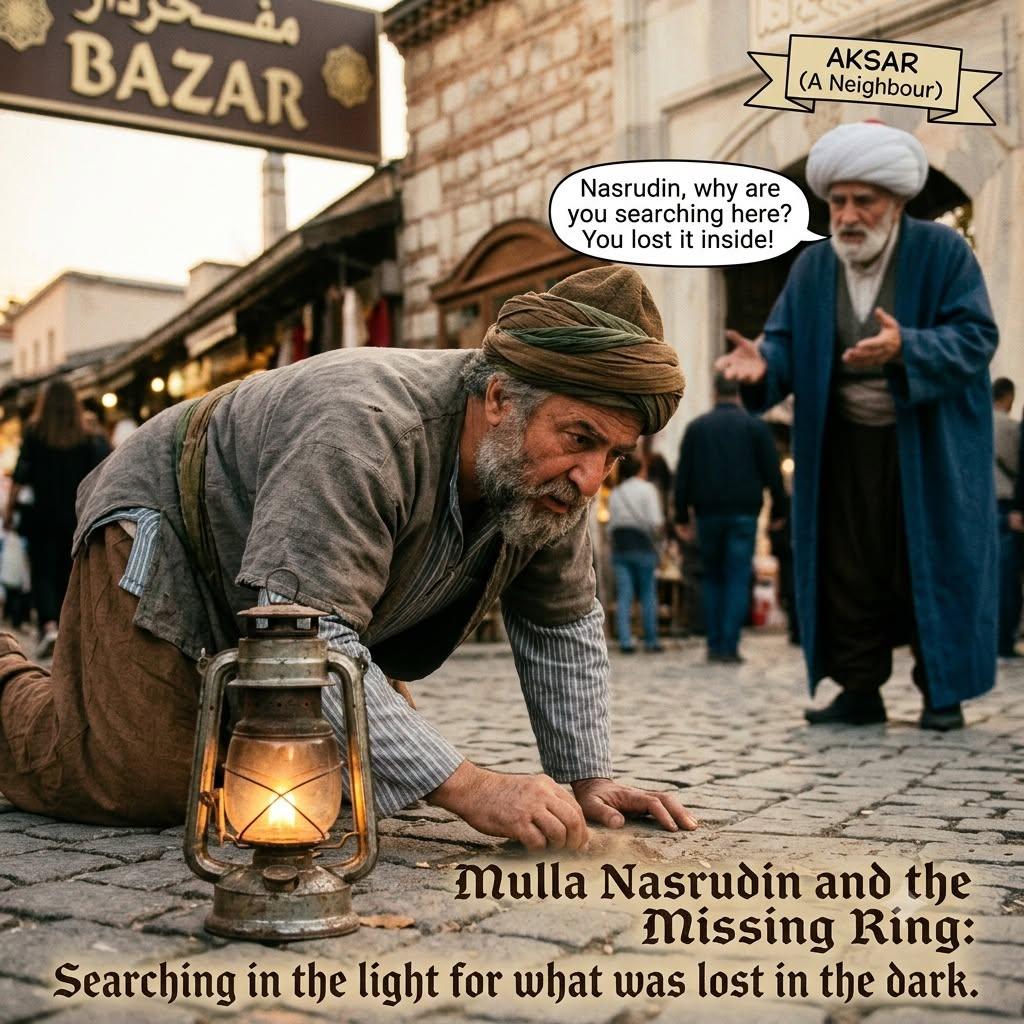
    It was a bustling evening in the heart of the ancient bazaar , but amidst the crowd, one man was completely preoccupied. **Mulla Nasrudin** was down on all fours, frantically brushing aside the dust and peering between the cobblestones.
    Right beside him sat a single, flickering lantern , casting a warm glow over his desperate search.
    His neighbor, **Aksar**, happened to be walking by and stopped in his tracks. Seeing his old friend on his knees looking completely distressed, Aksar called out:
    *"Nasrudin! What on earth are you doing down there?"*
    Mulla looked up, wiping sweat from his brow. *"I'm looking for my ring! I've lost it and I can't find it anywhere!"*
    Being a good neighbor, Aksar immediately knelt down to help. They searched together for a while, combing through the dirt, but found absolutely nothing.
    Finally, Aksar paused, looking around the bright street, and asked a logical question:
    *"Nasrudin, think back. Where exactly were you standing when you dropped it?"*
    Mulla pointed toward his house in the distance. *"Oh, I lost it inside my house, all the way in the back room!"*
    Aksar stared at him in utter disbelief. *"Nasrudin, if you lost the ring inside your house, why on earth are you searching out here in the middle of the street?!"*
    Mulla Nasrudin looked at him calmly and smiled.
    *"Well, my friend, isn't it obvious? It's pitch black inside my house, but out here under the streetlamps, there is so much more light!"*
    > **The Lesson:** We often look for solutions in the easiest, most comfortable places rather than looking where the actual problem lies.
    #MullaNasrudin #MissingRing #NasrudinStories #SufiWisdom #Parable #AncientTales #FolkTales #Philosophy #LifeLessons #WiseWords #BazaarVibes #ClassicStories #StoryTime #InstaStory #DeepThoughts #LookingInTheWrongPlace #Perspective #Mindset
    RSIF8 Roll no:100 Task no:13 Task topic:Mulla Nasrudin's Missing Ring 💍 The Story of Mulla Nasrudin and the Missing Ring ✨ It was a bustling evening in the heart of the ancient bazaar 🕌, but amidst the crowd, one man was completely preoccupied. **Mulla Nasrudin** was down on all fours, frantically brushing aside the dust and peering between the cobblestones. 🧐 Right beside him sat a single, flickering lantern 🕯️, casting a warm glow over his desperate search. His neighbor, **Aksar**, happened to be walking by and stopped in his tracks. Seeing his old friend on his knees looking completely distressed, Aksar called out: 🗣️ *"Nasrudin! What on earth are you doing down there?"* Mulla looked up, wiping sweat from his brow. 😰 *"I'm looking for my ring! I've lost it and I can't find it anywhere!"* Being a good neighbor, Aksar immediately knelt down to help. They searched together for a while, combing through the dirt, but found absolutely nothing. 🤷‍♂️ Finally, Aksar paused, looking around the bright street, and asked a logical question: 🤔 *"Nasrudin, think back. Where exactly were you standing when you dropped it?"* Mulla pointed toward his house in the distance. 🏠 *"Oh, I lost it inside my house, all the way in the back room!"* Aksar stared at him in utter disbelief. 🤯 *"Nasrudin, if you lost the ring inside your house, why on earth are you searching out here in the middle of the street?!"* Mulla Nasrudin looked at him calmly and smiled. 😏 *"Well, my friend, isn't it obvious? It's pitch black inside my house, but out here under the streetlamps, there is so much more light!"* 💡 > **The Lesson:** We often look for solutions in the easiest, most comfortable places rather than looking where the actual problem lies. 🧠✨ #MullaNasrudin #MissingRing #NasrudinStories #SufiWisdom #Parable #AncientTales #FolkTales #Philosophy #LifeLessons #WiseWords #BazaarVibes #ClassicStories #StoryTime #InstaStory #DeepThoughts #LookingInTheWrongPlace #Perspective #Mindset
    0 Kommentare 0 Anteile 394 Ansichten
  • Fondation Level Batch No 4
    Roll RSLC #42
    Task No #111
    Day #111

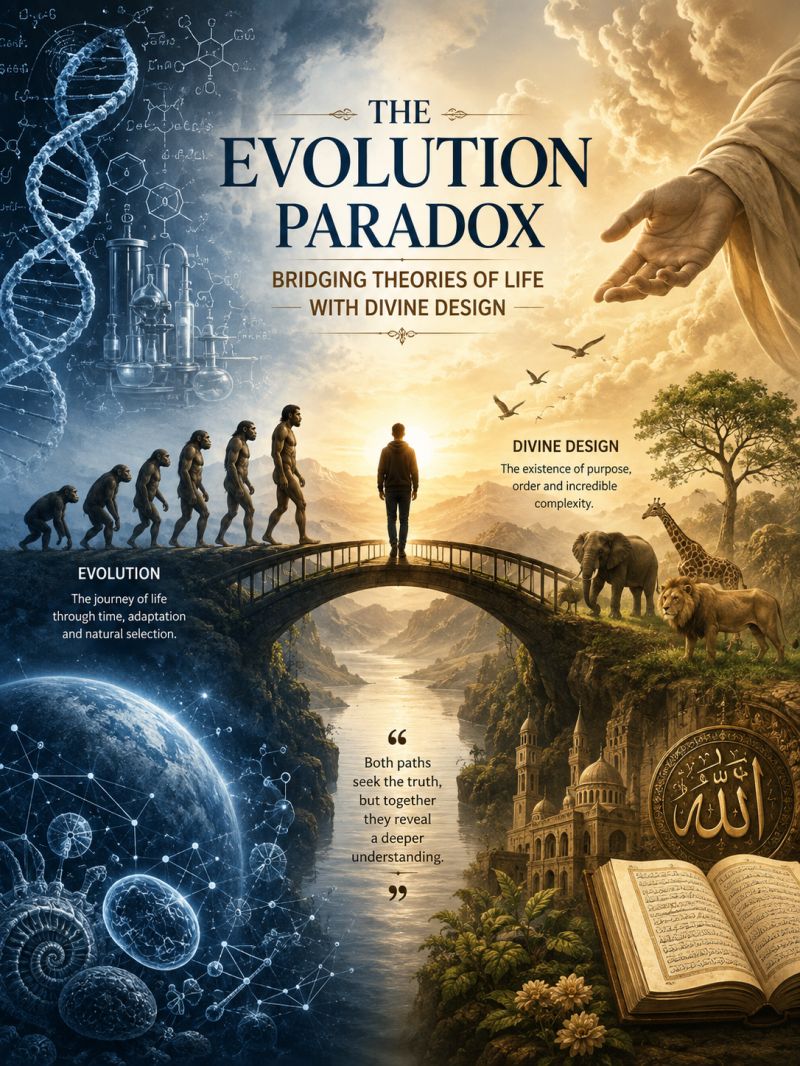
    The Evolution Paradox: A Story with a Moral Lesson

    Once, a curious young student named Ayan often wondered about the origin of life. He spent his evenings reading about evolution, observing nature, and asking questions about how living creatures change over time. The more he learned, the more amazed he became by the complexity and diversity of life.

    One day, Ayan discussed his questions with his teacher. His teacher told him that science helps us explore how life changes through evidence and observation, while faith encourages people to think about the meaning and purpose of creation. Ayan realized that asking questions did not weaken his curiosity; instead, it helped him understand the world with greater humility.

    From that day forward, Ayan stopped thinking that every difficult question needed an immediate answer. He continued studying science while also reflecting on the deeper questions of existence. He learned that knowledge is not only about proving what we already believe, but also about being willing to learn, think, and discover.

    Moral Lesson: True wisdom begins with curiosity and humility. We should seek knowledge, respect evidence, and remain open to deeper questions about life and existence. The more we learn, the more we realize how much there is still to understand.

    #Evolution #DivineDesign #ScienceAndFaith #OriginOfLife #EvolutionTheory #PhilosophyOfLife #ScienceAndSpirituality
    Fondation Level Batch No 4 Roll RSLC #42 Task No #111 Day #111 The Evolution Paradox: A Story with a Moral Lesson Once, a curious young student named Ayan often wondered about the origin of life. He spent his evenings reading about evolution, observing nature, and asking questions about how living creatures change over time. The more he learned, the more amazed he became by the complexity and diversity of life. One day, Ayan discussed his questions with his teacher. His teacher told him that science helps us explore how life changes through evidence and observation, while faith encourages people to think about the meaning and purpose of creation. Ayan realized that asking questions did not weaken his curiosity; instead, it helped him understand the world with greater humility. From that day forward, Ayan stopped thinking that every difficult question needed an immediate answer. He continued studying science while also reflecting on the deeper questions of existence. He learned that knowledge is not only about proving what we already believe, but also about being willing to learn, think, and discover. Moral Lesson: True wisdom begins with curiosity and humility. We should seek knowledge, respect evidence, and remain open to deeper questions about life and existence. The more we learn, the more we realize how much there is still to understand. #Evolution #DivineDesign #ScienceAndFaith #OriginOfLife #EvolutionTheory #PhilosophyOfLife #ScienceAndSpirituality
    0 Kommentare 0 Anteile 1219 Ansichten
  • #rsisb
    Roll No.240
    Story No.25
    Foundation Level

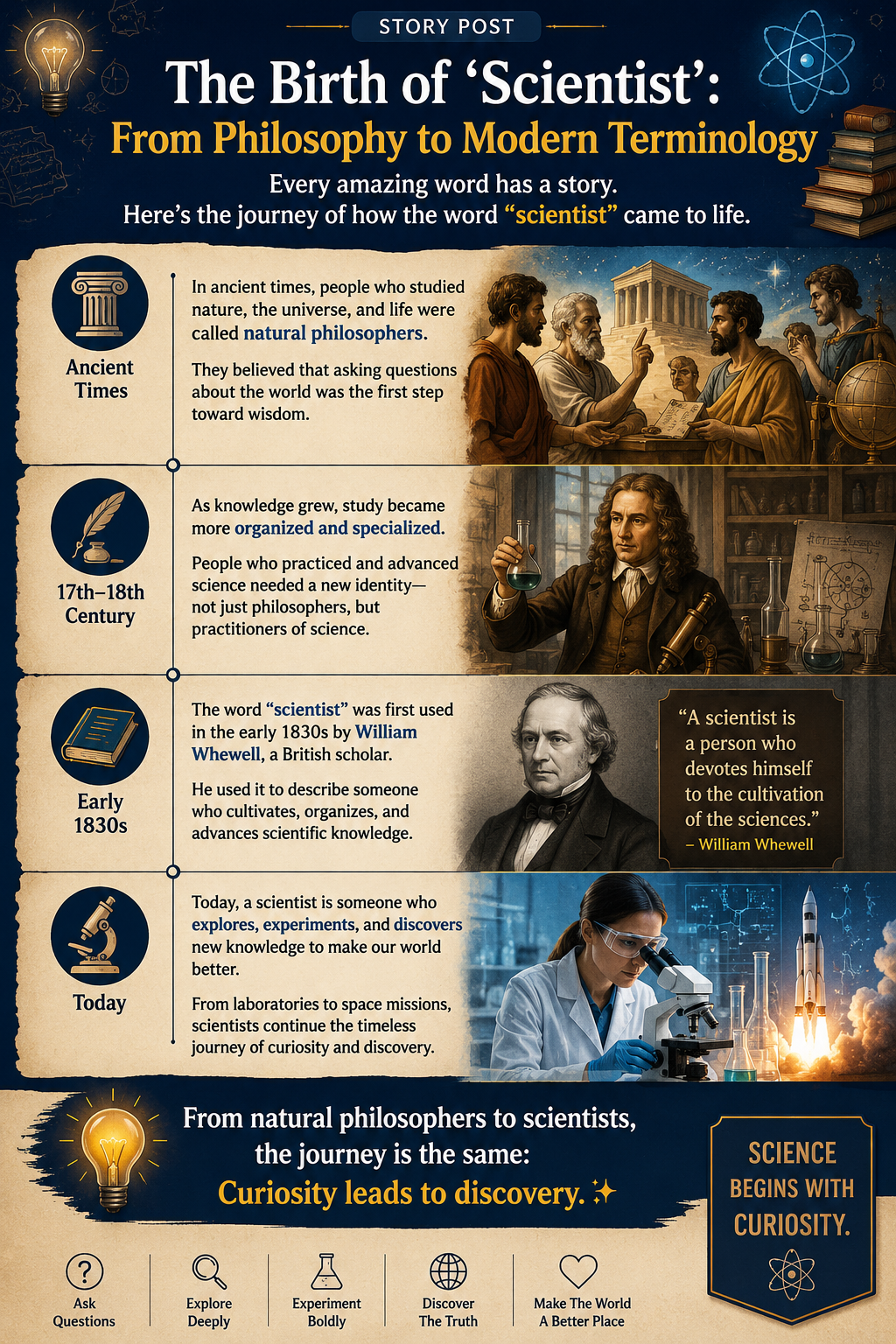
    “Scientist” is a word that represents curiosity, discovery, and the human desire to understand the world.

    Long before the modern term existed, people who studied nature were often called natural philosophers. Over time, scientific thinking became more specialized, and a new word was needed to describe those who practiced science professionally.

    This story explores how the word “scientist” was born, how its meaning evolved, and how it became a familiar part of modern language.

    From asking questions to discovering answers — the journey of science begins with curiosity.

    #Scientist #ScienceHistory #WordOrigins #HistoryOfScience #Philosophy #LanguageEvolution #Curiosity #Discovery #Knowledge #Learning #StoryPost

    Rehan School Islamabad Campus
    Asma Shaheen Eduction Wali
    Irum Asim
    Saima Happines Wali

    #rsisb Roll No.240 Story No.25 Foundation Level 🔬 “Scientist” is a word that represents curiosity, discovery, and the human desire to understand the world. 🌍✨ Long before the modern term existed, people who studied nature were often called natural philosophers. Over time, scientific thinking became more specialized, and a new word was needed to describe those who practiced science professionally. 📖 This story explores how the word “scientist” was born, how its meaning evolved, and how it became a familiar part of modern language. 💡 From asking questions to discovering answers — the journey of science begins with curiosity. #Scientist #ScienceHistory #WordOrigins #HistoryOfScience #Philosophy #LanguageEvolution #Curiosity #Discovery #Knowledge #Learning #StoryPost 🔬🌍📚✨ Rehan School Islamabad Campus Asma Shaheen Eduction Wali Irum Asim Saima Happines Wali
    0 Kommentare 0 Anteile 1255 Ansichten
  • #rsisb
    Roll No.240
    Story Post No.24
    Foundation Level

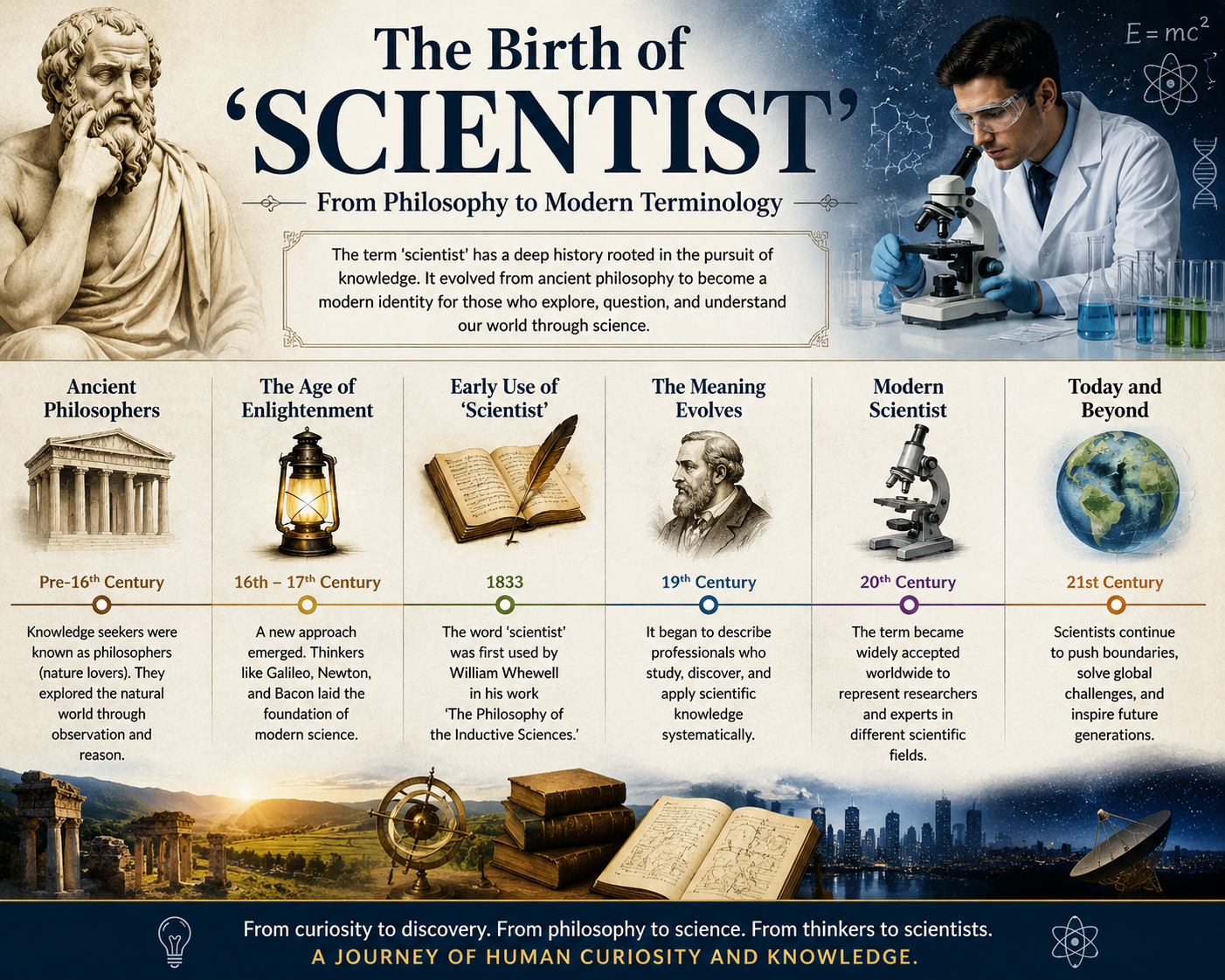
    The word “scientist” may sound like a modern term, but the journey behind it is connected to centuries of human curiosity, philosophy, observation, experimentation, and the search for knowledge.

    Long before the word “scientist” became common, people who studied the natural world were often known as philosophers, scholars, natural philosophers, mathematicians, and thinkers. They asked important questions about nature, the universe, life, matter, motion, and the world around them.

    From the thinkers of the ancient world to the scholars of the Renaissance and the Scientific Revolution, humans continued developing new ways to understand nature. Observation became more important, experiments became more systematic, and evidence gradually became a central part of scientific inquiry.

    During the 18th and 19th centuries, many different branches of knowledge began becoming more specialized. Physics, chemistry, biology, astronomy, geology, and other fields developed their own methods, discoveries, and communities of researchers.

    A major moment in terminology came in the 19th century, when the word “scientist” was introduced as a useful name for people engaged in scientific study. The term is widely associated with William Whewell, who used it in 1833. This helped provide a new, unified word for researchers working across different areas of science.

    The evolution of this word reflects something bigger than language. It represents the changing way humanity organized knowledge and recognized scientific work. The transition from “natural philosopher” to “scientist” shows how science gradually became a distinct and organized field of study.

    Today, scientists work in laboratories, universities, hospitals, observatories, research centers, engineering facilities, and many other places around the world. They investigate everything from tiny cells and molecules to distant galaxies and the origins of the universe.

    Modern science continues to grow through curiosity, evidence, teamwork, technology, and a willingness to ask difficult questions. Every discovery begins with someone wondering, “Why?”, “How?”, or “What if?”

    The story of the word “scientist” reminds us that human knowledge is always evolving. What began with simple curiosity and philosophical questioning gradually developed into the powerful and diverse scientific world we know today.

    From thinkers to researchers. From philosophy to science. From questions to discoveries.

    Science is not only about finding answers—it is also about continuing to ask better questions.

    A journey from curiosity to discovery, and from philosophy to modern science.

    #TheBirthOfScientist #Scientist #HistoryOfScience #ScienceHistory #ScientificRevolution #Philosophy #NaturalPhilosophy #WilliamWhewell #1833 #ModernScience #ScienceEducation #ScientificTerminology #Science #Scientists #Research #Discovery #Curiosity #Knowledge #Learning #Education #STEM #Physics #Chemistry #Biology #Astronomy #Geology #Innovation #Experimentation #ScientificThinking #CriticalThinking #HumanKnowledge #HistoryOfKnowledge #ScienceJourney #FromPhilosophyToScience #ScienceFacts #EducationalContent #LearningJourney #ExploreScience #DiscoverScience

    Rehan School Islamabad Campus
    Asma Shaheen EducationWali
    Irum Asim
    Saima Happinesswali

    #rsisb Roll No.240 Story Post No.24 Foundation Level The word “scientist” may sound like a modern term, but the journey behind it is connected to centuries of human curiosity, philosophy, observation, experimentation, and the search for knowledge. 🧠🔎 Long before the word “scientist” became common, people who studied the natural world were often known as philosophers, scholars, natural philosophers, mathematicians, and thinkers. 🏛️📜 They asked important questions about nature, the universe, life, matter, motion, and the world around them. From the thinkers of the ancient world to the scholars of the Renaissance and the Scientific Revolution, humans continued developing new ways to understand nature. 🌌🌍📖 Observation became more important, experiments became more systematic, and evidence gradually became a central part of scientific inquiry. 🔬🧪✨ During the 18th and 19th centuries, many different branches of knowledge began becoming more specialized. Physics, chemistry, biology, astronomy, geology, and other fields developed their own methods, discoveries, and communities of researchers. 🧬⚗️🌠 A major moment in terminology came in the 19th century, when the word “scientist” was introduced as a useful name for people engaged in scientific study. The term is widely associated with William Whewell, who used it in 1833. 📜🔬 This helped provide a new, unified word for researchers working across different areas of science. The evolution of this word reflects something bigger than language. It represents the changing way humanity organized knowledge and recognized scientific work. 🌟📚 The transition from “natural philosopher” to “scientist” shows how science gradually became a distinct and organized field of study. Today, scientists work in laboratories, universities, hospitals, observatories, research centers, engineering facilities, and many other places around the world. 🌍🧪🔭 They investigate everything from tiny cells and molecules to distant galaxies and the origins of the universe. 🧬🦠🌌 Modern science continues to grow through curiosity, evidence, teamwork, technology, and a willingness to ask difficult questions. 💡🤝🚀 Every discovery begins with someone wondering, “Why?”, “How?”, or “What if?” The story of the word “scientist” reminds us that human knowledge is always evolving. What began with simple curiosity and philosophical questioning gradually developed into the powerful and diverse scientific world we know today. 🌱➡️🔬➡️🌍 ✨ From thinkers to researchers. From philosophy to science. From questions to discoveries. ✨ Science is not only about finding answers—it is also about continuing to ask better questions. 🔎💡 🌟 A journey from curiosity to discovery, and from philosophy to modern science. 🌟 #TheBirthOfScientist #Scientist #HistoryOfScience #ScienceHistory #ScientificRevolution #Philosophy #NaturalPhilosophy #WilliamWhewell #1833 #ModernScience #ScienceEducation #ScientificTerminology #Science #Scientists #Research #Discovery #Curiosity #Knowledge #Learning #Education #STEM #Physics #Chemistry #Biology #Astronomy #Geology #Innovation #Experimentation #ScientificThinking #CriticalThinking #HumanKnowledge #HistoryOfKnowledge #ScienceJourney #FromPhilosophyToScience #ScienceFacts #EducationalContent #LearningJourney #ExploreScience #DiscoverScience 🔬📚🧠🌍✨🔭🧪🚀💡🌟 Rehan School Islamabad Campus Asma Shaheen EducationWali Irum Asim Saima Happinesswali
    0 Kommentare 0 Anteile 3456 Ansichten

  • #rsisb
    Roll no.239
    Maya no.19
    Foundation Level

    **“Conscious – Tracing the Evolution of Awareness”** explores one of the greatest mysteries of science and philosophy: **how awareness and conscious experience developed in living beings**. Consciousness allows us to experience the world, think, remember, feel emotions, make decisions, and recognize ourselves.

    The topic takes us back to the earliest forms of life and asks how simple organisms developed increasingly complex ways of sensing and responding to their surroundings. As nervous systems and brains became more sophisticated, organisms gained greater abilities to process information, learn from experiences, remember events, and respond flexibly to their environments.

    One of the most fascinating questions is whether consciousness appeared suddenly or **evolved gradually over millions of years**. Scientists study the brains and behaviors of humans and other animals to understand possible forms of awareness. However, consciousness remains difficult to explain because subjective experiences—such as seeing colors, feeling pain, or experiencing emotions—are personal and cannot be directly observed by others.

    The discussion also introduces **self-awareness**, which is the ability to recognize oneself and reflect on one's own thoughts and experiences. Human consciousness is closely connected with language, memory, attention, imagination, creativity, and decision-making.

    Another important part of the topic is the relationship between **conscious and unconscious processes**. Many things our brains do happen automatically, without our full awareness. This shows that the human mind is far more complex than conscious thought alone.

    Overall, this 25-minute exploration encourages us to think deeply about **who we are, how awareness developed, and what it means to be conscious**. It connects biology, neuroscience, psychology, evolution, and philosophy while reminding us that many questions about consciousness are still unanswered.

    **Key Message:** Understanding consciousness may help us better understand not only the human brain, but also the evolution of life, intelligence, identity, and our place in the universe.
    ### **Hashtags**

    #Consciousness #Awareness #Evolution #HumanMind #BrainScience #Neuroscience #SelfAwareness #Psychology #Science #Philosophy #HumanEvolution #Learning #Curiosity #Knowledge #MindAndBrain
    #rsisb Roll no.239 Maya no.19 Foundation Level **“Conscious – Tracing the Evolution of Awareness”** explores one of the greatest mysteries of science and philosophy: **how awareness and conscious experience developed in living beings**. Consciousness allows us to experience the world, think, remember, feel emotions, make decisions, and recognize ourselves. The topic takes us back to the earliest forms of life and asks how simple organisms developed increasingly complex ways of sensing and responding to their surroundings. As nervous systems and brains became more sophisticated, organisms gained greater abilities to process information, learn from experiences, remember events, and respond flexibly to their environments. One of the most fascinating questions is whether consciousness appeared suddenly or **evolved gradually over millions of years**. Scientists study the brains and behaviors of humans and other animals to understand possible forms of awareness. However, consciousness remains difficult to explain because subjective experiences—such as seeing colors, feeling pain, or experiencing emotions—are personal and cannot be directly observed by others. The discussion also introduces **self-awareness**, which is the ability to recognize oneself and reflect on one's own thoughts and experiences. Human consciousness is closely connected with language, memory, attention, imagination, creativity, and decision-making. Another important part of the topic is the relationship between **conscious and unconscious processes**. Many things our brains do happen automatically, without our full awareness. This shows that the human mind is far more complex than conscious thought alone. Overall, this 25-minute exploration encourages us to think deeply about **who we are, how awareness developed, and what it means to be conscious**. It connects biology, neuroscience, psychology, evolution, and philosophy while reminding us that many questions about consciousness are still unanswered. 🌟 **Key Message:** Understanding consciousness may help us better understand not only the human brain, but also the evolution of life, intelligence, identity, and our place in the universe. ### **Hashtags** #Consciousness #Awareness #Evolution #HumanMind #BrainScience #Neuroscience #SelfAwareness #Psychology #Science #Philosophy #HumanEvolution #Learning #Curiosity #Knowledge #MindAndBrain 🧠🔬✨
    0 Kommentare 0 Anteile 2406 Ansichten 3

  • #rsisb
    Roll no.239
    Maya no.19
    Foundation Level

    **“Conscious – Tracing the Evolution of Awareness”** explores one of the greatest mysteries of science and philosophy: **how awareness and conscious experience developed in living beings**. Consciousness allows us to experience the world, think, remember, feel emotions, make decisions, and recognize ourselves.

    The topic takes us back to the earliest forms of life and asks how simple organisms developed increasingly complex ways of sensing and responding to their surroundings. As nervous systems and brains became more sophisticated, organisms gained greater abilities to process information, learn from experiences, remember events, and respond flexibly to their environments.

    One of the most fascinating questions is whether consciousness appeared suddenly or **evolved gradually over millions of years**. Scientists study the brains and behaviors of humans and other animals to understand possible forms of awareness. However, consciousness remains difficult to explain because subjective experiences—such as seeing colors, feeling pain, or experiencing emotions—are personal and cannot be directly observed by others.

    The discussion also introduces **self-awareness**, which is the ability to recognize oneself and reflect on one's own thoughts and experiences. Human consciousness is closely connected with language, memory, attention, imagination, creativity, and decision-making.

    Another important part of the topic is the relationship between **conscious and unconscious processes**. Many things our brains do happen automatically, without our full awareness. This shows that the human mind is far more complex than conscious thought alone.

    Overall, this 25-minute exploration encourages us to think deeply about **who we are, how awareness developed, and what it means to be conscious**. It connects biology, neuroscience, psychology, evolution, and philosophy while reminding us that many questions about consciousness are still unanswered.

    **Key Message:** Understanding consciousness may help us better understand not only the human brain, but also the evolution of life, intelligence, identity, and our place in the universe.

    ### **Hashtags**

    #Consciousness #Awareness #Evolution #HumanMind #BrainScience #Neuroscience #SelfAwareness #Psychology #Science #Philosophy #HumanEvolution #Learning #Curiosity #Knowledge #MindAndBrain


    **“Conscious – Tracing the Evolution of Awareness”** explores one of the greatest mysteries of science and philosophy: **how awareness and conscious experience developed in living beings**. Consciousness allows us to experience the world, think, remember, feel emotions, make decisions, and recognize ourselves.

    The topic takes us back to the earliest forms of life and asks how simple organisms developed increasingly complex ways of sensing and responding to their surroundings. As nervous systems and brains became more sophisticated, organisms gained greater abilities to process information, learn from experiences, remember events, and respond flexibly to their environments.

    One of the most fascinating questions is whether consciousness appeared suddenly or **evolved gradually over millions of years**. Scientists study the brains and behaviors of humans and other animals to understand possible forms of awareness. However, consciousness remains difficult to explain because subjective experiences—such as seeing colors, feeling pain, or experiencing emotions—are personal and cannot be directly observed by others.

    The discussion also introduces **self-awareness**, which is the ability to recognize oneself and reflect on one's own thoughts and experiences. Human consciousness is closely connected with language, memory, attention, imagination, creativity, and decision-making.

    Another important part of the topic is the relationship between **conscious and unconscious processes**. Many things our brains do happen automatically, without our full awareness. This shows that the human mind is far more complex than conscious thought alone.

    Overall, this 25-minute exploration encourages us to think deeply about **who we are, how awareness developed, and what it means to be conscious**. It connects biology, neuroscience, psychology, evolution, and philosophy while reminding us that many questions about consciousness are still unanswered.

    **Key Message:** Understanding consciousness may help us better understand not only the human brain, but also the evolution of life, intelligence, identity, and our place in the universe.

    ### **Hashtags**

    #Consciousness #Awareness #Evolution #HumanMind #BrainScience #Neuroscience #SelfAwareness #Psychology #Science #Philosophy #HumanEvolution #Learning #Curiosity #Knowledge #MindAndBrain
    #rsisb Roll no.239 Maya no.19 Foundation Level **“Conscious – Tracing the Evolution of Awareness”** explores one of the greatest mysteries of science and philosophy: **how awareness and conscious experience developed in living beings**. Consciousness allows us to experience the world, think, remember, feel emotions, make decisions, and recognize ourselves. The topic takes us back to the earliest forms of life and asks how simple organisms developed increasingly complex ways of sensing and responding to their surroundings. As nervous systems and brains became more sophisticated, organisms gained greater abilities to process information, learn from experiences, remember events, and respond flexibly to their environments. One of the most fascinating questions is whether consciousness appeared suddenly or **evolved gradually over millions of years**. Scientists study the brains and behaviors of humans and other animals to understand possible forms of awareness. However, consciousness remains difficult to explain because subjective experiences—such as seeing colors, feeling pain, or experiencing emotions—are personal and cannot be directly observed by others. The discussion also introduces **self-awareness**, which is the ability to recognize oneself and reflect on one's own thoughts and experiences. Human consciousness is closely connected with language, memory, attention, imagination, creativity, and decision-making. Another important part of the topic is the relationship between **conscious and unconscious processes**. Many things our brains do happen automatically, without our full awareness. This shows that the human mind is far more complex than conscious thought alone. Overall, this 25-minute exploration encourages us to think deeply about **who we are, how awareness developed, and what it means to be conscious**. It connects biology, neuroscience, psychology, evolution, and philosophy while reminding us that many questions about consciousness are still unanswered. 🌟 **Key Message:** Understanding consciousness may help us better understand not only the human brain, but also the evolution of life, intelligence, identity, and our place in the universe. ### **Hashtags** #Consciousness #Awareness #Evolution #HumanMind #BrainScience #Neuroscience #SelfAwareness #Psychology #Science #Philosophy #HumanEvolution #Learning #Curiosity #Knowledge #MindAndBrain 🧠🔬✨ **“Conscious – Tracing the Evolution of Awareness”** explores one of the greatest mysteries of science and philosophy: **how awareness and conscious experience developed in living beings**. Consciousness allows us to experience the world, think, remember, feel emotions, make decisions, and recognize ourselves. The topic takes us back to the earliest forms of life and asks how simple organisms developed increasingly complex ways of sensing and responding to their surroundings. As nervous systems and brains became more sophisticated, organisms gained greater abilities to process information, learn from experiences, remember events, and respond flexibly to their environments. One of the most fascinating questions is whether consciousness appeared suddenly or **evolved gradually over millions of years**. Scientists study the brains and behaviors of humans and other animals to understand possible forms of awareness. However, consciousness remains difficult to explain because subjective experiences—such as seeing colors, feeling pain, or experiencing emotions—are personal and cannot be directly observed by others. The discussion also introduces **self-awareness**, which is the ability to recognize oneself and reflect on one's own thoughts and experiences. Human consciousness is closely connected with language, memory, attention, imagination, creativity, and decision-making. Another important part of the topic is the relationship between **conscious and unconscious processes**. Many things our brains do happen automatically, without our full awareness. This shows that the human mind is far more complex than conscious thought alone. Overall, this 25-minute exploration encourages us to think deeply about **who we are, how awareness developed, and what it means to be conscious**. It connects biology, neuroscience, psychology, evolution, and philosophy while reminding us that many questions about consciousness are still unanswered. 🌟 **Key Message:** Understanding consciousness may help us better understand not only the human brain, but also the evolution of life, intelligence, identity, and our place in the universe. ### **Hashtags** #Consciousness #Awareness #Evolution #HumanMind #BrainScience #Neuroscience #SelfAwareness #Psychology #Science #Philosophy #HumanEvolution #Learning #Curiosity #Knowledge #MindAndBrain 🧠🔬✨
    0 Kommentare 0 Anteile 2310 Ansichten 2

  • #rsisb
    Roll no.239
    Maya no.19
    Foundation Level

    **“Conscious – Tracing the Evolution of Awareness”** explores one of the greatest mysteries of science and philosophy: **how awareness and conscious experience developed in living beings**. Consciousness allows us to experience the world, think, remember, feel emotions, make decisions, and recognize ourselves.

    The topic takes us back to the earliest forms of life and asks how simple organisms developed increasingly complex ways of sensing and responding to their surroundings. As nervous systems and brains became more sophisticated, organisms gained greater abilities to process information, learn from experiences, remember events, and respond flexibly to their environments.

    One of the most fascinating questions is whether consciousness appeared suddenly or **evolved gradually over millions of years**. Scientists study the brains and behaviors of humans and other animals to understand possible forms of awareness. However, consciousness remains difficult to explain because subjective experiences—such as seeing colors, feeling pain, or experiencing emotions—are personal and cannot be directly observed by others.

    The discussion also introduces **self-awareness**, which is the ability to recognize oneself and reflect on one's own thoughts and experiences. Human consciousness is closely connected with language, memory, attention, imagination, creativity, and decision-making.

    Another important part of the topic is the relationship between **conscious and unconscious processes**. Many things our brains do happen automatically, without our full awareness. This shows that the human mind is far more complex than conscious thought alone.

    Overall, this 25-minute exploration encourages us to think deeply about **who we are, how awareness developed, and what it means to be conscious**. It connects biology, neuroscience, psychology, evolution, and philosophy while reminding us that many questions about consciousness are still unanswered.

    **Key Message:** Understanding consciousness may help us better understand not only the human brain, but also the evolution of life, intelligence, identity, and our place in the universe.


    #Consciousness #Awareness #Evolution #HumanMind #BrainScience #Neuroscience #SelfAwareness #Psychology #Science #Philosophy #HumanEvolution #Learning #Curiosity #Knowledge #MindAndBrain


    **“Conscious – Tracing the Evolution of Awareness”** explores one of the greatest mysteries of science and philosophy: **how awareness and conscious experience developed in living beings**. Consciousness allows us to experience the world, think, remember, feel emotions, make decisions, and recognize ourselves.

    The topic takes us back to the earliest forms of life and asks how simple organisms developed increasingly complex ways of sensing and responding to their surroundings. As nervous systems and brains became more sophisticated, organisms gained greater abilities to process information, learn from experiences, remember events, and respond flexibly to their environments.
    One of the most fascinating questions is whether consciousness appeared suddenly or **evolved gradually over millions of years**. Scientists study the brains and behaviors of humans and other animals to understand possible forms of awareness. However, consciousness remains difficult to explain because subjective experiences—such as seeing colors, feeling pain, or experiencing emotions—are personal and cannot be directly observed by others.


    #Consciousness #Awareness #Evolution #HumanMind #BrainScience #Neuroscience #SelfAwareness #Psychology #Science #Philosophy #HumanEvolution #Learning #Curiosity #Knowledge #MindAndBrain
    #rsisb Roll no.239 Maya no.19 Foundation Level **“Conscious – Tracing the Evolution of Awareness”** explores one of the greatest mysteries of science and philosophy: **how awareness and conscious experience developed in living beings**. Consciousness allows us to experience the world, think, remember, feel emotions, make decisions, and recognize ourselves. The topic takes us back to the earliest forms of life and asks how simple organisms developed increasingly complex ways of sensing and responding to their surroundings. As nervous systems and brains became more sophisticated, organisms gained greater abilities to process information, learn from experiences, remember events, and respond flexibly to their environments. One of the most fascinating questions is whether consciousness appeared suddenly or **evolved gradually over millions of years**. Scientists study the brains and behaviors of humans and other animals to understand possible forms of awareness. However, consciousness remains difficult to explain because subjective experiences—such as seeing colors, feeling pain, or experiencing emotions—are personal and cannot be directly observed by others. The discussion also introduces **self-awareness**, which is the ability to recognize oneself and reflect on one's own thoughts and experiences. Human consciousness is closely connected with language, memory, attention, imagination, creativity, and decision-making. Another important part of the topic is the relationship between **conscious and unconscious processes**. Many things our brains do happen automatically, without our full awareness. This shows that the human mind is far more complex than conscious thought alone. Overall, this 25-minute exploration encourages us to think deeply about **who we are, how awareness developed, and what it means to be conscious**. It connects biology, neuroscience, psychology, evolution, and philosophy while reminding us that many questions about consciousness are still unanswered. 🌟 **Key Message:** Understanding consciousness may help us better understand not only the human brain, but also the evolution of life, intelligence, identity, and our place in the universe. #Consciousness #Awareness #Evolution #HumanMind #BrainScience #Neuroscience #SelfAwareness #Psychology #Science #Philosophy #HumanEvolution #Learning #Curiosity #Knowledge #MindAndBrain 🧠🔬✨ **“Conscious – Tracing the Evolution of Awareness”** explores one of the greatest mysteries of science and philosophy: **how awareness and conscious experience developed in living beings**. Consciousness allows us to experience the world, think, remember, feel emotions, make decisions, and recognize ourselves. The topic takes us back to the earliest forms of life and asks how simple organisms developed increasingly complex ways of sensing and responding to their surroundings. As nervous systems and brains became more sophisticated, organisms gained greater abilities to process information, learn from experiences, remember events, and respond flexibly to their environments. One of the most fascinating questions is whether consciousness appeared suddenly or **evolved gradually over millions of years**. Scientists study the brains and behaviors of humans and other animals to understand possible forms of awareness. However, consciousness remains difficult to explain because subjective experiences—such as seeing colors, feeling pain, or experiencing emotions—are personal and cannot be directly observed by others. #Consciousness #Awareness #Evolution #HumanMind #BrainScience #Neuroscience #SelfAwareness #Psychology #Science #Philosophy #HumanEvolution #Learning #Curiosity #Knowledge #MindAndBrain 🧠🔬✨
    0 Kommentare 0 Anteile 2274 Ansichten 1

  • #rsisb
    Roll no.239
    Maya no.19
    Foundation Level

    **“Conscious – Tracing the Evolution of Awareness”** explores one of the greatest mysteries of science and philosophy: **how awareness and conscious experience developed in living beings**. Consciousness allows us to experience the world, think, remember, feel emotions, make decisions, and recognize ourselves.

    The topic takes us back to the earliest forms of life and asks how simple organisms developed increasingly complex ways of sensing and responding to their surroundings. As nervous systems and brains became more sophisticated, organisms gained greater abilities to process information, learn from experiences, remember events, and respond flexibly to their environments.

    One of the most fascinating questions is whether consciousness appeared suddenly or **evolved gradually over millions of years**. Scientists study the brains and behaviors of humans and other animals to understand possible forms of awareness. However, consciousness remains difficult to explain because subjective experiences—such as seeing colors, feeling pain, or experiencing emotions—are personal and cannot be directly observed by others.

    The discussion also introduces **self-awareness**, which is the ability to recognize oneself and reflect on one's own thoughts and experiences. Human consciousness is closely connected with language, memory, attention, imagination, creativity, and decision-making.

    Another important part of the topic is the relationship between **conscious and unconscious processes**. Many things our brains do happen automatically, without our full awareness. This shows that the human mind is far more complex than conscious thought alone.

    Overall, this 25-minute exploration encourages us to think deeply about **who we are, how awareness developed, and what it means to be conscious**. It connects biology, neuroscience, psychology, evolution, and philosophy while reminding us that many questions about consciousness are still unanswered.

    **Key Message:** Understanding consciousness may help us better understand not only the human brain, but also the evolution of life, intelligence, identity, and our place in the universe.

    ### **Hashtags**

    #Consciousness #Awareness #Evolution #HumanMind #BrainScience #Neuroscience #SelfAwareness #Psychology #Science #Philosophy #HumanEvolution #Learning #Curiosity #Knowledge #MindAndBrain


    **“Conscious – Tracing the Evolution of Awareness”** explores one of the greatest mysteries of science and philosophy: **how awareness and conscious experience developed in living beings**. Consciousness allows us to experience the world, think, remember, feel emotions, make decisions, and recognize ourselves.

    The topic takes us back to the earliest forms of life and asks how simple organisms developed increasingly complex ways of sensing and responding to their surroundings. As nervous systems and brains became more sophisticated, organisms gained greater abilities to process information, learn from experiences, remember events, and respond flexibly to their environments.

    One of the most fascinating questions is whether consciousness appeared suddenly or **evolved gradually over millions of years**. Scientists study the brains and behaviors of humans and other animals to understand possible forms of awareness. However, consciousness remains difficult to explain because subjective experiences—such as seeing colors, feeling pain, or experiencing emotions—are personal and cannot be directly observed by others.
    ### **Hashtags**

    #Consciousness #Awareness #Evolution #HumanMind #BrainScience #Neuroscience #SelfAwareness #Psychology #Science #Philosophy #HumanEvolution #Learning #Curiosity #Knowledge #MindAndBrain
    #rsisb Roll no.239 Maya no.19 Foundation Level **“Conscious – Tracing the Evolution of Awareness”** explores one of the greatest mysteries of science and philosophy: **how awareness and conscious experience developed in living beings**. Consciousness allows us to experience the world, think, remember, feel emotions, make decisions, and recognize ourselves. The topic takes us back to the earliest forms of life and asks how simple organisms developed increasingly complex ways of sensing and responding to their surroundings. As nervous systems and brains became more sophisticated, organisms gained greater abilities to process information, learn from experiences, remember events, and respond flexibly to their environments. One of the most fascinating questions is whether consciousness appeared suddenly or **evolved gradually over millions of years**. Scientists study the brains and behaviors of humans and other animals to understand possible forms of awareness. However, consciousness remains difficult to explain because subjective experiences—such as seeing colors, feeling pain, or experiencing emotions—are personal and cannot be directly observed by others. The discussion also introduces **self-awareness**, which is the ability to recognize oneself and reflect on one's own thoughts and experiences. Human consciousness is closely connected with language, memory, attention, imagination, creativity, and decision-making. Another important part of the topic is the relationship between **conscious and unconscious processes**. Many things our brains do happen automatically, without our full awareness. This shows that the human mind is far more complex than conscious thought alone. Overall, this 25-minute exploration encourages us to think deeply about **who we are, how awareness developed, and what it means to be conscious**. It connects biology, neuroscience, psychology, evolution, and philosophy while reminding us that many questions about consciousness are still unanswered. 🌟 **Key Message:** Understanding consciousness may help us better understand not only the human brain, but also the evolution of life, intelligence, identity, and our place in the universe. ### **Hashtags** #Consciousness #Awareness #Evolution #HumanMind #BrainScience #Neuroscience #SelfAwareness #Psychology #Science #Philosophy #HumanEvolution #Learning #Curiosity #Knowledge #MindAndBrain 🧠🔬✨ **“Conscious – Tracing the Evolution of Awareness”** explores one of the greatest mysteries of science and philosophy: **how awareness and conscious experience developed in living beings**. Consciousness allows us to experience the world, think, remember, feel emotions, make decisions, and recognize ourselves. The topic takes us back to the earliest forms of life and asks how simple organisms developed increasingly complex ways of sensing and responding to their surroundings. As nervous systems and brains became more sophisticated, organisms gained greater abilities to process information, learn from experiences, remember events, and respond flexibly to their environments. One of the most fascinating questions is whether consciousness appeared suddenly or **evolved gradually over millions of years**. Scientists study the brains and behaviors of humans and other animals to understand possible forms of awareness. However, consciousness remains difficult to explain because subjective experiences—such as seeing colors, feeling pain, or experiencing emotions—are personal and cannot be directly observed by others. ### **Hashtags** #Consciousness #Awareness #Evolution #HumanMind #BrainScience #Neuroscience #SelfAwareness #Psychology #Science #Philosophy #HumanEvolution #Learning #Curiosity #Knowledge #MindAndBrain 🧠🔬✨
    0 Kommentare 0 Anteile 2232 Ansichten 2

  • #rsisb
    Roll no.239
    Maya no.19
    Foundation Level

    **“Conscious – Tracing the Evolution of Awareness”** explores one of the greatest mysteries of science and philosophy: **how awareness and conscious experience developed in living beings**. Consciousness allows us to experience the world, think, remember, feel emotions, make decisions, and recognize ourselves.

    The topic takes us back to the earliest forms of life and asks how simple organisms developed increasingly complex ways of sensing and responding to their surroundings. As nervous systems and brains became more sophisticated, organisms gained greater abilities to process information, learn from experiences, remember events, and respond flexibly to their environments.

    One of the most fascinating questions is whether consciousness appeared suddenly or **evolved gradually over millions of years**. Scientists study the brains and behaviors of humans and other animals to understand possible forms of awareness. However, consciousness remains difficult to explain because subjective experiences—such as seeing colors, feeling pain, or experiencing emotions—are personal and cannot be directly observed by others.

    The discussion also introduces **self-awareness**, which is the ability to recognize oneself and reflect on one's own thoughts and experiences. Human consciousness is closely connected with language, memory, attention, imagination, creativity, and decision-making.

    Another important part of the topic is the relationship between **conscious and unconscious processes**. Many things our brains do happen automatically, without our full awareness. This shows that the human mind is far more complex than conscious thought alone.

    Overall, this 25-minute exploration encourages us to think deeply about **who we are, how awareness developed, and what it means to be conscious**. It connects biology, neuroscience, psychology, evolution, and philosophy while reminding us that many questions about consciousness are still unanswered.

    **Key Message:** Understanding consciousness may help us better understand not only the human brain, but also the evolution of life, intelligence, identity, and our place in the universe.

    ### **Hashtags**

    #Consciousness #Awareness #Evolution #HumanMind #BrainScience #Neuroscience #SelfAwareness #Psychology #Science #Philosophy #HumanEvolution #Learning #Curiosity #Knowledge #MindAndBrain


    **“Conscious – Tracing the Evolution of Awareness”** explores one of the greatest mysteries of science and philosophy: **how awareness and conscious experience developed in living beings**. Consciousness allows us to experience the world, think, remember, feel emotions, make decisions, and recognize ourselves.

    The topic takes us back to the earliest forms of life and asks how simple organisms developed increasingly complex ways of sensing and responding to their surroundings. As nervous systems and brains became more sophisticated, organisms gained greater abilities to process information, learn from experiences, remember events, and respond flexibly to their environments.

    One of the most fascinating questions is whether consciousness appeared suddenly or **evolved gradually over millions of years**. Scientists study the brains and behaviors of humans and other animals to understand possible forms of awareness. However, consciousness remains difficult to explain because subjective experiences—such as seeing colors, feeling pain, or experiencing emotions—are personal and cannot be directly observed by others.

    The discussion also introduces **self-awareness**, which is the ability to recognize oneself and reflect on one's own thoughts and experiences. Human consciousness is closely connected with language, memory, attention, imagination, creativity, and decision-making.

    Another important part of the topic is the relationship between **conscious and unconscious processes**. Many things our brains do happen automatically, without our full awareness. This shows that the human mind is far more complex than conscious thought alone.

    Overall, this 25-minute exploration encourages us to think deeply about **who we are, how awareness developed, and what it means to be conscious**. It connects biology, neuroscience, psychology, evolution, and philosophy while reminding us that many questions about consciousness are still unanswered.

    **Key Message:** Understanding consciousness may help us better understand not only the human brain, but also the evolution of life, intelligence, identity, and our place in the universe.

    ### **Hashtags**

    #Consciousness #Awareness #Evolution #HumanMind #BrainScience #Neuroscience #SelfAwareness #Psychology #Science #Philosophy #HumanEvolution #Learning #Curiosity #Knowledge #MindAndBrain
    #rsisb Roll no.239 Maya no.19 Foundation Level **“Conscious – Tracing the Evolution of Awareness”** explores one of the greatest mysteries of science and philosophy: **how awareness and conscious experience developed in living beings**. Consciousness allows us to experience the world, think, remember, feel emotions, make decisions, and recognize ourselves. The topic takes us back to the earliest forms of life and asks how simple organisms developed increasingly complex ways of sensing and responding to their surroundings. As nervous systems and brains became more sophisticated, organisms gained greater abilities to process information, learn from experiences, remember events, and respond flexibly to their environments. One of the most fascinating questions is whether consciousness appeared suddenly or **evolved gradually over millions of years**. Scientists study the brains and behaviors of humans and other animals to understand possible forms of awareness. However, consciousness remains difficult to explain because subjective experiences—such as seeing colors, feeling pain, or experiencing emotions—are personal and cannot be directly observed by others. The discussion also introduces **self-awareness**, which is the ability to recognize oneself and reflect on one's own thoughts and experiences. Human consciousness is closely connected with language, memory, attention, imagination, creativity, and decision-making. Another important part of the topic is the relationship between **conscious and unconscious processes**. Many things our brains do happen automatically, without our full awareness. This shows that the human mind is far more complex than conscious thought alone. Overall, this 25-minute exploration encourages us to think deeply about **who we are, how awareness developed, and what it means to be conscious**. It connects biology, neuroscience, psychology, evolution, and philosophy while reminding us that many questions about consciousness are still unanswered. 🌟 **Key Message:** Understanding consciousness may help us better understand not only the human brain, but also the evolution of life, intelligence, identity, and our place in the universe. ### **Hashtags** #Consciousness #Awareness #Evolution #HumanMind #BrainScience #Neuroscience #SelfAwareness #Psychology #Science #Philosophy #HumanEvolution #Learning #Curiosity #Knowledge #MindAndBrain 🧠🔬✨ **“Conscious – Tracing the Evolution of Awareness”** explores one of the greatest mysteries of science and philosophy: **how awareness and conscious experience developed in living beings**. Consciousness allows us to experience the world, think, remember, feel emotions, make decisions, and recognize ourselves. The topic takes us back to the earliest forms of life and asks how simple organisms developed increasingly complex ways of sensing and responding to their surroundings. As nervous systems and brains became more sophisticated, organisms gained greater abilities to process information, learn from experiences, remember events, and respond flexibly to their environments. One of the most fascinating questions is whether consciousness appeared suddenly or **evolved gradually over millions of years**. Scientists study the brains and behaviors of humans and other animals to understand possible forms of awareness. However, consciousness remains difficult to explain because subjective experiences—such as seeing colors, feeling pain, or experiencing emotions—are personal and cannot be directly observed by others. The discussion also introduces **self-awareness**, which is the ability to recognize oneself and reflect on one's own thoughts and experiences. Human consciousness is closely connected with language, memory, attention, imagination, creativity, and decision-making. Another important part of the topic is the relationship between **conscious and unconscious processes**. Many things our brains do happen automatically, without our full awareness. This shows that the human mind is far more complex than conscious thought alone. Overall, this 25-minute exploration encourages us to think deeply about **who we are, how awareness developed, and what it means to be conscious**. It connects biology, neuroscience, psychology, evolution, and philosophy while reminding us that many questions about consciousness are still unanswered. 🌟 **Key Message:** Understanding consciousness may help us better understand not only the human brain, but also the evolution of life, intelligence, identity, and our place in the universe. ### **Hashtags** #Consciousness #Awareness #Evolution #HumanMind #BrainScience #Neuroscience #SelfAwareness #Psychology #Science #Philosophy #HumanEvolution #Learning #Curiosity #Knowledge #MindAndBrain 🧠🔬✨
    0 Kommentare 0 Anteile 2120 Ansichten 3

  • #rsisb
    Roll no.239
    Maya no.19
    Foundation Level

    **“Conscious – Tracing the Evolution of Awareness”** explores one of the greatest mysteries of science and philosophy: **how awareness and conscious experience developed in living beings**. Consciousness allows us to experience the world, think, remember, feel emotions, make decisions, and recognize ourselves.

    The topic takes us back to the earliest forms of life and asks how simple organisms developed increasingly complex ways of sensing and responding to their surroundings. As nervous systems and brains became more sophisticated, organisms gained greater abilities to process information, learn from experiences, remember events, and respond flexibly to their environments.

    One of the most fascinating questions is whether consciousness appeared suddenly or **evolved gradually over millions of years**. Scientists study the brains and behaviors of humans and other animals to understand possible forms of awareness. However, consciousness remains difficult to explain because subjective experiences—such as seeing colors, feeling pain, or experiencing emotions—are personal and cannot be directly observed by others.

    The discussion also introduces **self-awareness**, which is the ability to recognize oneself and reflect on one's own thoughts and experiences. Human consciousness is closely connected with language, memory, attention, imagination, creativity, and decision-making.

    Another important part of the topic is the relationship between **conscious and unconscious processes**. Many things our brains do happen automatically, without our full awareness. This shows that the human mind is far more complex than conscious thought alone.

    Overall, this 25-minute exploration encourages us to think deeply about **who we are, how awareness developed, and what it means to be conscious**. It connects biology, neuroscience, psychology, evolution, and philosophy while reminding us that many questions about consciousness are still unanswered.

    **Key Message:** Understanding consciousness may help us better understand not only the human brain, but also the evolution of life, intelligence, identity, and our place in the universe.

    ### **Hashtags**

    #Consciousness #Awareness #Evolution #HumanMind #BrainScience #Neuroscience #SelfAwareness #Psychology #Science #Philosophy #HumanEvolution #Learning #Curiosity #Knowledge #MindAndBrain


    **“Conscious – Tracing the Evolution of Awareness”** explores one of the greatest mysteries of science and philosophy: **how awareness and conscious experience developed in living beings**. Consciousness allows us to experience the world, think, remember, feel emotions, make decisions, and recognize ourselves.

    The topic takes us back to the earliest forms of life and asks how simple organisms developed increasingly complex ways of sensing and responding to their surroundings. As nervous systems and brains became more sophisticated, organisms gained greater abilities to process information, learn from experiences, remember events, and respond flexibly to their environments.

    One of the most fascinating questions is whether consciousness appeared suddenly or **evolved gradually over millions of years**. Scientists study the brains and behaviors of humans and other animals to understand possible forms of awareness. However, consciousness remains difficult to explain because subjective experiences—such as seeing colors, feeling pain, or experiencing emotions—are personal and cannot be directly observed by others.

    The discussion also introduces **self-awareness**, which is the ability to recognize oneself and reflect on one's own thoughts and experiences. Human consciousness is closely connected with language, memory, attention, imagination, creativity, and decision-making.

    Another important part of the topic is the relationship between **conscious and unconscious processes**. Many things our brains do happen automatically, without our full awareness. This shows that the human mind is far more complex than conscious thought alone.

    Overall, this 25-minute exploration encourages us to think deeply about **who we are, how awareness developed, and what it means to be conscious**. It connects biology, neuroscience, psychology, evolution, and philosophy while reminding us that many questions about consciousness are still unanswered.

    **Key Message:** Understanding consciousness may help us better understand not only the human brain, but also the evolution of life, intelligence, identity, and our place in the universe.

    ### **Hashtags**

    #Consciousness #Awareness #Evolution #HumanMind #BrainScience #Neuroscience #SelfAwareness #Psychology #Science #Philosophy #HumanEvolution #Learning #Curiosity #Knowledge #MindAndBrain
    #rsisb Roll no.239 Maya no.19 Foundation Level **“Conscious – Tracing the Evolution of Awareness”** explores one of the greatest mysteries of science and philosophy: **how awareness and conscious experience developed in living beings**. Consciousness allows us to experience the world, think, remember, feel emotions, make decisions, and recognize ourselves. The topic takes us back to the earliest forms of life and asks how simple organisms developed increasingly complex ways of sensing and responding to their surroundings. As nervous systems and brains became more sophisticated, organisms gained greater abilities to process information, learn from experiences, remember events, and respond flexibly to their environments. One of the most fascinating questions is whether consciousness appeared suddenly or **evolved gradually over millions of years**. Scientists study the brains and behaviors of humans and other animals to understand possible forms of awareness. However, consciousness remains difficult to explain because subjective experiences—such as seeing colors, feeling pain, or experiencing emotions—are personal and cannot be directly observed by others. The discussion also introduces **self-awareness**, which is the ability to recognize oneself and reflect on one's own thoughts and experiences. Human consciousness is closely connected with language, memory, attention, imagination, creativity, and decision-making. Another important part of the topic is the relationship between **conscious and unconscious processes**. Many things our brains do happen automatically, without our full awareness. This shows that the human mind is far more complex than conscious thought alone. Overall, this 25-minute exploration encourages us to think deeply about **who we are, how awareness developed, and what it means to be conscious**. It connects biology, neuroscience, psychology, evolution, and philosophy while reminding us that many questions about consciousness are still unanswered. 🌟 **Key Message:** Understanding consciousness may help us better understand not only the human brain, but also the evolution of life, intelligence, identity, and our place in the universe. ### **Hashtags** #Consciousness #Awareness #Evolution #HumanMind #BrainScience #Neuroscience #SelfAwareness #Psychology #Science #Philosophy #HumanEvolution #Learning #Curiosity #Knowledge #MindAndBrain 🧠🔬✨ **“Conscious – Tracing the Evolution of Awareness”** explores one of the greatest mysteries of science and philosophy: **how awareness and conscious experience developed in living beings**. Consciousness allows us to experience the world, think, remember, feel emotions, make decisions, and recognize ourselves. The topic takes us back to the earliest forms of life and asks how simple organisms developed increasingly complex ways of sensing and responding to their surroundings. As nervous systems and brains became more sophisticated, organisms gained greater abilities to process information, learn from experiences, remember events, and respond flexibly to their environments. One of the most fascinating questions is whether consciousness appeared suddenly or **evolved gradually over millions of years**. Scientists study the brains and behaviors of humans and other animals to understand possible forms of awareness. However, consciousness remains difficult to explain because subjective experiences—such as seeing colors, feeling pain, or experiencing emotions—are personal and cannot be directly observed by others. The discussion also introduces **self-awareness**, which is the ability to recognize oneself and reflect on one's own thoughts and experiences. Human consciousness is closely connected with language, memory, attention, imagination, creativity, and decision-making. Another important part of the topic is the relationship between **conscious and unconscious processes**. Many things our brains do happen automatically, without our full awareness. This shows that the human mind is far more complex than conscious thought alone. Overall, this 25-minute exploration encourages us to think deeply about **who we are, how awareness developed, and what it means to be conscious**. It connects biology, neuroscience, psychology, evolution, and philosophy while reminding us that many questions about consciousness are still unanswered. 🌟 **Key Message:** Understanding consciousness may help us better understand not only the human brain, but also the evolution of life, intelligence, identity, and our place in the universe. ### **Hashtags** #Consciousness #Awareness #Evolution #HumanMind #BrainScience #Neuroscience #SelfAwareness #Psychology #Science #Philosophy #HumanEvolution #Learning #Curiosity #Knowledge #MindAndBrain 🧠🔬✨
    0 Kommentare 0 Anteile 2080 Ansichten 2
Suchergebnis