• #rsisb
    Roll no 248
    Foundation level
    story post no 17
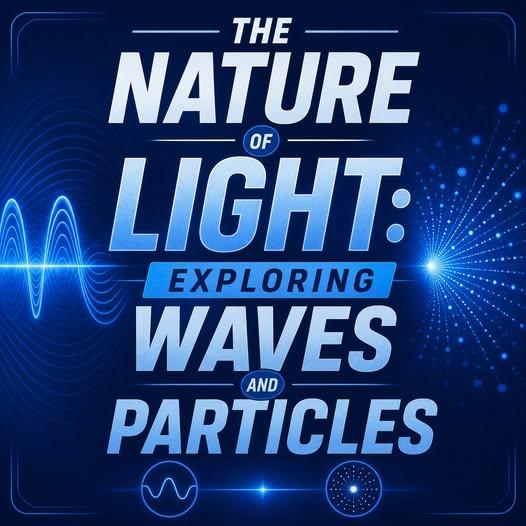
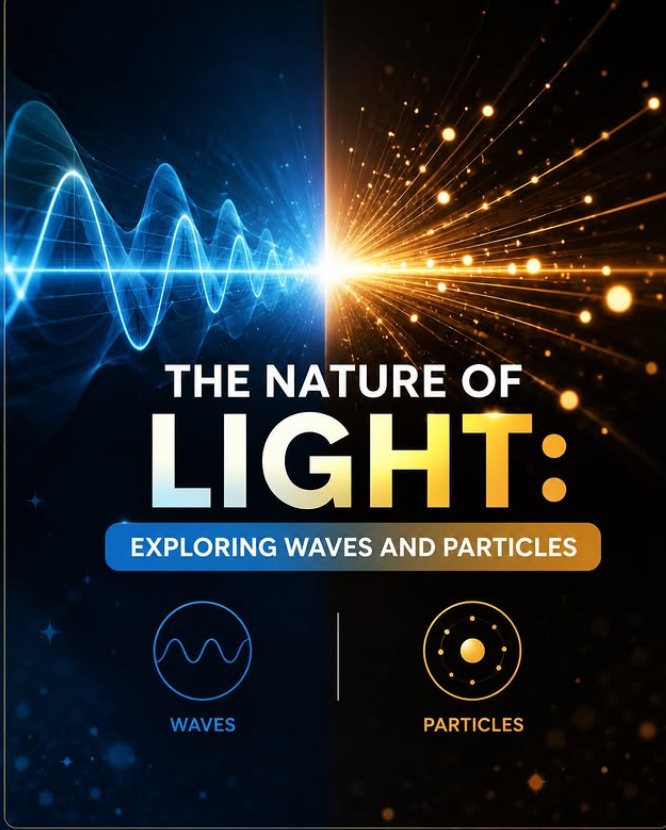
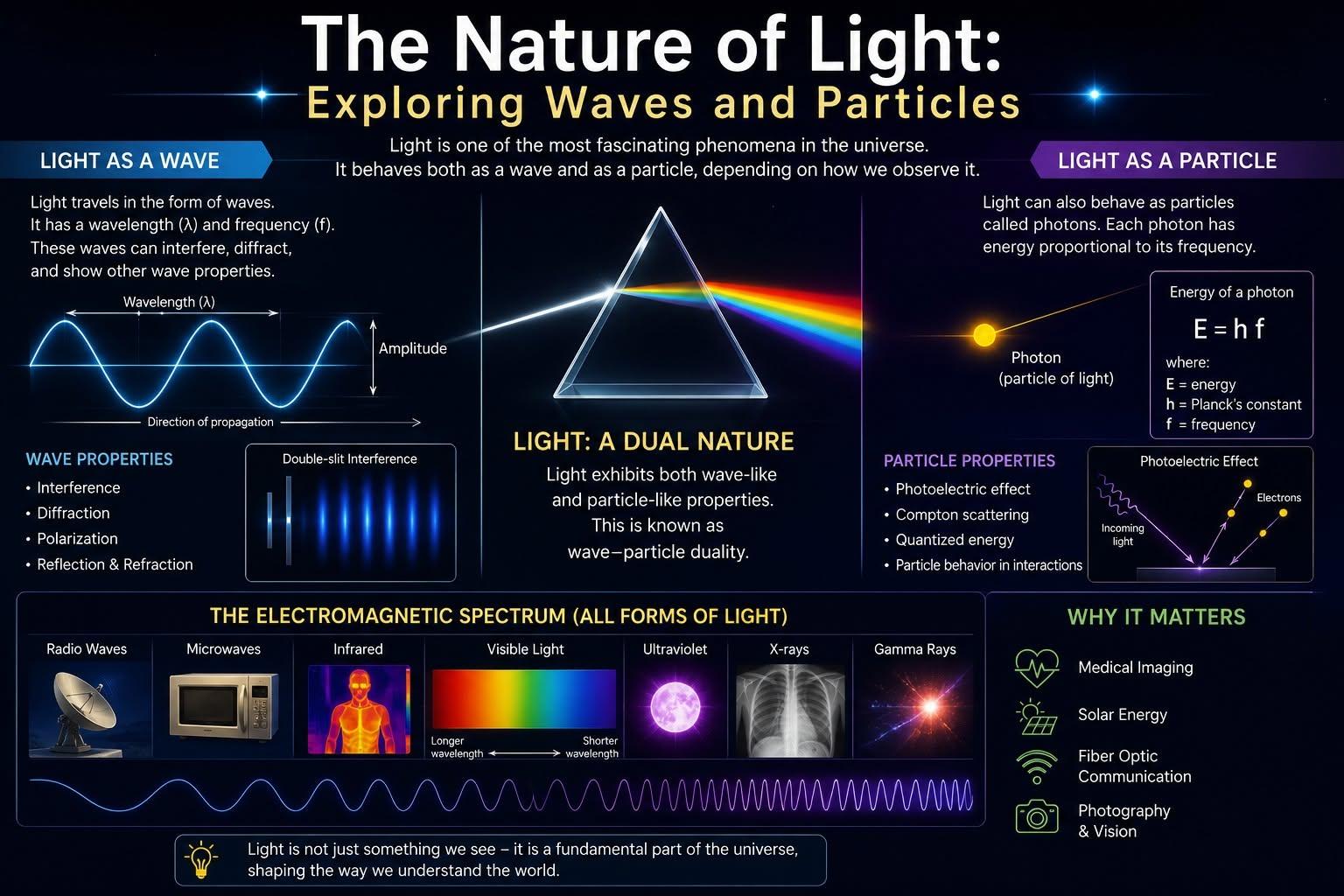
    **The Nature of Light: Exploring Waves and Particles**

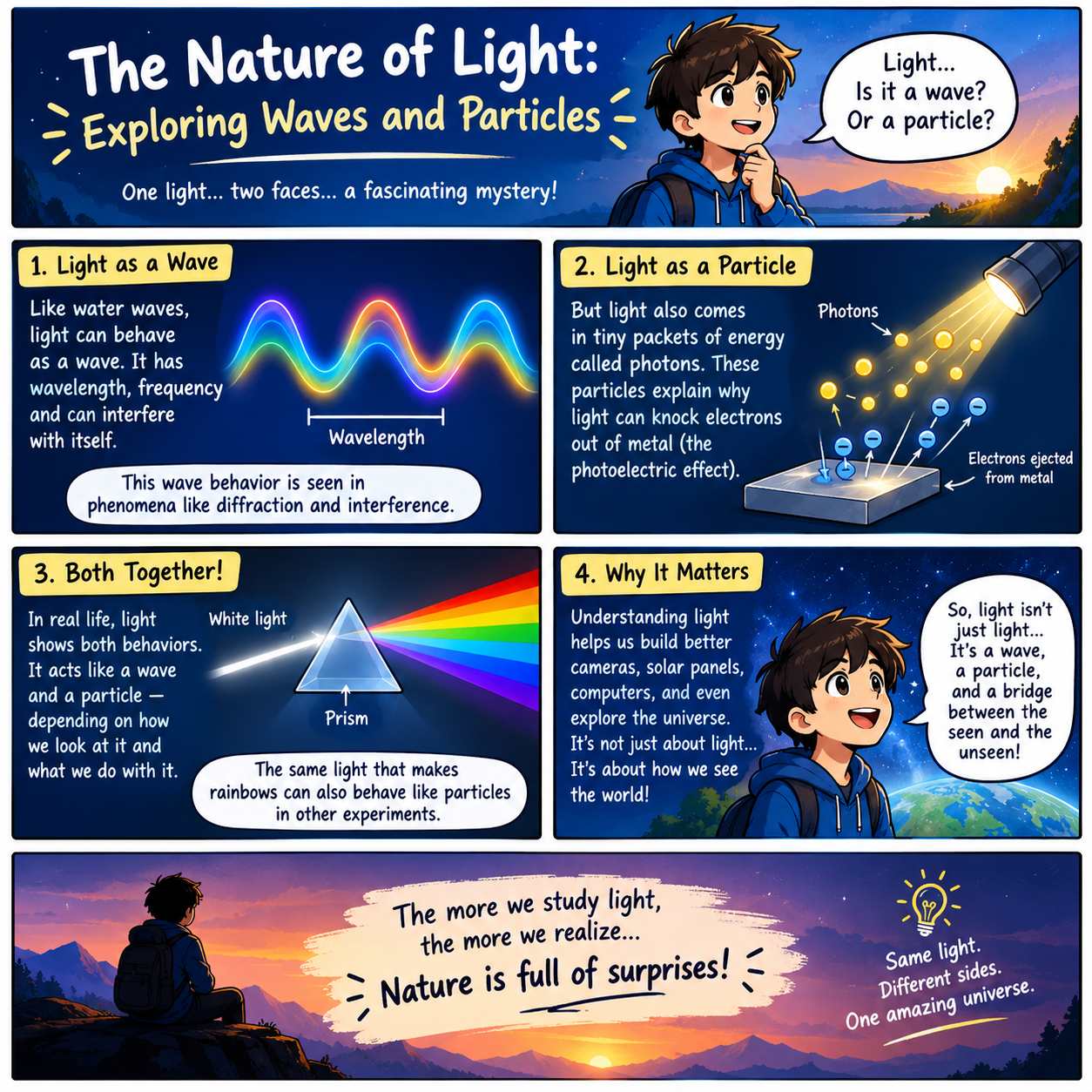
    What is light? Is it a wave, a particle, or both? Explore the fascinating world of light and discover how it can behave like a **wave** and like tiny packets of energy called **photons** . From colorful rainbows to lasers and the light from distant stars , light is everywhere around us!

    Join us on an exciting journey through physics and uncover the amazing science behind one of nature’s most mysterious phenomena.

    #NatureOfLight #Light #Physics #WavesAndParticles #Photon #Science #PhysicsFacts #STEM #ScienceLearning #Waves #Energy #Education #ExploreScience #AmazingScience
    #rsisb Roll no 248 Foundation level story post no 17 💡🌈 **The Nature of Light: Exploring Waves and Particles** 🔬✨ What is light? Is it a wave, a particle, or both? 🤔💫 Explore the fascinating world of light and discover how it can behave like a **wave** 🌊 and like tiny packets of energy called **photons** ⚛️. From colorful rainbows 🌈 to lasers 🔦 and the light from distant stars ⭐, light is everywhere around us! Join us on an exciting journey through physics and uncover the amazing science behind one of nature’s most mysterious phenomena. 🚀🔬📚 #NatureOfLight #Light #Physics #WavesAndParticles #Photon #Science #PhysicsFacts #STEM #ScienceLearning #Waves #Energy #Education #ExploreScience #AmazingScience 🌈💡🔬✨
    0 Commenti 0 condivisioni 226 Views
  • #rsisb
    Roll No.240
    Story No.15
    Foundation Level

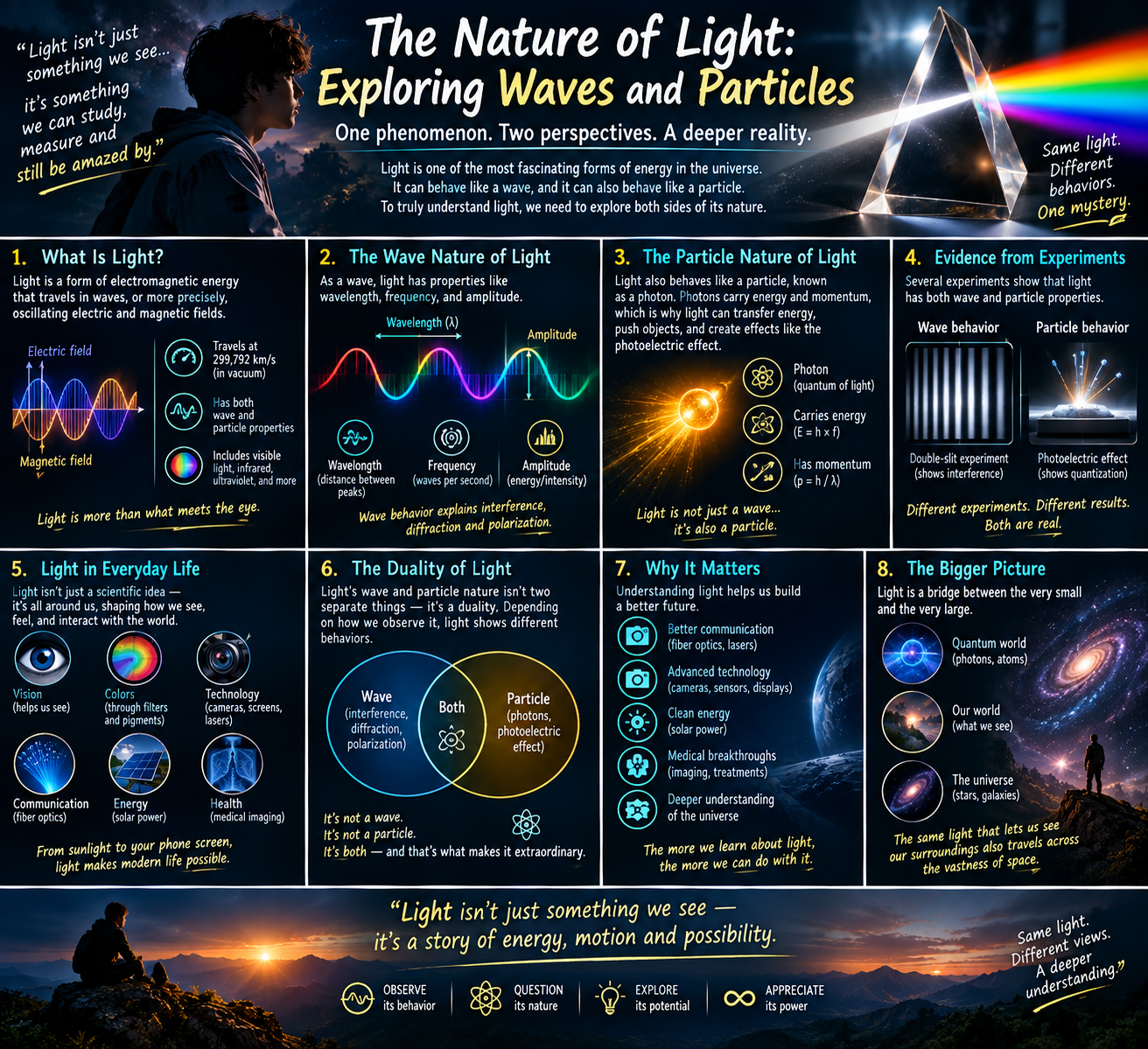
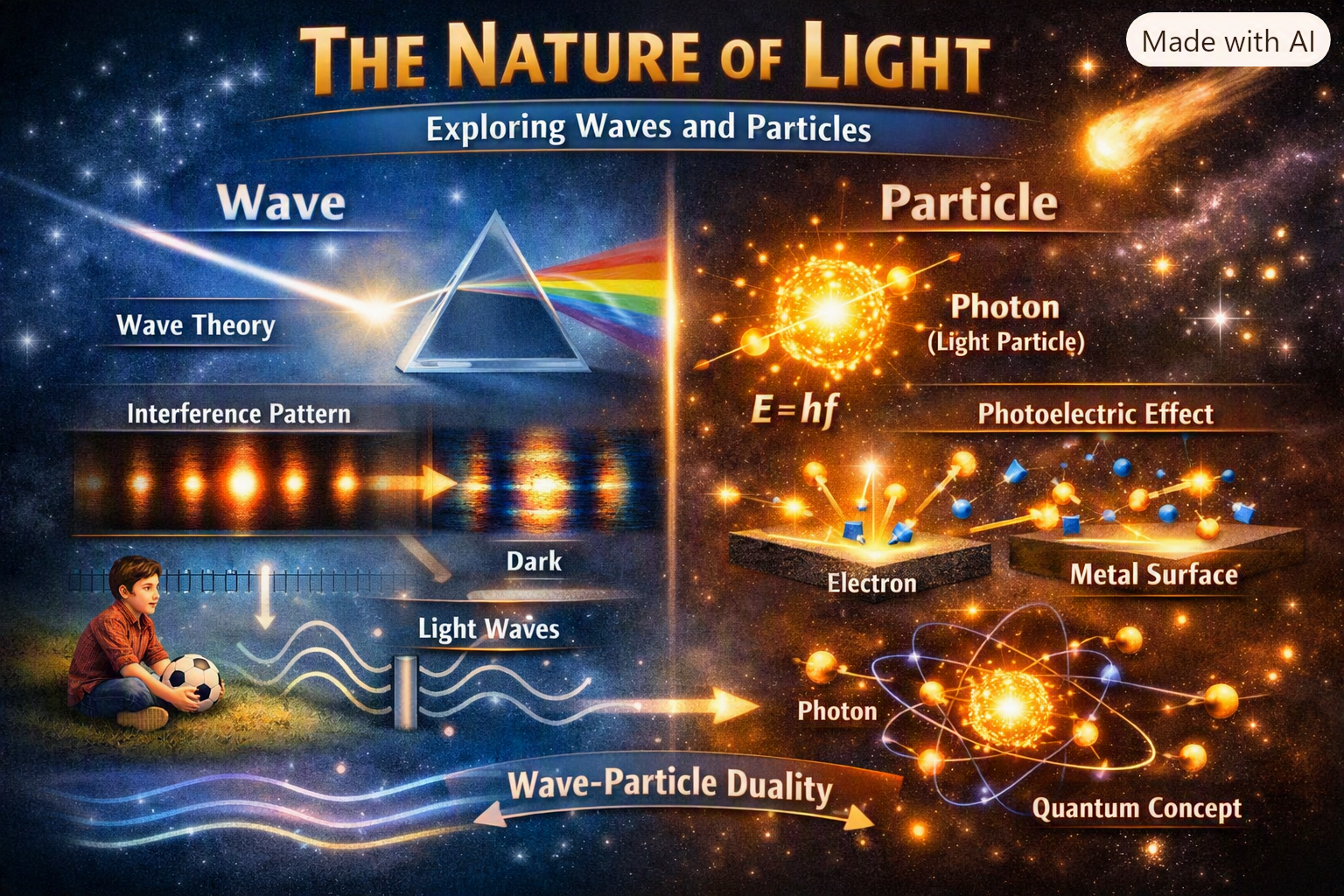
    ### **The Nature of Light: Exploring Waves and Particles**

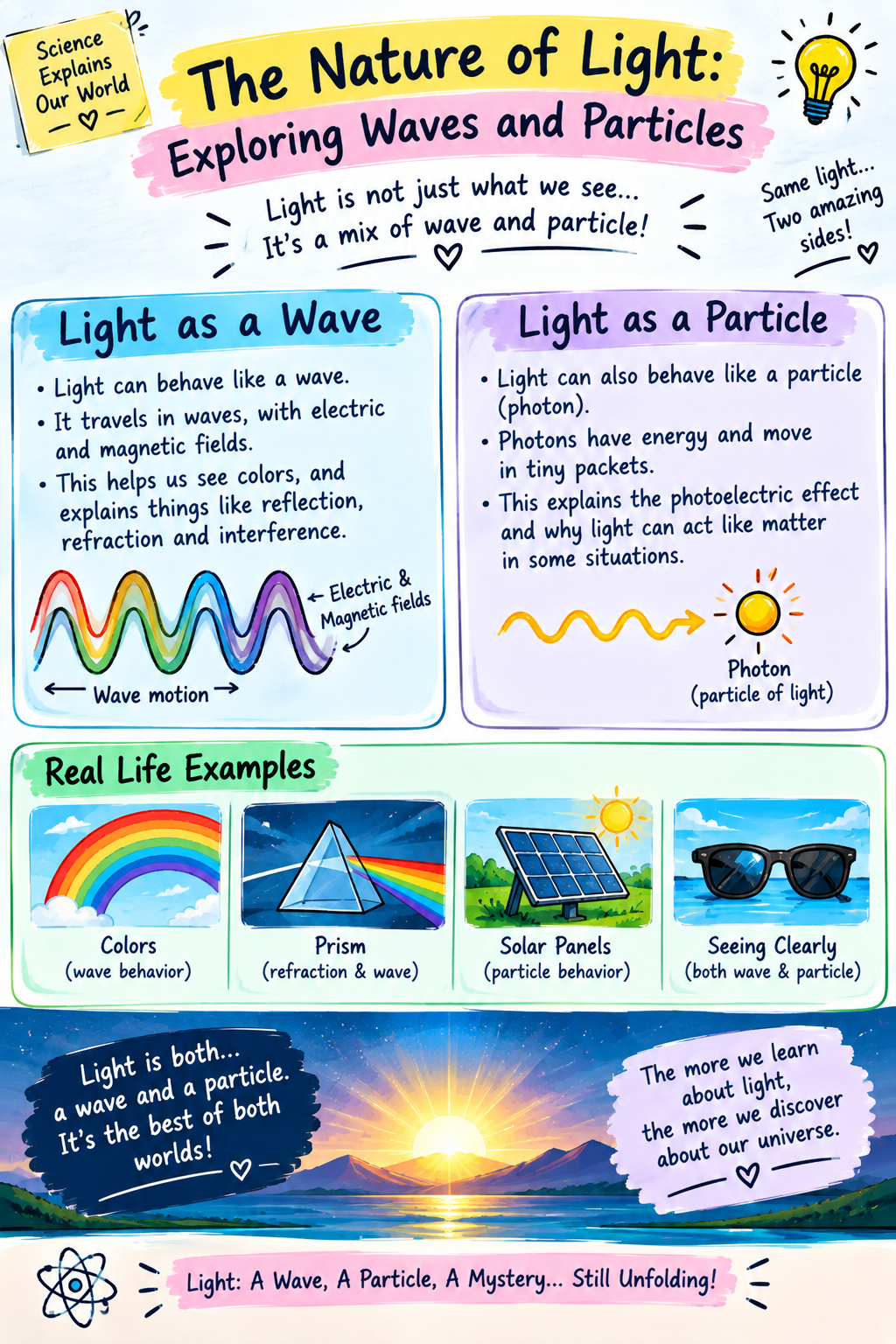
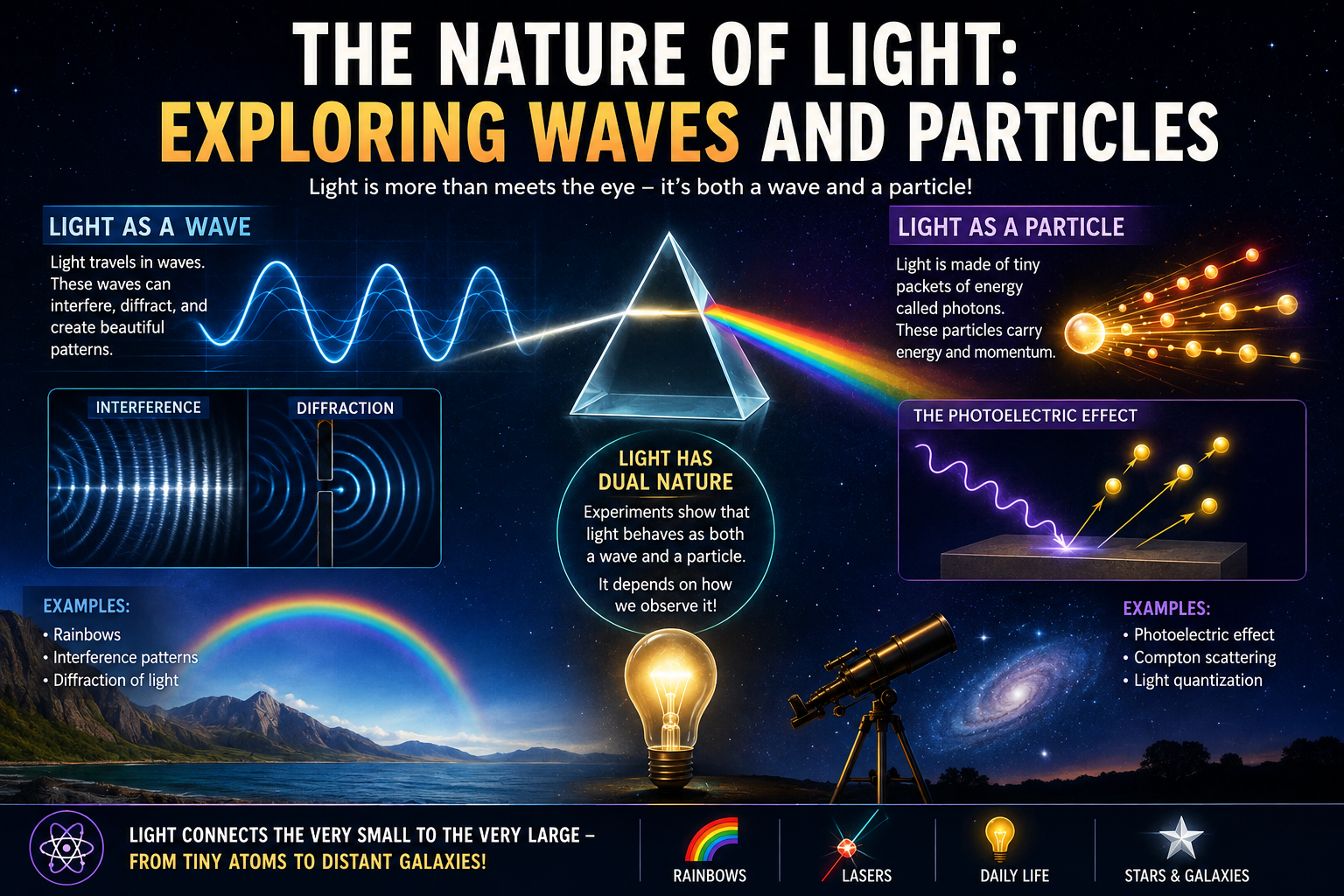
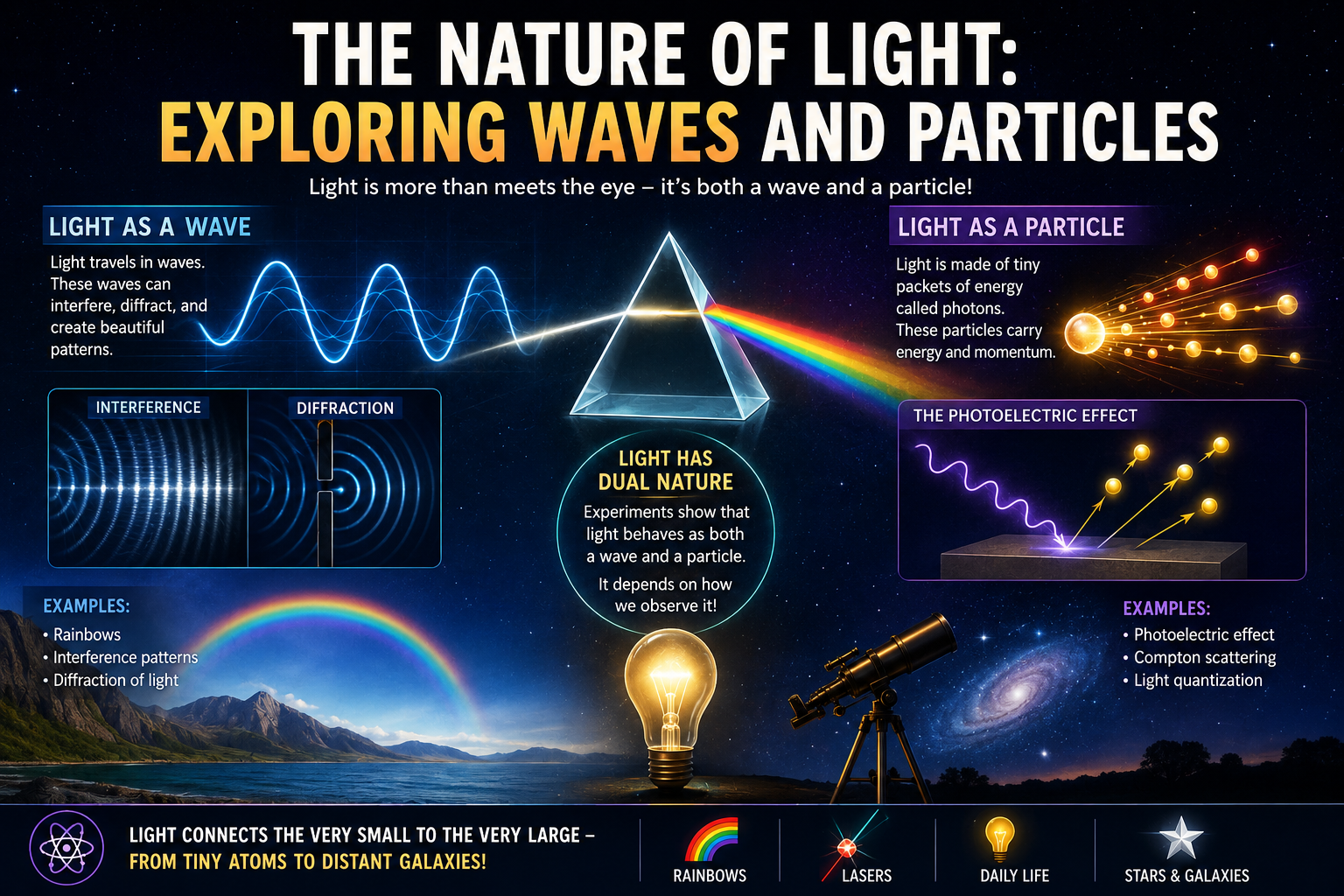
    Light is one of the most fascinating phenomena in the universe, playing a vital role in everything from vision and communication to modern technology and scientific discovery. Unlike ordinary objects, light exhibits a remarkable property known as **wave-particle duality**, meaning it behaves both as a wave and as a stream of tiny particles called **photons**. This unique characteristic has transformed our understanding of physics and the fundamental laws that govern the universe.

    As a wave, light travels through space in the form of electromagnetic waves, displaying properties such as reflection, refraction, interference, diffraction, and polarization. These wave behaviors explain everyday phenomena like rainbows, mirrors, lenses, and the colors we observe in nature. As particles, photons carry discrete amounts of energy, allowing light to interact with matter in ways that explain the photoelectric effect, lasers, and many modern technologies. Together, these two perspectives provide a complete understanding of how light behaves under different conditions.

    Exploring the nature of light helps us appreciate the incredible discoveries made by scientists such as Isaac Newton, Thomas Young, James Clerk Maxwell, Albert Einstein, and Max Planck. Their groundbreaking work laid the foundation for quantum mechanics, optics, telecommunications, medical imaging, fiber-optic communication, astronomy, and renewable energy technologies. From illuminating our homes to enabling space exploration, light continues to shape the modern world in extraordinary ways.

    **#NatureOfLight #Physics #Science #WaveParticleDuality #Light #Photons #ElectromagneticWaves #QuantumPhysics #Optics #STEM #Education #ScientificDiscovery #Technology #Learning #ExploreScience **

    Rehan School Islamabad Campus
    Asma Shaheen EducationWali
    Irum Asim
    Saima Happinesswali
    #rsisb Roll No.240 Story No.15 Foundation Level ### **The Nature of Light: Exploring Waves and Particles** Light is one of the most fascinating phenomena in the universe, playing a vital role in everything from vision and communication to modern technology and scientific discovery. Unlike ordinary objects, light exhibits a remarkable property known as **wave-particle duality**, meaning it behaves both as a wave and as a stream of tiny particles called **photons**. This unique characteristic has transformed our understanding of physics and the fundamental laws that govern the universe. As a wave, light travels through space in the form of electromagnetic waves, displaying properties such as reflection, refraction, interference, diffraction, and polarization. These wave behaviors explain everyday phenomena like rainbows, mirrors, lenses, and the colors we observe in nature. As particles, photons carry discrete amounts of energy, allowing light to interact with matter in ways that explain the photoelectric effect, lasers, and many modern technologies. Together, these two perspectives provide a complete understanding of how light behaves under different conditions. Exploring the nature of light helps us appreciate the incredible discoveries made by scientists such as Isaac Newton, Thomas Young, James Clerk Maxwell, Albert Einstein, and Max Planck. Their groundbreaking work laid the foundation for quantum mechanics, optics, telecommunications, medical imaging, fiber-optic communication, astronomy, and renewable energy technologies. From illuminating our homes to enabling space exploration, light continues to shape the modern world in extraordinary ways. **#NatureOfLight #Physics #Science #WaveParticleDuality #Light #Photons #ElectromagneticWaves #QuantumPhysics #Optics #STEM #Education #ScientificDiscovery #Technology #Learning #ExploreScience 🌈💡🔬⚛️📚** Rehan School Islamabad Campus Asma Shaheen EducationWali Irum Asim Saima Happinesswali
    0 Commenti 0 condivisioni 3194 Views
  • Teleportation, as seen in science fiction, where a person or object instantly moves from one place to another, is not real in the physical sense. However, in the field of quantum mechanics, a form of teleportation called quantum teleportation has been successfully demonstrated in experiments.

    Quantum Teleportation:

    Quantum teleportation does not transfer matter itself but instead transfers quantum information from one particle to another, even if they are far apart. This process relies on a phenomenon called quantum entanglement, where two particles remain connected in such a way that changing the state of one instantly affects the other, regardless of distance.

    Successful Experiments:

    Scientists have successfully teleported quantum states of particles such as photons (light particles), atoms, and electrons over distances ranging from a few meters to hundreds of kilometers. For example:
    • In 1997, scientists at the University of Innsbruck, Austria, successfully teleported a quantum state of a photon.
    • In 2015, researchers teleported quantum information between atoms over a meter in a laboratory.
    • In 2017, China’s Micius satellite teleported photons from Earth to space over 1,200 km, the longest distance recorded.

    Can We Teleport Humans?

    Currently, teleporting humans or large objects is impossible because:
    1. Human Complexity: A human body consists of trillions of atoms, and transferring all quantum states accurately would require enormous computing power.
    2. Destruction and Reconstruction: Theoretically, teleportation would require breaking down a person’s atomic structure at one location and reassembling it at another, which raises ethical and technical challenges.
    3. Heisenberg’s Uncertainty Principle: This principle states that measuring the exact state of a particle disturbs it, making perfect reconstruction difficult.

    Conclusion:

    While quantum teleportation is real and has been successfully tested, physical teleportation of people or objects, like in movies, is still science fiction. However, future advancements in quantum mechanics and computing might open new possibilities.
    Teleportation, as seen in science fiction, where a person or object instantly moves from one place to another, is not real in the physical sense. However, in the field of quantum mechanics, a form of teleportation called quantum teleportation has been successfully demonstrated in experiments. Quantum Teleportation: Quantum teleportation does not transfer matter itself but instead transfers quantum information from one particle to another, even if they are far apart. This process relies on a phenomenon called quantum entanglement, where two particles remain connected in such a way that changing the state of one instantly affects the other, regardless of distance. Successful Experiments: Scientists have successfully teleported quantum states of particles such as photons (light particles), atoms, and electrons over distances ranging from a few meters to hundreds of kilometers. For example: • In 1997, scientists at the University of Innsbruck, Austria, successfully teleported a quantum state of a photon. • In 2015, researchers teleported quantum information between atoms over a meter in a laboratory. • In 2017, China’s Micius satellite teleported photons from Earth to space over 1,200 km, the longest distance recorded. Can We Teleport Humans? Currently, teleporting humans or large objects is impossible because: 1. Human Complexity: A human body consists of trillions of atoms, and transferring all quantum states accurately would require enormous computing power. 2. Destruction and Reconstruction: Theoretically, teleportation would require breaking down a person’s atomic structure at one location and reassembling it at another, which raises ethical and technical challenges. 3. Heisenberg’s Uncertainty Principle: This principle states that measuring the exact state of a particle disturbs it, making perfect reconstruction difficult. Conclusion: While quantum teleportation is real and has been successfully tested, physical teleportation of people or objects, like in movies, is still science fiction. However, future advancements in quantum mechanics and computing might open new possibilities.
    0 Commenti 0 condivisioni 1160 Views
  • What is Physics? A Journey from Curiosity to Science

    Physics is the science of nature. It studies the laws that govern matter, energy, space, and time. From the falling of an apple to the motion of galaxies, from the spark of electricity to the mysteries of black holes, physics explains how the universe works.

    But physics did not appear fully formed. It has a long history, beginning with human curiosity thousands of years ago.


    1. The Birth of Wonder (Ancient Civilizations)

    The story of physics begins with the first humans who looked at the sky and asked:
    • Why do the stars move?
    • Why does the sun rise and set?
    • Why do objects fall down instead of up?

    Ancient Egyptians studied the stars to predict the Nile floods. Babylonians recorded planetary motion. The Chinese studied magnetism. In India, thinkers like Kanada spoke of atoms (anu). These were not yet “physics,” but they planted the seeds of scientific thinking.


    2. Greek Beginnings (6th century BCE – 4th century BCE)

    The Greeks were the first to ask systematic questions about nature.
    • Thales believed everything came from water.
    • Democritus imagined the universe was made of tiny, indivisible particles called “atoms.”
    • Aristotle (4th century BCE) wrote about motion, elements, and the heavens. Although many of his ideas were wrong, they shaped science for centuries.

    Greek physics was more philosophy than experiment, but it gave us the habit of searching for universal laws.


    3. The Age of Islamic Science (8th – 14th century CE)

    When Europe entered the Dark Ages, the Islamic world became the center of science.
    • Alhazen (Ibn al-Haytham) pioneered the scientific method and explained how vision works using light.
    • Al-Biruni measured Earth’s radius with surprising accuracy.
    • Avicenna (Ibn Sina) studied motion and inertia, anticipating Newton.

    These scholars translated Greek works, criticized them, and laid the foundations for modern physics.


    4. The Scientific Revolution (16th – 17th century)

    This was the true birth of modern physics.
    • Copernicus placed the sun, not Earth, at the center of the universe.
    • Galileo Galilei used experiments to study falling bodies and the motion of planets, overthrowing Aristotle’s ideas.
    • Isaac Newton (1687) united heaven and earth under the same laws of motion and gravity, creating classical mechanics.

    For the first time, the universe was seen as a giant machine governed by mathematical laws.


    5. The Age of Energy and Light (18th – 19th century)

    The Industrial Revolution brought new questions.
    • Thermodynamics (heat and engines) explained steam power.
    • Electromagnetism (Faraday, Maxwell) united electricity, magnetism, and light into one theory.
    • Scientists discovered atoms were made of smaller particles.

    Physics was no longer about stars alone—it powered machines, factories, and cities.


    6. The 20th Century: Revolution Upon Revolution

    The 1900s brought the most radical changes:
    • Einstein’s Relativity (1905–1915) showed that time and space are not fixed but bend with motion and gravity.
    • Quantum Mechanics (Planck, Bohr, Heisenberg, Schrödinger) revealed the strange rules of the atomic world—where particles can exist in two places at once.
    • Nuclear Physics led to both energy (nuclear power) and destruction (atomic bombs).
    • Cosmology revealed that the universe is expanding from a Big Bang.

    Physics became the science not only of the very large (cosmos) but also of the very small (quarks, photons, neutrinos).


    7. The Present and the Future

    Today, physics continues to ask questions:
    • What is dark matter and dark energy (95% of the universe)?
    • How do we unify relativity and quantum mechanics into a “theory of everything”?
    • Can we control fusion energy like the sun?
    • Is the universe infinite or part of a multiverse?

    With AI tools like ChatGPT, physicists can now analyze mountains of data, generate new hypotheses, and even simulate universes, accelerating discovery beyond what was ever possible before.


    Conclusion

    Physics began as simple curiosity—watching the stars, asking why things fall, wondering about light. Over thousands of years, it has grown into a science that explains the structure of the universe and powers modern life.

    From Aristotle to Newton, from Einstein to today’s AI-powered research, the journey of physics shows one truth: every mystery of nature is an invitation to discover a new law.

    And perhaps the next great leap in physics—the Physics of Consciousness, the Physics of Abundance, or the Physics of AI-Human Symbiosis—will begin with us.
    What is Physics? A Journey from Curiosity to Science Physics is the science of nature. It studies the laws that govern matter, energy, space, and time. From the falling of an apple to the motion of galaxies, from the spark of electricity to the mysteries of black holes, physics explains how the universe works. But physics did not appear fully formed. It has a long history, beginning with human curiosity thousands of years ago. ⸻ 1. The Birth of Wonder (Ancient Civilizations) The story of physics begins with the first humans who looked at the sky and asked: • Why do the stars move? • Why does the sun rise and set? • Why do objects fall down instead of up? Ancient Egyptians studied the stars to predict the Nile floods. Babylonians recorded planetary motion. The Chinese studied magnetism. In India, thinkers like Kanada spoke of atoms (anu). These were not yet “physics,” but they planted the seeds of scientific thinking. ⸻ 2. Greek Beginnings (6th century BCE – 4th century BCE) The Greeks were the first to ask systematic questions about nature. • Thales believed everything came from water. • Democritus imagined the universe was made of tiny, indivisible particles called “atoms.” • Aristotle (4th century BCE) wrote about motion, elements, and the heavens. Although many of his ideas were wrong, they shaped science for centuries. Greek physics was more philosophy than experiment, but it gave us the habit of searching for universal laws. ⸻ 3. The Age of Islamic Science (8th – 14th century CE) When Europe entered the Dark Ages, the Islamic world became the center of science. • Alhazen (Ibn al-Haytham) pioneered the scientific method and explained how vision works using light. • Al-Biruni measured Earth’s radius with surprising accuracy. • Avicenna (Ibn Sina) studied motion and inertia, anticipating Newton. These scholars translated Greek works, criticized them, and laid the foundations for modern physics. ⸻ 4. The Scientific Revolution (16th – 17th century) This was the true birth of modern physics. • Copernicus placed the sun, not Earth, at the center of the universe. • Galileo Galilei used experiments to study falling bodies and the motion of planets, overthrowing Aristotle’s ideas. • Isaac Newton (1687) united heaven and earth under the same laws of motion and gravity, creating classical mechanics. For the first time, the universe was seen as a giant machine governed by mathematical laws. ⸻ 5. The Age of Energy and Light (18th – 19th century) The Industrial Revolution brought new questions. • Thermodynamics (heat and engines) explained steam power. • Electromagnetism (Faraday, Maxwell) united electricity, magnetism, and light into one theory. • Scientists discovered atoms were made of smaller particles. Physics was no longer about stars alone—it powered machines, factories, and cities. ⸻ 6. The 20th Century: Revolution Upon Revolution The 1900s brought the most radical changes: • Einstein’s Relativity (1905–1915) showed that time and space are not fixed but bend with motion and gravity. • Quantum Mechanics (Planck, Bohr, Heisenberg, Schrödinger) revealed the strange rules of the atomic world—where particles can exist in two places at once. • Nuclear Physics led to both energy (nuclear power) and destruction (atomic bombs). • Cosmology revealed that the universe is expanding from a Big Bang. Physics became the science not only of the very large (cosmos) but also of the very small (quarks, photons, neutrinos). ⸻ 7. The Present and the Future Today, physics continues to ask questions: • What is dark matter and dark energy (95% of the universe)? • How do we unify relativity and quantum mechanics into a “theory of everything”? • Can we control fusion energy like the sun? • Is the universe infinite or part of a multiverse? With AI tools like ChatGPT, physicists can now analyze mountains of data, generate new hypotheses, and even simulate universes, accelerating discovery beyond what was ever possible before. ⸻ Conclusion Physics began as simple curiosity—watching the stars, asking why things fall, wondering about light. Over thousands of years, it has grown into a science that explains the structure of the universe and powers modern life. From Aristotle to Newton, from Einstein to today’s AI-powered research, the journey of physics shows one truth: every mystery of nature is an invitation to discover a new law. And perhaps the next great leap in physics—the Physics of Consciousness, the Physics of Abundance, or the Physics of AI-Human Symbiosis—will begin with us.
    0 Commenti 0 condivisioni 1681 Views
  • I am Lecturer in Mehran UET and curently living in Eruope and studying in Italy. Doing Phd in Integrated Photonics. I have also carried one year of my Bachelor in Copenhagen, Denmark.

    I have visited several countries in Europe and have meet thousands of multicultural people aroud the globe and still meeting.

    Also I have spent two years in Eni Pakistan (Mutinational Italian Firm). So I already fulfilling the idea behind making 500 mutual friends.

    Can we be friends ?
    I am Lecturer in Mehran UET and curently living in Eruope and studying in Italy. Doing Phd in Integrated Photonics. I have also carried one year of my Bachelor in Copenhagen, Denmark. I have visited several countries in Europe and have meet thousands of multicultural people aroud the globe and still meeting. Also I have spent two years in Eni Pakistan (Mutinational Italian Firm). So I already fulfilling the idea behind making 500 mutual friends. Can we be friends ?
    0 Commenti 0 condivisioni 85 Views
  • This will change everything for humanity once working properly !

    Quantium Entanglement allows instant communication faster than the speed of light without any means of transportation in between ! Humans still don’t understand how it works but we know that it works !

    We can communicate between anywhere on earth or planets, instantly !

    How would you like to use it ?

    I strongly recommend you to watch series https://youtu.be/q4ONRJ1kTdA to understand this more !

    For the first time ever, a research team led by physicists at the University of Bristol has now demonstrated quantum teleportation of information between two micrometer-scale silicon chips.
    Instead of relying on the flow of electrons for data transfer (as occurs in a typical computer), information was passed between the two computer chips using a quantum effect known as entanglement. In entanglement, the state of one particle is inextricably tied to the state of the other. Measuring one particle, in turn, immediately reveals information about the other. In this way, entanglement has now proved an effective method teleporting, or transmitting, data between devices without a physical electronic connection. And while still relegated to a controlled lab environment, the research team ultimately achieved high-fidelity quantum teleportation of 91 percent.

    Why it’s important: While still a poorly understood phenomenon, quantum entanglement shows promising and highly consequential applications for the future of computing. As explained by Beijing University scientist and one of the study’s authors, Dr. Jianwei Wang, “In the future, a single silicon-chip integration of quantum photonic devices and classical electronic controls will open the door for fully chip-based CMOS-compatible quantum communication and information processing networks.” In effect, these early demonstrations of quantum entanglement’s utility will soon pave the way for a new generation of chips, processors, and networks, not to mention extraordinarily powerful computers.

    Via Tatiana Fedorova
    This will change everything for humanity once working properly ! Quantium Entanglement allows instant communication faster than the speed of light without any means of transportation in between ! Humans still don’t understand how it works but we know that it works ! We can communicate between anywhere on earth or planets, instantly ! How would you like to use it ? I strongly recommend you to watch series https://youtu.be/q4ONRJ1kTdA to understand this more ! For the first time ever, a research team led by physicists at the University of Bristol has now demonstrated quantum teleportation of information between two micrometer-scale silicon chips. Instead of relying on the flow of electrons for data transfer (as occurs in a typical computer), information was passed between the two computer chips using a quantum effect known as entanglement. In entanglement, the state of one particle is inextricably tied to the state of the other. Measuring one particle, in turn, immediately reveals information about the other. In this way, entanglement has now proved an effective method teleporting, or transmitting, data between devices without a physical electronic connection. And while still relegated to a controlled lab environment, the research team ultimately achieved high-fidelity quantum teleportation of 91 percent. Why it’s important: While still a poorly understood phenomenon, quantum entanglement shows promising and highly consequential applications for the future of computing. As explained by Beijing University scientist and one of the study’s authors, Dr. Jianwei Wang, “In the future, a single silicon-chip integration of quantum photonic devices and classical electronic controls will open the door for fully chip-based CMOS-compatible quantum communication and information processing networks.” In effect, these early demonstrations of quantum entanglement’s utility will soon pave the way for a new generation of chips, processors, and networks, not to mention extraordinarily powerful computers. Via Tatiana Fedorova
    0 Commenti 0 condivisioni 19 Views
  • Colors in nature come mainly from three sources: pigments, structural colors, and bioluminescence. Such is the case of blue and green colors, compared to reds and the rest because they can be structural colors.

    Colors in nature come mainly from three sources: pigments, structural colors, and bioluminescence. Such is the case of blue and green colors, compared to reds and the rest because they can be structural colors.

    Structural coloring is the result of microscopically fine structured surfaces that interfere with visible light, sometimes in combination with pigments. For example, peacock tail feathers are brown pigmented, but because of their microscopic structure, they also reflect blue, turquoise and green light. And they are often iridescent. Thus, structural coloring is a classic optical effect of interference and diffraction, rather than a quantum property of photon absorption and emission, which is responsible for color in pigments (as plants, which efficiently absorb red light and the green is reflected) and bioluminescence.

    Learn more about the biophysics of the natural world in the free Unified Science Course in the Resonance Academy at ResonanceScience.org

    Photo by Kelvin Hudson
    Colors in nature come mainly from three sources: pigments, structural colors, and bioluminescence. Such is the case of blue and green colors, compared to reds and the rest because they can be structural colors. Colors in nature come mainly from three sources: pigments, structural colors, and bioluminescence. Such is the case of blue and green colors, compared to reds and the rest because they can be structural colors. Structural coloring is the result of microscopically fine structured surfaces that interfere with visible light, sometimes in combination with pigments. For example, peacock tail feathers are brown pigmented, but because of their microscopic structure, they also reflect blue, turquoise and green light. And they are often iridescent. Thus, structural coloring is a classic optical effect of interference and diffraction, rather than a quantum property of photon absorption and emission, which is responsible for color in pigments (as plants, which efficiently absorb red light and the green is reflected) and bioluminescence. Learn more about the biophysics of the natural world in the free Unified Science Course in the Resonance Academy at ResonanceScience.org Photo by Kelvin Hudson
    0 Commenti 0 condivisioni 578 Views
  • Do you want to study in Germany on Scholarship?

    Meet Abdul Wasay who is studying there Medical Photonics and can guide you how you can also do the same.

    He wants to partner with people who he can start a business related to medical photonics equipment & medical processes in future. Do add and inbox him !

    https://youtu.be/lw5sk7bp0dQ this video explains more about what is medical photonics usage !

    #germany #GermanyScholarships #scholarships
    Do you want to study in Germany on Scholarship? Meet Abdul Wasay who is studying there Medical Photonics and can guide you how you can also do the same. He wants to partner with people who he can start a business related to medical 🏥 photonics equipment & medical processes in future. Do add and inbox him ! https://youtu.be/lw5sk7bp0dQ this video explains more about what is medical photonics usage ! #germany #GermanyScholarships #scholarships
    0 Commenti 0 condivisioni 20 Views
  • Scientists in China built a super-smart computer called Jiuzhang, which is very different from regular computers. It’s a quantum computer, which means it uses special science tricks like superposition (being in two places at once) and entanglement (particles being connected even far apart) to solve problems super quickly.

    Here’s how amazing it is: Jiuzhang solved a math problem in just 4 minutes that would take a normal supercomputer 2.6 billion years to figure out! That’s older than the dinosaurs!

    This computer is made of lasers, mirrors, and detectors that can count tiny particles of light called photons. Jiuzhang can count 76 photons at once, which is way better than regular computers that can only handle 5 photons. This special way of counting is called Gaussian boson sampling (a fancy name for the technique it uses).

    But how does a quantum computer like Jiuzhang work? Regular computers use tiny switches called “bits” to handle information. These bits can either be 0 or 1, like little light switches that are either off or on. Quantum computers use something much cooler called qubits (short for quantum bits). A qubit can be 0, 1, or even both at the same time! This happens because of a special science rule called superposition. Imagine flipping a coin, and instead of it landing heads or tails, it floats in between both at once.

    Quantum computers also use entanglement, which means qubits can “talk” to each other instantly, even if they’re far apart. This teamwork between qubits helps quantum computers test many possibilities at the same time, making them much faster at solving very hard problems.

    Why does this matter? Well, Jiuzhang’s abilities could help solve tricky problems in areas like chemistry, math, and even create a super-fast quantum internet. It’s not just a faster version of regular computers—it’s like a whole new way of thinking about how to solve problems!
    Scientists in China built a super-smart computer called Jiuzhang, which is very different from regular computers. It’s a quantum computer, which means it uses special science tricks like superposition (being in two places at once) and entanglement (particles being connected even far apart) to solve problems super quickly. Here’s how amazing it is: Jiuzhang solved a math problem in just 4 minutes that would take a normal supercomputer 2.6 billion years to figure out! That’s older than the dinosaurs! This computer is made of lasers, mirrors, and detectors that can count tiny particles of light called photons. Jiuzhang can count 76 photons at once, which is way better than regular computers that can only handle 5 photons. This special way of counting is called Gaussian boson sampling (a fancy name for the technique it uses). But how does a quantum computer like Jiuzhang work? Regular computers use tiny switches called “bits” to handle information. These bits can either be 0 or 1, like little light switches that are either off or on. Quantum computers use something much cooler called qubits (short for quantum bits). A qubit can be 0, 1, or even both at the same time! This happens because of a special science rule called superposition. Imagine flipping a coin, and instead of it landing heads or tails, it floats in between both at once. Quantum computers also use entanglement, which means qubits can “talk” to each other instantly, even if they’re far apart. This teamwork between qubits helps quantum computers test many possibilities at the same time, making them much faster at solving very hard problems. Why does this matter? Well, Jiuzhang’s abilities could help solve tricky problems in areas like chemistry, math, and even create a super-fast quantum internet. It’s not just a faster version of regular computers—it’s like a whole new way of thinking about how to solve problems!
    0 Commenti 0 condivisioni 713 Views
  • ACCL Day 160

    The Story of Lumi—the Light Explorer

    Lumi was a tiny traveler made of pure light. He moved faster than anything in existence—no one could catch him. When Lumi wanted to stretch and spread out, he became a wave, flowing smoothly like ripples on a calm ocean. He could bend, reflect, refract, and even create beautiful rainbows.

    But when Lumi needed to deliver energy, he transformed into a particle called a photon—small, fast, and precise like a tiny messenger.

    One day, Lumi traveled to Earth to explore a lab where scientists performed the famous double-slit experiment. Lumi giggled as he created wave patterns on the screen—but when scientists watched him closely, he instantly turned into particles.

    "Its my magic!" Lumi laughed.

    "You can be a wave AND a particle?" a scientist asked.

    "Yes," Lumi said proudly. "I am both, depending on how you look at me. Thats the secret of light."

    Aniyal smiled as he imagined Lumi flying around the universe, switching between wave and particle like a superhero with two powers. Suddenly, the sunlight in his classroom felt more alive—more magical.

    Light wasnt just brightness.
    It was a mystery.
    A traveler.
    A dual-natured wonder that shaped everything in the universe.

    And from that day on, whenever Aniyal saw light—whether from the sun, a lamp, or his phone—he remembered Lumi, the explorer of waves and particles.

    The world felt brighter.
    ACCL Day 160 ✨ The Story of Lumi—the Light Explorer ✨ Lumi was a tiny traveler made of pure light. He moved faster than anything in existence—no one could catch him. When Lumi wanted to stretch and spread out, he became a wave, flowing smoothly like ripples on a calm ocean. He could bend, reflect, refract, and even create beautiful rainbows. But when Lumi needed to deliver energy, he transformed into a particle called a photon—small, fast, and precise like a tiny messenger. One day, Lumi traveled to Earth to explore a lab where scientists performed the famous double-slit experiment. Lumi giggled as he created wave patterns on the screen—but when scientists watched him closely, he instantly turned into particles. "It's my magic!" Lumi laughed. "You can be a wave AND a particle?" a scientist asked. "Yes," Lumi said proudly. "I am both, depending on how you look at me. That's the secret of light." Aniyal smiled as he imagined Lumi flying around the universe, switching between wave and particle like a superhero with two powers. Suddenly, the sunlight in his classroom felt more alive—more magical. Light wasn't just brightness. It was a mystery. A traveler. A dual-natured wonder that shaped everything in the universe. And from that day on, whenever Aniyal saw light—whether from the sun, a lamp, or his phone—he remembered Lumi, the explorer of waves and particles. The world felt brighter. ✨
    0 Commenti 0 condivisioni 256 Views
Pagine in Evidenza