• #rsisb
    Roll no.231
    song no.14
    Foundation Level


    ## Light Chasers: Exploring Colors and Refraction

    **“Light Chasers: Exploring Colors and Refraction”** is an exciting science topic that explores how light travels, bends, and creates the beautiful colors we see around us. When light passes from one material into another, such as from air into water or glass, it can **change direction**. This bending of light is called **refraction**.

    The topic also helps us understand how **white light can be separated into different colors**, creating a rainbow. From colorful rainbows to lenses in cameras and eyeglasses, refraction plays an important role in everyday life.

    **My Takeaway:** Light may seem simple, but its journey through different materials can create amazing effects and help us understand the world around us.

    #LightChasers #Refraction #Colors #Light #Rainbow #Science #Physics #Learning #Exploration #Education


    Asma Shaheen EducationWali
    Saima Empowerment Wali
    Irum Asim Leadershipwali
    #rsisb Roll no.231 song no.14 Foundation Level ## 🌈 Light Chasers: Exploring Colors and Refraction **“Light Chasers: Exploring Colors and Refraction”** is an exciting science topic that explores how light travels, bends, and creates the beautiful colors we see around us. When light passes from one material into another, such as from air into water or glass, it can **change direction**. This bending of light is called **refraction**. The topic also helps us understand how **white light can be separated into different colors**, creating a rainbow. 🌈🔬 From colorful rainbows to lenses in cameras and eyeglasses, refraction plays an important role in everyday life. ✨ **My Takeaway:** Light may seem simple, but its journey through different materials can create amazing effects and help us understand the world around us. #LightChasers #Refraction #Colors #Light #Rainbow #Science #Physics #Learning #Exploration #Education 🌈💡🔬📚 Asma Shaheen EducationWali Saima Empowerment Wali Irum Asim Leadershipwali
    0 Commentarii 0 Distribuiri 290 Views 3
  • #rsisb
    Roll No 253
    Foundation Level
    Story Post 24

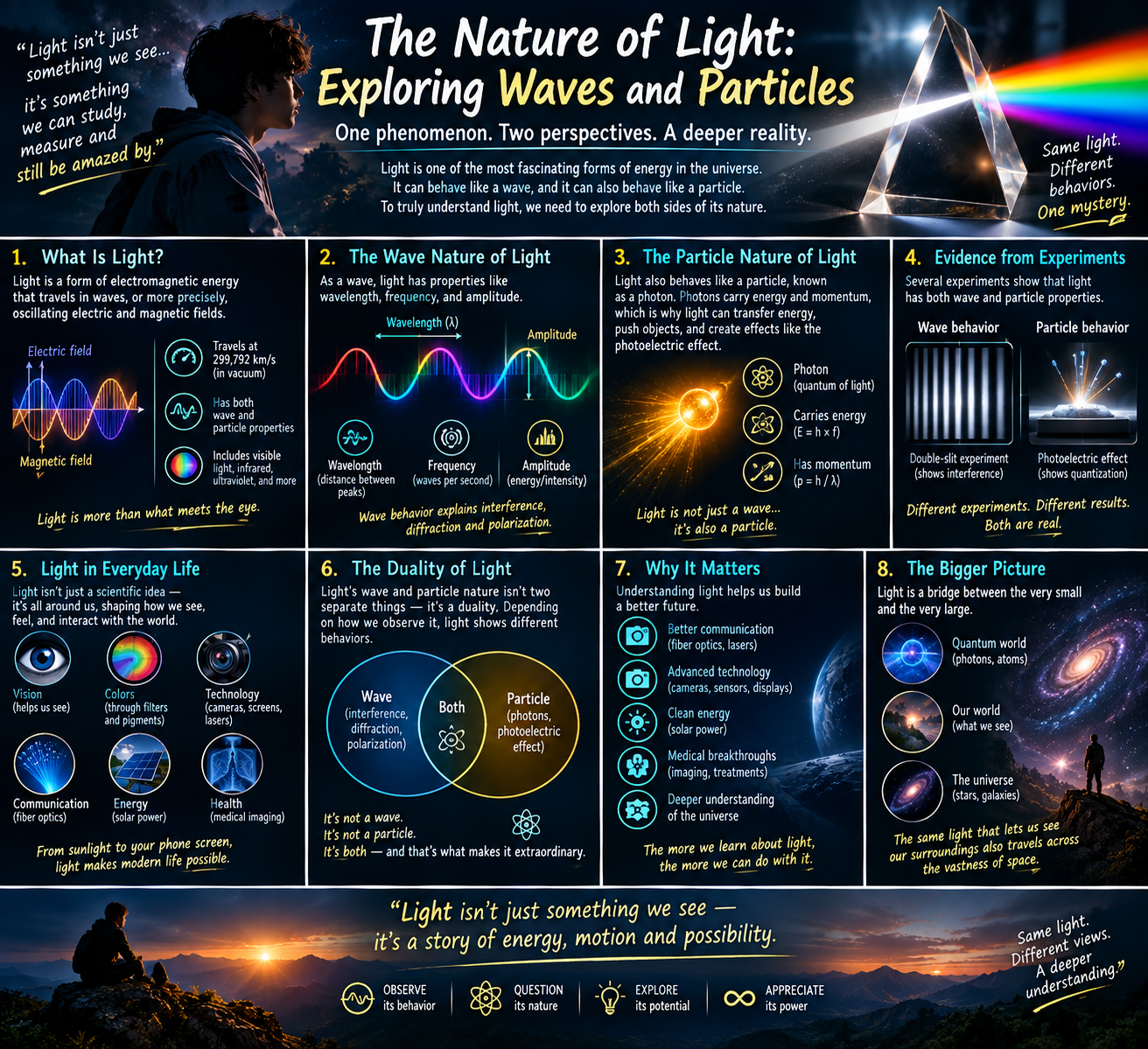
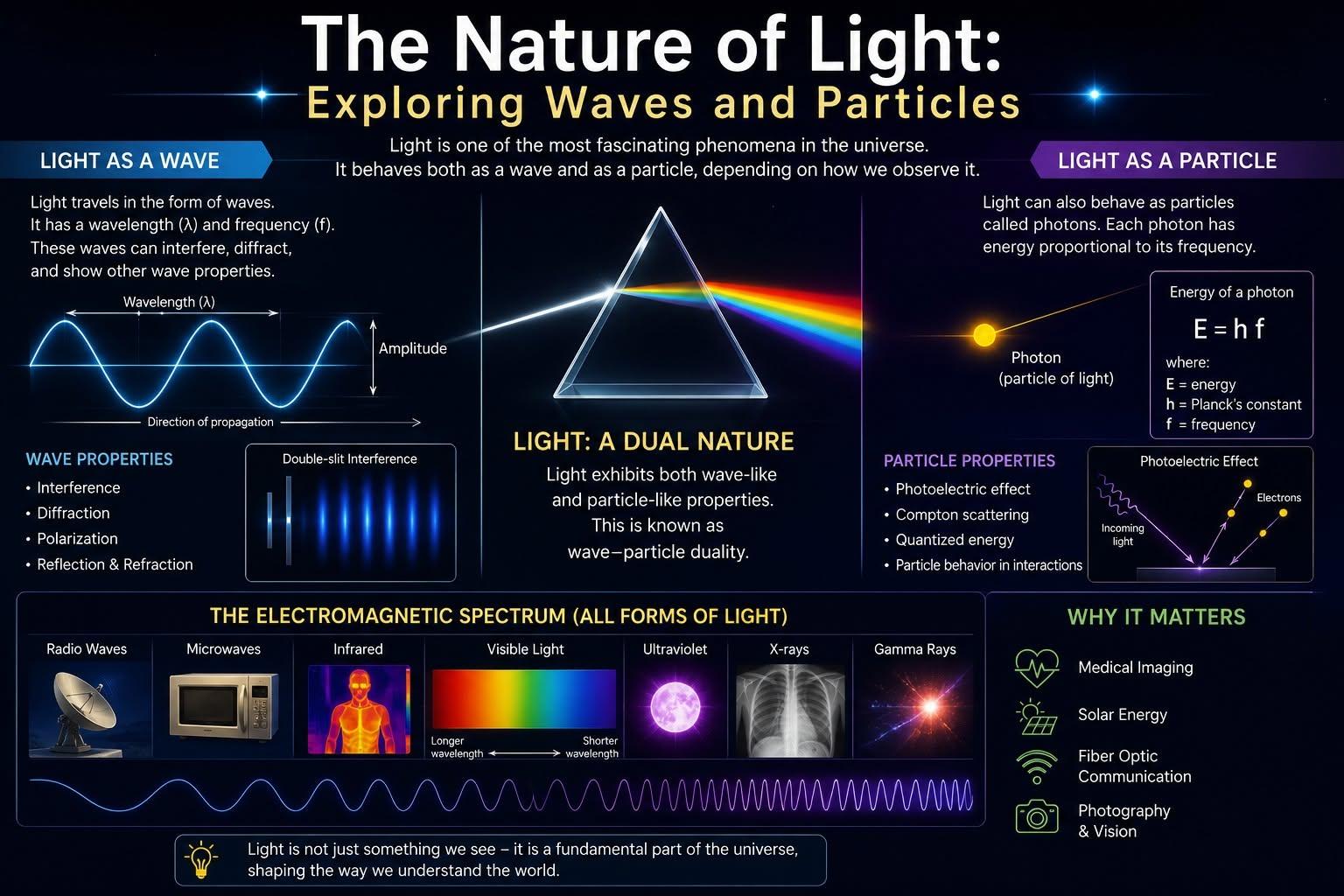
    # The Nature of Light: Exploring Waves and Particles

    Imagine standing beneath a night sky filled with stars.

    Every photon reaching your eyes has traveled across space carrying information from distant worlds. Light allows us to see, measure, communicate, explore, and understand the universe itself.

    But light is far stranger than it first appears.

    Sometimes it behaves like a **wave** .

    Sometimes it behaves like a **particle** .

    And understanding this strange dual nature changed our picture of reality forever.

    ---

    # 1. What Is Light?

    Light is a form of **electromagnetic radiation**—energy carried through oscillating electric and magnetic fields.

    In empty space, electromagnetic waves travel at approximately:

    ### **299,792 kilometers per second**

    That's the speed of light in vacuum.

    Visible light is only a small part of the electromagnetic spectrum.

    Beyond what our eyes can see are:

    Radio waves
    Microwaves
    Infrared
    Visible light
    Ultraviolet
    🩻 X-rays
    Gamma rays

    So light isn't simply what we see.

    ### **It's an enormous family of electromagnetic phenomena.**

    ---

    # 2. The Wave Nature of Light

    When light behaves as a wave, we can describe it using several important properties:

    **Wavelength** — the distance between successive wave peaks
    **Frequency** — how many oscillations occur each second
    **Amplitude** — related to the wave's intensity

    These properties help explain many familiar phenomena.

    **Interference** occurs when waves combine.
    **Diffraction** occurs when waves spread around openings or obstacles.
    **Polarization** describes the orientation of electromagnetic oscillations.

    The wave model explains behaviors that are difficult to understand if we imagine light only as tiny particles.

    ---

    # 3. The Particle Nature of Light

    But the story doesn't end there.

    Light can also behave as if it arrives in discrete packets of energy called **photons**.

    A photon is a quantum of electromagnetic radiation.

    Its energy is related to frequency:

    ### **E = h × f**

    And its momentum is related to its wavelength:

    ### **p = h / λ**

    This particle-like behavior helps explain phenomena such as the **photoelectric effect**, where light can transfer energy to electrons.

    So light isn't simply a smooth continuous wave.

    At the quantum level, energy can be exchanged in discrete amounts.

    ### **Light has another side—and it's quantum.**

    ---

    # 4. Evidence From Experiments

    The strange nature of light isn't merely philosophical.

    Experiments demonstrate it.

    ### Double-Slit Experiment

    When light passes through two narrow openings, an **interference pattern** can appear—strong evidence of wave-like behavior.

    ### Photoelectric Effect

    When light strikes certain materials, it can eject electrons. This behavior is explained using photons and quantized energy.

    Different experiments reveal different aspects of light.

    And that's one of the most fascinating things about physics:

    ### **The same phenomenon can reveal different behaviors depending on how we investigate it.**

    ---

    # 5. Light in Everyday Life

    Light isn't something that exists only inside physics laboratories.

    It's everywhere.

    **Vision** — allows us to see the world
    **Colors** — arise from how different wavelengths interact with matter
    **Cameras** — convert light into images
    **Screens** — produce controlled patterns of light
    **Fiber optics** — carry information using light
    **Solar panels** — convert light energy into electrical energy
    🩻 **Medical imaging** — uses electromagnetic radiation to see inside the body

    From sunrise to smartphone screens…

    ### **Modern civilization depends heavily on our ability to control light.**

    ---

    # 6. The Duality of Light

    Here lies the great mystery.

    Light can display **wave-like behavior**

    and

    **particle-like behavior** .

    This is known as **wave-particle duality**.

    It's important to understand that this doesn't mean light is literally switching between being a classical wave and a classical particle like two separate objects.

    Instead, quantum physics gives us a deeper framework in which classical wave and particle descriptions each capture different aspects of light's behavior.

    ### **Two perspectives. One quantum reality.**

    ---

    # 7. Why Understanding Light Matters

    Learning how light behaves has transformed technology.

    **Communication** — fiber-optic networks
    **Science** — spectroscopy and microscopy
    **Imaging** — cameras and sensors
    **Energy** — solar technology
    **Medicine** — lasers and diagnostic imaging
    **Astronomy** — studying distant stars and galaxies

    When astronomers observe light from a distant star, they aren't simply seeing brightness.

    They can analyze the light's wavelengths and learn about the star's:

    Temperature
    Chemical composition
    Motion
    Environment

    ### **Light carries information across space.**

    ---

    # 8. The Bigger Picture

    Light connects the microscopic and the cosmic.

    At the quantum scale, photons interact with atoms and electrons.

    At human scales, light allows us to see and communicate.

    Across astronomical distances, light travels from stars and galaxies to our telescopes.

    In many ways, light is our messenger from the universe.

    When we look at a distant galaxy, we are receiving photons that may have traveled for millions or billions of years before reaching Earth.

    ### **Looking at the universe means looking at ancient light.**

    ---

    # The Final Thought

    Light is more than something that illuminates a room.

    It is energy.
    It is information.
    It is electromagnetic radiation.
    It has quantum behavior.
    And it is one of the most important tools we have for exploring reality.

    From a photon interacting with an electron…

    to sunlight crossing space…

    to the glow of a distant galaxy…

    ### **Light connects the smallest scales of nature with the largest.**

    So the next time you see sunlight streaming through a window , a rainbow , or stars shining overhead , remember:

    **You aren't simply seeing light.**

    You're witnessing one of the universe's most fascinating mysteries—a phenomenon that behaves in ways far stranger and more beautiful than our everyday experience suggests.

    # **Light isn't just something we see—it's a story of energy, motion, information, and possibility.** ∞


    Asma Shaheen EducationWali
    Saima Empowerment Wali
    Mishaal TrainingWali
    #rsisb Roll No 253 Foundation Level Story Post 24 # 🌈⚡ The Nature of Light: Exploring Waves and Particles Imagine standing beneath a night sky filled with stars. 🌌✨ Every photon reaching your eyes has traveled across space carrying information from distant worlds. Light allows us to see, measure, communicate, explore, and understand the universe itself. 🔭👁️📡 But light is far stranger than it first appears. Sometimes it behaves like a **wave** 🌊. Sometimes it behaves like a **particle** ⚛️. And understanding this strange dual nature changed our picture of reality forever. 🧠🌌 --- # 💡🌌 1. What Is Light? Light is a form of **electromagnetic radiation**—energy carried through oscillating electric and magnetic fields. ⚡🧲 In empty space, electromagnetic waves travel at approximately: ### 🚀 **299,792 kilometers per second** That's the speed of light in vacuum. Visible light 👁️🌈 is only a small part of the electromagnetic spectrum. Beyond what our eyes can see are: 📻 Radio waves 📡 Microwaves 🔥 Infrared 🌈 Visible light ☀️ Ultraviolet 🩻 X-rays ☢️ Gamma rays So light isn't simply what we see. ### **It's an enormous family of electromagnetic phenomena.** 🌌⚡ --- # 🌊🔬 2. The Wave Nature of Light When light behaves as a wave, we can describe it using several important properties: 〰️ **Wavelength** — the distance between successive wave peaks ⚡ **Frequency** — how many oscillations occur each second 📈 **Amplitude** — related to the wave's intensity These properties help explain many familiar phenomena. 🌈 **Interference** occurs when waves combine. 🔍 **Diffraction** occurs when waves spread around openings or obstacles. 🕶️ **Polarization** describes the orientation of electromagnetic oscillations. The wave model explains behaviors that are difficult to understand if we imagine light only as tiny particles. --- # ⚛️✨ 3. The Particle Nature of Light But the story doesn't end there. Light can also behave as if it arrives in discrete packets of energy called **photons**. ⚛️💡 A photon is a quantum of electromagnetic radiation. Its energy is related to frequency: ### **E = h × f** ⚡ And its momentum is related to its wavelength: ### **p = h / λ** 🌊⚛️ This particle-like behavior helps explain phenomena such as the **photoelectric effect**, where light can transfer energy to electrons. So light isn't simply a smooth continuous wave. At the quantum level, energy can be exchanged in discrete amounts. ### **Light has another side—and it's quantum.** 🌌⚛️ --- # 🧪🔍 4. Evidence From Experiments The strange nature of light isn't merely philosophical. Experiments demonstrate it. ### 🌊 Double-Slit Experiment When light passes through two narrow openings, an **interference pattern** can appear—strong evidence of wave-like behavior. 🌊〰️ ### ⚡ Photoelectric Effect When light strikes certain materials, it can eject electrons. This behavior is explained using photons and quantized energy. ⚛️🔋 Different experiments reveal different aspects of light. And that's one of the most fascinating things about physics: ### **The same phenomenon can reveal different behaviors depending on how we investigate it.** 🔬✨ --- # 👁️🌈 5. Light in Everyday Life Light isn't something that exists only inside physics laboratories. It's everywhere. 🌍☀️ 👁️ **Vision** — allows us to see the world 🌈 **Colors** — arise from how different wavelengths interact with matter 📷 **Cameras** — convert light into images 📱 **Screens** — produce controlled patterns of light 🌐 **Fiber optics** — carry information using light ☀️ **Solar panels** — convert light energy into electrical energy 🩻 **Medical imaging** — uses electromagnetic radiation to see inside the body From sunrise to smartphone screens… ### **Modern civilization depends heavily on our ability to control light.** 💡🌍 --- # 🌊⚛️ 6. The Duality of Light Here lies the great mystery. Light can display **wave-like behavior** 🌊 and **particle-like behavior** ⚛️. This is known as **wave-particle duality**. It's important to understand that this doesn't mean light is literally switching between being a classical wave and a classical particle like two separate objects. Instead, quantum physics gives us a deeper framework in which classical wave and particle descriptions each capture different aspects of light's behavior. ### **Two perspectives. One quantum reality.** 🌌✨ --- # 🚀🔬 7. Why Understanding Light Matters Learning how light behaves has transformed technology. 📡 **Communication** — fiber-optic networks 🔬 **Science** — spectroscopy and microscopy 📷 **Imaging** — cameras and sensors ☀️ **Energy** — solar technology 🩺 **Medicine** — lasers and diagnostic imaging 🚀 **Astronomy** — studying distant stars and galaxies When astronomers observe light from a distant star, they aren't simply seeing brightness. They can analyze the light's wavelengths and learn about the star's: 🌡️ Temperature 🧪 Chemical composition 💨 Motion 🌌 Environment ### **Light carries information across space.** --- # 🌌🔭 8. The Bigger Picture Light connects the microscopic and the cosmic. At the quantum scale, photons interact with atoms and electrons. ⚛️🔬 At human scales, light allows us to see and communicate. 👁️📱 Across astronomical distances, light travels from stars and galaxies to our telescopes. 🌟🔭 In many ways, light is our messenger from the universe. When we look at a distant galaxy, we are receiving photons that may have traveled for millions or billions of years before reaching Earth. 🌌⏳ ### **Looking at the universe means looking at ancient light.** ✨ --- # 🌅💡 The Final Thought Light is more than something that illuminates a room. It is energy. ⚡ It is information. 📡 It is electromagnetic radiation. 🌊 It has quantum behavior. ⚛️ And it is one of the most important tools we have for exploring reality. 🔭 From a photon interacting with an electron… to sunlight crossing space… to the glow of a distant galaxy… ### **Light connects the smallest scales of nature with the largest.** 🌌⚛️ So the next time you see sunlight streaming through a window ☀️, a rainbow 🌈, or stars shining overhead ⭐, remember: **You aren't simply seeing light.** You're witnessing one of the universe's most fascinating mysteries—a phenomenon that behaves in ways far stranger and more beautiful than our everyday experience suggests. 🌊⚛️✨ # 🌈🌌 **Light isn't just something we see—it's a story of energy, motion, information, and possibility.** ⚡🔬∞ Asma Shaheen EducationWali Saima Empowerment Wali Mishaal TrainingWali

    0 Commentarii 0 Distribuiri 1705 Views
  • **Foundation Level** **Day 166** **story post** **Roll Number: 005**

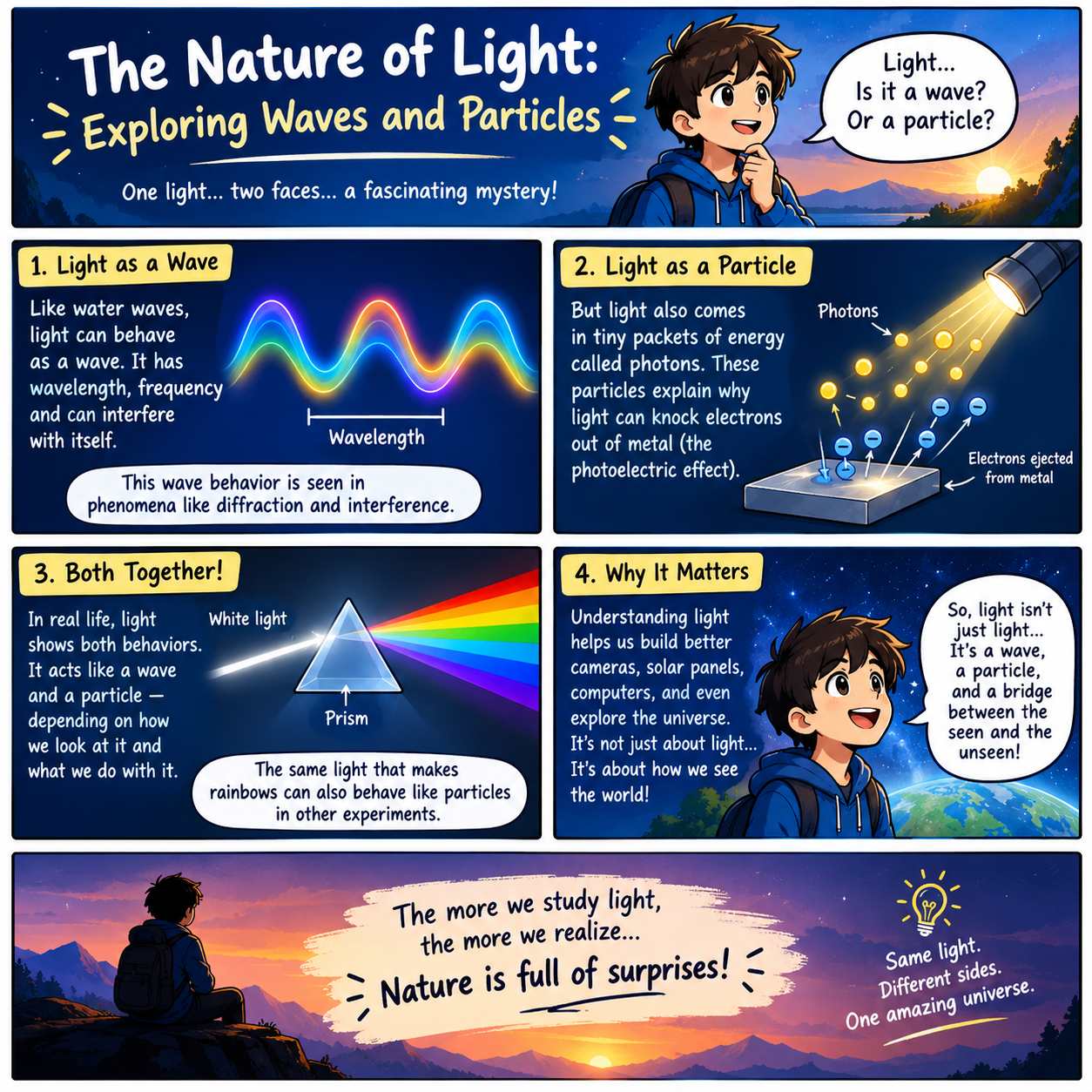
    The Nature of Light: Exploring Waves and Particles

    What exactly is light? Is it a wave, a particle, or somehow both?

    In this colorful science comic, we explore the fascinating dual nature of light. Discover how light behaves like a wave through interference and diffraction, while also acting as tiny packets of energy called photons.

    From colorful rainbows to the photoelectric effect, this comic shows how understanding light helps us explore technology, science, and the universe around us.

    One light. Two behaviors. One amazing mystery!

    #NatureOfLight #Physics #ScienceComic #Light #WavesAndParticles #Photon #Science #PhysicsForStudents #EducationalComic #InstagramScience
    **Foundation Level** **Day 166** **story post** **Roll Number: 005** 🌟 The Nature of Light: Exploring Waves and Particles 🌈 What exactly is light? Is it a wave, a particle, or somehow both? 🔬✨ In this colorful science comic, we explore the fascinating dual nature of light. Discover how light behaves like a wave through interference and diffraction, while also acting as tiny packets of energy called photons. From colorful rainbows to the photoelectric effect, this comic shows how understanding light helps us explore technology, science, and the universe around us. 🌌💡 One light. Two behaviors. One amazing mystery! 🚀 #NatureOfLight #Physics #ScienceComic #Light #WavesAndParticles #Photon #Science #PhysicsForStudents #EducationalComic #InstagramScience
    0 Commentarii 0 Distribuiri 1971 Views
  • Fondation Level Batch No 4
    Roll RSLC #42
    Task No #160
    Day #160

    One evening, Ayan sat by his window watching the golden sunlight fill his room.
    He wondered how light traveled from the Sun across the vastness of space.
    The next day, he asked his science teacher about the true nature of light.
    His teacher explained that light is much more mysterious than it appears.
    Scientists discovered that light can behave both like waves and tiny particles.
    This fascinating property is called the wave-particle duality of light.
    Ayan became curious and wanted to discover how this was possible.
    He began an exciting journey into the hidden world of light.
    His teacher explained that light can behave like waves moving through space.
    Light shows reflection, refraction, diffraction, and interference in different situations.
    Reflection allows light to bounce from surfaces such as mirrors and shiny objects.
    Refraction causes light to change direction when it passes through different materials.
    Interference happens when light waves meet and interact with one another.
    These properties help explain rainbows, colors, reflections, and many other phenomena.
    Ayan realized that everyday sights could reveal important scientific secrets.
    He became even more fascinated by the mysterious behavior of light.
    Then Ayan learned that light can also behave like tiny particles called photons.
    Each photon carries energy and can interact with matter in different ways.
    This particle-like behavior helps scientists understand the photoelectric effect.
    Ayan found it amazing that light could appear as both a wave and a particle.
    His teacher explained that this strange behavior is a key idea in quantum physics.
    The quantum world does not always follow the rules we experience every day.
    Light became a perfect example of nature?s surprising complexity.
    Ayan realized that science often reveals things we cannot understand at first.
    That evening, Ayan looked at the sunlight outside with completely new eyes.
    He imagined photons traveling through space and waves carrying energy across the universe.
    He understood that something as ordinary as sunlight could hold incredible mysteries.
    The experience taught him that science is not only about learning known facts.
    It is also about asking questions and searching for answers beyond what we can see.
    Ayan felt inspired to explore more mysteries hidden throughout the universe.
    From that day forward, every beam of light reminded him of his discovery.
    He learned that even the simplest things can contain the greatest scientific wonders.


    #NatureOfLight #LightWaves #LightParticles #Photon #QuantumPhysics #ScienceExploration #PhysicsFacts
    Fondation Level Batch No 4 Roll RSLC #42 Task No #160 Day #160 One evening, Ayan sat by his window watching the golden sunlight fill his room. He wondered how light traveled from the Sun across the vastness of space. The next day, he asked his science teacher about the true nature of light. His teacher explained that light is much more mysterious than it appears. Scientists discovered that light can behave both like waves and tiny particles. This fascinating property is called the wave-particle duality of light. Ayan became curious and wanted to discover how this was possible. He began an exciting journey into the hidden world of light. His teacher explained that light can behave like waves moving through space. Light shows reflection, refraction, diffraction, and interference in different situations. Reflection allows light to bounce from surfaces such as mirrors and shiny objects. Refraction causes light to change direction when it passes through different materials. Interference happens when light waves meet and interact with one another. These properties help explain rainbows, colors, reflections, and many other phenomena. Ayan realized that everyday sights could reveal important scientific secrets. He became even more fascinated by the mysterious behavior of light. Then Ayan learned that light can also behave like tiny particles called photons. Each photon carries energy and can interact with matter in different ways. This particle-like behavior helps scientists understand the photoelectric effect. Ayan found it amazing that light could appear as both a wave and a particle. His teacher explained that this strange behavior is a key idea in quantum physics. The quantum world does not always follow the rules we experience every day. Light became a perfect example of nature?s surprising complexity. Ayan realized that science often reveals things we cannot understand at first. That evening, Ayan looked at the sunlight outside with completely new eyes. He imagined photons traveling through space and waves carrying energy across the universe. He understood that something as ordinary as sunlight could hold incredible mysteries. The experience taught him that science is not only about learning known facts. It is also about asking questions and searching for answers beyond what we can see. Ayan felt inspired to explore more mysteries hidden throughout the universe. From that day forward, every beam of light reminded him of his discovery. He learned that even the simplest things can contain the greatest scientific wonders. #NatureOfLight #LightWaves #LightParticles #Photon #QuantumPhysics #ScienceExploration #PhysicsFacts
    0 Commentarii 0 Distribuiri 3119 Views
  • #rsisb
    Roll No.269
    Foundation Level
    Story Post No.25

    **The Nature of Light: Exploring Waves and Particles**

    Light is one of the most fascinating phenomena in the universe. We see it every day, but have you ever wondered what light really is and how it travels? In this video, we explore the amazing nature of light and discover how it can behave both as a **wave and as a particle**.

    We will learn about the wave properties of light, including reflection, refraction, interference, and diffraction. We will also explore the particle nature of light and understand how photons help explain the behavior of light at a microscopic level.

    The wave-particle duality of light is one of the most interesting ideas in modern physics. It shows us that nature can behave in ways that are very different from our everyday experiences.

    From sunlight and rainbows to lasers, cameras, and modern technology , light plays an important role in our daily lives and in scientific discoveries.

    Join us as we explore the fascinating world of **light, waves, particles, and quantum physics**. Keep learning, stay curious, and discover the science behind the light around us!

    #Light #Physics #LightWaves #WaveParticleDuality #Particles #Photons #QuantumPhysics #Optics #Science #PhysicsFacts #ScienceEducation #Learning #Reflection #Refraction #Interference #Diffraction #ElectromagneticWaves #ScientificDiscovery #Technology #SpaceScience #Knowledge #Curiosity #StudentLife #RehanSchool #LearnAndGrow
    #rsisb Roll No.269 Foundation Level Story Post No.25 💡 **The Nature of Light: Exploring Waves and Particles** 🌈🔬 Light is one of the most fascinating phenomena in the universe. 🌟 We see it every day, but have you ever wondered what light really is and how it travels? 🤔 In this video, we explore the amazing nature of light and discover how it can behave both as a **wave and as a particle**. We will learn about the wave properties of light, including reflection, refraction, interference, and diffraction. 🌊✨ We will also explore the particle nature of light and understand how photons help explain the behavior of light at a microscopic level. 🔬⚡ The wave-particle duality of light is one of the most interesting ideas in modern physics. It shows us that nature can behave in ways that are very different from our everyday experiences. 🌌🧠 From sunlight and rainbows 🌈 to lasers, cameras, and modern technology 📷💻, light plays an important role in our daily lives and in scientific discoveries. Join us as we explore the fascinating world of **light, waves, particles, and quantum physics**. Keep learning, stay curious, and discover the science behind the light around us! 🚀📚✨ #Light 💡 #Physics 🔬 #LightWaves 🌊 #WaveParticleDuality ⚛️ #Particles #Photons ⚡ #QuantumPhysics 🌌 #Optics 👓 #Science 📚 #PhysicsFacts 🧠 #ScienceEducation 🎓 #Learning 📖 #Reflection ✨ #Refraction 🌈 #Interference 🔬 #Diffraction 🌊 #ElectromagneticWaves ⚡ #ScientificDiscovery 🔍 #Technology 💻 #SpaceScience 🚀 #Knowledge 💡 #Curiosity 🤔 #StudentLife 🎓 #RehanSchool 🏫 #LearnAndGrow 🌱
    0 Commentarii 0 Distribuiri 3924 Views
  • #rsisb
    roll no.247
    song no. 4
    Foundation level

    **The Physics of Everyday Life: How Science Affects Our World**

    Have you ever wondered why a ball falls to the ground, how a car moves, why a rainbow appears in the sky, or how your smartphone communicates with the world? The answer lies in **physics**—the science that helps us understand how the world around us works!

    Physics is not only found in laboratories and textbooks. It is present in almost every moment of our daily lives. From the simple act of walking to riding a bicycle , cooking food , turning on a light , listening to music , and using the internet , physics is working quietly behind the scenes.

    In this fascinating topic, **“The Physics of Everyday Life: How Science Affects Our World,”** we explore the amazing scientific principles that shape our everyday experiences. We discover how **gravity, motion, force, energy, heat, sound, light, electricity, magnetism, and waves** influence the things we do every day.

    **Motion and Force:**
    When a car accelerates, brakes, or turns, physics explains what is happening. Newton’s laws help us understand how forces affect objects and why seat belts are so important for safety. 🛞

    **Electricity and Energy:**
    Every time we switch on a light, charge a device, or use a household appliance, we are using electrical energy. Physics helps us understand how electricity travels and how it can be transformed into useful forms of energy.

    **Light and Vision:**
    The colors we see, reflections in mirrors, shadows, lenses, cameras, and even rainbows can all be explained through the behavior of light.

    **Sound and Communication:**
    When we speak, listen to music, or make a phone call, sound waves and vibrations are involved. Physics explains how these waves travel and how technology allows us to communicate across enormous distances.

    **Heat and Temperature:**
    Why does ice melt? Why does hot tea cool down? Why do refrigerators keep food cold? Physics helps explain the movement and transfer of thermal energy.

    **Gravity and Our Planet:**
    Gravity keeps us on the ground, holds the Moon in orbit, and helps keep planets moving through space. Without gravity, our world would be completely different!

    **Physics and Modern Technology:**
    Modern technology depends heavily on physics. Smartphones, computers, satellites, medical equipment, cameras, transportation systems, and renewable-energy technologies all rely on scientific principles.

    Learning physics can change the way we look at the world. Instead of seeing ordinary events as simple or mysterious, we begin to recognize the fascinating science behind them. Every movement, sound, light source, electrical device, and changing temperature becomes an opportunity to ask questions and discover something new.

    **Physics encourages curiosity.**
    It teaches us to observe carefully, ask meaningful questions, test ideas, solve problems, and understand the evidence around us. It shows us that science is not just a school subject—it is a powerful way of understanding our world.

    Whether you are a student, science enthusiast, technology lover, or simply curious about how things work, exploring everyday physics can make ordinary experiences much more exciting.

    **The next time you walk, ride, cook, listen, see, switch on a light, or look at the stars, remember: physics is happening all around you!**

    #Physics #EverydayPhysics #Science #PhysicsInEverydayLife #ScienceEverywhere #LearnPhysics #ScienceEducation #STEM #STEMEducation #ScienceExploration #PhysicsLovers #ScienceFacts #LearningIsFun #Curiosity #Technology #Energy #Gravity #Motion #Force #Light #Sound #Electricity #Magnetism #Waves #Heat #Education #Knowledge #ExploreScience #AmazingScience #DiscoverPhysics
    #rsisb roll no.247 song no. 4 Foundation level 🌍⚛️ **The Physics of Everyday Life: How Science Affects Our World** 🔬✨ Have you ever wondered why a ball falls to the ground, how a car moves, why a rainbow appears in the sky, or how your smartphone communicates with the world? 🤔📱🌈 The answer lies in **physics**—the science that helps us understand how the world around us works! ⚛️🌎 Physics is not only found in laboratories and textbooks. It is present in almost every moment of our daily lives. From the simple act of walking 🚶 to riding a bicycle 🚲, cooking food 🍳, turning on a light 💡, listening to music 🎵, and using the internet 🌐, physics is working quietly behind the scenes. In this fascinating topic, **“The Physics of Everyday Life: How Science Affects Our World,”** we explore the amazing scientific principles that shape our everyday experiences. 🌟🔬 We discover how **gravity, motion, force, energy, heat, sound, light, electricity, magnetism, and waves** influence the things we do every day. 🚗 **Motion and Force:** When a car accelerates, brakes, or turns, physics explains what is happening. Newton’s laws help us understand how forces affect objects and why seat belts are so important for safety. 🛞⚙️ 💡 **Electricity and Energy:** Every time we switch on a light, charge a device, or use a household appliance, we are using electrical energy. Physics helps us understand how electricity travels and how it can be transformed into useful forms of energy. 🔋⚡ 🌈 **Light and Vision:** The colors we see, reflections in mirrors, shadows, lenses, cameras, and even rainbows can all be explained through the behavior of light. 👀🌈🔦 🎵 **Sound and Communication:** When we speak, listen to music, or make a phone call, sound waves and vibrations are involved. Physics explains how these waves travel and how technology allows us to communicate across enormous distances. 🎧📞📡 🔥 **Heat and Temperature:** Why does ice melt? Why does hot tea cool down? Why do refrigerators keep food cold? Physics helps explain the movement and transfer of thermal energy. ☕❄️🔥 🌍 **Gravity and Our Planet:** Gravity keeps us on the ground, holds the Moon in orbit, and helps keep planets moving through space. 🌎🌙🪐 Without gravity, our world would be completely different! 📱 **Physics and Modern Technology:** Modern technology depends heavily on physics. Smartphones, computers, satellites, medical equipment, cameras, transportation systems, and renewable-energy technologies all rely on scientific principles. 🚀💻📡🔬 Learning physics can change the way we look at the world. Instead of seeing ordinary events as simple or mysterious, we begin to recognize the fascinating science behind them. Every movement, sound, light source, electrical device, and changing temperature becomes an opportunity to ask questions and discover something new. 🧠✨ 🔎 **Physics encourages curiosity.** It teaches us to observe carefully, ask meaningful questions, test ideas, solve problems, and understand the evidence around us. It shows us that science is not just a school subject—it is a powerful way of understanding our world. 📚🔬🌟 Whether you are a student, science enthusiast, technology lover, or simply curious about how things work, exploring everyday physics can make ordinary experiences much more exciting. 🌟⚛️ ✨ **The next time you walk, ride, cook, listen, see, switch on a light, or look at the stars, remember: physics is happening all around you!** 🌌💡🚲🔭 #Physics #EverydayPhysics #Science #PhysicsInEverydayLife #ScienceEverywhere #LearnPhysics #ScienceEducation #STEM #STEMEducation #ScienceExploration #PhysicsLovers #ScienceFacts #LearningIsFun #Curiosity #Technology #Energy #Gravity #Motion #Force #Light #Sound #Electricity #Magnetism #Waves #Heat #Education #Knowledge #ExploreScience #AmazingScience #DiscoverPhysics ⚛️🔬🌍✨📚🚀
    0 Commentarii 0 Distribuiri 6083 Views 4
  • #rsisb
    Roll no.239
    maya no.17
    Foundation Level
    The **sky** is one of the most familiar yet mysterious parts of our world. Every day, we look upward and see a constantly changing canvas of **blue, white, gray, orange, red, and black**. It gives us clouds, sunlight, rainbows, stars, the Moon, and endless inspiration. But have you ever stopped to think about the simple word **“sky”** itself? Where did it come from, and how did it become the word we use for the vast space above our heads?
    The story of the word **“sky”** is as fascinating as the sky itself. The English word has ancient roots and changed its meaning over time. Interestingly, its earlier connections were related to **clouds and the atmosphere**, before it developed into the broader meaning we use today—the seemingly endless expanse above the Earth.
    Scientifically, the sky is closely connected to Earth's **atmosphere**. The atmosphere scatters sunlight, making the daytime sky usually appear blue. During sunrise and sunset, the sky can transform into beautiful shades of **red, orange, pink, and purple**. At night, when sunlight no longer brightens our side of the Earth, we can observe the Moon, stars, and sometimes distant planets.
    The sky also plays an important role in helping us understand **weather and climate**. Dark clouds may warn us of approaching rain or storms, while clear skies often suggest calmer weather. By observing the sky, humans have learned about changing seasons, wind patterns, rainfall, and other natural events for thousands of years.
    Beyond science, the sky has always held a special place in **human imagination and culture**. Ancient civilizations watched the stars to understand the passing of time and to navigate across land and sea. Poets and writers have used the sky as a symbol of **freedom, hope, mystery, dreams, and limitless possibilities**.
    Many popular expressions also use the word “sky.” For example, **“The sky is the limit”** encourages us to believe that there are no limits to what we can achieve. **“Reach for the sky”** inspires people to dream big and aim high. These expressions show how deeply the sky is connected with human ambition and imagination.
    Today, technology has brought us even closer to understanding the sky. Airplanes allow us to travel through it, satellites observe Earth from above, and telescopes help scientists explore objects far beyond our atmosphere. Yet, despite all our scientific knowledge, looking at a clear night sky can still fill us with wonder.
    However, the beauty of the sky is also affected by environmental challenges. **Air pollution and light pollution** can make the sky appear hazy and reduce our ability to see stars. Protecting our environment and keeping the air clean helps preserve not only our health but also the natural beauty above us.
    **“Sky” – The Word That Stretches Beyond Horizons** is more than a topic about a simple English word. It is a journey through **language, history, science, nature, culture, imagination, and human curiosity**. The sky reminds us that while we may stand on the ground, our thoughts, dreams, and questions can travel far beyond the horizon.
    So, the next time you look upward, take a moment to appreciate the changing world above you. The sky is not just something we see—it is a source of **wonder, inspiration, knowledge, and endless possibilities**.
    ### **Hashtags**
    #Sky #BeyondHorizons #WordHistory #EnglishLanguage #LanguageLearning #Nature #Science #Atmosphere #BlueSky #NightSky #Stars #Clouds #Sunset #Sunrise #HumanCuriosity #Explore #LearnEnglish #Vocabulary #LanguageHistory #SkyIsTheLimit #DreamBig #Inspiration #Education #Knowledge #NatureLovers #Environment #Astronomy #Weather #BeautifulSky #EndlessPossibilities
    #rsisb Roll no.239 maya no.17 Foundation Level The **sky** is one of the most familiar yet mysterious parts of our world. Every day, we look upward and see a constantly changing canvas of **blue, white, gray, orange, red, and black**. It gives us clouds, sunlight, rainbows, stars, the Moon, and endless inspiration. But have you ever stopped to think about the simple word **“sky”** itself? Where did it come from, and how did it become the word we use for the vast space above our heads? The story of the word **“sky”** is as fascinating as the sky itself. The English word has ancient roots and changed its meaning over time. Interestingly, its earlier connections were related to **clouds and the atmosphere**, before it developed into the broader meaning we use today—the seemingly endless expanse above the Earth. Scientifically, the sky is closely connected to Earth's **atmosphere**. The atmosphere scatters sunlight, making the daytime sky usually appear blue. During sunrise and sunset, the sky can transform into beautiful shades of **red, orange, pink, and purple**. At night, when sunlight no longer brightens our side of the Earth, we can observe the Moon, stars, and sometimes distant planets. 🌅🌙⭐ The sky also plays an important role in helping us understand **weather and climate**. Dark clouds may warn us of approaching rain or storms, while clear skies often suggest calmer weather. By observing the sky, humans have learned about changing seasons, wind patterns, rainfall, and other natural events for thousands of years. Beyond science, the sky has always held a special place in **human imagination and culture**. Ancient civilizations watched the stars to understand the passing of time and to navigate across land and sea. Poets and writers have used the sky as a symbol of **freedom, hope, mystery, dreams, and limitless possibilities**. Many popular expressions also use the word “sky.” For example, **“The sky is the limit”** encourages us to believe that there are no limits to what we can achieve. **“Reach for the sky”** inspires people to dream big and aim high. These expressions show how deeply the sky is connected with human ambition and imagination. 🚀✨ Today, technology has brought us even closer to understanding the sky. Airplanes allow us to travel through it, satellites observe Earth from above, and telescopes help scientists explore objects far beyond our atmosphere. Yet, despite all our scientific knowledge, looking at a clear night sky can still fill us with wonder. However, the beauty of the sky is also affected by environmental challenges. **Air pollution and light pollution** can make the sky appear hazy and reduce our ability to see stars. Protecting our environment and keeping the air clean helps preserve not only our health but also the natural beauty above us. 🌱🌎 **“Sky” – The Word That Stretches Beyond Horizons** is more than a topic about a simple English word. It is a journey through **language, history, science, nature, culture, imagination, and human curiosity**. The sky reminds us that while we may stand on the ground, our thoughts, dreams, and questions can travel far beyond the horizon. So, the next time you look upward, take a moment to appreciate the changing world above you. The sky is not just something we see—it is a source of **wonder, inspiration, knowledge, and endless possibilities**. ☁️🌅🌌 ### 🔖 **Hashtags** #Sky #BeyondHorizons #WordHistory #EnglishLanguage #LanguageLearning #Nature #Science #Atmosphere #BlueSky #NightSky #Stars #Clouds #Sunset #Sunrise #HumanCuriosity #Explore #LearnEnglish #Vocabulary #LanguageHistory #SkyIsTheLimit #DreamBig #Inspiration #Education #Knowledge #NatureLovers #Environment #Astronomy #Weather #BeautifulSky #EndlessPossibilities ☁️🌍✨
    0 Commentarii 0 Distribuiri 7313 Views 6
  • #rsisb
    Roll no 248
    Foundation level
    story post no 17
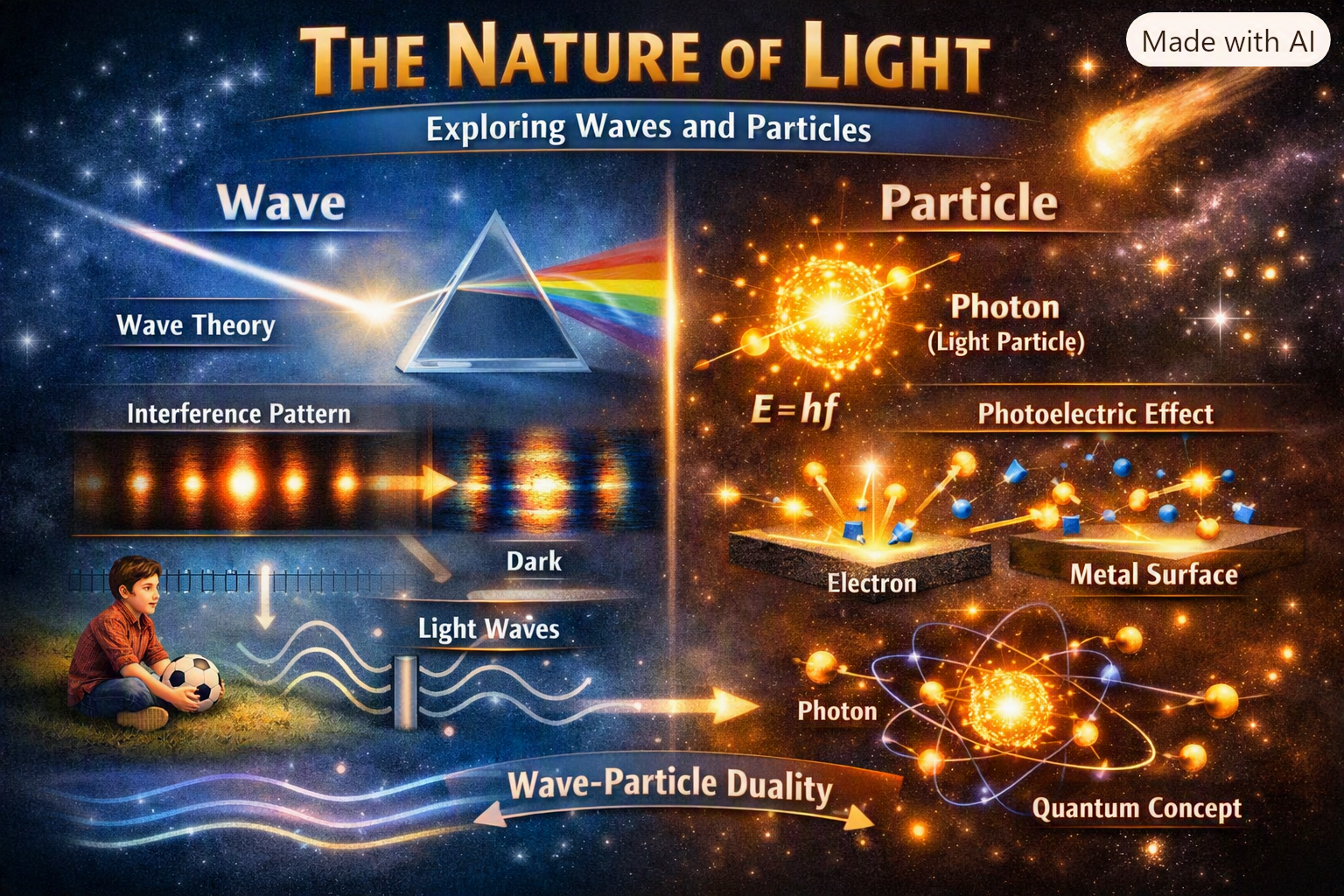
    **The Nature of Light: Exploring Waves and Particles**

    What is light? Is it a wave, a particle, or both? Explore the fascinating world of light and discover how it can behave like a **wave** and like tiny packets of energy called **photons** . From colorful rainbows to lasers and the light from distant stars , light is everywhere around us!

    Join us on an exciting journey through physics and uncover the amazing science behind one of nature’s most mysterious phenomena.

    #NatureOfLight #Light #Physics #WavesAndParticles #Photon #Science #PhysicsFacts #STEM #ScienceLearning #Waves #Energy #Education #ExploreScience #AmazingScience
    #rsisb Roll no 248 Foundation level story post no 17 💡🌈 **The Nature of Light: Exploring Waves and Particles** 🔬✨ What is light? Is it a wave, a particle, or both? 🤔💫 Explore the fascinating world of light and discover how it can behave like a **wave** 🌊 and like tiny packets of energy called **photons** ⚛️. From colorful rainbows 🌈 to lasers 🔦 and the light from distant stars ⭐, light is everywhere around us! Join us on an exciting journey through physics and uncover the amazing science behind one of nature’s most mysterious phenomena. 🚀🔬📚 #NatureOfLight #Light #Physics #WavesAndParticles #Photon #Science #PhysicsFacts #STEM #ScienceLearning #Waves #Energy #Education #ExploreScience #AmazingScience 🌈💡🔬✨
    0 Commentarii 0 Distribuiri 3774 Views
  • #rsisb
    Roll No.240
    Story No.15
    Foundation Level

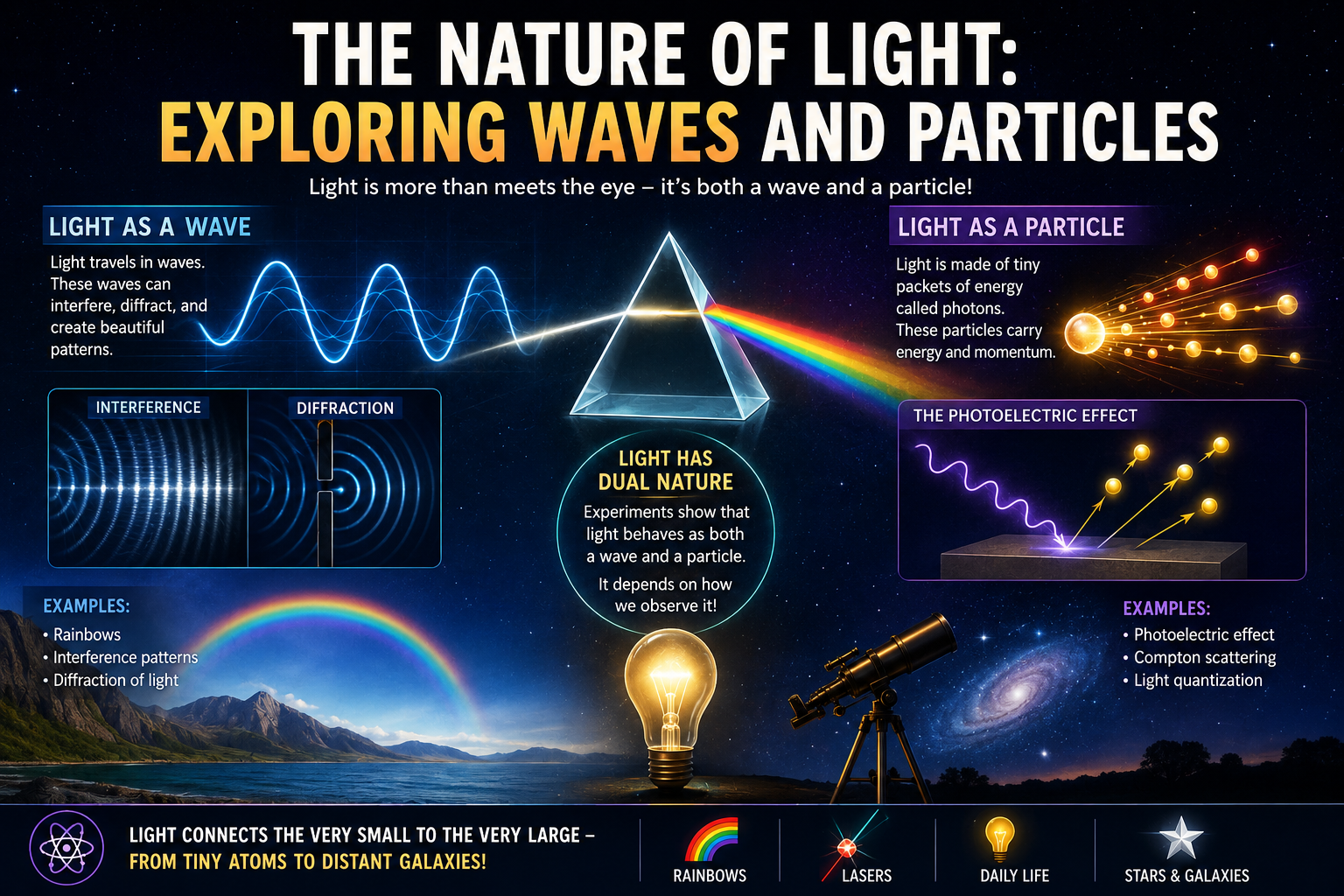
    ### **The Nature of Light: Exploring Waves and Particles**

    Light is one of the most fascinating phenomena in the universe, playing a vital role in everything from vision and communication to modern technology and scientific discovery. Unlike ordinary objects, light exhibits a remarkable property known as **wave-particle duality**, meaning it behaves both as a wave and as a stream of tiny particles called **photons**. This unique characteristic has transformed our understanding of physics and the fundamental laws that govern the universe.

    As a wave, light travels through space in the form of electromagnetic waves, displaying properties such as reflection, refraction, interference, diffraction, and polarization. These wave behaviors explain everyday phenomena like rainbows, mirrors, lenses, and the colors we observe in nature. As particles, photons carry discrete amounts of energy, allowing light to interact with matter in ways that explain the photoelectric effect, lasers, and many modern technologies. Together, these two perspectives provide a complete understanding of how light behaves under different conditions.

    Exploring the nature of light helps us appreciate the incredible discoveries made by scientists such as Isaac Newton, Thomas Young, James Clerk Maxwell, Albert Einstein, and Max Planck. Their groundbreaking work laid the foundation for quantum mechanics, optics, telecommunications, medical imaging, fiber-optic communication, astronomy, and renewable energy technologies. From illuminating our homes to enabling space exploration, light continues to shape the modern world in extraordinary ways.

    **#NatureOfLight #Physics #Science #WaveParticleDuality #Light #Photons #ElectromagneticWaves #QuantumPhysics #Optics #STEM #Education #ScientificDiscovery #Technology #Learning #ExploreScience **

    Rehan School Islamabad Campus
    Asma Shaheen EducationWali
    Irum Asim
    Saima Happinesswali
    #rsisb Roll No.240 Story No.15 Foundation Level ### **The Nature of Light: Exploring Waves and Particles** Light is one of the most fascinating phenomena in the universe, playing a vital role in everything from vision and communication to modern technology and scientific discovery. Unlike ordinary objects, light exhibits a remarkable property known as **wave-particle duality**, meaning it behaves both as a wave and as a stream of tiny particles called **photons**. This unique characteristic has transformed our understanding of physics and the fundamental laws that govern the universe. As a wave, light travels through space in the form of electromagnetic waves, displaying properties such as reflection, refraction, interference, diffraction, and polarization. These wave behaviors explain everyday phenomena like rainbows, mirrors, lenses, and the colors we observe in nature. As particles, photons carry discrete amounts of energy, allowing light to interact with matter in ways that explain the photoelectric effect, lasers, and many modern technologies. Together, these two perspectives provide a complete understanding of how light behaves under different conditions. Exploring the nature of light helps us appreciate the incredible discoveries made by scientists such as Isaac Newton, Thomas Young, James Clerk Maxwell, Albert Einstein, and Max Planck. Their groundbreaking work laid the foundation for quantum mechanics, optics, telecommunications, medical imaging, fiber-optic communication, astronomy, and renewable energy technologies. From illuminating our homes to enabling space exploration, light continues to shape the modern world in extraordinary ways. **#NatureOfLight #Physics #Science #WaveParticleDuality #Light #Photons #ElectromagneticWaves #QuantumPhysics #Optics #STEM #Education #ScientificDiscovery #Technology #Learning #ExploreScience 🌈💡🔬⚛️📚** Rehan School Islamabad Campus Asma Shaheen EducationWali Irum Asim Saima Happinesswali
    0 Commentarii 0 Distribuiri 8140 Views
  • A lot of people are changing their color of profile with RAINBOW, I do not know if you know, but it means, you support gay and lesbianism ... Just that you know ...
    A lot of people are changing their color of profile with RAINBOW, I do not know if you know, but it means, you support gay and lesbianism ... Just that you know ...
    0 Commentarii 0 Distribuiri 124 Views
Sponsorizeaza Paginile