



#rsisb
Roll No.247
foundation level
# The Journey of Dinosaurs: A Scientific Perspective
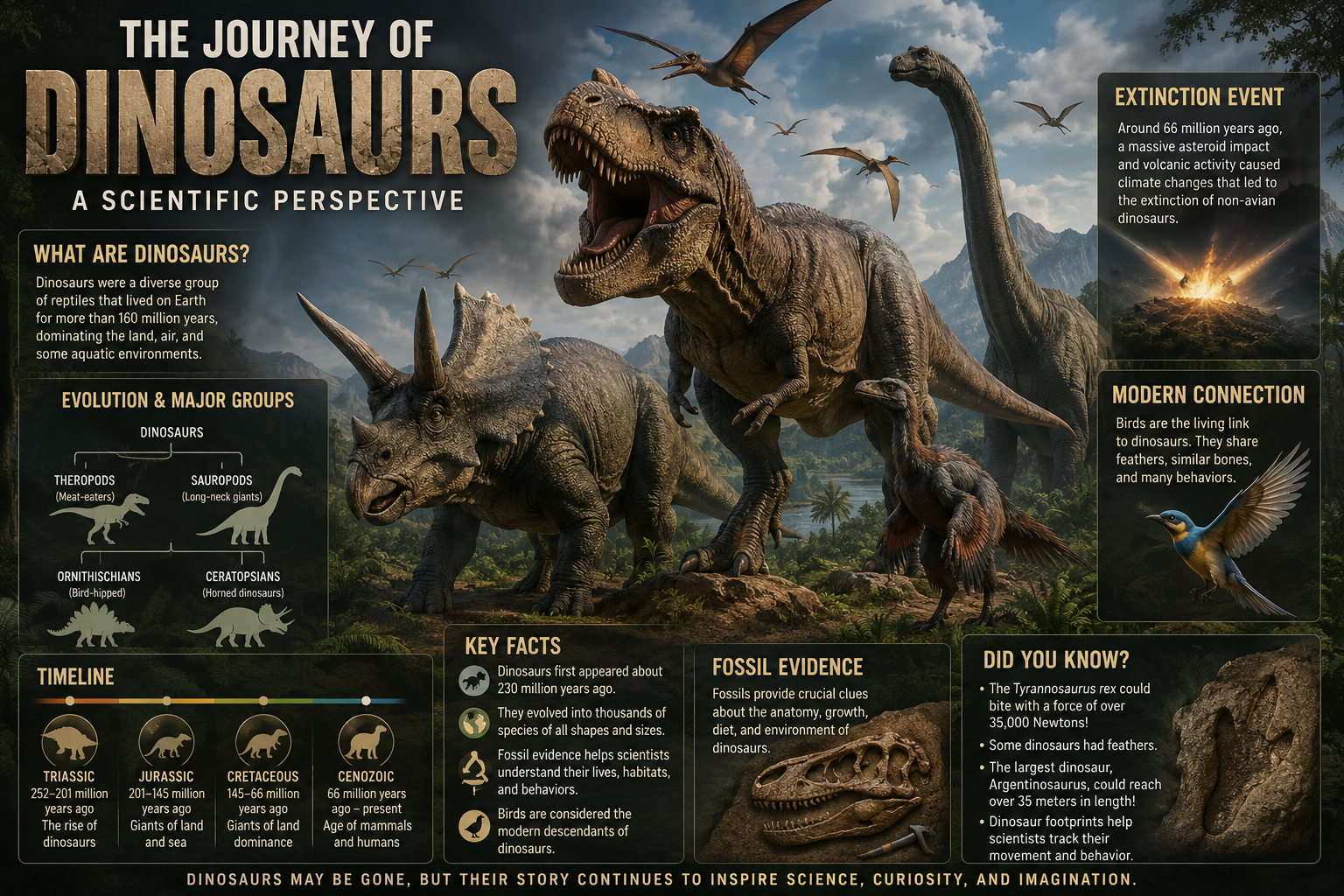
Step into the fascinating world of dinosaurs and explore one of the most remarkable chapters in the history of life on Earth! Dinosaurs ruled many of the planet’s ecosystems for more than 160 million years, appearing during the Triassic Period and continuing through the Jurassic and Cretaceous Periods. Their incredible diversity included enormous plant-eaters, powerful predators, swift hunters, armored species, and many other extraordinary creatures.
From a scientific perspective, the story of dinosaurs is not simply a tale of giant creatures—it is a story of evolution, adaptation, survival, extinction, and discovery. Scientists learn about dinosaurs through fossils, including bones, teeth, footprints, eggs, nests, and even traces of skin and feathers. By carefully studying these clues, paleontologists can reconstruct how dinosaurs lived, what they ate, how they moved, and how different species changed over millions of years.
Dinosaurs first appeared roughly 230 million years ago. Over time, they adapted to changing environments and became one of the most successful groups of land animals in Earth's history. Some developed long necks and enormous bodies to reach vegetation, while others evolved sharp teeth and strong jaws for hunting. Their fossils have been discovered on every continent, showing just how widely they were distributed.
The Jurassic Period is often remembered as a time when giant dinosaurs became especially prominent. Huge sauropods walked across ancient landscapes, while theropods hunted or scavenged. During the Cretaceous Period, dinosaurs continued to diversify, and many familiar species appeared. At the same time, flowering plants became increasingly important parts of many ecosystems.
One of the most important scientific discoveries is that birds are living dinosaurs. Evidence from fossils, anatomy, and evolutionary studies shows that modern birds descended from theropod dinosaurs. This means that although non-avian dinosaurs disappeared from the fossil record about 66 million years ago, the dinosaur lineage continues today in the form of birds.
The end of the Cretaceous Period brought a dramatic change. A large asteroid struck what is now the Yucatán Peninsula, contributing to major environmental disruptions around the world. This event, together with other environmental changes, played a major role in the extinction of non-avian dinosaurs. However, many other organisms survived, including early mammals, reptiles, and birds.
Today, dinosaur research continues to evolve. New fossils, improved imaging technologies, computer modeling, and advances in genetics and evolutionary biology are helping scientists understand these ancient animals more accurately. Every newly discovered fossil can provide another piece of the enormous puzzle of Earth's past.
The journey of dinosaurs reminds us that Earth has changed dramatically over geological time. Their story teaches us about adaptation, biodiversity, environmental change, and extinction. Most importantly, it shows how scientific evidence can help us understand a world that existed millions of years before humans appeared.
Whether you are fascinated by enormous herbivores, fearsome predators, ancient ecosystems, or the origins of modern birds, the scientific journey of dinosaurs offers endless opportunities for discovery. Their fossils connect us to a distant past and inspire scientists, students, and curious minds to keep asking questions about the incredible history of life on our planet.
#Dinosaurs #DinosaurJourney #Paleontology #Science #Fossils #Evolution #EarthHistory #JurassicPeriod #CretaceousPeriod #TriassicPeriod #DinosaurScience #AncientEarth #NaturalHistory #PrehistoricLife #ScientificDiscovery #Paleontologist #Biodiversity #Extinction #BirdsAreDinosaurs #LearnScience #ScienceEducation
Roll No.247
foundation level
# The Journey of Dinosaurs: A Scientific Perspective
Step into the fascinating world of dinosaurs and explore one of the most remarkable chapters in the history of life on Earth! Dinosaurs ruled many of the planet’s ecosystems for more than 160 million years, appearing during the Triassic Period and continuing through the Jurassic and Cretaceous Periods. Their incredible diversity included enormous plant-eaters, powerful predators, swift hunters, armored species, and many other extraordinary creatures.
From a scientific perspective, the story of dinosaurs is not simply a tale of giant creatures—it is a story of evolution, adaptation, survival, extinction, and discovery. Scientists learn about dinosaurs through fossils, including bones, teeth, footprints, eggs, nests, and even traces of skin and feathers. By carefully studying these clues, paleontologists can reconstruct how dinosaurs lived, what they ate, how they moved, and how different species changed over millions of years.
Dinosaurs first appeared roughly 230 million years ago. Over time, they adapted to changing environments and became one of the most successful groups of land animals in Earth's history. Some developed long necks and enormous bodies to reach vegetation, while others evolved sharp teeth and strong jaws for hunting. Their fossils have been discovered on every continent, showing just how widely they were distributed.
The Jurassic Period is often remembered as a time when giant dinosaurs became especially prominent. Huge sauropods walked across ancient landscapes, while theropods hunted or scavenged. During the Cretaceous Period, dinosaurs continued to diversify, and many familiar species appeared. At the same time, flowering plants became increasingly important parts of many ecosystems.
One of the most important scientific discoveries is that birds are living dinosaurs. Evidence from fossils, anatomy, and evolutionary studies shows that modern birds descended from theropod dinosaurs. This means that although non-avian dinosaurs disappeared from the fossil record about 66 million years ago, the dinosaur lineage continues today in the form of birds.
The end of the Cretaceous Period brought a dramatic change. A large asteroid struck what is now the Yucatán Peninsula, contributing to major environmental disruptions around the world. This event, together with other environmental changes, played a major role in the extinction of non-avian dinosaurs. However, many other organisms survived, including early mammals, reptiles, and birds.
Today, dinosaur research continues to evolve. New fossils, improved imaging technologies, computer modeling, and advances in genetics and evolutionary biology are helping scientists understand these ancient animals more accurately. Every newly discovered fossil can provide another piece of the enormous puzzle of Earth's past.
The journey of dinosaurs reminds us that Earth has changed dramatically over geological time. Their story teaches us about adaptation, biodiversity, environmental change, and extinction. Most importantly, it shows how scientific evidence can help us understand a world that existed millions of years before humans appeared.
Whether you are fascinated by enormous herbivores, fearsome predators, ancient ecosystems, or the origins of modern birds, the scientific journey of dinosaurs offers endless opportunities for discovery. Their fossils connect us to a distant past and inspire scientists, students, and curious minds to keep asking questions about the incredible history of life on our planet.
#Dinosaurs #DinosaurJourney #Paleontology #Science #Fossils #Evolution #EarthHistory #JurassicPeriod #CretaceousPeriod #TriassicPeriod #DinosaurScience #AncientEarth #NaturalHistory #PrehistoricLife #ScientificDiscovery #Paleontologist #Biodiversity #Extinction #BirdsAreDinosaurs #LearnScience #ScienceEducation
#rsisb
Roll No.247
foundation level
# The Journey of Dinosaurs: A Scientific Perspective 🦖🌍🔬
Step into the fascinating world of dinosaurs and explore one of the most remarkable chapters in the history of life on Earth! 🌎🦕 Dinosaurs ruled many of the planet’s ecosystems for more than 160 million years, appearing during the Triassic Period and continuing through the Jurassic and Cretaceous Periods. Their incredible diversity included enormous plant-eaters, powerful predators, swift hunters, armored species, and many other extraordinary creatures. 🦴✨
From a scientific perspective, the story of dinosaurs is not simply a tale of giant creatures—it is a story of evolution, adaptation, survival, extinction, and discovery. Scientists learn about dinosaurs through fossils, including bones, teeth, footprints, eggs, nests, and even traces of skin and feathers. 🔬🦴 By carefully studying these clues, paleontologists can reconstruct how dinosaurs lived, what they ate, how they moved, and how different species changed over millions of years.
Dinosaurs first appeared roughly 230 million years ago. 🌋🌿 Over time, they adapted to changing environments and became one of the most successful groups of land animals in Earth's history. Some developed long necks and enormous bodies to reach vegetation, while others evolved sharp teeth and strong jaws for hunting. 🦕🌱🦖 Their fossils have been discovered on every continent, showing just how widely they were distributed.
The Jurassic Period is often remembered as a time when giant dinosaurs became especially prominent. 🌴☀️ Huge sauropods walked across ancient landscapes, while theropods hunted or scavenged. During the Cretaceous Period, dinosaurs continued to diversify, and many familiar species appeared. At the same time, flowering plants became increasingly important parts of many ecosystems. 🌸🦖
One of the most important scientific discoveries is that birds are living dinosaurs. 🐦🦕 Evidence from fossils, anatomy, and evolutionary studies shows that modern birds descended from theropod dinosaurs. This means that although non-avian dinosaurs disappeared from the fossil record about 66 million years ago, the dinosaur lineage continues today in the form of birds. 🌍🔬
The end of the Cretaceous Period brought a dramatic change. A large asteroid struck what is now the Yucatán Peninsula, contributing to major environmental disruptions around the world. 🌠🌎 This event, together with other environmental changes, played a major role in the extinction of non-avian dinosaurs. However, many other organisms survived, including early mammals, reptiles, and birds.
Today, dinosaur research continues to evolve. 🧑🔬🔎 New fossils, improved imaging technologies, computer modeling, and advances in genetics and evolutionary biology are helping scientists understand these ancient animals more accurately. Every newly discovered fossil can provide another piece of the enormous puzzle of Earth's past. 🦴🧩
The journey of dinosaurs reminds us that Earth has changed dramatically over geological time. 🌎⏳ Their story teaches us about adaptation, biodiversity, environmental change, and extinction. Most importantly, it shows how scientific evidence can help us understand a world that existed millions of years before humans appeared.
Whether you are fascinated by enormous herbivores, fearsome predators, ancient ecosystems, or the origins of modern birds, the scientific journey of dinosaurs offers endless opportunities for discovery. 🦖🔬🌿 Their fossils connect us to a distant past and inspire scientists, students, and curious minds to keep asking questions about the incredible history of life on our planet. 🌍✨
#Dinosaurs 🦖 #DinosaurJourney 🦕 #Paleontology 🔬 #Science 🧪 #Fossils 🦴 #Evolution 🧬 #EarthHistory 🌍 #JurassicPeriod 🌿 #CretaceousPeriod 🌋 #TriassicPeriod 🌎 #DinosaurScience 🔎 #AncientEarth ⏳ #NaturalHistory 🏞️ #PrehistoricLife 🦕 #ScientificDiscovery 💡 #Paleontologist 🧑🔬 #Biodiversity 🌱 #Extinction 🌠 #BirdsAreDinosaurs 🐦 #LearnScience 📚 #ScienceEducation 🔬✨
0 Yorumlar
0 hisse senetleri
10116 Views