• **Roll No: 2**
    **Batch: 14**
    **Book: ACCL**
    **Task No: 161**

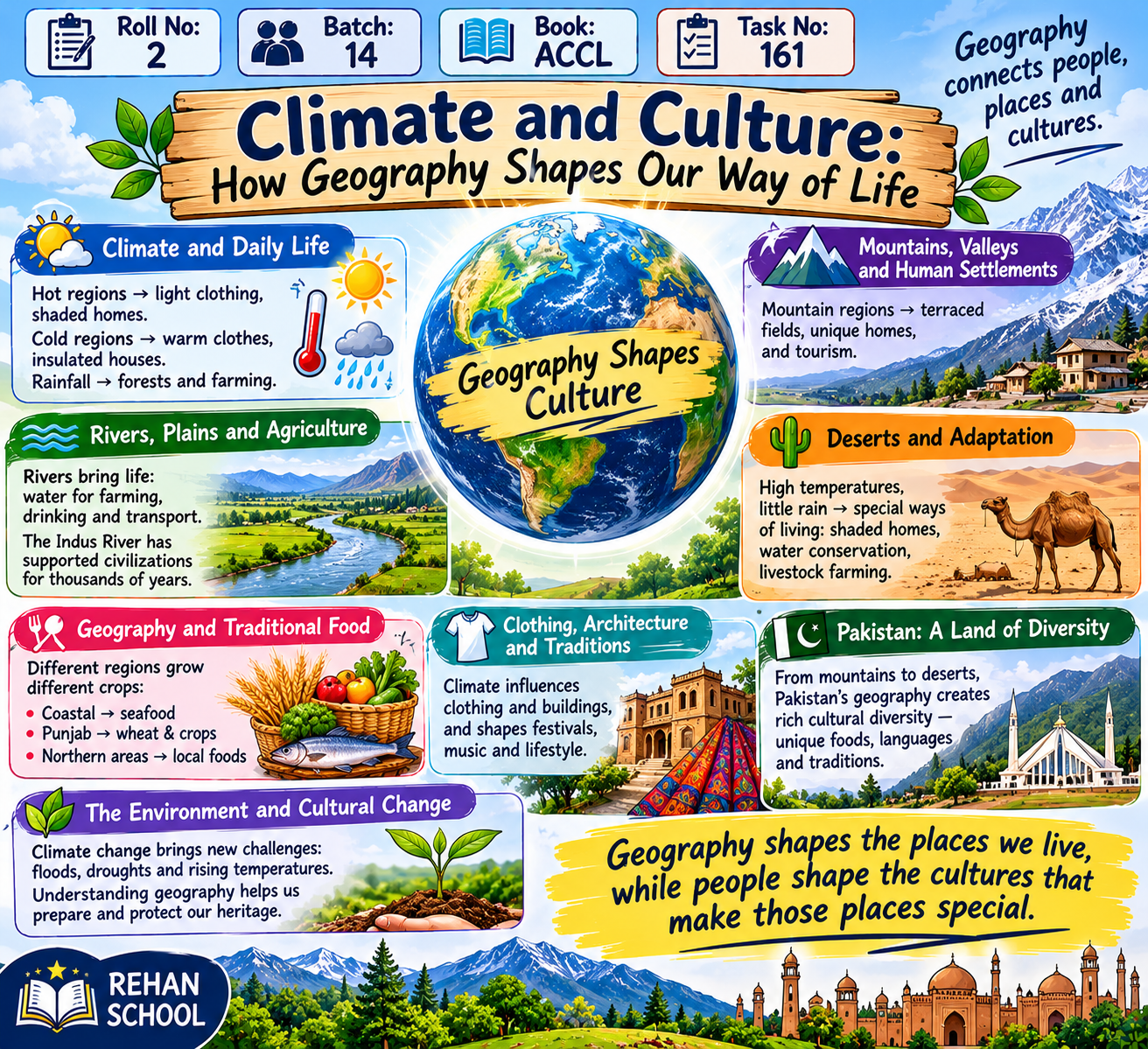
    # Climate and Culture: How Geography Shapes Our Way of Life

    Have you ever wondered why people in different parts of the world wear different clothes, eat different foods, build different houses, and celebrate different traditions? One important reason is geography. The physical features of a region, including its mountains, rivers, deserts, forests, and climate, influence how people live and develop their cultures. Geography is not just about maps and locations; it is also about understanding the relationship between people and their environment.

    **Climate refers to the long-term patterns of weather in a particular region, while geography describes the physical features and location of places.** These two factors influence many aspects of human life, including agriculture, housing, transportation, clothing, occupations, and cultural traditions. Over generations, communities develop ways of living that respond to the conditions around them.

    ## Climate and Daily Life

    Climate plays an important role in determining people's daily activities. In hot regions, people often prefer lightweight clothing and buildings designed to provide shade and ventilation. In colder areas, warm clothing, insulated houses, and heating systems help people remain comfortable.

    Rainfall also affects daily life. Regions receiving plenty of rain may support forests, rivers, and farming, while areas with limited rainfall often require careful water management. These environmental conditions influence where communities settle and how they use natural resources.

    ## Mountains, Valleys, and Human Settlements

    Mountains and valleys create unique living environments. People living in mountainous regions may build houses on slopes or in valleys and develop transportation systems suited to difficult terrain. Farming practices may include terraced fields, where steps are created on hillsides to make agricultural land more usable.

    Mountain communities often develop strong connections with their natural surroundings. Tourism, livestock farming, handicrafts, and forestry can become important sources of livelihood. In Pakistan, regions such as Gilgit-Baltistan and parts of Khyber Pakhtunkhwa demonstrate how mountain geography influences local lifestyles and traditions.

    ## Rivers, Plains, and Agriculture

    Rivers and fertile plains have played a major role in the development of human civilizations. Rivers provide water for drinking, farming, transportation, and other activities. Their surrounding land can contain fertile soil that supports the growth of crops.

    The Indus River is an important example. It has supported communities and agriculture in Pakistan for thousands of years. The Indus Valley Civilization developed around this river system, demonstrating how access to water and suitable land can contribute to the growth of cities, trade, and organized societies.

    ## Deserts and Adaptation

    Desert regions have high temperatures, limited rainfall, and scarce water resources. People living in these areas develop ways to adapt to challenging environmental conditions. They may use traditional methods of water conservation, construct buildings that provide shade, and organize their activities around cooler parts of the day.

    In some desert communities, livestock farming, trade, and traditional crafts are important occupations. Their clothing, food, architecture, and customs reflect generations of experience in living with a dry climate.

    ## Geography and Traditional Food

    Food is another interesting example of how geography shapes culture. Different regions grow different crops depending on their climate, soil, and water availability. Coastal communities often include fish and seafood in their diets, while agricultural regions may depend more on wheat, rice, vegetables, and fruits.

    In Pakistan, regional food traditions reflect local environments and cultural history. Punjab is famous for its agricultural products and traditional dishes, while coastal Sindh and Balochistan have strong connections with seafood. Northern areas are known for regional foods influenced by their mountain environment and local ingredients.

    ## Clothing, Architecture, and Traditions

    Geography influences the materials people use for clothing and construction. In cold climates, wool and other insulating materials are useful, while lighter fabrics are often preferred in hot environments.

    Traditional architecture also reflects local conditions. Houses in warm regions may have courtyards and shaded spaces, while buildings in colder areas may use materials and designs that help retain heat. Local traditions, festivals, music, and celebrations can also develop through people's relationship with their environment, history, and community life.

    ## The Environment and Cultural Change

    Although geography influences culture, human communities are not limited by their surroundings. People use creativity, technology, and knowledge to adapt to changing conditions. Modern transportation, irrigation systems, renewable energy, and improved construction methods have changed the way many communities live.

    Climate change is creating new challenges around the world. Rising temperatures, changing rainfall patterns, floods, droughts, and extreme weather events can affect agriculture, water supplies, homes, and traditional livelihoods. Understanding the connection between geography and culture can help communities prepare for these challenges and protect their natural and cultural heritage.

    ## Pakistan: A Land of Geographical and Cultural Diversity

    Pakistan is an excellent example of how geography creates cultural diversity. From the high mountains of the north to the deserts of the south, from fertile plains to coastal areas, every region has its own environmental characteristics and traditions.

    The people of different regions speak various languages, prepare different foods, wear traditional clothing, and celebrate unique cultural events. These differences make Pakistan a country rich in heritage and identity. At the same time, shared history and national values connect its communities.

    Geography teaches us that every place has its own story. The mountains, rivers, deserts, forests, and climates around us influence how societies grow, adapt, and preserve their traditions. By understanding these connections, we can appreciate cultural diversity and recognize the importance of protecting our environment.

    **Geography shapes the places we live, while people shape the cultures that make those places special. When we understand the relationship between climate, land, and human life, we gain a deeper appreciation of our world's diversity and the remarkable ways people adapt to their surroundings. **

    #ClimateAndCulture #Geography #CulturalDiversity #Environment #Pakistan #HumanGeography #ClimateChange #ACCL #Batch14 #Task161
    **Roll No: 2** **Batch: 14** **Book: ACCL** **Task No: 161** # 🌍🏔️ Climate and Culture: How Geography Shapes Our Way of Life 🌦️🏡 Have you ever wondered why people in different parts of the world wear different clothes, eat different foods, build different houses, and celebrate different traditions? 🌎✨ One important reason is geography. The physical features of a region, including its mountains, rivers, deserts, forests, and climate, influence how people live and develop their cultures. Geography is not just about maps and locations; it is also about understanding the relationship between people and their environment. **Climate refers to the long-term patterns of weather in a particular region, while geography describes the physical features and location of places.** 🌤️ These two factors influence many aspects of human life, including agriculture, housing, transportation, clothing, occupations, and cultural traditions. Over generations, communities develop ways of living that respond to the conditions around them. ## 🌞 Climate and Daily Life Climate plays an important role in determining people's daily activities. In hot regions, people often prefer lightweight clothing and buildings designed to provide shade and ventilation. In colder areas, warm clothing, insulated houses, and heating systems help people remain comfortable. ❄️☀️ Rainfall also affects daily life. Regions receiving plenty of rain may support forests, rivers, and farming, while areas with limited rainfall often require careful water management. These environmental conditions influence where communities settle and how they use natural resources. ## 🏔️ Mountains, Valleys, and Human Settlements Mountains and valleys create unique living environments. 🏔️ People living in mountainous regions may build houses on slopes or in valleys and develop transportation systems suited to difficult terrain. Farming practices may include terraced fields, where steps are created on hillsides to make agricultural land more usable. Mountain communities often develop strong connections with their natural surroundings. Tourism, livestock farming, handicrafts, and forestry can become important sources of livelihood. In Pakistan, regions such as Gilgit-Baltistan and parts of Khyber Pakhtunkhwa demonstrate how mountain geography influences local lifestyles and traditions. 🇵🇰 ## 🌾 Rivers, Plains, and Agriculture Rivers and fertile plains have played a major role in the development of human civilizations. 🌊 Rivers provide water for drinking, farming, transportation, and other activities. Their surrounding land can contain fertile soil that supports the growth of crops. The Indus River is an important example. It has supported communities and agriculture in Pakistan for thousands of years. The Indus Valley Civilization developed around this river system, demonstrating how access to water and suitable land can contribute to the growth of cities, trade, and organized societies. 🌾🏛️ ## 🏜️ Deserts and Adaptation Desert regions have high temperatures, limited rainfall, and scarce water resources. 🐪 People living in these areas develop ways to adapt to challenging environmental conditions. They may use traditional methods of water conservation, construct buildings that provide shade, and organize their activities around cooler parts of the day. In some desert communities, livestock farming, trade, and traditional crafts are important occupations. Their clothing, food, architecture, and customs reflect generations of experience in living with a dry climate. ## 🍲 Geography and Traditional Food Food is another interesting example of how geography shapes culture. 🍚 Different regions grow different crops depending on their climate, soil, and water availability. Coastal communities often include fish and seafood in their diets, while agricultural regions may depend more on wheat, rice, vegetables, and fruits. In Pakistan, regional food traditions reflect local environments and cultural history. Punjab is famous for its agricultural products and traditional dishes, while coastal Sindh and Balochistan have strong connections with seafood. Northern areas are known for regional foods influenced by their mountain environment and local ingredients. 🍛🇵🇰 ## 👕 Clothing, Architecture, and Traditions Geography influences the materials people use for clothing and construction. In cold climates, wool and other insulating materials are useful, while lighter fabrics are often preferred in hot environments. 🧥 Traditional architecture also reflects local conditions. Houses in warm regions may have courtyards and shaded spaces, while buildings in colder areas may use materials and designs that help retain heat. Local traditions, festivals, music, and celebrations can also develop through people's relationship with their environment, history, and community life. 🎶🏡 ## 🌱 The Environment and Cultural Change Although geography influences culture, human communities are not limited by their surroundings. People use creativity, technology, and knowledge to adapt to changing conditions. Modern transportation, irrigation systems, renewable energy, and improved construction methods have changed the way many communities live. Climate change is creating new challenges around the world. Rising temperatures, changing rainfall patterns, floods, droughts, and extreme weather events can affect agriculture, water supplies, homes, and traditional livelihoods. 🌍 Understanding the connection between geography and culture can help communities prepare for these challenges and protect their natural and cultural heritage. ## 🇵🇰 Pakistan: A Land of Geographical and Cultural Diversity Pakistan is an excellent example of how geography creates cultural diversity. From the high mountains of the north to the deserts of the south, from fertile plains to coastal areas, every region has its own environmental characteristics and traditions. 🏔️🌊 The people of different regions speak various languages, prepare different foods, wear traditional clothing, and celebrate unique cultural events. These differences make Pakistan a country rich in heritage and identity. At the same time, shared history and national values connect its communities. Geography teaches us that every place has its own story. The mountains, rivers, deserts, forests, and climates around us influence how societies grow, adapt, and preserve their traditions. By understanding these connections, we can appreciate cultural diversity and recognize the importance of protecting our environment. 🌳🤝 **Geography shapes the places we live, while people shape the cultures that make those places special. When we understand the relationship between climate, land, and human life, we gain a deeper appreciation of our world's diversity and the remarkable ways people adapt to their surroundings. 🌍💚✨** #ClimateAndCulture #Geography #CulturalDiversity #Environment #Pakistan #HumanGeography #ClimateChange #ACCL #Batch14 #Task161 🌍🏔️🌦️
    0 التعليقات 0 المشاركات 2846 مشاهدة
  • #rsisb Roll No:232 foundation level student. Documentary:17 🤖 **Documentary – The History and Future of Artificial Intelligence** 🚀🌍 Today, I explored an interesting and educational documentary titled **"The History and Future of Artificial Intelligence."** This documentary explores the journey of Artificial Intelligence (AI), from its early beginnings to the advanced technologies that are shaping our modern world. It explains how AI has developed over the years and how it is transforming the way people learn, work, communicate, and solve problems. Throughout this documentary, I learned about the early ideas behind artificial intelligence, the scientists and researchers who helped develop it, and the important milestones that made modern AI possible. I also discovered how technologies such as machine learning, deep learning, robotics, natural language processing, and generative AI have changed the world of technology. 💻🧠 One of the most fascinating things I learned is that AI can perform many tasks that traditionally required human intelligence. For example, AI can understand language, recognize images, analyze information, answer questions, assist with research, and generate creative content. The documentary also explores the future of artificial intelligence and its potential impact on education, healthcare, transportation, business, communication, and many other fields. AI could help people solve complex problems, improve productivity, discover new opportunities, and make everyday tasks easier. However, I also learned that AI comes with important challenges, including privacy, data security, misinformation, fairness, and responsible use. This means that humans must develop and use artificial intelligence carefully, ethically, and responsibly. ### What I Learned: 1. Artificial Intelligence has developed through decades of research and innovation. 2. Machine learning helps computers learn patterns from data. 3. AI is transforming education, healthcare, business, and communication. 4. Robotics and automation are changing industries. 5. Generative AI can create text, images, audio, and other content. 6. Responsible AI development is important for society. 7. Human creativity, critical thinking, and decision-making remain valuable. 8. The future of AI will bring new opportunities and challenges. ### My Personal Experience: I really enjoyed watching this documentary because I am interested in artificial intelligence and modern technology. It helped me understand how AI started, how it developed, and what possibilities it may bring in the future. I realized that AI is not just a technology of today; it is an important part of the future. As a student and technology enthusiast, I want to continue learning about AI, explore new tools, improve my digital skills, and understand how I can use technology to create something useful for society. ### Conclusion: The main message of this documentary is that artificial intelligence is changing the world, and understanding it is becoming increasingly important. We should learn about AI, develop our skills, use it responsibly, and prepare ourselves for future technological developments. **"The future belongs to those who learn, innovate, and use technology to make a positive difference in the world!"** 🌍🤖✨ #ArtificialIntelligence #HistoryOfAI #FutureOfAI #AI #MachineLearning #DeepLearning #GenerativeAI #Robotics #Technology #Innovation #DigitalTransformation #FutureTechnology #AIRevolution #ComputerScience #TechEducation #ResponsibleAI #DigitalSkills #CreativeThinking #LearningWithAI #TechnologyEnthusiast #PersonalGrowth #KeepLearning #FutureReady 🤖💻🚀🌍🧠✨ Irum Asim Leadershipwali Asma Shaheen EducationWali Rehan School Islamabad Campus https://www.facebook.com/share/v/1CJxofddfy/
    WWW.FACEBOOK.COM
    Facebook
    #rsisb Roll No:232 foundation level student. Documentary:17 🤖 **Documentary – The History and Future of Artificial Intelligence** 🚀🌍 Today, I explored an interesting and educational documentary...
    0 التعليقات 0 المشاركات 2754 مشاهدة
  • RSIf8
    Roll Number: 49
    Story post no.47
    Story post topic:Exploring the Organelles' Roles

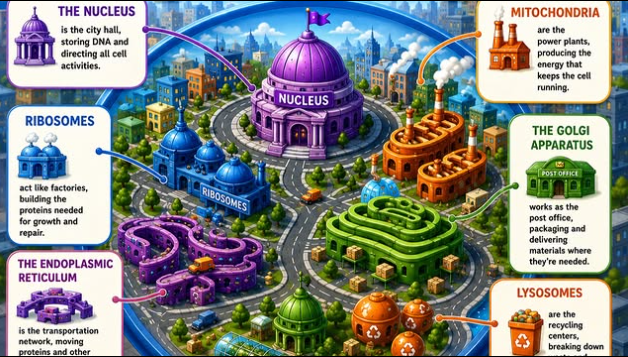
    Imagine a cell as a busy city where every organelle has an important job!

    The nucleus is the city hall, storing DNA and directing all cell activities.
    Mitochondria are the power plants, producing the energy that keeps the cell running.
    Ribosomes act like factories, building the proteins needed for growth and repair.
    The Golgi apparatus works as the post office, packaging and delivering materials where they're needed.
    The endoplasmic reticulum is the transportation network, moving proteins and other substances throughout the cell.
    Lysosomes are the recycling centers, breaking down waste and keeping the cell clean.
    In plant cells, chloroplasts capture sunlight to produce food through photosynthesis.

    Together, these tiny organelles work in perfect harmony, proving that even the smallest parts can make the biggest difference.

    Every cell is a bustling city—and every organelle plays a vital role in keeping life alive!

    #CellBiology #Science #Biology #Organelles #STEM #Education #Learning #ScienceFacts #DidYouKnow #Microscope #LifeScience #Knowledge
    RSIf8 Roll Number: 49 Story post no.47 Story post topic:Exploring the Organelles' Roles Imagine a cell as a busy city where every organelle has an important job! 🌟🏙️ 🧠 The nucleus is the city hall, storing DNA and directing all cell activities. ⚡ Mitochondria are the power plants, producing the energy that keeps the cell running. 🏭 Ribosomes act like factories, building the proteins needed for growth and repair. 📦 The Golgi apparatus works as the post office, packaging and delivering materials where they're needed. 🚚 The endoplasmic reticulum is the transportation network, moving proteins and other substances throughout the cell. 🧹 Lysosomes are the recycling centers, breaking down waste and keeping the cell clean. 🌿 In plant cells, chloroplasts capture sunlight to produce food through photosynthesis. ☀️🍃 Together, these tiny organelles work in perfect harmony, proving that even the smallest parts can make the biggest difference. 🌍💚 Every cell is a bustling city—and every organelle plays a vital role in keeping life alive! 🌟🔬 #CellBiology #Science #Biology #Organelles #STEM #Education #Learning #ScienceFacts #DidYouKnow #Microscope #LifeScience #Knowledge 🧬✨
    0 التعليقات 0 المشاركات 1484 مشاهدة
  • RSIF8
    Roll no:14
    song no:14
    song topic:"You are never too old to set another goal or dream a new dream." — C.S. Lewis

    # The Physics of Everyday Life: How Science Affects Our World

    Discover the amazing connection between science and our everyday lives with **“The Physics of Everyday Life: How Science Affects Our World”** — an educational and inspiring song that explores how physics shapes the world around us!

    From the light that brightens our homes to the electricity that powers our devices, physics is everywhere. It explains gravity, motion, sound, heat, energy, and the fascinating forces that make our universe work.

    This song takes listeners on an exciting journey through the wonders of science, showing how physics helps us understand everyday activities, modern technology, transportation, and the natural world.

    Perfect for students, teachers, science enthusiasts, and curious minds, this song makes learning physics enjoyable, memorable, and fun. Let the rhythm of music inspire you to explore scientific discoveries, ask questions, and uncover the secrets of nature!

    **Learn through music, explore through science, and discover the physics behind every moment of life!**

    Listen, learn, and enjoy the incredible world of physics!

    **#Physics #EverydayPhysics #ScienceSong #EducationalMusic #LearnThroughMusic #ScienceEducation #PhysicsInDailyLife #STEMEducation #ScienceAndTechnology #LearningIsFun #EducationalSong #ExploreScience**
    RSIF8 Roll no:14 song no:14 song topic:"You are never too old to set another goal or dream a new dream." — C.S. Lewis # 🎵 The Physics of Everyday Life: How Science Affects Our World 🌍🔬 Discover the amazing connection between science and our everyday lives with **“The Physics of Everyday Life: How Science Affects Our World”** — an educational and inspiring song that explores how physics shapes the world around us! ⚡🎶 From the light that brightens our homes to the electricity that powers our devices, physics is everywhere. It explains gravity, motion, sound, heat, energy, and the fascinating forces that make our universe work. 🌞💡 This song takes listeners on an exciting journey through the wonders of science, showing how physics helps us understand everyday activities, modern technology, transportation, and the natural world. 🚗✈️🌊 Perfect for students, teachers, science enthusiasts, and curious minds, this song makes learning physics enjoyable, memorable, and fun. Let the rhythm of music inspire you to explore scientific discoveries, ask questions, and uncover the secrets of nature! 🧪📚 ✨ **Learn through music, explore through science, and discover the physics behind every moment of life!** 🎧 Listen, learn, and enjoy the incredible world of physics! **#Physics #EverydayPhysics #ScienceSong #EducationalMusic #LearnThroughMusic #ScienceEducation #PhysicsInDailyLife #STEMEducation #ScienceAndTechnology #LearningIsFun #EducationalSong #ExploreScience**
    0 التعليقات 0 المشاركات 2535 مشاهدة 5
  • RSIF8
    Roll no:14
    story no:24
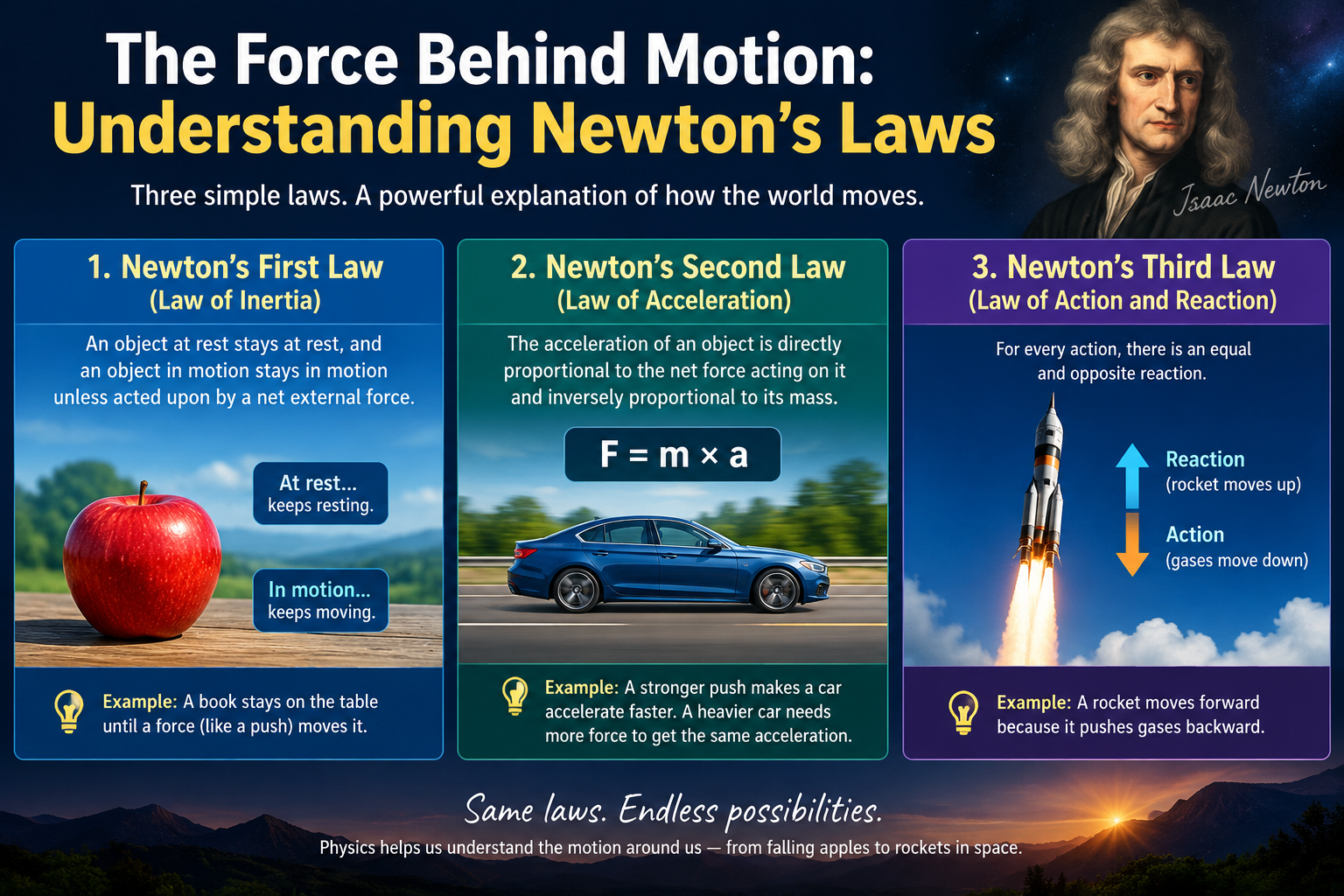
    story topic:The Force Behind Motion: Understanding Newton’s Laws

    **The Force Behind Motion: Understanding Newton’s Laws**

    Welcome to the fascinating world of physics, where forces, motion, and energy work together to explain how our universe operates! In this educational journey, we explore **Newton’s Three Laws of Motion**, some of the most important principles in science that help us understand why objects move, how they change speed, and how forces affect everything around us. From a simple falling apple to a speeding car and a powerful rocket launching into space, Newton’s laws are everywhere in our daily lives!

    **1. Newton’s First Law — The Law of Inertia**

    Newton’s First Law states that an object at rest remains at rest, and an object in motion continues moving at a constant speed in a straight line unless acted upon by an unbalanced external force. This principle explains why a book stays on a table until someone moves it and why passengers tend to move forward when a moving car suddenly stops. Inertia is the natural tendency of objects to resist changes in their state of motion.

    **2. Newton’s Second Law — The Law of Acceleration**

    Newton’s Second Law explains how force, mass, and acceleration are connected. The greater the net force applied to an object, the greater its acceleration. However, a heavier object requires more force than a lighter object to achieve the same acceleration. This relationship is expressed through the famous formula **F = m × a**, where F represents force, m represents mass, and a represents acceleration. This law helps engineers design vehicles, machines, and countless other technologies.

    **3. Newton’s Third Law — The Law of Action and Reaction**

    Newton’s Third Law states that for every action, there is an equal and opposite reaction. Whenever one object exerts a force on another, the second object exerts an equal force in the opposite direction. This principle explains how rockets move forward by pushing exhaust gases backward, how swimmers move through water, and how we walk by pushing against the ground. It reveals the incredible relationship between forces acting on interacting objects.

    **Why Are Newton’s Laws Important?**

    Newton’s laws are essential for understanding the physical world. They help scientists explain motion, engineers develop safer vehicles, athletes improve their performance, and space agencies calculate the movements of spacecraft. These principles are used in transportation, construction, robotics, aviation, sports science, and space exploration. By understanding these laws, students can develop stronger scientific thinking and see how classroom physics connects to real-life experiences.

    **Explore the Science Behind Everyday Motion!**

    Physics is more than formulas and equations; it is a way to understand the world around us. Every moving bicycle, bouncing ball, accelerating car, and launching rocket demonstrates the fascinating principles of force and motion. Learning Newton’s laws opens the door to deeper discoveries in science, technology, engineering, and mathematics.

    Join us on this exciting journey to discover how simple scientific principles explain some of the most extraordinary movements in our universe. Keep asking questions, stay curious, and never stop exploring the wonders of science!

    **Learn the Laws. Understand the Forces. Discover the Science of Motion!**

    Like, share, and follow for more educational content, fascinating science topics, and easy-to-understand explanations that make learning enjoyable!

    #NewtonsLaws #ForceAndMotion #Physics #ScienceEducation #IsaacNewton #LawOfInertia #Acceleration #ActionAndReaction #PhysicsExplained #ScienceFacts #STEMEducation #EducationalVideos #LearnScience #ScientificDiscoveries #SpaceExploration #KnowledgeIsPower
    RSIF8 Roll no:14 story no:24 story topic:The Force Behind Motion: Understanding Newton’s Laws 🚀 **The Force Behind Motion: Understanding Newton’s Laws** 🌍🔬 Welcome to the fascinating world of physics, where forces, motion, and energy work together to explain how our universe operates! 🌌 In this educational journey, we explore **Newton’s Three Laws of Motion**, some of the most important principles in science that help us understand why objects move, how they change speed, and how forces affect everything around us. From a simple falling apple to a speeding car and a powerful rocket launching into space, Newton’s laws are everywhere in our daily lives! 🍎🚗🚀 📘 **1. Newton’s First Law — The Law of Inertia** Newton’s First Law states that an object at rest remains at rest, and an object in motion continues moving at a constant speed in a straight line unless acted upon by an unbalanced external force. This principle explains why a book stays on a table until someone moves it and why passengers tend to move forward when a moving car suddenly stops. Inertia is the natural tendency of objects to resist changes in their state of motion. ⚡ **2. Newton’s Second Law — The Law of Acceleration** Newton’s Second Law explains how force, mass, and acceleration are connected. The greater the net force applied to an object, the greater its acceleration. However, a heavier object requires more force than a lighter object to achieve the same acceleration. This relationship is expressed through the famous formula **F = m × a**, where F represents force, m represents mass, and a represents acceleration. This law helps engineers design vehicles, machines, and countless other technologies. 🌟 **3. Newton’s Third Law — The Law of Action and Reaction** Newton’s Third Law states that for every action, there is an equal and opposite reaction. Whenever one object exerts a force on another, the second object exerts an equal force in the opposite direction. This principle explains how rockets move forward by pushing exhaust gases backward, how swimmers move through water, and how we walk by pushing against the ground. It reveals the incredible relationship between forces acting on interacting objects. 🔍 **Why Are Newton’s Laws Important?** Newton’s laws are essential for understanding the physical world. They help scientists explain motion, engineers develop safer vehicles, athletes improve their performance, and space agencies calculate the movements of spacecraft. These principles are used in transportation, construction, robotics, aviation, sports science, and space exploration. By understanding these laws, students can develop stronger scientific thinking and see how classroom physics connects to real-life experiences. 💡 **Explore the Science Behind Everyday Motion!** Physics is more than formulas and equations; it is a way to understand the world around us. Every moving bicycle, bouncing ball, accelerating car, and launching rocket demonstrates the fascinating principles of force and motion. Learning Newton’s laws opens the door to deeper discoveries in science, technology, engineering, and mathematics. Join us on this exciting journey to discover how simple scientific principles explain some of the most extraordinary movements in our universe. Keep asking questions, stay curious, and never stop exploring the wonders of science! 🌍✨ 🎯 **Learn the Laws. Understand the Forces. Discover the Science of Motion!** 👍 Like, share, and follow for more educational content, fascinating science topics, and easy-to-understand explanations that make learning enjoyable! #NewtonsLaws #ForceAndMotion #Physics #ScienceEducation #IsaacNewton #LawOfInertia #Acceleration #ActionAndReaction #PhysicsExplained #ScienceFacts #STEMEducation #EducationalVideos #LearnScience #ScientificDiscoveries #SpaceExploration #KnowledgeIsPower 🚀📚
    0 التعليقات 0 المشاركات 6548 مشاهدة
  • RSIF8
    Roll no 94
    Call annie no 16
    Call annie topic
    Going Live with Annie!

    Join me as I chat with Annie about "Wood – The Backbone of Early Civilization" . We'll explore how wood helped build homes, tools, transportation, and the foundations of early societies.

    Live discussion | Learning together | Exploring history

    Don't miss this exciting journey into the past!

    #WoodTheBackboneOfEarlyCivilization #TalkWithAnnie #HistoryMatters #EarlyCivilizations #LearningJourney #Education #WoodInHistory #StudentLife #KnowledgeSharing #GoLive #SocialMediaLive
    RSIF8 Roll no 94 Call annie no 16 Call annie topic 🌳✨ Going Live with Annie! ✨🌳 Join me as I chat with Annie about "Wood – The Backbone of Early Civilization" 🌍🏛️. We'll explore how wood helped build homes, tools, transportation, and the foundations of early societies. 🚤🪵🏠 📹 Live discussion | 🎙️ Learning together | 🌱 Exploring history Don't miss this exciting journey into the past! 🚀 #WoodTheBackboneOfEarlyCivilization #TalkWithAnnie #HistoryMatters #EarlyCivilizations #LearningJourney #Education #WoodInHistory #StudentLife #KnowledgeSharing #GoLive #SocialMediaLive 🌳📚✨🎤🌍
    0 التعليقات 0 المشاركات 3249 مشاهدة 5

  • **Roll No: 2**

    **Batch: 14**

    **Book: ACCL**

    **Task No: 149**

    # Expense Tracker — Record and Categorize Personal Expenses

    Today’s task is to develop an **Expense Tracker application** that helps users record, organize, and monitor their personal expenses in a simple and efficient way. The application will allow users to enter expense details, including the amount, date, description, and category, such as food, transportation, education, shopping, or entertainment. Users will be able to view their recorded transactions, categorize spending, and calculate their total expenses over a selected period. The project can also include features such as editing or deleting entries, filtering expenses by category, and displaying summaries to make spending patterns easier to understand. Through this coding task, I will practice programming concepts such as user input, data storage, functions, calculations, and data organization. This project will demonstrate how technology can support financial awareness, responsible spending, and better everyday money management while strengthening my coding and problem-solving skills.

    #Batch14 #Task149 #ACCL #ExpenseTracker #CodingTask #Programming #AppDevelopment #PersonalFinance #Budgeting #MoneyManagement #DataOrganization #ProblemSolving #DigitalSkills #DailyTask
    👤 **Roll No: 2** 📚 **Batch: 14** 📖 **Book: ACCL** 🎯 **Task No: 149** # 💰 Expense Tracker — Record and Categorize Personal Expenses 📊💻 Today’s task is to develop an **Expense Tracker application** that helps users record, organize, and monitor their personal expenses in a simple and efficient way. 💡 The application will allow users to enter expense details, including the amount, date, description, and category, such as food, transportation, education, shopping, or entertainment. 🛍️ Users will be able to view their recorded transactions, categorize spending, and calculate their total expenses over a selected period. 📈 The project can also include features such as editing or deleting entries, filtering expenses by category, and displaying summaries to make spending patterns easier to understand. Through this coding task, I will practice programming concepts such as user input, data storage, functions, calculations, and data organization. 🚀 This project will demonstrate how technology can support financial awareness, responsible spending, and better everyday money management while strengthening my coding and problem-solving skills. #Batch14 #Task149 #ACCL #ExpenseTracker #CodingTask #Programming #AppDevelopment #PersonalFinance #Budgeting #MoneyManagement #DataOrganization #ProblemSolving #DigitalSkills #DailyTask
    0 التعليقات 0 المشاركات 3925 مشاهدة
  • Mohsin RS F8
    Roll NO:13
    Coding Task NO:15
    Class: Foundation Level
    Made by Me

    Complete the Coding Task: Expense Tracker

    I completed the Expense Tracker coding task as a practical project to learn how technology can be used to organize and manage everyday financial information. The main purpose of this project is to create a simple and user-friendly application where users can record their income and expenses and easily see their overall balance.

    An Expense Tracker is a useful project for beginners because it combines several important programming concepts in one application. Instead of only displaying information on a webpage, the project allows the user to enter data, interact with buttons and forms, and see the information update dynamically.

    The application allows users to add transactions by entering details such as a description, amount, type, category, and date. A transaction can be marked as either income or an expense. Categories can help organize different types of spending, such as food, transportation, education, shopping, bills, entertainment, or other expenses.

    One of the most useful features of the project is the summary section. It displays the total income, total expenses, and remaining balance. Whenever a new transaction is added, the application calculates the updated totals automatically. This makes it easier to understand how the recorded money is being managed.

    The project also includes a transaction list where users can view their previous entries. Each transaction shows important information such as its description, category, amount, and date. If an entry is no longer needed, the user can delete it. There is also a Clear All option for removing all stored transactions.

    For the development of this project, I used HTML, CSS, and JavaScript. HTML was used to create the structure of the application, including the forms, summary cards, buttons, and transaction list. CSS was used to create a clean and responsive interface that can work on different screen sizes. JavaScript was used to add functionality, perform calculations, manage transactions, and update the interface whenever the data changes.
    Mohsin RS F8 🎓✨ Roll NO:13 Coding Task NO:15 Class: Foundation Level 📚 Made by Me 💻🚀 💰 Complete the Coding Task: Expense Tracker I completed the Expense Tracker coding task as a practical project to learn how technology can be used to organize and manage everyday financial information. The main purpose of this project is to create a simple and user-friendly application where users can record their income and expenses and easily see their overall balance. An Expense Tracker is a useful project for beginners because it combines several important programming concepts in one application. Instead of only displaying information on a webpage, the project allows the user to enter data, interact with buttons and forms, and see the information update dynamically. The application allows users to add transactions by entering details such as a description, amount, type, category, and date. A transaction can be marked as either income or an expense. Categories can help organize different types of spending, such as food, transportation, education, shopping, bills, entertainment, or other expenses. One of the most useful features of the project is the summary section. It displays the total income, total expenses, and remaining balance. Whenever a new transaction is added, the application calculates the updated totals automatically. This makes it easier to understand how the recorded money is being managed. The project also includes a transaction list where users can view their previous entries. Each transaction shows important information such as its description, category, amount, and date. If an entry is no longer needed, the user can delete it. There is also a Clear All option for removing all stored transactions. For the development of this project, I used HTML, CSS, and JavaScript. HTML was used to create the structure of the application, including the forms, summary cards, buttons, and transaction list. CSS was used to create a clean and responsive interface that can work on different screen sizes. JavaScript was used to add functionality, perform calculations, manage transactions, and update the interface whenever the data changes.
    0 التعليقات 0 المشاركات 1131 مشاهدة
  • RSIF8
    Roll no:85
    Task no:55
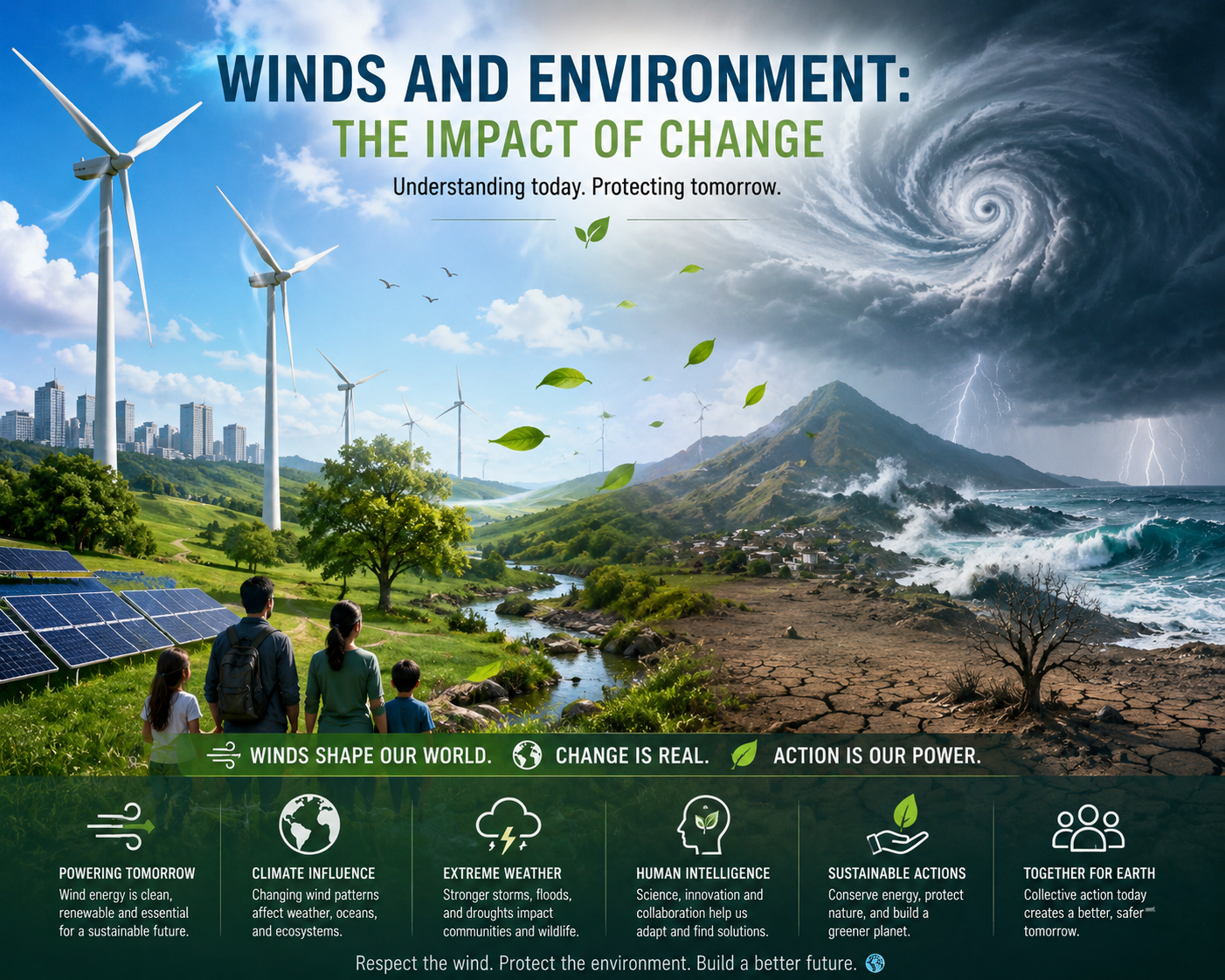
    Task topic: Winds and Environment: The Impact of Change
    The wind is one of nature's most powerful forces, shaping landscapes, influencing weather, and supporting life across the planet. It carries moisture that nourishes forests and farmland, spreads seeds that help plants grow, and drives ocean currents that regulate Earth's climate. For centuries, humans have relied on the wind for travel, agriculture, and renewable energy. Understanding how wind interacts with the environment helps us appreciate its essential role in maintaining the balance of nature.

    As the global climate changes, wind patterns are also shifting in many regions. Rising temperatures, changing air pressure, and altered weather systems can influence the strength, direction, and frequency of winds. These changes may contribute to more intense storms in some areas, prolonged droughts in others, and increased challenges for farming, transportation, and wildlife. Scientists continue to study these complex interactions to better predict future environmental conditions and help communities prepare for changing climates.

    Human intelligence plays a vital role in addressing environmental challenges. Through scientific research, technological innovation, and international cooperation, people are developing cleaner energy sources, improving weather forecasting, and creating sustainable practices that reduce environmental impact. Wind energy, in particular, has become one of the fastest-growing renewable energy sources, offering a cleaner alternative to fossil fuels while helping reduce greenhouse gas emissions.

    Protecting the environment requires both knowledge and action. Every individual can contribute by conserving energy, planting trees, reducing waste, and supporting sustainable solutions. By combining human intelligence with respect for nature, we can better understand the changing relationship between winds and the environment and work toward a healthier, more resilient future for generations to come.
    RSIF8 Roll no:85 Task no:55 Task topic: Winds and Environment: The Impact of Change The wind is one of nature's most powerful forces, shaping landscapes, influencing weather, and supporting life across the planet. It carries moisture that nourishes forests and farmland, spreads seeds that help plants grow, and drives ocean currents that regulate Earth's climate. For centuries, humans have relied on the wind for travel, agriculture, and renewable energy. Understanding how wind interacts with the environment helps us appreciate its essential role in maintaining the balance of nature. As the global climate changes, wind patterns are also shifting in many regions. Rising temperatures, changing air pressure, and altered weather systems can influence the strength, direction, and frequency of winds. These changes may contribute to more intense storms in some areas, prolonged droughts in others, and increased challenges for farming, transportation, and wildlife. Scientists continue to study these complex interactions to better predict future environmental conditions and help communities prepare for changing climates. Human intelligence plays a vital role in addressing environmental challenges. Through scientific research, technological innovation, and international cooperation, people are developing cleaner energy sources, improving weather forecasting, and creating sustainable practices that reduce environmental impact. Wind energy, in particular, has become one of the fastest-growing renewable energy sources, offering a cleaner alternative to fossil fuels while helping reduce greenhouse gas emissions. Protecting the environment requires both knowledge and action. Every individual can contribute by conserving energy, planting trees, reducing waste, and supporting sustainable solutions. By combining human intelligence with respect for nature, we can better understand the changing relationship between winds and the environment and work toward a healthier, more resilient future for generations to come.
    0 التعليقات 0 المشاركات 2615 مشاهدة
  • #rsisb
    Roll no.239
    Miss Zoya no.6
    Foundation Level

    Artificial Intelligence (AI) is a powerful technology that enables computers and machines to perform tasks that usually require human intelligence. AI can learn from data, recognize patterns, understand language, answer questions, solve problems, and help people make decisions.

    AI is now used in many areas, including **education, healthcare, science, smartphones, robotics, transportation, business, and entertainment**. Students can use AI to learn new topics, practice skills, generate ideas, and understand difficult concepts.

    The 100 AI questions explore important topics such as **how AI works, Machine Learning, robots, AI in education, AI and humans, healthcare, safety, ethics, and the future of technology**.

    AI has many benefits, but it can also make mistakes and should be used responsibly. We should always check important information and use AI as a helpful tool rather than depending on it completely.

    **Key Message:** AI can help us learn, create, and solve problems. By using it wisely, safely, and responsibly, we can make technology useful for a better future.

    #AI #ArtificialIntelligence #Technology #Education #MachineLearning #Robotics #Innovation #FutureOfTechnology #Students #DigitalLearning

    #rsisb Roll no.239 Miss Zoya no.6 Foundation Level Artificial Intelligence (AI) is a powerful technology that enables computers and machines to perform tasks that usually require human intelligence. AI can learn from data, recognize patterns, understand language, answer questions, solve problems, and help people make decisions. AI is now used in many areas, including **education, healthcare, science, smartphones, robotics, transportation, business, and entertainment**. Students can use AI to learn new topics, practice skills, generate ideas, and understand difficult concepts. The 100 AI questions explore important topics such as **how AI works, Machine Learning, robots, AI in education, AI and humans, healthcare, safety, ethics, and the future of technology**. AI has many benefits, but it can also make mistakes and should be used responsibly. We should always check important information and use AI as a helpful tool rather than depending on it completely. 🌟 **Key Message:** AI can help us learn, create, and solve problems. By using it wisely, safely, and responsibly, we can make technology useful for a better future. #AI #ArtificialIntelligence #Technology #Education #MachineLearning #Robotics #Innovation #FutureOfTechnology #Students #DigitalLearning 🤖💻🌍✨
    0 التعليقات 0 المشاركات 2173 مشاهدة 4
الصفحات المعززة