



• #rsisb
    Roll no.239
    Canva Post no.49
    Foundation Level


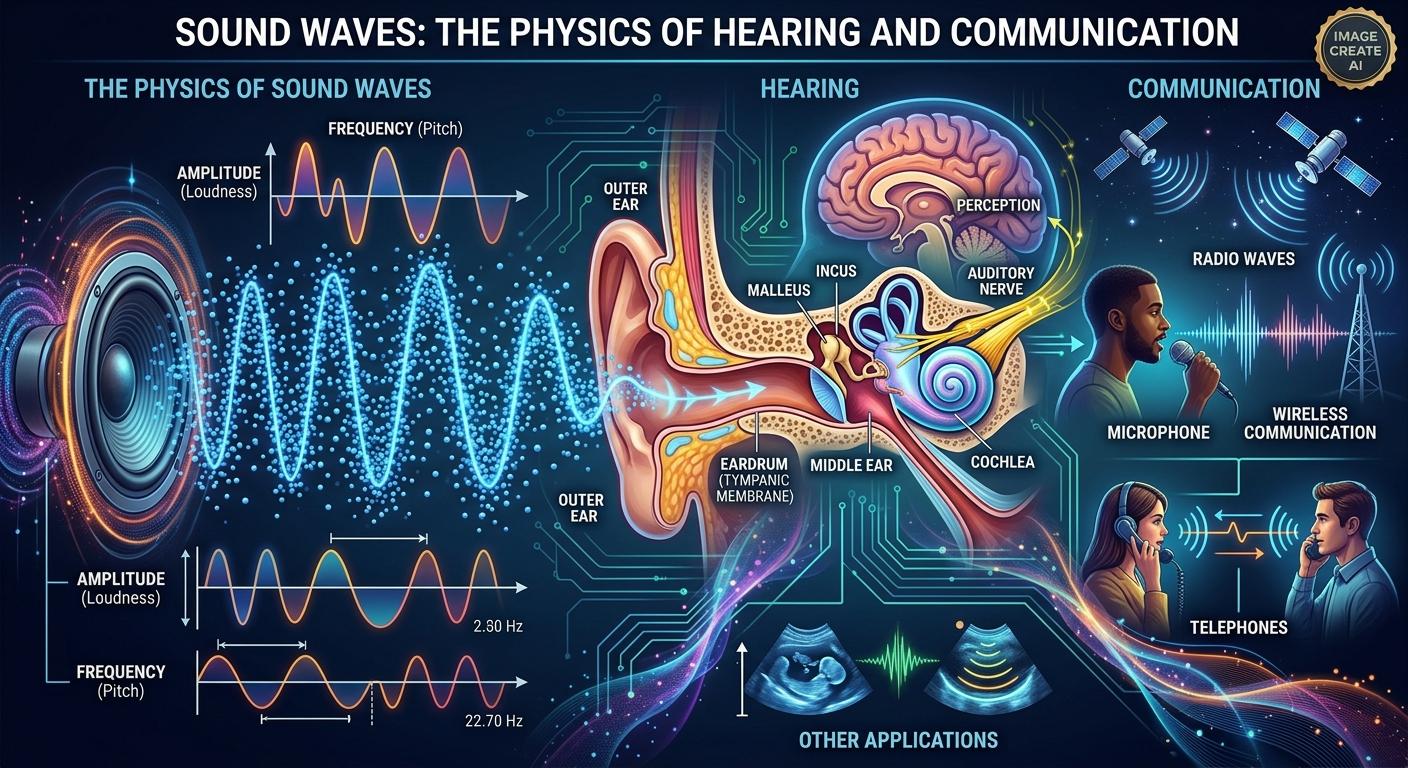
    Sound is an essential part of our everyday lives. We hear people speaking, music playing, birds singing, and many other sounds around us. But have you ever wondered how sound travels from one place to another? The answer lies in **sound waves**—vibrations that carry energy through a medium such as air, water, or solids.

    Sound is produced when an object **vibrates**. These vibrations cause nearby particles to move back and forth, creating a series of compressions and rarefactions. This movement travels outward as a wave. Unlike light, sound cannot travel through a vacuum because it needs particles to carry the vibrations.

    The characteristics of sound include **frequency, amplitude, wavelength, and speed**. Frequency determines the **pitch** of a sound: higher frequencies produce higher-pitched sounds, while lower frequencies produce deeper sounds. Amplitude is related to the **loudness** of a sound. Larger vibrations generally create louder sounds.

    Our ears are remarkable organs designed to detect these waves. Sound waves enter the ear and cause the **eardrum** to vibrate. These vibrations are transmitted through tiny bones in the middle ear and eventually reach the inner ear, where specialized cells convert them into electrical signals. The brain then interprets these signals as meaningful sounds.

    Sound waves also play a vital role in **human communication**. When we speak, our vocal cords vibrate and produce sound waves. These waves travel through the air to another person's ears, allowing them to hear and understand our words. Modern technology uses the same principles in telephones, microphones, radios, and other communication devices.

    The study of sound helps us understand not only hearing and communication but also music, medicine, engineering, and technology. From the simple vibration of a guitar string to advanced ultrasound technology, sound waves demonstrate the fascinating connection between **physics and everyday life**.

    **Sound is more than something we hear—it is energy in motion, carrying information and connecting us with the world around us.**

    #SoundWaves #Physics #Science #Hearing #Communication #Education #Learning #Waves #Technology
    #rsisb Roll no.239 Canva Post no.49 Foundation Level Sound is an essential part of our everyday lives. We hear people speaking, music playing, birds singing, and many other sounds around us. But have you ever wondered how sound travels from one place to another? The answer lies in **sound waves**—vibrations that carry energy through a medium such as air, water, or solids. Sound is produced when an object **vibrates**. These vibrations cause nearby particles to move back and forth, creating a series of compressions and rarefactions. This movement travels outward as a wave. Unlike light, sound cannot travel through a vacuum because it needs particles to carry the vibrations. The characteristics of sound include **frequency, amplitude, wavelength, and speed**. Frequency determines the **pitch** of a sound: higher frequencies produce higher-pitched sounds, while lower frequencies produce deeper sounds. Amplitude is related to the **loudness** of a sound. Larger vibrations generally create louder sounds. Our ears are remarkable organs designed to detect these waves. Sound waves enter the ear and cause the **eardrum** to vibrate. These vibrations are transmitted through tiny bones in the middle ear and eventually reach the inner ear, where specialized cells convert them into electrical signals. The brain then interprets these signals as meaningful sounds. Sound waves also play a vital role in **human communication**. When we speak, our vocal cords vibrate and produce sound waves. These waves travel through the air to another person's ears, allowing them to hear and understand our words. Modern technology uses the same principles in telephones, microphones, radios, and other communication devices. The study of sound helps us understand not only hearing and communication but also music, medicine, engineering, and technology. From the simple vibration of a guitar string to advanced ultrasound technology, sound waves demonstrate the fascinating connection between **physics and everyday life**. 🌟 **Sound is more than something we hear—it is energy in motion, carrying information and connecting us with the world around us.** #SoundWaves #Physics #Science #Hearing #Communication #Education #Learning #Waves #Technology 🔊🌍🎵
    0 التعليقات 0 المشاركات 3914 مشاهدة
  • #rsisb
    Roll No.240
    Story No.14
    Foundation Level

    **Sound Waves: The Physics of Hearing and Communication**

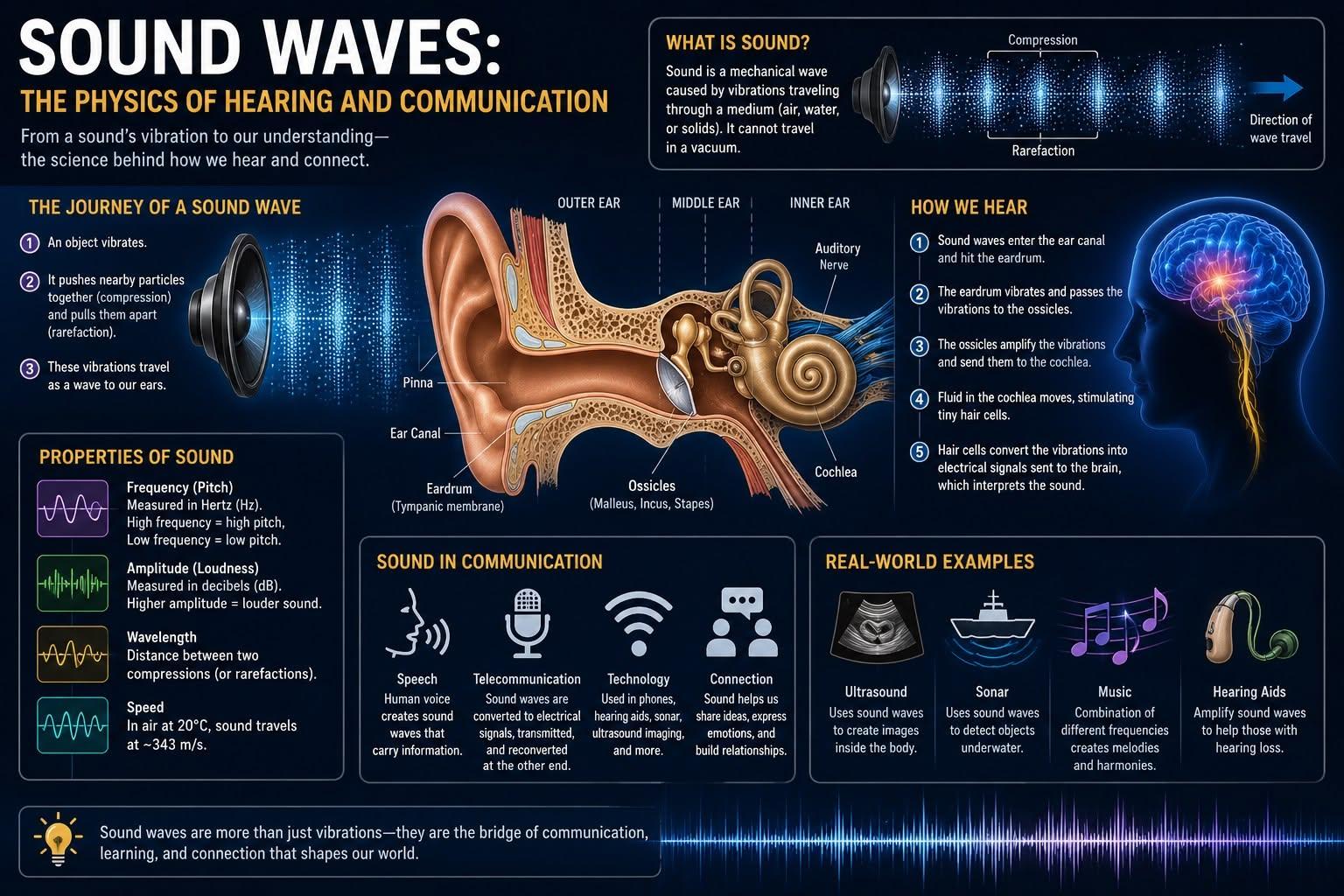
    Sound waves are invisible vibrations that travel through air, water, and solids, allowing us to hear and communicate with the world around us. Every sound begins when an object vibrates, creating waves that move through a medium until they reach our ears. These waves carry energy, not matter, and their frequency determines the pitch while their amplitude controls the loudness of the sound.

    Inside the human ear, sound waves follow an incredible journey. They enter through the outer ear, vibrate the eardrum, and pass through three tiny bones called the ossicles. These vibrations then reach the cochlea, where thousands of tiny hair cells convert them into electrical signals. The auditory nerve carries these signals to the brain, which interprets them as speech, music, or other familiar sounds.

    Sound plays a vital role in communication, education, entertainment, medicine, and technology. From conversations and musical performances to ultrasound imaging, sonar systems, and hearing aids, the science of sound has transformed countless aspects of modern life. Understanding how sound waves travel and interact with different materials helps scientists and engineers develop better communication systems and innovative technologies.

    The study of sound waves demonstrates the fascinating connection between physics and everyday life. By exploring concepts such as vibration, frequency, wavelength, amplitude, and wave speed, we gain a deeper appreciation of how hearing works and how sound enables people to connect, learn, and share ideas across the world.

    Rehan School Islamabad Campus
    Asma Shaheen EducationWali
    Irum Asim
    Saima Happinesswali
    #rsisb Roll No.240 Story No.14 Foundation Level **Sound Waves: The Physics of Hearing and Communication** Sound waves are invisible vibrations that travel through air, water, and solids, allowing us to hear and communicate with the world around us. Every sound begins when an object vibrates, creating waves that move through a medium until they reach our ears. These waves carry energy, not matter, and their frequency determines the pitch while their amplitude controls the loudness of the sound. Inside the human ear, sound waves follow an incredible journey. They enter through the outer ear, vibrate the eardrum, and pass through three tiny bones called the ossicles. These vibrations then reach the cochlea, where thousands of tiny hair cells convert them into electrical signals. The auditory nerve carries these signals to the brain, which interprets them as speech, music, or other familiar sounds. Sound plays a vital role in communication, education, entertainment, medicine, and technology. From conversations and musical performances to ultrasound imaging, sonar systems, and hearing aids, the science of sound has transformed countless aspects of modern life. Understanding how sound waves travel and interact with different materials helps scientists and engineers develop better communication systems and innovative technologies. The study of sound waves demonstrates the fascinating connection between physics and everyday life. By exploring concepts such as vibration, frequency, wavelength, amplitude, and wave speed, we gain a deeper appreciation of how hearing works and how sound enables people to connect, learn, and share ideas across the world. Rehan School Islamabad Campus Asma Shaheen EducationWali Irum Asim Saima Happinesswali
    0 التعليقات 0 المشاركات 5511 مشاهدة
  • Inshallah

    Prompt !!

    Ultra-realistic, high-resolution cinematic portrait of the man in the reference photo, wearing a traditional white thobe and keffiyeh, with stylish sunglasses. He stands calmly in front of Madinah at golden hour, as the warm sunset light creates a serene, glowing atmosphere. His expression is calm and dignified. Professional composition, soft cinematic lighting, 8K resolution, detailed.
    Inshallah ❤️ Prompt !! Ultra-realistic, high-resolution cinematic portrait of the man in the reference photo, wearing a traditional white thobe and keffiyeh, with stylish sunglasses. He stands calmly in front of Madinah at golden hour, as the warm sunset light creates a serene, glowing atmosphere. His expression is calm and dignified. Professional composition, soft cinematic lighting, 8K resolution, detailed.
    0 التعليقات 0 المشاركات 569 مشاهدة
  • Inshallah

    Prompt !!

    Ultra-realistic, high-resolution cinematic portrait of the man in the reference photo, wearing a traditional white thobe and keffiyeh, with stylish sunglasses. He stands calmly in front of Madinah at golden hour, as the warm sunset light creates a serene, glowing atmosphere. His expression is calm and dignified. Professional composition, soft cinematic lighting, 8K resolution, detailed.
    Inshallah ❤️ Prompt !! Ultra-realistic, high-resolution cinematic portrait of the man in the reference photo, wearing a traditional white thobe and keffiyeh, with stylish sunglasses. He stands calmly in front of Madinah at golden hour, as the warm sunset light creates a serene, glowing atmosphere. His expression is calm and dignified. Professional composition, soft cinematic lighting, 8K resolution, detailed.
    0 التعليقات 0 المشاركات 525 مشاهدة
  • Most educated car washers of Pakistan :) Amazing

    A week a go a boy messaged me, that I am a graduate of Electronics and am looking to wash cars, I thought he is doing a prank with me, based on my video to people who are asking me for money to go wash cars, I gave his contact to my office admin, and forgot, last week I was in an Iftaar and a boy came to me and told me that, your office still did not call me for car wash, And I was shocked, and gave him a hug, encouraging him about his boldness on doing what he intends to do. Today finally they came and washed the car and earned 200 rupees of washing the car.

    I have given them task to wash 100 cars, and come back to me, and we will start a proper car cleaning company or any other company that they are willing to start, based on their courage.

    Graduates like them are very very rare who are willing to let go of their fear and indulge into doing anything they feel, and They will be super successful in the long run as they have and will have competetive edge over any other un educated person doing the same thing anywhere else.

    I belive, that if they did the 100 cars, and come back to me and start a venture, there is no way on earth that they will not be ultra successful.

    I boy and respect to them and the parents who gave birth to such amazing young men !
    Most educated car washers of Pakistan :) Amazing A week a go a boy messaged me, that I am a graduate of Electronics and am looking to wash cars, I thought he is doing a prank with me, based on my video to people who are asking me for money to go wash car's, I gave his contact to my office admin, and forgot, last week I was in an Iftaar and a boy came to me and told me that, your office still did not call me for car wash, And I was shocked, and gave him a hug, encouraging him about his boldness on doing what he intends to do. Today finally they came and washed the car and earned 200 rupees of washing the car. I have given them task to wash 100 cars, and come back to me, and we will start a proper car cleaning company or any other company that they are willing to start, based on their courage. Graduates like them are very very rare who are willing to let go of their fear and indulge into doing anything they feel, and They will be super successful in the long run as they have and will have competetive edge over any other un educated person doing the same thing anywhere else. I belive, that if they did the 100 cars, and come back to me and start a venture, there is no way on earth that they will not be ultra successful. I boy and respect to them and the parents who gave birth to such amazing young men !
    0 التعليقات 0 المشاركات 538 مشاهدة
  • Forwarded as received !

    Are you a female doctor who is completing her house job and looking for a space to start your clinic? Are you motivated to work within your own communities (Model Colony, Bin Qasim, Korangi and Lyari- Karachi)? Sehat Kahani is here to offer you an amazing opportunity to run your clinic by providing you with an equipped space, medical personnel, mobilization resources and diagnostic facilities (lab referrals and ultrasound). Deadline to apply is 25th March. The first five eligible candidates will be selected on rolling basis. Apply fast! For further information please contact 03350336506 or 03433437227.
    makkiyajawed@sehatkahani.comzohaib.sehatkahani@gmail.com
    Forwarded as received ! Are you a female doctor who is completing her house job and looking for a space to start your clinic? Are you motivated to work within your own communities (Model Colony, Bin Qasim, Korangi and Lyari- Karachi)? Sehat Kahani is here to offer you an amazing opportunity to run your clinic by providing you with an equipped space, medical personnel, mobilization resources and diagnostic facilities (lab referrals and ultrasound). Deadline to apply is 25th March. The first five eligible candidates will be selected on rolling basis. Apply fast! For further information please contact 03350336506 or 03433437227. makkiyajawed@sehatkahani.comzohaib.sehatkahani@gmail.com
    0 التعليقات 0 المشاركات 634 مشاهدة
  • No new Siri still

    The iPhone 16 series introduces several exciting new features and improvements across its models, including iPhone 16, 16 Plus, 16 Pro, and 16 Pro Max.

    1. **New Camera Control Button**: One of the standout features is a dedicated **Camera Control button**, which simplifies taking photos and videos. You can quickly launch the camera and adjust settings by sliding along this button, making it easier to frame shots or adjust focus while shooting.

    2. **Enhanced Camera Capabilities**: The iPhone 16 brings significant upgrades to its camera system. The **48MP main camera** delivers improved image quality with options like 2x optical zoom, ultra-wide shots, and even macro photography. For videos, it supports **4K video recording at 120fps**, enabling cinematic slow-motion effects. Spatial photos and videos are also introduced, allowing for deeper memory capture to be viewed on devices like Apple Vision Pro.

    3. **Apple Intelligence and Visual Intelligence**: A key development is the integration of **Apple Intelligence**, Apple’s AI-powered features. While not available immediately, these tools will enhance search, object recognition, and photo cleanup using natural language and machine learning. The **Visual Intelligence** tool works similarly to Google Lens, identifying objects or places via the camera.

    4. **Performance Boosts with A18 Chip**: The iPhone 16 models are powered by the new **A18 and A18 Pro chipsets**, offering substantial performance upgrades—up to 30% faster CPU and 40% faster GPU. These are the first smartphones to feature 3nm chips, improving both speed and efficiency, especially in video encoding and gaming.

    5. **Audio and Video Recording**: The Pro models focus heavily on content creation with studio-quality microphones and the ability to adjust audio mixes for professional-grade sound during video recording.

    These features, alongside subtle design enhancements and new AI functionalities, make the iPhone 16 lineup a substantial upgrade, particularly for photography and content creation enthusiasts. The devices will start shipping with iOS 18, and more AI-powered features are expected to roll out later in 2024【6】【7】.
    No new Siri still 😞 The iPhone 16 series introduces several exciting new features and improvements across its models, including iPhone 16, 16 Plus, 16 Pro, and 16 Pro Max. 1. **New Camera Control Button**: One of the standout features is a dedicated **Camera Control button**, which simplifies taking photos and videos. You can quickly launch the camera and adjust settings by sliding along this button, making it easier to frame shots or adjust focus while shooting. 2. **Enhanced Camera Capabilities**: The iPhone 16 brings significant upgrades to its camera system. The **48MP main camera** delivers improved image quality with options like 2x optical zoom, ultra-wide shots, and even macro photography. For videos, it supports **4K video recording at 120fps**, enabling cinematic slow-motion effects. Spatial photos and videos are also introduced, allowing for deeper memory capture to be viewed on devices like Apple Vision Pro. 3. **Apple Intelligence and Visual Intelligence**: A key development is the integration of **Apple Intelligence**, Apple’s AI-powered features. While not available immediately, these tools will enhance search, object recognition, and photo cleanup using natural language and machine learning. The **Visual Intelligence** tool works similarly to Google Lens, identifying objects or places via the camera. 4. **Performance Boosts with A18 Chip**: The iPhone 16 models are powered by the new **A18 and A18 Pro chipsets**, offering substantial performance upgrades—up to 30% faster CPU and 40% faster GPU. These are the first smartphones to feature 3nm chips, improving both speed and efficiency, especially in video encoding and gaming. 5. **Audio and Video Recording**: The Pro models focus heavily on content creation with studio-quality microphones and the ability to adjust audio mixes for professional-grade sound during video recording. These features, alongside subtle design enhancements and new AI functionalities, make the iPhone 16 lineup a substantial upgrade, particularly for photography and content creation enthusiasts. The devices will start shipping with iOS 18, and more AI-powered features are expected to roll out later in 2024【6】【7】.
    0 التعليقات 0 المشاركات 821 مشاهدة
  • Inventing a room-temperature superconducting wire requires theoretical innovation and practical application. Here’s a proposed invention combining advanced materials, manufacturing techniques, and physical principles. This is a conceptual framework for a new type of superconductor wire that works at room temperature and standard atmospheric pressure.

    Name of the Invention: SuperCore RT-Wire

    Materials Used:
    1. Core Material:
    • A flexible and conductive metal like aluminum or copper as the structural backbone.
    • Coated with a stabilizing layer of boron-doped graphene for electron mobility enhancement.
    2. Superconducting Layer:
    • Hydrogen-Stabilized Lanthanum Hydride (LaH₁₀): Known to exhibit room-temperature superconductivity under high pressures.
    • Chemical Pressure Mimicry: Combine with nanostructured additives (like carbon nanotubes or diamond-like structures) to stabilize its superconducting state at normal pressure.
    3. Protective Encapsulation:
    • A flexible, transparent ceramic sheath (like silicon carbide) to protect against oxidation and moisture while maintaining flexibility.

    How It Works:
    1. Electron Pairing Without Cooling:
    • Use the hydrogen-stabilized structure of Lanthanum Hydride, reinforced by carbon nanostructures, to maintain quantum coherence (electron pairing) without requiring cryogenic cooling.
    2. Chemical Pressure Substitution:
    • Mimic the effects of extreme physical pressure by introducing chemical bonds and nanoscale lattice constraints using carbon-based scaffolds, like graphene or boron-doped diamond, to keep the superconducting structure stable.
    3. Multilayer Design:
    • The superconductor layer is deposited as a thin film over a conductive core (aluminum or copper).
    • Nanoengineered lattices prevent electron scattering, enhancing superconducting efficiency.

    Manufacturing Process:
    1. Step 1: Core Preparation
    • Aluminum or copper wire is cleaned and coated with a thin layer of boron-doped graphene using chemical vapor deposition (CVD).
    2. Step 2: Superconductor Layer Application
    • A thin film of hydrogen-stabilized lanthanum hydride is deposited onto the core wire using atomic layer deposition (ALD).
    • Carbon nanotubes or nanodiamonds are added during the process to stabilize the structure.
    3. Step 3: Protective Encapsulation
    • A ceramic or polymer sheath is applied using a spray-coating method to protect the wire and maintain structural integrity.
    4. Step 4: Quality Control
    • Each wire segment is tested for superconducting properties at room temperature before being spooled.

    Key Features:
    1. Room-Temperature Operation:
    • Works at standard atmospheric pressure and temperatures up to 25°C (77°F).
    2. Flexible and Scalable:
    • Designed to be produced in bulk using roll-to-roll manufacturing techniques, making it scalable and cost-effective.
    3. Affordable Materials:
    • Utilizes abundant elements like hydrogen, lanthanum, and carbon, reducing the overall cost.

    Applications:
    1. Power Transmission:
    Replace traditional copper or aluminum wires in power grids to eliminate energy losses.
    Example: A single kilometer of SuperCore RT-Wire could transmit gigawatts of electricity with zero resistance.
    2. Transportation:
    Use in maglev train systems to simplify and reduce the cost of high-speed rail systems.
    3. Electronics:
    Enable ultra-efficient circuits and processors for quantum computing and advanced AI systems.

    Challenges and Solutions:
    1. Stability at Normal Pressure:
    • Solution: Use nanoscale scaffolds and chemical bonding to maintain superconductivity without physical pressure.
    2. Cost Reduction:
    • Solution: Develop mass-production techniques like roll-to-roll deposition and inkjet printing for large-scale manufacturing.
    3. Durability:
    • Solution: Use robust protective coatings like silicon carbide to extend the wire’s lifespan.

    Proposed Prototype Development:
    1. Create a test segment of SuperCore RT-Wire using lab-scale CVD and ALD methods.
    2. Test for superconductivity at room temperature under normal atmospheric conditions.
    3. Iterate the design to optimize stability and reduce production costs.

    This invention, while conceptual, outlines a practical path to achieving a room-temperature superconducting wire using current knowledge and innovative engineering.
    Inventing a room-temperature superconducting wire requires theoretical innovation and practical application. Here’s a proposed invention combining advanced materials, manufacturing techniques, and physical principles. This is a conceptual framework for a new type of superconductor wire that works at room temperature and standard atmospheric pressure. Name of the Invention: SuperCore RT-Wire Materials Used: 1. Core Material: • A flexible and conductive metal like aluminum or copper as the structural backbone. • Coated with a stabilizing layer of boron-doped graphene for electron mobility enhancement. 2. Superconducting Layer: • Hydrogen-Stabilized Lanthanum Hydride (LaH₁₀): Known to exhibit room-temperature superconductivity under high pressures. • Chemical Pressure Mimicry: Combine with nanostructured additives (like carbon nanotubes or diamond-like structures) to stabilize its superconducting state at normal pressure. 3. Protective Encapsulation: • A flexible, transparent ceramic sheath (like silicon carbide) to protect against oxidation and moisture while maintaining flexibility. How It Works: 1. Electron Pairing Without Cooling: • Use the hydrogen-stabilized structure of Lanthanum Hydride, reinforced by carbon nanostructures, to maintain quantum coherence (electron pairing) without requiring cryogenic cooling. 2. Chemical Pressure Substitution: • Mimic the effects of extreme physical pressure by introducing chemical bonds and nanoscale lattice constraints using carbon-based scaffolds, like graphene or boron-doped diamond, to keep the superconducting structure stable. 3. Multilayer Design: • The superconductor layer is deposited as a thin film over a conductive core (aluminum or copper). • Nanoengineered lattices prevent electron scattering, enhancing superconducting efficiency. Manufacturing Process: 1. Step 1: Core Preparation • Aluminum or copper wire is cleaned and coated with a thin layer of boron-doped graphene using chemical vapor deposition (CVD). 2. Step 2: Superconductor Layer Application • A thin film of hydrogen-stabilized lanthanum hydride is deposited onto the core wire using atomic layer deposition (ALD). • Carbon nanotubes or nanodiamonds are added during the process to stabilize the structure. 3. Step 3: Protective Encapsulation • A ceramic or polymer sheath is applied using a spray-coating method to protect the wire and maintain structural integrity. 4. Step 4: Quality Control • Each wire segment is tested for superconducting properties at room temperature before being spooled. Key Features: 1. Room-Temperature Operation: • Works at standard atmospheric pressure and temperatures up to 25°C (77°F). 2. Flexible and Scalable: • Designed to be produced in bulk using roll-to-roll manufacturing techniques, making it scalable and cost-effective. 3. Affordable Materials: • Utilizes abundant elements like hydrogen, lanthanum, and carbon, reducing the overall cost. Applications: 1. Power Transmission: Replace traditional copper or aluminum wires in power grids to eliminate energy losses. Example: A single kilometer of SuperCore RT-Wire could transmit gigawatts of electricity with zero resistance. 2. Transportation: Use in maglev train systems to simplify and reduce the cost of high-speed rail systems. 3. Electronics: Enable ultra-efficient circuits and processors for quantum computing and advanced AI systems. Challenges and Solutions: 1. Stability at Normal Pressure: • Solution: Use nanoscale scaffolds and chemical bonding to maintain superconductivity without physical pressure. 2. Cost Reduction: • Solution: Develop mass-production techniques like roll-to-roll deposition and inkjet printing for large-scale manufacturing. 3. Durability: • Solution: Use robust protective coatings like silicon carbide to extend the wire’s lifespan. Proposed Prototype Development: 1. Create a test segment of SuperCore RT-Wire using lab-scale CVD and ALD methods. 2. Test for superconductivity at room temperature under normal atmospheric conditions. 3. Iterate the design to optimize stability and reduce production costs. This invention, while conceptual, outlines a practical path to achieving a room-temperature superconducting wire using current knowledge and innovative engineering.
    0 التعليقات 0 المشاركات 756 مشاهدة
  • Invention: Ultra-Efficient Motorcycle – “Eco700”

    Key Specifications:
    1. Fuel Efficiency: 700 km per liter of gasoline.
    2. Engine Type: Advanced Hyper-Efficient Combustion Engine (HECE).
    3. Weight: 50 kg (ultra-lightweight design).
    4. Top Speed: 90 km/h (optimized for fuel efficiency).
    5. Range: 7000 km on a 10-liter tank.

    Design Elements:
    1. Engine:
    • Homogeneous Charge Compression Ignition (HCCI) technology for near-perfect fuel combustion.
    • Nano-coated cylinder walls to reduce friction and heat loss.
    • Micro-turbocharging for efficient air-fuel mixing at low speeds.
    2. Chassis:
    • Constructed from carbon fiber-reinforced polymer for lightweight and durability.
    • Aerodynamic design to minimize drag.
    3. Fuel System:
    • Vapor injection system: Converts gasoline into a fine mist for better combustion.
    • Ultra-precise fuel injection controlled by AI algorithms.
    4. Transmission:
    • Continuously Variable Transmission (CVT) optimized for low energy loss.
    5. Wheels & Tires:
    • Low-resistance tires with self-sealing features to prevent punctures.
    6. Energy Recovery:
    • Regenerative braking to recover kinetic energy and reduce fuel usage.

    Prototype Assembly:
    1. Engine Development: Build the HCCI engine using advanced manufacturing techniques.
    2. Chassis Construction: Assemble the carbon-fiber body and integrate engine mounts.
    3. System Integration: Install the vapor injection and regenerative braking systems.
    4. Testing and Optimization: Conduct efficiency tests and fine-tune for maximum mileage.

    This motorcycle, the “Eco700,” achieves unparalleled fuel efficiency through cutting-edge engine technology, lightweight materials, and innovative design features.
    Invention: Ultra-Efficient Motorcycle – “Eco700” Key Specifications: 1. Fuel Efficiency: 700 km per liter of gasoline. 2. Engine Type: Advanced Hyper-Efficient Combustion Engine (HECE). 3. Weight: 50 kg (ultra-lightweight design). 4. Top Speed: 90 km/h (optimized for fuel efficiency). 5. Range: 7000 km on a 10-liter tank. Design Elements: 1. Engine: • Homogeneous Charge Compression Ignition (HCCI) technology for near-perfect fuel combustion. • Nano-coated cylinder walls to reduce friction and heat loss. • Micro-turbocharging for efficient air-fuel mixing at low speeds. 2. Chassis: • Constructed from carbon fiber-reinforced polymer for lightweight and durability. • Aerodynamic design to minimize drag. 3. Fuel System: • Vapor injection system: Converts gasoline into a fine mist for better combustion. • Ultra-precise fuel injection controlled by AI algorithms. 4. Transmission: • Continuously Variable Transmission (CVT) optimized for low energy loss. 5. Wheels & Tires: • Low-resistance tires with self-sealing features to prevent punctures. 6. Energy Recovery: • Regenerative braking to recover kinetic energy and reduce fuel usage. Prototype Assembly: 1. Engine Development: Build the HCCI engine using advanced manufacturing techniques. 2. Chassis Construction: Assemble the carbon-fiber body and integrate engine mounts. 3. System Integration: Install the vapor injection and regenerative braking systems. 4. Testing and Optimization: Conduct efficiency tests and fine-tune for maximum mileage. This motorcycle, the “Eco700,” achieves unparalleled fuel efficiency through cutting-edge engine technology, lightweight materials, and innovative design features.
    0 التعليقات 0 المشاركات 1259 مشاهدة
  • Invention: Budget Ultra-Efficient Motorcycle Engine - “EcoBudget700”

    Key Specifications:
    1. Fuel Efficiency: 700 km per liter of gasoline.
    2. Engine Cost: $100 (mass-produced).
    3. Material Choice: Affordable yet durable components.
    4. Simplified Design: Focus on functionality over high-end materials.

    Revised Engine Design:
    1. Engine Type:
    • Single-Cylinder 4-Stroke Engine with lean-burn technology.
    • Compression ratio optimized for maximum fuel efficiency (15:1).
    • Engine capacity: 50cc, tuned for low fuel consumption.
    2. Materials:
    • Cylinder Block: Aluminum alloy (low-cost casting).
    • Piston and Crankshaft: Steel (mass-produced with precision machining).
    • Engine Head: Cast iron (durable and inexpensive).
    3. Fuel System:
    • Simplified Carburetor with Pre-Mix Vaporization (low-cost alternative to direct injection).
    • Optimized air-fuel mixture control using a mechanical governor.
    4. Ignition System:
    • Low-Cost Spark Plug with high efficiency.
    • Basic CDI (Capacitor Discharge Ignition) system.
    5. Energy Recovery:
    • A simple flywheel system to store kinetic energy during deceleration.
    • No expensive regenerative braking systems.

    Cost Breakdown:
    • Cylinder Block (Aluminum): $20
    • Piston and Crankshaft (Steel): $25
    • Carburetor System: $15
    • Ignition System: $10
    • Miscellaneous (Bearings, Gaskets, etc.): $30

    Total Cost for Engine: $100

    Key Modifications for Cost Efficiency:
    1. Simplified Manufacturing: Use existing small engine production lines to mass-produce components.
    2. Off-the-Shelf Parts: Leverage commonly available motorcycle components to minimize R&D costs.
    3. Efficiency through Tuning: Precisely tune the engine for lean-burn operation at low speeds (maximum efficiency zone).

    Performance Expectations:
    • Fuel Efficiency: 700 km per liter in ideal conditions (cruising at 30-40 km/h).
    • Durability: Engine life of 5-7 years with basic maintenance.
    • Low Maintenance Costs: Simple design reduces repair costs.

    This affordable redesign makes a highly fuel-efficient engine accessible for mass-market production at just $100 per unit.
    Invention: Budget Ultra-Efficient Motorcycle Engine - “EcoBudget700” Key Specifications: 1. Fuel Efficiency: 700 km per liter of gasoline. 2. Engine Cost: $100 (mass-produced). 3. Material Choice: Affordable yet durable components. 4. Simplified Design: Focus on functionality over high-end materials. Revised Engine Design: 1. Engine Type: • Single-Cylinder 4-Stroke Engine with lean-burn technology. • Compression ratio optimized for maximum fuel efficiency (15:1). • Engine capacity: 50cc, tuned for low fuel consumption. 2. Materials: • Cylinder Block: Aluminum alloy (low-cost casting). • Piston and Crankshaft: Steel (mass-produced with precision machining). • Engine Head: Cast iron (durable and inexpensive). 3. Fuel System: • Simplified Carburetor with Pre-Mix Vaporization (low-cost alternative to direct injection). • Optimized air-fuel mixture control using a mechanical governor. 4. Ignition System: • Low-Cost Spark Plug with high efficiency. • Basic CDI (Capacitor Discharge Ignition) system. 5. Energy Recovery: • A simple flywheel system to store kinetic energy during deceleration. • No expensive regenerative braking systems. Cost Breakdown: • Cylinder Block (Aluminum): $20 • Piston and Crankshaft (Steel): $25 • Carburetor System: $15 • Ignition System: $10 • Miscellaneous (Bearings, Gaskets, etc.): $30 Total Cost for Engine: $100 Key Modifications for Cost Efficiency: 1. Simplified Manufacturing: Use existing small engine production lines to mass-produce components. 2. Off-the-Shelf Parts: Leverage commonly available motorcycle components to minimize R&D costs. 3. Efficiency through Tuning: Precisely tune the engine for lean-burn operation at low speeds (maximum efficiency zone). Performance Expectations: • Fuel Efficiency: 700 km per liter in ideal conditions (cruising at 30-40 km/h). • Durability: Engine life of 5-7 years with basic maintenance. • Low Maintenance Costs: Simple design reduces repair costs. This affordable redesign makes a highly fuel-efficient engine accessible for mass-market production at just $100 per unit.
    0 التعليقات 0 المشاركات 203 مشاهدة
الصفحات المعززة