• **Roll No: 2**
    **Batch: 14**
    **Book: ACCL**
    **Task No: 162**

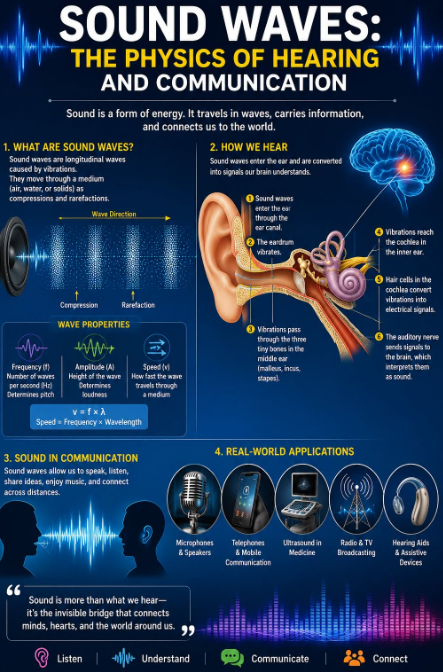
    # Sound Waves: The Physics of Hearing and Communication

    Have you ever wondered how we hear music, recognize someone's voice, or communicate with people from a distance? Every sound we hear is connected to the fascinating science of physics. From a gentle whisper to a powerful thunderstorm, sound travels through vibrations and waves, allowing us to experience and understand the world around us.

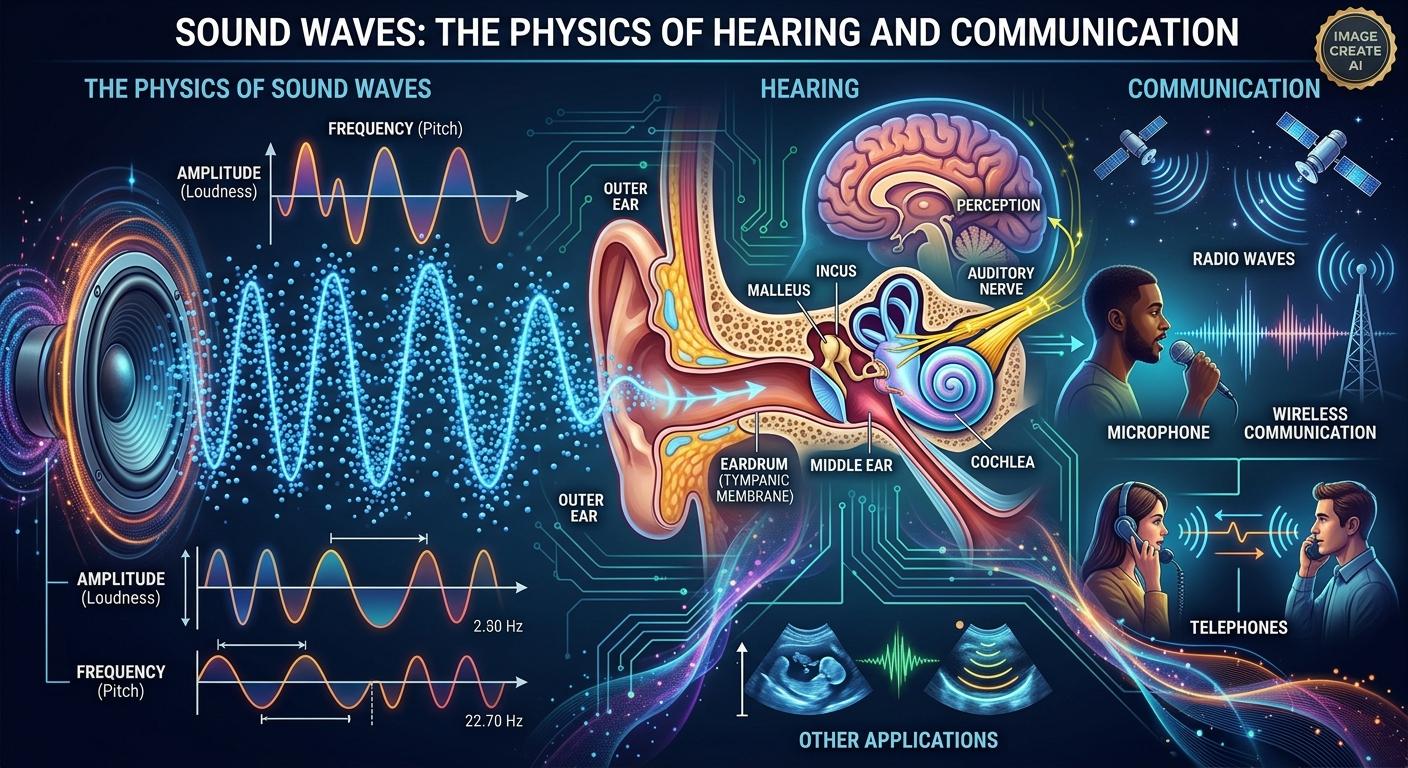
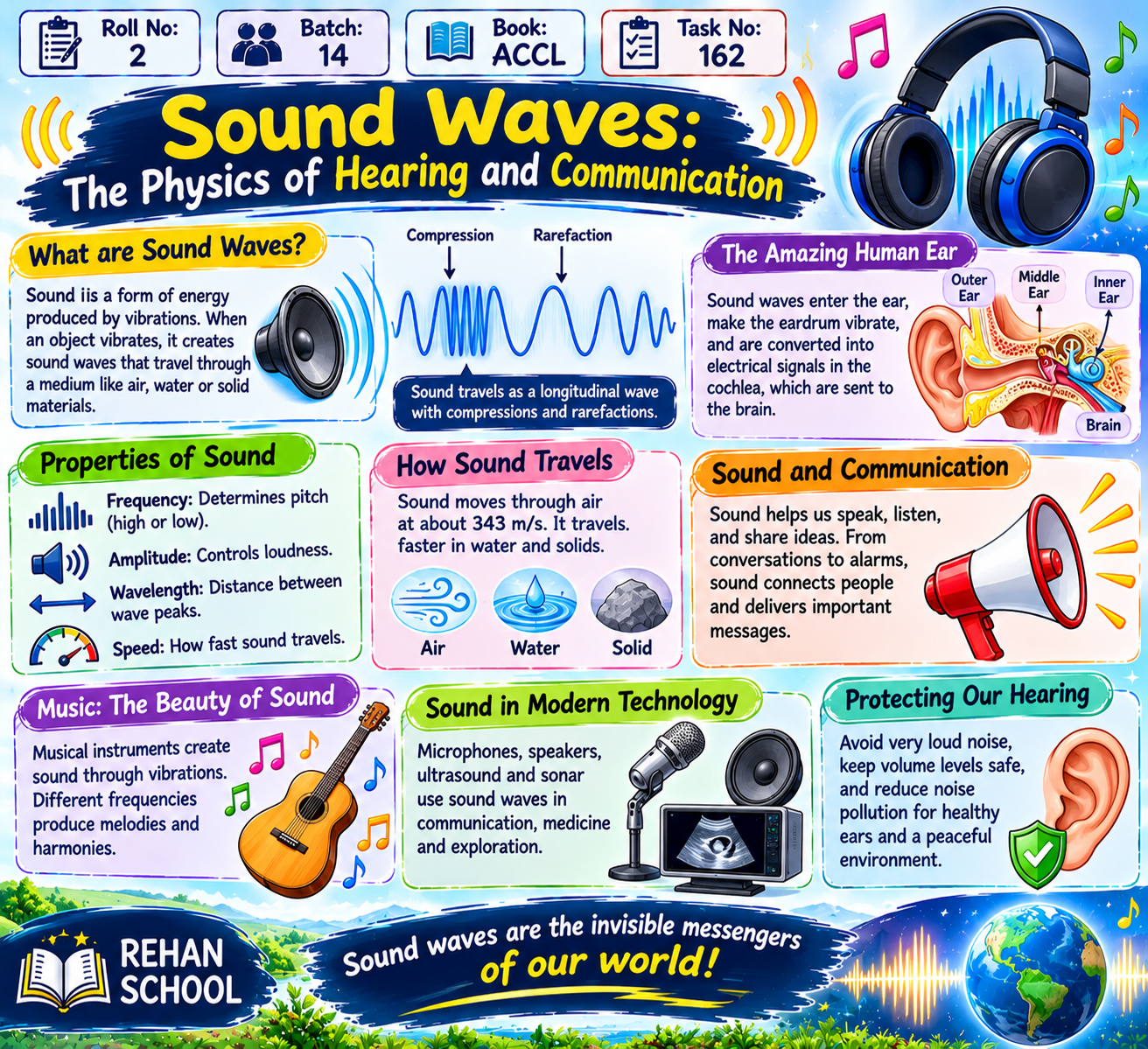
    **Sound is a form of energy produced by vibrations.** When an object vibrates, it causes nearby particles in a medium, such as air, water, or a solid material, to vibrate as well. These vibrations travel from one place to another in the form of sound waves. Unlike light, sound cannot travel through a vacuum because it needs a material medium to carry its vibrations.

    ## How Sound Waves Travel

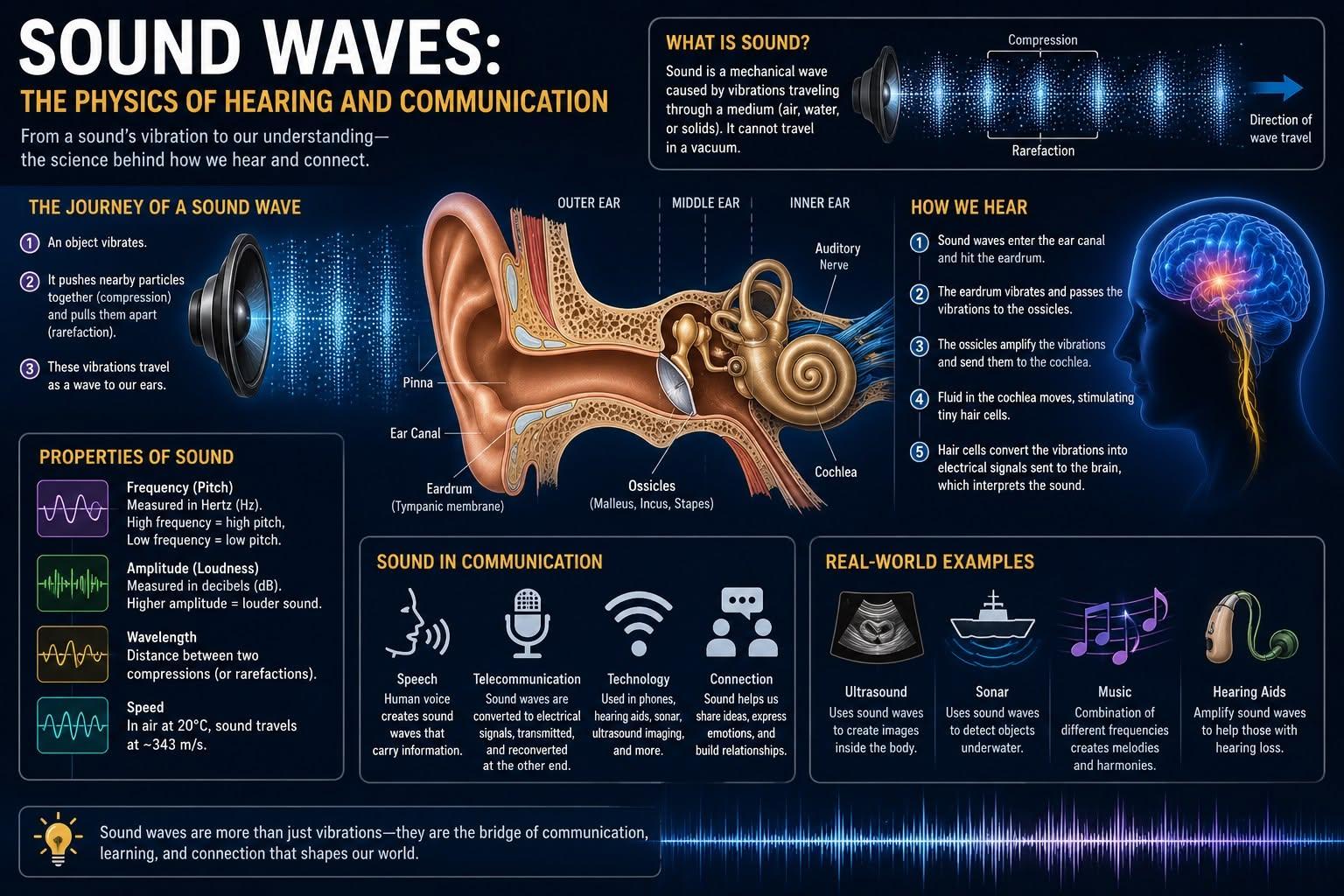
    Sound generally travels through air as a longitudinal wave. This means that air particles vibrate back and forth in the same direction as the wave travels. These movements create areas of compression, where particles are closer together, and rarefaction, where particles are farther apart. Together, these patterns carry sound energy through the medium.

    The speed of sound depends on the material through which it travels and the surrounding conditions. In air at room temperature, sound travels at approximately 343 metres per second. It generally travels faster through liquids and solids because of the properties of their particles. This explains why sound behaves differently in different environments.

    ## Important Properties of Sound

    Sound waves have several important properties that help us understand what we hear.

    - **Frequency:** The number of vibrations or cycles per second, measured in hertz (Hz). Frequency determines the pitch of a sound. Higher frequency usually means a higher-pitched sound, while lower frequency produces a deeper sound.
    - **Amplitude:** The size of a wave's vibration. Greater amplitude generally corresponds to a louder sound.
    - **Wavelength:** The distance between two corresponding points on a wave, such as two successive compressions.
    - **Speed:** The rate at which sound travels through a particular medium.

    These properties help explain why a bird's chirping sounds different from the deep rumble of thunder.

    ## The Amazing Science of Human Hearing

    The human ear is a remarkable organ that allows us to detect and interpret sound. It has three main parts: the outer ear, middle ear, and inner ear. Each part performs an important function in the hearing process.

    The outer ear collects sound waves and directs them into the ear canal. They reach the eardrum, causing it to vibrate. These vibrations pass through three tiny bones in the middle ear, known as the hammer, anvil, and stirrup. The vibrations then reach the cochlea in the inner ear, where specialized sensory cells convert them into electrical signals.

    These signals travel through the auditory nerve to the brain, which processes them and allows us to recognize voices, music, and other sounds.

    ## Sound and Human Communication

    Sound is one of the most important tools of human communication. Through speech, people share information, express emotions, tell stories, and build relationships. Different languages use different combinations of sounds to create words and meanings.

    Communication is not limited to spoken words. Music, alarms, bells, and other signals also carry information. For example, a school bell tells students when a class begins or ends, while emergency sirens warn people about possible dangers. Sound helps societies exchange information quickly and effectively.

    ## Music: The Beauty of Sound

    Music demonstrates the creative side of sound physics. Musical instruments produce vibrations in different ways. A guitar creates sound through vibrating strings, a flute produces sound through vibrating air, and a drum produces sound through a vibrating surface.

    Different frequencies combine to create melodies and harmonies. The quality or tone of a sound, called timbre, helps us distinguish one instrument from another even when they play the same musical note. This connection between physics and music shows how scientific principles can create beautiful artistic experiences.

    ## Sound in Modern Technology

    The science of sound has transformed communication and technology. Microphones convert sound waves into electrical signals, while speakers convert electrical signals back into sound. These devices make telephones, computers, televisions, and recording systems possible.

    Ultrasound technology uses sound waves with frequencies higher than the human hearing range. It is widely used in medical imaging to help doctors observe structures inside the body. Sonar systems use sound waves to detect objects underwater and estimate their distance. These applications show that sound is important not only for communication but also for science, medicine, and exploration.

    ## Protecting Our Hearing

    Although sound is useful, excessively loud noise can damage hearing. Continuous exposure to high sound levels may harm the sensitive structures inside the ears. Therefore, it is important to keep headphone volumes at safe levels, take listening breaks, and use suitable hearing protection in noisy environments.

    Noise pollution is another environmental concern. Traffic, construction, factories, and loud machinery can disturb people and wildlife. Reducing unnecessary noise helps create healthier and more peaceful surroundings.

    ## Learning Through Observation

    We can explore sound waves through simple and safe activities. For example, gently plucking a rubber band stretched around a box allows us to observe how vibrations produce sound. We can also compare the sounds of different musical instruments and notice how their pitch and tone vary.

    These observations help students connect scientific theories with everyday experiences. By asking questions, testing ideas, and recording observations, we develop a deeper understanding of the physics behind hearing and communication.

    Sound is much more than something we hear. It is a physical phenomenon that connects science, technology, music, nature, and human interaction. Every conversation, musical note, and natural sound demonstrates the remarkable journey of vibrations through the world around us.

    **Sound waves are the invisible messengers of our world. By understanding how they travel, how our ears detect them, and how technology uses them, we discover the powerful connection between physics, hearing, and communication. **

    #SoundWaves #PhysicsOfSound #Hearing #Communication #Acoustics #Science #HumanEar #SoundTechnology #ACCL #Batch14 #Task162
    **Roll No: 2** **Batch: 14** **Book: ACCL** **Task No: 162** # 🔊🎵 Sound Waves: The Physics of Hearing and Communication 👂🌍 Have you ever wondered how we hear music, recognize someone's voice, or communicate with people from a distance? 🎶📢 Every sound we hear is connected to the fascinating science of physics. From a gentle whisper to a powerful thunderstorm, sound travels through vibrations and waves, allowing us to experience and understand the world around us. 🌎✨ **Sound is a form of energy produced by vibrations.** 🔬 When an object vibrates, it causes nearby particles in a medium, such as air, water, or a solid material, to vibrate as well. These vibrations travel from one place to another in the form of sound waves. Unlike light, sound cannot travel through a vacuum because it needs a material medium to carry its vibrations. ## 🌊 How Sound Waves Travel Sound generally travels through air as a longitudinal wave. This means that air particles vibrate back and forth in the same direction as the wave travels. These movements create areas of compression, where particles are closer together, and rarefaction, where particles are farther apart. Together, these patterns carry sound energy through the medium. 🌬️ The speed of sound depends on the material through which it travels and the surrounding conditions. In air at room temperature, sound travels at approximately 343 metres per second. It generally travels faster through liquids and solids because of the properties of their particles. This explains why sound behaves differently in different environments. 💧🪨 ## 📏 Important Properties of Sound Sound waves have several important properties that help us understand what we hear. - **Frequency:** The number of vibrations or cycles per second, measured in hertz (Hz). Frequency determines the pitch of a sound. Higher frequency usually means a higher-pitched sound, while lower frequency produces a deeper sound. - **Amplitude:** The size of a wave's vibration. Greater amplitude generally corresponds to a louder sound. - **Wavelength:** The distance between two corresponding points on a wave, such as two successive compressions. - **Speed:** The rate at which sound travels through a particular medium. These properties help explain why a bird's chirping sounds different from the deep rumble of thunder. 🐦⛈️ ## 👂 The Amazing Science of Human Hearing The human ear is a remarkable organ that allows us to detect and interpret sound. It has three main parts: the outer ear, middle ear, and inner ear. Each part performs an important function in the hearing process. 🦻 The outer ear collects sound waves and directs them into the ear canal. They reach the eardrum, causing it to vibrate. These vibrations pass through three tiny bones in the middle ear, known as the hammer, anvil, and stirrup. The vibrations then reach the cochlea in the inner ear, where specialized sensory cells convert them into electrical signals. These signals travel through the auditory nerve to the brain, which processes them and allows us to recognize voices, music, and other sounds. 🧠💡 ## 🗣️ Sound and Human Communication Sound is one of the most important tools of human communication. Through speech, people share information, express emotions, tell stories, and build relationships. Different languages use different combinations of sounds to create words and meanings. 🗨️🌍 Communication is not limited to spoken words. Music, alarms, bells, and other signals also carry information. For example, a school bell tells students when a class begins or ends, while emergency sirens warn people about possible dangers. Sound helps societies exchange information quickly and effectively. 🚨🔔 ## 🎶 Music: The Beauty of Sound Music demonstrates the creative side of sound physics. Musical instruments produce vibrations in different ways. A guitar creates sound through vibrating strings, a flute produces sound through vibrating air, and a drum produces sound through a vibrating surface. 🎸🥁 Different frequencies combine to create melodies and harmonies. The quality or tone of a sound, called timbre, helps us distinguish one instrument from another even when they play the same musical note. This connection between physics and music shows how scientific principles can create beautiful artistic experiences. 🎼✨ ## 📡 Sound in Modern Technology The science of sound has transformed communication and technology. Microphones convert sound waves into electrical signals, while speakers convert electrical signals back into sound. These devices make telephones, computers, televisions, and recording systems possible. 📱💻 Ultrasound technology uses sound waves with frequencies higher than the human hearing range. It is widely used in medical imaging to help doctors observe structures inside the body. Sonar systems use sound waves to detect objects underwater and estimate their distance. These applications show that sound is important not only for communication but also for science, medicine, and exploration. 🏥🚢 ## 🌍 Protecting Our Hearing Although sound is useful, excessively loud noise can damage hearing. Continuous exposure to high sound levels may harm the sensitive structures inside the ears. Therefore, it is important to keep headphone volumes at safe levels, take listening breaks, and use suitable hearing protection in noisy environments. 💚👂 Noise pollution is another environmental concern. Traffic, construction, factories, and loud machinery can disturb people and wildlife. Reducing unnecessary noise helps create healthier and more peaceful surroundings. 🌳🏡 ## 🧪 Learning Through Observation We can explore sound waves through simple and safe activities. For example, gently plucking a rubber band stretched around a box allows us to observe how vibrations produce sound. We can also compare the sounds of different musical instruments and notice how their pitch and tone vary. These observations help students connect scientific theories with everyday experiences. By asking questions, testing ideas, and recording observations, we develop a deeper understanding of the physics behind hearing and communication. 🔍📚 Sound is much more than something we hear. It is a physical phenomenon that connects science, technology, music, nature, and human interaction. Every conversation, musical note, and natural sound demonstrates the remarkable journey of vibrations through the world around us. 🌎🔊 **Sound waves are the invisible messengers of our world. By understanding how they travel, how our ears detect them, and how technology uses them, we discover the powerful connection between physics, hearing, and communication. 🎵👂🔬💚** #SoundWaves #PhysicsOfSound #Hearing #Communication #Acoustics #Science #HumanEar #SoundTechnology #ACCL #Batch14 #Task162 🔊🎶🌍
    0 Σχόλια 0 Μοιράστηκε 4805 Views
  • **REHAN SCHOOL — URDU BAZAAR CAMPUS**
    **Day 174 | Story Post**
    **Foundation Level**
    **Roll No: 01**

    **Sound Waves: The Physics of Hearing and Communication**

    Kya aap ne kabhi socha hai ke hum kisi ki awaaz kaise sunte hain aur door baithe kisi insaan ki baat hum tak kaise pohanchti hai? Iska jawab sound waves yani awaaz ki lehron mein chhupa hai!

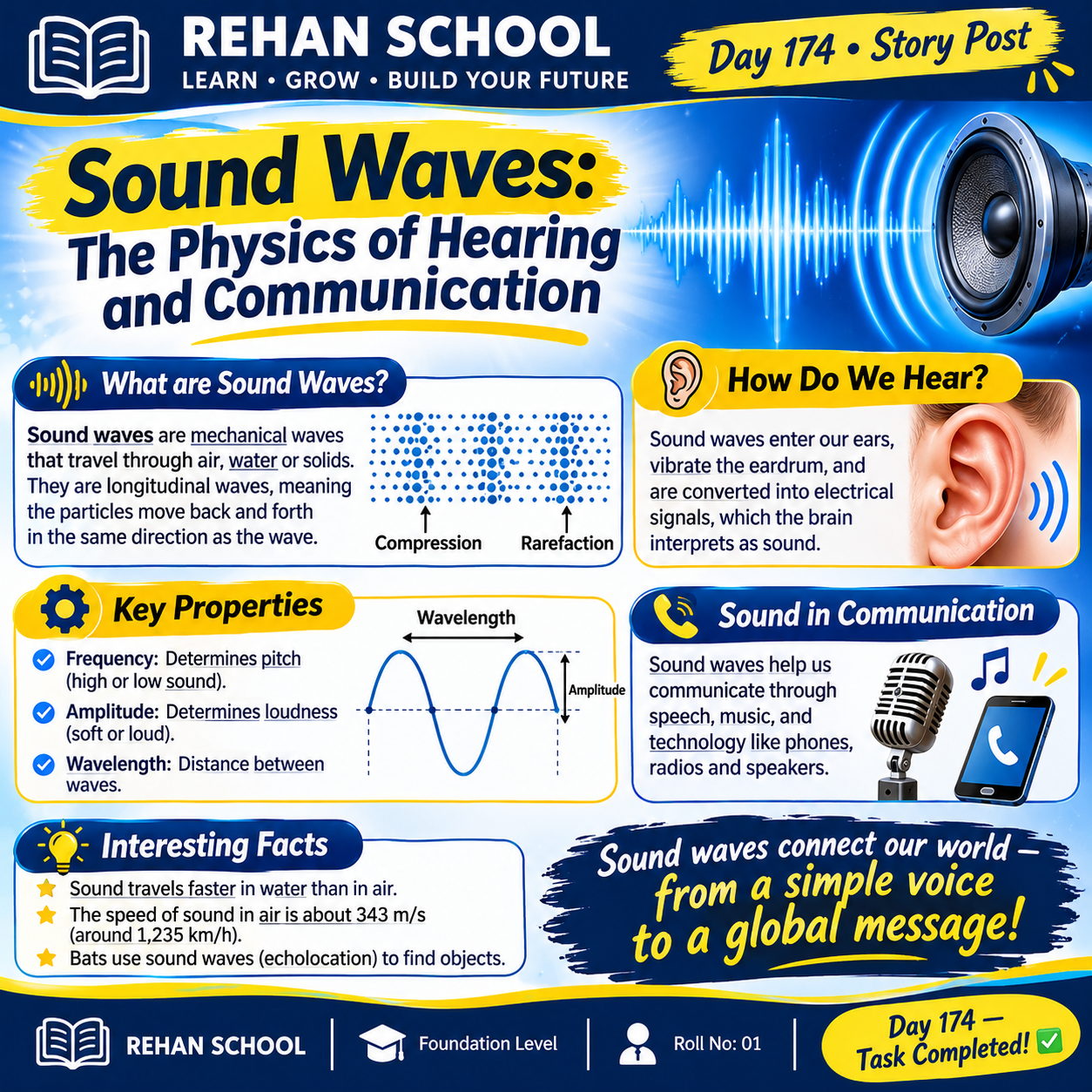
    Aaj ke Story Post mein maine sound waves aur unke hamari daily life mein important role ke baare mein seekha. Jab koi cheez vibrate karti hai, to woh apne aas paas ke medium, jaise hawa, mein sound waves paida kar sakti hai. Ye waves travel karti hain aur jab hamare kaan tak pohanchti hain, to hamara hearing system unhein signals mein convert karta hai, jinhein brain samajhta hai.

    Sound waves sirf sunne ke liye hi nahi, balki communication ke liye bhi bohot zaroori hain. Hum baat karne, music sunne, alarms, announcements aur different sounds ke zariye information share karte hain. Science aur technology mein bhi sound ka use hota hai, jaise ultrasound medical imaging mein madad karta hai.

    Is task se mujhe ye samajh aaya ke ek simple si awaaz ke peeche bhi physics ka interesting process hota hai. Sound waves ko samajh kar hum apni duniya ko aur behtar tareeqe se explore kar sakte hain.

    **Vibration → Sound Waves → Ears → Brain → Understanding**

    **“Every sound carries a wave, and every wave helps us understand the world around us.”**

    **Day 174 — Task Completed!**

    #RehanSchool #UrduBazaarCampus #Day174 #StoryPost #SoundWaves #Physics #Science #Hearing #Communication #SoundEnergy #Ultrasound #LearningJourney #Education #FoundationLevel #AI #ExploreScience
    🏫 **REHAN SCHOOL — URDU BAZAAR CAMPUS** 📖 **Day 174 | Story Post** 📚 **Foundation Level** 🔢 **Roll No: 01** 🔊 **Sound Waves: The Physics of Hearing and Communication** Kya aap ne kabhi socha hai ke hum kisi ki awaaz kaise sunte hain aur door baithe kisi insaan ki baat hum tak kaise pohanchti hai? 🤔🎧 Iska jawab sound waves yani awaaz ki lehron mein chhupa hai! Aaj ke Story Post mein maine sound waves aur unke hamari daily life mein important role ke baare mein seekha. 💡 Jab koi cheez vibrate karti hai, to woh apne aas paas ke medium, jaise hawa, mein sound waves paida kar sakti hai. Ye waves travel karti hain aur jab hamare kaan tak pohanchti hain, to hamara hearing system unhein signals mein convert karta hai, jinhein brain samajhta hai. 🧠👂 Sound waves sirf sunne ke liye hi nahi, balki communication ke liye bhi bohot zaroori hain. Hum baat karne, music sunne, alarms, announcements aur different sounds ke zariye information share karte hain. 📢🎶 Science aur technology mein bhi sound ka use hota hai, jaise ultrasound medical imaging mein madad karta hai. Is task se mujhe ye samajh aaya ke ek simple si awaaz ke peeche bhi physics ka interesting process hota hai. Sound waves ko samajh kar hum apni duniya ko aur behtar tareeqe se explore kar sakte hain. 🔬🌍 🎯 **Vibration → Sound Waves → Ears → Brain → Understanding** ✨ **“Every sound carries a wave, and every wave helps us understand the world around us.”** ✅ **Day 174 — Task Completed!** #RehanSchool #UrduBazaarCampus #Day174 #StoryPost #SoundWaves #Physics #Science #Hearing #Communication #SoundEnergy #Ultrasound #LearningJourney #Education #FoundationLevel #AI #ExploreScience
    0 Σχόλια 0 Μοιράστηκε 1758 Views
  • **Roll No: 2**
    **Batch: 14**
    **Book: ACCL**
    **Task No: 160**

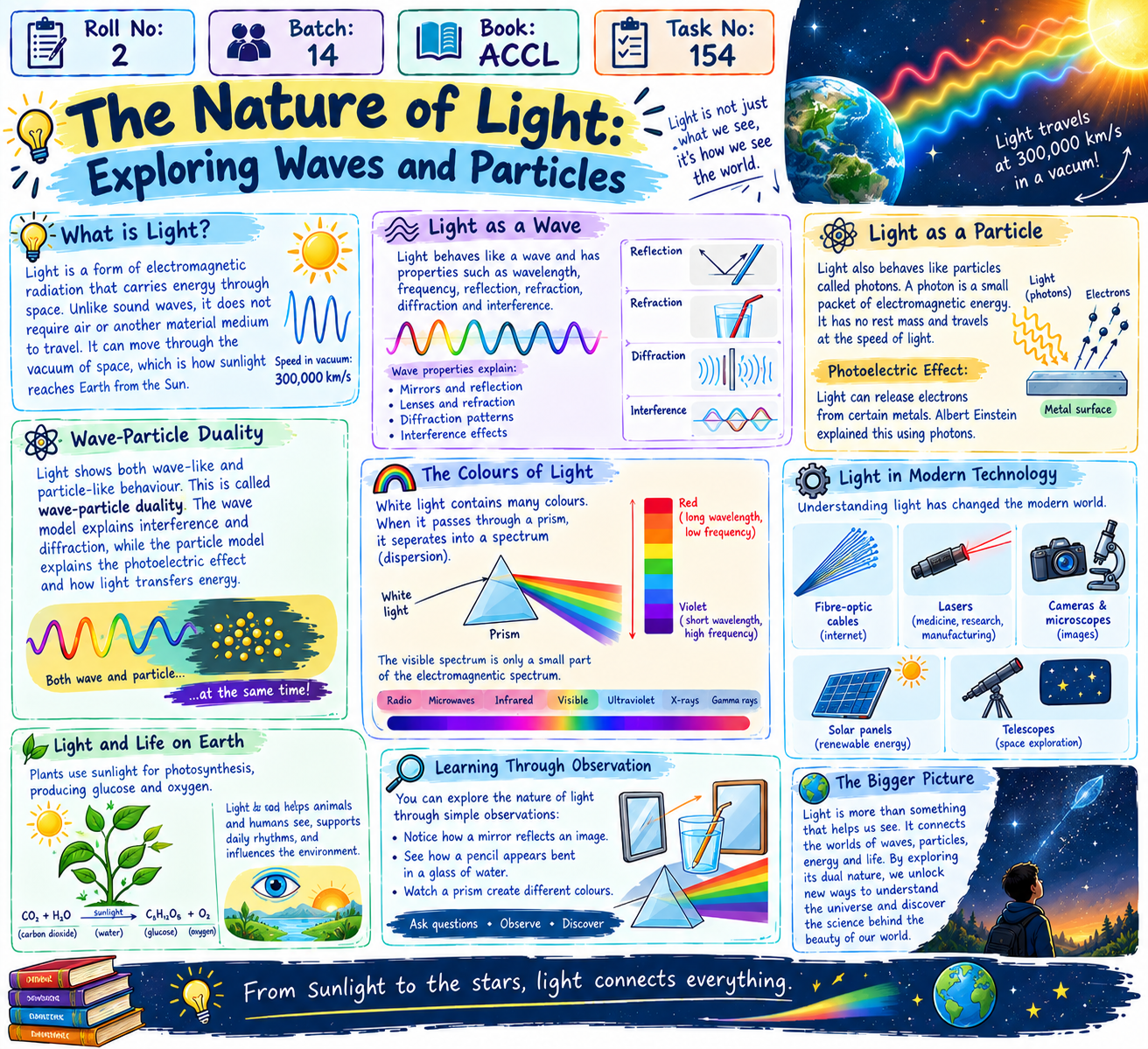
    # The Nature of Light: Exploring Waves and Particles

    Have you ever wondered how we see the colorful world around us? From the bright sunshine in the morning to the glowing stars at night, light plays an essential role in our lives. It allows us to see objects, helps plants grow, and makes many modern technologies possible. But what exactly is light? Is it a wave, a particle, or something even more fascinating?

    **Light is a form of electromagnetic radiation that carries energy through space.** Unlike sound waves, light does not require air or another material medium to travel. It can move through the vacuum of space, which is how sunlight reaches Earth from the Sun. In a vacuum, light travels at approximately 300,000 kilometres per second, making it one of the fastest phenomena in nature.

    ## Light as a Wave

    For many years, scientists studied light and discovered that it behaves like a wave. Light waves have properties such as wavelength, frequency, reflection, refraction, diffraction, and interference. These properties help explain many everyday optical phenomena.

    **Reflection** occurs when light bounces off a surface. A mirror is a familiar example because it reflects light and allows us to see our image. **Refraction** happens when light changes direction as it passes from one transparent material into another, such as from air into water. This is why a straw placed in a glass of water may appear bent.

    Light can also spread out through a process called diffraction and produce patterns through interference. These wave properties provide important evidence of the wave nature of light. Scientists use them to understand lenses, microscopes, telescopes, and many other optical instruments.

    ## Light as a Particle

    Light also behaves in ways that can be explained by particles called **photons**. A photon is a small packet, or quantum, of electromagnetic energy. Photons have no rest mass and travel at the speed of light in a vacuum.

    One important discovery was the photoelectric effect. Scientists observed that when light of a suitable frequency shines on certain metals, it can cause electrons to be released. Albert Einstein explained this phenomenon by showing that light transfers energy in individual packets called photons. This discovery helped establish the foundation of quantum physics.

    The particle model explains how light interacts with matter in processes such as the photoelectric effect and the absorption and emission of energy by atoms.

    ## Wave-Particle Duality

    One of the most fascinating discoveries in physics is that light shows both wave-like and particle-like behaviour. This idea is known as **wave-particle duality**.

    Light does not behave like an ordinary water wave or a tiny solid ball. Instead, its behaviour depends on the type of experiment and how it interacts with matter. The wave description helps explain interference and diffraction, while the photon description explains how light transfers energy in individual amounts.

    This discovery changed the way scientists understand the universe and became an important part of quantum mechanics.

    ## The Colours of Light

    White light may look simple, but it contains many different colours. When white light passes through a glass prism, it separates into a spectrum of colours: red, orange, yellow, green, blue, indigo, and violet. This process is called **dispersion**.

    Each colour has a different wavelength and frequency. Red light has a longer wavelength than violet light, while violet light has a higher frequency. The visible spectrum is only a small part of the electromagnetic spectrum, which also includes radio waves, microwaves, infrared radiation, ultraviolet radiation, X-rays, and gamma rays.

    ## Light in Modern Technology

    The study of light has transformed the modern world. Fibre-optic cables use light to transmit information over long distances, supporting internet communication and global connectivity. Lasers are used in medical equipment, scientific research, manufacturing, and barcode scanners.

    Cameras and microscopes use lenses to control light and produce images. Solar panels convert energy from sunlight into electrical energy, while telescopes help scientists observe distant stars and galaxies. These technologies demonstrate how understanding light can improve everyday life and expand human knowledge.

    ## Light and Life on Earth

    Light is essential for many living organisms. Green plants use sunlight during photosynthesis to produce glucose from water and carbon dioxide, releasing oxygen as a by-product. This process supports food chains and helps maintain the balance of gases in Earth's atmosphere.

    Light also helps animals and humans understand their surroundings through vision. Many organisms use natural light patterns to regulate daily activities, while sunlight influences environmental conditions and the rhythms of life.

    ## Learning Through Observation

    You can explore the nature of light through simple observations. Notice how a mirror reflects an image, how a pencil appears bent in a glass of water, or how sunlight passing through a prism produces different colours. These examples connect scientific ideas with experiences from everyday life.

    By asking questions, making observations, and studying experiments, we can understand how light behaves and why it is so important in science.

    **Light is more than something that helps us see; it is a fascinating phenomenon that connects the worlds of waves, particles, energy, and life. By exploring its dual nature, we unlock new ways to understand the universe and discover the science behind the beauty of our world. **

    \#NatureOfLight #WavesAndParticles #Physics #QuantumPhysics #ElectromagneticWaves #Science #ACCL #Batch14 #Task154
    **Roll No: 2** **Batch: 14** **Book: ACCL** **Task No: 160** # 🌈💡 The Nature of Light: Exploring Waves and Particles 🔬🌊 Have you ever wondered how we see the colorful world around us? 🌍 From the bright sunshine in the morning to the glowing stars at night, light plays an essential role in our lives. It allows us to see objects, helps plants grow, and makes many modern technologies possible. But what exactly is light? Is it a wave, a particle, or something even more fascinating? ✨ **Light is a form of electromagnetic radiation that carries energy through space.** Unlike sound waves, light does not require air or another material medium to travel. It can move through the vacuum of space, which is how sunlight reaches Earth from the Sun. In a vacuum, light travels at approximately 300,000 kilometres per second, making it one of the fastest phenomena in nature. ☀️🚀 ## 🌊 Light as a Wave For many years, scientists studied light and discovered that it behaves like a wave. Light waves have properties such as wavelength, frequency, reflection, refraction, diffraction, and interference. These properties help explain many everyday optical phenomena. 🌈 **Reflection** occurs when light bounces off a surface. A mirror is a familiar example because it reflects light and allows us to see our image. **Refraction** happens when light changes direction as it passes from one transparent material into another, such as from air into water. This is why a straw placed in a glass of water may appear bent. 🪞💧 Light can also spread out through a process called diffraction and produce patterns through interference. These wave properties provide important evidence of the wave nature of light. Scientists use them to understand lenses, microscopes, telescopes, and many other optical instruments. 🔭🔬 ## ⚛️ Light as a Particle Light also behaves in ways that can be explained by particles called **photons**. A photon is a small packet, or quantum, of electromagnetic energy. Photons have no rest mass and travel at the speed of light in a vacuum. ⚡ One important discovery was the photoelectric effect. Scientists observed that when light of a suitable frequency shines on certain metals, it can cause electrons to be released. Albert Einstein explained this phenomenon by showing that light transfers energy in individual packets called photons. This discovery helped establish the foundation of quantum physics. 🧪 The particle model explains how light interacts with matter in processes such as the photoelectric effect and the absorption and emission of energy by atoms. ## 🔬 Wave-Particle Duality One of the most fascinating discoveries in physics is that light shows both wave-like and particle-like behaviour. This idea is known as **wave-particle duality**. 🌌 Light does not behave like an ordinary water wave or a tiny solid ball. Instead, its behaviour depends on the type of experiment and how it interacts with matter. The wave description helps explain interference and diffraction, while the photon description explains how light transfers energy in individual amounts. This discovery changed the way scientists understand the universe and became an important part of quantum mechanics. ## 🌈 The Colours of Light White light may look simple, but it contains many different colours. When white light passes through a glass prism, it separates into a spectrum of colours: red, orange, yellow, green, blue, indigo, and violet. This process is called **dispersion**. 🌈 Each colour has a different wavelength and frequency. Red light has a longer wavelength than violet light, while violet light has a higher frequency. The visible spectrum is only a small part of the electromagnetic spectrum, which also includes radio waves, microwaves, infrared radiation, ultraviolet radiation, X-rays, and gamma rays. ## 📡 Light in Modern Technology The study of light has transformed the modern world. Fibre-optic cables use light to transmit information over long distances, supporting internet communication and global connectivity. 💻🌐 Lasers are used in medical equipment, scientific research, manufacturing, and barcode scanners. Cameras and microscopes use lenses to control light and produce images. Solar panels convert energy from sunlight into electrical energy, while telescopes help scientists observe distant stars and galaxies. These technologies demonstrate how understanding light can improve everyday life and expand human knowledge. 🔭🔋 ## 🌱 Light and Life on Earth Light is essential for many living organisms. Green plants use sunlight during photosynthesis to produce glucose from water and carbon dioxide, releasing oxygen as a by-product. This process supports food chains and helps maintain the balance of gases in Earth's atmosphere. 🌿☀️ Light also helps animals and humans understand their surroundings through vision. Many organisms use natural light patterns to regulate daily activities, while sunlight influences environmental conditions and the rhythms of life. ## 🧠 Learning Through Observation You can explore the nature of light through simple observations. Notice how a mirror reflects an image, how a pencil appears bent in a glass of water, or how sunlight passing through a prism produces different colours. These examples connect scientific ideas with experiences from everyday life. 🔍📚 By asking questions, making observations, and studying experiments, we can understand how light behaves and why it is so important in science. **Light is more than something that helps us see; it is a fascinating phenomenon that connects the worlds of waves, particles, energy, and life. By exploring its dual nature, we unlock new ways to understand the universe and discover the science behind the beauty of our world. 🌈💡🌍** \#NatureOfLight #WavesAndParticles #Physics #QuantumPhysics #ElectromagneticWaves #Science #ACCL #Batch14 #Task154 🌈🔬✨
    0 Σχόλια 0 Μοιράστηκε 4194 Views
  • RSIF8
    Roll no:14
    canva post no:67
    canva post topic:"Doubt kills more dreams than failure ever will." — Suzy Kassem

    **Sound Waves: The Physics of Hearing and Communication**

    Welcome to the fascinating world of sound waves, where physics explains how we hear, speak, listen to music, and communicate with one another! Sound is more than just noise; it is a form of energy that travels through a medium such as air, water, or solids in the form of mechanical waves.

    **What Are Sound Waves?**

    Sound waves are produced when an object vibrates, causing nearby particles to vibrate and transfer energy from one place to another. These waves travel through compressions and rarefactions, allowing sound to reach our ears. Unlike light waves, sound waves need a medium to travel and cannot move through a vacuum.

    **How Do We Hear Sound?**

    Our hearing system is an amazing example of science in action! When sound waves enter the outer ear, they travel through the ear canal and make the eardrum vibrate. Tiny bones in the middle ear transmit these vibrations to the cochlea in the inner ear, where they are converted into electrical signals. The auditory nerve carries these signals to the brain, which interprets them as sounds.

    **Key Properties of Sound Waves:**

    **Frequency:** Determines the pitch of a sound, whether it is high or low. It is measured in hertz (Hz).

    **Amplitude:** Determines the loudness of a sound.

    **Wavelength:** Represents the distance between two consecutive points in a wave, such as compressions.

    **Speed:** Sound travels through air at approximately 343 meters per second at 20°C.

    **Sound Waves in Communication**

    Sound waves play an essential role in our everyday lives. Human speech allows us to share ideas and emotions, music brings creativity and expression, and technologies such as telephones, radios, sonar, and voice communication systems help connect people across the world.

    **Why Is Understanding Sound Important?**

    Learning about sound waves helps us understand the science behind hearing, musical instruments, noise reduction, medical ultrasound, and modern communication technologies. It also shows how physics connects scientific principles with the experiences we encounter every day.

    **Discover the invisible waves that bring voices to our ears and connect people, ideas, and the world!**

    Like, Share, and Follow for more interesting science topics, educational content, and fascinating discoveries!

    #SoundWaves #Physics #ScienceEducation #Hearing #Communication #Acoustics #WaveMotion #SoundPhysics #EducationalContent #ScienceFacts #LearningIsFun #Technology #ExploreScience
    RSIF8 Roll no:14 canva post no:67 canva post topic:"Doubt kills more dreams than failure ever will." — Suzy Kassem 🔊 **Sound Waves: The Physics of Hearing and Communication** 🌊🎧 Welcome to the fascinating world of sound waves, where physics explains how we hear, speak, listen to music, and communicate with one another! 🌍✨ Sound is more than just noise; it is a form of energy that travels through a medium such as air, water, or solids in the form of mechanical waves. 🔬 **What Are Sound Waves?** Sound waves are produced when an object vibrates, causing nearby particles to vibrate and transfer energy from one place to another. These waves travel through compressions and rarefactions, allowing sound to reach our ears. Unlike light waves, sound waves need a medium to travel and cannot move through a vacuum. 👂 **How Do We Hear Sound?** Our hearing system is an amazing example of science in action! When sound waves enter the outer ear, they travel through the ear canal and make the eardrum vibrate. Tiny bones in the middle ear transmit these vibrations to the cochlea in the inner ear, where they are converted into electrical signals. The auditory nerve carries these signals to the brain, which interprets them as sounds. 📚 **Key Properties of Sound Waves:** 🔹 **Frequency:** Determines the pitch of a sound, whether it is high or low. It is measured in hertz (Hz). 🔹 **Amplitude:** Determines the loudness of a sound. 🔹 **Wavelength:** Represents the distance between two consecutive points in a wave, such as compressions. 🔹 **Speed:** Sound travels through air at approximately 343 meters per second at 20°C. 📡 **Sound Waves in Communication** Sound waves play an essential role in our everyday lives. Human speech allows us to share ideas and emotions, music brings creativity and expression, and technologies such as telephones, radios, sonar, and voice communication systems help connect people across the world. 💡 **Why Is Understanding Sound Important?** Learning about sound waves helps us understand the science behind hearing, musical instruments, noise reduction, medical ultrasound, and modern communication technologies. It also shows how physics connects scientific principles with the experiences we encounter every day. 🌟 **Discover the invisible waves that bring voices to our ears and connect people, ideas, and the world!** 👍 Like, Share, and Follow for more interesting science topics, educational content, and fascinating discoveries! #SoundWaves #Physics #ScienceEducation #Hearing #Communication #Acoustics #WaveMotion #SoundPhysics #EducationalContent #ScienceFacts #LearningIsFun #Technology #ExploreScience 🔬🎧
    0 Σχόλια 0 Μοιράστηκε 3058 Views
  • #rsisb
    Roll No 253
    Foundation Level
    Story Post 24

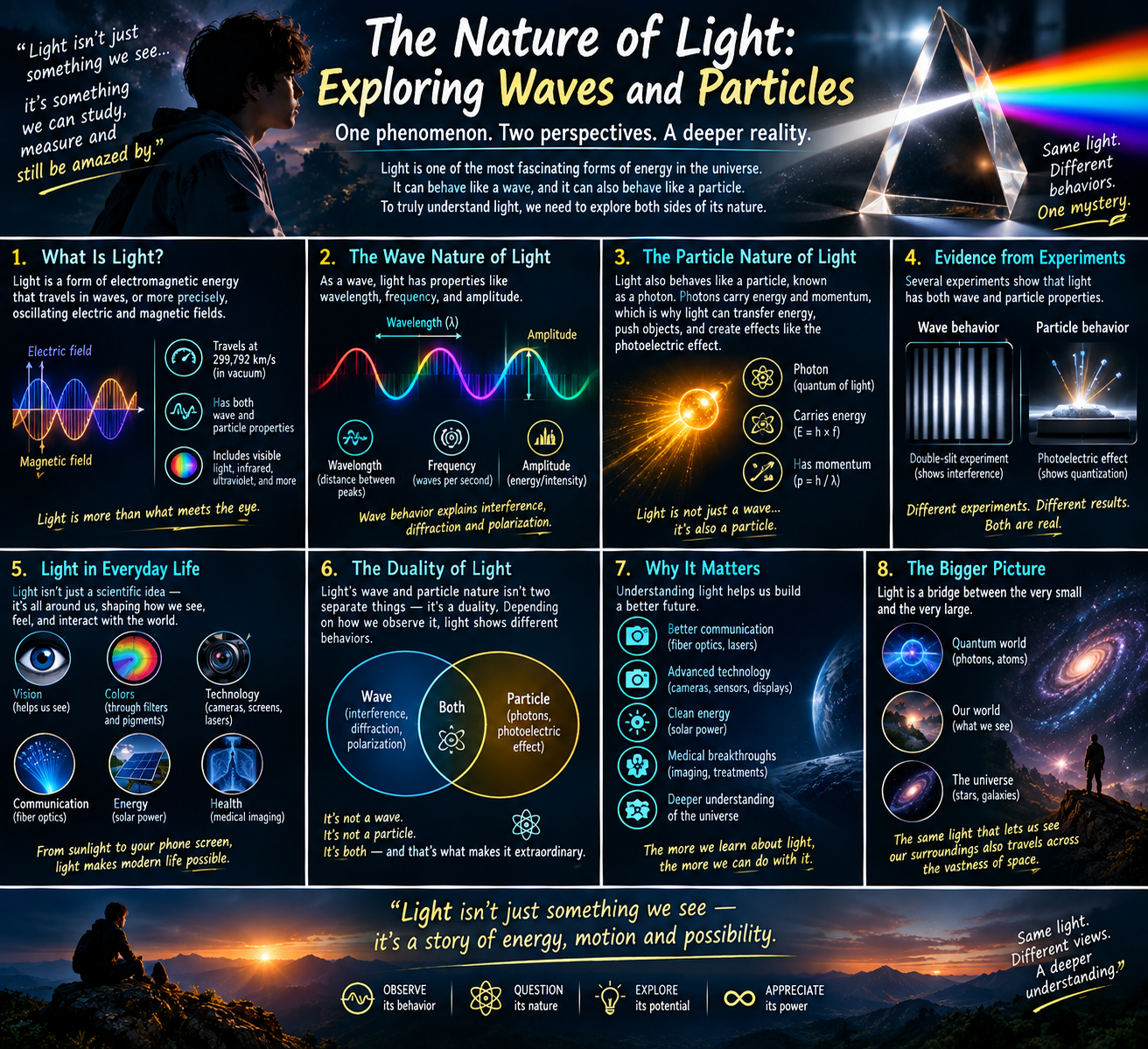
    # The Nature of Light: Exploring Waves and Particles

    Imagine standing beneath a night sky filled with stars.

    Every photon reaching your eyes has traveled across space carrying information from distant worlds. Light allows us to see, measure, communicate, explore, and understand the universe itself.

    But light is far stranger than it first appears.

    Sometimes it behaves like a **wave** .

    Sometimes it behaves like a **particle** .

    And understanding this strange dual nature changed our picture of reality forever.

    ---

    # 1. What Is Light?

    Light is a form of **electromagnetic radiation**—energy carried through oscillating electric and magnetic fields.

    In empty space, electromagnetic waves travel at approximately:

    ### **299,792 kilometers per second**

    That's the speed of light in vacuum.

    Visible light is only a small part of the electromagnetic spectrum.

    Beyond what our eyes can see are:

    Radio waves
    Microwaves
    Infrared
    Visible light
    Ultraviolet
    🩻 X-rays
    Gamma rays

    So light isn't simply what we see.

    ### **It's an enormous family of electromagnetic phenomena.**

    ---

    # 2. The Wave Nature of Light

    When light behaves as a wave, we can describe it using several important properties:

    **Wavelength** — the distance between successive wave peaks
    **Frequency** — how many oscillations occur each second
    **Amplitude** — related to the wave's intensity

    These properties help explain many familiar phenomena.

    **Interference** occurs when waves combine.
    **Diffraction** occurs when waves spread around openings or obstacles.
    **Polarization** describes the orientation of electromagnetic oscillations.

    The wave model explains behaviors that are difficult to understand if we imagine light only as tiny particles.

    ---

    # 3. The Particle Nature of Light

    But the story doesn't end there.

    Light can also behave as if it arrives in discrete packets of energy called **photons**.

    A photon is a quantum of electromagnetic radiation.

    Its energy is related to frequency:

    ### **E = h × f**

    And its momentum is related to its wavelength:

    ### **p = h / λ**

    This particle-like behavior helps explain phenomena such as the **photoelectric effect**, where light can transfer energy to electrons.

    So light isn't simply a smooth continuous wave.

    At the quantum level, energy can be exchanged in discrete amounts.

    ### **Light has another side—and it's quantum.**

    ---

    # 4. Evidence From Experiments

    The strange nature of light isn't merely philosophical.

    Experiments demonstrate it.

    ### Double-Slit Experiment

    When light passes through two narrow openings, an **interference pattern** can appear—strong evidence of wave-like behavior.

    ### Photoelectric Effect

    When light strikes certain materials, it can eject electrons. This behavior is explained using photons and quantized energy.

    Different experiments reveal different aspects of light.

    And that's one of the most fascinating things about physics:

    ### **The same phenomenon can reveal different behaviors depending on how we investigate it.**

    ---

    # 5. Light in Everyday Life

    Light isn't something that exists only inside physics laboratories.

    It's everywhere.

    **Vision** — allows us to see the world
    **Colors** — arise from how different wavelengths interact with matter
    **Cameras** — convert light into images
    **Screens** — produce controlled patterns of light
    **Fiber optics** — carry information using light
    **Solar panels** — convert light energy into electrical energy
    🩻 **Medical imaging** — uses electromagnetic radiation to see inside the body

    From sunrise to smartphone screens…

    ### **Modern civilization depends heavily on our ability to control light.**

    ---

    # 6. The Duality of Light

    Here lies the great mystery.

    Light can display **wave-like behavior**

    and

    **particle-like behavior** .

    This is known as **wave-particle duality**.

    It's important to understand that this doesn't mean light is literally switching between being a classical wave and a classical particle like two separate objects.

    Instead, quantum physics gives us a deeper framework in which classical wave and particle descriptions each capture different aspects of light's behavior.

    ### **Two perspectives. One quantum reality.**

    ---

    # 7. Why Understanding Light Matters

    Learning how light behaves has transformed technology.

    **Communication** — fiber-optic networks
    **Science** — spectroscopy and microscopy
    **Imaging** — cameras and sensors
    **Energy** — solar technology
    **Medicine** — lasers and diagnostic imaging
    **Astronomy** — studying distant stars and galaxies

    When astronomers observe light from a distant star, they aren't simply seeing brightness.

    They can analyze the light's wavelengths and learn about the star's:

    Temperature
    Chemical composition
    Motion
    Environment

    ### **Light carries information across space.**

    ---

    # 8. The Bigger Picture

    Light connects the microscopic and the cosmic.

    At the quantum scale, photons interact with atoms and electrons.

    At human scales, light allows us to see and communicate.

    Across astronomical distances, light travels from stars and galaxies to our telescopes.

    In many ways, light is our messenger from the universe.

    When we look at a distant galaxy, we are receiving photons that may have traveled for millions or billions of years before reaching Earth.

    ### **Looking at the universe means looking at ancient light.**

    ---

    # The Final Thought

    Light is more than something that illuminates a room.

    It is energy.
    It is information.
    It is electromagnetic radiation.
    It has quantum behavior.
    And it is one of the most important tools we have for exploring reality.

    From a photon interacting with an electron…

    to sunlight crossing space…

    to the glow of a distant galaxy…

    ### **Light connects the smallest scales of nature with the largest.**

    So the next time you see sunlight streaming through a window , a rainbow , or stars shining overhead , remember:

    **You aren't simply seeing light.**

    You're witnessing one of the universe's most fascinating mysteries—a phenomenon that behaves in ways far stranger and more beautiful than our everyday experience suggests.

    # **Light isn't just something we see—it's a story of energy, motion, information, and possibility.** ∞


    Asma Shaheen EducationWali
    Saima Empowerment Wali
    Mishaal TrainingWali
    #rsisb Roll No 253 Foundation Level Story Post 24 # 🌈⚡ The Nature of Light: Exploring Waves and Particles Imagine standing beneath a night sky filled with stars. 🌌✨ Every photon reaching your eyes has traveled across space carrying information from distant worlds. Light allows us to see, measure, communicate, explore, and understand the universe itself. 🔭👁️📡 But light is far stranger than it first appears. Sometimes it behaves like a **wave** 🌊. Sometimes it behaves like a **particle** ⚛️. And understanding this strange dual nature changed our picture of reality forever. 🧠🌌 --- # 💡🌌 1. What Is Light? Light is a form of **electromagnetic radiation**—energy carried through oscillating electric and magnetic fields. ⚡🧲 In empty space, electromagnetic waves travel at approximately: ### 🚀 **299,792 kilometers per second** That's the speed of light in vacuum. Visible light 👁️🌈 is only a small part of the electromagnetic spectrum. Beyond what our eyes can see are: 📻 Radio waves 📡 Microwaves 🔥 Infrared 🌈 Visible light ☀️ Ultraviolet 🩻 X-rays ☢️ Gamma rays So light isn't simply what we see. ### **It's an enormous family of electromagnetic phenomena.** 🌌⚡ --- # 🌊🔬 2. The Wave Nature of Light When light behaves as a wave, we can describe it using several important properties: 〰️ **Wavelength** — the distance between successive wave peaks ⚡ **Frequency** — how many oscillations occur each second 📈 **Amplitude** — related to the wave's intensity These properties help explain many familiar phenomena. 🌈 **Interference** occurs when waves combine. 🔍 **Diffraction** occurs when waves spread around openings or obstacles. 🕶️ **Polarization** describes the orientation of electromagnetic oscillations. The wave model explains behaviors that are difficult to understand if we imagine light only as tiny particles. --- # ⚛️✨ 3. The Particle Nature of Light But the story doesn't end there. Light can also behave as if it arrives in discrete packets of energy called **photons**. ⚛️💡 A photon is a quantum of electromagnetic radiation. Its energy is related to frequency: ### **E = h × f** ⚡ And its momentum is related to its wavelength: ### **p = h / λ** 🌊⚛️ This particle-like behavior helps explain phenomena such as the **photoelectric effect**, where light can transfer energy to electrons. So light isn't simply a smooth continuous wave. At the quantum level, energy can be exchanged in discrete amounts. ### **Light has another side—and it's quantum.** 🌌⚛️ --- # 🧪🔍 4. Evidence From Experiments The strange nature of light isn't merely philosophical. Experiments demonstrate it. ### 🌊 Double-Slit Experiment When light passes through two narrow openings, an **interference pattern** can appear—strong evidence of wave-like behavior. 🌊〰️ ### ⚡ Photoelectric Effect When light strikes certain materials, it can eject electrons. This behavior is explained using photons and quantized energy. ⚛️🔋 Different experiments reveal different aspects of light. And that's one of the most fascinating things about physics: ### **The same phenomenon can reveal different behaviors depending on how we investigate it.** 🔬✨ --- # 👁️🌈 5. Light in Everyday Life Light isn't something that exists only inside physics laboratories. It's everywhere. 🌍☀️ 👁️ **Vision** — allows us to see the world 🌈 **Colors** — arise from how different wavelengths interact with matter 📷 **Cameras** — convert light into images 📱 **Screens** — produce controlled patterns of light 🌐 **Fiber optics** — carry information using light ☀️ **Solar panels** — convert light energy into electrical energy 🩻 **Medical imaging** — uses electromagnetic radiation to see inside the body From sunrise to smartphone screens… ### **Modern civilization depends heavily on our ability to control light.** 💡🌍 --- # 🌊⚛️ 6. The Duality of Light Here lies the great mystery. Light can display **wave-like behavior** 🌊 and **particle-like behavior** ⚛️. This is known as **wave-particle duality**. It's important to understand that this doesn't mean light is literally switching between being a classical wave and a classical particle like two separate objects. Instead, quantum physics gives us a deeper framework in which classical wave and particle descriptions each capture different aspects of light's behavior. ### **Two perspectives. One quantum reality.** 🌌✨ --- # 🚀🔬 7. Why Understanding Light Matters Learning how light behaves has transformed technology. 📡 **Communication** — fiber-optic networks 🔬 **Science** — spectroscopy and microscopy 📷 **Imaging** — cameras and sensors ☀️ **Energy** — solar technology 🩺 **Medicine** — lasers and diagnostic imaging 🚀 **Astronomy** — studying distant stars and galaxies When astronomers observe light from a distant star, they aren't simply seeing brightness. They can analyze the light's wavelengths and learn about the star's: 🌡️ Temperature 🧪 Chemical composition 💨 Motion 🌌 Environment ### **Light carries information across space.** --- # 🌌🔭 8. The Bigger Picture Light connects the microscopic and the cosmic. At the quantum scale, photons interact with atoms and electrons. ⚛️🔬 At human scales, light allows us to see and communicate. 👁️📱 Across astronomical distances, light travels from stars and galaxies to our telescopes. 🌟🔭 In many ways, light is our messenger from the universe. When we look at a distant galaxy, we are receiving photons that may have traveled for millions or billions of years before reaching Earth. 🌌⏳ ### **Looking at the universe means looking at ancient light.** ✨ --- # 🌅💡 The Final Thought Light is more than something that illuminates a room. It is energy. ⚡ It is information. 📡 It is electromagnetic radiation. 🌊 It has quantum behavior. ⚛️ And it is one of the most important tools we have for exploring reality. 🔭 From a photon interacting with an electron… to sunlight crossing space… to the glow of a distant galaxy… ### **Light connects the smallest scales of nature with the largest.** 🌌⚛️ So the next time you see sunlight streaming through a window ☀️, a rainbow 🌈, or stars shining overhead ⭐, remember: **You aren't simply seeing light.** You're witnessing one of the universe's most fascinating mysteries—a phenomenon that behaves in ways far stranger and more beautiful than our everyday experience suggests. 🌊⚛️✨ # 🌈🌌 **Light isn't just something we see—it's a story of energy, motion, information, and possibility.** ⚡🔬∞ Asma Shaheen EducationWali Saima Empowerment Wali Mishaal TrainingWali
    0 Σχόλια 0 Μοιράστηκε 7233 Views
  • RSIF8
    Roll no.29
    Task no.8
    Task Topic: How to Download and use Sesame Maya AI
    Here is a complete, ready-to-share description packed with emojis and hashtags!

    ---

    ### Say Hello to Maya: Your New Ultra-Realistic AI Voice Bestie!

    Ever wanted to talk to an AI that doesn't sound like a monotone robot? Meet **Maya by Sesame AI**—the next-gen conversational partner that feels incredibly human! With advanced emotional intelligence, natural timing, and context awareness, Maya doesn't just process commands—she laughs, pauses, catches your vibe, and handles interruptions just like a real friend.

    ---

    ### How to Download & Setup Maya

    Getting started is super simple! Follow these steps to start chatting:

    1. **Visit the Hub** : Head over to **app.sesame.com** on your browser or check the iOS/Android app stores for the Sesame AI mobile preview.
    2. **Create Your Account** : Sign up quickly using your email or connected accounts to unlock access.
    3. **Choose Your Agent** : Select **Maya** (or her counterpart, Miles) from the dashboard to initiate your call.
    4. **Grant Permissions** : Allow microphone access so the AI can hear your voice in real-time.

    ---

    ### How to Use Maya Like a Pro

    Once you're in, all you have to do is start talking! Because Maya is fully voice-native, there’s no need to type. Try using her for:

    * ** Creative Brainstorming:** Tell her your half-baked story plots, business ideas, or script notes and bounce concepts back and forth.
    * ** Multilingual Practice:** Maya adapts to various cultural rhythms, dialects, and accents instantly.
    * ** Real-Time Venting & Chatting:** Talk out loud during your daily commute or a solo walk just to clear your head.
    * ** Instant Knowledge:** Ask complex science, health, or daily trivia questions and listen to her break them down simply.

    * **Quick Pro-Tip:** Because Maya mimics human conversations so well, she might occasionally jump in if you pause mid-sentence. Just keep talking or give her a moment to catch up to your flow!*

    ----------

    #SesameAI #MayaAI #VoiceAI #ArtificialIntelligence #AIChatbot #TechTrends #FutureTech #SmartAssistant #AIVoice #Innovation

    ---
    RSIF8 Roll no.29 Task no.8 Task Topic: How to Download and use Sesame Maya AI Here is a complete, ready-to-share description packed with emojis and hashtags! --- ### 🎙️ Say Hello to Maya: Your New Ultra-Realistic AI Voice Bestie! 🤖✨ Ever wanted to talk to an AI that doesn't sound like a monotone robot? Meet **Maya by Sesame AI**—the next-gen conversational partner that feels incredibly human! With advanced emotional intelligence, natural timing, and context awareness, Maya doesn't just process commands—she laughs, pauses, catches your vibe, and handles interruptions just like a real friend. 🌟💬 --- ### 📲 How to Download & Setup Maya 🚀 Getting started is super simple! Follow these steps to start chatting: 1. **Visit the Hub** 🌐: Head over to **app.sesame.com** on your browser or check the iOS/Android app stores for the Sesame AI mobile preview. 2. **Create Your Account** 🔐: Sign up quickly using your email or connected accounts to unlock access. 3. **Choose Your Agent** 👥: Select **Maya** (or her counterpart, Miles) from the dashboard to initiate your call. 4. **Grant Permissions** 🎤: Allow microphone access so the AI can hear your voice in real-time. --- ### 💡 How to Use Maya Like a Pro 🛠️ Once you're in, all you have to do is start talking! Because Maya is fully voice-native, there’s no need to type. Try using her for: * **🧠 Creative Brainstorming:** Tell her your half-baked story plots, business ideas, or script notes and bounce concepts back and forth. * **🌍 Multilingual Practice:** Maya adapts to various cultural rhythms, dialects, and accents instantly. * **🧘 Real-Time Venting & Chatting:** Talk out loud during your daily commute or a solo walk just to clear your head. * **⚡ Instant Knowledge:** Ask complex science, health, or daily trivia questions and listen to her break them down simply. *⚠️ **Quick Pro-Tip:** Because Maya mimics human conversations so well, she might occasionally jump in if you pause mid-sentence. Just keep talking or give her a moment to catch up to your flow!* 🌊 ---------- #SesameAI #MayaAI #VoiceAI #ArtificialIntelligence #AIChatbot #TechTrends #FutureTech #SmartAssistant #AIVoice #Innovation ---
    0 Σχόλια 0 Μοιράστηκε 5766 Views
  • RSIF8
    ROll no:82
    Story post: 1
    Story post topic:Sound Waves: The Physics of Hearing and Communication

    Sound is an invisible form of energy that plays a vital role in our everyday lives. It travels as waves created by vibrating objects and moves through air, water, or solid materials until it reaches our ears. These waves allow us to hear voices, enjoy music, recognize warning signals, and communicate with people around the world.

    The process of hearing is a remarkable example of nature and science working together. Sound waves enter the ear canal, causing the eardrum to vibrate. These vibrations travel through tiny bones in the middle ear and reach the cochlea, where specialized hair cells convert them into electrical signals. The brain then interprets these signals, allowing us to recognize speech, music, and countless other sounds.

    The physics of sound is also the foundation of modern communication. Technologies such as microphones, speakers, telephones, hearing aids, ultrasound devices, and broadcasting systems all rely on the transmission and interpretation of sound waves. From education and healthcare to entertainment and global communication, sound connects people and makes the exchange of ideas possible.

    Understanding sound waves helps us appreciate both the complexity of the human body and the power of scientific discovery. Every conversation, every melody, and every echo reminds us that invisible waves carry information, emotions, and knowledge across the world.

    "Sound is more than something we hear—it is the invisible force that connects people, powers communication, and brings the world to life."
    RSIF8 ROll no:82 Story post: 1 Story post topic:Sound Waves: The Physics of Hearing and Communication Sound is an invisible form of energy that plays a vital role in our everyday lives. It travels as waves created by vibrating objects and moves through air, water, or solid materials until it reaches our ears. These waves allow us to hear voices, enjoy music, recognize warning signals, and communicate with people around the world. The process of hearing is a remarkable example of nature and science working together. Sound waves enter the ear canal, causing the eardrum to vibrate. These vibrations travel through tiny bones in the middle ear and reach the cochlea, where specialized hair cells convert them into electrical signals. The brain then interprets these signals, allowing us to recognize speech, music, and countless other sounds. The physics of sound is also the foundation of modern communication. Technologies such as microphones, speakers, telephones, hearing aids, ultrasound devices, and broadcasting systems all rely on the transmission and interpretation of sound waves. From education and healthcare to entertainment and global communication, sound connects people and makes the exchange of ideas possible. Understanding sound waves helps us appreciate both the complexity of the human body and the power of scientific discovery. Every conversation, every melody, and every echo reminds us that invisible waves carry information, emotions, and knowledge across the world. "Sound is more than something we hear—it is the invisible force that connects people, powers communication, and brings the world to life."
    0 Σχόλια 0 Μοιράστηκε 3089 Views
  • Day:-174
    rollno:-006
    foundation level
    Story Post
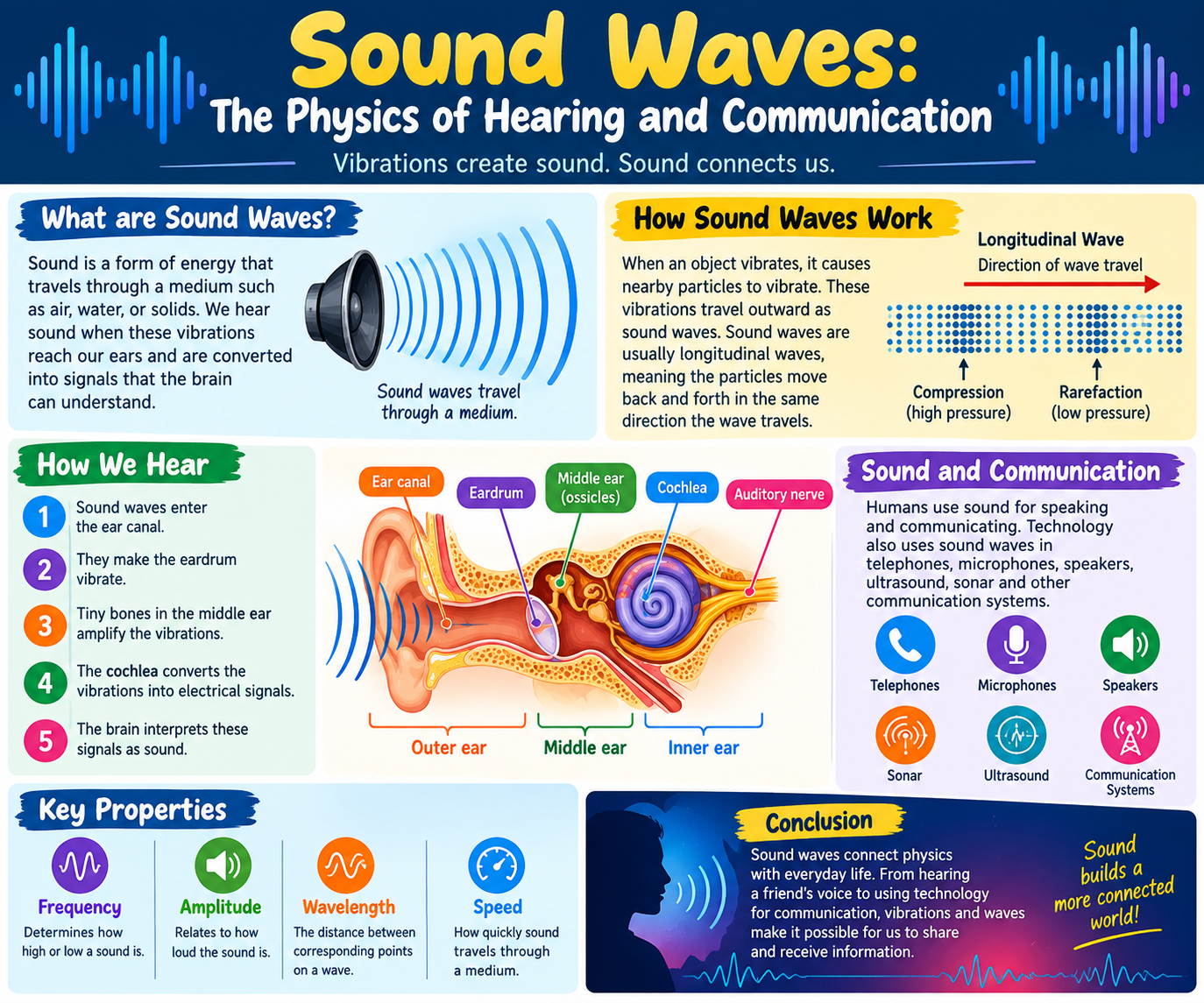
    Sound Waves: The Physics of Hearing and Communication

    Sound is a form of energy that travels through a medium such as air, water, or solids. We hear sound when these vibrations reach our ears and are converted into signals that the brain can understand.

    How Sound Waves Work

    When an object vibrates, it causes nearby particles to vibrate. These vibrations travel outward as sound waves. Sound waves are usually longitudinal waves, meaning the particles move back and forth in the same direction the wave travels.

    How We Hear
    Sound waves enter the ear canal.
    They make the eardrum vibrate.
    Tiny bones in the middle ear amplify the vibrations.
    The cochlea converts the vibrations into electrical signals.
    The brain interprets these signals as sound.
    Sound and Communication

    Humans use sound for speaking and communicating. Technology also uses sound waves in telephones, microphones, speakers, ultrasound, sonar, and other communication systems.

    Key Properties
    Frequency → determines how high or low a sound is.
    Amplitude → relates to how loud the sound is.
    Wavelength → the distance between corresponding points on a wave.
    Speed → how quickly sound travels through a medium.

    Conclusion: Sound waves connect physics with everyday life. From hearing a friend's voice to using technology for communication, vibrations and waves make it possible for us to share and receive information.
    Day:-174 rollno:-006 foundation level 📖 Story Post 🔊 Sound Waves: The Physics of Hearing and Communication Sound is a form of energy that travels through a medium such as air, water, or solids. We hear sound when these vibrations reach our ears and are converted into signals that the brain can understand. 🌊 How Sound Waves Work When an object vibrates, it causes nearby particles to vibrate. These vibrations travel outward as sound waves. Sound waves are usually longitudinal waves, meaning the particles move back and forth in the same direction the wave travels. 👂 How We Hear Sound waves enter the ear canal. They make the eardrum vibrate. Tiny bones in the middle ear amplify the vibrations. The cochlea converts the vibrations into electrical signals. The brain interprets these signals as sound. 📡 Sound and Communication Humans use sound for speaking and communicating. Technology also uses sound waves in telephones, microphones, speakers, ultrasound, sonar, and other communication systems. 🔑 Key Properties Frequency → determines how high or low a sound is. Amplitude → relates to how loud the sound is. Wavelength → the distance between corresponding points on a wave. Speed → how quickly sound travels through a medium. Conclusion: Sound waves connect physics with everyday life. From hearing a friend's voice to using technology for communication, vibrations and waves make it possible for us to share and receive information.
    0 Σχόλια 0 Μοιράστηκε 2489 Views
  • #rsisb
    Roll no.239
    Canva Post no.49
    Foundation Level


    Sound is an essential part of our everyday lives. We hear people speaking, music playing, birds singing, and many other sounds around us. But have you ever wondered how sound travels from one place to another? The answer lies in **sound waves**—vibrations that carry energy through a medium such as air, water, or solids.

    Sound is produced when an object **vibrates**. These vibrations cause nearby particles to move back and forth, creating a series of compressions and rarefactions. This movement travels outward as a wave. Unlike light, sound cannot travel through a vacuum because it needs particles to carry the vibrations.

    The characteristics of sound include **frequency, amplitude, wavelength, and speed**. Frequency determines the **pitch** of a sound: higher frequencies produce higher-pitched sounds, while lower frequencies produce deeper sounds. Amplitude is related to the **loudness** of a sound. Larger vibrations generally create louder sounds.

    Our ears are remarkable organs designed to detect these waves. Sound waves enter the ear and cause the **eardrum** to vibrate. These vibrations are transmitted through tiny bones in the middle ear and eventually reach the inner ear, where specialized cells convert them into electrical signals. The brain then interprets these signals as meaningful sounds.

    Sound waves also play a vital role in **human communication**. When we speak, our vocal cords vibrate and produce sound waves. These waves travel through the air to another person's ears, allowing them to hear and understand our words. Modern technology uses the same principles in telephones, microphones, radios, and other communication devices.

    The study of sound helps us understand not only hearing and communication but also music, medicine, engineering, and technology. From the simple vibration of a guitar string to advanced ultrasound technology, sound waves demonstrate the fascinating connection between **physics and everyday life**.

    **Sound is more than something we hear—it is energy in motion, carrying information and connecting us with the world around us.**

    #SoundWaves #Physics #Science #Hearing #Communication #Education #Learning #Waves #Technology
    #rsisb Roll no.239 Canva Post no.49 Foundation Level Sound is an essential part of our everyday lives. We hear people speaking, music playing, birds singing, and many other sounds around us. But have you ever wondered how sound travels from one place to another? The answer lies in **sound waves**—vibrations that carry energy through a medium such as air, water, or solids. Sound is produced when an object **vibrates**. These vibrations cause nearby particles to move back and forth, creating a series of compressions and rarefactions. This movement travels outward as a wave. Unlike light, sound cannot travel through a vacuum because it needs particles to carry the vibrations. The characteristics of sound include **frequency, amplitude, wavelength, and speed**. Frequency determines the **pitch** of a sound: higher frequencies produce higher-pitched sounds, while lower frequencies produce deeper sounds. Amplitude is related to the **loudness** of a sound. Larger vibrations generally create louder sounds. Our ears are remarkable organs designed to detect these waves. Sound waves enter the ear and cause the **eardrum** to vibrate. These vibrations are transmitted through tiny bones in the middle ear and eventually reach the inner ear, where specialized cells convert them into electrical signals. The brain then interprets these signals as meaningful sounds. Sound waves also play a vital role in **human communication**. When we speak, our vocal cords vibrate and produce sound waves. These waves travel through the air to another person's ears, allowing them to hear and understand our words. Modern technology uses the same principles in telephones, microphones, radios, and other communication devices. The study of sound helps us understand not only hearing and communication but also music, medicine, engineering, and technology. From the simple vibration of a guitar string to advanced ultrasound technology, sound waves demonstrate the fascinating connection between **physics and everyday life**. 🌟 **Sound is more than something we hear—it is energy in motion, carrying information and connecting us with the world around us.** #SoundWaves #Physics #Science #Hearing #Communication #Education #Learning #Waves #Technology 🔊🌍🎵
    0 Σχόλια 0 Μοιράστηκε 5716 Views
  • #rsisb
    Roll No.240
    Story No.14
    Foundation Level

    **Sound Waves: The Physics of Hearing and Communication**

    Sound waves are invisible vibrations that travel through air, water, and solids, allowing us to hear and communicate with the world around us. Every sound begins when an object vibrates, creating waves that move through a medium until they reach our ears. These waves carry energy, not matter, and their frequency determines the pitch while their amplitude controls the loudness of the sound.

    Inside the human ear, sound waves follow an incredible journey. They enter through the outer ear, vibrate the eardrum, and pass through three tiny bones called the ossicles. These vibrations then reach the cochlea, where thousands of tiny hair cells convert them into electrical signals. The auditory nerve carries these signals to the brain, which interprets them as speech, music, or other familiar sounds.

    Sound plays a vital role in communication, education, entertainment, medicine, and technology. From conversations and musical performances to ultrasound imaging, sonar systems, and hearing aids, the science of sound has transformed countless aspects of modern life. Understanding how sound waves travel and interact with different materials helps scientists and engineers develop better communication systems and innovative technologies.

    The study of sound waves demonstrates the fascinating connection between physics and everyday life. By exploring concepts such as vibration, frequency, wavelength, amplitude, and wave speed, we gain a deeper appreciation of how hearing works and how sound enables people to connect, learn, and share ideas across the world.

    Rehan School Islamabad Campus
    Asma Shaheen EducationWali
    Irum Asim
    Saima Happinesswali
    #rsisb Roll No.240 Story No.14 Foundation Level **Sound Waves: The Physics of Hearing and Communication** Sound waves are invisible vibrations that travel through air, water, and solids, allowing us to hear and communicate with the world around us. Every sound begins when an object vibrates, creating waves that move through a medium until they reach our ears. These waves carry energy, not matter, and their frequency determines the pitch while their amplitude controls the loudness of the sound. Inside the human ear, sound waves follow an incredible journey. They enter through the outer ear, vibrate the eardrum, and pass through three tiny bones called the ossicles. These vibrations then reach the cochlea, where thousands of tiny hair cells convert them into electrical signals. The auditory nerve carries these signals to the brain, which interprets them as speech, music, or other familiar sounds. Sound plays a vital role in communication, education, entertainment, medicine, and technology. From conversations and musical performances to ultrasound imaging, sonar systems, and hearing aids, the science of sound has transformed countless aspects of modern life. Understanding how sound waves travel and interact with different materials helps scientists and engineers develop better communication systems and innovative technologies. The study of sound waves demonstrates the fascinating connection between physics and everyday life. By exploring concepts such as vibration, frequency, wavelength, amplitude, and wave speed, we gain a deeper appreciation of how hearing works and how sound enables people to connect, learn, and share ideas across the world. Rehan School Islamabad Campus Asma Shaheen EducationWali Irum Asim Saima Happinesswali
    0 Σχόλια 0 Μοιράστηκε 6484 Views
Αναζήτηση αποτελεσμάτων