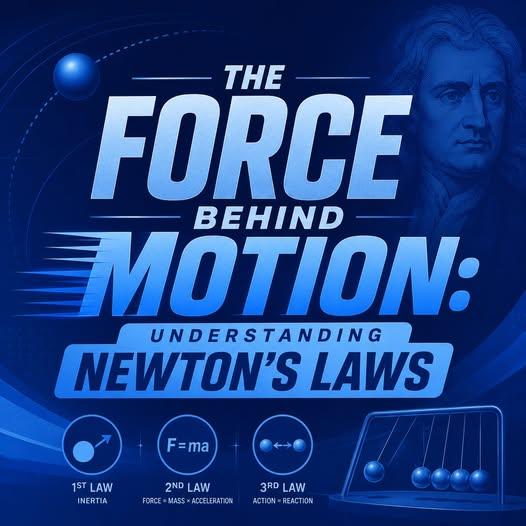
• ACCL Day 153 — Story: The Force Behind Motion: Understanding Newton’s Laws

    The sun was barely up when the science lab doors slid open, and young Ayan stepped inside. Today wasn’t just any day — it was the day he finally understood why things move the way they do.

    As he placed a small toy car on the table, Sir Imran walked in with his usual smile.
    “Ready to learn how the universe pushes you around?” he joked.

    Ayan nodded.

    “Good,” Sir Imran said. “Let’s talk Newton.”

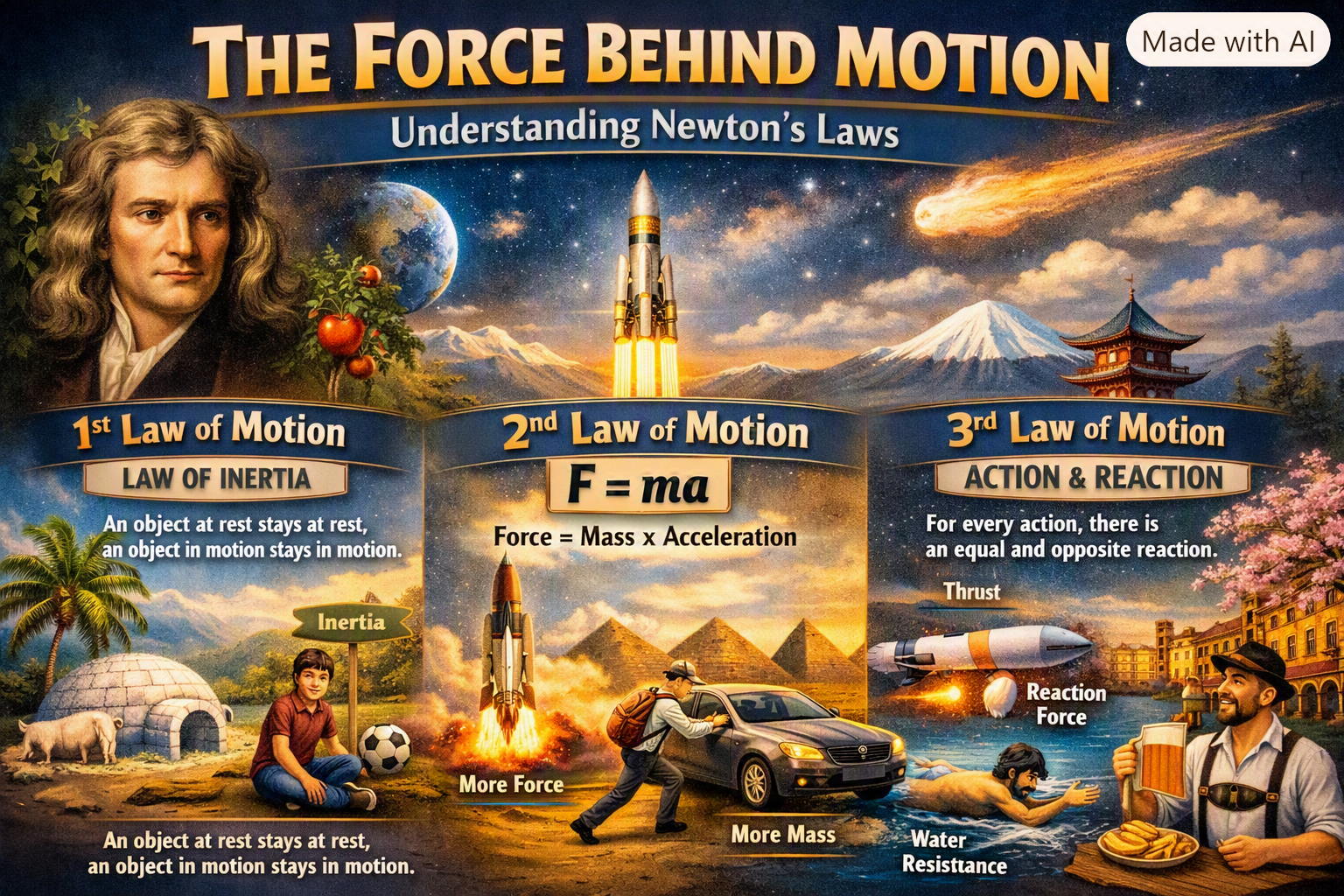
    First Law — The Law of Inertia

    Ayan flicked the toy car lightly. It moved… then stopped.
    “Why did it stop?” Sir Imran asked.
    “Because I stopped pushing it,” Ayan replied.
    “No,” Sir Imran grinned. “It stopped because friction pushed back. Without any forces, things keep going forever.”

    Ayan imagined a car flying endlessly through space — no brakes, no slowing down.
    So that’s inertia, he thought.
    Objects don’t stop unless something forces them to.

    Second Law — F = ma

    Sir Imran handed him two identical cars: one empty, one full of metal weights.
    “Push them both,” he ordered.

    Ayan pushed.
    The light car zoomed. The heavy one crawled.

    “The heavier something is, the more force you need,” Sir Imran explained. “Force equals mass times acceleration. Simple math — powerful truth.”

    Ayan felt like he had just unlocked a secret code of the universe.

    Third Law — Action & Reaction

    Finally, Sir Imran placed a balloon car on the table.
    “Let go.”

    WOOSH! The balloon shot air backwards — the car zoomed forward.

    “For every action,” Sir Imran said, “there’s an equal and opposite reaction. The universe always responds.”

    Ayan watched the car bounce off the wall and laughed.
    It wasn’t just science… it felt like magic.

    The Lesson of the Day

    As Ayan packed up, he whispered to himself:
    “Everything moves for a reason. Forces shape every step we take.”

    Walking out of the lab, he felt the world differently — every motion, every push, every reaction suddenly made sense.

    Newton wasn’t just writing laws.
    He was explaining the story written into every moment of our lives.
    ACCL Day 153 — Story: The Force Behind Motion: Understanding Newton’s Laws The sun was barely up when the science lab doors slid open, and young Ayan stepped inside. Today wasn’t just any day — it was the day he finally understood why things move the way they do. As he placed a small toy car on the table, Sir Imran walked in with his usual smile. “Ready to learn how the universe pushes you around?” he joked. Ayan nodded. “Good,” Sir Imran said. “Let’s talk Newton.” First Law — The Law of Inertia Ayan flicked the toy car lightly. It moved… then stopped. “Why did it stop?” Sir Imran asked. “Because I stopped pushing it,” Ayan replied. “No,” Sir Imran grinned. “It stopped because friction pushed back. Without any forces, things keep going forever.” Ayan imagined a car flying endlessly through space — no brakes, no slowing down. So that’s inertia, he thought. Objects don’t stop unless something forces them to. Second Law — F = ma Sir Imran handed him two identical cars: one empty, one full of metal weights. “Push them both,” he ordered. Ayan pushed. The light car zoomed. The heavy one crawled. “The heavier something is, the more force you need,” Sir Imran explained. “Force equals mass times acceleration. Simple math — powerful truth.” Ayan felt like he had just unlocked a secret code of the universe. Third Law — Action & Reaction Finally, Sir Imran placed a balloon car on the table. “Let go.” WOOSH! The balloon shot air backwards — the car zoomed forward. “For every action,” Sir Imran said, “there’s an equal and opposite reaction. The universe always responds.” Ayan watched the car bounce off the wall and laughed. It wasn’t just science… it felt like magic. The Lesson of the Day As Ayan packed up, he whispered to himself: “Everything moves for a reason. Forces shape every step we take.” Walking out of the lab, he felt the world differently — every motion, every push, every reaction suddenly made sense. Newton wasn’t just writing laws. He was explaining the story written into every moment of our lives.
    0 Comentários 0 Compartilhamentos 22 Visualizações
  • Mohsin RS F8
    Story post NO:18
    roll NO:13
    Class: Foundation Level
    Made by Me

    The Force Behind Motion: Understanding Newton’s Laws

    Motion is one of the most important ideas in physics. Everything around us is constantly affected by forces, whether we notice them or not. A ball rolling across the ground, a car accelerating on a road, a bicycle slowing down, a person jumping, and a rocket launching into space are all examples of motion caused or changed by forces. To understand these everyday movements, scientists use fundamental principles known as Newton’s Laws of Motion.

    Sir Isaac Newton developed his three laws of motion in the 17th century, and they became a foundation of classical physics. These laws help explain the relationship between force, mass, and motion. They allow us to understand not only simple movements around us but also complicated systems involving machines, vehicles, sports, engineering, and space exploration.

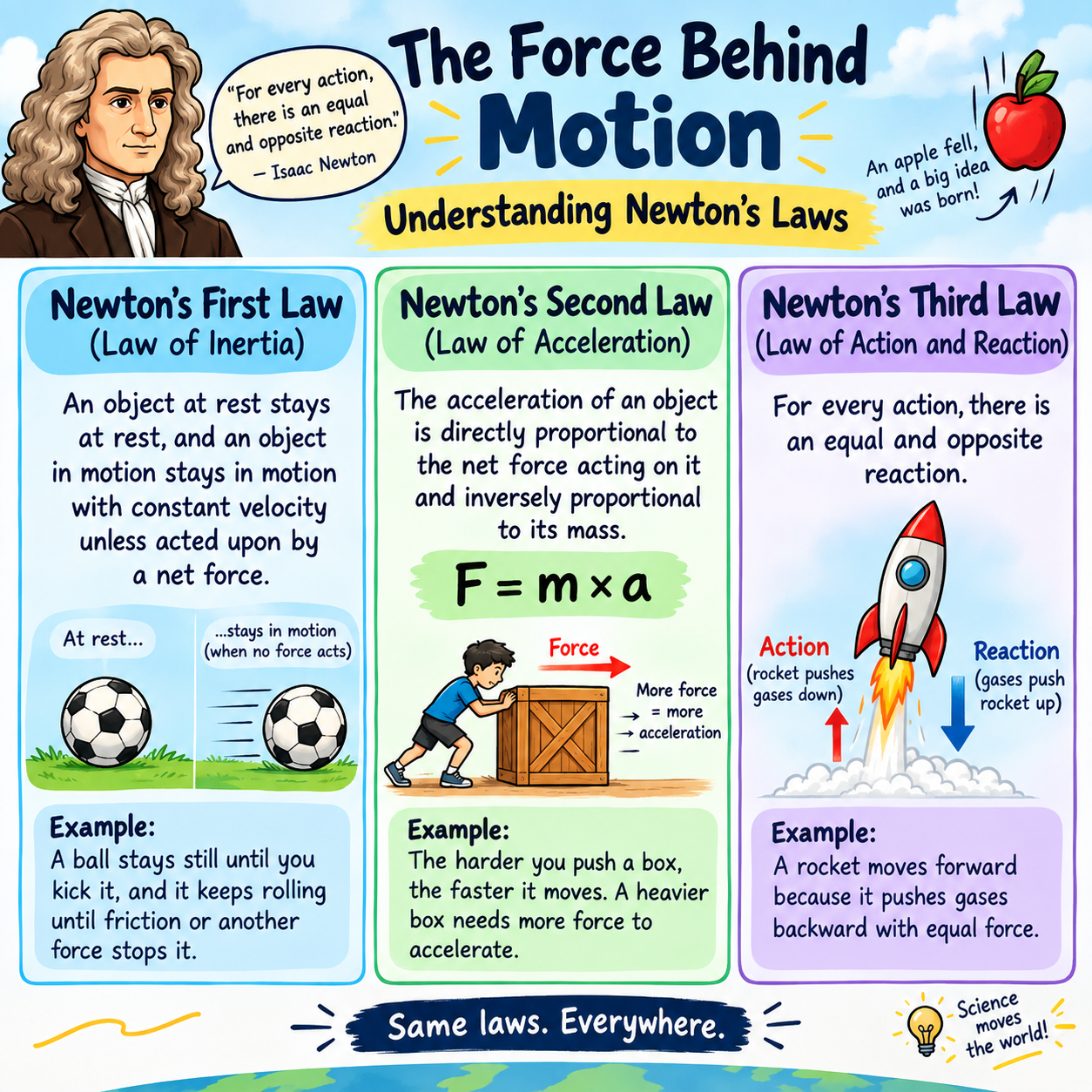
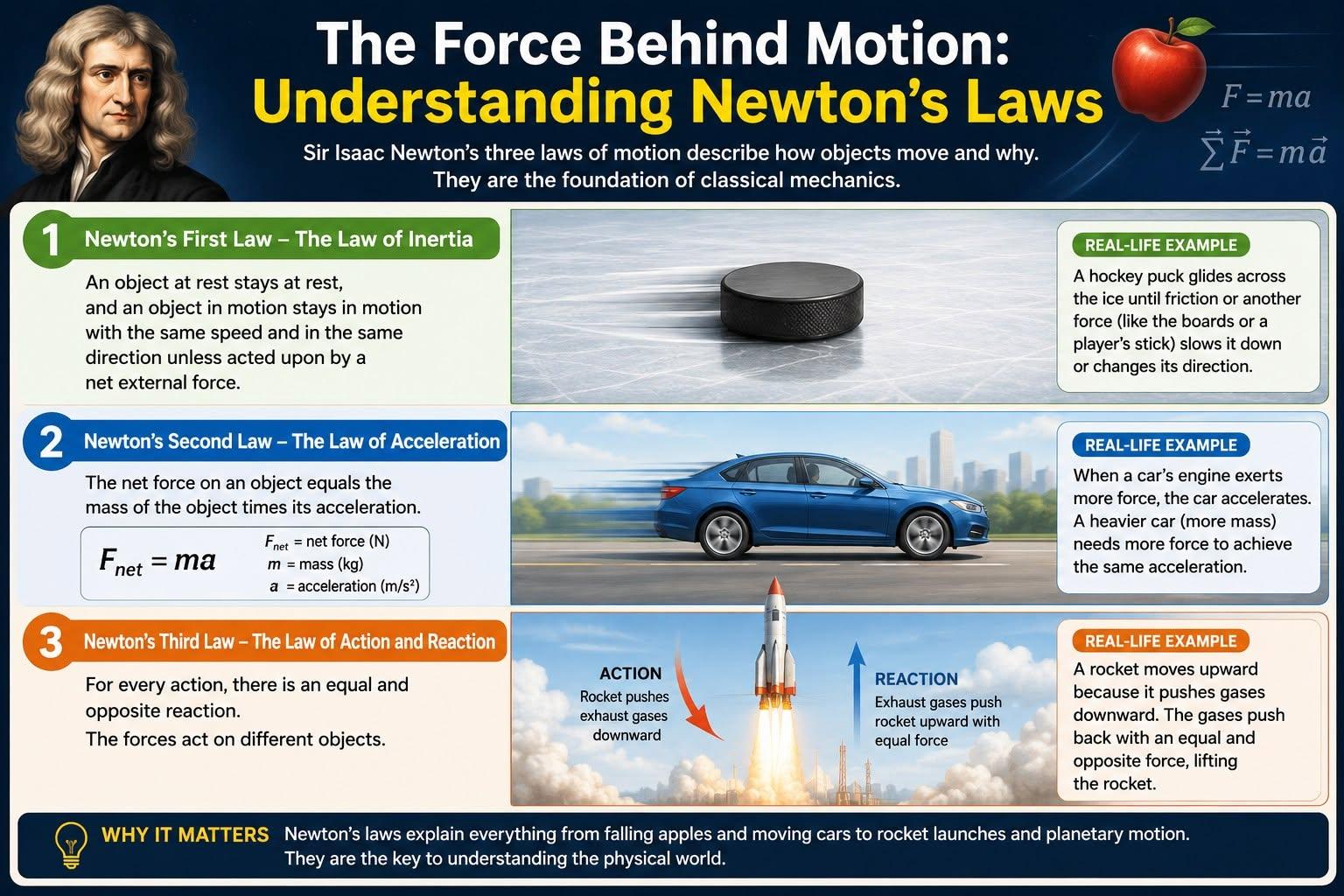
    The First Law of Motion, often called the Law of Inertia, explains that an object at rest tends to remain at rest, while an object in motion tends to continue moving in the same direction and at the same speed unless an external force acts upon it. In everyday life, we can see this when a football remains still until someone kicks it. Similarly, when a moving car suddenly stops, passengers tend to move forward because their bodies were already in motion. This law teaches us that objects do not naturally change their motion without a force acting on them.

    The Second Law of Motion explains how force affects the acceleration of an object. It is commonly represented by the equation F = m × a, meaning that force is equal to mass multiplied by acceleration. This law shows that applying a greater force can produce greater acceleration, while an object with greater mass requires more force to achieve the same acceleration. For example, pushing an empty shopping cart is usually easier than pushing a heavily loaded one. This principle is extremely important in the design of vehicles, machines, sports equipment, and many engineering systems.

    The Third Law of Motion states that for every action, there is an equal and opposite
    Mohsin RS F8 🎓✨ Story post NO:18 roll NO:13 Class: Foundation Level 📚 Made by Me 💻🚀 The Force Behind Motion: Understanding Newton’s Laws ⚡🔬🚀 Motion is one of the most important ideas in physics. Everything around us is constantly affected by forces, whether we notice them or not. A ball rolling across the ground, a car accelerating on a road, a bicycle slowing down, a person jumping, and a rocket launching into space are all examples of motion caused or changed by forces. To understand these everyday movements, scientists use fundamental principles known as Newton’s Laws of Motion. Sir Isaac Newton developed his three laws of motion in the 17th century, and they became a foundation of classical physics. These laws help explain the relationship between force, mass, and motion. They allow us to understand not only simple movements around us but also complicated systems involving machines, vehicles, sports, engineering, and space exploration. The First Law of Motion, often called the Law of Inertia, explains that an object at rest tends to remain at rest, while an object in motion tends to continue moving in the same direction and at the same speed unless an external force acts upon it. In everyday life, we can see this when a football remains still until someone kicks it. Similarly, when a moving car suddenly stops, passengers tend to move forward because their bodies were already in motion. This law teaches us that objects do not naturally change their motion without a force acting on them. The Second Law of Motion explains how force affects the acceleration of an object. It is commonly represented by the equation F = m × a, meaning that force is equal to mass multiplied by acceleration. This law shows that applying a greater force can produce greater acceleration, while an object with greater mass requires more force to achieve the same acceleration. For example, pushing an empty shopping cart is usually easier than pushing a heavily loaded one. This principle is extremely important in the design of vehicles, machines, sports equipment, and many engineering systems. The Third Law of Motion states that for every action, there is an equal and opposite
    0 Comentários 0 Compartilhamentos 496 Visualizações
  • MohsinRSF8
    song title no:9
    Rool no:13
    Class: Foundation level

    Calculus: The Journey of Numbers and Sacred Spaces

    Calculus is one of the most remarkable branches of mathematics because it gives us a way to understand change, movement, growth, space, patterns, and continuous processes. At first, calculus may appear to be a collection of complicated formulas, symbols, graphs, limits, derivatives, and integrals. However, when we look deeper, we discover that calculus is actually a beautiful language used to describe the world around us.

    The story of calculus begins with one of the most important questions in mathematics and science: How does something change? Everything around us is constantly changing. The position of a moving object changes with time. The speed of a vehicle changes as it accelerates or slows down. Plants grow, populations increase or decrease, rivers flow, temperatures rise and fall, and planets move through space. Calculus provides mathematical tools that allow us to study these changes carefully and accurately.

    One of the most important concepts in calculus is the derivative. A derivative helps us understand the rate at which something is changing at a particular moment. It allows us to move beyond simply knowing the beginning and ending values of something and instead understand what is happening between those points. This idea is extremely useful in physics, engineering, astronomy, economics, biology, computer science, and many other fields.

    For example, imagine a car traveling along a road. We may know how far the car has traveled after a certain amount of time, but calculus allows us to determine its speed at a specific instant. By studying the change in position over time, we can understand motion in a much more detailed way. This simple idea becomes the foundation for understanding acceleration, forces, planetary motion, and many other physical processes.

    The second major idea of calculus is integration. While differentiation focuses on rates of change, integration focuses on accumulation. An integral can help us calculate areas, volumes, distances, and quantities that build up over time. If many small pieces are combined together,
    MohsinRSF8 song title no:9 Rool no:13 Class: Foundation level Calculus: The Journey of Numbers and Sacred Spaces Calculus is one of the most remarkable branches of mathematics because it gives us a way to understand change, movement, growth, space, patterns, and continuous processes. At first, calculus may appear to be a collection of complicated formulas, symbols, graphs, limits, derivatives, and integrals. However, when we look deeper, we discover that calculus is actually a beautiful language used to describe the world around us. The story of calculus begins with one of the most important questions in mathematics and science: How does something change? Everything around us is constantly changing. The position of a moving object changes with time. The speed of a vehicle changes as it accelerates or slows down. Plants grow, populations increase or decrease, rivers flow, temperatures rise and fall, and planets move through space. Calculus provides mathematical tools that allow us to study these changes carefully and accurately. One of the most important concepts in calculus is the derivative. A derivative helps us understand the rate at which something is changing at a particular moment. It allows us to move beyond simply knowing the beginning and ending values of something and instead understand what is happening between those points. This idea is extremely useful in physics, engineering, astronomy, economics, biology, computer science, and many other fields. For example, imagine a car traveling along a road. We may know how far the car has traveled after a certain amount of time, but calculus allows us to determine its speed at a specific instant. By studying the change in position over time, we can understand motion in a much more detailed way. This simple idea becomes the foundation for understanding acceleration, forces, planetary motion, and many other physical processes. The second major idea of calculus is integration. While differentiation focuses on rates of change, integration focuses on accumulation. An integral can help us calculate areas, volumes, distances, and quantities that build up over time. If many small pieces are combined together,
    0 Comentários 0 Compartilhamentos 1492 Visualizações 125
  • RSIF8
    Roll no: 99
    Story post no: 23
    Story topic: The Force Behind Motion: Understanding Newton's Laws
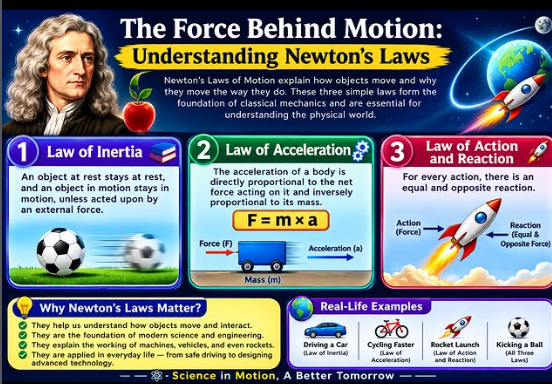
    Newton’s laws of motion form the foundation of classical mechanics and help us understand how forces affect the movement of objects. From a moving car to a falling object, these laws explain motion in everyday life and across the universe.
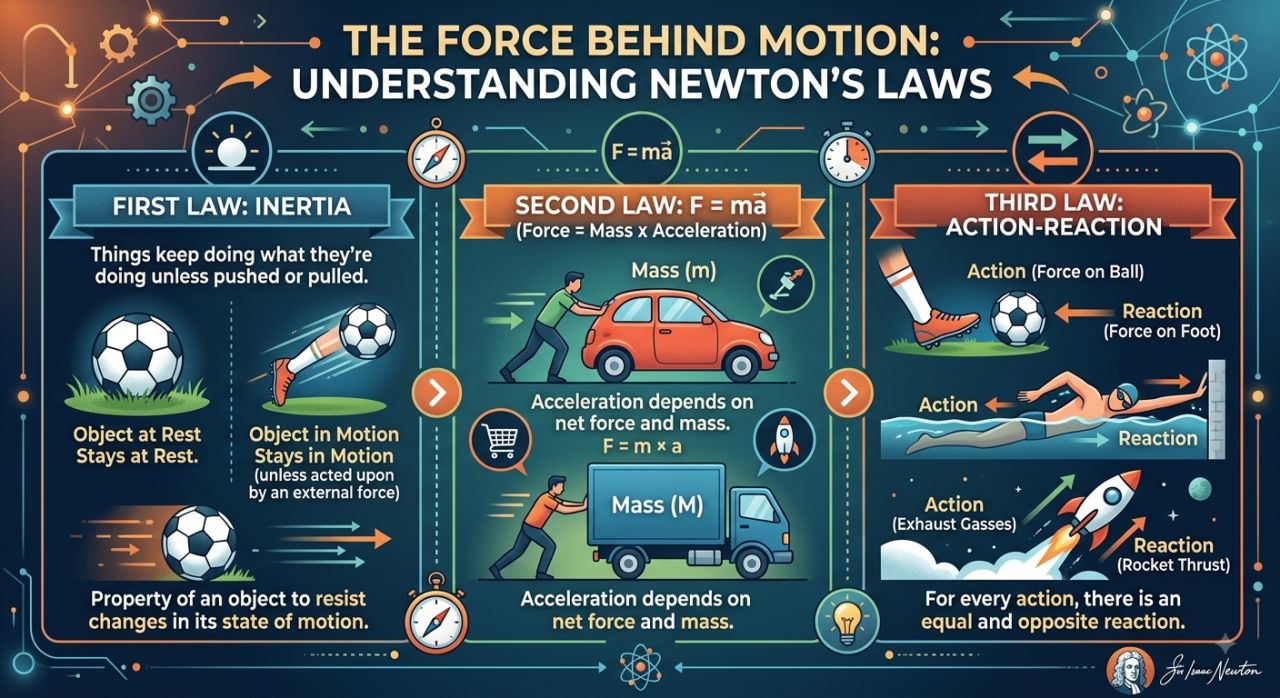
    The First Law introduces inertia, explaining that an object remains at rest or in motion unless acted upon by an external force. The Second Law connects force, mass, and acceleration through the equation F = ma. The Third Law states that every action has an equal and opposite reaction.
    Together, Newton’s laws provide a powerful framework for understanding motion and show how simple principles can explain complex physical phenomena.
    #NewtonLaws #Physics #Newton #Motion #Force #ClassicalMechanics #ScienceEducation #PhysicsEducation #STEM #LearnPhysics #Education
    RSIF8 Roll no: 99 Story post no: 23 Story topic: The Force Behind Motion: Understanding Newton's Laws Newton’s laws of motion form the foundation of classical mechanics and help us understand how forces affect the movement of objects. From a moving car to a falling object, these laws explain motion in everyday life and across the universe. The First Law introduces inertia, explaining that an object remains at rest or in motion unless acted upon by an external force. The Second Law connects force, mass, and acceleration through the equation F = ma. The Third Law states that every action has an equal and opposite reaction. Together, Newton’s laws provide a powerful framework for understanding motion and show how simple principles can explain complex physical phenomena. #NewtonLaws #Physics #Newton #Motion #Force #ClassicalMechanics #ScienceEducation #PhysicsEducation #STEM #LearnPhysics #Education
    0 Comentários 0 Compartilhamentos 1565 Visualizações
  • #rsisb
    Roll No 253
    Foundation Level
    Story Post 23

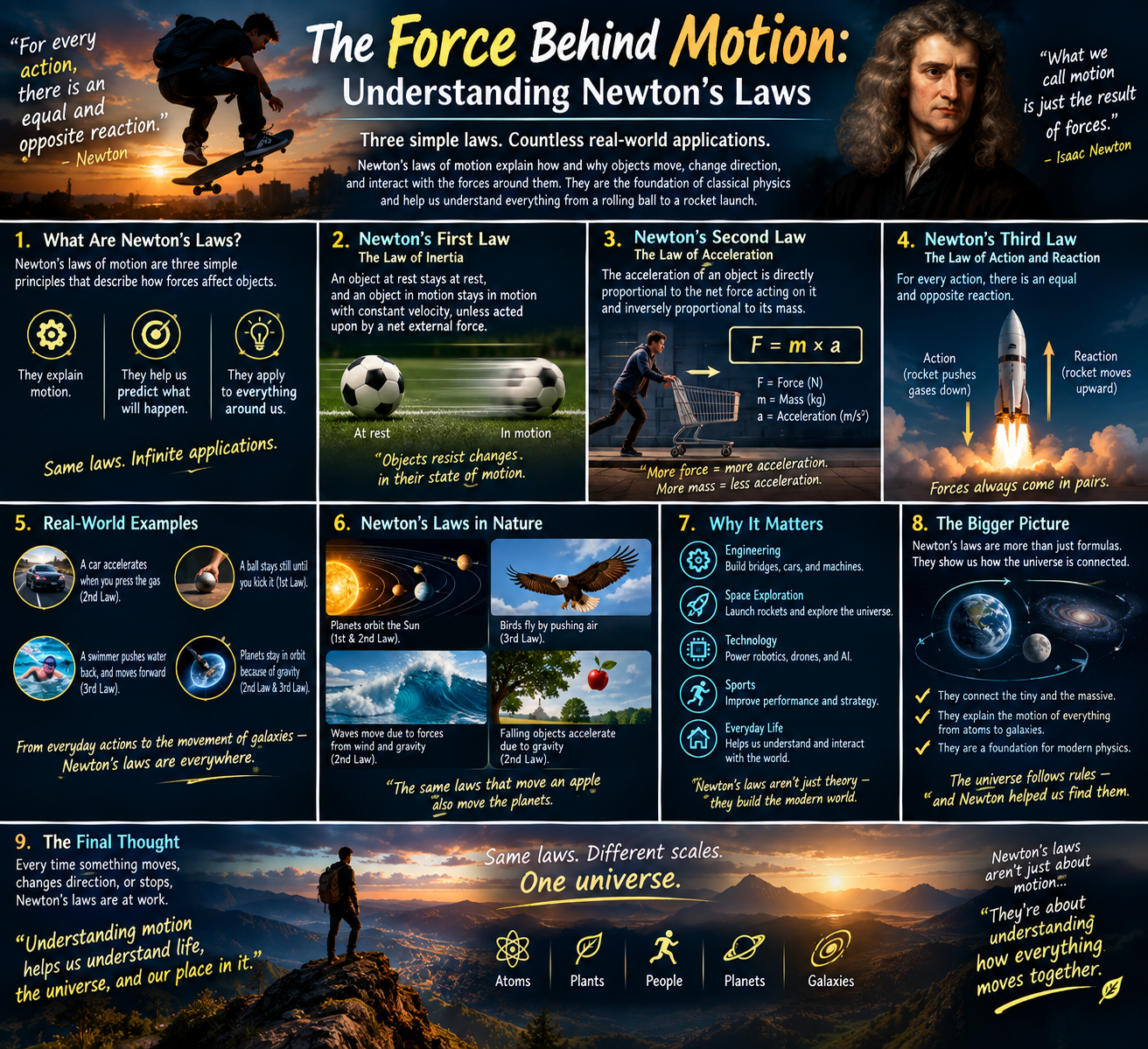
    # The Force Behind Motion: Understanding Newton’s Laws

    Imagine watching a football fly through the air , a car accelerate down a road , a rocket launch into space , or planets orbiting a star .

    These events may appear completely different—but beneath them is the same fundamental idea:

    ## **Forces control motion.**

    More than three centuries ago, **Isaac Newton** developed three laws that transformed our understanding of how objects move and interact. These laws became the foundation of classical mechanics and remain essential to physics, engineering, astronomy, and countless technologies today.

    ---

    # 1. What Are Newton's Laws?

    Newton's three laws describe the relationship between:

    **Force**
    **Mass**
    **Acceleration**
    **Motion**

    Together, they help us explain why objects remain still, why they accelerate, and how forces interact.

    From a rolling ball to a spacecraft , the same fundamental principles apply.

    ### **Three simple laws. Infinite applications.**

    ---

    # 2. Newton's First Law — The Law of Inertia

    Newton's First Law states that an object at rest remains at rest, while an object in motion continues moving at constant velocity unless acted upon by a net external force.

    This property is called **inertia**.

    Imagine a football sitting on the ground.

    It stays there until you kick it.

    Once moving, it won't naturally change its motion unless another force acts on it—such as friction, air resistance, or another object.

    A car requires braking to stop.
    A ball slows because of friction.
    Objects in space can continue moving with very little resistance.

    ### **Objects resist changes in their state of motion.**

    ---

    # 3. Newton's Second Law — The Law of Acceleration

    The second law explains how force changes motion.

    Its famous equation is:

    # **F = m × a**

    Where:

    **F** = Force
    **m** = Mass
    **a** = Acceleration

    This means that increasing the net force on an object generally increases its acceleration, while increasing the object's mass makes the same force produce less acceleration.

    Imagine pushing an empty shopping cart .

    It accelerates easily.

    Now fill it with heavy objects.

    The same push produces less acceleration.

    ### **More net force → more acceleration.**

    ### **More mass → less acceleration for the same force.**

    This simple relationship powers everything from vehicle design to rocket engineering .

    ---

    # 4. Newton's Third Law — Action and Reaction

    Newton's Third Law states:

    ### **For every action, there is an equal and opposite reaction.**

    Forces always occur through interactions between objects.

    Consider a rocket.

    The engine pushes hot gases downward and backward.

    The gases exert an equal and opposite force on the rocket, pushing it upward.

    The same principle appears everywhere:

    A swimmer pushes water backward → the water pushes the swimmer forward.
    A bird pushes air downward → the air helps push the bird upward.
    You push the ground backward → the ground pushes you forward.

    ### **Forces come in pairs.**

    ---

    # 5. Newton's Laws in Everyday Life

    You don't need a laboratory to see Newton's laws.

    They are happening around you constantly.

    **Cars:** Engine force changes speed and direction.
    **Sports:** Kicking a ball changes its motion.
    **Swimming:** Pushing water creates forward motion.
    **Cycling:** Pedaling produces forces that accelerate the bicycle.
    **Falling objects:** Gravity changes their motion.
    **Skateboards:** Pushing against the ground creates movement.

    Everyday motion is essentially a continuous interaction between forces.

    ---

    # 6. Newton's Laws in Nature

    Newton's laws don't stop at Earth.

    They also help describe motion throughout the universe.

    Planets orbit stars.
    Moons orbit planets.
    Comets travel through space.
    Waves respond to forces.
    Birds generate lift through interactions with air.
    Objects accelerate under gravity.

    The same physics that explains a falling apple can help describe the motion of enormous celestial bodies.

    ### **From apples to planets, the same laws operate across nature.**

    ---

    # 7. Why Newton's Laws Matter

    Newton's laws are more than equations in a textbook.

    They are essential tools for understanding and designing the physical world.

    **Engineering** — bridges, buildings, vehicles, and machines
    **Space exploration** — rockets, spacecraft, and orbital motion
    **Technology** — robots, drones, and automated systems
    **Sports science** — movement, speed, and performance
    **Transportation** — cars, aircraft, and trains

    Modern technology depends heavily on our ability to predict how forces produce motion.

    ---

    # 8. The Bigger Picture

    Newton's laws reveal something remarkable:

    The universe is not simply a collection of random movements.

    Objects interact through measurable forces.

    From microscopic particles to massive planets and galaxies , physics provides mathematical relationships that help us understand motion.

    The scale may change.

    The objects may change.

    But the underlying principles remain incredibly powerful.

    ### **Tiny or massive. Fast or slow. Earth or space. Motion follows physical laws.**

    ---

    # 9. The Final Thought

    Every time something moves…

    Every time something accelerates…

    Every time something changes direction…

    **Newton's laws are there.**

    A skateboard rolling down a street
    A bird taking flight
    A rocket leaving Earth
    A planet orbiting the Sun

    Different events.

    Different scales.

    One underlying framework.

    ## **Same laws. Different scales. One universe.**

    Understanding motion isn't just about solving equations.

    It's about understanding **how the physical world moves, interacts, and holds together.**

    ### **Once you understand the forces behind motion, the world around you begins to move in a whole new way.**


    Asma Shaheen EducationWali
    Saima Empowerment Wali
    Mishaal TrainingWali
    #rsisb Roll No 253 Foundation Level Story Post 23 # ⚡🌌 The Force Behind Motion: Understanding Newton’s Laws Imagine watching a football fly through the air ⚽, a car accelerate down a road 🚗💨, a rocket launch into space 🚀, or planets orbiting a star 🪐✨. These events may appear completely different—but beneath them is the same fundamental idea: ## **Forces control motion.** ⚡🧲 More than three centuries ago, **Isaac Newton** developed three laws that transformed our understanding of how objects move and interact. These laws became the foundation of classical mechanics and remain essential to physics, engineering, astronomy, and countless technologies today. 🔬⚙️🌍 --- # 🧠⚡ 1. What Are Newton's Laws? Newton's three laws describe the relationship between: ⚡ **Force** 🧱 **Mass** 💨 **Acceleration** 🏃 **Motion** Together, they help us explain why objects remain still, why they accelerate, and how forces interact. From a rolling ball 🎾 to a spacecraft 🚀, the same fundamental principles apply. ### **Three simple laws. Infinite applications.** 🌌 --- # 🛑➡️ 2. Newton's First Law — The Law of Inertia Newton's First Law states that an object at rest remains at rest, while an object in motion continues moving at constant velocity unless acted upon by a net external force. This property is called **inertia**. 🧱⚡ Imagine a football sitting on the ground. ⚽ It stays there until you kick it. Once moving, it won't naturally change its motion unless another force acts on it—such as friction, air resistance, or another object. 🚗 A car requires braking to stop. ⚽ A ball slows because of friction. 🛰️ Objects in space can continue moving with very little resistance. ### **Objects resist changes in their state of motion.** --- # 💨⚙️ 3. Newton's Second Law — The Law of Acceleration The second law explains how force changes motion. Its famous equation is: # **F = m × a** ⚡ Where: **F** = Force 🧲 **m** = Mass ⚖️ **a** = Acceleration 💨 This means that increasing the net force on an object generally increases its acceleration, while increasing the object's mass makes the same force produce less acceleration. Imagine pushing an empty shopping cart 🛒. It accelerates easily. Now fill it with heavy objects. The same push produces less acceleration. ### **More net force → more acceleration.** ### **More mass → less acceleration for the same force.** This simple relationship powers everything from vehicle design 🚗 to rocket engineering 🚀. --- # 🚀🔥 4. Newton's Third Law — Action and Reaction Newton's Third Law states: ### **For every action, there is an equal and opposite reaction.** ⚡ Forces always occur through interactions between objects. Consider a rocket. 🚀 The engine pushes hot gases downward and backward. The gases exert an equal and opposite force on the rocket, pushing it upward. ⬆️🔥 The same principle appears everywhere: 🏊 A swimmer pushes water backward → the water pushes the swimmer forward. 🦅 A bird pushes air downward → the air helps push the bird upward. 🚶 You push the ground backward → the ground pushes you forward. ### **Forces come in pairs.** 🔗⚡ --- # 🌍⚽ 5. Newton's Laws in Everyday Life You don't need a laboratory to see Newton's laws. They are happening around you constantly. 🚗 **Cars:** Engine force changes speed and direction. ⚽ **Sports:** Kicking a ball changes its motion. 🏊 **Swimming:** Pushing water creates forward motion. 🚲 **Cycling:** Pedaling produces forces that accelerate the bicycle. 🍎 **Falling objects:** Gravity changes their motion. 🛹 **Skateboards:** Pushing against the ground creates movement. Everyday motion is essentially a continuous interaction between forces. --- # 🌌🪐 6. Newton's Laws in Nature Newton's laws don't stop at Earth. They also help describe motion throughout the universe. 🌌 🪐 Planets orbit stars. 🌙 Moons orbit planets. ☄️ Comets travel through space. 🌊 Waves respond to forces. 🦅 Birds generate lift through interactions with air. 🍎 Objects accelerate under gravity. The same physics that explains a falling apple can help describe the motion of enormous celestial bodies. ### **From apples to planets, the same laws operate across nature.** 🍎➡️🪐 --- # ⚙️🚀 7. Why Newton's Laws Matter Newton's laws are more than equations in a textbook. They are essential tools for understanding and designing the physical world. 🏗️ **Engineering** — bridges, buildings, vehicles, and machines 🚀 **Space exploration** — rockets, spacecraft, and orbital motion 🤖 **Technology** — robots, drones, and automated systems 🏃 **Sports science** — movement, speed, and performance 🚗 **Transportation** — cars, aircraft, and trains Modern technology depends heavily on our ability to predict how forces produce motion. --- # 🌌🔭 8. The Bigger Picture Newton's laws reveal something remarkable: The universe is not simply a collection of random movements. Objects interact through measurable forces. ⚛️🧲 From microscopic particles 🔬 to massive planets 🪐 and galaxies 🌌, physics provides mathematical relationships that help us understand motion. The scale may change. The objects may change. But the underlying principles remain incredibly powerful. ### **Tiny or massive. Fast or slow. Earth or space. Motion follows physical laws.** ⚡🌍🌌 --- # 🌅⚡ 9. The Final Thought Every time something moves… Every time something accelerates… Every time something changes direction… **Newton's laws are there.** 🧠⚡ A skateboard rolling down a street 🛹 A bird taking flight 🦅 A rocket leaving Earth 🚀 A planet orbiting the Sun ☀️🪐 Different events. Different scales. One underlying framework. ## 🌌 **Same laws. Different scales. One universe.** Understanding motion isn't just about solving equations. It's about understanding **how the physical world moves, interacts, and holds together.** ⚛️🌍✨ ### **Once you understand the forces behind motion, the world around you begins to move in a whole new way.** ⚡🔬🌌 Asma Shaheen EducationWali Saima Empowerment Wali Mishaal TrainingWali
    0 Comentários 0 Compartilhamentos 3417 Visualizações
  • **Foundation Level** **Day 153** **story post** **Roll Number: 005**

    The Force Behind Motion: Understanding Newton’s Laws

    Ever wondered why objects move, stop, or change direction? Isaac Newton’s three laws of motion help us understand the forces behind movement.

    First Law – Inertia: Objects keep their state of motion unless a force changes it.
    Second Law – Acceleration: Force, mass, and acceleration are connected by F = m × a.
    Third Law – Action & Reaction: Every action has an equal and opposite reaction.

    From a rolling ball to a launching rocket , Newton’s laws are working all around us!

    #NewtonLaws #Physics #Science #Motion #Force #Education #ScienceExplained #PhysicsForStudents #LearningScience #InstagramEducation
    **Foundation Level** **Day 153** **story post** **Roll Number: 005** 🚀 The Force Behind Motion: Understanding Newton’s Laws ⚡ Ever wondered why objects move, stop, or change direction? 🌍 Isaac Newton’s three laws of motion help us understand the forces behind movement. 🔹 First Law – Inertia: Objects keep their state of motion unless a force changes it. 🔹 Second Law – Acceleration: Force, mass, and acceleration are connected by F = m × a. 🔹 Third Law – Action & Reaction: Every action has an equal and opposite reaction. From a rolling ball ⚽ to a launching rocket 🚀, Newton’s laws are working all around us! #NewtonLaws #Physics #Science #Motion #Force #Education #ScienceExplained #PhysicsForStudents #LearningScience #InstagramEducation
    0 Comentários 0 Compartilhamentos 1583 Visualizações
  • Fondation Level Batch No 4
    Roll RSLC #42
    Task No #153
    Day #153

    One bright morning, Adam was playing in a park when he noticed a football resting quietly on the grass. He gently kicked the ball, and it suddenly began rolling across the field. Curious, Adam wondered why the ball had moved only after he kicked it. His teacher explained that this was connected to Newton?s First Law of Motion. An object remains at rest or keeps moving in the same way unless an external force changes its motion. Adam realized that even a simple kick could demonstrate an important scientific principle. From that moment, he became interested in discovering the forces behind everyday movement.

    Adam then decided to test how different objects responded to force. He pushed a light ball and a heavier ball with similar strength and noticed that the lighter ball moved more easily. His teacher explained Newton?s Second Law, which connects force, mass, and acceleration. Adam learned that applying more force can produce a greater change in an object?s motion. He also discovered that heavier objects usually need more force to achieve the same acceleration. Suddenly, pushing a bicycle, moving a box, or kicking a ball seemed much more interesting to him. He understood that forces were constantly influencing the world around him.

    Later, Adam threw a ball against a wall and watched it bounce back toward him. His teacher explained that this was an example of Newton?s Third Law of Motion. Whenever one object applies a force to another object, an equal and opposite force acts back. Adam realized that this principle could be seen when people walk, jump, swim, or ride a bicycle. When his feet pushed the ground backward, the ground pushed him forward. He also learned that rockets move upward by pushing gases downward at high speed. Newton?s Third Law suddenly made many everyday movements easier for Adam to understand.

    By the end of the day, Adam realized that Newton?s laws were much more than formulas in a science book. They were powerful principles that explained how objects move, stop, accelerate, and interact with one another. He could see examples of them in cars, bicycles, sports, falling objects, machines, and even rockets traveling into space. The world around him suddenly looked like a fascinating laboratory filled with invisible forces. Adam understood that physics helps us discover the rules behind ordinary events. From a simple football rolling across the grass to a spacecraft leaving Earth, Newton?s laws tell an amazing story about the force behind motion.

    #NewtonLaws #Physics #ForceAndMotion #NewtonianPhysics #ScienceEducation #PhysicsExplained #LearningScience
    Fondation Level Batch No 4 Roll RSLC #42 Task No #153 Day #153 One bright morning, Adam was playing in a park when he noticed a football resting quietly on the grass. He gently kicked the ball, and it suddenly began rolling across the field. Curious, Adam wondered why the ball had moved only after he kicked it. His teacher explained that this was connected to Newton?s First Law of Motion. An object remains at rest or keeps moving in the same way unless an external force changes its motion. Adam realized that even a simple kick could demonstrate an important scientific principle. From that moment, he became interested in discovering the forces behind everyday movement. Adam then decided to test how different objects responded to force. He pushed a light ball and a heavier ball with similar strength and noticed that the lighter ball moved more easily. His teacher explained Newton?s Second Law, which connects force, mass, and acceleration. Adam learned that applying more force can produce a greater change in an object?s motion. He also discovered that heavier objects usually need more force to achieve the same acceleration. Suddenly, pushing a bicycle, moving a box, or kicking a ball seemed much more interesting to him. He understood that forces were constantly influencing the world around him. Later, Adam threw a ball against a wall and watched it bounce back toward him. His teacher explained that this was an example of Newton?s Third Law of Motion. Whenever one object applies a force to another object, an equal and opposite force acts back. Adam realized that this principle could be seen when people walk, jump, swim, or ride a bicycle. When his feet pushed the ground backward, the ground pushed him forward. He also learned that rockets move upward by pushing gases downward at high speed. Newton?s Third Law suddenly made many everyday movements easier for Adam to understand. By the end of the day, Adam realized that Newton?s laws were much more than formulas in a science book. They were powerful principles that explained how objects move, stop, accelerate, and interact with one another. He could see examples of them in cars, bicycles, sports, falling objects, machines, and even rockets traveling into space. The world around him suddenly looked like a fascinating laboratory filled with invisible forces. Adam understood that physics helps us discover the rules behind ordinary events. From a simple football rolling across the grass to a spacecraft leaving Earth, Newton?s laws tell an amazing story about the force behind motion. #NewtonLaws #Physics #ForceAndMotion #NewtonianPhysics #ScienceEducation #PhysicsExplained #LearningScience
    0 Comentários 0 Compartilhamentos 2707 Visualizações
  • #rsisb
    Roll no.247
    canva post .31
    Foundation leve

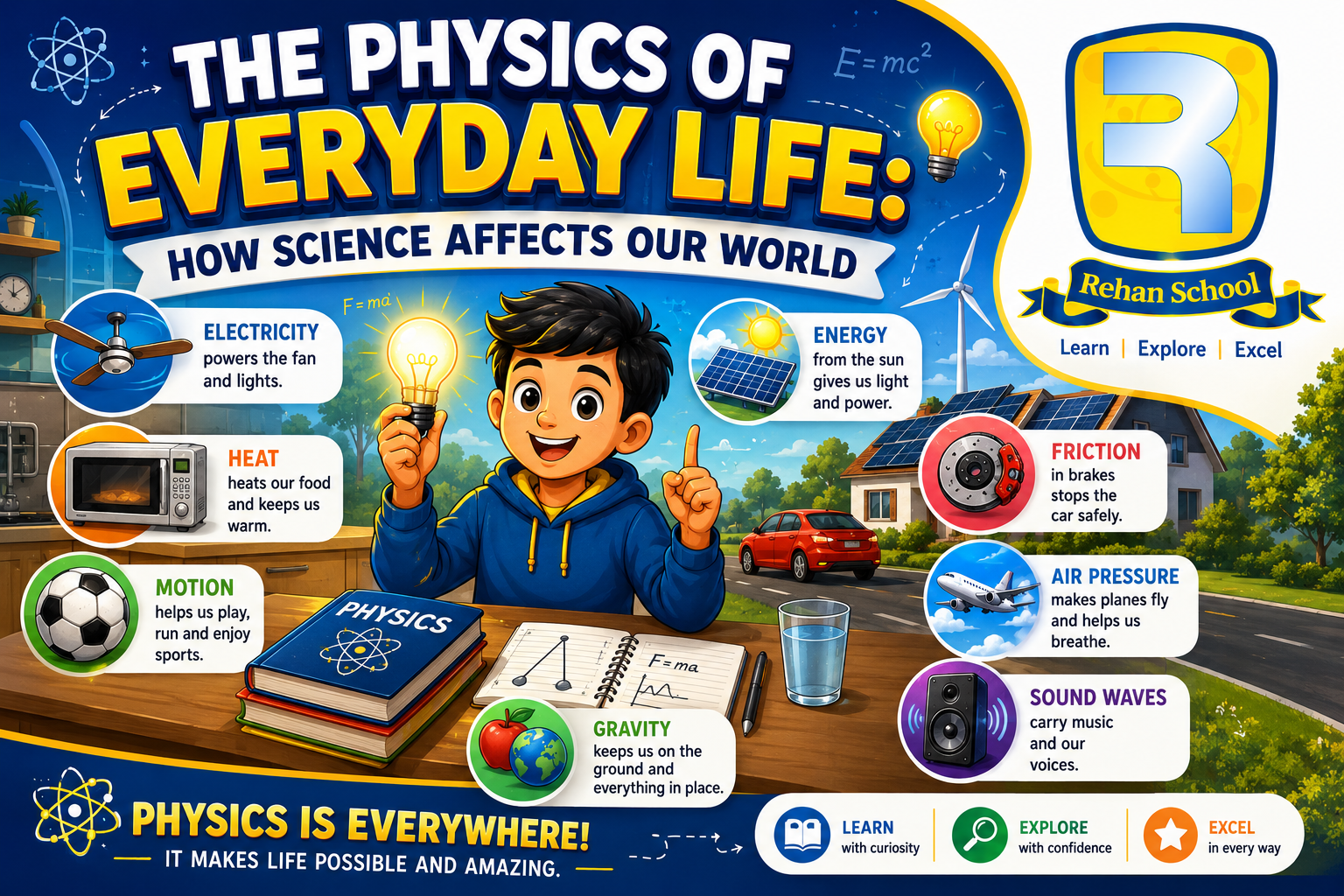
    **The Physics of Everyday Life: How Science Affects Our World**

    Have you ever wondered why a ball falls when you drop it, how a bicycle stays balanced, why a car moves forward, how a fan produces airflow, or how your smartphone communicates with the world around you? All of these everyday experiences are connected to **physics**—the science that helps us understand how the universe works.

    **“The Physics of Everyday Life: How Science Affects Our World”** is an exciting journey into the science behind the ordinary things we see and use every day. From the moment we wake up and switch on a light to the time we travel, study, play, cook, communicate, and relax, physics is constantly working around us.

    **Energy and Electricity:**
    Electricity powers our homes, schools, computers, appliances, and countless modern technologies. Understanding energy helps us see how electrical power is generated, transferred, and transformed into useful forms.

    **Motion and Forces:**
    Whenever something moves, forces are involved. Walking, running, cycling, driving, throwing a ball, or opening a door can all be explained through concepts such as force, motion, friction, and acceleration. ‍

    **Heat and Temperature:**
    From boiling water to cooling food in a refrigerator , heat transfer plays an important role in our daily lives. Physics explains why different materials heat up and cool down at different rates.

    **Light and Sound:**
    The colors we see, the sounds we hear, the mirrors we use, and the cameras in our phones are all connected to fascinating physical principles.

    **Gravity and the Natural World:**
    Gravity keeps us on Earth and influences everything from falling objects to the movement of planets and satellites.

    **Technology and Modern Life:**
    Physics is also behind many technologies we depend on, including smartphones, computers, medical equipment, transportation systems, satellites, and communication devices.

    The most amazing lesson is that **physics is not only something we study in textbooks—it is happening all around us.** When we understand the science behind everyday events, ordinary experiences become opportunities for discovery.

    This topic encourages curiosity, observation, critical thinking, experimentation, and a deeper appreciation for the world around us. It reminds us that asking **“Why?”** can be the beginning of an exciting scientific journey.

    Whether you are a student, teacher, science enthusiast, or simply someone curious about how things work, exploring everyday physics can help you look at the world from a completely new perspective.

    **Observe. Question. Experiment. Discover. Learn.**
    Because science is not far away—it is part of **every moment of our everyday lives!**

    #Physics #EverydayPhysics #Science #PhysicsInEverydayLife #ScienceEducation #STEM #STEMEducation #LearnScience #ScienceEverywhere #PhysicsExplained #ScienceAndTechnology #EverydayScience #LearningIsFun #Curiosity #Discovery #Education #Students #Teachers #ScientificThinking #Experiments #Energy #Motion #Gravity #Electricity #Light #Sound #Technology #Innovation #ExploreScience #KnowledgeIsPower
    #rsisb Roll no.247 canva post .31 Foundation leve 🌍⚛️ **The Physics of Everyday Life: How Science Affects Our World** 🔬✨ Have you ever wondered why a ball falls when you drop it, how a bicycle stays balanced, why a car moves forward, how a fan produces airflow, or how your smartphone communicates with the world around you? 🤔📱🚗 All of these everyday experiences are connected to **physics**—the science that helps us understand how the universe works. 🌌🔭 **“The Physics of Everyday Life: How Science Affects Our World”** is an exciting journey into the science behind the ordinary things we see and use every day. From the moment we wake up and switch on a light 💡 to the time we travel, study, play, cook, communicate, and relax, physics is constantly working around us. ⚡ **Energy and Electricity:** Electricity powers our homes, schools, computers, appliances, and countless modern technologies. Understanding energy helps us see how electrical power is generated, transferred, and transformed into useful forms. 🚗 **Motion and Forces:** Whenever something moves, forces are involved. Walking, running, cycling, driving, throwing a ball, or opening a door can all be explained through concepts such as force, motion, friction, and acceleration. 🏃‍♂️⚽🚲 🌡️ **Heat and Temperature:** From boiling water ☕ to cooling food in a refrigerator ❄️, heat transfer plays an important role in our daily lives. Physics explains why different materials heat up and cool down at different rates. 💡 **Light and Sound:** The colors we see, the sounds we hear, the mirrors we use, and the cameras in our phones are all connected to fascinating physical principles. 🌈👂📷 🌍 **Gravity and the Natural World:** Gravity keeps us on Earth and influences everything from falling objects to the movement of planets and satellites. 🪐🌎 📱 **Technology and Modern Life:** Physics is also behind many technologies we depend on, including smartphones, computers, medical equipment, transportation systems, satellites, and communication devices. 🚀💻📡 The most amazing lesson is that **physics is not only something we study in textbooks—it is happening all around us.** 📚✨ When we understand the science behind everyday events, ordinary experiences become opportunities for discovery. This topic encourages curiosity, observation, critical thinking, experimentation, and a deeper appreciation for the world around us. 🔬🧠🌟 It reminds us that asking **“Why?”** can be the beginning of an exciting scientific journey. Whether you are a student, teacher, science enthusiast, or simply someone curious about how things work, exploring everyday physics can help you look at the world from a completely new perspective. 🌎💫 🔭 **Observe. Question. Experiment. Discover. Learn.** Because science is not far away—it is part of **every moment of our everyday lives!** ⚛️❤️ #Physics #EverydayPhysics #Science #PhysicsInEverydayLife #ScienceEducation #STEM #STEMEducation #LearnScience #ScienceEverywhere #PhysicsExplained #ScienceAndTechnology #EverydayScience #LearningIsFun #Curiosity #Discovery #Education #Students #Teachers #ScientificThinking #Experiments #Energy #Motion #Gravity #Electricity #Light #Sound #Technology #Innovation #ExploreScience #KnowledgeIsPower 🌍🔬⚡🚀📚✨
    0 Comentários 0 Compartilhamentos 6046 Visualizações
  • #rsisb
    Roll No.269
    Foundation Level
    Story Post No.24


    **The Force Behind Motion: Understanding Newton’s Laws**

    Have you ever wondered why objects move, stop, or change direction? The answer lies in one of the most important ideas in physics: **force and motion**.

    In this video, we explore **Newton’s Three Laws of Motion** and understand how they explain the movement of objects in our everyday lives. From a ball rolling on the ground to a car accelerating and a rocket launching into space , Newton’s laws help us understand the forces behind motion.

    We will learn how objects behave when forces act on them, how force and acceleration are connected, and why every action has an equal and opposite reaction. These simple but powerful laws are the foundation of many concepts in physics and engineering.

    This topic shows us that physics is not just about formulas—it is all around us! From sports and transportation to machines and space exploration, Newton’s laws help explain the world we see every day.

    Join us as we explore the fascinating **force behind motion** and discover how Newton’s laws shape our understanding of the physical world.

    #NewtonLaws #Newton #Physics #ForceAndMotion #Motion #Science #PhysicsFacts #NewtonLawsOfMotion #Force #Acceleration #Gravity #Mechanics #ScienceEducation #Learning #Education #ScientificDiscovery #PhysicsExperiment #SpaceScience #Engineering #Knowledge #Curiosity #StudentLife #ScienceFacts #RehanSchool #LearnAndGrow
    #rsisb Roll No.269 Foundation Level Story Post No.24 ⚡ **The Force Behind Motion: Understanding Newton’s Laws** 🚀🔬 Have you ever wondered why objects move, stop, or change direction? 🤔 The answer lies in one of the most important ideas in physics: **force and motion**. In this video, we explore **Newton’s Three Laws of Motion** and understand how they explain the movement of objects in our everyday lives. From a ball rolling on the ground ⚽ to a car accelerating 🚗 and a rocket launching into space 🚀, Newton’s laws help us understand the forces behind motion. We will learn how objects behave when forces act on them, how force and acceleration are connected, and why every action has an equal and opposite reaction. ⚖️💡 These simple but powerful laws are the foundation of many concepts in physics and engineering. This topic shows us that physics is not just about formulas—it is all around us! 🌍 From sports and transportation to machines and space exploration, Newton’s laws help explain the world we see every day. Join us as we explore the fascinating **force behind motion** and discover how Newton’s laws shape our understanding of the physical world. 🔬📚✨ #NewtonLaws ⚡ #Newton #Physics 🔬 #ForceAndMotion 🚀 #Motion #Science 📚 #PhysicsFacts 💡 #NewtonLawsOfMotion #Force 💪 #Acceleration 🏎️ #Gravity 🌍 #Mechanics 🔧 #ScienceEducation 🎓 #Learning 📖 #Education 🧠 #ScientificDiscovery 🔍 #PhysicsExperiment 🧪 #SpaceScience 🚀 #Engineering ⚙️ #Knowledge 💡 #Curiosity 🤔 #StudentLife 🎓 #ScienceFacts 🌎 #RehanSchool 🏫 #LearnAndGrow 🌱
    0 Comentários 0 Compartilhamentos 3894 Visualizações
  • #rsisb
    Roll no.239
    Story post no.22
    Foundation Level


    Why do objects move, stop, or change direction? The answer lies in **Newton’s Laws of Motion**!

    From a moving car to a flying rocket , Newton’s laws help us understand how forces affect motion. They explain the relationship between **force, mass, acceleration, and action-reaction**.

    Explore the science behind everyday movement and discover how these powerful laws continue to shape our understanding of the physical world!

    #NewtonLaws #Physics #Science #Motion #Force #IsaacNewton #Education #ScienceFacts #Learning #STEM #PhysicsWorld #Knowledge #Discovery
    #rsisb Roll no.239 Story post no.22 Foundation Level Why do objects move, stop, or change direction? 🤔 The answer lies in **Newton’s Laws of Motion**! 🌍✨ From a moving car 🚗 to a flying rocket 🚀, Newton’s laws help us understand how forces affect motion. They explain the relationship between **force, mass, acceleration, and action-reaction**. ⚡🔬 Explore the science behind everyday movement and discover how these powerful laws continue to shape our understanding of the physical world! 🌟🧠 #NewtonLaws #Physics #Science #Motion #Force #IsaacNewton #Education #ScienceFacts #Learning #STEM #PhysicsWorld #Knowledge #Discovery 🚀⚙️🔬
    0 Comentários 0 Compartilhamentos 1883 Visualizações
Páginas Impulsionadas