**Roll No: 2**
**Batch: 14**
**Book: ACCL**
**Task No: 145**
# The Ethics and Education of Animal Dissections
Have you ever wondered how students learn about the internal structures of animals and why science education places importance on understanding life responsibly? Animal dissection has been used in biology classrooms and scientific research to help learners explore anatomy, examine organs, and understand how different body systems function. However, it also raises important questions about animal welfare, ethical responsibility, and the best ways to teach scientific concepts.
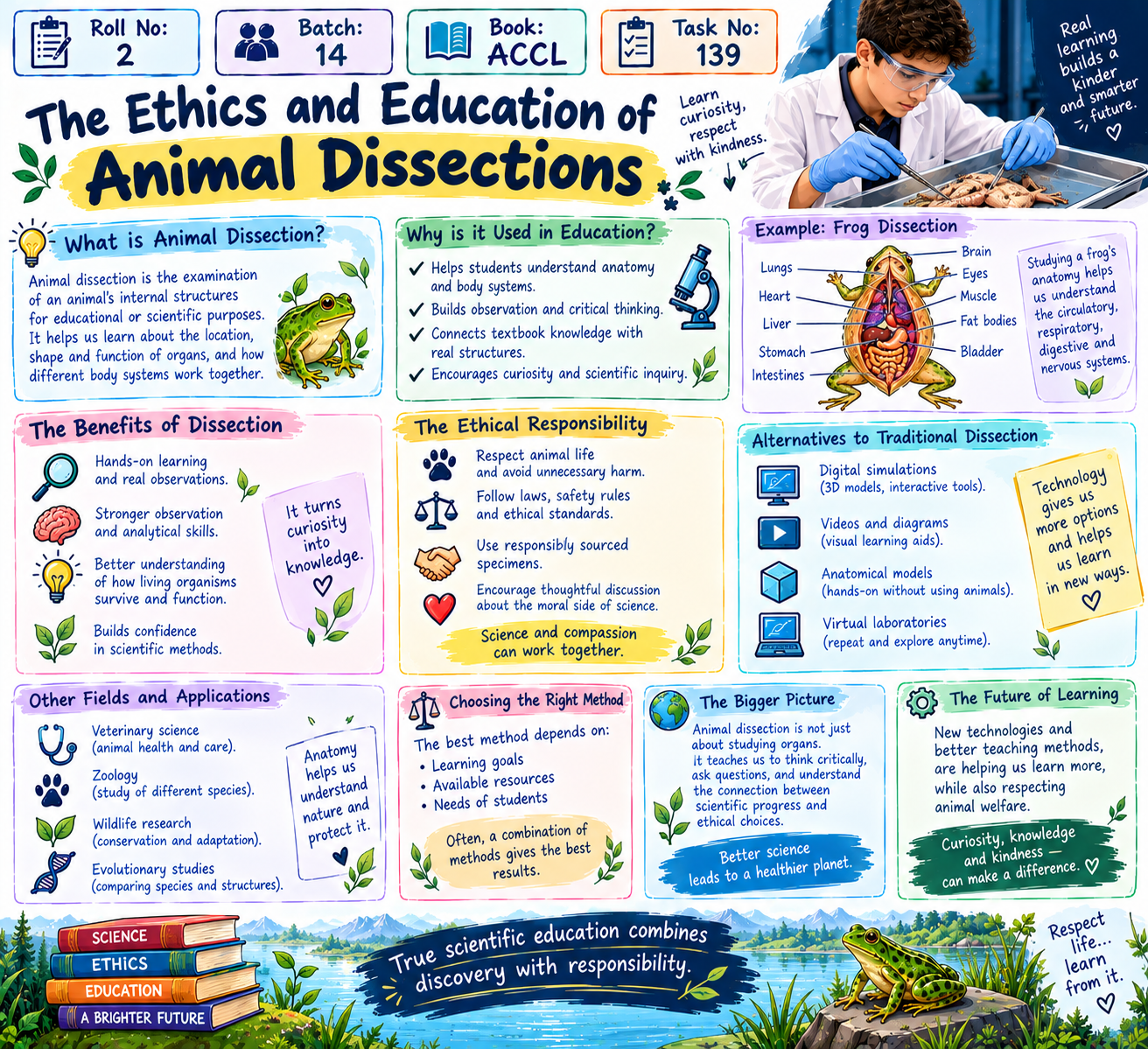
**Animal dissection is the examination of an animal's internal structures for educational or scientific purposes.** By studying anatomy, students can learn how organs are arranged and how body systems work together. For example, examining the anatomy of a frog can help learners understand the circulatory, respiratory, digestive, and nervous systems. These observations connect information from textbooks with the physical structures found in living organisms.
One major benefit of dissection is that it encourages active learning. Instead of only memorizing the names of organs, students can observe anatomical structures, compare their shapes and positions, and ask questions about their functions. This process can strengthen observation skills, critical thinking, and scientific understanding. It also helps learners recognize that every organ has a role in supporting the survival of an organism.
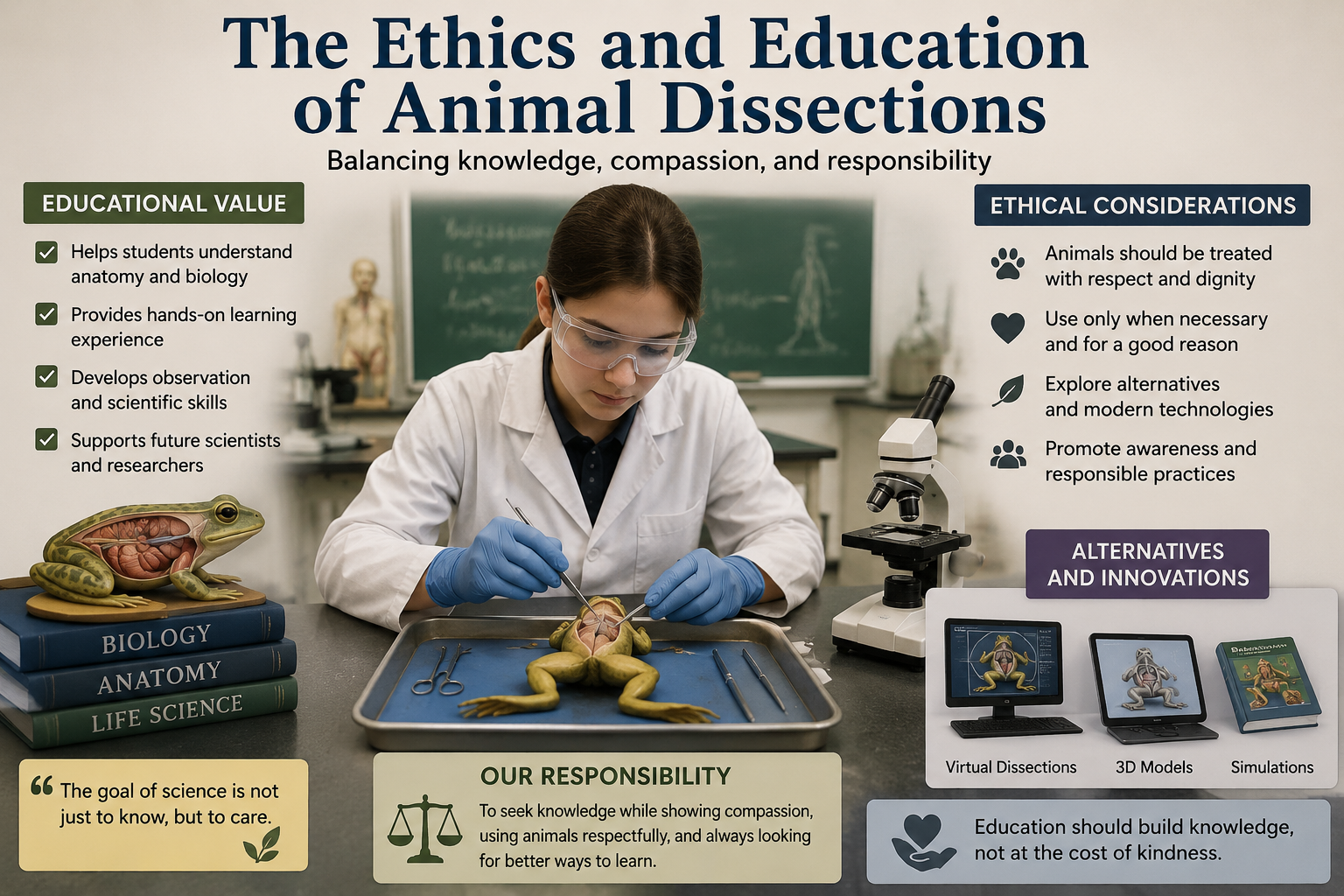
Nevertheless, **education must balance scientific learning with respect for animal life.** Animals are living organisms with their own biological needs, and their use in education should be considered carefully. Teachers and institutions should follow applicable laws, safety rules, and ethical standards. Specimens should be obtained responsibly, and unnecessary harm should be avoided. Students should also be encouraged to discuss the moral responsibilities that accompany scientific discovery.
Fortunately, modern technology provides several alternatives to traditional dissection. Digital simulations allow students to explore three-dimensional anatomical models, examine virtual organs, and study body systems through interactive activities. Videos, diagrams, anatomical models, and virtual laboratories can also make complex concepts easier to understand. These approaches may reduce the need for physical specimens while offering flexible opportunities for repeated learning.
The best educational method can depend on the learning objective, available resources, and the needs of students. A physical specimen may provide certain observations that a diagram cannot fully reproduce, while a digital model may allow students to rotate structures, zoom in on details, and repeat an activity without using another specimen. Combining different teaching methods can provide a richer understanding of anatomy and biology.
Animal dissection also connects classroom education with wider scientific fields. Knowledge of anatomy contributes to veterinary science, zoology, wildlife research, and the study of animal health. Comparing anatomical structures across species can help scientists investigate adaptation and evolutionary relationships. Such knowledge can also support conservation efforts by improving our understanding of animals and the environments in which they live.
Ethics should remain an important part of every scientific learning experience. Students should be able to ask questions, understand why a particular method is being used, and learn about alternatives where appropriate. Teachers can create respectful classrooms by explaining the educational purpose of activities, ensuring proper supervision, and encouraging thoughtful discussion. Scientific progress is strongest when curiosity is combined with compassion and responsibility.
Another important lesson is that science continues to develop. New technologies and educational methods provide opportunities to improve the way anatomy is taught. By evaluating the effectiveness of different approaches, educators can choose methods that support learning while taking animal welfare seriously. This ongoing evaluation reflects the scientific habit of questioning, testing, and improving established practices.
Ultimately, the ethics and education of animal dissections are about more than studying organs. They encourage students to think critically about scientific methods, recognize the value of responsible research, and understand the relationship between knowledge and moral choices. Learning biology should deepen both our understanding of nature and our respect for living organisms.
**True scientific education combines discovery with responsibility. By studying anatomy thoughtfully, considering ethical alternatives, and respecting animal welfare, we can develop knowledgeable learners who value both scientific progress and the natural world. **
#AnimalDissection #AnimalEthics #Biology #ScienceEducation #AnimalWelfare #Anatomy #ACCL #Batch14 #Task139
**Roll No: 2**
**Batch: 14**
**Book: ACCL**
**Task No: 145**
# 🐸🔬 The Ethics and Education of Animal Dissections 🌿📚
Have you ever wondered how students learn about the internal structures of animals and why science education places importance on understanding life responsibly? 🧬🔍 Animal dissection has been used in biology classrooms and scientific research to help learners explore anatomy, examine organs, and understand how different body systems function. However, it also raises important questions about animal welfare, ethical responsibility, and the best ways to teach scientific concepts.
**Animal dissection is the examination of an animal's internal structures for educational or scientific purposes.** 🔬 By studying anatomy, students can learn how organs are arranged and how body systems work together. For example, examining the anatomy of a frog can help learners understand the circulatory, respiratory, digestive, and nervous systems. These observations connect information from textbooks with the physical structures found in living organisms. 🐸🫀
One major benefit of dissection is that it encourages active learning. 📖 Instead of only memorizing the names of organs, students can observe anatomical structures, compare their shapes and positions, and ask questions about their functions. This process can strengthen observation skills, critical thinking, and scientific understanding. It also helps learners recognize that every organ has a role in supporting the survival of an organism.
Nevertheless, **education must balance scientific learning with respect for animal life.** 💚 Animals are living organisms with their own biological needs, and their use in education should be considered carefully. Teachers and institutions should follow applicable laws, safety rules, and ethical standards. Specimens should be obtained responsibly, and unnecessary harm should be avoided. Students should also be encouraged to discuss the moral responsibilities that accompany scientific discovery. ⚖️🌱
Fortunately, modern technology provides several alternatives to traditional dissection. 💻🧬 Digital simulations allow students to explore three-dimensional anatomical models, examine virtual organs, and study body systems through interactive activities. Videos, diagrams, anatomical models, and virtual laboratories can also make complex concepts easier to understand. These approaches may reduce the need for physical specimens while offering flexible opportunities for repeated learning.
The best educational method can depend on the learning objective, available resources, and the needs of students. 🏫 A physical specimen may provide certain observations that a diagram cannot fully reproduce, while a digital model may allow students to rotate structures, zoom in on details, and repeat an activity without using another specimen. Combining different teaching methods can provide a richer understanding of anatomy and biology.
Animal dissection also connects classroom education with wider scientific fields. 🏥 Knowledge of anatomy contributes to veterinary science, zoology, wildlife research, and the study of animal health. Comparing anatomical structures across species can help scientists investigate adaptation and evolutionary relationships. Such knowledge can also support conservation efforts by improving our understanding of animals and the environments in which they live. 🌍🐦
Ethics should remain an important part of every scientific learning experience. Students should be able to ask questions, understand why a particular method is being used, and learn about alternatives where appropriate. Teachers can create respectful classrooms by explaining the educational purpose of activities, ensuring proper supervision, and encouraging thoughtful discussion. Scientific progress is strongest when curiosity is combined with compassion and responsibility. 🤝💚
Another important lesson is that science continues to develop. 🔬 New technologies and educational methods provide opportunities to improve the way anatomy is taught. By evaluating the effectiveness of different approaches, educators can choose methods that support learning while taking animal welfare seriously. This ongoing evaluation reflects the scientific habit of questioning, testing, and improving established practices.
Ultimately, the ethics and education of animal dissections are about more than studying organs. They encourage students to think critically about scientific methods, recognize the value of responsible research, and understand the relationship between knowledge and moral choices. 🌿📚 Learning biology should deepen both our understanding of nature and our respect for living organisms.
**True scientific education combines discovery with responsibility. By studying anatomy thoughtfully, considering ethical alternatives, and respecting animal welfare, we can develop knowledgeable learners who value both scientific progress and the natural world. 🐸🔬🌎💚**
#AnimalDissection #AnimalEthics #Biology #ScienceEducation #AnimalWelfare #Anatomy #ACCL #Batch14 #Task139 🐸🧬📚
0 التعليقات
0 المشاركات
225 مشاهدة