• RSIF8
    roll no 72
    task no 185
    chatgpt no 1
    chatgpt topic"Earth" – The History of Our Home in a Word
    Earth: The History of Our Home in a Word”

    The word “Earth” represents much more than the planet beneath our feet—it carries a story of language, history, science, culture, and human civilization.

    In this journey, we explore where the word “Earth” came from, how ancient civilizations understood our planet, how maps and exploration changed our perspective, and how science transformed our understanding of Earth’s place in the universe.

    From ancient beliefs to modern environmental awareness, the history of one simple word reveals how humanity’s relationship with our home has evolved over time.

    Earth is not just where we live—it is the word we use for the place we call home.

    #Earth #OurHome #EarthHistory #Language #History #Science #Civilization #PlanetEarth #Environment #Astronomy #Learning #Education #ExploreAndLearn
    RSIF8 roll no 72 task no 185 chatgpt no 1 chatgpt topic"Earth" – The History of Our Home in a Word Earth: The History of Our Home in a Word” 🌎✨ The word “Earth” represents much more than the planet beneath our feet—it carries a story of language, history, science, culture, and human civilization. 🌱📖 In this journey, we explore where the word “Earth” came from, how ancient civilizations understood our planet, how maps and exploration changed our perspective, and how science transformed our understanding of Earth’s place in the universe. 🔭🌍 From ancient beliefs to modern environmental awareness, the history of one simple word reveals how humanity’s relationship with our home has evolved over time. ✨ Earth is not just where we live—it is the word we use for the place we call home. 💙🌎 #Earth #OurHome #EarthHistory #Language #History #Science #Civilization #PlanetEarth #Environment #Astronomy #Learning #Education #ExploreAndLearn 🌍🌱✨
    0 Commentaires 0 Parts 181 Vue 10
  • Trigonometry: The Story of Angles

    Description:
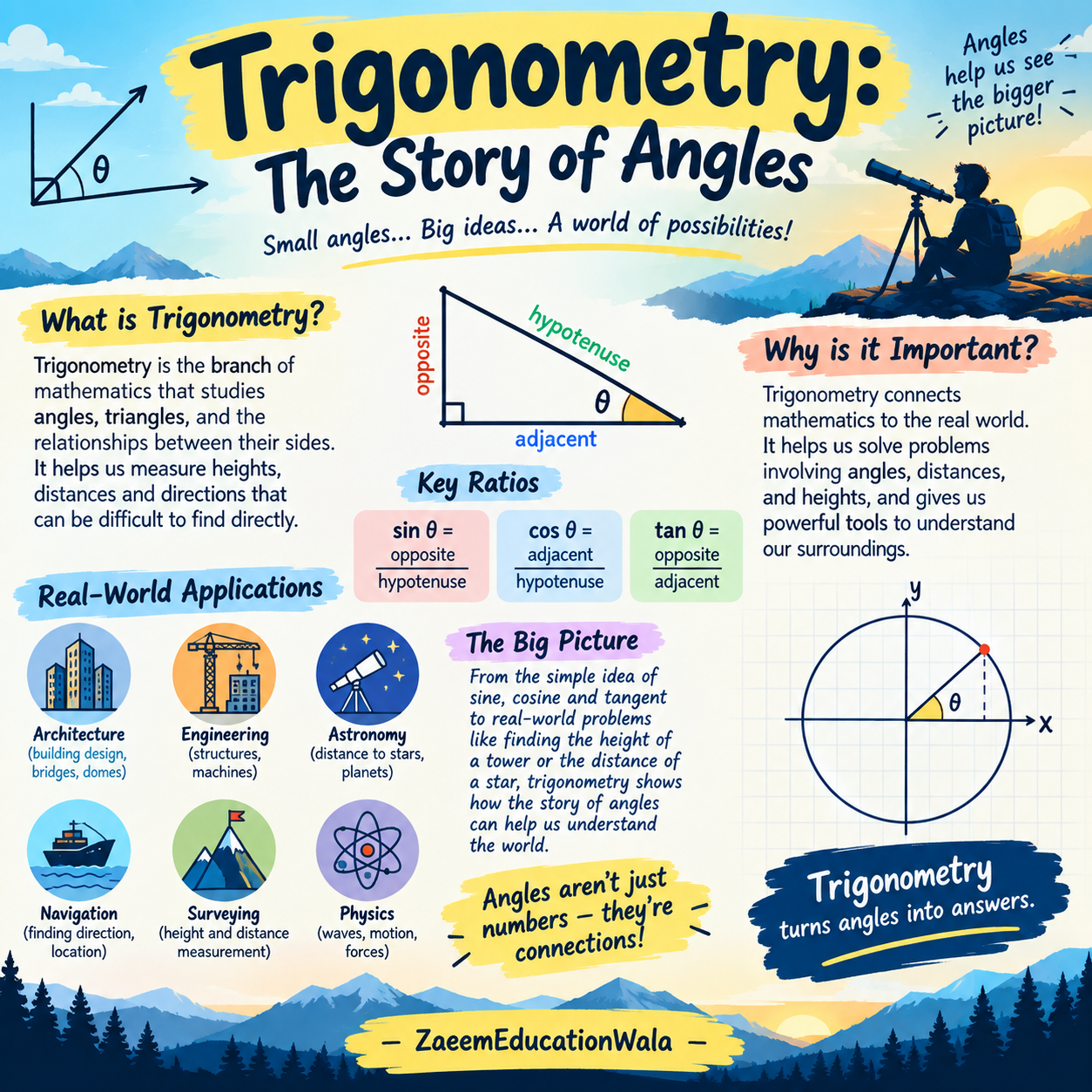
    Trigonometry is a fascinating branch of mathematics that explores the relationship between angles and the sides of triangles. It helps us measure heights, distances, and directions that can be difficult to find directly.

    Using concepts such as sine, cosine, and tangent, trigonometry connects mathematics to the real world. It is used in architecture, engineering, astronomy, navigation, construction, and physics. Learning trigonometry helps us understand how angles shape the world around us.

    #Trigonometry #TheStoryOfAngles #Mathematics #Geometry #Sine #Cosine #Tangent #MathLearning #ScienceAndMath #ZaeemEducationWala

    Day:-90
    rollno:-006
    foundation level
    Story Post
    📐 Trigonometry: The Story of Angles Description: Trigonometry is a fascinating branch of mathematics that explores the relationship between angles and the sides of triangles. It helps us measure heights, distances, and directions that can be difficult to find directly. Using concepts such as sine, cosine, and tangent, trigonometry connects mathematics to the real world. It is used in architecture, engineering, astronomy, navigation, construction, and physics. Learning trigonometry helps us understand how angles shape the world around us. #Trigonometry #TheStoryOfAngles #Mathematics #Geometry #Sine #Cosine #Tangent #MathLearning #ScienceAndMath #ZaeemEducationWala Day:-90 rollno:-006 foundation level 📖 Story Post
    0 Commentaires 0 Parts 453 Vue
  • Quiz Description

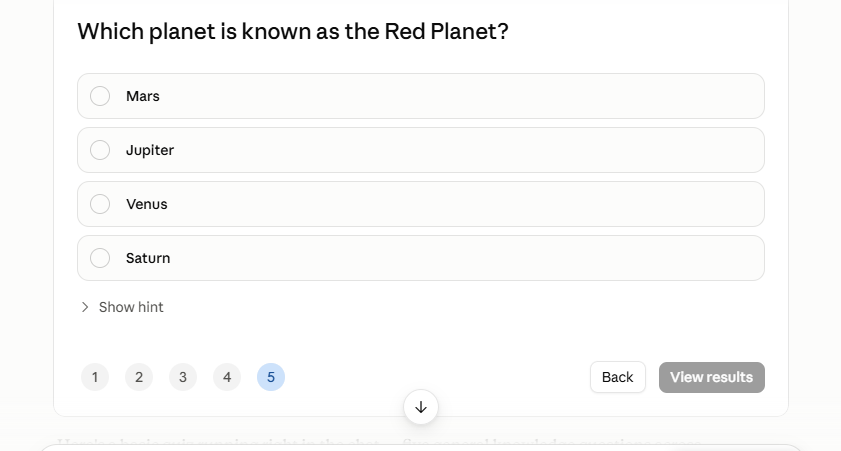
    This screenshot shows a Science Quiz question asking:

    “Which planet is known as the Red Planet?”

    The quiz provides four answer choices:

    Mars
    Jupiter
    Venus
    Saturn

    The question is part of a 5-question quiz, with question 5 currently selected. A “Show hint” option is available, along with Back and View results buttons.

    Correct answer: Mars — Mars is called the Red Planet because iron minerals in its surface rocks create a reddish appearance.

    #ScienceQuiz #Space #Planets #Mars #Learning #Education #Quiz #Astronomy #zaeemeducationwala
    Day:-75
    rollno:-006
    foundation level
    Coding Task
    🪐 Quiz Description This screenshot shows a Science Quiz question asking: “Which planet is known as the Red Planet?” The quiz provides four answer choices: 🔴 Mars 🟠 Jupiter 🟡 Venus 🪐 Saturn The question is part of a 5-question quiz, with question 5 currently selected. A “Show hint” option is available, along with Back and View results buttons. 🎯 Correct answer: Mars — Mars is called the Red Planet because iron minerals in its surface rocks create a reddish appearance. #ScienceQuiz #Space #Planets #Mars #Learning #Education #Quiz #Astronomy #zaeemeducationwala Day:-75 rollno:-006 foundation level 💻 Coding Task
    0 Commentaires 0 Parts 994 Vue
  • RSIF8
    Roll no 68
    Task no 90
    Task topic; Trigonometry: The Story of Angles

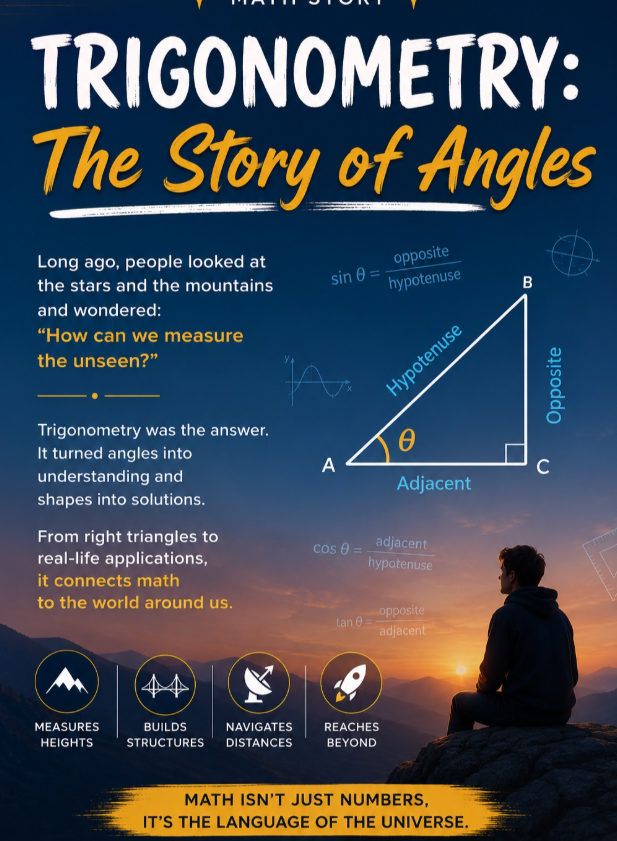
    Every angle tells a story! Trigonometry is the branch of mathematics that helps us understand the relationship between angles and sides of triangles. It plays a vital role in architecture, engineering, astronomy, navigation, and even computer graphics. From measuring the height of mountains to designing bridges and exploring space, trigonometry helps solve real-world problems with precision.

    Discover how the power of angles shapes the world around us and inspires innovation every day!

    RSIF8 Roll no 68 Task no 90 Task topic; Trigonometry: The Story of Angles Every angle tells a story! Trigonometry is the branch of mathematics that helps us understand the relationship between angles and sides of triangles. It plays a vital role in architecture, engineering, astronomy, navigation, and even computer graphics. From measuring the height of mountains to designing bridges and exploring space, trigonometry helps solve real-world problems with precision. 📚 Discover how the power of angles shapes the world around us and inspires innovation every day!
    0 Commentaires 0 Parts 736 Vue
  • #rsisb
    Roll no 248
    Foundation level
    Song no 24
    **Black Holes and Beyond: Exploring the Limits of Physics**

    Step into the mysterious universe of black holes, where gravity becomes incredibly powerful and the laws of physics are pushed to their limits! This song takes you on an exciting journey through space, exploring cosmic mysteries, spacetime, gravity, and the unanswered questions that continue to inspire scientists.

    Let the music carry you beyond the stars and into the deepest mysteries of the cosmos! Learn, wonder, and imagine what lies beyond our understanding.

    #BlackHoles #BeyondTheStars #Physics #Space #Astronomy #Cosmos #Science #Universe #Spacetime #Gravity #ScienceSong #CosmicMysteries #ExploreTheUniverse #LearningThroughMusic
    #rsisb Roll no 248 Foundation level Song no 24 🌌🕳️ **Black Holes and Beyond: Exploring the Limits of Physics** 🚀✨ Step into the mysterious universe of black holes, where gravity becomes incredibly powerful and the laws of physics are pushed to their limits! 🌠🔭 This song takes you on an exciting journey through space, exploring cosmic mysteries, spacetime, gravity, and the unanswered questions that continue to inspire scientists. 🪐⚡ 🎶 Let the music carry you beyond the stars and into the deepest mysteries of the cosmos! 🌌✨ Learn, wonder, and imagine what lies beyond our understanding. 🚀🔬 #BlackHoles 🕳️ #BeyondTheStars 🌟 #Physics 🔬 #Space 🌌 #Astronomy 🔭 #Cosmos 🪐 #Science 🎓 #Universe 🌠 #Spacetime ⏳ #Gravity ⚡ #ScienceSong 🎶 #CosmicMysteries 🚀 #ExploreTheUniverse 🔭 #LearningThroughMusic 🎵
    0 Commentaires 0 Parts 2365 Vue 8
  • Day 90
    Task No:90
    Roll No:42
    RSLC
    Foundation Level, Batch#04

    Trigonometry is the fascinating branch of mathematics that reveals the hidden relationships between angles and sides of triangles. From the earliest civilizations to modern science, humans have relied on angles to measure distances, navigate oceans, and understand the world around them. What may seem like simple lines and triangles actually hold the secrets to solving some of lifes greatest mathematical challenges.

    As mathematicians explored the power of angles, they discovered remarkable patterns through sine, cosine, and tangent. These concepts became essential tools in architecture, astronomy, engineering, and navigation. Whether designing towering skyscrapers, calculating the height of mountains, or guiding satellites through space, trigonometry continues to play a vital role in shaping our modern world.

    Today, trigonometry is far more than a classroom subject?its a universal language of precision and discovery. Every angle tells a story, every triangle hides a solution, and every calculation brings us closer to understanding the beauty of mathematics. By learning trigonometry, we unlock the power to measure, create, and innovate in ways that transform imagination into reality.

    #Trigonometry #Mathematics #Angles #Geometry #Education #STEM #Learning #Science #Engineering #MathLovers #Knowledge #Students #Study #Innovation #ProblemSolving
    Day 90 Task No:90 Roll No:42 RSLC Foundation Level, Batch#04 Trigonometry is the fascinating branch of mathematics that reveals the hidden relationships between angles and sides of triangles. From the earliest civilizations to modern science, humans have relied on angles to measure distances, navigate oceans, and understand the world around them. What may seem like simple lines and triangles actually hold the secrets to solving some of life's greatest mathematical challenges. As mathematicians explored the power of angles, they discovered remarkable patterns through sine, cosine, and tangent. These concepts became essential tools in architecture, astronomy, engineering, and navigation. Whether designing towering skyscrapers, calculating the height of mountains, or guiding satellites through space, trigonometry continues to play a vital role in shaping our modern world. Today, trigonometry is far more than a classroom subject?it's a universal language of precision and discovery. Every angle tells a story, every triangle hides a solution, and every calculation brings us closer to understanding the beauty of mathematics. By learning trigonometry, we unlock the power to measure, create, and innovate in ways that transform imagination into reality. #Trigonometry #Mathematics #Angles #Geometry #Education #STEM #Learning #Science #Engineering #MathLovers #Knowledge #Students #Study #Innovation #ProblemSolving
    0 Commentaires 0 Parts 2693 Vue
  • #rsisb
    Roll No.240
    Image With Chatgpt No.7
    Foundation Level

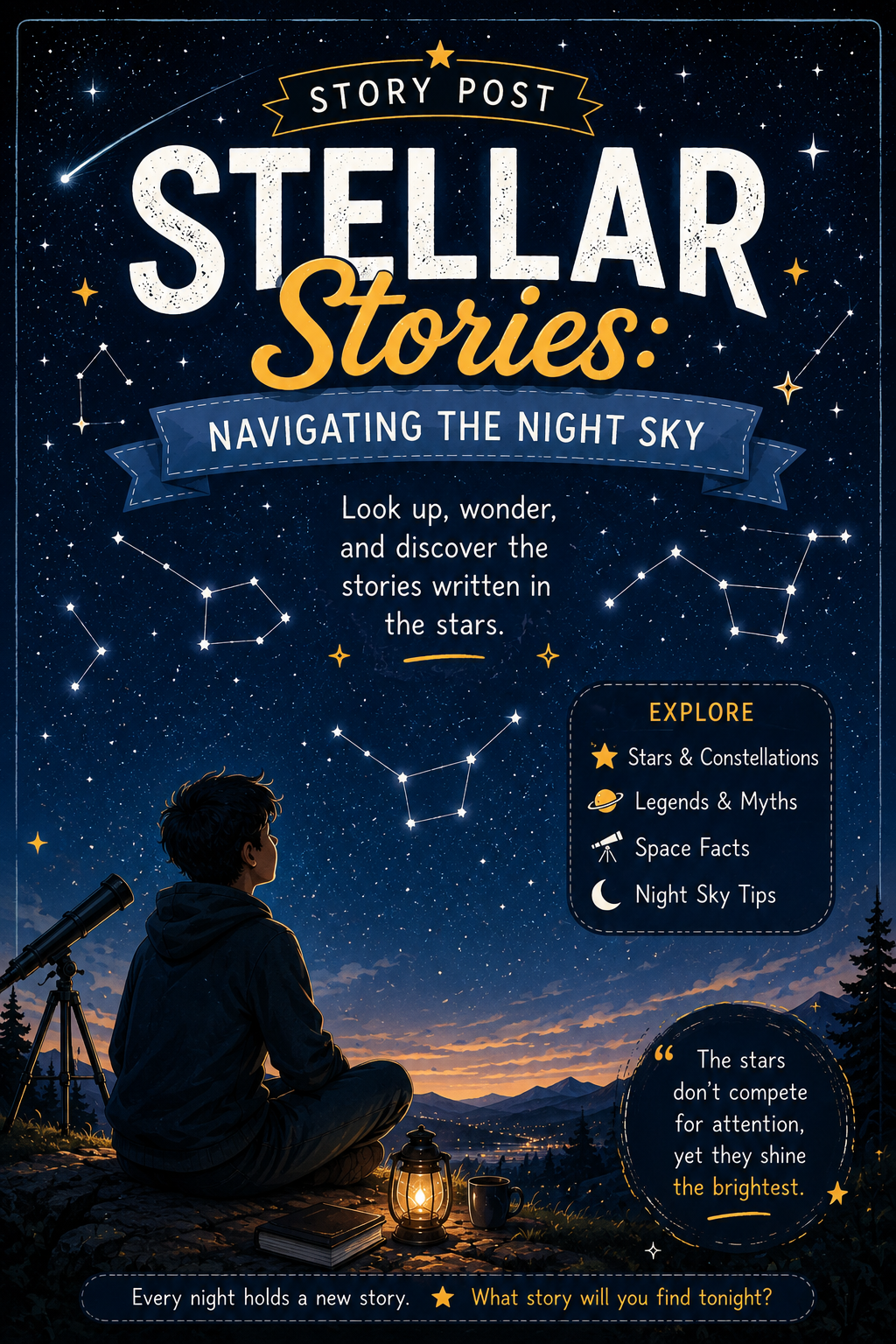
    Step into the magical world of the night sky! Discover beautiful stars , fascinating constellations , ancient legends , and the mysteries of space . Every star has a story, and every night gives us a chance to look up, wonder, and explore.

    Let the stars guide your imagination and inspire you to discover something new!

    Hashtags

    #StellarStories #NightSky #Stars #Constellations #Space #Astronomy #Stargazing #Universe #Cosmos #NightSkyPhotography #ExploreTheStars #SpaceLovers #StarGazing #CosmicJourney #SkyWatchers

    Rehan School Islamabad Campus
    Asma Shaheen EducationWali
    Irum Asim
    Saima Happinesswali

    #rsisb Roll No.240 Image With Chatgpt No.7 Foundation Level Step into the magical world of the night sky! 🌌✨ Discover beautiful stars ⭐, fascinating constellations 🔭, ancient legends 📖, and the mysteries of space 🚀. Every star has a story, and every night gives us a chance to look up, wonder, and explore. 🌠💫 Let the stars guide your imagination and inspire you to discover something new! 🌟🔭 🏷️ Hashtags #StellarStories #NightSky #Stars #Constellations #Space #Astronomy #Stargazing #Universe #Cosmos #NightSkyPhotography #ExploreTheStars #SpaceLovers #StarGazing #CosmicJourney #SkyWatchers 🌌✨⭐🔭🚀🌙🌠💫 Rehan School Islamabad Campus Asma Shaheen EducationWali Irum Asim Saima Happinesswali
    0 Commentaires 0 Parts 2859 Vue
  • #rsisb
    Roll No.240
    Story Post No.24
    Foundation Level

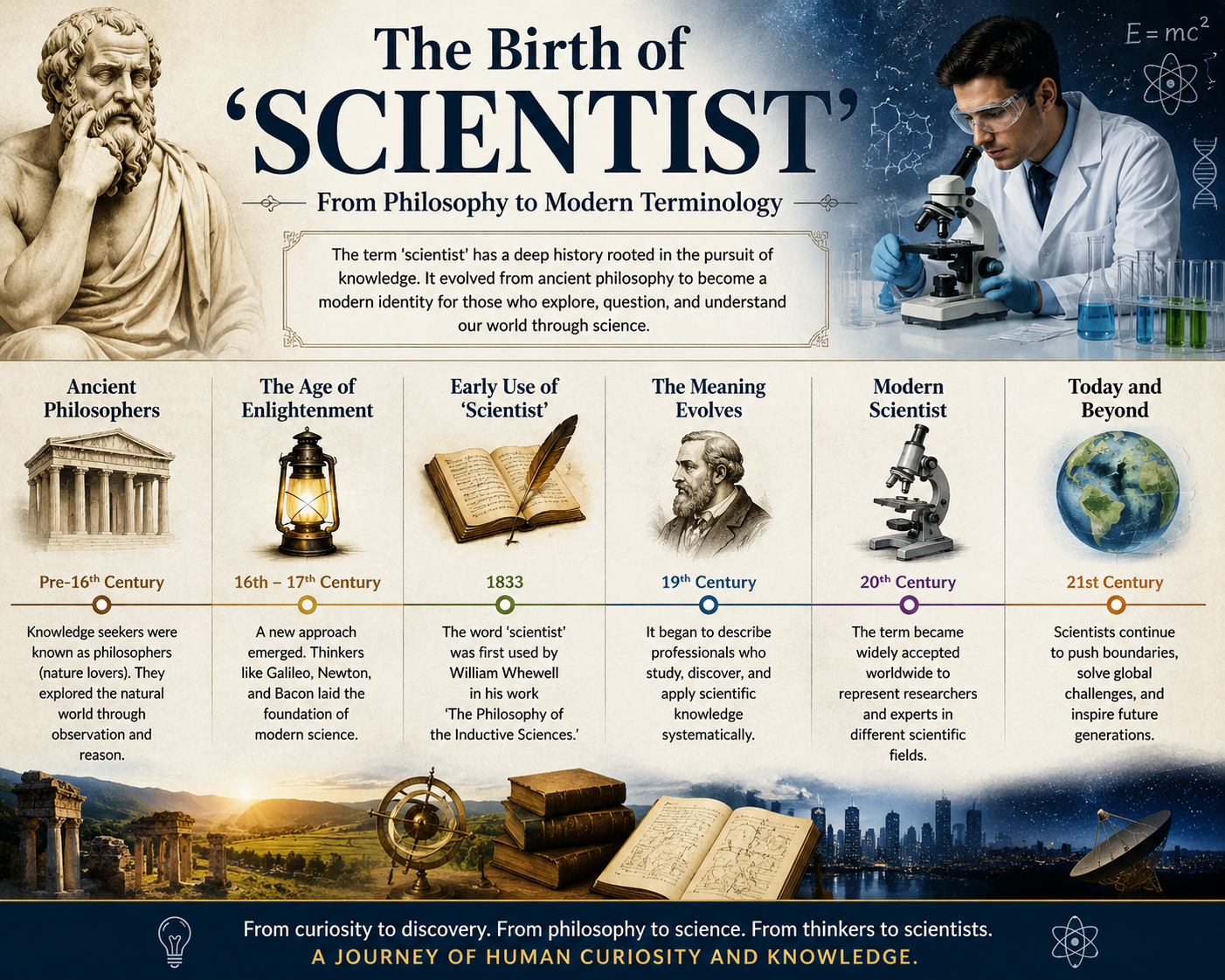
    The word “scientist” may sound like a modern term, but the journey behind it is connected to centuries of human curiosity, philosophy, observation, experimentation, and the search for knowledge.

    Long before the word “scientist” became common, people who studied the natural world were often known as philosophers, scholars, natural philosophers, mathematicians, and thinkers. They asked important questions about nature, the universe, life, matter, motion, and the world around them.

    From the thinkers of the ancient world to the scholars of the Renaissance and the Scientific Revolution, humans continued developing new ways to understand nature. Observation became more important, experiments became more systematic, and evidence gradually became a central part of scientific inquiry.

    During the 18th and 19th centuries, many different branches of knowledge began becoming more specialized. Physics, chemistry, biology, astronomy, geology, and other fields developed their own methods, discoveries, and communities of researchers.

    A major moment in terminology came in the 19th century, when the word “scientist” was introduced as a useful name for people engaged in scientific study. The term is widely associated with William Whewell, who used it in 1833. This helped provide a new, unified word for researchers working across different areas of science.

    The evolution of this word reflects something bigger than language. It represents the changing way humanity organized knowledge and recognized scientific work. The transition from “natural philosopher” to “scientist” shows how science gradually became a distinct and organized field of study.

    Today, scientists work in laboratories, universities, hospitals, observatories, research centers, engineering facilities, and many other places around the world. They investigate everything from tiny cells and molecules to distant galaxies and the origins of the universe.

    Modern science continues to grow through curiosity, evidence, teamwork, technology, and a willingness to ask difficult questions. Every discovery begins with someone wondering, “Why?”, “How?”, or “What if?”

    The story of the word “scientist” reminds us that human knowledge is always evolving. What began with simple curiosity and philosophical questioning gradually developed into the powerful and diverse scientific world we know today.

    From thinkers to researchers. From philosophy to science. From questions to discoveries.

    Science is not only about finding answers—it is also about continuing to ask better questions.

    A journey from curiosity to discovery, and from philosophy to modern science.

    #TheBirthOfScientist #Scientist #HistoryOfScience #ScienceHistory #ScientificRevolution #Philosophy #NaturalPhilosophy #WilliamWhewell #1833 #ModernScience #ScienceEducation #ScientificTerminology #Science #Scientists #Research #Discovery #Curiosity #Knowledge #Learning #Education #STEM #Physics #Chemistry #Biology #Astronomy #Geology #Innovation #Experimentation #ScientificThinking #CriticalThinking #HumanKnowledge #HistoryOfKnowledge #ScienceJourney #FromPhilosophyToScience #ScienceFacts #EducationalContent #LearningJourney #ExploreScience #DiscoverScience

    Rehan School Islamabad Campus
    Asma Shaheen EducationWali
    Irum Asim
    Saima Happinesswali

    #rsisb Roll No.240 Story Post No.24 Foundation Level The word “scientist” may sound like a modern term, but the journey behind it is connected to centuries of human curiosity, philosophy, observation, experimentation, and the search for knowledge. 🧠🔎 Long before the word “scientist” became common, people who studied the natural world were often known as philosophers, scholars, natural philosophers, mathematicians, and thinkers. 🏛️📜 They asked important questions about nature, the universe, life, matter, motion, and the world around them. From the thinkers of the ancient world to the scholars of the Renaissance and the Scientific Revolution, humans continued developing new ways to understand nature. 🌌🌍📖 Observation became more important, experiments became more systematic, and evidence gradually became a central part of scientific inquiry. 🔬🧪✨ During the 18th and 19th centuries, many different branches of knowledge began becoming more specialized. Physics, chemistry, biology, astronomy, geology, and other fields developed their own methods, discoveries, and communities of researchers. 🧬⚗️🌠 A major moment in terminology came in the 19th century, when the word “scientist” was introduced as a useful name for people engaged in scientific study. The term is widely associated with William Whewell, who used it in 1833. 📜🔬 This helped provide a new, unified word for researchers working across different areas of science. The evolution of this word reflects something bigger than language. It represents the changing way humanity organized knowledge and recognized scientific work. 🌟📚 The transition from “natural philosopher” to “scientist” shows how science gradually became a distinct and organized field of study. Today, scientists work in laboratories, universities, hospitals, observatories, research centers, engineering facilities, and many other places around the world. 🌍🧪🔭 They investigate everything from tiny cells and molecules to distant galaxies and the origins of the universe. 🧬🦠🌌 Modern science continues to grow through curiosity, evidence, teamwork, technology, and a willingness to ask difficult questions. 💡🤝🚀 Every discovery begins with someone wondering, “Why?”, “How?”, or “What if?” The story of the word “scientist” reminds us that human knowledge is always evolving. What began with simple curiosity and philosophical questioning gradually developed into the powerful and diverse scientific world we know today. 🌱➡️🔬➡️🌍 ✨ From thinkers to researchers. From philosophy to science. From questions to discoveries. ✨ Science is not only about finding answers—it is also about continuing to ask better questions. 🔎💡 🌟 A journey from curiosity to discovery, and from philosophy to modern science. 🌟 #TheBirthOfScientist #Scientist #HistoryOfScience #ScienceHistory #ScientificRevolution #Philosophy #NaturalPhilosophy #WilliamWhewell #1833 #ModernScience #ScienceEducation #ScientificTerminology #Science #Scientists #Research #Discovery #Curiosity #Knowledge #Learning #Education #STEM #Physics #Chemistry #Biology #Astronomy #Geology #Innovation #Experimentation #ScientificThinking #CriticalThinking #HumanKnowledge #HistoryOfKnowledge #ScienceJourney #FromPhilosophyToScience #ScienceFacts #EducationalContent #LearningJourney #ExploreScience #DiscoverScience 🔬📚🧠🌍✨🔭🧪🚀💡🌟 Rehan School Islamabad Campus Asma Shaheen EducationWali Irum Asim Saima Happinesswali
    0 Commentaires 0 Parts 5696 Vue
  • #rsisb
    Roll no.239
    maya no.18
    Foundation Level

    The word **“Earth”** is one of the oldest and most meaningful words in the English language. It represents much more than the planet beneath our feet. Earth is our **home, the source of life, the ground we walk on, and a symbol of nature and human existence**. But where did this simple word come from, and how did its meaning develop over time?

    The history of the word **“Earth”** takes us back thousands of years. In ancient forms of English and related Germanic languages, words similar to *earth* were used to describe the **ground, soil, land, and the physical world**. Over time, the word developed into the name we now use for our entire planet. Unlike many planets in our Solar System, whose names are connected to ancient gods and mythology, **Earth's English name is closely connected to the ordinary ground beneath our feet**.

    This connection tells us something important about human history. Long before people understood that they lived on a planet moving through space, they experienced Earth simply as the land around them—the soil that grew their food, the ground that supported their homes, and the world they could see and touch.

    As human knowledge grew, our understanding of Earth changed dramatically. Ancient thinkers observed the sky and began asking important questions about the shape and nature of the world. Over centuries, explorers, scientists, astronomers, and travelers expanded humanity's understanding of the planet. Eventually, space exploration allowed humans to see Earth from beyond its atmosphere. Those images showed something extraordinary: **our vast world is a beautiful, fragile-looking sphere surrounded by the darkness of space**.

    From a scientific perspective, Earth is the **third planet from the Sun** and the only world currently known to support life. It has liquid water on its surface, a protective atmosphere, and a wide variety of environments that support countless living organisms. Its oceans, forests, mountains, deserts, rivers, and grasslands form an incredibly diverse and interconnected system.

    Earth's structure is also fascinating. Beneath the surface are different layers, including the **crust, mantle, and core**. These layers influence many natural processes, including the movement of tectonic plates, earthquakes, volcanic activity, and the formation of mountains. Although we live on the surface, the planet beneath us is constantly changing.

    Life on Earth depends on a delicate balance. **Air, water, sunlight, soil, and biodiversity** all play essential roles in supporting life. Plants produce oxygen and form the foundation of many ecosystems. Oceans help regulate climate and support an enormous variety of life. Forests provide habitats and influence the movement of water and carbon through the environment.

    However, Earth also faces serious environmental challenges. **Pollution, deforestation, habitat destruction, and climate change** affect ecosystems and communities around the world. These challenges remind us that Earth is not an unlimited resource. The choices humans make today can influence the quality of life for future generations.

    Protecting Earth does not always require extraordinary actions. Small changes can make a difference, such as **reducing waste, conserving water and energy, planting and protecting trees, avoiding unnecessary pollution, and learning more about the environment**. Governments, scientists, businesses, communities, and individuals all have important roles to play.

    The word **“Earth”** also has a powerful emotional and cultural meaning. People may come from different countries, speak different languages, and follow different traditions, but we all share the same planet. From this perspective, Earth can be seen as a symbol of our **shared home and shared responsibility**.

    **“Earth” – The History of Our Home in a Word** is therefore a journey through **language, history, science, nature, and human imagination**. The story of this word shows how language grows alongside human knowledge. What once described the soil beneath people's feet eventually became the name of an entire world traveling through space.

    The next time you hear or say the word **“Earth,”** remember that it carries a remarkable story. It connects us to the ancient past, the natural world around us, and the future we are helping to create.

    **Earth is not just where we live—it is the only home we all share. Protecting it is a responsibility that belongs to everyone.**

    ### **Hashtags**

    #Earth #OurPlanet #PlanetEarth #WordHistory #HistoryOfEarth #EnglishLanguage #LanguageHistory #Science #Nature #Environment #ClimateAwareness #ProtectOurPlanet #Sustainability #EarthScience #Space #Astronomy #LifeOnEarth #MotherEarth #SaveEarth #GoGreen #CleanEnvironment #Biodiversity #ClimateChange #Education #Knowledge #LearnAndExplore #OnePlanet #FutureGenerations #EarthLovers #OurHome
    #rsisb Roll no.239 maya no.18 Foundation Level The word **“Earth”** is one of the oldest and most meaningful words in the English language. It represents much more than the planet beneath our feet. Earth is our **home, the source of life, the ground we walk on, and a symbol of nature and human existence**. But where did this simple word come from, and how did its meaning develop over time? The history of the word **“Earth”** takes us back thousands of years. In ancient forms of English and related Germanic languages, words similar to *earth* were used to describe the **ground, soil, land, and the physical world**. Over time, the word developed into the name we now use for our entire planet. Unlike many planets in our Solar System, whose names are connected to ancient gods and mythology, **Earth's English name is closely connected to the ordinary ground beneath our feet**. 📖🌱 This connection tells us something important about human history. Long before people understood that they lived on a planet moving through space, they experienced Earth simply as the land around them—the soil that grew their food, the ground that supported their homes, and the world they could see and touch. As human knowledge grew, our understanding of Earth changed dramatically. Ancient thinkers observed the sky and began asking important questions about the shape and nature of the world. Over centuries, explorers, scientists, astronomers, and travelers expanded humanity's understanding of the planet. Eventually, space exploration allowed humans to see Earth from beyond its atmosphere. Those images showed something extraordinary: **our vast world is a beautiful, fragile-looking sphere surrounded by the darkness of space**. 🚀🌌 From a scientific perspective, Earth is the **third planet from the Sun** and the only world currently known to support life. It has liquid water on its surface, a protective atmosphere, and a wide variety of environments that support countless living organisms. Its oceans, forests, mountains, deserts, rivers, and grasslands form an incredibly diverse and interconnected system. 🌊🏔️🌳 Earth's structure is also fascinating. Beneath the surface are different layers, including the **crust, mantle, and core**. These layers influence many natural processes, including the movement of tectonic plates, earthquakes, volcanic activity, and the formation of mountains. Although we live on the surface, the planet beneath us is constantly changing. Life on Earth depends on a delicate balance. **Air, water, sunlight, soil, and biodiversity** all play essential roles in supporting life. Plants produce oxygen and form the foundation of many ecosystems. Oceans help regulate climate and support an enormous variety of life. Forests provide habitats and influence the movement of water and carbon through the environment. However, Earth also faces serious environmental challenges. **Pollution, deforestation, habitat destruction, and climate change** affect ecosystems and communities around the world. These challenges remind us that Earth is not an unlimited resource. The choices humans make today can influence the quality of life for future generations. 🌿♻️ Protecting Earth does not always require extraordinary actions. Small changes can make a difference, such as **reducing waste, conserving water and energy, planting and protecting trees, avoiding unnecessary pollution, and learning more about the environment**. Governments, scientists, businesses, communities, and individuals all have important roles to play. The word **“Earth”** also has a powerful emotional and cultural meaning. People may come from different countries, speak different languages, and follow different traditions, but we all share the same planet. From this perspective, Earth can be seen as a symbol of our **shared home and shared responsibility**. 🤝🌍 **“Earth” – The History of Our Home in a Word** is therefore a journey through **language, history, science, nature, and human imagination**. The story of this word shows how language grows alongside human knowledge. What once described the soil beneath people's feet eventually became the name of an entire world traveling through space. The next time you hear or say the word **“Earth,”** remember that it carries a remarkable story. It connects us to the ancient past, the natural world around us, and the future we are helping to create. **Earth is not just where we live—it is the only home we all share. Protecting it is a responsibility that belongs to everyone.** 🌍💚✨ ### 🔖 **Hashtags** #Earth #OurPlanet #PlanetEarth #WordHistory #HistoryOfEarth #EnglishLanguage #LanguageHistory #Science #Nature #Environment #ClimateAwareness #ProtectOurPlanet #Sustainability #EarthScience #Space #Astronomy #LifeOnEarth #MotherEarth #SaveEarth #GoGreen #CleanEnvironment #Biodiversity #ClimateChange #Education #Knowledge #LearnAndExplore #OnePlanet #FutureGenerations #EarthLovers #OurHome 🌍🌿💚✨

    0 Commentaires 0 Parts 8853 Vue 18
  • #rsisb
    Roll no.239
    Song no .5
    Foundation Level


    Black holes are among the most mysterious objects in the universe! Their incredible gravitational force challenges our understanding of space, time, and the laws of physics.

    As scientists explore these cosmic giants, we move closer to unlocking the deepest secrets of the universe. What lies beyond the limits of what we know?

    Keep exploring, keep questioning, and never stop discovering!

    #BlackHoles #Physics #Science #Universe #Space #Astronomy #Cosmos #ScienceFacts #SpaceExploration #Gravity #TimeAndSpace #Astrophysics #Knowledge #Discovery
    #rsisb Roll no.239 Song no .5 Foundation Level Black holes are among the most mysterious objects in the universe! 🌠 Their incredible gravitational force challenges our understanding of space, time, and the laws of physics. 🔭🚀 As scientists explore these cosmic giants, we move closer to unlocking the deepest secrets of the universe. What lies beyond the limits of what we know? 🌌🤔✨ Keep exploring, keep questioning, and never stop discovering! 🚀🧠🔬 #BlackHoles #Physics #Science #Universe #Space #Astronomy #Cosmos #ScienceFacts #SpaceExploration #Gravity #TimeAndSpace #Astrophysics #Knowledge #Discovery 🌌🕳️🚀✨🔭
    0 Commentaires 0 Parts 1921 Vue 3
Plus de résultats