• Rsif8
    Roll No 30
    Post No 240
    **How Did Trade Routes Shape the History of the World? | Educational Video**

    Have you ever wondered how people from different countries traded goods and shared ideas hundreds of years ago?

    In this video, we explore how ancient trade routes connected different parts of the world. We learn about the famous Silk Road, the Spice Routes, and important sea routes.

    Traders travelled long distances using camels, ships, and other methods of transport. They exchanged valuable goods such as spices, silk, gold, and cotton.

    Trade routes did more than exchange goods. They also helped spread knowledge, cultures, religions, languages, and new inventions between different civilizations.

    This video helps us understand how trade routes shaped world history and connected people across the globe.

    Watch and enjoy this interesting journey through history!

    **Thank you for watching! Don't forget to Like, Share, and Subscribe.**

    #TradeRoutes #WorldHistory #SilkRoad #AncientHistory #HistoryLearning #EducationalVideo #RehanSchool

    Rsif8 Roll No 30 Post No 240 🌍 **How Did Trade Routes Shape the History of the World? | Educational Video** Have you ever wondered how people from different countries traded goods and shared ideas hundreds of years ago? In this video, we explore how ancient trade routes connected different parts of the world. We learn about the famous Silk Road, the Spice Routes, and important sea routes. Traders travelled long distances using camels, ships, and other methods of transport. They exchanged valuable goods such as spices, silk, gold, and cotton. Trade routes did more than exchange goods. They also helped spread knowledge, cultures, religions, languages, and new inventions between different civilizations. This video helps us understand how trade routes shaped world history and connected people across the globe. πŸŽ₯ Watch and enjoy this interesting journey through history! **Thank you for watching! Don't forget to Like, Share, and Subscribe.** #TradeRoutes #WorldHistory #SilkRoad #AncientHistory #HistoryLearning #EducationalVideo #RehanSchool
    0 Comments 0 Shares 906 Views
  • #rsisb
    Roll no.239
    Miss zoya 28
    Foundation Level

    The desert is one of the most amazing places in the world. It is a large area of land that receives very little rainfall. Deserts usually have hot and dry weather during the day, while some deserts become very cold at night.

    Deserts are full of beautiful sand dunes, mountains, rocks, and amazing natural views. Many animals live in deserts, such as camels, snakes, lizards, foxes, and scorpions. These animals have special abilities that help them survive in difficult conditions.

    The camel is known as the ship of the desert because it can travel long distances and survive with little water. Some plants, such as cactus and palm trees, can also grow in desert environments.

    People who live in deserts learn how to survive in hot weather and protect themselves from sandstorms. Water is very important for all living things in the desert.

    Deserts teach us about patience, survival, nature, and the importance of water. We should protect desert animals, plants, and the environment.

    The desert is not just a place of sand; it is a beautiful world full of life and surprises.

    #Desert #Nature #Animals #Environment #Learning #ArabicQuestions

    New to streaming or looking to level up? Check out StreamYard and get $10 discount!
    #rsisb Roll no.239 Miss zoya 28 Foundation Level The desert is one of the most amazing places in the world. It is a large area of land that receives very little rainfall. Deserts usually have hot and dry weather during the day, while some deserts become very cold at night. Deserts are full of beautiful sand dunes, mountains, rocks, and amazing natural views. Many animals live in deserts, such as camels, snakes, lizards, foxes, and scorpions. These animals have special abilities that help them survive in difficult conditions. The camel is known as the ship of the desert because it can travel long distances and survive with little water. Some plants, such as cactus and palm trees, can also grow in desert environments. People who live in deserts learn how to survive in hot weather and protect themselves from sandstorms. Water is very important for all living things in the desert. Deserts teach us about patience, survival, nature, and the importance of water. We should protect desert animals, plants, and the environment. The desert is not just a place of sand; it is a beautiful world full of life and surprises. πŸͺ🌡 #Desert #Nature #Animals #Environment #Learning #ArabicQuestions 🏜️ πŸŽ™οΈ New to streaming or looking to level up? Check out StreamYard and get $10 discount! 😍
    0 Comments 0 Shares 572 Views 1
  • RSIF8
    Roll no.38
    Story post no.28
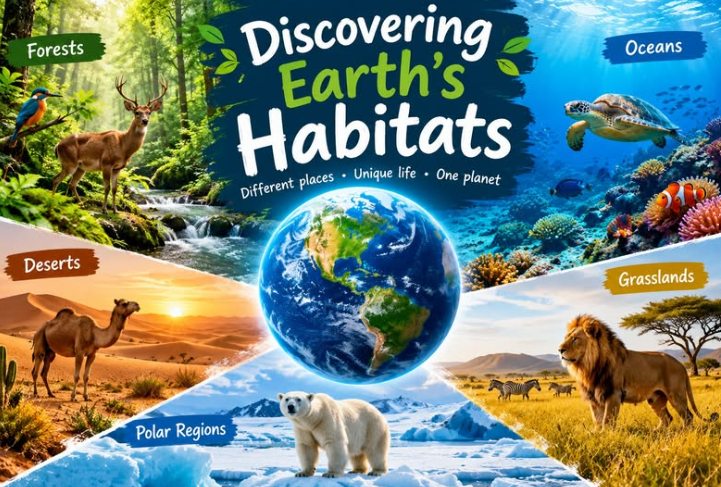
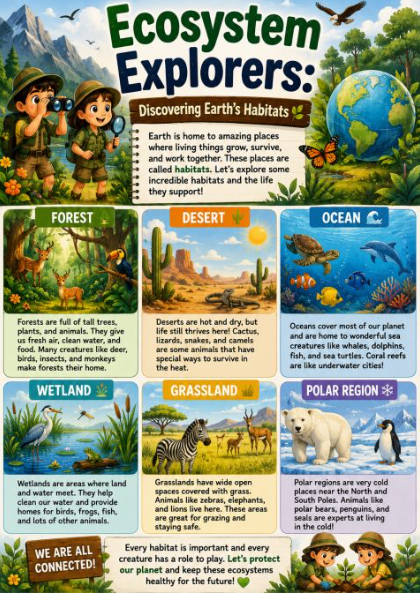
    Story post topic Ecosystem Explorers: Discovering Earth's Habitats

    Ecosystem Explorers: Discovering Earth's Habitats

    Imagine becoming an **Ecosystem Explorer** and traveling across Earth to discover amazing places where plants and animals live!

    Our first stop is the **forest**, where tall trees provide homes for birds, deer, insects, and many other animals.

    Next, we travel to the **desert**, a hot and dry habitat where camels, snakes, lizards, and special plants have learned to survive.

    Then we dive into the **ocean**, where dolphins, whales, colorful fish, and sea turtles live among beautiful coral reefs.

    Our adventure continues through **wetlands**, **grasslands**, and the **polar regions**. Each habitat is different, but every one is important. They provide food, water, shelter, and space for living things.

    As Ecosystem Explorers, we learn that all living things are connected. Protecting forests, oceans, rivers, and wildlife helps keep our planet healthy.

    **Explore nature. Protect habitats. Make a difference!**

    #EcosystemExplorers

    #Habitats

    #Nature

    #Environment

    #Wildlife
    #Earth #Science #Learning #ProtectOurPlanet
    RSIF8 Roll no.38 Story post no.28 Story post topic Ecosystem Explorers: Discovering Earth's Habitats Ecosystem Explorers: Discovering Earth's Habitats Imagine becoming an **Ecosystem Explorer** and traveling across Earth to discover amazing places where plants and animals live! Our first stop is the **forest**, where tall trees provide homes for birds, deer, insects, and many other animals. Next, we travel to the **desert**, a hot and dry habitat where camels, snakes, lizards, and special plants have learned to survive. Then we dive into the **ocean**, where dolphins, whales, colorful fish, and sea turtles live among beautiful coral reefs. Our adventure continues through **wetlands**, **grasslands**, and the **polar regions**. Each habitat is different, but every one is important. They provide food, water, shelter, and space for living things. As Ecosystem Explorers, we learn that all living things are connected. Protecting forests, oceans, rivers, and wildlife helps keep our planet healthy. **Explore nature. Protect habitats. Make a difference!** #EcosystemExplorers #Habitats #Nature #Environment #Wildlife #Earth #Science #Learning #ProtectOurPlanet
    0 Comments 0 Shares 2504 Views
  • Roll No: 43
    Story Post No: 26
    Story Post Topic: Discovering Earth’s Habitats
    Discovering Earth’s Habitats
    One morning, a curious young explorer named Sami began a journey to discover the amazing habitats of Earth.
    His first stop was the forest, where tall trees provided homes for birds, deer, and many other animals.
    Next, Sami visited the ocean. Beneath the blue water, he saw colorful fish, sea turtles, and beautiful coral reefs.
    Then he crossed a hot desert, where camels survived by adapting to the dry environment.
    After that, Sami reached the cold polar regions, where he saw a polar bear living among the snow and ice. ‍
    Finally, he explored the grasslands, where lions, zebras, and many plants lived together.
    Sami learned that every habitat is special and that plants and animals depend on their environment to survive. He returned home with one important lesson:
    "Different habitats, different lives—but one Earth for us all.”
    Roll No: 43 Story Post No: 26 Story Post Topic: Discovering Earth’s Habitats 🌍 Discovering Earth’s Habitats One morning, a curious young explorer named Sami began a journey to discover the amazing habitats of Earth. πŸŒ±πŸ” His first stop was the forest, where tall trees provided homes for birds, deer, and many other animals. 🦌🐦🌳 Next, Sami visited the ocean. Beneath the blue water, he saw colorful fish, sea turtles, and beautiful coral reefs. 🐠🐒🌊 Then he crossed a hot desert, where camels survived by adapting to the dry environment. πŸͺ🏜️ After that, Sami reached the cold polar regions, where he saw a polar bear living among the snow and ice. 🐻‍❄️❄️ Finally, he explored the grasslands, where lions, zebras, and many plants lived together. πŸ¦πŸ¦“πŸŒΎ Sami learned that every habitat is special and that plants and animals depend on their environment to survive. He returned home with one important lesson: "Different habitats, different lives—but one Earth for us all.” πŸŒπŸ’š
    0 Comments 0 Shares 914 Views
  • Can someone share a video of someone explaining the Cure from the camels urine ?
    Can someone share a video of someone explaining the Cure from the camels 🐫 urine ?
    0 Comments 0 Shares 326 Views
  • There are no camels in Germany, Hamburg is a city in Germany, are there Camels in Hamburg ?
    There are no camels πŸͺ in Germany, Hamburg is a city in Germany, are there Camels in Hamburg ?
    0 Comments 0 Shares 825 Views
  • You know you are Pakistani when !

    1. You know youre Pakistani when your mothers response to any ailment is "Namak paani se gargle karo" (Gargle with salt water).

    2. Youve mastered the art of bargaining, whether its at a high-end store or a street vendor, and consider it a personal victory to get a discount.

    3. Youve been part of at least one heated debate about which city has the best biryani: Karachi, Lahore, or Hyderabad.

    4. Youre used to attending weddings that have more guests than some villages total populations.

    5. Youve experienced the joy of eating mangoes in every form possible during the summer season and discussing the superiority of Pakistani mangoes with anyone wholl listen.

    6. Youve used "bas 5 minute mein pohanch raha hoon" (Im arriving in just 5 minutes) while still being an hour away.

    7. Youve had to explain that Pakistan has mountains, deserts, and beaches, not just one landscape.

    8. You know the struggle of explaining cricket to foreigners and why its vastly superior to baseball.

    9. You cant start your day without a cup of chai and have strong opinions on how it should be made.

    10. Youve celebrated rain by making pakoras and having chai as if its an unwritten national rule.

    11. You understand the concept of "Pakistani Standard Time" where events start at least an hour later than scheduled.

    12. Youve been caught in a conversation about relatives you dont remember, with your parents saying, "Tum ne chota tha jab unko dekha tha" (You were young when you last saw them).

    13. Youve had to explain that no, you dont ride camels to school or work.

    14. You know that a proper send-off for someone traveling involves sweetened rice or a spoonful of yogurt for good luck.

    15. Youve experienced the chaos and beauty of attending a crowded bazaar, smelling a mix of street food, spices, and everything in between.

    16. Youve been part of a gathering where the conversation shifts seamlessly between Urdu, English, and regional languages.

    17. Youve been asked about your marriage plans by relatives the moment you reach a certain age, regardless of your actual plans.

    18. Youve experienced the dilemma of choosing between Coke Studio versions of songs and the originals.

    19. Youve had the pleasure of eating roadside chapli kebabs and proclaiming them better than any restaurants.

    20. Youve attended a mehndi where dancing and singing competitions between the brides and grooms sides lasted all night.

    21. You know the importance of a good "jugaad" (quick fix) and have implemented it in various aspects of life.

    22. Youve felt the pride of wearing traditional clothes on cultural festivals and special occasions.

    23. Youve had to correct someone that its not "Indian" music or movies; its Pakistani!

    24. Youve participated in or watched a kite-flying competition during Basant and felt the communal excitement.

    25. Youve been in a situation where every social gathering turns into an impromptu musical night, with someone inevitably pulling out a guitar or harmonium.

    These playful points touch on the unique aspects of Pakistani culture, from the love of cricket and chai to the vibrant wedding celebrations and the multilingual tapestry that defines everyday life.
    You know you are Pakistani when ! 1. You know you're Pakistani when your mother's response to any ailment is "Namak paani se gargle karo" (Gargle with salt water). 2. You've mastered the art of bargaining, whether it's at a high-end store or a street vendor, and consider it a personal victory to get a discount. 3. You've been part of at least one heated debate about which city has the best biryani: Karachi, Lahore, or Hyderabad. 4. You're used to attending weddings that have more guests than some villages' total populations. 5. You've experienced the joy of eating mangoes in every form possible during the summer season and discussing the superiority of Pakistani mangoes with anyone who'll listen. 6. You've used "bas 5 minute mein pohanch raha hoon" (I'm arriving in just 5 minutes) while still being an hour away. 7. You've had to explain that Pakistan has mountains, deserts, and beaches, not just one landscape. 8. You know the struggle of explaining cricket to foreigners and why it's vastly superior to baseball. 9. You can't start your day without a cup of chai and have strong opinions on how it should be made. 10. You've celebrated rain by making pakoras and having chai as if it's an unwritten national rule. 11. You understand the concept of "Pakistani Standard Time" where events start at least an hour later than scheduled. 12. You've been caught in a conversation about relatives you don't remember, with your parents saying, "Tum ne chota tha jab unko dekha tha" (You were young when you last saw them). 13. You've had to explain that no, you don't ride camels to school or work. 14. You know that a proper send-off for someone traveling involves sweetened rice or a spoonful of yogurt for good luck. 15. You've experienced the chaos and beauty of attending a crowded bazaar, smelling a mix of street food, spices, and everything in between. 16. You've been part of a gathering where the conversation shifts seamlessly between Urdu, English, and regional languages. 17. You've been asked about your marriage plans by relatives the moment you reach a certain age, regardless of your actual plans. 18. You've experienced the dilemma of choosing between Coke Studio versions of songs and the originals. 19. You've had the pleasure of eating roadside chapli kebabs and proclaiming them better than any restaurant's. 20. You've attended a mehndi where dancing and singing competitions between the bride's and groom's sides lasted all night. 21. You know the importance of a good "jugaad" (quick fix) and have implemented it in various aspects of life. 22. You've felt the pride of wearing traditional clothes on cultural festivals and special occasions. 23. You've had to correct someone that it's not "Indian" music or movies; it's Pakistani! 24. You've participated in or watched a kite-flying competition during Basant and felt the communal excitement. 25. You've been in a situation where every social gathering turns into an impromptu musical night, with someone inevitably pulling out a guitar or harmonium. These playful points touch on the unique aspects of Pakistani culture, from the love of cricket and chai to the vibrant wedding celebrations and the multilingual tapestry that defines everyday life.
    0 Comments 0 Shares 2338 Views
  • This is Karachi !
    ============

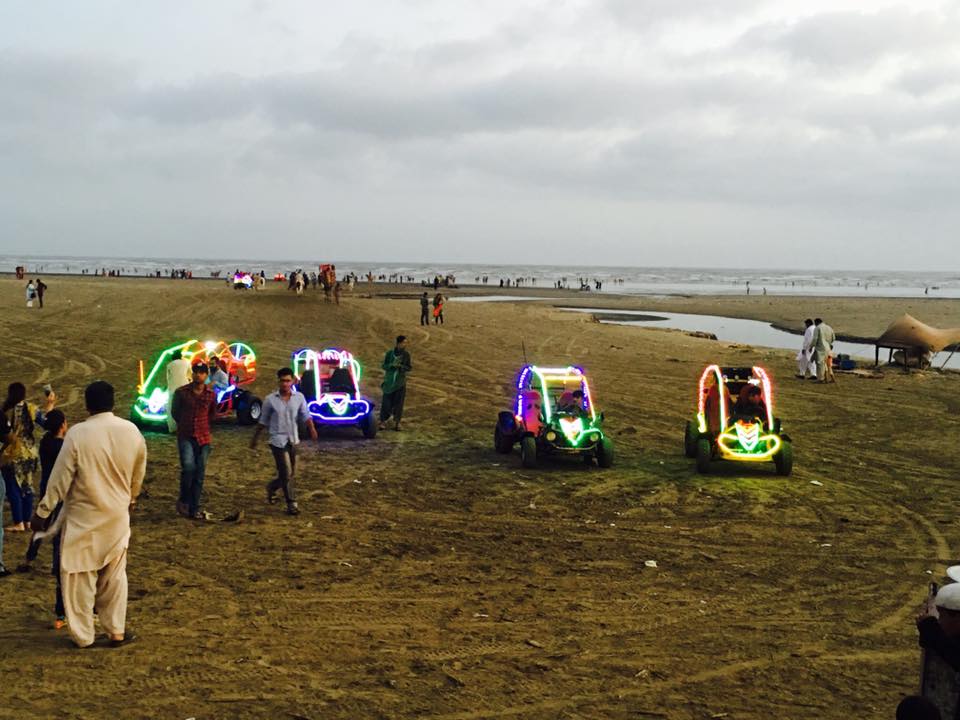
    These 4 wheelers are now on the Karachi beaches in hundreds of quantity, specially on Saturday and Sundays, along with the Horses, and camels which are there to entertain you for less than $1

    They have taken these LED Light strips and put them on these cars, and after sun set, it is amazing to see them acting like Glowing worms.

    A very very unique experience indeed in the world.

    #rehanallahwala #Karachi
    This is Karachi ! ============ These 4 wheelers are now on the Karachi beaches in hundreds of quantity, specially on Saturday and Sundays, along with the Horses, and camels which are there to entertain you for less than $1 They have taken these LED Light strips and put them on these cars, and after sun set, it is amazing to see them acting like Glowing worms. A very very unique experience indeed in the world. #rehanallahwala #Karachi
    0 Comments 0 Shares 145 Views
  • Camels are truly remarkable animals, perfectly adapted to harsh desert conditions:

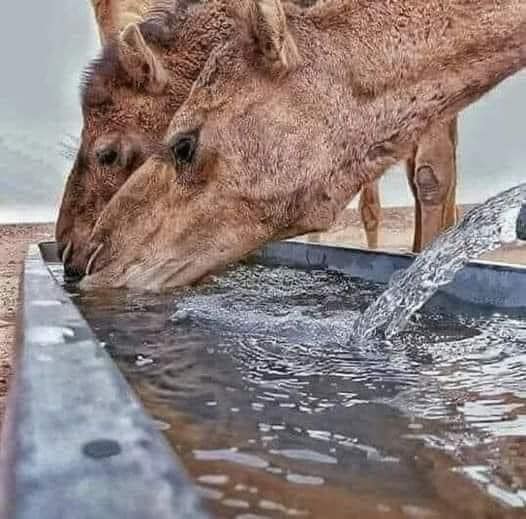
    β€’ They can drink salty water without any harm, as their kidneys are incredibly efficient at filtering out the salt and conserving fresh water. This makes them well-suited for environments where water sources may not be ideal for most animals.
    β€’ Camels can eat thorny plants with ease. Their tough mouths and specialized papillae allow them to chew thorns without injury. This ability to handle rough vegetation is a survival advantage in the desert.
    β€’ Their eyes are protected from desert sand by a special transparent third eyelid, called the nictitating membrane, which shields their eyes while still allowing them to see. They also have long eyelashes that keep out dust and debris.
    β€’ Camels can regulate their body temperature according to their environment. In extremely hot conditions, they let their body temperature rise during the day to avoid sweating and conserve water, while at night, they cool down to endure cold desert temperatures.

    Camels are truly a marvel of nature, showcasing incredible adaptations that help them thrive in some of the toughest environments on Earth.

    #Camels #DesertAdaptations #NatureWonders #SurvivalSkills
    Camels are truly remarkable animals, perfectly adapted to harsh desert conditions: β€’ They can drink salty water without any harm, as their kidneys are incredibly efficient at filtering out the salt and conserving fresh water. This makes them well-suited for environments where water sources may not be ideal for most animals. β€’ Camels can eat thorny plants with ease. Their tough mouths and specialized papillae allow them to chew thorns without injury. This ability to handle rough vegetation is a survival advantage in the desert. β€’ Their eyes are protected from desert sand by a special transparent third eyelid, called the nictitating membrane, which shields their eyes while still allowing them to see. They also have long eyelashes that keep out dust and debris. β€’ Camels can regulate their body temperature according to their environment. In extremely hot conditions, they let their body temperature rise during the day to avoid sweating and conserve water, while at night, they cool down to endure cold desert temperatures. Camels are truly a marvel of nature, showcasing incredible adaptations that help them thrive in some of the toughest environments on Earth. #Camels #DesertAdaptations #NatureWonders #SurvivalSkills
    0 Comments 0 Shares 490 Views
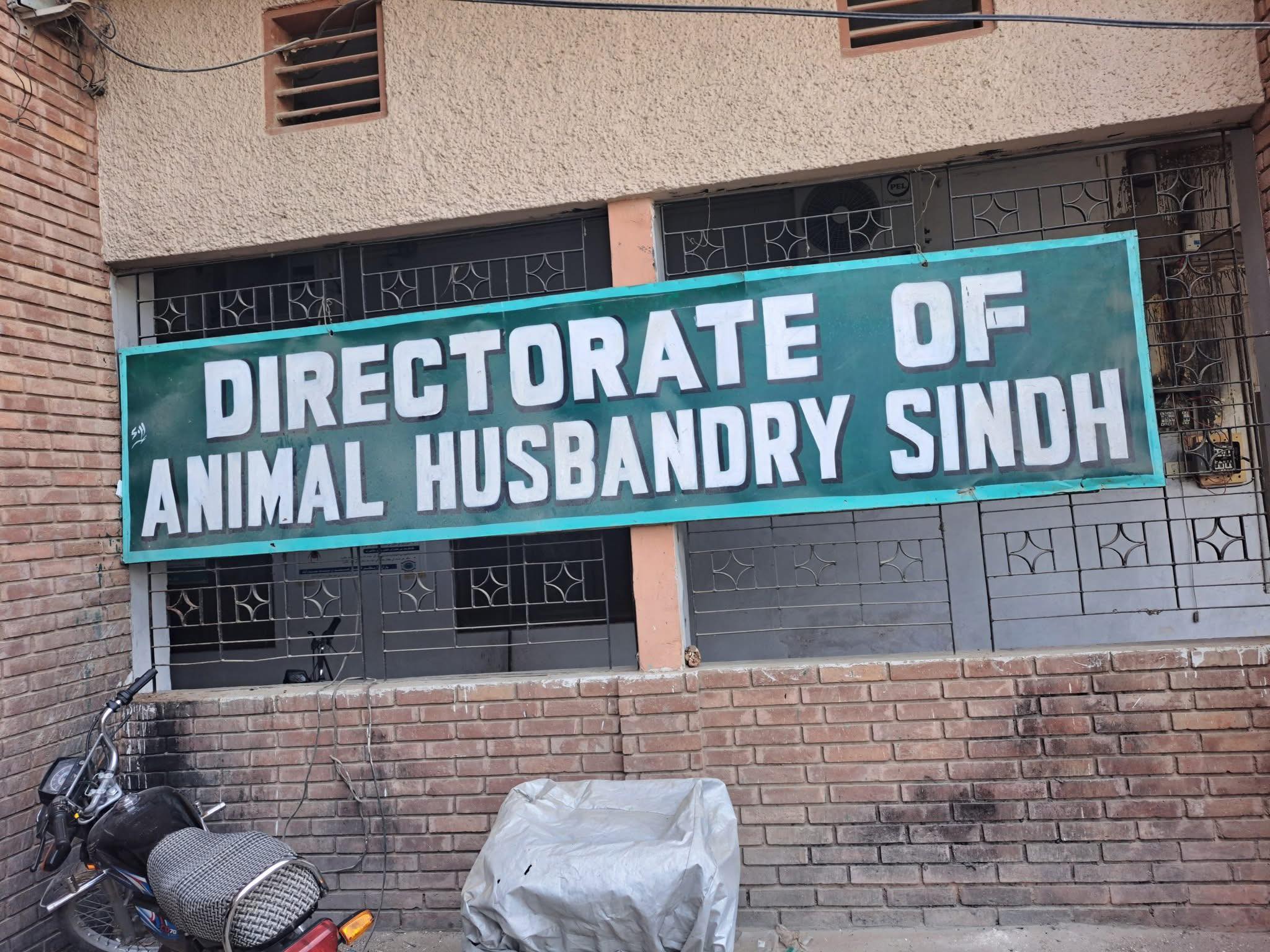
  • Directorate of Animal Husbandry Sindh – Bio

    The Directorate of Animal Husbandry Sindh is a key department under the Government of Sindh, dedicated to promoting livestock development, animal health, and veterinary services across the province. With a mission to enhance food security, rural livelihoods, and sustainable livestock farming, the Directorate plays a vital role in Pakistan’s agricultural ecosystem.

    Its core responsibilities include implementing disease control and vaccination programs, improving animal breeding through modern techniques, supporting dairy and poultry sectors, and ensuring the welfare of both livestock and farmers. Through field offices, veterinary hospitals, mobile clinics, and training centers, the Directorate works to uplift livestock productivity and health while empowering rural communities.

    From cattle to camels, from poultry to pets, the Directorate serves as the backbone of Sindh’s animal agriculture β€” improving economic resilience, public health, and food supply for millions.
    Directorate of Animal Husbandry Sindh – Bio The Directorate of Animal Husbandry Sindh is a key department under the Government of Sindh, dedicated to promoting livestock development, animal health, and veterinary services across the province. With a mission to enhance food security, rural livelihoods, and sustainable livestock farming, the Directorate plays a vital role in Pakistan’s agricultural ecosystem. Its core responsibilities include implementing disease control and vaccination programs, improving animal breeding through modern techniques, supporting dairy and poultry sectors, and ensuring the welfare of both livestock and farmers. Through field offices, veterinary hospitals, mobile clinics, and training centers, the Directorate works to uplift livestock productivity and health while empowering rural communities. From cattle to camels, from poultry to pets, the Directorate serves as the backbone of Sindh’s animal agriculture β€” improving economic resilience, public health, and food supply for millions.
    0 Comments 0 Shares 179 Views
More Results