• Foundation level

    Day:- 97
    Rollno:-005
    Story Post

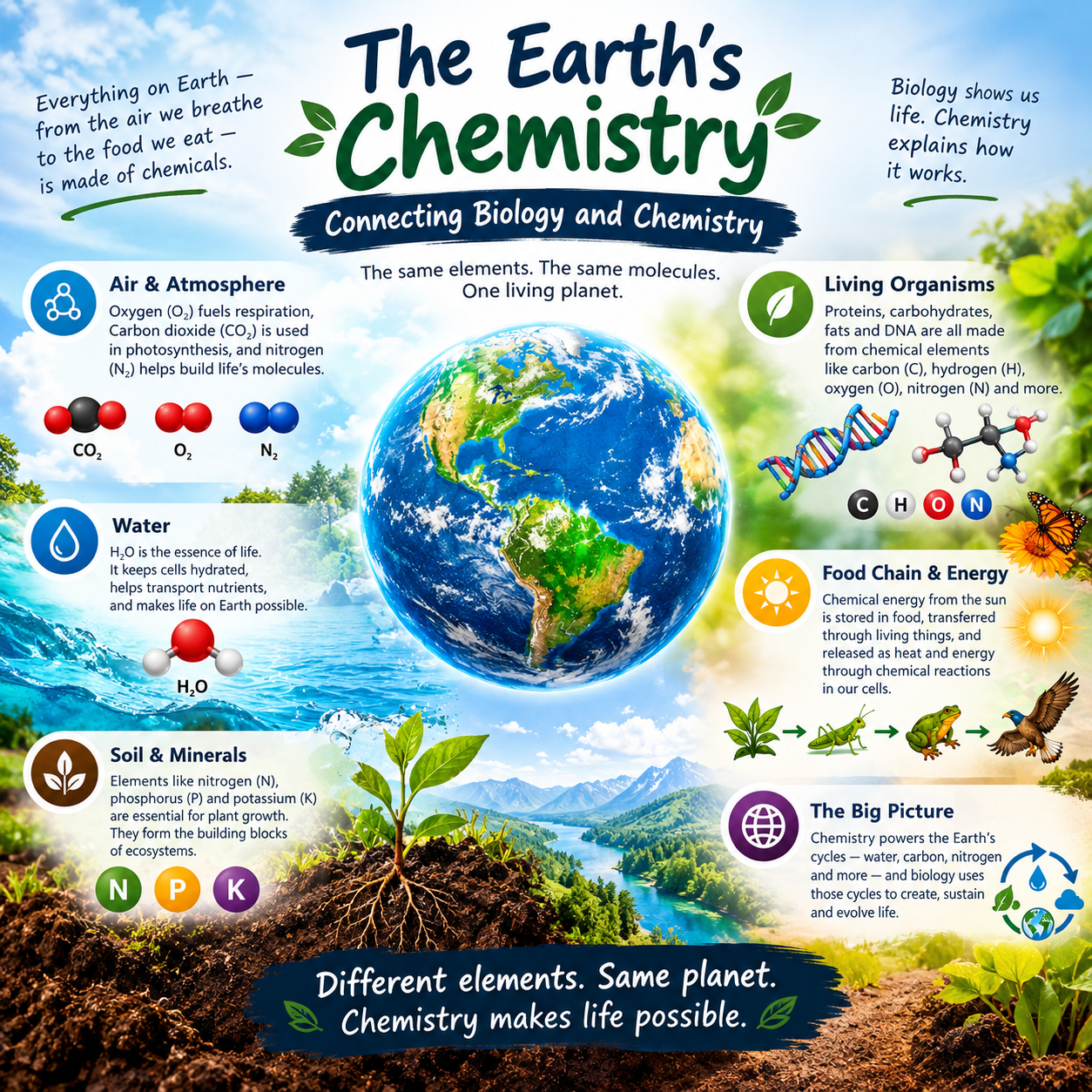
    The Earth’s Chemistry – Connecting Biology and Chemistry

    Everything around us—from the air we breathe and the water we drink to plants, animals, soil, and even our own bodies—is connected through chemistry. Chemistry explains the elements and molecules that make life possible, while biology shows how living organisms use them.

    From oxygen and carbon dioxide in the atmosphere to water, minerals, proteins, DNA, and carbohydrates, chemical reactions are constantly taking place on Earth.

    This educational post explores how chemistry and biology work together to support life, ecosystems, energy flow, and Earth’s natural cycles.

    Different elements. Same planet. Chemistry makes life possible!

    #EarthsChemistry #Chemistry #Biology #Science #EarthScience #Molecules #Elements #Nature #Education #SciencePost #Learning #STEM #EnvironmentalScience #ChemistryAndBiology
    Foundation level Day:- 97 Rollno:-005 πŸ“– Story Post 🌍 The Earth’s Chemistry – Connecting Biology and Chemistry πŸ§ͺ🌱 Everything around us—from the air we breathe and the water we drink to plants, animals, soil, and even our own bodies—is connected through chemistry. Chemistry explains the elements and molecules that make life possible, while biology shows how living organisms use them. From oxygen and carbon dioxide in the atmosphere to water, minerals, proteins, DNA, and carbohydrates, chemical reactions are constantly taking place on Earth. πŸŒΏπŸ”¬ This educational post explores how chemistry and biology work together to support life, ecosystems, energy flow, and Earth’s natural cycles. ✨ Different elements. Same planet. Chemistry makes life possible! #EarthsChemistry #Chemistry #Biology #Science #EarthScience #Molecules #Elements #Nature #Education #SciencePost #Learning #STEM #EnvironmentalScience #ChemistryAndBiology
    0 Reacties 0 aandelen 84 Views
  • #rsisb
    Roll no.239
    Maya no.20
    Foundation Level

    **“Air – Breathing Life into Language”** explores the importance of air in our lives and the many meanings connected with the simple word **“air.”** Air is essential for life, as humans and animals need oxygen for breathing, while plants also interact with gases in the atmosphere to support life on Earth.

    The topic explains how **breathing** connects us to the natural world. Every breath we take depends on the atmosphere around us. Our lungs take in oxygen and release carbon dioxide, making breathing one of the most important processes that happens continuously in our bodies.

    The discussion also looks at **air in nature**. Moving air creates wind, which can move clouds, leaves, and even help generate electricity through wind power. Air also plays an important role in weather and the Earth's atmosphere.

    Another interesting part is the connection between **air and language**. We use air to produce speech and sounds. Our lungs provide the airflow needed for speaking, singing, and communicating. The word “air” itself also appears in many expressions, showing how language can connect everyday physical experiences with ideas and emotions.

    The topic also highlights the importance of **clean air**. Smoke, vehicle emissions, burning waste, and other forms of pollution can affect air quality. Planting trees, reducing pollution, avoiding unnecessary burning, and protecting the environment are some ways people can help maintain cleaner air.

    ### Key Message

    **Air is invisible, but it is essential to life, communication, nature, and our everyday world.** Understanding air helps us appreciate every breath we take and reminds us of our responsibility to protect the environment.

    ### Hashtags

    #Air #Breathing #Language #Science #Environment #CleanAir #Oxygen #Nature #Learning #Education #Students #AirPollution #SaveTrees #Knowledge
    #rsisb Roll no.239 Maya no.20 Foundation Level **“Air – Breathing Life into Language”** explores the importance of air in our lives and the many meanings connected with the simple word **“air.”** Air is essential for life, as humans and animals need oxygen for breathing, while plants also interact with gases in the atmosphere to support life on Earth. The topic explains how **breathing** connects us to the natural world. Every breath we take depends on the atmosphere around us. Our lungs take in oxygen and release carbon dioxide, making breathing one of the most important processes that happens continuously in our bodies. The discussion also looks at **air in nature**. Moving air creates wind, which can move clouds, leaves, and even help generate electricity through wind power. Air also plays an important role in weather and the Earth's atmosphere. Another interesting part is the connection between **air and language**. We use air to produce speech and sounds. Our lungs provide the airflow needed for speaking, singing, and communicating. The word “air” itself also appears in many expressions, showing how language can connect everyday physical experiences with ideas and emotions. The topic also highlights the importance of **clean air**. Smoke, vehicle emissions, burning waste, and other forms of pollution can affect air quality. Planting trees, reducing pollution, avoiding unnecessary burning, and protecting the environment are some ways people can help maintain cleaner air. ### 🌟 Key Message **Air is invisible, but it is essential to life, communication, nature, and our everyday world.** Understanding air helps us appreciate every breath we take and reminds us of our responsibility to protect the environment. ### πŸ”– Hashtags #Air #Breathing #Language #Science #Environment #CleanAir #Oxygen #Nature #Learning #Education #Students #AirPollution #SaveTrees #Knowledge πŸŒ¬οΈπŸŒ±πŸ“š
    0 Reacties 0 aandelen 443 Views 23
  • accl task
    day 69
    week 3
    task: story post 69
    topic:Acids and Bases: The Balance of Nature
    Title: Acids and Bases: The Balance of Nature

    One afternoon, a curious student named Ayan entered the chemistry laboratory.

    On the table were several ordinary substances: lemon juice, vinegar, baking soda, soap, and pure water.

    Ayan looked at them and asked his teacher,

    β€œHow can such different substances all be part of the same scientific system?”

    His teacher smiled.

    β€œBecause many of them can be understood through the chemistry of acids, bases, and balance.”

    Ayan became curious.

    The World of Acids

    The teacher first placed a small amount of lemon juice on the table.

    β€œLemon juice contains citric acid,” she explained.

    Acids are substances that, in water, increase the concentration of hydrogen ions (H⁺). Many acids have a sour taste, although scientists never identify an unknown chemical by tasting it.

    Ayan had seen acids in everyday life without realizing it.

    Vinegar contains acetic acid.

    The stomach naturally contains hydrochloric acid, which helps with digestion.

    Even some fruits contain naturally occurring acids.

    Ayan began to understand that the word β€œacid” did not always mean something dangerous.

    Discovering Bases

    Next, the teacher showed him a solution of baking soda.

    β€œThis behaves as a base in water,” she said.

    Bases generally increase the concentration of hydroxide ions or accept hydrogen ions, depending on the chemical definition being used.

    Many basic substances are found around us.

    Some cleaning products are basic.

    Soap solutions are often basic.

    Certain minerals and compounds in nature can also behave as bases.

    Ayan realized that acids and bases were not simply opposites in a textbook.

    They were part of everyday chemistry.

    The pH Scale

    The teacher then drew a colorful scale on the board.

    It was the pH scale.

    β€œpH helps us describe how acidic or basic an aqueous solution is,” she explained.

    At about pH 7, a solution is considered neutral under standard conditions, such as pure water at around room temperature.

    Values below 7 are generally acidic.

    Values above 7 are generally basic.

    Ayan looked at the scale with fascination.

    The numbers seemed simple, but they represented important chemical differences.

    The teacher added:

    β€œThe pH scale is logarithmic. A change of one pH unit represents a tenfold change in hydrogen-ion concentration.”

    Ayan suddenly realized that even a small numerical change could represent a significant chemical difference.

    When Acids and Bases Meet

    Then the teacher performed an experiment.

    She carefully combined an acid with a base.

    The two substances reacted.

    In many common acid-base reactions, the products include water and a salt. This type of reaction is often called neutralization.

    Ayan watched as the chemistry changed before his eyes.

    β€œSo acids and bases can balance each other?” he asked.

    β€œIn the right conditions, yes,” his teacher replied.

    β€œBut neutralization does not always mean the final mixture has exactly pH 7. The result depends on the substances and their amounts.”

    Ayan nodded.

    Chemistry was more precise than he had imagined.

    Balance in Nature

    The teacher then showed Ayan pictures of lakes, soil, oceans, and living organisms.

    β€œAcid-base balance is important in nature too.”

    Soil chemistry can influence how nutrients are available to plants.

    The pH of freshwater can affect aquatic organisms.

    Ocean chemistry is also changing as the ocean absorbs carbon dioxide from the atmosphere, which leads to ocean acidification.

    This does not mean the ocean suddenly becomes a strong acid.

    Instead, its seawater chemistry shifts toward greater acidity, with important consequences for organisms that build shells or skeletons from calcium carbonate.

    Ayan began to see that chemistry was connected to the entire environment.

    Balance Inside the Human Body

    The teacher then explained that acid-base balance is also essential inside the human body.

    Blood normally stays within a narrow pH range.

    The body uses several systemsβ€”including the lungs and kidneysβ€”to help regulate this balance.

    The lungs influence carbon dioxide levels, while the kidneys help regulate acids and bases over longer periods.

    Ayan was amazed.

    β€œEven our bodies have their own chemical balancing systems?”

    β€œExactly,” said his teacher.

    The Power of Buffers

    There was one final concept.

    The teacher added:

    β€œSome solutions contain buffers.”

    Buffers help resist large changes in pH when relatively small amounts of acid or base are added.

    Ayan learned that buffer systems are important in chemistry, biology, medicine, and many natural environments.

    They help keep chemical conditions within useful ranges.

    The Lesson of Balance

    As the lesson ended, Ayan looked again at the bottles on the laboratory table.

    Lemon juice.

    Vinegar.

    Baking soda.

    Water.

    They seemed ordinary.

    But behind each substance was a world of chemical reactions, ions, and equilibrium.

    Ayan finally understood the lesson.

    Acids and bases are not simply about β€œstrong” and β€œweak” chemicals.

    They are part of a larger story about chemical balance.

    From a laboratory experiment to soil, oceans, and living organisms, acid-base chemistry helps explain how many systems behave.

    Final Thought

    Nature depends on balance.

    Too much of one chemical condition can change an entire system, while the right balance can help maintain stability.

    Acids and bases teach us an important scientific lesson:9 sometimes, understanding two different forces interact is the key to understanding the system as a when

    accl task day 69 week 3 task: story post 69 topic:Acids and Bases: The Balance of Nature Title: πŸ§ͺ Acids and Bases: The Balance of Nature One afternoon, a curious student named Ayan entered the chemistry laboratory. On the table were several ordinary substances: lemon juice, vinegar, baking soda, soap, and pure water. Ayan looked at them and asked his teacher, β€œHow can such different substances all be part of the same scientific system?” His teacher smiled. β€œBecause many of them can be understood through the chemistry of acids, bases, and balance.” Ayan became curious. πŸ‹ The World of Acids The teacher first placed a small amount of lemon juice on the table. β€œLemon juice contains citric acid,” she explained. Acids are substances that, in water, increase the concentration of hydrogen ions (H⁺). Many acids have a sour taste, although scientists never identify an unknown chemical by tasting it. Ayan had seen acids in everyday life without realizing it. Vinegar contains acetic acid. The stomach naturally contains hydrochloric acid, which helps with digestion. Even some fruits contain naturally occurring acids. Ayan began to understand that the word β€œacid” did not always mean something dangerous. 🧼 Discovering Bases Next, the teacher showed him a solution of baking soda. β€œThis behaves as a base in water,” she said. Bases generally increase the concentration of hydroxide ions or accept hydrogen ions, depending on the chemical definition being used. Many basic substances are found around us. Some cleaning products are basic. Soap solutions are often basic. Certain minerals and compounds in nature can also behave as bases. Ayan realized that acids and bases were not simply opposites in a textbook. They were part of everyday chemistry. 🌈 The pH Scale The teacher then drew a colorful scale on the board. It was the pH scale. β€œpH helps us describe how acidic or basic an aqueous solution is,” she explained. At about pH 7, a solution is considered neutral under standard conditions, such as pure water at around room temperature. Values below 7 are generally acidic. Values above 7 are generally basic. Ayan looked at the scale with fascination. The numbers seemed simple, but they represented important chemical differences. The teacher added: β€œThe pH scale is logarithmic. A change of one pH unit represents a tenfold change in hydrogen-ion concentration.” Ayan suddenly realized that even a small numerical change could represent a significant chemical difference. βš–οΈ When Acids and Bases Meet Then the teacher performed an experiment. She carefully combined an acid with a base. The two substances reacted. In many common acid-base reactions, the products include water and a salt. This type of reaction is often called neutralization. Ayan watched as the chemistry changed before his eyes. β€œSo acids and bases can balance each other?” he asked. β€œIn the right conditions, yes,” his teacher replied. β€œBut neutralization does not always mean the final mixture has exactly pH 7. The result depends on the substances and their amounts.” Ayan nodded. Chemistry was more precise than he had imagined. 🌱 Balance in Nature The teacher then showed Ayan pictures of lakes, soil, oceans, and living organisms. β€œAcid-base balance is important in nature too.” Soil chemistry can influence how nutrients are available to plants. The pH of freshwater can affect aquatic organisms. Ocean chemistry is also changing as the ocean absorbs carbon dioxide from the atmosphere, which leads to ocean acidification. This does not mean the ocean suddenly becomes a strong acid. Instead, its seawater chemistry shifts toward greater acidity, with important consequences for organisms that build shells or skeletons from calcium carbonate. Ayan began to see that chemistry was connected to the entire environment. 🧬 Balance Inside the Human Body The teacher then explained that acid-base balance is also essential inside the human body. Blood normally stays within a narrow pH range. The body uses several systemsβ€”including the lungs and kidneysβ€”to help regulate this balance. The lungs influence carbon dioxide levels, while the kidneys help regulate acids and bases over longer periods. Ayan was amazed. β€œEven our bodies have their own chemical balancing systems?” β€œExactly,” said his teacher. πŸ”¬ The Power of Buffers There was one final concept. The teacher added: β€œSome solutions contain buffers.” Buffers help resist large changes in pH when relatively small amounts of acid or base are added. Ayan learned that buffer systems are important in chemistry, biology, medicine, and many natural environments. They help keep chemical conditions within useful ranges. 🌍 The Lesson of Balance As the lesson ended, Ayan looked again at the bottles on the laboratory table. Lemon juice. Vinegar. Baking soda. Water. They seemed ordinary. But behind each substance was a world of chemical reactions, ions, and equilibrium. Ayan finally understood the lesson. Acids and bases are not simply about β€œstrong” and β€œweak” chemicals. They are part of a larger story about chemical balance. From a laboratory experiment to soil, oceans, and living organisms, acid-base chemistry helps explain how many systems behave. βš—οΈ Final Thought Nature depends on balance. Too much of one chemical condition can change an entire system, while the right balance can help maintain stability. Acids and bases teach us an important scientific lesson:9 sometimes, understanding two different forces interact is the key to understanding the system as a when

    0 Reacties 0 aandelen 688 Views
  • #rsisb
    Roll no.239
    Song no .17
    Foundation Level

    Explore the fascinating story of the chemical elements, from **carbon**, the building block of life, to **gold**, one of the most precious elements on Earth.

    This topic takes us on a journey through the periodic table, discovering how different elements are formed, what makes them unique, and how they shape our world. From the atoms in our bodies to the metals used in technology and jewelry, every element has its own incredible story.

    #StoryOfElements #CarbonToGold #Chemistry #PeriodicTable #Science #Atoms #Elements #Education #Learning
    #rsisb Roll no.239 Song no .17 Foundation Level Explore the fascinating story of the chemical elements, from **carbon**, the building block of life, to **gold**, one of the most precious elements on Earth. πŸŒπŸ”¬ This topic takes us on a journey through the periodic table, discovering how different elements are formed, what makes them unique, and how they shape our world. From the atoms in our bodies to the metals used in technology and jewelry, every element has its own incredible story. βš›οΈπŸ’« #StoryOfElements #CarbonToGold #Chemistry #PeriodicTable #Science #Atoms #Elements #Education #Learning πŸ§ͺπŸ”¬πŸŒŸ
    0 Reacties 0 aandelen 449 Views 1


  • RSIF8
    Roll no68
    Task no 63
    Task topic; The Story of Elements: From Carbon to Gold

    "The Story of Elements: From Carbon to Gold" celebrates the fascinating world of chemical elements and their importance in our lives. From carbon, the foundation of life, to gold, a symbol of beauty and value, each element has unique properties and plays a vital role in nature, technology, and human progress. This journey through the periodic table reminds us that every element contributes to the amazing story of science and the universe.
    RSIF8 Roll no68 Task no 63 Task topic; The Story of Elements: From Carbon to Gold "The Story of Elements: From Carbon to Gold" celebrates the fascinating world of chemical elements and their importance in our lives. From carbon, the foundation of life, to gold, a symbol of beauty and value, each element has unique properties and plays a vital role in nature, technology, and human progress. This journey through the periodic table reminds us that every element contributes to the amazing story of science and the universe.
    0 Reacties 0 aandelen 247 Views 3
  • #rsisb
    Roll no.247
    song .23
    Foundation level

    **The Story of Elements: From Carbon to Gold**

    The world around us is made from a fascinating collection of chemical elements, each with its own unique properties, history, and role in nature. From the carbon in living organisms to the gold found deep within the Earth, every element tells a remarkable story about how our universe works.

    **Carbon** is one of the most important elements for life. It forms the foundation of countless molecules, including those that make up living things. Carbon can also appear in very different forms, from soft graphite to brilliant diamond.

    As we explore the periodic table, we discover elements with completely different characteristics. Oxygen helps living organisms release energy. Iron is essential in many biological processes and has shaped human civilization through tools and technology. Copper has been used for thousands of years and remains important in electrical systems.

    And then there is **gold**—a rare, beautiful, and chemically fascinating element. Its resistance to corrosion and distinctive appearance have made it valuable throughout human history. But gold is more than something beautiful; it also has important scientific and technological applications.

    This journey from **carbon to gold** reminds us that the periodic table is not simply a list of symbols. It is a story of matter, stars, planets, life, discovery, and human curiosity. Every element contributes a small but important piece to the incredible story of our universe.

    Learning about elements helps us understand what everything is made of—from our bodies and oceans to rocks, stars, and modern technology. The deeper we explore chemistry, the more we discover that even the smallest building blocks of matter can tell enormous stories.

    **Explore the periodic table. Discover the elements. Understand the matter that makes our world!**

    #TheStoryOfElements #CarbonToGold #Elements #Chemistry #PeriodicTable #Science #ChemistryEducation #ScienceExploration #ChemicalElements #Carbon #Gold #Matter #Atoms #Molecules #ScienceLearning #STEM #STEMEducation #YoungScientists #ExploreScience #LearnChemistry #ScienceIsAmazing #Universe #Discovery #Education #Knowledge #Curiosity #FutureScientists
    #rsisb Roll no.247 song .23 Foundation level 🌟πŸ§ͺ **The Story of Elements: From Carbon to Gold** πŸͺ™βœ¨ The world around us is made from a fascinating collection of chemical elements, each with its own unique properties, history, and role in nature. πŸŒπŸ”¬ From the carbon in living organisms to the gold found deep within the Earth, every element tells a remarkable story about how our universe works. πŸŒŒβš›οΈ πŸ–€ **Carbon** is one of the most important elements for life. It forms the foundation of countless molecules, including those that make up living things. 🌱🧬 Carbon can also appear in very different forms, from soft graphite to brilliant diamond. πŸ’Ž As we explore the periodic table, we discover elements with completely different characteristics. Oxygen helps living organisms release energy. 🌬️πŸ”₯ Iron is essential in many biological processes and has shaped human civilization through tools and technology. βš™οΈπŸ—οΈ Copper has been used for thousands of years and remains important in electrical systems. πŸ”Œβš‘ And then there is **gold**—a rare, beautiful, and chemically fascinating element. πŸͺ™βœ¨ Its resistance to corrosion and distinctive appearance have made it valuable throughout human history. But gold is more than something beautiful; it also has important scientific and technological applications. πŸ”¬πŸ’» This journey from **carbon to gold** reminds us that the periodic table is not simply a list of symbols. It is a story of matter, stars, planets, life, discovery, and human curiosity. 🌌⭐🌍 Every element contributes a small but important piece to the incredible story of our universe. πŸ”¬πŸ“š Learning about elements helps us understand what everything is made of—from our bodies and oceans to rocks, stars, and modern technology. The deeper we explore chemistry, the more we discover that even the smallest building blocks of matter can tell enormous stories. βš›οΈπŸŒŸ πŸš€ **Explore the periodic table. Discover the elements. Understand the matter that makes our world!** πŸ§ͺ🌍✨ #TheStoryOfElements #CarbonToGold #Elements #Chemistry #PeriodicTable #Science #ChemistryEducation #ScienceExploration #ChemicalElements #Carbon #Gold #Matter #Atoms #Molecules #ScienceLearning #STEM #STEMEducation #YoungScientists #ExploreScience #LearnChemistry #ScienceIsAmazing #Universe #Discovery #Education #Knowledge #Curiosity #FutureScientists πŸ§ͺβš›οΈπŸŒŒπŸ”¬πŸ“šβœ¨
    0 Reacties 0 aandelen 1315 Views 8
  • RSIF8
    Roll no: 09
    Song no: 09
    Song topic: The Story of Elements: From Carbon to Goldand.

    **The Story of Elements: From Carbon to Gold**

    Take a musical journey through the amazing world of elements! From carbon—the building block of life—to the precious sparkle of gold, discover how atoms and stars connect to create the universe around us. A fun and creative way to explore chemistry and the incredible story of the elements!

    #Elements #CarbonToGold #Chemistry #Science #PeriodicTable #Atoms #Universe #STEM #ScienceIsFun #LearningThroughMusic
    RSIF8 Roll no: 09 Song no: 09 Song topic: The Story of Elements: From Carbon to Goldand. πŸŒŸπŸ”¬ **The Story of Elements: From Carbon to Gold** πŸ§ͺ✨ Take a musical journey through the amazing world of elements! 🌌🎢 From carbon—the building block of life—to the precious sparkle of gold, discover how atoms and stars connect to create the universe around us. πŸŒŸβš›οΈ A fun and creative way to explore chemistry and the incredible story of the elements! 🎡🌍 #Elements #CarbonToGold #Chemistry #Science #PeriodicTable #Atoms #Universe #STEM #ScienceIsFun #LearningThroughMusic πŸ§ͺβš›οΈπŸŒŸπŸŽΆ
    0 Reacties 0 aandelen 833 Views 3
  • #rsisb
    Roll no.247
    song .5
    Foundation level

    **The Human Body: A Marvel of Creation**

    The human body is one of the most fascinating and complex systems in the natural world. From the tiny cells that build our tissues to the powerful organs that keep us alive, every part of the body has an important role to play.

    **The brain** helps us think, learn, remember, communicate, and understand the world around us.
    **The heart** continuously pumps blood throughout the body, delivering oxygen and nutrients to cells.
    **The lungs** allow us to breathe and exchange oxygen and carbon dioxide.
    **The blood** transports oxygen, nutrients, hormones, and other essential substances.
    **The skeleton** provides structure and protects important organs, while **muscles** help us move and perform everyday activities.

    At the microscopic level, billions of cells work together in an incredible network. Cells form tissues, tissues form organs, and organs work together as interconnected systems. The body constantly maintains balance through processes such as temperature regulation, digestion, breathing, circulation, and immune responses.

    What makes the human body especially remarkable is its ability to adapt, repair, learn, and respond to its environment. Every heartbeat, breath, movement, and thought represents a complex interaction between biological systems.

    Studying the human body teaches us not only about anatomy and biology but also about the importance of health, nutrition, exercise, rest, hygiene, and taking care of ourselves.

    **The Human Body: A Marvel of Creation** reminds us that science can reveal the amazing complexity of life. Every cell has a story, every organ has a purpose, and every system contributes to the extraordinary experience of being alive.

    #TheHumanBody #MarvelOfCreation #HumanAnatomy #Biology #Science #HumanBodyScience #AnatomyAndPhysiology #Cells #Brain #Heart #Lungs #HumanHealth #ScienceEducation #Learning #ExploreScience #BiologyEducation #AmazingScience #LifeScience #Knowledge #Education #DiscoverSc ience #ScienceIsAmazing
    #rsisb Roll no.247 song .5 Foundation level 🧬✨ **The Human Body: A Marvel of Creation** πŸ«€πŸ§  The human body is one of the most fascinating and complex systems in the natural world. From the tiny cells that build our tissues to the powerful organs that keep us alive, every part of the body has an important role to play. πŸŒπŸ”¬ 🧠 **The brain** helps us think, learn, remember, communicate, and understand the world around us. ❀️ **The heart** continuously pumps blood throughout the body, delivering oxygen and nutrients to cells. 🫁 **The lungs** allow us to breathe and exchange oxygen and carbon dioxide. 🩸 **The blood** transports oxygen, nutrients, hormones, and other essential substances. 🦴 **The skeleton** provides structure and protects important organs, while **muscles** help us move and perform everyday activities. πŸ’ͺ At the microscopic level, billions of cells work together in an incredible network. 🧫✨ Cells form tissues, tissues form organs, and organs work together as interconnected systems. The body constantly maintains balance through processes such as temperature regulation, digestion, breathing, circulation, and immune responses. βš™οΈπŸŒ‘οΈ What makes the human body especially remarkable is its ability to adapt, repair, learn, and respond to its environment. Every heartbeat, breath, movement, and thought represents a complex interaction between biological systems. πŸ”¬πŸ’« Studying the human body teaches us not only about anatomy and biology but also about the importance of health, nutrition, exercise, rest, hygiene, and taking care of ourselves. πŸ“šπŸ₯—πŸ’§πŸ˜΄ 🌟 **The Human Body: A Marvel of Creation** reminds us that science can reveal the amazing complexity of life. Every cell has a story, every organ has a purpose, and every system contributes to the extraordinary experience of being alive. 🧬❀️🌎 #TheHumanBody #MarvelOfCreation #HumanAnatomy #Biology #Science #HumanBodyScience #AnatomyAndPhysiology #Cells #Brain #Heart #Lungs #HumanHealth #ScienceEducation #Learning #ExploreScience #BiologyEducation #AmazingScience #LifeScience #Knowledge #Education #DiscoverSc ience #ScienceIsAmazing πŸ§¬πŸ”¬πŸ§ β€οΈπŸ«πŸ¦΄πŸ’ͺ🌍✨
    0 Reacties 0 aandelen 1995 Views 4
  • Day 97
    Task No:97
    Roll No:42
    RSLC
    Foundation Level, Batch#04

    Deep beneath the Earths surface and across its vast oceans, an incredible chemical journey has been shaping life for billions of years. Every drop of water, every mineral in the soil, and every breath of oxygen is part of a natural chemical cycle. These elements combine in perfect balance, creating the conditions that allow plants, animals, and humans to survive. Biology and chemistry work together as natures hidden partners, building the foundation of life on our planet.

    Plants demonstrate this remarkable connection every day by transforming sunlight, water, and carbon dioxide into food through photosynthesis. This amazing biological process depends entirely on chemical reactions that produce oxygen for living organisms. Animals and humans then use this oxygen to release energy from food, while returning carbon dioxide to the atmosphere, creating a continuous cycle that keeps Earths ecosystems healthy and alive.

    The relationship between biology and chemistry reminds us that every living thing is connected through natures invisible processes. From the smallest cell to the largest forest, chemical reactions make life possible and maintain the balance of our environment. By understanding this powerful partnership, we gain a deeper appreciation for our planet and the responsibility we all share to protect the natural world for future generations.

    #TheEarthsChemistry #Biology #Chemistry #Science #Nature #Earth #Photosynthesis #Ecosystem #EnvironmentalScience #STEM #Learning #Education #Knowledge #ScienceFacts #NatureLovers
    Day 97 Task No:97 Roll No:42 RSLC Foundation Level, Batch#04 Deep beneath the Earth's surface and across its vast oceans, an incredible chemical journey has been shaping life for billions of years. Every drop of water, every mineral in the soil, and every breath of oxygen is part of a natural chemical cycle. These elements combine in perfect balance, creating the conditions that allow plants, animals, and humans to survive. Biology and chemistry work together as nature's hidden partners, building the foundation of life on our planet. Plants demonstrate this remarkable connection every day by transforming sunlight, water, and carbon dioxide into food through photosynthesis. This amazing biological process depends entirely on chemical reactions that produce oxygen for living organisms. Animals and humans then use this oxygen to release energy from food, while returning carbon dioxide to the atmosphere, creating a continuous cycle that keeps Earth's ecosystems healthy and alive. The relationship between biology and chemistry reminds us that every living thing is connected through nature's invisible processes. From the smallest cell to the largest forest, chemical reactions make life possible and maintain the balance of our environment. By understanding this powerful partnership, we gain a deeper appreciation for our planet and the responsibility we all share to protect the natural world for future generations. #TheEarthsChemistry #Biology #Chemistry #Science #Nature #Earth #Photosynthesis #Ecosystem #EnvironmentalScience #STEM #Learning #Education #Knowledge #ScienceFacts #NatureLovers
    0 Reacties 0 aandelen 2533 Views
  • #rsisb
    Roll No.240
    Image With Chatgpt No.5
    Foundation Level

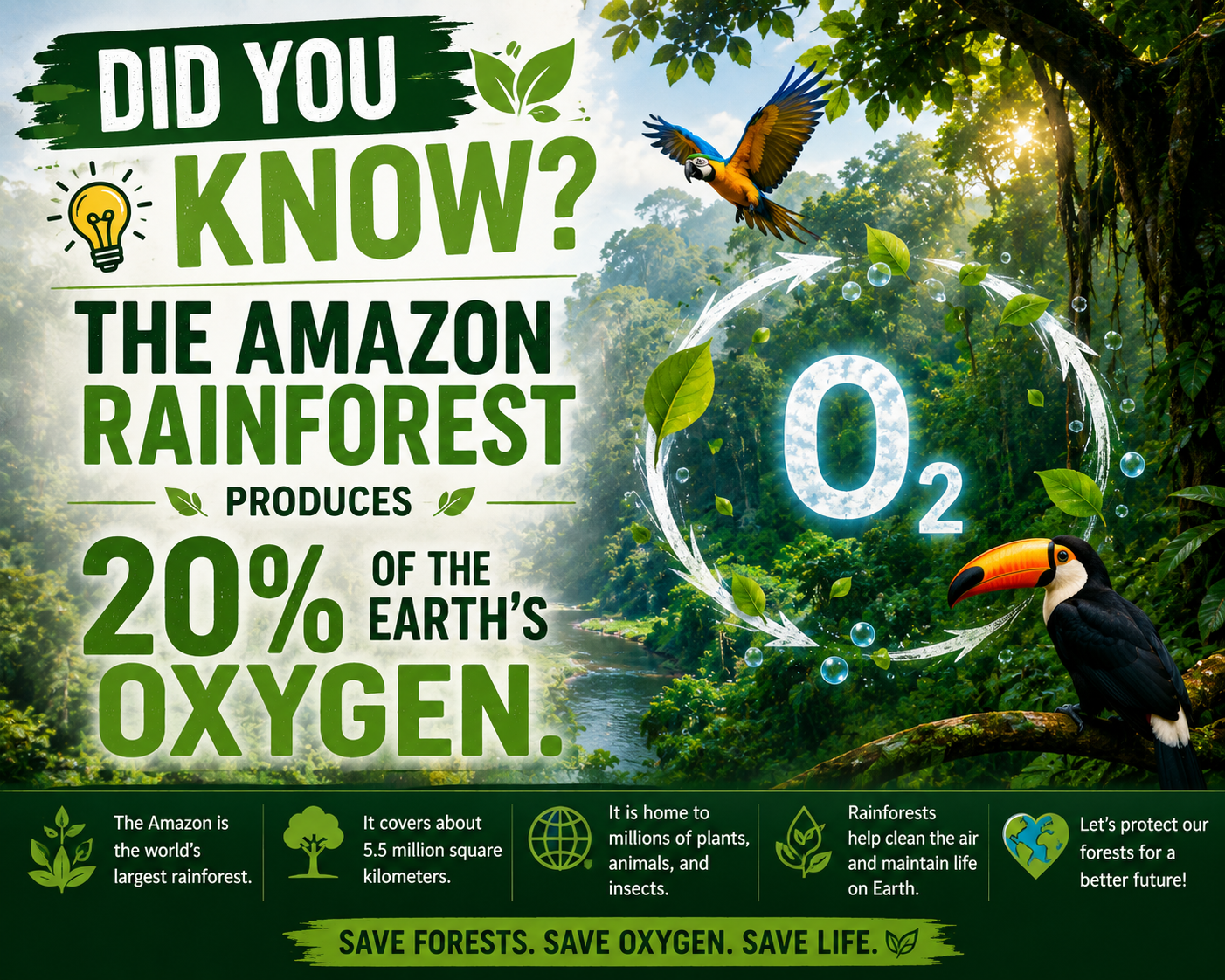
    The Amazon Rainforest is one of the most extraordinary natural environments on our planet. Stretching across a vast area of South America, it is home to an incredible variety of plants, animals, insects, birds, and microorganisms.

    The rainforest is often called the “lungs of the world,” because its plants produce oxygen through photosynthesis and the ecosystem plays an important role in absorbing and storing carbon dioxide. However, the commonly repeated claim that the Amazon produces 20% of the world’s oxygen is misleading. Much of the oxygen produced by plants is also consumed by plants, animals, fungi, and microorganisms within the ecosystem.

    What makes the Amazon truly remarkable is its biodiversity. From colorful macaws flying through the canopy to jaguars moving through the forest, countless species depend on this habitat for food, shelter, and survival.

    The rainforest also has an important role in the global carbon cycle and climate system. Trees and vegetation absorb large amounts of carbon dioxide, storing carbon in plants and soils. This makes protecting healthy forests important for the environment and for communities that depend on them.

    Every part of the Amazon ecosystem is connected. When forests are damaged or destroyed, the effects can spread through habitats, wildlife populations, water systems, and climate processes.

    Learning about the Amazon teaches us an important lesson: protecting nature means protecting the systems that support life. Conservation, responsible land use, reducing deforestation, and caring for biodiversity can all help preserve this extraordinary ecosystem for future generations.

    Explore the rainforest. Discover its biodiversity. Understand its importance. Protect our planet.

    The Amazon is more than just a forest—it is a living, interconnected world filled with life, discovery, and natural wonder.

    #AmazonRainforest #Amazon #Rainforest #DidYouKnow #Nature #Biodiversity #Wildlife #Environment #Earth #PlanetEarth #Forest #TropicalRainforest #Ecology #Science #Biology #ScienceEducation #EnvironmentalEducation #WildlifeConservation #ForestConservation #ProtectNature #SaveTheRainforest #Climate #CarbonCycle #Ecosystem #NaturalWorld #NatureLovers #ExploreNature #EarthScience #LearningJourney #EducationalContent #ScienceFacts #BiodiversityMatters #EverySpeciesCounts #ProtectOurPlanet

    Rehan School Islamabad Campus
    Asma Shaheen EducationWali
    Irum Asim
    Saima Happinesswali

    #rsisb Roll No.240 Image With Chatgpt No.5 Foundation Level The Amazon Rainforest is one of the most extraordinary natural environments on our planet. Stretching across a vast area of South America, it is home to an incredible variety of plants, animals, insects, birds, and microorganisms. πŸŒŽπŸŒ±πŸ’πŸ¦‹ The rainforest is often called the “lungs of the world,” because its plants produce oxygen through photosynthesis and the ecosystem plays an important role in absorbing and storing carbon dioxide. However, the commonly repeated claim that the Amazon produces 20% of the world’s oxygen is misleading. Much of the oxygen produced by plants is also consumed by plants, animals, fungi, and microorganisms within the ecosystem. What makes the Amazon truly remarkable is its biodiversity. πŸŒΏπŸ’πŸπŸ¦œπŸ† From colorful macaws flying through the canopy to jaguars moving through the forest, countless species depend on this habitat for food, shelter, and survival. The rainforest also has an important role in the global carbon cycle and climate system. Trees and vegetation absorb large amounts of carbon dioxide, storing carbon in plants and soils. 🌱🌍 This makes protecting healthy forests important for the environment and for communities that depend on them. Every part of the Amazon ecosystem is connected. πŸŒ³βž‘οΈπŸ¦‹βž‘οΈπŸ¦βž‘οΈπŸ† When forests are damaged or destroyed, the effects can spread through habitats, wildlife populations, water systems, and climate processes. Learning about the Amazon teaches us an important lesson: protecting nature means protecting the systems that support life. πŸ’šπŸŒŽ Conservation, responsible land use, reducing deforestation, and caring for biodiversity can all help preserve this extraordinary ecosystem for future generations. ✨ Explore the rainforest. Discover its biodiversity. Understand its importance. Protect our planet. πŸŒΏπŸ”¬πŸŒ The Amazon is more than just a forest—it is a living, interconnected world filled with life, discovery, and natural wonder. πŸŒ³πŸ’šπŸ¦œ #AmazonRainforest #Amazon #Rainforest #DidYouKnow #Nature #Biodiversity #Wildlife #Environment #Earth #PlanetEarth #Forest #TropicalRainforest #Ecology #Science #Biology #ScienceEducation #EnvironmentalEducation #WildlifeConservation #ForestConservation #ProtectNature #SaveTheRainforest #Climate #CarbonCycle #Ecosystem #NaturalWorld #NatureLovers #ExploreNature #EarthScience #LearningJourney #EducationalContent #ScienceFacts #BiodiversityMatters #EverySpeciesCounts #ProtectOurPlanet πŸŒŽπŸŒΏπŸŒ³πŸ¦œπŸ†πŸ’ Rehan School Islamabad Campus Asma Shaheen EducationWali Irum Asim Saima Happinesswali
    0 Reacties 0 aandelen 5493 Views
Zoekresultaten