• RSIF8
    Roll no 94
    Song no 16
    Song topic
    Microbial Universe: The Power of the Invisible World

    Step into the fascinating world of microbes—the tiny organisms that shape life in ways we can hardly imagine! From helping plants grow to supporting human health , these invisible heroes play a powerful role in our everyday lives.

    This song celebrates the beauty, mystery, and importance of the microbial universe, reminding us that even the smallest forms of life can have the greatest impact.

    Let the rhythm of science inspire curiosity, wonder, and appreciation for the hidden world around us!

    Every drop of water, every breath of air, and every handful of soil is filled with a universe of microscopic life working tirelessly behind the scenes.

    #MicrobialUniverse #InvisibleWorld #ScienceMusic #Microbiology #STEM #ScienceEducation #Biology #Nature #Innovation #Learning #Knowledge #TinyButMighty #ExploreScience #LifeOnEarth #ScientificWonder
    RSIF8 Roll no 94 Song no 16 Song topic 🌍🦠 Microbial Universe: The Power of the Invisible World 🎢✨ Step into the fascinating world of microbes—the tiny organisms that shape life in ways we can hardly imagine! From helping plants grow 🌱 to supporting human health πŸ’š, these invisible heroes play a powerful role in our everyday lives. This song celebrates the beauty, mystery, and importance of the microbial universe, reminding us that even the smallest forms of life can have the greatest impact. πŸŒŸπŸ”¬ 🎡 Let the rhythm of science inspire curiosity, wonder, and appreciation for the hidden world around us! πŸ’« Every drop of water, every breath of air, and every handful of soil is filled with a universe of microscopic life working tirelessly behind the scenes. #MicrobialUniverse #InvisibleWorld #ScienceMusic #Microbiology #STEM #ScienceEducation #Biology #Nature #Innovation #Learning #Knowledge #TinyButMighty #ExploreScience #LifeOnEarth #ScientificWonder πŸ¦ πŸ”¬πŸŒŽβœ¨πŸŽΆπŸ’š
    0 Comments 0 Shares 373 Views 2
  • **Roll No: 2**
    **Batch: 14**
    **Book: ACCL**
    **Task No: 138**

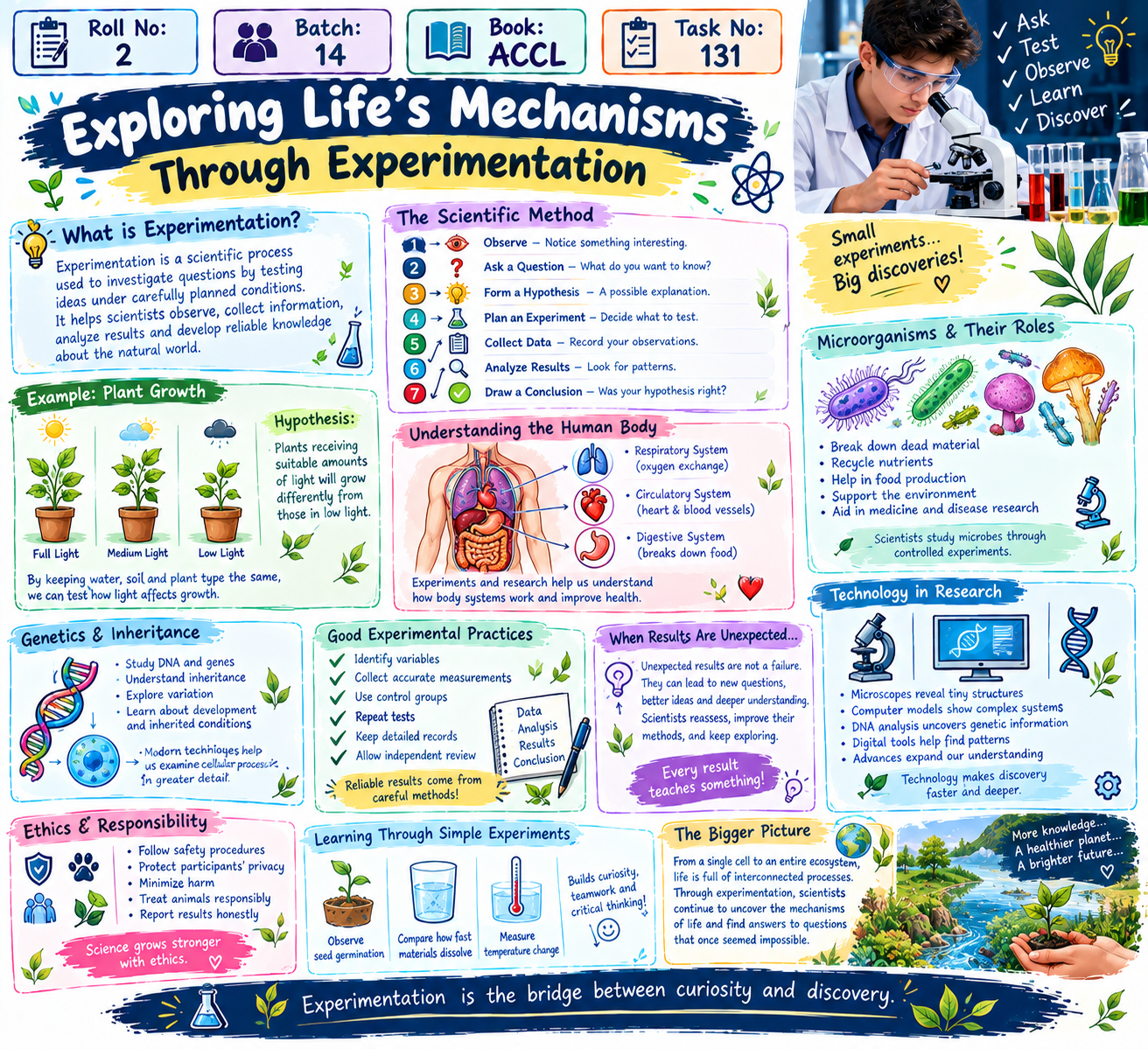
    # Exploring Life’s Mechanisms Through Experimentation

    Have you ever wondered how scientists discover the secrets of life? From understanding how plants grow to investigating how the human heart works, science helps us explore the processes that make living organisms function. Behind many important discoveries lies a powerful method called **experimentation**, which allows scientists to test ideas, observe results, and develop a deeper understanding of the natural world.

    **Experimentation is a scientific process used to investigate questions by testing ideas under carefully planned conditions.** Scientists begin by observing something interesting, asking a question, and developing a hypothesis—a possible explanation that can be tested. They then design an experiment, collect information, and analyze the results to determine whether the evidence supports their original idea. This process helps turn curiosity into reliable scientific knowledge.

    One fascinating example is the study of plant growth. Imagine a student who wants to discover whether the amount of light affects how quickly a plant grows. The student forms a hypothesis that plants receiving suitable amounts of light will grow differently from plants kept in low-light conditions. By keeping factors such as water, soil, and plant type consistent, the student can compare the results and investigate the role of light in plant development.

    Experimentation is also essential for understanding the human body. Scientists investigate how the heart circulates blood, how the lungs exchange gases, and how the digestive system processes food. Through carefully designed studies, medical imaging, laboratory tests, and other research methods, scientists learn how body systems work together to maintain health. Their findings can contribute to improved medical treatments and a better understanding of human biology.

    Another important field is microbiology, the study of microscopic organisms. Many bacteria and fungi play beneficial roles in nature, including breaking down dead material and recycling nutrients. Scientists use controlled experiments to investigate how these organisms respond to different environmental conditions. Such research can help improve food production, develop medicines, understand infectious diseases, and protect ecosystems.

    Experiments also help researchers understand genetics and the mechanisms of inheritance. By studying DNA, genes, and the characteristics of organisms across generations, scientists investigate how biological information is passed on and how variations arise. Modern techniques allow researchers to explore cellular processes in greater detail, helping them understand development, inherited conditions, and the relationships among different forms of life.

    A successful experiment requires more than simply observing what happens. Scientists must identify the variables they are studying, collect accurate measurements, and repeat tests when appropriate. They often use control groups for comparison and record their observations carefully. Repeating experiments helps determine whether a result is consistent, while independent review allows other researchers to examine the methods and evaluate the conclusions. These practices make scientific findings more trustworthy.

    Sometimes experiments produce unexpected results. Instead of treating an unexpected outcome as a failure, scientists use it as an opportunity to ask new questions. They may reconsider their hypothesis, improve their experimental design, or investigate another possible explanation. Scientific progress often happens through this cycle of questioning, testing, learning, and refining ideas. Every result can contribute something valuable when it is interpreted carefully.

    Technology has made biological experimentation more advanced than ever before. Microscopes reveal structures too small to see with the naked eye, computer models help researchers understand complicated systems, and DNA analysis allows scientists to investigate genetic information. Digital tools can also help organize large amounts of data and identify patterns that might otherwise be difficult to notice. These innovations continue to expand our understanding of living organisms.

    However, scientific experimentation must always be guided by responsibility and ethics. Researchers should follow safety procedures, protect participants' privacy, minimize harm, and treat animals responsibly. Experiments involving people or animals require appropriate ethical review and safeguards. Scientists must also report results honestly, even when the findings do not match their expectations. Reliable science depends on both accurate evidence and responsible behavior.

    Experimentation connects classroom learning with real-world discoveries. Students can explore scientific ideas through safe activities, such as observing seed germination, comparing how quickly different materials dissolve in water, or measuring changes in temperature. These activities encourage curiosity, careful observation, teamwork, and critical thinking. They also show that science is not just a collection of facts to memorize; it is an ongoing process of discovery.

    As we explore life's mechanisms, we begin to understand how countless processes work together to support living organisms. From the activity inside a single cell to the interactions among species in an ecosystem, each discovery reveals another part of nature's complexity. Through experimentation, scientists continue to investigate these connections and search for answers to questions that once seemed impossible to solve.

    **Experimentation is the bridge between curiosity and discovery. By asking thoughtful questions, testing ideas fairly, and learning from evidence, we can uncover the mechanisms of life and use scientific knowledge to improve human health, protect the environment, and build a brighter future. **

    \#Experimentation #Biology #ScientificMethod #LifeSciences #ScientificDiscovery #Research #ACCL #Batch14 #Task131
    **Roll No: 2** **Batch: 14** **Book: ACCL** **Task No: 138** # πŸ”¬πŸ§ͺ Exploring Life’s Mechanisms Through Experimentation 🌱🧬 Have you ever wondered how scientists discover the secrets of life? 🌍 From understanding how plants grow to investigating how the human heart works, science helps us explore the processes that make living organisms function. Behind many important discoveries lies a powerful method called **experimentation**, which allows scientists to test ideas, observe results, and develop a deeper understanding of the natural world. πŸ”βœ¨ **Experimentation is a scientific process used to investigate questions by testing ideas under carefully planned conditions.** πŸ§ͺ Scientists begin by observing something interesting, asking a question, and developing a hypothesis—a possible explanation that can be tested. They then design an experiment, collect information, and analyze the results to determine whether the evidence supports their original idea. This process helps turn curiosity into reliable scientific knowledge. πŸ“šπŸ’‘ One fascinating example is the study of plant growth. 🌱 Imagine a student who wants to discover whether the amount of light affects how quickly a plant grows. The student forms a hypothesis that plants receiving suitable amounts of light will grow differently from plants kept in low-light conditions. By keeping factors such as water, soil, and plant type consistent, the student can compare the results and investigate the role of light in plant development. β˜€οΈπŸŒΏ Experimentation is also essential for understanding the human body. ❀️ Scientists investigate how the heart circulates blood, how the lungs exchange gases, and how the digestive system processes food. Through carefully designed studies, medical imaging, laboratory tests, and other research methods, scientists learn how body systems work together to maintain health. Their findings can contribute to improved medical treatments and a better understanding of human biology. 🫁🧠 Another important field is microbiology, the study of microscopic organisms. 🦠 Many bacteria and fungi play beneficial roles in nature, including breaking down dead material and recycling nutrients. Scientists use controlled experiments to investigate how these organisms respond to different environmental conditions. Such research can help improve food production, develop medicines, understand infectious diseases, and protect ecosystems. πŸ”¬πŸŒ Experiments also help researchers understand genetics and the mechanisms of inheritance. 🧬 By studying DNA, genes, and the characteristics of organisms across generations, scientists investigate how biological information is passed on and how variations arise. Modern techniques allow researchers to explore cellular processes in greater detail, helping them understand development, inherited conditions, and the relationships among different forms of life. πŸŒ±πŸ” A successful experiment requires more than simply observing what happens. Scientists must identify the variables they are studying, collect accurate measurements, and repeat tests when appropriate. πŸ“ They often use control groups for comparison and record their observations carefully. Repeating experiments helps determine whether a result is consistent, while independent review allows other researchers to examine the methods and evaluate the conclusions. These practices make scientific findings more trustworthy. πŸ“ŠπŸ“ Sometimes experiments produce unexpected results. πŸ€” Instead of treating an unexpected outcome as a failure, scientists use it as an opportunity to ask new questions. They may reconsider their hypothesis, improve their experimental design, or investigate another possible explanation. Scientific progress often happens through this cycle of questioning, testing, learning, and refining ideas. Every result can contribute something valuable when it is interpreted carefully. πŸ’‘πŸ”„ Technology has made biological experimentation more advanced than ever before. πŸ€–πŸ”¬ Microscopes reveal structures too small to see with the naked eye, computer models help researchers understand complicated systems, and DNA analysis allows scientists to investigate genetic information. Digital tools can also help organize large amounts of data and identify patterns that might otherwise be difficult to notice. These innovations continue to expand our understanding of living organisms. πŸ’»πŸ§¬ However, scientific experimentation must always be guided by responsibility and ethics. πŸ’š Researchers should follow safety procedures, protect participants' privacy, minimize harm, and treat animals responsibly. Experiments involving people or animals require appropriate ethical review and safeguards. Scientists must also report results honestly, even when the findings do not match their expectations. Reliable science depends on both accurate evidence and responsible behavior. βš–οΈπŸŒΏ Experimentation connects classroom learning with real-world discoveries. 🏫 Students can explore scientific ideas through safe activities, such as observing seed germination, comparing how quickly different materials dissolve in water, or measuring changes in temperature. These activities encourage curiosity, careful observation, teamwork, and critical thinking. They also show that science is not just a collection of facts to memorize; it is an ongoing process of discovery. 🌈πŸ§ͺ As we explore life's mechanisms, we begin to understand how countless processes work together to support living organisms. From the activity inside a single cell to the interactions among species in an ecosystem, each discovery reveals another part of nature's complexity. Through experimentation, scientists continue to investigate these connections and search for answers to questions that once seemed impossible to solve. πŸŒŽπŸ¦‹πŸ”¬ **Experimentation is the bridge between curiosity and discovery. By asking thoughtful questions, testing ideas fairly, and learning from evidence, we can uncover the mechanisms of life and use scientific knowledge to improve human health, protect the environment, and build a brighter future. πŸ”¬πŸ§¬πŸŒπŸ’š** \#Experimentation #Biology #ScientificMethod #LifeSciences #ScientificDiscovery #Research #ACCL #Batch14 #Task131 πŸ§ͺπŸ”¬πŸŒ±
    0 Comments 0 Shares 612 Views
  • #rsisb
    Roll no. 247
    Story post . 25
    Foundation level

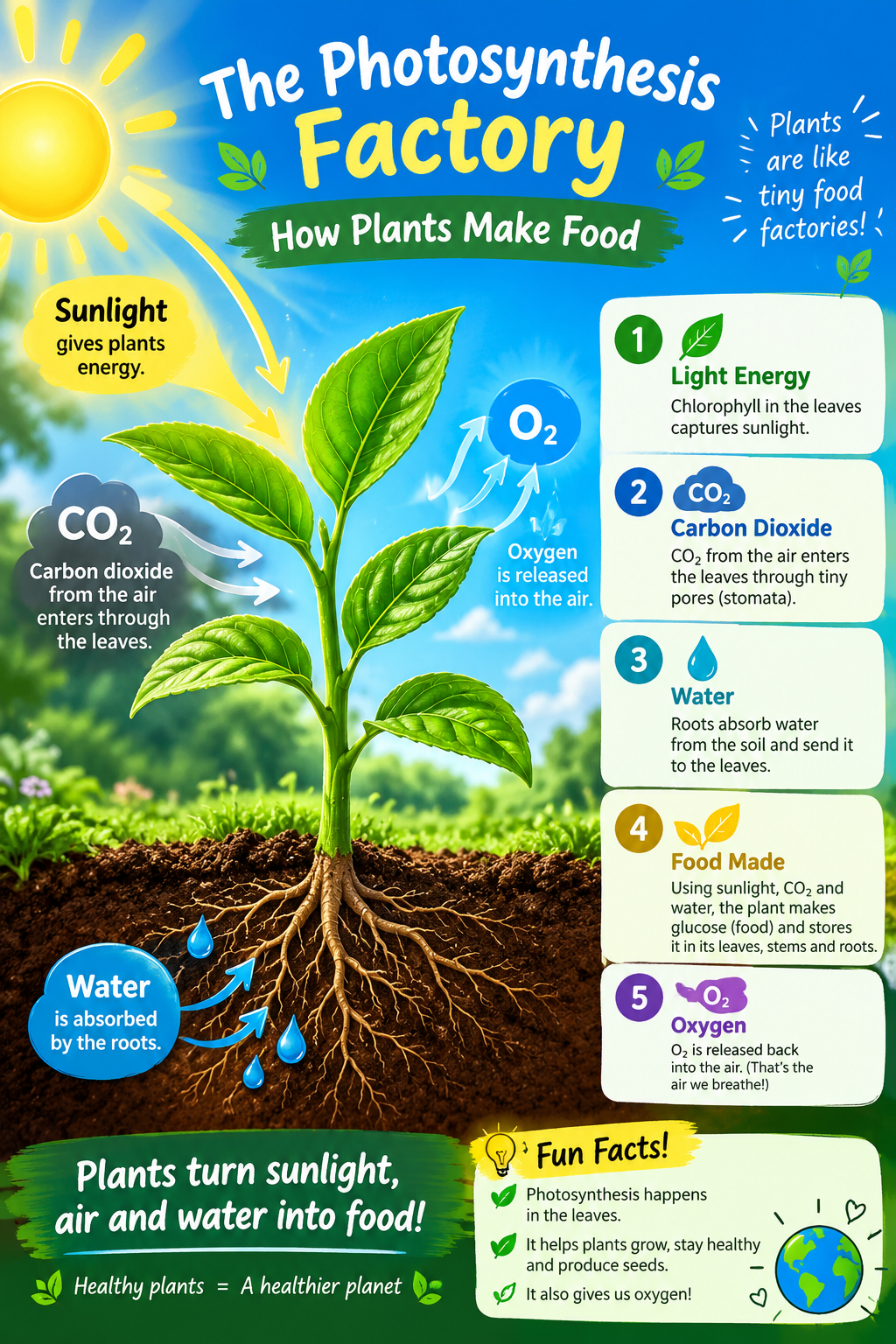
    **The Photosynthesis Factory: How Plants Make Food **

    Welcome to the amazing world of plants! Have you ever wondered how plants make their own food without going to a kitchen or a grocery store? The answer is **PHOTOSYNTHESIS!**

    Imagine every green plant as a tiny natural food factory! The leaves work like solar-powered machines, using sunlight , water , and carbon dioxide (COβ‚‚) from the air to produce glucose, a type of sugar that provides energy for the plant. During this amazing process, plants also release oxygen (Oβ‚‚) into the air, which humans and many other living things need to breathe!

    **How Does the Photosynthesis Factory Work?**

    **Step 1: Sunlight — The Power Source!**
    Sunlight provides the energy plants need to make their food.

    **Step 2: Water — The Essential Ingredient!**
    Plants absorb water from the soil through their roots.

    **Step 3: Carbon Dioxide — From the Air!**
    Plants take in carbon dioxide through tiny openings in their leaves called stomata.

    **Step 4: Chlorophyll — The Green Magic!**
    Chlorophyll is the green pigment in leaves that absorbs light energy.

    **Step 5: Making Food!**
    Using light energy, plants turn water and carbon dioxide into glucose, which they use for energy and growth. They also release oxygen!

    **Why Is Photosynthesis Important?**

    Plants provide food for people and animals.
    They release oxygen that supports life on Earth.
    They help remove carbon dioxide from the atmosphere.
    They support food chains and healthy ecosystems.
    They help keep our planet green, beautiful, and full of life!

    Isn't nature incredible? Every green leaf is part of a wonderful living factory that helps support life on Earth. The next time you see a tree, a flower, or a little green plant, remember the amazing science happening inside its leaves!

    **Today's Science Fact:** Photosynthesis shows us how plants use sunlight to make their own food and help sustain life on our planet!

    **Protect plants, grow more trees, save nature, and keep our planet green!** Every plant matters!

    Like , Share , and Comment : What is your favorite plant, and why do you love it?

    #Photosynthesis #PhotosynthesisFactory #HowPlantsMakeFood #PlantScience #ScienceForKids #LearnScience #Biology #NatureLovers #GreenPlanet #PlantLife #ScienceEducation #AmazingNature #SaveTrees #ProtectNature #EnvironmentalAwareness #STEMEducation #EducationalPost #DiscoverScience #GreenEarth #KeepLearning
    #rsisb Roll no. 247 Story post . 25 Foundation level 🌿🏭 **The Photosynthesis Factory: How Plants Make Food πŸŒ±β˜€οΈ** πŸŒπŸ’š Welcome to the amazing world of plants! Have you ever wondered how plants make their own food without going to a kitchen or a grocery store? πŸ€”πŸŒΏ The answer is **PHOTOSYNTHESIS!** πŸŒžπŸƒ 🏭🌱 Imagine every green plant as a tiny natural food factory! The leaves work like solar-powered machines, using sunlight β˜€οΈ, water πŸ’§, and carbon dioxide (COβ‚‚) from the air 🌬️ to produce glucose, a type of sugar that provides energy for the plant. During this amazing process, plants also release oxygen (Oβ‚‚) into the air, which humans and many other living things need to breathe! πŸŒŽπŸ’š πŸ”¬πŸƒ **How Does the Photosynthesis Factory Work?** β˜€οΈ **Step 1: Sunlight — The Power Source!** Sunlight provides the energy plants need to make their food. 🌞⚑ πŸ’§ **Step 2: Water — The Essential Ingredient!** Plants absorb water from the soil through their roots. πŸŒ±πŸ’¦ 🌬️ **Step 3: Carbon Dioxide — From the Air!** Plants take in carbon dioxide through tiny openings in their leaves called stomata. πŸƒπŸ”¬ πŸ’š **Step 4: Chlorophyll — The Green Magic!** Chlorophyll is the green pigment in leaves that absorbs light energy. 🌿✨ 🍬 **Step 5: Making Food!** Using light energy, plants turn water and carbon dioxide into glucose, which they use for energy and growth. They also release oxygen! πŸŒ±πŸ¬πŸ’¨ πŸŒŽπŸ’š **Why Is Photosynthesis Important?** 🌳 Plants provide food for people and animals. πŸ’¨ They release oxygen that supports life on Earth. 🌍 They help remove carbon dioxide from the atmosphere. 🍎 They support food chains and healthy ecosystems. 🌿 They help keep our planet green, beautiful, and full of life! 🀩🌱 Isn't nature incredible? Every green leaf is part of a wonderful living factory that helps support life on Earth. The next time you see a tree, a flower, or a little green plant, remember the amazing science happening inside its leaves! πŸŒ³πŸ”¬β˜€οΈ πŸ’‘ **Today's Science Fact:** Photosynthesis shows us how plants use sunlight to make their own food and help sustain life on our planet! πŸŒ±πŸ’š **Protect plants, grow more trees, save nature, and keep our planet green!** 🌍🌳 Every plant matters! πŸ“’ Like πŸ‘, Share πŸ”„, and Comment πŸ’¬: What is your favorite plant, and why do you love it? 🌻🌡🌹 #Photosynthesis #PhotosynthesisFactory #HowPlantsMakeFood #PlantScience #ScienceForKids #LearnScience #Biology #NatureLovers #GreenPlanet #PlantLife #ScienceEducation #AmazingNature #SaveTrees #ProtectNature #EnvironmentalAwareness #STEMEducation #EducationalPost #DiscoverScience #GreenEarth #KeepLearning πŸŒΏπŸŒπŸ”¬β˜€οΈπŸ’š
    0 Comments 0 Shares 397 Views
  • #rsisb
    Roll no. 247
    Story post . 24
    Foundation level

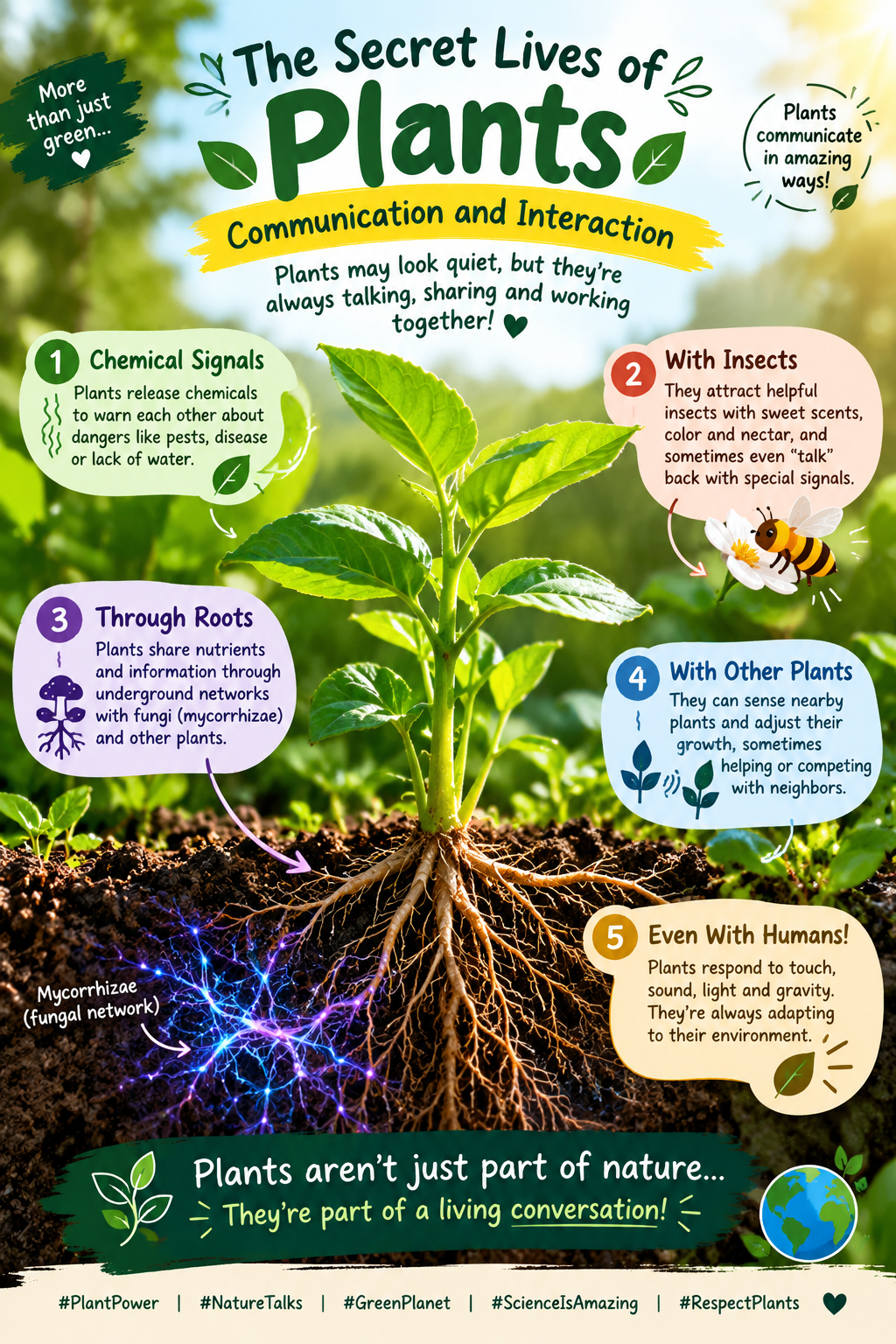
    **The Secret Lives of Plants: Communication and Interaction **

    Have you ever wondered if plants can communicate with each other? The world of plants is full of amazing secrets, hidden connections, and fascinating interactions! Although plants cannot speak like humans, they have incredible ways of responding to their surroundings and interacting with other living things.

    **How Do Plants Communicate?**

    Plants use different methods to exchange information with their environment. Some plants release chemical signals into the air when they are damaged by insects, which can help nearby plants prepare their own defenses. Plants can also send chemical signals through their roots and interact with helpful fungi living in the soil. These underground relationships help plants access nutrients and water, showing us how connected nature really is!

    **Plants and Their Amazing Partners**

    Plants have special relationships with insects, birds, animals, and microorganisms. Bees and butterflies visit flowers to collect nectar and pollen while helping plants reproduce through pollination. Birds and animals spread seeds to new places, allowing more plants to grow. Beneath the ground, roots, fungi, and tiny soil organisms work together to support healthy ecosystems. Every living thing has an important role in maintaining the balance of nature!

    **How Plants Respond to Their Environment**

    Plants may not walk from one place to another, but they can respond to sunlight, gravity, touch, temperature, and water. Sunflowers and many other plants show movements related to light, while roots generally grow toward sources of water and respond to gravity. Some plants even close their leaves when touched! These wonderful abilities help plants survive, grow, and adapt to changing conditions.

    **Why Should We Protect Plants?**

    Plants provide oxygen, food, shelter, and habitats for countless living organisms. They help maintain healthy soil, absorb carbon dioxide, and support biodiversity. By planting trees, growing flowers, protecting forests, saving water, and avoiding unnecessary damage to plants, we can help protect our beautiful planet. Even small actions can make a positive difference!

    **Let's Explore the Wonders of Nature!**

    Through *“The Secret Lives of Plants: Communication and Interaction,”* we discover that nature is much more connected than we might imagine. Plants are not simply decorations in our surroundings; they are living organisms that respond to their environment and participate in complex relationships with other species.

    Let’s keep asking questions, exploring science, observing nature, and learning something new every day! The more we understand plants, the more we appreciate the incredible world around us.

    **Question for Everyone:** Did you know that plants can respond to chemical signals and interact with fungi underground? Share your thoughts in the comments!

    Like, share, and comment to spread awareness about the amazing secret lives of plants!

    **Protect Nature. Respect Life. Keep Exploring!**

    #TheSecretLivesOfPlants #PlantCommunication #PlantScience #NatureLovers #AmazingPlants #ScienceEducation #PlantInteractions #NatureIsAmazing #EnvironmentalAwareness #Biodiversity #Ecosystems #PlantLife #GreenPlanet #SaveNature #ProtectOurPlanet #Biology #LearnSomethingNew #ScienceForEveryone #EducationalPost #StoryPost #PlantsAndNature #SustainableLiving #ExploreNature #RehanSchool #LearningWithAI
    #rsisb Roll no. 247 Story post . 24 Foundation level 🌿🌱 **The Secret Lives of Plants: Communication and Interaction 🌻🌳** 🌍✨ Have you ever wondered if plants can communicate with each other? πŸ€”πŸŒΏ The world of plants is full of amazing secrets, hidden connections, and fascinating interactions! πŸŒ±πŸ’š Although plants cannot speak like humans, they have incredible ways of responding to their surroundings and interacting with other living things. πŸŒ»πŸ¦‹ πŸŒ³πŸ’¬ **How Do Plants Communicate?** Plants use different methods to exchange information with their environment. 🌿🌬️ Some plants release chemical signals into the air when they are damaged by insects, which can help nearby plants prepare their own defenses. πŸ›πŸƒ Plants can also send chemical signals through their roots and interact with helpful fungi living in the soil. πŸ„πŸŒ± These underground relationships help plants access nutrients and water, showing us how connected nature really is! 🌍🀝 🌻🐝 **Plants and Their Amazing Partners** Plants have special relationships with insects, birds, animals, and microorganisms. πŸ¦‹πŸ Bees and butterflies visit flowers to collect nectar and pollen while helping plants reproduce through pollination. 🌺🐝 Birds and animals spread seeds to new places, allowing more plants to grow. 🐦🌳 Beneath the ground, roots, fungi, and tiny soil organisms work together to support healthy ecosystems. πŸ„πŸŒΏ Every living thing has an important role in maintaining the balance of nature! πŸ’šπŸŒŽ πŸŒžπŸ’§ **How Plants Respond to Their Environment** Plants may not walk from one place to another, but they can respond to sunlight, gravity, touch, temperature, and water. β˜€οΈπŸŒ± Sunflowers and many other plants show movements related to light, while roots generally grow toward sources of water and respond to gravity. πŸŒ»πŸ’¦ Some plants even close their leaves when touched! πŸŒΏπŸ‘ These wonderful abilities help plants survive, grow, and adapt to changing conditions. πŸŒŽπŸ’š **Why Should We Protect Plants?** Plants provide oxygen, food, shelter, and habitats for countless living organisms. 🌳🌍 They help maintain healthy soil, absorb carbon dioxide, and support biodiversity. 🐝🌼 By planting trees, growing flowers, protecting forests, saving water, and avoiding unnecessary damage to plants, we can help protect our beautiful planet. πŸŒ±β™»οΈ Even small actions can make a positive difference! πŸ”¬πŸ“š **Let's Explore the Wonders of Nature!** Through *“The Secret Lives of Plants: Communication and Interaction,”* we discover that nature is much more connected than we might imagine. 🌿✨ Plants are not simply decorations in our surroundings; they are living organisms that respond to their environment and participate in complex relationships with other species. πŸŒ³πŸ’š Let’s keep asking questions, exploring science, observing nature, and learning something new every day! πŸ”πŸŒ± The more we understand plants, the more we appreciate the incredible world around us. πŸŒπŸ’« πŸ’¬ **Question for Everyone:** Did you know that plants can respond to chemical signals and interact with fungi underground? πŸ„πŸŒ± Share your thoughts in the comments! πŸ‘‡πŸ˜Š ❀️ Like, πŸ”„ share, and πŸ’¬ comment to spread awareness about the amazing secret lives of plants! 🌿 **Protect Nature. Respect Life. Keep Exploring!** πŸŒŽπŸ’š #TheSecretLivesOfPlants #PlantCommunication #PlantScience #NatureLovers #AmazingPlants #ScienceEducation #PlantInteractions #NatureIsAmazing #EnvironmentalAwareness #Biodiversity #Ecosystems #PlantLife #GreenPlanet #SaveNature #ProtectOurPlanet #Biology #LearnSomethingNew #ScienceForEveryone #EducationalPost #StoryPost #PlantsAndNature #SustainableLiving #ExploreNature #RehanSchool #LearningWithAI πŸŒΏπŸŒ»πŸŒŽβœ¨πŸ’š
    0 Comments 0 Shares 637 Views
  • RSIF8
    Roll No:92
    Short Documentary No:6
    Topic:# Documentary — The Secret Lives of Plants: Communication and Interaction

    In this documentary, I explored the fascinating world of plants and discovered how they communicate and interact with their surroundings. Plants may seem silent, but they have amazing ways of responding to light, water, touch, and changes in their environment. Some plants release chemical signals to warn nearby plants about danger, while others work together with fungi and insects to survive and grow.

    This documentary helped me understand that plants are more active and intelligent in their responses than we often imagine. It also showed me why protecting plants and trees is important for our planet and all living things.

    **Moral:** Nature is full of wonders, and even the quietest living things have amazing stories to tell.

    #SecretLivesOfPlants #PlantCommunication #NatureDocumentary #ScienceAndNature #Environment #PlantLife #LearningThroughDocumentaries
    RSIF8 Roll No:92 Short Documentary No:6 Topic:# Documentary — The Secret Lives of Plants: Communication and Interaction 🌿 In this documentary, I explored the fascinating world of plants and discovered how they communicate and interact with their surroundings. Plants may seem silent, but they have amazing ways of responding to light, water, touch, and changes in their environment. Some plants release chemical signals to warn nearby plants about danger, while others work together with fungi and insects to survive and grow. This documentary helped me understand that plants are more active and intelligent in their responses than we often imagine. It also showed me why protecting plants and trees is important for our planet and all living things. **Moral:** Nature is full of wonders, and even the quietest living things have amazing stories to tell. #SecretLivesOfPlants #PlantCommunication #NatureDocumentary #ScienceAndNature #Environment #PlantLife #LearningThroughDocumentaries
    0 Comments 0 Shares 264 Views 3
  • RSIF8
    Roll no 94
    Story post no 15
    Story post topic
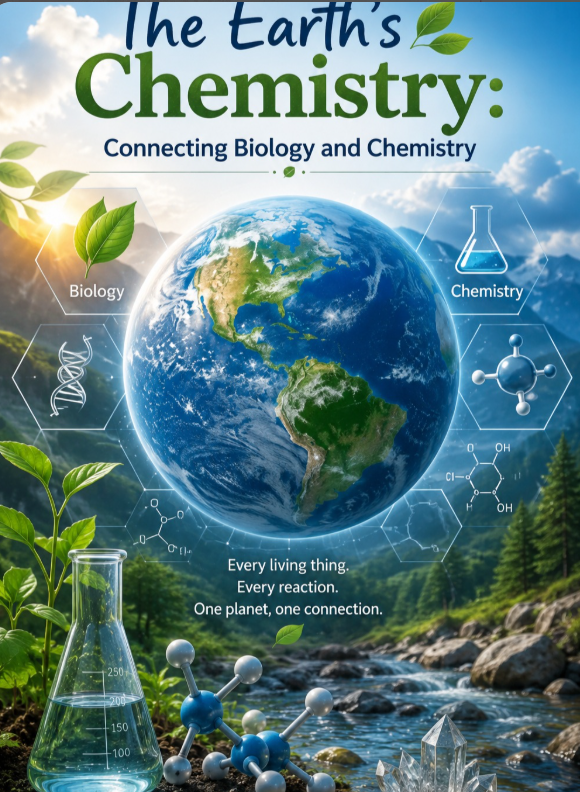
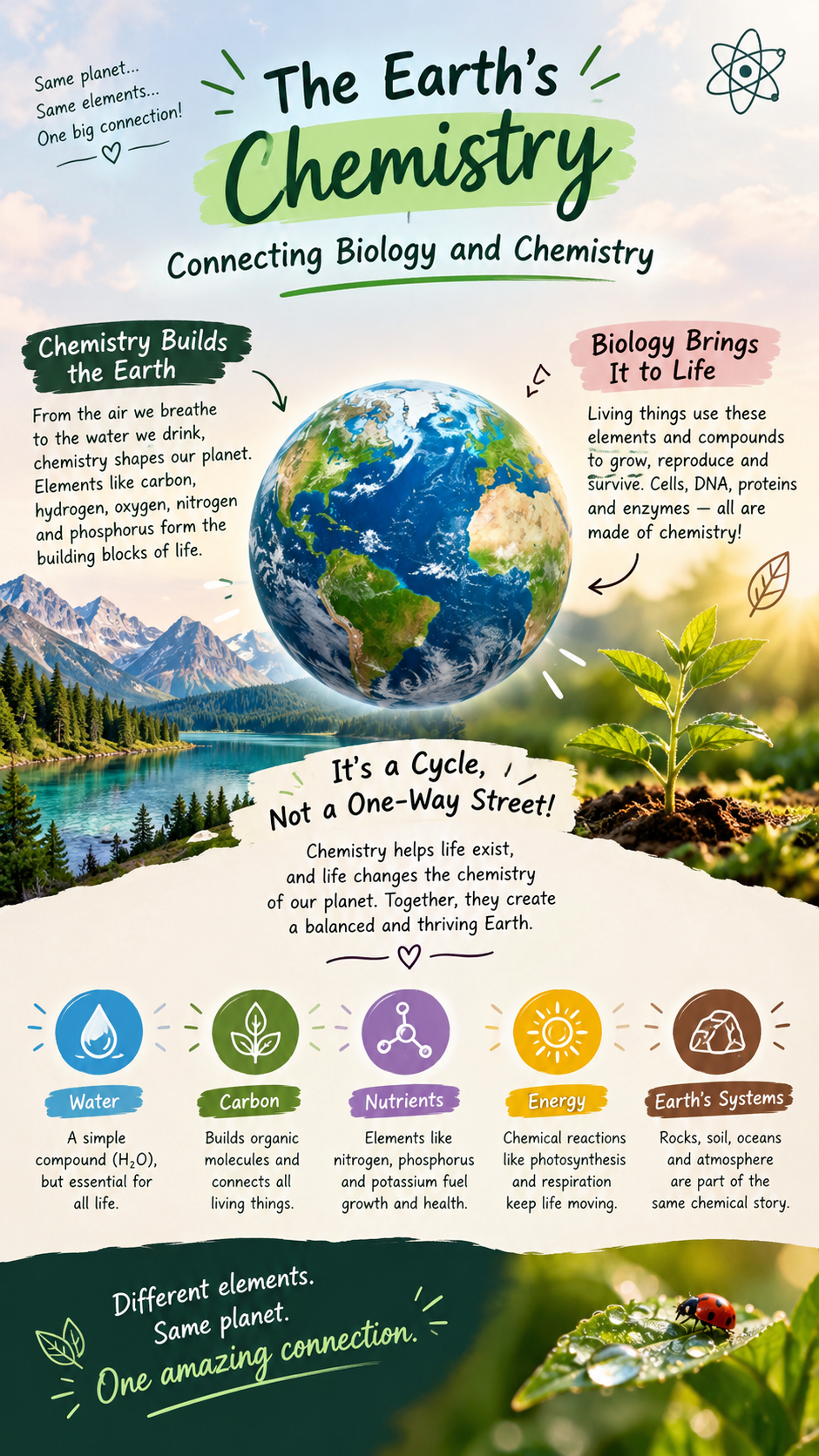
    The Earth's Chemistry: Connecting Biology and Chemistry
    Today I explored the amazing connection between Biology and Chemistry and discovered how these two sciences work together to explain life on Earth. Every living organism, from the smallest cell to the largest tree, depends on chemical reactions to survive and grow.
    Chemistry helps us understand how nutrients are absorbed, how plants perform photosynthesis, and how our bodies produce energy. Biology shows us how these chemical processes create and sustain life. Together, they reveal the incredible systems that keep our planet healthy and balanced.
    Learning about Earth's chemistry reminds us that everything in nature is connected. The air we breathe, the water we drink, the food we eat, and the ecosystems around us all depend on important chemical and biological interactions.
    By studying these connections, scientists can develop new medicines, protect the environment, improve agriculture, and find solutions to global challenges. The more we learn about science, the more we appreciate the beauty and complexity of our world.
    Let's continue exploring, learning, and protecting our planet for future generations!
    #EarthsChemistry #BiologyAndChemistry #ScienceEducation #STEM #EnvironmentalScience #LifeScience #Chemistry #Biology #ScienceLovers #LearningJourney #NatureAndScience #ScientificDiscovery #EarthScience #FutureScientists #Innovation #Education #ExploreScience #KnowledgeIsPower #PlanetEarth #ScienceForEveryone
    RSIF8 Roll no 94 Story post no 15 Story post topic 🌍πŸ§ͺ The Earth's Chemistry: Connecting Biology and Chemistry πŸŒ±πŸ”¬ Today I explored the amazing connection between Biology and Chemistry and discovered how these two sciences work together to explain life on Earth. 🌎✨ Every living organism, from the smallest cell to the largest tree, depends on chemical reactions to survive and grow. 🌿🧬 Chemistry helps us understand how nutrients are absorbed, how plants perform photosynthesis, and how our bodies produce energy. ⚑🌱 Biology shows us how these chemical processes create and sustain life. Together, they reveal the incredible systems that keep our planet healthy and balanced. πŸŒπŸ’š Learning about Earth's chemistry reminds us that everything in nature is connected. The air we breathe, the water we drink, the food we eat, and the ecosystems around us all depend on important chemical and biological interactions. πŸ’§πŸŒ³β˜€οΈ By studying these connections, scientists can develop new medicines, protect the environment, improve agriculture, and find solutions to global challenges. πŸ”¬πŸŒΎπŸ’Š The more we learn about science, the more we appreciate the beauty and complexity of our world. 🌎✨ Let's continue exploring, learning, and protecting our planet for future generations! πŸŒπŸ’™πŸŒ± #EarthsChemistry #BiologyAndChemistry #ScienceEducation #STEM #EnvironmentalScience #LifeScience #Chemistry #Biology #ScienceLovers #LearningJourney #NatureAndScience #ScientificDiscovery #EarthScience #FutureScientists #Innovation #Education #ExploreScience #KnowledgeIsPower #PlanetEarth #ScienceForEveryone 🌍πŸ§ͺπŸŒΏπŸ”¬πŸ’š
    0 Comments 0 Shares 593 Views
  • RSIF8
    Task NO:41

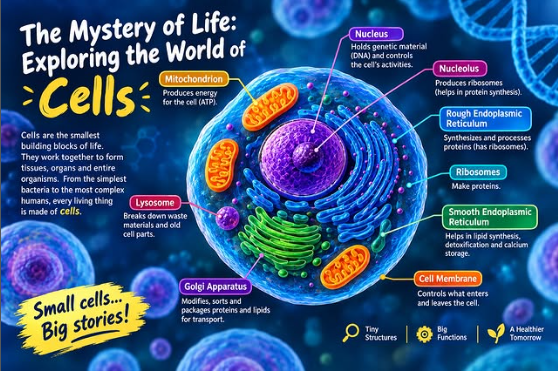
    The Mystery of Life: Exploring the World of Cells

    Cells are the fundamental building blocks of life, and understanding them helps us understand how living organisms grow, function, develop, and survive. From tiny microorganisms to plants, animals, and humans, every living organism is made up of cells. Although cells are incredibly small, they contain many fascinating structures that work together like a well-organized system.

    In this learning task, I explored the amazing world of cells and learned about different cell organelles and their important functions. The nucleus contains genetic material and helps control the activities of the cell, while the nucleolus plays an important role in producing ribosomes. The mitochondria are responsible for producing energy that the cell needs to perform its activities. I also learned about the rough and smooth endoplasmic reticulum, which are involved in processes such as protein production, lipid synthesis, and other cellular functions.

    Another interesting part of the cell is the Golgi apparatus, which modifies, sorts, and packages proteins and other materials for transport. Ribosomes help make proteins, while lysosomes help break down waste materials and unwanted cell components. The cell membrane surrounds the cell and controls what enters and leaves it. Learning about these structures made me realize that even the smallest parts of life have specific jobs and work together to keep the cell functioning properly.

    This topic also helped me understand how complex life can exist at a microscopic level. A cell may look tiny and simple from the outside, but inside it is a busy world filled with structures, chemical reactions, energy production, information, and continuous activity. Studying cells gives us a foundation for learning more advanced topics such as genetics, DNA, human biology, diseases, medicine, and biotechnology.

    Through this task, I improved my knowledge of biology and developed a greater appreciation for the incredible organization found in living things. It also reminded me that science is all about asking questions, exploring mysteries, observing carefully, and discovering
    RSIF8 Task NO:41 πŸ”¬πŸ§¬ The Mystery of Life: Exploring the World of Cells πŸ§¬πŸ”¬ Cells are the fundamental building blocks of life, and understanding them helps us understand how living organisms grow, function, develop, and survive. From tiny microorganisms to plants, animals, and humans, every living organism is made up of cells. Although cells are incredibly small, they contain many fascinating structures that work together like a well-organized system. In this learning task, I explored the amazing world of cells and learned about different cell organelles and their important functions. The nucleus contains genetic material and helps control the activities of the cell, while the nucleolus plays an important role in producing ribosomes. The mitochondria are responsible for producing energy that the cell needs to perform its activities. I also learned about the rough and smooth endoplasmic reticulum, which are involved in processes such as protein production, lipid synthesis, and other cellular functions. Another interesting part of the cell is the Golgi apparatus, which modifies, sorts, and packages proteins and other materials for transport. Ribosomes help make proteins, while lysosomes help break down waste materials and unwanted cell components. The cell membrane surrounds the cell and controls what enters and leaves it. Learning about these structures made me realize that even the smallest parts of life have specific jobs and work together to keep the cell functioning properly. This topic also helped me understand how complex life can exist at a microscopic level. A cell may look tiny and simple from the outside, but inside it is a busy world filled with structures, chemical reactions, energy production, information, and continuous activity. Studying cells gives us a foundation for learning more advanced topics such as genetics, DNA, human biology, diseases, medicine, and biotechnology. Through this task, I improved my knowledge of biology and developed a greater appreciation for the incredible organization found in living things. It also reminded me that science is all about asking questions, exploring mysteries, observing carefully, and discovering
    0 Comments 0 Shares 512 Views
  • RSIF8
    Roll no:09
    Story post no: 14
    Story post topic: "The Earth's Chemistry: Connecting Biology and Chemistry".
    **The Earth's Chemistry: Connecting Biology and Chemistry**

    Did you know that chemistry and biology work together to make life on Earth possible?

    From the water we drink and the air we breathe to the plants that grow and the food we eat , chemistry is everywhere! Biology shows us how living organisms use these elements and compounds to grow, survive, and thrive.

    **Chemistry builds the foundation. Biology brings it to life!** Together, they help maintain the beautiful balance of our planet.

    Different elements. Same planet. One amazing connection!

    #EarthScience #Chemistry #Biology #ScienceAndNature #EnvironmentalScience #LifeOnEarth #ScienceEducation #LearnEveryDay #NatureLovers #STEM
    RSIF8 Roll no:09 Story post no: 14 Story post topic: "The Earth's Chemistry: Connecting Biology and Chemistry". 🌍πŸ§ͺ **The Earth's Chemistry: Connecting Biology and Chemistry** πŸŒ±πŸ”¬ Did you know that chemistry and biology work together to make life on Earth possible? πŸ’šβœ¨ From the water we drink πŸ’§ and the air we breathe 🌬️ to the plants that grow 🌿 and the food we eat 🍎, chemistry is everywhere! Biology shows us how living organisms use these elements and compounds to grow, survive, and thrive. πŸŒŽπŸ’« 🌱 **Chemistry builds the foundation. Biology brings it to life!** Together, they help maintain the beautiful balance of our planet. πŸ’šπŸŒ ✨ Different elements. Same planet. One amazing connection! ✨ #EarthScience #Chemistry #Biology #ScienceAndNature #EnvironmentalScience #LifeOnEarth #ScienceEducation #LearnEveryDay #NatureLovers #STEM 🌍πŸ§ͺπŸŒ±πŸ’š
    0 Comments 0 Shares 344 Views
  • RSIF8
    ROLL NO 77
    SHOURT DOCUMENTARY TOPIC he Photosynthesis Factory: How Plants Make Food

    **The Photosynthesis Factory: How Plants Make Food**

    Have you ever wondered how plants make their own food?
    In this amazing journey, discover how plants use **sunlight , water , and carbon dioxide ** to produce food through the incredible process of **photosynthesis**.

    From tiny chloroplasts to the oxygen we breathe, photosynthesis is one of nature’s most amazing processes!

    Watch the video and discover the fascinating science happening inside every green leaf!

    #Photosynthesis #PlantScience #Biology #Science #Plants #Nature #Education #ScienceFacts #Learning #EducationalContent #AI #Knowledge #KeepLearning
    RSIF8 ROLL NO 77 SHOURT DOCUMENTARY TOPIC he Photosynthesis Factory: How Plants Make Food πŸŒ±β˜€οΈ **The Photosynthesis Factory: How Plants Make Food** πŸƒ Have you ever wondered how plants make their own food? πŸ€”πŸŒΏ In this amazing journey, discover how plants use **sunlight β˜€οΈ, water πŸ’§, and carbon dioxide 🌬️** to produce food through the incredible process of **photosynthesis**. 🌱✨ From tiny chloroplasts to the oxygen we breathe, photosynthesis is one of nature’s most amazing processes! πŸŒπŸ’š πŸŽ₯ Watch the video and discover the fascinating science happening inside every green leaf! πŸ”¬πŸŒΏ #Photosynthesis #PlantScience #Biology #Science #Plants #Nature #Education #ScienceFacts #Learning #EducationalContent #AI #Knowledge #KeepLearning πŸŒ±πŸ”¬πŸŒβœ¨
    0 Comments 0 Shares 340 Views 6
  • #rsisb
    Roll no. 247
    Story post . 18
    Foundation level

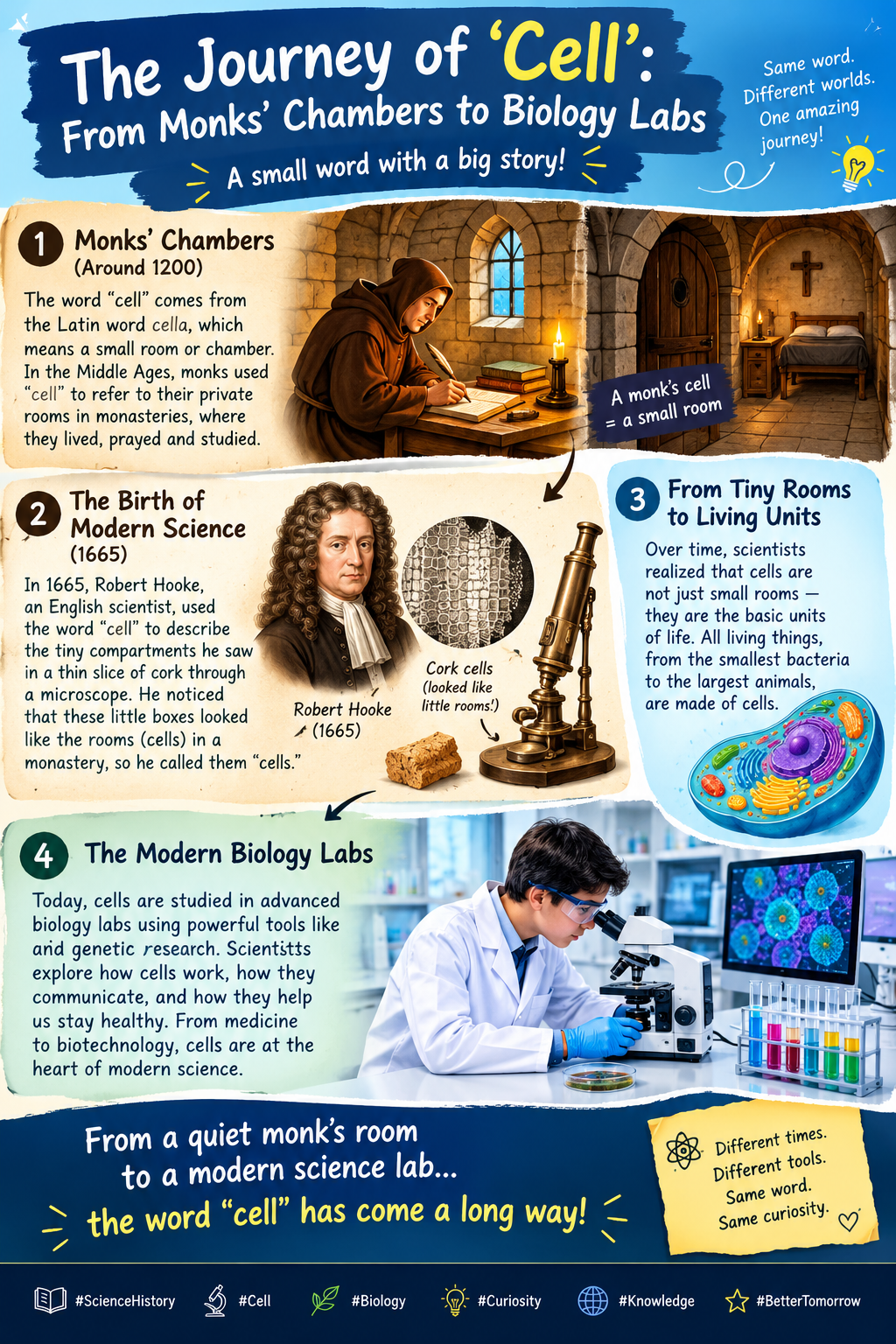
    **The Journey of “Cell”: From Monks’ Chambers to Biology Labs **

    **Have you ever wondered why the tiny building blocks of life are called “cells”?** The story behind this important scientific word takes us on a fascinating journey from the quiet chambers of monks to modern biology laboratories!

    The word **“cell”** comes from the Latin word *cella*, which means a small room or chamber. In the past, monks lived and prayed in small rooms called cells. These simple rooms inspired a name that would later become one of the most important words in biology! ‍

    In 1665, an English scientist named **Robert Hooke** made an important discovery. While examining a thin slice of cork under a microscope, he noticed many tiny, box-like compartments. They reminded him of the small rooms where monks lived, so he called them **“cells.”** This observation was published in his famous book *Micrographia*.

    But the story did not end there! Years later, scientists developed better microscopes and discovered that cells were not just empty compartments. They were the basic units of living things!

    ‍‍ Scientists such as **Antonie van Leeuwenhoek** observed living microscopic organisms, while other researchers helped build our understanding of cells. Over time, scientists developed the **cell theory**, which explains that all living organisms are made of one or more cells and that new cells come from existing cells.

    Today, cells are studied in laboratories all around the world. Scientists explore how cells grow, obtain energy, communicate, reproduce, and help our bodies function. From the cells in plants to the cells in humans , these tiny structures play an enormous role in life!

    **What makes this journey so amazing?** A word that once described a small room became the name for the fundamental unit of life. It reminds us that even the smallest observation can lead to a huge scientific discovery!

    **Learning Message:** Stay curious, keep asking questions, and never underestimate the power of observation. Every great discovery begins with someone noticing something others might overlook!

    **Question for You:** If you could look at any object under a powerful microscope, what would you choose to explore? Share your answer in the comments!

    Like, share, and comment to spread the love of science and learning! Let's inspire more young scientists to explore the amazing world around us.

    #rsisb Roll no. 247 Story post . 18 Foundation level πŸ”¬πŸ“š **The Journey of “Cell”: From Monks’ Chambers to Biology Labs 🧫✨** πŸŒπŸ€” **Have you ever wondered why the tiny building blocks of life are called “cells”?** The story behind this important scientific word takes us on a fascinating journey from the quiet chambers of monks to modern biology laboratories! πŸ›οΈβž‘οΈπŸ”¬ πŸ“–βœ¨ The word **“cell”** comes from the Latin word *cella*, which means a small room or chamber. In the past, monks lived and prayed in small rooms called cells. These simple rooms inspired a name that would later become one of the most important words in biology! πŸ§‘‍πŸ«πŸ›οΈ πŸ”πŸ§ͺ In 1665, an English scientist named **Robert Hooke** made an important discovery. While examining a thin slice of cork under a microscope, he noticed many tiny, box-like compartments. They reminded him of the small rooms where monks lived, so he called them **“cells.”** πŸ§«πŸ”¬ This observation was published in his famous book *Micrographia*. πŸŒŸπŸ”¬ But the story did not end there! Years later, scientists developed better microscopes and discovered that cells were not just empty compartments. They were the basic units of living things! 🦠🌱 πŸ‘¨‍πŸ”¬πŸ‘©‍πŸ”¬ Scientists such as **Antonie van Leeuwenhoek** observed living microscopic organisms, while other researchers helped build our understanding of cells. Over time, scientists developed the **cell theory**, which explains that all living organisms are made of one or more cells and that new cells come from existing cells. πŸ§¬πŸ’‘ 🌿🐾 Today, cells are studied in laboratories all around the world. Scientists explore how cells grow, obtain energy, communicate, reproduce, and help our bodies function. From the cells in plants 🌱 to the cells in humans 🧍, these tiny structures play an enormous role in life! πŸš€πŸ’­ **What makes this journey so amazing?** A word that once described a small room became the name for the fundamental unit of life. It reminds us that even the smallest observation can lead to a huge scientific discovery! πŸŽ―πŸ“š **Learning Message:** Stay curious, keep asking questions, and never underestimate the power of observation. Every great discovery begins with someone noticing something others might overlook! πŸŒˆπŸ” πŸ’¬ **Question for You:** If you could look at any object under a powerful microscope, what would you choose to explore? πŸ”¬πŸ€” Share your answer in the comments! β€οΈπŸ‘ Like, share, and comment to spread the love of science and learning! Let's inspire more young scientists to explore the amazing world around us. 🌍πŸ§ͺ✨
    0 Comments 0 Shares 331 Views
More Results