



#rsisb
Roll no. 247
Story post . 18
Foundation level
**The Journey of “Cell”: From Monks’ Chambers to Biology Labs **
**Have you ever wondered why the tiny building blocks of life are called “cells”?** The story behind this important scientific word takes us on a fascinating journey from the quiet chambers of monks to modern biology laboratories!
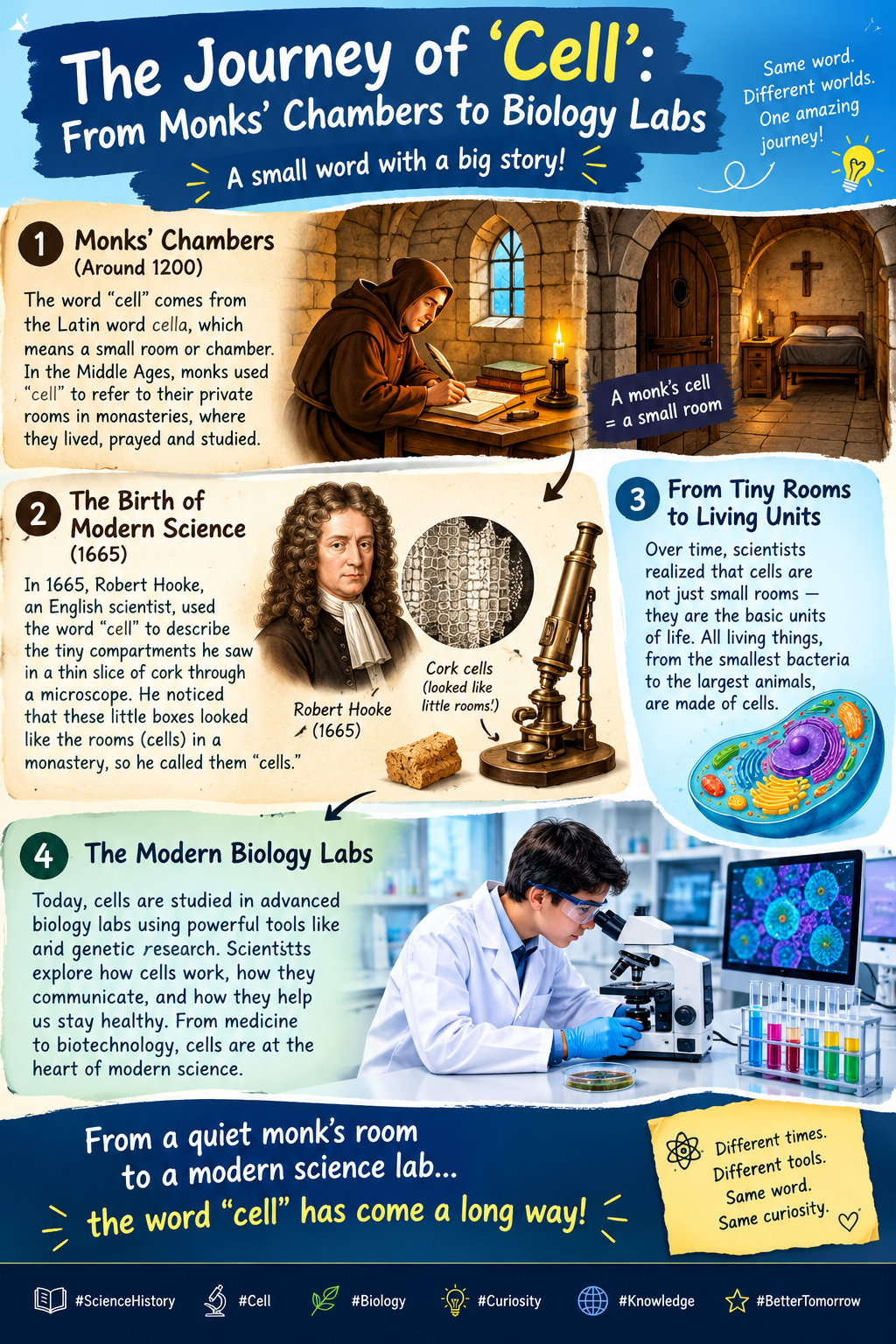
The word **“cell”** comes from the Latin word *cella*, which means a small room or chamber. In the past, monks lived and prayed in small rooms called cells. These simple rooms inspired a name that would later become one of the most important words in biology!
In 1665, an English scientist named **Robert Hooke** made an important discovery. While examining a thin slice of cork under a microscope, he noticed many tiny, box-like compartments. They reminded him of the small rooms where monks lived, so he called them **“cells.”** This observation was published in his famous book *Micrographia*.
But the story did not end there! Years later, scientists developed better microscopes and discovered that cells were not just empty compartments. They were the basic units of living things!
Scientists such as **Antonie van Leeuwenhoek** observed living microscopic organisms, while other researchers helped build our understanding of cells. Over time, scientists developed the **cell theory**, which explains that all living organisms are made of one or more cells and that new cells come from existing cells.
Today, cells are studied in laboratories all around the world. Scientists explore how cells grow, obtain energy, communicate, reproduce, and help our bodies function. From the cells in plants to the cells in humans , these tiny structures play an enormous role in life!
**What makes this journey so amazing?** A word that once described a small room became the name for the fundamental unit of life. It reminds us that even the smallest observation can lead to a huge scientific discovery!
**Learning Message:** Stay curious, keep asking questions, and never underestimate the power of observation. Every great discovery begins with someone noticing something others might overlook!
**Question for You:** If you could look at any object under a powerful microscope, what would you choose to explore? Share your answer in the comments!
Like, share, and comment to spread the love of science and learning! Let's inspire more young scientists to explore the amazing world around us.
#JourneyOfCell #HistoryOfScience #RobertHooke #CellDiscovery #CellTheory #Biology #ScienceEducation #Microscope #ScientificDiscoveries #LearningIsFun #YoungScientists #ExploreAndDiscover #ScienceForEveryone #BiologyFacts #KnowledgeIsPower #Curiosity #STEMEducation #RehanSchool #RSISB #RehanCodingWithAI
Roll no. 247
Story post . 18
Foundation level
**The Journey of “Cell”: From Monks’ Chambers to Biology Labs **
**Have you ever wondered why the tiny building blocks of life are called “cells”?** The story behind this important scientific word takes us on a fascinating journey from the quiet chambers of monks to modern biology laboratories!
The word **“cell”** comes from the Latin word *cella*, which means a small room or chamber. In the past, monks lived and prayed in small rooms called cells. These simple rooms inspired a name that would later become one of the most important words in biology!
In 1665, an English scientist named **Robert Hooke** made an important discovery. While examining a thin slice of cork under a microscope, he noticed many tiny, box-like compartments. They reminded him of the small rooms where monks lived, so he called them **“cells.”** This observation was published in his famous book *Micrographia*.
But the story did not end there! Years later, scientists developed better microscopes and discovered that cells were not just empty compartments. They were the basic units of living things!
Scientists such as **Antonie van Leeuwenhoek** observed living microscopic organisms, while other researchers helped build our understanding of cells. Over time, scientists developed the **cell theory**, which explains that all living organisms are made of one or more cells and that new cells come from existing cells.
Today, cells are studied in laboratories all around the world. Scientists explore how cells grow, obtain energy, communicate, reproduce, and help our bodies function. From the cells in plants to the cells in humans , these tiny structures play an enormous role in life!
**What makes this journey so amazing?** A word that once described a small room became the name for the fundamental unit of life. It reminds us that even the smallest observation can lead to a huge scientific discovery!
**Learning Message:** Stay curious, keep asking questions, and never underestimate the power of observation. Every great discovery begins with someone noticing something others might overlook!
**Question for You:** If you could look at any object under a powerful microscope, what would you choose to explore? Share your answer in the comments!
Like, share, and comment to spread the love of science and learning! Let's inspire more young scientists to explore the amazing world around us.
#JourneyOfCell #HistoryOfScience #RobertHooke #CellDiscovery #CellTheory #Biology #ScienceEducation #Microscope #ScientificDiscoveries #LearningIsFun #YoungScientists #ExploreAndDiscover #ScienceForEveryone #BiologyFacts #KnowledgeIsPower #Curiosity #STEMEducation #RehanSchool #RSISB #RehanCodingWithAI
#rsisb
Roll no. 247
Story post . 18
Foundation level
🔬📚 **The Journey of “Cell”: From Monks’ Chambers to Biology Labs 🧫✨**
🌍🤔 **Have you ever wondered why the tiny building blocks of life are called “cells”?** The story behind this important scientific word takes us on a fascinating journey from the quiet chambers of monks to modern biology laboratories! 🏛️➡️🔬
📖✨ The word **“cell”** comes from the Latin word *cella*, which means a small room or chamber. In the past, monks lived and prayed in small rooms called cells. These simple rooms inspired a name that would later become one of the most important words in biology! 🧑🏫🏛️
🔍🧪 In 1665, an English scientist named **Robert Hooke** made an important discovery. While examining a thin slice of cork under a microscope, he noticed many tiny, box-like compartments. They reminded him of the small rooms where monks lived, so he called them **“cells.”** 🧫🔬 This observation was published in his famous book *Micrographia*.
🌟🔬 But the story did not end there! Years later, scientists developed better microscopes and discovered that cells were not just empty compartments. They were the basic units of living things! 🦠🌱
👨🔬👩🔬 Scientists such as **Antonie van Leeuwenhoek** observed living microscopic organisms, while other researchers helped build our understanding of cells. Over time, scientists developed the **cell theory**, which explains that all living organisms are made of one or more cells and that new cells come from existing cells. 🧬💡
🌿🐾 Today, cells are studied in laboratories all around the world. Scientists explore how cells grow, obtain energy, communicate, reproduce, and help our bodies function. From the cells in plants 🌱 to the cells in humans 🧍, these tiny structures play an enormous role in life!
🚀💭 **What makes this journey so amazing?** A word that once described a small room became the name for the fundamental unit of life. It reminds us that even the smallest observation can lead to a huge scientific discovery!
🎯📚 **Learning Message:** Stay curious, keep asking questions, and never underestimate the power of observation. Every great discovery begins with someone noticing something others might overlook! 🌈🔍
💬 **Question for You:** If you could look at any object under a powerful microscope, what would you choose to explore? 🔬🤔 Share your answer in the comments!
❤️👍 Like, share, and comment to spread the love of science and learning! Let's inspire more young scientists to explore the amazing world around us. 🌍🧪✨
#JourneyOfCell #HistoryOfScience #RobertHooke #CellDiscovery #CellTheory #Biology #ScienceEducation #Microscope #ScientificDiscoveries #LearningIsFun #YoungScientists #ExploreAndDiscover #ScienceForEveryone #BiologyFacts #KnowledgeIsPower #Curiosity #STEMEducation #RehanSchool #RSISB #RehanCodingWithAI 📚🔬🌱✨
0 Kommentare
0 Anteile
70 Ansichten