• RSIf8
    Roll Number: 49
    Story post no.33
    Story post topic:Chemistry Quest — Elements of Everyday Life

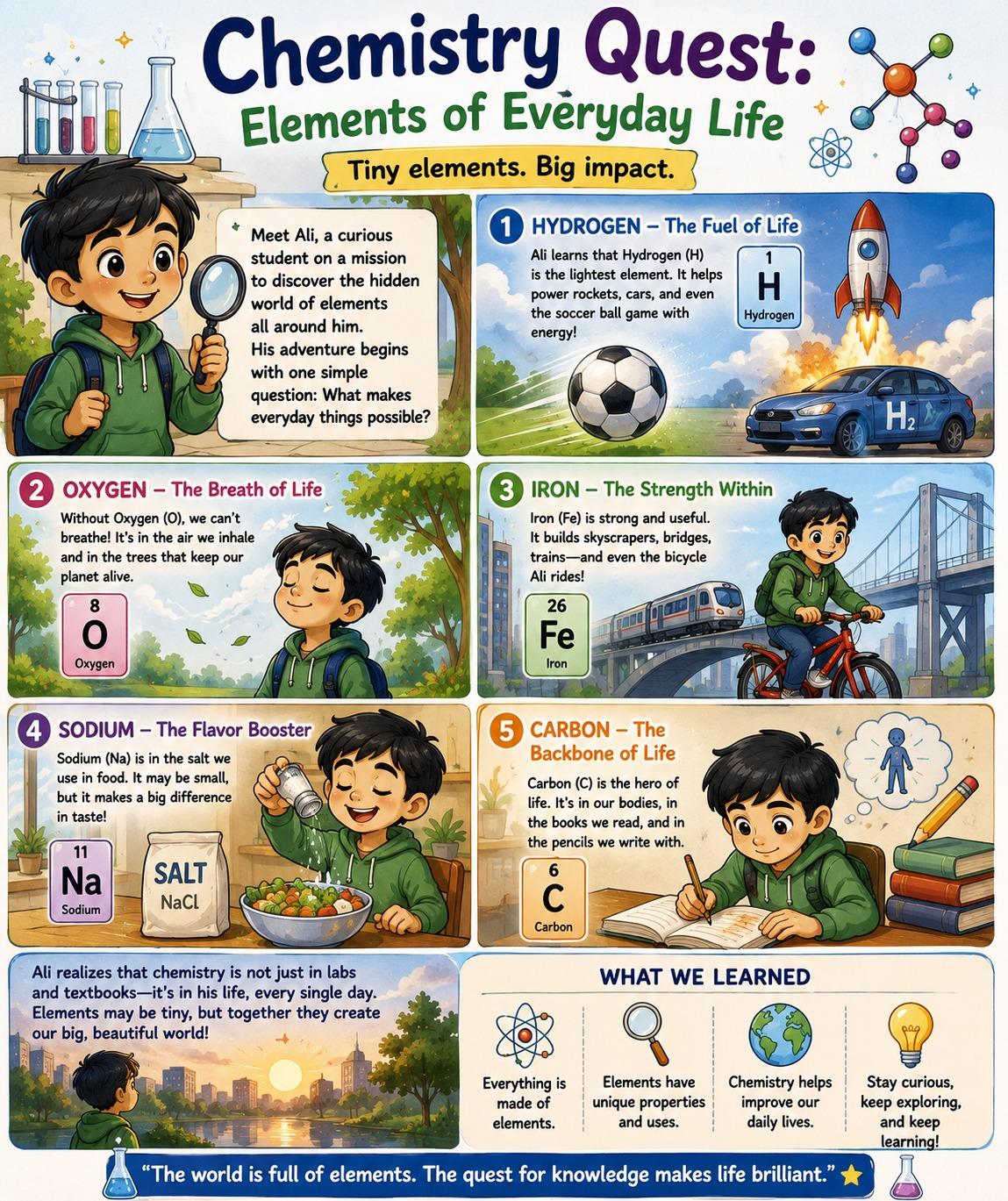
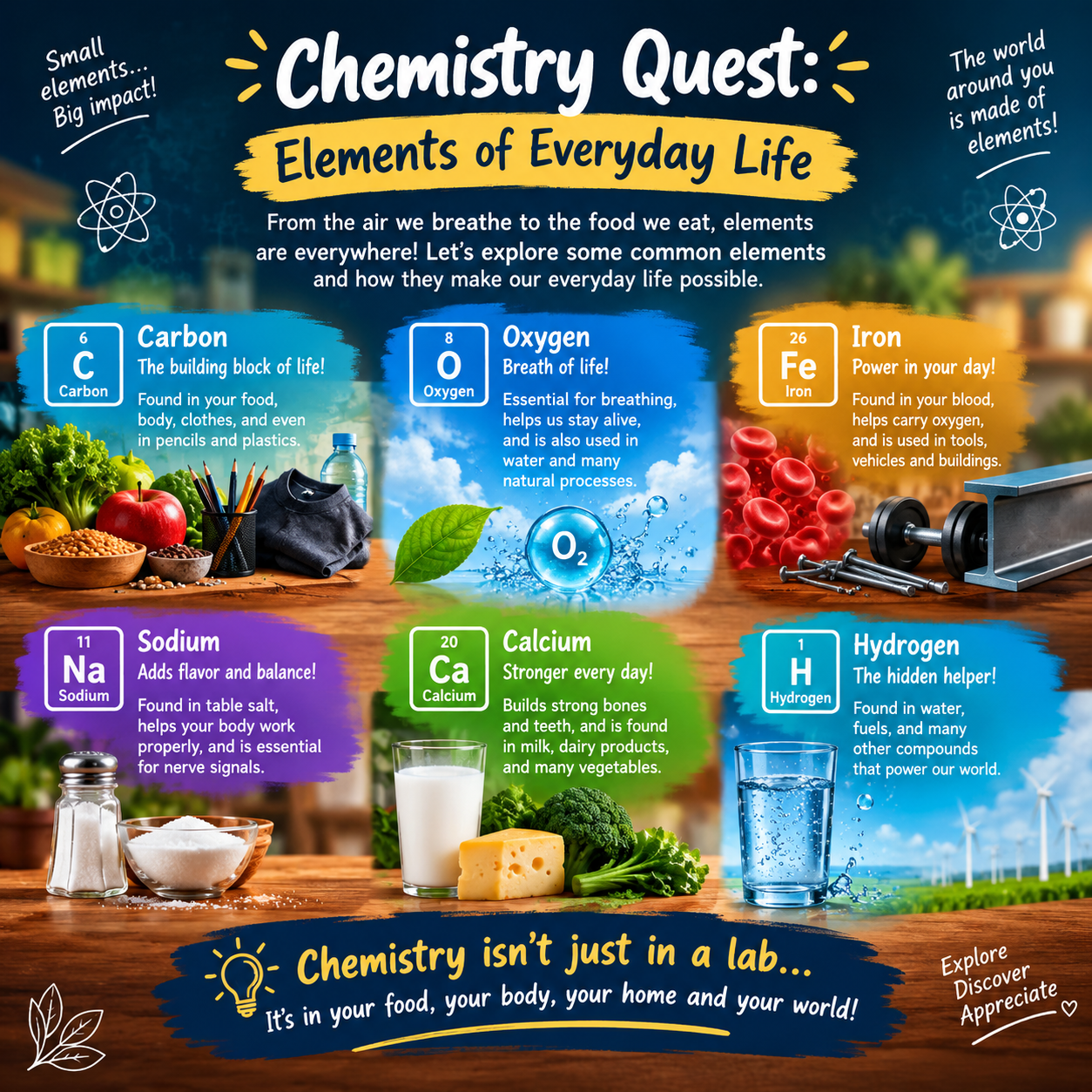
    Have you ever wondered how chemistry makes our everyday lives possible? From the air we breathe to the food we eat, chemical elements are all around us! This exciting story post explores the fascinating role of elements such as Carbon, Oxygen, Iron, Sodium, Calcium, and Hydrogen in our daily lives.

    Through this creative learning journey, I discovered how carbon is found in living things, oxygen is essential for breathing, iron helps our bodies carry oxygen, sodium supports important body functions, calcium strengthens our bones and teeth, and hydrogen is a key component of water.

    This activity helped me understand that chemistry is not limited to laboratories; it is an important part of our bodies, homes, nature, and the world around us. Learning about these elements makes science more interesting and helps us appreciate the wonders of everyday life!

    Small elements, big impact! Let's explore, discover, and appreciate the chemistry all around us.

    #ChemistryQuest #ElementsOfEverydayLife #Chemistry #ScienceEducation #ChemicalElements #Carbon #Oxygen #Iron #Sodium #Calcium #Hydrogen #CreativeLearning #ClassFoundation #RSf8
    RSIf8 Roll Number: 49 Story post no.33 Story post topic:Chemistry Quest — Elements of Everyday Life ⚗️✨ Have you ever wondered how chemistry makes our everyday lives possible? From the air we breathe to the food we eat, chemical elements are all around us! 🌿💧 This exciting story post explores the fascinating role of elements such as Carbon, Oxygen, Iron, Sodium, Calcium, and Hydrogen in our daily lives. Through this creative learning journey, I discovered how carbon is found in living things, oxygen is essential for breathing, iron helps our bodies carry oxygen, sodium supports important body functions, calcium strengthens our bones and teeth, and hydrogen is a key component of water. 🔬🧬 This activity helped me understand that chemistry is not limited to laboratories; it is an important part of our bodies, homes, nature, and the world around us. Learning about these elements makes science more interesting and helps us appreciate the wonders of everyday life! 💡📚 Small elements, big impact! Let's explore, discover, and appreciate the chemistry all around us. 🚀🌱 #ChemistryQuest #ElementsOfEverydayLife #Chemistry #ScienceEducation #ChemicalElements #Carbon #Oxygen #Iron #Sodium #Calcium #Hydrogen #CreativeLearning #ClassFoundation #RSf8
    0 Комментарии 0 Поделились 19 Просмотры
  • ### Roll No: 2

    ### Batch 1

    ### Task 66:

    ### Book: Accl

    ** The Story of Elements: From Carbon to Gold **

    Today’s task is to create an educational and creative **song titled “The Story of Elements: From Carbon to Gold.”** The song takes listeners on a fascinating journey through the world of chemical elements, exploring how different elements form the foundation of everything around us. From the simplicity of carbon to the precious nature of gold, each element has its own unique properties, story, and importance in science. The song aims to make chemistry more interesting by combining scientific knowledge with creativity, rhythm, and imagination. It encourages learners to discover the amazing world of elements and understand how chemistry connects with the universe, nature, technology, and everyday life.

    #Batch1 #Task66 #TheStoryOfElements #CarbonToGold #Chemistry #ScienceSong #ChemicalElements #PeriodicTable #Science #Education #Learning #CreativeLearning #Accl #DailyTask
    ### 👤 Roll No: 2 ### 📚 Batch 1 ### 🎵 Task 66: ### 📖 Book: Accl **🎶🧪 The Story of Elements: From Carbon to Gold 🌟⚛️** Today’s task is to create an educational and creative **song titled “The Story of Elements: From Carbon to Gold.”** 🎵✨ The song takes listeners on a fascinating journey through the world of chemical elements, exploring how different elements form the foundation of everything around us. 🌍🔬 From the simplicity of carbon to the precious nature of gold, each element has its own unique properties, story, and importance in science. ⚛️💛 The song aims to make chemistry more interesting by combining scientific knowledge with creativity, rhythm, and imagination. 🎶📚 It encourages learners to discover the amazing world of elements and understand how chemistry connects with the universe, nature, technology, and everyday life. 🚀🧪✨ #Batch1 #Task66 #TheStoryOfElements #CarbonToGold #Chemistry #ScienceSong #ChemicalElements #PeriodicTable #Science #Education #Learning #CreativeLearning #Accl #DailyTask
    0 Комментарии 0 Поделились 2124 Просмотры 3
  • RSIF8
    Roll No 13
    Story post No 10
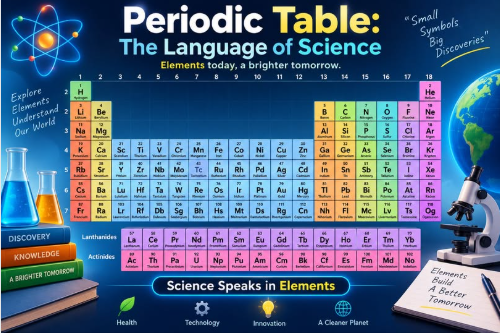
    Story post Topic **Periodic Table: The Language of Science**

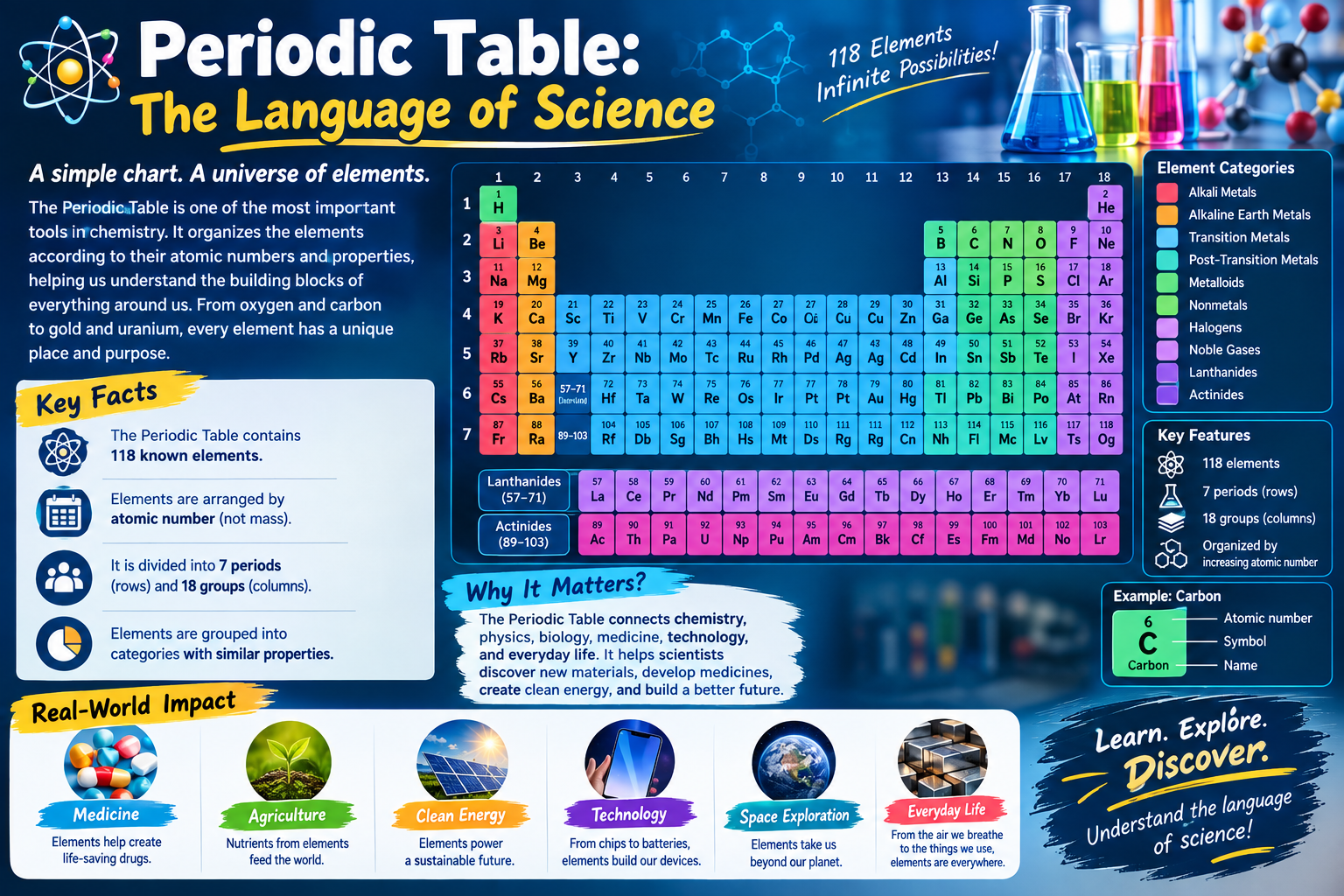
    The Periodic Table is one of the most important tools in chemistry. It organizes the elements according to their atomic numbers and properties, helping us understand the building blocks of everything around us. From oxygen and carbon to gold and uranium, every element has a unique place and purpose.

    In this educational journey, explore the **118 known elements**, their symbols, atomic numbers, groups, periods, and major categories. Discover how the Periodic Table connects chemistry, physics, biology, medicine, technology, and everyday life.

    Learn how elements combine to form molecules, materials, medicines, and countless technologies that shape our modern world.

    **Learn. Explore. Discover. Understand the language of science!**

    #PeriodicTable #Chemistry #Science #Elements #ChemicalElements #ScienceEducation #ChemistryLovers #STEM #Education #Learning #ScienceFacts #AtomicStructure #PeriodicTableOfElements
    RSIF8 Roll No 13 Story post No 10 Story post Topic 🧪 **Periodic Table: The Language of Science** 🌍🔬 The Periodic Table is one of the most important tools in chemistry. It organizes the elements according to their atomic numbers and properties, helping us understand the building blocks of everything around us. From oxygen and carbon to gold and uranium, every element has a unique place and purpose. In this educational journey, explore the **118 known elements**, their symbols, atomic numbers, groups, periods, and major categories. Discover how the Periodic Table connects chemistry, physics, biology, medicine, technology, and everyday life. ✨ Learn how elements combine to form molecules, materials, medicines, and countless technologies that shape our modern world. 📚 **Learn. Explore. Discover. Understand the language of science!** #PeriodicTable #Chemistry #Science #Elements #ChemicalElements #ScienceEducation #ChemistryLovers #STEM #Education #Learning #ScienceFacts #AtomicStructure #PeriodicTableOfElements
    0 Комментарии 0 Поделились 1999 Просмотры
  • RSIF8
    Roll no:14
    story post:9
    story topic:Periodic Table: The Language of Science
    # Periodic Table: The Language of Science
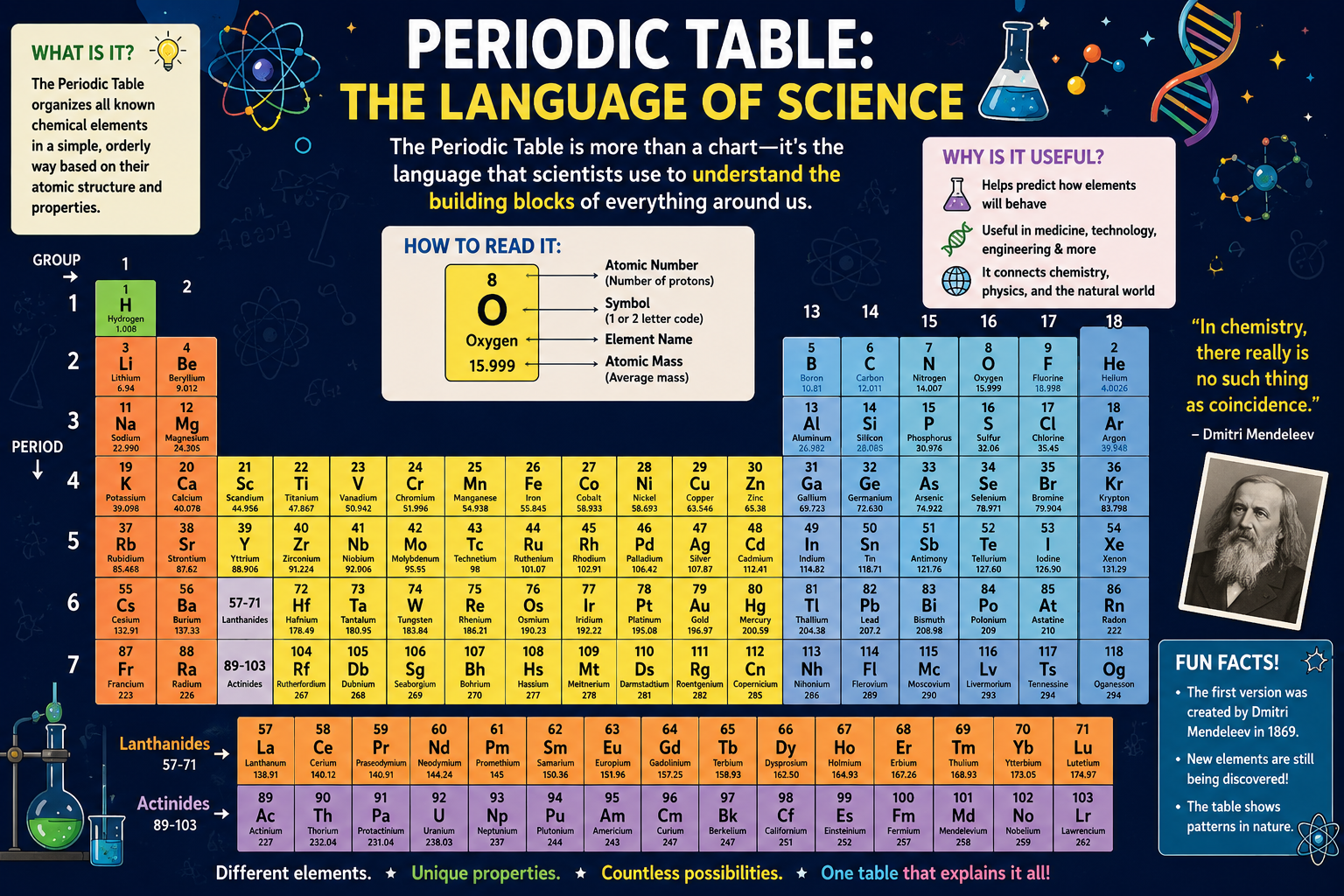
    I successfully completed my **Foundation Level task** on the topic **“Periodic Table: The Language of Science.”**
    The Periodic Table is one of the most important tools in the world of **chemistry and science**. It organizes all known chemical elements in a clear and systematic way according to their **atomic numbers, properties, and electron arrangements**.
    During this task, I explored different **groups and periods** of the Periodic Table and learned about various types of elements, including **metals, non-metals, metalloids, noble gases, alkali metals, and halogens**. I also learned about important elements such as **Hydrogen, Oxygen, Carbon, Iron, Gold, Silver, and many others**.
    This activity helped me understand how scientists use the Periodic Table to **identify elements, compare their properties, predict their behavior, and understand chemical reactions**. It also showed me how elements are connected to our everyday lives, from the air we breathe and the water we drink to technology , medicine , energy , and many other areas.
    **What I Learned:**
    How the Periodic Table is organized
    The meaning of atomic numbers and element symbols
    Difference between groups and periods
    Types and properties of different elements
    Importance of elements in daily life
    How the Periodic Table helps scientists understand chemistry
    This task increased my interest in **science and chemistry** and helped me understand that the Periodic Table is more than just a chart—it is truly a **language that scientists use to understand the building blocks of our world.**
    I am happy to have completed this task successfully and gained valuable knowledge that will help me in my future learning and scientific studies.
    ### Science Speaks in Elements!
    ### Learn • Explore • Discover • Create
    #PeriodicTable #LanguageOfScience #Chemistry #Science #ChemicalElements #FoundationLevel #Learning #Education #ScienceEducation #ChemistryLearning #AtomicNumber #Elements #STEM #ScienceProject #StudentLearning #ExploreScience #LearnChemistry #ScientificDiscovery #FutureScientist #EducationMatters #KnowledgeIsPower #LearnAndGrow #ScienceIsFun #FoundationTask See less
    RSIF8 Roll no:14 story post:9 story topic:Periodic Table: The Language of Science # 🧪🔬 Periodic Table: The Language of Science 🌍⚛️ I successfully completed my **Foundation Level task** on the topic **“Periodic Table: The Language of Science.”** 🎓✨ The Periodic Table is one of the most important tools in the world of **chemistry and science**. 🧪🔬 It organizes all known chemical elements in a clear and systematic way according to their **atomic numbers, properties, and electron arrangements**. ⚛️📚 During this task, I explored different **groups and periods** of the Periodic Table and learned about various types of elements, including **metals, non-metals, metalloids, noble gases, alkali metals, and halogens**. 🔍🧬 I also learned about important elements such as **Hydrogen, Oxygen, Carbon, Iron, Gold, Silver, and many others**. 🌟 This activity helped me understand how scientists use the Periodic Table to **identify elements, compare their properties, predict their behavior, and understand chemical reactions**. 🧠⚗️ It also showed me how elements are connected to our everyday lives, from the air we breathe 🌬️ and the water we drink 💧 to technology 📱, medicine 💊, energy ⚡, and many other areas. 🌟 **What I Learned:** ✅ How the Periodic Table is organized 📊 ✅ The meaning of atomic numbers and element symbols ⚛️ ✅ Difference between groups and periods 🔢 ✅ Types and properties of different elements 🧪 ✅ Importance of elements in daily life 🌍 ✅ How the Periodic Table helps scientists understand chemistry 🔬 💡 This task increased my interest in **science and chemistry** and helped me understand that the Periodic Table is more than just a chart—it is truly a **language that scientists use to understand the building blocks of our world.** 🌎⚛️ I am happy to have completed this task successfully and gained valuable knowledge that will help me in my future learning and scientific studies. 🎓🚀✨ ### 🌟 Science Speaks in Elements! 🧪⚛️ ### 🔬 Learn • Explore • Discover • Create 🌍💡 #PeriodicTable #LanguageOfScience #Chemistry #Science #ChemicalElements #FoundationLevel #Learning #Education #ScienceEducation #ChemistryLearning #AtomicNumber #Elements #STEM #ScienceProject #StudentLearning #ExploreScience #LearnChemistry #ScientificDiscovery #FutureScientist #EducationMatters #KnowledgeIsPower #LearnAndGrow #ScienceIsFun #FoundationTask 🧪🔬⚛️🌍📚✨ See less
    0 Комментарии 0 Поделились 3156 Просмотры
  • #rsisb
    Roll no.239
    Image with Chat gpt no.11
    Foundation Level


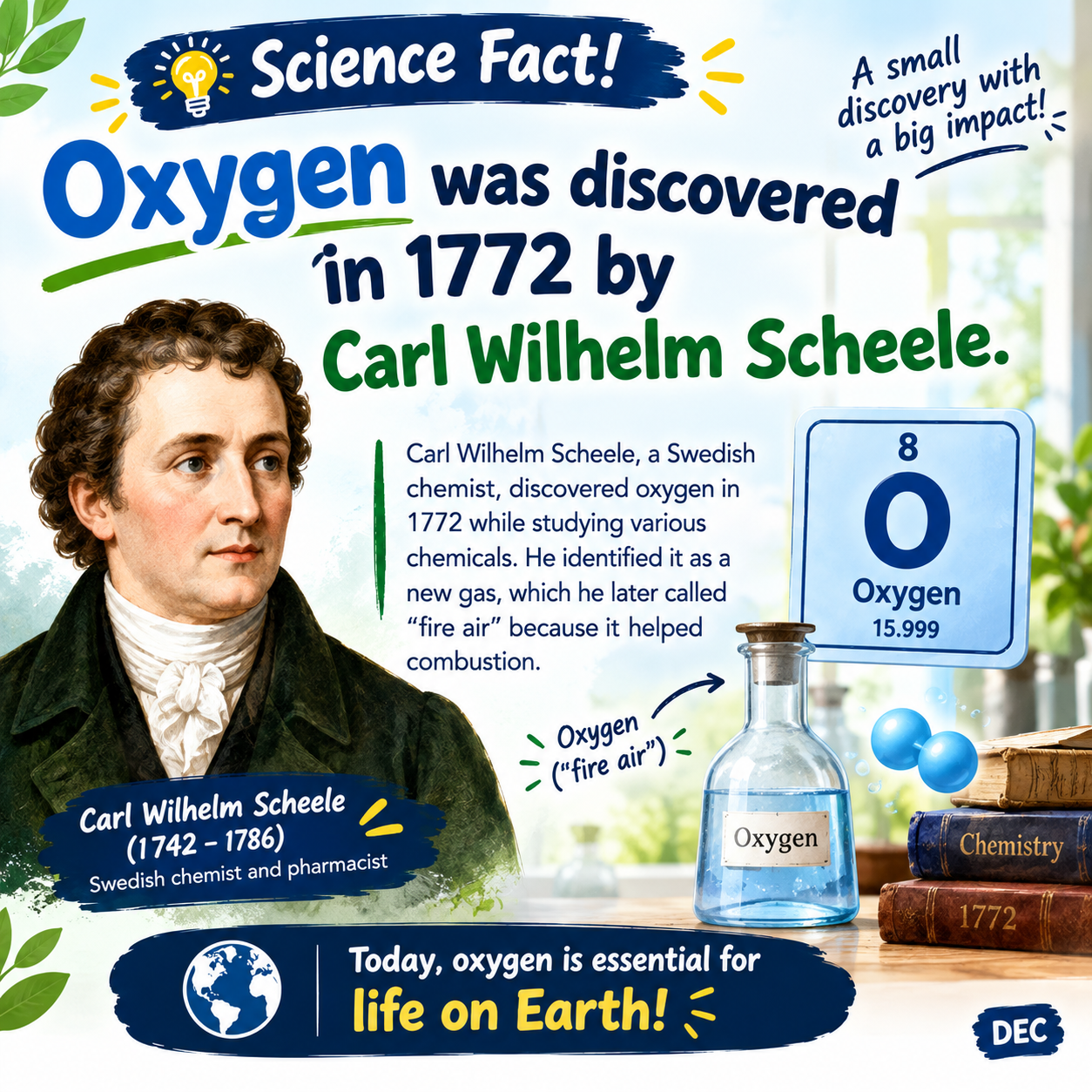
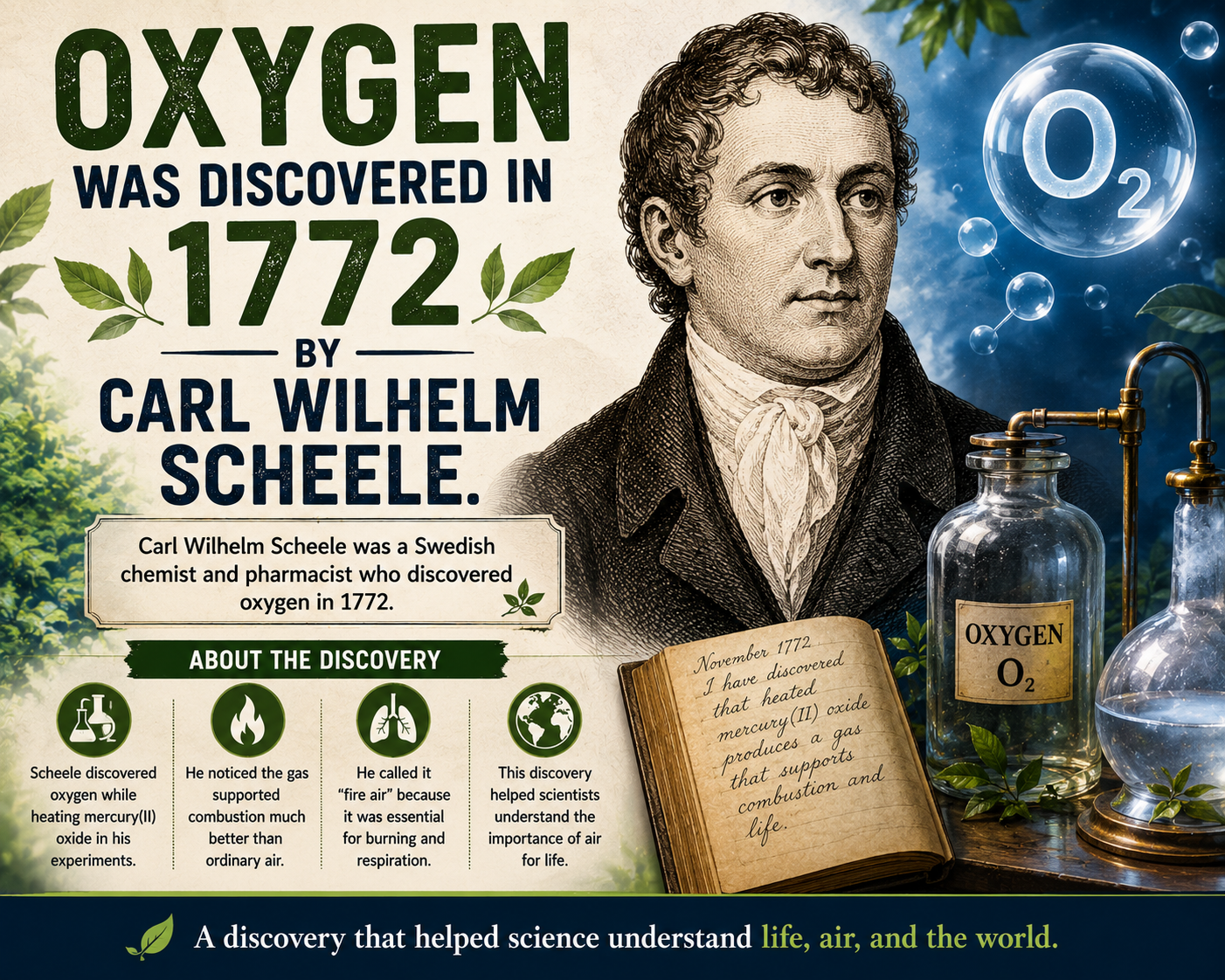
    In around **1772**, Swedish chemist and pharmacist **Carl Wilhelm Scheele** produced and studied a gas that we now know as **oxygen**. He called it **“fire air”** because he observed that it strongly supported combustion.

    Scheele’s experiments helped reveal that the air around us was not simply one single substance. Instead, it contained different gases with different properties. His work became an important part of the development of modern chemistry.

    **Who was Carl Wilhelm Scheele?**
    Carl Wilhelm Scheele (1742–1786) was a Swedish chemist and pharmacist known for his experimental work with many substances. He investigated gases, minerals, acids, and other chemicals and made several important observations during his scientific career.

    **Why is oxygen so important?**
    Oxygen is essential for most forms of life on Earth. Humans and many other organisms use oxygen during **cellular respiration**, a process that helps cells release energy from food. Oxygen also plays an important role in combustion and many chemical reactions.

    **A fascinating part of the story:**
    The history of oxygen’s discovery involved more than one scientist. Scheele investigated oxygen around **1772**, while **Joseph Priestley** independently produced and studied the gas in **1774**. Later, **Antoine Lavoisier** helped establish oxygen’s role in combustion and respiration and gave the element its name.

    **Quick facts:**
    Element: **Oxygen**
    Chemical symbol: **O**
    Atomic number: **8**
    Scheele’s work: **around 1772**
    Scheele’s name for it: **“Fire air”**
    Oxygen is essential for life and many natural and chemical processes.

    From a laboratory experiment centuries ago to our understanding of the atmosphere today, the discovery of oxygen shows how scientific knowledge develops through **careful observation, experimentation, and the work of multiple scientists**.

    **Science is full of discoveries that changed the way we understand our world!**

    **Learn. Explore. Question. Discover.**

    #ScienceFact #Oxygen #CarlWilhelmScheele #Chemistry #ScienceHistory #ChemistryFacts #DidYouKnow #ScienceEducation #LearnScience #PhysicsAndChemistry #Biology #STEM #ScientificDiscovery #HistoryOfScience #ChemicalElements #OxygenDiscovery #Education #Knowledge #FunScience #DEC
    #rsisb Roll no.239 Image with Chat gpt no.11 Foundation Level In around **1772**, Swedish chemist and pharmacist **Carl Wilhelm Scheele** produced and studied a gas that we now know as **oxygen**. He called it **“fire air”** because he observed that it strongly supported combustion. 🔥 Scheele’s experiments helped reveal that the air around us was not simply one single substance. Instead, it contained different gases with different properties. His work became an important part of the development of modern chemistry. 🧪📚 🔎 **Who was Carl Wilhelm Scheele?** Carl Wilhelm Scheele (1742–1786) was a Swedish chemist and pharmacist known for his experimental work with many substances. He investigated gases, minerals, acids, and other chemicals and made several important observations during his scientific career. 🌬️ **Why is oxygen so important?** Oxygen is essential for most forms of life on Earth. Humans and many other organisms use oxygen during **cellular respiration**, a process that helps cells release energy from food. Oxygen also plays an important role in combustion and many chemical reactions. 📖 **A fascinating part of the story:** The history of oxygen’s discovery involved more than one scientist. Scheele investigated oxygen around **1772**, while **Joseph Priestley** independently produced and studied the gas in **1774**. Later, **Antoine Lavoisier** helped establish oxygen’s role in combustion and respiration and gave the element its name. 🌟 **Quick facts:** 🔹 Element: **Oxygen** 🔹 Chemical symbol: **O** 🔹 Atomic number: **8** 🔹 Scheele’s work: **around 1772** 🔹 Scheele’s name for it: **“Fire air”** 🔹 Oxygen is essential for life and many natural and chemical processes. From a laboratory experiment centuries ago to our understanding of the atmosphere today, the discovery of oxygen shows how scientific knowledge develops through **careful observation, experimentation, and the work of multiple scientists**. 🌍🧠 💡 **Science is full of discoveries that changed the way we understand our world!** 📚 **Learn. Explore. Question. Discover.** 🔬✨ #ScienceFact #Oxygen #CarlWilhelmScheele #Chemistry #ScienceHistory #ChemistryFacts #DidYouKnow #ScienceEducation #LearnScience #PhysicsAndChemistry #Biology #STEM #ScientificDiscovery #HistoryOfScience #ChemicalElements #OxygenDiscovery #Education #Knowledge #FunScience #DEC
    0 Комментарии 0 Поделились 2661 Просмотры
  • RSIf8
    Roll Number: 49
    Story post no.31
    Story post topic: **Chemistry Quest: Elements of Everyday Life**

    Embark on an exciting journey into the world of chemistry with **“Chemistry Quest: Elements of Everyday Life.”** From the air we breathe to the food we eat, the water we drink, and the materials we use every day, chemistry is all around us!

    **In this Chemistry Quest, we explore:**
    Common chemical elements and their properties
    Elements found in water and the environment
    Chemistry behind the food we eat
    Elements and compounds in everyday products
    How elements are used in technology and energy
    The importance of chemistry in our daily lives

    Chemistry helps us understand what things are made of and how they interact with each other. Every element has a unique role in the world around us!

    **Which chemical element do you find most interesting?** Share your answer in the comments!

    Like | Comment | Share | Follow for more educational and interesting content.

    #ChemistryQuest #ElementsOfEverydayLife #Chemistry #ChemicalElements #Science #ScienceEducation #EverydayChemistry #PeriodicTable #Learning #Education #ScienceFacts #ChemistryLovers #StudentLife #EducationalContent #Knowledge #ExploreScience #FunLearning #AyeshAhmed
    RSIf8 Roll Number: 49 Story post no.31 Story post topic:🧪🌍 **Chemistry Quest: Elements of Everyday Life** ⚛️✨ Embark on an exciting journey into the world of chemistry with **“Chemistry Quest: Elements of Everyday Life.”** 🔬🌟 From the air we breathe to the food we eat, the water we drink, and the materials we use every day, chemistry is all around us! 🔎 **In this Chemistry Quest, we explore:** ⚛️ Common chemical elements and their properties 💧 Elements found in water and the environment 🍎 Chemistry behind the food we eat 🧼 Elements and compounds in everyday products 🔋 How elements are used in technology and energy 🌱 The importance of chemistry in our daily lives Chemistry helps us understand what things are made of and how they interact with each other. Every element has a unique role in the world around us! 🌎💡 💬 **Which chemical element do you find most interesting?** Share your answer in the comments! 👍 Like | 💭 Comment | 🔄 Share | 🔔 Follow for more educational and interesting content. #ChemistryQuest #ElementsOfEverydayLife #Chemistry #ChemicalElements #Science #ScienceEducation #EverydayChemistry #PeriodicTable #Learning #Education #ScienceFacts #ChemistryLovers #StudentLife #EducationalContent #Knowledge #ExploreScience #FunLearning #AyeshAhmed
    0 Комментарии 0 Поделились 2473 Просмотры
  • Day:-62
    rollno:-006
    foundation level
    Story Post
    Periodic Table: The Language of Science

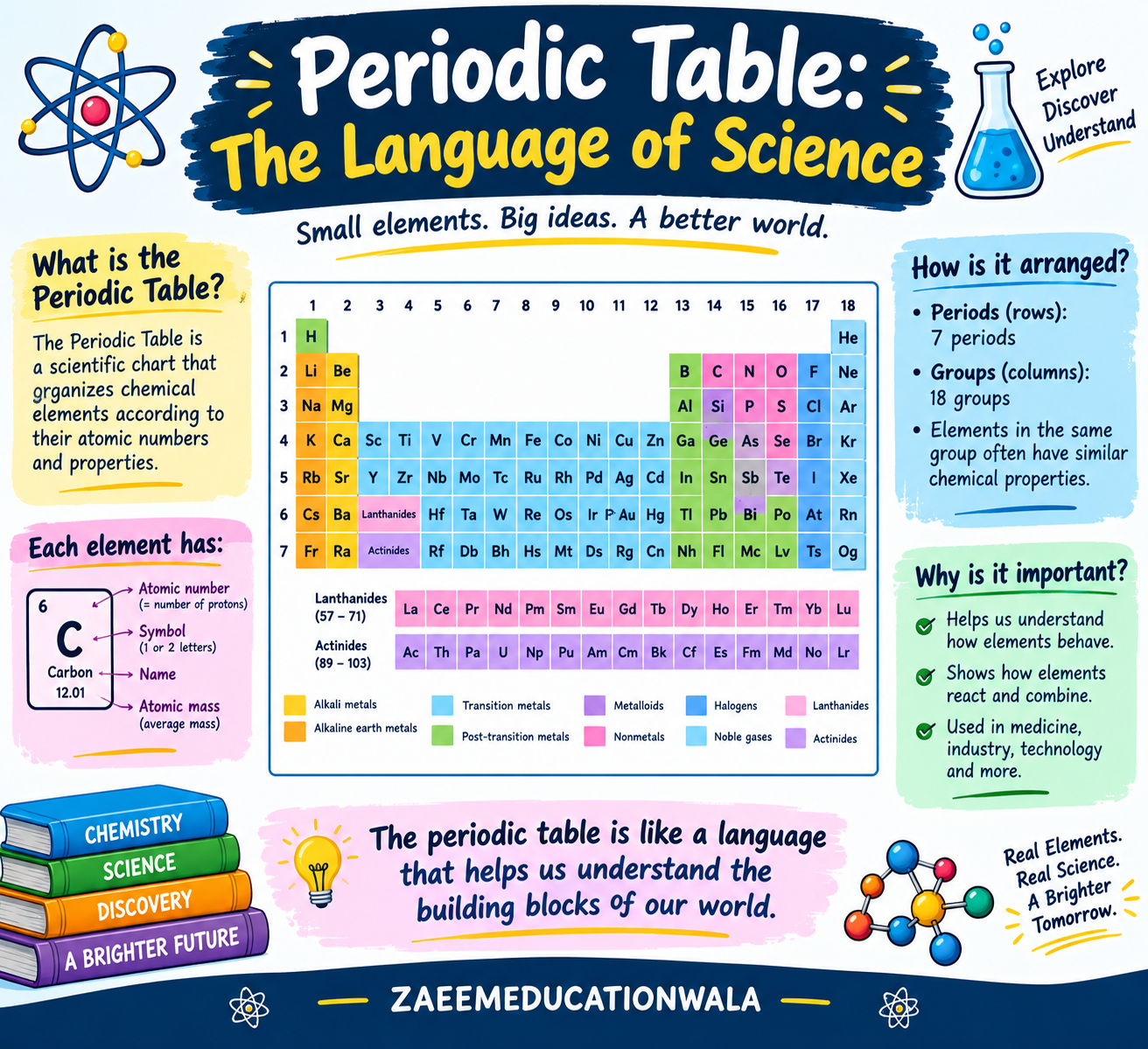
    The Periodic Table is a scientific chart that organizes chemical elements according to their atomic numbers and properties. Each element has a unique name, symbol, and atomic number, such as H for Hydrogen, O for Oxygen, and Fe for Iron.

    The table is arranged into periods (rows) and groups (columns). Elements in the same group often have similar chemical properties. Studying the periodic table helps us understand how elements behave, react, and combine to form different substances.

    Key Message:
    The periodic table is like a language that helps us understand the building blocks of our world.

    #PeriodicTable #Chemistry #Science #ChemicalElements #Atoms #STEM #ScienceEducation #Learning #Chemistry #ZaeemEducationWala

    Day:-62 rollno:-006 foundation level 📖 Story Post 🧪 Periodic Table: The Language of Science The Periodic Table is a scientific chart that organizes chemical elements according to their atomic numbers and properties. Each element has a unique name, symbol, and atomic number, such as H for Hydrogen, O for Oxygen, and Fe for Iron. The table is arranged into periods (rows) and groups (columns). Elements in the same group often have similar chemical properties. Studying the periodic table helps us understand how elements behave, react, and combine to form different substances. 🔬 Key Message: The periodic table is like a language that helps us understand the building blocks of our world. #PeriodicTable #Chemistry #Science #ChemicalElements #Atoms #STEM #ScienceEducation #Learning #Chemistry #ZaeemEducationWala
    0 Комментарии 0 Поделились 1005 Просмотры
  • #rsisb
    Roll no.247
    song .23
    Foundation level

    **The Story of Elements: From Carbon to Gold**

    The world around us is made from a fascinating collection of chemical elements, each with its own unique properties, history, and role in nature. From the carbon in living organisms to the gold found deep within the Earth, every element tells a remarkable story about how our universe works.

    **Carbon** is one of the most important elements for life. It forms the foundation of countless molecules, including those that make up living things. Carbon can also appear in very different forms, from soft graphite to brilliant diamond.

    As we explore the periodic table, we discover elements with completely different characteristics. Oxygen helps living organisms release energy. Iron is essential in many biological processes and has shaped human civilization through tools and technology. Copper has been used for thousands of years and remains important in electrical systems.

    And then there is **gold**—a rare, beautiful, and chemically fascinating element. Its resistance to corrosion and distinctive appearance have made it valuable throughout human history. But gold is more than something beautiful; it also has important scientific and technological applications.

    This journey from **carbon to gold** reminds us that the periodic table is not simply a list of symbols. It is a story of matter, stars, planets, life, discovery, and human curiosity. Every element contributes a small but important piece to the incredible story of our universe.

    Learning about elements helps us understand what everything is made of—from our bodies and oceans to rocks, stars, and modern technology. The deeper we explore chemistry, the more we discover that even the smallest building blocks of matter can tell enormous stories.

    **Explore the periodic table. Discover the elements. Understand the matter that makes our world!**

    #TheStoryOfElements #CarbonToGold #Elements #Chemistry #PeriodicTable #Science #ChemistryEducation #ScienceExploration #ChemicalElements #Carbon #Gold #Matter #Atoms #Molecules #ScienceLearning #STEM #STEMEducation #YoungScientists #ExploreScience #LearnChemistry #ScienceIsAmazing #Universe #Discovery #Education #Knowledge #Curiosity #FutureScientists
    #rsisb Roll no.247 song .23 Foundation level 🌟🧪 **The Story of Elements: From Carbon to Gold** 🪙✨ The world around us is made from a fascinating collection of chemical elements, each with its own unique properties, history, and role in nature. 🌍🔬 From the carbon in living organisms to the gold found deep within the Earth, every element tells a remarkable story about how our universe works. 🌌⚛️ 🖤 **Carbon** is one of the most important elements for life. It forms the foundation of countless molecules, including those that make up living things. 🌱🧬 Carbon can also appear in very different forms, from soft graphite to brilliant diamond. 💎 As we explore the periodic table, we discover elements with completely different characteristics. Oxygen helps living organisms release energy. 🌬️🔥 Iron is essential in many biological processes and has shaped human civilization through tools and technology. ⚙️🏗️ Copper has been used for thousands of years and remains important in electrical systems. 🔌⚡ And then there is **gold**—a rare, beautiful, and chemically fascinating element. 🪙✨ Its resistance to corrosion and distinctive appearance have made it valuable throughout human history. But gold is more than something beautiful; it also has important scientific and technological applications. 🔬💻 This journey from **carbon to gold** reminds us that the periodic table is not simply a list of symbols. It is a story of matter, stars, planets, life, discovery, and human curiosity. 🌌⭐🌍 Every element contributes a small but important piece to the incredible story of our universe. 🔬📚 Learning about elements helps us understand what everything is made of—from our bodies and oceans to rocks, stars, and modern technology. The deeper we explore chemistry, the more we discover that even the smallest building blocks of matter can tell enormous stories. ⚛️🌟 🚀 **Explore the periodic table. Discover the elements. Understand the matter that makes our world!** 🧪🌍✨ #TheStoryOfElements #CarbonToGold #Elements #Chemistry #PeriodicTable #Science #ChemistryEducation #ScienceExploration #ChemicalElements #Carbon #Gold #Matter #Atoms #Molecules #ScienceLearning #STEM #STEMEducation #YoungScientists #ExploreScience #LearnChemistry #ScienceIsAmazing #Universe #Discovery #Education #Knowledge #Curiosity #FutureScientists 🧪⚛️🌌🔬📚✨
    0 Комментарии 0 Поделились 4859 Просмотры 8
  • RSIF8
    Roll no: 09
    Story post no: 09
    Story post topic: Periodic Table: The Language of Science.

    Periodic Table: The Language of Science

    The Periodic Table organizes chemical elements in a clear and meaningful way, helping us understand their properties and behavior. From Hydrogen to Gold, every element has a unique place and role in the world around us.

    #PeriodicTable #Chemistry #Science #ChemicalElements #STEM #ScienceEducation #LearnChemistry #AtomicScience #ScienceFacts #LearningIsFun
    RSIF8 Roll no: 09 Story post no: 09 Story post topic: Periodic Table: The Language of Science. 🧪⚛️ Periodic Table: The Language of Science 🌟 The Periodic Table organizes chemical elements in a clear and meaningful way, helping us understand their properties and behavior. 🔬📚 From Hydrogen to Gold, every element has a unique place and role in the world around us. 🌍✨ #PeriodicTable #Chemistry #Science #ChemicalElements #STEM #ScienceEducation #LearnChemistry #AtomicScience #ScienceFacts #LearningIsFun 🧪⚛️🔬📖🌟
    0 Комментарии 0 Поделились 1343 Просмотры
  • #rsisb
    Roll No.240
    Image With Chatgpt No.6
    Foundation Level

    Oxygen is one of the most important elements for life on Earth, but its discovery was the result of careful experiments, curiosity, and scientific investigation.

    In 1772, Swedish chemist and pharmacist Carl Wilhelm Scheele identified a gas that behaved differently from ordinary air. He found that this gas strongly supported combustion and played an important role in the processes we now understand as respiration and burning.

    Scheele referred to the gas as “fire air” because of its ability to support combustion. His experiments helped reveal that air was not simply one single substance, but a mixture containing different gases.

    The story of oxygen’s discovery is a fascinating example of how science develops through observation and experimentation. Scientists investigate materials, record their observations, test ideas, and gradually build a better understanding of the natural world.

    Although Scheele discovered oxygen independently, the recognition and naming of oxygen as an element also involved other scientists, including Joseph Priestley and Antoine Lavoisier. Their work helped establish oxygen’s role in combustion and contributed to the development of modern chemistry.

    Oxygen is represented by the chemical symbol O and has the atomic number 8. It is essential for aerobic respiration in humans and many other organisms. Without oxygen, most familiar forms of complex life could not survive.

    The discovery of oxygen changed the way scientists understood air, combustion, chemistry, and life. It became an important part of the scientific revolution in chemistry and helped researchers develop a much clearer understanding of chemical reactions.

    This story also reminds us that major scientific discoveries often happen through patience, careful observation, and a willingness to ask questions. Every experiment can reveal something new, and every discovery can open the door to further knowledge.

    From “fire air” to oxygen, the journey of discovery changed chemistry forever.

    Science teaches us that the world around us is full of mysteries waiting to be explored. Whether studying gases, atoms, cells, planets, or living organisms, curiosity is often the first step toward discovery.

    Question. Observe. Experiment. Discover. Learn.

    #Oxygen #DiscoveryOfOxygen #CarlWilhelmScheele #ScienceHistory #HistoryOfScience #Chemistry #ChemicalElements #OxygenDiscovery #1772 #ScientificDiscovery #ScienceEducation #ChemistryFacts #ScienceFacts #LearnScience #ScientificRevolution #Combustion #Air #Respiration #ChemistryHistory #STEM #Education #LearningJourney #ScienceExperiment #ScientificThinking #Research #Discovery #Knowledge #Innovation #Curiosity #ExploreScience #ScienceLovers #EducationalContent #Scientists #ChemicalScience #ModernChemistry #ScienceJourney #HistoryOfChemistry

    Rehan School Islamabad Campus
    Asma Shaheen EducationWali
    Irum Asim
    Saima Happinesswali

    #rsisb Roll No.240 Image With Chatgpt No.6 Foundation Level Oxygen is one of the most important elements for life on Earth, but its discovery was the result of careful experiments, curiosity, and scientific investigation. 🌱🫁🔥 In 1772, Swedish chemist and pharmacist Carl Wilhelm Scheele identified a gas that behaved differently from ordinary air. He found that this gas strongly supported combustion and played an important role in the processes we now understand as respiration and burning. 🔥🧪 Scheele referred to the gas as “fire air” because of its ability to support combustion. His experiments helped reveal that air was not simply one single substance, but a mixture containing different gases. 🌬️🔬 The story of oxygen’s discovery is a fascinating example of how science develops through observation and experimentation. Scientists investigate materials, record their observations, test ideas, and gradually build a better understanding of the natural world. 📚🔎💡 Although Scheele discovered oxygen independently, the recognition and naming of oxygen as an element also involved other scientists, including Joseph Priestley and Antoine Lavoisier. Their work helped establish oxygen’s role in combustion and contributed to the development of modern chemistry. ⚗️🧠🌍 Oxygen is represented by the chemical symbol O and has the atomic number 8. It is essential for aerobic respiration in humans and many other organisms. 🫁🌿🐾 Without oxygen, most familiar forms of complex life could not survive. The discovery of oxygen changed the way scientists understood air, combustion, chemistry, and life. 🌎🔥🔬 It became an important part of the scientific revolution in chemistry and helped researchers develop a much clearer understanding of chemical reactions. This story also reminds us that major scientific discoveries often happen through patience, careful observation, and a willingness to ask questions. 💭➡️🔬➡️💡 Every experiment can reveal something new, and every discovery can open the door to further knowledge. ✨ From “fire air” to oxygen, the journey of discovery changed chemistry forever. ✨ Science teaches us that the world around us is full of mysteries waiting to be explored. 🌍🔎 Whether studying gases, atoms, cells, planets, or living organisms, curiosity is often the first step toward discovery. 🚀📚 🌟 Question. Observe. Experiment. Discover. Learn. 🌟 #Oxygen #DiscoveryOfOxygen #CarlWilhelmScheele #ScienceHistory #HistoryOfScience #Chemistry #ChemicalElements #OxygenDiscovery #1772 #ScientificDiscovery #ScienceEducation #ChemistryFacts #ScienceFacts #LearnScience #ScientificRevolution #Combustion #Air #Respiration #ChemistryHistory #STEM #Education #LearningJourney #ScienceExperiment #ScientificThinking #Research #Discovery #Knowledge #Innovation #Curiosity #ExploreScience #ScienceLovers #EducationalContent #Scientists #ChemicalScience #ModernChemistry #ScienceJourney #HistoryOfChemistry 🔬🧪🌍🔥🫁📚💡✨🚀🌱 Rehan School Islamabad Campus Asma Shaheen EducationWali Irum Asim Saima Happinesswali
    0 Комментарии 0 Поделились 9346 Просмотры
Расширенные страницы