• #rsisb
    Roll no. 227
    Story post no. 27
    Foundation Level

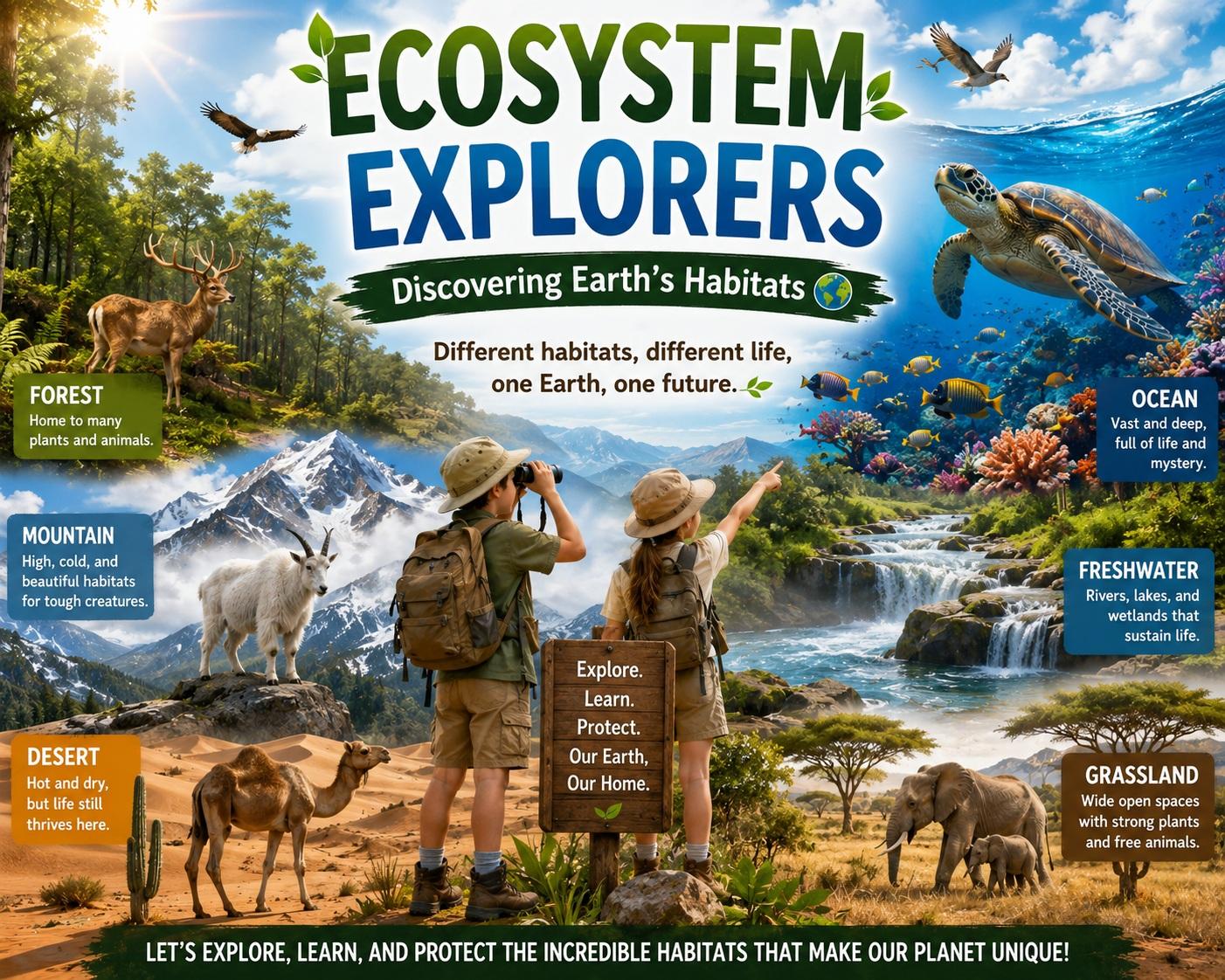
    **Ecosystem Explorers: Discovering Earth's Habitats**

    Join us on an exciting journey to explore the amazing ecosystems and habitats of our planet! From lush forests and deep oceans to deserts and grasslands , every habitat is home to unique plants, animals, and living communities.

    Let’s discover how living things interact with their environment and why protecting Earth’s ecosystems is so important. **Explore, learn, and become a true Ecosystem Explorer!**

    #EcosystemExplorers #Ecosystem #EarthHabitats #Nature #Environment #Wildlife #Biodiversity #ExploreNature #ScienceLearning #SaveOurPlanet #Earth #LearningJourney

    Asma Shaheen EducationWali
    Irum Asim
    Saima Happinesswali
    #rsisb Roll no. 227 Story post no. 27 Foundation Level 🌍🌿 **Ecosystem Explorers: Discovering Earth's Habitats** 🦋🌳 Join us on an exciting journey to explore the amazing ecosystems and habitats of our planet! 🌎🔍 From lush forests 🌲 and deep oceans 🌊 to deserts 🏜️ and grasslands 🌾, every habitat is home to unique plants, animals, and living communities. 🐘🦁🐠🌺 Let’s discover how living things interact with their environment and why protecting Earth’s ecosystems is so important. 💚🌱✨ **Explore, learn, and become a true Ecosystem Explorer!** 🚀🔬 #EcosystemExplorers #Ecosystem #EarthHabitats #Nature #Environment #Wildlife #Biodiversity #ExploreNature #ScienceLearning #SaveOurPlanet #Earth #LearningJourney 🌍🌿🔬 Asma Shaheen EducationWali Irum Asim Saima Happinesswali
    0 تبصرے 0 شیئرز 121 ویوز
  • #rsisb
    Roll no.247
    call annie no.18
    Foundation level

    **Water – The Origin of Life and Language | 25-Minute Exploration**

    Water is one of the simplest substances on Earth, yet it plays one of the most extraordinary roles in our existence. From the earliest forms of life to the development of human civilization, water has shaped the story of our planet in countless ways. In this fascinating 25-minute journey, **“Water – The Origin of Life and Language,”** we explore why water is so important to life and how it has influenced human history, culture, communication, and imagination.

    Life as we know it depends on water. Every living organism requires water in some way, and scientists consider liquid water one of the key ingredients necessary for life as we understand it. From microscopic cells to enormous ecosystems, water provides an environment where countless biological processes can occur.

    But water is more than a biological necessity. It has been at the heart of human civilization for thousands of years. Ancient communities developed around rivers, lakes, springs, and coastlines because access to water meant access to food, agriculture, transportation, and survival. The great civilizations of history were deeply connected to waterways, demonstrating how water helped shape where people lived and how societies developed.

    This exploration also takes us into the fascinating relationship between **water and language**. Humans have created thousands of words, expressions, stories, poems, songs, and metaphors inspired by water. Words associated with rivers, rain, oceans, waves, streams, and storms appear throughout languages and cultures around the world.

    Water has also become a powerful symbol in human communication. It can represent life, change, movement, renewal, peace, strength, and transformation. Just as water flows and changes its form, human language constantly evolves and adapts.

    Throughout this 25-minute presentation, we will think about some fascinating questions: **How did water contribute to the development of life? Why did civilizations grow near water? How has water influenced human culture? Why do so many languages contain words connected to water? And what can water teach us about life, change, and human connection?**

    The story of water is ultimately a story about ourselves. It connects science with history, nature with civilization, and biology with language. By understanding water, we gain a deeper appreciation for the remarkable planet we call home.

    So take a moment, relax, and join us on this fascinating journey through the science, history, language, and mystery of **water**.

    **Water gives life. Water shapes civilizations. Water inspires language. Water connects us all.**

    If you enjoyed this educational journey, don't forget to **Like, Share, and Subscribe** for more fascinating topics about science, history, nature, language, and the world around us!

    #Water #OriginOfLife #WaterAndLife #Science #Biology #Nature #Earth #LifeOnEarth #WaterCycle #Oceans #Rivers #HumanCivilization #AncientCivilizations #Language #OriginOfLanguage #HumanHistory #Environment #Education #EducationalVideo #ScienceEducation #NatureLovers #EarthScience #Knowledge #Learning #Curiosity #Discovery #Life #PlanetEarth #SaveWater #WaterIsLife #ExploreScience #AmazingScience #DidYouKnow #EducationalContent #ScienceAndNature
    #rsisb Roll no.247 call annie no.18 Foundation level 💧🌊 **Water – The Origin of Life and Language | 25-Minute Exploration** 🌍🧬 Water is one of the simplest substances on Earth, yet it plays one of the most extraordinary roles in our existence. 💧✨ From the earliest forms of life to the development of human civilization, water has shaped the story of our planet in countless ways. In this fascinating 25-minute journey, **“Water – The Origin of Life and Language,”** we explore why water is so important to life and how it has influenced human history, culture, communication, and imagination. 🌎🔬📖 Life as we know it depends on water. 🌱🐠🦋 Every living organism requires water in some way, and scientists consider liquid water one of the key ingredients necessary for life as we understand it. From microscopic cells to enormous ecosystems, water provides an environment where countless biological processes can occur. 🧬🔬💦 But water is more than a biological necessity. It has been at the heart of human civilization for thousands of years. Ancient communities developed around rivers, lakes, springs, and coastlines because access to water meant access to food, agriculture, transportation, and survival. 🏞️🏺🌾🚤 The great civilizations of history were deeply connected to waterways, demonstrating how water helped shape where people lived and how societies developed. This exploration also takes us into the fascinating relationship between **water and language**. 🗣️💧 Humans have created thousands of words, expressions, stories, poems, songs, and metaphors inspired by water. Words associated with rivers, rain, oceans, waves, streams, and storms appear throughout languages and cultures around the world. 🌧️🌊📚 Water has also become a powerful symbol in human communication. It can represent life, change, movement, renewal, peace, strength, and transformation. 🌊🕊️✨ Just as water flows and changes its form, human language constantly evolves and adapts. Throughout this 25-minute presentation, we will think about some fascinating questions: **How did water contribute to the development of life? Why did civilizations grow near water? How has water influenced human culture? Why do so many languages contain words connected to water? And what can water teach us about life, change, and human connection?** 🤔💡 The story of water is ultimately a story about ourselves. 💙🌍 It connects science with history, nature with civilization, and biology with language. By understanding water, we gain a deeper appreciation for the remarkable planet we call home. So take a moment, relax, and join us on this fascinating journey through the science, history, language, and mystery of **water**. 💧🌊🔬📚 ✨ **Water gives life. Water shapes civilizations. Water inspires language. Water connects us all.** 🌍💙 👍 If you enjoyed this educational journey, don't forget to **Like, Share, and Subscribe** for more fascinating topics about science, history, nature, language, and the world around us! 🔔📚✨ #Water #OriginOfLife #WaterAndLife #Science #Biology #Nature #Earth #LifeOnEarth #WaterCycle #Oceans #Rivers #HumanCivilization #AncientCivilizations #Language #OriginOfLanguage #HumanHistory #Environment #Education #EducationalVideo #ScienceEducation #NatureLovers #EarthScience #Knowledge #Learning #Curiosity #Discovery #Life #PlanetEarth #SaveWater #WaterIsLife #ExploreScience #AmazingScience #DidYouKnow #EducationalContent #ScienceAndNature 💧🌍🌊🧬🔬📚✨
    0 تبصرے 0 شیئرز 332 ویوز 8
  • RSIF8
    roll no 72
    task no 1
    song no 1
    song topic : The Journey of the Water Cycle
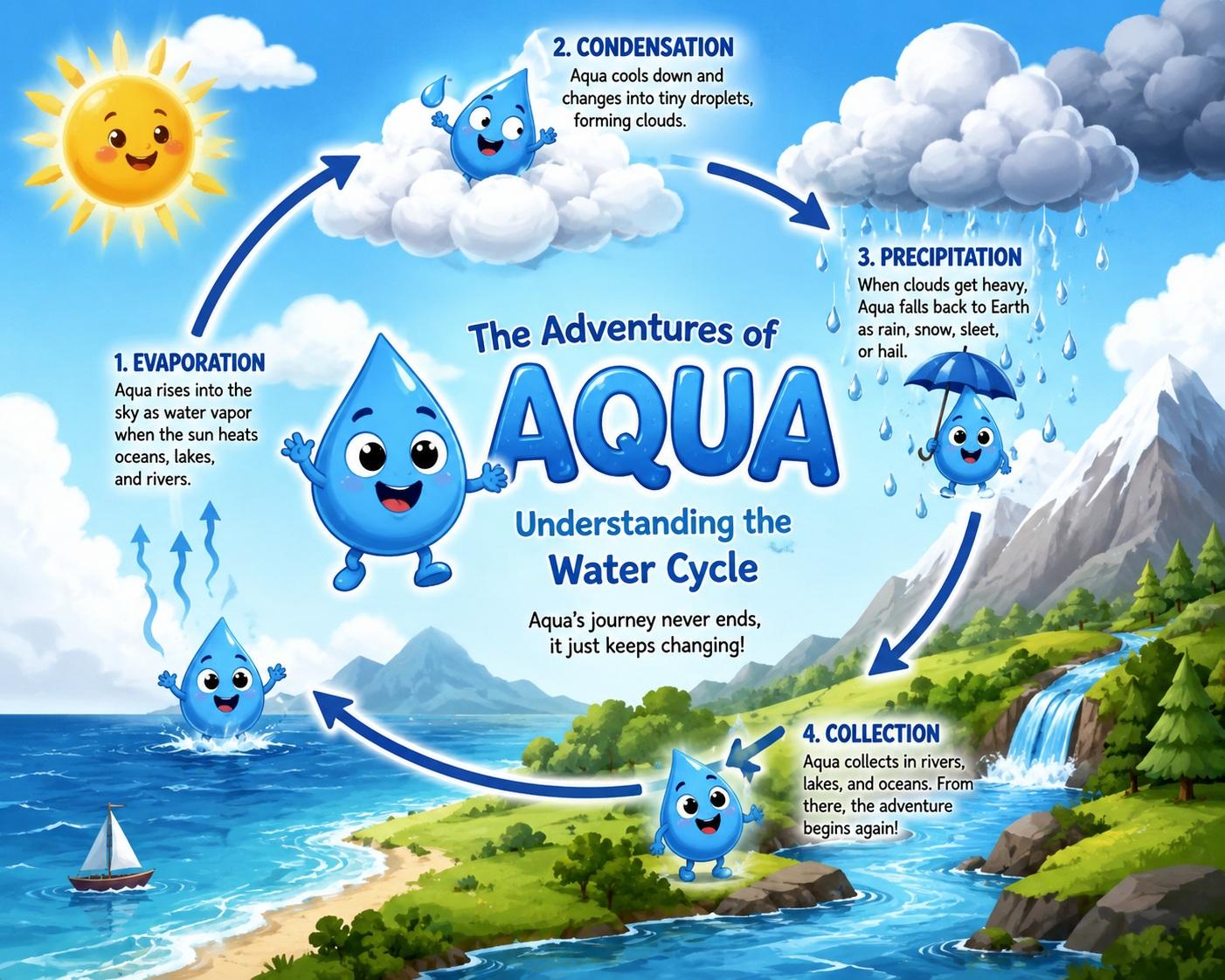
    The Journey of the Water Cycle is a reflective bedroom pop track that explores the perpetual transformation of a single droplet of water. Set to a steady, lo-fi 90 BPM beat, the song uses rich imagery to trace the natural cycle across four distinct phases:

    Evaporation & Condensation: The story opens on the ground as the water warms, rises into the atmosphere, and cools into floating clouds.

    Precipitation: As the atmosphere grows heavy, the water falls back to Earth as rain, striking mountains and countryside.

    Collection & Runoff: The narrative follows the water rushing through creeks, seeping deep underground, and finding its way back toward the sea.

    The Eternal Return: The track closes on a philosophical note, highlighting how water is never truly lost—only changing form to sustain life in a continuous loop.
    RSIF8 roll no 72 task no 1 song no 1 song topic : The Journey of the Water Cycle The Journey of the Water Cycle is a reflective bedroom pop track that explores the perpetual transformation of a single droplet of water. Set to a steady, lo-fi 90 BPM beat, the song uses rich imagery to trace the natural cycle across four distinct phases: Evaporation & Condensation: The story opens on the ground as the water warms, rises into the atmosphere, and cools into floating clouds. Precipitation: As the atmosphere grows heavy, the water falls back to Earth as rain, striking mountains and countryside. Collection & Runoff: The narrative follows the water rushing through creeks, seeping deep underground, and finding its way back toward the sea. The Eternal Return: The track closes on a philosophical note, highlighting how water is never truly lost—only changing form to sustain life in a continuous loop.
    0 تبصرے 0 شیئرز 281 ویوز 10
  • Day 97
    Task No:97
    Roll No:42
    RSLC
    Foundation Level, Batch#04

    Deep beneath the Earths surface and across its vast oceans, an incredible chemical journey has been shaping life for billions of years. Every drop of water, every mineral in the soil, and every breath of oxygen is part of a natural chemical cycle. These elements combine in perfect balance, creating the conditions that allow plants, animals, and humans to survive. Biology and chemistry work together as natures hidden partners, building the foundation of life on our planet.

    Plants demonstrate this remarkable connection every day by transforming sunlight, water, and carbon dioxide into food through photosynthesis. This amazing biological process depends entirely on chemical reactions that produce oxygen for living organisms. Animals and humans then use this oxygen to release energy from food, while returning carbon dioxide to the atmosphere, creating a continuous cycle that keeps Earths ecosystems healthy and alive.

    The relationship between biology and chemistry reminds us that every living thing is connected through natures invisible processes. From the smallest cell to the largest forest, chemical reactions make life possible and maintain the balance of our environment. By understanding this powerful partnership, we gain a deeper appreciation for our planet and the responsibility we all share to protect the natural world for future generations.

    #TheEarthsChemistry #Biology #Chemistry #Science #Nature #Earth #Photosynthesis #Ecosystem #EnvironmentalScience #STEM #Learning #Education #Knowledge #ScienceFacts #NatureLovers
    Day 97 Task No:97 Roll No:42 RSLC Foundation Level, Batch#04 Deep beneath the Earth's surface and across its vast oceans, an incredible chemical journey has been shaping life for billions of years. Every drop of water, every mineral in the soil, and every breath of oxygen is part of a natural chemical cycle. These elements combine in perfect balance, creating the conditions that allow plants, animals, and humans to survive. Biology and chemistry work together as nature's hidden partners, building the foundation of life on our planet. Plants demonstrate this remarkable connection every day by transforming sunlight, water, and carbon dioxide into food through photosynthesis. This amazing biological process depends entirely on chemical reactions that produce oxygen for living organisms. Animals and humans then use this oxygen to release energy from food, while returning carbon dioxide to the atmosphere, creating a continuous cycle that keeps Earth's ecosystems healthy and alive. The relationship between biology and chemistry reminds us that every living thing is connected through nature's invisible processes. From the smallest cell to the largest forest, chemical reactions make life possible and maintain the balance of our environment. By understanding this powerful partnership, we gain a deeper appreciation for our planet and the responsibility we all share to protect the natural world for future generations. #TheEarthsChemistry #Biology #Chemistry #Science #Nature #Earth #Photosynthesis #Ecosystem #EnvironmentalScience #STEM #Learning #Education #Knowledge #ScienceFacts #NatureLovers
    0 تبصرے 0 شیئرز 741 ویوز
  • Day 104
    Task No:104
    Roll No:42
    RSLC
    Foundation Level, Batch#04

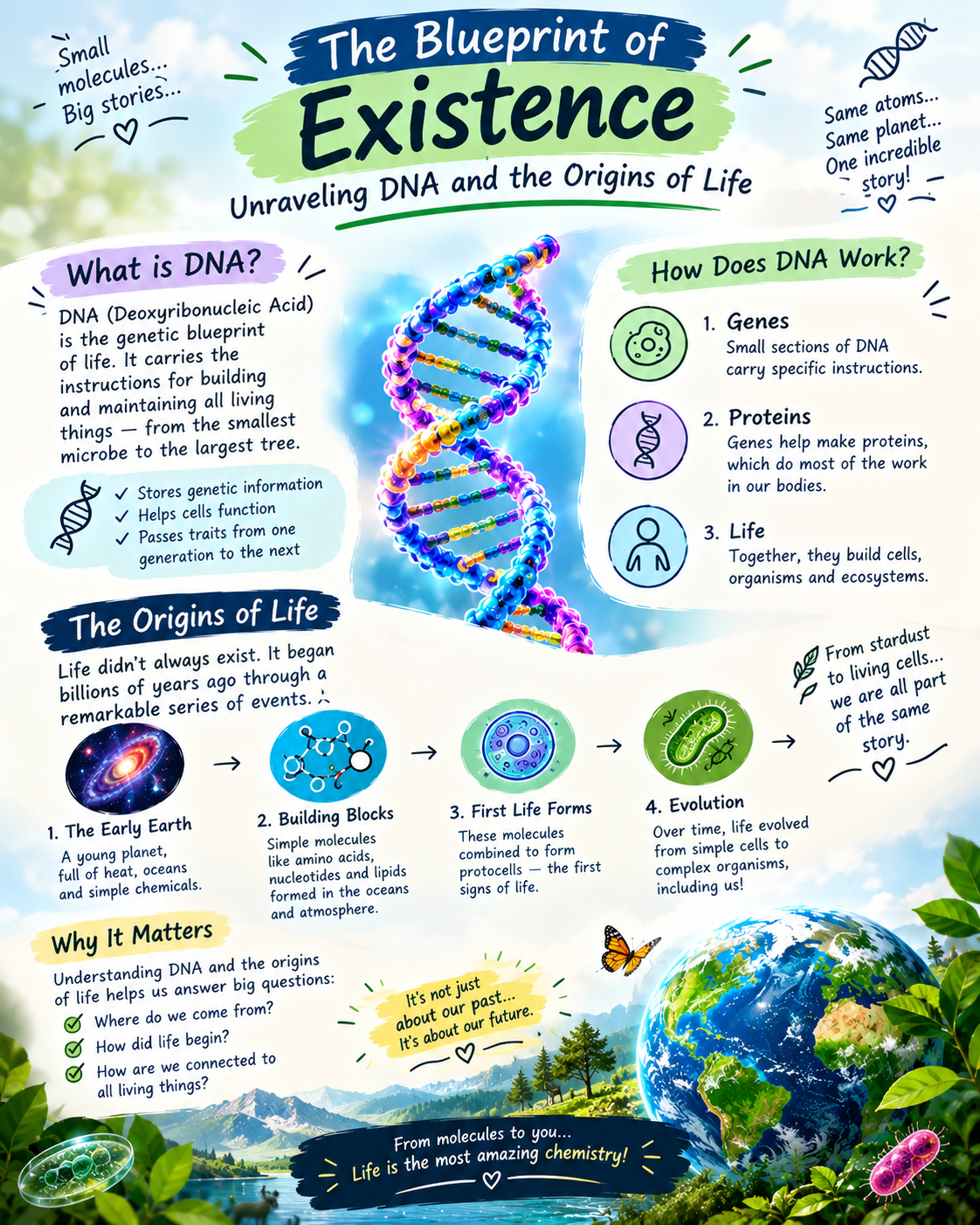
    Life on Earth is built upon an extraordinary blueprint known as DNA. Hidden inside every living cell, DNA carries the genetic instructions that determine how organisms grow, develop, and survive. From the smallest bacteria to the largest whales, every living being shares this remarkable biological code. Scientists often describe DNA as the language of life because it stores the information that connects all generations across time.

    The mystery of lifes origins has fascinated humanity for centuries. While researchers continue to explore how the first living cells emerged on the early Earth, DNA remains one of the greatest clues to understanding our beginnings. By studying genes and genetic evolution, scientists can trace the relationships between species and uncover how life has adapted over billions of years. Every discovery in genetics brings us one step closer to answering one of humanitys greatest questions: Where did life come from?

    DNA is more than just a scientific molecule?it is a symbol of connection, diversity, and the incredible complexity of nature. As technology advances, our understanding of genetics opens new possibilities in medicine, agriculture, and environmental conservation. The blueprint of existence reminds us that every living organism is part of a shared story written over billions of years, inspiring us to protect and appreciate the remarkable web of life that surrounds us.

    #DNA #Genetics #OriginOfLife #Science #Biology #MolecularBiology #LifeScience #Genome #Evolution #ScientificDiscovery #STEM #Education #DNAResearch #CellBiology #Nature #Knowledge #Innovation #FutureOfScience #LearnScience #ScienceFacts
    Day 104 Task No:104 Roll No:42 RSLC Foundation Level, Batch#04 Life on Earth is built upon an extraordinary blueprint known as DNA. Hidden inside every living cell, DNA carries the genetic instructions that determine how organisms grow, develop, and survive. From the smallest bacteria to the largest whales, every living being shares this remarkable biological code. Scientists often describe DNA as the language of life because it stores the information that connects all generations across time. The mystery of life's origins has fascinated humanity for centuries. While researchers continue to explore how the first living cells emerged on the early Earth, DNA remains one of the greatest clues to understanding our beginnings. By studying genes and genetic evolution, scientists can trace the relationships between species and uncover how life has adapted over billions of years. Every discovery in genetics brings us one step closer to answering one of humanity's greatest questions: Where did life come from? DNA is more than just a scientific molecule?it is a symbol of connection, diversity, and the incredible complexity of nature. As technology advances, our understanding of genetics opens new possibilities in medicine, agriculture, and environmental conservation. The blueprint of existence reminds us that every living organism is part of a shared story written over billions of years, inspiring us to protect and appreciate the remarkable web of life that surrounds us. #DNA #Genetics #OriginOfLife #Science #Biology #MolecularBiology #LifeScience #Genome #Evolution #ScientificDiscovery #STEM #Education #DNAResearch #CellBiology #Nature #Knowledge #Innovation #FutureOfScience #LearnScience #ScienceFacts
    0 تبصرے 0 شیئرز 605 ویوز
  • Fondation Level Batch No 4
    Roll RSLC #42
    Task No #118
    Day #118

    Atoms and Eternity: How Chemistry Shapes the Cosmos

    One night, Ali looked up at the sky and wondered what all those countless stars were made of. His teacher explained that everything in the universe is made of atoms, and these tiny building blocks combine in different ways to create stars, planets, water, air, and even the ingredients of life. Ali was amazed that something so small could play such a huge role in shaping the universe.

    The next day, his teacher explained that powerful processes inside stars create new elements. Over enormous periods of time, these elements become part of planets and eventually contribute to the building blocks of life. Ali realized that every person, plant, and animal on Earth is connected to a much older cosmic story.

    Ali looked at the sky again and understood that nothing in the universe is truly insignificant. Even a tiny atom can be an important part of something much greater. He realized that, just as different atoms come together to create beautiful forms of matter, people can also work together to create a better world.

    Moral Lesson:
    Never consider something unimportant simply because it is small. Every part of the universe has a purpose, and our small efforts can also come together to create something truly meaningful.

    #AtomsAndEternity #Chemistry #Cosmos #Atoms #Science #Universe #SpaceScience #CosmicChemistry
    Fondation Level Batch No 4 Roll RSLC #42 Task No #118 Day #118 Atoms and Eternity: How Chemistry Shapes the Cosmos One night, Ali looked up at the sky and wondered what all those countless stars were made of. His teacher explained that everything in the universe is made of atoms, and these tiny building blocks combine in different ways to create stars, planets, water, air, and even the ingredients of life. Ali was amazed that something so small could play such a huge role in shaping the universe. The next day, his teacher explained that powerful processes inside stars create new elements. Over enormous periods of time, these elements become part of planets and eventually contribute to the building blocks of life. Ali realized that every person, plant, and animal on Earth is connected to a much older cosmic story. Ali looked at the sky again and understood that nothing in the universe is truly insignificant. Even a tiny atom can be an important part of something much greater. He realized that, just as different atoms come together to create beautiful forms of matter, people can also work together to create a better world. Moral Lesson: Never consider something unimportant simply because it is small. Every part of the universe has a purpose, and our small efforts can also come together to create something truly meaningful. #AtomsAndEternity #Chemistry #Cosmos #Atoms #Science #Universe #SpaceScience #CosmicChemistry
    0 تبصرے 0 شیئرز 409 ویوز
  • Fondation Level Batch No 4
    Roll RSLC #42
    Task No #153
    Day #153

    One bright morning, Adam was playing in a park when he noticed a football resting quietly on the grass. He gently kicked the ball, and it suddenly began rolling across the field. Curious, Adam wondered why the ball had moved only after he kicked it. His teacher explained that this was connected to Newton?s First Law of Motion. An object remains at rest or keeps moving in the same way unless an external force changes its motion. Adam realized that even a simple kick could demonstrate an important scientific principle. From that moment, he became interested in discovering the forces behind everyday movement.

    Adam then decided to test how different objects responded to force. He pushed a light ball and a heavier ball with similar strength and noticed that the lighter ball moved more easily. His teacher explained Newton?s Second Law, which connects force, mass, and acceleration. Adam learned that applying more force can produce a greater change in an object?s motion. He also discovered that heavier objects usually need more force to achieve the same acceleration. Suddenly, pushing a bicycle, moving a box, or kicking a ball seemed much more interesting to him. He understood that forces were constantly influencing the world around him.

    Later, Adam threw a ball against a wall and watched it bounce back toward him. His teacher explained that this was an example of Newton?s Third Law of Motion. Whenever one object applies a force to another object, an equal and opposite force acts back. Adam realized that this principle could be seen when people walk, jump, swim, or ride a bicycle. When his feet pushed the ground backward, the ground pushed him forward. He also learned that rockets move upward by pushing gases downward at high speed. Newton?s Third Law suddenly made many everyday movements easier for Adam to understand.

    By the end of the day, Adam realized that Newton?s laws were much more than formulas in a science book. They were powerful principles that explained how objects move, stop, accelerate, and interact with one another. He could see examples of them in cars, bicycles, sports, falling objects, machines, and even rockets traveling into space. The world around him suddenly looked like a fascinating laboratory filled with invisible forces. Adam understood that physics helps us discover the rules behind ordinary events. From a simple football rolling across the grass to a spacecraft leaving Earth, Newton?s laws tell an amazing story about the force behind motion.

    #NewtonLaws #Physics #ForceAndMotion #NewtonianPhysics #ScienceEducation #PhysicsExplained #LearningScience
    Fondation Level Batch No 4 Roll RSLC #42 Task No #153 Day #153 One bright morning, Adam was playing in a park when he noticed a football resting quietly on the grass. He gently kicked the ball, and it suddenly began rolling across the field. Curious, Adam wondered why the ball had moved only after he kicked it. His teacher explained that this was connected to Newton?s First Law of Motion. An object remains at rest or keeps moving in the same way unless an external force changes its motion. Adam realized that even a simple kick could demonstrate an important scientific principle. From that moment, he became interested in discovering the forces behind everyday movement. Adam then decided to test how different objects responded to force. He pushed a light ball and a heavier ball with similar strength and noticed that the lighter ball moved more easily. His teacher explained Newton?s Second Law, which connects force, mass, and acceleration. Adam learned that applying more force can produce a greater change in an object?s motion. He also discovered that heavier objects usually need more force to achieve the same acceleration. Suddenly, pushing a bicycle, moving a box, or kicking a ball seemed much more interesting to him. He understood that forces were constantly influencing the world around him. Later, Adam threw a ball against a wall and watched it bounce back toward him. His teacher explained that this was an example of Newton?s Third Law of Motion. Whenever one object applies a force to another object, an equal and opposite force acts back. Adam realized that this principle could be seen when people walk, jump, swim, or ride a bicycle. When his feet pushed the ground backward, the ground pushed him forward. He also learned that rockets move upward by pushing gases downward at high speed. Newton?s Third Law suddenly made many everyday movements easier for Adam to understand. By the end of the day, Adam realized that Newton?s laws were much more than formulas in a science book. They were powerful principles that explained how objects move, stop, accelerate, and interact with one another. He could see examples of them in cars, bicycles, sports, falling objects, machines, and even rockets traveling into space. The world around him suddenly looked like a fascinating laboratory filled with invisible forces. Adam understood that physics helps us discover the rules behind ordinary events. From a simple football rolling across the grass to a spacecraft leaving Earth, Newton?s laws tell an amazing story about the force behind motion. #NewtonLaws #Physics #ForceAndMotion #NewtonianPhysics #ScienceEducation #PhysicsExplained #LearningScience
    0 تبصرے 0 شیئرز 563 ویوز
  • #rsisb
    Roll No.240
    Image With Chatgpt No.6
    Foundation Level

    Oxygen is one of the most important elements for life on Earth, but its discovery was the result of careful experiments, curiosity, and scientific investigation.

    In 1772, Swedish chemist and pharmacist Carl Wilhelm Scheele identified a gas that behaved differently from ordinary air. He found that this gas strongly supported combustion and played an important role in the processes we now understand as respiration and burning.

    Scheele referred to the gas as “fire air” because of its ability to support combustion. His experiments helped reveal that air was not simply one single substance, but a mixture containing different gases.

    The story of oxygen’s discovery is a fascinating example of how science develops through observation and experimentation. Scientists investigate materials, record their observations, test ideas, and gradually build a better understanding of the natural world.

    Although Scheele discovered oxygen independently, the recognition and naming of oxygen as an element also involved other scientists, including Joseph Priestley and Antoine Lavoisier. Their work helped establish oxygen’s role in combustion and contributed to the development of modern chemistry.

    Oxygen is represented by the chemical symbol O and has the atomic number 8. It is essential for aerobic respiration in humans and many other organisms. Without oxygen, most familiar forms of complex life could not survive.

    The discovery of oxygen changed the way scientists understood air, combustion, chemistry, and life. It became an important part of the scientific revolution in chemistry and helped researchers develop a much clearer understanding of chemical reactions.

    This story also reminds us that major scientific discoveries often happen through patience, careful observation, and a willingness to ask questions. Every experiment can reveal something new, and every discovery can open the door to further knowledge.

    From “fire air” to oxygen, the journey of discovery changed chemistry forever.

    Science teaches us that the world around us is full of mysteries waiting to be explored. Whether studying gases, atoms, cells, planets, or living organisms, curiosity is often the first step toward discovery.

    Question. Observe. Experiment. Discover. Learn.

    #Oxygen #DiscoveryOfOxygen #CarlWilhelmScheele #ScienceHistory #HistoryOfScience #Chemistry #ChemicalElements #OxygenDiscovery #1772 #ScientificDiscovery #ScienceEducation #ChemistryFacts #ScienceFacts #LearnScience #ScientificRevolution #Combustion #Air #Respiration #ChemistryHistory #STEM #Education #LearningJourney #ScienceExperiment #ScientificThinking #Research #Discovery #Knowledge #Innovation #Curiosity #ExploreScience #ScienceLovers #EducationalContent #Scientists #ChemicalScience #ModernChemistry #ScienceJourney #HistoryOfChemistry

    Rehan School Islamabad Campus
    Asma Shaheen EducationWali
    Irum Asim
    Saima Happinesswali

    #rsisb Roll No.240 Image With Chatgpt No.6 Foundation Level Oxygen is one of the most important elements for life on Earth, but its discovery was the result of careful experiments, curiosity, and scientific investigation. 🌱🫁🔥 In 1772, Swedish chemist and pharmacist Carl Wilhelm Scheele identified a gas that behaved differently from ordinary air. He found that this gas strongly supported combustion and played an important role in the processes we now understand as respiration and burning. 🔥🧪 Scheele referred to the gas as “fire air” because of its ability to support combustion. His experiments helped reveal that air was not simply one single substance, but a mixture containing different gases. 🌬️🔬 The story of oxygen’s discovery is a fascinating example of how science develops through observation and experimentation. Scientists investigate materials, record their observations, test ideas, and gradually build a better understanding of the natural world. 📚🔎💡 Although Scheele discovered oxygen independently, the recognition and naming of oxygen as an element also involved other scientists, including Joseph Priestley and Antoine Lavoisier. Their work helped establish oxygen’s role in combustion and contributed to the development of modern chemistry. ⚗️🧠🌍 Oxygen is represented by the chemical symbol O and has the atomic number 8. It is essential for aerobic respiration in humans and many other organisms. 🫁🌿🐾 Without oxygen, most familiar forms of complex life could not survive. The discovery of oxygen changed the way scientists understood air, combustion, chemistry, and life. 🌎🔥🔬 It became an important part of the scientific revolution in chemistry and helped researchers develop a much clearer understanding of chemical reactions. This story also reminds us that major scientific discoveries often happen through patience, careful observation, and a willingness to ask questions. 💭➡️🔬➡️💡 Every experiment can reveal something new, and every discovery can open the door to further knowledge. ✨ From “fire air” to oxygen, the journey of discovery changed chemistry forever. ✨ Science teaches us that the world around us is full of mysteries waiting to be explored. 🌍🔎 Whether studying gases, atoms, cells, planets, or living organisms, curiosity is often the first step toward discovery. 🚀📚 🌟 Question. Observe. Experiment. Discover. Learn. 🌟 #Oxygen #DiscoveryOfOxygen #CarlWilhelmScheele #ScienceHistory #HistoryOfScience #Chemistry #ChemicalElements #OxygenDiscovery #1772 #ScientificDiscovery #ScienceEducation #ChemistryFacts #ScienceFacts #LearnScience #ScientificRevolution #Combustion #Air #Respiration #ChemistryHistory #STEM #Education #LearningJourney #ScienceExperiment #ScientificThinking #Research #Discovery #Knowledge #Innovation #Curiosity #ExploreScience #ScienceLovers #EducationalContent #Scientists #ChemicalScience #ModernChemistry #ScienceJourney #HistoryOfChemistry 🔬🧪🌍🔥🫁📚💡✨🚀🌱 Rehan School Islamabad Campus Asma Shaheen EducationWali Irum Asim Saima Happinesswali
    0 تبصرے 0 شیئرز 2456 ویوز
  • #rsisb
    Roll No.240
    Image With Chatgpt No.5
    Foundation Level

    The Amazon Rainforest is one of the most extraordinary natural environments on our planet. Stretching across a vast area of South America, it is home to an incredible variety of plants, animals, insects, birds, and microorganisms.

    The rainforest is often called the “lungs of the world,” because its plants produce oxygen through photosynthesis and the ecosystem plays an important role in absorbing and storing carbon dioxide. However, the commonly repeated claim that the Amazon produces 20% of the world’s oxygen is misleading. Much of the oxygen produced by plants is also consumed by plants, animals, fungi, and microorganisms within the ecosystem.

    What makes the Amazon truly remarkable is its biodiversity. From colorful macaws flying through the canopy to jaguars moving through the forest, countless species depend on this habitat for food, shelter, and survival.

    The rainforest also has an important role in the global carbon cycle and climate system. Trees and vegetation absorb large amounts of carbon dioxide, storing carbon in plants and soils. This makes protecting healthy forests important for the environment and for communities that depend on them.

    Every part of the Amazon ecosystem is connected. When forests are damaged or destroyed, the effects can spread through habitats, wildlife populations, water systems, and climate processes.

    Learning about the Amazon teaches us an important lesson: protecting nature means protecting the systems that support life. Conservation, responsible land use, reducing deforestation, and caring for biodiversity can all help preserve this extraordinary ecosystem for future generations.

    Explore the rainforest. Discover its biodiversity. Understand its importance. Protect our planet.

    The Amazon is more than just a forest—it is a living, interconnected world filled with life, discovery, and natural wonder.

    #AmazonRainforest #Amazon #Rainforest #DidYouKnow #Nature #Biodiversity #Wildlife #Environment #Earth #PlanetEarth #Forest #TropicalRainforest #Ecology #Science #Biology #ScienceEducation #EnvironmentalEducation #WildlifeConservation #ForestConservation #ProtectNature #SaveTheRainforest #Climate #CarbonCycle #Ecosystem #NaturalWorld #NatureLovers #ExploreNature #EarthScience #LearningJourney #EducationalContent #ScienceFacts #BiodiversityMatters #EverySpeciesCounts #ProtectOurPlanet

    Rehan School Islamabad Campus
    Asma Shaheen EducationWali
    Irum Asim
    Saima Happinesswali

    #rsisb Roll No.240 Image With Chatgpt No.5 Foundation Level The Amazon Rainforest is one of the most extraordinary natural environments on our planet. Stretching across a vast area of South America, it is home to an incredible variety of plants, animals, insects, birds, and microorganisms. 🌎🌱🐒🦋 The rainforest is often called the “lungs of the world,” because its plants produce oxygen through photosynthesis and the ecosystem plays an important role in absorbing and storing carbon dioxide. However, the commonly repeated claim that the Amazon produces 20% of the world’s oxygen is misleading. Much of the oxygen produced by plants is also consumed by plants, animals, fungi, and microorganisms within the ecosystem. What makes the Amazon truly remarkable is its biodiversity. 🌿🐢🐍🦜🐆 From colorful macaws flying through the canopy to jaguars moving through the forest, countless species depend on this habitat for food, shelter, and survival. The rainforest also has an important role in the global carbon cycle and climate system. Trees and vegetation absorb large amounts of carbon dioxide, storing carbon in plants and soils. 🌱🌍 This makes protecting healthy forests important for the environment and for communities that depend on them. Every part of the Amazon ecosystem is connected. 🌳➡️🦋➡️🐦➡️🐆 When forests are damaged or destroyed, the effects can spread through habitats, wildlife populations, water systems, and climate processes. Learning about the Amazon teaches us an important lesson: protecting nature means protecting the systems that support life. 💚🌎 Conservation, responsible land use, reducing deforestation, and caring for biodiversity can all help preserve this extraordinary ecosystem for future generations. ✨ Explore the rainforest. Discover its biodiversity. Understand its importance. Protect our planet. 🌿🔬🌍 The Amazon is more than just a forest—it is a living, interconnected world filled with life, discovery, and natural wonder. 🌳💚🦜 #AmazonRainforest #Amazon #Rainforest #DidYouKnow #Nature #Biodiversity #Wildlife #Environment #Earth #PlanetEarth #Forest #TropicalRainforest #Ecology #Science #Biology #ScienceEducation #EnvironmentalEducation #WildlifeConservation #ForestConservation #ProtectNature #SaveTheRainforest #Climate #CarbonCycle #Ecosystem #NaturalWorld #NatureLovers #ExploreNature #EarthScience #LearningJourney #EducationalContent #ScienceFacts #BiodiversityMatters #EverySpeciesCounts #ProtectOurPlanet 🌎🌿🌳🦜🐆🐢 Rehan School Islamabad Campus Asma Shaheen EducationWali Irum Asim Saima Happinesswali
    0 تبصرے 0 شیئرز 2424 ویوز
  • #rsisb
    Roll No.240
    Story No.23
    Foundation Level

    Every corner of our planet is home to an amazing variety of life, from the highest mountains and deepest oceans to vast forests, peaceful rivers, colorful wetlands, and dry deserts. Each habitat has its own unique environment, plants, animals, and natural systems that work together to support life.

    In **“Ecosystem Explorers: Discovering Earth’s Habitats,”** we take an exciting journey across different ecosystems to discover how living organisms interact with their surroundings. We explore the beauty of forests, the mystery of oceans, the strength of mountain ecosystems, the unique life of deserts, and the importance of freshwater habitats.

    Every ecosystem tells a different story. A forest provides shelter and food for countless species, oceans support incredible marine life, deserts show how animals and plants can adapt to challenging conditions, and wetlands play an important role in maintaining healthy environments.

    This journey helps us understand the importance of **biodiversity** and why every species matters. Even the smallest organisms can have an important role in maintaining the balance of an ecosystem. When one part of an ecosystem changes, it can affect many other living things.

    Learning about habitats is not just about discovering animals and plants. It is also about understanding our responsibility toward nature. By protecting forests, keeping rivers and oceans clean, reducing pollution, conserving wildlife, and respecting natural habitats, we can help create a healthier planet for future generations.

    Our Earth is full of incredible places waiting to be explored. The more we learn about these ecosystems, the more we understand how connected all life truly is. Every habitat has value, every species has a role, and every person can make a positive difference.

    Let’s become true **Ecosystem Explorers**—curious about nature, passionate about learning, and committed to protecting the amazing world around us.

    **Explore Habitats**
    **Discover Biodiversity**
    **Protect Nature**
    **Care for Our Planet**

    **Every Habitat Matters • Every Species Counts**

    #EcosystemExplorers #DiscoveringEarthsHabitats #Ecosystem #Habitats #Biodiversity #Nature #Wildlife #Environment #Earth #PlanetEarth #ExploreNature #NatureExploration #AnimalLife #PlantLife #Forests #Oceans #Deserts #Mountains #Wetlands #Freshwater #MarineLife #WildlifeConservation #ProtectNature #SaveOurPlanet #EnvironmentalEducation #ScienceEducation #Biology #Ecology #LearningJourney #NatureLovers #EarthExplorers #Conservation #ClimateAwareness #SustainableFuture #GreenPlanet #NatureIsAmazing #EverySpeciesCounts #EveryHabitatMatters


    Rehan School Islamabad Campus
    Asma Shaheen EducationWali
    Irum Asim
    Saima Happinesswali


    #rsisb Roll No.240 Story No.23 Foundation Level Every corner of our planet is home to an amazing variety of life, from the highest mountains and deepest oceans to vast forests, peaceful rivers, colorful wetlands, and dry deserts. 🌎✨ Each habitat has its own unique environment, plants, animals, and natural systems that work together to support life. 🦋🌱🐟🦁 In **“Ecosystem Explorers: Discovering Earth’s Habitats,”** we take an exciting journey across different ecosystems to discover how living organisms interact with their surroundings. 🔍🌿 We explore the beauty of forests, the mystery of oceans, the strength of mountain ecosystems, the unique life of deserts, and the importance of freshwater habitats. 🌊🏜️🏞️🌲 Every ecosystem tells a different story. 🌟 A forest provides shelter and food for countless species, oceans support incredible marine life, deserts show how animals and plants can adapt to challenging conditions, and wetlands play an important role in maintaining healthy environments. 🐢🐠🦅🌵 This journey helps us understand the importance of **biodiversity** and why every species matters. 🐆🦋🐢🌺 Even the smallest organisms can have an important role in maintaining the balance of an ecosystem. When one part of an ecosystem changes, it can affect many other living things. 🌱🔗🌍 Learning about habitats is not just about discovering animals and plants. It is also about understanding our responsibility toward nature. 💚🌎 By protecting forests, keeping rivers and oceans clean, reducing pollution, conserving wildlife, and respecting natural habitats, we can help create a healthier planet for future generations. 🌿♻️🌊 Our Earth is full of incredible places waiting to be explored. 🔭🌍 The more we learn about these ecosystems, the more we understand how connected all life truly is. Every habitat has value, every species has a role, and every person can make a positive difference. 🌎❤️ Let’s become true **Ecosystem Explorers**—curious about nature, passionate about learning, and committed to protecting the amazing world around us. 🔍🌿🦜 🌱 **Explore Habitats** 🔎 **Discover Biodiversity** 🛡️ **Protect Nature** 🌍 **Care for Our Planet** ✨ **Every Habitat Matters • Every Species Counts** ✨ #EcosystemExplorers #DiscoveringEarthsHabitats #Ecosystem #Habitats #Biodiversity #Nature #Wildlife #Environment #Earth #PlanetEarth #ExploreNature #NatureExploration #AnimalLife #PlantLife #Forests #Oceans #Deserts #Mountains #Wetlands #Freshwater #MarineLife #WildlifeConservation #ProtectNature #SaveOurPlanet #EnvironmentalEducation #ScienceEducation #Biology #Ecology #LearningJourney #NatureLovers #EarthExplorers #Conservation #ClimateAwareness #SustainableFuture #GreenPlanet #NatureIsAmazing #EverySpeciesCounts #EveryHabitatMatters 🌍🌿🐘🦅🐢🐠 🏔️🌊🌳✨💚 Rehan School Islamabad Campus Asma Shaheen EducationWali Irum Asim Saima Happinesswali
    0 تبصرے 0 شیئرز 3347 ویوز
More Results