• Day: -104

    Roll No: 006

    Level: Foundation

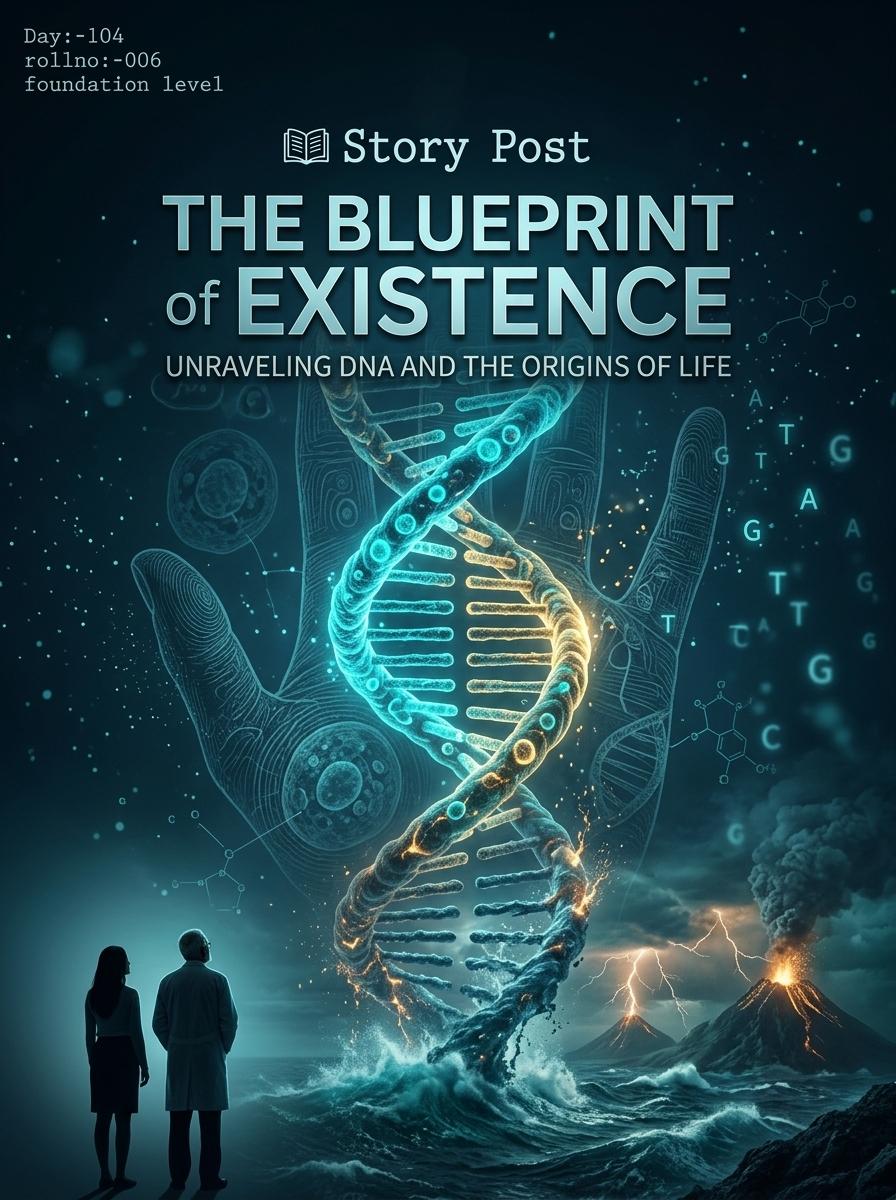
    Title: The Blueprint of Existence

    The laboratory was quiet, save for the low hum of the sequencing machines and the persistent click of Maya’s pen against her notebook. On the monitor, billions of nitrogenous bases flickered in glowing cyan—A, T, C, G—a silent language written four billion years ago.

    For centuries, humanity looked up at the stars to understand where we came from, building telescopes to peer into the void. But as Maya watched the double helix render across her screen, she knew the real ledger of our origins wasn't written in dust and plasma. It was coiled tightly inside every nucleus of every living cell on Earth.

    "Still trying to read the first page?"

    Maya turned. Dr. Aris stood in the doorway, two mugs of cold coffee in hand. He set one on her desk, his gaze lingering on the digital rendering of RNA strands folding over themselves in a simulated primordial tide pool.

    "It’s the transition that gets me," Maya said, tracing the curve of the ribbon on her screen. "RNA was the pioneer—acting as both the blueprint and the engine in the primitive soup. But it was fragile. Volatile. How did life take that impossible leap from chaotic chemistry to the absolute permanence of DNA?"

    Aris smiled, pulling up a chair. "By inventing memory. RNA lived in the moment, reacting and replicating in hydrothermal heat. But DNA was built to endure. It dropped an oxygen atom, twisted into a double helix, and locked the master copy in a vault. It stopped just reacting to the world and started remembering it."

    They sat in silence for a moment, surrounded by data streams containing the genetic blueprints of thousands of species—from ancient deep-sea archaebacteria to modern human genomes. Every single one used the exact same four-letter alphabet, a continuous, unbroken chain of code passed down through unfathomable millennia, surviving mass extinctions, ice ages, and cosmic bombardments.

    "We think of history as monuments, books, and empires," Maya whispered, adjusting her glasses. "But none of those last. Empires crumble to dust. Books burn."

    "And yet," Aris added quietly, "a sequence forged in a primordial tide pool fou
    Day: -104 Roll No: 006 Level: Foundation Title: The Blueprint of Existence The laboratory was quiet, save for the low hum of the sequencing machines and the persistent click of Maya’s pen against her notebook. On the monitor, billions of nitrogenous bases flickered in glowing cyan—A, T, C, G—a silent language written four billion years ago. For centuries, humanity looked up at the stars to understand where we came from, building telescopes to peer into the void. But as Maya watched the double helix render across her screen, she knew the real ledger of our origins wasn't written in dust and plasma. It was coiled tightly inside every nucleus of every living cell on Earth. "Still trying to read the first page?" Maya turned. Dr. Aris stood in the doorway, two mugs of cold coffee in hand. He set one on her desk, his gaze lingering on the digital rendering of RNA strands folding over themselves in a simulated primordial tide pool. "It’s the transition that gets me," Maya said, tracing the curve of the ribbon on her screen. "RNA was the pioneer—acting as both the blueprint and the engine in the primitive soup. But it was fragile. Volatile. How did life take that impossible leap from chaotic chemistry to the absolute permanence of DNA?" Aris smiled, pulling up a chair. "By inventing memory. RNA lived in the moment, reacting and replicating in hydrothermal heat. But DNA was built to endure. It dropped an oxygen atom, twisted into a double helix, and locked the master copy in a vault. It stopped just reacting to the world and started remembering it." They sat in silence for a moment, surrounded by data streams containing the genetic blueprints of thousands of species—from ancient deep-sea archaebacteria to modern human genomes. Every single one used the exact same four-letter alphabet, a continuous, unbroken chain of code passed down through unfathomable millennia, surviving mass extinctions, ice ages, and cosmic bombardments. "We think of history as monuments, books, and empires," Maya whispered, adjusting her glasses. "But none of those last. Empires crumble to dust. Books burn." "And yet," Aris added quietly, "a sequence forged in a primordial tide pool fou
    0 Commentaires 0 Parts 461 Vue
  • RSIF8
    Roll No 13
    Story post no 7
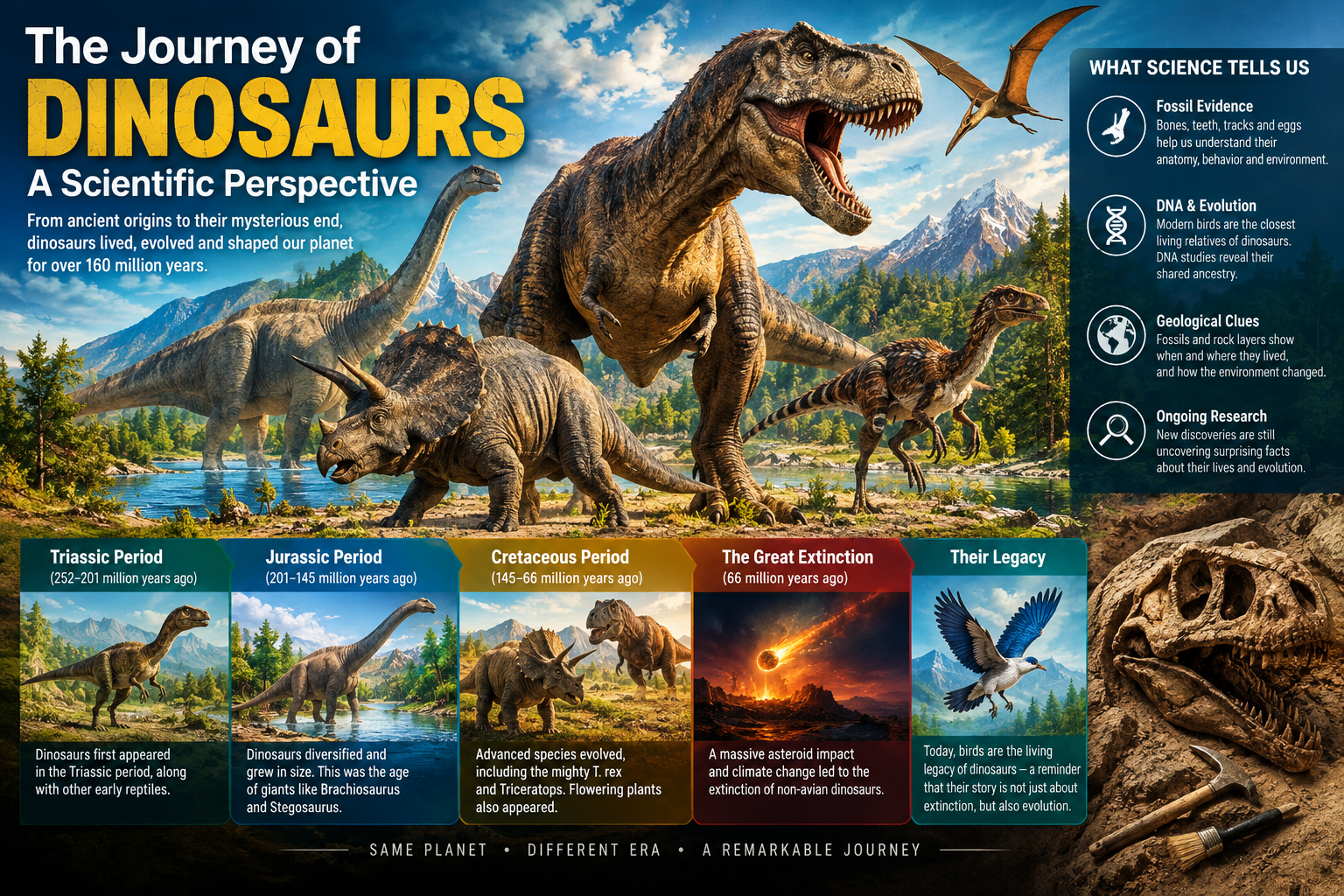
    story post topic **The Journey of Dinosaurs: A Scientific Perspective**

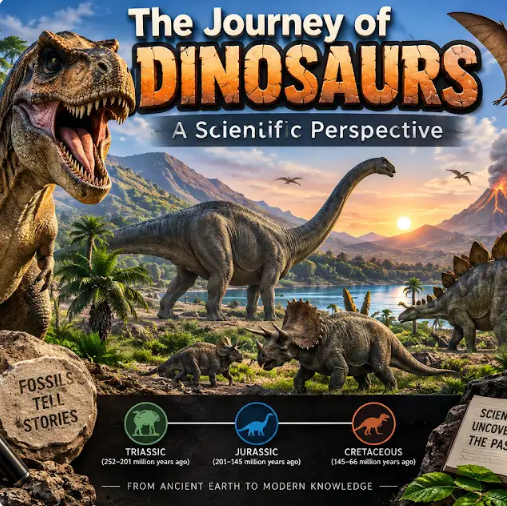
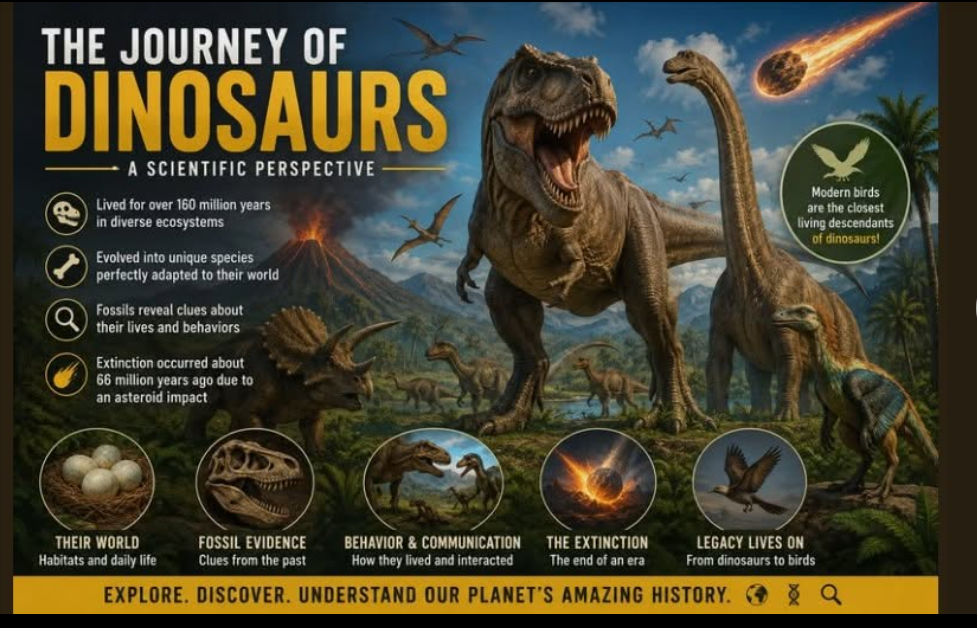
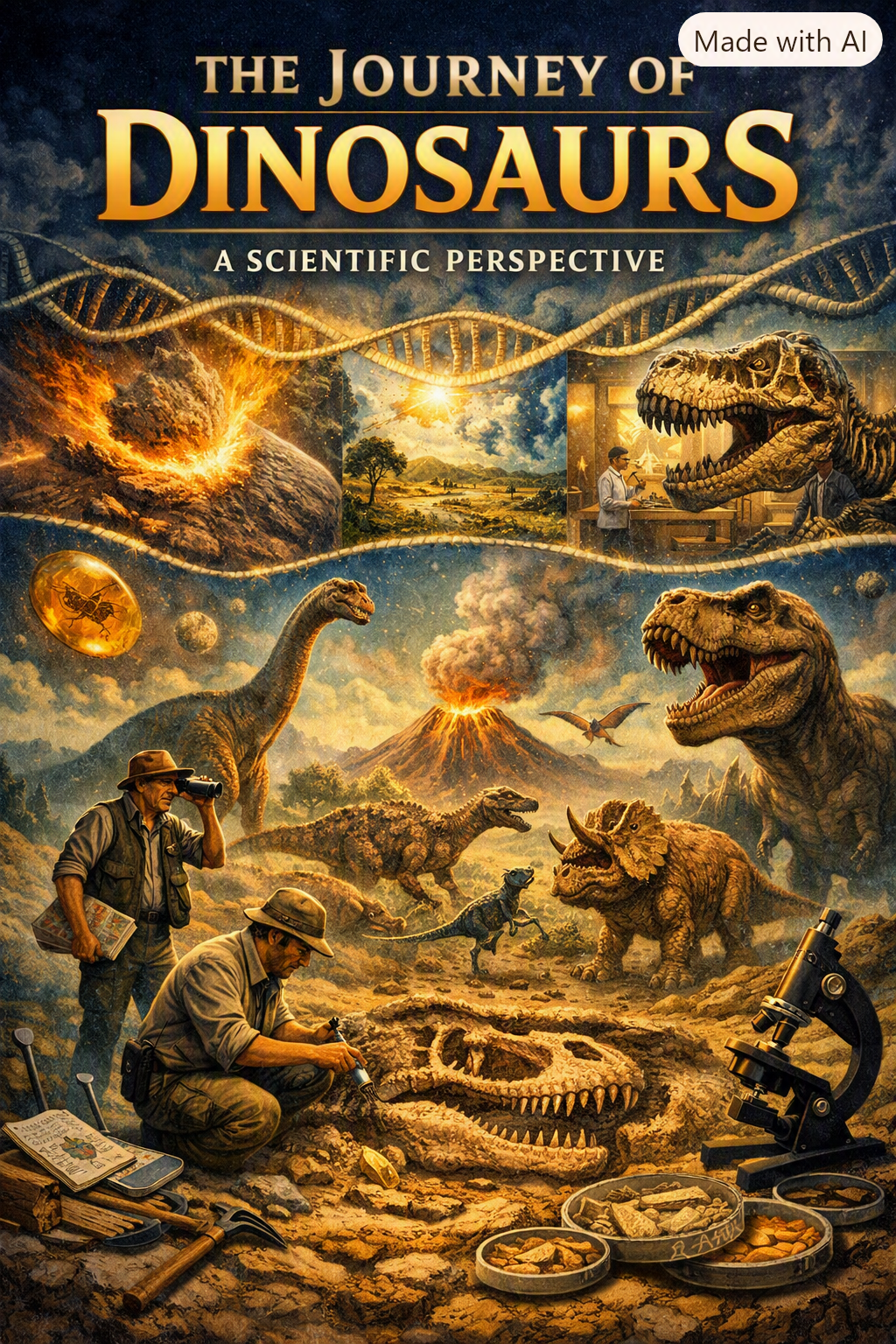
    Step back millions of years and explore the incredible journey of dinosaurs—from their emergence during the Triassic Period to their remarkable diversity in the Jurassic and Cretaceous Periods, and finally the mass extinction about 66 million years ago.

    This fascinating journey explores what science has discovered through **fossils, bones, footprints, geological evidence, and evolutionary research**. Discover how dinosaurs lived, evolved, adapted to changing environments, and left behind a lasting legacy through modern birds.

    From the mighty **T. rex** and enormous sauropods to armored dinosaurs and flying pterosaurs, their story continues to inspire scientists and uncover new mysteries about Earth's ancient past.

    **Explore the evidence. Discover the evolution. Travel through 160+ million years of dinosaur history!**

    #Dinosaurs #DinosaurHistory #Science #Paleontology #Evolution #Fossils #TyrannosaurusRex #Jurassic #Cretaceous #Triassic #AncientEarth #DinosaurFacts #ScientificPerspective #HistoryOfEarth
    RSIF8 Roll No 13 Story post no 7 story post topic 🦖 **The Journey of Dinosaurs: A Scientific Perspective** 🌍 Step back millions of years and explore the incredible journey of dinosaurs—from their emergence during the Triassic Period to their remarkable diversity in the Jurassic and Cretaceous Periods, and finally the mass extinction about 66 million years ago. 🦕🌋 This fascinating journey explores what science has discovered through **fossils, bones, footprints, geological evidence, and evolutionary research**. Discover how dinosaurs lived, evolved, adapted to changing environments, and left behind a lasting legacy through modern birds. 🐦🔬 From the mighty **T. rex** and enormous sauropods to armored dinosaurs and flying pterosaurs, their story continues to inspire scientists and uncover new mysteries about Earth's ancient past. 🔎 **Explore the evidence. Discover the evolution. Travel through 160+ million years of dinosaur history!** #Dinosaurs #DinosaurHistory #Science #Paleontology #Evolution #Fossils #TyrannosaurusRex #Jurassic #Cretaceous #Triassic #AncientEarth #DinosaurFacts #ScientificPerspective #HistoryOfEarth
    0 Commentaires 0 Parts 1156 Vue
  • RSIF8
    Roll no:14
    story post no:8
    story topic:The Journey of Dinosaurs: A Scientific Perspective

    **The Journey of Dinosaurs: A Scientific Perspective**

    Step into the fascinating world of dinosaurs and discover the incredible story of life on Earth millions of years ago!

    **“The Journey of Dinosaurs: A Scientific Perspective”** explores the amazing history of dinosaurs through the lens of science. From their appearance during the **Triassic Period** to their incredible diversity during the **Jurassic and Cretaceous Periods**, dinosaurs ruled many parts of our planet for millions of years.

    Through fossils, footprints, bones, rocks, and other scientific evidence, paleontologists have been able to uncover clues about how dinosaurs lived, what they ate, how they moved, and how different species evolved over time.

    The journey also takes us through the changing prehistoric environment, including ancient forests, oceans, volcanic activity, climate changes, and the events that shaped life on Earth. Scientists continue to study these clues to understand the mysterious past of our planet.

    One of the most fascinating parts of dinosaur science is understanding their extinction around **66 million years ago** and discovering how their legacy continues today. Modern birds are considered living dinosaurs, giving us an amazing connection between the prehistoric world and the world we live in today!

    This topic helped me understand how **science, fossils, research, and evidence** allow us to explore a world that existed long before humans. It shows us that every fossil has a story and every discovery can teach us something new about Earth's history.

    **From ancient footprints to modern scientific discoveries, the journey of dinosaurs reminds us that the past is full of mysteries waiting to be explored!**

    #JourneyOfDinosaurs #Dinosaurs #ScientificPerspective #Paleontology #Fossils #DinosaurHistory #PrehistoricWorld #Science #EarthHistory #Evolution #Triassic #Jurassic #Cretaceous #DinosaurDiscovery #AncientEarth #Learning #Education #ScienceProject #FoundationLevel #ExploreAndLearn
    RSIF8 Roll no:14 story post no:8 story topic:The Journey of Dinosaurs: A Scientific Perspective 🦖🌍 **The Journey of Dinosaurs: A Scientific Perspective** 🌍🦕 Step into the fascinating world of dinosaurs and discover the incredible story of life on Earth millions of years ago! 🔬🦴🌋 **“The Journey of Dinosaurs: A Scientific Perspective”** explores the amazing history of dinosaurs through the lens of science. From their appearance during the **Triassic Period** to their incredible diversity during the **Jurassic and Cretaceous Periods**, dinosaurs ruled many parts of our planet for millions of years. 🌿🌎 🦕 Through fossils, footprints, bones, rocks, and other scientific evidence, paleontologists have been able to uncover clues about how dinosaurs lived, what they ate, how they moved, and how different species evolved over time. 🔍🦴 🌋 The journey also takes us through the changing prehistoric environment, including ancient forests, oceans, volcanic activity, climate changes, and the events that shaped life on Earth. Scientists continue to study these clues to understand the mysterious past of our planet. 🌋🌳☀️ 💡 One of the most fascinating parts of dinosaur science is understanding their extinction around **66 million years ago** and discovering how their legacy continues today. Modern birds are considered living dinosaurs, giving us an amazing connection between the prehistoric world and the world we live in today! 🐦🦖 🎓 This topic helped me understand how **science, fossils, research, and evidence** allow us to explore a world that existed long before humans. It shows us that every fossil has a story and every discovery can teach us something new about Earth's history. 🔬📚✨ 🌟 **From ancient footprints to modern scientific discoveries, the journey of dinosaurs reminds us that the past is full of mysteries waiting to be explored!** 🚀🦴 #JourneyOfDinosaurs #Dinosaurs #ScientificPerspective #Paleontology #Fossils #DinosaurHistory #PrehistoricWorld #Science #EarthHistory #Evolution #Triassic #Jurassic #Cretaceous #DinosaurDiscovery #AncientEarth #Learning #Education #ScienceProject #FoundationLevel #ExploreAndLearn 🦖🔬🌍📚✨
    0 Commentaires 0 Parts 2254 Vue
  • Day:-48
    rollno:-006
    foundation level
    Story Post
    # The Journey of Dinosaurs: A Scientific Perspective

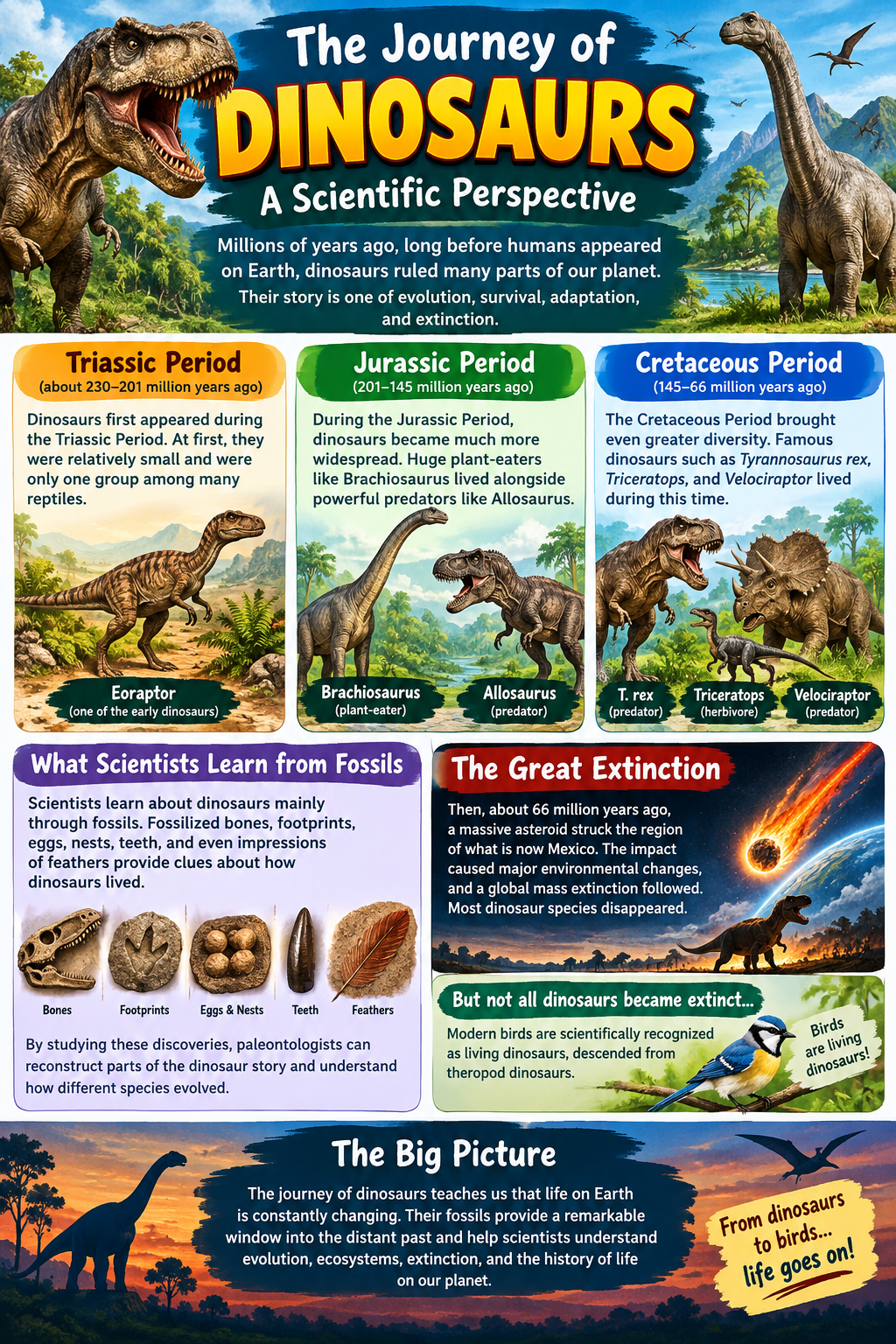
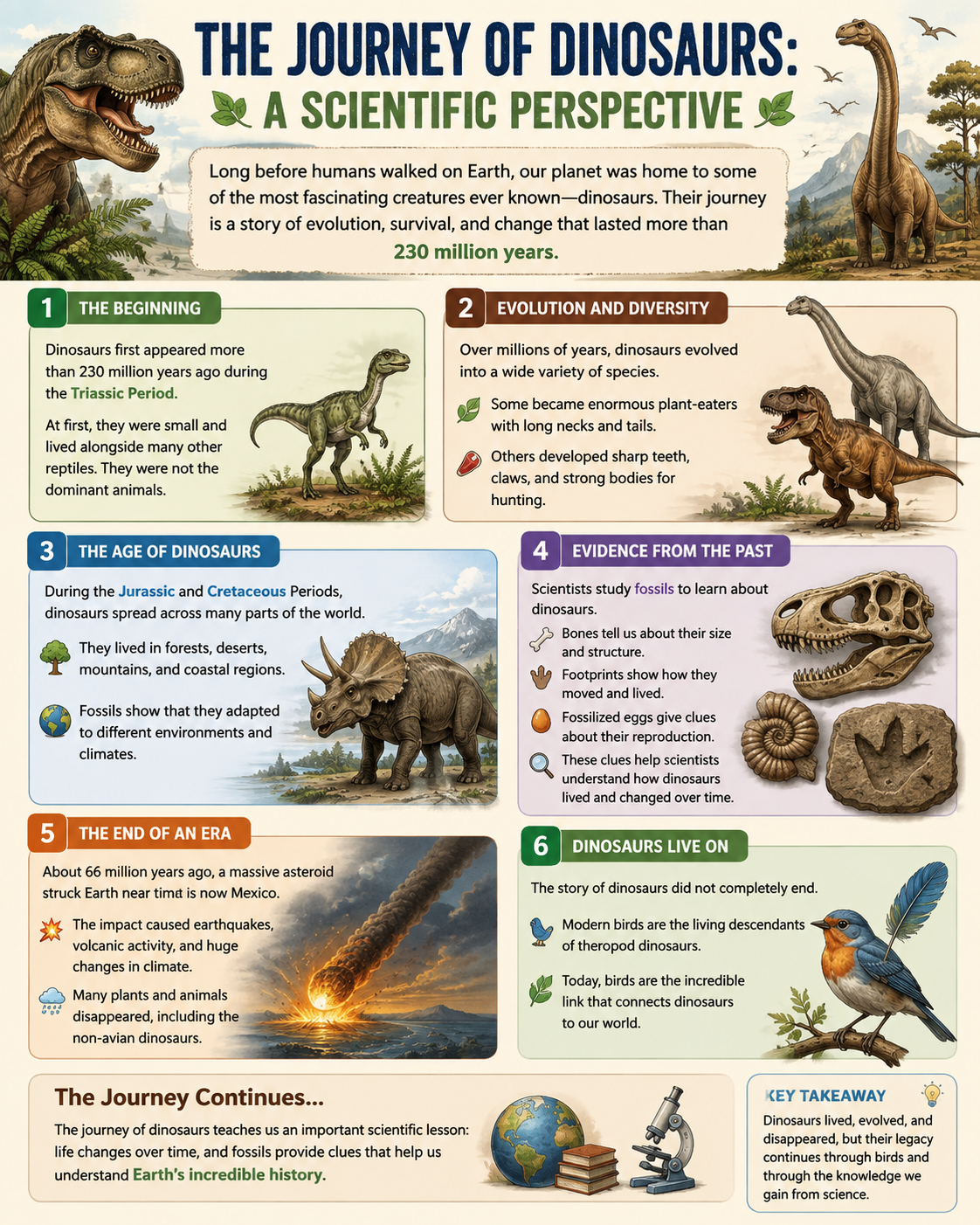
    Millions of years ago, long before humans appeared on Earth, dinosaurs ruled many parts of our planet. Their story is one of evolution, survival, adaptation, and extinction.

    Dinosaurs first appeared during the **Triassic Period, about 230 million years ago**. At first, they were relatively small and were only one group among many reptiles. Over millions of years, however, dinosaurs evolved into an incredible variety of species.

    During the **Jurassic Period**, dinosaurs became much more widespread. Huge plant-eating dinosaurs such as *Brachiosaurus* lived alongside powerful predators such as *Allosaurus*. Some dinosaurs developed long necks, sharp teeth, armor, horns, or other features that helped them survive in their environments.

    The **Cretaceous Period** brought even greater diversity. Famous dinosaurs such as *Tyrannosaurus rex*, *Triceratops*, and *Velociraptor* lived during this time. Scientists believe dinosaurs occupied many different habitats and had complex behaviors, including nesting, caring for young, hunting, and possibly communicating with one another.

    Scientists learn about dinosaurs mainly through **fossils**. Fossilized bones, footprints, eggs, nests, teeth, and even impressions of feathers provide clues about how dinosaurs lived. By studying these discoveries, paleontologists can reconstruct parts of the dinosaur story and understand how different species evolved.

    Then, about **66 million years ago**, a massive asteroid struck the region of what is now Mexico. The impact caused major environmental changes, and a global mass extinction followed. Most dinosaur species disappeared. However, not all dinosaurs became extinct.

    Modern birds are scientifically recognized as **living dinosaurs**, descended from theropod dinosaurs. This means that although non-avian dinosaurs such as *T. rex* are gone, their evolutionary legacy continues today in birds.

    The journey of dinosaurs teaches us that life on Earth is constantly changing. Their fossils provide a remarkable window into the distant past and help scientists understand evolution, ecosystems, extinction, and the history of life on our planet.
    Day:-48 rollno:-006 foundation level 📖 Story Post # 🦖 The Journey of Dinosaurs: A Scientific Perspective Millions of years ago, long before humans appeared on Earth, dinosaurs ruled many parts of our planet. Their story is one of evolution, survival, adaptation, and extinction. Dinosaurs first appeared during the **Triassic Period, about 230 million years ago**. At first, they were relatively small and were only one group among many reptiles. Over millions of years, however, dinosaurs evolved into an incredible variety of species. During the **Jurassic Period**, dinosaurs became much more widespread. Huge plant-eating dinosaurs such as *Brachiosaurus* lived alongside powerful predators such as *Allosaurus*. Some dinosaurs developed long necks, sharp teeth, armor, horns, or other features that helped them survive in their environments. The **Cretaceous Period** brought even greater diversity. Famous dinosaurs such as *Tyrannosaurus rex*, *Triceratops*, and *Velociraptor* lived during this time. Scientists believe dinosaurs occupied many different habitats and had complex behaviors, including nesting, caring for young, hunting, and possibly communicating with one another. Scientists learn about dinosaurs mainly through **fossils**. Fossilized bones, footprints, eggs, nests, teeth, and even impressions of feathers provide clues about how dinosaurs lived. By studying these discoveries, paleontologists can reconstruct parts of the dinosaur story and understand how different species evolved. Then, about **66 million years ago**, a massive asteroid struck the region of what is now Mexico. The impact caused major environmental changes, and a global mass extinction followed. Most dinosaur species disappeared. However, not all dinosaurs became extinct. Modern birds are scientifically recognized as **living dinosaurs**, descended from theropod dinosaurs. This means that although non-avian dinosaurs such as *T. rex* are gone, their evolutionary legacy continues today in birds. The journey of dinosaurs teaches us that life on Earth is constantly changing. Their fossils provide a remarkable window into the distant past and help scientists understand evolution, ecosystems, extinction, and the history of life on our planet.
    0 Commentaires 0 Parts 1414 Vue
  • RSIF8
    Roll No: 112
    Story Post No: 6
    Story Post Topic: The Journey of Dinosaurs: A Scientific Perspective
    **The Journey of Dinosaurs: A Scientific Perspective**
    Today, I completed an interesting and educational task about **The Journey of Dinosaurs: A Scientific Perspective**. This activity gave me the opportunity to explore the fascinating history of dinosaurs and understand how scientists learn about these incredible creatures that lived millions of years ago.
    Dinosaurs first appeared on Earth more than **230 million years ago** during the Triassic Period. Over millions of years, they evolved into many different species with different sizes, shapes, diets, and ways of living. Some dinosaurs were small and fast, while others were enormous plant-eaters.
    During the **Jurassic Period**, dinosaurs became even more diverse and widespread. They lived in many different environments and developed different adaptations that helped them survive. The **Cretaceous Period** was another important stage in their history, when many well-known dinosaur species lived.
    One of the most important things I learned is how scientists discover information about dinosaurs. Scientists study fossils such as bones, teeth, footprints, and eggs. They also examine rock layers and use different scientific methods to understand when dinosaurs lived and how they behaved.
    Dinosaurs had different diets. Some were **herbivores** that ate plants, while others were **carnivores** that ate other animals. There were also dinosaurs with more varied diets. Studying their teeth, bones, and fossil evidence helps scientists understand what they may have eaten.
    One of the most important events in dinosaur history happened about **66 million years ago**. A large asteroid struck Earth, causing major environmental and climate changes. This event contributed to the extinction of the non-avian dinosaurs.
    However, the dinosaur story did not completely end. Scientists have found strong evidence that **modern birds are living descendants of theropod dinosaurs**. This means that dinosaurs still have a living connection to the world today!
    This task helped me understand that fossils are like pieces of a giant scientific puzzle. Each fossil can provide clues about ancient life, and scientists carefully study these clues to build a better understanding of Earth's history.
    I also learned that science is constantly developing. New fossil discoveries, improved technology, and new research can help scientists learn more about dinosaurs and correct or improve our understanding of the past.
    **My key learning from this task:**
    Dinosaurs lived millions of years ago.
    Their history covered a huge period of Earth's history.
    Fossils provide important evidence about ancient life.
    Scientists use evidence and research to study dinosaurs.
    Dinosaurs had different diets and lifestyles.
    A major asteroid impact occurred around 66 million years ago.
    Birds are living descendants of theropod dinosaurs.
    Studying dinosaurs helps us understand Earth's changing environment.
    Overall, this task was a fascinating journey into the ancient world. It helped me appreciate the importance of science, fossils, research, and evidence in understanding our planet's past.
    The story of dinosaurs reminds us that Earth has changed dramatically over time and that life continues to evolve and adapt. Their fossils allow us to look into the distant past and discover how incredible the history of life on our planet really is.
    **Learning about the past helps us understand the present and inspires us to explore the future!**
    #RSIF8 #RollNo112 #Dinosaurs #DinosaurJourney #ScientificPerspective #DinosaurScience #Paleontology #Fossils #DinosaurFossils #AncientEarth #EarthHistory #ScienceLearning #ScientificDiscovery #Jurassic #Triassic #Cretaceous #Evolution #NaturalHistory #AncientLife #LearningJourney #StudentLearning #ScienceProject #Research #Curiosity #KeepLearning #LearnAndGrow #ScienceIsAmazing #HistoryOfLife #ExploreScience #Education
    RSIF8 Roll No: 112 Story Post No: 6 Story Post Topic: The Journey of Dinosaurs: A Scientific Perspective 🦕🌟 **The Journey of Dinosaurs: A Scientific Perspective** 🌟🦖 Today, I completed an interesting and educational task about **The Journey of Dinosaurs: A Scientific Perspective**. 🦖🔬📚 This activity gave me the opportunity to explore the fascinating history of dinosaurs and understand how scientists learn about these incredible creatures that lived millions of years ago. 🌍⏳ Dinosaurs first appeared on Earth more than **230 million years ago** during the Triassic Period. 🦕🌿 Over millions of years, they evolved into many different species with different sizes, shapes, diets, and ways of living. Some dinosaurs were small and fast, while others were enormous plant-eaters. 🦖🌱 During the **Jurassic Period**, dinosaurs became even more diverse and widespread. 🌎🦕 They lived in many different environments and developed different adaptations that helped them survive. The **Cretaceous Period** was another important stage in their history, when many well-known dinosaur species lived. 🦖🌿✨ One of the most important things I learned is how scientists discover information about dinosaurs. 🔬🦴 Scientists study fossils such as bones, teeth, footprints, and eggs. They also examine rock layers and use different scientific methods to understand when dinosaurs lived and how they behaved. 🧪🪨📖 Dinosaurs had different diets. 🌱🍖 Some were **herbivores** that ate plants, while others were **carnivores** that ate other animals. There were also dinosaurs with more varied diets. Studying their teeth, bones, and fossil evidence helps scientists understand what they may have eaten. 🦷🔬 One of the most important events in dinosaur history happened about **66 million years ago**. ☄️🌍 A large asteroid struck Earth, causing major environmental and climate changes. This event contributed to the extinction of the non-avian dinosaurs. 🌎⏳ However, the dinosaur story did not completely end. 🐦✨ Scientists have found strong evidence that **modern birds are living descendants of theropod dinosaurs**. This means that dinosaurs still have a living connection to the world today! 🦖➡️🐦🌍 This task helped me understand that fossils are like pieces of a giant scientific puzzle. 🧩🦴 Each fossil can provide clues about ancient life, and scientists carefully study these clues to build a better understanding of Earth's history. 🔬📚 I also learned that science is constantly developing. New fossil discoveries, improved technology, and new research can help scientists learn more about dinosaurs and correct or improve our understanding of the past. 🧠🔍🚀 ✨ **My key learning from this task:** 🦖 Dinosaurs lived millions of years ago. ⏳ Their history covered a huge period of Earth's history. 🦴 Fossils provide important evidence about ancient life. 🔬 Scientists use evidence and research to study dinosaurs. 🌱 Dinosaurs had different diets and lifestyles. ☄️ A major asteroid impact occurred around 66 million years ago. 🐦 Birds are living descendants of theropod dinosaurs. 🌍 Studying dinosaurs helps us understand Earth's changing environment. Overall, this task was a fascinating journey into the ancient world. 🦕🌍 It helped me appreciate the importance of science, fossils, research, and evidence in understanding our planet's past. 🔬📚✨ The story of dinosaurs reminds us that Earth has changed dramatically over time and that life continues to evolve and adapt. 🌱🌎🦖 Their fossils allow us to look into the distant past and discover how incredible the history of life on our planet really is. 🌟🔬 📚 **Learning about the past helps us understand the present and inspires us to explore the future!** 🚀🌍✨ #RSIF8 #RollNo112 #Dinosaurs #DinosaurJourney #ScientificPerspective #DinosaurScience #Paleontology #Fossils #DinosaurFossils #AncientEarth #EarthHistory #ScienceLearning #ScientificDiscovery #Jurassic #Triassic #Cretaceous #Evolution #NaturalHistory #AncientLife #LearningJourney #StudentLearning #ScienceProject #Research #Curiosity #KeepLearning #LearnAndGrow #ScienceIsAmazing #HistoryOfLife #ExploreScience #Education 🦖🦕🔬🦴🌍⏳☄️🐦🌱📚🧪🪨🧩💡✨🌟🚀🌿🌎❤️👏🎓
    0 Commentaires 0 Parts 3227 Vue
  • #rsisb
    Roll no.239
    Foundation Level

    Dinosaurs are among the most fascinating creatures that ever lived on Earth. Their story is a remarkable journey through millions of years of evolution, adaptation, survival, and extinction. Scientists study dinosaur fossils, footprints, and ancient environments to understand how these incredible animals lived and how they shaped the history of our planet.
    **The Beginning of the Dinosaur Era**
    Dinosaurs first appeared around **230 million years ago** during the **Mesozoic Era**. They evolved from early reptiles and quickly became one of the most successful groups of animals on Earth. Over time, they adapted to different environments, developing unique features that helped them survive.
    **The Age of Dinosaurs**
    The Mesozoic Era is often called the **"Age of Dinosaurs"** and lasted for more than 180 million years. It was divided into three major periods:
    **Triassic Period** (about 252–201 million years ago)
    The first dinosaurs appeared and began spreading across the planet. Small, fast-moving dinosaurs evolved during this time.
    **Jurassic Period** (about 201–145 million years ago)
    Dinosaurs became larger and more diverse. Giant plant-eaters like long-necked sauropods and powerful predators ruled many landscapes.
    **Cretaceous Period** (about 145–66 million years ago)
    Dinosaurs reached their greatest variety. Famous species such as **Tyrannosaurus rex** and **Triceratops** lived during this time.
    **How Scientists Study Dinosaurs**
    Scientists called **paleontologists** uncover clues from the past by studying:
    Fossilized bones
    Ancient footprints
    Dinosaur eggs
    Fossil plants
    Geological evidence
    These discoveries help researchers learn about dinosaur behavior, diets, movement, and habitats.
    **Dinosaur Adaptations and Survival**
    Dinosaurs developed amazing adaptations to survive:
    Sharp teeth for hunting
    Armor and horns for protection
    🪽 Feathers in some species
    Strong legs for movement
    Different feeding strategies
    Some dinosaurs evolved into birds, making modern birds the living descendants of these ancient creatures.
    **The Great Extinction Event**
    Around **66 million years ago**, a massive asteroid impact contributed to the extinction of many dinosaur species. This event changed life on Earth forever and opened opportunities for new groups of animals, including mammals, to expand.
    **The Scientific Importance of Dinosaurs**
    Studying dinosaurs helps scientists understand:
    How life evolves over time
    How Earth’s environments change
    How species adapt and survive
    How ancient ecosystems worked
    Dinosaurs remind us that life on Earth is constantly changing. Their story teaches us about resilience, adaptation, and the incredible history of our planet.
    **The journey of dinosaurs is not just a story of the past — it is a scientific window into the evolution of life itself.** See less
    #rsisb Roll no.239 Foundation Level Dinosaurs are among the most fascinating creatures that ever lived on Earth. Their story is a remarkable journey through millions of years of evolution, adaptation, survival, and extinction. 🌎🦕 Scientists study dinosaur fossils, footprints, and ancient environments to understand how these incredible animals lived and how they shaped the history of our planet. 🔍📚 🕰️ **The Beginning of the Dinosaur Era** 🌱🦖 Dinosaurs first appeared around **230 million years ago** during the **Mesozoic Era**. They evolved from early reptiles and quickly became one of the most successful groups of animals on Earth. Over time, they adapted to different environments, developing unique features that helped them survive. 🌿✨ 🌎 **The Age of Dinosaurs** 🦕🏞️ The Mesozoic Era is often called the **"Age of Dinosaurs"** and lasted for more than 180 million years. It was divided into three major periods: 🌋 **Triassic Period** (about 252–201 million years ago) ➡️ The first dinosaurs appeared and began spreading across the planet. Small, fast-moving dinosaurs evolved during this time. 🦎 🌿 **Jurassic Period** (about 201–145 million years ago) ➡️ Dinosaurs became larger and more diverse. Giant plant-eaters like long-necked sauropods and powerful predators ruled many landscapes. 🌳🦕 🔥 **Cretaceous Period** (about 145–66 million years ago) ➡️ Dinosaurs reached their greatest variety. Famous species such as **Tyrannosaurus rex** and **Triceratops** lived during this time. 🌎⚔️ 🔬 **How Scientists Study Dinosaurs** 🧪📖 Scientists called **paleontologists** uncover clues from the past by studying: 🦴 Fossilized bones 👣 Ancient footprints 🥚 Dinosaur eggs 🌿 Fossil plants 🏞️ Geological evidence These discoveries help researchers learn about dinosaur behavior, diets, movement, and habitats. 🔍✨ 🦖 **Dinosaur Adaptations and Survival** 💪🌱 Dinosaurs developed amazing adaptations to survive: 🦷 Sharp teeth for hunting 🛡️ Armor and horns for protection 🪽 Feathers in some species 🏃 Strong legs for movement 🌿 Different feeding strategies Some dinosaurs evolved into birds, making modern birds the living descendants of these ancient creatures. 🐦✨ ☄️ **The Great Extinction Event** 🌑🌍 Around **66 million years ago**, a massive asteroid impact contributed to the extinction of many dinosaur species. This event changed life on Earth forever and opened opportunities for new groups of animals, including mammals, to expand. 🌎💫 🌟 **The Scientific Importance of Dinosaurs** 🔬 Studying dinosaurs helps scientists understand: 🌱 How life evolves over time 🌍 How Earth’s environments change 🧬 How species adapt and survive 🔭 How ancient ecosystems worked Dinosaurs remind us that life on Earth is constantly changing. Their story teaches us about resilience, adaptation, and the incredible history of our planet. 🌎🦖 ✨ **The journey of dinosaurs is not just a story of the past — it is a scientific window into the evolution of life itself.** 🌟🔬 See less
    0 Commentaires 0 Parts 1837 Vue
  • Foundation level :-
    Day 41
    Roll:-005
    story post


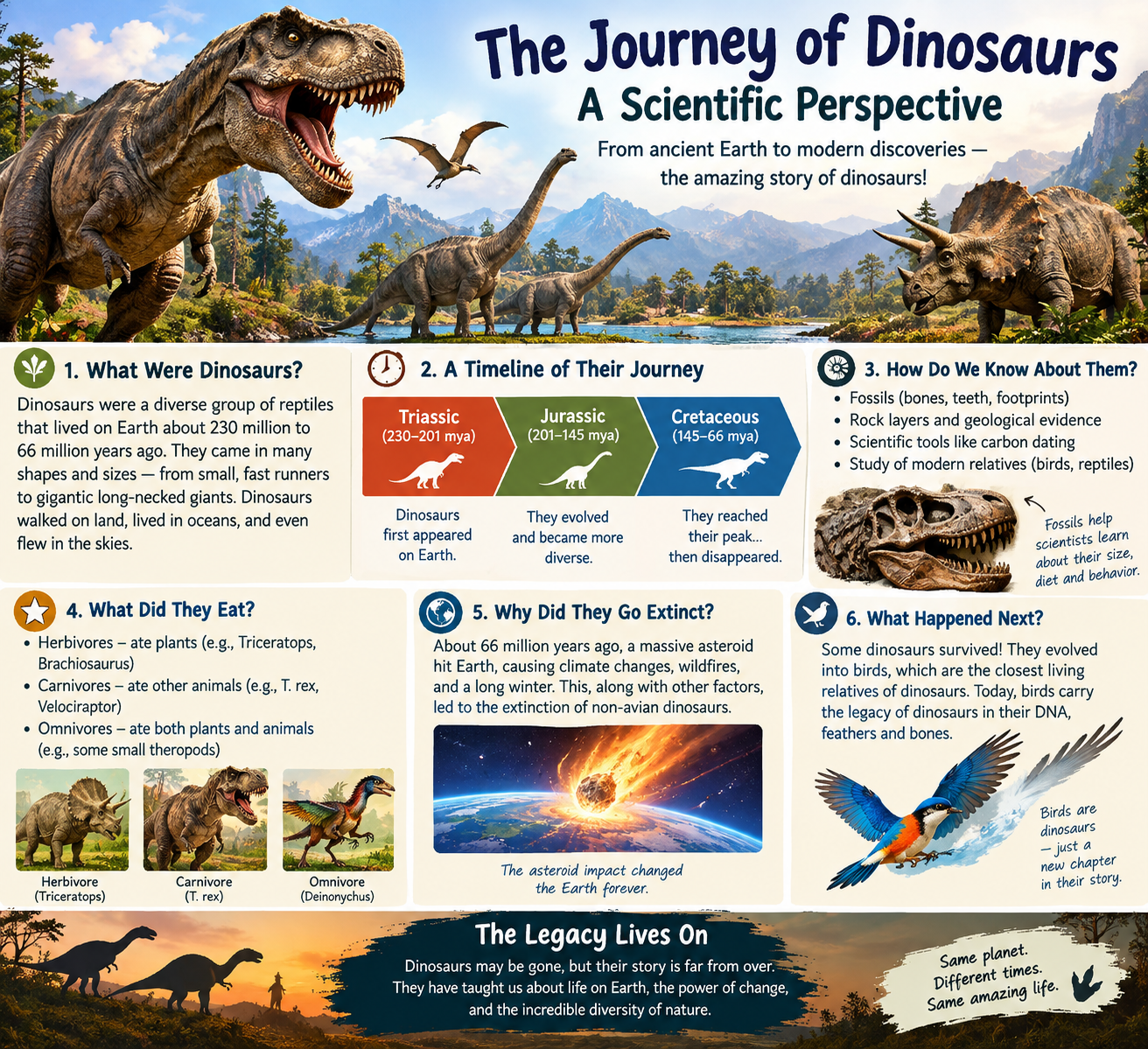
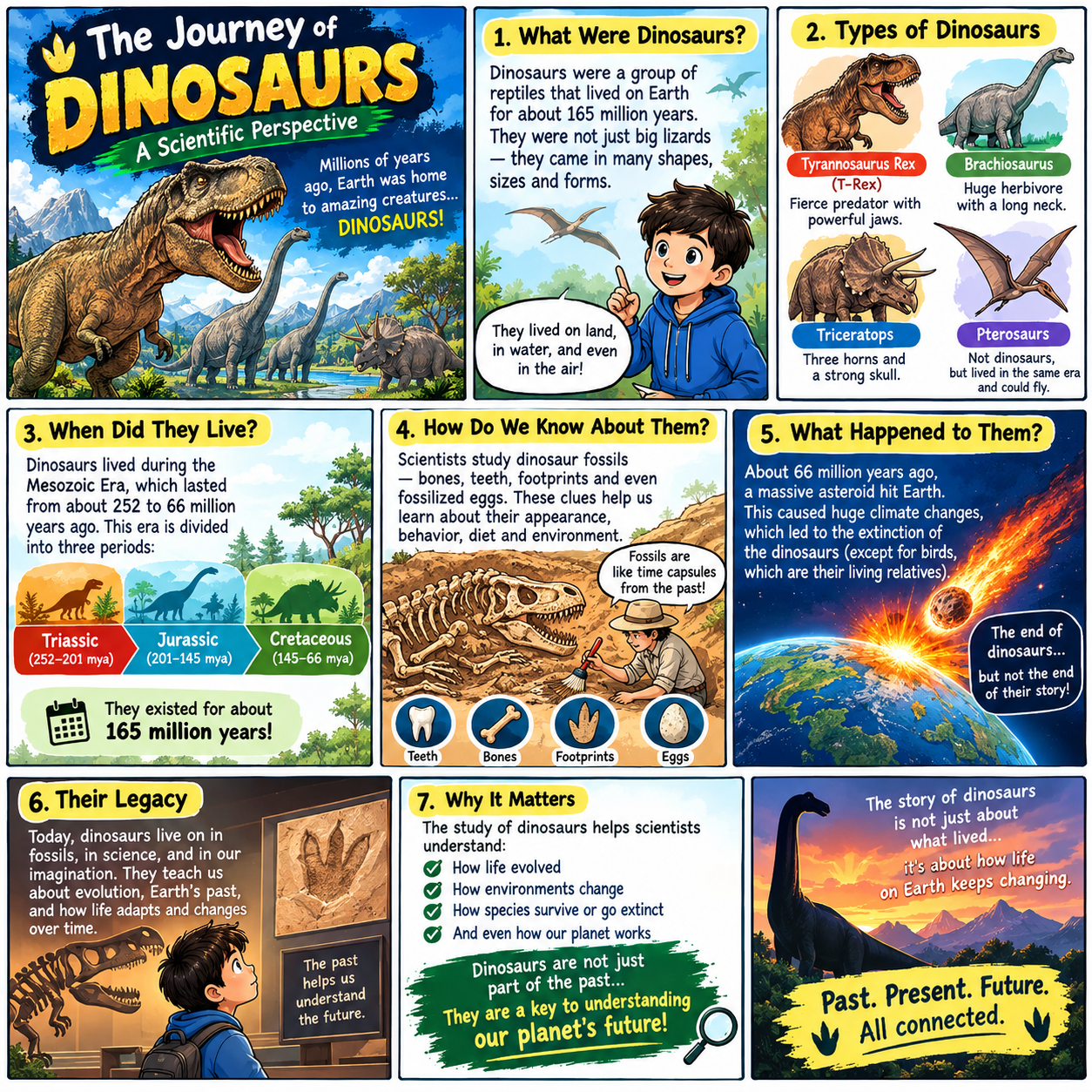
    **“The Journey of Dinosaurs: A Scientific Perspective”** is a colorful, comic-style educational post that takes viewers on an exciting journey through the prehistoric world of dinosaurs. The design combines **bright illustrations, bold headings, speech bubbles, timelines, and easy-to-understand scientific information**, making the topic fun and engaging for students and young learners.

    The post begins by introducing dinosaurs as an amazing group of animals that lived on Earth for millions of years. It explains that dinosaurs were not simply giant lizards—they appeared in many different **shapes, sizes, and forms**, from enormous plant-eating giants to powerful meat-eating predators.

    The comic introduces several famous prehistoric creatures, including **Tyrannosaurus rex, Brachiosaurus, and Triceratops**, while also explaining that **pterosaurs were flying reptiles rather than dinosaurs**. Each section uses colorful illustrations to help readers recognize the different creatures and understand how they lived.

    A timeline explains the **Mesozoic Era**, including the **Triassic, Jurassic, and Cretaceous periods**, showing how dinosaurs existed for an incredibly long period of Earth's history. Another section explains how scientists discover information about prehistoric life through **fossils, bones, teeth, footprints, and eggs**—almost like pieces of a giant puzzle from the past.

    The post also explores the dramatic end of the non-avian dinosaurs around **66 million years ago**, when a massive asteroid impact contributed to major environmental and climate changes. Importantly, the comic points out that **birds are living relatives of dinosaurs**, showing that the dinosaur story did not completely end.

    The final sections explain why studying dinosaurs matters today. Fossils and scientific research help us understand **evolution, changing environments, survival, extinction, and the history of our planet**. The overall message is that studying the past can help us understand the present and think about Earth's future.

    **Past. Present. Future. All connected.**
    **Explore the past. Understand life. Discover the future.**
    Foundation level :- Day 41 Roll:-005 story post **“The Journey of Dinosaurs: A Scientific Perspective”** is a colorful, comic-style educational post that takes viewers on an exciting journey through the prehistoric world of dinosaurs. The design combines **bright illustrations, bold headings, speech bubbles, timelines, and easy-to-understand scientific information**, making the topic fun and engaging for students and young learners. The post begins by introducing dinosaurs as an amazing group of animals that lived on Earth for millions of years. It explains that dinosaurs were not simply giant lizards—they appeared in many different **shapes, sizes, and forms**, from enormous plant-eating giants to powerful meat-eating predators. The comic introduces several famous prehistoric creatures, including **Tyrannosaurus rex, Brachiosaurus, and Triceratops**, while also explaining that **pterosaurs were flying reptiles rather than dinosaurs**. Each section uses colorful illustrations to help readers recognize the different creatures and understand how they lived. A timeline explains the **Mesozoic Era**, including the **Triassic, Jurassic, and Cretaceous periods**, showing how dinosaurs existed for an incredibly long period of Earth's history. Another section explains how scientists discover information about prehistoric life through **fossils, bones, teeth, footprints, and eggs**—almost like pieces of a giant puzzle from the past. The post also explores the dramatic end of the non-avian dinosaurs around **66 million years ago**, when a massive asteroid impact contributed to major environmental and climate changes. Importantly, the comic points out that **birds are living relatives of dinosaurs**, showing that the dinosaur story did not completely end. The final sections explain why studying dinosaurs matters today. Fossils and scientific research help us understand **evolution, changing environments, survival, extinction, and the history of our planet**. The overall message is that studying the past can help us understand the present and think about Earth's future. 🦕 **Past. Present. Future. All connected.** 🔬 **Explore the past. Understand life. Discover the future.**
    0 Commentaires 0 Parts 1569 Vue
  • RSIF8
    Roll no: 09
    Story post no:08
    Story post topic: Create a story post title The Journey of Dinosaurs: A Scientific Perspective.

    The Journey of Dinosaurs: A Scientific Perspective

    Step into the fascinating world of dinosaurs and explore their incredible journey through millions of years! From their beginnings and evolution to their extinction and the connection between dinosaurs and modern birds, this story shows how fossils help scientists uncover Earth’s amazing history.

    #Dinosaurs #DinosaurJourney #Science #Fossils #Evolution #EarthHistory #ScientificPerspective #Learning #Paleontology #HistoryOfEarth
    RSIF8 Roll no: 09 Story post no:08 Story post topic: Create a story post title The Journey of Dinosaurs: A Scientific Perspective. 🦖🌍 The Journey of Dinosaurs: A Scientific Perspective 🔬🦕 Step into the fascinating world of dinosaurs and explore their incredible journey through millions of years! From their beginnings and evolution to their extinction and the connection between dinosaurs and modern birds, this story shows how fossils help scientists uncover Earth’s amazing history. 🦴🌿✨ #Dinosaurs #DinosaurJourney #Science #Fossils #Evolution #EarthHistory #ScientificPerspective #Learning #Paleontology #HistoryOfEarth 🦖🔬🌍📚✨
    0 Commentaires 0 Parts 1116 Vue
  • RSIF8
    Roll no 68
    Task no 48
    Task topic; The Journey of Dinosaurs: A Scientific Perspective

    Step back in time and explore the incredible story of the dinosaurs! From their emergence over 230 million years ago to their extinction around 66 million years ago, these fascinating creatures ruled the Earth for millions of years.

    Through fossil discoveries and scientific research, we continue to uncover how dinosaurs lived, evolved, and adapted to changing environments. Their legacy lives on today, not only in museums and research but also through modern birds, which are their closest living descendants.

    Join us in discovering the wonders of prehistoric life and celebrating the power of science to reveal Earth's ancient past. Every fossil tells a story, and every discovery brings us one step closer to understanding the history of our planet.
    RSIF8 Roll no 68 Task no 48 Task topic; The Journey of Dinosaurs: A Scientific Perspective 🌍 Step back in time and explore the incredible story of the dinosaurs! From their emergence over 230 million years ago to their extinction around 66 million years ago, these fascinating creatures ruled the Earth for millions of years. Through fossil discoveries and scientific research, we continue to uncover how dinosaurs lived, evolved, and adapted to changing environments. Their legacy lives on today, not only in museums and research but also through modern birds, which are their closest living descendants. Join us in discovering the wonders of prehistoric life and celebrating the power of science to reveal Earth's ancient past. Every fossil tells a story, and every discovery brings us one step closer to understanding the history of our planet.
    0 Commentaires 0 Parts 817 Vue
  • #rsisb
    Roll No.269
    Foundation Level
    Story Post No.7


    # The Journey of Dinosaurs: A Scientific Perspective

    Dinosaurs are some of the most fascinating creatures to ever walk on Earth. In this video, **“The Journey of Dinosaurs: A Scientific Perspective,”** we explore their incredible history through the lens of science and discover how these remarkable animals lived, evolved, and eventually disappeared.

    From their origins millions of years ago to the rise of famous dinosaurs such as **Tyrannosaurus rex, Triceratops, Stegosaurus, and Velociraptor**, we take a journey through prehistoric Earth. We’ll learn how scientists use fossils, rocks, footprints, and other evidence to understand the lives of dinosaurs and reconstruct their ancient world.

    The video also explores dinosaur evolution, their different habitats, diets, behaviors, and the changing environment of prehistoric Earth. Scientists have discovered that dinosaurs were incredibly diverse, ranging from small feathered species to enormous plant-eating giants.

    We’ll also look at one of the biggest mysteries in Earth’s history: **what caused the extinction of most dinosaurs about 66 million years ago?** By examining scientific evidence, we can better understand the asteroid impact and the environmental changes that played a major role in the end of the non-avian dinosaurs.

    But the story of dinosaurs did not completely end. Modern birds are considered living dinosaurs, meaning that part of the dinosaur story continues today!

    Join us on this exciting scientific journey through millions of years of history and discover how dinosaurs changed our understanding of life on Earth.

    Like the video
    Share your thoughts in the comments
    Subscribe for more educational and science content!

    #Dinosaurs #DinosaurHistory #Science #Paleontology #PrehistoricLife #DinosaurEvolution #TyrannosaurusRex #Fossils #EarthHistory #Jurassic #Cretaceous #ScienceEducation #AncientWorld #Extinction #Learning

    #rsisb Roll No.269 Foundation Level Story Post No.7 # The Journey of Dinosaurs: A Scientific Perspective 🦖🌍🔬 Dinosaurs are some of the most fascinating creatures to ever walk on Earth. In this video, **“The Journey of Dinosaurs: A Scientific Perspective,”** we explore their incredible history through the lens of science and discover how these remarkable animals lived, evolved, and eventually disappeared. From their origins millions of years ago to the rise of famous dinosaurs such as **Tyrannosaurus rex, Triceratops, Stegosaurus, and Velociraptor**, we take a journey through prehistoric Earth. 🌋🦕 We’ll learn how scientists use fossils, rocks, footprints, and other evidence to understand the lives of dinosaurs and reconstruct their ancient world. The video also explores dinosaur evolution, their different habitats, diets, behaviors, and the changing environment of prehistoric Earth. 🌿🌋 Scientists have discovered that dinosaurs were incredibly diverse, ranging from small feathered species to enormous plant-eating giants. We’ll also look at one of the biggest mysteries in Earth’s history: **what caused the extinction of most dinosaurs about 66 million years ago?** ☄️🌍 By examining scientific evidence, we can better understand the asteroid impact and the environmental changes that played a major role in the end of the non-avian dinosaurs. But the story of dinosaurs did not completely end. Modern birds are considered living dinosaurs, meaning that part of the dinosaur story continues today! 🐦🦖 Join us on this exciting scientific journey through millions of years of history and discover how dinosaurs changed our understanding of life on Earth. 👍 Like the video 💬 Share your thoughts in the comments 🔔 Subscribe for more educational and science content! #Dinosaurs #DinosaurHistory #Science #Paleontology #PrehistoricLife #DinosaurEvolution #TyrannosaurusRex #Fossils #EarthHistory #Jurassic #Cretaceous #ScienceEducation #AncientWorld #Extinction #Learning 🦖🔬🌍
    0 Commentaires 0 Parts 4129 Vue
Plus de résultats