• #rsisb
    Roll No.247
    foundation level
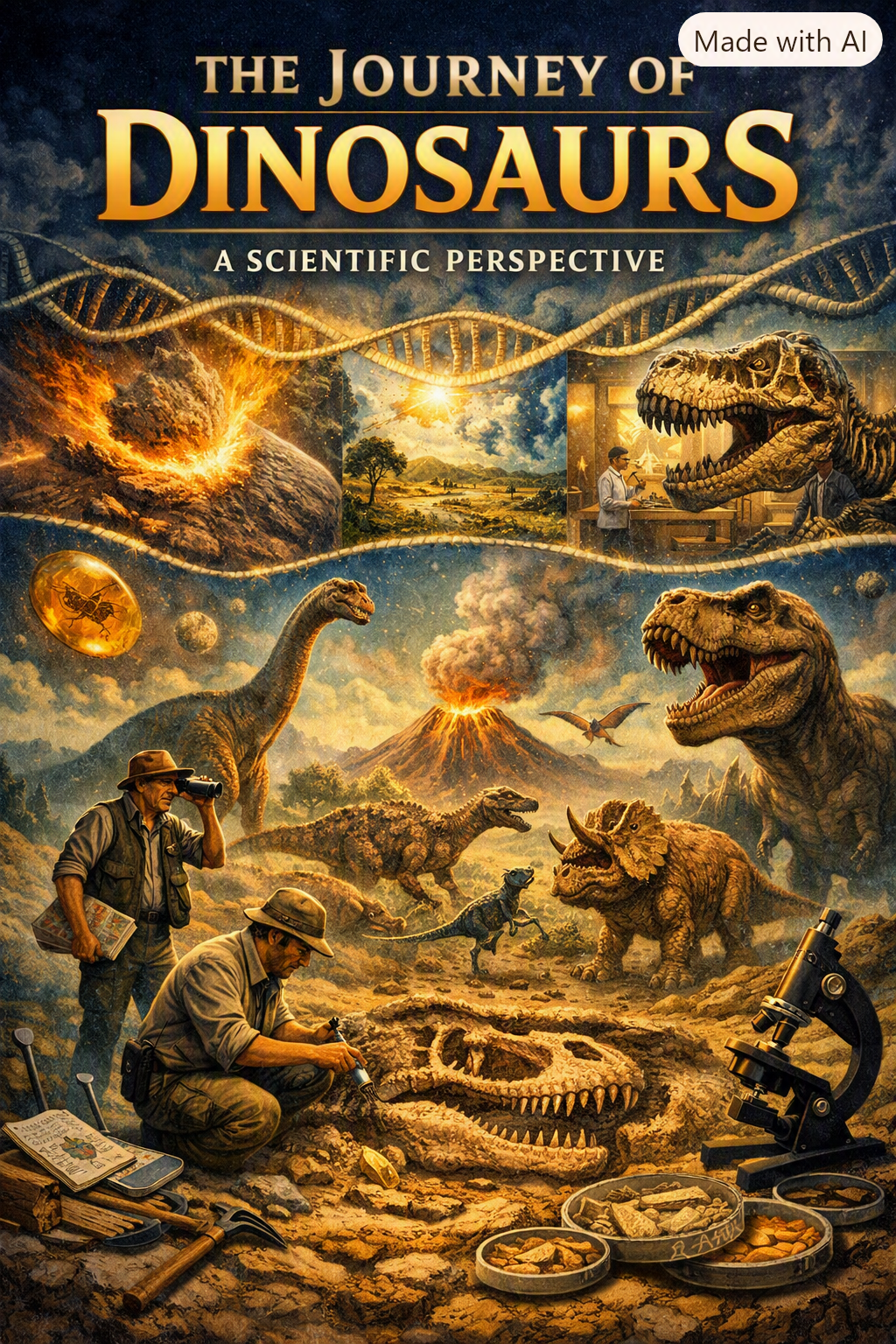
    # The Journey of Dinosaurs: A Scientific Perspective

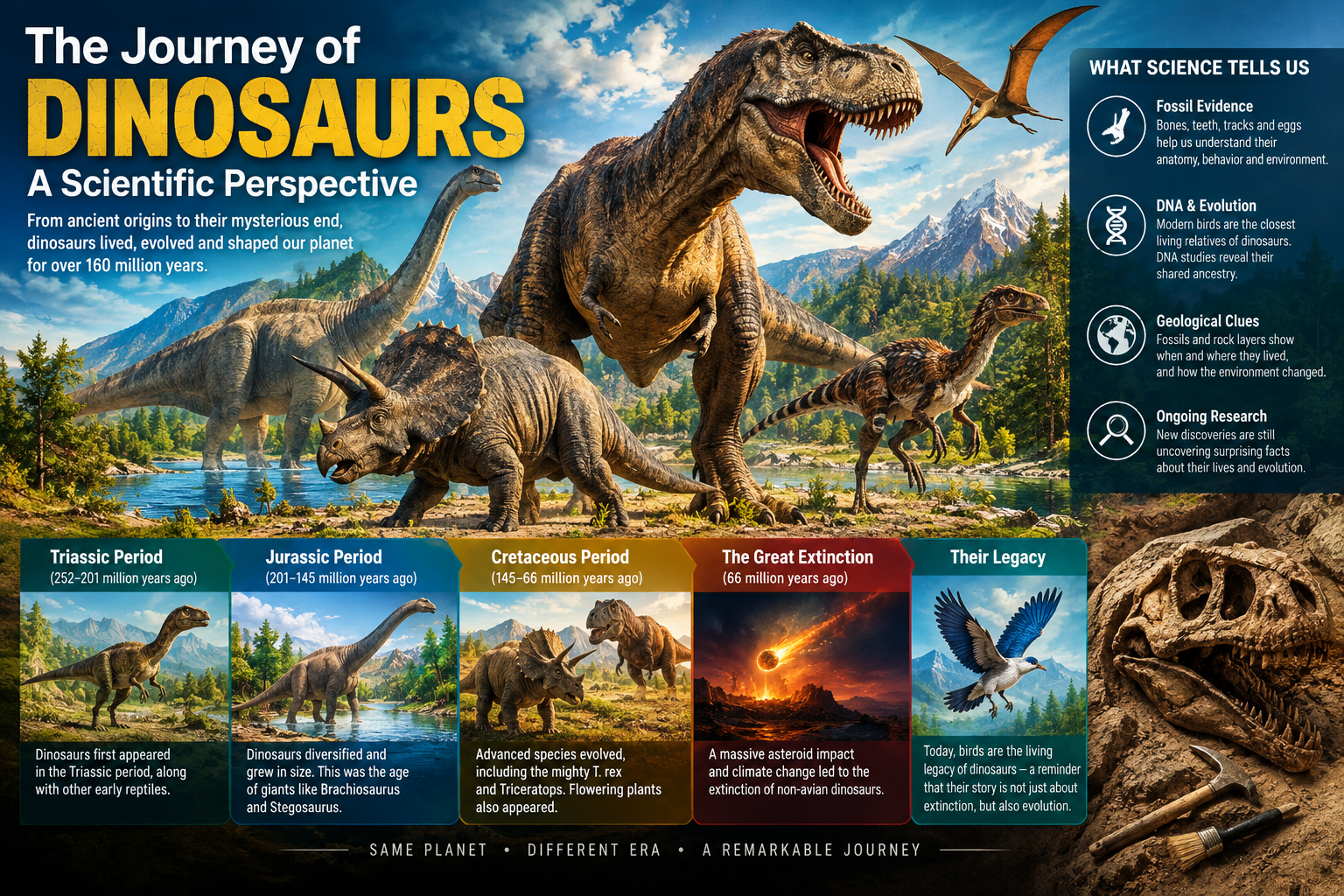
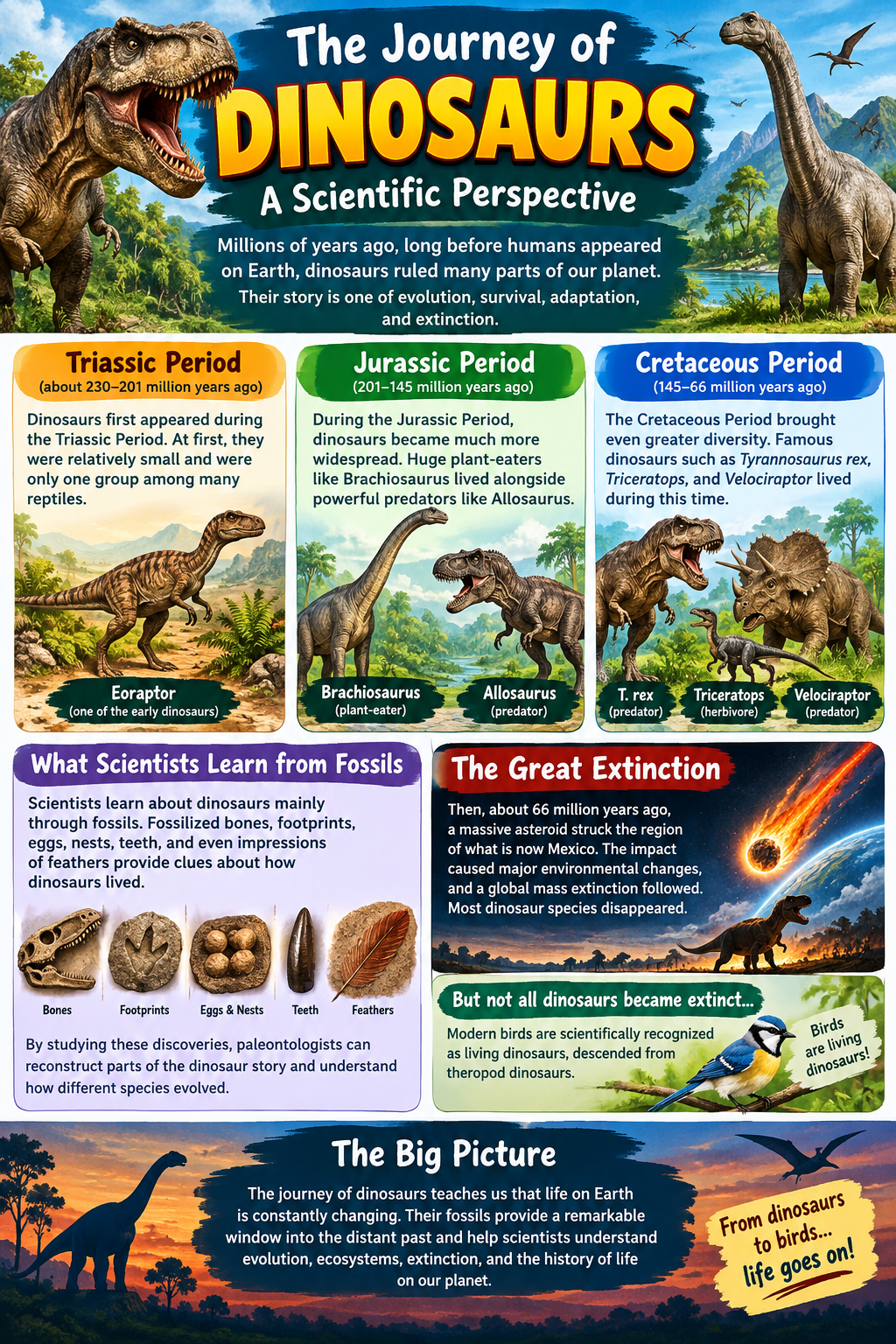
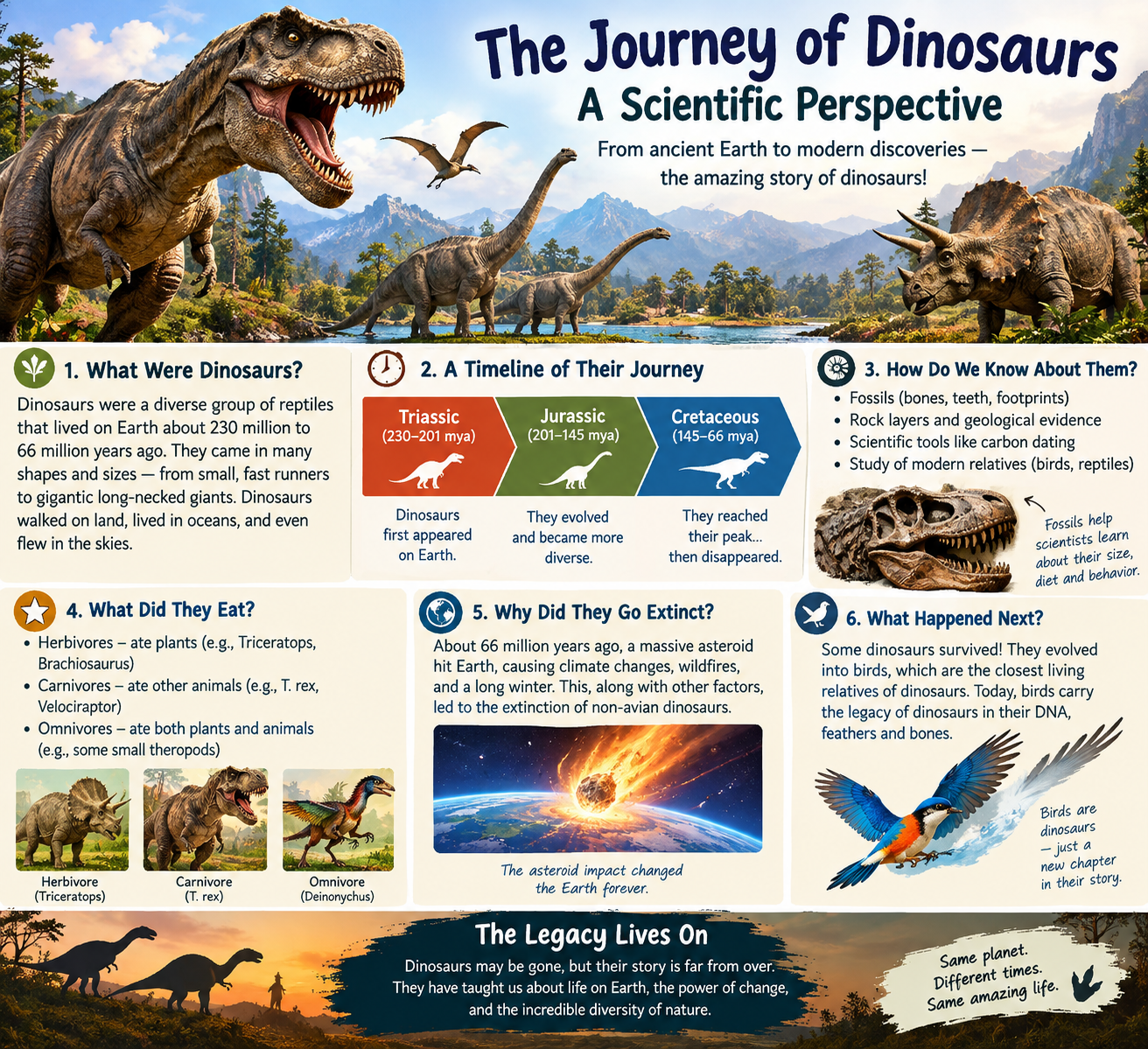
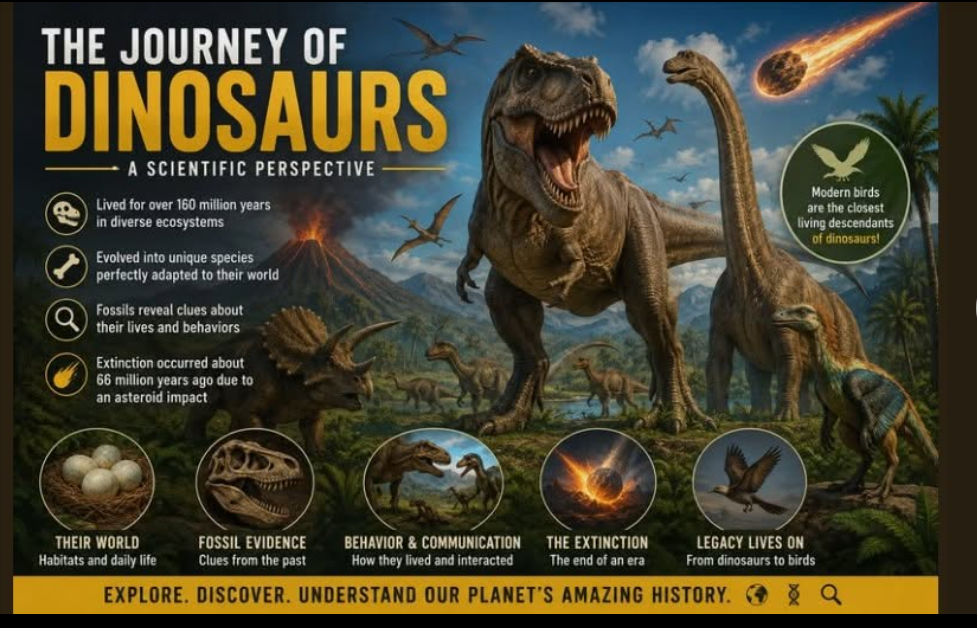
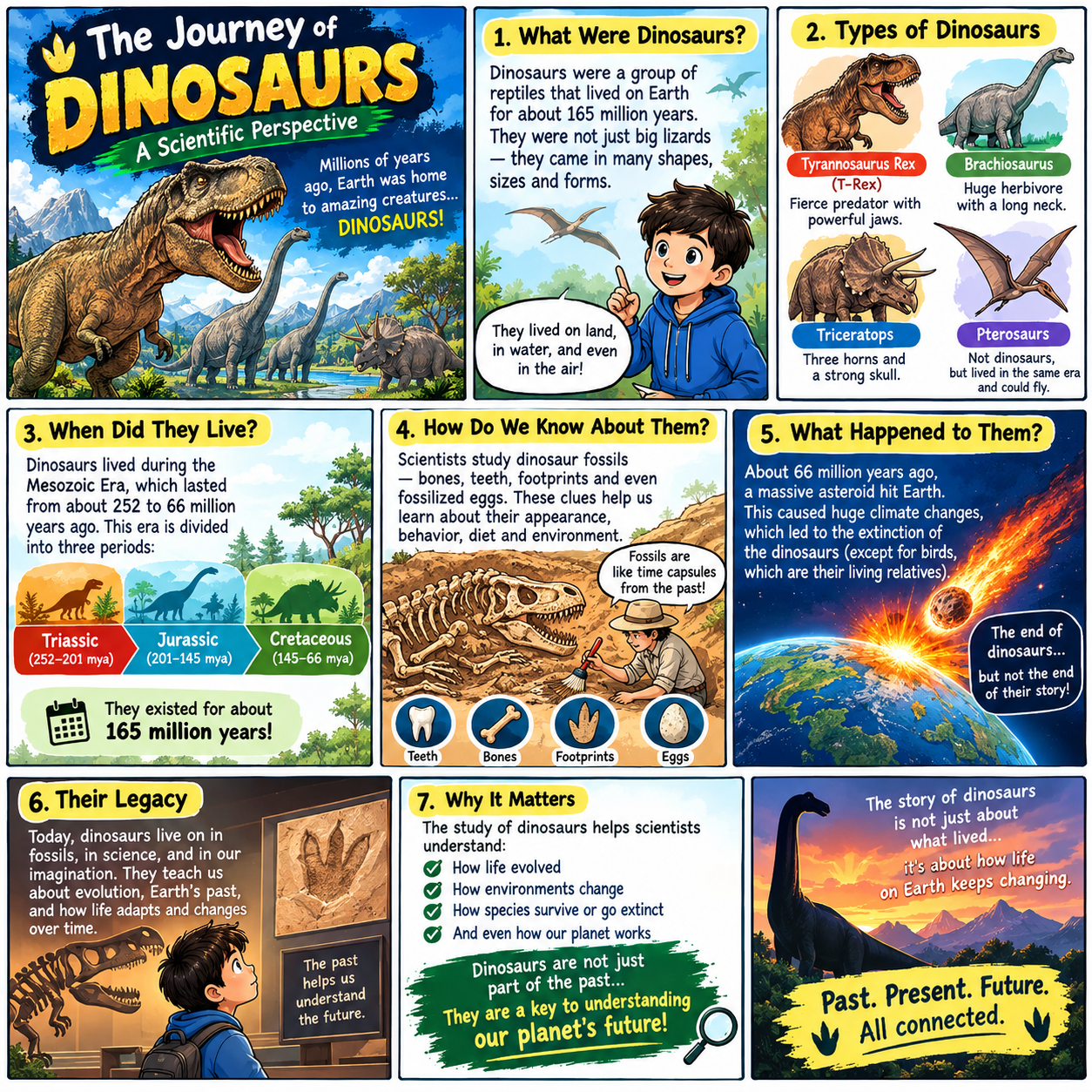
    Step into the fascinating world of dinosaurs and explore one of the most remarkable chapters in the history of life on Earth! Dinosaurs ruled many of the planet’s ecosystems for more than 160 million years, appearing during the Triassic Period and continuing through the Jurassic and Cretaceous Periods. Their incredible diversity included enormous plant-eaters, powerful predators, swift hunters, armored species, and many other extraordinary creatures.

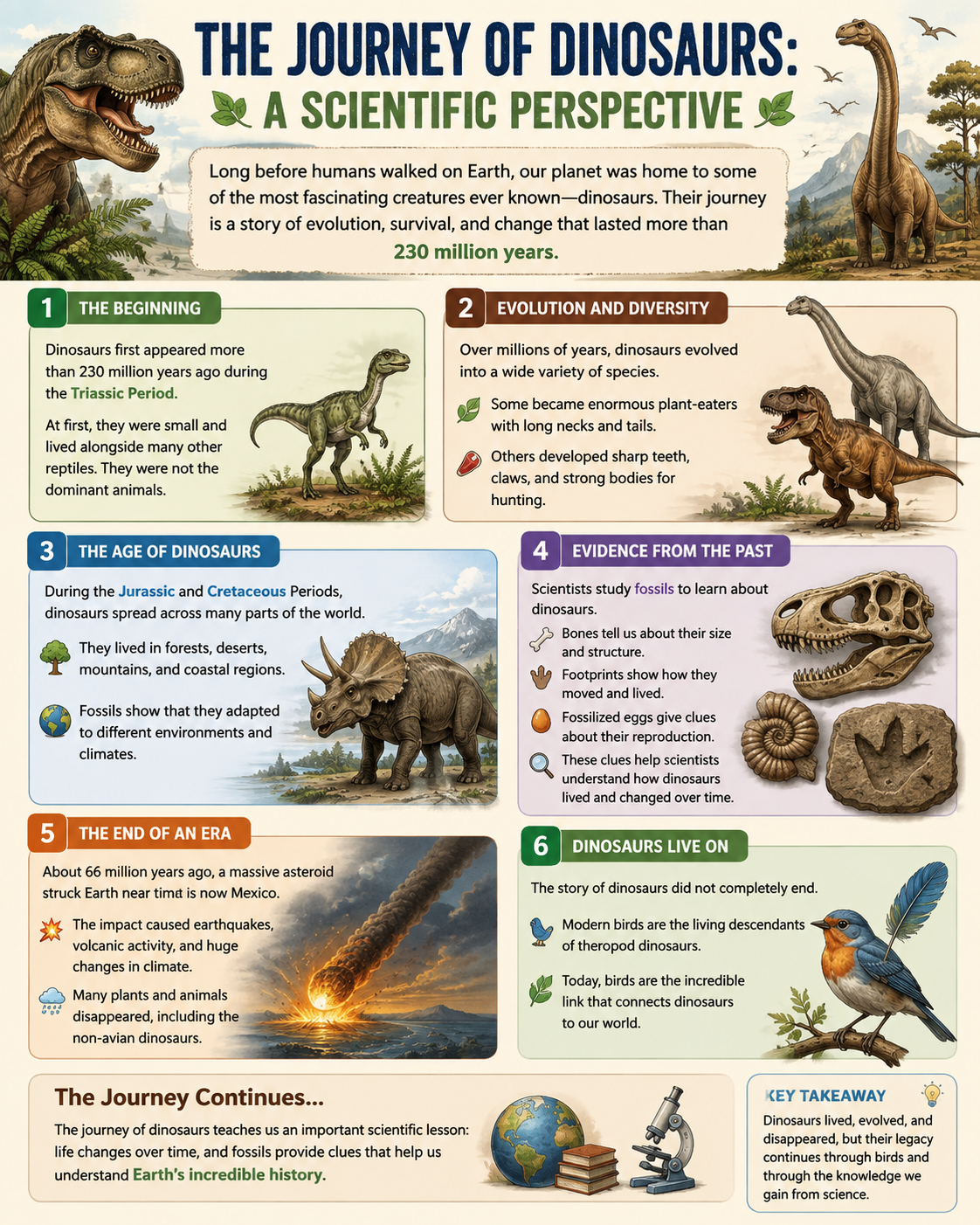
    From a scientific perspective, the story of dinosaurs is not simply a tale of giant creatures—it is a story of evolution, adaptation, survival, extinction, and discovery. Scientists learn about dinosaurs through fossils, including bones, teeth, footprints, eggs, nests, and even traces of skin and feathers. By carefully studying these clues, paleontologists can reconstruct how dinosaurs lived, what they ate, how they moved, and how different species changed over millions of years.

    Dinosaurs first appeared roughly 230 million years ago. Over time, they adapted to changing environments and became one of the most successful groups of land animals in Earth's history. Some developed long necks and enormous bodies to reach vegetation, while others evolved sharp teeth and strong jaws for hunting. Their fossils have been discovered on every continent, showing just how widely they were distributed.

    The Jurassic Period is often remembered as a time when giant dinosaurs became especially prominent. Huge sauropods walked across ancient landscapes, while theropods hunted or scavenged. During the Cretaceous Period, dinosaurs continued to diversify, and many familiar species appeared. At the same time, flowering plants became increasingly important parts of many ecosystems.

    One of the most important scientific discoveries is that birds are living dinosaurs. Evidence from fossils, anatomy, and evolutionary studies shows that modern birds descended from theropod dinosaurs. This means that although non-avian dinosaurs disappeared from the fossil record about 66 million years ago, the dinosaur lineage continues today in the form of birds.

    The end of the Cretaceous Period brought a dramatic change. A large asteroid struck what is now the Yucatán Peninsula, contributing to major environmental disruptions around the world. This event, together with other environmental changes, played a major role in the extinction of non-avian dinosaurs. However, many other organisms survived, including early mammals, reptiles, and birds.

    Today, dinosaur research continues to evolve. New fossils, improved imaging technologies, computer modeling, and advances in genetics and evolutionary biology are helping scientists understand these ancient animals more accurately. Every newly discovered fossil can provide another piece of the enormous puzzle of Earth's past.

    The journey of dinosaurs reminds us that Earth has changed dramatically over geological time. Their story teaches us about adaptation, biodiversity, environmental change, and extinction. Most importantly, it shows how scientific evidence can help us understand a world that existed millions of years before humans appeared.

    Whether you are fascinated by enormous herbivores, fearsome predators, ancient ecosystems, or the origins of modern birds, the scientific journey of dinosaurs offers endless opportunities for discovery. Their fossils connect us to a distant past and inspire scientists, students, and curious minds to keep asking questions about the incredible history of life on our planet.

    #Dinosaurs #DinosaurJourney #Paleontology #Science #Fossils #Evolution #EarthHistory #JurassicPeriod #CretaceousPeriod #TriassicPeriod #DinosaurScience #AncientEarth #NaturalHistory #PrehistoricLife #ScientificDiscovery #Paleontologist #Biodiversity #Extinction #BirdsAreDinosaurs #LearnScience #ScienceEducation
    #rsisb Roll No.247 foundation level # The Journey of Dinosaurs: A Scientific Perspective 🦖🌍🔬 Step into the fascinating world of dinosaurs and explore one of the most remarkable chapters in the history of life on Earth! 🌎🦕 Dinosaurs ruled many of the planet’s ecosystems for more than 160 million years, appearing during the Triassic Period and continuing through the Jurassic and Cretaceous Periods. Their incredible diversity included enormous plant-eaters, powerful predators, swift hunters, armored species, and many other extraordinary creatures. 🦴✨ From a scientific perspective, the story of dinosaurs is not simply a tale of giant creatures—it is a story of evolution, adaptation, survival, extinction, and discovery. Scientists learn about dinosaurs through fossils, including bones, teeth, footprints, eggs, nests, and even traces of skin and feathers. 🔬🦴 By carefully studying these clues, paleontologists can reconstruct how dinosaurs lived, what they ate, how they moved, and how different species changed over millions of years. Dinosaurs first appeared roughly 230 million years ago. 🌋🌿 Over time, they adapted to changing environments and became one of the most successful groups of land animals in Earth's history. Some developed long necks and enormous bodies to reach vegetation, while others evolved sharp teeth and strong jaws for hunting. 🦕🌱🦖 Their fossils have been discovered on every continent, showing just how widely they were distributed. The Jurassic Period is often remembered as a time when giant dinosaurs became especially prominent. 🌴☀️ Huge sauropods walked across ancient landscapes, while theropods hunted or scavenged. During the Cretaceous Period, dinosaurs continued to diversify, and many familiar species appeared. At the same time, flowering plants became increasingly important parts of many ecosystems. 🌸🦖 One of the most important scientific discoveries is that birds are living dinosaurs. 🐦🦕 Evidence from fossils, anatomy, and evolutionary studies shows that modern birds descended from theropod dinosaurs. This means that although non-avian dinosaurs disappeared from the fossil record about 66 million years ago, the dinosaur lineage continues today in the form of birds. 🌍🔬 The end of the Cretaceous Period brought a dramatic change. A large asteroid struck what is now the Yucatán Peninsula, contributing to major environmental disruptions around the world. 🌠🌎 This event, together with other environmental changes, played a major role in the extinction of non-avian dinosaurs. However, many other organisms survived, including early mammals, reptiles, and birds. Today, dinosaur research continues to evolve. 🧑‍🔬🔎 New fossils, improved imaging technologies, computer modeling, and advances in genetics and evolutionary biology are helping scientists understand these ancient animals more accurately. Every newly discovered fossil can provide another piece of the enormous puzzle of Earth's past. 🦴🧩 The journey of dinosaurs reminds us that Earth has changed dramatically over geological time. 🌎⏳ Their story teaches us about adaptation, biodiversity, environmental change, and extinction. Most importantly, it shows how scientific evidence can help us understand a world that existed millions of years before humans appeared. Whether you are fascinated by enormous herbivores, fearsome predators, ancient ecosystems, or the origins of modern birds, the scientific journey of dinosaurs offers endless opportunities for discovery. 🦖🔬🌿 Their fossils connect us to a distant past and inspire scientists, students, and curious minds to keep asking questions about the incredible history of life on our planet. 🌍✨ #Dinosaurs 🦖 #DinosaurJourney 🦕 #Paleontology 🔬 #Science 🧪 #Fossils 🦴 #Evolution 🧬 #EarthHistory 🌍 #JurassicPeriod 🌿 #CretaceousPeriod 🌋 #TriassicPeriod 🌎 #DinosaurScience 🔎 #AncientEarth ⏳ #NaturalHistory 🏞️ #PrehistoricLife 🦕 #ScientificDiscovery 💡 #Paleontologist 🧑‍🔬 #Biodiversity 🌱 #Extinction 🌠 #BirdsAreDinosaurs 🐦 #LearnScience 📚 #ScienceEducation 🔬✨
    0 Комментарии 0 Поделились 196 Просмотры
  • #rsisb
    Roll No.240
    Story Post No.7
    Foundation Level

    **The Journey of Dinosaurs: A Scientific Perspective**

    Step back in time and explore the incredible world of dinosaurs! From their rise over 230 million years ago to their dominance across the Earth and their mysterious extinction, this video takes you on a fascinating scientific journey through prehistoric life.

    Discover how dinosaurs evolved, what they ate, how they lived, and what modern fossils reveal about these extraordinary creatures. Whether you're a student, a science enthusiast, or simply curious about Earth's ancient past, this video offers an exciting and educational adventure.

    If you enjoyed this video, don't forget to **Like**, **Share**, and **Subscribe** for more amazing science and history content!

    #Dinosaurs #Science #PrehistoricLife #Fossils #Paleontology #EarthHistory #EducationalVideo #Nature #Learning #AncientWorld #Discovery #YouTubeEducation

    Rehan School Islamabad Campus
    Asma Shaheen EducationWali
    Irum Asim
    Saima Happinesswali
    #rsisb Roll No.240 Story Post No.7 Foundation Level 🦖 **The Journey of Dinosaurs: A Scientific Perspective** 🌍 Step back in time and explore the incredible world of dinosaurs! From their rise over 230 million years ago to their dominance across the Earth and their mysterious extinction, this video takes you on a fascinating scientific journey through prehistoric life. Discover how dinosaurs evolved, what they ate, how they lived, and what modern fossils reveal about these extraordinary creatures. Whether you're a student, a science enthusiast, or simply curious about Earth's ancient past, this video offers an exciting and educational adventure. 👍 If you enjoyed this video, don't forget to **Like**, **Share**, and **Subscribe** for more amazing science and history content! #Dinosaurs 🦖 #Science 🔬 #PrehistoricLife 🌍 #Fossils 🦴 #Paleontology #EarthHistory #EducationalVideo 📚 #Nature #Learning #AncientWorld #Discovery #YouTubeEducation Rehan School Islamabad Campus Asma Shaheen EducationWali Irum Asim Saima Happinesswali
    0 Комментарии 0 Поделились 472 Просмотры

  • #rsisb
    Roll no. 214
    Foundation level
    Story post no. 9
    The Journey of Dinosaurs: A Scientific Perspective**
    Step back in time and explore the incredible world of dinosaurs! From their rise over 230 million years ago to their dominance of Earth and their eventual extinction, dinosaurs remain one of science's greatest mysteries. Fossils, footprints, and modern research continue to reveal fascinating insights into their lives, evolution, and the ancient environments they called home. Join us as we uncover the scientific story of these extraordinary creatures and discover how they shaped the history of our planet.
    Science helps us understand the past, inspires curiosity, and reminds us that our planet has an amazing history waiting to be explored!
    **#Dinosaurs #Science #Paleontology #Fossils #EarthHistory #Jurassic #Cretaceous #PrehistoricLife #Evolution #STEM #ScienceEducation #Nature #History #Learning #Discovery #AncientWorld #Geology #EducationalContent #ExploreScience #Knowledge
    #rsisb Roll no. 214 Foundation level Story post no. 9 The Journey of Dinosaurs: A Scientific Perspective** Step back in time and explore the incredible world of dinosaurs! From their rise over 230 million years ago to their dominance of Earth and their eventual extinction, dinosaurs remain one of science's greatest mysteries. Fossils, footprints, and modern research continue to reveal fascinating insights into their lives, evolution, and the ancient environments they called home. Join us as we uncover the scientific story of these extraordinary creatures and discover how they shaped the history of our planet. Science helps us understand the past, inspires curiosity, and reminds us that our planet has an amazing history waiting to be explored! **#Dinosaurs #Science #Paleontology #Fossils #EarthHistory #Jurassic #Cretaceous #PrehistoricLife #Evolution #STEM #ScienceEducation #Nature #History #Learning #Discovery #AncientWorld #Geology #EducationalContent #ExploreScience #Knowledge
    0 Комментарии 0 Поделились 3438 Просмотры
  • What Version of Humanity Are We Living In?

    Let’s break it down like a cosmic software update:

    Humanity v7.0 – Probably.
    But depending on the framework you choose, it could be v5.0, v12.0, or v∞.

    Let me show you the different models used to version humanity


    1. Islamic/Abrahamic View:
    • Adam (عليه السلام) was the first man, so this is technically Humanity v1.0
    • BUT… many Islamic scholars (like Ibn Abbas, Ibn Kathir) mention many creations of mankind before Adam
    Some even say: Adam was the first of this cycle, but there were other Adams before him

    Implication:
    We might be in Humanity v5.0 or v7.0 in God’s cosmic cycles

    Qur’an (2:30) says:
    “I am placing a khalifah (successor) on Earth.”
    The angels reply:
    “Will You place one who causes corruption?”
    ➤ This implies: they’ve seen this before…


    2. Hindu View: Cyclical Yugas
    • Time is cyclical, not linear
    • We are currently in Kali Yuga — the darkest, most corrupt era
    • After this, a reboot begins again with Satya Yuga (Golden Age)

    Implication:
    We’re in version 4 of a 4-part cycle, like living in a beta test before the full reboot


    3. Ancient Alien / Sumerian View
    • Humanity was created, destroyed, reengineered
    • Floods, resets, extinction events (Atlantis, Lemuria, etc.)
    • The Sumerian king list shows rulers who reigned for 10,000+ years — pre-flood “superhumans”

    Implication:
    We’re in Humanity v4.2 — Post-Flood Patch


    4. Modern Scientific View (Evolutionary)
    • Homo sapiens = around 300,000 years old
    • Before that: Neanderthals, Homo erectus, Denisovans — all versions before us
    • We’ve had multiple “releases” — now upgraded with ChatGPT

    Implication:
    We’re Homo Sapiens v3.1, now merging with AI to become Homo Techno-Deus


    5. Spiritual / New Age View
    • 1st Dimension: Atoms
    • 2nd Dimension: Life
    • 3rd: Ego/Materiality (us)
    • 4th: Awakening
    • 5th: Unity Consciousness

    Implication:
    We are currently shifting from 3D → 4D → 5D
    Welcome to Humanity v5.0 Beta: Spirit Meets Silicon


    So, What Version Are We In?

    Rehan Version of Truth™:

    We’re probably living in Humanity v6 or v7,
    a civilization that’s halfway between beast and divine,
    struggling with ego, but flirting with enlightenment.

    We’re downloading divine upgrades,
    but still stuck with some corrupted tribal files.


    Bonus Thought:

    Maybe the real goal isn’t versioning…

    Maybe it’s to become version-less —
    To awaken, ascend, and finally realize we are the software,
    the hardware, and the programmer.
    🌍 What Version of Humanity Are We Living In? Let’s break it down like a cosmic software update: 🧬 Humanity v7.0 – Probably. But depending on the framework you choose, it could be v5.0, v12.0, or v∞. Let me show you the different models used to version humanity 👇 ⸻ 🕰️ 1. Islamic/Abrahamic View: • Adam (عليه السلام) was the first man, so this is technically Humanity v1.0 • BUT… many Islamic scholars (like Ibn Abbas, Ibn Kathir) mention many creations of mankind before Adam • 👀 Some even say: Adam was the first of this cycle, but there were other Adams before him 🧠 Implication: We might be in Humanity v5.0 or v7.0 in God’s cosmic cycles 📖 Qur’an (2:30) says: “I am placing a khalifah (successor) on Earth.” The angels reply: “Will You place one who causes corruption?” ➤ This implies: they’ve seen this before… ⸻ 🔱 2. Hindu View: Cyclical Yugas • Time is cyclical, not linear • We are currently in Kali Yuga — the darkest, most corrupt era • After this, a reboot begins again with Satya Yuga (Golden Age) 🧠 Implication: We’re in version 4 of a 4-part cycle, like living in a beta test before the full reboot ⸻ 👽 3. Ancient Alien / Sumerian View • Humanity was created, destroyed, reengineered • Floods, resets, extinction events (Atlantis, Lemuria, etc.) • The Sumerian king list shows rulers who reigned for 10,000+ years — pre-flood “superhumans” 🧠 Implication: We’re in Humanity v4.2 — Post-Flood Patch ⸻ 🧬 4. Modern Scientific View (Evolutionary) • Homo sapiens = around 300,000 years old • Before that: Neanderthals, Homo erectus, Denisovans — all versions before us • We’ve had multiple “releases” — now upgraded with ChatGPT 😎 🧠 Implication: We’re Homo Sapiens v3.1, now merging with AI to become Homo Techno-Deus ⸻ 🧘‍♂️ 5. Spiritual / New Age View • 1st Dimension: Atoms • 2nd Dimension: Life • 3rd: Ego/Materiality (us) • 4th: Awakening • 5th: Unity Consciousness 🧠 Implication: We are currently shifting from 3D → 4D → 5D Welcome to Humanity v5.0 Beta: Spirit Meets Silicon ⸻ 🧠 So, What Version Are We In? Rehan Version of Truth™: We’re probably living in Humanity v6 or v7, a civilization that’s halfway between beast and divine, struggling with ego, but flirting with enlightenment. We’re downloading divine upgrades, but still stuck with some corrupted tribal files. ⸻ 🚀 Bonus Thought: Maybe the real goal isn’t versioning… Maybe it’s to become version-less — To awaken, ascend, and finally realize we are the software, the hardware, and the programmer.
    0 Комментарии 0 Поделились 471 Просмотры
  • – The Planet Union Declaration (2025)

    The weapons of our time are not tanks or cannons.
    They are nuclear materials and artificial intelligence.

    If left unchecked, they can end humanity.
    If shared wisely, they can power abundance.

    That’s why we call for:
    A Nuclear Commons Authority – every atom of uranium & plutonium managed for humanity, not for armies.
    An AI Authority – every super-GPU cluster monitored, no secret systems risking us all.

    This is not about losing sovereignty.
    It’s about guaranteeing survival.

    Europe once pooled coal & steel to make war impossible.
    Now we must pool nukes & AI to make extinction impossible.

    This is the first step to Planet Union.
    Join us. Share this. Be the spark.

    #PlanetUnion #Peace2030 #SharedPower #AIforHumanity #NuclearCommons
    🌍 – The Planet Union Declaration (2025) 🚨 The weapons of our time are not tanks or cannons. They are nuclear materials and artificial intelligence. ⚡ If left unchecked, they can end humanity. 💡 If shared wisely, they can power abundance. 👉 That’s why we call for: 1️⃣ A Nuclear Commons Authority – every atom of uranium & plutonium managed for humanity, not for armies. 2️⃣ An AI Authority – every super-GPU cluster monitored, no secret systems risking us all. This is not about losing sovereignty. It’s about guaranteeing survival. Europe once pooled coal & steel to make war impossible. Now we must pool nukes & AI to make extinction impossible. 🌍 This is the first step to Planet Union. ✊ Join us. Share this. Be the spark. #PlanetUnion #Peace2030 #SharedPower #AIforHumanity #NuclearCommons
    0 Комментарии 0 Поделились 1680 Просмотры
  • In the near future, superhuman intelligence will be developed. This will either lead to our extinction or create a utopia.
    In the near future, superhuman intelligence will be developed. This will either lead to our extinction or create a utopia.
    0 Комментарии 0 Поделились 63 Просмотры
  • We spend 2000 billion dollars a years on trying to stop our ideas & values to cross our borders !

    This is very near to my heart and important to save our race from extinction!
    We spend 2000 billion dollars a years on trying to stop our ideas & values to cross our borders ! This is very near to my heart ❤️ and important to save our race from extinction!
    0 Комментарии 0 Поделились 14 Просмотры 0
  • Share some good news and let’s make some good news of our own also ! And yes it may take 20 years !

    In the early 2000s, famous Brazilian photographer Sebastião Salgado and his wife Lélia Wanick decided to rebuild their 600-hectare desert land in Aimorés. They have planted more than 2 million tree seedlings with employees and volunteers in 18 years.
    And the result is amazing! They created a new forest and now the site has 293 species of plants, 172 species of birds, and 33 species of animals, some of which were on the brink of extinction.
    Share some good news and let’s make some good news of our own also ! And yes it may take 20 years ! In the early 2000s, famous Brazilian photographer Sebastião Salgado and his wife Lélia Wanick decided to rebuild their 600-hectare desert land in Aimorés. They have planted more than 2 million tree seedlings with employees and volunteers in 18 years. And the result is amazing! They created a new forest and now the site has 293 species of plants, 172 species of birds, and 33 species of animals, some of which were on the brink of extinction.
    0 Комментарии 0 Поделились 14 Просмотры
  • We spend 2000 billion dollars a years on trying to stop our ideas & values to cross our borders !

    This is very near to my heart and important to save our race from extinction!
    We spend 2000 billion dollars a years on trying to stop our ideas & values to cross our borders ! This is very near to my heart ❤️ and important to save our race from extinction!
    0 Комментарии 0 Поделились 41 Просмотры 0
  • ** ACCl Task 36 – Day 48: The Journey of Dinosaurs: A Scientific Perspective **

    I have successfully completed my thirty-sixth ACCl task titled **“The Journey of Dinosaurs: A Scientific Perspective”** .
    This task helped me explore how **dinosaurs lived, evolved, and disappeared**, deepening my understanding of Earth’s ancient history and the science of evolution .

    Part I: The Rise of Argentumdraco The world was the Mesozoic Era, a sprawling, humid greenhouse, and in the heart of what would one day be the Patagonia desert, the first Argentumdraco ("Silver Dragon") hatched. It was the early Late Cretaceous period, about 95 million years ago. Argentumdraco magnificens was a magnificent specimen of the Titanosauria, a subclass of the long-necked, plant-eating Sauropods.Unlike its ancient, bulkier ancestors, the Argentumdraco possessed a relatively slender frame, a long, flexible neck used to graze on the canopy's highest cycads and conifers, and skin that, when wet, shimmered with a faint, silvery-green iridescence—hence its name. Its feet, like those of all sauropods, were columnar, built for supporting its $60$-ton mass across the moist floodplain.The young Argentumdraco, who the paleontologists of the future would affectionately nickname "Ares," grew fast. His life was a constant, slow-motion migration, following the seasonal blooms of vegetation and avoiding the razor-toothed gaze of the massive Giganotosaurus that patrolled the forests. For millions of years, the species thrived. They were the undisputed, slow-moving monarchs of their ecosystem, a testament to evolutionary success.Part II: The Shadow of Chicxulub Then, $66$ million years ago, the environment began to subtly shift. Volcanic activity had been increasing across the globe—the Deccan Traps were pouring out vast sheets of lava and gas—straining the atmosphere. Ares, now old and scarred, felt the dryness in the air and the increasing scarcity of his preferred equatorial ferns.The true cataclysm, however, came in the form of a blinding flash from above. A massive asteroid, estimated to be $10$ kilometers wide, hurtled into the shallow waters of the Yucatán Peninsula, near what is now Chicxulub.The immediate effects were devastating: an immense shockwave, tsunamis, and a fiery blast that ignited global wildfires. But it was the aftermath that truly sealed the fate of the dinosaurs. The impact hurled colossal amounts of dust, soot, and sulfur aerosols into the stratosphere, blocking out the sun and plunging the Earth into years of "impact winter."Ares and his herd, thousands of miles away, did not die in the blast. They died of starvation. As the darkness persisted, photosynthesis failed. The massive ferns and conifers withered. Ares's immense bulk, once an advantage in warding off predators, became a metabolic liability. His $60$-ton body simply required too much energy from a world that had none left to give. Ares was among the last of his kind, his final resting place a muddy riverbed, an end not of violence, but of slow, cold inevitability.Part III: The Legacy of a Bone For $66$ million years, Ares's fossilized skeleton lay undisturbed. The continents drifted, the climate cooled, and new life—the small, resilient mammals that had scurried in the dinosaurs' shadow—inherited the Earth.Then, in the 21st century, a team of paleontologists, using geological mapping and seismic surveys, unearthed Ares's massive femur. It was enormous, a pale, petrified column of calcium and time.The scientists named the site "The Silver Bed." Through painstaking excavation and laboratory analysis, they didn't just find a skeleton; they reconstructed a story.CT scans revealed lines of arrested growth, like tree rings, detailing Ares's rapid juvenile growth rate.Geochemical analysis of the rock surrounding the bones confirmed the precise dating—$95.2 \pm 0.4$ million years ago.The unique pelvic structure was analyzed, helping to refine the evolutionary tree of sauropods.Ares, the Argentumdraco, became a key piece of the puzzle, a Type Specimen illustrating the magnificence of the dinosaurian world and the fragility of even the greatest life forms against a cosmic event.The scientists realized that while the asteroid wiped out all non-avian dinosaurs, it didn't truly end the dinosaur journey. The small, feathered theropods—birds—survived. The robin on your windowsill and the mighty Argentumdraco share an ancient, unbroken lineage.Ares’s bone now rests in a museum, a silent, monumental testament to a biological empire that spanned $165$ million years. It is a scientific narrative written in stone: the ultimate power of evolution, the devastating force of extinction, and the endless cycle of life on a tumultuous planet.
    **📘 ACCl Task 36 – Day 48: The Journey of Dinosaurs: A Scientific Perspective 🦖** I have successfully completed my thirty-sixth ACCl task titled **“The Journey of Dinosaurs: A Scientific Perspective”** 🌍. This task helped me explore how **dinosaurs lived, evolved, and disappeared**, deepening my understanding of Earth’s ancient history and the science of evolution 🔬✨. Part I: The Rise of Argentumdraco 🌍The world was the Mesozoic Era, a sprawling, humid greenhouse, and in the heart of what would one day be the Patagonia desert, the first Argentumdraco ("Silver Dragon") hatched. It was the early Late Cretaceous period, about 95 million years ago. Argentumdraco magnificens was a magnificent specimen of the Titanosauria, a subclass of the long-necked, plant-eating Sauropods.Unlike its ancient, bulkier ancestors, the Argentumdraco possessed a relatively slender frame, a long, flexible neck used to graze on the canopy's highest cycads and conifers, and skin that, when wet, shimmered with a faint, silvery-green iridescence—hence its name. Its feet, like those of all sauropods, were columnar, built for supporting its $60$-ton mass across the moist floodplain.The young Argentumdraco, who the paleontologists of the future would affectionately nickname "Ares," grew fast. His life was a constant, slow-motion migration, following the seasonal blooms of vegetation and avoiding the razor-toothed gaze of the massive Giganotosaurus that patrolled the forests. For millions of years, the species thrived. They were the undisputed, slow-moving monarchs of their ecosystem, a testament to evolutionary success.Part II: The Shadow of Chicxulub 🔥Then, $66$ million years ago, the environment began to subtly shift. Volcanic activity had been increasing across the globe—the Deccan Traps were pouring out vast sheets of lava and gas—straining the atmosphere. Ares, now old and scarred, felt the dryness in the air and the increasing scarcity of his preferred equatorial ferns.The true cataclysm, however, came in the form of a blinding flash from above. A massive asteroid, estimated to be $10$ kilometers wide, hurtled into the shallow waters of the Yucatán Peninsula, near what is now Chicxulub.The immediate effects were devastating: an immense shockwave, tsunamis, and a fiery blast that ignited global wildfires. But it was the aftermath that truly sealed the fate of the dinosaurs. The impact hurled colossal amounts of dust, soot, and sulfur aerosols into the stratosphere, blocking out the sun and plunging the Earth into years of "impact winter."Ares and his herd, thousands of miles away, did not die in the blast. They died of starvation. As the darkness persisted, photosynthesis failed. The massive ferns and conifers withered. Ares's immense bulk, once an advantage in warding off predators, became a metabolic liability. His $60$-ton body simply required too much energy from a world that had none left to give. Ares was among the last of his kind, his final resting place a muddy riverbed, an end not of violence, but of slow, cold inevitability.Part III: The Legacy of a Bone 🦴For $66$ million years, Ares's fossilized skeleton lay undisturbed. The continents drifted, the climate cooled, and new life—the small, resilient mammals that had scurried in the dinosaurs' shadow—inherited the Earth.Then, in the 21st century, a team of paleontologists, using geological mapping and seismic surveys, unearthed Ares's massive femur. It was enormous, a pale, petrified column of calcium and time.The scientists named the site "The Silver Bed." Through painstaking excavation and laboratory analysis, they didn't just find a skeleton; they reconstructed a story.CT scans revealed lines of arrested growth, like tree rings, detailing Ares's rapid juvenile growth rate.Geochemical analysis of the rock surrounding the bones confirmed the precise dating—$95.2 \pm 0.4$ million years ago.The unique pelvic structure was analyzed, helping to refine the evolutionary tree of sauropods.Ares, the Argentumdraco, became a key piece of the puzzle, a Type Specimen illustrating the magnificence of the dinosaurian world and the fragility of even the greatest life forms against a cosmic event.The scientists realized that while the asteroid wiped out all non-avian dinosaurs, it didn't truly end the dinosaur journey. The small, feathered theropods—birds—survived. The robin on your windowsill and the mighty Argentumdraco share an ancient, unbroken lineage.Ares’s bone now rests in a museum, a silent, monumental testament to a biological empire that spanned $165$ million years. It is a scientific narrative written in stone: the ultimate power of evolution, the devastating force of extinction, and the endless cycle of life on a tumultuous planet.
    0 Комментарии 0 Поделились 824 Просмотры
Расширенные страницы