• #RSFI8
    Roll No: 64
    Class: Foundation Level
    Muhammad ibrahim Acctounting wala
    Documentary task topic"Decoding 'Cyber': Origins in Norbert Wiener's Cybernetics".
    TodayIwatchedthe
    DocumentaryDecodingCyber
    OriginsinNorbertWienersCyberneticsandlearnedaboutthefascinatinghistoryofcyberneticsandmoderntechnology.ThisdocumentaryexplainshowNorbertWienerstudiedcommunicationcontrolandfeedbackinmachinesandlivingorganisms.Ithelpedmeunderstandhowhisideascontributedtothedevelopmentofcomputersartificialintelligenceandmodernsmarttechnology.Thiswasanamazingeducationalexperienceanditinspiredmetolearnmoreaboutscienceinnovationandthefutureofthedigitalworld.

    #Documentary #DecodingCyber #NorbertWiener #Cybernetics #Technology #ArtificialIntelligence #Computers #DigitalWorld #Innovation #Science #Education #Learning #HistoryOfTechnology #FutureTechnology #RehanSchool #RSFI8
    #RSFI8 Roll No: 64📝 Class: Foundation Level Muhammad ibrahim Acctounting wala Documentary task topic"Decoding 'Cyber': Origins in Norbert Wiener's Cybernetics". TodayIwatchedthe DocumentaryDecodingCyber OriginsinNorbertWienersCyberneticsandlearnedaboutthefascinatinghistoryofcyberneticsandmoderntechnology.ThisdocumentaryexplainshowNorbertWienerstudiedcommunicationcontrolandfeedbackinmachinesandlivingorganisms.Ithelpedmeunderstandhowhisideascontributedtothedevelopmentofcomputersartificialintelligenceandmodernsmarttechnology.Thiswasanamazingeducationalexperienceanditinspiredmetolearnmoreaboutscienceinnovationandthefutureofthedigitalworld. #Documentary #DecodingCyber #NorbertWiener #Cybernetics #Technology #ArtificialIntelligence #Computers #DigitalWorld #Innovation #Science #Education #Learning #HistoryOfTechnology #FutureTechnology #RehanSchool #RSFI8
    0 التعليقات 0 المشاركات 1162 مشاهدة 8
  • RSIf8
    Roll Number: 49
    Story post no.42
    Story post topic:The Evolution of 'Robot': From Czech Play to Tech Terminology". **The Evolution of “Robot”: From Czech Play to Tech Terminology**

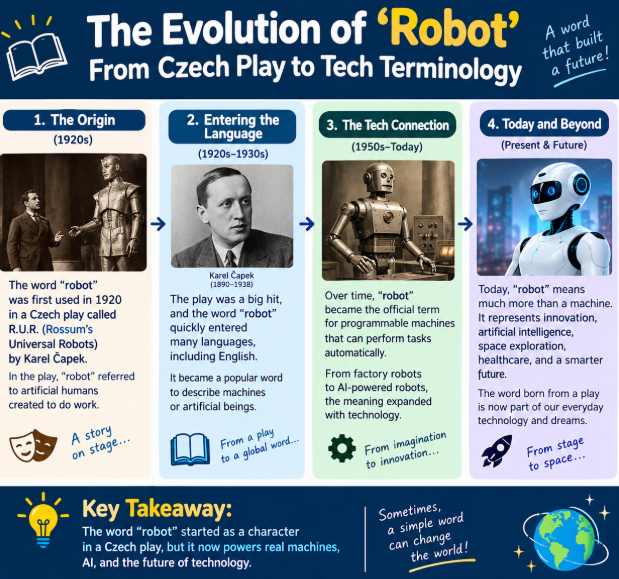
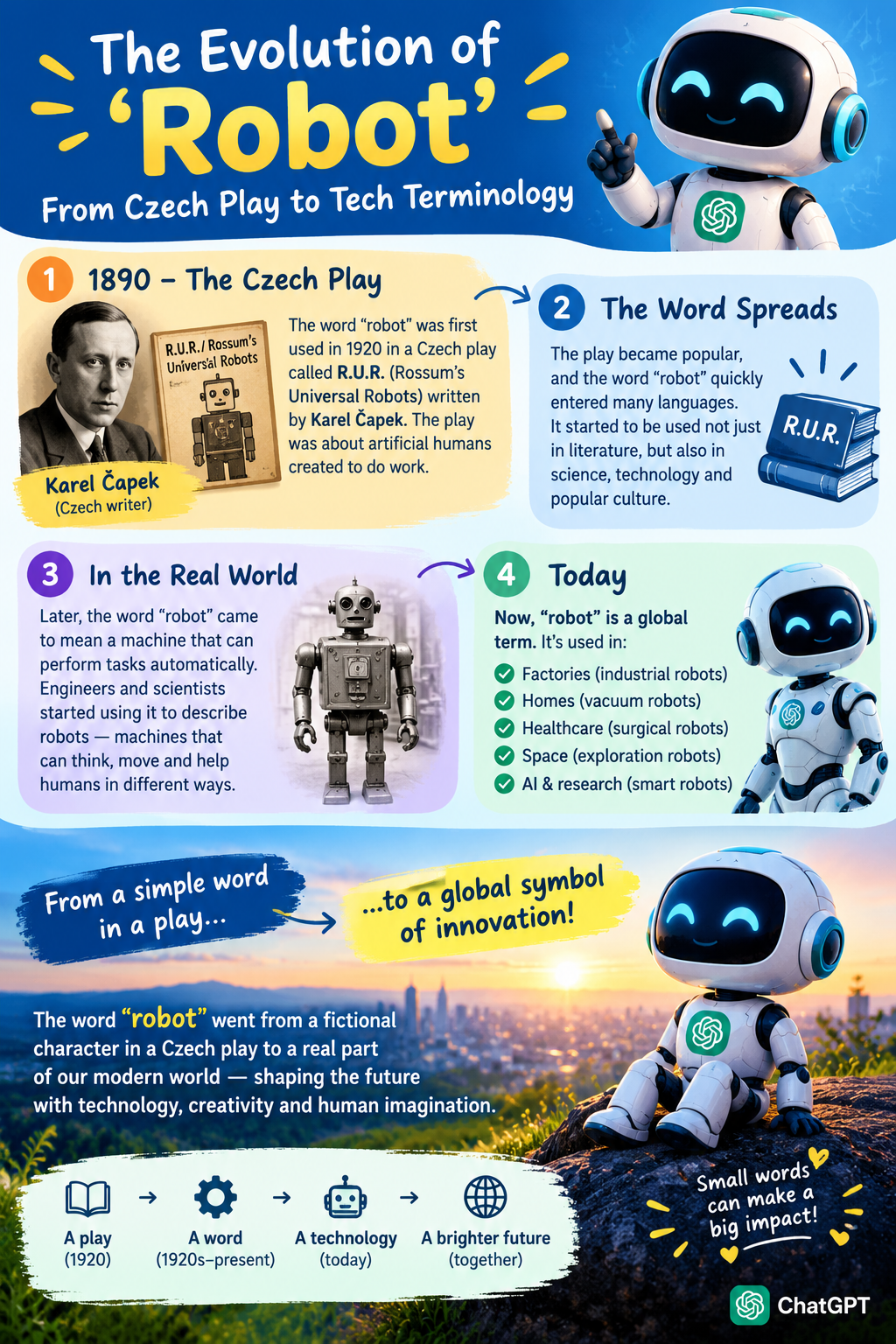
    Did you know that the word **“robot”** first appeared in a Czech play called *R.U.R. (Rossum’s Universal Robots)* by Karel Čapek in 1920?

    Over time, this simple word became an important part of our world of technology. Today, robots help us in factories, hospitals, space exploration, and many other fields!

    **What We Learn:**

    How the word “robot” originated

    How it became popular around the world

    How robots have changed with technology

    How AI and robotics may shape our future

    **Remember:** A word from a play became a symbol of innovation and the future of technology!

    What kind of robot would you like to invent? Share your ideas in the comments!

    #EvolutionOfRobots #Robotics #ArtificialIntelligence #Technology #Innovation #Science #HistoryOfTechnology #FutureTechnology #Education #LearnSomethingNew #RehanCodingWithAI #Facebook #Instagram #YouTube #LinkedIn #TikTok
    RSIf8 Roll Number: 49 Story post no.42 Story post topic:The Evolution of 'Robot': From Czech Play to Tech Terminology".🤖📚 **The Evolution of “Robot”: From Czech Play to Tech Terminology** 🌍✨ Did you know that the word **“robot”** first appeared in a Czech play called *R.U.R. (Rossum’s Universal Robots)* by Karel Čapek in 1920? 🤯 Over time, this simple word became an important part of our world of technology. Today, robots help us in factories, hospitals, space exploration, and many other fields! 🚀🏥🏭 💡 **What We Learn:** ✅ How the word “robot” originated ✅ How it became popular around the world ✅ How robots have changed with technology ✅ How AI and robotics may shape our future 🌟 **Remember:** A word from a play became a symbol of innovation and the future of technology! 📢 What kind of robot would you like to invent? Share your ideas in the comments! 💬 #EvolutionOfRobots #Robotics #ArtificialIntelligence #Technology #Innovation #Science #HistoryOfTechnology #FutureTechnology #Education #LearnSomethingNew #RehanCodingWithAI #Facebook #Instagram #YouTube #LinkedIn #TikTok
    0 التعليقات 0 المشاركات 1361 مشاهدة
  • #rsisb
    Roll no. 247
    Story post . 18
    Foundation level

    **Story Post — Decoding “Cyber”: Origins in Norbert Wiener’s Cybernetics**

    **Have you ever wondered where the word “Cyber” comes from?**

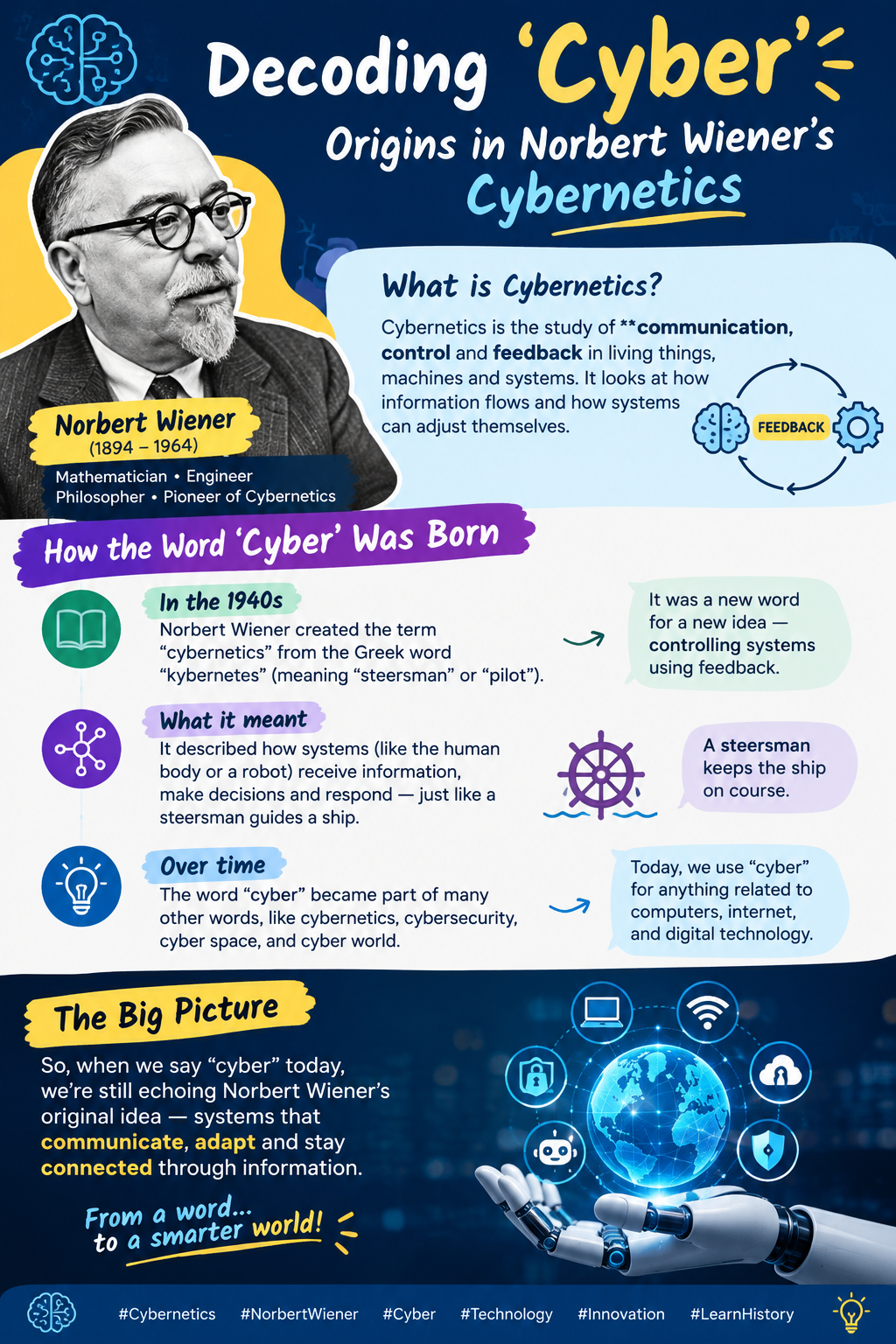
    The word *Cyber* is connected to the fascinating world of **cybernetics**, a field that explores communication, control, and feedback in both living organisms and machines. It helps us understand how humans, computers, and other systems receive information, respond to changes, and make adjustments.

    **The Story Behind Cybernetics**

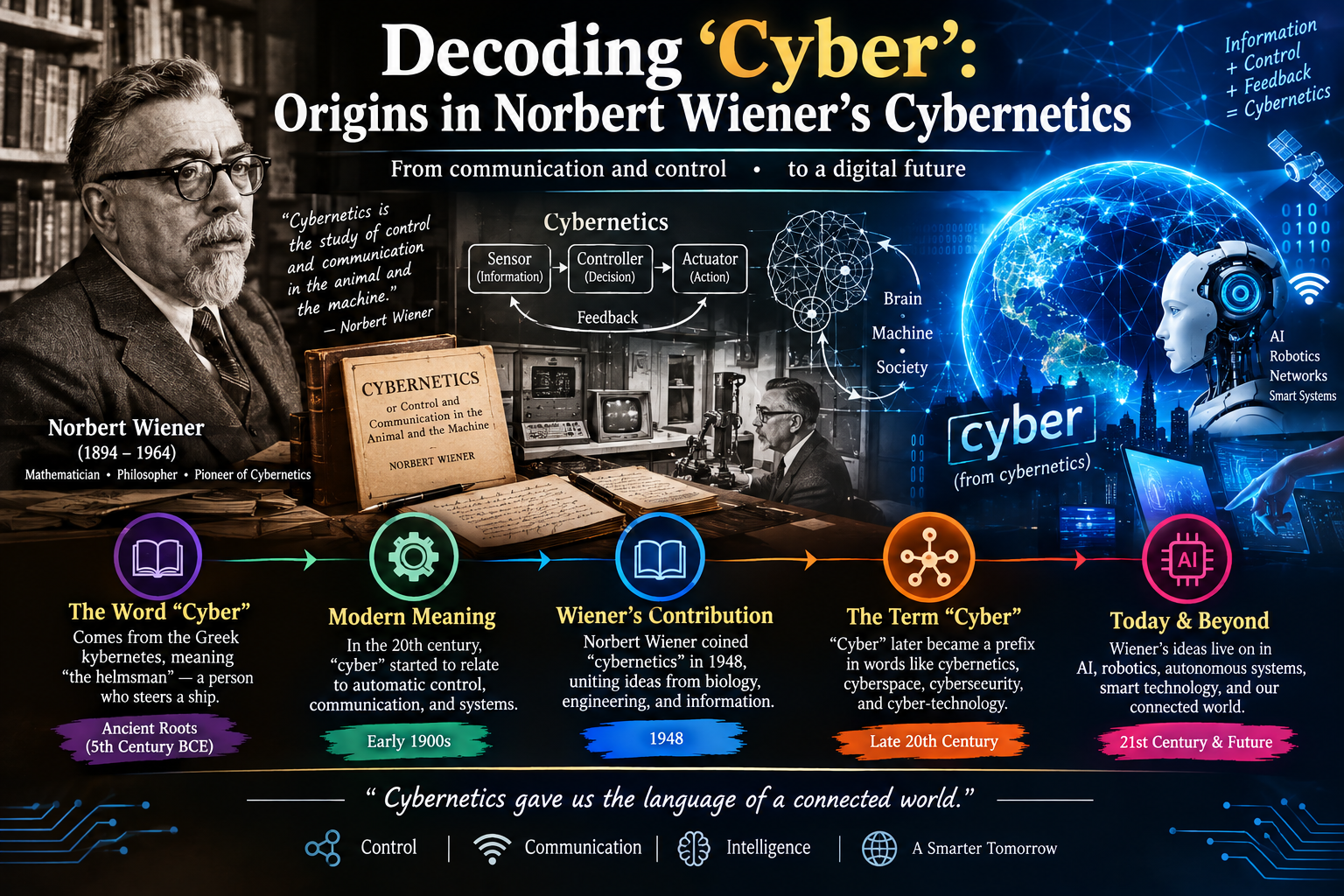
    The story takes us back to **Norbert Wiener (1894–1964)**, an American mathematician who helped establish the field of cybernetics. In 1948, he published his influential book *Cybernetics: Or Control and Communication in the Animal and the Machine*.

    Wiener explored how communication and control work in animals and machines. One important concept was **feedback**—when a system uses information about its results to adjust what it does next.

    For example, a thermostat checks the temperature of a room and adjusts the heating to maintain the desired temperature. Similarly, modern robots use sensors to understand their surroundings and adjust their movements. These ideas help us understand many technologies we use today!

    **How Did “Cyber” Become So Popular?**

    Over time, the word *cyber* became associated with computers, digital communication, and the internet. Today, we hear it in words such as:

    **Cybersecurity** — protecting computers, networks, and information from digital threats.

    **Cyberspace** — the digital environment where people communicate and interact online.

    **Cybercrime** — illegal activities involving computers or digital networks.

    **Cybernetics** — the study of control, communication, and feedback in systems.

    From the early ideas of cybernetics to today's connected digital world, this little word has become part of our everyday vocabulary!

    **Why Is This Story Important?**

    Understanding the history of the word *cyber* helps us appreciate how scientific ideas influence language and technology. It also reminds us that many modern inventions are built on ideas developed decades ago. Every time we use the internet, learn about artificial intelligence, or explore robotics, we encounter concepts connected to communication, information, and control.

    **Today's Learning Message:**
    Every word has a story, and every story can teach us something new! Keep asking questions, exploring history, and discovering how science shapes our world.

    **Question for You:**
    Which cyber-related topic interests you the most: cybersecurity, artificial intelligence, robotics, or the history of the internet? Share your answer in the comments!

    Like, share, and comment to help others discover the amazing story behind the word *Cyber*!

    #Cyber #Cybernetics #NorbertWiener #WordOrigins #HistoryOfTechnology #Technology #Science #ComputerScience #ArtificialIntelligence #AI #Cybersecurity #DigitalWorld #Internet #Robotics #Innovation #LearningEveryDay #EducationalContent #DidYouKnow #KnowledgeIsPower #TechHistory #DigitalLiteracy #StoryPost #RehanSchool #RSISB #RehanCodingWithAI
    #rsisb Roll no. 247 Story post . 18 Foundation level 🌐🤖 **Story Post — Decoding “Cyber”: Origins in Norbert Wiener’s Cybernetics** 💻📚 ✨ **Have you ever wondered where the word “Cyber” comes from?** 🚀 The word *Cyber* is connected to the fascinating world of **cybernetics**, a field that explores communication, control, and feedback in both living organisms and machines. 🧠⚙️ It helps us understand how humans, computers, and other systems receive information, respond to changes, and make adjustments. 📖 **The Story Behind Cybernetics** The story takes us back to **Norbert Wiener (1894–1964)**, an American mathematician who helped establish the field of cybernetics. In 1948, he published his influential book *Cybernetics: Or Control and Communication in the Animal and the Machine*. 📘🔬 Wiener explored how communication and control work in animals and machines. One important concept was **feedback**—when a system uses information about its results to adjust what it does next. 🔄🤖 For example, a thermostat checks the temperature of a room and adjusts the heating to maintain the desired temperature. 🌡️🏠 Similarly, modern robots use sensors to understand their surroundings and adjust their movements. These ideas help us understand many technologies we use today! 🌍 **How Did “Cyber” Become So Popular?** Over time, the word *cyber* became associated with computers, digital communication, and the internet. Today, we hear it in words such as: 💻 **Cybersecurity** — protecting computers, networks, and information from digital threats. 🌐 **Cyberspace** — the digital environment where people communicate and interact online. 🕵️ **Cybercrime** — illegal activities involving computers or digital networks. 🤖 **Cybernetics** — the study of control, communication, and feedback in systems. From the early ideas of cybernetics to today's connected digital world, this little word has become part of our everyday vocabulary! 🌟 🎯 **Why Is This Story Important?** Understanding the history of the word *cyber* helps us appreciate how scientific ideas influence language and technology. It also reminds us that many modern inventions are built on ideas developed decades ago. Every time we use the internet, learn about artificial intelligence, or explore robotics, we encounter concepts connected to communication, information, and control. 🚀🧠 💡 **Today's Learning Message:** Every word has a story, and every story can teach us something new! Keep asking questions, exploring history, and discovering how science shapes our world. 📚✨ 💬 **Question for You:** Which cyber-related topic interests you the most: cybersecurity, artificial intelligence, robotics, or the history of the internet? Share your answer in the comments! 👇🌐 ❤️ Like, share, and comment to help others discover the amazing story behind the word *Cyber*! #Cyber #Cybernetics #NorbertWiener #WordOrigins #HistoryOfTechnology #Technology #Science #ComputerScience #ArtificialIntelligence #AI #Cybersecurity #DigitalWorld #Internet #Robotics #Innovation #LearningEveryDay #EducationalContent #DidYouKnow #KnowledgeIsPower #TechHistory #DigitalLiteracy #StoryPost #RehanSchool #RSISB #RehanCodingWithAI 🚀💻📚
    0 التعليقات 0 المشاركات 3236 مشاهدة
  • #rsisb
    Roll no. 247
    Story post 14
    Foundation level

    **The Evolution of “Robot”: From Czech Play to Tech Terminology **

    Have you ever wondered where the word **“robot”** came from? Today, we use this word when talking about smart machines, artificial intelligence, factories, space exploration, and modern technology. But did you know that the word “robot” became popular through a Czech play written more than a century ago? Let's explore the fascinating journey of this little word that became a big part of our technological world!

    **1. The Beginning: A Czech Play **

    The story of the word “robot” begins with Czech writer and playwright **Karel Čapek** and his science-fiction play *R.U.R. (Rossum’s Universal Robots)*, first performed in 1921 and published in 1920. The play imagined artificial workers created to perform tasks for humans. It introduced audiences to ideas about artificial beings, technology, work, and the relationship between humans and machines.

    The word “robot” comes from the Czech word *robota*, associated with forced labor or compulsory work. Interestingly, Karel Čapek credited his brother, **Josef Čapek**, with suggesting the word for the play.

    **2. How the Word Spread Around the World **

    As the play gained attention, the word “robot” spread beyond literature and entered everyday language. People began using it to discuss machines that could perform tasks automatically. Over time, robots became a popular subject in science-fiction stories, films, books, and discussions about the future.

    Writers and scientists explored exciting questions: Could machines help humans? Could robots perform difficult tasks? How might technology change our lives? These questions helped inspire generations of inventors and researchers.

    **3. From Fiction to Real Machines **

    Robots eventually became an important part of real-world engineering and science. Modern robots can perform repetitive tasks, assist with manufacturing, explore places that are difficult for humans to reach, and help researchers carry out complex work.

    Today, we can find robots in many areas:

    **Factories:** Industrial robots help assemble products and perform precise tasks.

    **Homes:** Robotic vacuum cleaners help people with household cleaning.

    **Healthcare:** Specialised robotic systems assist medical professionals with certain procedures.

    **Space Exploration:** Robotic rovers and spacecraft help scientists explore distant worlds.

    **Agriculture:** Some robots help monitor crops and perform farming tasks.

    **Research:** Scientists use robots to test ideas, collect information, and explore new possibilities.

    **4. Robots and Artificial Intelligence **

    Modern technology has introduced new possibilities through artificial intelligence (AI). Some robots use AI to interpret information from sensors, recognise objects, plan actions, or respond to changing conditions. However, not every robot uses AI, and not every AI system is a robot.

    This difference is important! A robot is generally a physical machine that can carry out tasks, while AI refers to computer systems designed to perform tasks that may require abilities such as recognising patterns or understanding language. Together, robotics and AI are helping researchers develop new tools and technologies.

    **5. What Can We Learn from the Evolution of “Robot”?**

    The journey of the word “robot” teaches us that ideas can travel from books and plays into real life. A word introduced through a fictional story became an important term in science, engineering, and technology.

    It also reminds us that technology is created by people using imagination, creativity, teamwork, and scientific knowledge. As we learn more about robots, we should think about how to use technology responsibly and how it can benefit people and communities.

    **Conclusion: From a Czech Play to a Technological Future**

    The evolution of “robot” is a remarkable example of how language, literature, and science connect. What began as a word associated with artificial workers in a Czech play is now used around the world to describe machines that help us in factories, homes, hospitals, laboratories, and space exploration.

    The future of robotics will continue to bring new discoveries, challenges, and opportunities. By learning about the past, understanding the present, and thinking creatively about the future, we can become more informed and responsible users of technology.

    **Let's keep learning, exploring, and innovating!** Every great invention begins with an idea, and every curious mind has the potential to discover something new.

    **Question for everyone:** If you could invent a helpful robot, what would you want it to do? Share your ideas in the comments!

    Like, share, and spread the excitement of science and technology!

    ━━━━━━━━━━━━━━━━━━

    **HASHTAGS**

    #EvolutionOfRobots #RobotHistory #TheWordRobot #KarelCapek #JosefCapek #RUR #CzechLiterature #HistoryOfTechnology #Robotics #ArtificialIntelligence #AI #ScienceAndTechnology #EducationalPost #StoryPost #TechnologyEducation #FutureTechnology #Innovation #Engineering #STEMEducation #ScienceForEveryone #LearningIsFun #DigitalLearning #TechHistory #SmartMachines #SpaceExploration #IndustrialRobots #CreativeThinking #KnowledgeIsPower #ChatGPT #PostOnAllPlatforms
    #rsisb Roll no. 247 Story post 14 Foundation level 🤖🌍 **The Evolution of “Robot”: From Czech Play to Tech Terminology 📚✨** 🚀🤖 Have you ever wondered where the word **“robot”** came from? Today, we use this word when talking about smart machines, artificial intelligence, factories, space exploration, and modern technology. But did you know that the word “robot” became popular through a Czech play written more than a century ago? 📖🌟 Let's explore the fascinating journey of this little word that became a big part of our technological world! 💡🌐 📚 **1. The Beginning: A Czech Play 🇨🇿** The story of the word “robot” begins with Czech writer and playwright **Karel Čapek** and his science-fiction play *R.U.R. (Rossum’s Universal Robots)*, first performed in 1921 and published in 1920. 🎭🤖 The play imagined artificial workers created to perform tasks for humans. It introduced audiences to ideas about artificial beings, technology, work, and the relationship between humans and machines. The word “robot” comes from the Czech word *robota*, associated with forced labor or compulsory work. Interestingly, Karel Čapek credited his brother, **Josef Čapek**, with suggesting the word for the play. ✍️💭 🌎 **2. How the Word Spread Around the World 🌐** As the play gained attention, the word “robot” spread beyond literature and entered everyday language. People began using it to discuss machines that could perform tasks automatically. 📖⚙️ Over time, robots became a popular subject in science-fiction stories, films, books, and discussions about the future. Writers and scientists explored exciting questions: Could machines help humans? Could robots perform difficult tasks? How might technology change our lives? These questions helped inspire generations of inventors and researchers. 🚀🧠 ⚙️ **3. From Fiction to Real Machines 🏭** Robots eventually became an important part of real-world engineering and science. Modern robots can perform repetitive tasks, assist with manufacturing, explore places that are difficult for humans to reach, and help researchers carry out complex work. 🔧🤖 Today, we can find robots in many areas: 🏭 **Factories:** Industrial robots help assemble products and perform precise tasks. 🏠 **Homes:** Robotic vacuum cleaners help people with household cleaning. 🏥 **Healthcare:** Specialised robotic systems assist medical professionals with certain procedures. 🚀 **Space Exploration:** Robotic rovers and spacecraft help scientists explore distant worlds. 🌾 **Agriculture:** Some robots help monitor crops and perform farming tasks. 🧪 **Research:** Scientists use robots to test ideas, collect information, and explore new possibilities. 💻 **4. Robots and Artificial Intelligence 🧠** Modern technology has introduced new possibilities through artificial intelligence (AI). Some robots use AI to interpret information from sensors, recognise objects, plan actions, or respond to changing conditions. 🤖💡 However, not every robot uses AI, and not every AI system is a robot. This difference is important! A robot is generally a physical machine that can carry out tasks, while AI refers to computer systems designed to perform tasks that may require abilities such as recognising patterns or understanding language. Together, robotics and AI are helping researchers develop new tools and technologies. 🌐✨ 🌟 **5. What Can We Learn from the Evolution of “Robot”?** The journey of the word “robot” teaches us that ideas can travel from books and plays into real life. A word introduced through a fictional story became an important term in science, engineering, and technology. 📚➡️⚙️ It also reminds us that technology is created by people using imagination, creativity, teamwork, and scientific knowledge. As we learn more about robots, we should think about how to use technology responsibly and how it can benefit people and communities. ❤️🌍 🎯 **Conclusion: From a Czech Play to a Technological Future** The evolution of “robot” is a remarkable example of how language, literature, and science connect. What began as a word associated with artificial workers in a Czech play is now used around the world to describe machines that help us in factories, homes, hospitals, laboratories, and space exploration. 🤖🚀 The future of robotics will continue to bring new discoveries, challenges, and opportunities. By learning about the past, understanding the present, and thinking creatively about the future, we can become more informed and responsible users of technology. 🌟💚 📢 **Let's keep learning, exploring, and innovating!** Every great invention begins with an idea, and every curious mind has the potential to discover something new. 💡📚 💬 **Question for everyone:** If you could invent a helpful robot, what would you want it to do? Share your ideas in the comments! 👇🤖 ❤️ Like, share, and spread the excitement of science and technology! ━━━━━━━━━━━━━━━━━━ 🏷️ **HASHTAGS** #EvolutionOfRobots #RobotHistory #TheWordRobot #KarelCapek #JosefCapek #RUR #CzechLiterature #HistoryOfTechnology #Robotics #ArtificialIntelligence #AI #ScienceAndTechnology #EducationalPost #StoryPost #TechnologyEducation #FutureTechnology #Innovation #Engineering #STEMEducation #ScienceForEveryone #LearningIsFun #DigitalLearning #TechHistory #SmartMachines #SpaceExploration #IndustrialRobots #CreativeThinking #KnowledgeIsPower #ChatGPT #PostOnAllPlatforms 🤖🌍📚🚀✨

    0 التعليقات 0 المشاركات 7312 مشاهدة
  • RSIF8
    ROLL NO 66
    DOCUMENTARY NO 02
    DOCUMENTARY TOPIC: The Evolution of “Robot”: From Czech Play to Tech Terminology

    Have you ever wondered where the word “robot” came from?

    This short documentary explores the fascinating journey of the word robot, from its origins in the 1920 Czech play R.U.R. (Rossum’s Universal Robots) by Czech writer Karel Čapek to its modern meaning in science and technology.

    The word comes from the Czech term “robota,” associated with forced labor or hard work. What began as a fictional concept of artificial workers eventually became one of the most recognizable words in the world of technology.

    Today, robots are used in factories, scientific research, space exploration, healthcare, automation, and many other fields. With advances in artificial intelligence, robotics continues to evolve and change the way we think about machines and the future.

    Watch the documentary to discover how a word from a Czech stage play became a symbol of modern technology!

    From fiction to reality—this is the incredible evolution of the “robot.”

    #Robot #Robotics #Technology #ArtificialIntelligence #AI #HistoryOfTechnology #KarelCapek #RUR #Science #Innovation #TechHistory #FutureTechnology #EducationalDocumentary #Learning #Engineering #Automation #Robots #TechEducation
    RSIF8 ROLL NO 66 DOCUMENTARY NO 02 DOCUMENTARY TOPIC: 🤖 The Evolution of “Robot”: From Czech Play to Tech Terminology Have you ever wondered where the word “robot” came from? 🤔⚙️ This short documentary explores the fascinating journey of the word robot, from its origins in the 1920 Czech play R.U.R. (Rossum’s Universal Robots) by Czech writer Karel Čapek to its modern meaning in science and technology. The word comes from the Czech term “robota,” associated with forced labor or hard work. What began as a fictional concept of artificial workers eventually became one of the most recognizable words in the world of technology. Today, robots are used in factories, scientific research, space exploration, healthcare, automation, and many other fields. With advances in artificial intelligence, robotics continues to evolve and change the way we think about machines and the future. 🎬 Watch the documentary to discover how a word from a Czech stage play became a symbol of modern technology! ✨ From fiction to reality—this is the incredible evolution of the “robot.” #Robot #Robotics #Technology #ArtificialIntelligence #AI #HistoryOfTechnology #KarelCapek #RUR #Science #Innovation #TechHistory #FutureTechnology #EducationalDocumentary #Learning #Engineering #Automation #Robots #TechEducation
    0 التعليقات 0 المشاركات 3098 مشاهدة 0
  • #rsisb
    Roll NO:232
    Foundation level student.
    Story post:22

    DescriptionDecoding Cyber: Origins in Norbert Wieners Cybernetics Discover the fascinating story behind the word “Cyber”! Explore how it is connected to Norbert Wiener’s cybernetics, a field focused on communication, control, feedback, and systems. From early ideas about machines and communication to today’s cybersecurity, cyberspace, and digital technology, the word “Cyber” has become a major part of our modern technological world. Join us on this exciting journey through science, technology, language, and innovation! Hashtags#Cyber #Cybernetics #NorbertWiener #CyberHistory #Technology #ComputerScience #ArtificialIntelligence #Cybersecurity #DigitalWorld #Innovation #ScienceAndTechnology #HistoryOfTechnology #TechFacts #ScienceFacts #Learning #Education #FutureTech #DigitalTechnology #Knowledge Emojis
    #rsisb Roll NO:232 Foundation level student. Story post:22 💻 DescriptionDecoding Cyber: Origins in Norbert Wieners Cybernetics 🤖🧠Discover the fascinating story behind the word “Cyber”! 🌐✨ Explore how it is connected to Norbert Wiener’s cybernetics, a field focused on communication, control, feedback, and systems. 📡🔄From early ideas about machines and communication to today’s cybersecurity, cyberspace, and digital technology, the word “Cyber” has become a major part of our modern technological world. 💻🔐🌍Join us on this exciting journey through science, technology, language, and innovation! 🚀📚🏷️ Hashtags#Cyber #Cybernetics #NorbertWiener #CyberHistory #Technology #ComputerScience #ArtificialIntelligence #Cybersecurity #DigitalWorld #Innovation #ScienceAndTechnology #HistoryOfTechnology #TechFacts #ScienceFacts #Learning #Education #FutureTech #DigitalTechnology #Knowledge 🌐💻🤖😊 Emojis💻 🌐 🤖 🧠 📡 🔐 ⚙️ 🔄 🧪 🚀 📚 💡 🔎 🌍 ✨
    0 التعليقات 0 المشاركات 3888 مشاهدة
  • #rsisb
    Roll no.239
    Story post no.17
    Foundation Level

    The word **“robot”** may sound like it belongs to the world of modern technology, artificial intelligence, and futuristic machines—but its fascinating journey actually began on the **stage of a Czech play!**
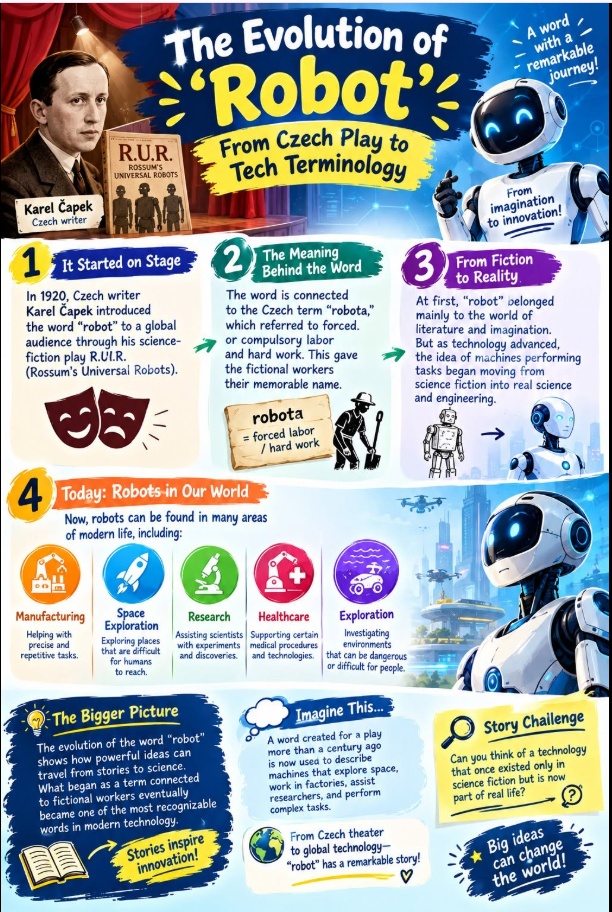
    In **1920**, Czech writer **Karel Čapek** introduced the word “robot” to a global audience through his science-fiction play ***R.U.R. (Rossum’s Universal Robots)***. The story imagined artificial workers created to perform labor for humans.
    The word is connected to the Czech term **“robota,”** which referred to forced or compulsory labor and hard work. This connection helped give the fictional workers their memorable name.
    At first, “robot” belonged mainly to the world of literature and imagination. But as technology advanced, the idea of machines performing tasks began moving from **science fiction into real science and engineering**.
    Today, robots can be found in many areas of modern life, including:
    **Manufacturing** — helping with precise and repetitive tasks
    **Space exploration** — exploring places that are difficult for humans to reach
    **Research** — assisting scientists with experiments and discoveries
    **Healthcare** — supporting certain medical procedures and technologies
    **Exploration** — investigating environments that can be dangerous or difficult for people
    The evolution of the word **“robot”** shows how powerful ideas can travel from **stories to science**. What began as a term connected to fictional workers eventually became one of the most recognizable words in modern technology.
    **Imagine this:** A word created for a play more than a century ago is now used to describe machines that explore space, work in factories, assist researchers, and perform complex tasks.
    **From Czech theater to global technology—“robot” has a remarkable story!**
    **Story Challenge:** Can you think of a technology that once existed only in science fiction but is now part of real life?
    #Robot #Robots #Robotics #RobotHistory #HistoryOfTechnology #KarelCapek #RUR #CzechHistory #Technology #Science #Engineering #STEM #TechHistory #Innovation #FutureTechnology #ArtificialIntelligence #ScienceFiction #TechFacts #DidYouKnow #ScienceEducation #LearningIsFun #TechnologyFacts #RoboticsEducation
    #rsisb Roll no.239 Story post no.17 Foundation Level The word **“robot”** may sound like it belongs to the world of modern technology, artificial intelligence, and futuristic machines—but its fascinating journey actually began on the **stage of a Czech play!** 🎭✨ In **1920**, Czech writer **Karel Čapek** introduced the word “robot” to a global audience through his science-fiction play ***R.U.R. (Rossum’s Universal Robots)***. The story imagined artificial workers created to perform labor for humans. 🤖🏭 The word is connected to the Czech term **“robota,”** which referred to forced or compulsory labor and hard work. This connection helped give the fictional workers their memorable name. 💡📚 At first, “robot” belonged mainly to the world of literature and imagination. But as technology advanced, the idea of machines performing tasks began moving from **science fiction into real science and engineering**. 🔬⚙️ Today, robots can be found in many areas of modern life, including: 🏭 **Manufacturing** — helping with precise and repetitive tasks 🚀 **Space exploration** — exploring places that are difficult for humans to reach 🔬 **Research** — assisting scientists with experiments and discoveries 🏥 **Healthcare** — supporting certain medical procedures and technologies 🌊 **Exploration** — investigating environments that can be dangerous or difficult for people The evolution of the word **“robot”** shows how powerful ideas can travel from **stories to science**. What began as a term connected to fictional workers eventually became one of the most recognizable words in modern technology. 🌟🤖 💭 **Imagine this:** A word created for a play more than a century ago is now used to describe machines that explore space, work in factories, assist researchers, and perform complex tasks. ✨ **From Czech theater to global technology—“robot” has a remarkable story!** 🔎 **Story Challenge:** Can you think of a technology that once existed only in science fiction but is now part of real life? #Robot #Robots #Robotics #RobotHistory #HistoryOfTechnology #KarelCapek #RUR #CzechHistory #Technology #Science #Engineering #STEM #TechHistory #Innovation #FutureTechnology #ArtificialIntelligence #ScienceFiction #TechFacts #DidYouKnow #ScienceEducation #LearningIsFun #TechnologyFacts #RoboticsEducation 🤖⚙️🔬📚🎭🚀✨
    0 التعليقات 0 المشاركات 4839 مشاهدة
  • #rsisb
    Roll no 248
    Foundation level
    song no 2
    **Documentary — “The Evolution of ‘Robot’: From Czech Play to Tech Terminology”**

    Discover the fascinating journey of the word **“robot”**! From its origins in a Czech play to becoming a powerful term in modern technology, this documentary explores how language, literature, and innovation came together to shape a word we use every day.

    Learn how the idea of robots evolved from fiction into real-world technology and how robots are now helping people in science, education, industry, space exploration, and everyday life.

    A fascinating story about **language, creativity, technology, and the future!**

    #Robot #Robotics #Technology #AI #ArtificialIntelligence #Innovation #FutureTech #HistoryOfTechnology #Documentary #CzechHistory #Science #Learning #Education #TechJourney #Future #DigitalWorld
    #rsisb Roll no 248 Foundation level song no 2 🤖🎬 **Documentary — “The Evolution of ‘Robot’: From Czech Play to Tech Terminology”** 🌍⚙️ Discover the fascinating journey of the word **“robot”**! 🤖✨ From its origins in a Czech play to becoming a powerful term in modern technology, this documentary explores how language, literature, and innovation came together to shape a word we use every day. 📚💡 Learn how the idea of robots evolved from fiction into real-world technology and how robots are now helping people in science, education, industry, space exploration, and everyday life. 🚀🏭🧠 A fascinating story about **language, creativity, technology, and the future!** 🌟🤖 #Robot #Robotics #Technology #AI #ArtificialIntelligence #Innovation #FutureTech #HistoryOfTechnology #Documentary #CzechHistory #Science #Learning #Education #TechJourney #Future #DigitalWorld 🤖⚙️🌍📚🚀
    0 التعليقات 0 المشاركات 1608 مشاهدة 1
  • #rsisb
    Roll no.239
    Story post no.21
    Foundation Level


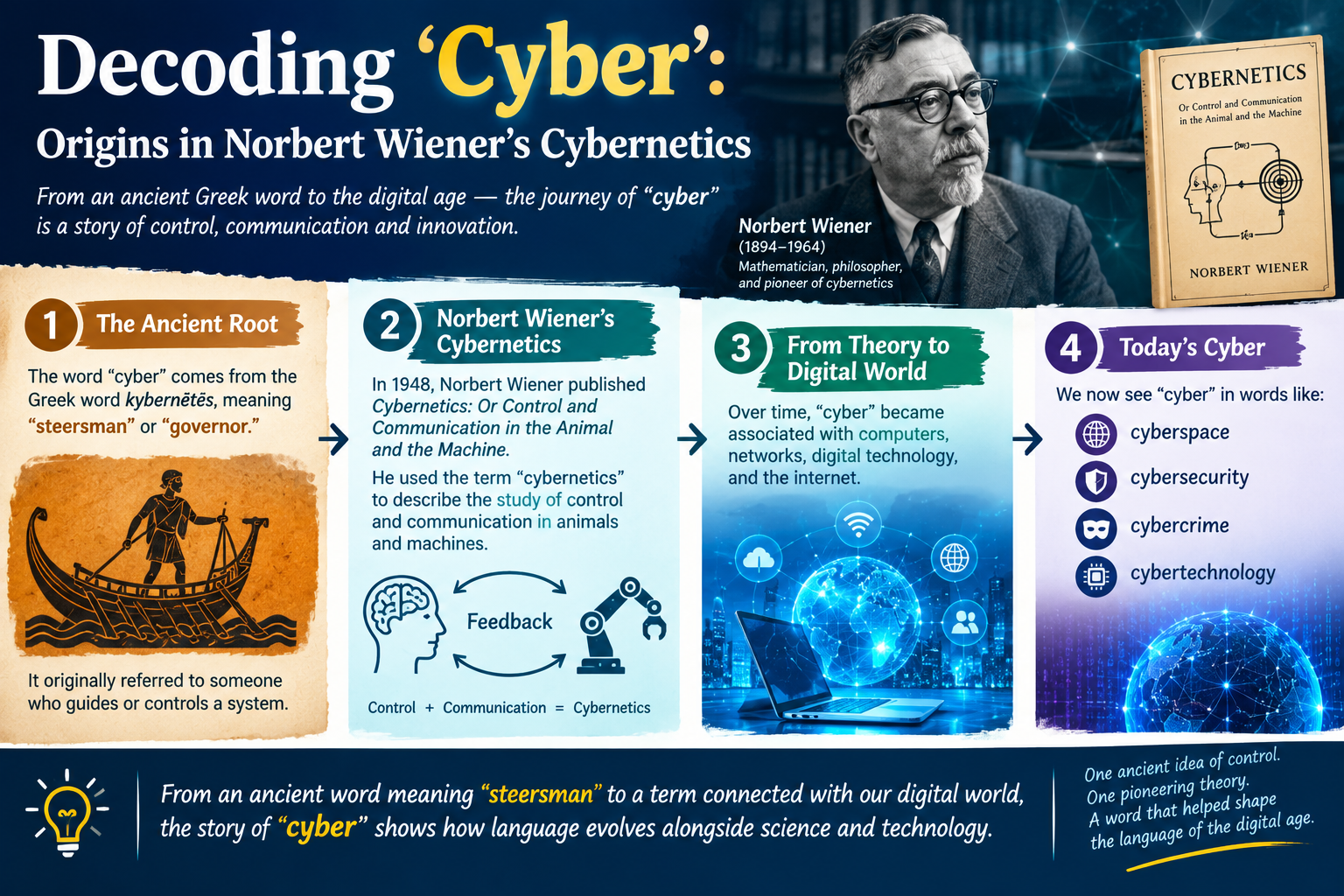
    The word **“cyber”** has a fascinating journey from ancient Greek language to the modern digital world.

    In 1948, American mathematician and philosopher **Norbert Wiener** published *Cybernetics: Or Control and Communication in the Animal and the Machine*. He used the term **“cybernetics”** to describe the study of control and communication in animals and machines.

    The word traces back to the Greek **“kybernētēs,”** meaning **“steersman” or “governor”**—someone who guides or controls a system.

    Over time, **“cyber”** became associated with computers, networks, digital technology, and the internet. Today, we encounter it in words such as **cyberspace, cybersecurity, cybercrime, and cybertechnology**.

    From an ancient word meaning **“steersman”** to a term connected with our digital world, the story of **“cyber”** shows how language evolves alongside science and technology.

    **One ancient idea of control. One pioneering theory. A word that helped shape the language of the digital age.**

    #Cyber #Cybernetics #NorbertWiener #Technology #ComputerScience #HistoryOfTechnology #Etymology #DigitalWorld #Cybersecurity #ScienceHistory #DidYouKnow #Education #Innovation #TechnologyHistory
    #rsisb Roll no.239 Story post no.21 Foundation Level The word **“cyber”** has a fascinating journey from ancient Greek language to the modern digital world. 🌐 In 1948, American mathematician and philosopher **Norbert Wiener** published *Cybernetics: Or Control and Communication in the Animal and the Machine*. He used the term **“cybernetics”** to describe the study of control and communication in animals and machines. The word traces back to the Greek **“kybernētēs,”** meaning **“steersman” or “governor”**—someone who guides or controls a system. 🚢 Over time, **“cyber”** became associated with computers, networks, digital technology, and the internet. Today, we encounter it in words such as **cyberspace, cybersecurity, cybercrime, and cybertechnology**. From an ancient word meaning **“steersman”** to a term connected with our digital world, the story of **“cyber”** shows how language evolves alongside science and technology. 🔬💻 ✨ **One ancient idea of control. One pioneering theory. A word that helped shape the language of the digital age.** #Cyber #Cybernetics #NorbertWiener #Technology #ComputerScience #HistoryOfTechnology #Etymology #DigitalWorld #Cybersecurity #ScienceHistory #DidYouKnow #Education #Innovation #TechnologyHistory
    0 التعليقات 0 المشاركات 2785 مشاهدة
  • Untitled recording - 2026-09-28T212906.216RSIF 8

    Roll no 93

    Short documentary no 3

    Short documentary topic: "The Evolution of 'Robot': From Czech Play to Tech Terminology".Bilkul — yeh **ready-to-post description** hai:


    **Documentary — The Evolution of “Robot”: From Czech Play to Tech Terminology**


    Have you ever wondered where the word **“robot”** came from?


    In this documentary, we explore the fascinating journey of the word **“robot”**, from its introduction in Karel Čapek’s 1920 play **R.U.R. (Rossum’s Universal Robots)** to its modern meaning in science, engineering, robotics, and artificial intelligence.


    The word is connected to the Czech term **“robota,”** associated with hard or forced labor. Over time, the idea of artificial workers evolved into the robots we know today—machines used in factories, medicine, space exploration, research, agriculture, and many other fields.


    **From a stage play to modern technology, the story of “robot” shows how human imagination can influence the future.**


    Watch the full documentary and discover the amazing evolution of robotics!


    #Robot #Robotics #ArtificialIntelligence #AI #Technology #HistoryOfTechnology #Science #Innovation #Documentary #FutureTechnology #RUR #KarelCapek #RehanSchool #RehanCodingWithAI
    Untitled recording - 2026-09-28T212906.216RSIF 8 Roll no 93 Short documentary no 3 Short documentary topic: "The Evolution of 'Robot': From Czech Play to Tech Terminology".Bilkul — yeh **ready-to-post description** hai: 🤖 **Documentary — The Evolution of “Robot”: From Czech Play to Tech Terminology** Have you ever wondered where the word **“robot”** came from? 🤔 In this documentary, we explore the fascinating journey of the word **“robot”**, from its introduction in Karel Čapek’s 1920 play **R.U.R. (Rossum’s Universal Robots)** to its modern meaning in science, engineering, robotics, and artificial intelligence. The word is connected to the Czech term **“robota,”** associated with hard or forced labor. Over time, the idea of artificial workers evolved into the robots we know today—machines used in factories, medicine, space exploration, research, agriculture, and many other fields. 🚀 **From a stage play to modern technology, the story of “robot” shows how human imagination can influence the future.** 🎥 Watch the full documentary and discover the amazing evolution of robotics! #Robot #Robotics #ArtificialIntelligence #AI #Technology #HistoryOfTechnology #Science #Innovation #Documentary #FutureTechnology #RUR #KarelCapek #RehanSchool #RehanCodingWithAI
    0 التعليقات 0 المشاركات 1695 مشاهدة 8
الصفحات المعززة