**Roll No: 2**
**Batch: 14**
**Book: ACCL**
**Task No: 153**
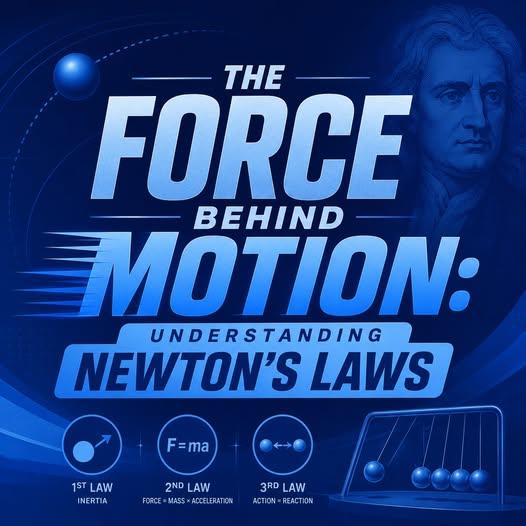
# The Force Behind Motion: Understanding Newton’s Laws
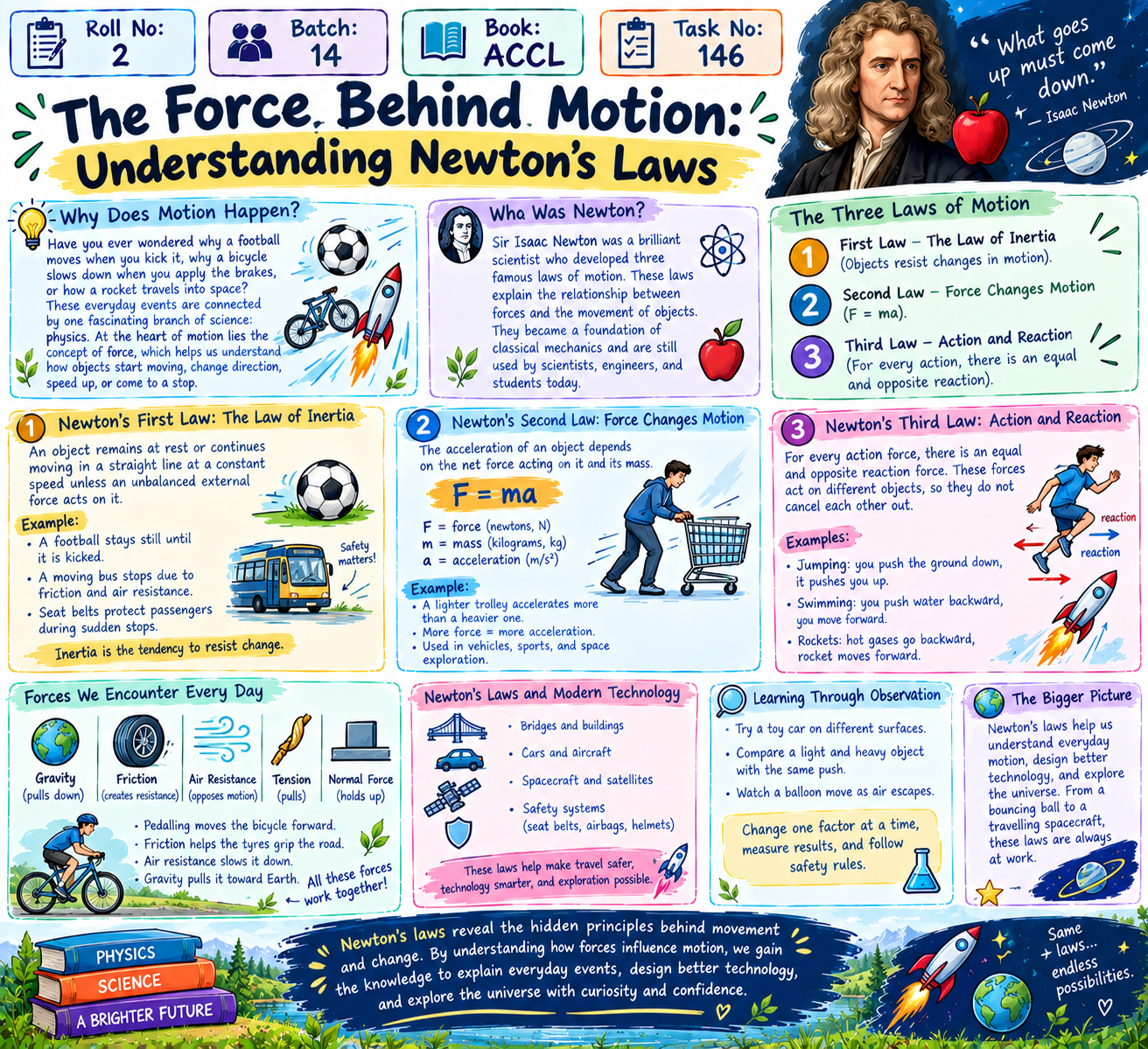
Have you ever wondered why a football moves when you kick it, why a bicycle slows down when you apply the brakes, or how a rocket travels into space? These everyday events are connected by one fascinating branch of science: physics. At the heart of motion lies the concept of **force**, which helps us understand how objects start moving, change direction, speed up, or come to a stop.
One of the most important scientists in the history of physics was **Sir Isaac Newton**. Through his work, Newton developed three famous laws of motion that explain the relationship between forces and the movement of objects. These laws became a foundation of classical mechanics and continue to help scientists, engineers, and students understand the physical world around them.
## Newton’s First Law: The Law of Inertia
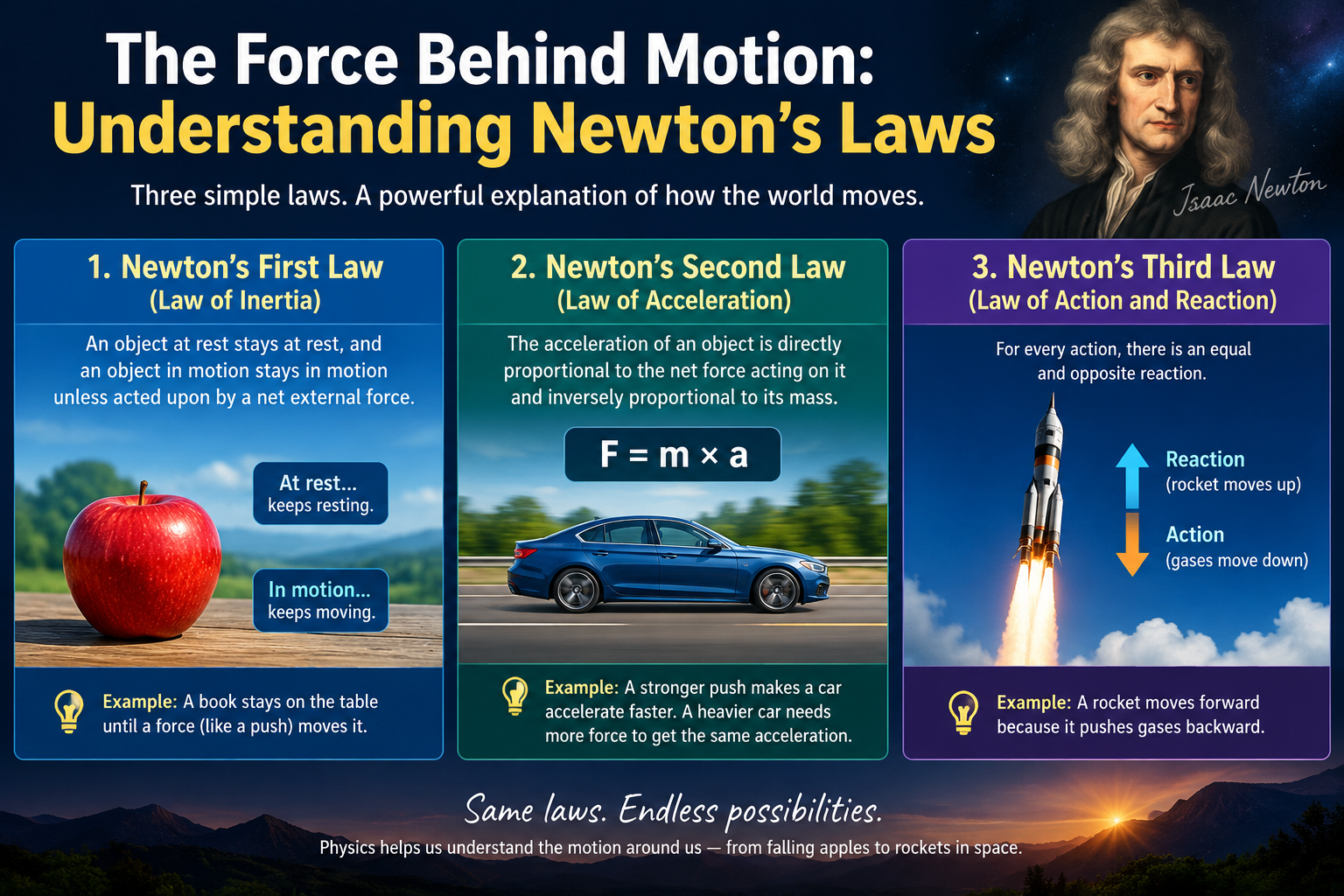
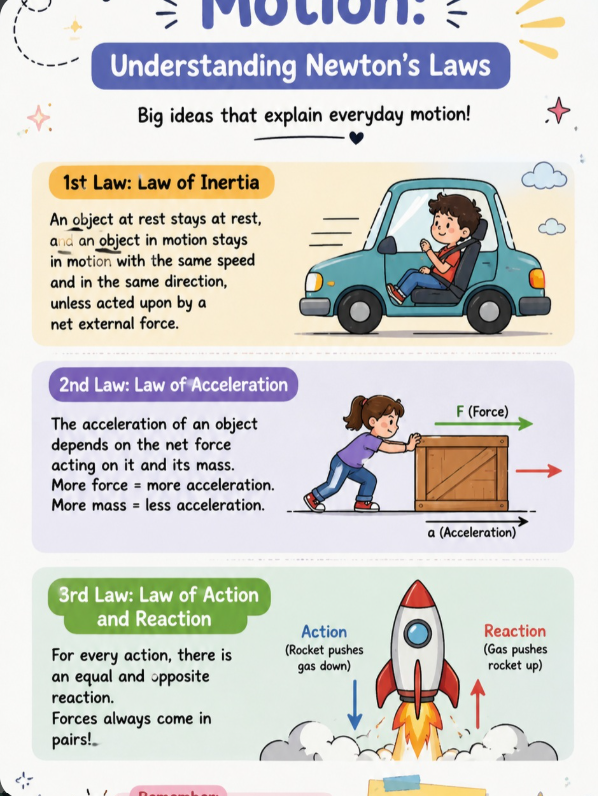
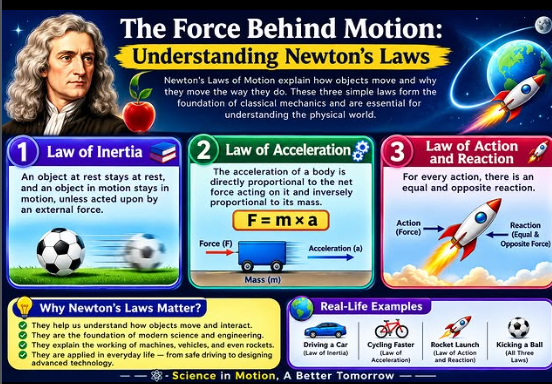
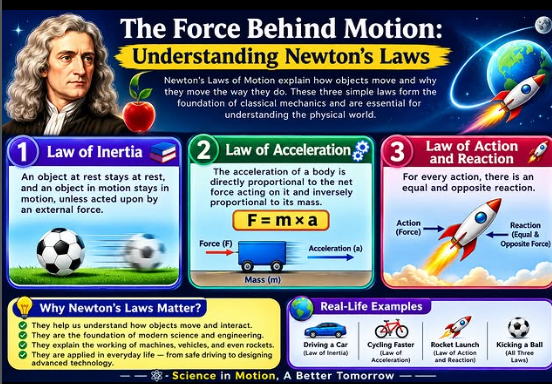
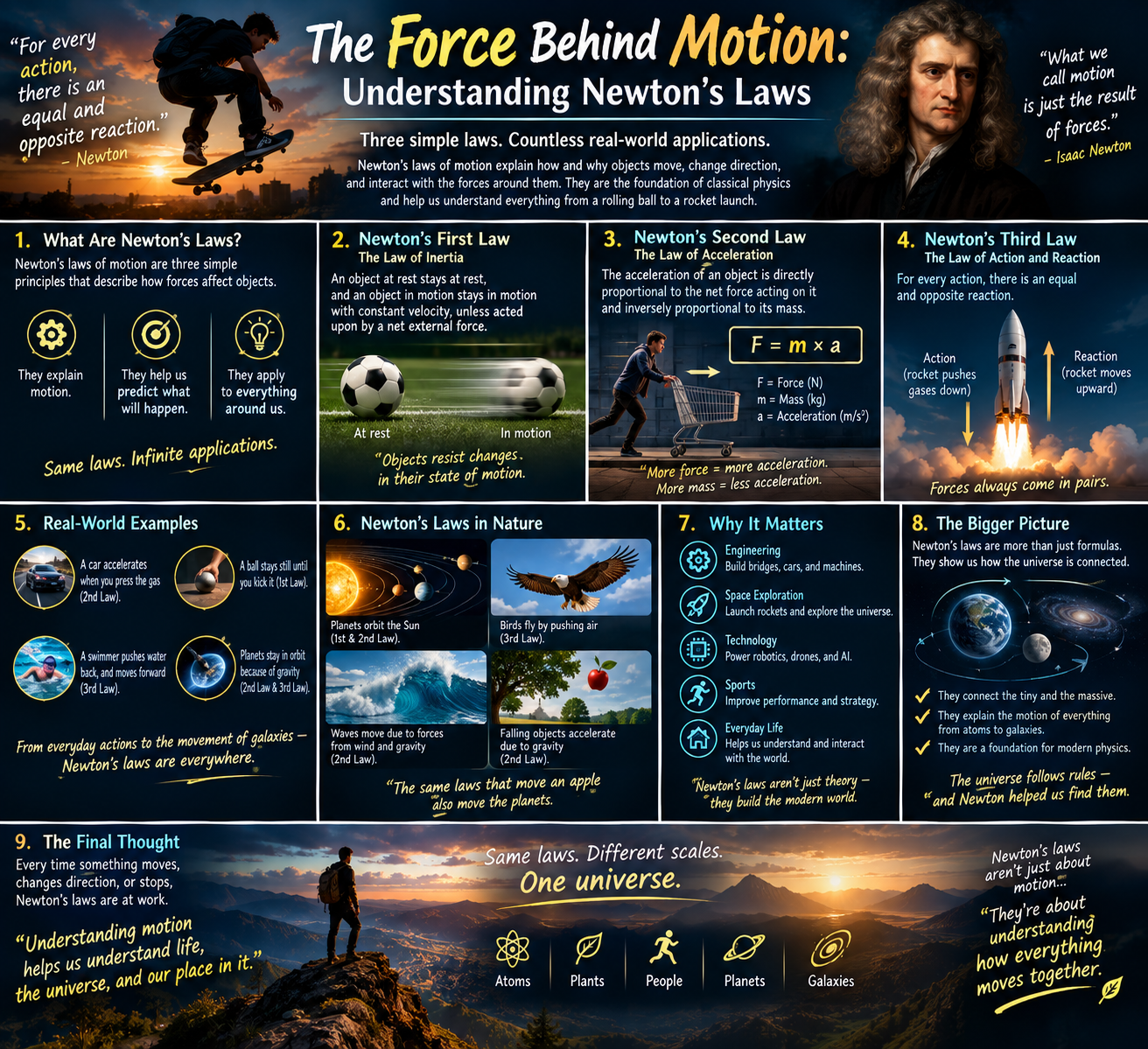
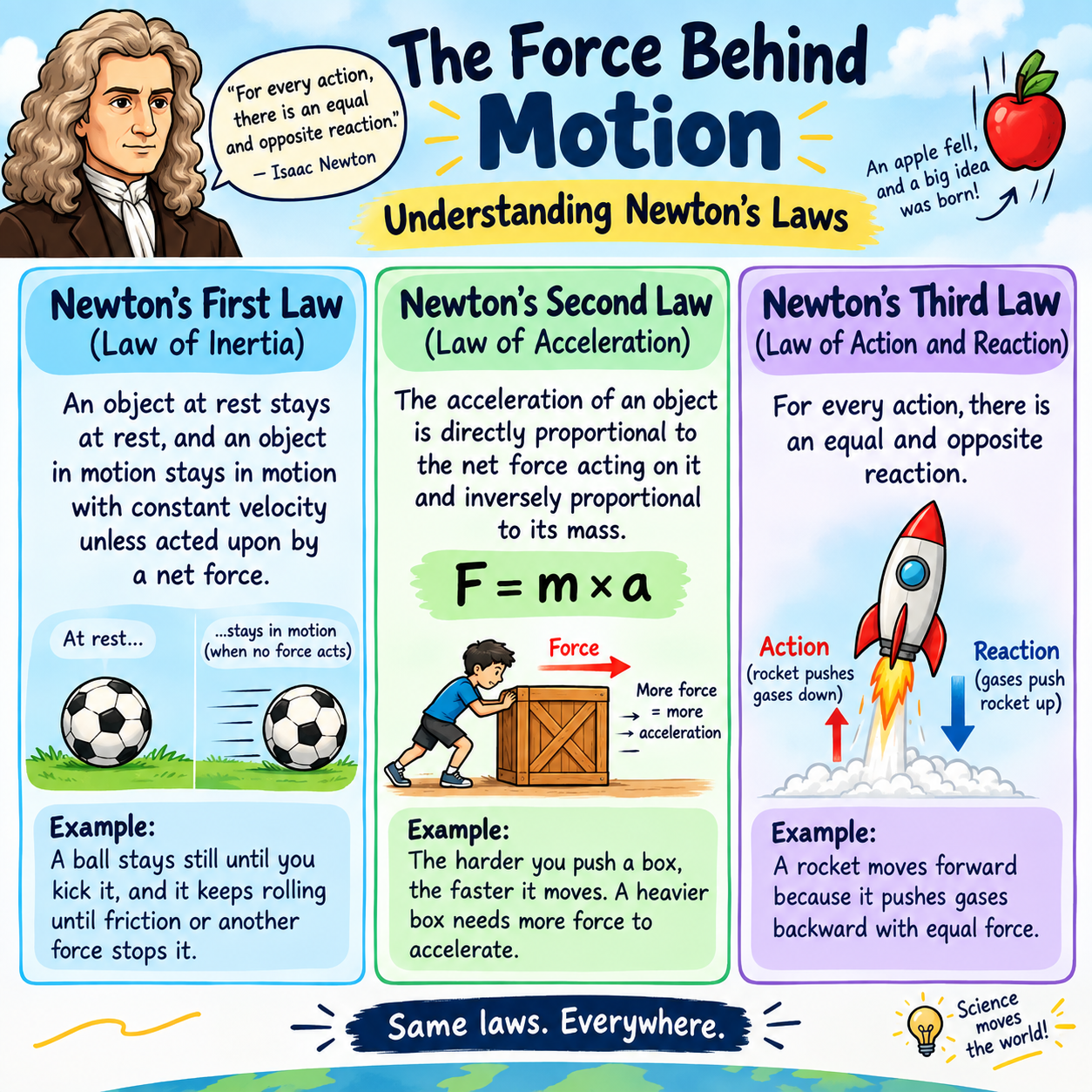
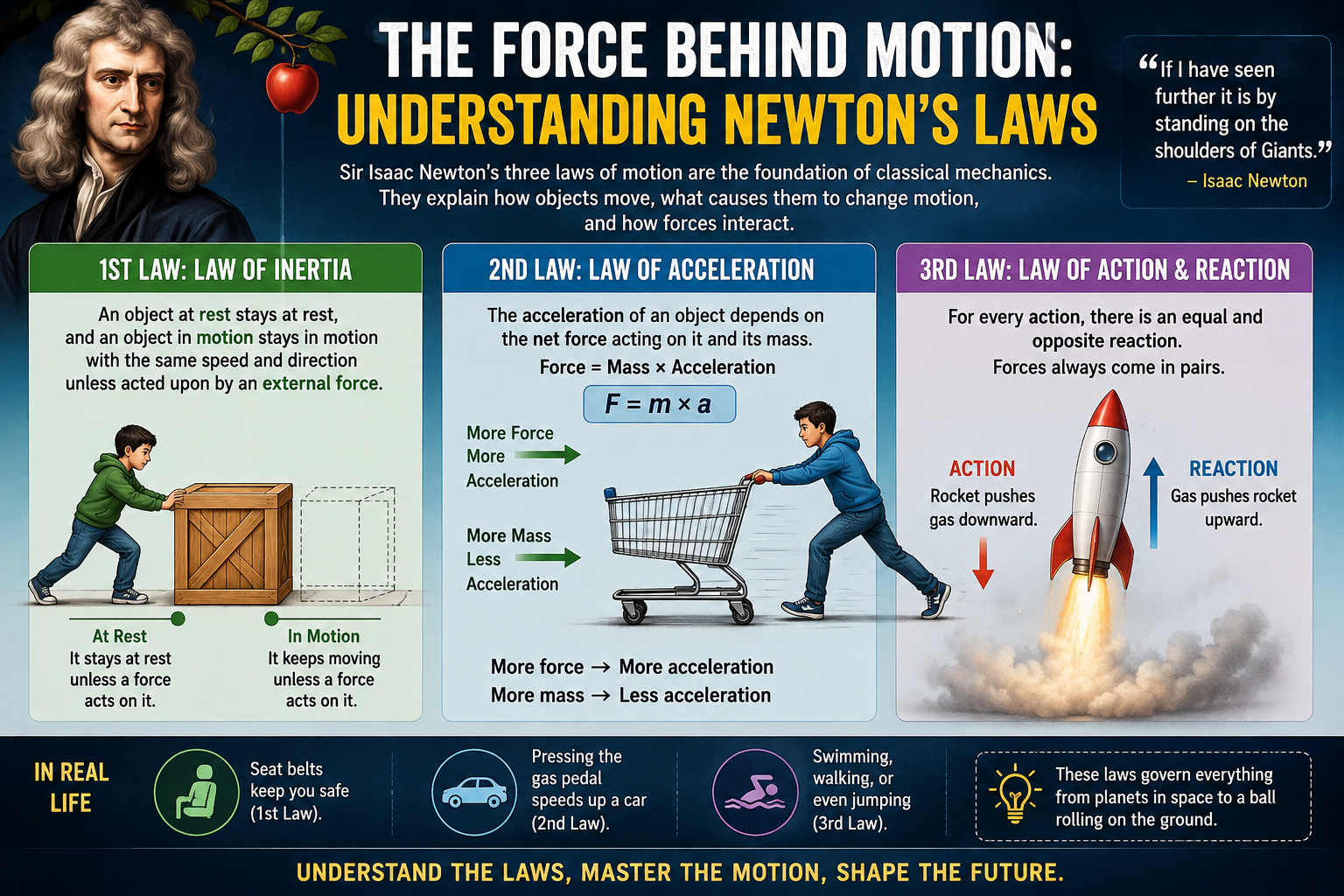
Newton’s first law states that an object remains at rest or continues moving in a straight line at a constant speed unless an unbalanced external force acts on it. This tendency to resist changes in motion is called **inertia**.
Imagine a football resting on the ground. It will remain still until someone kicks it or another force acts upon it. Once the ball begins moving, friction between the ball and the ground, along with air resistance, gradually slows it down. Without these opposing forces, the ball would continue moving at a constant velocity.
You can also notice inertia when a moving bus suddenly brakes. Passengers may feel their bodies move forward because their bodies tend to maintain their previous motion. Seat belts help protect passengers by providing a force that restrains their movement. This shows how Newton’s first law explains both everyday experiences and important safety features.
## Newton’s Second Law: Force Changes Motion
Newton’s second law explains how an unbalanced force changes an object’s motion. The acceleration of an object depends on the net force acting on it and its mass. For an object with constant mass, the relationship is written as:
[
\boxed{F = ma}
]
Here, (F) represents the net force, (m) represents mass, and (a) represents acceleration. Force is measured in newtons (N), mass in kilograms (kg), and acceleration in metres per second squared ((\text{m/s}^2)).
Consider pushing an empty shopping trolley and then pushing a heavily loaded one. The empty trolley usually accelerates more easily because it has less mass. If the same net force acts on two objects, the object with less mass experiences greater acceleration. Similarly, increasing the net force on an object of constant mass increases its acceleration.
This law is essential in engineering, transport, sports, and space exploration. Engineers use it to calculate how much force is needed to accelerate vehicles, while athletes use the principles of force and acceleration when running, jumping, and throwing objects.
## Newton’s Third Law: Action and Reaction
Newton’s third law states that **for every action force, there is an equal and opposite reaction force**. These two forces act on different objects, so they do not cancel each other out.
Think about what happens when you jump. Your feet push down against the ground, and the ground pushes upward on you. This upward force helps you rise into the air. The same principle explains how swimmers move forward by pushing water backward.
Rockets provide another remarkable example. A rocket expels hot gases backward at high speed, and the gases exert an opposite force on the rocket, pushing it forward. This principle works even in the vacuum of space because the rocket does not need air to push against. Its motion results from the interaction between the rocket and the expelled gases.
## Forces We Encounter Every Day
Forces are all around us, even when we do not notice them. Gravity pulls objects toward Earth, friction acts between surfaces in contact, and air resistance opposes an object moving through the atmosphere. Tension in a rope can pull an object, while a normal force from a supporting surface helps hold an object up.
These forces often work together. For example, when a cyclist travels along a road, pedalling produces forward motion, friction helps the tyres grip the road, air resistance opposes movement, and gravity pulls the cyclist toward Earth. Understanding how these forces interact helps explain why the bicycle speeds up, slows down, or turns.
## Newton’s Laws and Modern Technology
Newton’s laws are important far beyond the classroom. Engineers apply them when designing bridges, cars, aircraft, and machines. Scientists use them to predict the motion of many objects, while space agencies apply mechanics to plan spacecraft trajectories and study the movement of satellites.
These laws also help improve safety. Seat belts, airbags, helmets, and vehicle safety systems are designed with an understanding of motion, forces, and changes in momentum. Although modern physics includes ideas beyond Newton’s laws, his work remains extremely useful for understanding everyday motion and many engineering problems.
## Learning Through Observation
You do not need a complicated laboratory to begin exploring Newton’s laws. You can observe a toy car rolling across different surfaces, compare how a light and a heavier object respond to the same gentle push, or watch a balloon move as air escapes from it. Such simple observations can help connect scientific ideas with real experiences.
When conducting experiments, it is important to change one factor at a time where possible, measure results carefully, and follow appropriate safety precautions. By observing patterns and asking questions, students can develop critical thinking skills and discover how physics explains the world around them.
Newton’s laws teach us that motion is not random. The movement of a bouncing ball, a speeding bicycle, a swimming person, and a travelling spacecraft can all be understood by investigating forces and their effects.
**Newton’s laws reveal the hidden principles behind movement and change. By understanding how forces influence motion, we gain the knowledge to explain everyday events, design better technology, and explore the universe with curiosity and confidence. **
\#NewtonsLaws #ForceAndMotion #Physics #Science #Inertia #Acceleration #SpaceExploration #ACCL #Batch14 #Task146
**Roll No: 2**
**Batch: 14**
**Book: ACCL**
**Task No: 153**
# 🚀⚙️ The Force Behind Motion: Understanding Newton’s Laws 🍎🌍
Have you ever wondered why a football moves when you kick it, why a bicycle slows down when you apply the brakes, or how a rocket travels into space? 🚲⚽🚀 These everyday events are connected by one fascinating branch of science: physics. At the heart of motion lies the concept of **force**, which helps us understand how objects start moving, change direction, speed up, or come to a stop.
One of the most important scientists in the history of physics was **Sir Isaac Newton**. 🍎🔭 Through his work, Newton developed three famous laws of motion that explain the relationship between forces and the movement of objects. These laws became a foundation of classical mechanics and continue to help scientists, engineers, and students understand the physical world around them.
## ⚖️ Newton’s First Law: The Law of Inertia
Newton’s first law states that an object remains at rest or continues moving in a straight line at a constant speed unless an unbalanced external force acts on it. This tendency to resist changes in motion is called **inertia**. 🧱✨
Imagine a football resting on the ground. ⚽ It will remain still until someone kicks it or another force acts upon it. Once the ball begins moving, friction between the ball and the ground, along with air resistance, gradually slows it down. Without these opposing forces, the ball would continue moving at a constant velocity.
You can also notice inertia when a moving bus suddenly brakes. 🚌 Passengers may feel their bodies move forward because their bodies tend to maintain their previous motion. Seat belts help protect passengers by providing a force that restrains their movement. This shows how Newton’s first law explains both everyday experiences and important safety features.
## 💪 Newton’s Second Law: Force Changes Motion
Newton’s second law explains how an unbalanced force changes an object’s motion. The acceleration of an object depends on the net force acting on it and its mass. For an object with constant mass, the relationship is written as:
[
\boxed{F = ma}
]
Here, (F) represents the net force, (m) represents mass, and (a) represents acceleration. Force is measured in newtons (N), mass in kilograms (kg), and acceleration in metres per second squared ((\text{m/s}^2)). 🔬📐
Consider pushing an empty shopping trolley and then pushing a heavily loaded one. 🛒 The empty trolley usually accelerates more easily because it has less mass. If the same net force acts on two objects, the object with less mass experiences greater acceleration. Similarly, increasing the net force on an object of constant mass increases its acceleration.
This law is essential in engineering, transport, sports, and space exploration. Engineers use it to calculate how much force is needed to accelerate vehicles, while athletes use the principles of force and acceleration when running, jumping, and throwing objects. 🏃♂️🏀
## 🔄 Newton’s Third Law: Action and Reaction
Newton’s third law states that **for every action force, there is an equal and opposite reaction force**. These two forces act on different objects, so they do not cancel each other out. 🌍⚡
Think about what happens when you jump. Your feet push down against the ground, and the ground pushes upward on you. This upward force helps you rise into the air. 🦘 The same principle explains how swimmers move forward by pushing water backward.
Rockets provide another remarkable example. 🚀 A rocket expels hot gases backward at high speed, and the gases exert an opposite force on the rocket, pushing it forward. This principle works even in the vacuum of space because the rocket does not need air to push against. Its motion results from the interaction between the rocket and the expelled gases.
## 🌎 Forces We Encounter Every Day
Forces are all around us, even when we do not notice them. Gravity pulls objects toward Earth, friction acts between surfaces in contact, and air resistance opposes an object moving through the atmosphere. 🪂🌬️ Tension in a rope can pull an object, while a normal force from a supporting surface helps hold an object up.
These forces often work together. For example, when a cyclist travels along a road, pedalling produces forward motion, friction helps the tyres grip the road, air resistance opposes movement, and gravity pulls the cyclist toward Earth. 🚴♂️ Understanding how these forces interact helps explain why the bicycle speeds up, slows down, or turns.
## 🛰️ Newton’s Laws and Modern Technology
Newton’s laws are important far beyond the classroom. Engineers apply them when designing bridges, cars, aircraft, and machines. 🏗️🚗 Scientists use them to predict the motion of many objects, while space agencies apply mechanics to plan spacecraft trajectories and study the movement of satellites.
These laws also help improve safety. Seat belts, airbags, helmets, and vehicle safety systems are designed with an understanding of motion, forces, and changes in momentum. Although modern physics includes ideas beyond Newton’s laws, his work remains extremely useful for understanding everyday motion and many engineering problems.
## 🧠 Learning Through Observation
You do not need a complicated laboratory to begin exploring Newton’s laws. You can observe a toy car rolling across different surfaces, compare how a light and a heavier object respond to the same gentle push, or watch a balloon move as air escapes from it. 🎈🧪 Such simple observations can help connect scientific ideas with real experiences.
When conducting experiments, it is important to change one factor at a time where possible, measure results carefully, and follow appropriate safety precautions. By observing patterns and asking questions, students can develop critical thinking skills and discover how physics explains the world around them.
Newton’s laws teach us that motion is not random. The movement of a bouncing ball, a speeding bicycle, a swimming person, and a travelling spacecraft can all be understood by investigating forces and their effects. 🌌⚙️
**Newton’s laws reveal the hidden principles behind movement and change. By understanding how forces influence motion, we gain the knowledge to explain everyday events, design better technology, and explore the universe with curiosity and confidence. 🚀🌍💡**
\#NewtonsLaws #ForceAndMotion #Physics #Science #Inertia #Acceleration #SpaceExploration #ACCL #Batch14 #Task146 ⚙️🚀📚
0 Commentaires
0 Parts
180 Vue