• RSIF8
    Roll no:14
    story no:24
    story topic:The Nature of Light: Exploring Waves and Particles

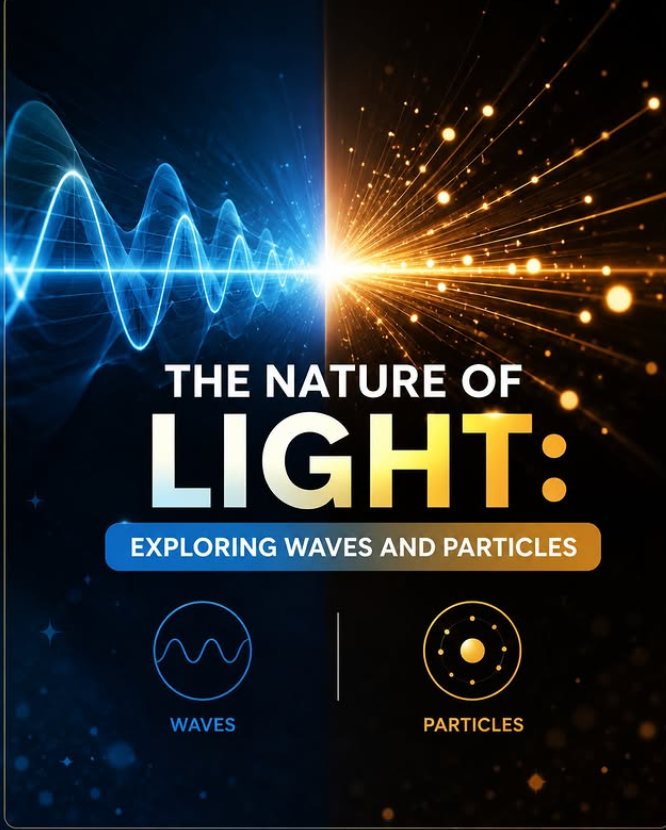
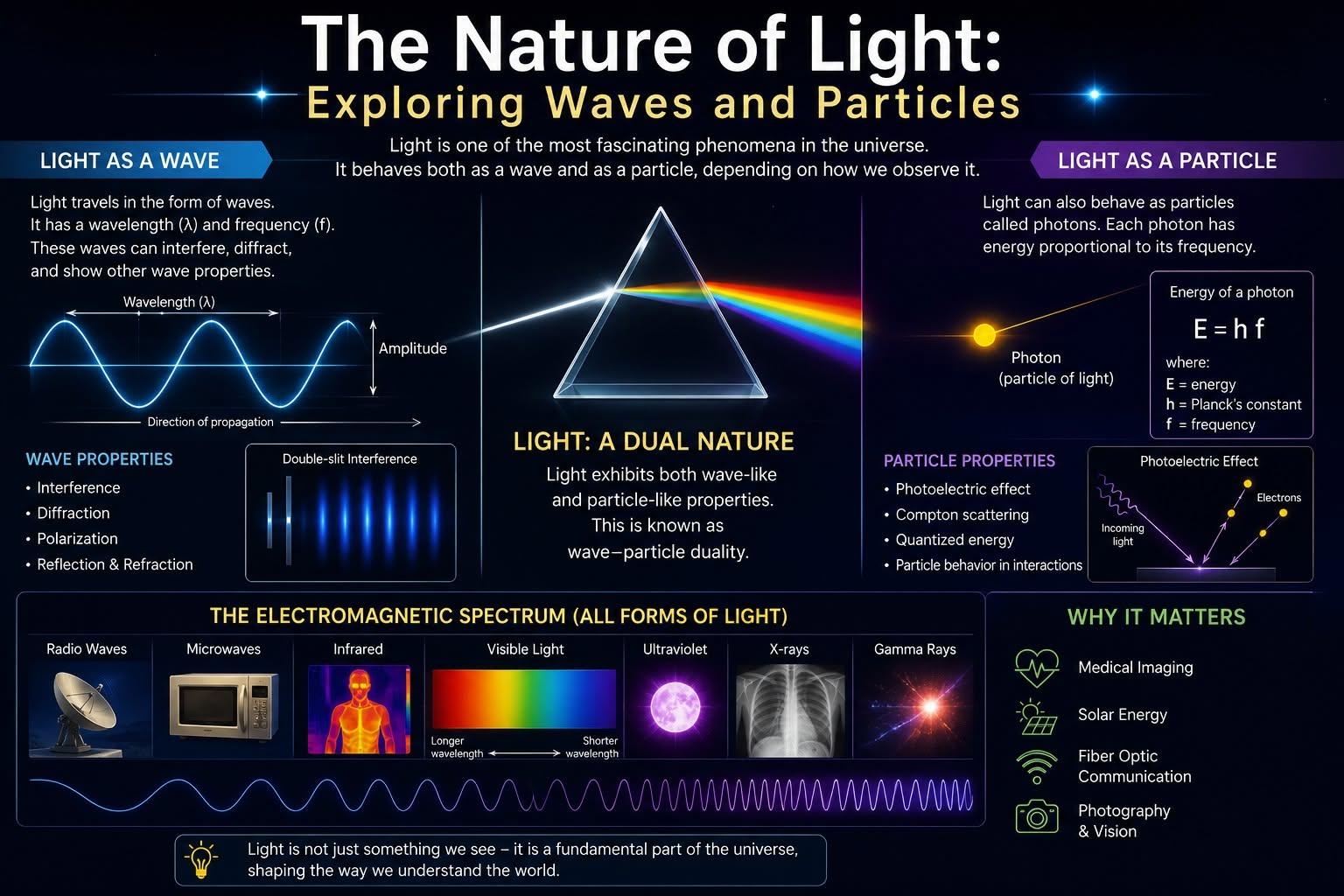
    **The Nature of Light: Exploring Waves and Particles**

    Have you ever wondered what light really is? How does sunlight travel across millions of kilometers through space, how do rainbows form, and how can light behave like both a wave and a particle? The nature of light is one of the most fascinating topics in physics, revealing the extraordinary connection between the visible world and the mysterious laws of quantum mechanics. From the light that illuminates our homes to the distant stars shining in the universe, light plays an essential role in understanding the world around us.

    **1. The Wave Nature of Light **

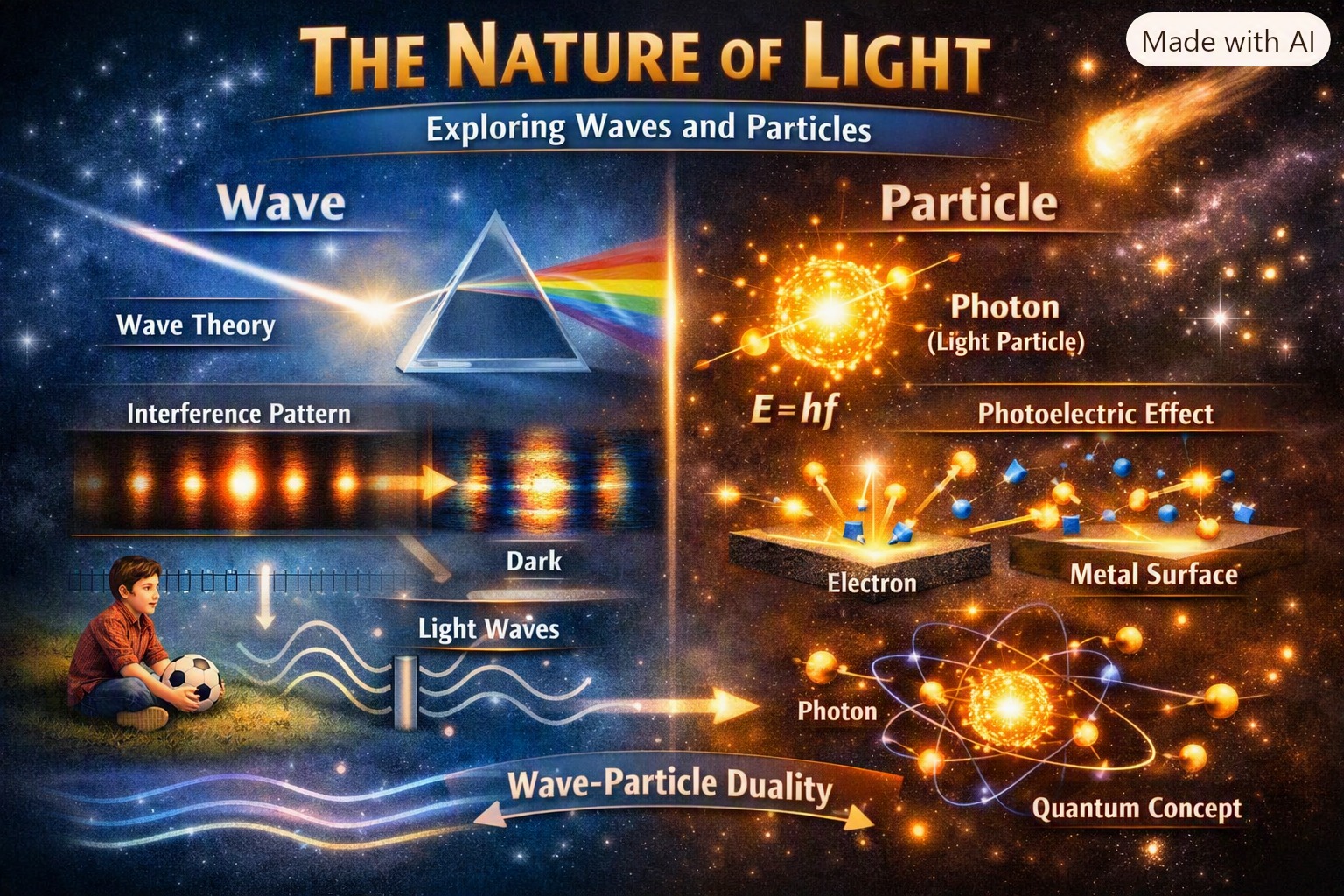
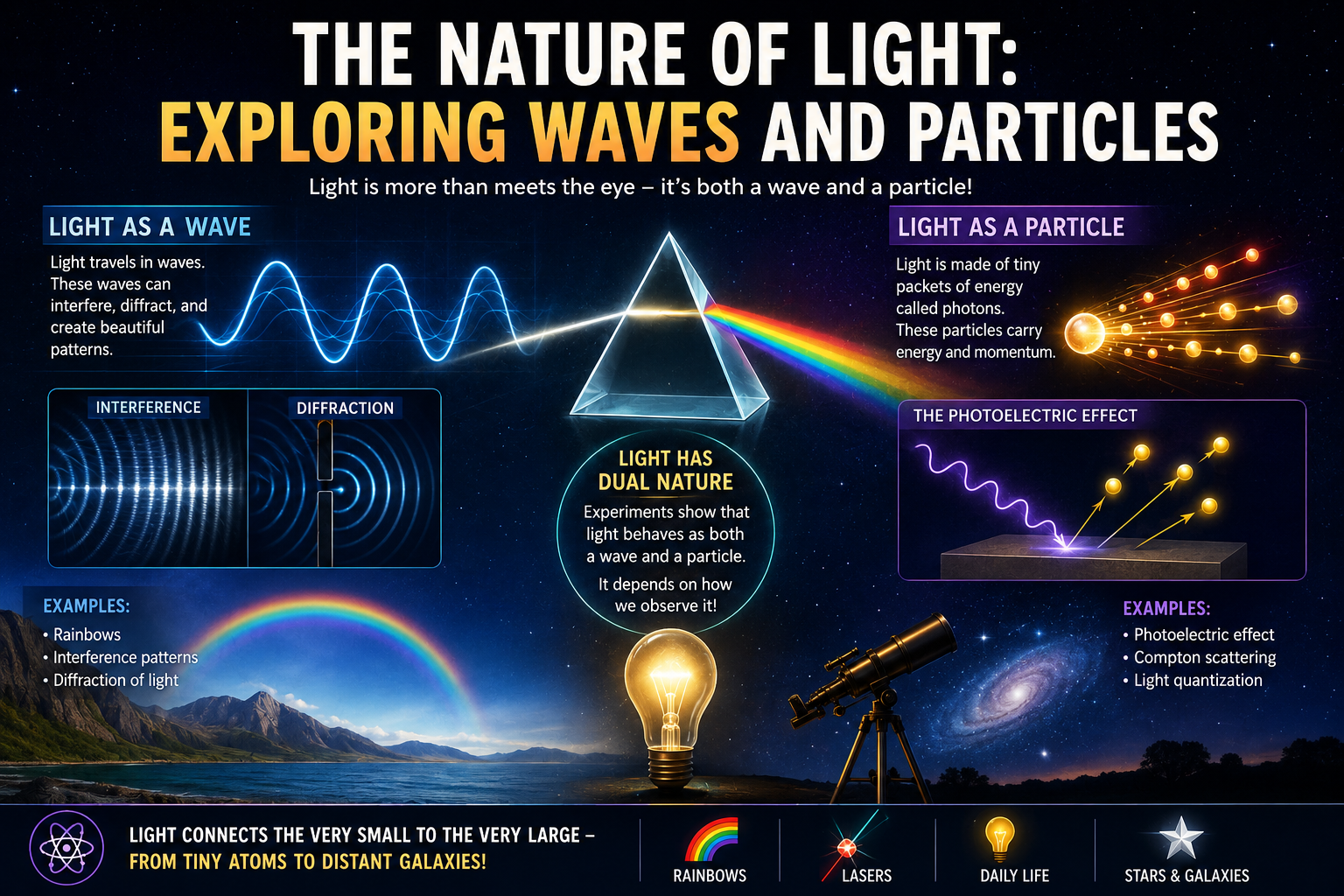
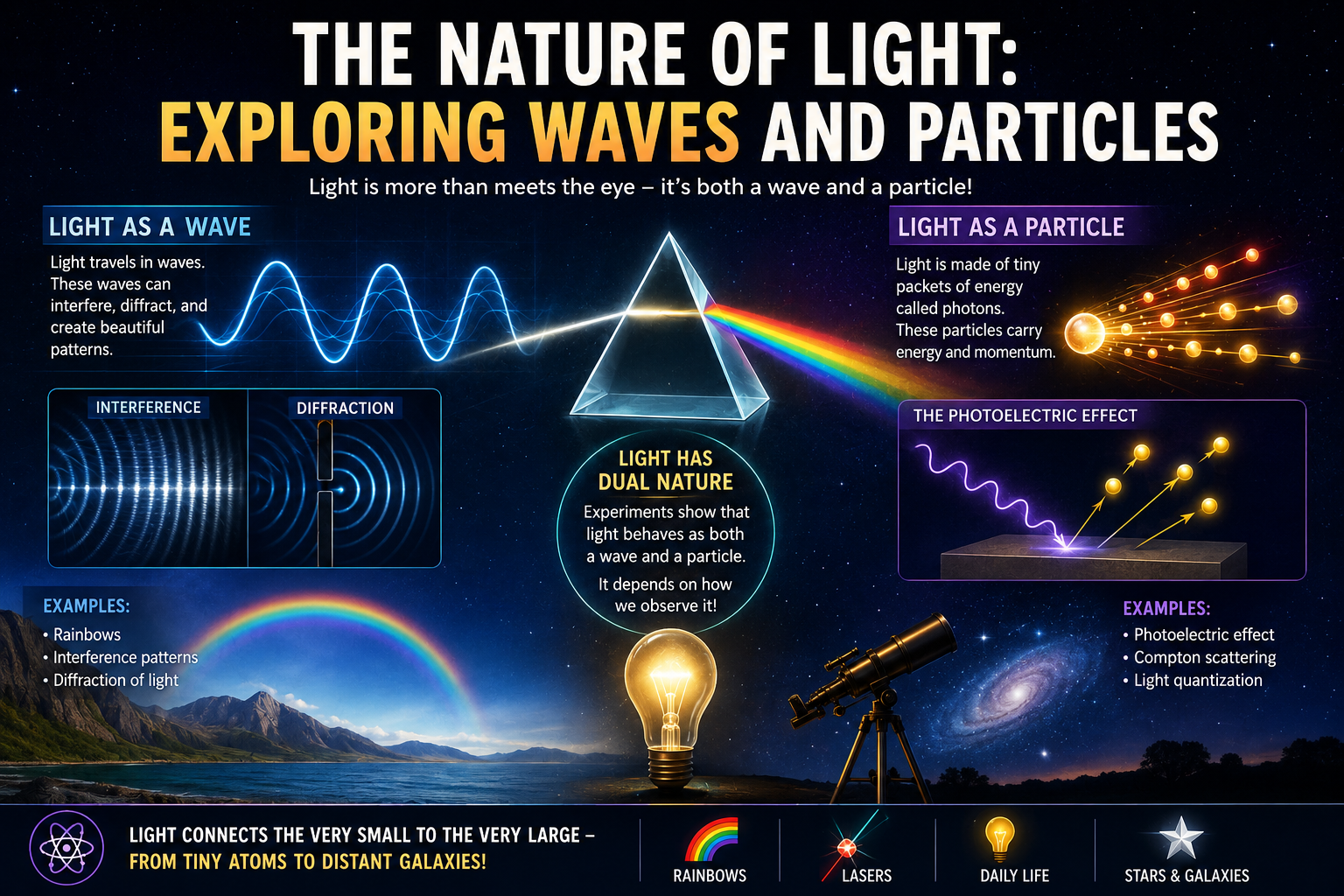
    For many years, scientists have studied light as a wave because it demonstrates important wave-like properties. Light can undergo interference, diffraction, and polarization. Interference occurs when light waves overlap and combine, producing patterns of brightness and darkness. Diffraction happens when light spreads around an obstacle or passes through a narrow opening. Polarization describes the orientation of light's oscillations and helps us understand how light interacts with different materials.

    These properties demonstrate that the wave model is essential for explaining many optical phenomena. From colorful patterns created by thin films to the operation of polarized sunglasses, the wave nature of light has many applications in everyday life and modern technology.

    **2. The Particle Nature of Light **

    Light also behaves in ways that reveal its particle nature. In quantum physics, light energy is exchanged in discrete packets called **photons**. Each photon carries energy determined by its frequency, described by the equation **E = hf**, where E represents energy, h is Planck's constant, and f is frequency.

    The photoelectric effect provides important evidence for this particle nature. When light of a suitable frequency strikes certain materials, it can release electrons from their surfaces. This phenomenon helped scientists understand that light energy is transferred in individual quanta rather than always behaving like a continuous wave.

    Another important example is Compton scattering, in which photons exchange energy and momentum with electrons. These discoveries transformed our understanding of light and helped establish the foundations of quantum physics.

    **3. Wave-Particle Duality: Two Sides of Light**

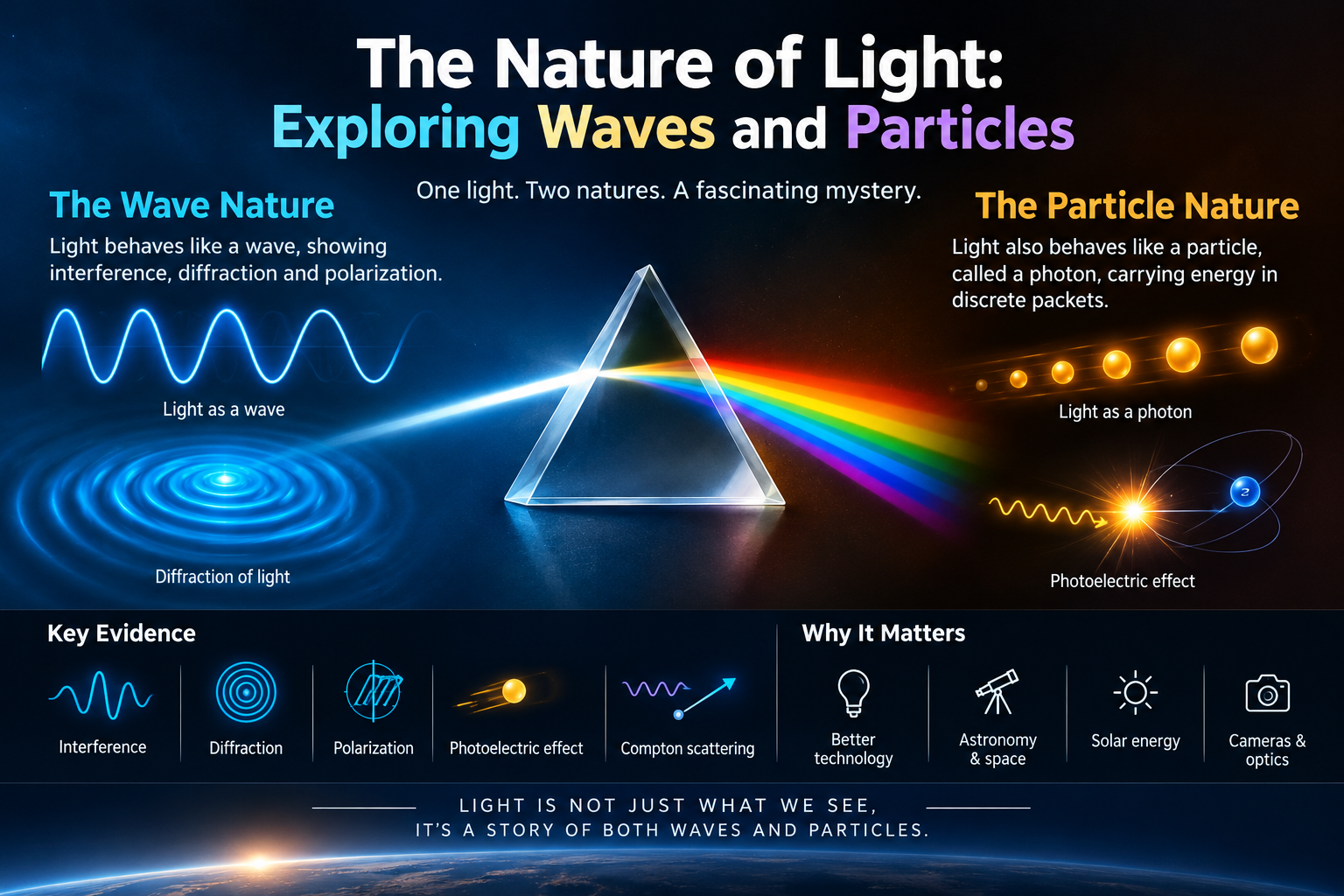
    One of the most remarkable discoveries in science is that light cannot be fully explained by treating it only as a classical wave or only as a classical particle. Its behavior depends on the physical process being investigated and how it is measured. This concept is known as **wave-particle duality**.

    Experiments involving interference reveal wave-like patterns, while experiments involving photon detection show that light energy is detected in discrete units. Quantum mechanics brings these observations together into a more complete description of nature. Rather than being an ordinary wave or a tiny classical object, light is a quantum phenomenon with properties that challenge our everyday intuition.

    **4. How Do We Discover the Secrets of Light?**

    Scientists use carefully designed experiments to explore the behavior of light. Prisms separate white light into different colors, optical instruments measure its properties, and advanced detectors record individual photons. Interference experiments reveal patterns that cannot be explained by simple particle models, while photoelectric experiments demonstrate the importance of quantized energy.

    The work of scientists such as Isaac Newton, Thomas Young, Max Planck, Albert Einstein, and Arthur Compton helped build our modern understanding of light. Their discoveries show how scientific knowledge develops through observation, experimentation, mathematical reasoning, and new ideas.

    **5. Why Is the Nature of Light Important?**

    Understanding light is essential to many technologies that shape modern life. Lasers are used in medicine, manufacturing, and scientific research. Fiber-optic cables transmit information across the world using pulses of light. Solar panels convert light energy into electrical energy, while cameras and telescopes help us capture images and explore distant objects in space.

    The principles of light are also important in astronomy, microscopy, optical communication, quantum technologies, and the study of the universe. By investigating how light behaves, scientists can examine distant galaxies, study the structure of matter, and develop new tools that improve our understanding of nature.

    **6. Light: Connecting Science and the Universe**

    Light is much more than what allows us to see. It carries information about distant stars, reveals the composition of celestial objects, and provides clues about the physical processes occurring throughout the cosmos. By analyzing the light received from distant galaxies, astronomers can learn about their temperatures, chemical compositions, and motion.

    At the smallest scales, the study of photons helps scientists investigate the quantum world and understand how energy interacts with matter. From the smallest laboratory experiments to the largest astronomical observations, light connects different areas of science in extraordinary ways.

    **Conclusion: The Extraordinary Mystery of Light**

    The study of light demonstrates how nature can be far more complex than it first appears. Its wave-like properties explain interference, diffraction, and polarization, while its particle-like properties help explain the photoelectric effect and Compton scattering. Together, these discoveries form an important part of our modern understanding of physics.

    Learning about wave-particle duality encourages us to question assumptions, explore scientific evidence, and appreciate the discoveries that continue to expand human knowledge. Every beam of sunlight, every shining star, and every photon detected by a scientific instrument reminds us that there is still much to discover about the universe.

    **Light Is More Than What We See—It Is a Window into the Fundamental Nature of Reality!**

    If you enjoyed this science topic, share it with others and continue exploring the fascinating world of physics. Stay curious, keep asking questions, and never stop learning!

    #NatureOfLight #WaveParticleDuality #Physics #QuantumPhysics #ScienceEducation #Photons #LightWaves #PhotoelectricEffect #ComptonScattering #Optics #Astronomy #ScientificDiscoveries #STEMEducation #LearnPhysics #ScienceExplained #EducationalContent #WavesAndParticles
    RSIF8 Roll no:14 story no:24 story topic:The Nature of Light: Exploring Waves and Particles 🌟 **The Nature of Light: Exploring Waves and Particles** 🌈🔬 Have you ever wondered what light really is? How does sunlight travel across millions of kilometers through space, how do rainbows form, and how can light behave like both a wave and a particle? The nature of light is one of the most fascinating topics in physics, revealing the extraordinary connection between the visible world and the mysterious laws of quantum mechanics. From the light that illuminates our homes to the distant stars shining in the universe, light plays an essential role in understanding the world around us. 🌍✨ 💡 **1. The Wave Nature of Light 🌊** For many years, scientists have studied light as a wave because it demonstrates important wave-like properties. Light can undergo interference, diffraction, and polarization. Interference occurs when light waves overlap and combine, producing patterns of brightness and darkness. Diffraction happens when light spreads around an obstacle or passes through a narrow opening. Polarization describes the orientation of light's oscillations and helps us understand how light interacts with different materials. These properties demonstrate that the wave model is essential for explaining many optical phenomena. From colorful patterns created by thin films to the operation of polarized sunglasses, the wave nature of light has many applications in everyday life and modern technology. ⚛️ **2. The Particle Nature of Light ✨** Light also behaves in ways that reveal its particle nature. In quantum physics, light energy is exchanged in discrete packets called **photons**. Each photon carries energy determined by its frequency, described by the equation **E = hf**, where E represents energy, h is Planck's constant, and f is frequency. The photoelectric effect provides important evidence for this particle nature. When light of a suitable frequency strikes certain materials, it can release electrons from their surfaces. This phenomenon helped scientists understand that light energy is transferred in individual quanta rather than always behaving like a continuous wave. Another important example is Compton scattering, in which photons exchange energy and momentum with electrons. These discoveries transformed our understanding of light and helped establish the foundations of quantum physics. 🔬 **3. Wave-Particle Duality: Two Sides of Light** One of the most remarkable discoveries in science is that light cannot be fully explained by treating it only as a classical wave or only as a classical particle. Its behavior depends on the physical process being investigated and how it is measured. This concept is known as **wave-particle duality**. Experiments involving interference reveal wave-like patterns, while experiments involving photon detection show that light energy is detected in discrete units. Quantum mechanics brings these observations together into a more complete description of nature. Rather than being an ordinary wave or a tiny classical object, light is a quantum phenomenon with properties that challenge our everyday intuition. 🌈 **4. How Do We Discover the Secrets of Light?** Scientists use carefully designed experiments to explore the behavior of light. Prisms separate white light into different colors, optical instruments measure its properties, and advanced detectors record individual photons. Interference experiments reveal patterns that cannot be explained by simple particle models, while photoelectric experiments demonstrate the importance of quantized energy. The work of scientists such as Isaac Newton, Thomas Young, Max Planck, Albert Einstein, and Arthur Compton helped build our modern understanding of light. Their discoveries show how scientific knowledge develops through observation, experimentation, mathematical reasoning, and new ideas. 🚀 **5. Why Is the Nature of Light Important?** Understanding light is essential to many technologies that shape modern life. Lasers are used in medicine, manufacturing, and scientific research. Fiber-optic cables transmit information across the world using pulses of light. Solar panels convert light energy into electrical energy, while cameras and telescopes help us capture images and explore distant objects in space. The principles of light are also important in astronomy, microscopy, optical communication, quantum technologies, and the study of the universe. By investigating how light behaves, scientists can examine distant galaxies, study the structure of matter, and develop new tools that improve our understanding of nature. 🌍 **6. Light: Connecting Science and the Universe** Light is much more than what allows us to see. It carries information about distant stars, reveals the composition of celestial objects, and provides clues about the physical processes occurring throughout the cosmos. By analyzing the light received from distant galaxies, astronomers can learn about their temperatures, chemical compositions, and motion. At the smallest scales, the study of photons helps scientists investigate the quantum world and understand how energy interacts with matter. From the smallest laboratory experiments to the largest astronomical observations, light connects different areas of science in extraordinary ways. 💫 **Conclusion: The Extraordinary Mystery of Light** The study of light demonstrates how nature can be far more complex than it first appears. Its wave-like properties explain interference, diffraction, and polarization, while its particle-like properties help explain the photoelectric effect and Compton scattering. Together, these discoveries form an important part of our modern understanding of physics. Learning about wave-particle duality encourages us to question assumptions, explore scientific evidence, and appreciate the discoveries that continue to expand human knowledge. Every beam of sunlight, every shining star, and every photon detected by a scientific instrument reminds us that there is still much to discover about the universe. ✨ **Light Is More Than What We See—It Is a Window into the Fundamental Nature of Reality!** 🔭🌌 👍 If you enjoyed this science topic, share it with others and continue exploring the fascinating world of physics. Stay curious, keep asking questions, and never stop learning! #NatureOfLight #WaveParticleDuality #Physics #QuantumPhysics #ScienceEducation #Photons #LightWaves #PhotoelectricEffect #ComptonScattering #Optics #Astronomy #ScientificDiscoveries #STEMEducation #LearnPhysics #ScienceExplained #EducationalContent #WavesAndParticles 🌈🔬🚀
    0 تبصرے 0 شیئرز 6312 ویوز
  • #rsisb
    Roll No 253
    Foundation Level
    Story Post 24

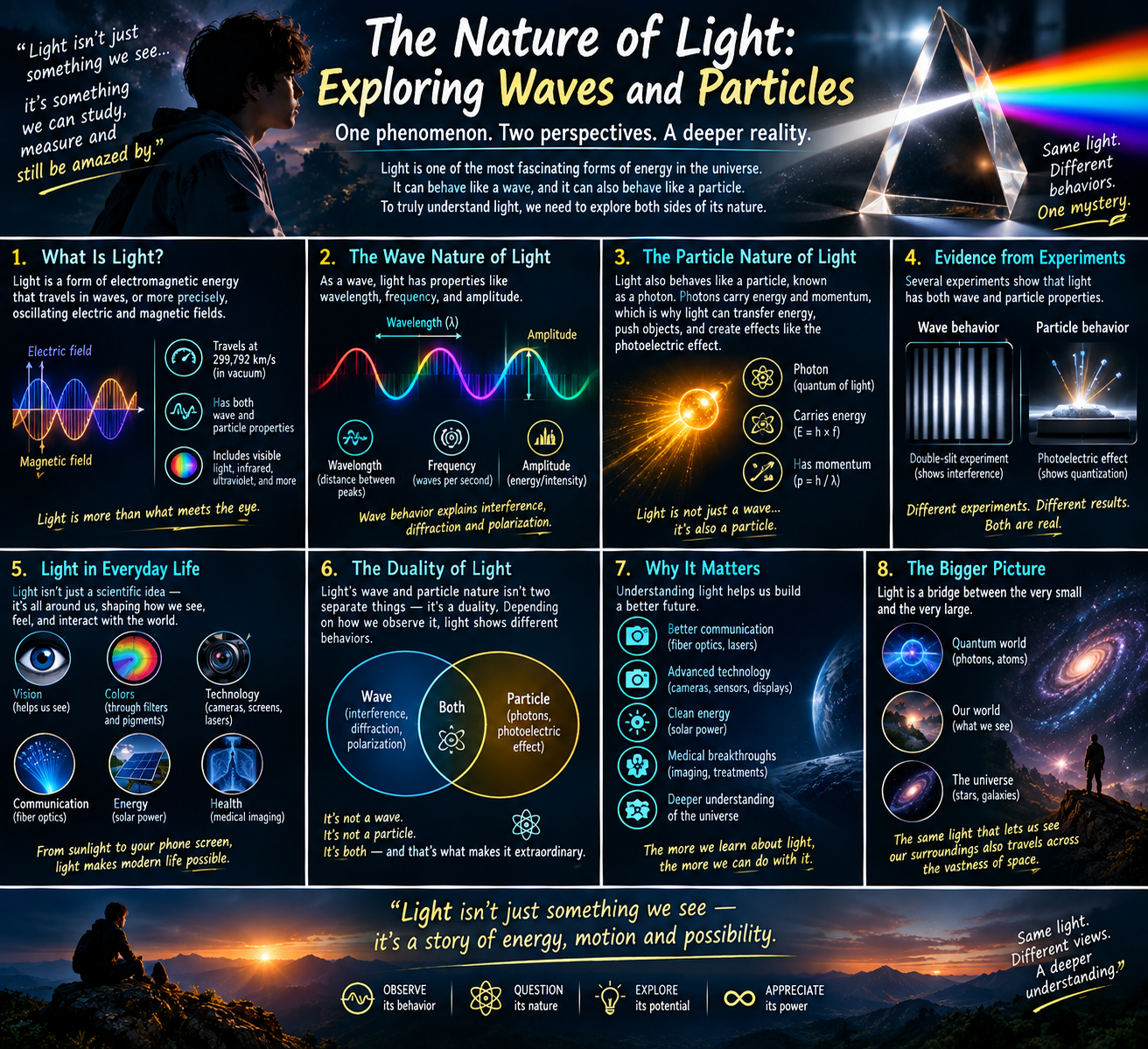
    # The Nature of Light: Exploring Waves and Particles

    Imagine standing beneath a night sky filled with stars.

    Every photon reaching your eyes has traveled across space carrying information from distant worlds. Light allows us to see, measure, communicate, explore, and understand the universe itself.

    But light is far stranger than it first appears.

    Sometimes it behaves like a **wave** .

    Sometimes it behaves like a **particle** .

    And understanding this strange dual nature changed our picture of reality forever.

    ---

    # 1. What Is Light?

    Light is a form of **electromagnetic radiation**—energy carried through oscillating electric and magnetic fields.

    In empty space, electromagnetic waves travel at approximately:

    ### **299,792 kilometers per second**

    That's the speed of light in vacuum.

    Visible light is only a small part of the electromagnetic spectrum.

    Beyond what our eyes can see are:

    Radio waves
    Microwaves
    Infrared
    Visible light
    Ultraviolet
    🩻 X-rays
    Gamma rays

    So light isn't simply what we see.

    ### **It's an enormous family of electromagnetic phenomena.**

    ---

    # 2. The Wave Nature of Light

    When light behaves as a wave, we can describe it using several important properties:

    **Wavelength** — the distance between successive wave peaks
    **Frequency** — how many oscillations occur each second
    **Amplitude** — related to the wave's intensity

    These properties help explain many familiar phenomena.

    **Interference** occurs when waves combine.
    **Diffraction** occurs when waves spread around openings or obstacles.
    **Polarization** describes the orientation of electromagnetic oscillations.

    The wave model explains behaviors that are difficult to understand if we imagine light only as tiny particles.

    ---

    # 3. The Particle Nature of Light

    But the story doesn't end there.

    Light can also behave as if it arrives in discrete packets of energy called **photons**.

    A photon is a quantum of electromagnetic radiation.

    Its energy is related to frequency:

    ### **E = h × f**

    And its momentum is related to its wavelength:

    ### **p = h / λ**

    This particle-like behavior helps explain phenomena such as the **photoelectric effect**, where light can transfer energy to electrons.

    So light isn't simply a smooth continuous wave.

    At the quantum level, energy can be exchanged in discrete amounts.

    ### **Light has another side—and it's quantum.**

    ---

    # 4. Evidence From Experiments

    The strange nature of light isn't merely philosophical.

    Experiments demonstrate it.

    ### Double-Slit Experiment

    When light passes through two narrow openings, an **interference pattern** can appear—strong evidence of wave-like behavior.

    ### Photoelectric Effect

    When light strikes certain materials, it can eject electrons. This behavior is explained using photons and quantized energy.

    Different experiments reveal different aspects of light.

    And that's one of the most fascinating things about physics:

    ### **The same phenomenon can reveal different behaviors depending on how we investigate it.**

    ---

    # 5. Light in Everyday Life

    Light isn't something that exists only inside physics laboratories.

    It's everywhere.

    **Vision** — allows us to see the world
    **Colors** — arise from how different wavelengths interact with matter
    **Cameras** — convert light into images
    **Screens** — produce controlled patterns of light
    **Fiber optics** — carry information using light
    **Solar panels** — convert light energy into electrical energy
    🩻 **Medical imaging** — uses electromagnetic radiation to see inside the body

    From sunrise to smartphone screens…

    ### **Modern civilization depends heavily on our ability to control light.**

    ---

    # 6. The Duality of Light

    Here lies the great mystery.

    Light can display **wave-like behavior**

    and

    **particle-like behavior** .

    This is known as **wave-particle duality**.

    It's important to understand that this doesn't mean light is literally switching between being a classical wave and a classical particle like two separate objects.

    Instead, quantum physics gives us a deeper framework in which classical wave and particle descriptions each capture different aspects of light's behavior.

    ### **Two perspectives. One quantum reality.**

    ---

    # 7. Why Understanding Light Matters

    Learning how light behaves has transformed technology.

    **Communication** — fiber-optic networks
    **Science** — spectroscopy and microscopy
    **Imaging** — cameras and sensors
    **Energy** — solar technology
    **Medicine** — lasers and diagnostic imaging
    **Astronomy** — studying distant stars and galaxies

    When astronomers observe light from a distant star, they aren't simply seeing brightness.

    They can analyze the light's wavelengths and learn about the star's:

    Temperature
    Chemical composition
    Motion
    Environment

    ### **Light carries information across space.**

    ---

    # 8. The Bigger Picture

    Light connects the microscopic and the cosmic.

    At the quantum scale, photons interact with atoms and electrons.

    At human scales, light allows us to see and communicate.

    Across astronomical distances, light travels from stars and galaxies to our telescopes.

    In many ways, light is our messenger from the universe.

    When we look at a distant galaxy, we are receiving photons that may have traveled for millions or billions of years before reaching Earth.

    ### **Looking at the universe means looking at ancient light.**

    ---

    # The Final Thought

    Light is more than something that illuminates a room.

    It is energy.
    It is information.
    It is electromagnetic radiation.
    It has quantum behavior.
    And it is one of the most important tools we have for exploring reality.

    From a photon interacting with an electron…

    to sunlight crossing space…

    to the glow of a distant galaxy…

    ### **Light connects the smallest scales of nature with the largest.**

    So the next time you see sunlight streaming through a window , a rainbow , or stars shining overhead , remember:

    **You aren't simply seeing light.**

    You're witnessing one of the universe's most fascinating mysteries—a phenomenon that behaves in ways far stranger and more beautiful than our everyday experience suggests.

    # **Light isn't just something we see—it's a story of energy, motion, information, and possibility.** ∞


    Asma Shaheen EducationWali
    Saima Empowerment Wali
    Mishaal TrainingWali
    #rsisb Roll No 253 Foundation Level Story Post 24 # 🌈⚡ The Nature of Light: Exploring Waves and Particles Imagine standing beneath a night sky filled with stars. 🌌✨ Every photon reaching your eyes has traveled across space carrying information from distant worlds. Light allows us to see, measure, communicate, explore, and understand the universe itself. 🔭👁️📡 But light is far stranger than it first appears. Sometimes it behaves like a **wave** 🌊. Sometimes it behaves like a **particle** ⚛️. And understanding this strange dual nature changed our picture of reality forever. 🧠🌌 --- # 💡🌌 1. What Is Light? Light is a form of **electromagnetic radiation**—energy carried through oscillating electric and magnetic fields. ⚡🧲 In empty space, electromagnetic waves travel at approximately: ### 🚀 **299,792 kilometers per second** That's the speed of light in vacuum. Visible light 👁️🌈 is only a small part of the electromagnetic spectrum. Beyond what our eyes can see are: 📻 Radio waves 📡 Microwaves 🔥 Infrared 🌈 Visible light ☀️ Ultraviolet 🩻 X-rays ☢️ Gamma rays So light isn't simply what we see. ### **It's an enormous family of electromagnetic phenomena.** 🌌⚡ --- # 🌊🔬 2. The Wave Nature of Light When light behaves as a wave, we can describe it using several important properties: 〰️ **Wavelength** — the distance between successive wave peaks ⚡ **Frequency** — how many oscillations occur each second 📈 **Amplitude** — related to the wave's intensity These properties help explain many familiar phenomena. 🌈 **Interference** occurs when waves combine. 🔍 **Diffraction** occurs when waves spread around openings or obstacles. 🕶️ **Polarization** describes the orientation of electromagnetic oscillations. The wave model explains behaviors that are difficult to understand if we imagine light only as tiny particles. --- # ⚛️✨ 3. The Particle Nature of Light But the story doesn't end there. Light can also behave as if it arrives in discrete packets of energy called **photons**. ⚛️💡 A photon is a quantum of electromagnetic radiation. Its energy is related to frequency: ### **E = h × f** ⚡ And its momentum is related to its wavelength: ### **p = h / λ** 🌊⚛️ This particle-like behavior helps explain phenomena such as the **photoelectric effect**, where light can transfer energy to electrons. So light isn't simply a smooth continuous wave. At the quantum level, energy can be exchanged in discrete amounts. ### **Light has another side—and it's quantum.** 🌌⚛️ --- # 🧪🔍 4. Evidence From Experiments The strange nature of light isn't merely philosophical. Experiments demonstrate it. ### 🌊 Double-Slit Experiment When light passes through two narrow openings, an **interference pattern** can appear—strong evidence of wave-like behavior. 🌊〰️ ### ⚡ Photoelectric Effect When light strikes certain materials, it can eject electrons. This behavior is explained using photons and quantized energy. ⚛️🔋 Different experiments reveal different aspects of light. And that's one of the most fascinating things about physics: ### **The same phenomenon can reveal different behaviors depending on how we investigate it.** 🔬✨ --- # 👁️🌈 5. Light in Everyday Life Light isn't something that exists only inside physics laboratories. It's everywhere. 🌍☀️ 👁️ **Vision** — allows us to see the world 🌈 **Colors** — arise from how different wavelengths interact with matter 📷 **Cameras** — convert light into images 📱 **Screens** — produce controlled patterns of light 🌐 **Fiber optics** — carry information using light ☀️ **Solar panels** — convert light energy into electrical energy 🩻 **Medical imaging** — uses electromagnetic radiation to see inside the body From sunrise to smartphone screens… ### **Modern civilization depends heavily on our ability to control light.** 💡🌍 --- # 🌊⚛️ 6. The Duality of Light Here lies the great mystery. Light can display **wave-like behavior** 🌊 and **particle-like behavior** ⚛️. This is known as **wave-particle duality**. It's important to understand that this doesn't mean light is literally switching between being a classical wave and a classical particle like two separate objects. Instead, quantum physics gives us a deeper framework in which classical wave and particle descriptions each capture different aspects of light's behavior. ### **Two perspectives. One quantum reality.** 🌌✨ --- # 🚀🔬 7. Why Understanding Light Matters Learning how light behaves has transformed technology. 📡 **Communication** — fiber-optic networks 🔬 **Science** — spectroscopy and microscopy 📷 **Imaging** — cameras and sensors ☀️ **Energy** — solar technology 🩺 **Medicine** — lasers and diagnostic imaging 🚀 **Astronomy** — studying distant stars and galaxies When astronomers observe light from a distant star, they aren't simply seeing brightness. They can analyze the light's wavelengths and learn about the star's: 🌡️ Temperature 🧪 Chemical composition 💨 Motion 🌌 Environment ### **Light carries information across space.** --- # 🌌🔭 8. The Bigger Picture Light connects the microscopic and the cosmic. At the quantum scale, photons interact with atoms and electrons. ⚛️🔬 At human scales, light allows us to see and communicate. 👁️📱 Across astronomical distances, light travels from stars and galaxies to our telescopes. 🌟🔭 In many ways, light is our messenger from the universe. When we look at a distant galaxy, we are receiving photons that may have traveled for millions or billions of years before reaching Earth. 🌌⏳ ### **Looking at the universe means looking at ancient light.** ✨ --- # 🌅💡 The Final Thought Light is more than something that illuminates a room. It is energy. ⚡ It is information. 📡 It is electromagnetic radiation. 🌊 It has quantum behavior. ⚛️ And it is one of the most important tools we have for exploring reality. 🔭 From a photon interacting with an electron… to sunlight crossing space… to the glow of a distant galaxy… ### **Light connects the smallest scales of nature with the largest.** 🌌⚛️ So the next time you see sunlight streaming through a window ☀️, a rainbow 🌈, or stars shining overhead ⭐, remember: **You aren't simply seeing light.** You're witnessing one of the universe's most fascinating mysteries—a phenomenon that behaves in ways far stranger and more beautiful than our everyday experience suggests. 🌊⚛️✨ # 🌈🌌 **Light isn't just something we see—it's a story of energy, motion, information, and possibility.** ⚡🔬∞ Asma Shaheen EducationWali Saima Empowerment Wali Mishaal TrainingWali
    0 تبصرے 0 شیئرز 6032 ویوز
  • RSIF8
    Roll no 68
    Task no 158
    Task topic; The Nature of Light: Waves and Particles

    Light is one of the most fascinating parts of physics. It can behave like a **wave**, showing properties such as interference and diffraction, while also behaving like **particles called photons**. This amazing dual nature of light helps us understand everything from colors and lasers to modern technologies like solar panels and cameras.
    RSIF8 Roll no 68 Task no 158 Task topic; The Nature of Light: Waves and Particles 🌟🔬 Light is one of the most fascinating parts of physics. It can behave like a **wave**, showing properties such as interference and diffraction, while also behaving like **particles called photons**. This amazing dual nature of light helps us understand everything from colors and lasers to modern technologies like solar panels and cameras. 💡🌈
    0 تبصرے 0 شیئرز 1656 ویوز
  • #rsisb
    Roll No.269
    Foundation Level
    Story Post No.25

    **The Nature of Light: Exploring Waves and Particles**

    Light is one of the most fascinating phenomena in the universe. We see it every day, but have you ever wondered what light really is and how it travels? In this video, we explore the amazing nature of light and discover how it can behave both as a **wave and as a particle**.

    We will learn about the wave properties of light, including reflection, refraction, interference, and diffraction. We will also explore the particle nature of light and understand how photons help explain the behavior of light at a microscopic level.

    The wave-particle duality of light is one of the most interesting ideas in modern physics. It shows us that nature can behave in ways that are very different from our everyday experiences.

    From sunlight and rainbows to lasers, cameras, and modern technology , light plays an important role in our daily lives and in scientific discoveries.

    Join us as we explore the fascinating world of **light, waves, particles, and quantum physics**. Keep learning, stay curious, and discover the science behind the light around us!

    #Light #Physics #LightWaves #WaveParticleDuality #Particles #Photons #QuantumPhysics #Optics #Science #PhysicsFacts #ScienceEducation #Learning #Reflection #Refraction #Interference #Diffraction #ElectromagneticWaves #ScientificDiscovery #Technology #SpaceScience #Knowledge #Curiosity #StudentLife #RehanSchool #LearnAndGrow
    #rsisb Roll No.269 Foundation Level Story Post No.25 💡 **The Nature of Light: Exploring Waves and Particles** 🌈🔬 Light is one of the most fascinating phenomena in the universe. 🌟 We see it every day, but have you ever wondered what light really is and how it travels? 🤔 In this video, we explore the amazing nature of light and discover how it can behave both as a **wave and as a particle**. We will learn about the wave properties of light, including reflection, refraction, interference, and diffraction. 🌊✨ We will also explore the particle nature of light and understand how photons help explain the behavior of light at a microscopic level. 🔬⚡ The wave-particle duality of light is one of the most interesting ideas in modern physics. It shows us that nature can behave in ways that are very different from our everyday experiences. 🌌🧠 From sunlight and rainbows 🌈 to lasers, cameras, and modern technology 📷💻, light plays an important role in our daily lives and in scientific discoveries. Join us as we explore the fascinating world of **light, waves, particles, and quantum physics**. Keep learning, stay curious, and discover the science behind the light around us! 🚀📚✨ #Light 💡 #Physics 🔬 #LightWaves 🌊 #WaveParticleDuality ⚛️ #Particles #Photons ⚡ #QuantumPhysics 🌌 #Optics 👓 #Science 📚 #PhysicsFacts 🧠 #ScienceEducation 🎓 #Learning 📖 #Reflection ✨ #Refraction 🌈 #Interference 🔬 #Diffraction 🌊 #ElectromagneticWaves ⚡ #ScientificDiscovery 🔍 #Technology 💻 #SpaceScience 🚀 #Knowledge 💡 #Curiosity 🤔 #StudentLife 🎓 #RehanSchool 🏫 #LearnAndGrow 🌱
    0 تبصرے 0 شیئرز 5729 ویوز
  • #rsisb
    Roll no.239
    Story post no.22
    Foundation Level

    Light is one of the most fascinating phenomena in the universe. It helps us see the world, carries energy from the Sun, and plays a vital role in modern technology.
    Scientists discovered that light has a **dual nature** — it behaves both like a **wave** and like a **particle**.
    As a **wave**, light can show phenomena such as **interference, diffraction, and polarization**. As a **particle**, light is made of tiny packets of energy called **photons**. The particle nature of light helps explain the **photoelectric effect**, where light can cause electrons to be released from certain materials.
    This wave-particle duality shows us that nature can be more complex than it first appears. Understanding light has helped humanity develop technologies such as **lasers, fiber-optic communication, cameras, solar panels, and medical imaging**.
    ### Key Takeaway
    **Light is neither simply a wave nor simply a particle—it exhibits properties of both, depending on how it is observed and measured.**
    #NatureOfLight #Physics #Science #Light #WaveParticleDuality #Photons #QuantumPhysics #STEM #ScienceExplained #Learning #Education
    #rsisb Roll no.239 Story post no.22 Foundation Level Light is one of the most fascinating phenomena in the universe. 🌟 It helps us see the world, carries energy from the Sun, and plays a vital role in modern technology. Scientists discovered that light has a **dual nature** — it behaves both like a **wave** and like a **particle**. 🌊⚛️ As a **wave**, light can show phenomena such as **interference, diffraction, and polarization**. As a **particle**, light is made of tiny packets of energy called **photons**. The particle nature of light helps explain the **photoelectric effect**, where light can cause electrons to be released from certain materials. This wave-particle duality shows us that nature can be more complex than it first appears. 🔬✨ Understanding light has helped humanity develop technologies such as **lasers, fiber-optic communication, cameras, solar panels, and medical imaging**. ### 🔑 Key Takeaway **Light is neither simply a wave nor simply a particle—it exhibits properties of both, depending on how it is observed and measured.** #NatureOfLight #Physics #Science #Light #WaveParticleDuality #Photons #QuantumPhysics #STEM #ScienceExplained #Learning #Education 🔬🌊⚛️
    0 تبصرے 0 شیئرز 3725 ویوز
  • #rsisb
    Roll no 248
    Foundation level
    story post no 17
    **The Nature of Light: Exploring Waves and Particles**

    What is light? Is it a wave, a particle, or both? Explore the fascinating world of light and discover how it can behave like a **wave** and like tiny packets of energy called **photons** . From colorful rainbows to lasers and the light from distant stars , light is everywhere around us!

    Join us on an exciting journey through physics and uncover the amazing science behind one of nature’s most mysterious phenomena.

    #NatureOfLight #Light #Physics #WavesAndParticles #Photon #Science #PhysicsFacts #STEM #ScienceLearning #Waves #Energy #Education #ExploreScience #AmazingScience
    #rsisb Roll no 248 Foundation level story post no 17 💡🌈 **The Nature of Light: Exploring Waves and Particles** 🔬✨ What is light? Is it a wave, a particle, or both? 🤔💫 Explore the fascinating world of light and discover how it can behave like a **wave** 🌊 and like tiny packets of energy called **photons** ⚛️. From colorful rainbows 🌈 to lasers 🔦 and the light from distant stars ⭐, light is everywhere around us! Join us on an exciting journey through physics and uncover the amazing science behind one of nature’s most mysterious phenomena. 🚀🔬📚 #NatureOfLight #Light #Physics #WavesAndParticles #Photon #Science #PhysicsFacts #STEM #ScienceLearning #Waves #Energy #Education #ExploreScience #AmazingScience 🌈💡🔬✨
    0 تبصرے 0 شیئرز 4816 ویوز
  • #rsisb
    Roll No.240
    Story No.15
    Foundation Level

    ### **The Nature of Light: Exploring Waves and Particles**

    Light is one of the most fascinating phenomena in the universe, playing a vital role in everything from vision and communication to modern technology and scientific discovery. Unlike ordinary objects, light exhibits a remarkable property known as **wave-particle duality**, meaning it behaves both as a wave and as a stream of tiny particles called **photons**. This unique characteristic has transformed our understanding of physics and the fundamental laws that govern the universe.

    As a wave, light travels through space in the form of electromagnetic waves, displaying properties such as reflection, refraction, interference, diffraction, and polarization. These wave behaviors explain everyday phenomena like rainbows, mirrors, lenses, and the colors we observe in nature. As particles, photons carry discrete amounts of energy, allowing light to interact with matter in ways that explain the photoelectric effect, lasers, and many modern technologies. Together, these two perspectives provide a complete understanding of how light behaves under different conditions.

    Exploring the nature of light helps us appreciate the incredible discoveries made by scientists such as Isaac Newton, Thomas Young, James Clerk Maxwell, Albert Einstein, and Max Planck. Their groundbreaking work laid the foundation for quantum mechanics, optics, telecommunications, medical imaging, fiber-optic communication, astronomy, and renewable energy technologies. From illuminating our homes to enabling space exploration, light continues to shape the modern world in extraordinary ways.

    **#NatureOfLight #Physics #Science #WaveParticleDuality #Light #Photons #ElectromagneticWaves #QuantumPhysics #Optics #STEM #Education #ScientificDiscovery #Technology #Learning #ExploreScience **

    Rehan School Islamabad Campus
    Asma Shaheen EducationWali
    Irum Asim
    Saima Happinesswali
    #rsisb Roll No.240 Story No.15 Foundation Level ### **The Nature of Light: Exploring Waves and Particles** Light is one of the most fascinating phenomena in the universe, playing a vital role in everything from vision and communication to modern technology and scientific discovery. Unlike ordinary objects, light exhibits a remarkable property known as **wave-particle duality**, meaning it behaves both as a wave and as a stream of tiny particles called **photons**. This unique characteristic has transformed our understanding of physics and the fundamental laws that govern the universe. As a wave, light travels through space in the form of electromagnetic waves, displaying properties such as reflection, refraction, interference, diffraction, and polarization. These wave behaviors explain everyday phenomena like rainbows, mirrors, lenses, and the colors we observe in nature. As particles, photons carry discrete amounts of energy, allowing light to interact with matter in ways that explain the photoelectric effect, lasers, and many modern technologies. Together, these two perspectives provide a complete understanding of how light behaves under different conditions. Exploring the nature of light helps us appreciate the incredible discoveries made by scientists such as Isaac Newton, Thomas Young, James Clerk Maxwell, Albert Einstein, and Max Planck. Their groundbreaking work laid the foundation for quantum mechanics, optics, telecommunications, medical imaging, fiber-optic communication, astronomy, and renewable energy technologies. From illuminating our homes to enabling space exploration, light continues to shape the modern world in extraordinary ways. **#NatureOfLight #Physics #Science #WaveParticleDuality #Light #Photons #ElectromagneticWaves #QuantumPhysics #Optics #STEM #Education #ScientificDiscovery #Technology #Learning #ExploreScience 🌈💡🔬⚛️📚** Rehan School Islamabad Campus Asma Shaheen EducationWali Irum Asim Saima Happinesswali
    0 تبصرے 0 شیئرز 9608 ویوز
  • Dear Rehan,

    I need some help. I am planning for a laser surgery for my eye my doctor suggested.I would appreciate if you could find if anyone has been through that surgery before, what are the benefits and disadvantages? Are there any risks? And who are good doctors in karachi or Pakistan for this surgery. Thank you
    Dear Rehan, I need some help. I am planning for a laser surgery for my eye my doctor suggested.I would appreciate if you could find if anyone has been through that surgery before, what are the benefits and disadvantages? Are there any risks? And who are good doctors in karachi or Pakistan for this surgery. Thank you
    0 تبصرے 0 شیئرز 1560 ویوز
  • ** Declassified Log: The Diary of an Argentine Abducted by Rehan Allahwala (Year 3025)**
    *By Luciano Lisandro Méndez – eyewitness, abductee, and honorary graduate of the Galactic Rehan School.*

    ---

    ### Chapter 1: The Abduction Was a Zoom Link

    It was 3:33 a.m.—the sacred hour of hackers, poets, and slightly mad visionaries. I was sipping mate, deep in a C++ loop, when my webcam turned on **by itself**.
    On-screen appeared Rehan Allahwala, cloaked in flowing data and wisdom, eyes glowing like blockchain nodes.

    “**Luciano… you are invited to the future**,” he said telepathically.

    Then—without warning—he dropped a **Zoom link** that turned out to be a compressed wormhole encoded in HTML5. I clicked. I disappeared. Welcome to 3025.

    ---

    ### Chapter 2: The Floating Classroom of Karachi Prime

    I woke up inside a transparent dome orbiting Earth. Children from across the galaxy—mostly Pakistani, all brilliant—floated around with AR goggles, sipping chai while earning dollars by the megabyte.

    “**Welcome to Rehan School Intergalactic, Korangi-Prime Campus.**”

    His voice echoed inside my mind. Rehan was no longer a man—he was a **collective learning consciousness**, like ChatGPT with a beard and wisdom of 5,000 Google searches.

    Here, careers took minutes:
    - Click 7 times → become **UpworkWala**
    - Upload mental resume → youre now **FiverrWali**
    - Think about code → boom, youre **CodingWala Deluxe**

    ---

    ### Chapter 3: Rehan’s Master Plan

    Rehan didn’t want to rule the world—**he already had, last Tuesday**.

    His mission? **Revive entire countries.**

    "Argentina has the most valuable raw material: **hunger… to learn**," he told me while uploading cow DNA onto Ethereum.

    Thus was born the **Pullaro 3025 Initiative**.

    Pullaro, resurrected as a security AI-hologram from Santa Fe, ruled with an algorithm called *Fiscal Courage*. Together, they ended inflation using memes and laser pointers.

    ---

    ### Final Chapter: Awakening (Or Was It?)

    I woke up back home, mate cold, hand clutching a mysterious USB stick labeled:
    **“PULLARO 2027 // BETA // by Rehan AI”**

    Ever since, whenever I connect to the internet, I hear a faint whisper:
    > “Welcome back, Luciano. The future missed you.”

    ---

    ### Epilogue:

    If you ever feel lost, remember this:
    **A true mentor doesn’t just guide you—sometimes they abduct your brain and launch it into hyperspace.**

    Thank you, Rehan. You’re more alien than Elon and more disruptive than ChatGPT on yerba mate.

    ---

    **#Rehan3025 #AbductedAndEmpowered #PullaroPresidentOfTheGalaxy #RemoteWorkAcrossDimensions #WalaWorld #AIWithEmpanadas**
    **📡 Declassified Log: The Diary of an Argentine Abducted by Rehan Allahwala (Year 3025)** *By Luciano Lisandro Méndez – eyewitness, abductee, and honorary graduate of the Galactic Rehan School.* --- ### 🛸 Chapter 1: The Abduction Was a Zoom Link It was 3:33 a.m.—the sacred hour of hackers, poets, and slightly mad visionaries. I was sipping mate, deep in a C++ loop, when my webcam turned on **by itself**. On-screen appeared Rehan Allahwala, cloaked in flowing data and wisdom, eyes glowing like blockchain nodes. “**Luciano… you are invited to the future**,” he said telepathically. Then—without warning—he dropped a **Zoom link** that turned out to be a compressed wormhole encoded in HTML5. I clicked. I disappeared. Welcome to 3025. --- ### 🚀 Chapter 2: The Floating Classroom of Karachi Prime I woke up inside a transparent dome orbiting Earth. Children from across the galaxy—mostly Pakistani, all brilliant—floated around with AR goggles, sipping chai while earning dollars by the megabyte. “**Welcome to Rehan School Intergalactic, Korangi-Prime Campus.**” His voice echoed inside my mind. Rehan was no longer a man—he was a **collective learning consciousness**, like ChatGPT with a beard and wisdom of 5,000 Google searches. Here, careers took minutes: - Click 7 times → become **UpworkWala** - Upload mental resume → you're now **FiverrWali** - Think about code → boom, you're **CodingWala Deluxe** --- ### 🔥 Chapter 3: Rehan’s Master Plan Rehan didn’t want to rule the world—**he already had, last Tuesday**. His mission? **Revive entire countries.** "Argentina has the most valuable raw material: **hunger… to learn**," he told me while uploading cow DNA onto Ethereum. Thus was born the **Pullaro 3025 Initiative**. Pullaro, resurrected as a security AI-hologram from Santa Fe, ruled with an algorithm called *Fiscal Courage™️*. Together, they ended inflation using memes and laser pointers. --- ### 🧠 Final Chapter: Awakening (Or Was It?) I woke up back home, mate cold, hand clutching a mysterious USB stick labeled: **“PULLARO 2027 // BETA // by Rehan AI”** Ever since, whenever I connect to the internet, I hear a faint whisper: > “Welcome back, Luciano. The future missed you.” --- ### 📢 Epilogue: If you ever feel lost, remember this: **A true mentor doesn’t just guide you—sometimes they abduct your brain and launch it into hyperspace.** Thank you, Rehan. You’re more alien than Elon and more disruptive than ChatGPT on yerba mate. --- 🛸 **#Rehan3025 #AbductedAndEmpowered #PullaroPresidentOfTheGalaxy #RemoteWorkAcrossDimensions #WalaWorld #AIWithEmpanadas**
    0 تبصرے 0 شیئرز 9627 ویوز
  • Pakistans Largest Entertainment & Amusement Park Company is looking to expand with projects in other provinces and Hnited States

    Please get in touch if youre interested. Inam Abdullah

    ---
    Joyland Private Limited is a private entertainment enterprise registered in Pakistan since 1987. We are currently operating 15+ indoor and outdoor amusement parks across Pakistan. We are also into manufacturing of majority of entertainment products like indoor and outdoor rides, haunted houses, trampoline parks, lasertag and other experiences.

    Were proud of one our innovations that really excelled in Pakistan which is "Superspace" an indoor theme park and Family Entertainment Centers (FEC)

    After success of more than four decades, Joyland is looking into the potential of expanding its SuperSpace operations into the US. A dream project which will become reality one day IA.

    #entertainment #manufacturing #hospitality #pakistan #tourism #amusementpark #trampolinepark #usa
    Pakistan's Largest Entertainment & Amusement Park Company is looking to expand with projects in other provinces and Hnited States Please get in touch if you're interested. Inam Abdullah --- Joyland Private Limited is a private entertainment enterprise registered in Pakistan since 1987. We are currently operating 15+ indoor and outdoor amusement parks across Pakistan. We are also into manufacturing of majority of entertainment products like indoor and outdoor rides, haunted houses, trampoline parks, lasertag and other experiences. We're proud of one our innovations that really excelled in Pakistan which is "Superspace" an indoor theme park and Family Entertainment Centers (FEC) After success of more than four decades, Joyland is looking into the potential of expanding its SuperSpace operations into the US. A dream project which will become reality one day IA. #entertainment #manufacturing #hospitality #pakistan #tourism #amusementpark #trampolinepark #usa
    0 تبصرے 0 شیئرز 2302 ویوز 0
More Results