• RSIF8
    Roll no:14
    story no:24
    story topic:The Nature of Light: Exploring Waves and Particles

    **The Nature of Light: Exploring Waves and Particles**

    Have you ever wondered what light really is? How does sunlight travel across millions of kilometers through space, how do rainbows form, and how can light behave like both a wave and a particle? The nature of light is one of the most fascinating topics in physics, revealing the extraordinary connection between the visible world and the mysterious laws of quantum mechanics. From the light that illuminates our homes to the distant stars shining in the universe, light plays an essential role in understanding the world around us.

    **1. The Wave Nature of Light **

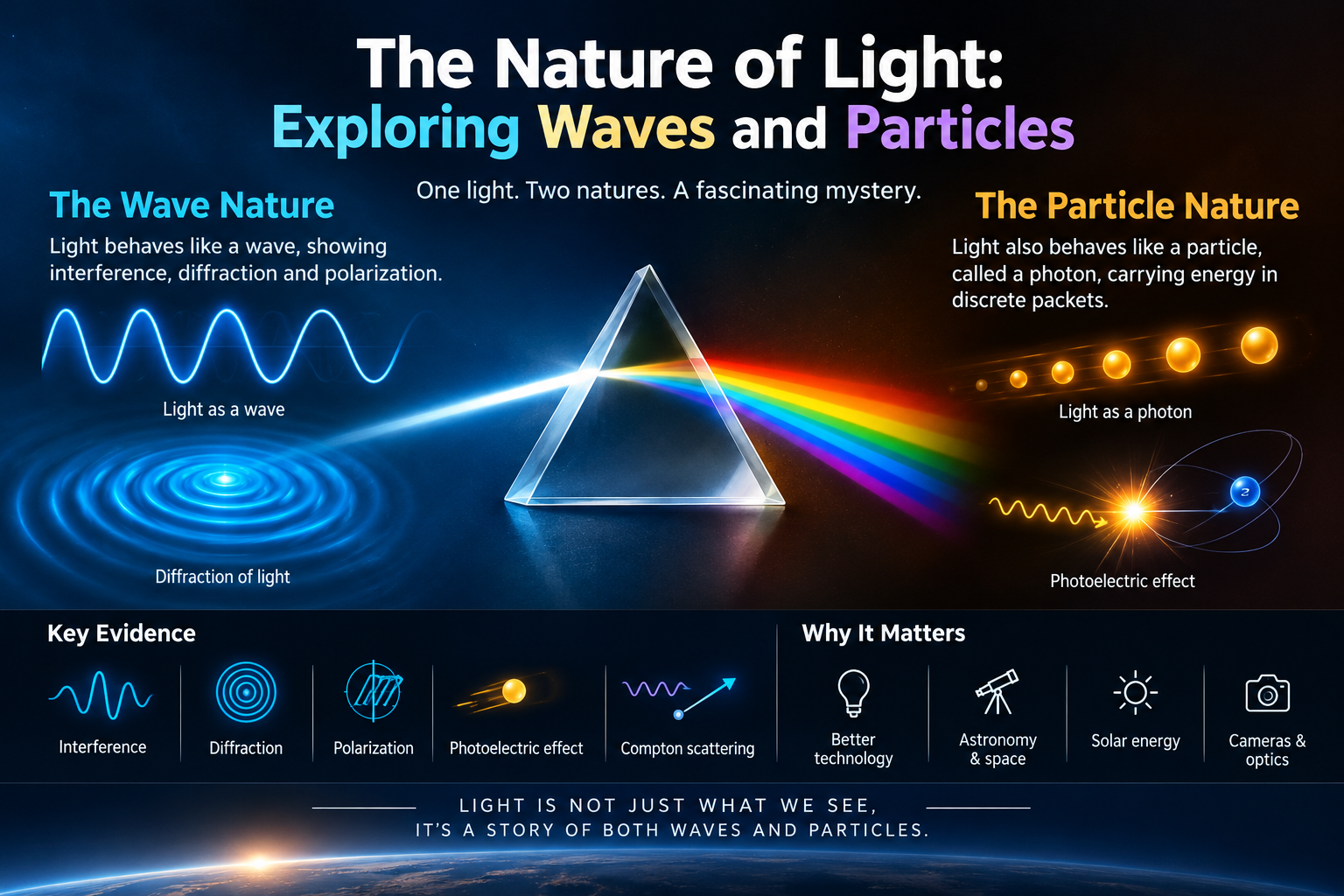
    For many years, scientists have studied light as a wave because it demonstrates important wave-like properties. Light can undergo interference, diffraction, and polarization. Interference occurs when light waves overlap and combine, producing patterns of brightness and darkness. Diffraction happens when light spreads around an obstacle or passes through a narrow opening. Polarization describes the orientation of light's oscillations and helps us understand how light interacts with different materials.

    These properties demonstrate that the wave model is essential for explaining many optical phenomena. From colorful patterns created by thin films to the operation of polarized sunglasses, the wave nature of light has many applications in everyday life and modern technology.

    **2. The Particle Nature of Light **

    Light also behaves in ways that reveal its particle nature. In quantum physics, light energy is exchanged in discrete packets called **photons**. Each photon carries energy determined by its frequency, described by the equation **E = hf**, where E represents energy, h is Planck's constant, and f is frequency.

    The photoelectric effect provides important evidence for this particle nature. When light of a suitable frequency strikes certain materials, it can release electrons from their surfaces. This phenomenon helped scientists understand that light energy is transferred in individual quanta rather than always behaving like a continuous wave.

    Another important example is Compton scattering, in which photons exchange energy and momentum with electrons. These discoveries transformed our understanding of light and helped establish the foundations of quantum physics.

    **3. Wave-Particle Duality: Two Sides of Light**

    One of the most remarkable discoveries in science is that light cannot be fully explained by treating it only as a classical wave or only as a classical particle. Its behavior depends on the physical process being investigated and how it is measured. This concept is known as **wave-particle duality**.

    Experiments involving interference reveal wave-like patterns, while experiments involving photon detection show that light energy is detected in discrete units. Quantum mechanics brings these observations together into a more complete description of nature. Rather than being an ordinary wave or a tiny classical object, light is a quantum phenomenon with properties that challenge our everyday intuition.

    **4. How Do We Discover the Secrets of Light?**

    Scientists use carefully designed experiments to explore the behavior of light. Prisms separate white light into different colors, optical instruments measure its properties, and advanced detectors record individual photons. Interference experiments reveal patterns that cannot be explained by simple particle models, while photoelectric experiments demonstrate the importance of quantized energy.

    The work of scientists such as Isaac Newton, Thomas Young, Max Planck, Albert Einstein, and Arthur Compton helped build our modern understanding of light. Their discoveries show how scientific knowledge develops through observation, experimentation, mathematical reasoning, and new ideas.

    **5. Why Is the Nature of Light Important?**

    Understanding light is essential to many technologies that shape modern life. Lasers are used in medicine, manufacturing, and scientific research. Fiber-optic cables transmit information across the world using pulses of light. Solar panels convert light energy into electrical energy, while cameras and telescopes help us capture images and explore distant objects in space.

    The principles of light are also important in astronomy, microscopy, optical communication, quantum technologies, and the study of the universe. By investigating how light behaves, scientists can examine distant galaxies, study the structure of matter, and develop new tools that improve our understanding of nature.

    **6. Light: Connecting Science and the Universe**

    Light is much more than what allows us to see. It carries information about distant stars, reveals the composition of celestial objects, and provides clues about the physical processes occurring throughout the cosmos. By analyzing the light received from distant galaxies, astronomers can learn about their temperatures, chemical compositions, and motion.

    At the smallest scales, the study of photons helps scientists investigate the quantum world and understand how energy interacts with matter. From the smallest laboratory experiments to the largest astronomical observations, light connects different areas of science in extraordinary ways.

    **Conclusion: The Extraordinary Mystery of Light**

    The study of light demonstrates how nature can be far more complex than it first appears. Its wave-like properties explain interference, diffraction, and polarization, while its particle-like properties help explain the photoelectric effect and Compton scattering. Together, these discoveries form an important part of our modern understanding of physics.

    Learning about wave-particle duality encourages us to question assumptions, explore scientific evidence, and appreciate the discoveries that continue to expand human knowledge. Every beam of sunlight, every shining star, and every photon detected by a scientific instrument reminds us that there is still much to discover about the universe.

    **Light Is More Than What We See—It Is a Window into the Fundamental Nature of Reality!**

    If you enjoyed this science topic, share it with others and continue exploring the fascinating world of physics. Stay curious, keep asking questions, and never stop learning!

    #NatureOfLight #WaveParticleDuality #Physics #QuantumPhysics #ScienceEducation #Photons #LightWaves #PhotoelectricEffect #ComptonScattering #Optics #Astronomy #ScientificDiscoveries #STEMEducation #LearnPhysics #ScienceExplained #EducationalContent #WavesAndParticles
    RSIF8 Roll no:14 story no:24 story topic:The Nature of Light: Exploring Waves and Particles 🌟 **The Nature of Light: Exploring Waves and Particles** 🌈🔬 Have you ever wondered what light really is? How does sunlight travel across millions of kilometers through space, how do rainbows form, and how can light behave like both a wave and a particle? The nature of light is one of the most fascinating topics in physics, revealing the extraordinary connection between the visible world and the mysterious laws of quantum mechanics. From the light that illuminates our homes to the distant stars shining in the universe, light plays an essential role in understanding the world around us. 🌍✨ 💡 **1. The Wave Nature of Light 🌊** For many years, scientists have studied light as a wave because it demonstrates important wave-like properties. Light can undergo interference, diffraction, and polarization. Interference occurs when light waves overlap and combine, producing patterns of brightness and darkness. Diffraction happens when light spreads around an obstacle or passes through a narrow opening. Polarization describes the orientation of light's oscillations and helps us understand how light interacts with different materials. These properties demonstrate that the wave model is essential for explaining many optical phenomena. From colorful patterns created by thin films to the operation of polarized sunglasses, the wave nature of light has many applications in everyday life and modern technology. ⚛️ **2. The Particle Nature of Light ✨** Light also behaves in ways that reveal its particle nature. In quantum physics, light energy is exchanged in discrete packets called **photons**. Each photon carries energy determined by its frequency, described by the equation **E = hf**, where E represents energy, h is Planck's constant, and f is frequency. The photoelectric effect provides important evidence for this particle nature. When light of a suitable frequency strikes certain materials, it can release electrons from their surfaces. This phenomenon helped scientists understand that light energy is transferred in individual quanta rather than always behaving like a continuous wave. Another important example is Compton scattering, in which photons exchange energy and momentum with electrons. These discoveries transformed our understanding of light and helped establish the foundations of quantum physics. 🔬 **3. Wave-Particle Duality: Two Sides of Light** One of the most remarkable discoveries in science is that light cannot be fully explained by treating it only as a classical wave or only as a classical particle. Its behavior depends on the physical process being investigated and how it is measured. This concept is known as **wave-particle duality**. Experiments involving interference reveal wave-like patterns, while experiments involving photon detection show that light energy is detected in discrete units. Quantum mechanics brings these observations together into a more complete description of nature. Rather than being an ordinary wave or a tiny classical object, light is a quantum phenomenon with properties that challenge our everyday intuition. 🌈 **4. How Do We Discover the Secrets of Light?** Scientists use carefully designed experiments to explore the behavior of light. Prisms separate white light into different colors, optical instruments measure its properties, and advanced detectors record individual photons. Interference experiments reveal patterns that cannot be explained by simple particle models, while photoelectric experiments demonstrate the importance of quantized energy. The work of scientists such as Isaac Newton, Thomas Young, Max Planck, Albert Einstein, and Arthur Compton helped build our modern understanding of light. Their discoveries show how scientific knowledge develops through observation, experimentation, mathematical reasoning, and new ideas. 🚀 **5. Why Is the Nature of Light Important?** Understanding light is essential to many technologies that shape modern life. Lasers are used in medicine, manufacturing, and scientific research. Fiber-optic cables transmit information across the world using pulses of light. Solar panels convert light energy into electrical energy, while cameras and telescopes help us capture images and explore distant objects in space. The principles of light are also important in astronomy, microscopy, optical communication, quantum technologies, and the study of the universe. By investigating how light behaves, scientists can examine distant galaxies, study the structure of matter, and develop new tools that improve our understanding of nature. 🌍 **6. Light: Connecting Science and the Universe** Light is much more than what allows us to see. It carries information about distant stars, reveals the composition of celestial objects, and provides clues about the physical processes occurring throughout the cosmos. By analyzing the light received from distant galaxies, astronomers can learn about their temperatures, chemical compositions, and motion. At the smallest scales, the study of photons helps scientists investigate the quantum world and understand how energy interacts with matter. From the smallest laboratory experiments to the largest astronomical observations, light connects different areas of science in extraordinary ways. 💫 **Conclusion: The Extraordinary Mystery of Light** The study of light demonstrates how nature can be far more complex than it first appears. Its wave-like properties explain interference, diffraction, and polarization, while its particle-like properties help explain the photoelectric effect and Compton scattering. Together, these discoveries form an important part of our modern understanding of physics. Learning about wave-particle duality encourages us to question assumptions, explore scientific evidence, and appreciate the discoveries that continue to expand human knowledge. Every beam of sunlight, every shining star, and every photon detected by a scientific instrument reminds us that there is still much to discover about the universe. ✨ **Light Is More Than What We See—It Is a Window into the Fundamental Nature of Reality!** 🔭🌌 👍 If you enjoyed this science topic, share it with others and continue exploring the fascinating world of physics. Stay curious, keep asking questions, and never stop learning! #NatureOfLight #WaveParticleDuality #Physics #QuantumPhysics #ScienceEducation #Photons #LightWaves #PhotoelectricEffect #ComptonScattering #Optics #Astronomy #ScientificDiscoveries #STEMEducation #LearnPhysics #ScienceExplained #EducationalContent #WavesAndParticles 🌈🔬🚀
    0 Comments 0 Shares 911 Views
  • #rsisb
    Roll no. 247
    Story post 14
    Foundation level

    **The Evolution of “Robot”: From Czech Play to Tech Terminology **

    Have you ever wondered where the word **“robot”** came from? Today, we use this word when talking about smart machines, artificial intelligence, factories, space exploration, and modern technology. But did you know that the word “robot” became popular through a Czech play written more than a century ago? Let's explore the fascinating journey of this little word that became a big part of our technological world!

    **1. The Beginning: A Czech Play **

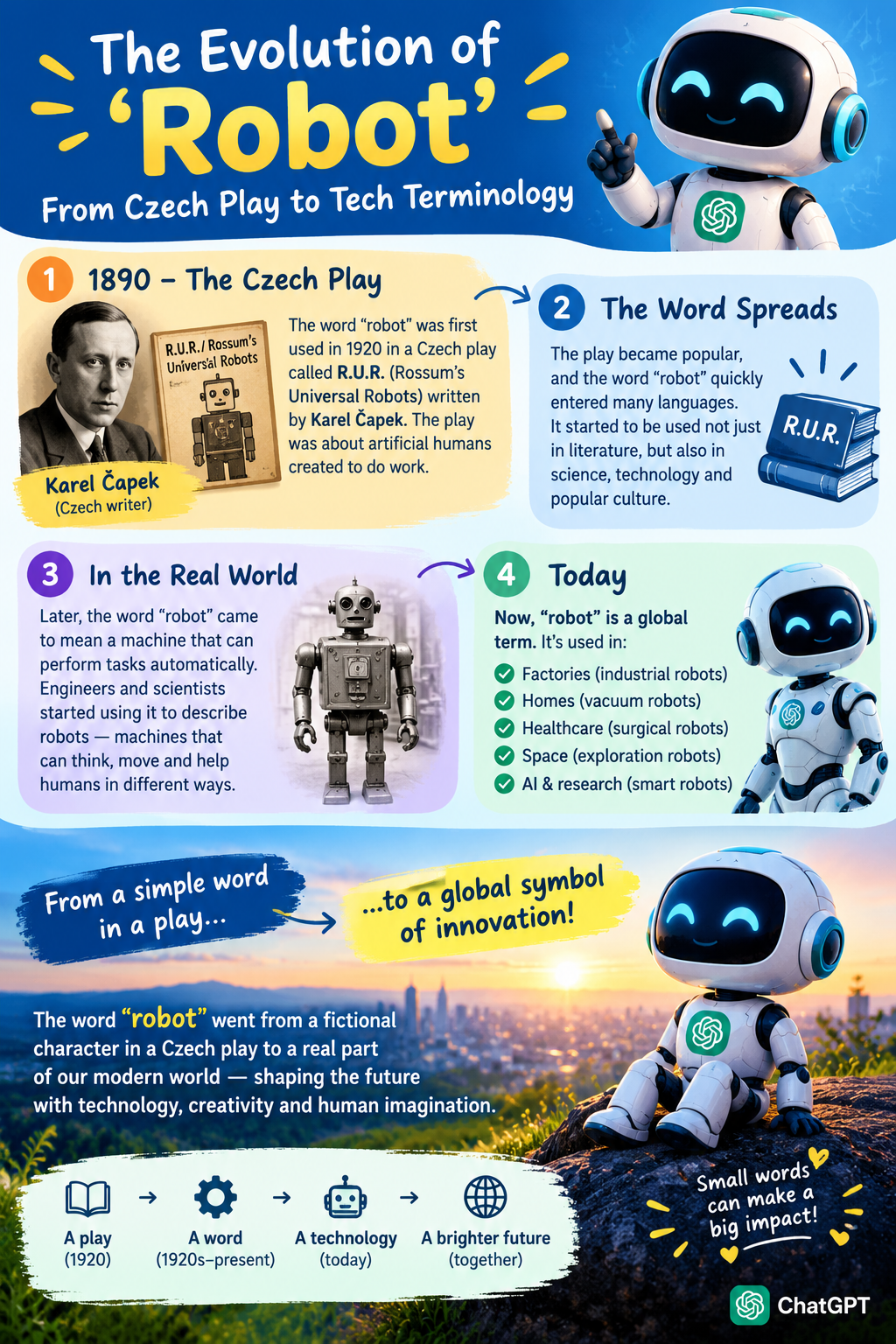
    The story of the word “robot” begins with Czech writer and playwright **Karel Čapek** and his science-fiction play *R.U.R. (Rossum’s Universal Robots)*, first performed in 1921 and published in 1920. The play imagined artificial workers created to perform tasks for humans. It introduced audiences to ideas about artificial beings, technology, work, and the relationship between humans and machines.

    The word “robot” comes from the Czech word *robota*, associated with forced labor or compulsory work. Interestingly, Karel Čapek credited his brother, **Josef Čapek**, with suggesting the word for the play.

    **2. How the Word Spread Around the World **

    As the play gained attention, the word “robot” spread beyond literature and entered everyday language. People began using it to discuss machines that could perform tasks automatically. Over time, robots became a popular subject in science-fiction stories, films, books, and discussions about the future.

    Writers and scientists explored exciting questions: Could machines help humans? Could robots perform difficult tasks? How might technology change our lives? These questions helped inspire generations of inventors and researchers.

    **3. From Fiction to Real Machines **

    Robots eventually became an important part of real-world engineering and science. Modern robots can perform repetitive tasks, assist with manufacturing, explore places that are difficult for humans to reach, and help researchers carry out complex work.

    Today, we can find robots in many areas:

    **Factories:** Industrial robots help assemble products and perform precise tasks.

    **Homes:** Robotic vacuum cleaners help people with household cleaning.

    **Healthcare:** Specialised robotic systems assist medical professionals with certain procedures.

    **Space Exploration:** Robotic rovers and spacecraft help scientists explore distant worlds.

    **Agriculture:** Some robots help monitor crops and perform farming tasks.

    **Research:** Scientists use robots to test ideas, collect information, and explore new possibilities.

    **4. Robots and Artificial Intelligence **

    Modern technology has introduced new possibilities through artificial intelligence (AI). Some robots use AI to interpret information from sensors, recognise objects, plan actions, or respond to changing conditions. However, not every robot uses AI, and not every AI system is a robot.

    This difference is important! A robot is generally a physical machine that can carry out tasks, while AI refers to computer systems designed to perform tasks that may require abilities such as recognising patterns or understanding language. Together, robotics and AI are helping researchers develop new tools and technologies.

    **5. What Can We Learn from the Evolution of “Robot”?**

    The journey of the word “robot” teaches us that ideas can travel from books and plays into real life. A word introduced through a fictional story became an important term in science, engineering, and technology.

    It also reminds us that technology is created by people using imagination, creativity, teamwork, and scientific knowledge. As we learn more about robots, we should think about how to use technology responsibly and how it can benefit people and communities.

    **Conclusion: From a Czech Play to a Technological Future**

    The evolution of “robot” is a remarkable example of how language, literature, and science connect. What began as a word associated with artificial workers in a Czech play is now used around the world to describe machines that help us in factories, homes, hospitals, laboratories, and space exploration.

    The future of robotics will continue to bring new discoveries, challenges, and opportunities. By learning about the past, understanding the present, and thinking creatively about the future, we can become more informed and responsible users of technology.

    **Let's keep learning, exploring, and innovating!** Every great invention begins with an idea, and every curious mind has the potential to discover something new.

    **Question for everyone:** If you could invent a helpful robot, what would you want it to do? Share your ideas in the comments!

    Like, share, and spread the excitement of science and technology!

    ━━━━━━━━━━━━━━━━━━

    **HASHTAGS**

    #EvolutionOfRobots #RobotHistory #TheWordRobot #KarelCapek #JosefCapek #RUR #CzechLiterature #HistoryOfTechnology #Robotics #ArtificialIntelligence #AI #ScienceAndTechnology #EducationalPost #StoryPost #TechnologyEducation #FutureTechnology #Innovation #Engineering #STEMEducation #ScienceForEveryone #LearningIsFun #DigitalLearning #TechHistory #SmartMachines #SpaceExploration #IndustrialRobots #CreativeThinking #KnowledgeIsPower #ChatGPT #PostOnAllPlatforms
    #rsisb Roll no. 247 Story post 14 Foundation level 🤖🌍 **The Evolution of “Robot”: From Czech Play to Tech Terminology 📚✨** 🚀🤖 Have you ever wondered where the word **“robot”** came from? Today, we use this word when talking about smart machines, artificial intelligence, factories, space exploration, and modern technology. But did you know that the word “robot” became popular through a Czech play written more than a century ago? 📖🌟 Let's explore the fascinating journey of this little word that became a big part of our technological world! 💡🌐 📚 **1. The Beginning: A Czech Play 🇨🇿** The story of the word “robot” begins with Czech writer and playwright **Karel Čapek** and his science-fiction play *R.U.R. (Rossum’s Universal Robots)*, first performed in 1921 and published in 1920. 🎭🤖 The play imagined artificial workers created to perform tasks for humans. It introduced audiences to ideas about artificial beings, technology, work, and the relationship between humans and machines. The word “robot” comes from the Czech word *robota*, associated with forced labor or compulsory work. Interestingly, Karel Čapek credited his brother, **Josef Čapek**, with suggesting the word for the play. ✍️💭 🌎 **2. How the Word Spread Around the World 🌐** As the play gained attention, the word “robot” spread beyond literature and entered everyday language. People began using it to discuss machines that could perform tasks automatically. 📖⚙️ Over time, robots became a popular subject in science-fiction stories, films, books, and discussions about the future. Writers and scientists explored exciting questions: Could machines help humans? Could robots perform difficult tasks? How might technology change our lives? These questions helped inspire generations of inventors and researchers. 🚀🧠 ⚙️ **3. From Fiction to Real Machines 🏭** Robots eventually became an important part of real-world engineering and science. Modern robots can perform repetitive tasks, assist with manufacturing, explore places that are difficult for humans to reach, and help researchers carry out complex work. 🔧🤖 Today, we can find robots in many areas: 🏭 **Factories:** Industrial robots help assemble products and perform precise tasks. 🏠 **Homes:** Robotic vacuum cleaners help people with household cleaning. 🏥 **Healthcare:** Specialised robotic systems assist medical professionals with certain procedures. 🚀 **Space Exploration:** Robotic rovers and spacecraft help scientists explore distant worlds. 🌾 **Agriculture:** Some robots help monitor crops and perform farming tasks. 🧪 **Research:** Scientists use robots to test ideas, collect information, and explore new possibilities. 💻 **4. Robots and Artificial Intelligence 🧠** Modern technology has introduced new possibilities through artificial intelligence (AI). Some robots use AI to interpret information from sensors, recognise objects, plan actions, or respond to changing conditions. 🤖💡 However, not every robot uses AI, and not every AI system is a robot. This difference is important! A robot is generally a physical machine that can carry out tasks, while AI refers to computer systems designed to perform tasks that may require abilities such as recognising patterns or understanding language. Together, robotics and AI are helping researchers develop new tools and technologies. 🌐✨ 🌟 **5. What Can We Learn from the Evolution of “Robot”?** The journey of the word “robot” teaches us that ideas can travel from books and plays into real life. A word introduced through a fictional story became an important term in science, engineering, and technology. 📚➡️⚙️ It also reminds us that technology is created by people using imagination, creativity, teamwork, and scientific knowledge. As we learn more about robots, we should think about how to use technology responsibly and how it can benefit people and communities. ❤️🌍 🎯 **Conclusion: From a Czech Play to a Technological Future** The evolution of “robot” is a remarkable example of how language, literature, and science connect. What began as a word associated with artificial workers in a Czech play is now used around the world to describe machines that help us in factories, homes, hospitals, laboratories, and space exploration. 🤖🚀 The future of robotics will continue to bring new discoveries, challenges, and opportunities. By learning about the past, understanding the present, and thinking creatively about the future, we can become more informed and responsible users of technology. 🌟💚 📢 **Let's keep learning, exploring, and innovating!** Every great invention begins with an idea, and every curious mind has the potential to discover something new. 💡📚 💬 **Question for everyone:** If you could invent a helpful robot, what would you want it to do? Share your ideas in the comments! 👇🤖 ❤️ Like, share, and spread the excitement of science and technology! ━━━━━━━━━━━━━━━━━━ 🏷️ **HASHTAGS** #EvolutionOfRobots #RobotHistory #TheWordRobot #KarelCapek #JosefCapek #RUR #CzechLiterature #HistoryOfTechnology #Robotics #ArtificialIntelligence #AI #ScienceAndTechnology #EducationalPost #StoryPost #TechnologyEducation #FutureTechnology #Innovation #Engineering #STEMEducation #ScienceForEveryone #LearningIsFun #DigitalLearning #TechHistory #SmartMachines #SpaceExploration #IndustrialRobots #CreativeThinking #KnowledgeIsPower #ChatGPT #PostOnAllPlatforms 🤖🌍📚🚀✨
    0 Comments 0 Shares 4973 Views
  • #rsisb
    Roll no 248
    Foundation level
    Story post no 21
    **The Evolution of “Robot”: From Czech Play to Tech Terminology**

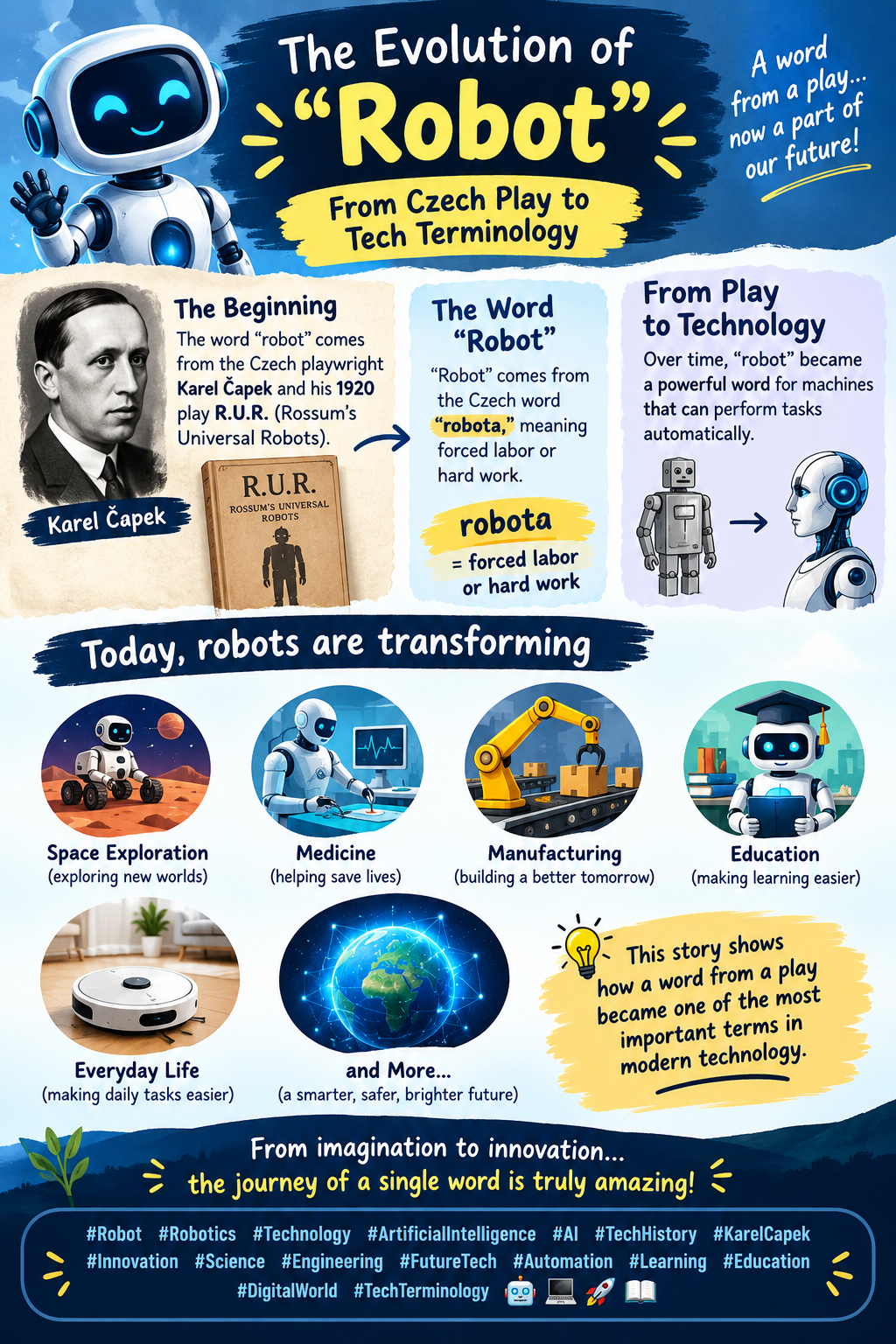
    Have you ever wondered where the word **“robot”** came from? The story begins with the Czech playwright **Karel Čapek** and his 1920 play *R.U.R. (Rossum’s Universal Robots)*. The word “robot” comes from the Czech word **“robota,”** meaning forced labor or hard work.

    Over time, “robot” became a powerful word for machines that can perform tasks automatically. Today, robots are transforming **science, medicine, manufacturing, space exploration, education, and everyday life**! ‍

    This story shows how a word from a play became one of the most important terms in modern technology.

    #Robot #Robotics #Technology #ArtificialIntelligence #AI #TechHistory #KarelCapek #Innovation #Science #Engineering #FutureTech #Automation #Learning #Education #DigitalWorld #TechTerminology
    #rsisb Roll no 248 Foundation level Story post no 21 🤖✨ **The Evolution of “Robot”: From Czech Play to Tech Terminology** 🎭💻 Have you ever wondered where the word **“robot”** came from? 🤔🌍 The story begins with the Czech playwright **Karel Čapek** and his 1920 play *R.U.R. (Rossum’s Universal Robots)*. 🎭🤖 The word “robot” comes from the Czech word **“robota,”** meaning forced labor or hard work. 💡 Over time, “robot” became a powerful word for machines that can perform tasks automatically. Today, robots are transforming **science, medicine, manufacturing, space exploration, education, and everyday life**! 🚀🏭🧑‍⚕️🌌 This story shows how a word from a play became one of the most important terms in modern technology. 📚➡️🤖 #Robot #Robotics #Technology #ArtificialIntelligence #AI #TechHistory #KarelCapek #Innovation #Science #Engineering #FutureTech #Automation #Learning #Education #DigitalWorld #TechTerminology 🤖💻🚀📚✨
    0 Comments 0 Shares 1907 Views
  • #rsisb
    Roll no.239
    Story post no.17
    Foundation Level

    The word **“robot”** may sound like it belongs to the world of modern technology, artificial intelligence, and futuristic machines—but its fascinating journey actually began on the **stage of a Czech play!**
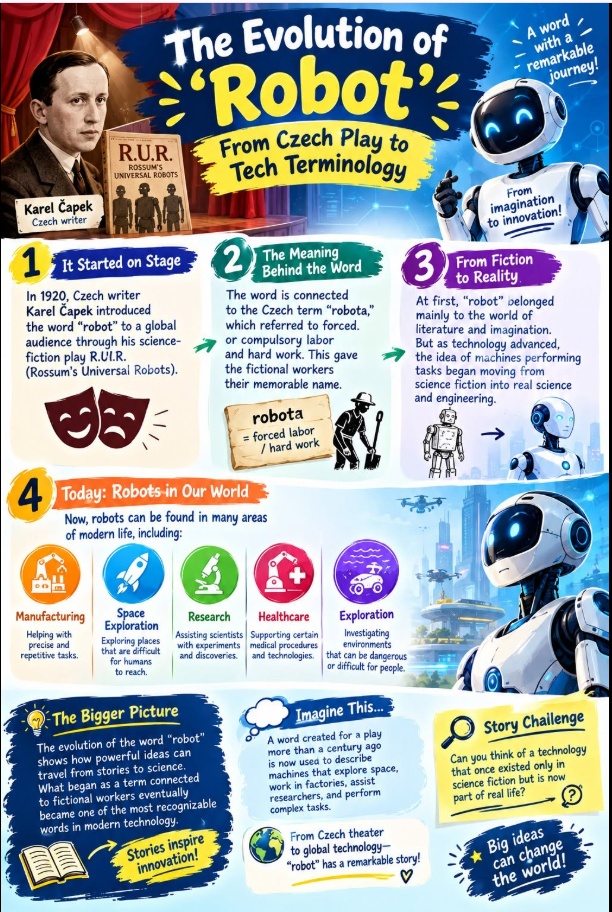
    In **1920**, Czech writer **Karel Čapek** introduced the word “robot” to a global audience through his science-fiction play ***R.U.R. (Rossum’s Universal Robots)***. The story imagined artificial workers created to perform labor for humans.
    The word is connected to the Czech term **“robota,”** which referred to forced or compulsory labor and hard work. This connection helped give the fictional workers their memorable name.
    At first, “robot” belonged mainly to the world of literature and imagination. But as technology advanced, the idea of machines performing tasks began moving from **science fiction into real science and engineering**.
    Today, robots can be found in many areas of modern life, including:
    **Manufacturing** — helping with precise and repetitive tasks
    **Space exploration** — exploring places that are difficult for humans to reach
    **Research** — assisting scientists with experiments and discoveries
    **Healthcare** — supporting certain medical procedures and technologies
    **Exploration** — investigating environments that can be dangerous or difficult for people
    The evolution of the word **“robot”** shows how powerful ideas can travel from **stories to science**. What began as a term connected to fictional workers eventually became one of the most recognizable words in modern technology.
    **Imagine this:** A word created for a play more than a century ago is now used to describe machines that explore space, work in factories, assist researchers, and perform complex tasks.
    **From Czech theater to global technology—“robot” has a remarkable story!**
    **Story Challenge:** Can you think of a technology that once existed only in science fiction but is now part of real life?
    #Robot #Robots #Robotics #RobotHistory #HistoryOfTechnology #KarelCapek #RUR #CzechHistory #Technology #Science #Engineering #STEM #TechHistory #Innovation #FutureTechnology #ArtificialIntelligence #ScienceFiction #TechFacts #DidYouKnow #ScienceEducation #LearningIsFun #TechnologyFacts #RoboticsEducation
    #rsisb Roll no.239 Story post no.17 Foundation Level The word **“robot”** may sound like it belongs to the world of modern technology, artificial intelligence, and futuristic machines—but its fascinating journey actually began on the **stage of a Czech play!** 🎭✨ In **1920**, Czech writer **Karel Čapek** introduced the word “robot” to a global audience through his science-fiction play ***R.U.R. (Rossum’s Universal Robots)***. The story imagined artificial workers created to perform labor for humans. 🤖🏭 The word is connected to the Czech term **“robota,”** which referred to forced or compulsory labor and hard work. This connection helped give the fictional workers their memorable name. 💡📚 At first, “robot” belonged mainly to the world of literature and imagination. But as technology advanced, the idea of machines performing tasks began moving from **science fiction into real science and engineering**. 🔬⚙️ Today, robots can be found in many areas of modern life, including: 🏭 **Manufacturing** — helping with precise and repetitive tasks 🚀 **Space exploration** — exploring places that are difficult for humans to reach 🔬 **Research** — assisting scientists with experiments and discoveries 🏥 **Healthcare** — supporting certain medical procedures and technologies 🌊 **Exploration** — investigating environments that can be dangerous or difficult for people The evolution of the word **“robot”** shows how powerful ideas can travel from **stories to science**. What began as a term connected to fictional workers eventually became one of the most recognizable words in modern technology. 🌟🤖 💭 **Imagine this:** A word created for a play more than a century ago is now used to describe machines that explore space, work in factories, assist researchers, and perform complex tasks. ✨ **From Czech theater to global technology—“robot” has a remarkable story!** 🔎 **Story Challenge:** Can you think of a technology that once existed only in science fiction but is now part of real life? #Robot #Robots #Robotics #RobotHistory #HistoryOfTechnology #KarelCapek #RUR #CzechHistory #Technology #Science #Engineering #STEM #TechHistory #Innovation #FutureTechnology #ArtificialIntelligence #ScienceFiction #TechFacts #DidYouKnow #ScienceEducation #LearningIsFun #TechnologyFacts #RoboticsEducation 🤖⚙️🔬📚🎭🚀✨
    0 Comments 0 Shares 3992 Views
  • I am here

    Tuesday, February 17
    10am–12pm

    Inventing Tomorrows Manufacturing

    A Foresight Engineering series hosted in partnership by Innovation Leadership Board, Lux Research, and Stanford’s Strategic Foresight & Innovation.

    A new era of manufacturing has emerged due to fast advances in 3-D printing, the maker movement, and more. This half-day workshop will be a fast-paced, hands-on introduction to understanding the topic. You will hear the latest research from the field, and then build prototypes using several tools from the Strategic Foresight Framework™. Limited enrollment, so apply quickly.

    Hosts: Stanford’s Strategic Foresight & Innovation, Innovation Leadership Board, Lux Research
    Location: Stanford University, Peterson Engineering Laboratory (d.school) atrium, 550 Panama Mall, Stanford, CA 94305 (see map)
    Tickets: Free, pre-register at http://innovation.io/giwevent2015 due to limited seats
    I am here Tuesday, February 17 10am–12pm Inventing Tomorrow's Manufacturing A Foresight Engineering series hosted in partnership by Innovation Leadership Board, Lux Research, and Stanford’s Strategic Foresight & Innovation. A new era of manufacturing has emerged due to fast advances in 3-D printing, the maker movement, and more. This half-day workshop will be a fast-paced, hands-on introduction to understanding the topic. You will hear the latest research from the field, and then build prototypes using several tools from the Strategic Foresight Framework™. Limited enrollment, so apply quickly. Hosts: Stanford’s Strategic Foresight & Innovation, Innovation Leadership Board, Lux Research Location: Stanford University, Peterson Engineering Laboratory (d.school) atrium, 550 Panama Mall, Stanford, CA 94305 (see map) Tickets: Free, pre-register at http://innovation.io/giwevent2015 due to limited seats
    0 Comments 0 Shares 2298 Views
  • Assalamalkum anyone in. Your circle manufacturing filter straw also know as life straw in Pakistan.
    Assalamalkum anyone in. Your circle manufacturing filter straw also know as life straw in Pakistan.
    0 Comments 0 Shares 1605 Views
  • Partial lockdown to be enforced in Istanbul and turkey from tonight. Here is the details of the order from Federal goverment.
    ========================
    18.11.2020
    Number: Z-89780865-153-19161 18/11/2020
    Subject: Coronavirus New Measures

    TO DISTRIBUTION LOCATIONS

    Ministry of Health and Coronavirus Science in order to manage the risk of the coronavirus (Covid19) epidemic in terms of public health and public order, to ensure social isolation, to protect the physical distance and to control the rate of disease spread.
    The proposals of the Council have been implemented by taking many precautionary decisions in line with the instructions of our President.

    It is seen that the spread / transmission of the coronavirus epidemic, which has affected the whole world in 2020, has recently increased in all countries. It is observed that there is a very serious increase in the course of the epidemic, especially in countries on the European continent, and many new precautionary decisions have been taken within the scope of combating the epidemic.

    In addition to the cleaning, mask and distance rules, which are the basic principles of the controlled social life period in our country, as well as the course of the epidemic and possible risks, the rules and measures to be followed for all areas of life are determined. In this context, in line with the decisions taken in the Presidential Cabinet convened under the chairmanship of our President on 17.11.2020, whoch will be applicable from 20:00 on Friday, 20.11.2020;

    1. Shopping malls, markets, barbershops, hairdressers and beauty centers will only be able to serve our citizens between 10:00 and 20:00.

    2. Food and beverage places such as restaurants, diners, patisseries, cafes and cafetaria may be open between 10:00 and 20:00 only to provide take-away or take-away service. The restaurant, restaurant or online food order companies will only be able to provide package service after 20:00 by phone or online order.

    Food and beverage places located on the side of intercity highways and serving vehicles for intercity public transportation or logistics purposes, provided that they are determined individually by the Provincial / District General Hygiene Boards and are not located in the residential area, will be exempted from the restrictions.

    3. Until 31.12.2020, the activities of cinema halls and until a new decision is taken, coffeehouse, coffee house, rural gardens, internet cafe / lounges, electronic game lounges, billiard lounge, clubs and tea gardens and synthetic pitches will be stopped. The implementation of hookah lounges, whose activities were suspended before, will be continued.

    4. In all our provinces, citizens aged 65 and over will be able to go out between 10:00 and 13:00 during the day, and citizens under 20 (born on 01.01.2001 and after) between 13:00 and 16:00 during the day. Except for employees who submit a work / SGK record, etc. document showing their workplaces and their conditions), citizens of the specified age groups will be restricted from going out to the streets outside these hours.

    5. Until a new decision is made, the curfew will be restricted on weekends, except from 10:00 to 20:00. Production, manufacturing and supply chains are exempt from this restriction. In this regard, the first curfew will be from 20:00 on Saturday, November 21 until 10:00 on Sunday, November 22; and from 20:00 on Sunday, November 22 until 05:00 on Monday, November 23.

    In the following weekends, the implementation will continue as stated above until a new decision is taken.

    In order to minimize the effect of curfew on daily life;

    5.1 WORKPLACE, BUSINESS AND INSTITUTIONS TO BE OPEN

    a) Workplaces that carry out activities related to the production, transportation and sales of drugs, medical devices, medical masks and disinfectants,

    b) Public and private health institutions and organizations, pharmacies, veterinary clinics and animal hospitals,

    c) Public institutions and organizations and enterprises required for the maintenance of compulsory public services (Airports, ports, border gates, customs, highways, nursing homes, elderly nursing homes, rehabilitation centers, Emergency Call Centers, AFAD Units, institutions / organizations that carry out disaster related work, Vefa Social Support Units, Migration Management, PTT etc.),

    ç) Large facilities and enterprises strategically operating in the natural gas, electricity and petroleum sectors (such as refinery and petrochemical facilities and thermal and natural gas cycle power plants),

    d) Companies engaged in domestic and international transportation (including export / import / transit passes) and logistics,

    e) Hotels and accommodation,

    f) Emergency construction, equipment, etc. to increase the capacity of health services. businesses / companies carrying out the activities,

    g) Animal shelters, animal farms and animal care centers,

    ğ) Production and manufacturing facilities,

    h) Newspaper, radio and television organizations, newspaper printing presses and newspaper distributors,

    ı) The number of fuel stations and tire repairers to be determined by the Governorships / District Governorships for settlement centers, one per 50,000 population and one for each 50 km on the intercity highway and if any, on the highway passing through the provincial borders (Fuel stations and tire to be open within the scope of this article repairers will be determined by lot method),

    i) Vegetable / fruit wholesale markets,

    5.2 PERSONS WITH EXCEPTIONS

    a) Managers, officers or employees in the above mentioned "Workplaces, Businesses and Institutions to be Open",

    b) Those who are assigned to ensure public order and security (including private security officers),

    c) Emergency Call Centers, Vefa Social Support Units, Red Crescent, those who work in AFAD and within the scope of disaster,

    ç) Those who document that they will attend other central exams announced by ÖSYM (spouse, sibling, a companion from the mother or father) and exam attendants,

    d) Those who are in charge of burials (religious officials, hospital and municipal officials, etc.) and those who will attend the funerals of their first-degree relatives,

    e) Electricity, water, natural gas, telecommunication etc. Those who are responsible for the maintenance and repair of the transmission and infrastructure systems that should not be interrupted,

    f) Those who are involved in the transportation or logistics of products and / or materials (including cargo), domestic and international transportation, storage and related activities,

    g) Elderly nursing homes, nursing homes, rehabilitation centers, childrens homes, etc. social protection / care center employees,

    ğ) Employees at production and manufacturing facilities,

    h) Those who graze sheep and cattle, those who carry out beekeeping activities,

    i) Technical service employees provided that they document that they are out to provide service,

    i) Those who constantly wait for their workplaces during the hours / days their workplaces are closed,

    j) Personnel who will work on weekends to carry out public transportation, cleaning, solid waste, water and sewage, spraying, fire brigade and cemetery services of the municipalities,

    k) Those who have a mandatory health appointment (including blood and plasma donations to be made to the Red Crescent),

    l) Dormitory, hostel, construction site, etc. Those in charge of meeting the basic needs of those staying in public places,

    m) Employees who are at risk of leaving their workplaces due to occupational health and safety (workplace doctor, etc.),

    n) Veterinarians,

    o) Those with Special Needs such as autism, severe mental retardation, down syndrome and their parents / guardian or accompanying persons,

    ö) Members of the Animal Feeding Group established within the scope of our Circular No. 7486 dated 30.04.2020 and those who will feed street animals,

    p) Individuals working in the production, irrigation, processing, spraying, harvesting, marketing and transportation of plant and animal products,

    r) Those who go out to meet the compulsory needs of their pets, provided that it is limited to the front of their residence,

    s) Those who are in charge of the delivery service to homes within the hours when curfew is imposed,

    ş) Establish a personal relationship with their children within the framework of the court decision (on condition that they submit the court decision),

    t) Athletes, managers and other officials in sports competitions that can be played without an audience,

    u) Those who work in the intercity public transportation vehicles (plane, bus, train, ship, etc.) and the ticket, reservation code etc. that they will travel with these public transportation vehicles. by submitting and documenting,

    ü) Drivers and officers of urban public transportation vehicles (metrobus, metro, bus, minibus, taxi, etc.).

    6.The practice of imposing a smoking ban in areas where there is or can be a density of our citizens such as main streets, streets, squares and public transportation stops, as specified in our Circular No. 18579 dated 11.11.2020, can be expanded by the Provincial / District General Hygiene Boards.

    7. By the Provincial General Hygiene Boards, it will be ensured that all kinds of measures, especially increasing the number of trips, will be taken by local administrations to reduce the density of public transportation vehicles in the city and to ensure the sparseness in the voyages.

    8. Within the framework of the principles regarding weddings and wedding ceremonies with our Circular dated 02.09.2020 and numbered 14210;

    Wedding ceremonies / celebrations must be carried out with the condition of observing mask, distance, cleaning rules, minimum participation and at least 20 minutes between each wedding ceremony,

    Wedding ceremonies are held in a maximum of one hour in the form of a wedding ceremony with seating arrangements, masks, distance and cleaning rules,

    In addition, within the framework of our Circular No. 12682 dated 30.07.2020, the full implementation of the provisions regarding collective condolence will continue.

    9. It is essential that our citizens do not travel in the city or intercity with their private vehicles during the periods when the curfew is applied on weekends.

    But;
    Those who want to be discharged from the hospital where they are treated and return to their original residence, who have been referred with a doctor report and / or have a doctors appointment / check,

    Those to attend the funeral of himself or his spouse, deceased first-degree relative or brother or to accompany the funeral transfer (maximum 4 people),

    Those who have come to the city they are in in the last 5 days but do not have a place to stay but want to return to their place of residence (those who submit their travel ticket, vehicle license plate, other documents showing their travel, information and information),

    Those who want to return to their settlements by completing military service,

    Those who have Private or public invitations to a daily contract

    Those released from penal execution institutions,

    Our citizens will be able to travel with their private vehicles on the EBAŞVURU and ALO 199 systems of the Ministry of Internal Affairs or directly to the Governorships / District Governorships, provided that they obtain permission from the Travel Permit Boards, in the presence of the above-mentioned situations.

    It is of vital importance for all our public officials, especially our Governors and District Governors, to focus on activities that increase social sensitivity to comply with the measures taken in the fight against the epidemic, and to continue making sacrifices altogether, as it has been until today, for us to overcome this process and to regain healthy days.

    In line with the principles stated above, in accordance with Articles 27 and 72 of the General Hygiene Law, the decisions of the Provincial / District General Hygiene Boards are taken urgently, no disruption in practice and unjust treatment is caused, the establishment of administrative action for those who do not comply with the decisions taken in accordance with the relevant articles of the Public Health Law and Regarding the initiation of necessary judicial proceedings within the scope of Article 195 of the Turkish Criminal Code regarding criminal behavior;

    — at Chiko Hookah Lounge.
    Partial lockdown to be enforced in Istanbul and turkey from tonight. Here is the details of the order from Federal goverment. ======================== 18.11.2020 Number: Z-89780865-153-19161 18/11/2020 Subject: Coronavirus New Measures TO DISTRIBUTION LOCATIONS Ministry of Health and Coronavirus Science in order to manage the risk of the coronavirus (Covid19) epidemic in terms of public health and public order, to ensure social isolation, to protect the physical distance and to control the rate of disease spread. The proposals of the Council have been implemented by taking many precautionary decisions in line with the instructions of our President. It is seen that the spread / transmission of the coronavirus epidemic, which has affected the whole world in 2020, has recently increased in all countries. It is observed that there is a very serious increase in the course of the epidemic, especially in countries on the European continent, and many new precautionary decisions have been taken within the scope of combating the epidemic. In addition to the cleaning, mask and distance rules, which are the basic principles of the controlled social life period in our country, as well as the course of the epidemic and possible risks, the rules and measures to be followed for all areas of life are determined. In this context, in line with the decisions taken in the Presidential Cabinet convened under the chairmanship of our President on 17.11.2020, whoch will be applicable from 20:00 on Friday, 20.11.2020; 1. Shopping malls, markets, barbershops, hairdressers and beauty centers will only be able to serve our citizens between 10:00 and 20:00. 2. Food and beverage places such as restaurants, diners, patisseries, cafes and cafetaria may be open between 10:00 and 20:00 only to provide take-away or take-away service. The restaurant, restaurant or online food order companies will only be able to provide package service after 20:00 by phone or online order. Food and beverage places located on the side of intercity highways and serving vehicles for intercity public transportation or logistics purposes, provided that they are determined individually by the Provincial / District General Hygiene Boards and are not located in the residential area, will be exempted from the restrictions. 3. Until 31.12.2020, the activities of cinema halls and until a new decision is taken, coffeehouse, coffee house, rural gardens, internet cafe / lounges, electronic game lounges, billiard lounge, clubs and tea gardens and synthetic pitches will be stopped. The implementation of hookah lounges, whose activities were suspended before, will be continued. 4. In all our provinces, citizens aged 65 and over will be able to go out between 10:00 and 13:00 during the day, and citizens under 20 (born on 01.01.2001 and after) between 13:00 and 16:00 during the day. Except for employees who submit a work / SGK record, etc. document showing their workplaces and their conditions), citizens of the specified age groups will be restricted from going out to the streets outside these hours. 5. Until a new decision is made, the curfew will be restricted on weekends, except from 10:00 to 20:00. Production, manufacturing and supply chains are exempt from this restriction. In this regard, the first curfew will be from 20:00 on Saturday, November 21 until 10:00 on Sunday, November 22; and from 20:00 on Sunday, November 22 until 05:00 on Monday, November 23. In the following weekends, the implementation will continue as stated above until a new decision is taken. In order to minimize the effect of curfew on daily life; 5.1 WORKPLACE, BUSINESS AND INSTITUTIONS TO BE OPEN a) Workplaces that carry out activities related to the production, transportation and sales of drugs, medical devices, medical masks and disinfectants, b) Public and private health institutions and organizations, pharmacies, veterinary clinics and animal hospitals, c) Public institutions and organizations and enterprises required for the maintenance of compulsory public services (Airports, ports, border gates, customs, highways, nursing homes, elderly nursing homes, rehabilitation centers, Emergency Call Centers, AFAD Units, institutions / organizations that carry out disaster related work, Vefa Social Support Units, Migration Management, PTT etc.), ç) Large facilities and enterprises strategically operating in the natural gas, electricity and petroleum sectors (such as refinery and petrochemical facilities and thermal and natural gas cycle power plants), d) Companies engaged in domestic and international transportation (including export / import / transit passes) and logistics, e) Hotels and accommodation, f) Emergency construction, equipment, etc. to increase the capacity of health services. businesses / companies carrying out the activities, g) Animal shelters, animal farms and animal care centers, ğ) Production and manufacturing facilities, h) Newspaper, radio and television organizations, newspaper printing presses and newspaper distributors, ı) The number of fuel stations and tire repairers to be determined by the Governorships / District Governorships for settlement centers, one per 50,000 population and one for each 50 km on the intercity highway and if any, on the highway passing through the provincial borders (Fuel stations and tire to be open within the scope of this article repairers will be determined by lot method), i) Vegetable / fruit wholesale markets, 5.2 PERSONS WITH EXCEPTIONS a) Managers, officers or employees in the above mentioned "Workplaces, Businesses and Institutions to be Open", b) Those who are assigned to ensure public order and security (including private security officers), c) Emergency Call Centers, Vefa Social Support Units, Red Crescent, those who work in AFAD and within the scope of disaster, ç) Those who document that they will attend other central exams announced by ÖSYM (spouse, sibling, a companion from the mother or father) and exam attendants, d) Those who are in charge of burials (religious officials, hospital and municipal officials, etc.) and those who will attend the funerals of their first-degree relatives, e) Electricity, water, natural gas, telecommunication etc. Those who are responsible for the maintenance and repair of the transmission and infrastructure systems that should not be interrupted, f) Those who are involved in the transportation or logistics of products and / or materials (including cargo), domestic and international transportation, storage and related activities, g) Elderly nursing homes, nursing homes, rehabilitation centers, children's homes, etc. social protection / care center employees, ğ) Employees at production and manufacturing facilities, h) Those who graze sheep and cattle, those who carry out beekeeping activities, i) Technical service employees provided that they document that they are out to provide service, i) Those who constantly wait for their workplaces during the hours / days their workplaces are closed, j) Personnel who will work on weekends to carry out public transportation, cleaning, solid waste, water and sewage, spraying, fire brigade and cemetery services of the municipalities, k) Those who have a mandatory health appointment (including blood and plasma donations to be made to the Red Crescent), l) Dormitory, hostel, construction site, etc. Those in charge of meeting the basic needs of those staying in public places, m) Employees who are at risk of leaving their workplaces due to occupational health and safety (workplace doctor, etc.), n) Veterinarians, o) Those with Special Needs such as autism, severe mental retardation, down syndrome and their parents / guardian or accompanying persons, ö) Members of the Animal Feeding Group established within the scope of our Circular No. 7486 dated 30.04.2020 and those who will feed street animals, p) Individuals working in the production, irrigation, processing, spraying, harvesting, marketing and transportation of plant and animal products, r) Those who go out to meet the compulsory needs of their pets, provided that it is limited to the front of their residence, s) Those who are in charge of the delivery service to homes within the hours when curfew is imposed, ş) Establish a personal relationship with their children within the framework of the court decision (on condition that they submit the court decision), t) Athletes, managers and other officials in sports competitions that can be played without an audience, u) Those who work in the intercity public transportation vehicles (plane, bus, train, ship, etc.) and the ticket, reservation code etc. that they will travel with these public transportation vehicles. by submitting and documenting, ü) Drivers and officers of urban public transportation vehicles (metrobus, metro, bus, minibus, taxi, etc.). 6.The practice of imposing a smoking ban in areas where there is or can be a density of our citizens such as main streets, streets, squares and public transportation stops, as specified in our Circular No. 18579 dated 11.11.2020, can be expanded by the Provincial / District General Hygiene Boards. 7. By the Provincial General Hygiene Boards, it will be ensured that all kinds of measures, especially increasing the number of trips, will be taken by local administrations to reduce the density of public transportation vehicles in the city and to ensure the sparseness in the voyages. 8. Within the framework of the principles regarding weddings and wedding ceremonies with our Circular dated 02.09.2020 and numbered 14210; Wedding ceremonies / celebrations must be carried out with the condition of observing mask, distance, cleaning rules, minimum participation and at least 20 minutes between each wedding ceremony, Wedding ceremonies are held in a maximum of one hour in the form of a wedding ceremony with seating arrangements, masks, distance and cleaning rules, In addition, within the framework of our Circular No. 12682 dated 30.07.2020, the full implementation of the provisions regarding collective condolence will continue. 9. It is essential that our citizens do not travel in the city or intercity with their private vehicles during the periods when the curfew is applied on weekends. But; Those who want to be discharged from the hospital where they are treated and return to their original residence, who have been referred with a doctor report and / or have a doctor's appointment / check, Those to attend the funeral of himself or his spouse, deceased first-degree relative or brother or to accompany the funeral transfer (maximum 4 people), Those who have come to the city they are in in the last 5 days but do not have a place to stay but want to return to their place of residence (those who submit their travel ticket, vehicle license plate, other documents showing their travel, information and information), Those who want to return to their settlements by completing military service, Those who have Private or public invitations to a daily contract Those released from penal execution institutions, Our citizens will be able to travel with their private vehicles on the EBAŞVURU and ALO 199 systems of the Ministry of Internal Affairs or directly to the Governorships / District Governorships, provided that they obtain permission from the Travel Permit Boards, in the presence of the above-mentioned situations. It is of vital importance for all our public officials, especially our Governors and District Governors, to focus on activities that increase social sensitivity to comply with the measures taken in the fight against the epidemic, and to continue making sacrifices altogether, as it has been until today, for us to overcome this process and to regain healthy days. In line with the principles stated above, in accordance with Articles 27 and 72 of the General Hygiene Law, the decisions of the Provincial / District General Hygiene Boards are taken urgently, no disruption in practice and unjust treatment is caused, the establishment of administrative action for those who do not comply with the decisions taken in accordance with the relevant articles of the Public Health Law and Regarding the initiation of necessary judicial proceedings within the scope of Article 195 of the Turkish Criminal Code regarding criminal behavior; — at Chiko Hookah Lounge.
    0 Comments 0 Shares 6468 Views
  • *copied*

    Chinese economist slaps Pak Wig over a joint session yesterday at Isb...

    Stop blaming America and instead blame the Japanese and yourself

    “You have to stop blaming the west for your economic woes , the Japanese have damaged your economy more than anyone else “. The Pakistani official from the finance ministry was taken aback at these words from the outspoken member of the visiting Chinese think tank .

    The Chinese economist clarified his stance . “ Look , one single Japanese import has damaged Pakistan both economically and socially and that one sweet poison is the Japanese auto import “ he went on to say —-
    Ask yourself what good has it done for you ? Even after 3 decades of the Suzuki ,Toyota and Honda assembly plants you can’t produce a complete car without most Japanese components. And all Japanese imports are for your consumption not for selling outside of Pakistan.
    Your import is paid through foreign exchange which is very short and then you borrow from the IMF and other institutions to pay for it .

    You run these vehicles on imported energy which again is paid in dollars which you don’t have and you again borrow or beg from international institutions or friendly countries . More imports means more and more imported energy needs . How can you justify this waste ,it is a very horrible way to manage Finance . How long will you beg beg and beg just to enjoy expensive cars and big vehicles

    Then he touches his middle finger on his right temple and says “ change your mind set”

    Understand Thrift and safe for the future . Make it extremely hard for people to buy cars and make it easy to invest in productive sectors .manufacturing ,software services , water management, modernize agriculture . Create jobs for your exporters not importers

    Then he points his finger towards the Pakistani official and displeasedly says . Take examples from other countries . But don’t even try to imitate the Chinese model, your society is too broken and will fail to commit a Chinese model , it requires immense sacrifices and immense discipline .

    I would suggest you to take an example of Morocco , it has the same limited resources as Pakistan. They modernized their agriculture and industry by reducing waste .
    You know in two decades of automotive assemblies , they have become the biggest exporter of autos from Africa , even aerospace companies are heading towards Morocco . Their agricultural exports are found all over Europe

    Shut down Toyota and Honda plants if you cannot export from them and completely stop importing expensive vehicles show the true picture of the financial disaster of these imports to your Prime minister

    This verbal drubbing by the Chinese economist left the Pakistani big wig red faced as he exited the meeting in haste and wondered what kind of summary he should prepare on this meeting for Big wig , Mr Shoukat and avid lover of luxury vehicles himself.
    *copied* Chinese economist slaps Pak Wig over a joint session yesterday at Isb... Stop blaming America and instead blame the Japanese and yourself “You have to stop blaming the west for your economic woes , the Japanese have damaged your economy more than anyone else “. The Pakistani official from the finance ministry was taken aback at these words from the outspoken member of the visiting Chinese think tank . The Chinese economist clarified his stance . “ Look , one single Japanese import has damaged Pakistan both economically and socially and that one sweet poison is the Japanese auto import “ he went on to say —- Ask yourself what good has it done for you ? Even after 3 decades of the Suzuki ,Toyota and Honda assembly plants you can’t produce a complete car without most Japanese components. And all Japanese imports are for your consumption not for selling outside of Pakistan. Your import is paid through foreign exchange which is very short and then you borrow from the IMF and other institutions to pay for it . You run these vehicles on imported energy which again is paid in dollars which you don’t have and you again borrow or beg from international institutions or friendly countries . More imports means more and more imported energy needs . How can you justify this waste ,it is a very horrible way to manage Finance . How long will you beg beg and beg just to enjoy expensive cars and big vehicles Then he touches his middle finger on his right temple and says “ change your mind set” Understand Thrift and safe for the future . Make it extremely hard for people to buy cars and make it easy to invest in productive sectors .manufacturing ,software services , water management, modernize agriculture . Create jobs for your exporters not importers Then he points his finger towards the Pakistani official and displeasedly says . Take examples from other countries . But don’t even try to imitate the Chinese model, your society is too broken and will fail to commit a Chinese model , it requires immense sacrifices and immense discipline . I would suggest you to take an example of Morocco , it has the same limited resources as Pakistan. They modernized their agriculture and industry by reducing waste . You know in two decades of automotive assemblies , they have become the biggest exporter of autos from Africa , even aerospace companies are heading towards Morocco . Their agricultural exports are found all over Europe Shut down Toyota and Honda plants if you cannot export from them and completely stop importing expensive vehicles show the true picture of the financial disaster of these imports to your Prime minister This verbal drubbing by the Chinese economist left the Pakistani big wig red faced as he exited the meeting in haste and wondered what kind of summary he should prepare on this meeting for Big wig , Mr Shoukat and avid lover of luxury vehicles himself.
    0 Comments 0 Shares 2314 Views
  • How can we increase Pakistans per capita income from $100 to $500 a month

    To increase Pakistans per capita income from $100 to $500 a month, the following steps can be taken:
    1. Invest in human capital development: Pakistan can invest in human capital development by providing education and training opportunities to its citizens, which will help to increase the countrys productivity and competitiveness.
    2. Diversify the economy: Pakistan can diversify its economy by promoting new sectors, such as technology and manufacturing, which can generate higher-paying jobs and increase the countrys income.
    3. Enhance infrastructure: Pakistan can improve its infrastructure, such as roads, ports, and airports, to facilitate the flow of goods and services and boost economic growth.
    4. Foster international trade and investment: Pakistan can promote international trade and investment by improving its trade relations with other countries and attracting foreign investment.
    5. Implement economic reforms: Pakistan can implement economic reforms, such as reducing red tape and corruption, to improve the countrys business environment and encourage economic growth.
    6. Develop a strong regulatory framework: Pakistan can develop a strong regulatory framework to ensure that businesses operate in a fair and transparent manner, which will promote economic growth and development.
    7. Invest in the digital economy: Pakistan can invest in the digital economy to take advantage of new opportunities and technologies, which can help to increase the countrys per capita income.

    Suggestions by #chatgpt
    How can we increase Pakistans per capita income from $100 to $500 a month To increase Pakistan's per capita income from $100 to $500 a month, the following steps can be taken: 1. Invest in human capital development: Pakistan can invest in human capital development by providing education and training opportunities to its citizens, which will help to increase the country's productivity and competitiveness. 2. Diversify the economy: Pakistan can diversify its economy by promoting new sectors, such as technology and manufacturing, which can generate higher-paying jobs and increase the country's income. 3. Enhance infrastructure: Pakistan can improve its infrastructure, such as roads, ports, and airports, to facilitate the flow of goods and services and boost economic growth. 4. Foster international trade and investment: Pakistan can promote international trade and investment by improving its trade relations with other countries and attracting foreign investment. 5. Implement economic reforms: Pakistan can implement economic reforms, such as reducing red tape and corruption, to improve the country's business environment and encourage economic growth. 6. Develop a strong regulatory framework: Pakistan can develop a strong regulatory framework to ensure that businesses operate in a fair and transparent manner, which will promote economic growth and development. 7. Invest in the digital economy: Pakistan can invest in the digital economy to take advantage of new opportunities and technologies, which can help to increase the country's per capita income. Suggestions by #chatgpt
    0 Comments 0 Shares 1817 Views
  • Im Shoaib Naveed from Lahore Pakistan. I have 25 years of experience in electronics and can make it possible for any country to be a developed country by teaching electronics to people and making for people web of small, medium and large industries related to repairing , refurbishing and manufacturing of all types of electronics equipment in any country of the world.

    https://www.facebook.com/sn14j77
    I'm Shoaib Naveed from Lahore Pakistan. I have 25 years of experience in electronics and can make it possible for any country to be a developed country by teaching electronics to people and making for people web of small, medium and large industries related to repairing , refurbishing and manufacturing of all types of electronics equipment in any country of the world. https://www.facebook.com/sn14j77
    0 Comments 0 Shares 1750 Views
More Results