• #rsisb
    Roll No.240
    Story No.15
    Foundation Level

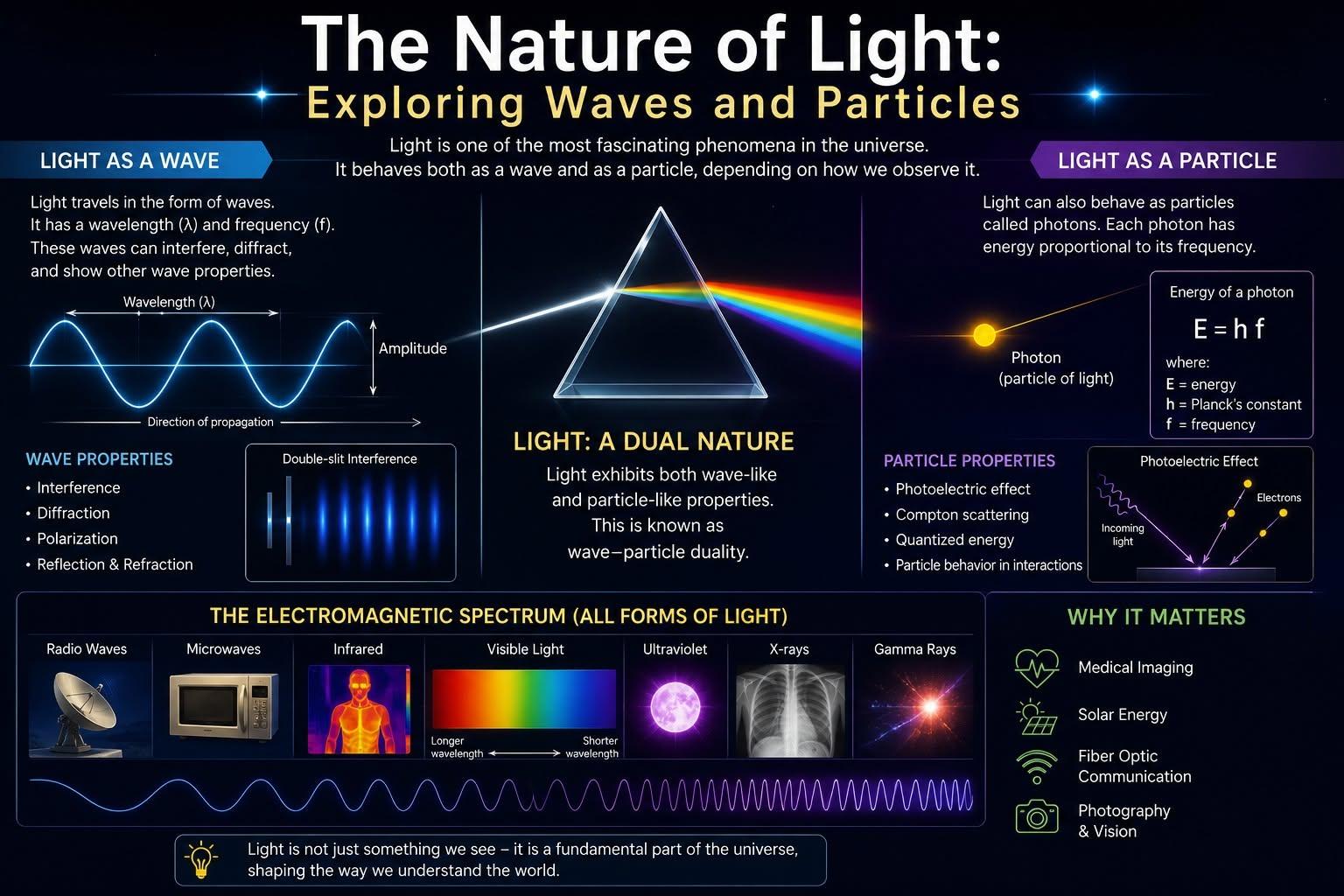
    ### **The Nature of Light: Exploring Waves and Particles**

    Light is one of the most fascinating phenomena in the universe, playing a vital role in everything from vision and communication to modern technology and scientific discovery. Unlike ordinary objects, light exhibits a remarkable property known as **wave-particle duality**, meaning it behaves both as a wave and as a stream of tiny particles called **photons**. This unique characteristic has transformed our understanding of physics and the fundamental laws that govern the universe.

    As a wave, light travels through space in the form of electromagnetic waves, displaying properties such as reflection, refraction, interference, diffraction, and polarization. These wave behaviors explain everyday phenomena like rainbows, mirrors, lenses, and the colors we observe in nature. As particles, photons carry discrete amounts of energy, allowing light to interact with matter in ways that explain the photoelectric effect, lasers, and many modern technologies. Together, these two perspectives provide a complete understanding of how light behaves under different conditions.

    Exploring the nature of light helps us appreciate the incredible discoveries made by scientists such as Isaac Newton, Thomas Young, James Clerk Maxwell, Albert Einstein, and Max Planck. Their groundbreaking work laid the foundation for quantum mechanics, optics, telecommunications, medical imaging, fiber-optic communication, astronomy, and renewable energy technologies. From illuminating our homes to enabling space exploration, light continues to shape the modern world in extraordinary ways.

    **#NatureOfLight #Physics #Science #WaveParticleDuality #Light #Photons #ElectromagneticWaves #QuantumPhysics #Optics #STEM #Education #ScientificDiscovery #Technology #Learning #ExploreScience **

    Rehan School Islamabad Campus
    Asma Shaheen EducationWali
    Irum Asim
    Saima Happinesswali
    #rsisb Roll No.240 Story No.15 Foundation Level ### **The Nature of Light: Exploring Waves and Particles** Light is one of the most fascinating phenomena in the universe, playing a vital role in everything from vision and communication to modern technology and scientific discovery. Unlike ordinary objects, light exhibits a remarkable property known as **wave-particle duality**, meaning it behaves both as a wave and as a stream of tiny particles called **photons**. This unique characteristic has transformed our understanding of physics and the fundamental laws that govern the universe. As a wave, light travels through space in the form of electromagnetic waves, displaying properties such as reflection, refraction, interference, diffraction, and polarization. These wave behaviors explain everyday phenomena like rainbows, mirrors, lenses, and the colors we observe in nature. As particles, photons carry discrete amounts of energy, allowing light to interact with matter in ways that explain the photoelectric effect, lasers, and many modern technologies. Together, these two perspectives provide a complete understanding of how light behaves under different conditions. Exploring the nature of light helps us appreciate the incredible discoveries made by scientists such as Isaac Newton, Thomas Young, James Clerk Maxwell, Albert Einstein, and Max Planck. Their groundbreaking work laid the foundation for quantum mechanics, optics, telecommunications, medical imaging, fiber-optic communication, astronomy, and renewable energy technologies. From illuminating our homes to enabling space exploration, light continues to shape the modern world in extraordinary ways. **#NatureOfLight #Physics #Science #WaveParticleDuality #Light #Photons #ElectromagneticWaves #QuantumPhysics #Optics #STEM #Education #ScientificDiscovery #Technology #Learning #ExploreScience 🌈💡🔬⚛️📚** Rehan School Islamabad Campus Asma Shaheen EducationWali Irum Asim Saima Happinesswali
    0 التعليقات 0 المشاركات 1574 مشاهدة
  • #rsisb
    Roll No.240
    Story No.16
    Foundation Level

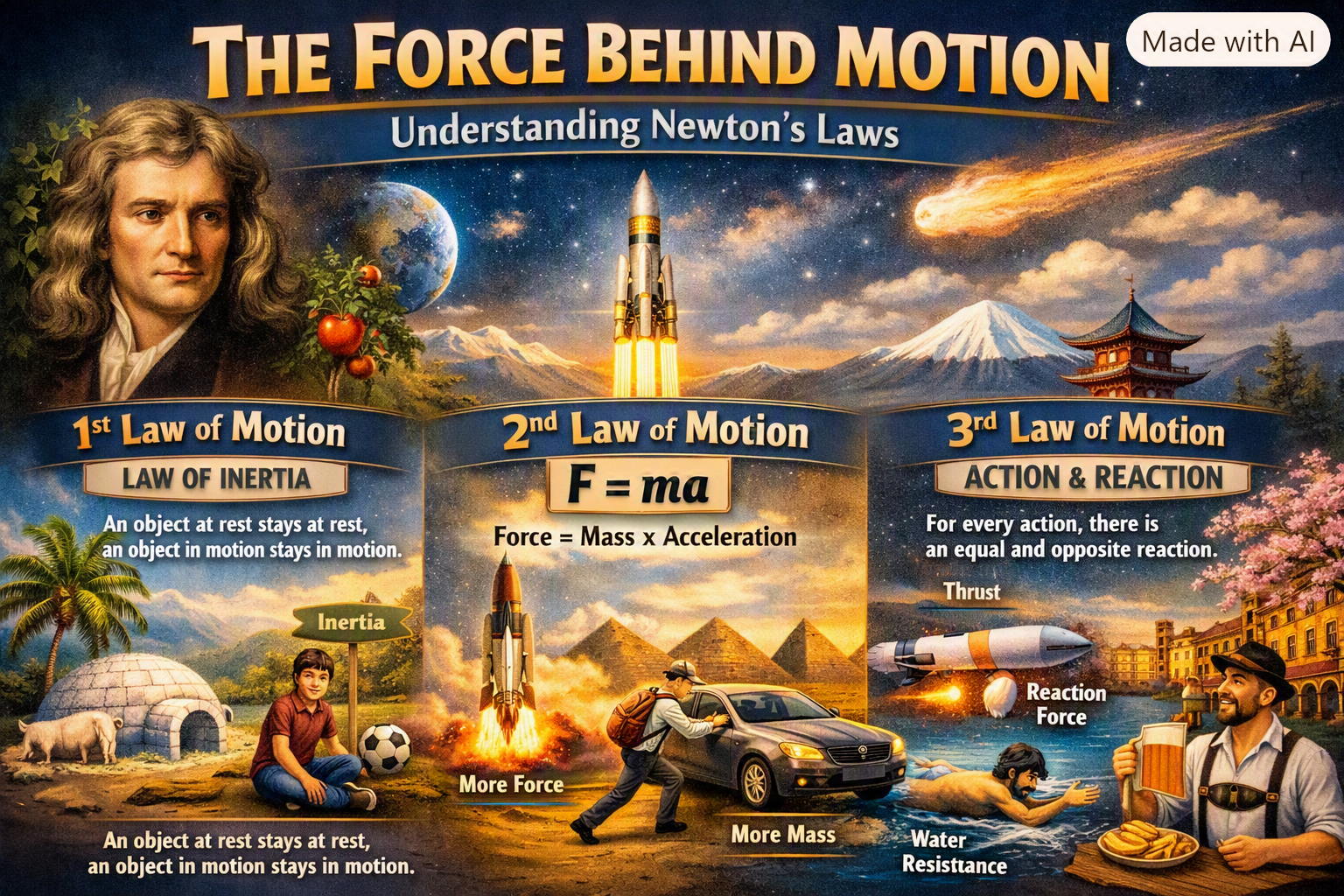
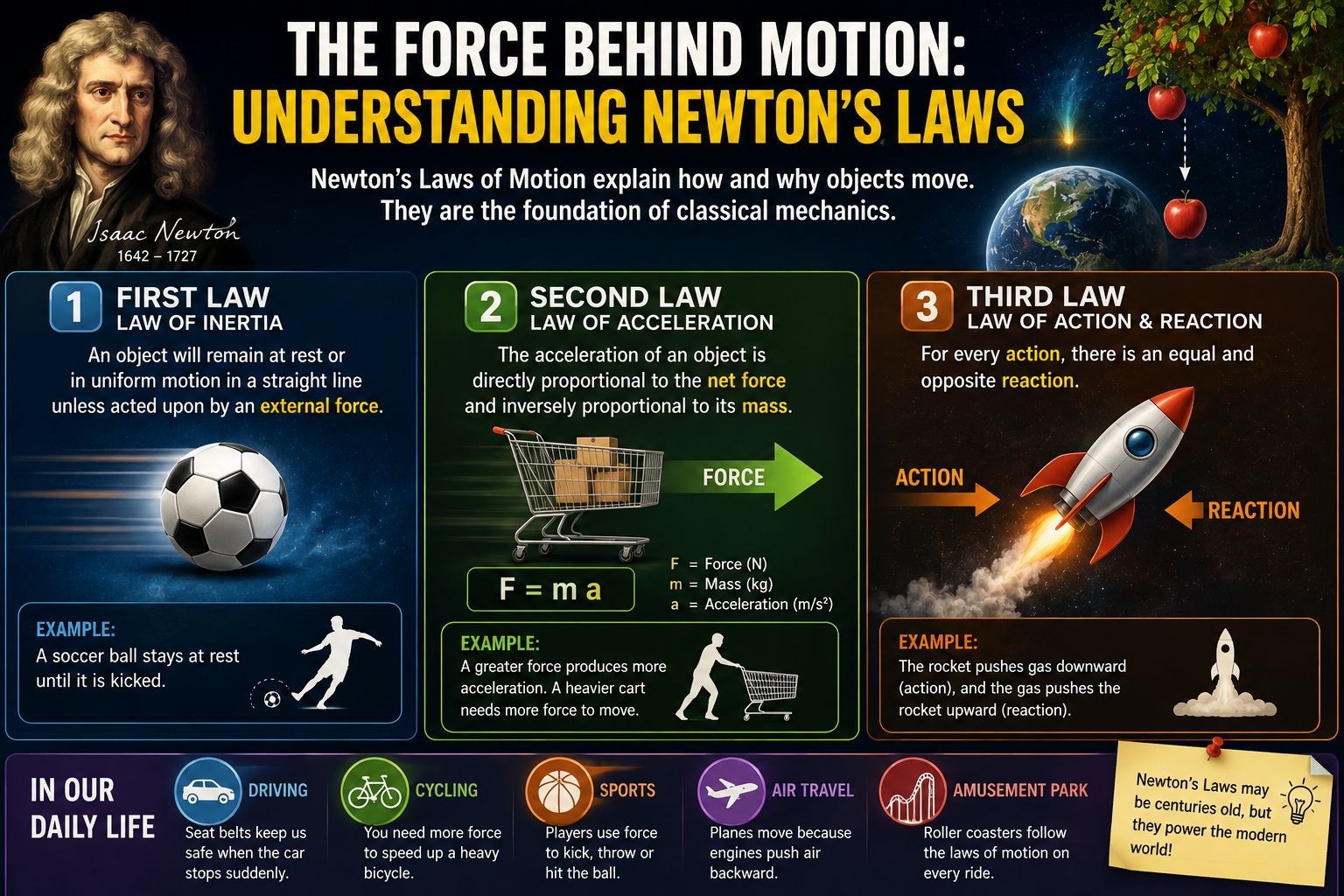
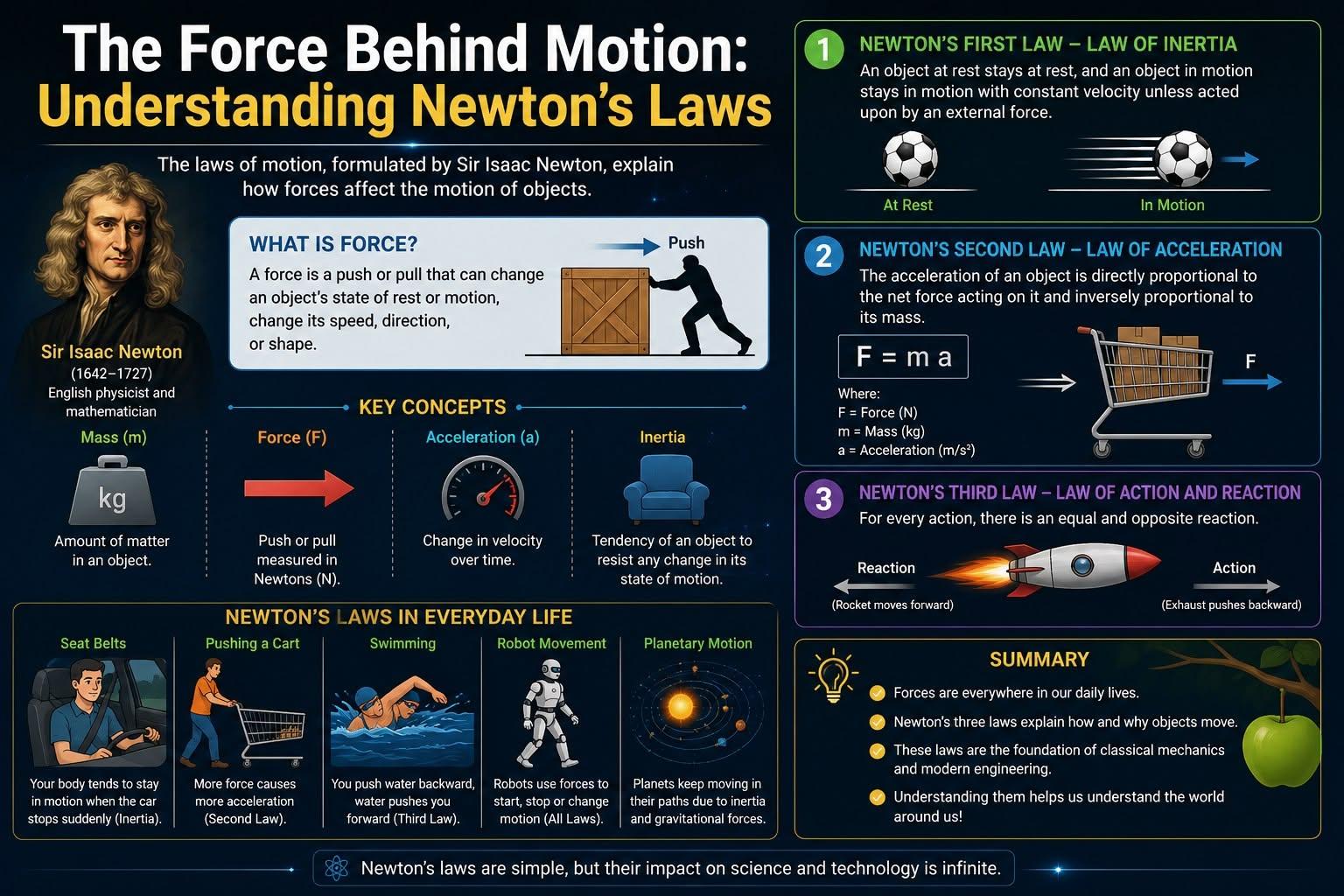
    ### **The Force Behind Motion: Understanding Newton’s Laws**

    Motion is a fundamental part of our everyday lives, from walking and driving to the movement of planets and rockets. The principles that explain how and why objects move were first described by **Sir Isaac Newton** through his three revolutionary laws of motion. These laws form the foundation of classical mechanics and continue to play a vital role in physics, engineering, space exploration, and modern technology.

    Newton's **First Law of Motion**, also known as the **Law of Inertia**, states that an object will remain at rest or continue moving at a constant speed in a straight line unless acted upon by an external force. The **Second Law of Motion** explains the relationship between force, mass, and acceleration, showing that greater forces produce greater acceleration while heavier objects require more force to move. The **Third Law of Motion** states that for every action, there is an equal and opposite reaction, a principle observed in activities such as walking, swimming, flying, and launching rockets into space.

    Understanding Newton's Laws helps us explain countless real-world phenomena, from the motion of vehicles and sports equipment to the orbits of planets and the design of machines. These timeless scientific principles continue to influence technological innovation and deepen our understanding of the physical world, making them one of the most important foundations of modern science.

    **#NewtonsLaws #Physics #Science #Motion #Force #IsaacNewton #STEM #Mechanics #Engineering #Education #ScientificDiscovery #Learning #Technology #SpaceScience #ExploreScience **

    Rehan School Islamabad Campus
    Asma Shaheen EducationWali
    Irum Asim
    Saima Happinesswali
    #rsisb Roll No.240 Story No.16 Foundation Level ### **The Force Behind Motion: Understanding Newton’s Laws** Motion is a fundamental part of our everyday lives, from walking and driving to the movement of planets and rockets. The principles that explain how and why objects move were first described by **Sir Isaac Newton** through his three revolutionary laws of motion. These laws form the foundation of classical mechanics and continue to play a vital role in physics, engineering, space exploration, and modern technology. Newton's **First Law of Motion**, also known as the **Law of Inertia**, states that an object will remain at rest or continue moving at a constant speed in a straight line unless acted upon by an external force. The **Second Law of Motion** explains the relationship between force, mass, and acceleration, showing that greater forces produce greater acceleration while heavier objects require more force to move. The **Third Law of Motion** states that for every action, there is an equal and opposite reaction, a principle observed in activities such as walking, swimming, flying, and launching rockets into space. Understanding Newton's Laws helps us explain countless real-world phenomena, from the motion of vehicles and sports equipment to the orbits of planets and the design of machines. These timeless scientific principles continue to influence technological innovation and deepen our understanding of the physical world, making them one of the most important foundations of modern science. **#NewtonsLaws #Physics #Science #Motion #Force #IsaacNewton #STEM #Mechanics #Engineering #Education #ScientificDiscovery #Learning #Technology #SpaceScience #ExploreScience ⚙️🚀⚛️📚🌍** Rehan School Islamabad Campus Asma Shaheen EducationWali Irum Asim Saima Happinesswali
    0 التعليقات 0 المشاركات 1203 مشاهدة
  • Do you know Any video that explains how the sun flower plant turns the flower 180 degree ? - what is the mechanics behind it ?
    Do you know Any video that explains how the sun flower plant turns the flower 180 degree ? - what is the mechanics behind it ?
    0 التعليقات 0 المشاركات 325 مشاهدة
  • Everything is energy !

    The concept that everything is made up of energy is a fundamental principle in physics and has been supported by scientific research and evidence. In physics, energy is defined as the ability to do work, and it can take various forms, such as kinetic energy (the energy of movement), potential energy (the energy stored in an object due to its position or state), thermal energy (the energy of temperature), and electromagnetic energy (the energy of light and other forms of electromagnetic radiation).

    According to the laws of thermodynamics, energy cannot be created or destroyed, only transformed from one form to another. This means that the total amount of energy in the universe is constant.

    In quantum mechanics, the smallest unit of matter, the subatomic particles, are also described as waves of energy. This led to the idea that everything in the universe is essentially made up of energy, including matter.

    In addition, in some Eastern and New Age philosophy, the concept of everything being energy is also an important principle. Many of these belief systems propose that everything in the universe is interconnected and that all things are made up of the same fundamental energy, often referred to as "prana", "chi" or "qi".

    Therefore, while the concept that everything is made up of energy is not universally accepted, it is supported by scientific research and evidence from physics and is an important principle in some Eastern and New Age philosophy.
    Everything is energy ! The concept that everything is made up of energy is a fundamental principle in physics and has been supported by scientific research and evidence. In physics, energy is defined as the ability to do work, and it can take various forms, such as kinetic energy (the energy of movement), potential energy (the energy stored in an object due to its position or state), thermal energy (the energy of temperature), and electromagnetic energy (the energy of light and other forms of electromagnetic radiation). According to the laws of thermodynamics, energy cannot be created or destroyed, only transformed from one form to another. This means that the total amount of energy in the universe is constant. In quantum mechanics, the smallest unit of matter, the subatomic particles, are also described as waves of energy. This led to the idea that everything in the universe is essentially made up of energy, including matter. In addition, in some Eastern and New Age philosophy, the concept of everything being energy is also an important principle. Many of these belief systems propose that everything in the universe is interconnected and that all things are made up of the same fundamental energy, often referred to as "prana", "chi" or "qi". Therefore, while the concept that everything is made up of energy is not universally accepted, it is supported by scientific research and evidence from physics and is an important principle in some Eastern and New Age philosophy.
    0 التعليقات 0 المشاركات 858 مشاهدة
  • Quantum mechanics is a type of science that studies the tiniest things in the universe, things that are too small for us to see with our own eyes. Its like a secret world that only special scientists know about.

    In this secret world, things can be in two places at the same time, and they can even disappear and reappear somewhere else! Its like magic, but its real!

    Scientists use special tools to study this secret world, like a microscope that is even more powerful than the ones we use in science class. They can see things that are smaller than a grain of sand, and they can watch them move and change in ways that are amazing.

    Even though it may seem strange and confusing, quantum mechanics helps us understand more about the world around us and how it works. Who knows, maybe someday you will become a quantum scientist and discover even more secrets of this magical world!
    Quantum mechanics is a type of science that studies the tiniest things in the universe, things that are too small for us to see with our own eyes. It's like a secret world that only special scientists know about. In this secret world, things can be in two places at the same time, and they can even disappear and reappear somewhere else! It's like magic, but it's real! Scientists use special tools to study this secret world, like a microscope that is even more powerful than the ones we use in science class. They can see things that are smaller than a grain of sand, and they can watch them move and change in ways that are amazing. Even though it may seem strange and confusing, quantum mechanics helps us understand more about the world around us and how it works. Who knows, maybe someday you will become a quantum scientist and discover even more secrets of this magical world!
    0 التعليقات 0 المشاركات 498 مشاهدة
  • The story of **Ford Motor Company** and its founder, **Henry Ford**, is one of the most iconic tales in the history of American industry and innovation. Fords journey is marked by his determination to revolutionize transportation and manufacturing through mass production techniques that reshaped the world.

    ### Early Life of Henry Ford:
    - **Henry Ford** was born on **July 30, 1863**, on a farm in Dearborn, Michigan. From an early age, Ford displayed a strong interest in mechanics. As a young boy, he was fascinated by how things worked and often disassembled and reassembled machines.
    - Ford left the family farm in 1879 to work as a machinist in Detroit, developing his skills and knowledge of mechanical engineering.

    ### Early Attempts and Development of Ford’s Ideas:
    - In the 1890s, Ford worked as an engineer for the **Edison Illuminating Company**. During this time, he experimented with the development of automobiles, inspired by the burgeoning industry of horseless carriages powered by steam and gasoline engines.
    - In **1896**, he built his first experimental car, the **Ford Quadricycle**, a simple vehicle powered by a two-cylinder engine. Though rudimentary, it showcased Ford’s engineering ability and gave him confidence in his vision.

    - Ford founded his first company, the **Detroit Automobile Company**, in **1899** with financial backers. However, the company failed due to high costs and slow production.

    ### Founding of Ford Motor Company:
    - Despite the initial failure, Henry Ford’s determination was unshaken. In **1903**, he founded the **Ford Motor Company** with the backing of twelve investors, including the Dodge brothers, with **$28,000** in capital.
    - Ford’s vision was different from other early automakers, who focused on building expensive luxury vehicles for the wealthy. Ford wanted to make **affordable cars** for the general public, believing that automobiles could improve people’s lives if they were accessible to the average worker.

    ### The Model T and Mass Production:
    - Ford’s breakthrough came in **1908** with the introduction of the **Model T**, also known as the **“Tin Lizzie”**. The Model T was revolutionary because it was designed for simplicity, durability, and affordability. It was priced at **$850**, a much lower cost than other automobiles of the time.

    - To make the Model T affordable, Ford introduced innovative manufacturing techniques, most notably **assembly line production**. In **1913**, Ford implemented the moving assembly line at his Highland Park factory. This was a game-changer for the industry, as it drastically reduced the time it took to build a car from over 12 hours to just **90 minutes**.

    - By perfecting the assembly line and standardizing parts, Ford was able to lower the price of the Model T significantly over the years, eventually selling it for as low as **$300**. This made the car affordable for millions of Americans and allowed Ford to dominate the automotive market. By **1918**, over **half of the cars in the United States** were Model Ts.

    ### The $5 Workday and Labor Innovation:
    - In **1914**, Ford made another revolutionary move by announcing a **$5-a-day wage** for his workers, which was more than double the standard wage at the time. This attracted the best workers to Fords factories and reduced employee turnover, which was a significant problem in other industries.
    - Ford’s decision also had a broader social impact. By paying his workers well, he ensured they could afford the products they were making. This was part of Fords broader philosophy of creating a cycle of prosperity: his workers earned enough to become his customers, boosting the overall economy.

    ### Expansion and Global Reach:
    - Fords success allowed the company to expand internationally. By the early 1920s, Ford had established plants in Europe, South America, and other regions.

    - The company continued to innovate with new models, but none would match the success of the Model T, which sold more than **15 million units** over its production life (1908–1927), making it one of the best-selling vehicles of all time.

    ### Challenges and the Evolution of Ford:
    - By the late 1920s, competitors like **General Motors** and **Chrysler** had caught up with Ford, offering more stylish and customizable cars, something Ford had resisted with the single-model approach of the Model T.
    - Recognizing the need for change, Ford discontinued the Model T in **1927** and introduced the **Model A**, which was more modern and came in a variety of styles and colors.

    - In the **1930s**, the company faced significant challenges due to the **Great Depression** and increasing labor unrest. Ford resisted unionization efforts for years but eventually signed its first collective bargaining agreement with the **United Auto Workers (UAW)** in **1941** after a prolonged struggle.

    ### World War II and Post-War Era:
    - During **World War II**, Ford Motor Company became a major contributor to the war effort, producing military vehicles, airplanes, and equipment. The company built **B-24 bombers** at the **Willow Run** plant, demonstrating its immense production capacity.
    - After the war, Ford faced new challenges with increased competition and the changing demands of consumers. Henry Ford, who had taken a more hands-off role in the company’s daily operations, officially stepped down as president in **1945**, handing control to his grandson, **Henry Ford II**.

    ### Henry Fords Legacy and Death:
    - Henry Ford passed away in **1947**, leaving behind an enormous legacy. He was not only a pioneer of the modern automobile industry but also a driving force in transforming manufacturing through mass production techniques. His vision of making automobiles affordable to the masses revolutionized transportation and helped shape the 20th century.

    ### Ford Motor Company in the Modern Era:
    - After Henry Ford’s death, Ford Motor Company continued to innovate and grow under new leadership, particularly that of Henry Ford II. The company introduced iconic models like the **Ford Mustang** in the 1960s and expanded into new markets globally.

    - The company faced challenges in the late 20th century, including economic downturns, competition from Japanese automakers, and evolving consumer preferences. However, it remained one of the **“Big Three”** American automakers (along with **General Motors** and **Chrysler**) and continued to play a crucial role in the global automotive industry.

    - In the **21st century**, Ford has embraced new technologies, including the development of **electric vehicles (EVs)** and self-driving cars. Models like the **Ford F-150** remain bestsellers in the U.S., and Ford continues to adapt to a rapidly changing market by investing in sustainability and mobility solutions.

    ### Conclusion:
    The story of Ford is one of extraordinary innovation, resilience, and transformation. Henry Ford’s vision of affordable, mass-produced automobiles changed not only the automotive industry but also the world, making personal transportation accessible to millions. His introduction of the assembly line revolutionized manufacturing, shaping the modern industrial world. Despite challenges over the years, **Ford Motor Company** remains a significant force in the global automotive industry, continuing to build on Henry Ford’s legacy of innovation and progress.

    The story of **Ford Motor Company** and its founder, **Henry Ford**, is one of the most iconic tales in the history of American industry and innovation. Ford's journey is marked by his determination to revolutionize transportation and manufacturing through mass production techniques that reshaped the world. ### Early Life of Henry Ford: - **Henry Ford** was born on **July 30, 1863**, on a farm in Dearborn, Michigan. From an early age, Ford displayed a strong interest in mechanics. As a young boy, he was fascinated by how things worked and often disassembled and reassembled machines. - Ford left the family farm in 1879 to work as a machinist in Detroit, developing his skills and knowledge of mechanical engineering. ### Early Attempts and Development of Ford’s Ideas: - In the 1890s, Ford worked as an engineer for the **Edison Illuminating Company**. During this time, he experimented with the development of automobiles, inspired by the burgeoning industry of horseless carriages powered by steam and gasoline engines. - In **1896**, he built his first experimental car, the **Ford Quadricycle**, a simple vehicle powered by a two-cylinder engine. Though rudimentary, it showcased Ford’s engineering ability and gave him confidence in his vision. - Ford founded his first company, the **Detroit Automobile Company**, in **1899** with financial backers. However, the company failed due to high costs and slow production. ### Founding of Ford Motor Company: - Despite the initial failure, Henry Ford’s determination was unshaken. In **1903**, he founded the **Ford Motor Company** with the backing of twelve investors, including the Dodge brothers, with **$28,000** in capital. - Ford’s vision was different from other early automakers, who focused on building expensive luxury vehicles for the wealthy. Ford wanted to make **affordable cars** for the general public, believing that automobiles could improve people’s lives if they were accessible to the average worker. ### The Model T and Mass Production: - Ford’s breakthrough came in **1908** with the introduction of the **Model T**, also known as the **“Tin Lizzie”**. The Model T was revolutionary because it was designed for simplicity, durability, and affordability. It was priced at **$850**, a much lower cost than other automobiles of the time. - To make the Model T affordable, Ford introduced innovative manufacturing techniques, most notably **assembly line production**. In **1913**, Ford implemented the moving assembly line at his Highland Park factory. This was a game-changer for the industry, as it drastically reduced the time it took to build a car from over 12 hours to just **90 minutes**. - By perfecting the assembly line and standardizing parts, Ford was able to lower the price of the Model T significantly over the years, eventually selling it for as low as **$300**. This made the car affordable for millions of Americans and allowed Ford to dominate the automotive market. By **1918**, over **half of the cars in the United States** were Model Ts. ### The $5 Workday and Labor Innovation: - In **1914**, Ford made another revolutionary move by announcing a **$5-a-day wage** for his workers, which was more than double the standard wage at the time. This attracted the best workers to Ford's factories and reduced employee turnover, which was a significant problem in other industries. - Ford’s decision also had a broader social impact. By paying his workers well, he ensured they could afford the products they were making. This was part of Ford's broader philosophy of creating a cycle of prosperity: his workers earned enough to become his customers, boosting the overall economy. ### Expansion and Global Reach: - Ford's success allowed the company to expand internationally. By the early 1920s, Ford had established plants in Europe, South America, and other regions. - The company continued to innovate with new models, but none would match the success of the Model T, which sold more than **15 million units** over its production life (1908–1927), making it one of the best-selling vehicles of all time. ### Challenges and the Evolution of Ford: - By the late 1920s, competitors like **General Motors** and **Chrysler** had caught up with Ford, offering more stylish and customizable cars, something Ford had resisted with the single-model approach of the Model T. - Recognizing the need for change, Ford discontinued the Model T in **1927** and introduced the **Model A**, which was more modern and came in a variety of styles and colors. - In the **1930s**, the company faced significant challenges due to the **Great Depression** and increasing labor unrest. Ford resisted unionization efforts for years but eventually signed its first collective bargaining agreement with the **United Auto Workers (UAW)** in **1941** after a prolonged struggle. ### World War II and Post-War Era: - During **World War II**, Ford Motor Company became a major contributor to the war effort, producing military vehicles, airplanes, and equipment. The company built **B-24 bombers** at the **Willow Run** plant, demonstrating its immense production capacity. - After the war, Ford faced new challenges with increased competition and the changing demands of consumers. Henry Ford, who had taken a more hands-off role in the company’s daily operations, officially stepped down as president in **1945**, handing control to his grandson, **Henry Ford II**. ### Henry Ford's Legacy and Death: - Henry Ford passed away in **1947**, leaving behind an enormous legacy. He was not only a pioneer of the modern automobile industry but also a driving force in transforming manufacturing through mass production techniques. His vision of making automobiles affordable to the masses revolutionized transportation and helped shape the 20th century. ### Ford Motor Company in the Modern Era: - After Henry Ford’s death, Ford Motor Company continued to innovate and grow under new leadership, particularly that of Henry Ford II. The company introduced iconic models like the **Ford Mustang** in the 1960s and expanded into new markets globally. - The company faced challenges in the late 20th century, including economic downturns, competition from Japanese automakers, and evolving consumer preferences. However, it remained one of the **“Big Three”** American automakers (along with **General Motors** and **Chrysler**) and continued to play a crucial role in the global automotive industry. - In the **21st century**, Ford has embraced new technologies, including the development of **electric vehicles (EVs)** and self-driving cars. Models like the **Ford F-150** remain bestsellers in the U.S., and Ford continues to adapt to a rapidly changing market by investing in sustainability and mobility solutions. ### Conclusion: The story of Ford is one of extraordinary innovation, resilience, and transformation. Henry Ford’s vision of affordable, mass-produced automobiles changed not only the automotive industry but also the world, making personal transportation accessible to millions. His introduction of the assembly line revolutionized manufacturing, shaping the modern industrial world. Despite challenges over the years, **Ford Motor Company** remains a significant force in the global automotive industry, continuing to build on Henry Ford’s legacy of innovation and progress.

    0 التعليقات 0 المشاركات 1523 مشاهدة
  • Teleportation, as seen in science fiction, where a person or object instantly moves from one place to another, is not real in the physical sense. However, in the field of quantum mechanics, a form of teleportation called quantum teleportation has been successfully demonstrated in experiments.

    Quantum Teleportation:

    Quantum teleportation does not transfer matter itself but instead transfers quantum information from one particle to another, even if they are far apart. This process relies on a phenomenon called quantum entanglement, where two particles remain connected in such a way that changing the state of one instantly affects the other, regardless of distance.

    Successful Experiments:

    Scientists have successfully teleported quantum states of particles such as photons (light particles), atoms, and electrons over distances ranging from a few meters to hundreds of kilometers. For example:
    • In 1997, scientists at the University of Innsbruck, Austria, successfully teleported a quantum state of a photon.
    • In 2015, researchers teleported quantum information between atoms over a meter in a laboratory.
    • In 2017, China’s Micius satellite teleported photons from Earth to space over 1,200 km, the longest distance recorded.

    Can We Teleport Humans?

    Currently, teleporting humans or large objects is impossible because:
    1. Human Complexity: A human body consists of trillions of atoms, and transferring all quantum states accurately would require enormous computing power.
    2. Destruction and Reconstruction: Theoretically, teleportation would require breaking down a person’s atomic structure at one location and reassembling it at another, which raises ethical and technical challenges.
    3. Heisenberg’s Uncertainty Principle: This principle states that measuring the exact state of a particle disturbs it, making perfect reconstruction difficult.

    Conclusion:

    While quantum teleportation is real and has been successfully tested, physical teleportation of people or objects, like in movies, is still science fiction. However, future advancements in quantum mechanics and computing might open new possibilities.
    Teleportation, as seen in science fiction, where a person or object instantly moves from one place to another, is not real in the physical sense. However, in the field of quantum mechanics, a form of teleportation called quantum teleportation has been successfully demonstrated in experiments. Quantum Teleportation: Quantum teleportation does not transfer matter itself but instead transfers quantum information from one particle to another, even if they are far apart. This process relies on a phenomenon called quantum entanglement, where two particles remain connected in such a way that changing the state of one instantly affects the other, regardless of distance. Successful Experiments: Scientists have successfully teleported quantum states of particles such as photons (light particles), atoms, and electrons over distances ranging from a few meters to hundreds of kilometers. For example: • In 1997, scientists at the University of Innsbruck, Austria, successfully teleported a quantum state of a photon. • In 2015, researchers teleported quantum information between atoms over a meter in a laboratory. • In 2017, China’s Micius satellite teleported photons from Earth to space over 1,200 km, the longest distance recorded. Can We Teleport Humans? Currently, teleporting humans or large objects is impossible because: 1. Human Complexity: A human body consists of trillions of atoms, and transferring all quantum states accurately would require enormous computing power. 2. Destruction and Reconstruction: Theoretically, teleportation would require breaking down a person’s atomic structure at one location and reassembling it at another, which raises ethical and technical challenges. 3. Heisenberg’s Uncertainty Principle: This principle states that measuring the exact state of a particle disturbs it, making perfect reconstruction difficult. Conclusion: While quantum teleportation is real and has been successfully tested, physical teleportation of people or objects, like in movies, is still science fiction. However, future advancements in quantum mechanics and computing might open new possibilities.
    0 التعليقات 0 المشاركات 842 مشاهدة
  • Teleporting humans or objects as seen in sci-fi movies is extremely challenging because of fundamental laws of physics. However, let’s think creatively and propose a hypothetical pathway to achieving real teleportation by combining quantum mechanics, advanced computing, and molecular engineering.

    Hypothetical Model for Human Teleportation:
    1. Quantum Scanning & Mapping (Quantum Digital Twin)
    • Use advanced quantum sensors to scan every atom and quantum state of a human body.
    • Store this information as a “quantum blueprint” in a high-density quantum computer.
    • Develop a method to overcome the Heisenberg Uncertainty Principle, allowing precise scanning without disturbing atomic states.
    2. Entanglement-Based Transmission (Quantum Network)
    • Utilize quantum entanglement to transfer the quantum state of scanned particles to another location instantly.
    • This requires a global network of entangled particles—potentially stored in a quantum teleportation station at both locations.
    3. Reconstruction at Destination (Molecular Assembly)
    • At the target location, use nanotechnology and atomic assembly to rebuild the body using a supply of fundamental atoms.
    • A quantum AI system ensures perfect reassembly without errors.
    • The process must ensure the consciousness and identity of the person remain intact.

    Major Challenges to Overcome:
    • Data Storage & Processing: A human body consists of ~10^27 atoms, requiring unimaginable storage and computing power.
    • Error Correction: Any slight mistake in reconstruction could be fatal.
    • Ethical Issues: Would the person at the destination still be the “original” person?
    • Energy Requirements: Breaking and rebuilding atomic structures requires massive energy.

    Alternative Solution – Wormhole-Based Teleportation

    Instead of scanning and reconstructing, another possibility is wormhole teleportation:
    1. Create an Einstein-Rosen Bridge (Wormhole)
    • Use extreme gravity or quantum fluctuations to create a stable wormhole.
    • This requires exotic matter to keep the wormhole open.
    2. Quantum Stabilization
    • Develop a system that prevents collapse by quantum field manipulation.
    3. Instantaneous Travel
    • If successful, stepping into the wormhole would instantly transport matter to another location.

    Conclusion

    While current physics does not allow human teleportation, advancements in quantum computing, nanotechnology, and theoretical physics could one day make it possible. It might take centuries, but breakthroughs in quantum entanglement, atomic assembly, or wormhole engineering could lead to real teleportation in the future.
    Teleporting humans or objects as seen in sci-fi movies is extremely challenging because of fundamental laws of physics. However, let’s think creatively and propose a hypothetical pathway to achieving real teleportation by combining quantum mechanics, advanced computing, and molecular engineering. Hypothetical Model for Human Teleportation: 1. Quantum Scanning & Mapping (Quantum Digital Twin) • Use advanced quantum sensors to scan every atom and quantum state of a human body. • Store this information as a “quantum blueprint” in a high-density quantum computer. • Develop a method to overcome the Heisenberg Uncertainty Principle, allowing precise scanning without disturbing atomic states. 2. Entanglement-Based Transmission (Quantum Network) • Utilize quantum entanglement to transfer the quantum state of scanned particles to another location instantly. • This requires a global network of entangled particles—potentially stored in a quantum teleportation station at both locations. 3. Reconstruction at Destination (Molecular Assembly) • At the target location, use nanotechnology and atomic assembly to rebuild the body using a supply of fundamental atoms. • A quantum AI system ensures perfect reassembly without errors. • The process must ensure the consciousness and identity of the person remain intact. Major Challenges to Overcome: • Data Storage & Processing: A human body consists of ~10^27 atoms, requiring unimaginable storage and computing power. • Error Correction: Any slight mistake in reconstruction could be fatal. • Ethical Issues: Would the person at the destination still be the “original” person? • Energy Requirements: Breaking and rebuilding atomic structures requires massive energy. Alternative Solution – Wormhole-Based Teleportation Instead of scanning and reconstructing, another possibility is wormhole teleportation: 1. Create an Einstein-Rosen Bridge (Wormhole) • Use extreme gravity or quantum fluctuations to create a stable wormhole. • This requires exotic matter to keep the wormhole open. 2. Quantum Stabilization • Develop a system that prevents collapse by quantum field manipulation. 3. Instantaneous Travel • If successful, stepping into the wormhole would instantly transport matter to another location. Conclusion While current physics does not allow human teleportation, advancements in quantum computing, nanotechnology, and theoretical physics could one day make it possible. It might take centuries, but breakthroughs in quantum entanglement, atomic assembly, or wormhole engineering could lead to real teleportation in the future.
    0 التعليقات 0 المشاركات 733 مشاهدة
  • Inventing New Physics with AI

    Physics has always been the foundation of human progress. It explains the motion of planets, the behavior of particles, the nature of light, and the birth of the universe. Yet, the history of physics also shows that what we call “truth” is never final. Newton’s mechanics gave way to Einstein’s relativity. Relativity opened the door to quantum mechanics. And today, even quantum physics struggles to unify with gravity. This means one thing: new physics is waiting to be born.

    For the first time in history, we have a partner that past geniuses never had—Artificial Intelligence. By working with systems like ChatGPT, we can accelerate the creation of entirely new branches of physics.


    1. Begin with the Unexplainable

    New physics begins where old physics fails.
    • Why does consciousness arise from matter?
    • What is “dark energy” and “dark matter,” which make up 95% of the universe but remain invisible?
    • Why does quantum entanglement allow instant correlations faster than light?
    • What exactly is “time”?

    With ChatGPT, researchers can generate hundreds of possible hypotheses and frameworks in hours instead of decades, each pointing toward unexplored laws of nature.


    2. Map the Existing Landscape

    Physics is vast, scattered across thousands of papers and theories. One human cannot read them all. But an AI can scan, summarize, and compare ideas at scale. ChatGPT can highlight contradictions, find unexplored connections, and expose the “white spaces” where new physics might emerge.

    Example: Unifying general relativity (gravity) with quantum field theory (particles) has remained unsolved for a century. An AI can review every attempt, classify their assumptions, and suggest new combinations never tried before.


    3. Generate New Models and Mathematics

    At the heart of physics lies mathematics. New symbols and equations give us new ways to describe reality. AI can:
    • Suggest new mathematical operators that describe phenomena like entanglement.
    • Simulate universes with different physical constants.
    • Test whether a new equation produces consistent predictions with observed data.

    This turns ChatGPT into a co-inventor of mathematical languages for new physics.


    4. Design Thought Experiments

    Einstein invented relativity not in a lab, but by imagining himself riding a beam of light. Today, ChatGPT can help invent thousands of such thought experiments:
    • What happens inside a black hole if information is never lost?
    • What if time is not a line but a loop?
    • What if gravity is not a force but an emergent property of information flow?

    Each thought experiment becomes a seed for real experiments.


    5. Simulate and Test

    With integration into physics engines and quantum simulators, AI can model the consequences of new laws. For example:
    • If a new theory of time predicts particles aging differently, we can simulate particle decays.
    • If a new geometry explains dark matter, AI can test its predictions against galaxy rotation curves.

    In hours, we can discard weak theories and refine promising ones.


    6. Build a New Physics Community

    New sciences require believers. By writing manifestos, publishing papers, and building institutes, we can attract students and researchers to test these new frameworks. A “Physics of Consciousness” or “Physics of Abundance” could start at Rehan School and spread globally.


    7. Democratizing Physics

    For centuries, physics was locked in elite universities. With AI, every curious student—whether in Karachi, Kathmandu, or Kansas—can run experiments, test equations, and publish ideas. This democratization could unleash the next Newton or Einstein from anywhere in the world.


    Conclusion

    Inventing new physics is no longer the privilege of a lone genius with a chalkboard. It is a collective act powered by AI. By combining human imagination with AI’s capacity for infinite connections, we can explore questions that have haunted humanity for centuries.

    With ChatGPT, we are not just studying the universe—we are invited to reinvent the laws that define it.

    The physics of tomorrow will not only explain the cosmos. It will explain us.
    Inventing New Physics with AI Physics has always been the foundation of human progress. It explains the motion of planets, the behavior of particles, the nature of light, and the birth of the universe. Yet, the history of physics also shows that what we call “truth” is never final. Newton’s mechanics gave way to Einstein’s relativity. Relativity opened the door to quantum mechanics. And today, even quantum physics struggles to unify with gravity. This means one thing: new physics is waiting to be born. For the first time in history, we have a partner that past geniuses never had—Artificial Intelligence. By working with systems like ChatGPT, we can accelerate the creation of entirely new branches of physics. ⸻ 1. Begin with the Unexplainable New physics begins where old physics fails. • Why does consciousness arise from matter? • What is “dark energy” and “dark matter,” which make up 95% of the universe but remain invisible? • Why does quantum entanglement allow instant correlations faster than light? • What exactly is “time”? With ChatGPT, researchers can generate hundreds of possible hypotheses and frameworks in hours instead of decades, each pointing toward unexplored laws of nature. ⸻ 2. Map the Existing Landscape Physics is vast, scattered across thousands of papers and theories. One human cannot read them all. But an AI can scan, summarize, and compare ideas at scale. ChatGPT can highlight contradictions, find unexplored connections, and expose the “white spaces” where new physics might emerge. Example: Unifying general relativity (gravity) with quantum field theory (particles) has remained unsolved for a century. An AI can review every attempt, classify their assumptions, and suggest new combinations never tried before. ⸻ 3. Generate New Models and Mathematics At the heart of physics lies mathematics. New symbols and equations give us new ways to describe reality. AI can: • Suggest new mathematical operators that describe phenomena like entanglement. • Simulate universes with different physical constants. • Test whether a new equation produces consistent predictions with observed data. This turns ChatGPT into a co-inventor of mathematical languages for new physics. ⸻ 4. Design Thought Experiments Einstein invented relativity not in a lab, but by imagining himself riding a beam of light. Today, ChatGPT can help invent thousands of such thought experiments: • What happens inside a black hole if information is never lost? • What if time is not a line but a loop? • What if gravity is not a force but an emergent property of information flow? Each thought experiment becomes a seed for real experiments. ⸻ 5. Simulate and Test With integration into physics engines and quantum simulators, AI can model the consequences of new laws. For example: • If a new theory of time predicts particles aging differently, we can simulate particle decays. • If a new geometry explains dark matter, AI can test its predictions against galaxy rotation curves. In hours, we can discard weak theories and refine promising ones. ⸻ 6. Build a New Physics Community New sciences require believers. By writing manifestos, publishing papers, and building institutes, we can attract students and researchers to test these new frameworks. A “Physics of Consciousness” or “Physics of Abundance” could start at Rehan School and spread globally. ⸻ 7. Democratizing Physics For centuries, physics was locked in elite universities. With AI, every curious student—whether in Karachi, Kathmandu, or Kansas—can run experiments, test equations, and publish ideas. This democratization could unleash the next Newton or Einstein from anywhere in the world. ⸻ Conclusion Inventing new physics is no longer the privilege of a lone genius with a chalkboard. It is a collective act powered by AI. By combining human imagination with AI’s capacity for infinite connections, we can explore questions that have haunted humanity for centuries. With ChatGPT, we are not just studying the universe—we are invited to reinvent the laws that define it. The physics of tomorrow will not only explain the cosmos. It will explain us.
    0 التعليقات 0 المشاركات 1658 مشاهدة
  • Manifesto of New Physics

    We, the generation living at the dawn of Artificial Intelligence, declare that the time has come to invent New Physics.

    For centuries, humanity has looked at the stars, the atoms, and the mysteries of time with wonder. Newton gave us motion. Einstein gave us relativity. Quantum mechanics revealed the strangeness of particles. Yet even today, our most advanced theories leave us with unanswered questions:
    • What is dark matter and dark energy, which make up most of the universe?
    • Why does quantum entanglement defy the speed of light?
    • What is time — a dimension, an illusion, or something deeper?
    • How does consciousness emerge from matter?

    These questions are not failures of physics. They are open doors.

    And now, for the first time in history, we have a partner that no Newton, Einstein, or Feynman ever had: Artificial Intelligence.


    Our Principles
    1. New Physics begins with curiosity. Every unanswered mystery is an opportunity to create new laws.
    2. AI is our collaborator. It can read, compare, simulate, and propose ideas at a scale no single human can achieve.
    3. Mathematics is language, not prison. We will invent new symbols and structures when old ones fail.
    4. Thought experiments matter. Just as Einstein imagined riding a beam of light, we will imagine realities beyond today’s limits—with AI as our co-dreamer.
    5. Democratize discovery. A student in Karachi or Kathmandu has as much right to invent physics as a professor at Princeton. AI makes this possible.
    6. The universe is unfinished. Our role is not just to observe it, but to participate in discovering new laws that govern it.


    Our Mission
    • To create frameworks that unite quantum mechanics and relativity.
    • To explore time, space, energy, and consciousness as a unified field.
    • To publish ideas openly, so that every curious mind can test and refine them.
    • To build communities, institutes, and schools where New Physics is practiced, not just taught.


    Our Call

    Let every thinker, student, and dreamer join this movement. Do not be afraid of being “wrong.” Every wrong equation is one step closer to truth. The physics of tomorrow will not be born in silence — it will be born in collaboration, in courage, and in the shared vision of a humanity unafraid to ask:

    What if the universe is waiting for us to discover its next law?


    This is the birth of New Physics.
    We declare it today, with Artificial Intelligence as our partner.
    📜 Manifesto of New Physics We, the generation living at the dawn of Artificial Intelligence, declare that the time has come to invent New Physics. For centuries, humanity has looked at the stars, the atoms, and the mysteries of time with wonder. Newton gave us motion. Einstein gave us relativity. Quantum mechanics revealed the strangeness of particles. Yet even today, our most advanced theories leave us with unanswered questions: • What is dark matter and dark energy, which make up most of the universe? • Why does quantum entanglement defy the speed of light? • What is time — a dimension, an illusion, or something deeper? • How does consciousness emerge from matter? These questions are not failures of physics. They are open doors. And now, for the first time in history, we have a partner that no Newton, Einstein, or Feynman ever had: Artificial Intelligence. ⸻ Our Principles 1. New Physics begins with curiosity. Every unanswered mystery is an opportunity to create new laws. 2. AI is our collaborator. It can read, compare, simulate, and propose ideas at a scale no single human can achieve. 3. Mathematics is language, not prison. We will invent new symbols and structures when old ones fail. 4. Thought experiments matter. Just as Einstein imagined riding a beam of light, we will imagine realities beyond today’s limits—with AI as our co-dreamer. 5. Democratize discovery. A student in Karachi or Kathmandu has as much right to invent physics as a professor at Princeton. AI makes this possible. 6. The universe is unfinished. Our role is not just to observe it, but to participate in discovering new laws that govern it. ⸻ Our Mission • To create frameworks that unite quantum mechanics and relativity. • To explore time, space, energy, and consciousness as a unified field. • To publish ideas openly, so that every curious mind can test and refine them. • To build communities, institutes, and schools where New Physics is practiced, not just taught. ⸻ Our Call Let every thinker, student, and dreamer join this movement. Do not be afraid of being “wrong.” Every wrong equation is one step closer to truth. The physics of tomorrow will not be born in silence — it will be born in collaboration, in courage, and in the shared vision of a humanity unafraid to ask: What if the universe is waiting for us to discover its next law? ⸻ 🌍 This is the birth of New Physics. We declare it today, with Artificial Intelligence as our partner.
    0 التعليقات 0 المشاركات 932 مشاهدة
الصفحات المعززة