• **Roll No: 2**
    **Batch: 14**
    **Book: ACCL**
    **Task No: 69**

    # Acids and Bases: The Balance of Nature

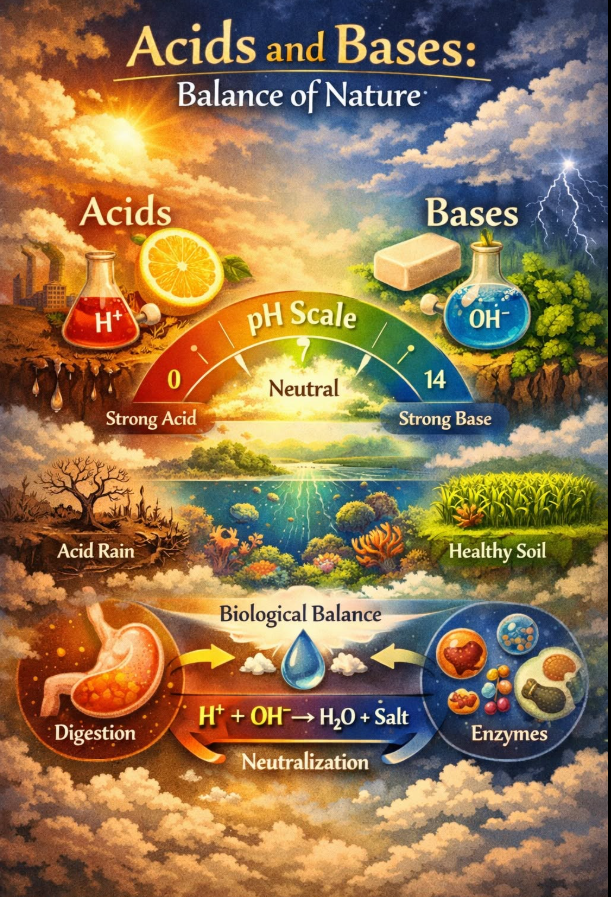
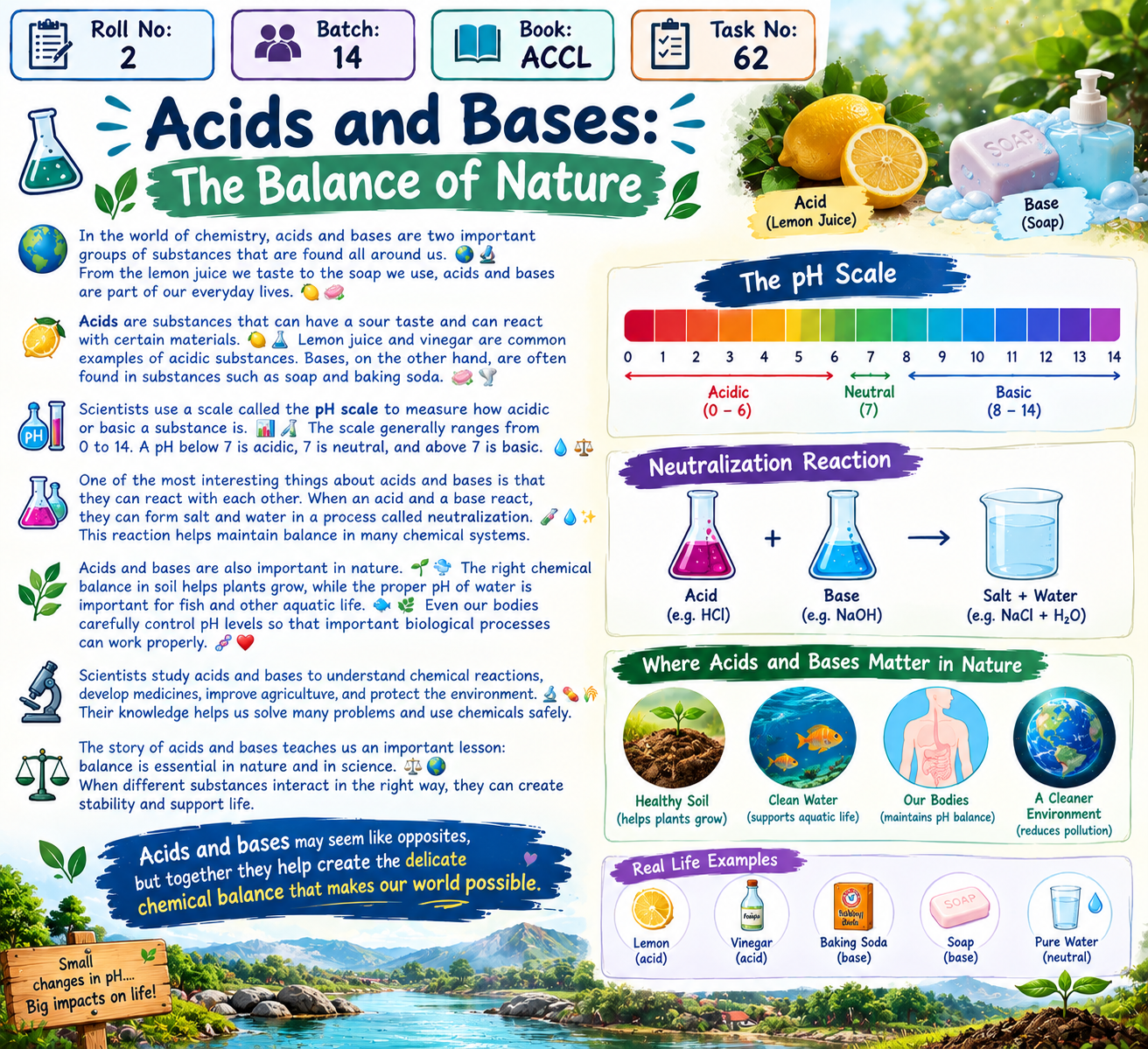
    In the world of chemistry, acids and bases are two important groups of substances that are found all around us. From the lemon juice we taste to the soap we use, acids and bases are part of our everyday lives.

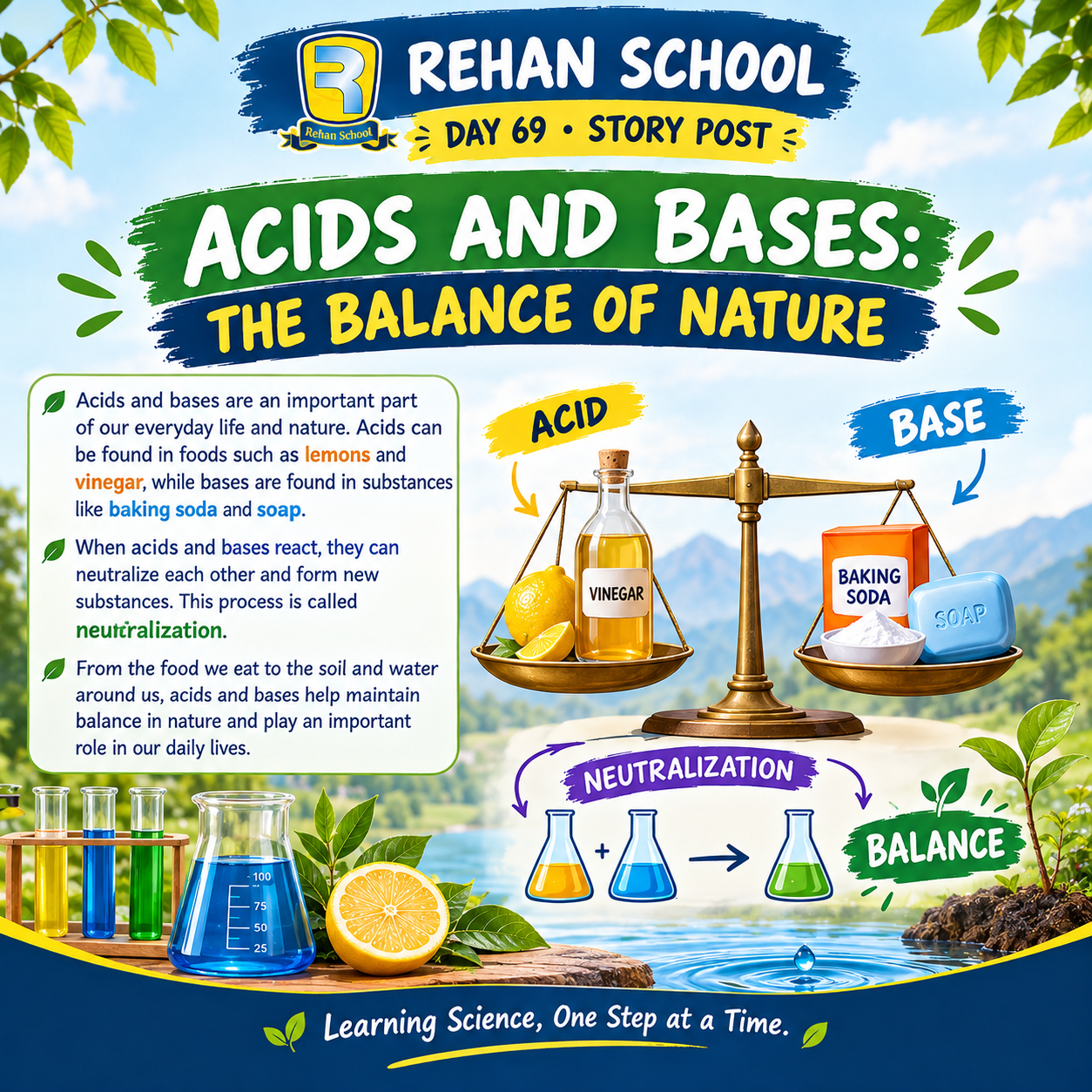
    Acids are substances that can have a sour taste and can react with certain materials. Lemon juice and vinegar are common examples of acidic substances. Bases, on the other hand, are often found in substances such as soap and baking soda.

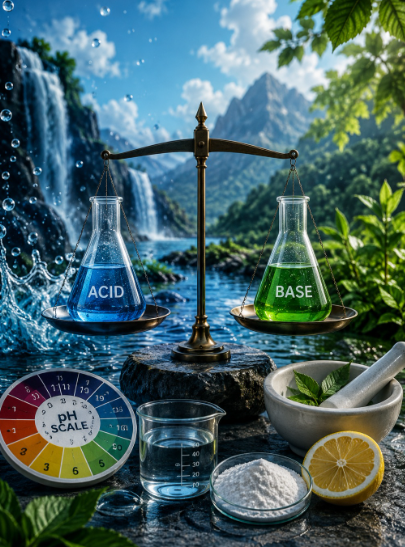
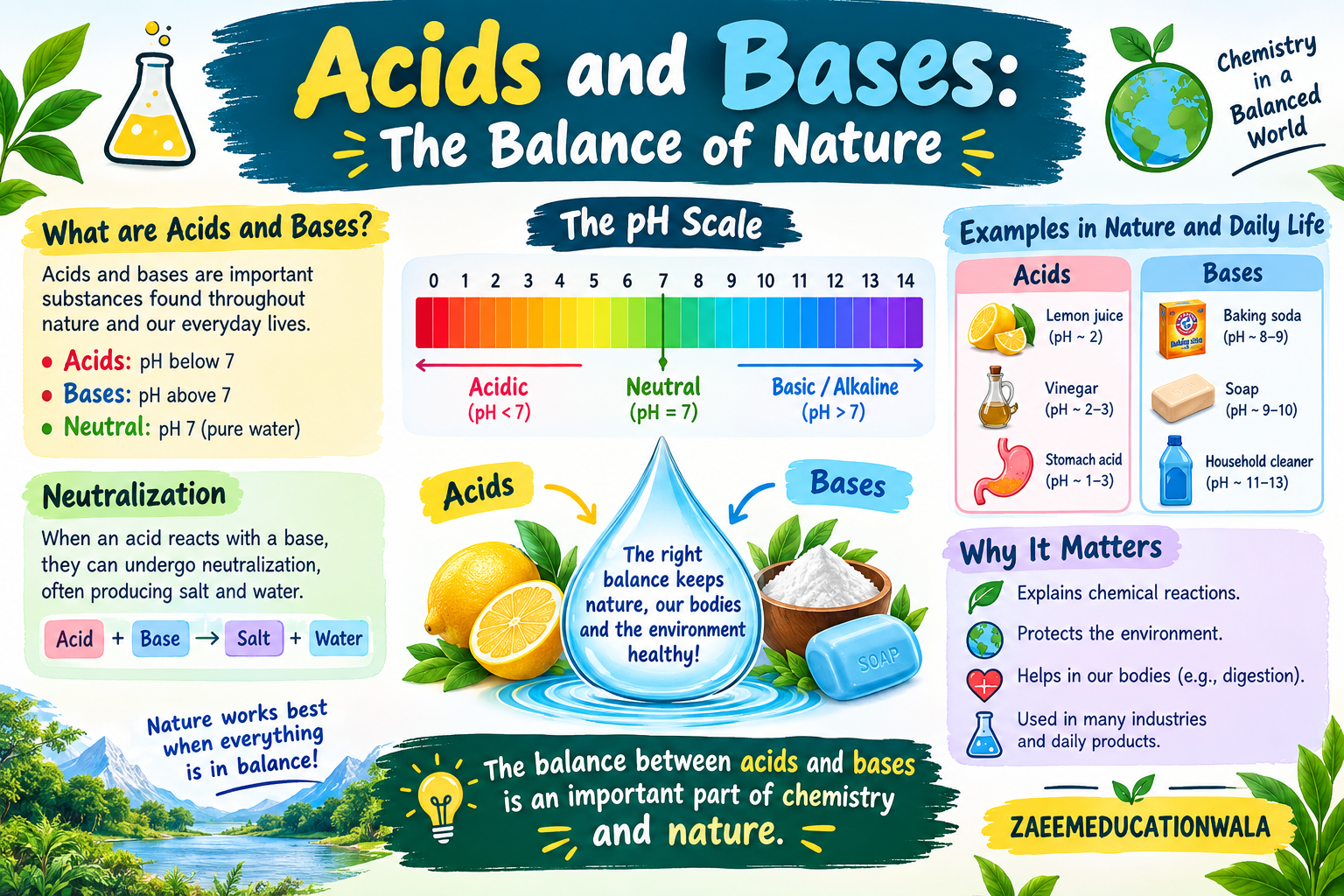
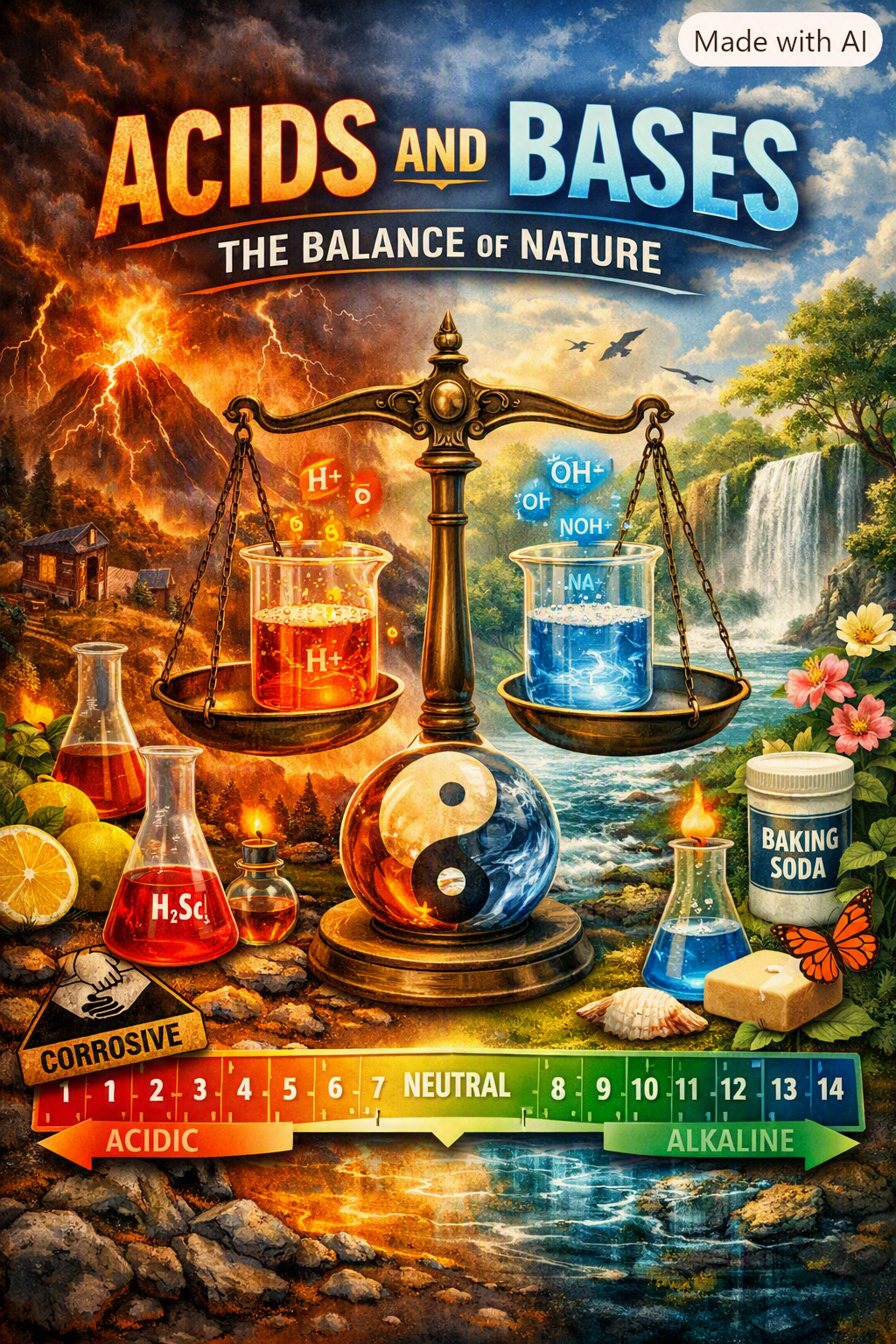
    Scientists use a scale called the **pH scale** to measure how acidic or basic a substance is. The scale generally ranges from **0 to 14**. A pH below 7 is acidic, 7 is neutral, and above 7 is basic.

    One of the most interesting things about acids and bases is that they can react with each other. When an acid and a base react, they can form **salt and water** in a process called neutralization. This reaction helps maintain balance in many chemical systems.

    Acids and bases are also important in nature. The right chemical balance in soil helps plants grow, while the proper pH of water is important for fish and other aquatic life. Even our bodies carefully control pH levels so that important biological processes can work properly.

    Scientists study acids and bases to understand chemical reactions, develop medicines, improve agriculture, and protect the environment. Their knowledge helps us solve many problems and use chemicals safely.

    The story of acids and bases teaches us an important lesson: **balance is essential in nature and in science.** When different substances interact in the right way, they can create stability and support life.

    **Acids and bases may seem like opposites, but together they help create the delicate chemical balance that makes our world possible. **
    **Roll No: 2** **Batch: 14** **Book: ACCL** **Task No: 69** # 🧪 Acids and Bases: The Balance of Nature 🌿⚖️ In the world of chemistry, acids and bases are two important groups of substances that are found all around us. 🌍🔬 From the lemon juice we taste to the soap we use, acids and bases are part of our everyday lives. 🍋🧼 Acids are substances that can have a sour taste and can react with certain materials. 🍋⚗️ Lemon juice and vinegar are common examples of acidic substances. Bases, on the other hand, are often found in substances such as soap and baking soda. 🧼🥄 Scientists use a scale called the **pH scale** to measure how acidic or basic a substance is. 📊🧪 The scale generally ranges from **0 to 14**. A pH below 7 is acidic, 7 is neutral, and above 7 is basic. 💧⚖️ One of the most interesting things about acids and bases is that they can react with each other. When an acid and a base react, they can form **salt and water** in a process called neutralization. 🧪💧✨ This reaction helps maintain balance in many chemical systems. Acids and bases are also important in nature. 🌱🌧️ The right chemical balance in soil helps plants grow, while the proper pH of water is important for fish and other aquatic life. 🐟🌿 Even our bodies carefully control pH levels so that important biological processes can work properly. 🧬❤️ Scientists study acids and bases to understand chemical reactions, develop medicines, improve agriculture, and protect the environment. 🔬💊🌾 Their knowledge helps us solve many problems and use chemicals safely. The story of acids and bases teaches us an important lesson: **balance is essential in nature and in science.** ⚖️🌍 When different substances interact in the right way, they can create stability and support life. **Acids and bases may seem like opposites, but together they help create the delicate chemical balance that makes our world possible. 🧪🌎✨**
    0 Comments 0 Shares 777 Views
  • RSIF8
    Roll no:85
    Task no:69
    Task topic:Acids and Bases: The Balance of Nature
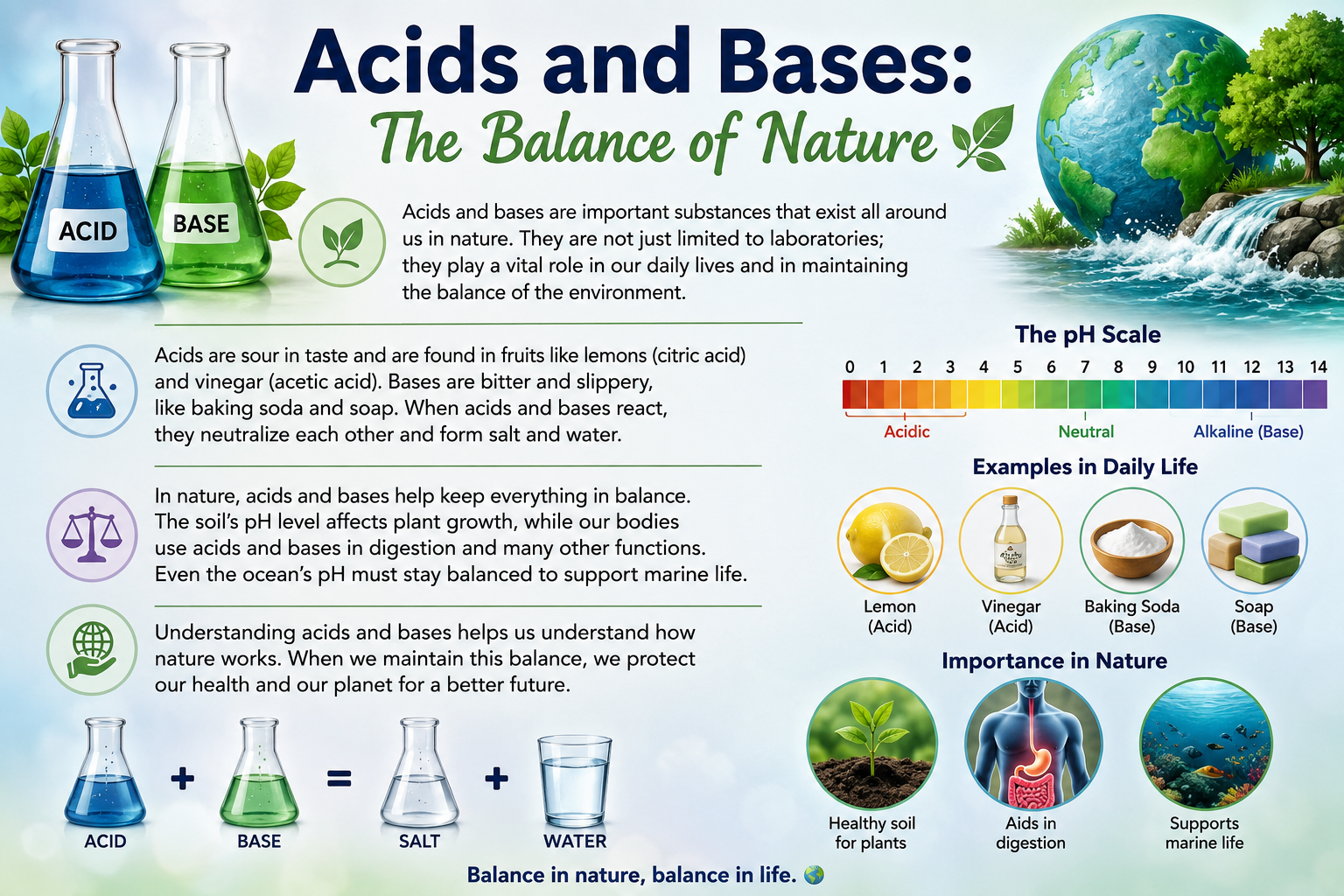
    Have you ever wondered why a lemon tastes sour, why soap feels slippery, or how our stomach digests food? The answer lies in the fascinating world of acids and bases. These substances are found everywhere—in nature, in our homes, and even inside our bodies. Together, they help maintain the delicate balance that supports life on Earth.
    Acids are substances that usually taste sour and have a pH below 7. Common examples include citric acid in lemons, acetic acid in vinegar, and hydrochloric acid in the stomach, which helps digest food. Bases, on the other hand, usually have a pH above 7 and feel slippery. Baking soda, soap, and many cleaning products are everyday examples of bases.
    One of the most amazing things about acids and bases is that they can neutralize each other. When an acid reacts with a base, they produce salt and water. This neutralization process is important in many areas of life, from treating acidic soil for better farming to making medicines that reduce excess stomach acid.
    Nature depends on the balance between acids and bases. Healthy soil has the right pH for plants to grow, rivers and oceans need balanced pH levels to support aquatic life, and our bodies carefully regulate pH so that organs and enzymes can function properly. Even a small change in this balance can affect living organisms.
    Understanding acids and bases helps us appreciate how chemistry works in everyday life. They are not just laboratory chemicals—they are essential to cooking, cleaning, farming, medicine, and the environment. By learning about them, we gain a deeper understanding of the natural world and the scientific principles that keep it in harmony
    RSIF8 Roll no:85 Task no:69 Task topic:Acids and Bases: The Balance of Nature Have you ever wondered why a lemon tastes sour, why soap feels slippery, or how our stomach digests food? The answer lies in the fascinating world of acids and bases. These substances are found everywhere—in nature, in our homes, and even inside our bodies. Together, they help maintain the delicate balance that supports life on Earth. Acids are substances that usually taste sour and have a pH below 7. Common examples include citric acid in lemons, acetic acid in vinegar, and hydrochloric acid in the stomach, which helps digest food. Bases, on the other hand, usually have a pH above 7 and feel slippery. Baking soda, soap, and many cleaning products are everyday examples of bases. One of the most amazing things about acids and bases is that they can neutralize each other. When an acid reacts with a base, they produce salt and water. This neutralization process is important in many areas of life, from treating acidic soil for better farming to making medicines that reduce excess stomach acid. Nature depends on the balance between acids and bases. Healthy soil has the right pH for plants to grow, rivers and oceans need balanced pH levels to support aquatic life, and our bodies carefully regulate pH so that organs and enzymes can function properly. Even a small change in this balance can affect living organisms. Understanding acids and bases helps us appreciate how chemistry works in everyday life. They are not just laboratory chemicals—they are essential to cooking, cleaning, farming, medicine, and the environment. By learning about them, we gain a deeper understanding of the natural world and the scientific principles that keep it in harmony
    0 Comments 0 Shares 917 Views
  • **RSLC ROLL NO 80#**
    **FOUNDATION LEVEL Batch 06#**
    **DAY 69 — TASK 69**
    https://paki.com/content/uploads/photos/2026/09/educator_3c8c776746553cde41b0a5614ee8f9a2_cropped.png
    # Acids and Bases: The Balance of Nature

    Have you ever wondered why lemons taste sour or why soap feels slippery? The answer lies in **acids and bases**!

    Acids are substances that often taste sour. For example, **lemon juice and vinegar** contain acids. Bases are different. They can feel slippery and are found in things like **soap and baking soda**.

    Acids and bases are important in nature and in our daily lives. Our stomach uses acid to help digest food, while plants and soil depend on the right balance of chemicals to grow properly. Scientists use the **pH scale** to measure how acidic or basic something is.

    The amazing thing is that acids and bases can balance each other. When an acid and a base react, they can form **salt and water**. This process is called **neutralization**.

    ### Moral:

    **Balance is important in nature and in life. Too much or too little of something can cause problems, but the right balance helps everything work properly.**

    ### Hashtags:

    #AcidsAndBases #Chemistry #Science #PHScale #SciencePost
    **RSLC ROLL NO 80#** **FOUNDATION LEVEL Batch 06#** **DAY 69 — TASK 69** https://paki.com/content/uploads/photos/2026/09/educator_3c8c776746553cde41b0a5614ee8f9a2_cropped.png # 🧪 Acids and Bases: The Balance of Nature Have you ever wondered why lemons taste sour or why soap feels slippery? 🤔 The answer lies in **acids and bases**! Acids are substances that often taste sour. For example, **lemon juice and vinegar** contain acids. Bases are different. They can feel slippery and are found in things like **soap and baking soda**. Acids and bases are important in nature and in our daily lives. Our stomach uses acid to help digest food, while plants and soil depend on the right balance of chemicals to grow properly. Scientists use the **pH scale** to measure how acidic or basic something is. The amazing thing is that acids and bases can balance each other. When an acid and a base react, they can form **salt and water**. This process is called **neutralization**. 🌱⚗️ ### 🌟 Moral: **Balance is important in nature and in life. Too much or too little of something can cause problems, but the right balance helps everything work properly.** ### 🏷️ Hashtags: #AcidsAndBases #Chemistry #Science #PHScale #SciencePost
    0 Comments 0 Shares 1021 Views
  • Mohsin #RSF8
    #Storypost8
    Class: Foundation level
    Made by Me
    rool no:13

    ## ** Story Post Title: Acids and Bases: The Balance of Nature**

    **Acids and Bases: The Balance of Nature**

    Nature is built on balance, and one of the most fascinating examples of this balance is the relationship between **acids and bases**. Although they have opposite properties, both are essential for life on Earth. From the food we eat to the water we drink, from the soil that grows our crops to the blood flowing through our bodies, acids and bases work together to maintain harmony in the natural world.

    Acids are substances that release hydrogen ions and often have a sour taste, while bases release hydroxide ions and are usually bitter or slippery to the touch. When an acid and a base react, they form **salt and water**, a process called **neutralization**. This reaction helps maintain stability in many natural and industrial processes.

    Our bodies also depend on this delicate balance. For example, human blood maintains a nearly constant pH level, allowing organs to function properly. Even a small change in this balance can affect our health. In nature, rainwater, oceans, rivers, and soil all rely on the correct pH to support plants, animals, and aquatic life.

    Acids and bases are not just laboratory chemicals—they are part of our everyday lives. Lemon juice, vinegar, oranges, baking soda, toothpaste, soap, and many household products all demonstrate the amazing role these substances play in our daily routines.

    Learning about acids and bases helps us understand how science explains the world around us. It teaches us that balance is not only important in chemistry but also in life itself. Just as nature thrives through harmony, we too can achieve success by maintaining balance in our thoughts, actions, and decisions.

    **Science shows us that every reaction has a purpose, and every balance creates a stronger, healthier world. Keep learning, stay curious, and discover the wonders hidden in everyday life!**

    #Science #Chemistry #AcidsAndBases #BalanceOfNature #LearningEveryDay #Education #STEM #Nature #Curiosity #Knowledge #RSF8
    Mohsin #RSF8🎓✨ #Storypost8 Class: Foundation level 📚 Made by Me 💻🚀 rool no:13 ## **📖 Story Post Title: Acids and Bases: The Balance of Nature** 🧪🌿 **Acids and Bases: The Balance of Nature** 🌿🧪 Nature is built on balance, and one of the most fascinating examples of this balance is the relationship between **acids and bases**. Although they have opposite properties, both are essential for life on Earth. From the food we eat to the water we drink, from the soil that grows our crops to the blood flowing through our bodies, acids and bases work together to maintain harmony in the natural world. Acids are substances that release hydrogen ions and often have a sour taste, while bases release hydroxide ions and are usually bitter or slippery to the touch. When an acid and a base react, they form **salt and water**, a process called **neutralization**. This reaction helps maintain stability in many natural and industrial processes. Our bodies also depend on this delicate balance. For example, human blood maintains a nearly constant pH level, allowing organs to function properly. Even a small change in this balance can affect our health. In nature, rainwater, oceans, rivers, and soil all rely on the correct pH to support plants, animals, and aquatic life. Acids and bases are not just laboratory chemicals—they are part of our everyday lives. Lemon juice, vinegar, oranges, baking soda, toothpaste, soap, and many household products all demonstrate the amazing role these substances play in our daily routines. Learning about acids and bases helps us understand how science explains the world around us. It teaches us that balance is not only important in chemistry but also in life itself. Just as nature thrives through harmony, we too can achieve success by maintaining balance in our thoughts, actions, and decisions. 🌍 **Science shows us that every reaction has a purpose, and every balance creates a stronger, healthier world. Keep learning, stay curious, and discover the wonders hidden in everyday life!** 🔬✨ #Science #Chemistry #AcidsAndBases #BalanceOfNature #LearningEveryDay #Education #STEM #Nature #Curiosity #Knowledge #RSF8🎓✨
    0 Comments 0 Shares 1744 Views
  • accl task
    day 69
    week 3
    task: story post 69
    topic:Acids and Bases: The Balance of Nature
    Title: Acids and Bases: The Balance of Nature

    One afternoon, a curious student named Ayan entered the chemistry laboratory.

    On the table were several ordinary substances: lemon juice, vinegar, baking soda, soap, and pure water.

    Ayan looked at them and asked his teacher,

    “How can such different substances all be part of the same scientific system?”

    His teacher smiled.

    “Because many of them can be understood through the chemistry of acids, bases, and balance.”

    Ayan became curious.

    The World of Acids

    The teacher first placed a small amount of lemon juice on the table.

    “Lemon juice contains citric acid,” she explained.

    Acids are substances that, in water, increase the concentration of hydrogen ions (H⁺). Many acids have a sour taste, although scientists never identify an unknown chemical by tasting it.

    Ayan had seen acids in everyday life without realizing it.

    Vinegar contains acetic acid.

    The stomach naturally contains hydrochloric acid, which helps with digestion.

    Even some fruits contain naturally occurring acids.

    Ayan began to understand that the word “acid” did not always mean something dangerous.

    Discovering Bases

    Next, the teacher showed him a solution of baking soda.

    “This behaves as a base in water,” she said.

    Bases generally increase the concentration of hydroxide ions or accept hydrogen ions, depending on the chemical definition being used.

    Many basic substances are found around us.

    Some cleaning products are basic.

    Soap solutions are often basic.

    Certain minerals and compounds in nature can also behave as bases.

    Ayan realized that acids and bases were not simply opposites in a textbook.

    They were part of everyday chemistry.

    The pH Scale

    The teacher then drew a colorful scale on the board.

    It was the pH scale.

    “pH helps us describe how acidic or basic an aqueous solution is,” she explained.

    At about pH 7, a solution is considered neutral under standard conditions, such as pure water at around room temperature.

    Values below 7 are generally acidic.

    Values above 7 are generally basic.

    Ayan looked at the scale with fascination.

    The numbers seemed simple, but they represented important chemical differences.

    The teacher added:

    “The pH scale is logarithmic. A change of one pH unit represents a tenfold change in hydrogen-ion concentration.”

    Ayan suddenly realized that even a small numerical change could represent a significant chemical difference.

    When Acids and Bases Meet

    Then the teacher performed an experiment.

    She carefully combined an acid with a base.

    The two substances reacted.

    In many common acid-base reactions, the products include water and a salt. This type of reaction is often called neutralization.

    Ayan watched as the chemistry changed before his eyes.

    “So acids and bases can balance each other?” he asked.

    “In the right conditions, yes,” his teacher replied.

    “But neutralization does not always mean the final mixture has exactly pH 7. The result depends on the substances and their amounts.”

    Ayan nodded.

    Chemistry was more precise than he had imagined.

    Balance in Nature

    The teacher then showed Ayan pictures of lakes, soil, oceans, and living organisms.

    “Acid-base balance is important in nature too.”

    Soil chemistry can influence how nutrients are available to plants.

    The pH of freshwater can affect aquatic organisms.

    Ocean chemistry is also changing as the ocean absorbs carbon dioxide from the atmosphere, which leads to ocean acidification.

    This does not mean the ocean suddenly becomes a strong acid.

    Instead, its seawater chemistry shifts toward greater acidity, with important consequences for organisms that build shells or skeletons from calcium carbonate.

    Ayan began to see that chemistry was connected to the entire environment.

    Balance Inside the Human Body

    The teacher then explained that acid-base balance is also essential inside the human body.

    Blood normally stays within a narrow pH range.

    The body uses several systems—including the lungs and kidneys—to help regulate this balance.

    The lungs influence carbon dioxide levels, while the kidneys help regulate acids and bases over longer periods.

    Ayan was amazed.

    “Even our bodies have their own chemical balancing systems?”

    “Exactly,” said his teacher.

    The Power of Buffers

    There was one final concept.

    The teacher added:

    “Some solutions contain buffers.”

    Buffers help resist large changes in pH when relatively small amounts of acid or base are added.

    Ayan learned that buffer systems are important in chemistry, biology, medicine, and many natural environments.

    They help keep chemical conditions within useful ranges.

    The Lesson of Balance

    As the lesson ended, Ayan looked again at the bottles on the laboratory table.

    Lemon juice.

    Vinegar.

    Baking soda.

    Water.

    They seemed ordinary.

    But behind each substance was a world of chemical reactions, ions, and equilibrium.

    Ayan finally understood the lesson.

    Acids and bases are not simply about “strong” and “weak” chemicals.

    They are part of a larger story about chemical balance.

    From a laboratory experiment to soil, oceans, and living organisms, acid-base chemistry helps explain how many systems behave.

    Final Thought

    Nature depends on balance.

    Too much of one chemical condition can change an entire system, while the right balance can help maintain stability.

    Acids and bases teach us an important scientific lesson:9 sometimes, understanding two different forces interact is the key to understanding the system as a when
    accl task day 69 week 3 task: story post 69 topic:Acids and Bases: The Balance of Nature Title: 🧪 Acids and Bases: The Balance of Nature One afternoon, a curious student named Ayan entered the chemistry laboratory. On the table were several ordinary substances: lemon juice, vinegar, baking soda, soap, and pure water. Ayan looked at them and asked his teacher, “How can such different substances all be part of the same scientific system?” His teacher smiled. “Because many of them can be understood through the chemistry of acids, bases, and balance.” Ayan became curious. 🍋 The World of Acids The teacher first placed a small amount of lemon juice on the table. “Lemon juice contains citric acid,” she explained. Acids are substances that, in water, increase the concentration of hydrogen ions (H⁺). Many acids have a sour taste, although scientists never identify an unknown chemical by tasting it. Ayan had seen acids in everyday life without realizing it. Vinegar contains acetic acid. The stomach naturally contains hydrochloric acid, which helps with digestion. Even some fruits contain naturally occurring acids. Ayan began to understand that the word “acid” did not always mean something dangerous. 🧼 Discovering Bases Next, the teacher showed him a solution of baking soda. “This behaves as a base in water,” she said. Bases generally increase the concentration of hydroxide ions or accept hydrogen ions, depending on the chemical definition being used. Many basic substances are found around us. Some cleaning products are basic. Soap solutions are often basic. Certain minerals and compounds in nature can also behave as bases. Ayan realized that acids and bases were not simply opposites in a textbook. They were part of everyday chemistry. 🌈 The pH Scale The teacher then drew a colorful scale on the board. It was the pH scale. “pH helps us describe how acidic or basic an aqueous solution is,” she explained. At about pH 7, a solution is considered neutral under standard conditions, such as pure water at around room temperature. Values below 7 are generally acidic. Values above 7 are generally basic. Ayan looked at the scale with fascination. The numbers seemed simple, but they represented important chemical differences. The teacher added: “The pH scale is logarithmic. A change of one pH unit represents a tenfold change in hydrogen-ion concentration.” Ayan suddenly realized that even a small numerical change could represent a significant chemical difference. ⚖️ When Acids and Bases Meet Then the teacher performed an experiment. She carefully combined an acid with a base. The two substances reacted. In many common acid-base reactions, the products include water and a salt. This type of reaction is often called neutralization. Ayan watched as the chemistry changed before his eyes. “So acids and bases can balance each other?” he asked. “In the right conditions, yes,” his teacher replied. “But neutralization does not always mean the final mixture has exactly pH 7. The result depends on the substances and their amounts.” Ayan nodded. Chemistry was more precise than he had imagined. 🌱 Balance in Nature The teacher then showed Ayan pictures of lakes, soil, oceans, and living organisms. “Acid-base balance is important in nature too.” Soil chemistry can influence how nutrients are available to plants. The pH of freshwater can affect aquatic organisms. Ocean chemistry is also changing as the ocean absorbs carbon dioxide from the atmosphere, which leads to ocean acidification. This does not mean the ocean suddenly becomes a strong acid. Instead, its seawater chemistry shifts toward greater acidity, with important consequences for organisms that build shells or skeletons from calcium carbonate. Ayan began to see that chemistry was connected to the entire environment. 🧬 Balance Inside the Human Body The teacher then explained that acid-base balance is also essential inside the human body. Blood normally stays within a narrow pH range. The body uses several systems—including the lungs and kidneys—to help regulate this balance. The lungs influence carbon dioxide levels, while the kidneys help regulate acids and bases over longer periods. Ayan was amazed. “Even our bodies have their own chemical balancing systems?” “Exactly,” said his teacher. 🔬 The Power of Buffers There was one final concept. The teacher added: “Some solutions contain buffers.” Buffers help resist large changes in pH when relatively small amounts of acid or base are added. Ayan learned that buffer systems are important in chemistry, biology, medicine, and many natural environments. They help keep chemical conditions within useful ranges. 🌍 The Lesson of Balance As the lesson ended, Ayan looked again at the bottles on the laboratory table. Lemon juice. Vinegar. Baking soda. Water. They seemed ordinary. But behind each substance was a world of chemical reactions, ions, and equilibrium. Ayan finally understood the lesson. Acids and bases are not simply about “strong” and “weak” chemicals. They are part of a larger story about chemical balance. From a laboratory experiment to soil, oceans, and living organisms, acid-base chemistry helps explain how many systems behave. ⚗️ Final Thought Nature depends on balance. Too much of one chemical condition can change an entire system, while the right balance can help maintain stability. Acids and bases teach us an important scientific lesson:9 sometimes, understanding two different forces interact is the key to understanding the system as a when
    0 Comments 0 Shares 3335 Views
  • Day:-69
    rollno:-006
    foundation level
    Story Post
    Acids and Bases: The Balance of Nature

    Acids and bases are important substances found throughout nature and our everyday lives. Acids generally have a pH below 7, while bases have a pH above 7; a neutral substance, such as pure water, has a pH of 7.

    From lemon juice and vinegar to baking soda and soap, acids and bases are all around us. When an acid reacts with a base, they can undergo neutralization, often producing salt and water.

    Understanding acids, bases, and the pH scale helps us explain chemical reactions, protect the environment, and understand many processes in our bodies and daily lives.

    Key Message:
    The balance between acids and bases is an important part of chemistry and nature.

    #AcidsAndBases #Chemistry #Science #PHScale #Neutralization #STEM #ScienceEducation #ChemistryLearning #Nature #ZaeemEducationWala
    Day:-69 rollno:-006 foundation level 📖 Story Post 🧪 Acids and Bases: The Balance of Nature Acids and bases are important substances found throughout nature and our everyday lives. Acids generally have a pH below 7, while bases have a pH above 7; a neutral substance, such as pure water, has a pH of 7. From lemon juice and vinegar to baking soda and soap, acids and bases are all around us. When an acid reacts with a base, they can undergo neutralization, often producing salt and water. Understanding acids, bases, and the pH scale helps us explain chemical reactions, protect the environment, and understand many processes in our bodies and daily lives. 🔬 Key Message: The balance between acids and bases is an important part of chemistry and nature. #AcidsAndBases #Chemistry #Science #PHScale #Neutralization #STEM #ScienceEducation #ChemistryLearning #Nature #ZaeemEducationWala
    0 Comments 0 Shares 1627 Views
  • **Day 69 | Story Post**
    **Foundation Level**
    **Roll No: 01**
    **Acids and Bases: The Balance of Nature**

    Aaj maine Rehan School ke Day 69 task ke liye **“Acids and Bases: The Balance of Nature”** par ek educational Story Post create kiya.

    Is task mein maine seekha ke acids aur bases hamari daily life aur nature mein kitna important role play karte hain.

    Maine acids, bases aur **neutralization** ke concept ko simple aur interesting way mein present karne ki koshish ki.

    Har task ke saath mujhe naye concepts seekhne aur apni creativity ko improve karne ka mauqa mil raha hai.

    **Task Completed!**

    **Rehan School — Day 69**

    #Day69 #RehanSchool #StoryPost #AcidsAndBases #Science #Chemistry #Learning #StudentLife #CreativeLearning #Education
    📖 **Day 69 | Story Post** **Foundation Level** **Roll No: 01** 🧪 **Acids and Bases: The Balance of Nature** Aaj maine Rehan School ke Day 69 task ke liye **“Acids and Bases: The Balance of Nature”** par ek educational Story Post create kiya. 🌱🧪 Is task mein maine seekha ke acids aur bases hamari daily life aur nature mein kitna important role play karte hain. 🍋🧼 Maine acids, bases aur **neutralization** ke concept ko simple aur interesting way mein present karne ki koshish ki. ⚖️✨ Har task ke saath mujhe naye concepts seekhne aur apni creativity ko improve karne ka mauqa mil raha hai. 📚💡 ✅ **Task Completed!** **Rehan School — Day 69** 🎯 #Day69 #RehanSchool #StoryPost #AcidsAndBases #Science #Chemistry #Learning #StudentLife #CreativeLearning #Education
    0 Comments 0 Shares 1165 Views
  • #rsisb
    Roll No.269
    Foundation Level
    Story Post No.10


    **Acids and Bases: The Balance of Nature **

    Have you ever wondered why lemons taste sour , why soap feels slippery , or how scientists measure the strength of different substances? The answer lies in the fascinating world of **acids and bases!**

    In this video, we explore **“Acids and Bases: The Balance of Nature”** and discover how these two important groups of substances interact with each other. Acids and bases are found everywhere around us—from the foods we eat and the drinks we enjoy to our environment, soil, water, and many everyday products.

    We’ll learn about the **pH scale**, the difference between acids and bases, neutral substances, indicators, and the process of **neutralization**. Understanding these concepts helps us see how chemistry plays an important role in everyday life.

    **In This Video, You’ll Learn:**
    What acids and bases are
    The meaning of the pH scale
    Examples of acids and bases in daily life
    What neutral substances are
    How indicators help identify acids and bases
    What happens during neutralization
    Why the balance between acids and bases is important in nature

    From the chemistry of our oceans and soil to the food in our kitchens, acids and bases help maintain balance in the natural world.

    Whether you're a student, science lover, or simply curious about how the world works, this video will help make chemistry interesting and easy to understand!

    **Like, Share & Subscribe** for more educational videos and fascinating science topics!

    **Question:** Can you name one acidic substance and one basic substance you use in everyday life?

    #AcidsAndBases #Chemistry #Science #PHScale #ScienceEducation #LearnChemistry #ChemicalReactions #Neutralization #Nature #ScienceFacts #STEM #Education #LearningIsFun #ChemistryForStudents
    #rsisb Roll No.269 Foundation Level Story Post No.10 🧪 **Acids and Bases: The Balance of Nature 🌿⚖️** Have you ever wondered why lemons taste sour 🍋, why soap feels slippery 🧼, or how scientists measure the strength of different substances? 🤔 The answer lies in the fascinating world of **acids and bases!** 🔬✨ In this video, we explore **“Acids and Bases: The Balance of Nature”** and discover how these two important groups of substances interact with each other. Acids and bases are found everywhere around us—from the foods we eat 🍊 and the drinks we enjoy 🥤 to our environment, soil, water, and many everyday products. 🌍💧 We’ll learn about the **pH scale**, the difference between acids and bases, neutral substances, indicators, and the process of **neutralization**. 🧪📚 Understanding these concepts helps us see how chemistry plays an important role in everyday life. 🌱 **In This Video, You’ll Learn:** 🔹 What acids and bases are 🔹 The meaning of the pH scale 🔹 Examples of acids and bases in daily life 🔹 What neutral substances are 🔹 How indicators help identify acids and bases 🔹 What happens during neutralization 🔹 Why the balance between acids and bases is important in nature 🌍 From the chemistry of our oceans and soil to the food in our kitchens, acids and bases help maintain balance in the natural world. ⚖️🌿 🎓 Whether you're a student, science lover, or simply curious about how the world works, this video will help make chemistry interesting and easy to understand! 🧠🔬 👍 **Like, Share & Subscribe** for more educational videos and fascinating science topics! 🔔📖 💬 **Question:** Can you name one acidic substance and one basic substance you use in everyday life? 🤔🧪 #AcidsAndBases 🧪 #Chemistry 🔬 #Science 🌍 #PHScale ⚖️ #ScienceEducation 📚 #LearnChemistry 🧠 #ChemicalReactions ⚗️ #Neutralization 🧪 #Nature 🌿 #ScienceFacts 💡 #STEM 🚀 #Education 🎓 #LearningIsFun 😊 #ChemistryForStudents 📖
    0 Comments 0 Shares 3824 Views
  • #rsisb
    Roll no.239
    Foundation Level
    **Acids and bases** are two important types of substances that play a major role in chemistry and in the natural world. Acids are generally known for their sour properties, while bases often have a bitter taste and slippery feel.
    The strength of an acid or base can be described using the **pH scale**, which ranges from 0 to 14. A pH below 7 is acidic, 7 is neutral, and above 7 is basic.
    Acids and bases are found everywhere—from **lemon juice and vinegar to soap, soil, oceans, and our bodies**. They also interact through a process called **neutralization**, where an acid and a base react to form products such as salt and water.
    Understanding acids and bases helps us appreciate the delicate **chemical balance of nature** and their importance in everyday life.
    #rsisb Roll no.239 Foundation Level **Acids and bases** are two important types of substances that play a major role in chemistry and in the natural world. Acids are generally known for their sour properties, while bases often have a bitter taste and slippery feel. The strength of an acid or base can be described using the **pH scale**, which ranges from 0 to 14. A pH below 7 is acidic, 7 is neutral, and above 7 is basic. Acids and bases are found everywhere—from **lemon juice and vinegar to soap, soil, oceans, and our bodies**. They also interact through a process called **neutralization**, where an acid and a base react to form products such as salt and water. Understanding acids and bases helps us appreciate the delicate **chemical balance of nature** and their importance in everyday life.
    0 Comments 0 Shares 1457 Views
  • To neutralize one human’s carbon footprint, we need to calculate how much carbon dioxide (CO₂) trees absorb.

    1. Average Human CO₂ Emissions Per Year

    Based on global averages:
    • Low-emission country (Pakistan): ~1 ton CO₂ per year
    • Medium-emission country (China): ~9 tons CO₂ per year
    • High-emission country (USA): ~14 tons CO₂ per year

    2. CO₂ Absorption by Trees
    • A mature tree absorbs 22 kg (~48 lbs) of CO₂ per year on average.
    • This varies by species, location, and growth conditions.

    3. Number of Trees Needed to Offset CO₂

    To offset one person’s annual emissions, we need:

    Country Annual CO₂ (tons) Trees Needed per Year
    USA 14 ~636 trees
    China 9 ~410 trees
    Pakistan 1 ~45 trees

    4. Lifetime Carbon Neutralization
    • If a person lives 70 years, their total emissions are:
    • USA: ~980 tons CO₂ → ~44,500 trees
    • China: ~630 tons CO₂ → ~28,600 trees
    • Pakistan: ~70 tons CO₂ → ~3,200 trees

    Conclusion

    To neutralize one person’s carbon footprint, we need ~45 trees per year in Pakistan, ~400 trees per year in China, and ~600 trees per year in the USA. However, this assumes each tree survives and reaches maturity, which may not always happen.

    Would you like suggestions on the best tree species for carbon sequestration?
    To neutralize one human’s carbon footprint, we need to calculate how much carbon dioxide (CO₂) trees absorb. 1. Average Human CO₂ Emissions Per Year Based on global averages: • Low-emission country (Pakistan): ~1 ton CO₂ per year • Medium-emission country (China): ~9 tons CO₂ per year • High-emission country (USA): ~14 tons CO₂ per year 2. CO₂ Absorption by Trees • A mature tree absorbs 22 kg (~48 lbs) of CO₂ per year on average. • This varies by species, location, and growth conditions. 3. Number of Trees Needed to Offset CO₂ To offset one person’s annual emissions, we need: Country Annual CO₂ (tons) Trees Needed per Year USA 14 ~636 trees China 9 ~410 trees Pakistan 1 ~45 trees 4. Lifetime Carbon Neutralization • If a person lives 70 years, their total emissions are: • USA: ~980 tons CO₂ → ~44,500 trees • China: ~630 tons CO₂ → ~28,600 trees • Pakistan: ~70 tons CO₂ → ~3,200 trees Conclusion To neutralize one person’s carbon footprint, we need ~45 trees per year in Pakistan, ~400 trees per year in China, and ~600 trees per year in the USA. However, this assumes each tree survives and reaches maturity, which may not always happen. Would you like suggestions on the best tree species for carbon sequestration?
    0 Comments 0 Shares 639 Views
More Results