• #rsisb
    Roll No 242
    Story Post 18
    Foundation level

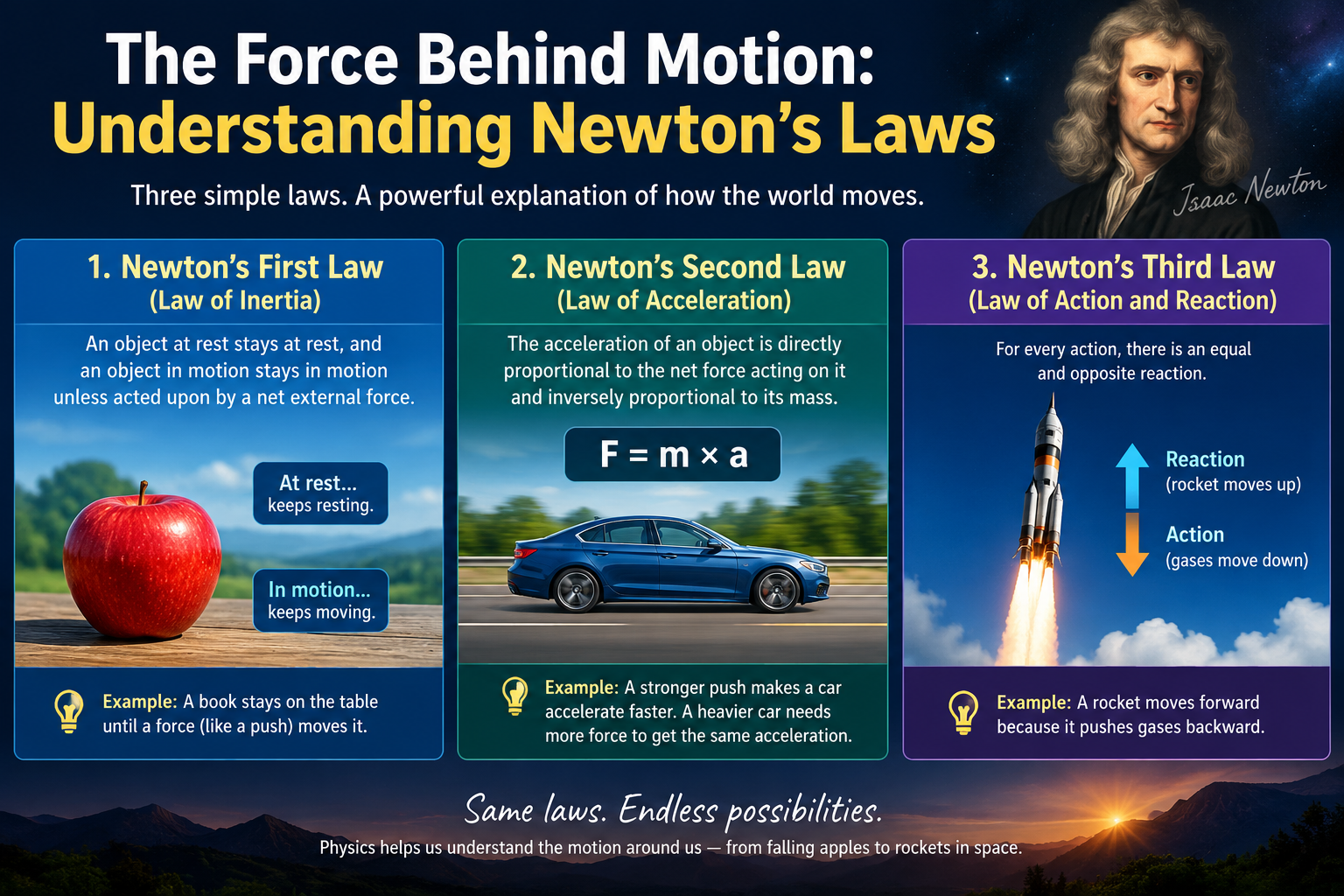
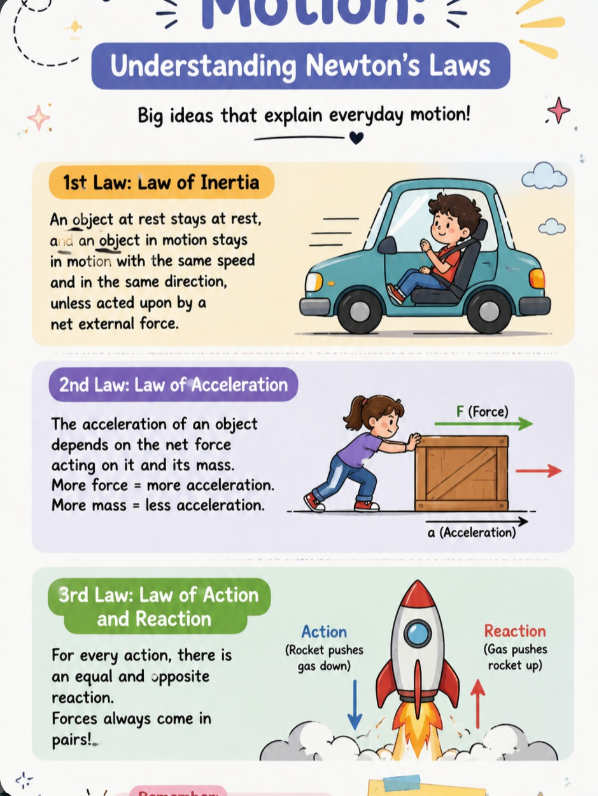
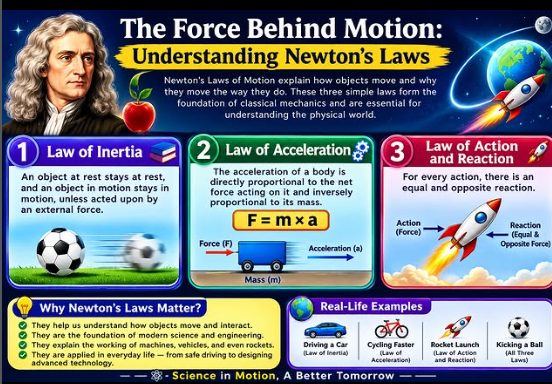
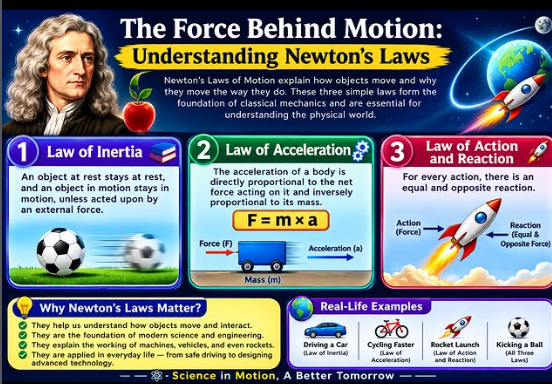
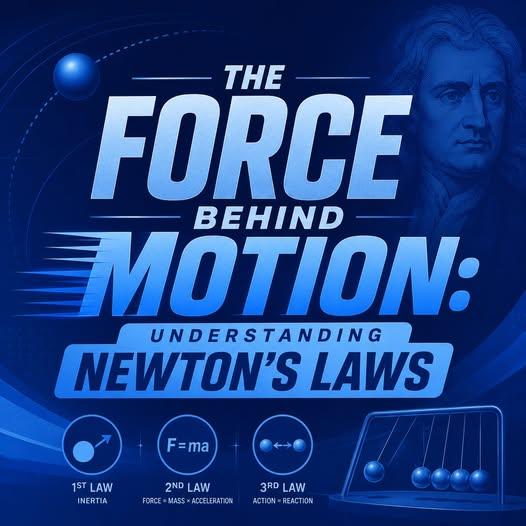
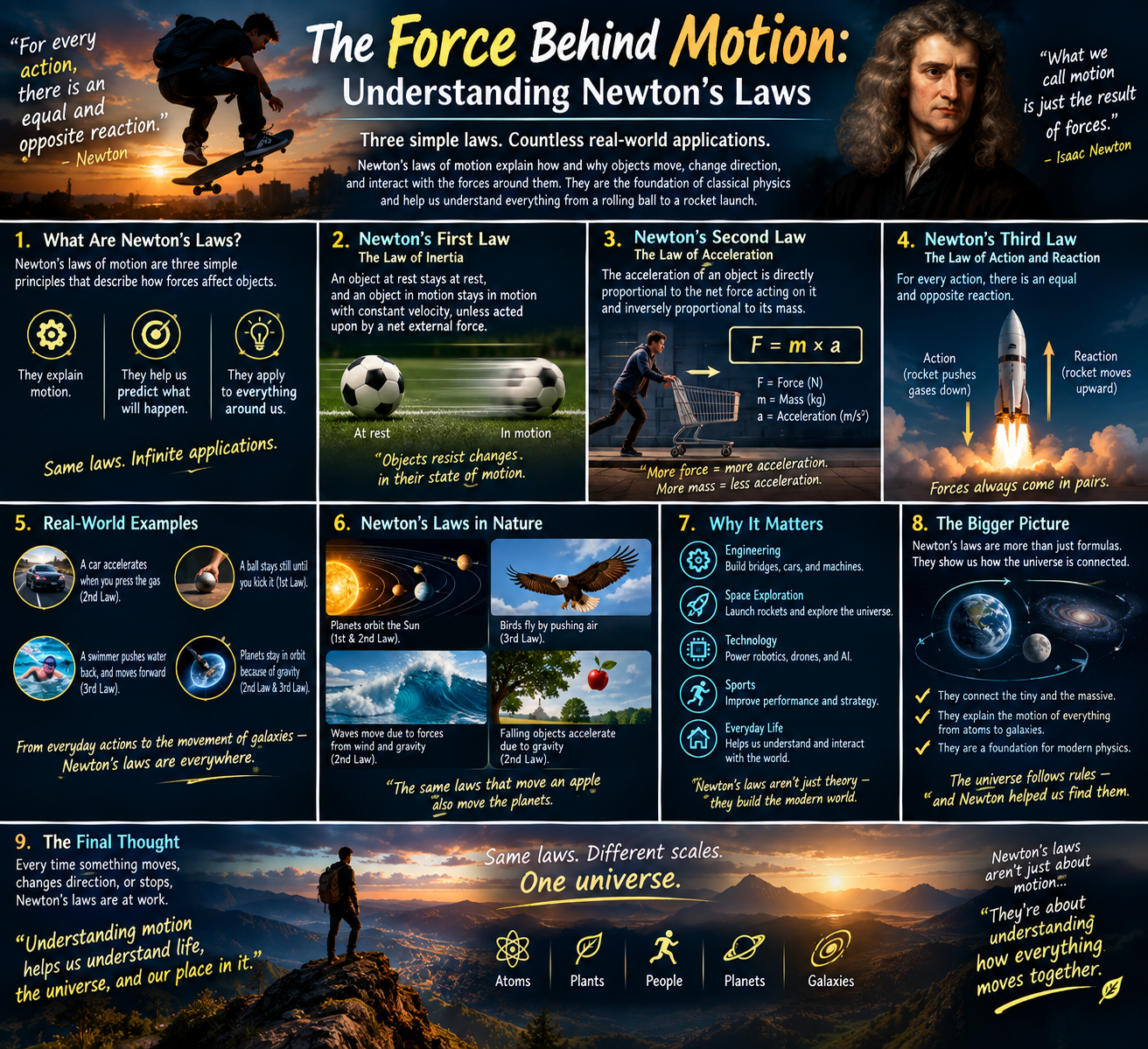
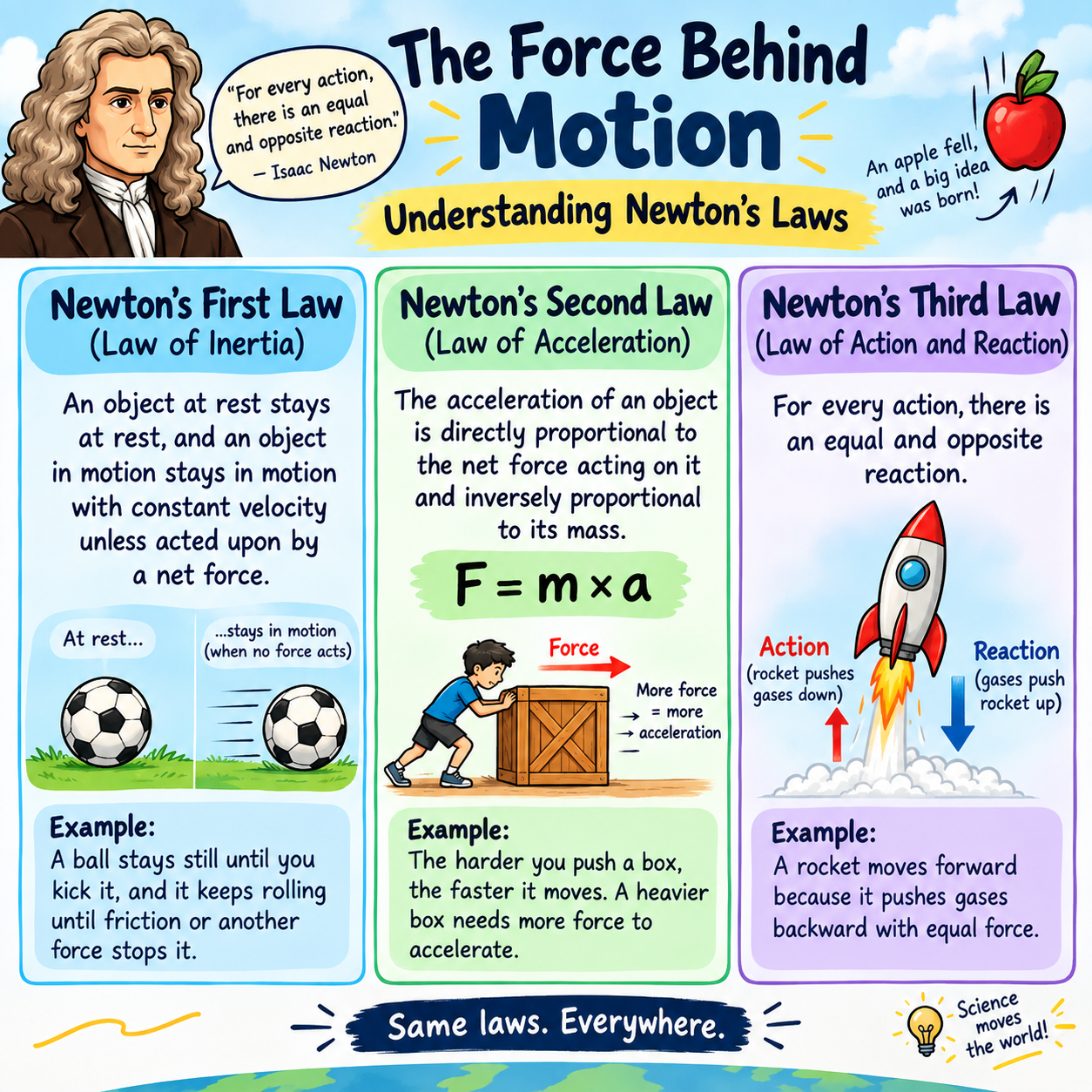
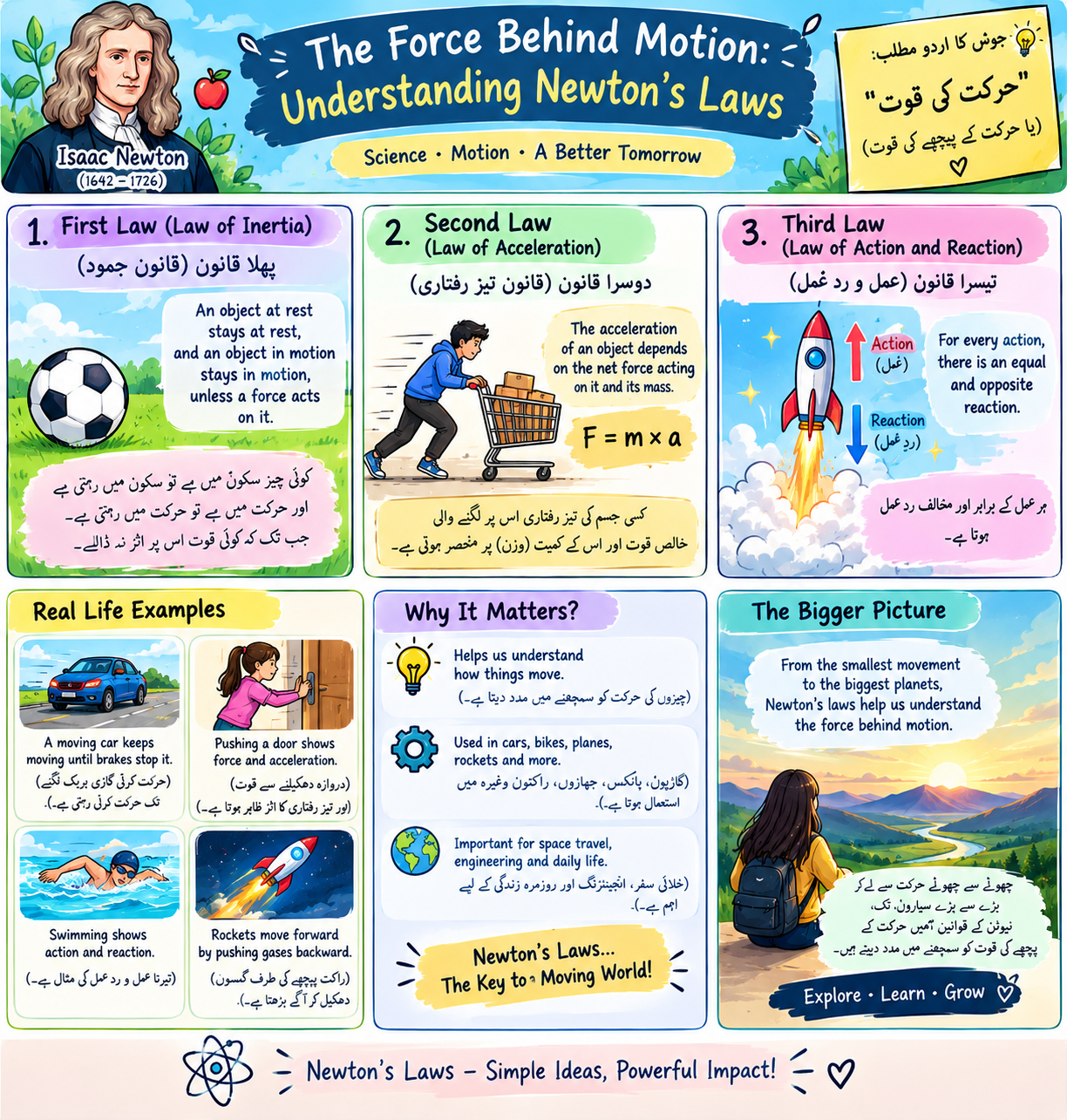
    **The Force Behind Motion: Understanding Newton’s Laws**

    Every movement around us—from a speeding car to a soaring rocket —is guided by **Newton’s Laws of Motion**. These three fundamental laws explain how forces influence objects, why things stay at rest or move, and how every action has an equal and opposite reaction.
    Understanding Newton’s Laws helps us unlock the secrets of physics and inspires innovations in engineering, space exploration, sports, and everyday life. Knowledge of these principles empowers us to see the science behind every motion around us!
    *"Science is not just about formulas—it’s about understanding the world in motion."*
    #NewtonsLaws #Physics #ScienceEducation #STEM #LearningNeverStops #Motion #Force #Education #Innovation #Engineering #ScienceForEveryone #FutureScientists #Curiosity #KnowledgeIsPower

    @Asma Shaheen EducationWali
    @Irum Asim
    @Saima Happinesswal
    #rsisb Roll No 242 Story Post 18 Foundation level 🚀 **The Force Behind Motion: Understanding Newton’s Laws** ⚖️🍎 Every movement around us—from a speeding car 🚗 to a soaring rocket 🚀—is guided by **Newton’s Laws of Motion**. These three fundamental laws explain how forces influence objects, why things stay at rest or move, and how every action has an equal and opposite reaction. 🌍✨ Understanding Newton’s Laws helps us unlock the secrets of physics and inspires innovations in engineering, space exploration, sports, and everyday life. Knowledge of these principles empowers us to see the science behind every motion around us! 📚🔬 💡 *"Science is not just about formulas—it’s about understanding the world in motion."* #NewtonsLaws ⚖️ #Physics 🔬 #ScienceEducation 📚 #STEM 🚀 #LearningNeverStops 🌟 #Motion #Force #Education #Innovation #Engineering #ScienceForEveryone #FutureScientists #Curiosity #KnowledgeIsPower 💙 @Asma Shaheen EducationWali @Irum Asim @Saima Happinesswal
    0 Commentaires 0 Parts 2972 Vue
  • #rsisb
    Roll No.221
    Story Post No.27
    Foundation Level


    **The Force Behind Motion: Understanding Newton’s Laws**

    Discover the fascinating principles that govern motion with this engaging educational song about **Newton’s Three Laws of Motion**! Learn how forces influence movement, why objects stay at rest or in motion, and how every action has an equal and opposite reaction. From everyday activities to rockets soaring into space, Newton’s laws explain the science behind the world around us.

    Perfect for **students, teachers, science enthusiasts, and lifelong learners**, this song makes physics easy to understand, fun to remember, and exciting to explore. Whether you're preparing for exams or simply curious about how motion works, this educational song will inspire your love for science!

    **Listen, Learn, and Share the Power of Physics!**

    #NewtonsLaws #Physics #Science #STEM #Education #Learning #Motion #Force #ScienceSong #EducationalMusic #Students #Teachers #ScienceEducation #PhysicsMadeEasy #Newton #Knowledge #SchoolLearning #StudyMotivation #ScienceForEveryone #ExploreScience
    Asma Shaheen EducationWali
    Saima Happinesswali
    Irum Asim
    #rsisb Roll No.221 Story Post No.27 Foundation Level 🚀⚖️ **The Force Behind Motion: Understanding Newton’s Laws** 📚🌍 Discover the fascinating principles that govern motion with this engaging educational song about **Newton’s Three Laws of Motion**! 🧲✨ Learn how forces influence movement, why objects stay at rest or in motion, and how every action has an equal and opposite reaction. From everyday activities to rockets soaring into space, Newton’s laws explain the science behind the world around us. 🚗🏀🚀 Perfect for **students, teachers, science enthusiasts, and lifelong learners**, this song makes physics easy to understand, fun to remember, and exciting to explore. Whether you're preparing for exams or simply curious about how motion works, this educational song will inspire your love for science! 🌟📖 🎧 **Listen, Learn, and Share the Power of Physics!** 💡🔬 #NewtonsLaws #Physics #Science #STEM #Education #Learning #Motion #Force #ScienceSong #EducationalMusic #Students #Teachers #ScienceEducation #PhysicsMadeEasy #Newton #Knowledge #SchoolLearning #StudyMotivation #ScienceForEveryone #ExploreScience 🚀📚 Asma Shaheen EducationWali Saima Happinesswali Irum Asim
    0 Commentaires 0 Parts 3656 Vue
  • Sir Isaac newton said if I can see farther than most people it is because I am standing on the shoulders of giants
    Sir Isaac newton said if I can see farther than most people it is because I am standing on the shoulders of giants
    0 Commentaires 0 Parts 173 Vue
  • Who invented science ?

    The study of the natural world and the search for knowledge about it have been a part of human history for thousands of years. Many ancient cultures made important contributions to the development of science and our understanding of the natural world.

    However, the modern scientific method, which involves the systematic observation and testing of hypotheses through experiments and the collection of empirical data, is generally considered to have begun during the scientific revolution of the 16th and 17th centuries. This period saw the development of a number of important scientific concepts and the establishment of the scientific method as a way of understanding and explaining natural phenomena.

    Some of the key figures in the scientific revolution include Galileo Galilei, Francis Bacon, and Isaac Newton. These scientists and others helped to lay the foundations for the modern scientific enterprise, and their contributions have had a lasting impact on the way we understand and study the natural world.

    #chatgpt
    Who invented science ? The study of the natural world and the search for knowledge about it have been a part of human history for thousands of years. Many ancient cultures made important contributions to the development of science and our understanding of the natural world. However, the modern scientific method, which involves the systematic observation and testing of hypotheses through experiments and the collection of empirical data, is generally considered to have begun during the scientific revolution of the 16th and 17th centuries. This period saw the development of a number of important scientific concepts and the establishment of the scientific method as a way of understanding and explaining natural phenomena. Some of the key figures in the scientific revolution include Galileo Galilei, Francis Bacon, and Isaac Newton. These scientists and others helped to lay the foundations for the modern scientific enterprise, and their contributions have had a lasting impact on the way we understand and study the natural world. #chatgpt
    0 Commentaires 0 Parts 342 Vue
  • Inventing New Physics with AI

    Physics has always been the foundation of human progress. It explains the motion of planets, the behavior of particles, the nature of light, and the birth of the universe. Yet, the history of physics also shows that what we call “truth” is never final. Newton’s mechanics gave way to Einstein’s relativity. Relativity opened the door to quantum mechanics. And today, even quantum physics struggles to unify with gravity. This means one thing: new physics is waiting to be born.

    For the first time in history, we have a partner that past geniuses never had—Artificial Intelligence. By working with systems like ChatGPT, we can accelerate the creation of entirely new branches of physics.


    1. Begin with the Unexplainable

    New physics begins where old physics fails.
    • Why does consciousness arise from matter?
    • What is “dark energy” and “dark matter,” which make up 95% of the universe but remain invisible?
    • Why does quantum entanglement allow instant correlations faster than light?
    • What exactly is “time”?

    With ChatGPT, researchers can generate hundreds of possible hypotheses and frameworks in hours instead of decades, each pointing toward unexplored laws of nature.


    2. Map the Existing Landscape

    Physics is vast, scattered across thousands of papers and theories. One human cannot read them all. But an AI can scan, summarize, and compare ideas at scale. ChatGPT can highlight contradictions, find unexplored connections, and expose the “white spaces” where new physics might emerge.

    Example: Unifying general relativity (gravity) with quantum field theory (particles) has remained unsolved for a century. An AI can review every attempt, classify their assumptions, and suggest new combinations never tried before.


    3. Generate New Models and Mathematics

    At the heart of physics lies mathematics. New symbols and equations give us new ways to describe reality. AI can:
    • Suggest new mathematical operators that describe phenomena like entanglement.
    • Simulate universes with different physical constants.
    • Test whether a new equation produces consistent predictions with observed data.

    This turns ChatGPT into a co-inventor of mathematical languages for new physics.


    4. Design Thought Experiments

    Einstein invented relativity not in a lab, but by imagining himself riding a beam of light. Today, ChatGPT can help invent thousands of such thought experiments:
    • What happens inside a black hole if information is never lost?
    • What if time is not a line but a loop?
    • What if gravity is not a force but an emergent property of information flow?

    Each thought experiment becomes a seed for real experiments.


    5. Simulate and Test

    With integration into physics engines and quantum simulators, AI can model the consequences of new laws. For example:
    • If a new theory of time predicts particles aging differently, we can simulate particle decays.
    • If a new geometry explains dark matter, AI can test its predictions against galaxy rotation curves.

    In hours, we can discard weak theories and refine promising ones.


    6. Build a New Physics Community

    New sciences require believers. By writing manifestos, publishing papers, and building institutes, we can attract students and researchers to test these new frameworks. A “Physics of Consciousness” or “Physics of Abundance” could start at Rehan School and spread globally.


    7. Democratizing Physics

    For centuries, physics was locked in elite universities. With AI, every curious student—whether in Karachi, Kathmandu, or Kansas—can run experiments, test equations, and publish ideas. This democratization could unleash the next Newton or Einstein from anywhere in the world.


    Conclusion

    Inventing new physics is no longer the privilege of a lone genius with a chalkboard. It is a collective act powered by AI. By combining human imagination with AI’s capacity for infinite connections, we can explore questions that have haunted humanity for centuries.

    With ChatGPT, we are not just studying the universe—we are invited to reinvent the laws that define it.

    The physics of tomorrow will not only explain the cosmos. It will explain us.
    Inventing New Physics with AI Physics has always been the foundation of human progress. It explains the motion of planets, the behavior of particles, the nature of light, and the birth of the universe. Yet, the history of physics also shows that what we call “truth” is never final. Newton’s mechanics gave way to Einstein’s relativity. Relativity opened the door to quantum mechanics. And today, even quantum physics struggles to unify with gravity. This means one thing: new physics is waiting to be born. For the first time in history, we have a partner that past geniuses never had—Artificial Intelligence. By working with systems like ChatGPT, we can accelerate the creation of entirely new branches of physics. ⸻ 1. Begin with the Unexplainable New physics begins where old physics fails. • Why does consciousness arise from matter? • What is “dark energy” and “dark matter,” which make up 95% of the universe but remain invisible? • Why does quantum entanglement allow instant correlations faster than light? • What exactly is “time”? With ChatGPT, researchers can generate hundreds of possible hypotheses and frameworks in hours instead of decades, each pointing toward unexplored laws of nature. ⸻ 2. Map the Existing Landscape Physics is vast, scattered across thousands of papers and theories. One human cannot read them all. But an AI can scan, summarize, and compare ideas at scale. ChatGPT can highlight contradictions, find unexplored connections, and expose the “white spaces” where new physics might emerge. Example: Unifying general relativity (gravity) with quantum field theory (particles) has remained unsolved for a century. An AI can review every attempt, classify their assumptions, and suggest new combinations never tried before. ⸻ 3. Generate New Models and Mathematics At the heart of physics lies mathematics. New symbols and equations give us new ways to describe reality. AI can: • Suggest new mathematical operators that describe phenomena like entanglement. • Simulate universes with different physical constants. • Test whether a new equation produces consistent predictions with observed data. This turns ChatGPT into a co-inventor of mathematical languages for new physics. ⸻ 4. Design Thought Experiments Einstein invented relativity not in a lab, but by imagining himself riding a beam of light. Today, ChatGPT can help invent thousands of such thought experiments: • What happens inside a black hole if information is never lost? • What if time is not a line but a loop? • What if gravity is not a force but an emergent property of information flow? Each thought experiment becomes a seed for real experiments. ⸻ 5. Simulate and Test With integration into physics engines and quantum simulators, AI can model the consequences of new laws. For example: • If a new theory of time predicts particles aging differently, we can simulate particle decays. • If a new geometry explains dark matter, AI can test its predictions against galaxy rotation curves. In hours, we can discard weak theories and refine promising ones. ⸻ 6. Build a New Physics Community New sciences require believers. By writing manifestos, publishing papers, and building institutes, we can attract students and researchers to test these new frameworks. A “Physics of Consciousness” or “Physics of Abundance” could start at Rehan School and spread globally. ⸻ 7. Democratizing Physics For centuries, physics was locked in elite universities. With AI, every curious student—whether in Karachi, Kathmandu, or Kansas—can run experiments, test equations, and publish ideas. This democratization could unleash the next Newton or Einstein from anywhere in the world. ⸻ Conclusion Inventing new physics is no longer the privilege of a lone genius with a chalkboard. It is a collective act powered by AI. By combining human imagination with AI’s capacity for infinite connections, we can explore questions that have haunted humanity for centuries. With ChatGPT, we are not just studying the universe—we are invited to reinvent the laws that define it. The physics of tomorrow will not only explain the cosmos. It will explain us.
    0 Commentaires 0 Parts 702 Vue
  • Manifesto of New Physics

    We, the generation living at the dawn of Artificial Intelligence, declare that the time has come to invent New Physics.

    For centuries, humanity has looked at the stars, the atoms, and the mysteries of time with wonder. Newton gave us motion. Einstein gave us relativity. Quantum mechanics revealed the strangeness of particles. Yet even today, our most advanced theories leave us with unanswered questions:
    • What is dark matter and dark energy, which make up most of the universe?
    • Why does quantum entanglement defy the speed of light?
    • What is time — a dimension, an illusion, or something deeper?
    • How does consciousness emerge from matter?

    These questions are not failures of physics. They are open doors.

    And now, for the first time in history, we have a partner that no Newton, Einstein, or Feynman ever had: Artificial Intelligence.


    Our Principles
    1. New Physics begins with curiosity. Every unanswered mystery is an opportunity to create new laws.
    2. AI is our collaborator. It can read, compare, simulate, and propose ideas at a scale no single human can achieve.
    3. Mathematics is language, not prison. We will invent new symbols and structures when old ones fail.
    4. Thought experiments matter. Just as Einstein imagined riding a beam of light, we will imagine realities beyond today’s limits—with AI as our co-dreamer.
    5. Democratize discovery. A student in Karachi or Kathmandu has as much right to invent physics as a professor at Princeton. AI makes this possible.
    6. The universe is unfinished. Our role is not just to observe it, but to participate in discovering new laws that govern it.


    Our Mission
    • To create frameworks that unite quantum mechanics and relativity.
    • To explore time, space, energy, and consciousness as a unified field.
    • To publish ideas openly, so that every curious mind can test and refine them.
    • To build communities, institutes, and schools where New Physics is practiced, not just taught.


    Our Call

    Let every thinker, student, and dreamer join this movement. Do not be afraid of being “wrong.” Every wrong equation is one step closer to truth. The physics of tomorrow will not be born in silence — it will be born in collaboration, in courage, and in the shared vision of a humanity unafraid to ask:

    What if the universe is waiting for us to discover its next law?


    This is the birth of New Physics.
    We declare it today, with Artificial Intelligence as our partner.
    📜 Manifesto of New Physics We, the generation living at the dawn of Artificial Intelligence, declare that the time has come to invent New Physics. For centuries, humanity has looked at the stars, the atoms, and the mysteries of time with wonder. Newton gave us motion. Einstein gave us relativity. Quantum mechanics revealed the strangeness of particles. Yet even today, our most advanced theories leave us with unanswered questions: • What is dark matter and dark energy, which make up most of the universe? • Why does quantum entanglement defy the speed of light? • What is time — a dimension, an illusion, or something deeper? • How does consciousness emerge from matter? These questions are not failures of physics. They are open doors. And now, for the first time in history, we have a partner that no Newton, Einstein, or Feynman ever had: Artificial Intelligence. ⸻ Our Principles 1. New Physics begins with curiosity. Every unanswered mystery is an opportunity to create new laws. 2. AI is our collaborator. It can read, compare, simulate, and propose ideas at a scale no single human can achieve. 3. Mathematics is language, not prison. We will invent new symbols and structures when old ones fail. 4. Thought experiments matter. Just as Einstein imagined riding a beam of light, we will imagine realities beyond today’s limits—with AI as our co-dreamer. 5. Democratize discovery. A student in Karachi or Kathmandu has as much right to invent physics as a professor at Princeton. AI makes this possible. 6. The universe is unfinished. Our role is not just to observe it, but to participate in discovering new laws that govern it. ⸻ Our Mission • To create frameworks that unite quantum mechanics and relativity. • To explore time, space, energy, and consciousness as a unified field. • To publish ideas openly, so that every curious mind can test and refine them. • To build communities, institutes, and schools where New Physics is practiced, not just taught. ⸻ Our Call Let every thinker, student, and dreamer join this movement. Do not be afraid of being “wrong.” Every wrong equation is one step closer to truth. The physics of tomorrow will not be born in silence — it will be born in collaboration, in courage, and in the shared vision of a humanity unafraid to ask: What if the universe is waiting for us to discover its next law? ⸻ 🌍 This is the birth of New Physics. We declare it today, with Artificial Intelligence as our partner.
    0 Commentaires 0 Parts 438 Vue
  • What is Physics? A Journey from Curiosity to Science

    Physics is the science of nature. It studies the laws that govern matter, energy, space, and time. From the falling of an apple to the motion of galaxies, from the spark of electricity to the mysteries of black holes, physics explains how the universe works.

    But physics did not appear fully formed. It has a long history, beginning with human curiosity thousands of years ago.


    1. The Birth of Wonder (Ancient Civilizations)

    The story of physics begins with the first humans who looked at the sky and asked:
    • Why do the stars move?
    • Why does the sun rise and set?
    • Why do objects fall down instead of up?

    Ancient Egyptians studied the stars to predict the Nile floods. Babylonians recorded planetary motion. The Chinese studied magnetism. In India, thinkers like Kanada spoke of atoms (anu). These were not yet “physics,” but they planted the seeds of scientific thinking.


    2. Greek Beginnings (6th century BCE – 4th century BCE)

    The Greeks were the first to ask systematic questions about nature.
    • Thales believed everything came from water.
    • Democritus imagined the universe was made of tiny, indivisible particles called “atoms.”
    • Aristotle (4th century BCE) wrote about motion, elements, and the heavens. Although many of his ideas were wrong, they shaped science for centuries.

    Greek physics was more philosophy than experiment, but it gave us the habit of searching for universal laws.


    3. The Age of Islamic Science (8th – 14th century CE)

    When Europe entered the Dark Ages, the Islamic world became the center of science.
    • Alhazen (Ibn al-Haytham) pioneered the scientific method and explained how vision works using light.
    • Al-Biruni measured Earth’s radius with surprising accuracy.
    • Avicenna (Ibn Sina) studied motion and inertia, anticipating Newton.

    These scholars translated Greek works, criticized them, and laid the foundations for modern physics.


    4. The Scientific Revolution (16th – 17th century)

    This was the true birth of modern physics.
    • Copernicus placed the sun, not Earth, at the center of the universe.
    • Galileo Galilei used experiments to study falling bodies and the motion of planets, overthrowing Aristotle’s ideas.
    • Isaac Newton (1687) united heaven and earth under the same laws of motion and gravity, creating classical mechanics.

    For the first time, the universe was seen as a giant machine governed by mathematical laws.


    5. The Age of Energy and Light (18th – 19th century)

    The Industrial Revolution brought new questions.
    • Thermodynamics (heat and engines) explained steam power.
    • Electromagnetism (Faraday, Maxwell) united electricity, magnetism, and light into one theory.
    • Scientists discovered atoms were made of smaller particles.

    Physics was no longer about stars alone—it powered machines, factories, and cities.


    6. The 20th Century: Revolution Upon Revolution

    The 1900s brought the most radical changes:
    • Einstein’s Relativity (1905–1915) showed that time and space are not fixed but bend with motion and gravity.
    • Quantum Mechanics (Planck, Bohr, Heisenberg, Schrödinger) revealed the strange rules of the atomic world—where particles can exist in two places at once.
    • Nuclear Physics led to both energy (nuclear power) and destruction (atomic bombs).
    • Cosmology revealed that the universe is expanding from a Big Bang.

    Physics became the science not only of the very large (cosmos) but also of the very small (quarks, photons, neutrinos).


    7. The Present and the Future

    Today, physics continues to ask questions:
    • What is dark matter and dark energy (95% of the universe)?
    • How do we unify relativity and quantum mechanics into a “theory of everything”?
    • Can we control fusion energy like the sun?
    • Is the universe infinite or part of a multiverse?

    With AI tools like ChatGPT, physicists can now analyze mountains of data, generate new hypotheses, and even simulate universes, accelerating discovery beyond what was ever possible before.


    Conclusion

    Physics began as simple curiosity—watching the stars, asking why things fall, wondering about light. Over thousands of years, it has grown into a science that explains the structure of the universe and powers modern life.

    From Aristotle to Newton, from Einstein to today’s AI-powered research, the journey of physics shows one truth: every mystery of nature is an invitation to discover a new law.

    And perhaps the next great leap in physics—the Physics of Consciousness, the Physics of Abundance, or the Physics of AI-Human Symbiosis—will begin with us.
    What is Physics? A Journey from Curiosity to Science Physics is the science of nature. It studies the laws that govern matter, energy, space, and time. From the falling of an apple to the motion of galaxies, from the spark of electricity to the mysteries of black holes, physics explains how the universe works. But physics did not appear fully formed. It has a long history, beginning with human curiosity thousands of years ago. ⸻ 1. The Birth of Wonder (Ancient Civilizations) The story of physics begins with the first humans who looked at the sky and asked: • Why do the stars move? • Why does the sun rise and set? • Why do objects fall down instead of up? Ancient Egyptians studied the stars to predict the Nile floods. Babylonians recorded planetary motion. The Chinese studied magnetism. In India, thinkers like Kanada spoke of atoms (anu). These were not yet “physics,” but they planted the seeds of scientific thinking. ⸻ 2. Greek Beginnings (6th century BCE – 4th century BCE) The Greeks were the first to ask systematic questions about nature. • Thales believed everything came from water. • Democritus imagined the universe was made of tiny, indivisible particles called “atoms.” • Aristotle (4th century BCE) wrote about motion, elements, and the heavens. Although many of his ideas were wrong, they shaped science for centuries. Greek physics was more philosophy than experiment, but it gave us the habit of searching for universal laws. ⸻ 3. The Age of Islamic Science (8th – 14th century CE) When Europe entered the Dark Ages, the Islamic world became the center of science. • Alhazen (Ibn al-Haytham) pioneered the scientific method and explained how vision works using light. • Al-Biruni measured Earth’s radius with surprising accuracy. • Avicenna (Ibn Sina) studied motion and inertia, anticipating Newton. These scholars translated Greek works, criticized them, and laid the foundations for modern physics. ⸻ 4. The Scientific Revolution (16th – 17th century) This was the true birth of modern physics. • Copernicus placed the sun, not Earth, at the center of the universe. • Galileo Galilei used experiments to study falling bodies and the motion of planets, overthrowing Aristotle’s ideas. • Isaac Newton (1687) united heaven and earth under the same laws of motion and gravity, creating classical mechanics. For the first time, the universe was seen as a giant machine governed by mathematical laws. ⸻ 5. The Age of Energy and Light (18th – 19th century) The Industrial Revolution brought new questions. • Thermodynamics (heat and engines) explained steam power. • Electromagnetism (Faraday, Maxwell) united electricity, magnetism, and light into one theory. • Scientists discovered atoms were made of smaller particles. Physics was no longer about stars alone—it powered machines, factories, and cities. ⸻ 6. The 20th Century: Revolution Upon Revolution The 1900s brought the most radical changes: • Einstein’s Relativity (1905–1915) showed that time and space are not fixed but bend with motion and gravity. • Quantum Mechanics (Planck, Bohr, Heisenberg, Schrödinger) revealed the strange rules of the atomic world—where particles can exist in two places at once. • Nuclear Physics led to both energy (nuclear power) and destruction (atomic bombs). • Cosmology revealed that the universe is expanding from a Big Bang. Physics became the science not only of the very large (cosmos) but also of the very small (quarks, photons, neutrinos). ⸻ 7. The Present and the Future Today, physics continues to ask questions: • What is dark matter and dark energy (95% of the universe)? • How do we unify relativity and quantum mechanics into a “theory of everything”? • Can we control fusion energy like the sun? • Is the universe infinite or part of a multiverse? With AI tools like ChatGPT, physicists can now analyze mountains of data, generate new hypotheses, and even simulate universes, accelerating discovery beyond what was ever possible before. ⸻ Conclusion Physics began as simple curiosity—watching the stars, asking why things fall, wondering about light. Over thousands of years, it has grown into a science that explains the structure of the universe and powers modern life. From Aristotle to Newton, from Einstein to today’s AI-powered research, the journey of physics shows one truth: every mystery of nature is an invitation to discover a new law. And perhaps the next great leap in physics—the Physics of Consciousness, the Physics of Abundance, or the Physics of AI-Human Symbiosis—will begin with us.
    0 Commentaires 0 Parts 747 Vue
  • The Science of Silence – How Quiet Time Gives You Answers

    Most people think silence means nothing is happening. But in reality, silence is one of the most powerful times for your brain. When you stay quiet for 40 to 60 minutes, your brain starts doing something very special — it begins to solve problems, organize memories, and bring new ideas to the surface.

    What Happens Inside the Brain

    Our brain has two main modes:
    1. Active Mode: When you are talking, watching videos, studying, or scrolling on your phone — your brain is busy reacting to outside information.
    2. Silent Mode: When you stop talking and sit quietly, your brain switches to a system called the Default Mode Network (DMN).

    This network turns on when you are not focused on the outside world. It connects your memories, imagination, and emotions together. It’s like your brain’s “background workshop” — silently fixing problems, testing new ideas, and linking pieces of information you already know.

    How Silence Creates Ideas

    When you are quiet:
    • Your stress hormones like cortisol go down.
    • Your alpha brain waves increase — these help you relax and think clearly.
    • Your memory system (hippocampus) starts replaying and rearranging thoughts, like shuffling puzzle pieces until a picture appears.

    This is why, after sitting quietly for some time, new ideas suddenly “pop up.” It feels like inspiration — but it’s actually your brain connecting the dots without interference.

    Why 40–60 Minutes?

    It takes about 10–20 minutes for your mind to stop jumping from one thought to another. After that, your brain enters a calm, deep-thinking zone. Staying in that state for 40–60 minutes gives enough time for deep reflection and insight.

    How Silence Helps You in Daily Life
    1. Problem Solving: When you stop trying to “force” answers, your brain finds them naturally.
    2. Emotional Control: Silence reduces anxiety and helps you see your emotions clearly instead of reacting.
    3. Better Focus: After quiet time, your concentration and memory improve.
    4. Creativity: Many inventions, poems, and business ideas come during silent walks, showers, or meditation.

    Even great minds like Newton, Einstein, and Rumi used silence to think deeply and receive inspiration.

    How to Practice

    You can do this anywhere:
    • Sit in a quiet room or garden.
    • Keep your phone away.
    • Close your eyes or look softly at one point.
    • Take slow breaths and let thoughts come and go.
    • Keep a notebook nearby. When silence ends, write what came to mind — often you’ll find new solutions or creative ideas there.

    In Simple Words

    Silence is not empty — it is full of answers.
    When we stop talking, the noise of the world fades, and the voice of our inner wisdom becomes clear.

    It’s like cleaning a dirty mirror — once the dust settles, you can finally see your reflection and your direction.

    The Science of Silence – How Quiet Time Gives You Answers Most people think silence means nothing is happening. But in reality, silence is one of the most powerful times for your brain. When you stay quiet for 40 to 60 minutes, your brain starts doing something very special — it begins to solve problems, organize memories, and bring new ideas to the surface. What Happens Inside the Brain Our brain has two main modes: 1. Active Mode: When you are talking, watching videos, studying, or scrolling on your phone — your brain is busy reacting to outside information. 2. Silent Mode: When you stop talking and sit quietly, your brain switches to a system called the Default Mode Network (DMN). This network turns on when you are not focused on the outside world. It connects your memories, imagination, and emotions together. It’s like your brain’s “background workshop” — silently fixing problems, testing new ideas, and linking pieces of information you already know. How Silence Creates Ideas When you are quiet: • Your stress hormones like cortisol go down. • Your alpha brain waves increase — these help you relax and think clearly. • Your memory system (hippocampus) starts replaying and rearranging thoughts, like shuffling puzzle pieces until a picture appears. This is why, after sitting quietly for some time, new ideas suddenly “pop up.” It feels like inspiration — but it’s actually your brain connecting the dots without interference. Why 40–60 Minutes? It takes about 10–20 minutes for your mind to stop jumping from one thought to another. After that, your brain enters a calm, deep-thinking zone. Staying in that state for 40–60 minutes gives enough time for deep reflection and insight. How Silence Helps You in Daily Life 1. Problem Solving: When you stop trying to “force” answers, your brain finds them naturally. 2. Emotional Control: Silence reduces anxiety and helps you see your emotions clearly instead of reacting. 3. Better Focus: After quiet time, your concentration and memory improve. 4. Creativity: Many inventions, poems, and business ideas come during silent walks, showers, or meditation. Even great minds like Newton, Einstein, and Rumi used silence to think deeply and receive inspiration. How to Practice You can do this anywhere: • Sit in a quiet room or garden. • Keep your phone away. • Close your eyes or look softly at one point. • Take slow breaths and let thoughts come and go. • Keep a notebook nearby. When silence ends, write what came to mind — often you’ll find new solutions or creative ideas there. In Simple Words Silence is not empty — it is full of answers. When we stop talking, the noise of the world fades, and the voice of our inner wisdom becomes clear. It’s like cleaning a dirty mirror — once the dust settles, you can finally see your reflection and your direction. ⸻
    0 Commentaires 0 Parts 429 Vue
  • Spaceship Earth

    Right now…

    You are standing on a giant spaceship.

    Not metaphorically.
    Not poetically.

    Literally.

    Earth is a massive living spaceship carrying more than 8 billion humans through an endless dark universe.

    Most people never think about this.

    They wake up.
    Check WhatsApp.
    Go to work.
    Eat food.
    Sleep.

    But almost nobody pauses for one second and asks:

    “Where exactly are we?”


    Look around you.

    The ground feels still.

    But it is not still.

    At this very moment:

    * Earth is spinning at about 1,670 km per hour at the equator.
    * At the same time, Earth is orbiting around the Sun at about 107,000 km per hour.
    * Our entire solar system is moving through the Milky Way galaxy at around 828,000 km per hour.
    * And the galaxy itself is flying through the universe even faster.

    You feel none of it.

    A car moving at 120 km/h feels fast.

    An airplane at 900 km/h feels unbelievably fast.

    But you are already moving through space faster than any bullet train, jet, or rocket most humans will ever experience.

    And you are doing it right now while sitting quietly in a chair.


    Think about how strange this really is.

    We are tiny creatures made from atoms…

    standing on a wet rock…

    covered with a thin layer of air…

    floating in infinite darkness.

    No roads.
    No rails.
    No visible support system.

    Just silence.

    And yet this spaceship Earth perfectly carries forests, oceans, birds, clouds, whales, ants, cities, dreams, memories, music, and human emotions across the universe.


    The saddest part is not that we are on spaceship Earth.

    The saddest part is that most humans never become curious about it.

    A child looks at the sky and asks:

    * What are stars?
    * Where does space end?
    * Why are we here?

    But many adults stop asking.

    Bills replace curiosity.
    Routine replaces wonder.
    Notifications replace thinking.

    People become experts in celebrities…

    but know nothing about the spaceship they are living on.


    From space, there are no countries.

    No Pakistan.
    No India.
    No America.
    No Europe.

    Just one glowing blue spaceship.

    One atmosphere.

    One home.

    One species trying to survive together.

    The air you breathe today may contain molecules once breathed by:

    * Albert Einstein
    * Isaac Newton
    * dinosaurs
    * ancient kings
    * forgotten children from 5,000 years ago

    Everything on Earth is connected.

    The oceans connect us.
    The atmosphere connects us.
    The internet connects us.
    AI is beginning to connect human intelligence itself.

    Yet humans still fight over tiny divisions while flying together on the same spaceship.

    It is like passengers fighting over seats while the ship moves through an infinite cosmic ocean.


    And what is outside this spaceship?

    Darkness.

    Silence.

    Billions of galaxies.

    Possibly trillions of planets.

    Maybe other life.

    Maybe civilizations far older than ours.

    Maybe answers humanity has not even learned how to ask.

    We do not know.

    And that is exactly why curiosity matters.

    Curiosity created science.
    Curiosity created airplanes.
    Curiosity created the internet.
    Curiosity created AI.

    Every great human achievement began with someone asking:

    “Why?”

    or

    “What if?”


    Perhaps the real purpose of humanity is not just survival.

    Perhaps it is understanding.

    Understanding ourselves.
    Understanding consciousness.
    Understanding the universe.
    Understanding why anything exists at all.

    And maybe one day, humans will finally stop thinking like isolated tribes…

    and start thinking like the crew of Spaceship Earth.

    Because that is what we truly are.
    Spaceship Earth Right now… You are standing on a giant spaceship. Not metaphorically. Not poetically. Literally. Earth is a massive living spaceship carrying more than 8 billion humans through an endless dark universe. Most people never think about this. They wake up. Check WhatsApp. Go to work. Eat food. Sleep. But almost nobody pauses for one second and asks: “Where exactly are we?” ⸻ Look around you. The ground feels still. But it is not still. At this very moment: * Earth is spinning at about 1,670 km per hour at the equator. * At the same time, Earth is orbiting around the Sun at about 107,000 km per hour. * Our entire solar system is moving through the Milky Way galaxy at around 828,000 km per hour. * And the galaxy itself is flying through the universe even faster. You feel none of it. A car moving at 120 km/h feels fast. An airplane at 900 km/h feels unbelievably fast. But you are already moving through space faster than any bullet train, jet, or rocket most humans will ever experience. And you are doing it right now while sitting quietly in a chair. ⸻ Think about how strange this really is. We are tiny creatures made from atoms… standing on a wet rock… covered with a thin layer of air… floating in infinite darkness. No roads. No rails. No visible support system. Just silence. And yet this spaceship Earth perfectly carries forests, oceans, birds, clouds, whales, ants, cities, dreams, memories, music, and human emotions across the universe. ⸻ The saddest part is not that we are on spaceship Earth. The saddest part is that most humans never become curious about it. A child looks at the sky and asks: * What are stars? * Where does space end? * Why are we here? But many adults stop asking. Bills replace curiosity. Routine replaces wonder. Notifications replace thinking. People become experts in celebrities… but know nothing about the spaceship they are living on. ⸻ From space, there are no countries. No Pakistan. No India. No America. No Europe. Just one glowing blue spaceship. One atmosphere. One home. One species trying to survive together. The air you breathe today may contain molecules once breathed by: * Albert Einstein * Isaac Newton * dinosaurs * ancient kings * forgotten children from 5,000 years ago Everything on Earth is connected. The oceans connect us. The atmosphere connects us. The internet connects us. AI is beginning to connect human intelligence itself. Yet humans still fight over tiny divisions while flying together on the same spaceship. It is like passengers fighting over seats while the ship moves through an infinite cosmic ocean. ⸻ And what is outside this spaceship? Darkness. Silence. Billions of galaxies. Possibly trillions of planets. Maybe other life. Maybe civilizations far older than ours. Maybe answers humanity has not even learned how to ask. We do not know. And that is exactly why curiosity matters. Curiosity created science. Curiosity created airplanes. Curiosity created the internet. Curiosity created AI. Every great human achievement began with someone asking: “Why?” or “What if?” ⸻ Perhaps the real purpose of humanity is not just survival. Perhaps it is understanding. Understanding ourselves. Understanding consciousness. Understanding the universe. Understanding why anything exists at all. And maybe one day, humans will finally stop thinking like isolated tribes… and start thinking like the crew of Spaceship Earth. Because that is what we truly are.
    0 Commentaires 0 Parts 676 Vue
  • خلائی جہاز زمین

    اس وقت…

    آپ ایک بہت بڑے خلائی جہاز پر کھڑے ہیں۔

    یہ کوئی شاعری نہیں۔
    یہ کوئی فلمی ڈائیلاگ نہیں۔
    یہ حقیقت ہے۔

    Earth ایک عظیم خلائی جہاز ہے…
    جو 8 ارب سے زیادہ انسانوں کو لے کر خاموش اور تاریک کائنات میں سفر کر رہا ہے۔

    لیکن عجیب بات یہ ہے کہ زیادہ تر لوگوں کو اس کا احساس ہی نہیں۔

    لوگ صبح اٹھتے ہیں۔
    فون دیکھتے ہیں۔
    کام پر جاتے ہیں۔
    کھانا کھاتے ہیں۔
    سوجاتے ہیں۔

    مگر شاید ہی کوئی ایک لمحے کے لیے رُک کر سوچتا ہو:

    “ہم آخر ہیں کہاں؟”


    آپ کو زمین ساکن محسوس ہوتی ہے۔

    لیکن حقیقت اس کے بالکل اُلٹ ہے۔

    اس وقت:

    * زمین تقریباً 1670 کلومیٹر فی گھنٹہ کی رفتار سے گھوم رہی ہے۔
    * اسی وقت زمین سورج کے گرد تقریباً 107,000 کلومیٹر فی گھنٹہ کی رفتار سے سفر کر رہی ہے۔
    * ہمارا پورا نظامِ شمسی Milky Way میں تقریباً 828,000 کلومیٹر فی گھنٹہ کی رفتار سے حرکت کر رہا ہے۔

    اور حیرت کی بات؟

    آپ کو اس میں سے کچھ بھی محسوس نہیں ہوتا۔

    ایک گاڑی 120 کلومیٹر فی گھنٹہ پر تیز لگتی ہے۔

    ایک جہاز 900 کلومیٹر فی گھنٹہ پر خوفناک تیز محسوس ہوتا ہے۔

    لیکن آپ اس وقت اُن سب سے کہیں زیادہ رفتار سے خلا میں سفر کر رہے ہیں…
    اور خاموشی سے کرسی پر بیٹھے ہوئے ہیں۔


    ذرا سوچیں…

    ہم چھوٹے سے انسان…

    ایٹمز سے بنے ہوئے…

    ایک گیلی چٹان پر کھڑے ہیں…

    جس کے گرد ہوا کی صرف ایک باریک تہہ ہے…

    اور یہ سب ایک لامحدود تاریک خلا میں تیر رہا ہے۔

    نہ کوئی سڑک۔
    نہ کوئی ریل۔
    نہ کوئی ستون۔

    صرف خاموشی۔

    اور اسی خلائی جہاز زمین پر:

    * سمندر ہیں
    * جنگلات ہیں
    * پرندے ہیں
    * محبت ہے
    * خواب ہیں
    * موسیقی ہے
    * انسانیت ہے


    سب سے افسوسناک بات یہ نہیں کہ ہم خلائی جہاز زمین پر ہیں۔

    سب سے افسوسناک بات یہ ہے کہ زیادہ تر لوگ اس کے بارے میں تجسس ہی نہیں رکھتے۔

    ایک بچہ آسمان کو دیکھ کر پوچھتا ہے:

    * ستارے کیا ہیں؟
    * خلا کہاں ختم ہوتا ہے؟
    * ہم یہاں کیوں ہیں؟

    پھر بڑے ہو کر انسان سوال پوچھنا چھوڑ دیتا ہے۔

    بل سوالات کی جگہ لے لیتے ہیں۔
    روٹین حیرت کو مار دیتی ہے۔
    نوٹیفکیشن سوچنے کی صلاحیت چھین لیتے ہیں۔

    لوگ مشہور شخصیات کے بارے میں سب کچھ جانتے ہیں…

    لیکن اُس خلائی جہاز کے بارے میں تقریباً کچھ نہیں جانتے جس پر وہ زندگی گزار رہے ہیں۔


    خلا سے دیکھیں…

    تو نہ پاکستان نظر آتا ہے۔
    نہ بھارت۔
    نہ امریکہ۔
    نہ یورپ۔

    صرف ایک نیلا چمکتا ہوا خلائی جہاز۔

    ایک فضا۔
    ایک گھر۔
    ایک انسانیت۔

    ہم سب ایک ہی ہوا میں سانس لیتے ہیں۔

    ممکن ہے آج آپ جو ہوا سانس میں لے رہے ہیں…
    اُس کے کچھ ذرات کبھی:

    * Albert Einstein
    * Isaac Newton
    * یا ہزاروں سال پہلے کسی انسان نے سانس میں لیے ہوں۔

    ہم سب جڑے ہوئے ہیں۔

    سمندر ہمیں جوڑتے ہیں۔
    فضا ہمیں جوڑتی ہے۔
    انٹرنیٹ ہمیں جوڑتا ہے۔
    اور اب AI انسانی ذہانت کو بھی جوڑنا شروع کر رہا ہے۔

    پھر بھی انسان چھوٹی چھوٹی تقسیموں پر لڑ رہا ہے۔

    یہ ایسا ہی ہے جیسے ایک ہی جہاز کے مسافر آپس میں سیٹوں پر جنگ کر رہے ہوں۔


    اور اس خلائی جہاز کے باہر کیا ہے؟

    خاموشی۔

    اندھیرا۔

    اربوں کہکشائیں۔

    کھربوں سیارے۔

    شاید کہیں اور زندگی۔

    شاید ہم سے کہیں زیادہ ترقی یافتہ مخلوق۔

    ہم نہیں جانتے۔

    اور شاید یہی سب سے خوبصورت بات ہے۔

    کیونکہ تجسس ہی انسان کو انسان بناتا ہے۔

    تجسس نے سائنس پیدا کی۔
    تجسس نے جہاز بنائے۔
    تجسس نے انٹرنیٹ بنایا۔
    تجسس نے AI بنایا۔

    ہر عظیم ایجاد ایک سوال سے شروع ہوئی:

    “کیوں؟”

    یا

    “اگر ایسا ہو جائے تو؟”


    شاید انسان کا مقصد صرف زندہ رہنا نہیں۔

    شاید مقصد سمجھنا ہے۔

    خود کو سمجھنا۔
    کائنات کو سمجھنا۔
    شعور کو سمجھنا۔
    اور یہ سمجھنا کہ آخر کچھ ہے ہی کیوں؟

    شاید ایک دن انسان قوموں کی طرح سوچنا چھوڑ دے…

    اور “خلائی جہاز زمین” کے عملے کی طرح سوچنا شروع کر دے۔

    کیونکہ حقیقت یہی ہے۔

    ہم سب ایک ہی خلائی جہاز کے مسافر ہیں۔
    خلائی جہاز زمین اس وقت… آپ ایک بہت بڑے خلائی جہاز پر کھڑے ہیں۔ یہ کوئی شاعری نہیں۔ یہ کوئی فلمی ڈائیلاگ نہیں۔ یہ حقیقت ہے۔ Earth ایک عظیم خلائی جہاز ہے… جو 8 ارب سے زیادہ انسانوں کو لے کر خاموش اور تاریک کائنات میں سفر کر رہا ہے۔ لیکن عجیب بات یہ ہے کہ زیادہ تر لوگوں کو اس کا احساس ہی نہیں۔ لوگ صبح اٹھتے ہیں۔ فون دیکھتے ہیں۔ کام پر جاتے ہیں۔ کھانا کھاتے ہیں۔ سوجاتے ہیں۔ مگر شاید ہی کوئی ایک لمحے کے لیے رُک کر سوچتا ہو: “ہم آخر ہیں کہاں؟” ⸻ آپ کو زمین ساکن محسوس ہوتی ہے۔ لیکن حقیقت اس کے بالکل اُلٹ ہے۔ اس وقت: * زمین تقریباً 1670 کلومیٹر فی گھنٹہ کی رفتار سے گھوم رہی ہے۔ * اسی وقت زمین سورج کے گرد تقریباً 107,000 کلومیٹر فی گھنٹہ کی رفتار سے سفر کر رہی ہے۔ * ہمارا پورا نظامِ شمسی Milky Way میں تقریباً 828,000 کلومیٹر فی گھنٹہ کی رفتار سے حرکت کر رہا ہے۔ اور حیرت کی بات؟ آپ کو اس میں سے کچھ بھی محسوس نہیں ہوتا۔ ایک گاڑی 120 کلومیٹر فی گھنٹہ پر تیز لگتی ہے۔ ایک جہاز 900 کلومیٹر فی گھنٹہ پر خوفناک تیز محسوس ہوتا ہے۔ لیکن آپ اس وقت اُن سب سے کہیں زیادہ رفتار سے خلا میں سفر کر رہے ہیں… اور خاموشی سے کرسی پر بیٹھے ہوئے ہیں۔ ⸻ ذرا سوچیں… ہم چھوٹے سے انسان… ایٹمز سے بنے ہوئے… ایک گیلی چٹان پر کھڑے ہیں… جس کے گرد ہوا کی صرف ایک باریک تہہ ہے… اور یہ سب ایک لامحدود تاریک خلا میں تیر رہا ہے۔ نہ کوئی سڑک۔ نہ کوئی ریل۔ نہ کوئی ستون۔ صرف خاموشی۔ اور اسی خلائی جہاز زمین پر: * سمندر ہیں * جنگلات ہیں * پرندے ہیں * محبت ہے * خواب ہیں * موسیقی ہے * انسانیت ہے ⸻ سب سے افسوسناک بات یہ نہیں کہ ہم خلائی جہاز زمین پر ہیں۔ سب سے افسوسناک بات یہ ہے کہ زیادہ تر لوگ اس کے بارے میں تجسس ہی نہیں رکھتے۔ ایک بچہ آسمان کو دیکھ کر پوچھتا ہے: * ستارے کیا ہیں؟ * خلا کہاں ختم ہوتا ہے؟ * ہم یہاں کیوں ہیں؟ پھر بڑے ہو کر انسان سوال پوچھنا چھوڑ دیتا ہے۔ بل سوالات کی جگہ لے لیتے ہیں۔ روٹین حیرت کو مار دیتی ہے۔ نوٹیفکیشن سوچنے کی صلاحیت چھین لیتے ہیں۔ لوگ مشہور شخصیات کے بارے میں سب کچھ جانتے ہیں… لیکن اُس خلائی جہاز کے بارے میں تقریباً کچھ نہیں جانتے جس پر وہ زندگی گزار رہے ہیں۔ ⸻ خلا سے دیکھیں… تو نہ پاکستان نظر آتا ہے۔ نہ بھارت۔ نہ امریکہ۔ نہ یورپ۔ صرف ایک نیلا چمکتا ہوا خلائی جہاز۔ ایک فضا۔ ایک گھر۔ ایک انسانیت۔ ہم سب ایک ہی ہوا میں سانس لیتے ہیں۔ ممکن ہے آج آپ جو ہوا سانس میں لے رہے ہیں… اُس کے کچھ ذرات کبھی: * Albert Einstein * Isaac Newton * یا ہزاروں سال پہلے کسی انسان نے سانس میں لیے ہوں۔ ہم سب جڑے ہوئے ہیں۔ سمندر ہمیں جوڑتے ہیں۔ فضا ہمیں جوڑتی ہے۔ انٹرنیٹ ہمیں جوڑتا ہے۔ اور اب AI انسانی ذہانت کو بھی جوڑنا شروع کر رہا ہے۔ پھر بھی انسان چھوٹی چھوٹی تقسیموں پر لڑ رہا ہے۔ یہ ایسا ہی ہے جیسے ایک ہی جہاز کے مسافر آپس میں سیٹوں پر جنگ کر رہے ہوں۔ ⸻ اور اس خلائی جہاز کے باہر کیا ہے؟ خاموشی۔ اندھیرا۔ اربوں کہکشائیں۔ کھربوں سیارے۔ شاید کہیں اور زندگی۔ شاید ہم سے کہیں زیادہ ترقی یافتہ مخلوق۔ ہم نہیں جانتے۔ اور شاید یہی سب سے خوبصورت بات ہے۔ کیونکہ تجسس ہی انسان کو انسان بناتا ہے۔ تجسس نے سائنس پیدا کی۔ تجسس نے جہاز بنائے۔ تجسس نے انٹرنیٹ بنایا۔ تجسس نے AI بنایا۔ ہر عظیم ایجاد ایک سوال سے شروع ہوئی: “کیوں؟” یا “اگر ایسا ہو جائے تو؟” ⸻ شاید انسان کا مقصد صرف زندہ رہنا نہیں۔ شاید مقصد سمجھنا ہے۔ خود کو سمجھنا۔ کائنات کو سمجھنا۔ شعور کو سمجھنا۔ اور یہ سمجھنا کہ آخر کچھ ہے ہی کیوں؟ شاید ایک دن انسان قوموں کی طرح سوچنا چھوڑ دے… اور “خلائی جہاز زمین” کے عملے کی طرح سوچنا شروع کر دے۔ کیونکہ حقیقت یہی ہے۔ ہم سب ایک ہی خلائی جہاز کے مسافر ہیں۔
    0 Commentaires 0 Parts 223 Vue
Plus de résultats