• RSIF8
    Roll no: 99
    Story post no: 23
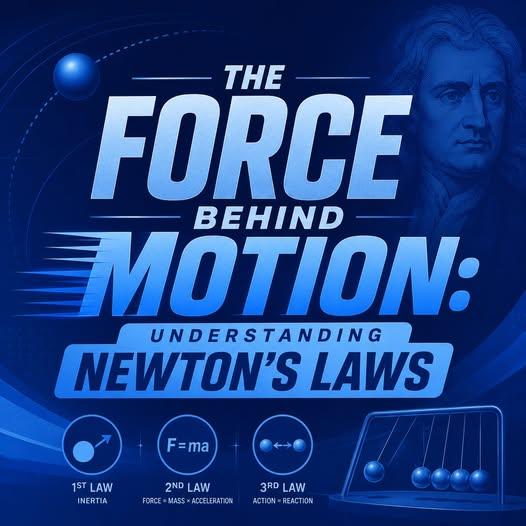
    Story topic: The Force Behind Motion: Understanding Newton's Laws
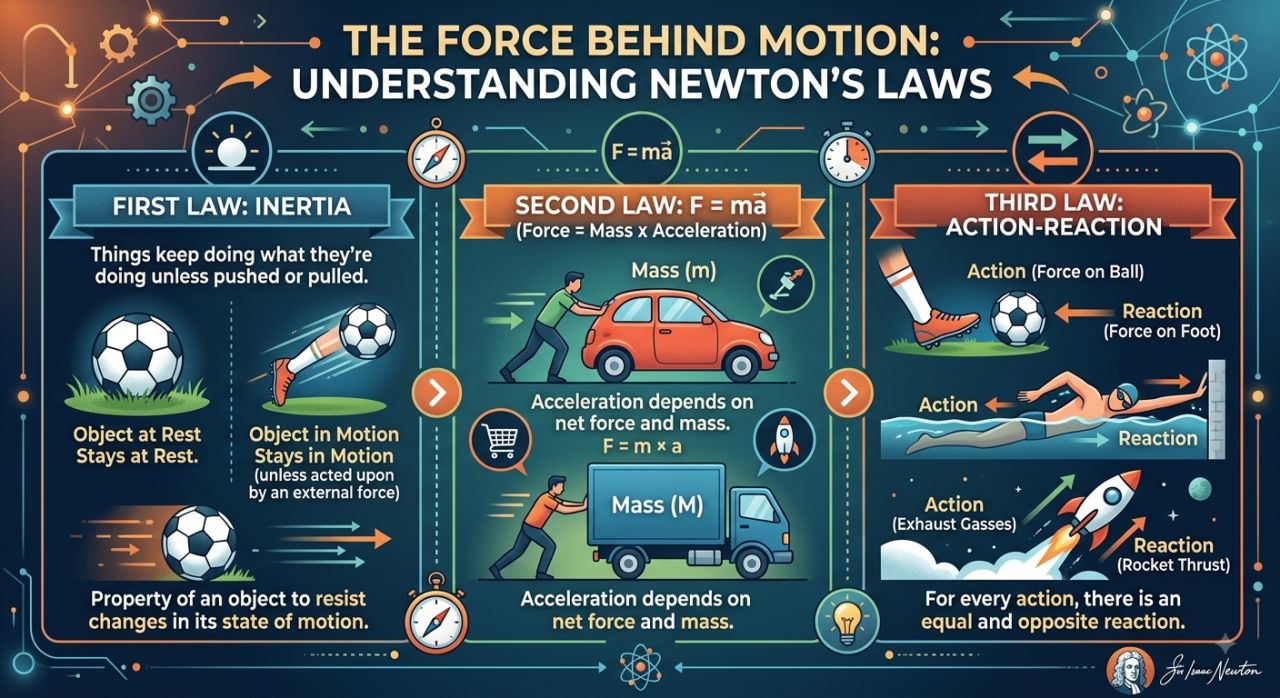
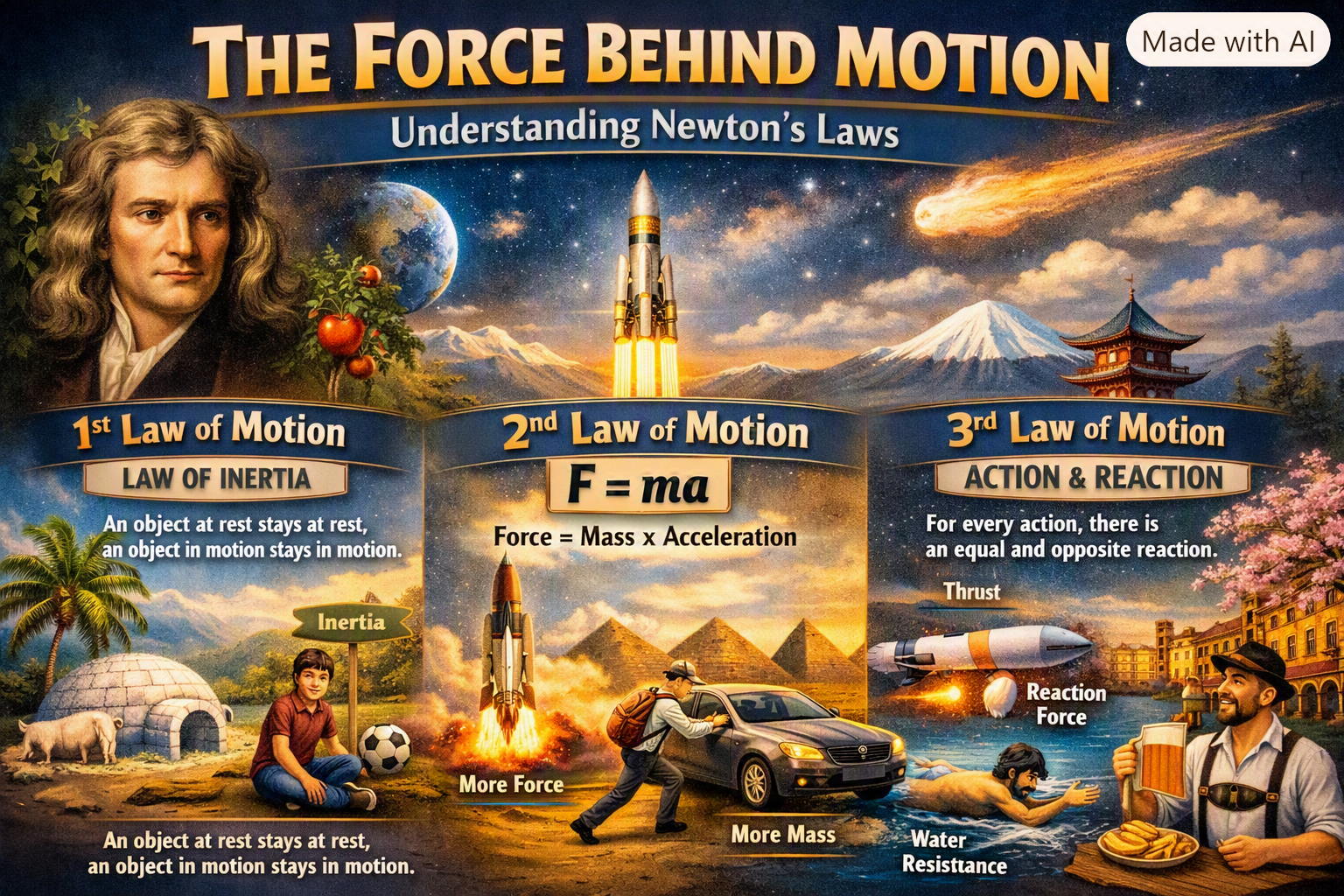
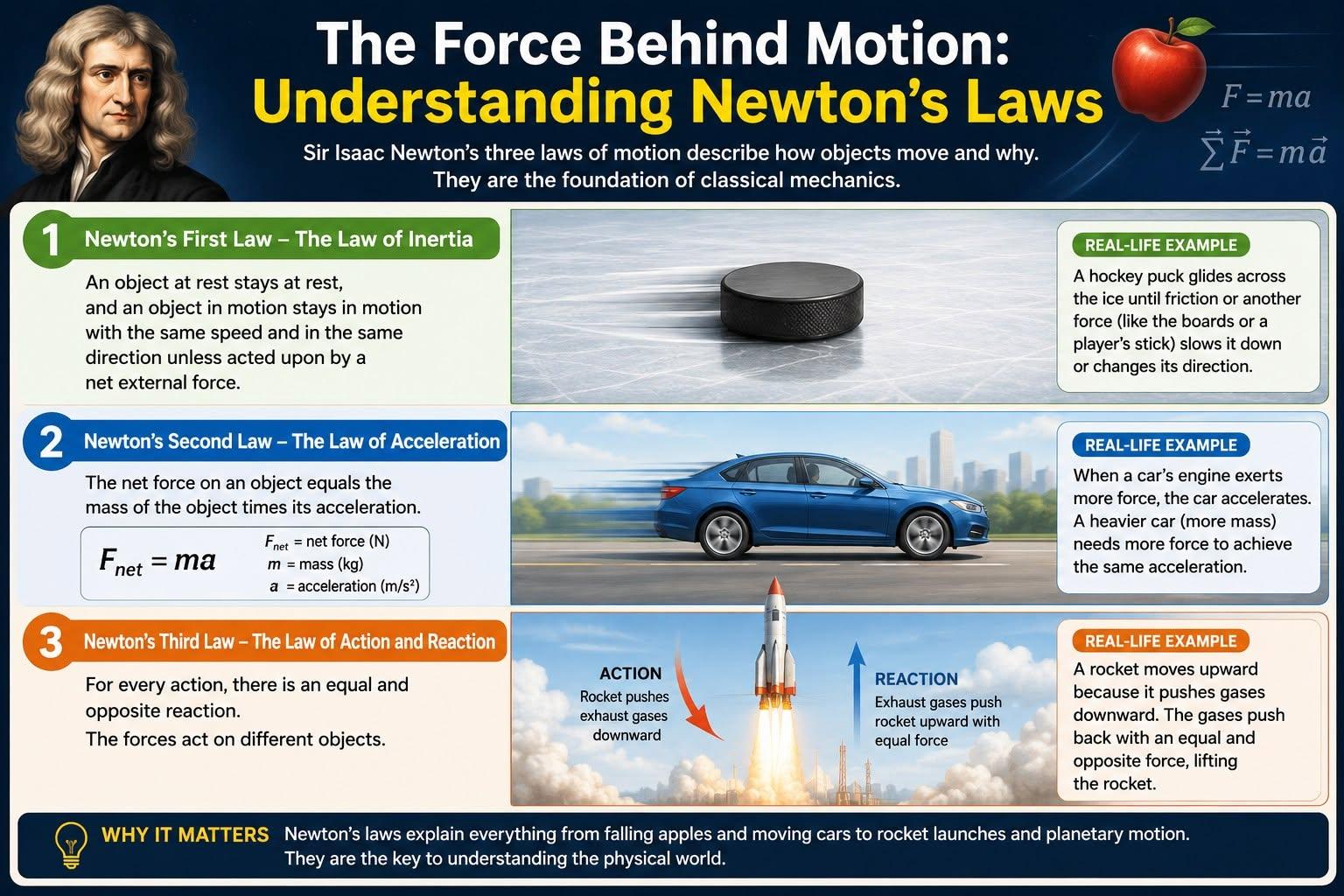
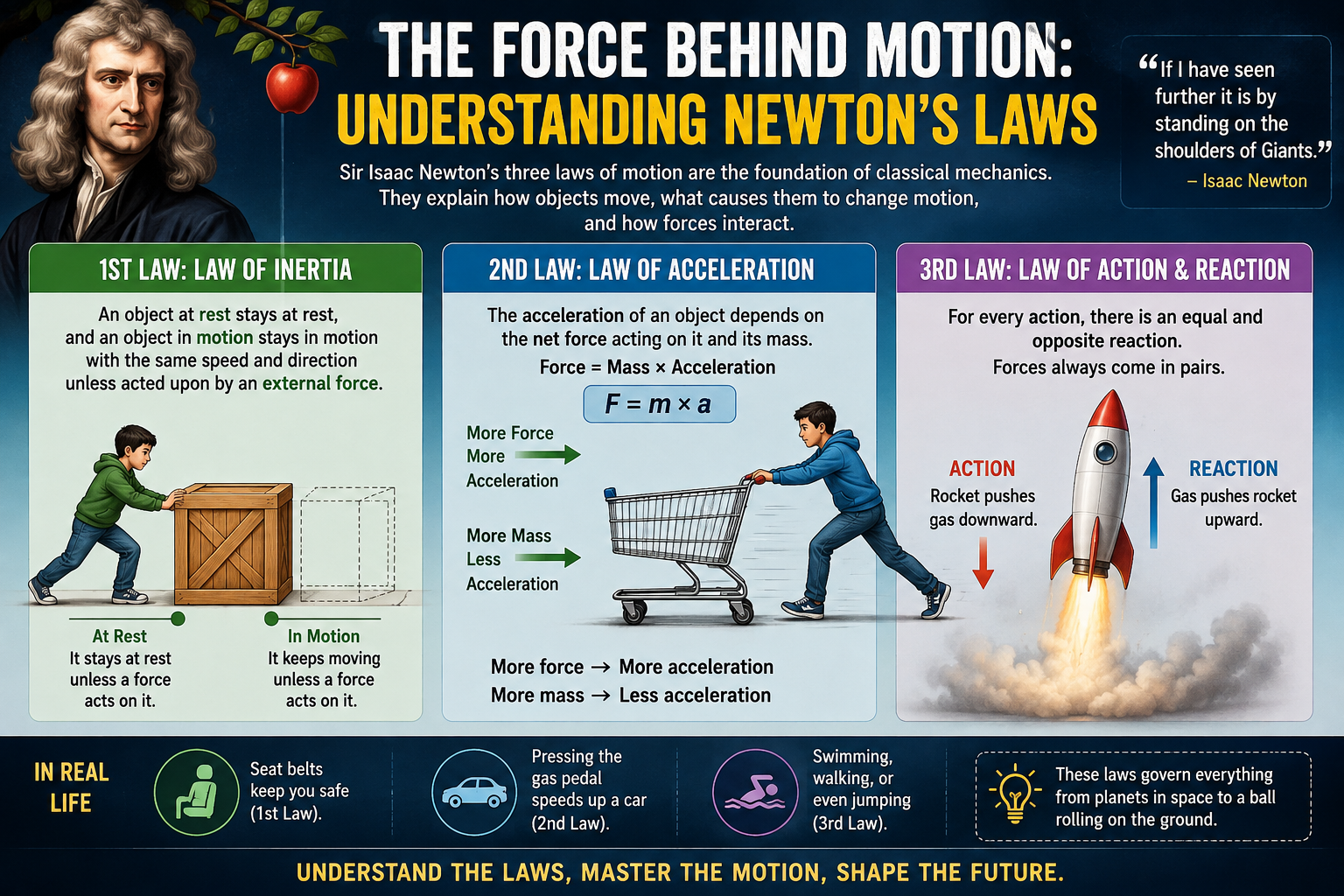
    Newton’s laws of motion form the foundation of classical mechanics and help us understand how forces affect the movement of objects. From a moving car to a falling object, these laws explain motion in everyday life and across the universe.
    The First Law introduces inertia, explaining that an object remains at rest or in motion unless acted upon by an external force. The Second Law connects force, mass, and acceleration through the equation F = ma. The Third Law states that every action has an equal and opposite reaction.
    Together, Newton’s laws provide a powerful framework for understanding motion and show how simple principles can explain complex physical phenomena.
    #NewtonLaws #Physics #Newton #Motion #Force #ClassicalMechanics #ScienceEducation #PhysicsEducation #STEM #LearnPhysics #Education
    RSIF8 Roll no: 99 Story post no: 23 Story topic: The Force Behind Motion: Understanding Newton's Laws Newton’s laws of motion form the foundation of classical mechanics and help us understand how forces affect the movement of objects. From a moving car to a falling object, these laws explain motion in everyday life and across the universe. The First Law introduces inertia, explaining that an object remains at rest or in motion unless acted upon by an external force. The Second Law connects force, mass, and acceleration through the equation F = ma. The Third Law states that every action has an equal and opposite reaction. Together, Newton’s laws provide a powerful framework for understanding motion and show how simple principles can explain complex physical phenomena. #NewtonLaws #Physics #Newton #Motion #Force #ClassicalMechanics #ScienceEducation #PhysicsEducation #STEM #LearnPhysics #Education
    0 Comments 0 Shares 1681 Views
  • **Foundation Level** **Day 153** **story post** **Roll Number: 005**

    The Force Behind Motion: Understanding Newton’s Laws

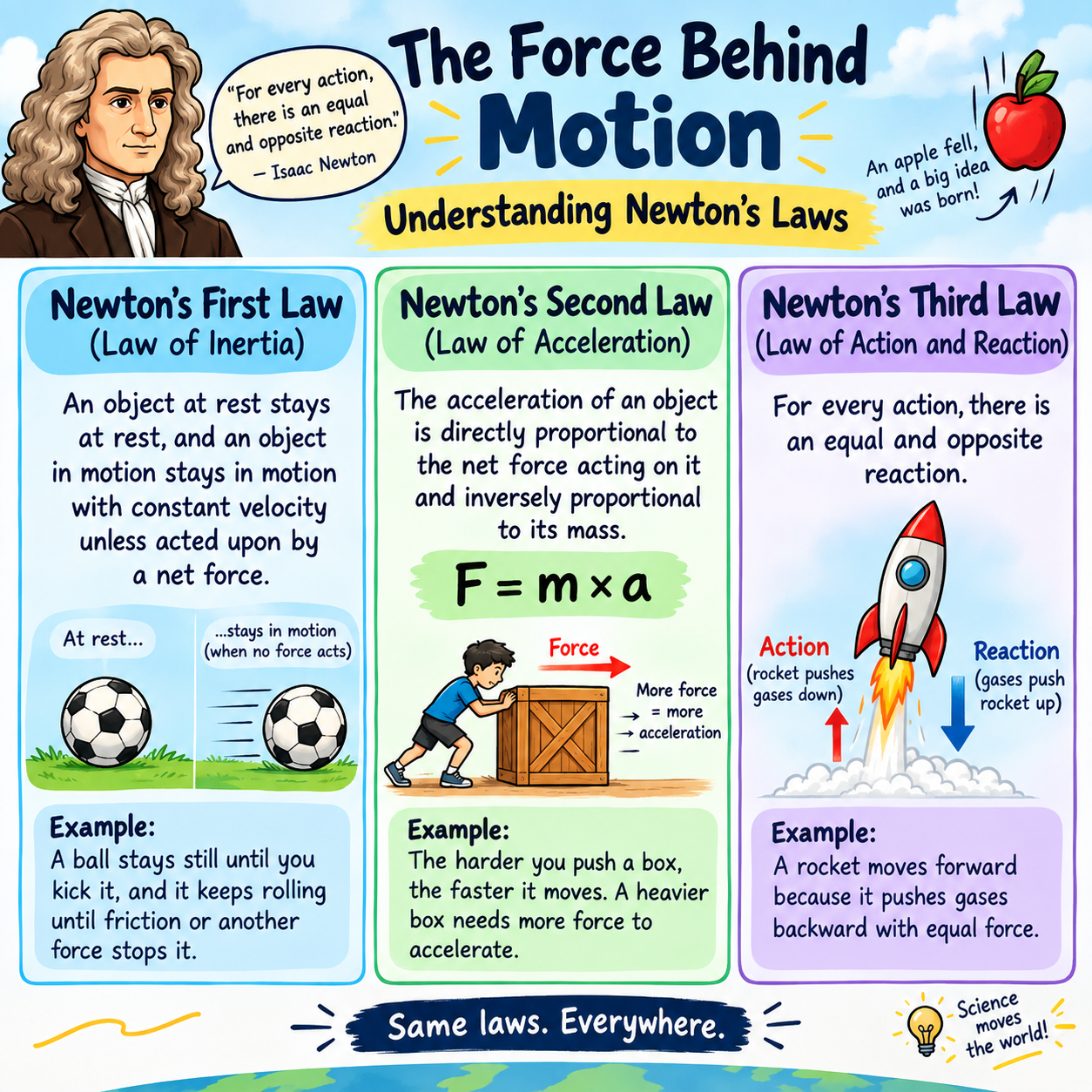
    Ever wondered why objects move, stop, or change direction? Isaac Newton’s three laws of motion help us understand the forces behind movement.

    First Law – Inertia: Objects keep their state of motion unless a force changes it.
    Second Law – Acceleration: Force, mass, and acceleration are connected by F = m × a.
    Third Law – Action & Reaction: Every action has an equal and opposite reaction.

    From a rolling ball to a launching rocket , Newton’s laws are working all around us!

    #NewtonLaws #Physics #Science #Motion #Force #Education #ScienceExplained #PhysicsForStudents #LearningScience #InstagramEducation
    **Foundation Level** **Day 153** **story post** **Roll Number: 005** ๐Ÿš€ The Force Behind Motion: Understanding Newton’s Laws โšก Ever wondered why objects move, stop, or change direction? ๐ŸŒ Isaac Newton’s three laws of motion help us understand the forces behind movement. ๐Ÿ”น First Law – Inertia: Objects keep their state of motion unless a force changes it. ๐Ÿ”น Second Law – Acceleration: Force, mass, and acceleration are connected by F = m × a. ๐Ÿ”น Third Law – Action & Reaction: Every action has an equal and opposite reaction. From a rolling ball โšฝ to a launching rocket ๐Ÿš€, Newton’s laws are working all around us! #NewtonLaws #Physics #Science #Motion #Force #Education #ScienceExplained #PhysicsForStudents #LearningScience #InstagramEducation
    0 Comments 0 Shares 1644 Views
  • Fondation Level Batch No 4
    Roll RSLC #42
    Task No #153
    Day #153

    One bright morning, Adam was playing in a park when he noticed a football resting quietly on the grass. He gently kicked the ball, and it suddenly began rolling across the field. Curious, Adam wondered why the ball had moved only after he kicked it. His teacher explained that this was connected to Newton?s First Law of Motion. An object remains at rest or keeps moving in the same way unless an external force changes its motion. Adam realized that even a simple kick could demonstrate an important scientific principle. From that moment, he became interested in discovering the forces behind everyday movement.

    Adam then decided to test how different objects responded to force. He pushed a light ball and a heavier ball with similar strength and noticed that the lighter ball moved more easily. His teacher explained Newton?s Second Law, which connects force, mass, and acceleration. Adam learned that applying more force can produce a greater change in an object?s motion. He also discovered that heavier objects usually need more force to achieve the same acceleration. Suddenly, pushing a bicycle, moving a box, or kicking a ball seemed much more interesting to him. He understood that forces were constantly influencing the world around him.

    Later, Adam threw a ball against a wall and watched it bounce back toward him. His teacher explained that this was an example of Newton?s Third Law of Motion. Whenever one object applies a force to another object, an equal and opposite force acts back. Adam realized that this principle could be seen when people walk, jump, swim, or ride a bicycle. When his feet pushed the ground backward, the ground pushed him forward. He also learned that rockets move upward by pushing gases downward at high speed. Newton?s Third Law suddenly made many everyday movements easier for Adam to understand.

    By the end of the day, Adam realized that Newton?s laws were much more than formulas in a science book. They were powerful principles that explained how objects move, stop, accelerate, and interact with one another. He could see examples of them in cars, bicycles, sports, falling objects, machines, and even rockets traveling into space. The world around him suddenly looked like a fascinating laboratory filled with invisible forces. Adam understood that physics helps us discover the rules behind ordinary events. From a simple football rolling across the grass to a spacecraft leaving Earth, Newton?s laws tell an amazing story about the force behind motion.

    #NewtonLaws #Physics #ForceAndMotion #NewtonianPhysics #ScienceEducation #PhysicsExplained #LearningScience
    Fondation Level Batch No 4 Roll RSLC #42 Task No #153 Day #153 One bright morning, Adam was playing in a park when he noticed a football resting quietly on the grass. He gently kicked the ball, and it suddenly began rolling across the field. Curious, Adam wondered why the ball had moved only after he kicked it. His teacher explained that this was connected to Newton?s First Law of Motion. An object remains at rest or keeps moving in the same way unless an external force changes its motion. Adam realized that even a simple kick could demonstrate an important scientific principle. From that moment, he became interested in discovering the forces behind everyday movement. Adam then decided to test how different objects responded to force. He pushed a light ball and a heavier ball with similar strength and noticed that the lighter ball moved more easily. His teacher explained Newton?s Second Law, which connects force, mass, and acceleration. Adam learned that applying more force can produce a greater change in an object?s motion. He also discovered that heavier objects usually need more force to achieve the same acceleration. Suddenly, pushing a bicycle, moving a box, or kicking a ball seemed much more interesting to him. He understood that forces were constantly influencing the world around him. Later, Adam threw a ball against a wall and watched it bounce back toward him. His teacher explained that this was an example of Newton?s Third Law of Motion. Whenever one object applies a force to another object, an equal and opposite force acts back. Adam realized that this principle could be seen when people walk, jump, swim, or ride a bicycle. When his feet pushed the ground backward, the ground pushed him forward. He also learned that rockets move upward by pushing gases downward at high speed. Newton?s Third Law suddenly made many everyday movements easier for Adam to understand. By the end of the day, Adam realized that Newton?s laws were much more than formulas in a science book. They were powerful principles that explained how objects move, stop, accelerate, and interact with one another. He could see examples of them in cars, bicycles, sports, falling objects, machines, and even rockets traveling into space. The world around him suddenly looked like a fascinating laboratory filled with invisible forces. Adam understood that physics helps us discover the rules behind ordinary events. From a simple football rolling across the grass to a spacecraft leaving Earth, Newton?s laws tell an amazing story about the force behind motion. #NewtonLaws #Physics #ForceAndMotion #NewtonianPhysics #ScienceEducation #PhysicsExplained #LearningScience
    0 Comments 0 Shares 2803 Views
  • #rsisb
    Roll No.269
    Foundation Level
    Story Post No.24


    **The Force Behind Motion: Understanding Newton’s Laws**

    Have you ever wondered why objects move, stop, or change direction? The answer lies in one of the most important ideas in physics: **force and motion**.

    In this video, we explore **Newton’s Three Laws of Motion** and understand how they explain the movement of objects in our everyday lives. From a ball rolling on the ground to a car accelerating and a rocket launching into space , Newton’s laws help us understand the forces behind motion.

    We will learn how objects behave when forces act on them, how force and acceleration are connected, and why every action has an equal and opposite reaction. These simple but powerful laws are the foundation of many concepts in physics and engineering.

    This topic shows us that physics is not just about formulas—it is all around us! From sports and transportation to machines and space exploration, Newton’s laws help explain the world we see every day.

    Join us as we explore the fascinating **force behind motion** and discover how Newton’s laws shape our understanding of the physical world.

    #NewtonLaws #Newton #Physics #ForceAndMotion #Motion #Science #PhysicsFacts #NewtonLawsOfMotion #Force #Acceleration #Gravity #Mechanics #ScienceEducation #Learning #Education #ScientificDiscovery #PhysicsExperiment #SpaceScience #Engineering #Knowledge #Curiosity #StudentLife #ScienceFacts #RehanSchool #LearnAndGrow
    #rsisb Roll No.269 Foundation Level Story Post No.24 โšก **The Force Behind Motion: Understanding Newton’s Laws** ๐Ÿš€๐Ÿ”ฌ Have you ever wondered why objects move, stop, or change direction? ๐Ÿค” The answer lies in one of the most important ideas in physics: **force and motion**. In this video, we explore **Newton’s Three Laws of Motion** and understand how they explain the movement of objects in our everyday lives. From a ball rolling on the ground โšฝ to a car accelerating ๐Ÿš— and a rocket launching into space ๐Ÿš€, Newton’s laws help us understand the forces behind motion. We will learn how objects behave when forces act on them, how force and acceleration are connected, and why every action has an equal and opposite reaction. โš–๏ธ๐Ÿ’ก These simple but powerful laws are the foundation of many concepts in physics and engineering. This topic shows us that physics is not just about formulas—it is all around us! ๐ŸŒ From sports and transportation to machines and space exploration, Newton’s laws help explain the world we see every day. Join us as we explore the fascinating **force behind motion** and discover how Newton’s laws shape our understanding of the physical world. ๐Ÿ”ฌ๐Ÿ“šโœจ #NewtonLaws โšก #Newton #Physics ๐Ÿ”ฌ #ForceAndMotion ๐Ÿš€ #Motion #Science ๐Ÿ“š #PhysicsFacts ๐Ÿ’ก #NewtonLawsOfMotion #Force ๐Ÿ’ช #Acceleration ๐ŸŽ๏ธ #Gravity ๐ŸŒ #Mechanics ๐Ÿ”ง #ScienceEducation ๐ŸŽ“ #Learning ๐Ÿ“– #Education ๐Ÿง  #ScientificDiscovery ๐Ÿ” #PhysicsExperiment ๐Ÿงช #SpaceScience ๐Ÿš€ #Engineering โš™๏ธ #Knowledge ๐Ÿ’ก #Curiosity ๐Ÿค” #StudentLife ๐ŸŽ“ #ScienceFacts ๐ŸŒŽ #RehanSchool ๐Ÿซ #LearnAndGrow ๐ŸŒฑ
    0 Comments 0 Shares 4022 Views
  • #rsisb
    Roll no.239
    Story post no.22
    Foundation Level


    Why do objects move, stop, or change direction? The answer lies in **Newton’s Laws of Motion**!

    From a moving car to a flying rocket , Newton’s laws help us understand how forces affect motion. They explain the relationship between **force, mass, acceleration, and action-reaction**.

    Explore the science behind everyday movement and discover how these powerful laws continue to shape our understanding of the physical world!

    #NewtonLaws #Physics #Science #Motion #Force #IsaacNewton #Education #ScienceFacts #Learning #STEM #PhysicsWorld #Knowledge #Discovery
    #rsisb Roll no.239 Story post no.22 Foundation Level Why do objects move, stop, or change direction? ๐Ÿค” The answer lies in **Newton’s Laws of Motion**! ๐ŸŒโœจ From a moving car ๐Ÿš— to a flying rocket ๐Ÿš€, Newton’s laws help us understand how forces affect motion. They explain the relationship between **force, mass, acceleration, and action-reaction**. โšก๐Ÿ”ฌ Explore the science behind everyday movement and discover how these powerful laws continue to shape our understanding of the physical world! ๐ŸŒŸ๐Ÿง  #NewtonLaws #Physics #Science #Motion #Force #IsaacNewton #Education #ScienceFacts #Learning #STEM #PhysicsWorld #Knowledge #Discovery ๐Ÿš€โš™๏ธ๐Ÿ”ฌ
    0 Comments 0 Shares 1942 Views
  • #rsisb
    Roll no.247
    Foundation level **The Force Behind Motion: Understanding Newton’s Laws**

    Have you ever wondered why objects move, stop, speed up, slow down, or change direction? The answer lies in one of the most important ideas in physics: **Newton’s Laws of Motion!**

    In this fascinating journey, we explore the three laws developed by **Sir Isaac Newton**, which help us understand how forces affect the motion of objects. ‍ From a ball rolling across the ground to a rocket launching into space , Newton’s laws are everywhere around us!

    **Newton’s First Law – The Law of Inertia:**
    An object tends to remain at rest or keep moving in a straight line unless an external force acts upon it. This explains why objects don’t simply change their motion on their own.

    **Newton’s Second Law – Force and Acceleration:**
    This law shows how force, mass, and acceleration are connected. The famous equation **F = ma** helps us understand why applying more force can produce greater acceleration.

    **Newton’s Third Law – Action and Reaction:**
    For every action, there is an equal and opposite reaction. This principle helps explain how we walk, swim, jump, and even how rockets move upward! ‍‍

    Newton’s laws are not just formulas written in a textbook—they are principles that describe motion in our everyday lives. Whether you are riding a bicycle , playing sports , pushing a door , or watching a car accelerate , physics is working all around you!

    In this topic, we’ll discover how **force, mass, acceleration, inertia, and action-reaction pairs** work together to explain the motion we see every day. It’s a perfect opportunity for students, science lovers, and curious minds to explore the amazing world of physics.

    **Key Topics:**
    Newton’s Three Laws of Motion
    Understanding Force and Motion
    Inertia and Mass
    Force, Mass & Acceleration
    Action and Reaction
    Real-Life Examples of Newton’s Laws
    The Role of Physics in Everyday Life
    Applications in Transportation, Sports, Space, and Engineering

    **Physics is everywhere!** Once you understand Newton’s laws, ordinary movements can become extraordinary scientific discoveries. So get ready to explore the forces that shape motion and uncover the science behind the world around us!

    Like, share, and follow for more exciting educational content!

    #NewtonLaws #NewtonLawsOfMotion #Physics #ForceAndMotion #Science #PhysicsEducation #ScienceForStudents #Newton #IsaacNewton #LawOfInertia #Acceleration #Force #Mass #Motion #ActionAndReaction #FEqualsMA #STEM #ScienceLearning #PhysicsExplained #LearnPhysics #EducationalVideo #ScienceEducation #AmazingScience #EverydayPhysics #SpaceScience
    #rsisb Roll no.247 Foundation level ๐Ÿš€โš™๏ธ **The Force Behind Motion: Understanding Newton’s Laws** โš™๏ธ๐Ÿš€ Have you ever wondered why objects move, stop, speed up, slow down, or change direction? ๐ŸŒโœจ The answer lies in one of the most important ideas in physics: **Newton’s Laws of Motion!** ๐Ÿง ๐Ÿ”ฌ In this fascinating journey, we explore the three laws developed by **Sir Isaac Newton**, which help us understand how forces affect the motion of objects. ๐Ÿƒ‍โ™‚๏ธโšฝ๐Ÿš— From a ball rolling across the ground to a rocket launching into space ๐Ÿš€๐ŸŒŒ, Newton’s laws are everywhere around us! ๐Ÿ“š **Newton’s First Law – The Law of Inertia:** An object tends to remain at rest or keep moving in a straight line unless an external force acts upon it. ๐Ÿ›‘โžก๏ธ This explains why objects don’t simply change their motion on their own. โšก **Newton’s Second Law – Force and Acceleration:** This law shows how force, mass, and acceleration are connected. The famous equation **F = ma** helps us understand why applying more force can produce greater acceleration. ๐Ÿ’ช๐Ÿ“ ๐Ÿ”ฅ **Newton’s Third Law – Action and Reaction:** For every action, there is an equal and opposite reaction. ๐ŸŒŸ This principle helps explain how we walk, swim, jump, and even how rockets move upward! ๐Ÿšถ‍โ™‚๏ธ๐ŸŠ‍โ™‚๏ธ๐Ÿš€ ๐ŸŒŽ Newton’s laws are not just formulas written in a textbook—they are principles that describe motion in our everyday lives. Whether you are riding a bicycle ๐Ÿšฒ, playing sports ๐Ÿ€, pushing a door ๐Ÿšช, or watching a car accelerate ๐Ÿš—๐Ÿ’จ, physics is working all around you! ๐Ÿ” In this topic, we’ll discover how **force, mass, acceleration, inertia, and action-reaction pairs** work together to explain the motion we see every day. It’s a perfect opportunity for students, science lovers, and curious minds to explore the amazing world of physics. ๐Ÿงช๐Ÿ“–โœจ ๐ŸŽฏ **Key Topics:** ๐Ÿ”น Newton’s Three Laws of Motion ๐Ÿ”น Understanding Force and Motion ๐Ÿ”น Inertia and Mass ๐Ÿ”น Force, Mass & Acceleration ๐Ÿ”น Action and Reaction ๐Ÿ”น Real-Life Examples of Newton’s Laws ๐Ÿ”น The Role of Physics in Everyday Life ๐Ÿ”น Applications in Transportation, Sports, Space, and Engineering ๐Ÿš—๐Ÿ€๐Ÿš€ ๐ŸŒŸ **Physics is everywhere!** Once you understand Newton’s laws, ordinary movements can become extraordinary scientific discoveries. So get ready to explore the forces that shape motion and uncover the science behind the world around us! ๐ŸŒ๐Ÿ”ฌ๐Ÿ’ซ ๐Ÿ‘ Like, share, and follow for more exciting educational content! ๐Ÿ“šโœจ #NewtonLaws #NewtonLawsOfMotion #Physics #ForceAndMotion #Science #PhysicsEducation #ScienceForStudents #Newton #IsaacNewton #LawOfInertia #Acceleration #Force #Mass #Motion #ActionAndReaction #FEqualsMA #STEM #ScienceLearning #PhysicsExplained #LearnPhysics #EducationalVideo #ScienceEducation #AmazingScience #EverydayPhysics #SpaceScience ๐Ÿš€๐Ÿ”ฌ๐ŸŒ
    0 Comments 0 Shares 7958 Views