• RSIF8
    ROLL NO 77
    MOVIE REVIEW NO 22
    MOVIE TOPIC "The Theory of Everything".

    The Theory of Everything – Unlocking the Secrets of the Universe!

    Have you ever wondered how the universe works? From the smallest particles to the biggest galaxies, scientists are searching for one ultimate theory that explains everything!

    Explore the fascinating mysteries of space, time, gravity, quantum physics, and black holes. Discover how brilliant scientists are trying to connect all the laws of nature into one powerful explanation.

    Will humanity ever uncover the ultimate secret of the universe?

    Watch until the end and join us on this amazing journey of science and discovery!

    Like, Comment, Subscribe, and share this video for more amazing facts and knowledge!

    Hashtags:

    \#TheoryOfEverything #Universe #Science #Physics #QuantumPhysics #AlbertEinstein #Space #BlackHoles #Cosmos #MysteriesOfTheUniverse #ScienceFacts #AmazingFacts #Education #Knowledge #DiscoverScience #SpaceExploration #BigBang #LearnSomethingNew
    RSIF8 ROLL NO 77 MOVIE REVIEW NO 22 MOVIE TOPIC "The Theory of Everything". 🌌 The Theory of Everything – Unlocking the Secrets of the Universe! 🚀 Have you ever wondered how the universe works? 🌍✨ From the smallest particles to the biggest galaxies, scientists are searching for one ultimate theory that explains everything! Explore the fascinating mysteries of space, time, gravity, quantum physics, and black holes. 🪐🔬 Discover how brilliant scientists are trying to connect all the laws of nature into one powerful explanation. Will humanity ever uncover the ultimate secret of the universe? 🤯🌠 Watch until the end and join us on this amazing journey of science and discovery! 👍 Like, 💬 Comment, 🔔 Subscribe, and share this video for more amazing facts and knowledge! 🔥 Hashtags: \#TheoryOfEverything #Universe #Science #Physics #QuantumPhysics #AlbertEinstein #Space #BlackHoles #Cosmos #MysteriesOfTheUniverse #ScienceFacts #AmazingFacts #Education #Knowledge #DiscoverScience #SpaceExploration #BigBang #LearnSomethingNew 🌌🚀
    0 Commentarios 0 Acciones 382 Views 1
  • **Roll No: 2**
    **Batch: 14**
    **Book: ACCL**
    **Task No: 160**

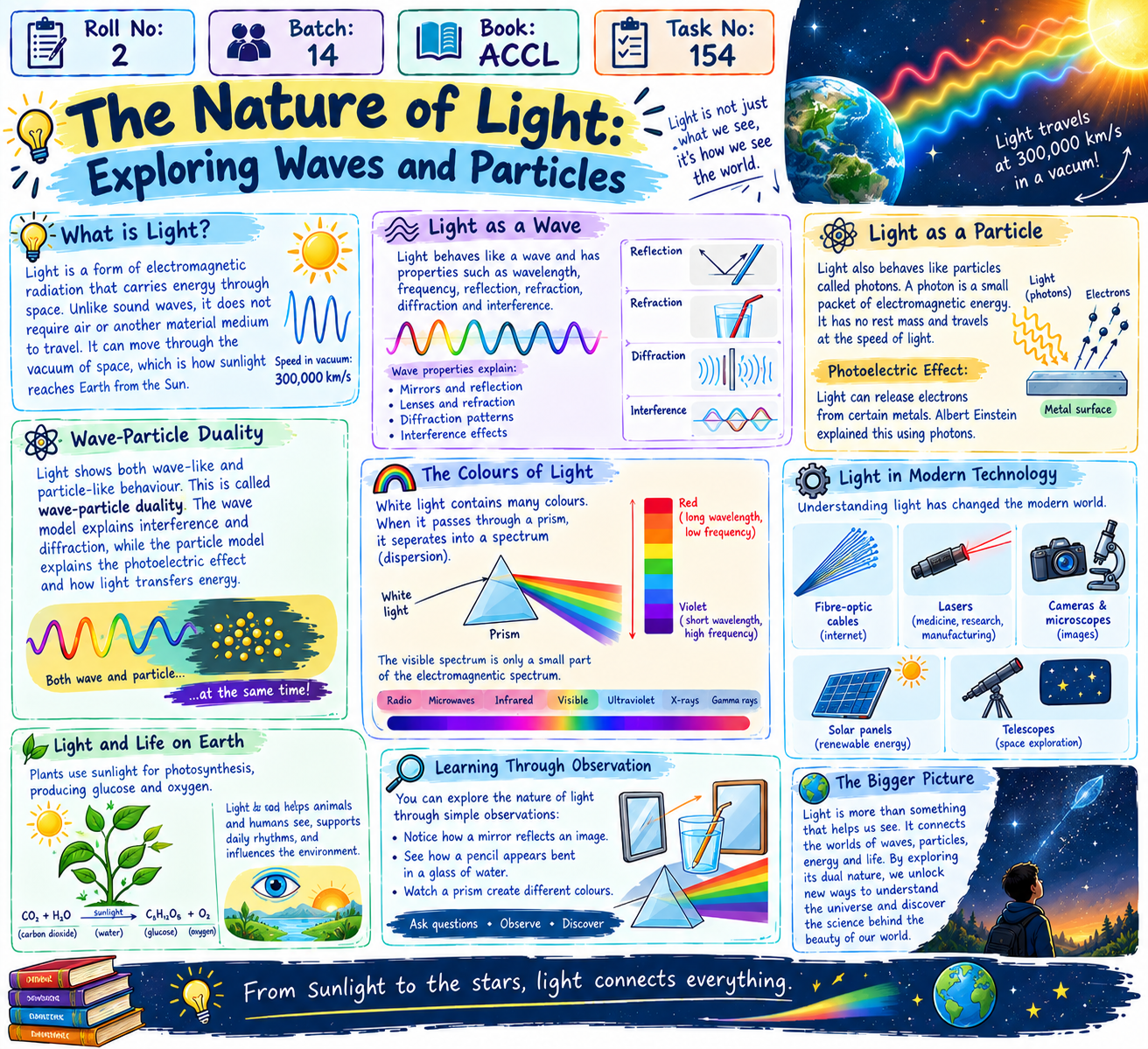
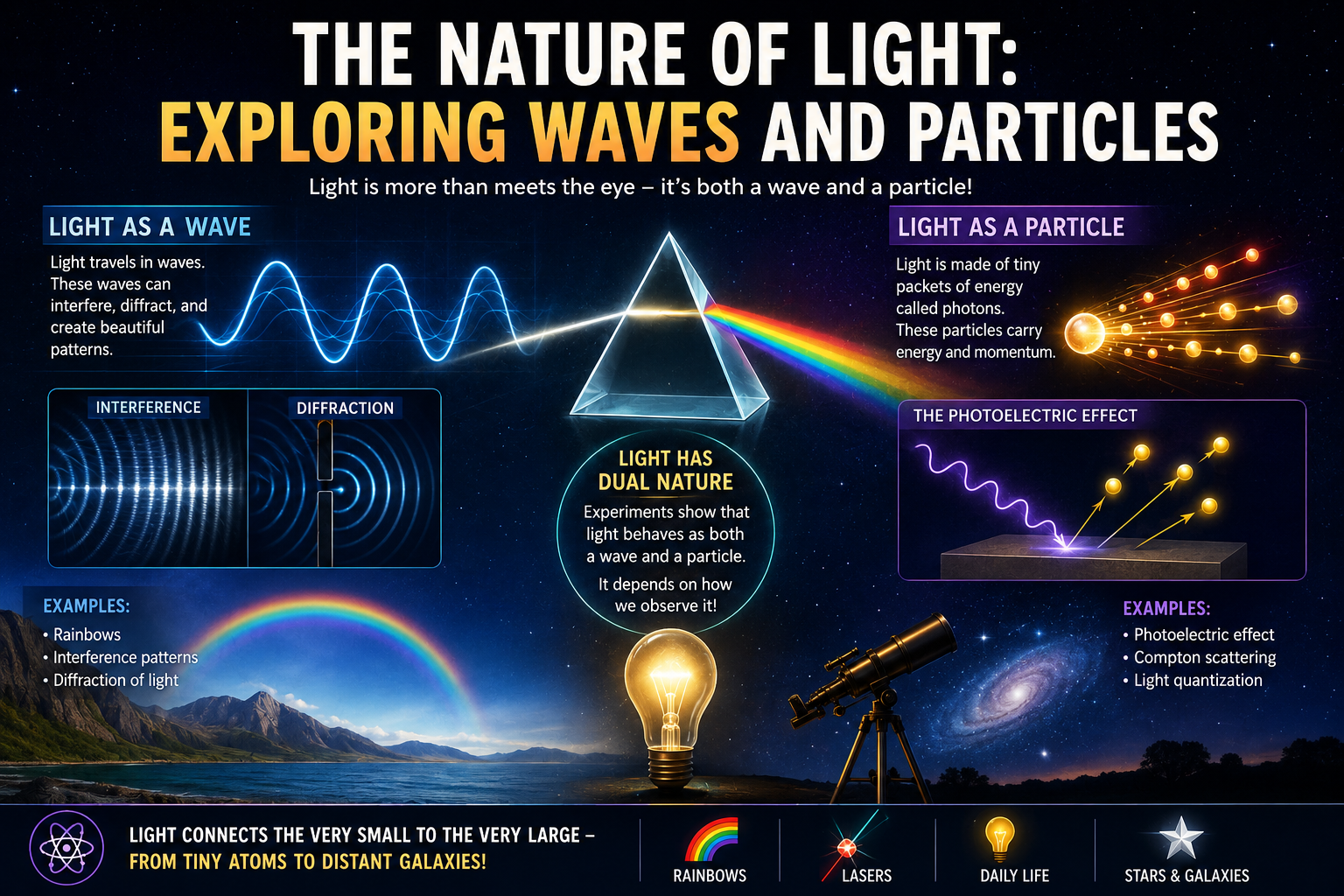
    # The Nature of Light: Exploring Waves and Particles

    Have you ever wondered how we see the colorful world around us? From the bright sunshine in the morning to the glowing stars at night, light plays an essential role in our lives. It allows us to see objects, helps plants grow, and makes many modern technologies possible. But what exactly is light? Is it a wave, a particle, or something even more fascinating?

    **Light is a form of electromagnetic radiation that carries energy through space.** Unlike sound waves, light does not require air or another material medium to travel. It can move through the vacuum of space, which is how sunlight reaches Earth from the Sun. In a vacuum, light travels at approximately 300,000 kilometres per second, making it one of the fastest phenomena in nature.

    ## Light as a Wave

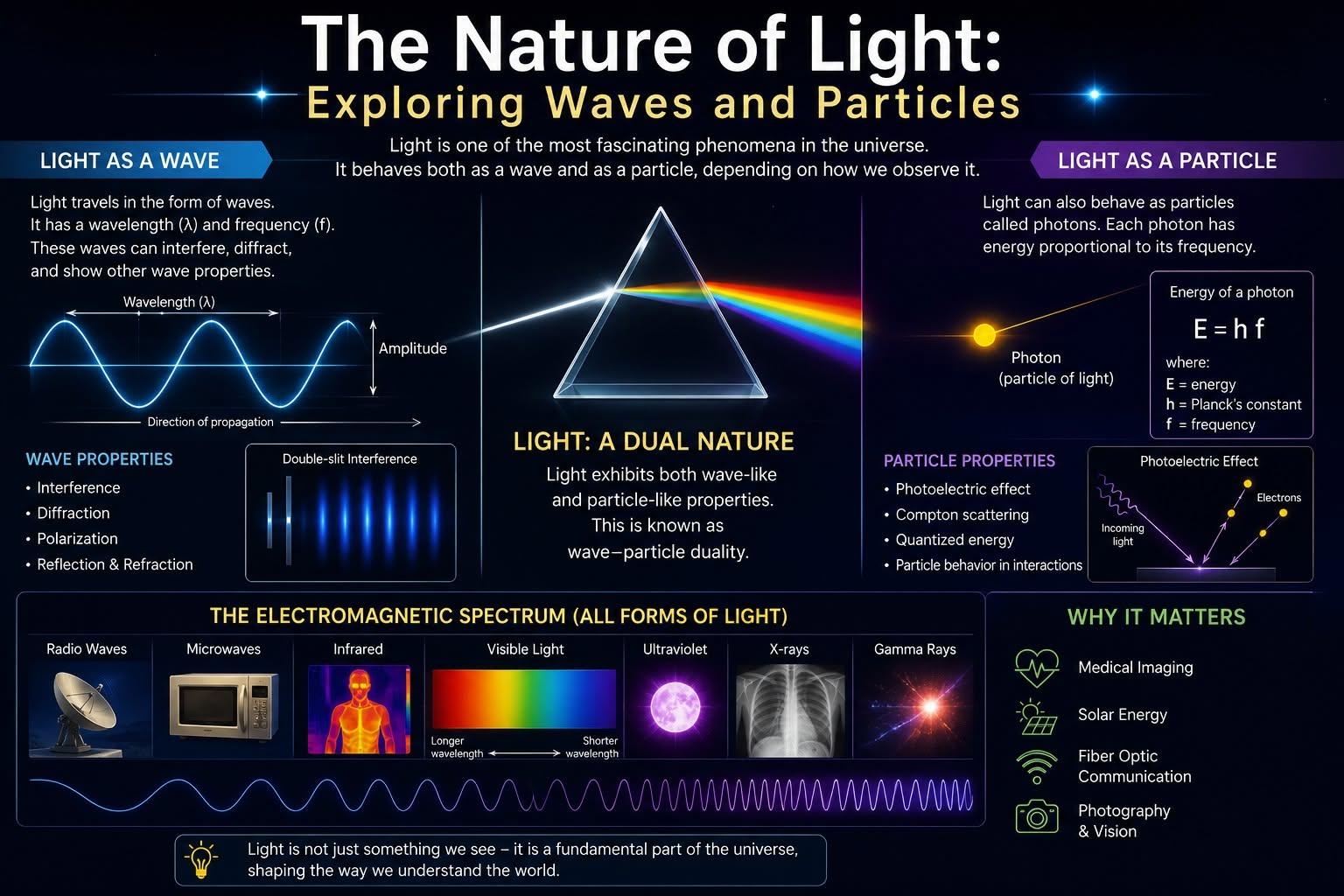
    For many years, scientists studied light and discovered that it behaves like a wave. Light waves have properties such as wavelength, frequency, reflection, refraction, diffraction, and interference. These properties help explain many everyday optical phenomena.

    **Reflection** occurs when light bounces off a surface. A mirror is a familiar example because it reflects light and allows us to see our image. **Refraction** happens when light changes direction as it passes from one transparent material into another, such as from air into water. This is why a straw placed in a glass of water may appear bent.

    Light can also spread out through a process called diffraction and produce patterns through interference. These wave properties provide important evidence of the wave nature of light. Scientists use them to understand lenses, microscopes, telescopes, and many other optical instruments.

    ## Light as a Particle

    Light also behaves in ways that can be explained by particles called **photons**. A photon is a small packet, or quantum, of electromagnetic energy. Photons have no rest mass and travel at the speed of light in a vacuum.

    One important discovery was the photoelectric effect. Scientists observed that when light of a suitable frequency shines on certain metals, it can cause electrons to be released. Albert Einstein explained this phenomenon by showing that light transfers energy in individual packets called photons. This discovery helped establish the foundation of quantum physics.

    The particle model explains how light interacts with matter in processes such as the photoelectric effect and the absorption and emission of energy by atoms.

    ## Wave-Particle Duality

    One of the most fascinating discoveries in physics is that light shows both wave-like and particle-like behaviour. This idea is known as **wave-particle duality**.

    Light does not behave like an ordinary water wave or a tiny solid ball. Instead, its behaviour depends on the type of experiment and how it interacts with matter. The wave description helps explain interference and diffraction, while the photon description explains how light transfers energy in individual amounts.

    This discovery changed the way scientists understand the universe and became an important part of quantum mechanics.

    ## The Colours of Light

    White light may look simple, but it contains many different colours. When white light passes through a glass prism, it separates into a spectrum of colours: red, orange, yellow, green, blue, indigo, and violet. This process is called **dispersion**.

    Each colour has a different wavelength and frequency. Red light has a longer wavelength than violet light, while violet light has a higher frequency. The visible spectrum is only a small part of the electromagnetic spectrum, which also includes radio waves, microwaves, infrared radiation, ultraviolet radiation, X-rays, and gamma rays.

    ## Light in Modern Technology

    The study of light has transformed the modern world. Fibre-optic cables use light to transmit information over long distances, supporting internet communication and global connectivity. Lasers are used in medical equipment, scientific research, manufacturing, and barcode scanners.

    Cameras and microscopes use lenses to control light and produce images. Solar panels convert energy from sunlight into electrical energy, while telescopes help scientists observe distant stars and galaxies. These technologies demonstrate how understanding light can improve everyday life and expand human knowledge.

    ## Light and Life on Earth

    Light is essential for many living organisms. Green plants use sunlight during photosynthesis to produce glucose from water and carbon dioxide, releasing oxygen as a by-product. This process supports food chains and helps maintain the balance of gases in Earth's atmosphere.

    Light also helps animals and humans understand their surroundings through vision. Many organisms use natural light patterns to regulate daily activities, while sunlight influences environmental conditions and the rhythms of life.

    ## Learning Through Observation

    You can explore the nature of light through simple observations. Notice how a mirror reflects an image, how a pencil appears bent in a glass of water, or how sunlight passing through a prism produces different colours. These examples connect scientific ideas with experiences from everyday life.

    By asking questions, making observations, and studying experiments, we can understand how light behaves and why it is so important in science.

    **Light is more than something that helps us see; it is a fascinating phenomenon that connects the worlds of waves, particles, energy, and life. By exploring its dual nature, we unlock new ways to understand the universe and discover the science behind the beauty of our world. **

    \#NatureOfLight #WavesAndParticles #Physics #QuantumPhysics #ElectromagneticWaves #Science #ACCL #Batch14 #Task154
    **Roll No: 2** **Batch: 14** **Book: ACCL** **Task No: 160** # 🌈💡 The Nature of Light: Exploring Waves and Particles 🔬🌊 Have you ever wondered how we see the colorful world around us? 🌍 From the bright sunshine in the morning to the glowing stars at night, light plays an essential role in our lives. It allows us to see objects, helps plants grow, and makes many modern technologies possible. But what exactly is light? Is it a wave, a particle, or something even more fascinating? ✨ **Light is a form of electromagnetic radiation that carries energy through space.** Unlike sound waves, light does not require air or another material medium to travel. It can move through the vacuum of space, which is how sunlight reaches Earth from the Sun. In a vacuum, light travels at approximately 300,000 kilometres per second, making it one of the fastest phenomena in nature. ☀️🚀 ## 🌊 Light as a Wave For many years, scientists studied light and discovered that it behaves like a wave. Light waves have properties such as wavelength, frequency, reflection, refraction, diffraction, and interference. These properties help explain many everyday optical phenomena. 🌈 **Reflection** occurs when light bounces off a surface. A mirror is a familiar example because it reflects light and allows us to see our image. **Refraction** happens when light changes direction as it passes from one transparent material into another, such as from air into water. This is why a straw placed in a glass of water may appear bent. 🪞💧 Light can also spread out through a process called diffraction and produce patterns through interference. These wave properties provide important evidence of the wave nature of light. Scientists use them to understand lenses, microscopes, telescopes, and many other optical instruments. 🔭🔬 ## ⚛️ Light as a Particle Light also behaves in ways that can be explained by particles called **photons**. A photon is a small packet, or quantum, of electromagnetic energy. Photons have no rest mass and travel at the speed of light in a vacuum. ⚡ One important discovery was the photoelectric effect. Scientists observed that when light of a suitable frequency shines on certain metals, it can cause electrons to be released. Albert Einstein explained this phenomenon by showing that light transfers energy in individual packets called photons. This discovery helped establish the foundation of quantum physics. 🧪 The particle model explains how light interacts with matter in processes such as the photoelectric effect and the absorption and emission of energy by atoms. ## 🔬 Wave-Particle Duality One of the most fascinating discoveries in physics is that light shows both wave-like and particle-like behaviour. This idea is known as **wave-particle duality**. 🌌 Light does not behave like an ordinary water wave or a tiny solid ball. Instead, its behaviour depends on the type of experiment and how it interacts with matter. The wave description helps explain interference and diffraction, while the photon description explains how light transfers energy in individual amounts. This discovery changed the way scientists understand the universe and became an important part of quantum mechanics. ## 🌈 The Colours of Light White light may look simple, but it contains many different colours. When white light passes through a glass prism, it separates into a spectrum of colours: red, orange, yellow, green, blue, indigo, and violet. This process is called **dispersion**. 🌈 Each colour has a different wavelength and frequency. Red light has a longer wavelength than violet light, while violet light has a higher frequency. The visible spectrum is only a small part of the electromagnetic spectrum, which also includes radio waves, microwaves, infrared radiation, ultraviolet radiation, X-rays, and gamma rays. ## 📡 Light in Modern Technology The study of light has transformed the modern world. Fibre-optic cables use light to transmit information over long distances, supporting internet communication and global connectivity. 💻🌐 Lasers are used in medical equipment, scientific research, manufacturing, and barcode scanners. Cameras and microscopes use lenses to control light and produce images. Solar panels convert energy from sunlight into electrical energy, while telescopes help scientists observe distant stars and galaxies. These technologies demonstrate how understanding light can improve everyday life and expand human knowledge. 🔭🔋 ## 🌱 Light and Life on Earth Light is essential for many living organisms. Green plants use sunlight during photosynthesis to produce glucose from water and carbon dioxide, releasing oxygen as a by-product. This process supports food chains and helps maintain the balance of gases in Earth's atmosphere. 🌿☀️ Light also helps animals and humans understand their surroundings through vision. Many organisms use natural light patterns to regulate daily activities, while sunlight influences environmental conditions and the rhythms of life. ## 🧠 Learning Through Observation You can explore the nature of light through simple observations. Notice how a mirror reflects an image, how a pencil appears bent in a glass of water, or how sunlight passing through a prism produces different colours. These examples connect scientific ideas with experiences from everyday life. 🔍📚 By asking questions, making observations, and studying experiments, we can understand how light behaves and why it is so important in science. **Light is more than something that helps us see; it is a fascinating phenomenon that connects the worlds of waves, particles, energy, and life. By exploring its dual nature, we unlock new ways to understand the universe and discover the science behind the beauty of our world. 🌈💡🌍** \#NatureOfLight #WavesAndParticles #Physics #QuantumPhysics #ElectromagneticWaves #Science #ACCL #Batch14 #Task154 🌈🔬✨
    0 Commentarios 0 Acciones 3582 Views
  • RSIF8
    Roll no:14
    story no:24
    story topic:The Nature of Light: Exploring Waves and Particles

    **The Nature of Light: Exploring Waves and Particles**

    Have you ever wondered what light really is? How does sunlight travel across millions of kilometers through space, how do rainbows form, and how can light behave like both a wave and a particle? The nature of light is one of the most fascinating topics in physics, revealing the extraordinary connection between the visible world and the mysterious laws of quantum mechanics. From the light that illuminates our homes to the distant stars shining in the universe, light plays an essential role in understanding the world around us.

    **1. The Wave Nature of Light **

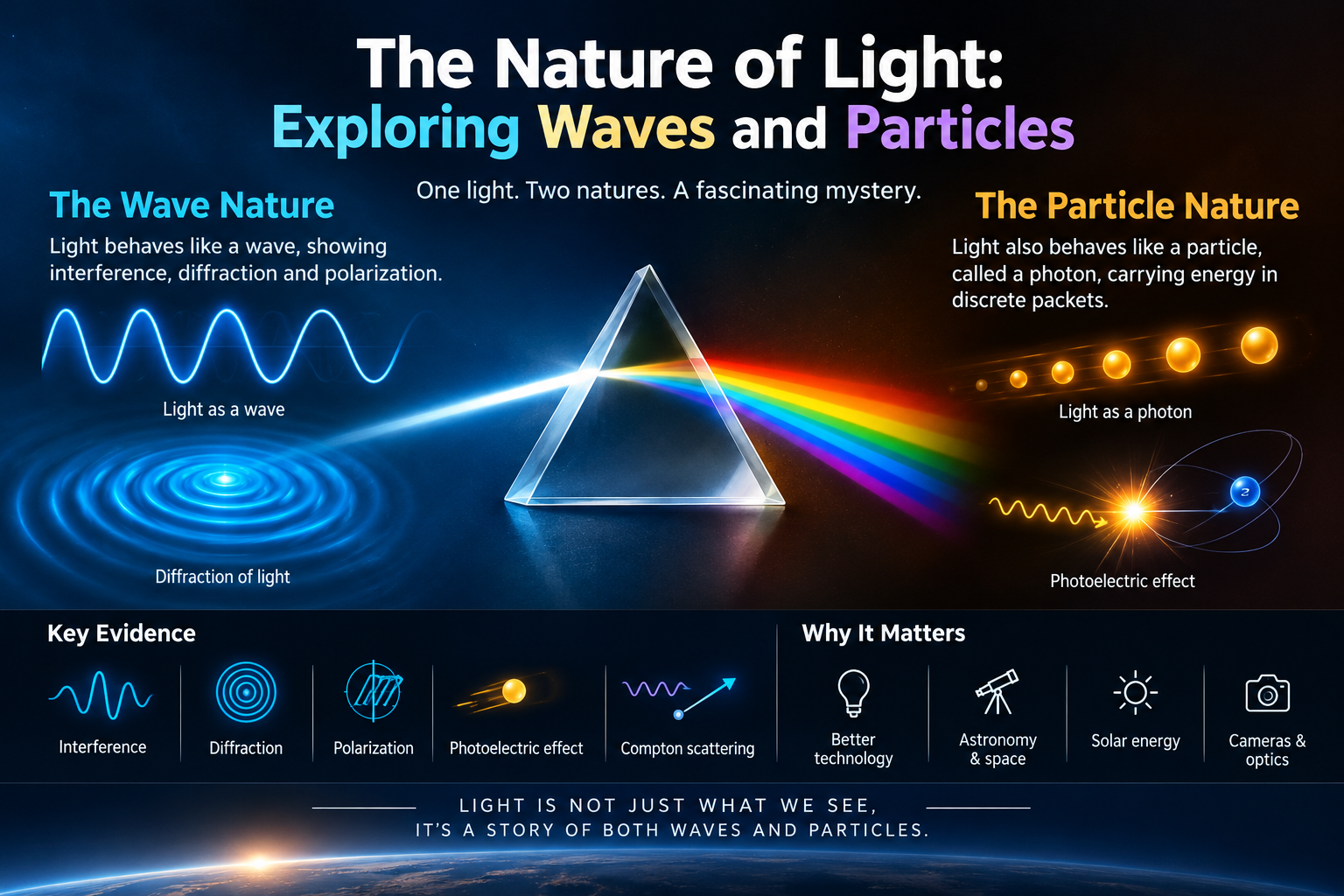
    For many years, scientists have studied light as a wave because it demonstrates important wave-like properties. Light can undergo interference, diffraction, and polarization. Interference occurs when light waves overlap and combine, producing patterns of brightness and darkness. Diffraction happens when light spreads around an obstacle or passes through a narrow opening. Polarization describes the orientation of light's oscillations and helps us understand how light interacts with different materials.

    These properties demonstrate that the wave model is essential for explaining many optical phenomena. From colorful patterns created by thin films to the operation of polarized sunglasses, the wave nature of light has many applications in everyday life and modern technology.

    **2. The Particle Nature of Light **

    Light also behaves in ways that reveal its particle nature. In quantum physics, light energy is exchanged in discrete packets called **photons**. Each photon carries energy determined by its frequency, described by the equation **E = hf**, where E represents energy, h is Planck's constant, and f is frequency.

    The photoelectric effect provides important evidence for this particle nature. When light of a suitable frequency strikes certain materials, it can release electrons from their surfaces. This phenomenon helped scientists understand that light energy is transferred in individual quanta rather than always behaving like a continuous wave.

    Another important example is Compton scattering, in which photons exchange energy and momentum with electrons. These discoveries transformed our understanding of light and helped establish the foundations of quantum physics.

    **3. Wave-Particle Duality: Two Sides of Light**

    One of the most remarkable discoveries in science is that light cannot be fully explained by treating it only as a classical wave or only as a classical particle. Its behavior depends on the physical process being investigated and how it is measured. This concept is known as **wave-particle duality**.

    Experiments involving interference reveal wave-like patterns, while experiments involving photon detection show that light energy is detected in discrete units. Quantum mechanics brings these observations together into a more complete description of nature. Rather than being an ordinary wave or a tiny classical object, light is a quantum phenomenon with properties that challenge our everyday intuition.

    **4. How Do We Discover the Secrets of Light?**

    Scientists use carefully designed experiments to explore the behavior of light. Prisms separate white light into different colors, optical instruments measure its properties, and advanced detectors record individual photons. Interference experiments reveal patterns that cannot be explained by simple particle models, while photoelectric experiments demonstrate the importance of quantized energy.

    The work of scientists such as Isaac Newton, Thomas Young, Max Planck, Albert Einstein, and Arthur Compton helped build our modern understanding of light. Their discoveries show how scientific knowledge develops through observation, experimentation, mathematical reasoning, and new ideas.

    **5. Why Is the Nature of Light Important?**

    Understanding light is essential to many technologies that shape modern life. Lasers are used in medicine, manufacturing, and scientific research. Fiber-optic cables transmit information across the world using pulses of light. Solar panels convert light energy into electrical energy, while cameras and telescopes help us capture images and explore distant objects in space.

    The principles of light are also important in astronomy, microscopy, optical communication, quantum technologies, and the study of the universe. By investigating how light behaves, scientists can examine distant galaxies, study the structure of matter, and develop new tools that improve our understanding of nature.

    **6. Light: Connecting Science and the Universe**

    Light is much more than what allows us to see. It carries information about distant stars, reveals the composition of celestial objects, and provides clues about the physical processes occurring throughout the cosmos. By analyzing the light received from distant galaxies, astronomers can learn about their temperatures, chemical compositions, and motion.

    At the smallest scales, the study of photons helps scientists investigate the quantum world and understand how energy interacts with matter. From the smallest laboratory experiments to the largest astronomical observations, light connects different areas of science in extraordinary ways.

    **Conclusion: The Extraordinary Mystery of Light**

    The study of light demonstrates how nature can be far more complex than it first appears. Its wave-like properties explain interference, diffraction, and polarization, while its particle-like properties help explain the photoelectric effect and Compton scattering. Together, these discoveries form an important part of our modern understanding of physics.

    Learning about wave-particle duality encourages us to question assumptions, explore scientific evidence, and appreciate the discoveries that continue to expand human knowledge. Every beam of sunlight, every shining star, and every photon detected by a scientific instrument reminds us that there is still much to discover about the universe.

    **Light Is More Than What We See—It Is a Window into the Fundamental Nature of Reality!**

    If you enjoyed this science topic, share it with others and continue exploring the fascinating world of physics. Stay curious, keep asking questions, and never stop learning!

    #NatureOfLight #WaveParticleDuality #Physics #QuantumPhysics #ScienceEducation #Photons #LightWaves #PhotoelectricEffect #ComptonScattering #Optics #Astronomy #ScientificDiscoveries #STEMEducation #LearnPhysics #ScienceExplained #EducationalContent #WavesAndParticles
    RSIF8 Roll no:14 story no:24 story topic:The Nature of Light: Exploring Waves and Particles 🌟 **The Nature of Light: Exploring Waves and Particles** 🌈🔬 Have you ever wondered what light really is? How does sunlight travel across millions of kilometers through space, how do rainbows form, and how can light behave like both a wave and a particle? The nature of light is one of the most fascinating topics in physics, revealing the extraordinary connection between the visible world and the mysterious laws of quantum mechanics. From the light that illuminates our homes to the distant stars shining in the universe, light plays an essential role in understanding the world around us. 🌍✨ 💡 **1. The Wave Nature of Light 🌊** For many years, scientists have studied light as a wave because it demonstrates important wave-like properties. Light can undergo interference, diffraction, and polarization. Interference occurs when light waves overlap and combine, producing patterns of brightness and darkness. Diffraction happens when light spreads around an obstacle or passes through a narrow opening. Polarization describes the orientation of light's oscillations and helps us understand how light interacts with different materials. These properties demonstrate that the wave model is essential for explaining many optical phenomena. From colorful patterns created by thin films to the operation of polarized sunglasses, the wave nature of light has many applications in everyday life and modern technology. ⚛️ **2. The Particle Nature of Light ✨** Light also behaves in ways that reveal its particle nature. In quantum physics, light energy is exchanged in discrete packets called **photons**. Each photon carries energy determined by its frequency, described by the equation **E = hf**, where E represents energy, h is Planck's constant, and f is frequency. The photoelectric effect provides important evidence for this particle nature. When light of a suitable frequency strikes certain materials, it can release electrons from their surfaces. This phenomenon helped scientists understand that light energy is transferred in individual quanta rather than always behaving like a continuous wave. Another important example is Compton scattering, in which photons exchange energy and momentum with electrons. These discoveries transformed our understanding of light and helped establish the foundations of quantum physics. 🔬 **3. Wave-Particle Duality: Two Sides of Light** One of the most remarkable discoveries in science is that light cannot be fully explained by treating it only as a classical wave or only as a classical particle. Its behavior depends on the physical process being investigated and how it is measured. This concept is known as **wave-particle duality**. Experiments involving interference reveal wave-like patterns, while experiments involving photon detection show that light energy is detected in discrete units. Quantum mechanics brings these observations together into a more complete description of nature. Rather than being an ordinary wave or a tiny classical object, light is a quantum phenomenon with properties that challenge our everyday intuition. 🌈 **4. How Do We Discover the Secrets of Light?** Scientists use carefully designed experiments to explore the behavior of light. Prisms separate white light into different colors, optical instruments measure its properties, and advanced detectors record individual photons. Interference experiments reveal patterns that cannot be explained by simple particle models, while photoelectric experiments demonstrate the importance of quantized energy. The work of scientists such as Isaac Newton, Thomas Young, Max Planck, Albert Einstein, and Arthur Compton helped build our modern understanding of light. Their discoveries show how scientific knowledge develops through observation, experimentation, mathematical reasoning, and new ideas. 🚀 **5. Why Is the Nature of Light Important?** Understanding light is essential to many technologies that shape modern life. Lasers are used in medicine, manufacturing, and scientific research. Fiber-optic cables transmit information across the world using pulses of light. Solar panels convert light energy into electrical energy, while cameras and telescopes help us capture images and explore distant objects in space. The principles of light are also important in astronomy, microscopy, optical communication, quantum technologies, and the study of the universe. By investigating how light behaves, scientists can examine distant galaxies, study the structure of matter, and develop new tools that improve our understanding of nature. 🌍 **6. Light: Connecting Science and the Universe** Light is much more than what allows us to see. It carries information about distant stars, reveals the composition of celestial objects, and provides clues about the physical processes occurring throughout the cosmos. By analyzing the light received from distant galaxies, astronomers can learn about their temperatures, chemical compositions, and motion. At the smallest scales, the study of photons helps scientists investigate the quantum world and understand how energy interacts with matter. From the smallest laboratory experiments to the largest astronomical observations, light connects different areas of science in extraordinary ways. 💫 **Conclusion: The Extraordinary Mystery of Light** The study of light demonstrates how nature can be far more complex than it first appears. Its wave-like properties explain interference, diffraction, and polarization, while its particle-like properties help explain the photoelectric effect and Compton scattering. Together, these discoveries form an important part of our modern understanding of physics. Learning about wave-particle duality encourages us to question assumptions, explore scientific evidence, and appreciate the discoveries that continue to expand human knowledge. Every beam of sunlight, every shining star, and every photon detected by a scientific instrument reminds us that there is still much to discover about the universe. ✨ **Light Is More Than What We See—It Is a Window into the Fundamental Nature of Reality!** 🔭🌌 👍 If you enjoyed this science topic, share it with others and continue exploring the fascinating world of physics. Stay curious, keep asking questions, and never stop learning! #NatureOfLight #WaveParticleDuality #Physics #QuantumPhysics #ScienceEducation #Photons #LightWaves #PhotoelectricEffect #ComptonScattering #Optics #Astronomy #ScientificDiscoveries #STEMEducation #LearnPhysics #ScienceExplained #EducationalContent #WavesAndParticles 🌈🔬🚀

    0 Commentarios 0 Acciones 8863 Views
  • RSIF8
    Roll no: 99
    Story post no: 24
    Story topic: The Nature of Light: Exploring Waves and Particles
    Light is one of the most fascinating phenomena in physics. It allows us to see the world around us, carries energy across vast distances, and plays a fundamental role in technologies ranging from cameras to fiber-optic communication.
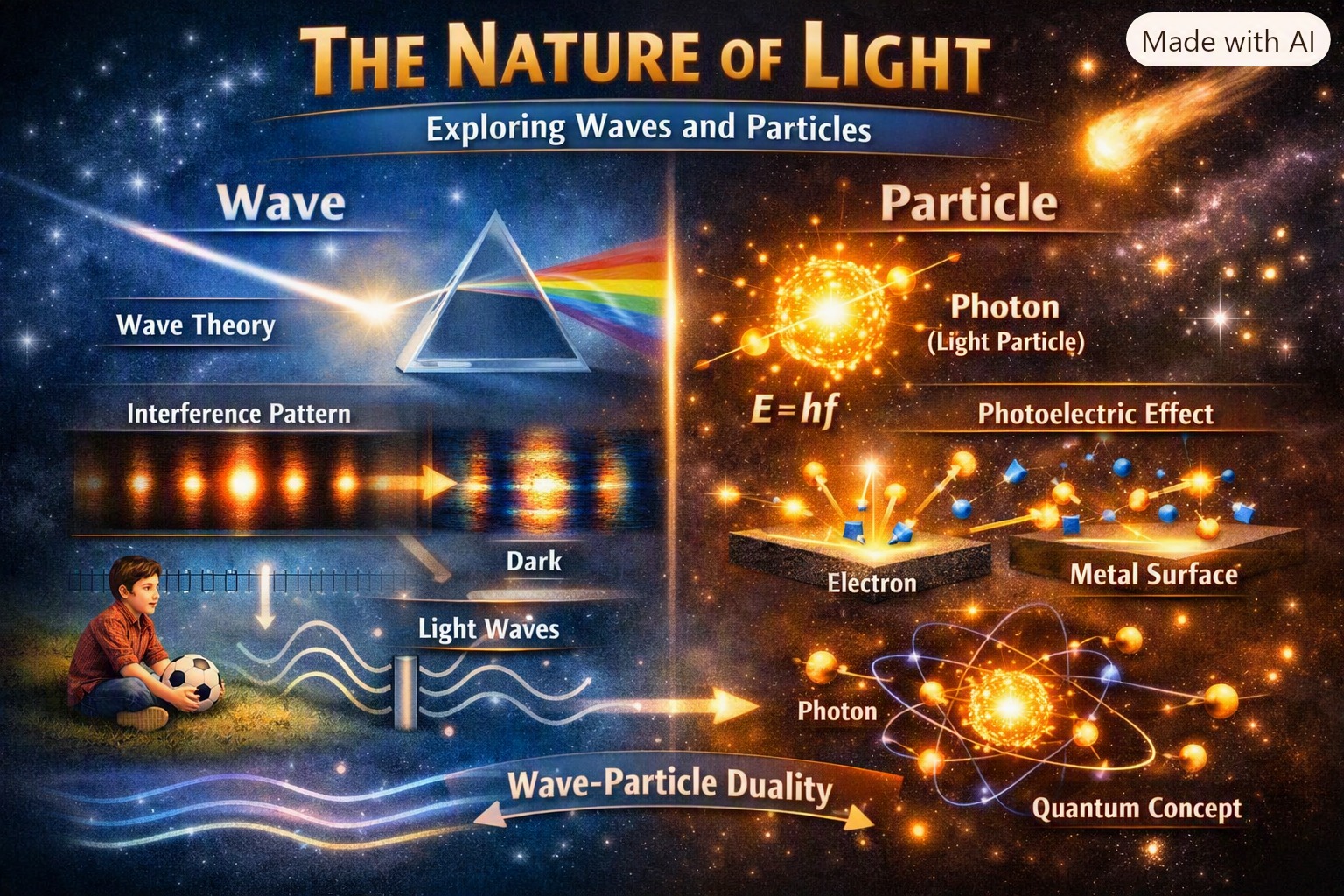
    One of the most remarkable discoveries in modern physics is that light can behave both as a wave and as a particle. Its wave nature explains phenomena such as interference, diffraction, and polarization, while its particle nature is described through photons, which carry discrete amounts of energy.
    Understanding the dual nature of light helps us explore the deeper principles of quantum physics and reveals how the same phenomenon can behave in different ways depending on how it is observed.
    #NatureOfLight #Physics #Light #WaveParticleDuality #QuantumPhysics #Photon #ScienceEducation #PhysicsEducation #STEM #LearnPhysics #Education
    RSIF8 Roll no: 99 Story post no: 24 Story topic: The Nature of Light: Exploring Waves and Particles Light is one of the most fascinating phenomena in physics. It allows us to see the world around us, carries energy across vast distances, and plays a fundamental role in technologies ranging from cameras to fiber-optic communication. One of the most remarkable discoveries in modern physics is that light can behave both as a wave and as a particle. Its wave nature explains phenomena such as interference, diffraction, and polarization, while its particle nature is described through photons, which carry discrete amounts of energy. Understanding the dual nature of light helps us explore the deeper principles of quantum physics and reveals how the same phenomenon can behave in different ways depending on how it is observed. #NatureOfLight #Physics #Light #WaveParticleDuality #QuantumPhysics #Photon #ScienceEducation #PhysicsEducation #STEM #LearnPhysics #Education
    0 Commentarios 0 Acciones 3154 Views
  • Fondation Level Batch No 4
    Roll RSLC #42
    Task No #160
    Day #160

    One evening, Ayan sat by his window watching the golden sunlight fill his room.
    He wondered how light traveled from the Sun across the vastness of space.
    The next day, he asked his science teacher about the true nature of light.
    His teacher explained that light is much more mysterious than it appears.
    Scientists discovered that light can behave both like waves and tiny particles.
    This fascinating property is called the wave-particle duality of light.
    Ayan became curious and wanted to discover how this was possible.
    He began an exciting journey into the hidden world of light.
    His teacher explained that light can behave like waves moving through space.
    Light shows reflection, refraction, diffraction, and interference in different situations.
    Reflection allows light to bounce from surfaces such as mirrors and shiny objects.
    Refraction causes light to change direction when it passes through different materials.
    Interference happens when light waves meet and interact with one another.
    These properties help explain rainbows, colors, reflections, and many other phenomena.
    Ayan realized that everyday sights could reveal important scientific secrets.
    He became even more fascinated by the mysterious behavior of light.
    Then Ayan learned that light can also behave like tiny particles called photons.
    Each photon carries energy and can interact with matter in different ways.
    This particle-like behavior helps scientists understand the photoelectric effect.
    Ayan found it amazing that light could appear as both a wave and a particle.
    His teacher explained that this strange behavior is a key idea in quantum physics.
    The quantum world does not always follow the rules we experience every day.
    Light became a perfect example of nature?s surprising complexity.
    Ayan realized that science often reveals things we cannot understand at first.
    That evening, Ayan looked at the sunlight outside with completely new eyes.
    He imagined photons traveling through space and waves carrying energy across the universe.
    He understood that something as ordinary as sunlight could hold incredible mysteries.
    The experience taught him that science is not only about learning known facts.
    It is also about asking questions and searching for answers beyond what we can see.
    Ayan felt inspired to explore more mysteries hidden throughout the universe.
    From that day forward, every beam of light reminded him of his discovery.
    He learned that even the simplest things can contain the greatest scientific wonders.


    #NatureOfLight #LightWaves #LightParticles #Photon #QuantumPhysics #ScienceExploration #PhysicsFacts
    Fondation Level Batch No 4 Roll RSLC #42 Task No #160 Day #160 One evening, Ayan sat by his window watching the golden sunlight fill his room. He wondered how light traveled from the Sun across the vastness of space. The next day, he asked his science teacher about the true nature of light. His teacher explained that light is much more mysterious than it appears. Scientists discovered that light can behave both like waves and tiny particles. This fascinating property is called the wave-particle duality of light. Ayan became curious and wanted to discover how this was possible. He began an exciting journey into the hidden world of light. His teacher explained that light can behave like waves moving through space. Light shows reflection, refraction, diffraction, and interference in different situations. Reflection allows light to bounce from surfaces such as mirrors and shiny objects. Refraction causes light to change direction when it passes through different materials. Interference happens when light waves meet and interact with one another. These properties help explain rainbows, colors, reflections, and many other phenomena. Ayan realized that everyday sights could reveal important scientific secrets. He became even more fascinated by the mysterious behavior of light. Then Ayan learned that light can also behave like tiny particles called photons. Each photon carries energy and can interact with matter in different ways. This particle-like behavior helps scientists understand the photoelectric effect. Ayan found it amazing that light could appear as both a wave and a particle. His teacher explained that this strange behavior is a key idea in quantum physics. The quantum world does not always follow the rules we experience every day. Light became a perfect example of nature?s surprising complexity. Ayan realized that science often reveals things we cannot understand at first. That evening, Ayan looked at the sunlight outside with completely new eyes. He imagined photons traveling through space and waves carrying energy across the universe. He understood that something as ordinary as sunlight could hold incredible mysteries. The experience taught him that science is not only about learning known facts. It is also about asking questions and searching for answers beyond what we can see. Ayan felt inspired to explore more mysteries hidden throughout the universe. From that day forward, every beam of light reminded him of his discovery. He learned that even the simplest things can contain the greatest scientific wonders. #NatureOfLight #LightWaves #LightParticles #Photon #QuantumPhysics #ScienceExploration #PhysicsFacts
    0 Commentarios 0 Acciones 5277 Views
  • #rsisb
    Roll No.269
    Foundation Level
    Story Post No.25

    **The Nature of Light: Exploring Waves and Particles**

    Light is one of the most fascinating phenomena in the universe. We see it every day, but have you ever wondered what light really is and how it travels? In this video, we explore the amazing nature of light and discover how it can behave both as a **wave and as a particle**.

    We will learn about the wave properties of light, including reflection, refraction, interference, and diffraction. We will also explore the particle nature of light and understand how photons help explain the behavior of light at a microscopic level.

    The wave-particle duality of light is one of the most interesting ideas in modern physics. It shows us that nature can behave in ways that are very different from our everyday experiences.

    From sunlight and rainbows to lasers, cameras, and modern technology , light plays an important role in our daily lives and in scientific discoveries.

    Join us as we explore the fascinating world of **light, waves, particles, and quantum physics**. Keep learning, stay curious, and discover the science behind the light around us!

    #Light #Physics #LightWaves #WaveParticleDuality #Particles #Photons #QuantumPhysics #Optics #Science #PhysicsFacts #ScienceEducation #Learning #Reflection #Refraction #Interference #Diffraction #ElectromagneticWaves #ScientificDiscovery #Technology #SpaceScience #Knowledge #Curiosity #StudentLife #RehanSchool #LearnAndGrow
    #rsisb Roll No.269 Foundation Level Story Post No.25 💡 **The Nature of Light: Exploring Waves and Particles** 🌈🔬 Light is one of the most fascinating phenomena in the universe. 🌟 We see it every day, but have you ever wondered what light really is and how it travels? 🤔 In this video, we explore the amazing nature of light and discover how it can behave both as a **wave and as a particle**. We will learn about the wave properties of light, including reflection, refraction, interference, and diffraction. 🌊✨ We will also explore the particle nature of light and understand how photons help explain the behavior of light at a microscopic level. 🔬⚡ The wave-particle duality of light is one of the most interesting ideas in modern physics. It shows us that nature can behave in ways that are very different from our everyday experiences. 🌌🧠 From sunlight and rainbows 🌈 to lasers, cameras, and modern technology 📷💻, light plays an important role in our daily lives and in scientific discoveries. Join us as we explore the fascinating world of **light, waves, particles, and quantum physics**. Keep learning, stay curious, and discover the science behind the light around us! 🚀📚✨ #Light 💡 #Physics 🔬 #LightWaves 🌊 #WaveParticleDuality ⚛️ #Particles #Photons ⚡ #QuantumPhysics 🌌 #Optics 👓 #Science 📚 #PhysicsFacts 🧠 #ScienceEducation 🎓 #Learning 📖 #Reflection ✨ #Refraction 🌈 #Interference 🔬 #Diffraction 🌊 #ElectromagneticWaves ⚡ #ScientificDiscovery 🔍 #Technology 💻 #SpaceScience 🚀 #Knowledge 💡 #Curiosity 🤔 #StudentLife 🎓 #RehanSchool 🏫 #LearnAndGrow 🌱
    0 Commentarios 0 Acciones 6336 Views
  • #rsisb
    Roll no.239
    Story post no.22
    Foundation Level

    Light is one of the most fascinating phenomena in the universe. It helps us see the world, carries energy from the Sun, and plays a vital role in modern technology.
    Scientists discovered that light has a **dual nature** — it behaves both like a **wave** and like a **particle**.
    As a **wave**, light can show phenomena such as **interference, diffraction, and polarization**. As a **particle**, light is made of tiny packets of energy called **photons**. The particle nature of light helps explain the **photoelectric effect**, where light can cause electrons to be released from certain materials.
    This wave-particle duality shows us that nature can be more complex than it first appears. Understanding light has helped humanity develop technologies such as **lasers, fiber-optic communication, cameras, solar panels, and medical imaging**.
    ### Key Takeaway
    **Light is neither simply a wave nor simply a particle—it exhibits properties of both, depending on how it is observed and measured.**
    #NatureOfLight #Physics #Science #Light #WaveParticleDuality #Photons #QuantumPhysics #STEM #ScienceExplained #Learning #Education
    #rsisb Roll no.239 Story post no.22 Foundation Level Light is one of the most fascinating phenomena in the universe. 🌟 It helps us see the world, carries energy from the Sun, and plays a vital role in modern technology. Scientists discovered that light has a **dual nature** — it behaves both like a **wave** and like a **particle**. 🌊⚛️ As a **wave**, light can show phenomena such as **interference, diffraction, and polarization**. As a **particle**, light is made of tiny packets of energy called **photons**. The particle nature of light helps explain the **photoelectric effect**, where light can cause electrons to be released from certain materials. This wave-particle duality shows us that nature can be more complex than it first appears. 🔬✨ Understanding light has helped humanity develop technologies such as **lasers, fiber-optic communication, cameras, solar panels, and medical imaging**. ### 🔑 Key Takeaway **Light is neither simply a wave nor simply a particle—it exhibits properties of both, depending on how it is observed and measured.** #NatureOfLight #Physics #Science #Light #WaveParticleDuality #Photons #QuantumPhysics #STEM #ScienceExplained #Learning #Education 🔬🌊⚛️
    0 Commentarios 0 Acciones 4203 Views
  • #rsisb
    Roll No.240
    Story No.15
    Foundation Level

    ### **The Nature of Light: Exploring Waves and Particles**

    Light is one of the most fascinating phenomena in the universe, playing a vital role in everything from vision and communication to modern technology and scientific discovery. Unlike ordinary objects, light exhibits a remarkable property known as **wave-particle duality**, meaning it behaves both as a wave and as a stream of tiny particles called **photons**. This unique characteristic has transformed our understanding of physics and the fundamental laws that govern the universe.

    As a wave, light travels through space in the form of electromagnetic waves, displaying properties such as reflection, refraction, interference, diffraction, and polarization. These wave behaviors explain everyday phenomena like rainbows, mirrors, lenses, and the colors we observe in nature. As particles, photons carry discrete amounts of energy, allowing light to interact with matter in ways that explain the photoelectric effect, lasers, and many modern technologies. Together, these two perspectives provide a complete understanding of how light behaves under different conditions.

    Exploring the nature of light helps us appreciate the incredible discoveries made by scientists such as Isaac Newton, Thomas Young, James Clerk Maxwell, Albert Einstein, and Max Planck. Their groundbreaking work laid the foundation for quantum mechanics, optics, telecommunications, medical imaging, fiber-optic communication, astronomy, and renewable energy technologies. From illuminating our homes to enabling space exploration, light continues to shape the modern world in extraordinary ways.

    **#NatureOfLight #Physics #Science #WaveParticleDuality #Light #Photons #ElectromagneticWaves #QuantumPhysics #Optics #STEM #Education #ScientificDiscovery #Technology #Learning #ExploreScience **

    Rehan School Islamabad Campus
    Asma Shaheen EducationWali
    Irum Asim
    Saima Happinesswali
    #rsisb Roll No.240 Story No.15 Foundation Level ### **The Nature of Light: Exploring Waves and Particles** Light is one of the most fascinating phenomena in the universe, playing a vital role in everything from vision and communication to modern technology and scientific discovery. Unlike ordinary objects, light exhibits a remarkable property known as **wave-particle duality**, meaning it behaves both as a wave and as a stream of tiny particles called **photons**. This unique characteristic has transformed our understanding of physics and the fundamental laws that govern the universe. As a wave, light travels through space in the form of electromagnetic waves, displaying properties such as reflection, refraction, interference, diffraction, and polarization. These wave behaviors explain everyday phenomena like rainbows, mirrors, lenses, and the colors we observe in nature. As particles, photons carry discrete amounts of energy, allowing light to interact with matter in ways that explain the photoelectric effect, lasers, and many modern technologies. Together, these two perspectives provide a complete understanding of how light behaves under different conditions. Exploring the nature of light helps us appreciate the incredible discoveries made by scientists such as Isaac Newton, Thomas Young, James Clerk Maxwell, Albert Einstein, and Max Planck. Their groundbreaking work laid the foundation for quantum mechanics, optics, telecommunications, medical imaging, fiber-optic communication, astronomy, and renewable energy technologies. From illuminating our homes to enabling space exploration, light continues to shape the modern world in extraordinary ways. **#NatureOfLight #Physics #Science #WaveParticleDuality #Light #Photons #ElectromagneticWaves #QuantumPhysics #Optics #STEM #Education #ScientificDiscovery #Technology #Learning #ExploreScience 🌈💡🔬⚛️📚** Rehan School Islamabad Campus Asma Shaheen EducationWali Irum Asim Saima Happinesswali
    0 Commentarios 0 Acciones 10111 Views