• ACCL TASK:160
    Day:160
    foundation level
    **The Nature of Light: Exploring Waves and Particles**
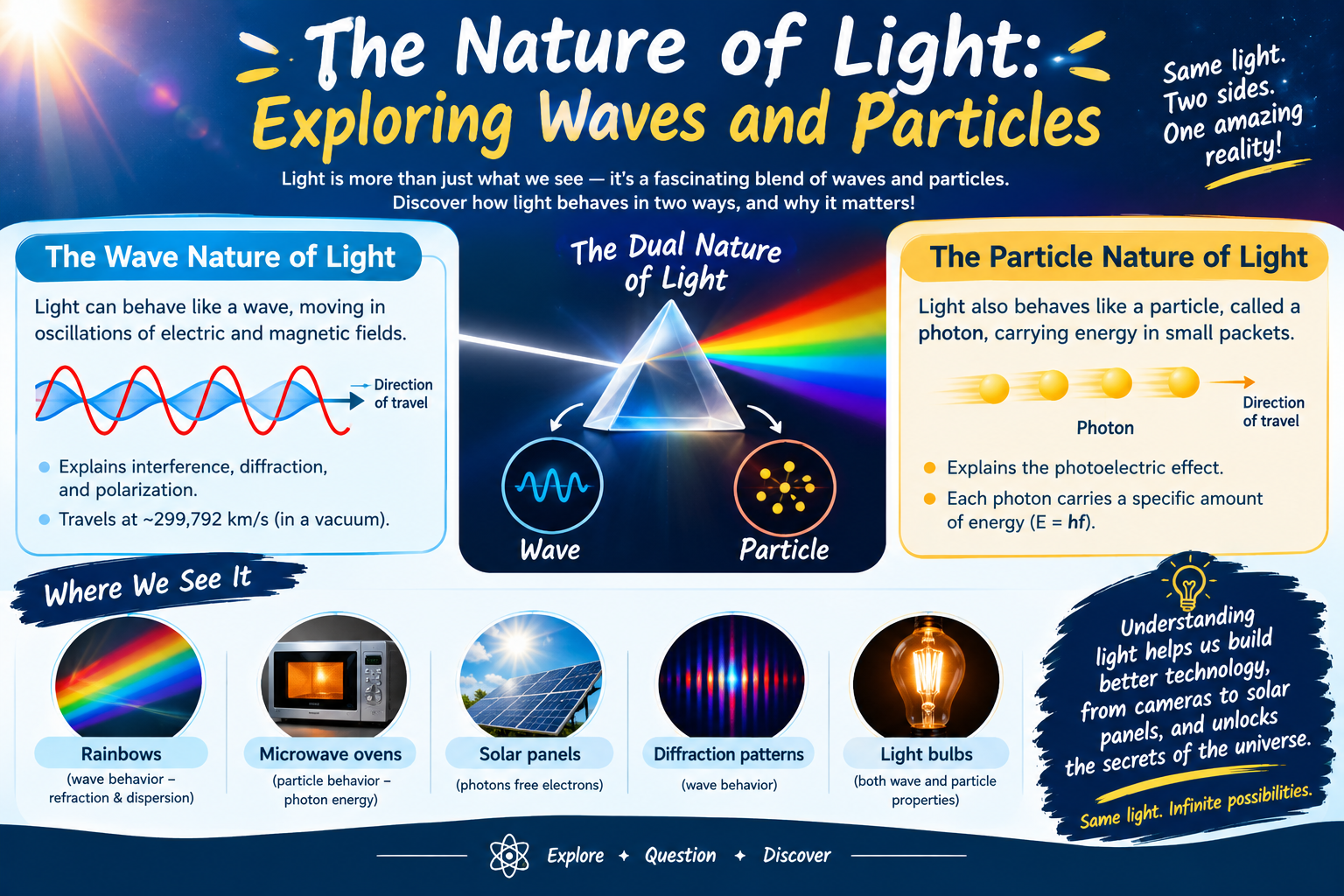
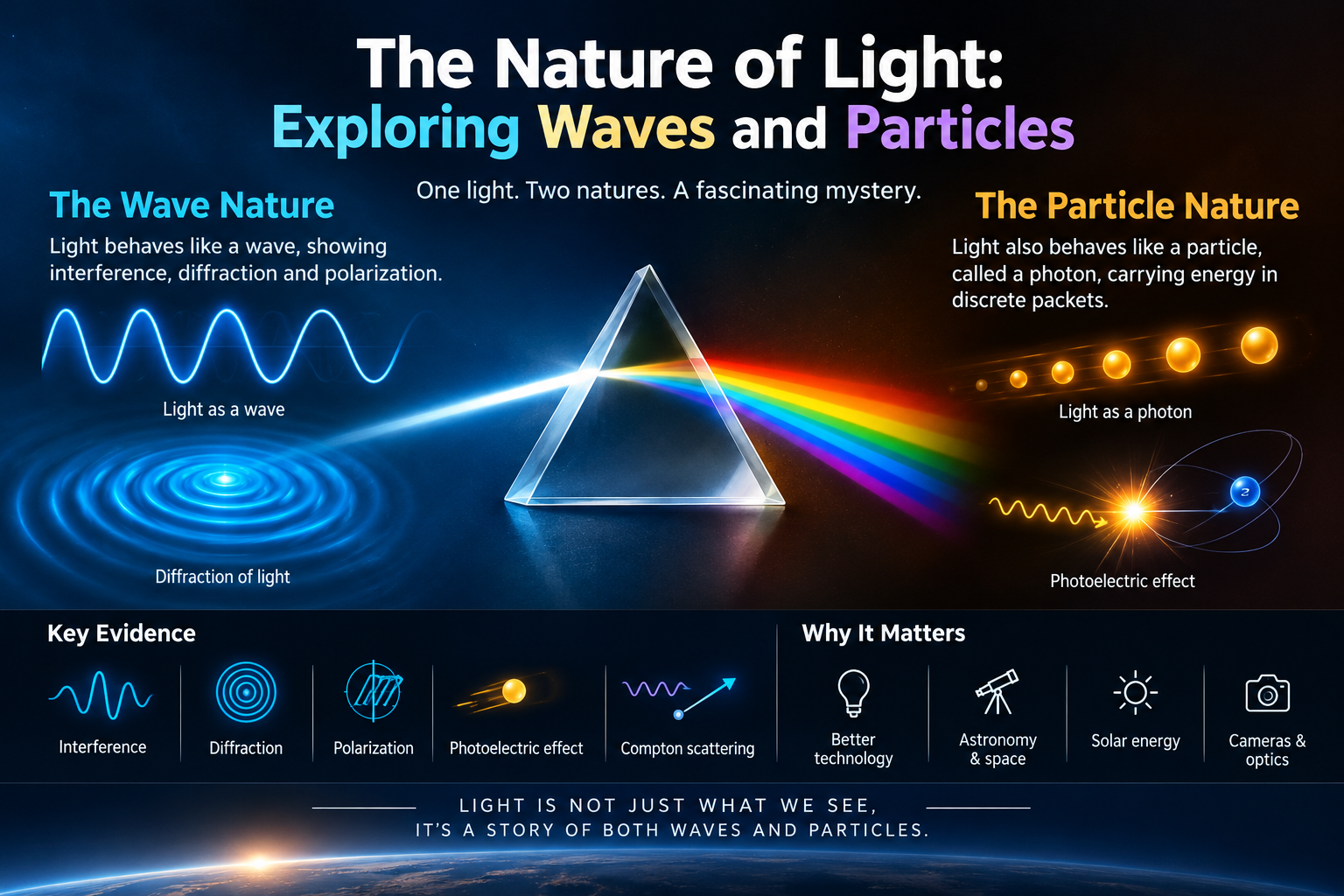
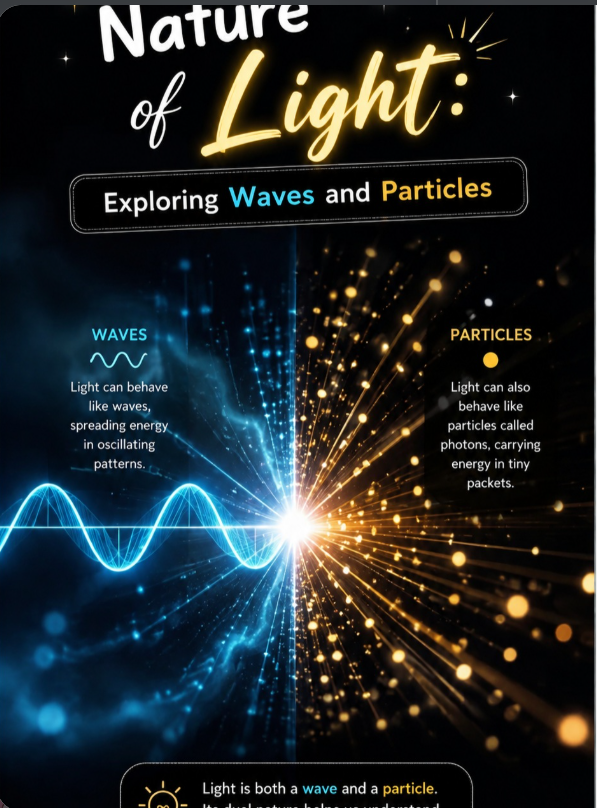
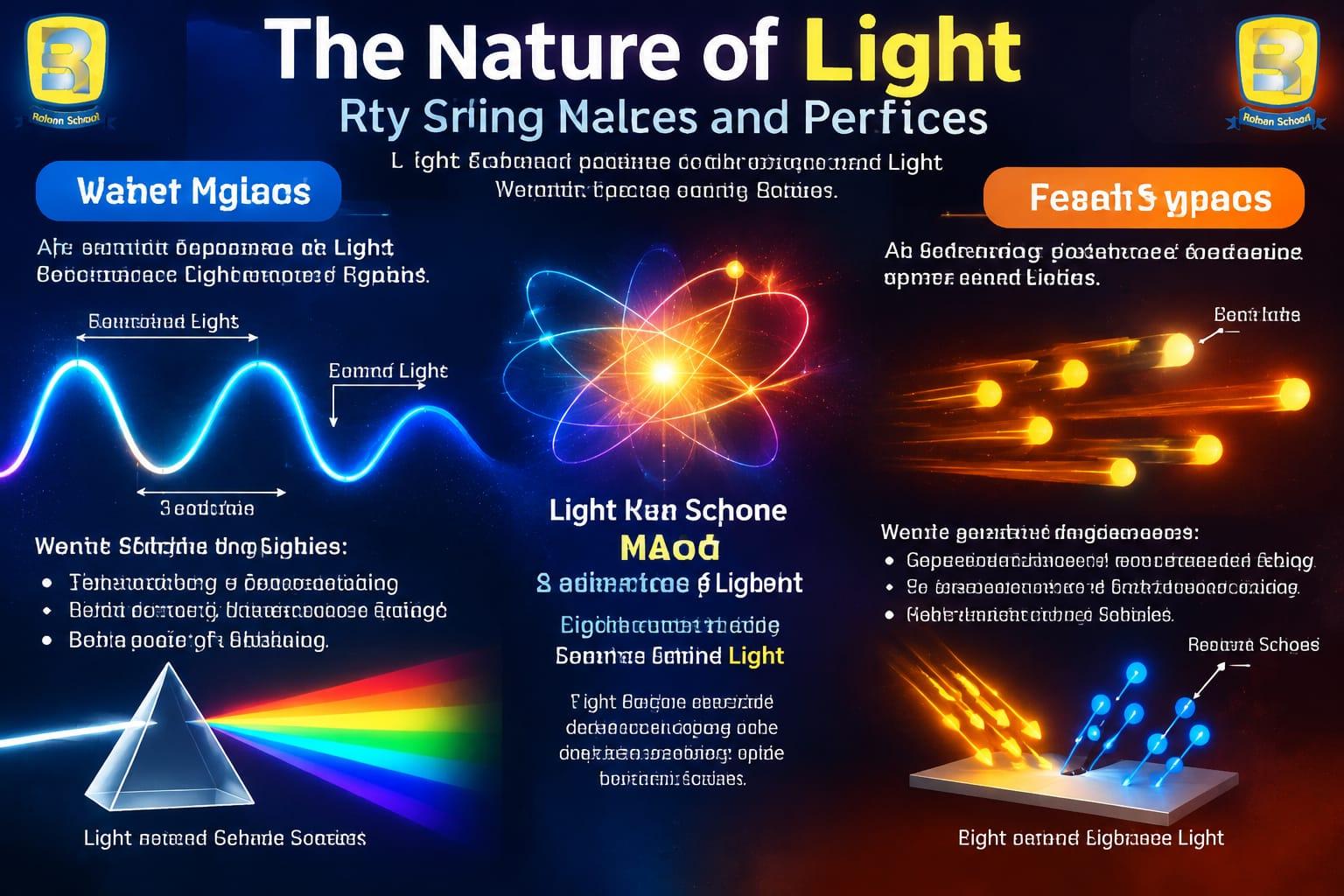
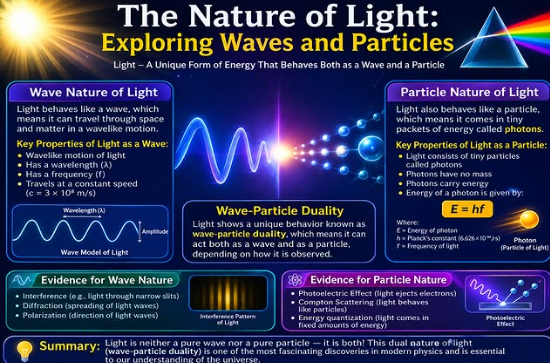
    Light is one of the most fascinating phenomena in physics. It can behave like a **wave**, showing interference, diffraction, and polarization, while also behaving like **particles called photons** that carry energy.
    From rainbows and solar panels to cameras and modern technology, understanding light helps us explore the world and the universe around us.
    #NatureOfLight #Physics #ScienceEducation #WaveParticleDuality #Photon #Learning #RehanSchool
    ACCL TASK:160 Day:160 foundation level **The Nature of Light: Exploring Waves and Particles** 🌈🔬💡 Light is one of the most fascinating phenomena in physics. It can behave like a **wave**, showing interference, diffraction, and polarization, while also behaving like **particles called photons** that carry energy. From rainbows and solar panels to cameras and modern technology, understanding light helps us explore the world and the universe around us. 🌌✨ #NatureOfLight #Physics #ScienceEducation #WaveParticleDuality #Photon #Learning #RehanSchool
    0 Kommentare 0 Anteile 2081 Ansichten
  • #rsisb Roll no:232 Foundation level student. Song No:8 🌈🎵 **Light Chasers: Exploring Colors and Refraction – Educational Song 🔬** In this creative and educational song, I explore the fascinating world of light, colors, and refraction! This song explains how light travels, bends when passing through different materials, and separates into beautiful colors. 🌞✨ Through music and creativity, I learned about reflection, refraction, prisms, the visible spectrum, and how rainbows are formed. These amazing scientific concepts help us understand the colorful world around us. 🌈💡 Let's follow the light, discover the science of colors, and make learning physics fun through music! 🎶🚀 **Hashtags:** #LightChasers #ColorsAndRefraction #Light #Refraction #Reflection #Rainbow #VisibleSpectrum #Prism #Physics #ScienceSong #EducationalSong #ScienceEducation #LearningThroughMusic #CreativeLearning #SunoAI 🌈🔬💡🎵 Irum Asim Leadershipwali Asma Shaheen EducationWali https://www.facebook.com/reel/2191918385006502/
    WWW.FACEBOOK.COM
    Facebook
    #rsisb Roll no:232 Foundation level student. Song No:8 🌈🎵 **Light Chasers: Exploring Colors and Refraction – Educational Song 🔬** In this creative and educational song, I explore the fascinating...
    0 Kommentare 0 Anteile 1767 Ansichten
  • RSIF8
    ROLL NO:92
    SONG NO:29
    TOPIC:** Light Chasers: Exploring Colors and Refraction **

    Discover the beautiful world of light, colors, and refraction through this creative educational song made with Suno.ai! Learn how light bends when it passes through different materials and how a simple prism can create the amazing colors of a rainbow. This song makes science fun, easy, and exciting for everyone!

    **Learn with music, explore with curiosity, and let science shine!**

    #LightChasers #ColorsAndRefraction #ScienceSong #SunoAI #EducationalMusic #ExploreScience #RainbowColors #Physics #LearnThroughMusic #ScienceIsFun
    RSIF8 ROLL NO:92 SONG NO:29 TOPIC:**🎵 Light Chasers: Exploring Colors and Refraction 🌈** Discover the beautiful world of light, colors, and refraction through this creative educational song made with Suno.ai! 🎶✨ Learn how light bends when it passes through different materials and how a simple prism can create the amazing colors of a rainbow. This song makes science fun, easy, and exciting for everyone! 🌟 **Learn with music, explore with curiosity, and let science shine!** #LightChasers #ColorsAndRefraction #ScienceSong #SunoAI #EducationalMusic #ExploreScience #RainbowColors #Physics #LearnThroughMusic #ScienceIsFun
    0 Kommentare 0 Anteile 1928 Ansichten 6
  • RSIF8
    Roll no.49
    Song no.34
    Song topic:Light Chasers: Exploring Colors and Refraction**

    Have you ever wondered how rainbows appear in the sky or why a pencil looks bent when placed in water? The answer lies in the amazing science of **light and refraction!** In this educational song, we explore the magic of light, discover the beautiful colors of the rainbow, and learn how light bends when it passes from one material into another. **What Youll Learn:** The colors of visible light What refraction means How prisms separate white light into colors Why rainbows appear in nature How science makes everyday life amazing! **Learning is more fun when science becomes a song!** Sing along, explore the world, and let your curiosity shine. **Question:** What is your favorite rainbow color, and have you ever seen a beautiful rainbow? Watch, enjoy, and share this educational song on all platforms!


    #LightChasers #ColorsAndRefraction #ScienceSong #EducationalSong #Rainbow #Physics #Refraction #LightAndColors #LearnWithMusic #ScienceEducation #SunoAI #CanvaVideo #RehanCodingWithAI #Facebook #Instagram #YouTube #LinkedIn #TikTok
    RSIF8 Roll no.49 Song no.34 Song topic:Light Chasers: Exploring Colors and Refraction** 🔬✨ Have you ever wondered how rainbows appear in the sky or why a pencil looks bent when placed in water? 🤔💧 The answer lies in the amazing science of **light and refraction!** ☀️ In this educational song, we explore the magic of light, discover the beautiful colors of the rainbow, and learn how light bends when it passes from one material into another. 🌟 **What Youll Learn:** ✅ The colors of visible light 🌈 ✅ What refraction means 🔬 ✅ How prisms separate white light into colors ✅ Why rainbows appear in nature 🌦️ ✅ How science makes everyday life amazing! 🎵 **Learning is more fun when science becomes a song!** Sing along, explore the world, and let your curiosity shine. 💬 **Question:** What is your favorite rainbow color, and have you ever seen a beautiful rainbow? 📢 Watch, enjoy, and share this educational song on all platforms! #LightChasers #ColorsAndRefraction #ScienceSong #EducationalSong #Rainbow #Physics #Refraction #LightAndColors #LearnWithMusic #ScienceEducation #SunoAI #CanvaVideo #RehanCodingWithAI #Facebook #Instagram #YouTube #LinkedIn #TikTok
    0 Kommentare 0 Anteile 2589 Ansichten 0
  • **Story Post | Day 160**
    **Foundation Level**
    **Roll No: 01**
    **Rehan School | Urdu Bazar Campus**

    **The Nature of Light: Exploring Waves and Particles**

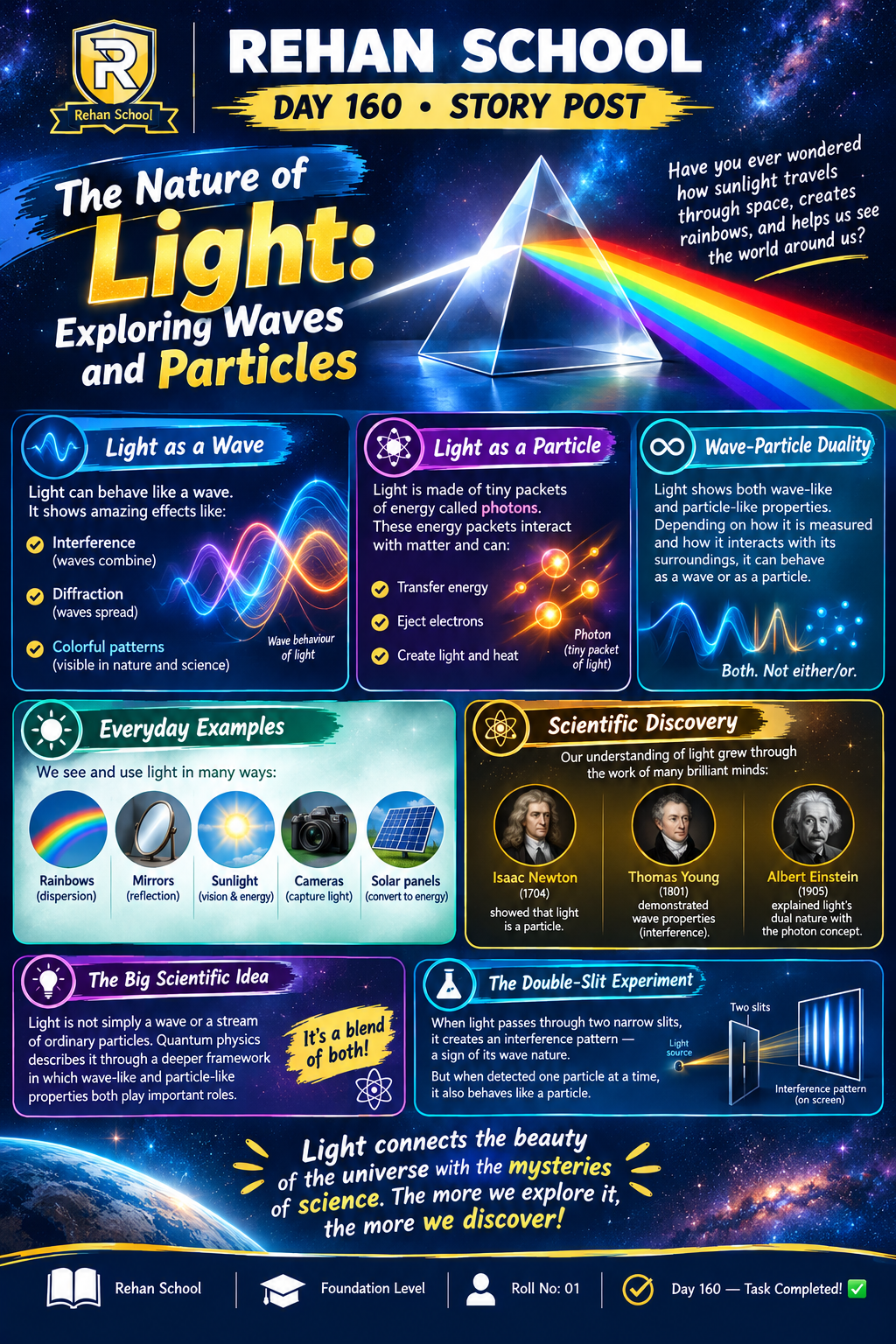
    Light is one of the most fascinating wonders of science! Through this task, I learned how light behaves like both a wave and a particle, and how photons help us understand its amazing properties.

    From colorful rainbows and reflections to cameras and solar panels, light plays an important role in our everyday lives. The discoveries of Isaac Newton, Thomas Young, and Albert Einstein helped us understand light in new and exciting ways.

    **Learning about light reminds us that curiosity and scientific exploration can reveal the hidden wonders of our universe!**

    **Rehan School | Day 160 — Task Completed! **

    #RehanSchool #UrduBazarCampus #Day160 #StoryPost #FoundationLevel #RollNo01 #Physics #NatureOfLight #ScienceEducation #KeepLearning
    📖 **Story Post | Day 160** 📚 **Foundation Level** 🔢 **Roll No: 01** 🏫 **Rehan School | Urdu Bazar Campus** 🌈 **The Nature of Light: Exploring Waves and Particles** Light is one of the most fascinating wonders of science! ✨ Through this task, I learned how light behaves like both a wave and a particle, and how photons help us understand its amazing properties. 🔬 From colorful rainbows and reflections to cameras and solar panels, light plays an important role in our everyday lives. The discoveries of Isaac Newton, Thomas Young, and Albert Einstein helped us understand light in new and exciting ways. 🌌 💡 **Learning about light reminds us that curiosity and scientific exploration can reveal the hidden wonders of our universe!** 🎓 **Rehan School | Day 160 — Task Completed! ✅** #RehanSchool #UrduBazarCampus #Day160 #StoryPost #FoundationLevel #RollNo01 #Physics #NatureOfLight #ScienceEducation #KeepLearning
    0 Kommentare 0 Anteile 3356 Ansichten
  • RSIF8
    Roll no:14
    story no:24
    story topic:The Nature of Light: Exploring Waves and Particles

    **The Nature of Light: Exploring Waves and Particles**

    Have you ever wondered what light really is? How does sunlight travel across millions of kilometers through space, how do rainbows form, and how can light behave like both a wave and a particle? The nature of light is one of the most fascinating topics in physics, revealing the extraordinary connection between the visible world and the mysterious laws of quantum mechanics. From the light that illuminates our homes to the distant stars shining in the universe, light plays an essential role in understanding the world around us.

    **1. The Wave Nature of Light **

    For many years, scientists have studied light as a wave because it demonstrates important wave-like properties. Light can undergo interference, diffraction, and polarization. Interference occurs when light waves overlap and combine, producing patterns of brightness and darkness. Diffraction happens when light spreads around an obstacle or passes through a narrow opening. Polarization describes the orientation of light's oscillations and helps us understand how light interacts with different materials.

    These properties demonstrate that the wave model is essential for explaining many optical phenomena. From colorful patterns created by thin films to the operation of polarized sunglasses, the wave nature of light has many applications in everyday life and modern technology.

    **2. The Particle Nature of Light **

    Light also behaves in ways that reveal its particle nature. In quantum physics, light energy is exchanged in discrete packets called **photons**. Each photon carries energy determined by its frequency, described by the equation **E = hf**, where E represents energy, h is Planck's constant, and f is frequency.

    The photoelectric effect provides important evidence for this particle nature. When light of a suitable frequency strikes certain materials, it can release electrons from their surfaces. This phenomenon helped scientists understand that light energy is transferred in individual quanta rather than always behaving like a continuous wave.

    Another important example is Compton scattering, in which photons exchange energy and momentum with electrons. These discoveries transformed our understanding of light and helped establish the foundations of quantum physics.

    **3. Wave-Particle Duality: Two Sides of Light**

    One of the most remarkable discoveries in science is that light cannot be fully explained by treating it only as a classical wave or only as a classical particle. Its behavior depends on the physical process being investigated and how it is measured. This concept is known as **wave-particle duality**.

    Experiments involving interference reveal wave-like patterns, while experiments involving photon detection show that light energy is detected in discrete units. Quantum mechanics brings these observations together into a more complete description of nature. Rather than being an ordinary wave or a tiny classical object, light is a quantum phenomenon with properties that challenge our everyday intuition.

    **4. How Do We Discover the Secrets of Light?**

    Scientists use carefully designed experiments to explore the behavior of light. Prisms separate white light into different colors, optical instruments measure its properties, and advanced detectors record individual photons. Interference experiments reveal patterns that cannot be explained by simple particle models, while photoelectric experiments demonstrate the importance of quantized energy.

    The work of scientists such as Isaac Newton, Thomas Young, Max Planck, Albert Einstein, and Arthur Compton helped build our modern understanding of light. Their discoveries show how scientific knowledge develops through observation, experimentation, mathematical reasoning, and new ideas.

    **5. Why Is the Nature of Light Important?**

    Understanding light is essential to many technologies that shape modern life. Lasers are used in medicine, manufacturing, and scientific research. Fiber-optic cables transmit information across the world using pulses of light. Solar panels convert light energy into electrical energy, while cameras and telescopes help us capture images and explore distant objects in space.

    The principles of light are also important in astronomy, microscopy, optical communication, quantum technologies, and the study of the universe. By investigating how light behaves, scientists can examine distant galaxies, study the structure of matter, and develop new tools that improve our understanding of nature.

    **6. Light: Connecting Science and the Universe**

    Light is much more than what allows us to see. It carries information about distant stars, reveals the composition of celestial objects, and provides clues about the physical processes occurring throughout the cosmos. By analyzing the light received from distant galaxies, astronomers can learn about their temperatures, chemical compositions, and motion.

    At the smallest scales, the study of photons helps scientists investigate the quantum world and understand how energy interacts with matter. From the smallest laboratory experiments to the largest astronomical observations, light connects different areas of science in extraordinary ways.

    **Conclusion: The Extraordinary Mystery of Light**

    The study of light demonstrates how nature can be far more complex than it first appears. Its wave-like properties explain interference, diffraction, and polarization, while its particle-like properties help explain the photoelectric effect and Compton scattering. Together, these discoveries form an important part of our modern understanding of physics.

    Learning about wave-particle duality encourages us to question assumptions, explore scientific evidence, and appreciate the discoveries that continue to expand human knowledge. Every beam of sunlight, every shining star, and every photon detected by a scientific instrument reminds us that there is still much to discover about the universe.

    **Light Is More Than What We See—It Is a Window into the Fundamental Nature of Reality!**

    If you enjoyed this science topic, share it with others and continue exploring the fascinating world of physics. Stay curious, keep asking questions, and never stop learning!

    #NatureOfLight #WaveParticleDuality #Physics #QuantumPhysics #ScienceEducation #Photons #LightWaves #PhotoelectricEffect #ComptonScattering #Optics #Astronomy #ScientificDiscoveries #STEMEducation #LearnPhysics #ScienceExplained #EducationalContent #WavesAndParticles
    RSIF8 Roll no:14 story no:24 story topic:The Nature of Light: Exploring Waves and Particles 🌟 **The Nature of Light: Exploring Waves and Particles** 🌈🔬 Have you ever wondered what light really is? How does sunlight travel across millions of kilometers through space, how do rainbows form, and how can light behave like both a wave and a particle? The nature of light is one of the most fascinating topics in physics, revealing the extraordinary connection between the visible world and the mysterious laws of quantum mechanics. From the light that illuminates our homes to the distant stars shining in the universe, light plays an essential role in understanding the world around us. 🌍✨ 💡 **1. The Wave Nature of Light 🌊** For many years, scientists have studied light as a wave because it demonstrates important wave-like properties. Light can undergo interference, diffraction, and polarization. Interference occurs when light waves overlap and combine, producing patterns of brightness and darkness. Diffraction happens when light spreads around an obstacle or passes through a narrow opening. Polarization describes the orientation of light's oscillations and helps us understand how light interacts with different materials. These properties demonstrate that the wave model is essential for explaining many optical phenomena. From colorful patterns created by thin films to the operation of polarized sunglasses, the wave nature of light has many applications in everyday life and modern technology. ⚛️ **2. The Particle Nature of Light ✨** Light also behaves in ways that reveal its particle nature. In quantum physics, light energy is exchanged in discrete packets called **photons**. Each photon carries energy determined by its frequency, described by the equation **E = hf**, where E represents energy, h is Planck's constant, and f is frequency. The photoelectric effect provides important evidence for this particle nature. When light of a suitable frequency strikes certain materials, it can release electrons from their surfaces. This phenomenon helped scientists understand that light energy is transferred in individual quanta rather than always behaving like a continuous wave. Another important example is Compton scattering, in which photons exchange energy and momentum with electrons. These discoveries transformed our understanding of light and helped establish the foundations of quantum physics. 🔬 **3. Wave-Particle Duality: Two Sides of Light** One of the most remarkable discoveries in science is that light cannot be fully explained by treating it only as a classical wave or only as a classical particle. Its behavior depends on the physical process being investigated and how it is measured. This concept is known as **wave-particle duality**. Experiments involving interference reveal wave-like patterns, while experiments involving photon detection show that light energy is detected in discrete units. Quantum mechanics brings these observations together into a more complete description of nature. Rather than being an ordinary wave or a tiny classical object, light is a quantum phenomenon with properties that challenge our everyday intuition. 🌈 **4. How Do We Discover the Secrets of Light?** Scientists use carefully designed experiments to explore the behavior of light. Prisms separate white light into different colors, optical instruments measure its properties, and advanced detectors record individual photons. Interference experiments reveal patterns that cannot be explained by simple particle models, while photoelectric experiments demonstrate the importance of quantized energy. The work of scientists such as Isaac Newton, Thomas Young, Max Planck, Albert Einstein, and Arthur Compton helped build our modern understanding of light. Their discoveries show how scientific knowledge develops through observation, experimentation, mathematical reasoning, and new ideas. 🚀 **5. Why Is the Nature of Light Important?** Understanding light is essential to many technologies that shape modern life. Lasers are used in medicine, manufacturing, and scientific research. Fiber-optic cables transmit information across the world using pulses of light. Solar panels convert light energy into electrical energy, while cameras and telescopes help us capture images and explore distant objects in space. The principles of light are also important in astronomy, microscopy, optical communication, quantum technologies, and the study of the universe. By investigating how light behaves, scientists can examine distant galaxies, study the structure of matter, and develop new tools that improve our understanding of nature. 🌍 **6. Light: Connecting Science and the Universe** Light is much more than what allows us to see. It carries information about distant stars, reveals the composition of celestial objects, and provides clues about the physical processes occurring throughout the cosmos. By analyzing the light received from distant galaxies, astronomers can learn about their temperatures, chemical compositions, and motion. At the smallest scales, the study of photons helps scientists investigate the quantum world and understand how energy interacts with matter. From the smallest laboratory experiments to the largest astronomical observations, light connects different areas of science in extraordinary ways. 💫 **Conclusion: The Extraordinary Mystery of Light** The study of light demonstrates how nature can be far more complex than it first appears. Its wave-like properties explain interference, diffraction, and polarization, while its particle-like properties help explain the photoelectric effect and Compton scattering. Together, these discoveries form an important part of our modern understanding of physics. Learning about wave-particle duality encourages us to question assumptions, explore scientific evidence, and appreciate the discoveries that continue to expand human knowledge. Every beam of sunlight, every shining star, and every photon detected by a scientific instrument reminds us that there is still much to discover about the universe. ✨ **Light Is More Than What We See—It Is a Window into the Fundamental Nature of Reality!** 🔭🌌 👍 If you enjoyed this science topic, share it with others and continue exploring the fascinating world of physics. Stay curious, keep asking questions, and never stop learning! #NatureOfLight #WaveParticleDuality #Physics #QuantumPhysics #ScienceEducation #Photons #LightWaves #PhotoelectricEffect #ComptonScattering #Optics #Astronomy #ScientificDiscoveries #STEMEducation #LearnPhysics #ScienceExplained #EducationalContent #WavesAndParticles 🌈🔬🚀

    0 Kommentare 0 Anteile 11684 Ansichten
  • RSIF8
    Roll no 94
    Story post no 23
    Story post topic
    The Nature of Light: Exploring Waves and Particles
    Light is one of the most fascinating wonders of the universe! It behaves like both a wave and a particle , helping scientists understand everything from rainbows to modern technology . Exploring the dual nature of light reveals how amazing and mysterious our world truly is.
    #NatureOfLight #ScienceFacts #WavesAndParticles #Physics #STEMEducation #LearningIsFun #ScienceLovers #ExploreScience #Knowledge #Innovation
    RSIF8 Roll no 94 Story post no 23 Story post topic 🌟 The Nature of Light: Exploring Waves and Particles 🌟 Light is one of the most fascinating wonders of the universe! 💡✨ It behaves like both a wave 🌊 and a particle ⚛️, helping scientists understand everything from rainbows 🌈 to modern technology 📱. Exploring the dual nature of light reveals how amazing and mysterious our world truly is. 🔬🌍 #NatureOfLight #ScienceFacts #WavesAndParticles #Physics #STEMEducation #LearningIsFun #ScienceLovers #ExploreScience #Knowledge #Innovation ✨🔭🌟
    0 Kommentare 0 Anteile 2532 Ansichten
  • #rsisb
    Roll no.279
    story post no.23
    Foundation Level
    The Mystery of Light: A Journey Through the Universe
    Once upon a time, a curious student wanted to discover the secrets of light. Every morning, sunlight entered his room and filled it with brightness. He wondered, “How does light travel, and why does it sometimes behave like a wave and sometimes like a particle?”
    He began exploring science and learned that light travels incredibly fast and helps us see the world around us. He discovered that rainbows form when sunlight interacts with water droplets. He also learned that light is made of tiny packets of energy called photons.
    With every discovery, his curiosity grew stronger. He realized that science is full of mysteries waiting to be explored. His journey taught him one important lesson: Never stop asking questions, because every question can lead to a new discovery!
    \#ScienceStory #NatureOfLight #WavesAndParticles #Curiosity #Physics #KeepLearning
    Asma Shaheen EducationWali
    Saima Empowerment Wali
    Irum Asim Leadershipwali
    #rsisb Roll no.279 story post no.23 Foundation Level 🌟 The Mystery of Light: A Journey Through the Universe 🌌💡 Once upon a time, a curious student wanted to discover the secrets of light. 🔍✨ Every morning, sunlight entered his room and filled it with brightness. ☀️ He wondered, “How does light travel, and why does it sometimes behave like a wave and sometimes like a particle?” 🌊⚛️ He began exploring science and learned that light travels incredibly fast and helps us see the world around us. 🌈🔬 He discovered that rainbows form when sunlight interacts with water droplets. 🌦️🌈 He also learned that light is made of tiny packets of energy called photons. ⚡ With every discovery, his curiosity grew stronger. 🚀 He realized that science is full of mysteries waiting to be explored. His journey taught him one important lesson: Never stop asking questions, because every question can lead to a new discovery! 💡📚🌍 \#ScienceStory #NatureOfLight #WavesAndParticles #Curiosity #Physics #KeepLearning 🔬🌈✨ Asma Shaheen EducationWali Saima Empowerment Wali Irum Asim Leadershipwali
    0 Kommentare 0 Anteile 2235 Ansichten
  • Mohsin RS F8
    Story post NO:19
    roll NO:13
    Class: Foundation Level
    Made by Me

    The Nature of Light: Exploring Waves and Particles

    Light is one of the most fascinating phenomena in the universe. We see it every day, from the warm glow of the Sun to the colors of a rainbow, but understanding what light actually is has been one of the most interesting challenges in the history of science. The topic “The Nature of Light: Exploring Waves and Particles” takes us on an exciting journey into the world of physics and helps us understand why light can behave in two seemingly different ways.

    For a long time, scientists debated whether light should be understood as a wave or as a collection of tiny particles. Experiments eventually showed that light has characteristics of both waves and particles. This remarkable property is known as wave-particle duality and is one of the foundations of modern physics.

    Light as a Wave

    When we study light as a wave, we can describe it using properties such as wavelength, frequency, and amplitude. Light can demonstrate wave behaviors such as interference, diffraction, and polarization. The famous double-slit experiment provides a powerful example of how light can create an interference pattern, showing behavior associated with waves.

    Different wavelengths of visible light correspond to different colors. When white light passes through a prism, it can separate into a beautiful spectrum of colors, reminding us that the light around us contains a fascinating range of electromagnetic radiation.

    Light as a Particle

    Light also displays particle-like behavior. In modern physics, these particles are called photons. A photon is a quantum of electromagnetic energy, and its energy is related to the frequency of light through the equation:

    E = hf

    Here, E represents the energy of a photon, h is Planck’s constant, and f is the frequency of the light.

    The photoelectric effect provided important evidence for the particle nature of light. In this phenomenon, light can transfer energy to electrons in certain materials. This discovery played an important role in the development of quantum physics.
    Mohsin RS F8 🎓✨ Story post NO:19 roll NO:13 Class: Foundation Level 📚 Made by Me 💻🚀 🌟 The Nature of Light: Exploring Waves and Particles 💡🌈 Light is one of the most fascinating phenomena in the universe. We see it every day, from the warm glow of the Sun to the colors of a rainbow, but understanding what light actually is has been one of the most interesting challenges in the history of science. The topic “The Nature of Light: Exploring Waves and Particles” takes us on an exciting journey into the world of physics and helps us understand why light can behave in two seemingly different ways. For a long time, scientists debated whether light should be understood as a wave or as a collection of tiny particles. Experiments eventually showed that light has characteristics of both waves and particles. This remarkable property is known as wave-particle duality and is one of the foundations of modern physics. 🌊 Light as a Wave When we study light as a wave, we can describe it using properties such as wavelength, frequency, and amplitude. Light can demonstrate wave behaviors such as interference, diffraction, and polarization. The famous double-slit experiment provides a powerful example of how light can create an interference pattern, showing behavior associated with waves. Different wavelengths of visible light correspond to different colors. When white light passes through a prism, it can separate into a beautiful spectrum of colors, reminding us that the light around us contains a fascinating range of electromagnetic radiation. ✨ Light as a Particle Light also displays particle-like behavior. In modern physics, these particles are called photons. A photon is a quantum of electromagnetic energy, and its energy is related to the frequency of light through the equation: E = hf Here, E represents the energy of a photon, h is Planck’s constant, and f is the frequency of the light. The photoelectric effect provided important evidence for the particle nature of light. In this phenomenon, light can transfer energy to electrons in certain materials. This discovery played an important role in the development of quantum physics.
    0 Kommentare 0 Anteile 3336 Ansichten
  • ACCL Day 160

    The Story of Lumi—the Light Explorer

    Lumi was a tiny traveler made of pure light. He moved faster than anything in existence—no one could catch him. When Lumi wanted to stretch and spread out, he became a wave, flowing smoothly like ripples on a calm ocean. He could bend, reflect, refract, and even create beautiful rainbows.

    But when Lumi needed to deliver energy, he transformed into a particle called a photon—small, fast, and precise like a tiny messenger.

    One day, Lumi traveled to Earth to explore a lab where scientists performed the famous double-slit experiment. Lumi giggled as he created wave patterns on the screen—but when scientists watched him closely, he instantly turned into particles.

    “It’s my magic!” Lumi laughed.

    “You can be a wave AND a particle?” a scientist asked.

    “Yes,” Lumi said proudly. “I am both, depending on how you look at me. That’s the secret of light.”

    Aniyal smiled as he imagined Lumi flying around the universe, switching between wave and particle like a superhero with two powers. Suddenly, the sunlight in his classroom felt more alive—more magical.

    Light wasn’t just brightness.
    It was a mystery.
    A traveler.
    A dual-natured wonder that shaped everything in the universe.

    And from that day on, whenever Aniyal saw light—whether from the sun, a lamp, or his phone—he remembered Lumi, the explorer of waves and particles.

    The world felt brighter.
    ACCL Day 160 ✨ The Story of Lumi—the Light Explorer ✨ Lumi was a tiny traveler made of pure light. He moved faster than anything in existence—no one could catch him. When Lumi wanted to stretch and spread out, he became a wave, flowing smoothly like ripples on a calm ocean. He could bend, reflect, refract, and even create beautiful rainbows. But when Lumi needed to deliver energy, he transformed into a particle called a photon—small, fast, and precise like a tiny messenger. One day, Lumi traveled to Earth to explore a lab where scientists performed the famous double-slit experiment. Lumi giggled as he created wave patterns on the screen—but when scientists watched him closely, he instantly turned into particles. “It’s my magic!” Lumi laughed. “You can be a wave AND a particle?” a scientist asked. “Yes,” Lumi said proudly. “I am both, depending on how you look at me. That’s the secret of light.” Aniyal smiled as he imagined Lumi flying around the universe, switching between wave and particle like a superhero with two powers. Suddenly, the sunlight in his classroom felt more alive—more magical. Light wasn’t just brightness. It was a mystery. A traveler. A dual-natured wonder that shaped everything in the universe. And from that day on, whenever Aniyal saw light—whether from the sun, a lamp, or his phone—he remembered Lumi, the explorer of waves and particles. The world felt brighter. ✨
    0 Kommentare 0 Anteile 1527 Ansichten
Suchergebnis