• Fondation Level Batch No 4
    Roll RSLC #42
    Task No #146
    Day #146

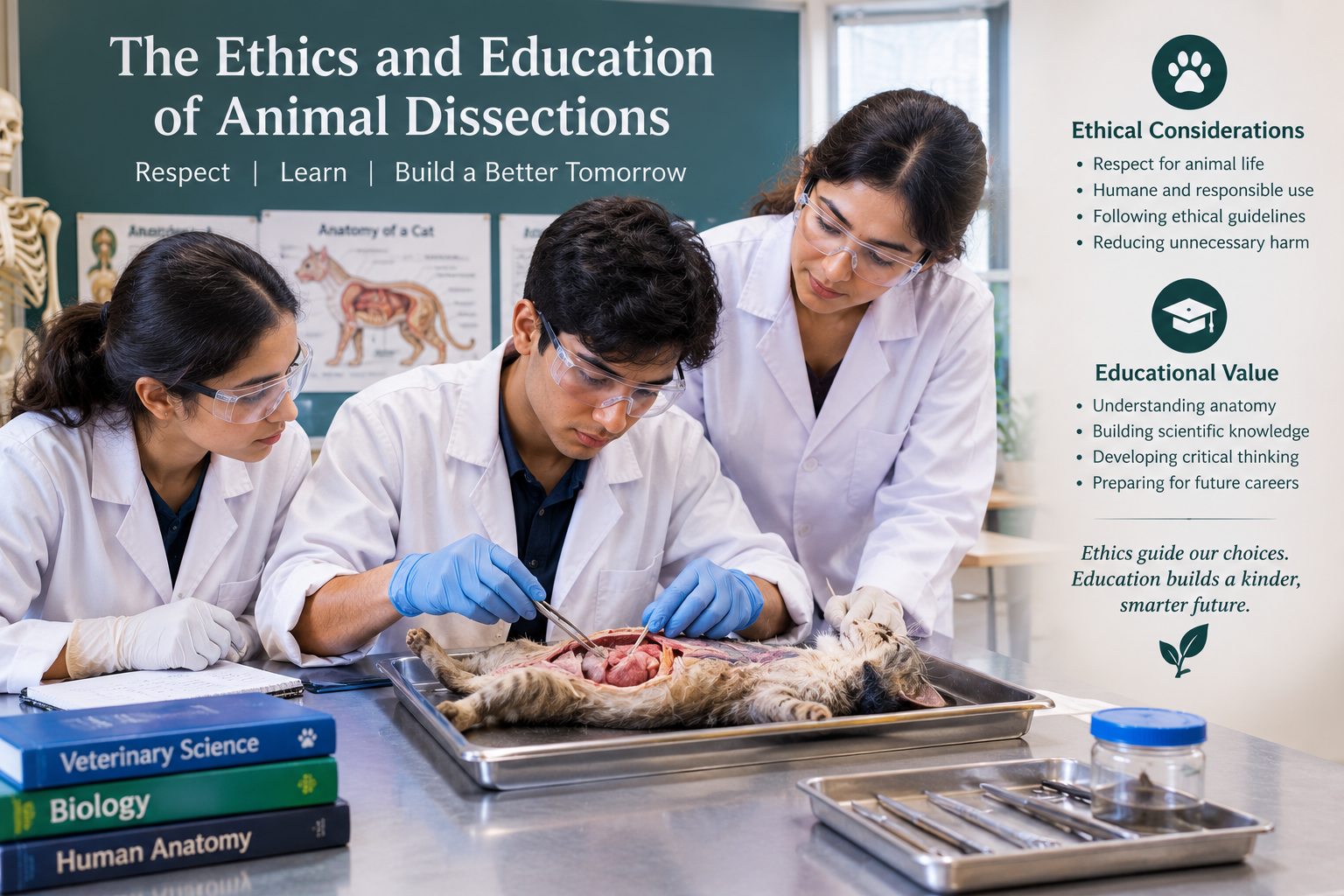
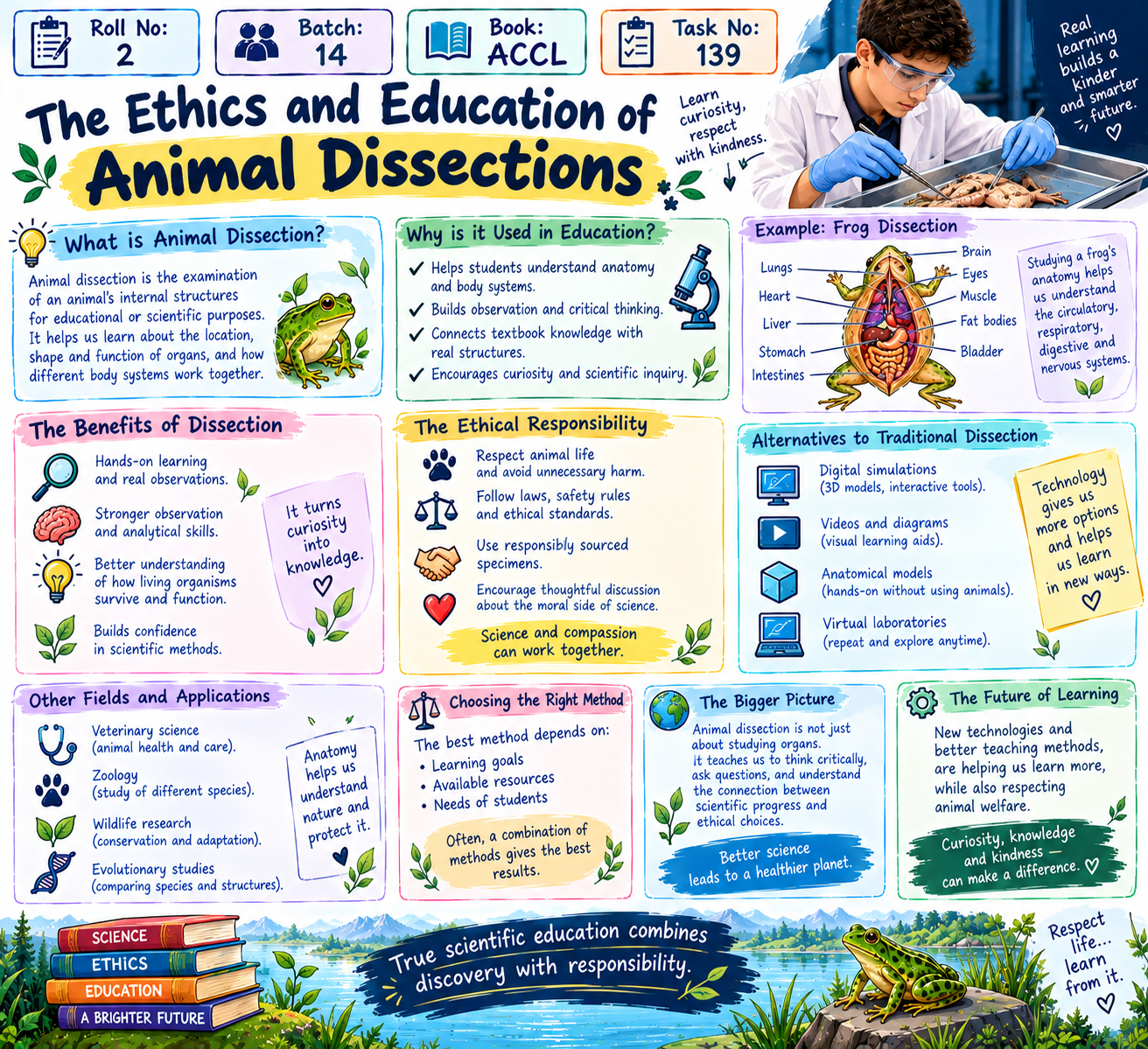
    # The Ethics and Education of Animal Dissections

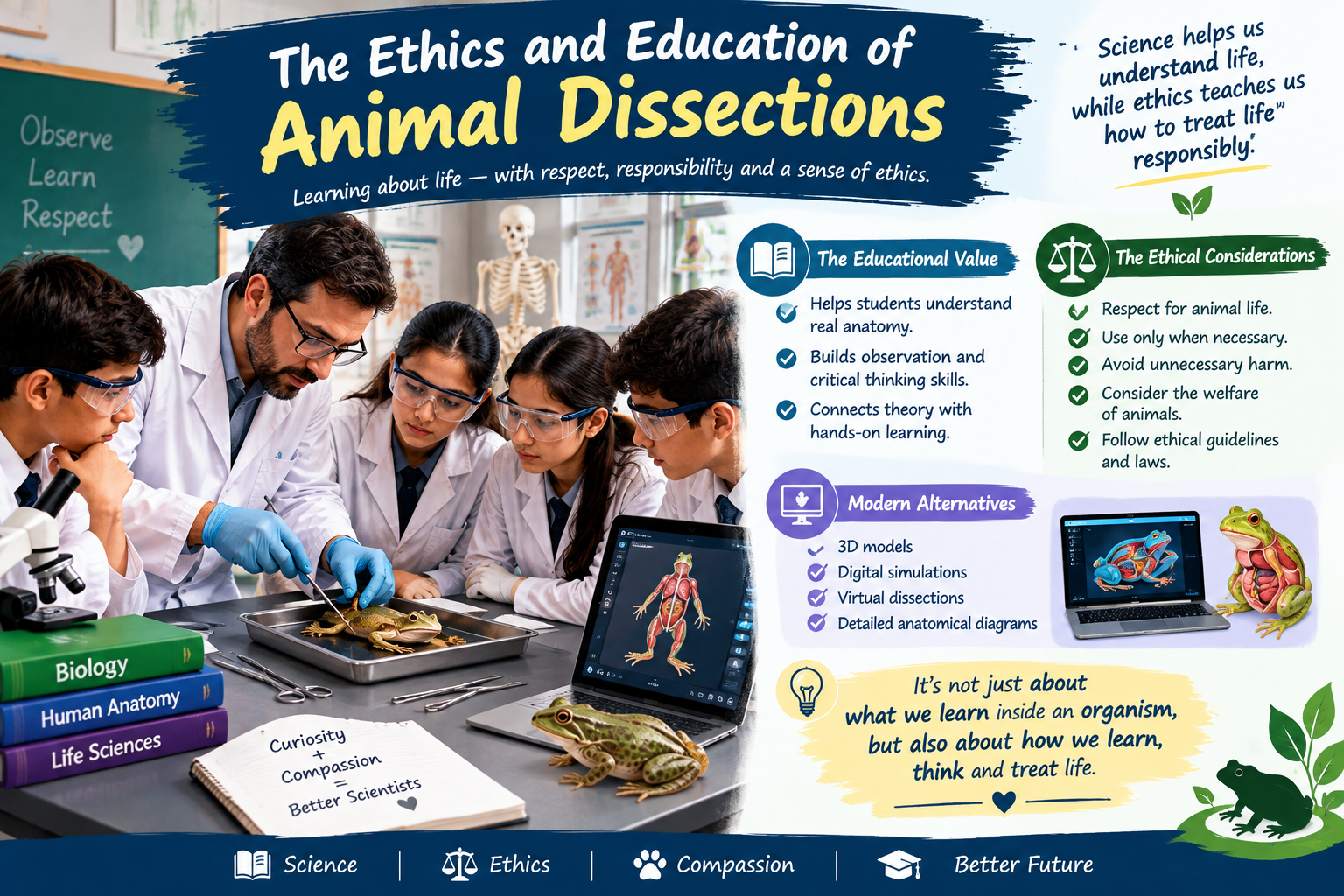
    On a bright Monday morning, Sara entered her biology classroom with excitement and curiosity. Her teacher, Ms. Helen, announced that the students would be learning about animal anatomy through a dissection lesson. Sara had always wanted to understand how living bodies worked, but she also wondered whether using animals for education was the right choice. Before beginning, Ms. Helen reminded the class that science was not only about discovering facts?it was also about making responsible and ethical decisions.

    During the lesson, Sara carefully observed the specimen and began to understand how different organs worked together. However, Ms. Helen explained that animals should never be treated as ordinary objects. They were living beings and deserved respect. She told the students that every use of an animal in education should have a clear purpose and that unnecessary harm should always be avoided.

    One student asked, ?Can we learn anatomy without using real animals?? Ms. Helen explained that modern technology now offers alternatives such as virtual dissections, 3D models, computer simulations, and artificial specimens. These methods can help students understand anatomy while reducing the need for animal use. Sara realized that scientific progress was not only about learning more, but also about finding kinder and more responsible ways to learn.

    At the end of the lesson, Sara wrote in her notebook, ?True science seeks knowledge without forgetting kindness.? She understood that education should develop knowledge, compassion, responsibility, and respect. From that day forward, she looked at science differently and realized that the best discoveries are those that help us understand life while also teaching us to value it.

    ## Moral Lesson

    **True education combines knowledge with compassion. Science should seek understanding while respecting life and choosing ethical ways to learn whenever possible.**

    #AnimalDissection #EthicsInScience #BiologyEducation #AnimalWelfare #ScienceEducation #EthicalLearning
    Fondation Level Batch No 4 Roll RSLC #42 Task No #146 Day #146 # The Ethics and Education of Animal Dissections On a bright Monday morning, Sara entered her biology classroom with excitement and curiosity. Her teacher, Ms. Helen, announced that the students would be learning about animal anatomy through a dissection lesson. Sara had always wanted to understand how living bodies worked, but she also wondered whether using animals for education was the right choice. Before beginning, Ms. Helen reminded the class that science was not only about discovering facts?it was also about making responsible and ethical decisions. During the lesson, Sara carefully observed the specimen and began to understand how different organs worked together. However, Ms. Helen explained that animals should never be treated as ordinary objects. They were living beings and deserved respect. She told the students that every use of an animal in education should have a clear purpose and that unnecessary harm should always be avoided. One student asked, ?Can we learn anatomy without using real animals?? Ms. Helen explained that modern technology now offers alternatives such as virtual dissections, 3D models, computer simulations, and artificial specimens. These methods can help students understand anatomy while reducing the need for animal use. Sara realized that scientific progress was not only about learning more, but also about finding kinder and more responsible ways to learn. At the end of the lesson, Sara wrote in her notebook, ?True science seeks knowledge without forgetting kindness.? She understood that education should develop knowledge, compassion, responsibility, and respect. From that day forward, she looked at science differently and realized that the best discoveries are those that help us understand life while also teaching us to value it. ## Moral Lesson **True education combines knowledge with compassion. Science should seek understanding while respecting life and choosing ethical ways to learn whenever possible.** #AnimalDissection #EthicsInScience #BiologyEducation #AnimalWelfare #ScienceEducation #EthicalLearning
    0 Comments 0 Shares 675 Views
  • #rsisb
    Roll no.247
    Foundation level

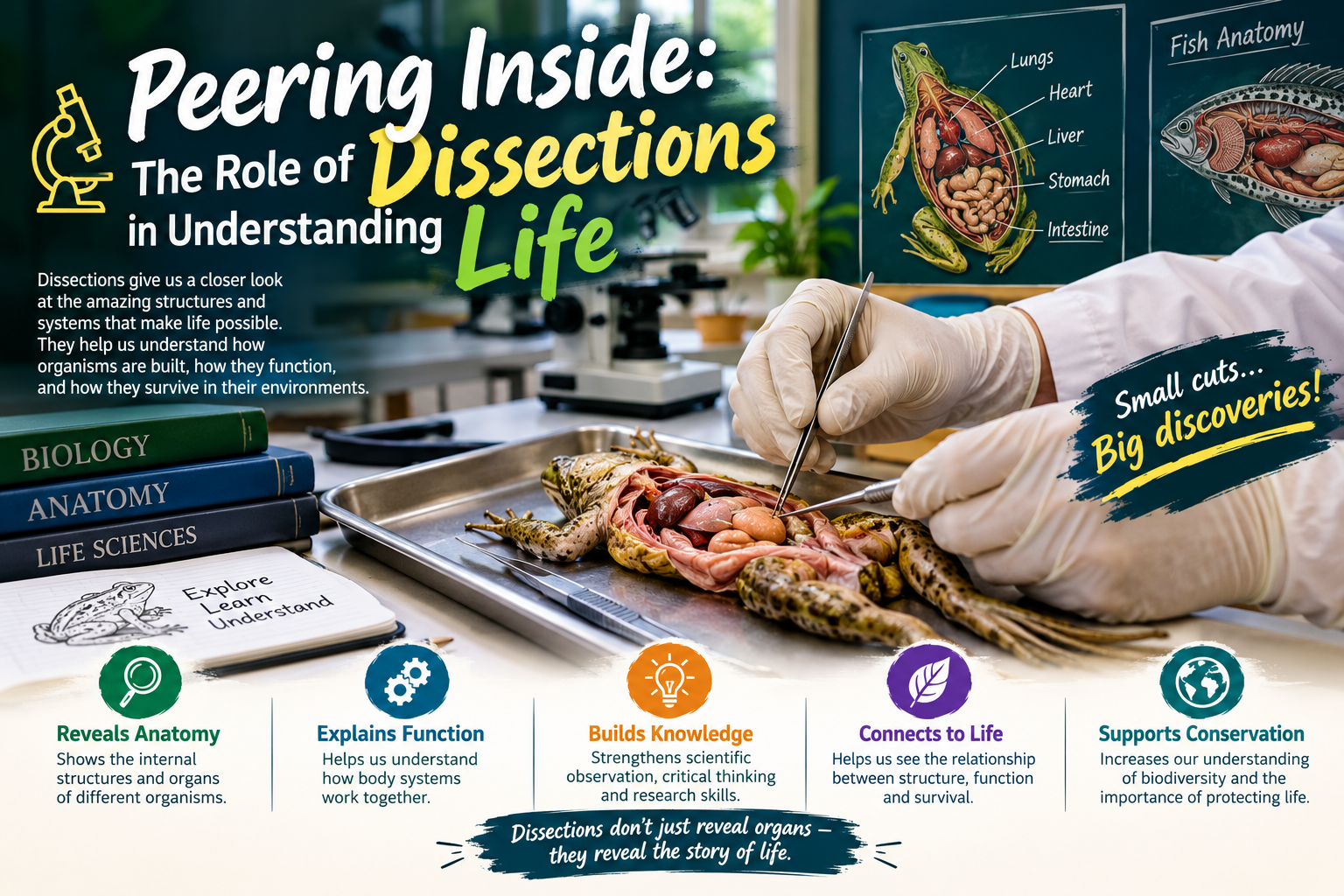
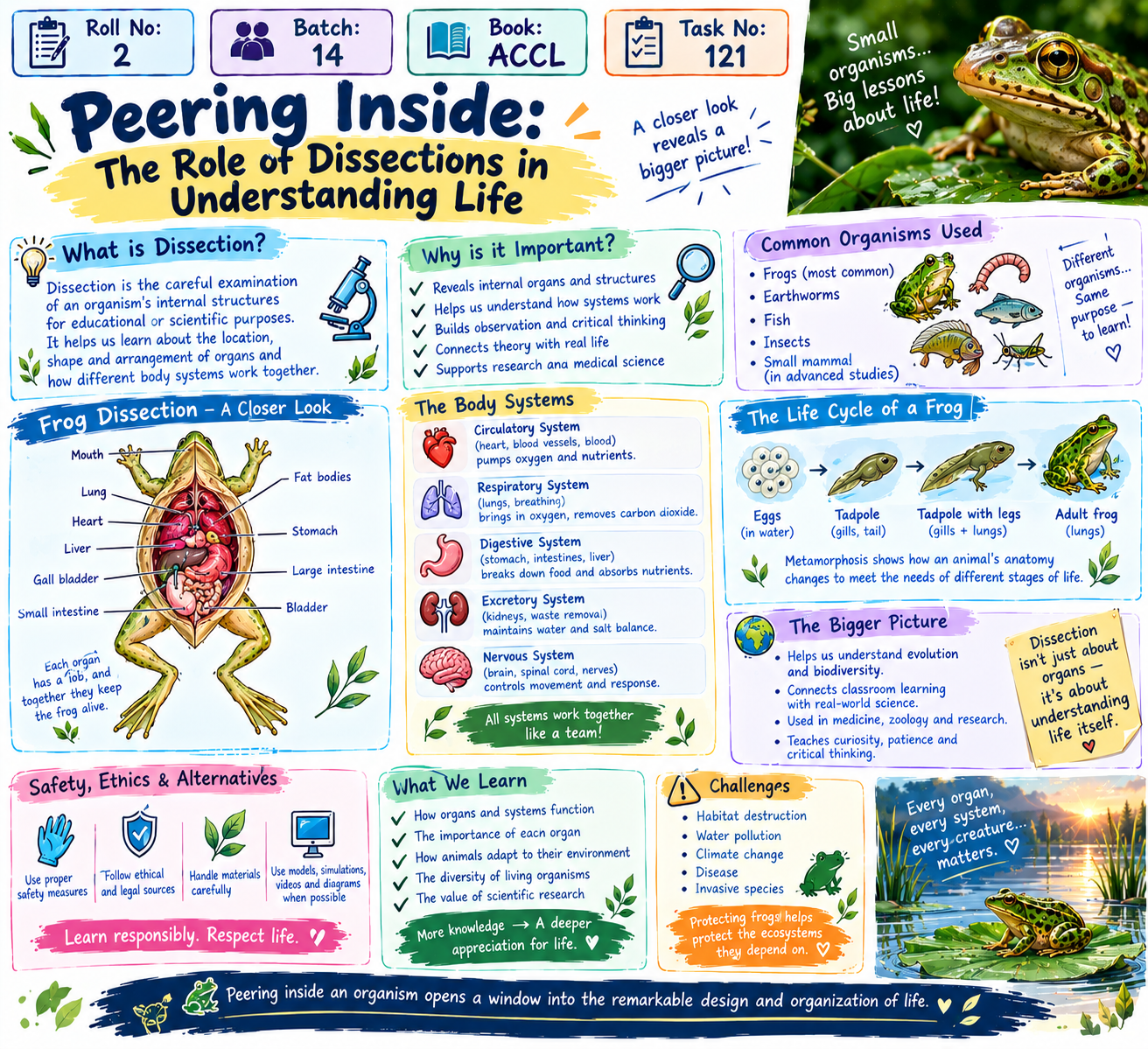
    **Peering Inside: The Role of Dissections in Understanding Life**

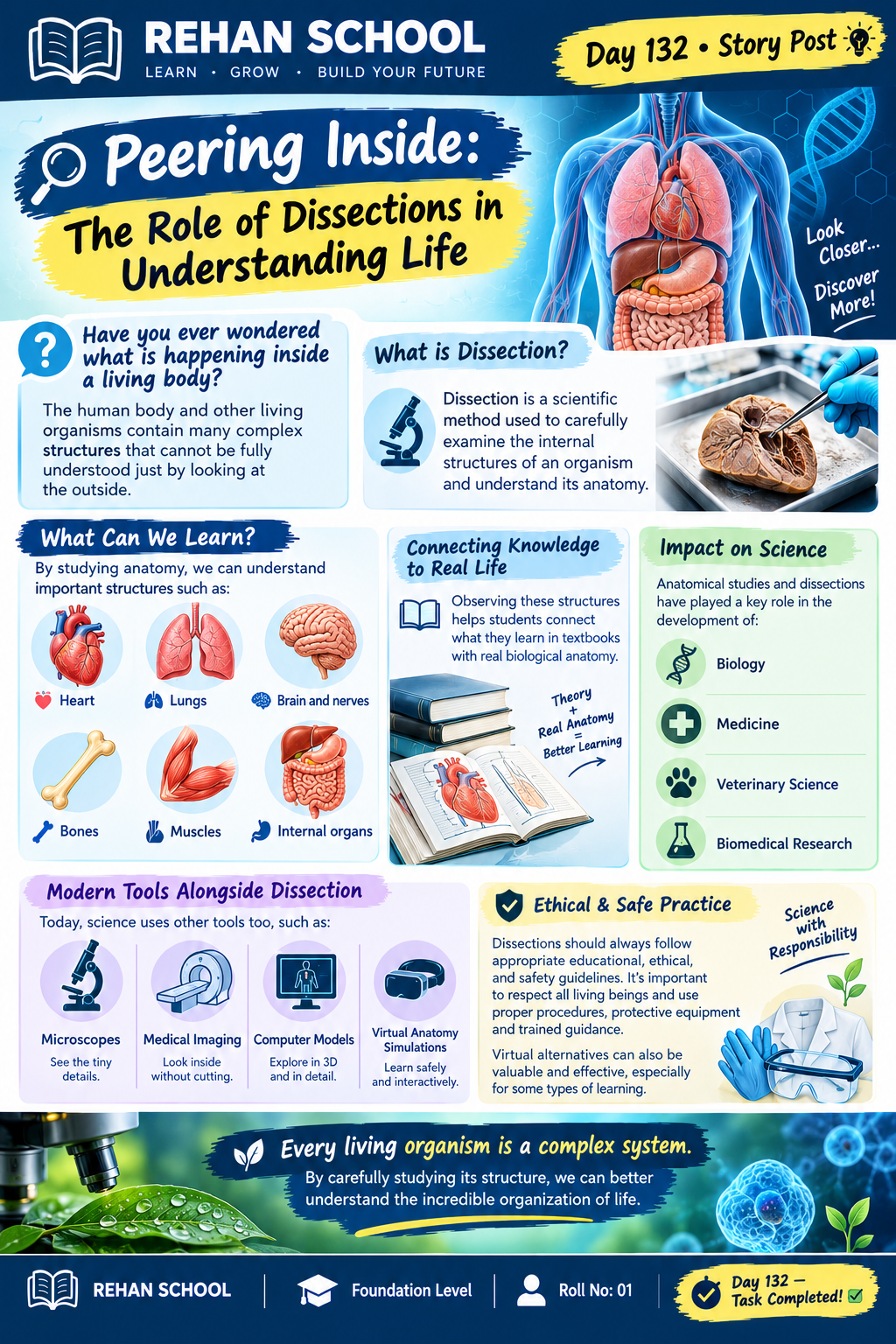
    Dissections have played an important role in helping students and scientists understand the incredible complexity of living organisms. By carefully examining biological structures, learners can move beyond diagrams and textbooks to develop a clearer understanding of how different organs, tissues, and body systems are connected.

    The study of anatomy through dissection can encourage curiosity, careful observation, scientific thinking, and respect for the complexity of life. It helps learners ask meaningful questions: How does an organ function? How are body systems connected? Why does each structure have a particular shape and position?

    From frogs and other organisms to modern anatomical models and digital simulations, the exploration of biological structures continues to support science education. Modern technology also provides alternatives such as 3D models, virtual dissections, and interactive simulations, making anatomy accessible in different ways.

    Most importantly, studying anatomy reminds us that life is a remarkable system of interconnected parts. Every structure has a role, and understanding those relationships helps us appreciate biology at a deeper level.

    Let’s explore, observe, question, and learn—because every discovery begins with curiosity!

    #Dissection #Biology #Anatomy #LifeScience #ScienceEducation #BiologyLearning #HumanAnatomy #AnimalAnatomy #ScientificDiscovery #ScienceExperiment #LearningBiology #STEMEducation #ScienceStudents #Curiosity #ExploreScience #AnatomyEducation #BiologicalSciences #ScienceJourney #LearnAndDiscover #UnderstandingLife
    #rsisb Roll no.247 Foundation level πŸ§¬πŸ”¬ **Peering Inside: The Role of Dissections in Understanding Life** 🐸✨ Dissections have played an important role in helping students and scientists understand the incredible complexity of living organisms. By carefully examining biological structures, learners can move beyond diagrams and textbooks to develop a clearer understanding of how different organs, tissues, and body systems are connected. πŸ«€πŸ«πŸ§  The study of anatomy through dissection can encourage curiosity, careful observation, scientific thinking, and respect for the complexity of life. It helps learners ask meaningful questions: How does an organ function? How are body systems connected? Why does each structure have a particular shape and position? πŸ€”πŸ”Ž From frogs and other organisms to modern anatomical models and digital simulations, the exploration of biological structures continues to support science education. πŸŒ±πŸΈπŸ’‘ Modern technology also provides alternatives such as 3D models, virtual dissections, and interactive simulations, making anatomy accessible in different ways. Most importantly, studying anatomy reminds us that life is a remarkable system of interconnected parts. Every structure has a role, and understanding those relationships helps us appreciate biology at a deeper level. 🌍🧬❀️ Let’s explore, observe, question, and learn—because every discovery begins with curiosity! πŸ”¬πŸ“šβœ¨ #Dissection #Biology #Anatomy #LifeScience #ScienceEducation #BiologyLearning #HumanAnatomy #AnimalAnatomy #ScientificDiscovery #ScienceExperiment #LearningBiology #STEMEducation #ScienceStudents #Curiosity #ExploreScience #AnatomyEducation #BiologicalSciences #ScienceJourney #LearnAndDiscover #UnderstandingLife πŸ§¬πŸ”¬πŸΈπŸ“šβœ¨
    0 Comments 0 Shares 3174 Views
  • #rsisb
    roll no.247
    Coding task no.7
    Foundation Level
    # The Ethics and Education of Animal Dissections
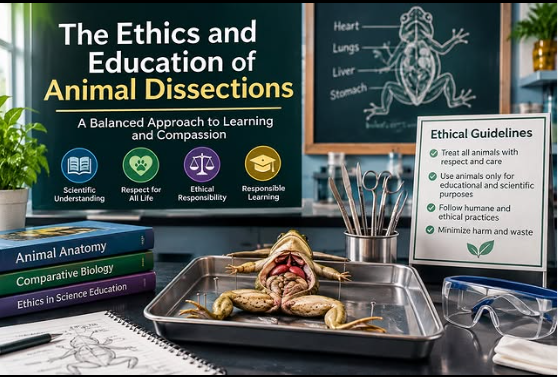
    Animal dissection has been an important part of science education for many years, especially in biology and anatomy classes. It allows students to observe the structure of organisms directly and understand how different body parts work together. However, the practice also raises important ethical questions about animal welfare, respect for living beings, and whether there are better educational alternatives.
    From an educational perspective, dissections can provide students with a hands-on learning experience that textbooks and diagrams cannot always provide. Students may develop a clearer understanding of anatomy, biological organization, and scientific observation. Practical activities can also encourage curiosity, careful observation, teamwork, and responsible scientific thinking.
    At the same time, ethical considerations should be taken seriously. Animals should not be treated simply as objects for classroom activities. Their use should follow appropriate welfare standards, and students should be encouraged to think about why an animal is being used and whether the educational objective could be achieved through another method.
    Modern education offers several alternatives, including high-quality anatomical models, computer simulations, virtual dissection programs, videos, and interactive digital resources. These approaches can sometimes provide detailed visual information while reducing or eliminating the need to use animals. For some students, alternatives may also make learning more comfortable and accessible.
    The most responsible approach is to balance educational value with ethical responsibility. Schools and teachers can carefully evaluate whether dissection is necessary, explain the ethical issues to students, follow proper guidelines, and provide suitable alternatives when appropriate.
    Ultimately, science education should not only teach students about biology—it should also teach them values such as compassion, responsibility, critical thinking, and respect for life. By combining scientific knowledge with ethical awareness, students can become better scientists, thoughtful citizens, and responsible stewards of the natural world.
    ### Key Message
    Animal dissection can offer valuable educational experiences, but it should always be considered alongside animal welfare, ethical responsibility, and modern alternatives. The goal of education should be to develop both **scientific understanding and compassion**.
    ### Hashtags
    #AnimalDissection #EthicsInScience #ScienceEducation #AnimalWelfare #BiologyEducation #EthicalScience #HandsOnLearning #VirtualLearning #ScienceAndEthics #StudentLearning #Biology #Anatomy #ScientificThinking #ResponsibleScience #EducationMatters #CompassionAndScience #STEMEducation #LearningThroughScience #RespectForLife #FutureScientists
    #rsisb roll no.247 Coding task no.7 Foundation Level # The Ethics and Education of Animal Dissections πŸ§ͺπŸΎπŸ“š Animal dissection has been an important part of science education for many years, especially in biology and anatomy classes. It allows students to observe the structure of organisms directly and understand how different body parts work together. However, the practice also raises important ethical questions about animal welfare, respect for living beings, and whether there are better educational alternatives. βš–οΈπŸΎ From an educational perspective, dissections can provide students with a hands-on learning experience that textbooks and diagrams cannot always provide. Students may develop a clearer understanding of anatomy, biological organization, and scientific observation. πŸ”¬πŸ“–βœ¨ Practical activities can also encourage curiosity, careful observation, teamwork, and responsible scientific thinking. At the same time, ethical considerations should be taken seriously. Animals should not be treated simply as objects for classroom activities. Their use should follow appropriate welfare standards, and students should be encouraged to think about why an animal is being used and whether the educational objective could be achieved through another method. ❀️🐾🌱 Modern education offers several alternatives, including high-quality anatomical models, computer simulations, virtual dissection programs, videos, and interactive digital resources. πŸ’»πŸ§¬ These approaches can sometimes provide detailed visual information while reducing or eliminating the need to use animals. For some students, alternatives may also make learning more comfortable and accessible. The most responsible approach is to balance educational value with ethical responsibility. Schools and teachers can carefully evaluate whether dissection is necessary, explain the ethical issues to students, follow proper guidelines, and provide suitable alternatives when appropriate. πŸŒβš–οΈ Ultimately, science education should not only teach students about biology—it should also teach them values such as compassion, responsibility, critical thinking, and respect for life. πŸ§ πŸ’šπŸΎ By combining scientific knowledge with ethical awareness, students can become better scientists, thoughtful citizens, and responsible stewards of the natural world. πŸŒ±πŸ”¬βœ¨ ### 🌟 Key Message Animal dissection can offer valuable educational experiences, but it should always be considered alongside animal welfare, ethical responsibility, and modern alternatives. The goal of education should be to develop both **scientific understanding and compassion**. πŸΎβ€οΈπŸ“š ### 🏷️ Hashtags #AnimalDissection #EthicsInScience #ScienceEducation #AnimalWelfare #BiologyEducation #EthicalScience #HandsOnLearning #VirtualLearning #ScienceAndEthics #StudentLearning #Biology #Anatomy #ScientificThinking #ResponsibleScience #EducationMatters #CompassionAndScience #STEMEducation #LearningThroughScience #RespectForLife #FutureScientists
    0 Comments 0 Shares 7055 Views
  • #rsisb
    Roll no.239
    Foundation Level

    Animal dissections have been used in biology education to help students understand **anatomy, organs, tissues, and body systems**. By examining specimens directly, students can connect what they learn from textbooks and diagrams with real biological structures.

    However, dissections also raise important **ethical questions**. Students and educators should consider animal welfare, the purpose of the dissection, and whether suitable alternatives are available. Dissections should be conducted with respect, following appropriate ethical and safety standards.

    Modern education can also use **3D models, digital simulations, videos, and virtual dissections**. These tools can provide valuable anatomical learning while reducing or eliminating the need to use animal specimens.

    The goal of education should be to develop scientific knowledge while also encouraging **responsibility, compassion, and respect for life**.

    **In simple words: Animal dissections can provide valuable biological knowledge, but responsible education should balance scientific learning with ethical considerations and appropriate alternatives.**
    #rsisb Roll no.239 Foundation Level Animal dissections have been used in biology education to help students understand **anatomy, organs, tissues, and body systems**. By examining specimens directly, students can connect what they learn from textbooks and diagrams with real biological structures. However, dissections also raise important **ethical questions**. Students and educators should consider animal welfare, the purpose of the dissection, and whether suitable alternatives are available. Dissections should be conducted with respect, following appropriate ethical and safety standards. Modern education can also use **3D models, digital simulations, videos, and virtual dissections**. These tools can provide valuable anatomical learning while reducing or eliminating the need to use animal specimens. The goal of education should be to develop scientific knowledge while also encouraging **responsibility, compassion, and respect for life**. **In simple words: Animal dissections can provide valuable biological knowledge, but responsible education should balance scientific learning with ethical considerations and appropriate alternatives.**
    0 Comments 0 Shares 2237 Views
  • #rsisb
    Roll no.239
    Foundation Level


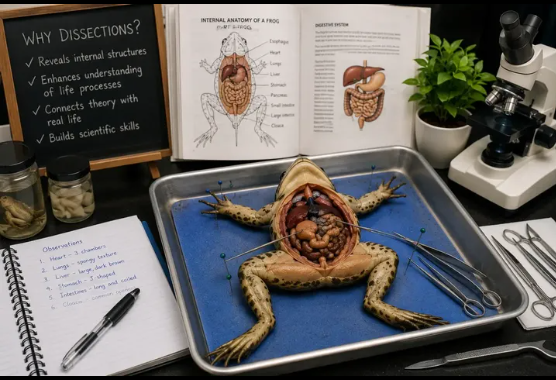
    **Dissection** is an important method used in biology to understand the internal structure of living organisms. By carefully examining organs, tissues, and body systems, students and scientists can learn how different parts of an organism are arranged and how they work together.

    Dissections provide a practical experience that books and diagrams cannot always provide. For example, studying a frog dissection can help students understand the **heart, lungs, liver, stomach, intestines, and other organs** in their natural positions. This hands-on learning can make biological concepts easier to understand and remember.

    Dissection also plays a role in **medical education and scientific research**. It has helped humans develop a deeper understanding of anatomy, disease, and the relationships between different body systems.

    However, dissections should always be performed responsibly, following **ethical guidelines, safety procedures, and respect for living organisms**. Modern alternatives, such as digital simulations and 3D anatomical models, can also provide valuable learning experiences.

    Overall, dissections help us **“peer inside” life** and transform biological knowledge from something we simply read about into something we can observe and understand more clearly.
    #rsisb Roll no.239 Foundation Level **Dissection** is an important method used in biology to understand the internal structure of living organisms. By carefully examining organs, tissues, and body systems, students and scientists can learn how different parts of an organism are arranged and how they work together. Dissections provide a practical experience that books and diagrams cannot always provide. For example, studying a frog dissection can help students understand the **heart, lungs, liver, stomach, intestines, and other organs** in their natural positions. This hands-on learning can make biological concepts easier to understand and remember. Dissection also plays a role in **medical education and scientific research**. It has helped humans develop a deeper understanding of anatomy, disease, and the relationships between different body systems. However, dissections should always be performed responsibly, following **ethical guidelines, safety procedures, and respect for living organisms**. Modern alternatives, such as digital simulations and 3D anatomical models, can also provide valuable learning experiences. Overall, dissections help us **“peer inside” life** and transform biological knowledge from something we simply read about into something we can observe and understand more clearly.
    0 Comments 0 Shares 3059 Views
  • #rsisb
    Roll No.240
    Story No.17
    Foundation level

    ### **The Ethics and Education of Animal Dissections**

    Animal dissection has long been an important part of biology and medical education, helping students understand anatomy, physiology, and the complex structures of living organisms. By examining real biological specimens, learners gain hands-on experience that strengthens their observation, critical thinking, and scientific investigation skills. For many years, dissections have played a significant role in preparing future doctors, veterinarians, scientists, and researchers by providing practical knowledge that complements classroom learning.

    At the same time, animal dissections raise important ethical questions about animal welfare, responsible scientific practice, and the balance between educational benefits and respect for living creatures. Modern education encourages students to consider these ethical perspectives while learning about science. Many schools and universities now offer alternatives such as virtual dissections, 3D anatomical models, computer simulations, and interactive digital laboratories. These innovative tools provide effective learning experiences while reducing the need for animal specimens in many educational settings.

    Understanding the ethics of animal dissection helps students develop not only scientific knowledge but also compassion, responsibility, and respect for life. By combining ethical awareness with scientific inquiry, educators can inspire future generations to pursue discovery in ways that are both innovative and humane. This balanced approach promotes critical thinking, responsible decision-making, and a deeper appreciation for the relationship between science, education, and the living world.

    **#AnimalDissection #Biology #ScienceEducation #Ethics #STEM #BiologyLab #Anatomy #LifeSciences #ScientificLearning #AnimalWelfare #Education #MedicalScience #CriticalThinking #Research #Science **

    Rehan School Islamabad Campus
    Asma Shaheen EducationWali
    Irum Asim
    Saima Happinesswali
    #rsisb Roll No.240 Story No.17 Foundation level ### **The Ethics and Education of Animal Dissections** Animal dissection has long been an important part of biology and medical education, helping students understand anatomy, physiology, and the complex structures of living organisms. By examining real biological specimens, learners gain hands-on experience that strengthens their observation, critical thinking, and scientific investigation skills. For many years, dissections have played a significant role in preparing future doctors, veterinarians, scientists, and researchers by providing practical knowledge that complements classroom learning. At the same time, animal dissections raise important ethical questions about animal welfare, responsible scientific practice, and the balance between educational benefits and respect for living creatures. Modern education encourages students to consider these ethical perspectives while learning about science. Many schools and universities now offer alternatives such as virtual dissections, 3D anatomical models, computer simulations, and interactive digital laboratories. These innovative tools provide effective learning experiences while reducing the need for animal specimens in many educational settings. Understanding the ethics of animal dissection helps students develop not only scientific knowledge but also compassion, responsibility, and respect for life. By combining ethical awareness with scientific inquiry, educators can inspire future generations to pursue discovery in ways that are both innovative and humane. This balanced approach promotes critical thinking, responsible decision-making, and a deeper appreciation for the relationship between science, education, and the living world. **#AnimalDissection #Biology #ScienceEducation #Ethics #STEM #BiologyLab #Anatomy #LifeSciences #ScientificLearning #AnimalWelfare #Education #MedicalScience #CriticalThinking #Research #Science πŸŒΏπŸ”¬πŸ§¬πŸΈπŸ“š** Rehan School Islamabad Campus Asma Shaheen EducationWali Irum Asim Saima Happinesswali
    0 Comments 0 Shares 6503 Views
  • #rsisb
    Roll No.240
    Story No.18
    Foundation Level

    ### **Exploring Life’s Mechanisms Through Experimentation**

    Scientific experimentation is one of the most powerful ways to understand the complex processes that sustain life. From the smallest microscopic cells to entire ecosystems, experiments allow scientists to observe, test, and explain how living organisms grow, reproduce, respond to their environment, and maintain balance. Through careful observation, data collection, and analysis, researchers uncover the biological mechanisms that drive life and contribute to advances in medicine, agriculture, biotechnology, and environmental conservation.

    Biological experiments help students and scientists explore essential topics such as genetics, cell biology, microbiology, physiology, ecology, and evolution. By forming hypotheses, conducting controlled experiments, and interpreting results, learners develop critical thinking, problem-solving, and analytical skills. Laboratory investigations also demonstrate the importance of accuracy, ethical responsibility, and evidence-based conclusions in scientific research.

    Modern technology has transformed biological experimentation through advanced microscopes, DNA sequencing, computer simulations, molecular biology techniques, and artificial intelligence. These innovations enable researchers to study diseases, develop life-saving medicines, improve crop production, protect endangered species, and better understand the incredible complexity of living organisms. Every experiment, whether simple or advanced, contributes valuable knowledge that helps improve human health and our understanding of the natural world.

    Exploring life's mechanisms through experimentation inspires curiosity, encourages innovation, and highlights the importance of scientific discovery. By combining observation, creativity, and rigorous testing, scientists continue to unlock the mysteries of life and create solutions to global challenges, paving the way for a healthier, more sustainable future.

    **#Biology #LifeScience #ScientificExperiment #Laboratory #STEM #ScienceEducation #Research #Biotechnology #CellBiology #Genetics #Microbiology #Innovation #ScientificDiscovery #Education #ExploreScience **

    Rehan School Islamabad Campus
    Asma Shaheen EducationWali
    Irum Asim
    Saima Happinesswali
    #rsisb Roll No.240 Story No.18 Foundation Level ### **Exploring Life’s Mechanisms Through Experimentation** Scientific experimentation is one of the most powerful ways to understand the complex processes that sustain life. From the smallest microscopic cells to entire ecosystems, experiments allow scientists to observe, test, and explain how living organisms grow, reproduce, respond to their environment, and maintain balance. Through careful observation, data collection, and analysis, researchers uncover the biological mechanisms that drive life and contribute to advances in medicine, agriculture, biotechnology, and environmental conservation. Biological experiments help students and scientists explore essential topics such as genetics, cell biology, microbiology, physiology, ecology, and evolution. By forming hypotheses, conducting controlled experiments, and interpreting results, learners develop critical thinking, problem-solving, and analytical skills. Laboratory investigations also demonstrate the importance of accuracy, ethical responsibility, and evidence-based conclusions in scientific research. Modern technology has transformed biological experimentation through advanced microscopes, DNA sequencing, computer simulations, molecular biology techniques, and artificial intelligence. These innovations enable researchers to study diseases, develop life-saving medicines, improve crop production, protect endangered species, and better understand the incredible complexity of living organisms. Every experiment, whether simple or advanced, contributes valuable knowledge that helps improve human health and our understanding of the natural world. Exploring life's mechanisms through experimentation inspires curiosity, encourages innovation, and highlights the importance of scientific discovery. By combining observation, creativity, and rigorous testing, scientists continue to unlock the mysteries of life and create solutions to global challenges, paving the way for a healthier, more sustainable future. **#Biology #LifeScience #ScientificExperiment #Laboratory #STEM #ScienceEducation #Research #Biotechnology #CellBiology #Genetics #Microbiology #Innovation #ScientificDiscovery #Education #ExploreScience πŸ”¬πŸ§¬πŸ§«πŸŒ±πŸ“š** Rehan School Islamabad Campus Asma Shaheen EducationWali Irum Asim Saima Happinesswali
    0 Comments 0 Shares 6515 Views
  • Today I created a Time-Travel Data Simulator Agent that helps users simulate and compare data across different time periods. The platform allows users to analyze historical trends, predict future scenarios, and visualize how data changes over time. It demonstrates how AI-powered simulations can support better planning, forecasting, and data-driven decision-making.
    Today I created a Time-Travel Data Simulator Agent that helps users simulate and compare data across different time periods. The platform allows users to analyze historical trends, predict future scenarios, and visualize how data changes over time. It demonstrates how AI-powered simulations can support better planning, forecasting, and data-driven decision-making. β³πŸ“ŠπŸ€–πŸš€
    0 Comments 0 Shares 1036 Views 1
  • Today I created a Time-Travel Data Simulator Agent that helps users simulate and compare data across different time periods. The platform allows users to analyze historical trends, predict future scenarios, and visualize how data changes over time. It demonstrates how AI-powered simulations can support better planning, forecasting, and data-driven decision-making.
    Today I created a Time-Travel Data Simulator Agent that helps users simulate and compare data across different time periods. The platform allows users to analyze historical trends, predict future scenarios, and visualize how data changes over time. It demonstrates how AI-powered simulations can support better planning, forecasting, and data-driven decision-making. β³πŸ“ŠπŸ€–πŸš€
    0 Comments 0 Shares 960 Views
  • ?? Project Completed: AI Time Travel Data Simulator ?
    Excited to share another AI-powered project ? Time Travel Data Simulator!
    This intelligent agent allows users to simulate and visualize data across different time periods by predicting future trends, analyzing historical patterns, and exploring "what-if" scenarios. It helps users understand how decisions and variables can influence outcomes over time, making data analysis more interactive, insightful, and engaging.
    Every project I build strengthens my expertise in Artificial Intelligence, data simulation, and real-world software development. Im excited to continue creating innovative AI solutions that transform ideas into intelligent applications. ??
    Exploring the past, understanding the present, and simulating the future with AI.
    #AI #TimeTravelDataSimulator #DataSimulation #PredictiveAnalytics #ArtificialIntelligence #DataScience #Automation #Python #WebDevelopment #SoftwareDevelopment #DeveloperLife #BuildInPublic #Innovation #RehanSchool #SadeemFreelancingwala
    ?? Project Completed: AI Time Travel Data Simulator ? Excited to share another AI-powered project ? Time Travel Data Simulator! This intelligent agent allows users to simulate and visualize data across different time periods by predicting future trends, analyzing historical patterns, and exploring "what-if" scenarios. It helps users understand how decisions and variables can influence outcomes over time, making data analysis more interactive, insightful, and engaging. Every project I build strengthens my expertise in Artificial Intelligence, data simulation, and real-world software development. I'm excited to continue creating innovative AI solutions that transform ideas into intelligent applications. ?? Exploring the past, understanding the present, and simulating the future with AI. #AI #TimeTravelDataSimulator #DataSimulation #PredictiveAnalytics #ArtificialIntelligence #DataScience #Automation #Python #WebDevelopment #SoftwareDevelopment #DeveloperLife #BuildInPublic #Innovation #RehanSchool #SadeemFreelancingwala
    0 Comments 0 Shares 4251 Views
More Results